The Black Shelter Dog Who Brought Her Toys to Strangers—Until One Woman Realized She Was Offering the Last Pieces of Her Old Home
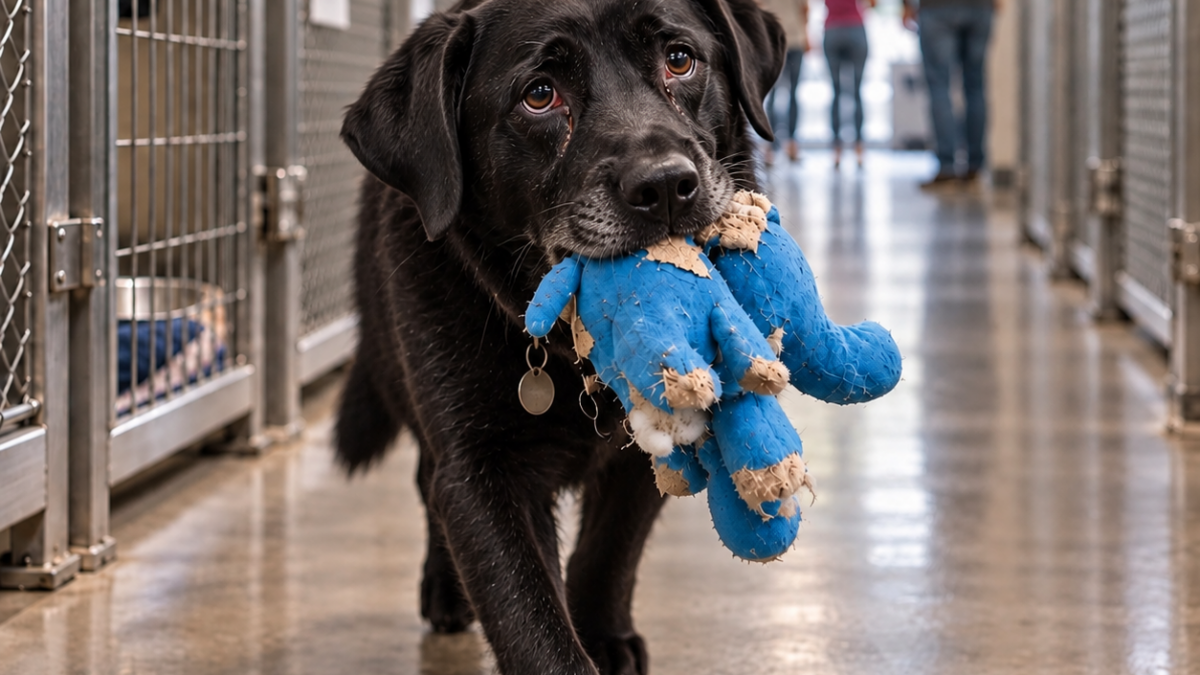
The Black Shelter Dog Who Brought Her Toys to Strangers—Until One Woman Realized She Was Offering the Last Pieces of Her Old Home.
Every morning, Roxy carried her favorite toy to the front of the kennel and offered it to strangers who still walked away.
The shelter called it adorable until the day we found the name sewn into every toy and realized she had been trying to give away the last pieces of the home someone had taken from her.
By the time the man who abandoned her came back demanding her return, one quiet black dog had already taught a whole town the difference between being owned and being loved.
The first time Roxy brought me a toy, I almost missed what it meant.
That is the thing I still think about whenever people ask me why her story stayed with me more than all the others.
It was not because she was the saddest dog I had ever met.
She wasn’t.
I had seen dogs come through Cedar Hollow Animal Shelter with broken legs, burned paws, missing eyes, untreated infections, embedded collars, and fear so deep they flattened themselves against the back of a kennel and shook whenever a person walked past.
It was not because she was the oldest.
Seven years old is not ancient, no matter how people behave in adoption rooms, but in shelter terms, seven means visitors call you “older” in the same voice they use for “problem.” They look at puppies first. Then dogs under two. Then the fluffy ones. Then the unusual ones. Then maybe, if their children are tired and the room is quiet, they glance at a seven-year-old black dog and say, “Oh, she’s sweet,” before moving on.
It was not even because she was black, though that mattered.
Black dogs have to work harder to be seen. People deny this, but anyone who has spent time in a shelter knows it. They blend into kennel shadows. Their faces are harder to photograph under fluorescent lights. Old superstitions and quiet prejudices still cling to them, even when people pretend they are joking.
No, the reason Roxy stayed with me was because she kept giving pieces of herself away to people who did not stay.
And for nearly two months, none of us understood that she was not playing.
My name is Claire Bennett, and I had been the adoption coordinator at Cedar Hollow Animal Shelter for six years when Roxy arrived.
Cedar Hollow was not a big shelter. We were tucked behind the county library and across from a tire shop, in a low brick building with chipped blue trim and a sign that had been repainted so many times the letters looked swollen. We had twenty-four dog kennels, a small medical room, two meet-and-greet spaces, one office that always smelled like coffee and printer ink, and a laundry room where volunteers occasionally cried into clean towels because rescue work has a way of finding the softest part of a person and squeezing.
People imagine shelters as places of constant tragedy.
They are wrong.
PART2:
Shelters are also places of ridiculous joy.
A three-legged dog stealing a sandwich from a deputy sheriff.
A puppy falling asleep inside a donated boot.
A senior beagle discovering squeaky toys at age twelve and screaming with disbelief.
A staff member walking into the break room with bottle-feeding formula in her hair and saying, “Nobody talk to me unless something is actively on fire.”
But underneath all of it, always, is waiting.
Animals waiting for food.
Waiting for medicine.
Waiting for someone to notice.
Waiting for the door to open and the right person to walk in.
Roxy came in on a Tuesday in September.
Tuesdays were usually quieter than weekends, which meant the front desk phone rang constantly because the universe likes balance. I was updating adoption records when Marlene from intake came into the office holding a file.
“We’ve got a surrender coming in,” she said.
I looked up.
“Owner surrender?”
“Sort of.”
I already hated the sound of that.
“Sort of how?”
PART3:
“Man says she belonged to his grandmother. Grandmother passed away. He can’t keep the dog.”
“That’s not sort of. That’s an owner surrender.”
“He doesn’t want to fill out the owner surrender form.”
There it was.
I leaned back in my chair.
“Why?”
“He says she isn’t technically his.”
“Is she in his possession?”
“Yes.”
“Did he bring her here?”
“Yes.”
“Then he fills out the form.”
Marlene’s mouth tightened.
“He’s already annoyed.”
“Marlene, people bring us animals in cardboard boxes and get annoyed when we ask for a phone number.”
“That is true.”
“What’s the dog’s name?”
“Roxy.”
Something about the name felt bright before I ever saw her.
Then I walked into intake.
The man standing at the counter had expensive sunglasses pushed up on his head and one hand wrapped around a leather leash like it offended him. He was maybe forty, clean-shaven, wearing a gray dress shirt with the sleeves rolled up. Beside him stood a medium-sized black dog with a white patch on her chest and a stuffed yellow duck hanging from her mouth.
She was not pulling.
She was not shaking.
She was just standing very still.
Her eyes were fixed on the man’s face, as if she was waiting for him to explain why the world had changed.
“This is taking too long,” he said when I walked in.
“I’m Claire,” I said. “I coordinate adoptions here. You’re surrendering Roxy?”
“I’m dropping her off.”
“That’s the same thing.”
His jaw moved.
“She was my grandmother’s dog. My grandmother died. I don’t have time for this.”
I looked down at Roxy.
Her tail gave one hopeful thump when I said her name.
“Hi, sweetheart.”
She stepped toward me, still holding the duck. Then she stopped and looked back at the man.
He tugged the leash.
“See? She’s friendly. Should be easy.”
Marlene slid the paperwork across the counter.
“We need her medical history, behavior history, feeding information, and anything she came with.”
“She came with that stupid pile of toys in the back seat,” he said. “You can throw them out.”
Roxy’s ears dropped.
I heard it before I understood it.
Not a bark.
Not a whine.
A small breathy sound around the toy in her mouth.
Marlene’s face changed.
“We don’t throw out an animal’s belongings if they’re safe.”
He shrugged.
“Suit yourself.”
“Your name?” I asked.
“Evan Parker.”
“And your grandmother’s name?”
His eyes sharpened.
“Why?”
“Because she was Roxy’s owner.”
He sighed dramatically.
“Margaret Parker.”
The moment he said the name, Roxy’s tail moved again.
This time harder.
She took two steps toward him.
He stepped back.
“Don’t start,” he muttered.
I will never forget those two words.
Not because they were shouted.
Because they were tired and cold, like this dog’s love was an inconvenience he had already decided he did not want.
We took Roxy to kennel seven.
It was clean. It had a raised bed, a water bowl, a blanket, and a front gate that opened toward the adoption hall.
Evan carried in a plastic trash bag full of toys and dropped it like garbage.
Roxy watched the bag hit the floor.
Then she looked up at me.
“Her food?” I asked.
“Don’t know.”
“Vet records?”
“No idea.”
“Any bite history?”
“No.”
“Does she like children?”
“How would I know?”
“Did she sleep in a crate? On furniture? Alone? With your grandmother?”
He looked at his watch.
“She slept wherever old women let dogs sleep.”
I set my pen down slowly.
Marlene, who knew my face, stepped forward before I said something that would get me written up.
“We’ll call you if we need anything else,” she said.
“Don’t,” Evan replied. “I’m done.”
Roxy stood at the kennel gate and watched him walk away.
She did not bark.
She did not panic.
She held the yellow duck in her mouth until the front door closed behind him.
Then she placed the duck carefully on the floor between her paws and lay down with her chin resting beside it.
For the first few days, Roxy seemed fine.
That was the word everyone used.
Fine.
She ate.
She went outside when asked.
She walked politely on leash.
She let volunteers brush her.
She accepted treats gently, with soft lips and careful teeth.
She was, as one teenager wrote on her volunteer sheet, “basically perfect.”
But perfect dogs are often the ones people miss most easily.
They do not demand attention.
They do not create emergencies.
They suffer politely.
On Roxy’s fourth morning, I saw her do it for the first time.
A young couple came into the adoption wing. They had already looked at three puppies and one energetic hound mix. When they reached Roxy’s kennel, she stood slowly, turned toward her bed, and picked up the yellow duck.
Then she walked to the front of the kennel and pushed the toy through the gap beneath the gate.
The woman laughed softly.
“Oh my God, she’s giving us her toy.”
Roxy’s tail wagged once.
The man crouched and picked it up.
“She’s cute.”
Roxy leaned forward, eyes bright, body still.
Waiting.
The couple smiled at her, read her kennel card, and moved on.
“Seven,” the woman whispered. “Maybe too old.”
The yellow duck remained on the floor outside the kennel.
Roxy stared at it.
Then she looked down the hall where they had gone.
I picked up the toy and gave it back.
Her tail moved once, but her eyes did not.
By the end of the week, everyone noticed.
Roxy offered the duck to a family with two boys.
A faded rope toy to a retired man.
A plush carrot to a college student.
A squeaky lamb to a woman who cried when Roxy rested her muzzle against the bars.
Every time, people smiled.
Every time, they said some version of, “How sweet.”
And every time, they left.
Soon visitors came just to see “the toy dog.” Someone posted a video of her online. The caption said, Shelter dog brings gifts to everyone she meets. The clip got shared around town.
For the first time, Roxy had attention.
But attention is not the same as a home.
People came, filmed her, laughed gently, took pictures, and walked away.
After the third week, Roxy stopped wagging when she offered the toys.
She still brought them.
But she no longer looked excited.
She looked serious.
Almost desperate.
One rainy afternoon, I watched her push the yellow duck toward a woman in a red coat. When the woman moved on, Roxy turned, walked back to her bed, chose a different toy, and brought that one too.
The woman did not see.
Roxy stood there with the plush carrot in her mouth until her jaw trembled.
That night, after closing, I went into her kennel and sat beside the pile of toys.
“What are you trying to tell us?” I whispered.
Roxy climbed onto the bed, pressed her body against my side, and placed the yellow duck in my lap.
Up close, I noticed something I had never really looked at before.
The duck had a patch sewn into its wing.
Not a factory tag.
A little square of blue fabric stitched by hand.
On it, in crooked thread, was one word.
Roxy.
I picked up the carrot.
Same thing.
Roxy.
The lamb.
Roxy.
The rope had a strip of fabric tied around it, hand-embroidered with the same name.
One by one, I checked every toy in the pile.
Each one had her name sewn into it.
But on the last toy, a small stuffed black bear with one missing ear, there was more.
Roxy, my shadow girl. Love, Nana Margaret.
My throat tightened.
I sat there for a long time with that bear in my hands while Roxy rested her head against my knee.
Suddenly, the toy offering was not cute anymore.
It was not a trick.
It was not a charming shelter behavior.
Roxy was giving strangers the last pieces of her old home.
Not because she did not want them.
Because maybe, in her dog heart, she thought if she handed over enough of what she loved, someone would understand she came from love.
Maybe she thought Margaret would come back through any person kind enough to hold one of those toys.
The next morning, I pulled Roxy’s file.
Margaret Parker’s name appeared only once, on the surrender form.
No obituary.
No notes.
No veterinary records.
No mention of the toys.
I searched online and found Margaret’s obituary in less than five minutes.
She had been seventy-nine. A retired elementary school librarian. Survived by one grandson, Evan Parker. Preceded in death by her husband, Thomas. Remembered for her Sunday pies, her garden, and “her beloved black dog, Roxy, who never left her side.”
There was a photo attached.
Margaret sat in a floral armchair with Roxy’s head in her lap.
The same yellow duck rested beside them.
I printed the obituary and taped it to Roxy’s file.
Then I made a new sign for her kennel.
Roxy is seven years old. She is gentle, loyal, and deeply attached to her toys because they belonged to the home she lost. Please do not take them from her. Please sit with her. Let her choose you slowly.
Something changed after that.
Volunteers stopped calling her toy routine adorable and started calling it brave.
Visitors no longer laughed and moved on quite as quickly.
They sat.
They listened.
They handed the toys back.
And Roxy, little by little, began to understand that not every hand took things away.
Then Evan Parker came back.
It was almost six weeks after surrender.
He walked into the shelter with the same sunglasses, the same irritated posture, and a folded newspaper in his hand. Roxy’s story had made the county weekly under the headline: Black Shelter Dog Offers Toys From Her Late Owner to Strangers.
He slapped the paper on the front desk.
“That’s my dog.”
Marlene looked at him over her glasses.
“You surrendered Roxy.”
“I changed my mind.”
I stepped out of the office.
Roxy was in a meet-and-greet room with a woman named Hannah Miller, a quiet nurse who had visited four times that week. Hannah never rushed Roxy. She sat on the floor, let Roxy bring toys, and always gave them back.
Evan pointed toward the adoption hall.
“I’ll take her now.”
“No,” I said.
His eyes narrowed.
“No?”
“You surrendered her legally. She is no longer yours.”
“She was my grandmother’s property.”
“She is not property here.”
He laughed.
“She’s a dog.”
“Yes,” I said. “That is why this matters.”
His face reddened.
“You used my family name in that sob story.”
“We used publicly available information about Margaret’s life and Roxy’s needs.”
“You made me look bad.”
Marlene stood.
“Mr. Parker, you did that yourself.”
He stepped closer to the counter.
“My grandmother’s estate is still being settled. That dog is part of it.”
“Funny,” I said quietly. “You told us she wasn’t technically yours.”
For one second, he had no answer.
Then greed did what cruelty often does.
It exposed itself.
“You people think I don’t know how this works?” he snapped. “That article got attention. Someone probably offered money. Maybe donations. Maybe a rescue wants her. I’m not letting you profit off my grandmother’s dog.”
From the hallway, a small voice said, “She brought him the bear.”
Everyone turned.
A little girl, maybe nine, stood beside her mother, looking toward the meet-and-greet window.
Inside, Roxy had walked to the door.
The black bear with one missing ear hung from her mouth.
Hannah sat behind her, one hand pressed to her chest.
Roxy pushed the bear under the door crack.
Toward Evan.
For a moment, the whole shelter went silent.
Evan looked down at the toy.
He did not kneel.
He did not soften.
He did not say her name.
He just stared at the bear like it was an accusation.
Then he muttered, “I don’t want that dirty thing.”
Roxy flinched.
It was small.
Most people would have missed it.
I did not.
Hannah stood, opened the meet-and-greet door, and stepped into the lobby with tears in her eyes.
“I want to adopt her,” she said.
Evan laughed bitterly.
“Of course you do.”
Hannah ignored him and looked at Marlene.
“I filled out the application this morning. My landlord approved it. My references are ready. I have a fenced yard. I work nights three days a week, but my sister lives next door. Roxy can keep all her toys. Every single one.”
Roxy stood behind her, pressed against her leg.
For the first time since arriving, she was not looking at the man who had abandoned her.
She was looking at the woman who had stayed.
Marlene’s voice was steady.
“Your application is approved.”
Evan exploded.
He threatened lawyers.
He threatened the county.
He threatened to call the police.
Marlene handed him a copy of the surrender agreement with his own signature circled at the bottom.
“You gave her up,” she said. “Roxy is going home.”
By the time the deputy arrived, Evan was shouting in the parking lot about property and reputation and people needing to mind their own business.
The deputy listened for exactly two minutes, then told him to leave.
The adoption took place that afternoon.
We packed every toy into a clean canvas bag. The yellow duck. The carrot. The lamb. The rope. The black bear.
Hannah knelt in front of Roxy and clipped on a new purple leash.
“Ready to go home, girl?”
Roxy looked back at the kennel hallway.
Then she looked at me.
I expected her to bring me a toy.
Instead, she leaned forward and pressed her forehead against my chest.
I wrapped my arms around her and felt her exhale like she had been holding her breath for weeks.
When she climbed into Hannah’s car, the bag of toys sat beside her. She put one paw on it and rested her chin on the black bear.
Hannah sent us a photo that night.
Roxy was asleep on a blue couch beneath a window, surrounded by every toy Margaret had made for her. The yellow duck was tucked beneath her chin. The black bear was against her chest.
The message said, She brought me the duck again. This time, I gave it back and told her everything here is hers.
I printed that photo and taped it above my desk.
Not because every shelter story ends that way.
They don’t.
Not because love erases abandonment.
It doesn’t.
I taped it there because Roxy taught me something I had forgotten after too many files, too many forms, and too many people who treated animals like belongings to be dropped off when grief became inconvenient.
Being owned is not the same as being loved.
Ownership signs papers.
Love sews a name into a toy by hand.
Ownership drops a dog at a shelter and calls her “that thing.”
Love sits on the floor four times in one week and waits until a broken heart is ready.
Roxy had been offering strangers the last pieces of the life she lost, hoping someone would understand what they meant.
Most people saw toys.
Hannah saw a home.
And in the end, that quiet black dog did not have to give away another piece of herself to be chosen.
She only had to meet someone who knew she was never a thing to be returned.
She was someone’s shadow girl.
And finally, she was loved like one again.








