The Biggest Marine in the Bar Mocked a Quiet Old Man and Asked His Call Sign—When He Said “Iceman,” the Entire Room Went Silent
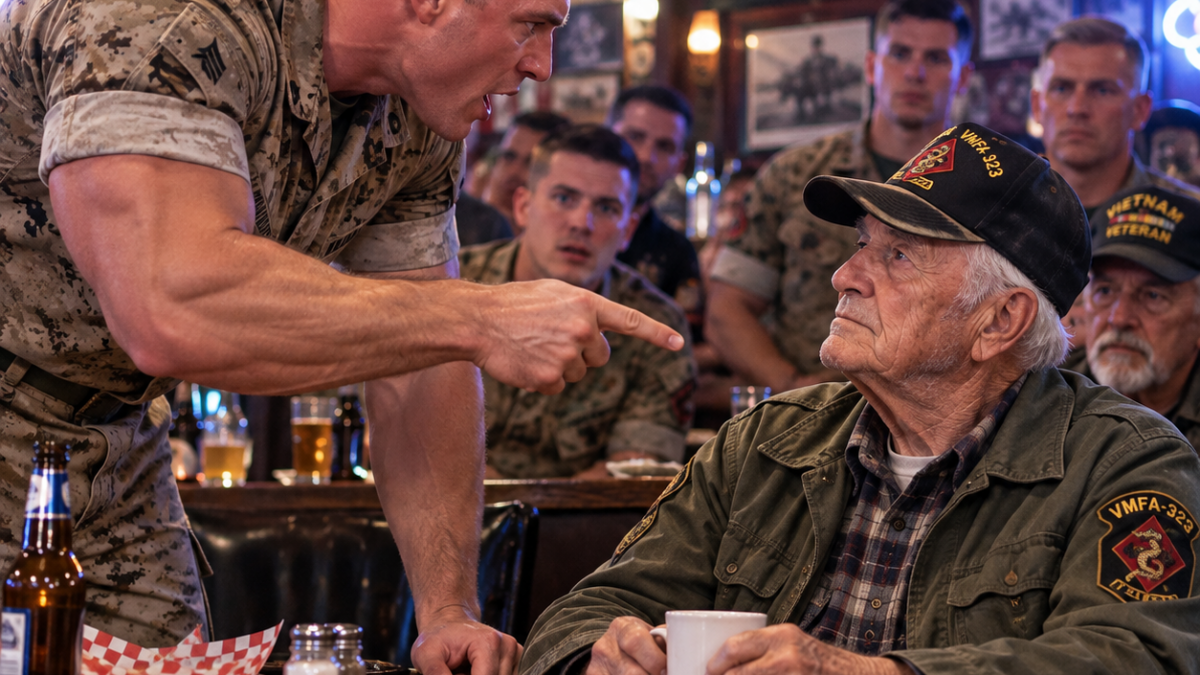
The Biggest Marine in the Bar Mocked a Quiet Old Man and Asked His Call Sign—When He Said “Iceman,” the Entire Room Went Silent.
Captain Daniel Mercer asked the frail old man what his call sign had been because he expected another harmless story from another veteran wearing a faded squadron cap.
The old man lifted his coffee, looked straight into the young Marine pilot’s eyes, and answered with one quiet word—“Iceman”—and every aviator in the bar who understood that name stopped smiling at the same time.
Then a retired major general walked through the door, recognized the old man instantly, and revealed the part Daniel Mercer was not prepared to hear: the stranger he had spent ten minutes mocking was the pilot who had once flown through a wall of fire to bring Daniel’s own grandfather home alive.
Captain Daniel Mercer had been the loudest man in O’Malley’s for almost an hour.
That did not mean he was drunk.
Not really.
Three beers in a man his size barely changed the way he walked.
Daniel was six foot four, broad through the shoulders, twenty-eight years old, and built with the kind of deliberate strength that came from years of flight-line workouts, running in desert heat, and believing the body was one more system that should never be allowed to fail.
He wore civilian clothes that night.
Jeans.
Boots.
Gray T-shirt.
But there was no mistaking what he was.
The haircut.
The posture.
The group around him.
The language.
The energy of young military aviators who had spent weeks being graded, challenged, corrected, and reminded that the difference between very good and not good enough could be measured in seconds.
O’Malley’s sat a short drive from the Marine Corps Air Station at Yuma, Arizona.
It was not a tourist bar.
The walls told you that.
Squadron plaques.
Photographs.
Faded patches.
Framed newspaper clippings.
A propeller blade signed by twenty pilots from a unit that no longer existed.
A piece of metal from an aircraft whose story everyone in the aviation community seemed to know differently.
The American flag behind the bar had hung there so long the fabric had gone soft at the edges.
Every spring the place filled with pilots and aircrew passing through Weapons and Tactics Instructor training.
The best young aviators in the Marine Corps came to Yuma.
People who were already accomplished arrived expecting to discover how much they still did not know.
Most handled that well.
Some did not.
Daniel Mercer had always been the kind of man who learned fast.
That had saved him professionally and hurt him personally.
He had been good at nearly everything that mattered to him.
School.
Sports.
Flight training.
Weapons employment.
Decision-making under pressure.
He had failed at enough things to respect work, but not enough important things to become humble.
Not yet.
That night his group had finished one of the hardest blocks of training they had faced all week.
Everyone was tired.
Everyone was wired.
They had come to O’Malley’s to bleed off pressure.
Daniel had become entertainment.
He told stories well.
He imitated instructors.
PART2:
He exaggerated his own mistakes.
People laughed.
Then one of his friends, Lieutenant Harris, nodded toward the back corner.
“Careful, Mercer.”
Daniel looked.
Two old men sat in a booth.
Both gray-haired.
Both wearing faded Marine aviation caps.
One was thin enough that his denim jacket seemed to hang from him.
The other was heavier, stooped, with hands that trembled slightly whenever he lifted his cup.
Harris smiled.
“You’re disturbing the elders.”
Daniel grinned.
“Those guys?”
“Yeah.”
“Show some respect.”
That was where the night bent.
Not because Daniel hated old veterans.
He didn’t.
His own grandfather had been one.
Daniel had grown up around framed Marine Corps photographs, though most of the details behind them were missing.
But Daniel had spent the day in an environment where confidence was armor.
His friends were laughing.
He made a choice designed to keep them laughing.
“Watch this.”
He stood.
The thin old man in the booth was named Jack Foster.
Nobody in the bar knew that.
At least not the young Marines.
The bartender knew him as Mr. Foster because that was printed on the card he sometimes used when he forgot cash.
Mostly the bartender called him “Coffee.”
Every Thursday and most Friday nights, Jack came in with his friend Sal Ramirez.
They took the same corner booth.
Jack ordered black coffee.
Sal ordered coffee and occasionally one whiskey he rarely finished.
They stayed perhaps two hours.
Sometimes longer.
They did not talk to strangers.
They did not need to.
Jack had been coming there so many years he blended into the walls.
Nobody ever asked why the cap on his head was nearly white with age.
It had once been dark blue.
On the front, a patch had faded too.
A rattlesnake.
The emblem of VMFA-323.
The Death Rattlers.
Young Daniel Mercer noticed the patch.
He did not recognize Jack.
That distinction changed his life.
Daniel stopped beside the booth.
“Evening, gentlemen.”
Sal looked up.
Jack continued holding coffee.
Daniel pointed at the cap.
“Marine aviation?”
Jack’s pale blue eyes moved to him.
“Yes.”
His voice was quiet.
Older than Daniel expected.
Daniel smiled.
“When?”
“A while ago.”
The group behind Daniel chuckled.
Not loudly.
Enough.
Daniel leaned one hand against the edge of the booth.
“You actually fly?”
Jack looked at him for a second.
“Yes.”
“What?”
“Phantom.”
Daniel’s smile changed.
F-4.
That should have been enough to make him slow down.
It wasn’t.
“What squadron?”
Jack touched the brim of his cap.
Daniel laughed.
“Right.”
Sal’s jaw tightened.
“Captain.”
He said.
Daniel looked.
Sal had noticed the rank-shaped tan line? No—Daniel was in civilian clothes. But Sal could tell by context, or friends called Mercer captain. Fine.
“Maybe let the man drink his coffee.”
Daniel held up both hands.
“I’m just talking.”
Jack said nothing.
That silence irritated Daniel.
Not because Jack had done anything wrong.
Because the younger man could not tell whether he was being taken seriously.
Daniel was used to reactions.
Agreement.
Challenge.
Laughter.
Respect.
Jack gave him nothing.
So Daniel pushed.
“You ever actually see combat?”
Sal’s eyes hardened.
Daniel’s friends had stopped laughing quite as much.
Jack replied:
“Yes.”
“Vietnam?”
“Yes.”
“Phantoms from Chu Lai?”
That got Daniel’s technical interest.
Jack nodded.
“What year?”
“Sixty-seven.”
“Sixty-eight.”
Daniel whistled.
“That’s a long time ago.”
Jack took another sip.
Daniel studied the old man.
Thin wrist.
Age spots.
A faint scar near jaw.
The faded cap.
He imagined all the old veterans he had encountered who added a little here, blurred something there, transformed one deployment into mythology over fifty years.
That judgment came too easily.
His grandfather Dale had never been like that.
Dale Mercer barely talked about Vietnam.
Daniel knew only fragments.
F-4 pilot.
Shot down.
Rescued.
Came home.
Stayed in aviation a while.
Then airline work.
Later, a quiet man who taught Daniel to fish and never missed a high school football game.
Dale had died two years earlier.
At the funeral, an old Marine had told Daniel:
“Your grandfather owed his life to another pilot.”
Daniel asked who.
The man said he didn’t know.
Dale himself had once told Daniel only:
“There was a man up there who should have gone home and didn’t.”
Daniel had been seventeen.
He had not asked enough questions.
Now he was twenty-eight and did not yet understand how much he regretted that.
He looked at Jack’s cap again.
“You know what gets me?”
Jack waited.
“You guys all had call signs too, right?”
Sal shifted.
“Mercer.”
Daniel heard warning this time.
Ignored.
“What was yours?”
Jack placed coffee on saucer.
The bar seemed louder around them.
Glasses.
Music.
Conversation.
Jack looked up.
Daniel smiled as if they were sharing joke.
“Come on.”
“Everybody had one.”
“What’d they call you?”
The old man’s gaze never changed.
“Iceman.”
That was all.
No dramatic pause after.
No smile.
No explanation.
Just:
“Iceman.”
Daniel’s grin stayed on his face for perhaps half a second.
Then disappeared.
Behind him, Lieutenant Harris stopped moving.
At another table, a Hornet pilot looked over.
Someone near bar said:
“What did he say?”
Daniel stared.
“Iceman?”
Jack picked up coffee again.
Daniel felt something cold slide down spine.
He had heard that name.
Not from movies.
Not pop culture.
Not as random call sign.
In Marine aviation lectures.
Stories passed down.
A calm voice on a bad radio.
A Phantom pilot whose composure under pressure had become an instructor shorthand decades later.
Different instructors told it differently.
The details had changed with repetition.
Some called it legend.
Some said nobody knew whether man still alive.
The point was always same.
When everything went wrong, slow your mind down.
Do not let chaos choose.
One instructor had told Daniel’s class:
“If your brain starts outrunning the jet, get Iceman about it.”
Daniel had assumed phrase was apocryphal.
A metaphor.
Maybe a composite.
Now a seventy-something man in a faded VMFA-323 cap had said it as casually as if someone asked middle name.
Daniel’s mouth went dry.
“That’s not funny.”
Jack did not respond.
“That was a real call sign.”
“Yes.”
“You’re saying you’re—”
Daniel stopped.
Jack watched him.
Sal’s expression was unreadable.
Daniel heard his friends behind him but nobody spoke.
He wanted Jack to laugh.
Wanted him to say:
Different Iceman.
Just coincidence.
Anything.
The old man gave him nothing.
Daniel asked:
“What’s your name?”
Sal stood.
Slowly.
One hand pressing table.
“Enough.”
Daniel looked at him.
Sal removed phone.
“Sit down, Jack.”
Jack said.
“I’m making a call.”
“You don’t have to.”
“I know.”
Sal walked toward door.
Daniel felt suddenly twenty-eight in the worst possible way.
Young.
Loud.
Certain.
And possibly very wrong.
He pulled chair from neighboring table.
Did not sit.
Not yet.
“Sir.”
That word came differently now.
“If you really are who you’re saying—”
Jack interrupted.
“I didn’t say anything except my call sign.”
The sentence hurt more than anger would have.
Daniel nodded.
“Right.”
He stepped back.
His friends had gone quiet.
One of them, Captain Lewis, whispered:
“Mercer, come back.”
Daniel did.
He sat.
Nobody teased him.
Nine minutes passed.
Daniel knew because he stared at digital clock over bar.
Nine minutes is long when you think you have publicly humiliated yourself in front of people whose opinion matters.
At minute three, Daniel considered leaving.
At minute four, pride stopped him.
At minute five, shame stopped him.
At minute six, he looked back.
Jack and Sal? Sal was outside. Jack sat alone.
Coffee in both hands.
No victory.
No smirk.
No interest in Daniel’s discomfort.
That somehow made everything worse.
At minute nine, front door opened.
A man entered wearing khaki trousers, a blue windbreaker, and the posture of somebody whose body had been answering to military habit longer than Daniel had been alive.
Late seventies.
White hair.
Straight back.
No uniform.
But a small retired-service pin on his jacket and the way half the older patrons reacted told enough.
One civilian by the door stood instinctively before catching himself.
Captain Harris whispered:
“Holy hell.”
Daniel knew face.
Retired Major General Frank Halloran.
Former Marine aviator.
A name still recognized around aviation circles.
Halloran had been at a base function that evening.
Sal walked in behind him.
The general scanned room.
Saw Jack.
Stopped.
Something changed in his face.
Not authority.
Memory.
He walked past Daniel without noticing him.
Straight to booth.
Jack looked up.
Halloran stopped three feet away.
For perhaps two seconds, neither man moved.
Then the general straightened.
Not a formal salute in civilian clothes.
Not performance.
Something simpler.
He stood with shoulders squared and said:
“Sir.”
His voice cracked.
The whole bar heard.
Jack’s eyes softened.
“Frankie.”
Halloran laughed once.
Wet.
Disbelieving.
“Jesus.”
“You got old.”
Jack said.
Halloran slid into booth like knees had weakened.
“So did you.”
“Not as badly.”
“You’re a liar.”
That made Jack almost smile.
Sal returned to seat.
Halloran reached across table.
Jack met hand.
They held longer than handshake.
Daniel stared.
His stomach sank further.
This was not a fraud.
This was not an old man borrowing legend.
Whatever Jack Foster had been, Frank Halloran knew.
And Halloran looked at him the way people look at someone they thought history had swallowed.
The general finally noticed room.
Then Daniel.
Sal said quietly:
“Frank.”
Halloran followed his eyes.
Daniel stood automatically.
“Sir.”
Halloran studied him.
No anger.
That was worse.
“Captain?”
“Daniel Mercer, sir.”
“What do you fly?”
“F-35B.”
“WTI?”
“Yes, sir.”
Halloran nodded.
“Good program.”
“Yes, sir.”
Then he looked at Jack.
Back to Daniel.
“Did you ask this gentleman something?”
Daniel swallowed.
“Yes, sir.”
“What?”
Daniel could have softened it.
Didn’t.
“I asked if he had really served.”
No one moved.
“And?”
“I asked his call sign.”
Halloran’s face barely changed.
“What did he tell you?”
“Iceman.”
Halloran looked down.
His eyes closed.
Then he exhaled through nose.
“Of course he did.”
Jack muttered:
“Frankie.”
“What?”
“Don’t.”
Halloran looked at him.
“These boys ought to know.”
“No.”
“They don’t need—”
“Jack.”
The old men stared at each other.
Finally Jack looked toward Daniel.
He seemed tired.
Not physically only.
Tired of weight attached to old name.
He said:
“If you’re going to tell something, tell only what you know.”
Halloran nodded.
That sentence shaped everything that followed.
Because legends are dangerous.
They grow.
They improve themselves with retelling.
Distances get longer.
Gunfire thicker.
Hero calmer.
Enemies more numerous.
Real men vanish beneath stories.
Halloran knew that.
So he did not begin with medals.
He began with March 1968.
“Captain Mercer.”
“Yes, sir.”
“Your generation trains with better systems than we ever imagined.”
“Better radios.”
“Better sensors.”
“Better navigation.”
“Better rescue coordination.”
“You study old cases because mistakes repeat.”
Daniel nodded.
Halloran pointed slightly toward Jack.
“One of the cases you’ve probably heard distorted started with a Phantom going down in the A Shau Valley.”
Daniel’s heartbeat changed.
A Shau.
His grandfather.
He did not yet connect.
Halloran continued.
“A flight was working over valley.”
“Bad day.”
“Ground fire heavy.”
“One aircraft took damage.”
“Lost systems.”
“Eventually went down.”
“The downed pilot survived impact.”
“Situation got ugly.”
“Fuel states on remaining aircraft were deteriorating.”
“Threat environment was getting worse.”
“Standard logic said mark position, pass coordinates, get out before you lose more airplanes.”
He paused.
“Jack stayed.”
Daniel looked at old man.
Jack stared into coffee.
Halloran said:
“He did not stay because he was fearless.”
“That story is nonsense.”
“He was scared.”
“Everybody was.”
“He stayed because the pilot on ground had very little time.”
Jack muttered:
“We all stayed as long as we could.”
Halloran nodded.
“True.”
“But you stayed longest.”
No contradiction.
“He worked low.”
“Marked.”
“Talked rescue assets.”
“Kept radio clear.”
“Made threat calls.”
“Helped coordinate approaches.”
“When rescue crew came in, Jack’s voice sounded like he was reading weather.”
Halloran smiled faintly.
“That was why Iceman fit.”
“Nothing hurried him outwardly.”
“Inside?”
He pointed at Jack.
“You’d have to ask him.”
Daniel could not.
Halloran continued.
“The downed pilot came out.”
“Alive.”
Daniel’s hands had begun to tremble.
He did not know why yet.
Not consciously.
Then Halloran added:
“Jack’s aircraft took damage later during egress.”
“He did not make it back with flight.”
“Eventually ejected.”
“Was captured.”
Silence.
Somebody turned music off behind bar.
No one admitted doing it.
Daniel looked at Jack.
The old man’s right hand rested on coffee.
Two fingers had old deformities Daniel had not noticed.
Halloran said:
“He spent years as prisoner.”
“He came home in 1973.”
“I’m not going to repeat stories that aren’t mine.”
“Jack has never liked other people narrating his captivity.”
Jack looked at him gratefully.
Halloran continued:
“What I will tell you is that men who were there trusted him.”
“They trusted his steadiness.”
“That’s enough.”
Daniel had heard much more dramatic version.
Five years of torture.
Never broke.
Never gave anything.
He suddenly understood how easily instructors turn suffering into mythology because lesson becomes cleaner.
The real man was sitting fifteen feet away.
He did not look legendary.
He looked tired.
Daniel asked carefully:
“Sir.”
Halloran turned.
“The pilot who went down.”
“What was his name?”
The general hesitated.
Something shifted.
“Why?”
Daniel’s voice dropped.
“My grandfather was shot down in the A Shau in sixty-eight.”
Jack’s head came up.
For first time all night, quickly.
Halloran stared at Daniel.
“What was your grandfather’s name?”
“Dale Mercer.”
Silence became physical.
Jack’s hand left cup.
Sal whispered:
“Oh.”
Halloran looked from Daniel to Jack.
“Dale?”
Daniel’s chest tightened.
“You knew him?”
Halloran almost laughed.
Not from humor.
From impossible symmetry.
“Dale Mercer.”
“F-4 pilot.”
“Tall.”
“Georgia boy?”
Daniel nodded slowly.
“He was from Macon.”
Jack stood.
Very slowly.
His age became obvious in movement.
He looked straight at Daniel.
“What was your grandmother’s name?”
Daniel’s mouth opened.
“Evelyn.”
Jack closed eyes.
When he opened them, there was water there.
“Dale made it home.”
Not a question.
Daniel nodded.
“Yes, sir.”
“He lived until two years ago.”
Jack sat again.
His face changed.
Something inside him had been holding one old uncertainty for half a century.
“He had children?”
“One son.”
“My dad.”
“And grandchildren?”
Daniel gave broken laugh.
“Me.”
Jack looked at him.
Really looked.
The broad shoulders.
Jaw.
Eyes.
He leaned forward slightly.
“You do look like him.”
That was when Daniel understood.
Not all at once.
The sentence his grandfather had said when Daniel was seventeen returned:
There was a man up there who should have gone home and didn’t.
Daniel looked at Halloran.
“No.”
The general said nothing.
Daniel shook his head.
“No.”
He looked at Jack.
“That was you?”
Jack did not answer immediately.
Then:
“Your grandfather had bad day.”
Daniel stared.
“You were the one who stayed.”
Jack’s mouth tightened.
“There were a lot of people involved.”
“But you—”
“Rescue crew got him.”
“Ground teams.”
“Other aircraft.”
“Not one man.”
Halloran interrupted gently.
“He stayed, Daniel.”
Jack shot him look.
Halloran did not retreat.
“He stayed.”
Daniel’s legs suddenly felt unreliable.
He sat.
Every stupid word of last fifteen minutes replayed.
You ever actually serve?
You know what that patch means?
What was your call sign?
The man he had treated as prop for bar joke had once looked down into a valley where Daniel’s grandfather lay waiting and chosen not to leave.
Daniel’s father existed because Dale Mercer came home.
Daniel existed because Dale Mercer came home.
The arithmetic was brutally simple.
Daniel stared at his hands.
“My grandfather…”
His voice broke.
“He used to say somebody stayed over him.”
Jack nodded.
“He remembered?”
“He never gave a name.”
“Why?”
“He said he never got to thank him.”
Jack looked away.
For first time all night, the old man seemed unable to hold eye contact.
Daniel said:
“He spent his whole life wondering.”
Jack whispered:
“So did I.”
“What?”
“Whether he made it.”
Halloran frowned.
“You never knew?”
Jack shook head.
“After repatriation, records.”
“Life.”
“I asked some.”
“Never found.”
“He had moved.”
Daniel felt grief for both men.
One had lived fifty-four more years believing rescuer disappeared.
The other had lived fifty years not knowing rescue meant a life.
That was bigger than shame.
Daniel stood.
His chair scraped.
Every Marine in room watched.
He faced Jack.
Came to attention.
Not because ceremony required.
Because he did not know what else to do with his body.
His right hand began to rise.
Jack frowned.
“Don’t.”
Daniel stopped halfway.
His eyes were wet.
“I’m sorry.”
Jack said nothing.
“I’m sorry for how I spoke to you.”
“I was showing off.”
“I saw an old man.”
“I decided I knew what that meant.”
“I was wrong.”
Jack’s expression remained unreadable.
Daniel swallowed.
Then said the thing that broke him.
“Thank you for my grandfather.”
His voice cracked.
“Thank you for my dad.”
He pressed lips together.
Could not stop.
“And thank you for me.”
The room blurred.
Daniel did not care.
Jack stared.
Then pushed himself up.
He was perhaps five foot nine now.
Maybe had once been taller.
Standing close, Daniel towered.
The old man reached.
Not for salute.
He placed hand on Daniel’s forearm.
“Sit down, son.”
Daniel wiped face.
“Yes, sir.”
Jack studied him.
“You really do have Dale’s face.”
Daniel sat.
Jack remained standing another second.
Then sat too.
Halloran moved over.
Sal slid coffee aside.
Daniel’s friends stayed back.
Nobody needed invitation.
Daniel asked:
“What was he like?”
Jack looked almost surprised.
“Your grandfather?”
“Yes.”
Jack smiled.
First real smile of night.
“Annoying.”
Daniel laughed through tears.
“He never told us that.”
“He cheated at cards.”
“No.”
“Yes.”
“He said everybody else cheated.”
“That was how he cheated.”
Halloran laughed.
“There’s truth.”
Daniel leaned closer.
For next three hours, the old legend disappeared.
That was the important part.
Iceman became Jack.
Dale Mercer became Dale.
Not names in history.
Men.
Jack told Daniel about Dale singing badly over intercom when bored.
About a habit of tapping helmet twice before takeoff.
About the first time he tried hot sauce in Vietnam and spent an entire day insisting he was not suffering.
About letters from Evelyn.
“He showed you?”
“Only envelopes.”
“He kept her photo inside map case.”
Daniel had never known.
“What picture?”
“White dress.”
“Hair tied back.”
Daniel knew photo.
It had sat on Dale’s dresser for decades.
Grandmother at twenty-one.
Jack said:
“He talked about home a lot.”
“He wanted four kids.”
Daniel laughed.
“He had one.”
“Well.”
“War changes ambitions.”
Silence came briefly.
Daniel asked:
“Did he know you were captured?”
Jack nodded.
“Probably eventually.”
“He wrote?”
“Prison mail was…”
Jack stopped.
“No.”
“I don’t remember a letter from him.”
Daniel looked down.
“My grandfather thought you died?”
“Maybe.”
“He said the man who stayed never came home.”
Jack’s face tightened.
“I came home.”
“Eventually.”
Daniel whispered:
“He would have wanted to know.”
“I would have wanted him to know too.”
There was no solution.
Only lateness.
Halloran said:
“Maybe this is knowing.”
Jack looked at him.
“Frankie.”
“What?”
“You got sentimental with age.”
“I’m allowed.”
Sal said:
“You always were.”
The old men laughed.
Daniel listened.
He had walked across bar to perform.
Now he sat among men whose histories made his own confidence feel small.
Not worthless.
Just unfinished.
Around midnight, Daniel’s friends began leaving.
Not him.
At 12:40, bartender quietly brought fresh coffee.
At 1:10, Halloran left.
He shook Daniel’s hand.
Before walking away, he said:
“Captain.”
“Sir?”
“Don’t turn this into another legend.”
Daniel nodded.
“Yes, sir.”
“Learn right thing.”
Daniel looked at Jack.
“What’s right thing?”
Halloran said:
“Ask him.”
Then left.
At two, Sal’s daughter came to pick him up.
The bar had emptied.
Jack still sat.
Daniel asked:
“Can I ask you something?”
“You’ve been doing that all night.”
“Why didn’t you tell anyone who you were?”
Jack looked around wall of plaques.
“Who says I didn’t?”
Daniel frowned.
Jack said:
“I told people who needed to know.”
“That used to be enough.”
“What about younger pilots?”
“They already have instructors.”
“But they use your call sign.”
“So I heard.”
“How does that feel?”
Jack considered.
“Strange.”
“Proud?”
“Sometimes.”
“Angry?”
“Sometimes.”
“Why angry?”
“Because a word gets cleaner than a man.”
Daniel waited.
Jack continued.
“People tell story about calm pilot.”
“They leave out scared pilot.”
“They tell prisoner who never broke.”
“Everybody broke in different ways.”
“They say hero.”
“They don’t say man who came home and couldn’t sleep through a ceiling fan because clicking reminded him of something.”
Daniel did not move.
Jack looked at coffee.
“Legend is easier.”
“Human is messier.”
Daniel said:
“I think we need messy.”
Jack glanced.
“Maybe.”
Daniel hesitated.
“Did you hate me when I came over?”
Jack almost smiled.
“No.”
“Why not?”
“You’re young.”
“That’s not excuse.”
“No.”
“But explanation.”
“I was loud once.”
Daniel could not imagine.
Jack laughed softly.
“You should ask Sal.”
“Was he worse?”
“He’ll lie.”
They both smiled.
Daniel said:
“I was disrespectful.”
“Yes.”
Jack did not soften.
Daniel respected that.
“I’m sorry.”
“I heard you.”
“Do you forgive me?”
Jack took long breath.
“You apologized.”
“You listened.”
“That’s usually enough.”
Daniel’s shoulders lowered.
Then Jack pointed at him.
“But don’t become humble because you’re ashamed.”
Daniel frowned.
“What?”
“Shame makes people perform too.”
“Same problem.”
“What should I do?”
Jack leaned back.
“Get curious before certain.”
Daniel remembered phrase forever.
Get curious before certain.
At 2:30, Jack stood.
Daniel offered ride.
“No.”
“I drove.”
“You shouldn’t drive this late.”
“I’ve been driving since before your father—”
Jack stopped.
Daniel smiled.
“There it is.”
“What?”
“The old guy line.”
Jack shook head.
“You’re still annoying.”
“So was Grandpa.”
“Yes.”
“Good.”
Outside, desert air had cooled.
Stars sharp.
Jack’s truck was an old Tacoma with faded paint.
Daniel walked him over.
Before Jack climbed in, Daniel said:
“Can I tell my dad?”
Jack froze.
“About tonight?”
“About you.”
Jack looked toward dark base.
Then:
“Yes.”
“Can he meet you?”
Long pause.
“If he wants.”
Daniel nodded.
“He will.”
Jack opened door.
Daniel said:
“Sir?”
Jack looked.
“I’m glad you stayed.”
Not just 1968.
Tonight too.
Jack understood.
He nodded.
Then drove away.
Daniel did not sleep.
At 4:17 a.m., he called his father.
The first call went unanswered.
The second too.
Third, his father picked up furious and afraid.
“Daniel?”
“Dad.”
“What happened?”
“You okay?”
“Yes.”
“Then why are you calling at four in morning?”
Daniel sat on hotel bed.
“Do you remember Grandpa talking about the pilot who stayed over him?”
Silence.
“Yes.”
“What did he say?”
“Not much.”
“That somebody stayed until rescue came.”
“That he never knew what happened to him.”
“Why?”
Daniel’s throat tightened.
“I met him.”
His father did not speak.
“Dad?”
“You what?”
“I met him.”
“That’s impossible.”
“He’s alive.”
Another silence.
Long.
Then Daniel heard his father sit.
“You sure?”
“Yes.”
“What’s his name?”
“Jack Foster.”
His father inhaled.
The sound turned into something halfway between sob and laugh.
“Dad?”
“Hold on.”
Daniel waited.
Then his father said:
“There’s a letter.”
“What?”
“Grandpa kept one.”
“From years ago.”
“Something about Jack.”
“Where?”
“In his papers.”
“I never knew what it meant.”
Daniel closed eyes.
History had been closer than all of them knew.
His father drove to Yuma two days later.
His name was Michael Mercer.
Fifty-five.
Civil engineer.
Less physically imposing than Daniel.
Same jaw.
Same eyes as Dale.
When Jack saw him enter O’Malley’s Saturday afternoon, he stood without being told.
Michael stopped.
Nobody mocked.
Nobody laughed.
He walked forward.
“Mr. Foster?”
Jack nodded.
Michael looked at him for a long time.
Then said:
“My father spent fifty years hoping you got home.”
Jack’s face folded.
Not dramatically.
Just enough.
“He did?”
“Yes.”
Michael reached into jacket.
An envelope.
Yellowed.
Unsent.
Dale’s handwriting.
JACK—
I don’t know where you are, or if this will ever reach you…
Jack sat before legs failed.
Michael continued.
“We found it after he died.”
“He never had an address.”
“So he never mailed.”
Jack’s hands shook.
Daniel watched from across table.
His grandfather had written:
I was told you didn’t make it back with flight.
Then later told you were missing.
Years later I heard prisoner rumors but never knew.
If you are alive, I owe you everything after March 1968.
Evelyn.
Michael.
My grandkids someday.
All of it.
Jack could not finish reading.
He covered eyes.
Daniel looked away.
Because some grief deserves privacy even in same room.
Michael sat beside.
They did not need speeches.
After several minutes, Jack whispered:
“He had son.”
“Yes.”
“Good boy?”
Michael laughed.
“Depends who you ask.”
“He had him.”
Michael pointed at Daniel.
Jack looked.
Daniel smiled.
Michael said:
“And now you’ve met loudest branch of family.”
Jack laughed through tears.
“Unfortunately.”
That afternoon, three generations that should never have been strangers sat together.
Dale missing only physically.
Stories filled gap.
The letter went home with Jack that night.
Michael insisted.
Jack refused first.
“It belongs to you.”
“No.”
“It was written to you.”
Jack eventually accepted.
Framed later.
Not on wall.
In drawer.
Some things are not displays.
The story at O’Malley’s did not remain secret.
Impossible.
Too many people saw.
But Daniel kept Halloran’s warning.
He did not post.
Did not tell reporters.
Did not turn Jack into viral video.
One young lieutenant uploaded vague story online without name.
“Met a legend tonight.”
Daniel asked him to remove identifying details.
He did.
Jack appreciated.
The bar changed organically.
When WTI students arrived following year, somebody whispered:
“Old guy in corner flew Phantoms.”
That was okay.
Sometimes someone recognized Iceman.
They approached quietly.
Most just said:
“Sir.”
Jack nodded.
If they asked combat questions, he often changed topic.
If they asked about flying, he talked for hours.
That distinction mattered.
He loved airplanes.
He did not owe anyone his worst days.
Daniel returned next spring.
Now an instructor candidate.
He sat across from Jack.
No crowd.
Two coffees.
“Still loud?”
Jack asked.
“Professionally.”
“Good.”
“Thought you wanted humble.”
“I want competent.”
“Humility without competence is just polite failure.”
Daniel laughed.
He wrote that down.
“Don’t quote me.”
“Too late.”
Over years, relationship deepened.
Not mentor in Hollywood sense.
Jack did not transform Daniel through monthly wisdom.
Sometimes they talked football.
Maintenance.
Old engines.
Modern jets Jack barely understood and pretended he did.
Daniel once tried explaining sensor fusion.
Jack said:
“So computer tells you everything.”
“Basically.”
“What do you do?”
“Decide what matters.”
Jack smiled.
“Same job.”
That stayed with Daniel.
Decide what matters.
Daniel’s career continued.
Promotions.
Deployments.
Instructor assignments.
He became less loud.
Not quiet.
That was never personality.
But certainty changed.
He asked more questions.
Young pilots noticed.
One made mistake during debrief and immediately began defensive explanation.
Daniel stopped him.
“Don’t defend yet.”
“Get curious before certain.”
The phrase became familiar in his squadron.
Nobody knew where it came from.
Appropriate.
Years later Daniel stood in classroom teaching advanced tactics.
A lieutenant panicked in simulation after multiple failures stacked.
Daniel paused scenario.
“What happened?”
“I got behind.”
“Then?”
“I sped up.”
“And?”
“Got more behind.”
Daniel nodded.
“When world accelerates, your first responsibility is not matching its panic.”
He almost said:
Be Iceman.
Stopped.
Jack had taught him legend can eat man.
So Daniel said:
“Slow mind.”
“Do next correct thing.”
A student asked:
“That the Iceman thing?”
Daniel smiled.
“Sort of.”
“Was he real?”
Daniel looked at room.
“Yes.”
“Did you meet him?”
“Yes.”
Everyone leaned.
Daniel said:
“And he’d hate this conversation.”
Laughter.
Then:
“Here’s lesson.”
“He wasn’t fearless.”
“He wasn’t superhuman.”
“He was trained.”
“Scared.”
“Tired.”
“And still able to prioritize.”
“If you turn him into somebody you can never be, his example becomes useless.”
That was the right version.
Jack approved when Daniel told him.
“Finally learned something.”
“Took years.”
“Marines.”
Jack shrugged.
Daniel’s grandfather Dale came alive again through Jack.
Michael found more papers.
Flight log.
Photographs.
One tape recording from 1980s where Dale mentioned “Jack.”
Daniel listened with Jack in O’Malley’s.
Dale’s voice:
I always wondered if Foster knew I made it.
Jack reached over and stopped tape.
Could not continue.
Daniel waited.
Jack said:
“I know now.”
Sometimes that is all grief permits.
Sal Ramirez died first.
Stroke.
Jack sat front row at funeral.
Daniel flew in.
After service, Jack stared at empty chair where Sal would never again sit.
Daniel said nothing.
Had learned.
Presence.
Not fixing.
Later Halloran died too.
The circle narrowed.
Jack became one of last keepers of memories nobody had written.
Daniel pushed gently.
“Record them.”
Jack resisted.
“I’m not museum.”
“No.”
“You’re witness.”
Different.
Eventually Jack agreed to oral-history interviews through aviation museum under conditions.
No sensational questions.
No focus solely on captivity.
Full career.
Childhood.
Training.
Flying.
Homecoming.
Family.
Civilian life.
Nightmares.
Mistakes.
Humor.
The messy man.
Daniel attended one session.
Interviewer asked:
“How did you remain calm over A Shau?”
Jack answered:
“I didn’t.”
Interviewer blinked.
“Sir?”
“I sounded calm.”
“Different.”
“What were you feeling?”
“Fear.”
“Confusion.”
“Fuel math.”
“Anger.”
“Mostly fuel math.”
Daniel laughed.
Interviewer smiled.
“So call sign Iceman…”
“Was joke before it was compliment.”
“How?”
Jack looked at Daniel.
“Do I tell?”
“Please.”
Jack sighed.
“I used to put ice in coffee.”
Room exploded laughing.
Daniel stared.
“That’s why?”
“First reason.”
“All those lectures…”
“Men improve stories.”
Jack grinned.
“Then I got reputation for radio voice.”
“Call sign survived.”
Daniel shook head.
“That is devastating.”
“Good.”
“Why didn’t you tell me?”
“You didn’t ask.”
Get curious before certain.
Again.
Jack’s health declined in his eighties.
Lungs.
Heart.
Years had accumulated.
Daniel visited more.
One afternoon Jack asked:
“You still flying?”
“For now.”
“Quit before body decides.”
“That advice from man who ejected into prison camp?”
“Exactly.”
Daniel smiled.
Jack became serious.
“Mercer.”
“Yes?”
“You know your grandfather didn’t owe me.”
Daniel frowned.
“For what?”
“Anything.”
“He wrote he did.”
“He was wrong.”
“You saved him.”
“People saved people.”
“Then he lived his life.”
“That was payment.”
Daniel looked down.
“I feel like I owe you.”
“That’s exactly what I’m telling you not to do.”
“How do I not?”
Jack leaned back.
“Do your job well.”
“Come home when you can.”
“Stay when you must.”
“Don’t be an ass to old men in bars.”
Daniel laughed so hard nurse came from hallway.
Jack smiled.
“Debt settled.”
Jack Foster died on a Tuesday morning.
Eighty-four.
Not in battle.
Not surrounded by flags.
At home.
His daughter present.
Daniel got call during briefing.
Stepped outside.
Stood alone.
Cried.
At memorial, no grand mythology.
Military honors appropriate to service.
Family photographs.
Young Jack before uniform.
Jack with wife.
Jack fishing badly.
Jack holding granddaughter.
Jack standing beside Phantom.
One photo from prison return era.
And one Daniel had taken years earlier.
Jack and Michael Mercer sitting in O’Malley’s booth with Dale’s old unsent letter on table.
Jack’s daughter asked Daniel to speak.
He nearly said no.
Then stood.
The room expected famous story.
A Shau.
Call sign.
Capture.
He did not tell it first.
He said:
“The first time I met Jack Foster, I insulted him.”
People laughed softly.
“Not accidentally.”
“I was showing off.”
More laughter.
“I thought age meant less.”
“I thought quiet meant empty.”
“I thought confidence and competence were same thing.”
He paused.
“Jack taught me they are not.”
Then told short version.
Not hero worship.
“He stayed when another pilot needed someone to stay.”
“That pilot was my grandfather.”
“My family exists because many people did their jobs that day, and Jack was one of them.”
“Years later, he stayed again.”
“This time in a booth long enough to let an arrogant captain become less stupid.”
Laughter through tears.
Daniel looked at casket.
“He never liked word legend.”
“So I won’t use it.”
“He was Jack.”
“He was afraid sometimes.”
“He was stubborn.”
“He drank terrible coffee.”
“He hated compliments.”
“He loved flying.”
“He lost people.”
“He carried things quietly.”
“He was a man.”
“And that is more useful than a legend.”
Afterward young Marine approached.
“Sir.”
Daniel was colonel by then.
“Yes?”
“I’ve heard Iceman story since flight school.”
Daniel nodded.
“Me too.”
“Was all of it true?”
Daniel smiled.
“No story is all true after fifty years.”
“What should I remember?”
Daniel thought.
Then:
“Don’t underestimate quiet people.”
“That’s it?”
“No.”
He looked at young pilot.
“When someone gives you a name, don’t rush to legend.”
“Ask for man.”
The pilot nodded.
Years later, Daniel retired.
At his final formal talk to young aviators, somebody asked for best advice of career.
He could have said:
Train hard.
Trust your wingman.
Manage fuel.
Know systems.
Respect maintenance.
All true.
Instead he told them about a bar.
Not Jack’s full biography.
His own mistake.
How easy it had been to see an old man and invent smaller life for him.
How confidence becomes arrogance when curiosity dies.
Then he said:
“The strongest person in room is not always loudest.”
“Neither is quietest.”
“That’s too simple.”
“What matters is whether you need everybody else to know how strong you are.”
He paused.
“I met a man once who had every reason to make sure people knew his name.”
“He never did.”
“His call sign lived longer than his ego.”
“That’s rare.”
A young captain asked:
“Was that Iceman?”
Daniel smiled.
“Yes.”
Room shifted.
Everyone knew.
Daniel continued:
“And before you turn him into saint, remember he once told me his call sign started because he put ice in coffee.”
Laughter broke tension.
Good.
Jack would have liked.
Daniel finished:
“Be humble enough to ask.”
“Steady enough to listen.”
“And when everything is loud, do not let noise choose your next action.”
That was all.
He never said:
Be Iceman.
Because there had only been one Jack Foster.
And Jack had spent the last years of his life teaching Daniel that imitation was not point.
The point was steadiness.
Human steadiness.
Fear included.
Years after retirement, Daniel still visited O’Malley’s when passing Yuma.
The corner booth remained.
Nobody reserved it officially.
But regulars tended to leave it open.
Not shrine.
Just habit.
A framed photograph hung nearby.
Jack.
Sal.
Halloran.
Daniel younger.
Four men around a table.
No medals visible.
No aircraft.
Coffee.
Under photograph, small brass plate:
GET CURIOUS BEFORE CERTAIN.
Daniel had protested.
Jack’s daughter insisted.
That was enough memorial.
One afternoon a young lieutenant sat in booth without knowing.
Daniel almost told him to move.
Then stopped.
Jack would hate that.
He ordered coffee.
Sat across.
The lieutenant noticed Daniel’s old Marine aviation cap.
“You fly?”
Daniel laughed.
“A while ago.”
“What?”
“F-35.”
The lieutenant’s eyes widened.
“No kidding?”
“No kidding.”
“Call sign?”
Daniel paused.
For a second he was twenty-eight again.
Jack across from him.
Cold-water eyes.
One word changing a room.
Daniel smiled.
“Mercy.”
The lieutenant laughed.
“That bad?”
“Long story.”
Daniel took sip.
The young man waited.
Good.
He waited.
Daniel thought:
Maybe there is hope.
Then he began.
Not with himself.
With an old man in a faded Death Rattlers cap.
A man everyone had mistaken for furniture.
A man who had once looked down into a burning valley and heard every reasonable voice telling him to leave.
Fuel said leave.
Threat said leave.
Training said survival mattered.
But somebody was still on ground.
So he stayed long enough.
Not forever.
Not without fear.
Long enough.
That was what mattered.
And fifty years later, when a loud young Marine walked up to insult him, Jack Foster stayed then too.
Long enough to answer one question.
Long enough for an old general to walk through the door.
Long enough for the grandson of Dale Mercer to discover that the stranger he had mocked was woven through his family history.
Long enough to turn humiliation into humility.
Long enough to make sure Daniel did not spend the rest of his life confusing volume with strength.
The first thing Daniel had ever asked Jack Foster was whether he had actually served.
Years later, that question still embarrassed him.
But Jack never used it against him.
That may have been final lesson.
A man who truly has nothing to prove does not need to destroy people who underestimate him.
He can correct them.
He can let them sit down.
He can tell them a story.
He can look at the face of an old friend’s grandson and choose curiosity over offense.
That night at O’Malley’s, Daniel Mercer thought the most important word spoken was:
Iceman.
It wasn’t.
The important words came later.
After the general.
After the truth.
After the apology.
When Daniel stood shaking, ashamed, unable to find any sentence large enough for what he owed.
Jack reached up.
Lowered his arm.
And said:
“Sit down, son.”
Because legends demand reverence.
Men make room at the table.
And Jack Foster had always been a man before he was ever a name.








