My Missing Cat Waited a Year on a Bike Trail—Then Led Me to the Family He’d Found Without Me
PART3:
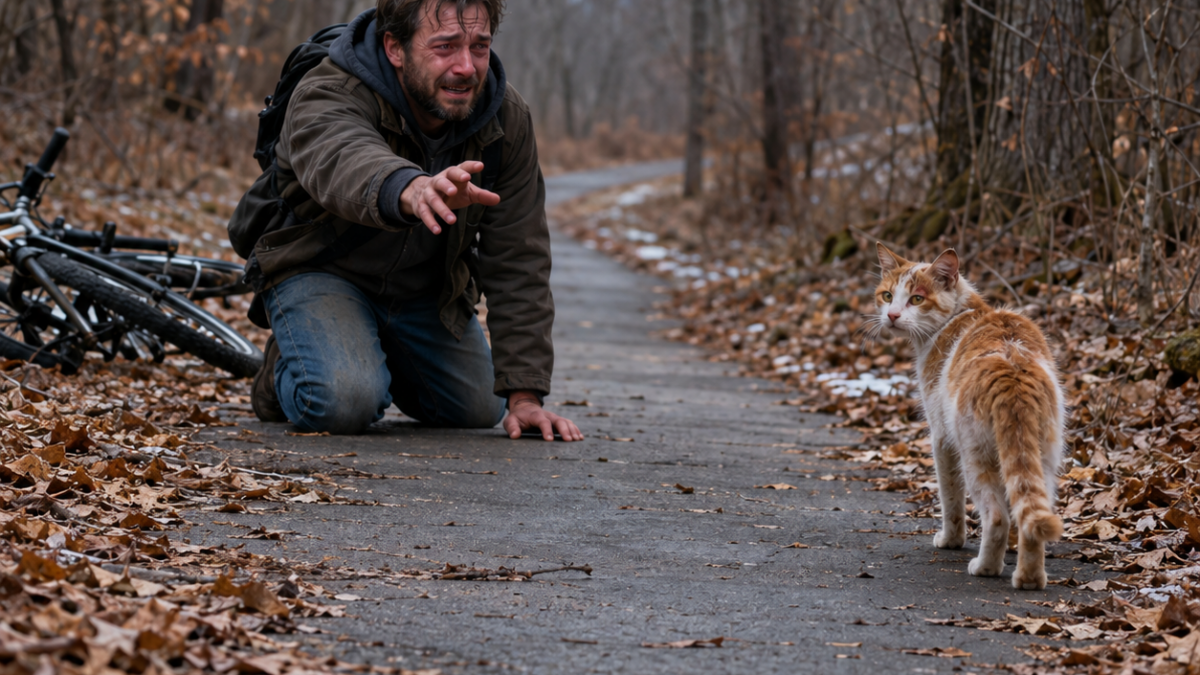
Chante took one cautious step forward.
I could see the little nick in his ear now. His whiskers were uneven. His fur was dirty along one side. I wanted to grab him, hold him against my chest, and promise I would never let anything happen to him again.
Instead, he backed away.
My heart dropped.
Maybe he remembered me but no longer trusted me.
Maybe a year outside had taught him that people were only safe from a distance.
“Dinner time,” I said softly.
The same words I had used every night for seven years.
Chante gave those two scratchy meows again.
I started crying right there on the trail.
Then he turned and ran.
“Chante!”
He stopped about fifty feet away and looked back.
I took one step toward him.
He ran farther, then stopped again.
That was when I understood.
He wanted me to follow.
I grabbed my bike and pushed it behind him.
Chante led me off the main trail toward an old picnic shelter hidden by trees. The roof sagged. One of the benches had been removed years ago. The ground beneath it was packed hard from rain, snow, and people cutting through when they did not feel like staying on the paved path.
Under the remaining bench was a flattened cardboard box, a pile of dry leaves, and a piece of faded blue fabric.
I knelt and picked it up.
It was part of the small blanket that had been inside Chante’s carrier the day he escaped.
Somehow, it must have fallen from the truck.
Chante had found it.
And built his whole life around the last thing that smelled like home.
A woman’s voice came from behind me.
“So you’re Evan.”
I turned.
An older woman stood on the path holding a small bag of cat food. She had silver hair tucked beneath a knit cap and tears in her eyes.
“My name is Elisabeth,” she said. “I’ve been feeding him since last summer.”
“You know him?”
“I know he waits for bicycles.”
She told me Chante appeared near the shelter every morning and late afternoon. He allowed her to leave food and fresh water, but he never let her touch him.
“He watches every man who rides past,” she said. “Sometimes he follows them for a few yards. Then he comes back here.”
I looked down at the blue cloth in my hand.
“He was waiting for me.”
Elisabeth nodded.
“I think he was.”
I sat on the cold pavement and called Chante again.
He stayed several feet away.
This time, I did not reach for him.
“I’m sorry,” I said.
My voice cracked, but I kept going.
“I didn’t stop because I quit loving you. I stopped because I didn’t know where else to look.”
Chante stared at me.
“I should have kept coming back.”
He took one step closer.
I told him about the apartment.
How quiet it was.
How I had started taking extra shifts because being tired was easier than sitting alone in a room where nobody waited for me.
“I kept your bowl,” I said. “I don’t know why. I guess part of me still thought you might need it.”
Chante came close enough to smell my fingers.
Then he pressed his forehead into my palm.
I broke down.
I lowered my head, and Chante climbed into my lap as if the missing year had collapsed into a few seconds. He felt much lighter than I remembered, but the rumble in his chest was the same.
Elisabeth turned away and wiped her face.
Chante still refused to be carried all the way home.
So I walked my bike, and he followed beside me for nearly two miles.
At the apartment entrance, he stopped.
It was not the home he remembered.
It had unfamiliar smells, narrow stairs, and a hallway that echoed.
“Wait here,” I said.
I ran inside and returned with the old blue bowl.
The moment I placed it on the floor, Chante walked through the doorway.
He explored every corner. He sniffed the couch. He sat beneath the kitchen cabinet where I had kept his bowl for a year. Then he jumped onto the chair by the window and curled into a tight orange-and-white ball.
That night, I slept on the couch.
Chante slept on my chest.
His bones pressed against me, and his purr kept waking me up.
I did not mind.
I placed one hand over his back just to make sure he was still there.
Finding Chante did not fix everything.
I still had bills.
My truck still needed repairs.
My apartment was still small.
But the next morning, I opened the curtains.
I made breakfast instead of drinking coffee for dinner.
I called Elisabeth and thanked her again.
Later, we put up a weatherproof board near the trail where people could post pictures of missing pets.
Chante gained weight.
His fur softened.
The small nick in his ear never went away, and neither did his habit of watching bicycles from the window.
People say cats remember their way home by following familiar scents.
But Chante did not return to our old house.
He waited on that trail until he found me.
And as he slept beside me that first night, I finally understood something that still brings tears to my eyes.
Chante had been lost for a year.
But I was the one who needed to be found.
Four months after Chante came home, a ten-year-old girl knocked on my apartment door, called him Sunny, and my cat ran straight into her arms.
That was when I learned finding him had only been the first half of the story.
It was a Saturday morning.
I was standing at the kitchen counter, trying to stretch one cup of coffee through a pile of unpaid bills, when someone knocked three times.
Chante lifted his head from the chair by the window.
He had gained almost five pounds since coming home. His orange-and-white fur had softened, though the little nick in his right ear was still there.
He watched the door but did not move.
I was not expecting anyone.
Elisabeth usually called before visiting, and the property manager had already completed the monthly inspection.
When I opened the door, I found a woman about my age standing in the hallway.
Beside her was a thin girl with dark hair pulled into a loose ponytail. She held a folded piece of paper against her chest.
The woman looked nervous.
The girl looked terrified.
“Are you Evan?” the woman asked.
“Yes.”
“My name is Rachel. This is my daughter, Lily.”
Before I could ask how they knew me, Lily looked past my legs into the apartment.
Her face changed.
“Sunny.”
Chante jumped down from the chair.
He moved so quickly that I barely had time to turn around.
He ran across the living room and stopped at the doorway.
Lily dropped to her knees.
“Sunny,” she said again.
Chante made two short, scratchy meows.
Then he walked straight into her arms.
I could not breathe.
Lily buried her face against his neck.
Chante pushed his forehead beneath her chin and started purring so loudly that I could hear it from where I stood.
Rachel covered her mouth with one hand.
Tears filled her eyes.
I held on to the doorframe.
“Why are you calling him that?”
Rachel looked at me.
“Because he lived with us.”
The hallway seemed to tilt.
“No,” I said.
It came out sharper than I meant.
“He’s my cat. His name is Chante.”
“I know,” Rachel said quickly. “We saw the photograph on the missing-pet board near the trail.”
She pointed to the folded paper in Lily’s hand.
It was a printed photograph of me sitting beside the old picnic shelter with Chante in my lap. Elisabeth had taken it the week after I found him.
Under the photograph, someone had written:
REUNITED AFTER ONE YEAR. NEVER STOP LOOKING.
“We aren’t here to cause trouble,” Rachel said.
But trouble was already standing in my doorway.
Chante rolled onto his back.
Lily rubbed his chest exactly where he liked it.
He closed his eyes.
“How long?” I asked.
Rachel looked down at her daughter.
“Almost five months.”
I felt something cold move through me.
“That isn’t possible.”
Rachel reached into her coat pocket and pulled out her phone.
“I brought pictures.”
I did not want to see them.
I looked anyway.
The first photograph showed Chante sitting beneath a wooden table on a screened porch. His fur was dirty. His ribs showed. There was no doubt it was him. The crooked orange patch above his left eye was clear.
The next photograph showed him eating from a green plastic bowl while Lily sat several feet away.
Another showed him sleeping in a laundry basket filled with towels.
Another showed Lily doing homework on the floor while Chante rested beside her.
In the final photograph, Chante was curled at the foot of a small bed beneath a quilt covered with yellow flowers.
The date on the picture was six weeks before I found him on the bike trail.
I handed the phone back.
My fingers had gone numb.
Rachel spoke quietly.
“He started coming to our porch in September. At first, he only ate when we went inside.”
Lily kept rubbing Chante’s chest.
“He was scared of doors,” she said.
Rachel nodded.
“If we closed the screen, he panicked. So we left it open. He came and went whenever he wanted.”
“Why didn’t you look for his owner?”
“We did.”
“Where?”
Rachel flinched.
“We checked the community pages. We walked through the neighborhood looking for posters. We asked around.”
“My posters were everywhere.”
“Not by September.”
I wanted to argue.
Then I remembered the rain-soaked papers peeling from telephone poles.
I remembered taking the last one down outside the laundromat because somebody had written a cruel message across Chante’s face.
I remembered how tired I had been.
I remembered quitting.
Rachel continued.
“We tried to put him in a carrier once. We wanted to take him to an animal clinic and check for identification.”
“What happened?”
“He tore through the side of the cardboard carrier and hid under our porch for three days.”
Lily lowered her voice.
“He thought we were sending him away.”
Those words hit harder than they should have.
I watched Chante press one paw against Lily’s arm.
He had never done that with Elisabeth.
He had never allowed Elisabeth to touch him at all.
But he knew this girl.
Not as someone who had left food beside a trail.
He knew her as family.
“What happened when he disappeared from your house?” I asked.
Rachel looked at Chante.
“There was a storm in January. The wind knocked part of our porch screen loose.”
“He didn’t run because of the screen,” Lily said.
Rachel glanced at her daughter.
“We don’t know why he left.”
“Yes, we do.”
Lily’s voice cracked.
“He heard a bicycle bell.”
No one spoke.
I looked toward the window.
Chante often sat there for hours, following every bicycle that passed through the apartment parking lot.
I had assumed it was fear.
Maybe it had been hope.
Rachel wiped her eyes.
“When Chante disappeared, Lily and I searched for six weeks.”
“I thought he was dead,” Lily said.
“I thought that for a year.”
Lily looked up at me.
Her face was wet.
“Then you know how it felt.”
I did not have an answer.
Rachel placed a gentle hand on her daughter’s shoulder.
“We only came because she needed to know he was alive.”
“Are you asking for him back?”
Rachel took a long breath.
“I don’t know what we’re asking.”
“That sounds like you’re asking for him.”
“I’m saying we loved him too.”
“He was mine for seven years.”
“And he was with us when he had no one.”
“I was looking for him.”
“I didn’t say you weren’t.”
Her voice stayed calm, which somehow made me angrier.
“He had a home.”
“He had an empty porch and a little girl who sat beside his food bowl for three weeks before he trusted her.”
“I didn’t abandon him.”
“I never said you did.”
“But you’re thinking it.”
“No.”
Rachel looked directly at me.
“I’m thinking none of us knew the whole story.”
Chante stood and walked back into the apartment.
For one hopeful second, I thought he had chosen me.
Then he stopped and looked over his shoulder at Lily.
She followed him inside.
Rachel stayed in the hallway.
I should have told them to leave.
Instead, I stepped aside.
Lily sat on the floor near the couch.
Chante climbed into her lap as if he had done it a hundred times.
Maybe he had.
Rachel remained standing.
“We moved here last summer,” she said. “My rent went up twice at our old place. I couldn’t keep paying it.”
I looked at her coat.
One button was missing.
The sleeve had been repaired with thread that did not match.
She was not rich.
She was not trying to take my cat because she could give him some perfect life I could not.
She was another person counting every dollar.
“Lily had to change schools,” Rachel continued. “She didn’t know anybody. I was working evenings, and she spent a lot of time with my sister.”
Lily rested her cheek against Chante’s back.
Rachel’s voice softened.
“Then he started coming to the porch.”
“I named him Sunny because he was the only good thing about that fall,” Lily said.
I looked away.
I wanted Rachel to be careless.
I wanted her to be selfish.
I wanted something about her to make the decision simple.
But she had bought food she probably could not afford for a cat who would not let her close the door.
She had placed blankets on a porch before the first frost.
She had raised one corner of the screen so he would never feel trapped.
Rachel opened her bag.
“I brought this.”
She handed me a faded red blanket.
It smelled faintly of laundry soap and cat fur.
“He slept on it,” Lily said. “You can keep it.”
Chante lifted his head when he saw the blanket.
He walked over and placed one paw on it.
Then he looked at Lily.
She started crying again.
Rachel took her hand.
“We should go.”
Lily did not move.
“Come on, honey.”
“Can I come back?”
Rachel looked at me.
The question was mine to answer.
Every part of me wanted to say no.
I had spent a year hating myself for losing Chante.
I had walked through snow, rain, and summer heat calling his name.
I had checked drainage pipes with a flashlight.
I had crawled beneath abandoned picnic tables.
I had opened every photograph people sent me, even when the cat in the picture was the wrong color.
When Chante came home, I believed the pain was finally over.
Now a child was asking me to share the one thing I had been given back.
“I don’t know,” I said.
Lily looked down.
Rachel nodded as if she understood.
They walked into the hallway.
Chante followed them.
He stopped at the doorway.
Rachel and Lily walked toward the stairs.
Chante gave two scratchy meows.
Lily turned around.
“Bye, Sunny.”
“His name is Chante,” I said.
She pressed her lips together.
“Bye, Chante.”
I closed the door.
Chante sat in front of it for almost an hour.
He did not look at me.
He did not come when I opened his food.
He only stared at the place where Lily had disappeared.
By noon, I could not stand the silence.
I called Elisabeth.
She listened to the whole story without interrupting.
When I finished, she was quiet for so long that I checked the phone to make sure the call had not ended.
“You knew,” I said.
“I knew he sometimes disappeared for a day or two.”
“You knew he was going to their house?”
“I didn’t know whose house.”
“You could have told me.”
“I didn’t know when you found him.”
“You said he stayed at the shelter every morning and afternoon.”
“He did.”
“That doesn’t mean he lived there.”
“No.”
Her answer was almost a whisper.
I closed my eyes.
“Why didn’t you say something?”
“Because you were holding him.”
“That’s not an answer.”
“You were holding him, Evan, and for the first time since I met that cat, he looked peaceful.”
“So you decided I didn’t deserve to know?”
“I decided not to ruin the first ten minutes of your reunion with information I wasn’t sure about.”
“You should have told me later.”
“Yes.”
The simple admission took the anger out of me.
Elisabeth sighed.
“I should have.”
I sat at the kitchen table.
Chante was still by the door.
“What am I supposed to do?”
“I don’t know.”
“You always know what to do.”
“No, I don’t.”
“You found a way to feed a scared cat for months without asking for anything back.”
“That was easy.”
“How was that easy?”
“He needed food. I had food.”
She paused.
“This is different. There are three people who love one animal, and only one of them can decide where he sleeps.”
“He’s a cat.”
“That’s who I meant.”
I almost laughed.
Nothing felt funny.
“What would you do?” I asked.
“I would stop asking who deserves him.”
“What should I ask?”
“What makes him feel safe.”
I watched Chante.
He had finally left the door.
He was sitting on the red blanket.
“That doesn’t help.”
“No,” Elisabeth said. “The truth usually doesn’t at first.”
After that, Rachel and I agreed to let Lily visit Chante.
One hour at the trail.
I stayed the whole time.
The first Saturday arrived with wet snow.
I placed Chante in his carrier and walked my bike toward the trail. He cried the entire way.
Every sound pulled me back to the day he escaped.
The borrowed pickup.
The loose rope.
The carrier door swinging open.
The flash of orange disappearing between trees.
By the time we reached the picnic shelter, my shirt was damp with sweat beneath my coat.
Rachel and Lily were already waiting.
Lily held the red blanket’s matching pillowcase.
The moment I opened the carrier, Chante stepped out.
He did not run to Lily.
He moved slowly around the shelter, sniffing the bench, the cardboard box, and the faded piece of blue cloth Elisabeth had left beneath a clear cover.
Then he looked toward the woods.
“Maybe this was a mistake,” I said.
Lily sat on the cold ground.
She did not call him.
She did not reach for him.
She simply placed the pillowcase in her lap.
Chante noticed it.
He walked toward her.
Halfway there, he stopped and looked at me.
I hated that look.
It felt as if he was asking permission to love someone else.
“Go ahead,” I whispered.
Chante climbed into Lily’s lap.
She wrapped the pillowcase around him.
For several minutes, she did not say anything.
Then she began telling him about school.
She told him a girl named Hannah had invited her to sit at a different lunch table.
She told him she had gotten a good grade on a math test.
She told him the plant by her window had died because she forgot to water it.
It was the kind of conversation children have with animals when they trust them more than people.
Chante listened with his eyes half closed.
Rachel stood beside me.
“Thank you,” she said.
“I haven’t decided anything.”
“I know.”
“He lives with me.”
“I know.”
“He sleeps on my chest.”
Rachel looked at Lily.
“He slept beside her feet.”
The words hurt, but her voice was not cruel.
She was only telling the truth.
After that, we met at the trail every Saturday.
At first, I watched the time.
One hour.
Never more.
Then a snowstorm delayed Rachel and Lily, and I found myself worrying they would not come.
Chante waited beneath the shelter.
Every time a person appeared around the bend, his ears lifted.
When Lily finally ran down the trail, Chante met her halfway.
I pretended not to notice how happy he was.
By March, the weatherproof board had filled with missing-pet photographs.
Elisabeth checked it every morning. She carried a notebook and wrote down the dates each animal disappeared. When someone reported a sighting, she drew lines between locations.
“You’ve turned this into a job,” I told her.
“It pays terribly.”
“How many have we helped?”
“Eleven dogs, nine cats, one rabbit, and something that was probably a very large ferret.”
“Probably?”
“The owner disagreed.”
The board gave people a place to put their fear.
Photographs appeared with phone numbers, names, and handwritten promises.
PLEASE COME HOME.
WE’RE STILL LOOKING.
YOUR BED IS WAITING.
Sometimes the photographs disappeared because the animal returned.
Sometimes they stayed until the ink faded.
I understood both outcomes.
One afternoon, someone pinned a picture of Chante beneath the word REUNITED.
Beside it, another person added a comment.
Returned to which family?
I pulled the paper down.
The next morning, three new notes appeared.
THE ORIGINAL OWNER SHOULD KEEP HIM.
THE PEOPLE WHO SAVED HIM DESERVE A SAY.
STOP TREATING ANIMALS LIKE PROPERTY. LET THE CAT CHOOSE.
By evening, the discussion had moved to the community page.
Someone had photographed me with Chante and Lily at the shelter.
The post spread quickly.
Most people did not know our names, but that did not stop them from deciding what kind of people we were.
Some said Rachel had tried to steal my cat.
Others said I had abandoned Chante and only wanted him after another family made him healthy.
Neither was true.
A few people blamed Elisabeth for feeding a lost animal without trapping him.
Someone wrote that Lily was old enough to learn she could not have everything she wanted.
Another person said only a heartless man would take a cat away from a lonely child.
I read that sentence six times.
Then I threw my phone onto the couch.
Chante jumped down and hid beneath the table.
“I’m sorry.”
He did not come out.
I had spent months telling him he was safe.
Now strangers were fighting over him through a screen.
They had turned the hardest year of his life into a contest with two teams.
People who had never seen him thin and shaking beneath the shelter were certain they knew what was best.
People who had never heard Lily whisper goodbye were calling her spoiled.
People who had never watched me search the woods were calling me careless.
I deleted my account from the community page.
The posts continued without me.
At the trail, someone taped a new message across the board.
LOVE DOES NOT GIVE YOU OWNERSHIP.
Beneath it, somebody else wrote:
RESPONSIBILITY DOES.
Elisabeth removed both.
“You can’t stop people from talking,” I told her.
“No.”
She folded the papers.
“But we don’t have to provide the wall.”
A week later, a former supervisor called.
His name was Dean. He had left our old warehouse the year before and taken a management position at a distribution center six hours away.
They needed a shift leader.
The pay was almost twice what I earned.
The job included regular hours.
There was a small apartment complex nearby with lower rent.
Pets were allowed.
“You were always reliable,” Dean said. “I can put your name near the top.”
My first feeling was relief.
My second was fear.
Six hours away meant no Saturday visits.
No bike trail.
No Elisabeth.
No Lily.
It also meant I could repair my truck.
I could pay for Chante’s dental work without skipping meals.
I could stop choosing which bill would be late.
Dean gave me three days to decide.
That night, I placed the letter about my rent increase beside the clinic estimate.
Chante sat on the table.
I showed him both pieces of paper.
“This is why people shouldn’t let cats make financial decisions.”
He stepped on the rent letter.
“Good point.”
He sat down.
I looked around the apartment.
The walls were thin.
The carpet had a stain shaped like the state of Texas, although we lived nowhere near Texas.
The kitchen window faced another brick wall.
It was not a good apartment.
It was simply the place where Chante had come home.
I called Rachel.
“I may be moving.”
There was a pause.
“How far?”
“Six hours.”
“Because of work?”
“Yes.”
“Is it a good job?”
“I think so.”
“Then you should take it.”
Her answer came too quickly.
“You’d like that.”
“No.”
“You’d get Chante.”
“I said you should take the job. I didn’t say anything about Chante.”
“He comes with me.”
“I assumed he would.”
“Did you?”
Rachel sighed.
“You want me to fight with you, Evan.”
“I want you to be honest.”
“I am.”
“Lily is going to be hurt.”
“Yes.”
“You’ll blame me.”
“No.”
“You won’t think I’m taking him away from her?”
“I’ll think you are his owner and you’re moving because you need a better job.”
“That sounds very reasonable.”
“I’m trying to be reasonable.”
“Why?”
“Because if I say what I actually feel, you might think I’m asking you to ruin your life for my daughter.”
I sat down.
“What do you actually feel?”
Rachel’s voice grew quieter.
“I feel like Lily already lost one home last year.”
I closed my eyes.
“I didn’t cause that.”
“I know.”
“And I didn’t ask Chante to find your porch.”
“I know.”
“What do you want from me?”
“I want there to be an answer that doesn’t hurt anybody.”
“There isn’t.”
“No.”
Neither of us spoke for several seconds.
Then Rachel said, “Bring him Saturday, no matter what you choose.”
“Why?”
“So Lily can say goodbye if she needs to.”
I accepted the job on Friday morning.
Dean emailed the details that afternoon.
I would start in four weeks.
The new apartment required a deposit, but I could handle it if I sold the truck instead of repairing it.
For the first time in years, my future looked like something other than the next bill.
I should have been happy.
Instead, I sat in my car outside the warehouse and cried.
On Saturday, Lily brought a small paper bag to the trail.
Inside was a knitted orange mouse, a photograph, and a letter.
The photograph showed Chante asleep beside her feet.
On the back, she had written:
SUNNY BEFORE I KNEW HIS REAL NAME.
The letter was for me.
Her handwriting tilted in different directions.
Dear Evan,
I know Chante was your cat first. I know you looked for him. My mom says you did not leave him on purpose.
I want you to know I did not take him on purpose either.
He just came.
Please don’t tell him I stopped loving him after he moves. I won’t.
Please keep the red blanket because he kneads it when he is tired.
He does not like thunder. He will hide in a closet, but if you sit on the floor and hum, he comes out.
Sometimes he wakes up and cries. I think he is checking if someone is still there.
Tell him I am still here, even when I am far away.
Love, Lily
I could not read the final line twice.
I folded the letter and put it in my coat pocket.
Lily sat beneath the shelter with Chante.
“Will the new apartment have a window?” she asked.
“Yes.”
“Can he see bicycles?”
“I don’t know.”
“You should check.”
“I will.”
“Will he sleep with you?”
“He usually does.”
She nodded.
“That’s good.”
Rachel stood several yards away, giving us space.
Lily took the knitted mouse from the bag.
“I made this in class.”
One eye was higher than the other.
Chante sniffed it.
Then he bit the tail.
Lily laughed.
It was the first time I had heard her laugh.
The sound made everything worse.
“I’m sorry,” I said.
She looked up.
“For what?”
“For taking him away.”
“He’s yours.”
“That doesn’t mean it doesn’t hurt.”
“No.”
She looked at Chante.
“Mom says sometimes adults make the choice that keeps the most things from falling apart.”
“That sounds like something your mom says often.”
“She says it when she is scared.”
I looked toward Rachel.
She was wiping her face.
The next four weeks passed too quickly.
I packed dishes into boxes.
I sold the truck to a mechanic who wanted the parts.
I scheduled Chante’s dental appointment near the new apartment.
I gave notice at the warehouse.
Every decision pointed in the same direction.
Forward.
But Chante became restless.
He started sitting by the door again.
He scratched at the carpet.
He cried each time I carried a box into the hallway.
The first time I brought out his carrier, he disappeared beneath the bed for six hours.
I left it open beside his food.
He refused to enter the kitchen.
“It’s different this time,” I told him.
He watched me from the bedroom doorway.
“You’re not going to escape.”
His tail flicked.
“I’m not going to lose you.”
He walked away.
The night before the move, a storm arrived.
Rain struck the windows.
Wind pushed against the building hard enough to make the hallway lights flicker.
Chante hid in the closet.
I remembered Lily’s letter.
I sat on the floor and hummed.
I felt ridiculous.
I did not know any full songs, so I repeated the same three notes.
After ten minutes, Chante stepped from behind my coats.
He climbed into my lap.
For a while, we sat in the dark.
Then I noticed the red blanket beneath him.
It was damp.
Chante had drooled on it while kneading.
I placed my hand on his back.
“Are you scared of the storm?”
He purred.
“Or are you scared of me moving you again?”
He lowered his head.
I wanted to tell myself that I was different from the man who had stopped beside the trail one year earlier.
That man had been panicked and careless.
This time, I had planned everything.
The carrier had a stronger latch.
The apartment was ready.
The job was secure.
But none of that changed what Chante saw.
Boxes.
A carrier.
A door.
The last time those things appeared together, he lost his home for a year.
I did not sleep.
At six in the morning, I carried the final box downstairs.
The moving van was supposed to arrive at seven.
Chante remained in the closet.
At six thirty, Rachel sent a message.
Safe travels. Lily asked me to remind you about the window.
At six forty-five, Elisabeth called.
“Are you packed?”
“Yes.”
“Is Chante calm?”
“No.”
“Are you?”
“No.”
“That seems fair.”
I sat on the edge of the bed.
“Elisabeth, what if I’m doing this because I’m afraid of being poor?”
“That would be a reasonable fear.”
“What if I’m taking him because I’m afraid he’ll choose them?”
She did not answer immediately.
“Also reasonable,” she said.
“That isn’t helpful.”
“You keep asking me to make your reasons pure.”
“What does that mean?”
“People rarely make important choices for one clean reason.”
I looked toward the closet.
“He’ll be better off with me when I have more money.”
“Maybe.”
“I’m his owner.”
“Yes.”
“I love him.”
“I know.”
“Then why does this feel wrong?”
“Because loving someone does not make every decision obvious.”
The moving van pulled into the parking lot.
I heard the engine through the wall.
“Elisabeth.”
“Yes?”
“I don’t know if I can put him in that carrier.”
“Then don’t do it yet.”
“The van is here.”
“The van can wait.”
“I’m paying by the hour.”
“Then decide quickly.”
I laughed despite myself.
Chante appeared at the closet entrance.
He looked at the boxes.
Then he looked at the open apartment door.
I had left it open while speaking to the movers.
My entire body tensed.
“Chante.”
He ran.
I dropped the phone.
By the time I reached the hallway, he was already on the stairs.
“Chante!”
A mover stepped aside as the cat shot through the lobby.
I ran outside without my coat.
Chante crossed the parking lot.
A car stopped.
The driver leaned on the horn.
Chante disappeared between two buildings.
I grabbed my bicycle.
The front tire was soft, but I did not care.
I rode toward the trail.
Rain from the night before had left the pavement slick.
Cold air burned my lungs.
I called Chante’s name until my throat hurt.
There were three places he might go.
The apartment.
The trail shelter.
Rachel’s house.
My stomach tightened when I realized I had never asked for her exact address.
I only knew she lived somewhere beyond the north entrance.
I reached the old shelter first.
It was empty.
The flattened cardboard box was gone.
The blue fabric remained beneath its plastic cover.
Chante’s paw prints marked the mud near the bench.
They continued down the trail.
I followed.
At the north entrance, the prints disappeared among footprints and bicycle tracks.
I called Rachel.
She answered on the first ring.
“Evan?”
“Chante got out.”
“What?”
“He ran toward the trail.”
“We’ll come.”
“I don’t know where he is.”
“We’ll find him.”
“I think he might be going to your house.”
Rachel gave me the address.
It was less than half a mile away.
I rode faster.
Her house was a small one-story rental with gray siding and a screened porch.
Part of the screen had been repaired with a square patch.
Chante was sitting on the front step.
Lily was on the other side of the glass door.
They stared at each other.
Neither moved.
I stopped my bike at the curb.
Chante looked back at me.
He did not run.
Rachel opened the door.
Lily stepped onto the porch.
She wore pajamas and one shoe.
“Chante?”
He made two scratchy meows.
Then he walked through the doorway.
I remained beside the road.
Rachel looked at me through the screen.
She did not close the door.
That mattered.
I walked slowly toward the porch.
Inside, Chante moved through the small living room as if he had never left.
He sniffed the table.
He rubbed his face against the leg of a chair.
He walked down the hallway and disappeared into Lily’s bedroom.
She followed him.
A few seconds later, I heard her crying.
Rachel opened the porch door wider.
“You should come in.”
I entered.
The house was warm.
There were moving boxes stacked against one wall.
For a moment, I thought Rachel was moving too.
Then I saw labels written in a child’s handwriting.
BOOKS.
WINTER CLOTHES.
SUNNY’S STUFF.
Rachel noticed me looking.
“We never unpacked that one.”
I walked to Lily’s room.
Chante was lying on the yellow flower quilt.
Lily sat beside him.
The red pillowcase was beneath his front paws.
He looked calm.
More than calm.
He looked familiar.
I knelt near the bed.
“Chante.”
He lifted his head.
I held out my hand.
He smelled my fingers.
Then he pressed his forehead into my palm.
Lily watched me.
“He still loves you.”
I nodded.
“He loves you too.”
That was the first time I had said it aloud.
The words hurt.
They were also true.
Rachel stood in the doorway.
“What are you going to do?” she asked.
I looked at Chante.
The moving van was waiting.
My new job was six hours away.
My apartment was almost empty.
I had already signed papers.
There were no easy choices left.
Only expensive ones.
Painful ones.
Choices people on community pages could judge from a warm room without carrying any part of the cost.
I could take Chante.
He would adapt eventually.
He had adapted to losing me.
He had adapted to the woods.
He had adapted to Elisabeth.
He had adapted to Rachel and Lily.
He had adapted to my small apartment.
That was what animals did when humans changed their lives.
They adapted because they had no other choice.
I was tired of asking him to do that.
“He stays,” I said.
Lily stopped breathing.
Rachel stared at me.
“What?”
“He stays here.”
Lily looked at her mother.
Then she looked back at me.
“Forever?”
The word was too large.
“I don’t know what forever means anymore.”
I placed my hand on Chante’s back.
“But this is a home he already knows.”
Rachel stepped into the room.
“Evan, you don’t have to decide because he ran here.”
“That isn’t why.”
“You’re upset.”
“I’ve been upset for four months.”
“You love him.”
“Yes.”
“He came back to you.”
“Yes.”
“You searched for him.”
“I know.”
Rachel lowered her voice.
“Then don’t give him away because you think suffering makes you selfish.”
I looked at her.
“That’s not what I think.”
“What do you think?”
“I think I keep saying he found me.”
My hand moved over Chante’s thin ear.
“But he found you too.”
Lily started crying again.
I turned toward her.
“You have to promise me something.”
She wiped her face.
“What?”
“You keep him inside.”
“I will.”
“You check the porch screen.”
“Every day.”
“You don’t leave doors open.”
“I won’t.”
“You keep the blue bowl.”
Her eyebrows lifted.
“The one from your apartment?”
“Yes.”
“Are you sure?”
“No.”
That made her laugh through her tears.
“He gets scared during storms,” I said. “You sit on the floor and hum.”
“I know.”
“He likes his food warmed slightly when it’s cold.”
“I know.”
“He’ll pretend he doesn’t want to be held, but if you sit down, he’ll climb onto you.”
“I know.”
“And he gets two treats after dinner.”
Lily looked at her mother.
“He told us one.”
“Chante is a liar.”
Rachel laughed and covered her face.
I leaned closer to Chante.
“I’m not leaving because I stopped loving you.”
His eyes stayed on mine.
“I’m leaving because I finally know where else to look.”
My voice broke.
Chante stood.
For one terrible second, I thought he would walk away.
Instead, he stepped into my lap.
I held him against my chest.
His purr filled the room.
I closed my eyes and remembered seven years of mornings.
Seven years of him waiting beside his bowl.
Seven years of fur on clean shirts.
Seven years of waking up with one numb arm because he had slept on it all night.
Then I remembered the trail.
The flattened box.
The blue cloth.
The bicycles.
The screened porch.
The yellow flower quilt.
One animal had carried pieces of three homes.
I had spent months trying to decide which piece mattered most.
Chante never asked that question.
He had simply loved whoever kept showing up.
I stayed until the movers called for the third time.
Before leaving, I rode back to the apartment and retrieved the blue bowl.
I also brought the chair from beside the window.
It was cheap and scratched.
Rachel said they had enough furniture.
“I know,” I told her.
“It’s his.”
We placed the chair near Lily’s window.
Chante jumped onto it immediately.
A bicycle passed outside.
His ears lifted.
He watched it until it disappeared.
Then he turned toward me.
I put my hand against the screen.
“Dinner time.”
Two short meows.
I walked away before I changed my mind.
The drive to my new apartment took seven hours because the rain returned.
Chante’s empty carrier sat on the passenger seat.
At one point, I pulled into a rest area and moved it to the back.
I could not keep looking at it.
The new apartment was cleaner than the old one.
The carpet had no stains.
The windows faced a row of maple trees.
It was quiet.
Too quiet.
I unpacked one plate, one cup, and one fork.
Then I sat on the floor.
For the first time in a year, nobody waited for me.
I had chosen that.
Knowing it was my choice did not make it easier.
Rachel sent a photograph that evening.
Chante was curled on the red blanket in Lily’s bed.
The blue bowl sat near the door.
Her message said:
He ate. He checked every room twice. Now he is sleeping. Lily is on the floor because she doesn’t want to disturb him.
I typed three different replies.
I deleted all of them.
Finally, I wrote:
Thank you for keeping the door open.
My new job began Monday.
The work was familiar.
Pallets.
Schedules.
Broken equipment.
People calling out because their cars would not start or their children were sick.
As shift leader, I was supposed to keep everything moving.
The pay was better.
The hours were regular.
Each Friday, money appeared in my account and stayed there longer than two days.
I paid for Chante’s dental appointment.
Rachel tried to refuse.
I told her the appointment had been scheduled before he moved in.
She accepted after I promised not to send money for his food.
Then she sent me a picture of six bags of food stacked beside her washing machine.
Lily has started saving part of her allowance, she wrote.
I called them every Wednesday.
At first, I asked only about Chante.
Did he eat?
Did he use the litter box?
Did he cry at night?
Did he scratch the door?
Did he watch bicycles?
The answers were yes, yes, sometimes, no, and always.
After a few weeks, Lily started telling me about other things.
School.
Her mother’s work.
A girl who stopped sitting with her at lunch.
A science project that failed because she used too much water.
I realized she had begun speaking to me the way she spoke to Chante.
Carefully.
As if testing whether I would disappear.
I came back one month later.
Rachel had offered to meet at the trail, but I asked to come to the house.
Chante was sitting in the window when I parked.
The moment I stepped onto the sidewalk, he stood.
His mouth opened.
I could not hear him through the glass.
Lily opened the front door.
Chante ran outside.
My heart stopped.
Then I saw the soft harness around his body and the long line in Lily’s hand.
She had promised to keep him safe.
Chante pulled her across the lawn.
I dropped to my knees.
He reached me and pressed his head beneath my chin.
I laughed and cried at the same time.
“You remember me.”
He made two meows.
Lily rolled her eyes.
“Of course he remembers you.”
For an hour, Chante refused to leave my lap.
Rachel made coffee.
Lily showed me where Chante slept.
There were three beds for him in the house.
He ignored all of them.
He slept on the yellow quilt, the old chair, or Rachel’s clean laundry.
Before I left, Lily asked whether I regretted giving him to her.
“Yes,” I said.
Her face fell.
I touched her shoulder.
“I regret it every morning.”
“Then you want him back?”
“Sometimes.”
She looked frightened.
“But wanting something back doesn’t always mean taking it is right.”
“Do you think he’s happier here?”
I looked at Chante sleeping on the chair.
“I think he’s happy.”
“That isn’t what I asked.”
“No.”
She waited.
“I don’t think happiness is a contest,” I said. “He was happy with me too.”
“Then how did you decide?”
“I decided you could give him something I couldn’t.”
“What?”
“Staying.”
Lily looked down.
“I’m sorry you had to move.”
“Me too.”
Months passed.
The missing-pet board near the trail became known as the Blue Bowl Board after Lily painted two blue bowls across the top and wrote:
LOST DOES NOT MEAN FORGOTTEN.
By summer, thirty-seven animals had been reunited with their families.
Not every story ended well.
Some photographs stayed for months.
A few were removed without explanation.
Elisabeth kept every faded copy in a folder.
“Why?” I asked once.
“Because someone loved them enough to keep looking.”
I came home every six weeks.
I called the visits home even though I no longer lived there.
Chante began recognizing the sound of my car. By the time I reached the porch, he was usually waiting in the window.
He never ran away from Rachel or Lily to follow me.
He never ignored me either.
He simply made room.
That was the part strangers online never understood.
They wanted him to choose because they wanted one of us to win.
Chante did not live that way.
He slept with Lily during storms.
He sat beside Rachel while she paid bills.
He waited for Elisabeth’s bicycle on Saturday mornings.
When I visited, he climbed onto my chest and purred until I could feel it in my teeth.
He had not divided his love.
He had multiplied the places where he felt safe.
In August, my new schedule changed.
Every Saturday would be required.
My visits home would become harder.
That evening, I sat in my still half-empty apartment and stared at the money I had saved for furniture.
I had moved because I believed security was a place I could reach.
Better pay.
Lower rent.
Regular hours.
But the ground still moved.
It moved for everybody.
A company changed its schedule.
A landlord raised rent.
A porch screen broke.
A carrier door opened.
Lives changed because of decisions made in rooms where the people affected were not present.
I thought about Chante.
He had survived by building more than one home.
I had spent my entire life doing the opposite.
I left before anyone could leave me.
I worked extra hours instead of asking for help.
I treated need like a private failure.
Maybe that was why losing him had broken me so completely.
He had been the only living thing I allowed to wait for me.
The next morning, I called Dean.
“I need to step down.”
There was a long silence.
“Because of Saturdays?”
“Because I moved here for a job that can change without asking me.”
“That’s every job.”
“I know.”
“You have something else?”
“Not yet.”
“You’re going to quit a good position without another one?”
“I’m giving notice.”
Dean sighed.
“I can’t tell you that’s smart.”
“I’m not asking you to.”
“Is this about the cat?”
“Partly.”
“That cat doesn’t even live with you.”
“I know.”
Dean laughed once.
Not cruelly.
“I definitely don’t understand.”
“That’s okay.”
Many people did not.
Rachel said the same thing.
“You can’t keep quitting jobs because you miss Chante.”
“I quit one job.”
“You’re leaving twice the pay.”
“I know.”
“Your rent is lower there.”
“I know.”
“Do you have a plan?”
“Not a very impressive one.”
She became quiet.
Then she said, “You’re not taking him back.”
“I didn’t say I was.”
“You’re moving closer.”
“Yes.”
“That will confuse Lily.”
“Why?”
“She’ll think you came back for him.”
“I came back for all of you.”
The words slipped out before I could stop them.
Rachel did not answer.
I heard her breathing.
Then Lily’s voice appeared in the background.
“Is that Evan?”
Rachel called, “Yes.”
“Tell him Chante threw up on the yellow quilt.”
I smiled.
Rachel returned to the phone.
“He ate a plant.”
“What kind?”
“The plant he already killed last year.”
“He wanted to make sure.”
Rachel laughed.
The sound felt like a light switching on.
I moved back in September.
The room above the repair shop was small and noisy during the day.
At night, it was quiet.
From one window, I could see a narrow section of the bike trail between two buildings.
The first Saturday after I returned, I walked to Rachel’s house.
I did not call ahead.
Chante was asleep in the window.
When he saw me, he stood so fast that he knocked over a small lamp.
Lily opened the door.
“You’re early.”
“By about five weeks.”
She stared at me.
Then she screamed for her mother.
Chante reached the porch wearing his harness.
He pulled so hard that Lily dropped the line.
For one second, everyone froze.
The porch door was open.
The street was only twenty feet away.
Chante looked at the freedom in front of him.
Then he looked at me.
He walked across the porch and sat on my shoes.
Rachel appeared in the hallway.
She pressed one hand over her heart.
“I think I just aged ten years.”
Lily grabbed the line.
“I’m sorry.”
“It’s okay,” I said.
“No,” Rachel replied. “It isn’t. We promised.”
“It was an accident.”
“That’s what people say right before somebody online destroys them.”
Her attempt at humor failed.
She was shaking.
I knelt and clipped the line to Chante’s harness.
“He stayed.”
Rachel looked at him.
“Yes.”
“He had a choice.”
Lily shook her head.
“He wasn’t choosing between running and staying.”
“What was he choosing?”
She pointed to the sidewalk.
“You were here.”
I sat on the porch with Chante in my lap.
Then I told them I had moved back.
Lily hugged me before I finished.
Rachel stood several feet away.
“You really did it.”
“I did.”
“Do you regret it?”
“Ask me after the first rent payment.”
She smiled.
“What happens now?”
I knew what she meant.
Not the apartment.
Not the job.
Chante.
“He stays here.”
Lily’s arms tightened around him.
“You’re sure?”
“No.”
She frowned.
“You say that a lot.”
“Most honest people should.”
I looked at Rachel.
“I don’t want to undo the decision because my circumstances changed.”
“You can visit whenever you want,” she said.
“I know.”
“And if he ever needs to stay with you—”
“I know.”
“And we’ll keep paying for food.”
“I know.”
Lily interrupted.
“He can have sleepovers.”
Rachel and I spoke at the same time.
“No.”
Lily rolled her eyes.
“Adults make everything difficult.”
She was not wrong.
We developed a routine.
I visited Wednesdays and Saturdays.
Sometimes Chante came to the trail in his harness.
Sometimes he stayed home because he had no interest in cooperating.
On cold evenings, Rachel made soup.
I repaired the loose porch step.
Lily helped me paint the old chair.
Elisabeth joined us when her knees allowed.
Without planning it, we became something that did not have a simple name.
Rachel and I were not a couple.
Elisabeth was not anybody’s grandmother.
Lily was not my daughter.
Chante did not legally belong to all of us.
But we checked on one another.
When Rachel worked late, I sat in the living room while Lily completed homework.
When my bicycle chain broke, Rachel drove me to work.
When Elisabeth had a bad cold, we left groceries outside her door.
People like to use words such as family, neighbor, owner, and friend as if every relationship needs one clear box.
Ours did not fit.
Maybe that was why it worked.
In November, a photograph appeared on the Blue Bowl Board.
It showed a small black cat with white paws.
The note beneath it said:
HER NAME IS PENNY. SHE IS AFRAID OF MEN. PLEASE DO NOT CHASE HER. MY SON CHECKS THE WINDOW EVERY MORNING.
The address was near the apartment where I had once lived.
For nine days, volunteers reported sightings.
Penny moved between garages and drainage pipes.
Food disappeared, but nobody saw her eat.
On the tenth evening, Lily and I checked the old picnic shelter.
The roof had been repaired, though the bench was still missing.
Chante walked beside us in his harness.
Near the cardboard box beneath the shelter, he froze.
His ears turned toward the woods.
Then he gave two scratchy meows.
A tiny black face appeared between the leaves.
Penny.
Lily sat on the ground.
She placed a bowl several feet away.
Penny did not move.
Chante lay down.
For almost forty minutes, nobody spoke.
The trail grew dark.
Cold moved through my gloves.
Then Penny stepped from the trees.
She walked toward Chante.
He remained still.
She smelled his tail.
Then she began eating.
We did not grab her.
We did not chase.
We waited.
When Penny finished, she walked into the open carrier beside the food.
Lily closed the door slowly.
The cat’s family arrived fifteen minutes later.
A boy about seven jumped from the car.
His father caught him before he reached the carrier.
“Slowly,” he said. “She’s scared.”
The boy dropped to his knees.
“Penny?”
The black cat pressed her face against the carrier door.
The boy started sobbing.
His father turned away.
I knew that movement.
I had made it myself many times.
The attempt to hide tears because relief felt too private to show strangers.
The boy looked at Chante.
“Did your cat find her?”
Lily looked at me.
“Yes,” she said. “He’s good at finding people.”
I placed my hand on Chante’s back.
He purred.
One year after I found him on the trail, we met at the old shelter.
Rachel brought coffee.
Elisabeth brought cat food even though unattended feeding was no longer allowed.
“It’s a gift,” she insisted.
“For whom?” Rachel asked.
“Whichever one of you complains least.”
Lily brought both bowls.
The green one and the blue one.
She placed them side by side beneath the repaired bench and filled them with water.
Chante drank from the blue bowl first.
Then he drank from the green one.
I took a picture.
The community page later argued about whether the bowls should have been placed there.
Somebody said we were encouraging irresponsible feeding.
Someone else said the photograph proved that animals remembered love.
A third person asked why anybody cared which bowl a cat used.
The argument continued for two days.
I did not read it.
People still ask whether I regret giving Chante to Lily.
The honest answer is yes.
I regret it when I wake up alone.
I regret it when I open a can of food at Rachel’s house and he runs past me toward Lily.
I regret it when he sleeps on the yellow quilt instead of my chest.
I regret every ordinary moment that belongs to them now.
But regret is not always proof that a choice was wrong.
Sometimes it is proof that the choice cost something.
Rachel once asked whether I believed Chante would have been happy if I had taken him six hours away.
I said yes.
He loved me.
He would have adapted.
He would have found the window.
He would have learned new sounds and smells.
He would have slept on my chest.
That version of the story could have been good too.
That is what made the choice so difficult.
There was no cruel person to defeat.
No careless stranger to blame.
No perfect ending waiting for us to discover it.
There were only people trying to love the same animal while rent increased, jobs changed, and life kept moving the furniture around.
I chose one home for Chante.
He chose more than one family.
On warm Saturdays, Lily walks him to the trail.
He still stops at the old shelter.
He smells the blue cloth beneath the clear cover.
He watches bicycles pass.
Sometimes a man rides by with his head down, thinking about bills.
Chante’s ears lift.
But he does not chase the bicycle anymore.
He looks at me.
Then at Lily.
Then toward Rachel and Elisabeth waiting near the board.
He knows where we are.
Last February, Lily asked me a question.
“If Chante had followed you into the new apartment and never met us again, would he have forgotten me?”
“No.”
“How do you know?”
“Because he didn’t forget me.”
She thought about that.
Then she sat beside him on the old bench.
“Do you think he was lost?”
I looked at Chante.
His orange-and-white body had filled out.
His coat was clean.
The nick in his ear remained.
It always would.
“I think he knew exactly where he was,” I said.
“Then why did he keep waiting?”
“Because knowing where you are isn’t the same as being where you belong.”
Lily placed her hand beside mine on Chante’s back.
He purred beneath both of us.
For a long time, I believed home was one door.
One bowl.
One person waiting on the other side.
Chante taught me something harder.
A home can be a screened porch left open for a frightened animal.
It can be an old woman carrying food through the snow.
It can be a child sitting on the floor without reaching too soon.
It can be a man admitting that love does not always mean holding on.
It can be a repaired shelter, a community board, and two mismatched bowls.
Chante had been lost for a year.
Then I found him.
Then I had to let someone else keep him.
Some people will always believe I made the wrong choice.
Maybe they are right.
But every Wednesday, when I turn onto Rachel’s street, Chante is waiting in the window.
He recognizes my steps.
He runs to the door.
And every time Lily opens it, she leaves enough space for me to enter.
Chante did not lead me into those woods simply because he wanted to show me where he had survived.
He led me there because my old idea of home had become too small.
He had found Elisabeth.
He had found Rachel.
He had found Lily.
Then he came back for me.
And in the end, none of us saved Chante alone.
We saved one another by refusing to close the door.








