Marines Looked for Him for a Decade — Until a K9 Sat at the Old Farmer’s Feet and Refused to Move
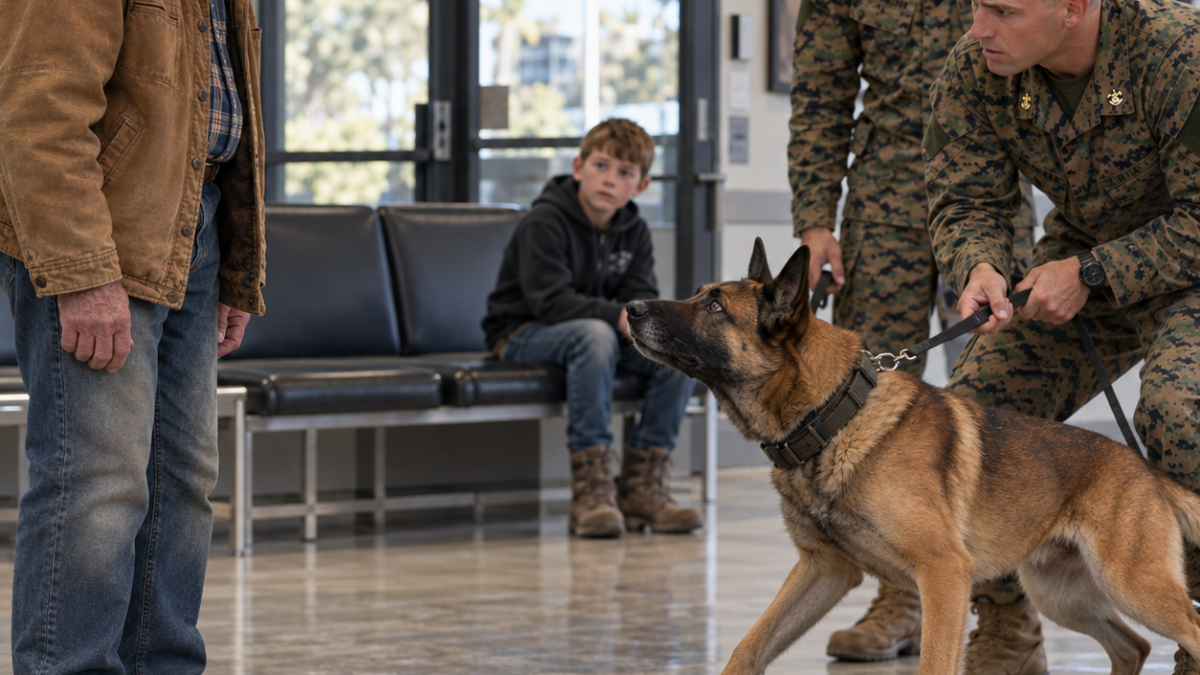
Marines Looked for Him for a Decade — Until a K9 Sat at the Old Farmer’s Feet and Refused to Move
The Marine Corps had listed Alton Pruitt as dead for ten years, and nobody in uniform had ever thought to check whether the old farmer was still sitting at his kitchen table in California.
Then a retired military K9 named Bracken walked across a crowded working dog center, folded himself over Alton’s boots, and refused to move.
Within forty-eight hours, that dog was supposed to be sent away forever—but one forgotten hand signal, one old brass leash clasp, and one misfiled record were about to prove that the dead man was still alive.
A low whine moved across the linoleum before anyone understood it was coming from the dog.
It was not a bark.
Not a growl.
Not even the nervous cry of an animal overwhelmed by noise.
It was thinner than that.
Older somehow.
An unbroken thread of sound that seemed to have grief caught inside it.
The sound came from a nine-year-old Belgian Malinois lying flat against a pair of scuffed brown boots in the lobby of the Southern California Regional Working Dog Center.
The dog’s name was Bracken.
Ninety pounds of military-bred muscle, black mask, amber eyes, scar along one ear, and a record full of words like detection, deployment, recovery, patrol, and behavioral concern.
The boots belonged to a seventy-nine-year-old farmer named Alton Pruitt.
He had come to the center that Wednesday morning in October because of three lines he had read in a county newspaper.
Retiring military working dog, difficult placement, no successful match after six weeks.
Something in those three lines had moved inside him like an old shelf giving way.
He could not explain why.
So he did what he had done most of his life when something in his chest told him to move.
He got in his truck and went.
His ten-year-old grandson, Wyatt, came with him because Wyatt’s mother worked Wednesdays and because Alton had said a working dog center was as good a place as any for a boy to spend an afternoon.
Wyatt now sat on a vinyl bench beside his grandfather, sneakers not quite touching the floor, fingers worrying a loose thread on one shoelace. He had the patient inattention of a boy who had learned that grown men’s business takes longer than a boy wants it to and there is no use hurrying it.
Across the lobby, handlers had frozen.
Captain Meredith Ashcroft stood with a tablet tucked under one arm and twelve years of training theory behind her expression.
She trusted that tablet.
She trusted the numbers on it.
Heart rate.
Stress response.
Placement history.
Handler attachment risk.
Bonding avoidant.
Behavioral unpredictability.
Bracken had failed every placement assessment for six straight weeks. He had refused handlers, ignored foster candidates, paced kennels until his pads were sore, and slept only in short, watchful bursts that were not truly sleep.
In forty-eight hours, he was scheduled to be transferred to a rehoming agency two states away.
That was the plan.
Plans matter in places like that.
Schedules.
Protocols.
Chain of command.
Paperwork.
PART2:
A dog lying across an old farmer’s boots had no official category.
Ashcroft looked at the tablet.
Then at the dog.
Then at Alton Pruitt.
For one second, the pieces refused to fit.
“Sergeant Red,” she said without turning around. “Get the leash.”
Sergeant Colton Red did not move as fast as she expected.
He was twenty-six, four years into handling, lean and quiet, with the kind of eyes that noticed a dog’s breathing before they noticed a room’s conversation. Something in him had gone still the moment Bracken crossed the lobby.
Because Bracken had not wandered.
He had not sniffed curiously.
He had not investigated a stranger.
The dog had lifted his head from thirty feet away, ears forward, body rising before any handler gave a command, and crossed the tile as if someone had called his name.
Nobody had.
Now he lay with his chin resting on the toe of Alton Pruitt’s boot, ribs moving fast and shallow, eyes fixed on the old man’s right hand.
“Sir,” Captain Ashcroft said, crouching near them, “I’m sorry, but visitors are not permitted to touch program animals.”
Alton had not touched the dog.
That was the strange part.
He had not called him.
Had not reached down.
Had not whistled.
Had not done anything anyone in the lobby could identify.
PART3:
He simply stood there in an old barn coat the color of dried tobacco, olive drab worn pale at the seams, a flannel shirt beneath it, and a feed-store cap that had been useful twenty years ago and sentimental ever since.
He did not look like a man anyone in that building expected to matter.
That was, in its own quiet way, the entire story of him.
Sixty years of practice at being the least interesting thing in any room.
Alton looked down at Bracken.
The dog whined again.
Low.
Steady.
Patient in the way only real fear can be patient.
Ashcroft glanced at her tablet.
Amber warning flag.
Elevated heart rate.
Acute fixation.
“Sergeant Red,” she repeated. “Leash.”
Red crouched and reached for the clip at Bracken’s collar.
The dog did not growl.
Did not snap.
Did not bare his teeth.
He simply became, in that instant, one hundred and ten pounds of dead, immovable weight.
He flattened along the floor as if gravity had doubled only for him.
His chin stayed on Alton’s boot.
His eyes stayed on the old man’s hand.
Ashcroft’s mouth tightened.
“Sir, I need to ask you not to encourage the behavior.”
“I’m not encouraging him,” Alton said.
His voice was quiet.
Dry.
Rural.
The sort of voice that had spent decades speaking mostly to cattle, fence posts, weather, and one woman who was now buried beneath spring grass at a small church cemetery outside Lompoc.
“I’ll need to see some identification,” Ashcroft said. “Just for our visitor log.”
Alton reached slowly into his coat.
His right hand trembled as he moved.
It had trembled for eleven years. Fine and constant. Enough to make a coffee cup ring faintly against its saucer in the morning. It was not the hand of a young man. It had known frostbite once, briefly, on a hillside whose name he had not spoken aloud since 1971. It had known fence wire, tractor bolts, splitting mauls, feed sacks, rifles, and the last soft weight of his wife Ruth’s hand before she stopped recognizing his name.
But before he pulled out the ID, that hand did something strange.
The tremor stilled.
The fingers curled.
Not into a fist.
Something more particular.
Four fingers folded, thumb laid flat along the first knuckle.
The shape hung in the air for half a second, like a word forming in a man’s mouth before he decides whether to say it.
Alton looked down at his own hand as if it belonged to someone he used to know.
Then he lowered it, reached into his wallet, and handed over a veteran’s identification card.
Private First Class Whitcomb at the front counter took the card and ran it through the visitor system out of habit.
The machine beeped.
The screen returned its answer in a flat font that had never doubted itself in its life.
PRUITT, ALTON R.
STATUS: DECEASED
RECORD DATE: 2013
The junior handlers near the water cooler saw it first.
One of them laughed.
A short, sharp bark of disbelief.
“Sir,” the corporal said, “you want to explain that to us?”
Alton did not look at him.
He looked at the dog.
Ashcroft took the card from Whitcomb and stared at the screen.
Then at the old man.
“Mr. Pruitt?”
“Yes.”
“There is clearly some kind of mix-up in the system.”
“So it says.”
“Believe me, that happens. But until we sort it out, I need Sergeant Red to move the dog, and I need you to step back from the kennel area.”
She lifted the tablet slightly, as if the data itself could restore order.
“Bracken has been flagged bonding avoidant for six weeks. Zero successful placements. This is not a training call. This is data.”
Alton’s mouth moved as if he meant to speak and thought better of it.
Then he said eleven words.
No more.
“He’s not avoiding a bond. He already made one.”
Nobody in the lobby understood what that meant.
Bracken did.
The dog pressed harder against Alton’s boot and closed his eyes.
By one o’clock, most of the lobby had emptied.
Visitors had been moved elsewhere. Handlers returned, reluctantly, to work they were pretending to do. A legal clerk somewhere had been asked to investigate why a living man had a dead file. Nobody liked the answer yet because there wasn’t one.
Against no small amount of Captain Ashcroft’s better judgment, Sergeant Red had quietly arranged for Alton to sit on a bench just inside the kennel wing.
Bracken lay beside him the entire time.
Chin on boot.
Body touching the old man’s ankle.
Every few minutes, Alton would breathe out slowly, and Bracken’s own breathing would follow.
Red noticed.
He noticed because good handlers learn that a dog’s body tells the truth half a second before behavior confirms it.
Bracken’s ears, which had swiveled all morning at every cart, door, voice, and bootstep, had gone still. Forward. Resting. Focused only on Alton’s chest.
His ribs, which had moved fast and shallow for weeks, slowed.
Four counts in.
Six counts out.
Like a second heart learning the rhythm of a first.
“He’s reading your breathing,” Red said.
Alton looked down.
“Dogs do that.”
“Not like this.”
“Good ones do. The ones taught right a long time back. Before it got scientific.”
Red studied him.
“You handled dogs?”
Alton did not answer right away.
Instead, his left hand slipped into the pocket of his barn coat.
He touched something there.
Wyatt saw it.
His grandfather had done that before. At the kitchen table. At church. Once at Ruth’s grave with the cemetery grass wet from spring rain.
A small coffee tin lived in that pocket.
Wyatt knew because he had seen it once when Alton thought no one was looking. The tin was old and dented, the painted label mostly gone. Inside was something wrapped in a handkerchief so soft with age it seemed more like memory than cloth.
Wyatt had never asked about it.
He had learned that some things a boy does not ask directly.
He only notices.
And carries the noticing until one day it becomes understanding.
Alton’s thumb pressed once against the shape inside the tin.
Then his hand came out empty.
“I handled dogs,” he said.
“When?”
“A long time ago.”
Red waited.
Alton’s gaze remained on Bracken.
“Marine Corps. Nineteen to twenty-five. Sixty-five to seventy-one.”
Red sat back on his heels.
“You were a Marine working dog handler?”
Alton’s mouth twitched.
“Still am, if you ask him.”
He nodded toward Bracken.
Captain Ashcroft came through the corridor twice in the next hour.
Both times, she had the tablet in hand.
Both times, she looked at the dog, then the data, as if a third pass might make the numbers explain themselves.
Bracken’s baseline heart rate, elevated for six straight weeks, had dropped into the range her own intake sheet called within normal limits for a resting adult male of the breed.
She tried recall twice.
Standard verbal command.
Standard hand signal.
The kind every dog in the program answered on the first call.
Bracken lifted his head both times.
Looked at her.
Then set his chin back on Alton’s boot, uninterested, unhurried, as if a phone were ringing with a number he did not recognize.
“That’s not in the literature,” Ashcroft muttered.
“No,” Alton said.
She looked at him.
He was not watching her. He was watching the dog’s paws.
“Some of it never got written down.”
For the first time that day, Ashcroft really looked at the man instead of the problem he created.
His stillness did not read like old age anymore.
It read like discipline.
His gaze moved across the room in slow, complete arcs. Not the darting glances of a nervous civilian in a strange building. He mapped exits, corners, movement, pressure points, bodies, sound.
She had spent years learning how to read dogs.
It occurred to her, standing there in the kennel corridor at two in the afternoon, that she had not yet properly read Alton Pruitt.
“Mr. Pruitt,” she said, “I want to be fair to you. Your ID says one thing, and our system says another. Until legal sorts that out, I have a dog scheduled for transport in less than forty-eight hours who has failed every placement assessment we have run this quarter. And now he is parked at the feet of a man who, according to our own records, does not exist.”
Alton looked up at her.
“I don’t have a box on my tablet for that,” she said.
Something almost like sympathy moved behind his eyes.
“No,” he said. “I don’t imagine you do.”
Red, still crouched nearby with a bowl of water Bracken had ignored, said, “Ma’am, his pulse dropped forty beats in under a minute when he found him. I’ve never seen that happen with anybody in this building. Not with me. Not with you. Not even with Colonel Sohl. And Bracken likes the colonel fine.”
Ashcroft did not answer.
She looked at the warning flag on her screen.
Amber had turned green.
She had not touched the setting.
By four o’clock, the light through the high windows had turned the color of weak tea.
Alton rose from the bench with the slow economy of a man who knew exactly how much motion his joints would forgive him.
Bracken rose with him.
Same rhythm.
Same pace.
As though they had rehearsed it.
The corporal who had laughed that morning had drifted back to the doorway and now stood watching silently.
Alton lifted his right hand.
It did not tremble.
He shaped it slowly.
Four fingers folded.
Thumb along the first knuckle.
Held at collarbone height.
The gesture hung there half a second longer than any modern signal required.
Then he brought two fingers to his lips and gave a whistle so low it barely carried past the first row of kennels.
Three short notes.
A fourth held long.
A pattern with no name in any manual printed after 1975.
Bracken changed before the whistle ended.
His body came alive, not with excitement, but with recognition.
He squared his shoulders to Alton’s chest and sat.
Not a loose sit.
Not distracted obedience.
A full, weighted, disciplined sit.
Spine straight.
Eyes locked.
The stillness of an animal who had finally heard the one thing he had been waiting for.
Red’s water bowl slipped in his hand and hit the floor.
It did not spill because his fingers froze around the rim.
Colonel Emmett Sohl came down the corridor twenty minutes after Red’s call.
He had expected something routine.
A database error.
A difficult visitor.
A stressed dog.
The kind of issue that reached his desk twice a month and rarely required his own boots on the floor.
He was sixty-one, lean, and carried himself like a career Marine who still ran because one day stopping might mean admitting something.
He came around the corner already forming the sentence he planned to use to smooth everything over.
He never said it.
He stopped mid-stride.
One boot still raised slightly off the tile.
Because at the far end of the kennel wing, an old man’s hand was dropping from beside his collarbone, and a nine-year-old working dog was sitting before him like a private called to attention by a general long believed dead.
“That signal,” Colonel Sohl said.
His voice had gone thin in a way none of the junior handlers had ever heard.
Ashcroft turned.
Sohl stepped closer.
“I have seen that signal.”
Alton looked at him.
“It’s in the orientation module,” Sohl said. “Slide eleven. We show it every quarter. Legacy bonding technique. Origin unknown.”
Alton’s face did not change.
“It’s not unknown.”
The corridor went silent.
“It’s mine.”
No one spoke.
Sohl looked from Alton to Bracken, then to Ashcroft’s tablet, where the green flag glowed harmlessly, as if the system had not spent six weeks being wrong.
“Visitor log,” Sohl said.
Whitcomb brought it.
He read the entry once.
Then again.
PRUITT, ALTON R.
STATUS: DECEASED
RECORD DATE: 2013
Sohl set the tablet down carefully, the way a man sets down something he suspects has become evidence.
“Sir,” he said.
This time the word came out formal.
“Were you Marine Corps dog handler program, mid to late sixties?”
“Nineteen to twenty-five,” Alton said. “Nineteen sixty-five to seventy-one. Three dogs in that stretch. Last one was named for a fence line, if that means anything to you.”
It meant something.
Sohl’s jaw worked once.
“There’s a Pruitt in the fallen handler archive,” he said. “Died in a training accident, Camp Pendleton, 2013, according to the record. Different first initial buried in the file if you dig, but nobody dug because nobody had reason to doubt a death certificate with a close-enough name.”
He looked at Alton in a way that made the hallway smaller.
“You’ve been listed among our dead for a decade, Mr. Pruitt. There is a plaque with a version of your name on it in the front hall.”
Something moved behind Alton’s eyes.
Quick as a held breath finally let go.
Then it was gone, folded back into the same stillness he had worn all day.
“I’ve been listed among the living just fine at my own kitchen table,” he said. “Didn’t much need the Marine Corps’ permission for that.”
Nobody laughed.
Ashcroft asked the practical question because someone had to.
“Sir, with respect, if this is a clerical error, we can fix it. But Bracken’s transfer authorization is already signed. I signed it myself three days ago. Transport leaves Friday at 0900. Once he is off our books, reclassification is a legal process with another agency.”
Sohl looked at her.
“Then reverse it.”
“I do not have the authority without the base commander’s countersignature. He is traveling until Thursday night.”
“Then we have a day.”
“We have less than that if the paperwork side does not move.” Ashcroft looked at Alton. “And to correct ten years of a false death record, JAG will want the original service file. Not a database entry. The system shows the physical file was transferred to a civilian archiving contractor in 2013 for digitization.”
Sohl closed his eyes briefly.
Ashcroft continued.
“That contractor’s warehouse burned in 2014. Everything not scanned was declared a loss.”
The corridor went quiet enough to hear the kennel fans humming three rooms away.
Bracken leaned his weight against Alton’s leg, as if he had understood the shape of the trouble in the humans’ voices and meant to answer the only way he could.
Alton looked down at the dog.
For the first time all day, weariness crossed his face.
Not defeat.
Just the plain tiredness of a man who had spent a decade not fighting a thing he now had to fight in forty-eight hours.
“Then I suppose,” he said quietly, “we’d best find out if that fire told the truth.”
Captain Ashcroft did not sleep much that night.
She would not have called it guilt.
Not yet.
Guilt had too much shape.
What she felt was an itch beneath her professional certainty. A splinter under skin. A fact sitting just below memory, waiting to surface.
At midnight, it came.
Slide eleven.
Every incoming handler saw it during orientation.
A grainy black-and-white photograph labeled:
LEGACY BONDING TECHNIQUE
HANDLER UNIDENTIFIED
A young man in the image held his hand near his collarbone, two fingers half-raised toward his lips. Lean jaw. Dark hair. A scar near the left thumb.
Ashcroft sat up in the dark.
She was at her desk before she had fully admitted why.
The module opened.
Slide eleven filled the screen.
The photograph did not merely resemble Alton Pruitt.
It matched him.
Not as an old man resembles all young men after enough years.
Specifically.
The scar.
The hand shape.
The eyes.
The angle of his head.
For ten years, the center had used his uncredited face to teach new handlers a technique it called anonymous history.
For ten years, his name had been on a death record.
For ten years, nobody had noticed that the unidentified young Marine in the training slide and the deceased Pruitt in the database were part of the same buried story.
Ashcroft sat with that a long time before closing the laptop.
The archive request went through official channels the next morning.
It returned within the hour.
Original physical file: Alton R. Pruitt.
Transferred 2013 to Redfield Record Solutions for digitization.
Millbrook warehouse fire, March 2014.
Digitization incomplete.
Physical loss presumed total.
That should have been the end.
It was not.
Because Grady Millwood, the center’s civilian records custodian, read the report over Ashcroft’s shoulder and went very still.
Grady was seventy-four, narrow-shouldered, quiet, and so much a fixture of the building that junior staff often treated him more like furniture than history. He had run records for eleven years as a civilian and decades before that in uniform, though few people asked about those years.
“Redfield didn’t lose everything in that fire,” he said.
Ashcroft turned.
“Mr. Millwood?”
“The report is either wrong, or it’s right about the fire and wrong about what burned.”
He pulled out a chair and sat slowly, as if his knees had suddenly remembered every year they carried.
“I worked records intake here starting in seventy-one,” he said. “Before civilian staff. Back when I was a young private with more boxes on my desk than sense in my head.”
Ashcroft waited.
“There was a batch that year flagged for reprocessing. Damaged folders. Water stains on the corners. Nothing wrong with what was inside. Reprocessing cost money. My supervisor told me to box what looked salvageable and ship the rest for digitizing later when budget allowed.”
He looked toward the archive shelves.
“Later never came.”
Ashcroft felt something cold move through her.
“Where did the boxes go?”
“Supply annex behind building six. Nobody indexed them. Indexing meant admitting they existed. Admitting they existed meant explaining why they had sat there for years already.”
“Are you telling me there may be a physical box in this facility that was never sent to Redfield?”
Grady’s face had gone pale.
“I am telling you I put a folder with the name Pruitt on it in one of those boxes in October of 1971. I was twenty years old. End of a sixty-hour week. Couldn’t tell one water-stained P name from another by then.”
His voice thinned.
“I have thought about that folder more times than I can count. Thought I misfiled a stranger. I did not know I buried somebody’s whole life.”
Nobody in the archive room spoke.
Then Ashcroft picked up her radio.
“We need building six unlocked,” she said. “Now. Before Friday runs out.”
The supply annex behind building six smelled of dust, cold concrete, and the stale breath of a room the sun had not reached properly in years.
It took Sergeant Red, two junior handlers, Grady Millwood’s uncertain memory, and nearly an hour of moving broken chairs, obsolete kennel panels, outdated training cones, and dead filing cabinets before they found the box.
It sat behind a stack of collapsed partitions.
Faded grease pencil marked one side with a batch number that matched nothing in any current system.
Inside were water-stained folders.
A dozen.
Then twenty.
Then one bearing the name:
PRUITT, A.
Grady stepped back as if the folder had spoken.
Ashcroft lifted it carefully.
The edges were soft with age.
The ink was still legible.
Inside was a full service record.
Separation papers.
Commendations.
Canine detection work across three deployments.
Training notes.
Handler evaluations.
A black-and-white photograph clipped to the inside cover.
A lean young Marine with dark hair and a whistle half-raised to his lips.
Colonel Sohl held the photograph beside Alton Pruitt’s face in the fluorescent light of the archive room later that afternoon.
No one said anything.
There was nothing left to argue.
By Thursday evening, paperwork moved through channels faster than anyone in the building had ever seen paperwork move.
JAG notified.
Base commander reached by phone ahead of his return.
Corrected identity packet assembled.
Service record verified.
The death record flagged for immediate correction.
Bracken’s transfer authorization rescinded at 11:40 p.m.
Nine hours before the van would have left.
Ashcroft walked the corrected file to the commander’s desk herself the next morning, though a courier could have done it.
She wanted to carry it.
She could not have explained why in regulation language.
When Alton heard the transfer had been canceled, he gave away almost nothing.
One slow nod.
One hand resting on Bracken’s head.
One sentence.
“The names on the wall should be fixed first. Mine can wait. I’d only ask you let the dog stay.”
That evening, with Bracken finally curled into real sleep on the floor beside the bench instead of the thin, watchful half-rest he had survived on for six weeks, Alton sat with Wyatt in the quiet visitor lounge and took the coffee tin from his coat pocket.
This time, he opened it.
Inside, wrapped in a soft handkerchief, lay a tarnished brass leash clasp.
Old.
Flattened.
Worn smooth along one edge where a thumb had rubbed it thousands of times.
Wyatt leaned closer.
“Grandpa?”
“Hm?”
“Whose was that?”
Alton turned the clasp between two fingers.
“Before the war. Older than my dogs. It was your great-great-grandfather’s. Ruth’s daddy.”
“Grandma Ruth’s father?”
“That’s right.”
“He had dogs too?”
“Coast watch. Back before either of us were born. Shepherds mostly. When he died, his dog wouldn’t eat for near a month. Ruth kept the clasp after her daddy passed. Gave it to me the week we married.”
He smiled faintly.
“Told me a leash only works if both ends trust each other.”
Wyatt looked at Bracken sleeping on the floor.
Alton’s voice softened.
“She asked me to promise I’d keep it until I found the right animal to put it on.”
“You never did?”
“I carried it forty years.”
He looked toward the dog.
“Didn’t know I was still looking until I read three lines in a county paper about a dog nobody wanted.”
Bracken’s ears twitched in sleep.
Alton hummed then, so quietly Wyatt almost missed it.
Three notes from an old hymn Ruth used to hum over the kitchen sink while drying the good plates. The same tune she had hummed at church before dementia took hymns before it took faces.
Alton looked at the brass clasp in his palm.
“He’s not grieving a handler,” he said.
Wyatt looked up.
“Bracken?”
Alton nodded.
“He’s grieving the only voice that ever called him by his working name. Been doing it quietly, without complaint, for a long time.”
The boy did not fully understand.
Not yet.
But he understood enough to reach down and lay one hand gently on Bracken’s shoulder.
The dog did not wake.
Three weeks later, on a bright cold morning in November, the front hall of the working dog center held a small ceremony that made no headlines and needed none.
The staff gathered in silence.
Handlers.
Marines.
Records clerks.
Veterinarians.
Kennel techs.
A few retired men and women who had known enough to come when they heard what had happened.
Colonel Sohl stood before the memorial wall.
For ten years, a brass plate had carried a wrong version of Alton Pruitt’s name under the fallen handler archive.
Sohl removed it himself.
Then he placed the corrected one beneath the proper heading.
ALTON R. PRUITT
HANDLER, 1965–1971
LIVING
That last word had never appeared on that wall before.
Living.
No one applauded.
The silence that followed was better.
The kind a room gives when it understands it has been wrong for a very long time and does not want to cheapen the correction with noise.
Alton stood beside Wyatt.
Bracken sat at his left knee.
Straight.
Still.
Proud.
The orientation module was pulled from rotation that same week.
Captain Ashcroft rewrote slide eleven herself, staying three evenings past shift until the wording was right.
It no longer read Handler unidentified beneath the old photograph.
It read:
ALTON R. PRUITT
U.S. MARINE CORPS WORKING DOG HANDLER
1965–1971
DEVELOPED EARLY LOW-SIGNAL BONDING TECHNIQUES USED IN ADVANCED HANDLER TRAINING. MISIDENTIFIED IN ARCHIVAL RECORDS FOR TEN YEARS. CREDIT RESTORED 2023.
Then, in smaller print, Ashcroft added one more sentence.
Institutional memory is only honorable when it remains willing to correct itself.
She showed the new slide to Grady Millwood before anyone else.
The old records custodian read it twice.
Then said, “That’s kinder than I deserve.”
Ashcroft shook her head.
“It is not kindness,” she said. “It is accuracy.”
That was the word her career had taught her to value.
And the thing the whole building had somehow forgotten to apply to a living man.
Bracken came home with Alton and Wyatt the following Saturday.
He rode in the bed of a truck older than Ashcroft herself, head out the rear window the entire forty minutes, ears back, tongue loose, no longer waiting for anything.
The farm sat west of town behind an old fence line and two rows of eucalyptus that clicked in the wind.
Bracken stepped out of the truck, sniffed once, and accepted the place as if some part of him already knew it.
He slept that first night at the foot of Alton’s bed.
Not in the mudroom where Alton had placed a blanket.
Not near the kitchen stove where most sensible old dogs would have chosen.
At the foot of the bed.
Close enough to hear breathing.
Close enough to know if the old man moved.
Close enough to answer a call no one else could hear.
In the mornings, Bracken followed Wyatt across the yard at a patient heel that no tablet had taught him and no placement assessment had predicted. The boy talked to him constantly. About school. About baseball. About whether Marines gave dogs medals. About whether Great-Grandma Ruth would have liked him.
“She would have fed him from the table,” Alton said.
“Would she?”
“And lied about it.”
Wyatt grinned.
“Like you?”
“I learned from the best.”
Alton still rose before light most mornings out of eighty years of habit more than need. He still sat sometimes at the workbench with the coffee tin open before him.
But the brass clasp no longer lived inside it.
It rode now on Bracken’s collar, looped through the ring where a tag might have hung, brass gone warm from being worn instead of stored.
One evening, with the last of the light turning the western fence line purple and gold, Alton sat in the porch chair that had been Ruth’s before it was his.
Bracken lay stretched across the boards at his feet.
Wyatt had fallen asleep an hour earlier, slumped sideways against the dog’s flank, one hand still buried loosely in his fur the way boys sleep when they have finally stopped expecting something good to be taken away.
The old clasp caught the porch light every time Bracken breathed.
Inside, the kettle began its low first note.
Not yet a whistle.
Only the sound a thing makes in the instant before it remembers how to sing.
Alton looked down at Bracken.
The dog opened one eye.
Alton lifted his hand.
Four fingers folded.
Thumb along the first knuckle.
Bracken’s head rose at once.
Not startled.
Ready.
Always ready.
Alton smiled.
“Rest,” he said.
The dog lowered his head again.
And for the first time in ten years, Alton Pruitt was not a dead man in a database.
He was an old Marine on his porch.
A farmer.
A grandfather.
A handler.
A man whose name had finally been returned to him.
And at his feet lay a dog everyone had called unplaceable because no one understood that Bracken had not been refusing a future.
He had been waiting for the right past to find him.
Sometimes a system loses a man.
Sometimes a file disappears.
Sometimes a name gets carved on the wrong wall and left there because nobody thinks to ask whether the dead are truly gone.
But dogs do not read databases.
They do not care what a screen says.
They remember breath.
Hands.
Rhythm.
Signals.
The shape of trust.
And on one Wednesday morning in October, a dog the Marines were ready to send away found the old farmer they had misfiled as dead, sat at his feet, and refused to move.
That was all it took.
Not a speech.
Not a lawsuit.
Not a ceremony.
Just a dog who knew the truth before the humans did.
And an old man who still remembered the signal.








