I Took My 8-Year-Old Daughter to the Shelter for a Kitten—Then an Old Gray Cat Who’d Been Waiting Six Years Picked Up Her Ragged Stuffed Monkey and Walked Straight to Her.
PART3:
And finally, the last row.
That was where I saw Dolly.
She was not cute in the easy way kittens are cute.
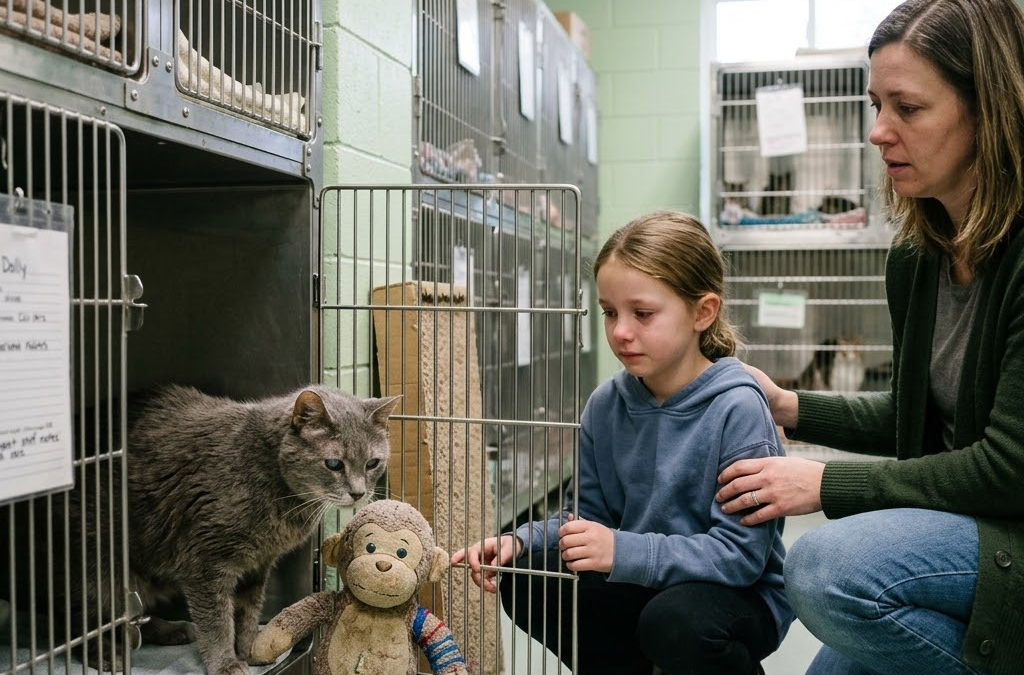
She was big, gray, and round through the middle. One ear folded at the tip. Her fur was patchy in places, as if she had been grooming herself too much from stress. Her eyes were cloudy at the edges but still gentle, and she had the expression of someone who had long ago stopped expecting doors to open for her.
She was asleep with both front paws wrapped around a stuffed monkey.
The monkey was old and ugly.
Its brown fabric had faded to a tired beige. One button eye did not match the other. Its arm had been sewn back on with blue thread, then red thread, then what looked like white fishing line. The poor thing had clearly survived several wars and lost most of them.
I stopped walking.
Ella stopped too.
Dolly opened one eye.
She did not rush to the cage door.
Did not meow.
Did not perform.
She simply lifted her head and tightened her paws around that monkey like it was the last thing in the world that had stayed.
A volunteer came over softly.
“That’s Dolly.”
I asked how long she had been there.
The volunteer looked down before answering.
“Almost six years.”
Six years.
The words settled between us.
Six years of people walking past her cage.
Six years of hearing other cats get chosen.
Six years of families pointing at kittens and saying, “That one.”
Six years of sleeping with a torn stuffed monkey because, apparently, nobody else had come back.
The volunteer told us Dolly had arrived with the monkey. Nobody knew much about her life before the rescue. But every time someone opened her cage, Dolly picked up the monkey and carried it to them.
Like a gift.
Like a promise.
Like she was saying, I don’t have much, but you can have my best thing if you take me home.
Ella crouched in front of the cage.
Dolly stood slowly.
Her back legs were stiff. She stepped over her blanket, picked up the monkey in her mouth, and walked to the door.
Then she dropped it right in front of Ella.
My daughter pressed her fingers against the bars.
“Mom,” she whispered, “she’s been waiting longer than me.”
I could not speak.
Because I knew what she meant.
Ella had been waiting too.
Waiting for home to feel normal again.
Waiting for me to stop crying behind closed doors.
Waiting for her father to keep a promise he kept postponing.
Waiting for someone to stay.
I wanted to say yes right away.
But fear is loud when you are already exhausted.
I thought about vet bills.
I thought about Dolly being old.
I thought about Ella loving her and losing her.
I thought a kitten would be safer.
Younger.
Easier.
Less complicated.
Then Dolly reached one paw through the bars.
Not toward me.
Toward Ella.
Just one soft, careful paw.
Ella slid her small hand under it.
And for the first time in months, my daughter cried in a way that sounded like healing instead of breaking.
We brought Dolly home that afternoon.
She did not explore like a kitten would have.
She walked slowly through our apartment, still carrying the monkey. She sniffed the couch. Looked into the kitchen. Stared at the empty corner near the window as if deciding it would do.
Then she placed the monkey there and sat beside it.
Like she had claimed the first safe place she could find.
That night, Ella had one of her bad nights.
I heard her crying quietly in her room.
Before I could get up, Dolly was already moving down the hall, monkey dragging under her chin.
She jumped onto Ella’s bed with a heavy grunt, dropped the monkey beside her, and curled against my daughter’s stomach.
No magic happened.
The hurt did not disappear.
The divorce was still real.
The empty chair at dinner was still empty.
The apartment was still small.
The bills still came.
But Ella placed one hand on Dolly’s back, and after a while, her breathing slowed.
From then on, Dolly became part of our little home.
Every morning, she waited by Ella’s shoes.
Every evening, she carried the monkey into the living room and dropped it between us like she was calling a family meeting.
If I came home exhausted, Dolly sat beside my purse.
If Ella had a rough day, Dolly slept outside her door.
She was not playful in the way kittens are playful.
She did not bounce off walls.
She did not chase toys across the room.
She snored.
She shed.
She sometimes missed the couch when she tried to jump, then looked offended as if gravity had personally insulted her.
But she loved like she had been saving it for years.
One Sunday, I found Ella sitting on the rug with a needle and purple thread.
The monkey had a new rip along its side.
“What are you doing?” I asked.
She did not look up.
“Fixing him.”
Her small brow furrowed in concentration.
“I don’t want Dolly to think old things get thrown away.”
I turned toward the sink so she would not see my face.
Because I had felt old too.
Not in years.
In spirit.
Used up.
Tired.
Too complicated.
Not the kind of person anyone would choose first.
But Dolly chose us every day.
She chose our secondhand couch.
Our quiet dinners.
Our imperfect little life.
She chose Ella on the hard nights.
She chose me when I came home too tired to speak.
Six months passed.
Dolly still carried the monkey everywhere.
But not like she was afraid anymore.
Now she carried it with pride.
She dropped it on Ella’s pillow before school.
She left it by my work shoes before I left.
At night, she slept between us, one paw resting on that monkey, her old eyes finally peaceful.
People said we rescued Dolly.
I guess that was true.
But the part nobody saw was this:
Dolly walked into our home carrying a torn-up toy after waiting six years for someone to want her.
And somehow, that old gray cat taught my daughter and me that being passed over does not mean you are unlovable.
Sometimes love is late.
But when it finally finds you, it knows exactly where to sit.
Three days after Dolly finally stopped sleeping like she might be taken back, the shelter called.
Someone was asking for her.
Not just any cat.
Her.
Her old name.
Her old story.
Her old life.
I was standing in our kitchen with a sink full of dishes and Dolly’s stuffed monkey lying beside my work shoes like a small, torn warning.
Ella was at the table doing homework.
Dolly was under her chair, snoring softly, one paw resting on Ella’s sock.
When my phone rang and I saw the shelter’s number, my stomach dropped before I even answered.
That is how life works sometimes.
Your heart knows trouble before your head gets the details.
“Hi,” the volunteer said carefully. “Is this Rachel?”
“Yes.”
“I don’t want to scare you. Dolly is fine. This is not about anything you did wrong.”
That did not help.
When people start with “don’t worry,” they are usually standing beside the very thing you are supposed to worry about.
I stepped into the hallway so Ella would not hear.
But Ella heard anyway.
Children who have been hurt become experts at listening through walls.
The volunteer took a breath.
“We posted Dolly’s adoption update on our page last week. Just a small one. Her picture with the monkey. A woman contacted us. She says she knew Dolly before she came here.”
My throat went dry.
“Knew her how?”
“She says Dolly belonged to her grandmother.”
I looked back toward the kitchen.
Dolly was awake now.
She had lifted her head like she knew the sound of her own past.
The volunteer continued.
“She recognized the stuffed monkey. She called it Mr. Buttons.”
Mr. Buttons.
That silly name hit me harder than it should have.
Because suddenly the monkey was not just Dolly’s strange little toy.
It had a name.
A history.
Hands that had held it before ours.
Thread sewn by people who loved enough to repair instead of replace.
“What does she want?” I asked.
There was a pause.
The pause told me more than the answer.
“She wants to talk to you.”
My first instinct was no.
Not because I was cruel.
Because I was afraid.
I had built a tiny, careful peace in that apartment.
Dolly had helped us breathe again.
Ella had started drawing on the fridge again.
Not big drawings.
Not cheerful ones yet.
Little things.
A cat sleeping on a moon.
A girl holding a gray balloon.
A crooked stuffed monkey wearing a crown.
It was not everything.
But it was something.
And now a stranger had reached through a phone call and touched the door of our home.
“Is she asking for Dolly back?” I whispered.
The volunteer did not answer quickly enough.
“She says her grandmother has never stopped asking about her.”
I closed my eyes.
In the kitchen, Ella said, “Mom?”
I turned.
She stood there in her socks, pencil still in her hand.
Dolly stood beside her with the monkey in her mouth.
The old gray cat looked at me with those cloudy eyes.
Like she had already been through this once.
Like she knew people sometimes discussed your life above your head.
I told the volunteer I needed time.
Then I hung up and sat on the hallway floor because my knees did not feel steady.
Ella did not ask what happened right away.
She came and sat across from me.
Dolly walked between us and dropped the monkey in the middle.
For a moment, none of us moved.
Then Ella said, very quietly, “Somebody wants her.”
I could have lied.
I could have said it was nothing.
Parents do that too.
We hide hard things and call it protection.
But children always know when the room has changed.
So I told her.
Not all of it.
Just enough.
A woman believed Dolly used to belong to her grandmother.
The grandmother had loved Dolly.
She had recognized the monkey.
Ella stared at the toy.
Its mismatched button eyes stared back.
Then my daughter said the sentence I had been thinking but felt too ashamed to say.
“She had six years.”
I did not answer.
“She had six years, Mom.”
“I know.”
“And nobody came.”
“I know.”
“She was in that cage with him for six years.”
“I know, baby.”
Ella picked up the monkey and held it against her chest.
Dolly watched her.
Not upset.
Just watching.
The way older animals do, like they understand people need time to catch up to simple truths.
Ella’s voice cracked.
“She’s ours now.”
I wanted to say yes.
I wanted to shut the whole thing down and protect my daughter from another goodbye.
But somewhere there was another woman.
Maybe old.
Maybe lonely.
Maybe still looking for a gray cat who had vanished from her lap.
And there was something ugly in me that did not want to think about that woman at all.
Because her pain threatened mine.
Because her love threatened ours.
That was the first time I understood that love is not always soft.
Sometimes love walks into a room carrying two broken hearts and asks which one should bleed less.
The woman’s name was Nora.
She was not Dolly’s first owner.
She was the granddaughter.
She called two nights later, after I avoided the number all day and finally admitted avoidance was not the same as peace.
Her voice was younger than I expected.
Tired, but gentle.
She said her grandmother’s name was Elaine.
She said Dolly had lived with Elaine for years in a small yellow house with a screened porch.
Back then, Dolly was called Daisy.
I almost laughed when she said it.
Daisy.
Our big gray cat with one bent ear and a snore like a tiny engine had once been named Daisy.
Nora said Elaine used to sit on the porch every evening with Dolly in her lap and that monkey tucked beside them.
The monkey had belonged to Nora when she was little. She had left it at Elaine’s house one summer. Dolly found it in a laundry basket and claimed it.
After that, nobody could touch it without permission.
Six years earlier, Elaine had fallen at home.
Nothing dramatic.
No villain music.
Just an older woman alone in a hallway.
Then doctors.
Then rehab.
Then a smaller room in a care home.
The family thought it would be temporary.
People always think life will return to the last place it made sense.
It often does not.
Nora had been sixteen then, living in another state with her mother. Elaine’s son, Nora’s uncle, handled the house.
He could not keep Dolly.
Or would not.
Nora did not say it with hate.
That somehow made it worse.
“He told Grandma Daisy was staying with a friend,” Nora said. “Then he took her to the rescue with the monkey because he thought it would help her settle.”
I pressed my fingers to my forehead.
“She was there six years.”
“I know.”
“She waited six years.”
“I know.”
Nora’s voice broke on the second one.
Then she said, “My grandmother never fully knew. She kept asking when Daisy was coming home.”
I looked at Ella’s bedroom door.
It was closed, but the light was on underneath.
She was supposed to be asleep.
She was not.
I knew that without checking.
Nora said she had recently moved closer to Elaine. She had been going through old photos to make her grandmother a memory book.
A gray cat.
A monkey.
A porch.
A woman smiling with her whole face.
Then she saw the shelter post.
Dolly, older and rounder, sitting on Ella’s bed with Mr. Buttons under her chin.
“She knew her immediately,” Nora said. “My grandmother doesn’t remember every name anymore, but when I showed her the picture, she said, ‘That’s my Daisy. She found her monkey.’”
There are sentences you wish you had never heard because once they enter you, they rearrange the furniture.
I asked again, “Are you asking for her back?”
Nora was quiet.
Then she said, “I don’t know what I’m asking.”
That honesty hurt more than pressure would have.
“She’s adopted,” I said.
“I know.”
“She’s bonded with my daughter.”
“I can see that.”
“My daughter has already lost enough.”
“I’m not trying to take her.”
But she was.
Even if she did not mean to.
Even if she only wanted a chance.
Even if she was trying to do something kind for one old woman.
She was still standing on the other side of my life asking whether love could be divided without tearing.
Nora asked if we would consider one visit.
Just one.
At Elaine’s care home.
No promises.
No decisions that day.
Only a chance for Elaine to see Dolly again.
I almost said no.
The word was right there.
Simple.
Protective.
Easy.
Then Dolly woke up, slid off the back of the couch with no grace at all, and padded toward Ella’s room. She pushed the door open with her nose.
A small hand reached out from the darkness and touched Dolly’s head.
I heard Ella whisper, “Come here, old lady.”
Dolly went in.
The door stayed cracked.
I looked at the monkey on the floor.
I thought about Elaine asking for six years.
I thought about Dolly waiting for six years.
I thought about Ella, who had learned too young that adults can leave even when they promised they would not.
“I’ll think about it,” I told Nora.
That was all.
Not yes.
Not no.
The most dangerous answer in the world.
Maybe.
The visit was scheduled for Sunday.
I told Ella on Friday.
She did not cry.
That was worse.
She sat very still on the floor beside Dolly and kept petting the same spot over and over.
Dolly tolerated it with the patience of a grandmother and the expression of a cat who had endured foolish humans before.
“I’m going with you,” Ella said.
“I think you should.”
“And Dolly comes home with us.”
“Yes.”
“Promise.”
There it was.
The dangerous word.
I could promise what I controlled.
I could not promise what seeing Elaine would do to Dolly.
I could not promise what seeing Dolly would do to Ella.
But I looked at my daughter’s face and knew this was not the moment for careful adult language.
So I said, “Dolly comes home with us.”
Ella nodded once.
Then she picked up the monkey and examined its side.
A seam had opened again.
“I need to fix him first,” she said.
She chose yellow thread.
Bright yellow.
Almost cheerful.
The care home was not gloomy.
That surprised me.
It was small and plain, with potted plants near the entrance and paper flowers taped to the windows. Nora met us outside wearing a cardigan with a loose button and tired eyes.
She was not a villain.
I hated that.
It would have been easier if she were.
She crouched slightly when she spoke to Ella.
“You must be Ella.”
Ella held the carrier handle with both hands.
Her knuckles were white.
“This is Dolly,” she said.
Not Daisy.
Dolly.
Nora heard it.
I could tell.
“She’s beautiful,” Nora said.
Ella looked down at the carrier.
Dolly had her face pressed against the little door, looking offended by travel and life in general.
“She’s old,” Ella said.
Nora smiled sadly.
“Old can still be beautiful.”
That was the first time Ella looked at her.
Just for a second.
Inside, Elaine waited in a small sitting room by the window.
She was thinner than I expected.
Her white hair was clipped back. Her hands rested on a blanket over her knees. On the table beside her was a framed photo.
A younger Elaine on a porch.
A younger Dolly in her lap.
The monkey tucked under one gray paw.
I saw Ella see it.
I saw her world get more complicated.
Until that moment, Dolly’s past had been an idea.
Now it had a face.
Elaine looked up when we entered.
For a second, her eyes were cloudy and uncertain.
Then Dolly made a sound from inside the carrier.
Not a meow.
Not exactly.
A low, rough chirp from deep in her chest.
Elaine’s hands trembled.
“Daisy?”
Ella went stiff.
I placed the carrier on the floor.
No one moved.
Dolly pressed her nose against the little door.
I opened it.
She did not rush out.
She stepped carefully, one paw at a time, as if crossing a bridge only she could see.
She sniffed the rug.
Looked at Nora.
Looked at me.
Then Elaine whispered, “There’s my girl.”
Dolly froze.
Her ears tipped forward.
The bent one folded even more.
Then she walked to Elaine’s chair.
Slowly.
Stiffly.
With all the dignity of an old cat trying not to show how much her bones ached.
Ella grabbed my hand.
Dolly reached Elaine’s feet, looked up, and gave one cracked little meow.
Elaine bent forward and began to cry.
Not loudly.
Not dramatically.
Just tears slipping down a lined face while her hands reached for a cat she thought life had taken forever.
Nora helped lift Dolly into Elaine’s lap because Elaine’s hands were not strong enough.
The second Dolly settled there, she tucked her head under Elaine’s chin.
And I knew.
Dolly remembered.
Ella’s hand crushed mine.
For a moment, Dolly seemed content.
Then she lifted her head and looked around.
Her eyes found the carrier.
She made another sound.
Ella understood before any of us.
She picked up the monkey.
Her face was pale.
She walked toward Elaine like each step cost her something.
“Here,” she said.
Elaine looked at the toy.
“Oh,” she whispered. “Mr. Buttons.”
Ella held it out.
Dolly leaned forward, took the monkey carefully in her mouth, and dropped it on Elaine’s lap.
Right between Elaine’s hands.
Like a gift.
Like a promise.
Like she was saying the same thing she had said to Ella at the shelter.
I don’t have much, but you can have my best thing.
That was when Ella walked out of the room.
I found her in the hallway by a vending machine, arms wrapped around herself.
She was not crying yet.
She was fighting too hard.
“I hate this,” she said.
“I know.”
“She loves her.”
“Yes.”
Ella looked at me with a hurt so raw it made the floor feel unsteady.
“Does that mean she loves me less?”
“No.”
“You don’t know that.”
“I know love doesn’t work like that.”
“That’s what people say when they want you to share something you can’t share.”
I had no answer.
Because part of me agreed.
We ask children to be generous with their hearts because adults failed to be responsible with theirs.
And sometimes we dress that up as maturity.
I crouched in front of her.
“You do not have to be okay right now.”
Her eyes filled.
“If she wants to stay, what happens?”
“Ella.”
“What happens?”
The promise sat between us.
Dolly comes home with us.
“We will not make a decision today,” I said.
“That’s not an answer.”
“No,” I whispered. “It’s the only honest one I have.”
She wiped her face hard with her sleeve.
Then she said something I will never forget.
“Why do kids always have to be the ones who understand?”
I had no defense.
Because she was right more often than adults like to admit.
We expect children to understand divorce.
Money.
Tired parents.
Changed plans.
Broken promises.
We expect them to understand why the thing they love must be shared, delayed, returned, or lost.
Then we praise them for being strong when what we really mean is they had no choice.
When we went back into the room, Dolly was still on Elaine’s lap.
But her eyes were on the doorway.
On Ella.
The moment Ella stepped inside, Dolly lifted her head.
Elaine looked from Dolly to Ella.
Then to me.
“You’re the little girl,” she said.
Ella froze.
Nora touched Elaine’s shoulder.
“Grandma, this is Ella. Dolly lives with her now.”
Elaine looked confused.
“Lives with her?”
“Yes,” Nora said softly.
Elaine stroked Dolly’s head.
Then looked at Ella again.
“Does she sleep at your feet?”
Ella swallowed.
“Sometimes on my stomach.”
Elaine smiled.
“She always did like to be heavy.”
Ella almost smiled back.
Almost.
Elaine touched the monkey.
“I sewed this arm three times.”
Ella looked at the yellow stitches she had added.
“I sewed the side.”
“With yellow?”
Ella nodded.
Elaine studied it.
“That is a brave color.”
Something shifted then.
Not solved.
Not healed.
Just shifted.
As if the room had made space for more than one kind of sadness.
We stayed forty minutes.
Dolly moved between Elaine’s lap and Ella’s feet.
Not choosing.
Or maybe choosing both.
That was the hard part.
Outside, Nora walked us to the car.
Her eyes were red.
“I’m sorry,” she said.
I believed her.
That made everything harder.
Then she said what I had feared all week.
“The care home allows small pets now in certain rooms.”
My stomach dropped.
Ella heard.
“She’s Dolly,” my daughter said sharply.
“I know.”
“No, you don’t. She’s Dolly when she waits by my shoes. She’s Dolly when she snores. She’s Dolly when she drops the monkey on my pillow. You don’t get to come back after six years and make her Daisy again.”
Nora took the words like she knew she deserved some of them, even if she had not caused the original wound.
“You’re right,” she said.
That surprised Ella.
Nora’s voice shook.
“I was a kid too when it happened. I should have asked more questions. I should have pushed harder. I didn’t. And my grandmother lost her cat.”
Ella looked away.
“But I’m asking now because I have to,” Nora continued. “Not because I think Dolly isn’t loved. I can see she is. If there is any chance of visits, weekends, a shared arrangement—anything—I would be grateful. And if your answer is no, I will have to accept that.”
A shared arrangement.
Weekends.
A schedule for a cat who had finally stopped looking over her shoulder.
It sounded reasonable.
It sounded impossible.
On the drive home, Ella did not speak.
Her hand stayed inside the carrier door, two fingers touching Dolly’s fur like she was making sure Dolly had not vanished.
That night, Dolly did something strange.
She did not sleep in Ella’s room.
She carried the monkey to the front door and lay down there.
Ella found her first.
“Mom.”
I came out and saw Dolly curled on the mat, body around the monkey, eyes open.
Not crying.
Not pacing.
Just waiting.
Ella looked at me with terror.
“She wants to go back.”
“We don’t know that.”
But my voice was not strong.
Dolly had slept by the door when we first brought her home.
Back then, the shelter volunteer told us some animals do that.
They wait to see if the next leaving is theirs.
She had stopped after two weeks.
Now she was back at the door.
Ella whispered, “Maybe she misses her.”
I said nothing.
Because that was the first generous thing Ella had said about Elaine, and I did not want to step on it.
The next few days were awful in the quiet way.
Nothing happened.
That was the problem.
No big scene.
No clear sign.
Just Dolly moving through the apartment with a restlessness we had not seen before.
She ate.
She slept.
She still followed Ella.
But twice she carried the monkey to the door.
Once she stood in the hallway and made that rough little chirping sound.
Ella heard it and went into her room.
I found her lying on the floor beside her bed, facing the wall.
“I don’t want to be selfish,” she said.
“You’re not selfish.”
“I feel selfish.”
“That’s different.”
She rolled over.
“If Dolly wants to be with Elaine, then keeping her is wrong.”
I sat beside her.
“If Dolly wants to be with you, then giving her away is wrong.”
“So what do we do?”
I wished my mother were alive.
I wished someone older and wiser could walk in, set a casserole on the counter, and tell me what the decent thing was.
But some rooms are yours alone.
Some decisions do not come with a witness.
“I think,” I said slowly, “we stop asking who deserves Dolly.”
Ella frowned.
“I think we ask what kind of life gives Dolly the most peace.”
Ella was quiet.
“She’s old,” I said. “She has already been moved, left, caged, and moved again. Maybe peace matters more than fairness.”
“That sounds like we keep her.”
“Maybe.”
“Or maybe peace is Elaine.”
“Maybe.”
“That’s not helping.”
“I know.”
Then Dolly walked in, dragging the monkey by one leg.
She stepped onto Ella’s blanket, dropped the monkey on Ella’s knee, and sat down with a tired huff.
Ella looked at her.
Dolly looked back.
Then Dolly put one paw on Ella’s leg.
Just one.
Soft.
Careful.
The same way she had done through the shelter bars.
Ella broke.
She cried into Dolly’s fur.
Dolly endured it with her usual old-lady patience.
The next morning, I called Nora.
I told her we could not do weekends.
Dolly had just settled.
We could not pass an old cat back and forth like a backpack.
Nora was quiet.
Then she said, “I understand.”
But I was not finished.
I told her we could do visits.
Once a month at first.
Maybe more if Dolly handled them well.
Always with Ella there.
Always with Dolly coming home afterward.
Nora cried.
Not loudly.
Just one breath that cracked.
“Thank you.”
“Don’t thank me yet,” I said.
Because I did not feel noble.
I felt sick.
Protective.
Uncertain.
I felt like half the people who heard the story would say I was doing the right thing and the other half would say I was being cruel to an old woman.
And maybe both sides would have a decent argument.
That is the part people do not like about real life.
Sometimes the comments section in your own head is already fighting before anyone else says a word.
The second visit was different.
Elaine was having a cloudy day.
That is what Nora called it.
She smiled when we arrived, but she did not say Daisy right away.
Dolly came out of the carrier, looked around, and went straight to Ella.
Ella’s shoulders lowered.
I saw relief pass through her whole body.
Then Elaine noticed the monkey.
Her eyes sharpened.
“Mr. Buttons,” she said.
Dolly picked it up and carried it to her.
Not rushing.
Not desperate.
Just sharing.
Elaine laughed.
A small, bright laugh.
Ella smiled despite herself.
After that, the visits became part of our lives.
Not easy.
But real.
Once a month.
Then twice.
Dolly seemed to understand the routine better than any of us.
Carrier meant car.
Car meant Elaine.
Elaine meant extra chin scratches and a woman who cried into her fur.
Home meant Ella.
Ella meant pillow.
Pillow meant the place Dolly chose at night.
That word mattered.
Chose.
I watched closely.
Too closely, maybe.
I looked for signs of distress.
Signs of longing.
Signs of betrayal.
But Dolly was not a symbol.
She was a cat.
Some days she wanted Elaine’s lap.
Some days she wanted to sit under Ella’s chair and ignore everyone.
Some days she carried the monkey into the hallway and left it there like she had lost interest in all human drama.
Slowly, Ella changed too.
At first, she sat through visits like a guard.
Arms folded.
Eyes on Dolly every second.
Then one afternoon, Elaine asked about school.
Ella gave one-word answers.
The next time, two-word answers.
A month later, Elaine asked if Ella still sewed.
“A little,” Ella said.
Elaine asked to see the monkey.
Ella handed it over.
Elaine examined the stitches like a judge at a county fair.
“The yellow is holding,” she said.
Ella glowed.
Then Elaine showed her how to make smaller stitches.
Nora brought a little sewing kit in a cookie tin with no brand name on it.
Elaine’s hands shook, so Ella had to thread the needle.
Dolly sat between them looking deeply proud of herself, as if she had arranged the whole class.
Maybe she had.
One Sunday, Elaine told Ella, “People kept telling me Daisy was just a cat.”
Ella looked up.
Elaine’s face had gone distant, but her voice was clear.
“They said I should be grateful for people. Grateful for care. Grateful for meals. And I was. But I still missed my cat.”
Ella nodded.
“I missed my dad when he left,” she said.
The room went still.
I had not expected her to say it.
Not there.
Not to Elaine.
Maybe not to anyone.
Elaine looked at her for a long moment.
Then she said, “Of course you did.”
That was all.
No lecture.
No explanation.
No telling her to be strong.
Just four words that gave my daughter permission to miss someone who had made choices that hurt her.
Ella leaned against the chair.
Dolly climbed halfway onto her lap and halfway onto Elaine’s foot.
It was uncomfortable for everyone except Dolly.
Nobody moved.
After that day, Ella started asking to bring things to Elaine.
A drawing.
A cookie from a batch we baked too long.
A purple thread spool because Elaine had said purple was a royal color.
The relationship did not fix everything.
Nothing does.
But it gave Ella something divorce had taken from her.
A safe adult who did not require her to pretend.
Then came the shelter event.
The rescue held a small gathering for people who had adopted older cats.
They asked if we would come with Dolly.
I said no at first.
Dolly was not a mascot.
Ella was not a poster child.
Our pain was not decoration for a donation table.
The volunteer understood.
Then she said, “Some people only come for kittens. Sometimes seeing a family with a senior cat changes one mind.”
That got me.
One mind.
One cage.
One old animal holding one torn toy.
I asked Ella.
She surprised me by saying yes.
“Dolly should show them she got a family,” she said.
So we went.
The shelter looked the same.
Faded paint.
Bell on the door.
Laundry soap, cat food, and hope.
The kitten room was full again.
Of course it was.
Tiny orange ones.
Fluffy black ones.
A white kitten climbing something it should not have been climbing.
Families smiled.
Children pointed.
Parents used the same voice I had once used.
“We’re only looking.”
Ella looked at me.
We both knew better.
Dolly was placed in a quiet corner on a blanket with her carrier open and the monkey beside her.
She stepped out, sniffed the blanket, and immediately sat on the monkey like a queen on a very sad throne.
People came by.
Some smiled politely.
Some said, “Aw, she’s sweet.”
Then they moved on to the kittens.
I felt my old anger rise.
Not at them exactly.
At the world.
At the way we treat young things like promise and old things like risk.
At the way we want love to arrive shiny, easy, and low-maintenance.
At the way we ask, “How long will I have?” before we ask, “How deeply can I love?”
Then a man in a clean jacket stopped with his daughter.
The girl looked about ten.
She stared at Dolly for a long time.
The man read the little card the shelter had made.
“Six years?” he said.
The volunteer nodded.
“She waited a long time.”
“That’s sad.”
His daughter crouched.
Dolly opened one eye.
The girl whispered, “She has a monkey.”
Ella stood a little taller.
“His name is Mr. Buttons.”
The girl smiled.
The man said, not unkindly, “We were thinking of a younger cat. You know, for the kids. Something with more time.”
There it was.
The practical sentence.
The common one.
The one I had once thought myself.
Something with more time.
Ella looked at Dolly.
Then at the man.
“She had time,” Ella said.
The man blinked.
Ella’s voice was steady.
“Six years of it. Nobody wanted it.”
The volunteer looked down, hiding a smile.
The man’s face turned a little red.
I started to step in, but Ella kept going.
“I used to think longer was better too. But sometimes longer just means more days being lonely.”
The little girl reached one finger toward Dolly.
Dolly sniffed it.
Then pushed her head against it.
The girl’s face changed.
Not huge.
Not dramatic.
Just open.
The man watched.
I could see the adult math happening in his face.
Years.
Costs.
Loss.
Convenience.
Then his daughter said, “Dad, what if she’s been waiting for us?”
He looked terrified.
I almost laughed.
Because that is how it starts.
A child asks the question that ruins every practical plan.
They did not adopt Dolly, of course.
Dolly was ours.
But they stayed.
They asked about another older cat in the back room.
A thin black one with a white chin and a grumpy face.
I do not know if they took him home that day.
I only know they stopped walking straight to the kittens.
Sometimes that is the first miracle.
Not adoption.
Attention.
That winter, Elaine got quieter.
Nora told me before one of our visits.
She did not make it dramatic.
She just said her grandmother was spending more time tired now.
Some days she remembered Dolly.
Some days she only remembered the feeling of her.
We kept going.
Even when it was inconvenient.
Even when I had worked late the night before.
Even when Ella had homework.
Even when Dolly complained in the carrier like she was being shipped across the ocean instead of twelve minutes across town.
One afternoon, Elaine did not remember my name.
She did not remember Nora’s at first either.
But when Dolly stepped out of the carrier, Elaine smiled.
Not with recognition exactly.
With comfort.
Like her heart knew what her mind could not reach.
Dolly climbed into her lap and settled there.
The monkey stayed beside Ella.
That was new.
Ella noticed.
Elaine noticed too.
She looked at the monkey.
Then at Ella.
“You keep him,” Elaine said.
Ella froze.
Nora’s eyes filled.
“Grandma?”
Elaine touched Dolly’s back.
“She found her girl.”
The room seemed to hold its breath.
Ella shook her head.
“No. He’s Dolly’s.”
Elaine smiled faintly.
“Then you both keep him.”
Ella looked at me.
I could not speak.
Elaine said, “Old things need someone who won’t throw them away.”
Ella sat on the edge of the chair.
“I won’t.”
“I know,” Elaine said.
And I think she did.
Maybe not the full story.
Maybe not every name.
But she knew the important thing.
Dolly was loved.
The monkey was mended.
The little girl understood.
A few weeks later, Nora called early in the morning.
Elaine had passed peacefully in her sleep.
There are losses that belong to you directly.
And there are losses that enter through a side door because someone you love is grieving.
Ella cried for Elaine.
Not the way she had cried after the divorce.
Not like the floor was gone.
But like someone had mattered and now they were gone.
That is a healthier kind of grief, if grief can be healthy.
It hurts because love was real.
We went to a small remembrance gathering at the care home.
No big service.
No speeches that tried too hard.
Just Nora, a few residents, two staff members, us, and Dolly in her carrier because Nora had asked.
At the end, Nora handed Ella a small envelope.
Inside was a photo.
Elaine on the porch.
Dolly when she was younger.
Mr. Buttons under her paw.
On the back, in shaky handwriting, Elaine had written:
For the girl who fixed what others forgot.
Ella read it three times.
Then pressed the photo to her chest.
Dolly, who had been sleeping through the emotional weight of the room, chose that moment to wake up and sneeze loudly.
Everyone laughed.
Even Nora.
Especially Nora.
That laugh saved the moment from becoming too heavy.
Life has a way of doing that.
It lets a cat sneeze in the middle of grief.
After Elaine was gone, Dolly stopped carrying the monkey to the door.
For a while, she kept it mostly on Ella’s bed.
Then one evening, she dragged it into the living room and dropped it between us.
Our family meeting.
Ella was on the couch.
I was folding laundry.
Dolly sat in front of us and looked from one to the other.
“What?” Ella asked her.
Dolly blinked.
Ella leaned down and picked up the monkey.
The yellow stitches were still holding.
So were the purple ones.
And the old blue ones.
And the red.
And the strange white fishing line from before our time.
That monkey was not pretty.
It was barely a monkey anymore.
It was a record of everyone who had refused to throw it away.
Ella ran her thumb over the seams.
Then she said, “Maybe this is what family looks like.”
I looked at her.
“What do you mean?”
She held up the monkey.
“Not matching. Fixed a lot. Still here.”
I turned toward the kitchen because some habits do not change.
I still did not always want her to see me cry.
But she saw.
She always did.
Dolly, unwilling to be left out of an emotional scene, wedged herself between our feet and sat on one of my slippers.
That became our life.
Not perfect.
Not healed in the clean way people like to imagine.
Ella still missed her father sometimes.
I still got tired.
Bills still came.
The carpet still looked terrible.
Dolly still shed enough fur to build a second cat.
But our home felt less like a place we had landed after losing something.
It felt like a place we were building.
Piece by piece.
Thread by thread.
A few months later, Ella asked if we could go back to the shelter.
I stopped stirring pasta.
“Why?”
She shrugged too casually.
“Just to look.”
I pointed the spoon at her.
“We both know what that means.”
She smiled.
A real smile.
Not polite.
Not careful.
Real.
“I don’t mean for us,” she said. “I mean for them.”
So we started going once a month.
Not to adopt another cat.
Our apartment was small, and Dolly had made it clear she was not accepting roommates unless they came with excellent references and no interest in her monkey.
We went to sit with the older cats.
Ella read to them.
Not baby books.
Her own books.
Mystery stories.
Science facts.
Sometimes homework she did not want to do.
The cats did not care.
They liked her voice.
One old tabby climbed into her lap every time and fell asleep before page two.
A long-haired white cat hissed at everyone except Ella, which Ella took as a compliment.
The volunteer once said, “You have a gift.”
Ella shook her head.
“They just know I won’t rush them.”
That was true.
She had become patient in a way no child should have to learn early.
But she had turned it into kindness instead of bitterness.
I was proud of her.
And sad for what it had cost.
Both things can be true.
That became the message I wish more adults understood.
Two things can be true.
Elaine loved Dolly.
Ella needed Dolly.
Nora waited too long.
Nora also tried to make it right.
I wanted to protect my daughter.
I also needed to teach her compassion.
Dolly had been abandoned.
Dolly was also deeply loved.
Keeping her was right.
Sharing her was right too.
Life is not always a courtroom.
Sometimes nobody needs to be sentenced.
Sometimes everyone is carrying a piece of the same broken thing.
Dolly lived with us for two more years.
That sounds short when I write it.
It did not feel short while we lived it.
It felt full.
Full of morning shoes.
Full of monkey deliveries.
Full of couch misses and offended looks.
Full of Ella growing taller and Dolly growing slower.
Full of ordinary Tuesdays, which I now believe are some of the holiest things a family can have.
Dolly’s fur got thinner.
Her cloudy eyes clouded more.
She slept deeper.
She still carried the monkey, but sometimes only halfway down the hall before needing a break.
Ella would pick up both Dolly and the monkey and say, “Come on, Grandma. I’ve got you.”
Dolly accepted this service as her due.
By then, Ella was not the same girl who had walked into the shelter looking politely at kittens.
She sang again.
Not loudly.
Not every day.
But sometimes I heard her in the bathroom, making up songs about Dolly being shaped like a loaf of bread.
She drew pictures on the fridge.
She left notes in my lunch bag.
Once, she drew Dolly wearing a crown and Elaine sitting beside her on a cloud with a sewing needle.
I kept that one.
I will always keep that one.
When Dolly’s last season came, it came gently.
I will not make it sound prettier than it was.
It hurt.
Of course it hurt.
Love always sends a bill.
But it was not the kind of hurt that makes you regret.
That is the difference.
Ella and I sat with Dolly on the living room rug one quiet evening.
The monkey was tucked under her chin.
Dolly’s breathing was slow.
Her old body was tired.
Ella stroked the bent ear.
She was crying, but she did not look broken.
She looked heartbroken.
There is a difference.
Broken means love destroyed you.
Heartbroken means love mattered.
Ella whispered, “Thank you for waiting for us.”
Dolly opened her eyes.
Just a little.
Then she placed one paw on the monkey and one paw on Ella’s hand.
Soft.
Careful.
The same paw that had reached through the shelter bars.
The same paw that had chosen my daughter when both of them were still waiting.
We said goodbye with the monkey beside her.
Later, Ella asked if we should bury it with her.
I told her it was her choice.
She held Mr. Buttons for a long time.
Then shook her head.
“No,” she said. “He still has work.”
So the monkey stayed.
He sits now on Ella’s bookshelf.
Not as a toy.
Not exactly.
As proof.
Proof that old things can be loved.
Proof that repaired does not mean ruined.
Proof that being passed over does not mean the story is finished.
Sometimes when Ella has a hard day, she still takes him down and holds him.
Sometimes I do too.
We did not rush back to the shelter after Dolly.
For a while, the apartment felt too quiet.
No snoring.
No gray fur on my black pants.
No monkey dropped in inconvenient places.
No small warm weight against Ella’s stomach on bad nights.
Grief made space slowly.
That is another thing people rush.
They want you to replace what you lost so you can smile again.
But love is not a broken lamp.
You do not swap it out and call the room fixed.
You let the darkness be dark for a while.
Then one Saturday, almost a year later, Ella stood by the door with her shoes on.
She was holding Mr. Buttons.
“Can we go look?” she asked.
I looked at the monkey.
Then at my daughter.
I knew what parents say when they are already half ready.
“We’re only going to look.”
She smiled.
This time, her face lit up before we even got there.
The shelter still smelled like laundry soap, cat food, and hope that had been waiting too long.
The kitten room was full.
Of course it was.
Tiny orange ones.
Fluffy black ones.
A white kitten climbing up the side of a playpen like every white kitten in the world had signed the same contract.
Ella smiled at them.
Really smiled.
Then she walked past.
To the last row.
To the older cats.
To the ones people paused at, sighed over, and left behind.
She stopped in front of a cage where a large brown tabby sat with his back turned.
His card said he was eleven.
His face said he had no interest in being interviewed.
Ella crouched.
The cat did not turn around.
She placed Mr. Buttons near the bars.
I held my breath.
The old tabby looked over his shoulder.
He stared at the monkey.
Then at Ella.
Then he stood slowly, walked to the front, and touched the monkey with one paw.
Ella looked up at me.
Her eyes were full.
Not empty.
Not desperate.
Full.
“Mom,” she whispered, “I think Dolly sent us someone grumpy.”
I laughed.
Then I cried.
Then I laughed again.
Because sometimes love is late.
Sometimes love is old.
Sometimes love has bad hips, cloudy eyes, a torn-up monkey, and terrible timing.
But when it finally finds you, it does not always fix your life.
It does something better.
It sits beside you while you learn how to live it.
And if you are lucky, it teaches you to leave the last row a little less lonely than you found it.








