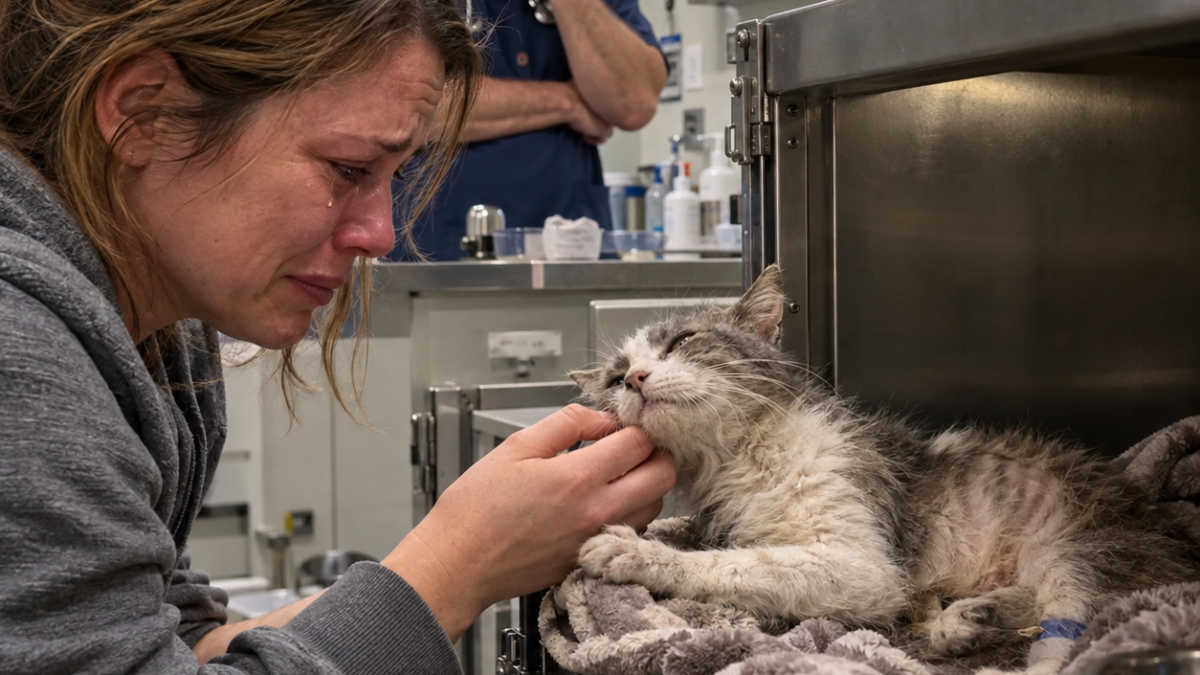
I found a starving cat behind a closed shop; it couldn’t even stand—then the vet saw its healing ribs and asked me a question
PART3:
I wanted Walker’s picture up there someday.
I wanted it so badly it hurt.
When Dr. Evan came back, his face had changed.
He spoke gently, but there are some truths no soft voice can soften.
“Two ribs were broken,” he said. “They’re healing, but not cleanly.”
I swallowed hard.
“Could he have fallen?”
Dr. Evan looked through the glass door at Walker, curled in his blanket like a pile of laundry someone had forgotten to fold.
“This pattern doesn’t look like a simple fall.”
I did not ask him to say more.
I already understood.
Someone had hurt him.
And that same little cat had still crawled toward my hand.
For one minute, anger rose in me so hot I could barely breathe.
Then Walker lifted his head from the cage and blinked.
Slowly.
Trusting.
Like I was the only thing in the room that mattered.
So I let the anger pass through me and land somewhere useful.
Not in revenge.
Not in noise.
In a promise.
He would never have to earn kindness again.
The later tests ruled out the biggest fears.
No tumor.
No deep infection.
No clear injury we could point to and say, Here. This explains everything.
But bodies remember.
That was what Dr. Evan told me.
A nervous system can carry terror long after the danger is gone.
A small body can keep bracing for pain even inside a safe room.
Walker was not just healing from broken ribs.
He was healing from being taught that hands could hurt.
So we moved slowly.
I put him in the quietest corner of my house, in a spare room with a low lamp, a soft bed, and no sudden footsteps.
I did not reach for him unless he came first.
I did not pick him up.
I did not call him brave like he owed me courage.
Every evening, I sat on the floor and read junk mail out loud because I had nothing better prepared.
Walker listened like it was a bedtime story.
“For a limited time, you may qualify for a new credit card,” I read one night.
Walker blinked.
“Exactly,” I told him. “Predatory.”
For three days, he stayed under the blanket.
On the fourth, he stuck out one paw.
On the sixth, he ate while I was in the room.
On the ninth, he took three crooked steps toward me, stopped, shook hard, and kept going.
Then one quiet night, when the house was dark and the whole world felt tired, Walker climbed into my lap.
Not gracefully.
Not easily.
He stumbled, caught himself, and pressed his forehead against my palm.
And there it was.
The smallest purr I had ever heard.
It sounded like a broken little engine trying to start again.
Walker was not fixed.
I do not like that word.
He still startled when something dropped.
Sometimes his legs twitched in his sleep.
Sometimes he ducked before remembering no one in my house was going to strike him.
But he started sleeping in sunbeams.
He ate every bite of his dinner.
He greeted me at the door with a raspy little meow, as if he had important news and I was late hearing it.
People talk a lot about rescuing animals.
The truth is, sometimes all we do is give them a place where they can stop surviving long enough to become themselves again.
Walker did not need pity.
He needed safety.
He needed patience.
He needed someone to move slowly, speak softly, and keep showing up after the sad part of the story was no longer new.
I did not know what happened to him before that night behind the shop.
I only knew what would happen now.
No hand in my house would ever make him flinch on purpose.
No pain would be treated like an inconvenience.
And every time Walker took one shaky step toward me, I would meet him halfway.
Because a cat who was hurt by people and still chooses to trust us is not weak.
He is the kind of miracle we should spend the rest of our lives trying to deserve.
For three weeks, I thought the hard part was getting Walker to trust my hand.
I was wrong.
The hard part came when a woman stood on my porch with wet eyes and said, “That’s my cat.”
For a second, I did not understand her.
Walker was behind me in the hallway, sitting in a patch of afternoon sun like he had paid rent on it.
He had gained almost a pound by then.
His fur was still rough in places, but the gray-and-white patches had started to look silver instead of dirty. His ribs no longer showed like little fence slats under his skin.
He looked up when the woman spoke.
Then he froze.
Not the way he froze when a bowl dropped.
Not the way he froze when a truck backfired down the street.
This was different.
His ears moved forward.
His body leaned one inch closer.
The woman covered her mouth.
“Oh, Simon,” she whispered.
Walker did not move.
My hand tightened on the doorframe.
I had never heard that name before.
The woman was maybe sixty, maybe older. It was hard to tell. She had the kind of tired face people get when they have carried one bad year after another and nobody has offered to take a corner.
Her hair was pulled back with a clip.
Her sweater had a stretched sleeve.
Her shoes were clean but worn at the edges.
She did not look dangerous.
That almost made it harder.
Because I had imagined the person from Walker’s past as a monster.
It is easier to be angry at a monster.
It is much harder when grief knocks on your door wearing old sneakers and asks for the cat you love.
“I’m sorry,” I said slowly. “Who are you?”
“My name is Marla,” she said. “Marla Benton. I saw the flyer at the clinic.”
My stomach dropped.
Dr. Evan’s office had posted Walker’s photo with my permission.
Just a simple found-cat notice.
Gray-and-white male. Injured. Found near the old strip mall. Proof of ownership required.
I had agreed because it was the right thing to do.
That was what I told myself at the time.
The right thing.
Those words can sound so clean until they ask something from you.
Marla looked past my shoulder again.
Walker took one shaky step into the hallway.
Then another.
I wanted to pick him up.
I wanted to shut the door.
I wanted to become the kind of person who did not have to be fair.
But Walker was watching her.
And I owed him more than my fear.
So I opened the door wider.
“Come in,” I said.
Marla stepped inside like she was afraid the floor might reject her.
Walker stayed near the wall.
He did not run to her.
He did not run from her either.
That was the first thing that broke my certainty.
Marla lowered herself to the floor without being asked.
Not close enough to crowd him.
Not far enough to feel cold.
She put both hands in her lap.
“Hi, baby,” she said.
Walker blinked once.
Slowly.
Then he made a sound I had never heard before.
It was not his raspy greeting meow.
It was smaller.
A question.
Marla started crying so hard she had to press her fist against her mouth.
I stood in the hallway with my arms crossed tight over my chest, feeling mean for wanting proof.
Feeling cruel for needing boundaries.
Feeling terrified that love might not be enough to let me keep him.
She showed me pictures on her phone.
There he was.
Not broken.
Not thin.
Not hiding behind a shop.
A rounder gray-and-white cat on a green couch, belly up like he trusted gravity itself.
A cat in a window.
A cat inside a laundry basket.
A cat with a little blue collar and a face full of attitude.
Simon.
Walker.
The same crooked white stripe down his nose.
The same gray spot under his chin.
The same tiny notch in one ear.
“He was my mother’s cat,” Marla said. “After she passed, he came to live with me.”
Walker’s tail tip twitched when she said mother.
Maybe it was nothing.
Maybe it was everything.
“I need to ask something,” I said, and my voice came out rough. “How did he end up behind that shop?”
Marla shut her eyes.
For a moment, she looked like she might fold in half.
“I don’t know all of it.”
That was not the answer I wanted.
“I need all of what you do know.”
She nodded.
She did not argue.
That counted for something.
“My mother died in November,” she said. “I brought Simon home the week after the service. He was scared, but he adjusted. He slept on my hip. He followed me to the kitchen. He had this ridiculous habit of yelling at the refrigerator.”
Walker turned his head toward the kitchen when she said refrigerator.
I hated that my eyes burned.
“I had to move in January,” she continued. “My rent went up. I couldn’t keep the house. I found a smaller place across town. I was overwhelmed, and my brother offered to help with the move.”
The word brother landed heavy in the room.
Walker lowered his head.
Marla saw it.
Her face changed.
“My brother didn’t like animals,” she said.
I waited.
“He said Simon was underfoot. Said he was making everything harder. On moving day, Simon got scared and hid. I thought he was in the carrier. My brother said he had loaded him already.”
She stopped.
The quiet stretched.
“I didn’t check.”
There it was.
Not cruelty, maybe.
Not hands raised on purpose, maybe.
But a choice.
A failure.
A moment where a living thing needed someone to look twice, and someone did not.
Marla wiped her cheek with the back of her hand.
“When I got to the new apartment, the carrier was empty. My brother said Simon must have slipped out when we stopped for gas. I spent days looking. I printed flyers. I called every clinic I could think of.”
She took a breath that shook.
“Then my brother stopped answering my calls.”
I looked down at Walker.
He had not moved closer.
He had not moved away.
His body was low, but his eyes were open.
“Did your brother hurt him?” I asked.
Marla’s lips trembled.
“I don’t know.”
That answer made me angry.
Not because she was lying.
Because sometimes the truth is worse when nobody can prove it.
“I found him with healing broken ribs,” I said.
She covered her mouth again.
A sound came out of her, small and raw.
Walker flinched.
I lifted one hand slightly.
Not at her.
Not at him.
Just a quiet signal to breathe.
Marla pressed both hands to her chest.
“I’m sorry,” she whispered. “I’m so sorry.”
She was not saying it to me.
She was saying it to the cat.
Walker looked at her for a long time.
Then he turned and limped back into my spare room.
I followed because that was what he expected.
He climbed into his soft bed under the lamp.
His body shook once, then settled.
I sat beside him, not touching him.
Marla stayed in the hallway.
She did not follow.
That counted too.
A few minutes later, she said, “I’m not here to take him today.”
I turned my head.
She was crying quietly now, but standing straight.
“I wanted to,” she said. “I came here thinking I would show you pictures and bring him home. But I can see he’s afraid. And I can see he trusts you.”
Walker tucked his nose under the edge of his blanket.
My heart twisted.
Marla looked at him like someone staring through a window at a room she used to live in.
“I lost my mother,” she whispered. “Then I lost my home. Then I lost him. I thought getting him back would fix one piece of it.”
She looked at me.
“But he’s not a piece of my grief. He’s alive.”
That was the first moment I liked her.
I did not want to.
But I did.
Still, liking someone does not answer the hard questions.
For the next two days, I barely slept.
Walker knew something had changed.
Cats always know when the air in a house has shifted.
He followed me from room to room more than usual. He slept pressed against my ankle. He meowed if I closed the bathroom door too long, like he needed proof I had not disappeared through a secret tunnel.
I called Dr. Evan.
He listened without interrupting.
Then he said the thing I did not want to hear.
“If she can prove ownership, this gets complicated.”
“I know.”
“But complicated doesn’t mean immediate,” he said. “His condition matters. His stress matters. His safety matters.”
“I don’t want to punish her for being poor,” I said.
There was a pause.
“No,” he said. “But you also don’t ignore what happened because someone’s story is sad.”
That sentence stayed with me.
It still does.
Everyone in Walker’s story had a sad part.
Marla had lost her mother.
Walker had lost his home.
I had found a cat and accidentally let my whole heart move into his fragile little body.
Sadness does not cancel responsibility.
But responsibility does not always look like blame.
On Friday, Marla came back with a folder.
Not dramatic.
Not pushy.
Just a folder.
Inside were old vet records from another small clinic on the east side.
Photos.
A microchip number that matched Walker’s file.
A handwritten note from her mother, apparently from years before, with feeding instructions and the words:
Simon hates closed doors.
I almost laughed.
Almost.
She also brought his old collar.
Walker smelled it from three feet away.
Then he backed up until his hip touched my leg.
Marla saw that too.
Her hand tightened around the collar.
“I washed it after the move,” she said softly. “Maybe I shouldn’t have.”
I did not know what to say.
What do you say when an old collar is both proof and wound?
Dr. Evan suggested a slow visit plan.
No promises.
No transfer.
No sudden changes.
Marla could visit in my living room for short amounts of time while Walker decided what he wanted to do.
That last part mattered to me.
Walker decided.
Not me.
Not Marla.
Not a piece of paper.
Not guilt.
Not the loud people online who think every answer is simple if they type it with enough capital letters.
I did not post about Marla.
I did not ask the internet to vote.
Walker was not content to me.
He was not a lesson with whiskers.
He was a living creature whose body had already paid for too many human decisions.
The first visit lasted eight minutes.
Marla sat on the floor near the coffee table.
I sat by the couch.
Walker sat under the side table where he could see both of us.
Nobody touched him.
Nobody reached.
Marla talked about her mother.
Not too much.
Just enough for the room to know the shape of the past.
“She used to call him her little gentleman,” Marla said. “Even when he stole ham off her plate.”
Walker blinked.
“He slept on her heating pad after church,” Marla said, then caught herself. “After Sunday mornings.”
She looked at me quickly, like she had stepped too close to something personal.
I did not care about that part.
I cared that Walker had lifted his head.
Marla smiled through tears.
“Yeah,” she whispered. “You remember that, don’t you?”
Walker did not come out.
But after she left, he walked over to the place where she had been sitting and smelled the carpet.
Then he looked at me.
I knelt beside him.
“I know,” I said. “This is a lot.”
He rubbed his cheek against my knee.
I took that as a yes.
The second visit lasted fifteen minutes.
Walker stayed visible the whole time.
The third visit, Marla brought a towel from her apartment.
Not his old one.
Hers.
She asked before taking it out of the bag.
I said yes.
She placed it near the door.
Walker sniffed it.
Then hissed.
A tiny, tired hiss.
Marla’s face crumpled.
But she did not take it personally.
She simply nodded and said, “Okay. Thank you for telling me.”
That was when something inside me loosened.
Because a lot of people say they love an animal until the animal says no.
They love the cuddle.
They love the reunion video.
They love the idea of forgiveness happening on a schedule that makes humans feel better.
But real love can sit on the floor and accept a hiss.
Real love can say, Thank you for telling me.
Walker slept badly that night.
His legs moved under the blanket.
Push.
Pull.
Push.
Pull.
I woke at two in the morning to the sound of his claws scraping the side of his bed.
When I turned on the lamp, his eyes were wide and empty.
Not awake.
Not fully.
Just trapped somewhere behind his own body.
I whispered his name.
“Walker.”
Nothing.
I moved slowly to the floor.
“Baby, you’re home.”
His paws kept moving.
“Walker, you’re safe.”
His breath hitched.
I placed my hand near him, palm down on the rug.
Not touching.
Just there.
After a long moment, his paw slid forward and landed on my knuckle.
Same as that first night.
Same choice.
Same miracle.
His body went still.
Then he woke up.
He stared at my hand like he had traveled miles to find it.
I cried then.
Quietly, so I would not scare him.
I cried because healing is not a straight road.
I cried because sometimes being safe makes the memories louder.
I cried because I wanted to protect him from everything, including his own dreams, and I could not.
The next morning, I told Marla we needed to pause visits.
She was silent for a few seconds.
Then she said, “Is he okay?”
“He had a rough night.”
“Because of me?”
I looked at Walker, asleep in a sunbeam with one paw over his face.
“I don’t know.”
She breathed out slowly.
“If stopping helps him, stop.”
No argument.
No guilt.
No but he’s mine.
Just that.
If stopping helps him, stop.
I sat down hard on the kitchen chair after we hung up.
Because I had spent days preparing to fight her.
And she kept making fighting impossible.
A week passed.
Walker got steadier again.
He ate well.
He started playing with a soft stuffed mouse, though his version of play was mostly lying on his side and smacking it like it owed him money.
He discovered the hallway mirror and seemed deeply offended by the suspicious cat inside it.
He learned the laundry basket was warm.
He learned my alarm meant breakfast.
He learned I was not impressed by dramatic fainting beside an empty food bowl forty-two minutes before dinner.
Little by little, he became funny.
That is the gift no one warns you about.
At first, rescue is fear, medicine, and watching every breath.
Then one day, the broken little creature you carried in a towel starts being weird on purpose.
And you realize you are not just keeping them alive anymore.
You are getting to know them.
Walker was nosy.
Opinionated.
Offended by closed doors.
Convinced all paper belonged on the floor.
Suspicious of house shoes.
Friendly with socks.
He liked to sit with one paw on my foot, not for support anymore, but as a claim.
Mine.
You are mine.
And maybe that was why I started making excuses.
Maybe another week.
Maybe after his next checkup.
Maybe after he stopped twitching.
Maybe after I was ready.
But that last one was not about Walker.
That was about me.
Dr. Evan knew it too.
At Walker’s next appointment, he watched him walk across the exam table with crooked little confidence.
Then he looked at me over his glasses.
“He’s doing better.”
“I know.”
“Still tender, but stronger.”
“I know.”
He listened to Walker’s chest.
Walker glared at him with deep personal disappointment.
“And emotionally?” I asked.
Dr. Evan set the stethoscope down.
“Better does not mean ready for upheaval.”
I exhaled.
“But it also does not mean you can avoid a decision forever.”
There it was.
The thing I hated most.
A decision.
I wanted Walker to decide in some obvious way.
I wanted him to leap into Marla’s arms or hide behind me forever.
I wanted a clean answer.
Life rarely gives you those.
Instead, it gave me a cat who loved two histories.
One that hurt him.
One that helped him.
And maybe one that had held him before either of us knew pain was coming.
Marla called that evening.
“I need to tell you something,” she said.
My stomach tightened.
“My brother came by.”
I stood so fast Walker startled.
I lowered my voice.
“Are you okay?”
“Yes. He wanted money. I didn’t let him in.”
I waited.
“He asked about Simon.”
My mouth went dry.
“He said, ‘You still crying over that cat?’”
Marla’s voice went flat.
“He laughed.”
Walker was sitting on the rug, licking one paw.
He looked so ordinary in that moment that the world felt cruel for having ever touched him.
“I asked him what happened,” Marla said.
I gripped the phone.
“He said Simon scratched him while he was moving boxes. He said he set him outside for a minute. Then he said animals run off all the time.”
She stopped.
“And?”
“And I told him not to contact me again.”
That was all she said.
Not a speech.
Not a threat.
Not a grand dramatic moment.
Just a woman finally closing one door.
“I should have done that years ago,” she whispered.
I did not answer right away.
Because that sentence held more than Walker.
It held a whole history I had no right to unpack.
“He can’t come near him,” I said.
“He won’t.”
“You can’t just hope that.”
“I’m not hoping,” she said. “I changed my locks. My landlord knows. My neighbor knows. I’m done making room for people who break things and call it an accident.”
I sat down slowly.
Walker came over and put one paw on my shoe.
His favorite old move.
I looked at him and felt my anger shift shape again.
Not into revenge.
Into clarity.
“Marla,” I said, “do you want him back because he is your mother’s cat, or because you believe your home is the safest place for him now?”
The silence that followed was long.
Honest silence usually is.
Finally, she said, “Both.”
That answer scared me because it was true.
Then she added, “But if only one of those can matter, it should be the second.”
I closed my eyes.
There are people who say the right thing because they know it sounds good.
And there are people who say the right thing like it costs them something.
Marla sounded like it cost her.
We restarted visits after that, but slower.
Ten minutes.
Then twelve.
Then twenty.
Walker began coming out sooner.
He did not let her touch him.
But he listened.
He sat near her shoes.
He sniffed her bag.
One evening, he walked behind her and brushed his tail against the back of her sweater.
Marla froze like she had been blessed by royalty.
“Don’t move,” I whispered.
“I won’t,” she whispered back.
Walker circled once.
Then he returned to me.
I wanted to be happy for her.
I was.
I wanted to be scared for myself.
I was that too.
That is the strange cruelty of shared love.
Someone else’s hope can feel like your loss.
A month after Marla first came to my door, Dr. Evan suggested a trial visit at her apartment.
One hour.
I would bring Walker.
I would stay.
No closed room.
No pressure.
No expectations.
“Let him gather information,” Dr. Evan said. “Cats need time to read a place.”
So on a Saturday morning, I lined Walker’s carrier with the blanket he liked best.
He saw it and gave me a look that clearly said he had contacted his attorney.
“I know,” I told him. “I hate this too.”
He went in after seven minutes of negotiation and two treats.
That was progress.
Marla lived in a small apartment on the second floor of a quiet brick building.
Not fancy.
Not awful.
Just small.
Clean.
A little tired.
A little warm.
The kind of place where every object has to earn its space.
Before we went in, I stood outside her door and listened.
No shouting.
No loud TV.
No heavy footsteps.
No chaos.
Marla opened the door and stepped back immediately.
“I put the towel under the window,” she said. “Food and water are in the kitchen. Litter box is in the bathroom with the door propped open.”
She had done everything Dr. Evan suggested.
Low lamp.
No strong scents.
No visitors.
No grabbing.
No pretending this was going to become some perfect reunion because strangers like neat endings.
I set the carrier down and opened the door.
Walker stayed inside.
Ten minutes passed.
Then fifteen.
Marla sat on the floor by the couch.
I sat near the door.
At twenty-two minutes, Walker stepped out.
He kept low.
He smelled the rug.
The table leg.
The corner of a cardboard box.
Then he stopped at an old wooden rocking chair near the window.
His whole body changed.
Marla pressed both hands over her mouth.
“That was my mother’s,” she said.
Walker stretched his neck toward the chair.
He sniffed one leg.
Then another.
Then he did something that made my heart drop and lift at the same time.
He rubbed his cheek against it.
Not once.
Three times.
His eyes half closed.
His body softened.
He remembered.
I had to look away.
Jealousy is an ugly feeling.
Pretending not to feel it does not make you kind.
It only makes you dishonest.
I was jealous of a chair.
A chair had known Walker before I did.
A chair had a piece of him I could never rescue, never earn, never replace.
He jumped onto the seat clumsily, missed, slid down, and tried again.
I moved forward by instinct.
Marla did too.
We both stopped.
Walker tried a third time and made it.
He turned in a circle.
Then sat.
The morning sun fell across his back.
For one quiet second, he did not look like Walker.
He looked like Simon.
Marla cried silently.
I cried too, but I faced the wall because I was still proud enough to be ridiculous.
The trial visit lasted fifty minutes.
Walker did not hide.
He did not purr.
He did not touch Marla.
But when I put the carrier down to leave, he looked from me to the rocking chair and made that little question sound again.
It followed me all the way home.
That night, he slept against my ribs.
His body warm.
His breath steady.
I lay awake and stared at the ceiling.
Here was the decision nobody wanted to say out loud.
Keeping Walker would be easier for me.
Returning him might heal something older in him.
Or it might reopen everything.
There was no way to know for sure.
People love to say, “Do what’s best for the animal.”
But sometimes what is best is not written in bright letters.
Sometimes it is a foggy road with grief on both sides.
Sometimes every choice hurts somebody.
Sometimes the only wrong answer is choosing what hurts the animal least for your own comfort and then calling it love.
I did not want to be that person.
So I made a list.
Not a dramatic list.
A real one.
What Walker needed daily.
What made him startle.
What helped him settle.
What Marla could provide.
What I could provide.
What risks existed in both homes.
What was about his welfare.
What was about my attachment.
The last column was the hardest.
Because once I started writing honestly, my excuses looked different.
He feels safe here was true.
I can’t bear to lose him was also true.
Those are not the same sentence.
A week later, we tried a two-hour visit.
Walker spent twenty minutes under Marla’s couch.
Then he came out and sat in the rocking chair.
Marla read a grocery flyer out loud because I had told her about the junk mail.
Walker listened like it was sacred literature.
I smiled despite myself.
On the next visit, he ate three bites of wet food from a plate on her kitchen floor.
On the next, he fell asleep for six minutes.
Marla did not move the entire time.
Her leg fell asleep.
She did not complain.
On the next, he walked over and touched her knee with his nose.
Marla looked at me, eyes wide.
I nodded.
She did not touch him.
She let the moment be enough.
That restraint mattered.
More than tears.
More than photos.
More than records.
Love that can wait is rare.
Walker was teaching both of us how to practice it.
But not everyone around me understood.
My friend June came over one evening with soup and opinions.
She took one look at Walker curled on my couch and said, “Absolutely not.”
“June.”
“No. I’m sorry. No.”
“She was his family.”
“You are his family now.”
“It’s not that simple.”
“It is to me.”
She set the soup on the counter harder than necessary.
“She lost him. He was hurt. You found him. You paid the vet. You sat up all night. End of story.”
Walker opened one eye.
June lowered her voice.
“Sorry, sir.”
I almost laughed.
But June’s face was serious.
“You don’t have to give back something you saved just because someone shows up sad.”
That sentence made my chest ache.
Because many people would agree with her.
Maybe most.
And part of me wanted to climb into that certainty and sleep there.
“I’m not giving back a sweater,” I said.
“I know that.”
“He has history.”
“He has trauma.”
“He has both.”
June crossed her arms.
“And what about you?”
I looked at Walker.
He was pretending not to listen, which meant he was definitely listening.
“What about me?”
“You keep making this noble. But you love him.”
My throat tightened.
“I know.”
“If you let him go, you’ll be devastated.”
“I know.”
“Then why are you acting like that doesn’t matter?”
I did not answer right away.
Because it did matter.
Of course it mattered.
I mattered too.
But I was not the one with healing ribs.
“I think love matters,” I said slowly. “But ownership of pain doesn’t.”
June’s expression softened, though she still looked mad.
“That sounds pretty, but it’s going to hurt.”
“I know.”
She sat beside me on the couch.
Walker immediately got up and moved three feet away because he did not appreciate emotional gatherings.
June sighed.
“I just don’t want you to be used.”
“Marla isn’t using me.”
“You don’t know that.”
“No,” I said. “But Walker knows more than we think.”
June looked at him.
He was now licking his shoulder with the dramatic focus of someone avoiding adult conversation.
“He’s a cat,” she said.
“He’s a survivor.”
“Same thing, sometimes.”
That made me smile.
The next day, Marla called with her own doubt.
“I don’t know if I should take him,” she said.
I sat down.
“What happened?”
“Nothing. That’s the thing. He had a good visit yesterday. He almost slept. He sniffed my hand. And then after you left, I cried for two hours because I realized I keep imagining my mother’s cat coming back.”
Her voice broke.
“But he isn’t the same cat. And I’m not the same person. What if I’m trying to rebuild a house that already burned down?”
I closed my eyes.
There it was.
The moral dilemma stripped clean.
Was love about restoring what was lost?
Or honoring what survived?
“I don’t know,” I said.
It was the only honest answer.
Marla gave a sad little laugh.
“I was hoping you’d say something wiser.”
“I’m fresh out.”
Walker jumped onto the table, which he was not allowed to do, and stared at me like rules were a hobby for weaker minds.
I lifted him down.
He jumped back up.
Marla heard the noise.
“Is he causing trouble?”
“Yes.”
“Good,” she said softly. “He used to be very good at that.”
We both laughed.
It surprised us.
Maybe that was the first moment we were not standing on opposite sides.
Maybe that was the first moment Walker had two people in the world who loved him enough to be scared together.
Dr. Evan eventually suggested an overnight trial.
Only if Walker continued improving.
I hated the idea.
Marla hated it too.
Walker, naturally, had no respect for our emotional process and spent his next clinic visit knocking a pen off the counter.
Dr. Evan watched him do it twice.
“He seems proud of himself.”
“He is.”
Walker sat beside the fallen pen like a tiny criminal waiting for applause.
Dr. Evan smiled.
“He’s stronger.”
“I know.”
“And he’s bonded to you.”
“I know.”
“And he’s reconnecting with Marla.”
“I know.”
“That means whatever happens next, someone will grieve.”
I rubbed Walker’s head with one finger.
He allowed it because we were in public and he had an image to maintain.
“How do I choose?” I asked.
Dr. Evan leaned back against the counter.
“You don’t choose who deserves him more. That’s a trap.”
I looked up.
“You choose which arrangement gives him the best chance at a stable life.”
Stable.
That word was not dramatic.
It did not make a good headline.
It did not satisfy the part of me that wanted fate and signs and one clean tearful answer.
But for Walker, stable was holy.
Stable meant food at the same time.
Hands moving slowly.
Doors staying open.
No surprise visitors.
No one laughing when he flinched.
No one treating his fear like an inconvenience.
No one needing him to become a symbol.
Just a life.
The overnight trial happened two weeks later.
I packed his blanket, his food, his medicine schedule, his favorite stuffed mouse, and a sweatshirt that smelled like me.
Then I sat on the floor beside his carrier and cried before we even left the house.
Walker bumped his head against my knee.
“Don’t be nice to me right now,” I whispered. “I can’t take it.”
He purred.
The little broken engine again.
Except it sounded less broken now.
Marla met us at her door with red eyes.
“I almost canceled,” she admitted.
“Me too.”
Walker walked out of the carrier faster this time.
He sniffed the rug.
He checked the kitchen.
He inspected the bathroom.
Then he went to the rocking chair and sat like he had an appointment.
I stayed for an hour.
Marla and I went over everything again.
Feeding.
Medication.
Night terrors.
Startle signs.
What to do if he hid.
What not to do if he hissed.
When to call me.
When to call Dr. Evan.
I sounded calm because sometimes adults are just frightened children with better posture.
When I finally stood to leave, Walker looked at me.
He did not come running.
He did not cry.
He did not hide.
He simply watched.
That almost hurt worse.
Marla stood near the door but did not touch him.
“You can call anytime,” she said.
“I know.”
“I mean anytime.”
“I know.”
I walked to my car.
I made it inside.
Then I sobbed so hard I had to sit there with both hands on the steering wheel until my body remembered how breathing worked.
The house was awful without him.
Not quiet.
Empty.
Quiet can be peaceful.
Empty has teeth.
I saw him everywhere.
On the couch.
By the food bowl.
In the hallway mirror, offended by his own reflection.
At 7:10, I looked down automatically because that was when he usually put one paw on my foot and demanded dinner like a tiny elderly judge.
No paw came.
I called Marla at 7:32.
“He ate,” she said before I could ask. “Half the bowl. Then he looked insulted that I stopped watching.”
I laughed and cried at the same time.
At 10:05, she sent a photo.
Walker in the rocking chair.
Eyes half closed.
My sweatshirt tucked beside him.
At 1:18 in the morning, my phone rang.
I answered before the second ring.
“What happened?”
“He had a bad dream,” Marla whispered. “He’s awake. He’s under the chair. I’m on the floor. I’m not touching him.”
My whole body went cold.
“Is he hurt?”
“No. Just scared.”
I sat up in bed.
“Put me on speaker.”
She did.
At first, I heard nothing.
Then the tiny sound of Walker breathing fast.
“Hey, baby,” I said softly into the phone. “I see you.”
The same words from the first night.
The first promise.
There was a pause.
Then Marla whispered, “His ears moved.”
“Good.”
I kept talking.
Not beautifully.
Not wisely.
I said nonsense.
I told him about the laundry.
I told him his food bowl was personally offended by his absence.
I told him the mirror cat had left no messages.
Marla gave a wet little laugh.
Then I heard it.
A small scrape.
A soft step.
Another.
“He’s coming out,” Marla whispered.
I closed my eyes.
“Let him.”
For a few seconds, nobody spoke.
Then Marla made a sound I will never forget.
Not a sob.
Not a laugh.
Something between awe and heartbreak.
“He put his paw on my foot.”
I pressed my hand over my mouth.
Walker had made his choice for that moment.
Not forever.
But for that moment.
And healing is made of moments.
The next morning, I drove over early.
I told myself I was being responsible.
That I needed to check on him.
That Dr. Evan would approve.
The truth was, I needed to see if Walker still knew me.
He did.
The second Marla opened the door, he came into the hallway with his crooked little walk and yelled at me.
Not a sad cry.
Not panic.
An accusation.
As if I had been late to an important meeting he personally scheduled.
I dropped to the floor.
He came to me.
Pressed his forehead into my palm.
Purred.
Then he turned around and walked back to the rocking chair.
Marla and I stared at each other.
There was the answer.
Not the clean one.
Not the easy one.
The real one.
Walker did not want to lose me.
But he was not terrified of staying with her.
He had room in him for both.
Maybe that was the miracle.
Not that he trusted one hand after being hurt.
But that he trusted more than one.
For the next month, we built a life none of us expected.
Walker stayed with Marla five days a week.
He came to my house on weekends.
At first, people told me it was ridiculous.
“Cats need one home,” June said.
“Usually,” I said.
“Usually?”
“Walker is not usual.”
Dr. Evan agreed to monitor him closely.
We kept routines predictable.
Same carrier.
Same blanket.
Same food.
Same words every time.
“Going to Marla’s.”
“Going to my house.”
Home became a bigger word than I thought it could be.
Some people would hate that arrangement.
I know that.
Some would say I should have kept him.
Some would say Marla had the legal and moral right to bring him home full-time.
Some would say sharing a cat is selfish.
Some would say it is beautiful.
I stopped needing everyone to agree.
Because Walker was not living in a comment section.
He was living in two quiet rooms where nobody moved too fast.
He had a rocking chair at Marla’s.
He had a sunbeam on my floor.
He had two food bowls.
Two people who knew the difference between his hungry meow and his scared one.
Two homes where hands stayed gentle.
Maybe, after everything, that was not confusion.
Maybe that was abundance.
The first time Marla came to my house without crying, she brought a small framed photo.
Her mother.
An older woman with bright eyes, sitting in the rocking chair with a gray-and-white cat sprawled across her lap.
Simon looked round and smug.
Very smug.
“That was his favorite spot,” Marla said.
I smiled.
“He still believes chairs exist for him.”
“They do.”
She handed me the frame.
“I made a copy for you.”
I stared at it.
My throat closed.
“I don’t know what to say.”
“Say you’ll put it somewhere he can ignore it.”
I laughed.
Then I hugged her.
It surprised both of us.
Walker watched from the couch with mild concern, as if humans embracing might lead to delayed dinner.
That was how Marla and I became something strange.
Not friends exactly, at first.
Something quieter.
Co-guardians.
Witnesses.
Two women standing on either side of a small cat’s second chance, trying not to drop it.
Walker kept changing.
Slowly.
Then suddenly.
One day, he jumped onto my bed without missing.
I clapped like a fool.
He immediately jumped down, offended by praise.
One day, a metal spoon fell in Marla’s kitchen.
He startled.
But he did not flatten.
He looked toward the sound, blinked hard, and stayed standing.
Marla called me crying.
“Standing,” she said. “He stayed standing.”
People who have never loved a wounded animal may not understand what that means.
But I did.
Standing meant his body was learning the room was safe.
Standing meant the past had not vanished, but it had lost one inch of power.
Standing meant Walker had found a little more of himself.
His dreams got softer too.
Not gone.
But softer.
Sometimes his paws still moved under the blanket.
But not always like running.
Sometimes like kneading.
Sometimes like walking through a place where nothing chased him.
Six months after I found him behind the shop, Dr. Evan took his picture for the clinic wall.
Not a perfect picture.
Walker refused to face the camera.
He sat sideways with one ear tilted and his eyes half closed, looking annoyed by the entire concept of gratitude.
Dr. Evan printed it anyway.
Under the photo, he wrote:
Walker, formerly Simon.
Loved twice.
I stared at those words for a long time.
Loved twice.
Not abandoned then rescued.
Not broken then fixed.
Loved twice.
It was not the whole story.
But it was a kinder title than any I had given it.
The day the photo went up, a woman in the waiting room asked if he was mine.
I looked at Walker in his carrier.
He looked back.
“Yes,” I said.
A second later, I added, “And hers too.”
The woman frowned a little.
I could see the question coming.
How does that work?
I smiled.
“Carefully,” I said.
That is still the best answer.
Carefully.
That is how you love anything fragile.
Carefully.
That is how you rebuild trust after it has been broken by someone else’s carelessness.
Carefully.
That is how you decide when there is no perfect choice, only the next gentle one.
Walker is older now.
Not old-old.
Just older than he was when I found him.
His walk is still crooked when he first wakes up.
One rib healed in a way you can feel if your hand rests just right along his side.
I used to hate that.
Now I think of it as a reminder.
Not of what happened.
Of what did not win.
The fear did not win.
The pain did not win.
The person who set him outside and walked away did not get the final word.
Neither did my anger.
Neither did Marla’s guilt.
Walker did.
With every slow blink.
Every stubborn meow.
Every ridiculous nap in the middle of a doorway.
Every paw placed on a shoe.
He wrote the ending himself.
One afternoon, nearly a year after I found him, Marla and I sat in her apartment while rain tapped softly against the window.
Walker was in the rocking chair, of course.
My sweatshirt was on one side.
Marla’s mother’s quilt was on the other.
He had arranged himself exactly between them.
Marla looked at him and said, “Do you ever think about what would have happened if you hadn’t found him?”
I did.
Of course I did.
But not in the way I used to.
At first, that thought had been a knife.
Now it was more like a candle.
A small light pointed toward responsibility.
“I think about how many Walkers are still out there,” I said.
Marla nodded.
“In alleys. Under porches. Behind shops.”
“In houses too,” she said quietly.
I looked at her.
She kept her eyes on Walker.
“Sometimes they’re not outside yet,” she said. “Sometimes everyone can see something is wrong, but they keep saying it’s not their business.”
I thought about her brother.
About all the moments before the final one.
All the times she probably made excuses because it was easier to survive the day that way.
All the times most of us do the same in smaller ways.
There is a kind of harm that looks loud.
And there is a kind that looks like looking away.
Walker had suffered both.
Marla reached one finger toward the chair.
Not to touch him.
Just to rest near the edge.
Walker opened one eye.
Then, with great inconvenience, he stretched and placed one paw over her finger.
Marla stopped breathing.
I smiled.
He kept it there for maybe three seconds.
Then he took it back because he had standards.
Marla cried anyway.
I did too.
Neither of us apologized.
Some tears deserve to exist.
That evening, when I brought Walker back to my house, he walked straight to his food bowl and yelled.
Then he yelled at the hallway.
Then he yelled at me.
“What?” I asked. “What is the emergency?”
He led me to the spare room.
His first room.
The quiet corner.
The low lamp.
The soft bed he had hidden under for three days.
He stepped inside, sniffed the blanket, and sat down.
I stood in the doorway.
I had not changed much in there.
I told myself it was because he still liked the room.
That was partly true.
But maybe I had kept it like a little museum of the night he survived.
Maybe I was afraid that if I moved things, I would be dishonoring what it took to get here.
Walker had no such problem.
He pawed at the blanket.
Turned in a circle.
Then dragged the stuffed mouse out into the hallway.
One small piece of the past, carried into the open.
I laughed so hard I cried.
The next day, I cleaned the room.
Not erased it.
Cleaned it.
I folded the old blanket and put it in a basket.
I moved the lamp to the living room.
I opened the curtains.
I let the room become a room again.
Walker supervised from the doorway with deep suspicion.
Healing asks that of us sometimes.
Not to forget.
Not to pretend.
But to stop building a shrine around the worst day.
To let the rescued life grow bigger than the rescue story.
That became the message Walker taught me.
Not the cute version.
Not the easy one people put on mugs.
The real one.
Love is not proven by how loudly you claim someone.
Love is proven by how safely they can breathe around you.
That is true for animals.
It is true for people.
It is true in families where everyone is tired and nobody has enough money and one more emergency feels like it might split the floor open.
It is true when grief makes us selfish.
It is true when guilt asks for a second chance.
It is true when the right thing does not feel fair.
When I finally shared a small piece of Walker’s story, I did not share Marla’s name.
I did not share details that belonged to her.
I did not give strangers a villain to hunt.
Just a gray-and-white cat, a broken beginning, and a question:
When an animal you saved still belongs to someone who failed them once, what does love require?
The comments were exactly what you would expect.
Keep him.
Give him back.
Poor woman.
Poor cat.
No second chances.
Everyone deserves second chances.
Animals are not property.
Animals need stability.
You’re an angel.
You’re naïve.
Marla is selfish.
You are selfish.
The internet did what the internet does.
It turned a living thing into a debate.
I almost deleted it.
Then Marla called.
“I read some of them,” she said.
“I’m sorry.”
“No,” she said. “It’s okay.”
“It’s not okay.”
“It made me think.”
I waited.
“I used to believe love meant wanting someone back,” she said. “Now I think maybe love means wanting them safe, even if that safety doesn’t look like what you pictured.”
Walker was on my lap, purring into my wrist.
I looked down at him.
“Yeah,” I said. “I think he agrees.”
“He told you that?”
“He’s very verbal.”
Marla laughed.
That laugh sounded lighter than it used to.
A year and a half later, Walker still divides his time.
Less formally now.
More naturally.
Sometimes Marla keeps him two weeks because my house is busy or I have repairs being done.
Sometimes he stays with me longer because Marla visits her cousin out of town.
He handles it because we made the world predictable.
He has two carriers now, but he prefers the old one.
He still hates closed doors.
He still believes all paperwork should be pushed off tables.
He still sleeps in sunbeams with the focus of a cat being paid by the hour.
He still startles sometimes.
But he recovers faster.
That is the part people miss.
Healing is not never being afraid again.
Healing is learning the fear can pass.
The sound happens.
The body jumps.
The room stays safe.
The hand stays gentle.
The food still comes.
The person does not leave.
Again.
And again.
And again.
One winter morning, I woke up to snow dusting the yard.
Not much.
Just enough to make everything quiet.
Walker was sleeping at the foot of my bed with his head on my ankle.
My phone buzzed.
A message from Marla.
A photo.
Her rocking chair, empty.
A caption underneath:
He left his mouse here. Please inform His Majesty.
I looked at the bed.
Walker’s eyes were open.
He had clearly seen the message and chosen not to care.
“You forgot your mouse,” I told him.
He blinked.
“Marla says it’s serious.”
He rolled over and showed me his belly, which was not an invitation and never had been.
I sent Marla a photo back.
Walker upside down, looking deeply unemployed.
Her reply came fast.
Tell him his grandmother would be proud.
I stared at that.
His grandmother.
Marla’s mother.
A woman I never met, but whose chair helped a wounded cat remember he had once been safe.
I think about her sometimes.
I think about the old woman who called him her little gentleman.
I think about how love can outlive the hands that first gave it.
I think about how Walker carried that love in his body, even after pain tried to bury it.
Maybe that is why he reached for my hand that first night.
Not because he did not know people could hurt.
He knew.
Of course he knew.
He reached anyway because someone, once, had taught him that hands could also be warm.
That truth had survived under the fear.
Marla’s mother gave him that.
Marla almost lost it.
I helped him find it again.
And Walker, stubborn miracle that he is, made room for all of us.
The last time Dr. Evan saw him for a routine checkup, he listened to Walker’s heart and smiled.
“Strong,” he said.
Walker looked offended.
As if strength was private.
Dr. Evan scratched under his chin.
Walker allowed three seconds.
No more.
“He’s doing well,” Dr. Evan said.
I nodded.
“He is.”
Then Dr. Evan looked at me.
“And you?”
I opened my mouth with the easy answer ready.
Fine.
Good.
Busy.
The usual.
But Walker was standing on the exam table with one paw pressed against my wrist.
So I told the truth.
“I’m better than I was.”
Dr. Evan nodded like that made sense.
And it did.
Walker was not the only one who had to heal from the idea that love meant holding tight.
I had to learn that too.
I had to learn that being needed can feel like purpose, but it can also become a cage if you are not careful.
I had to learn that saving someone does not make them yours to keep.
I had to learn that letting someone else love them does not erase what you gave.
Most of all, I had to learn that a happy ending is not always a straight line from rescue to forever.
Sometimes forever has two addresses.
Sometimes family is not the person who never failed.
Sometimes family is the person who tells the truth, makes repairs, and never again asks the wounded one to carry the weight of their guilt.
Sometimes family is the one who found you behind a closed shop and said, “I see you.”
Sometimes it is both.
Walker does not care what people call it.
He cares that breakfast arrives.
He cares that the lamp is on low.
He cares that nobody laughs when he flinches.
He cares that a hand waits instead of grabbing.
He cares that when he takes one shaky step, someone meets him halfway.
That is enough.
More than enough.
Tonight, he is asleep beside me as I write this.
His paw is resting on my wrist like a punctuation mark.
His breathing is slow.
Every now and then, his front legs twitch.
Not hard.
Just a small movement.
Maybe a dream.
Maybe a memory.
Maybe nothing at all.
I place my other hand near him on the blanket.
Not touching.
Just there.
After a moment, still mostly asleep, Walker stretches one paw forward until it lands on my finger.
The same way he did behind the shop.
The same way he did after the nightmares.
The same way he did when he chose Marla for one brave second under the rocking chair.
A paw on a hand.
A question.
A promise.
A miracle, still choosing.
Every time he does it, I remember the truth he has been teaching me from the beginning.
Trust is not weakness.
Forgiveness is not forgetting.
Safety is not a feeling you can demand from someone you hurt.
It is something you build.
Quietly.
Patiently.
One gentle moment at a time.
Walker was hurt by people.
Then he reached for people anyway.
Not because people deserved it automatically.
But because somewhere inside that small, shaking body, hope had not died.
So now two homes keep watch over that hope.
Two hands move slowly.
Two voices speak softly.
Two people spend their ordinary days trying to be worthy of one extraordinary cat.
And if you ask me who Walker belongs to, I finally have an answer.
Not me.
Not Marla.
Not the past.
Not the pain.
Walker belongs to the life he fought his way back to.
We just have the honor of being allowed inside it.








