HOA KAREN STORED HER CLASSIC CARS IN MY PRIVATE LAKE GARAGE — SHE NEVER CHECKED WHETHER I BELONGED TO HER HOA
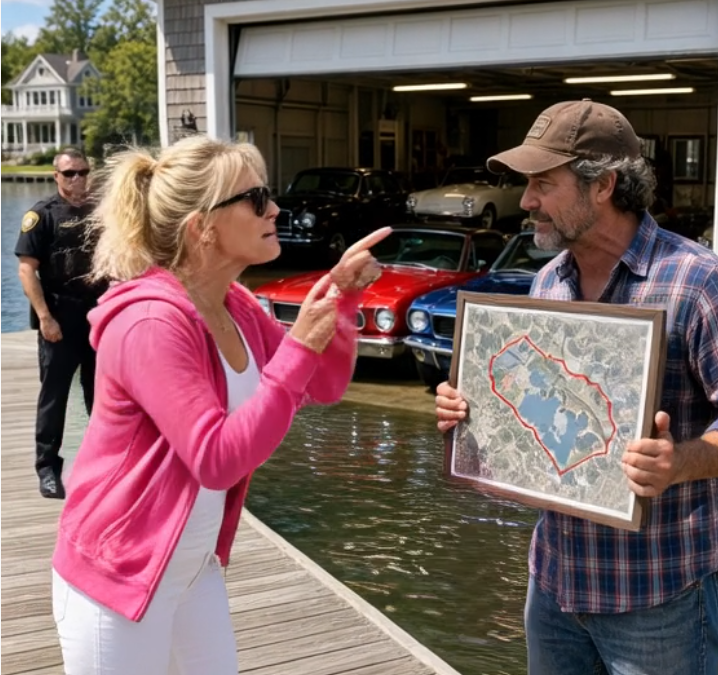
PART3:
Every resident knew the phrase “community standards,” and most of them looked tired when they said it.
I did not belong to Whispering Pines.
Not technically.
Not legally.
Not historically.
Not by deed.
Not by covenant.
Not by association.
My grandfather’s parcel was outside the subdivision boundaries. The recorded plat showed it plainly. The county parcel map showed it plainly. The title report showed it plainly. The subdivision covenants referenced the exception plainly.
But plain facts become invisible when an HOA board president wants a larger kingdom.
Renata Weston Carr became president of the Whispering Pines HOA six years before the garage incident.
She was sixty-two, always wore linen shirts in colors like “oyster” and “river fog,” and spoke as if every sentence had been notarized by her own reflection.
She had a talent for making unreasonable demands sound administrative.
She never yelled.
She did not need to.
Renata could make “good morning” feel like a notice of violation.
She chaired compliance meetings, landscaping committees, architectural reviews, and what she called “shoreline preservation initiatives,” which seemed to involve telling other people what they could see from her breakfast nook.
She also collected classic cars.
Not restored classics.
Collected.
There is a difference.
A restorer loves a machine back into use.
A collector like Renata acquired cars as proof that she knew how to acquire things.
Her vehicles were local legend.
A cream 1957 Thunderbird.
A black 1969 Camaro SS.
A red 1965 Mustang convertible.
They appeared at charity drives, lake festivals, and HOA holiday parades where she waved from the passenger seat like the queen of a very small country.
She stored them in a climate-controlled facility outside Jefferson City.
Or so I thought.
Renata and I had crossed paths before.
The first time was over a dock light.
She mailed me a letter on HOA stationery informing me that my amber dock light exceeded “community aesthetic parameters.”
I mailed back a copy of my deed, the subdivision plat, and a sticky note that said:
Dear Ms. Carr,
No.
She responded with a three-page letter explaining that “shoreline cohesion” required voluntary cooperation from all properties “visually affiliated” with Whispering Pines.
I responded with a postcard of the county courthouse and wrote:
Dear Ms. Carr,
Still no.
After that, she began referring to my property as “the legacy parcel.”
Not my name.
Not the Pruitt place.
The legacy parcel.
It always sounded to me like something she intended to fix.
Over the next few years, she tried small things.
A landscaping notice because my natural shoreline had “unmanaged vegetation.”
A parking notice because my truck was visible from the lake.
A “courtesy reminder” that exterior structures required architectural review.
Each time I responded with documents.
Not anger.
Not argument.
Documents.
Recorded deed.
County parcel map.
1971 title transfer.
1989 subdivision plat.
Declaration of covenants excluding preexisting parcels not voluntarily annexed.
No annexation agreement.
No signature by Elwood Pruitt.
No signature by Dale Pruitt.
No signature by me.
No dues account.
No voting rights.
No jurisdiction.
Renata did not like documents that disagreed with her.
She preferred the kind she created herself.
Everything changed when a development company called Lakefront Equity Partners began studying property around Caldwell Lake.
I learned this later.
At the time, I only noticed more survey flags near the eastern shoreline and more unfamiliar SUVs in Whispering Pines. Men in loafers came and went. Renata hosted two catered gatherings at the clubhouse. A glossy folder appeared in mailboxes advertising “The Preserve at Caldwell Lake,” a proposed expansion featuring luxury cottages, shared docks, walking paths, and “harmonized access to historic shoreline parcels.”
Historic shoreline parcels.
That phrase made my left eye twitch.
A week later, Renata stopped by my house.
Uninvited.
She parked her white Lexus at the top of my gravel drive and walked down wearing wedge sandals that were completely unsuitable for lake ground.
I was in the garage rebuilding a carburetor on a 1972 Honda CB350.
She stood outside the open bay door and looked around as if inventorying a place she had already decided how to use.
“Garrett,” she said.
“Renata.”
She smiled.
Not warmly.
Professionally.
“I’m sure you’ve heard we’re exploring a shoreline improvement initiative.”
“I’ve heard you’re exploring a development deal.”
“That is an unnecessarily hostile way to describe community enhancement.”
“Accurate, though.”
Her smile tightened.
She looked past me at the garage interior.
“You’ve done quite a bit of work here.”
“Yes.”
“Permitted?”
I wiped my hands on a rag.
“County inspected.”
“Interesting. The HOA has no file.”
“That would be because the HOA has no authority.”
She gave a small laugh.
The kind people use when they are trying to teach a dog it has misunderstood a command.
“We really must stop pretending your property exists in isolation. It affects the entire lakeside character.”
“My property exists exactly where the county says it exists.”
“Legal boundaries are not the only boundaries that matter.”
“They are the only ones that matter to my garage.”
She stood there for a moment, eyes moving over the epoxy floor, the lift, the climate-control unit, the tool cabinets, the reinforced overhead doors.
Then she said the first honest thing I had ever heard from her.
“This building is inconvenient.”
“To whom?”
“To the long-term plan.”
“That sounds like a personal problem with catering.”
Her eyes returned to mine.
“You know, Elwood was a stubborn man.”
“Yes.”
“It cost this community a great deal.”
“No,” I said. “It cost a developer four acres he wanted.”
Renata’s expression cooled.
“You might consider whether cooperation would be more beneficial than obstruction.”
“You might consider whether trespass law is more durable than HOA stationery.”
That ended the conversation.
Or so I thought.
Three weeks later, I drove to St. Louis for a consulting meeting that became two meetings, then a plant walkthrough, then a dinner I regretted attending by the salad course.
I spent two nights away.
When I came home, my padlock was gone.
Not opened.
Cut.
The chain hung from the garage latch in two pieces.
At first, my mind did that strange thing where it refused to interpret what my eyes saw.
Maybe I had removed it.
Maybe I had left the door open.
Maybe Dad had come by, though he was two hundred miles away and disliked driving after dark.
Then I saw the laminated notice zip-tied to the handle.
TEMPORARY STORAGE ASSIGNMENT
WHISPERING PINES ESTATES HOA
Compliance Department Authorized Use
Structure: Lakeside Utility Garage
Parcel: Legacy Shoreline Parcel
Purpose: Emergency Vehicle Storage During Community Facility Maintenance
Unauthorized Removal Prohibited
At the bottom was Renata’s signature.
Renata Weston Carr
HOA President / Compliance Chair
I stood there for several seconds.
Then I said, to no one, “Oh, Renata.”
I lifted the overhead door.
Inside my private garage, parked on my epoxy floor, were three classic cars.
Her Thunderbird.
Her Camaro.
Her Mustang.
They sat beneath my LED lights like museum pieces arranged for inspection.
Each one had a fitted cover folded neatly on the hood.
Each one had a drip mat underneath.
Each one had a laminated tag hanging from the rearview mirror reading:
WHISPERING PINES ESTATES
TEMPORARY PROTECTED STORAGE
My hydraulic lift had been lowered and locked out.
My tool cabinets had been shoved against the wall.
My rolling workbench had been moved outside under the lean-to.
My motorcycle frame, which I had been sanding before I left, was covered with a moving blanket that was not mine.
On the floor near the Thunderbird was a small piece of cut chain.
My chain.
I did not yell.
I did not kick the cars.
I did not call Renata first.
People like Renata live for emotional first responses. They know how to take your anger, frame it as instability, and make the paperwork about your behavior instead of theirs.
So I walked around the garage with my phone and filmed everything.
The cut lock.
The notice.
The vehicles.
The plates.
The VIN plates visible through windshields.
The moved equipment.
The shoe prints.
The scrape on the epoxy where someone had dragged my jack sideways.
The thermostat settings.
The entry door.
The missing exterior camera from the south corner.
That last part interested me.
Someone had removed my camera.
Not smashed it.
Removed it.
They had unscrewed the mount and cut the cable.
Unfortunately for them, Elwood Pruitt raised my father to distrust visible security.
My visible cameras were warnings.
My useful cameras were hidden.
The garage interior had two.
One in the rafters near the east beam.
One inside an old metal sign above the workbench.
Both recorded locally and to a cloud backup.
I went to the house, downloaded the footage, and watched Renata commit several crimes in excellent lighting.
At 8:14 a.m. the previous day, a white Lexus arrived.
At 8:21, a gray box truck backed down my gravel drive.
At 8:24, two men in work shirts cut my padlock with bolt cutters.
At 8:28, Renata walked into the frame wearing sunglasses and carrying a clipboard.
At 8:35, the Thunderbird rolled in.
Then the Camaro.
Then the Mustang.
At 9:12, one of the men pointed toward the hidden rafter camera without seeing it.
At 9:17, Renata inspected the garage, nodded, and signed the laminated notice on my workbench with a black marker.
My workbench.
At 9:21, she looked directly toward my tool cabinets and said something the camera audio caught clearly.
“Once possession is established, the parcel conversation becomes easier.”
I played that sentence three times.
Then I called the county sheriff’s non-emergency number.
Deputy Aaron Morales arrived forty minutes later.
He had been to my property once before when a fisherman claimed my private dock was public access because “the lake is public,” which was wrong in three separate ways.
Morales stepped into the garage, looked at the cars, looked at the laminated notice, then looked at me.
“You are not in the HOA.”
“No.”
“She knows that?”
“She has received at least seven written explanations.”
He read the notice.
“Temporary HOA storage.”
“Yes.”
“In your garage.”
“Yes.”
“On your land.”
“Yes.”
He looked at the Thunderbird.
“That is a beautiful car.”
“It is currently trespassing.”
“Cars don’t trespass. People do.”
“Then the cars are evidence of trespass.”
He gave me the tired look of a man who had hoped to retire without learning HOA terminology.
“Do you want them towed?”
“No.”
That surprised him.
“No?”
“No. I want a report documenting unlawful entry, damaged lock, interference with private property, and unauthorized storage of vehicles. I want the vehicles identified. I want the notice photographed. I want the video preserved as evidence. And I want Renata informed that removal must be scheduled through me in writing.”
Morales studied me.
“You already called a lawyer?”
“Not yet.”
“You talk like you did.”
“I read for sport.”
He sighed.
“Garrett, you realize if you don’t let her take them immediately, this gets messier.”
“Deputy, she broke in, parked three valuable cars in my private building, and signed a notice claiming HOA use of my structure. I am not helping her quietly undo that before the paperwork catches up.”
A small smile threatened his mouth.
He suppressed it.
“Fair enough.”
The sheriff’s report was clean.
I made sure of that.
No dramatics.
No speculation.
Facts.
Cut lock.
Unauthorized entry.
Three vehicles placed inside private structure.
Recorded video.
HOA notice.
No valid ownership or access claim.
No permission granted.
Then I called my attorney.
Her name was Vanessa Cho.
She had handled a contract dispute for me years earlier and once described litigation as “gardening with knives.”
I sent her the footage, the deed, the plat, the HOA notice, the sheriff’s report, and a short email titled:
Renata Has Chosen Performance Art.
Vanessa called twelve minutes later.
She did not say hello.
“She put classic cars in your garage?”
“Yes.”
“Without permission?”
“Yes.”
“After cutting your lock?”
“Yes.”
“And signed a notice?”
“Yes.”
There was a pause.
Then she said, “I need you to understand how rarely people give us this much rope already tied into a bow.”
By noon the next day, Renata had received a certified letter.
It stated that her vehicles had been placed on private property without authorization, that the property was not subject to Whispering Pines HOA covenants, that any claim of HOA authority was rejected, and that she had seventy-two hours to schedule removal under conditions that protected my property.
It also included an invoice.
Emergency lock replacement.
Camera repair.
Epoxy-floor inspection.
Tool relocation labor.
Private storage charge per vehicle per day.
Administrative documentation fee.
Climate-controlled specialty vehicle storage rate.
Vanessa chose the rate by calling three classic-car storage facilities within one hundred miles and selecting the highest defensible number.
The total for the first day was $1,860.
Renata called me nine minutes after signing for the letter.
I let it go to voicemail.
Her voice was clipped.
“Garrett, this is Renata Carr. You have escalated a simple community accommodation into an adversarial situation. The vehicles were placed temporarily due to maintenance at the clubhouse storage facility. I expect full cooperation. You are not authorized to assess fees against the Association or me personally. Call me immediately.”
I forwarded it to Vanessa.
Vanessa replied:
Excellent. She admits placement.
Day two invoice went out by email and certified mail.
Day three invoice followed.
On day four, Renata arrived with a tow company.
She did not notify me.
The tow truck driver, a man named Walt, looked deeply unhappy to be there.
Renata stood by the garage in white jeans and sunglasses.
“Open the door,” she said.
I was on the porch with coffee.
“Good morning, Renata.”
“This ends now.”
“It ends with written scheduling through counsel.”
“The cars are mine.”
“Then you should not have stored them in my building.”
“I was acting in my official capacity.”
“You signed in your official capacity. The titles will show whether the cars are yours personally, HOA assets, or undeclared conflicts of interest.”
That landed.
Her face changed.
Only a fraction.
But enough.
Walt removed his cap.
“Sir, I was told this was HOA property.”
“It is not.”
He looked at Renata.
She said, “It is under community jurisdiction.”
“No,” I said, “it is under county jurisdiction, and Deputy Morales can explain that when he gets here.”
Renata stiffened.
“You called law enforcement?”
“You brought an unauthorized tow truck onto my land to remove evidence from a reported trespass incident.”
Walt took three steps backward.
“I’m not touching anything.”
Smart man.
Deputy Morales arrived fifteen minutes later.
He spoke with Walt first.
Then Renata.
Then me.
Renata used phrases like “community necessity,” “executive emergency action,” and “longstanding implied authority.”
Morales listened patiently.
Then asked, “Do you have a court order?”
Renata blinked.
“No.”
“Written permission from Mr. Pruitt?”
“No, but—”
“Proof this parcel belongs to Whispering Pines Estates?”
“It is surrounded by—”
“That wasn’t the question.”
Her mouth shut.
Morales turned to Walt.
“You’re free to leave.”
Walt left so fast the tow hook was still swinging.
By the end of the week, the invoices totaled $9,420.
That was when Renata made her second major mistake.
She sent an email to the entire Whispering Pines board claiming I was “holding community vehicles hostage.”
Community vehicles.
That phrase mattered.
Because the cars were not community vehicles.
I knew because Vanessa had already pulled the title records.
All three cars were titled personally to Renata Weston Carr or to a limited liability company called RWC Heritage Assets.
The HOA did not own them.
The HOA did not insure them.
The HOA had not approved storage expenses.
The HOA had not authorized use of my garage.
Yet Renata had signed the storage notice in her HOA capacity and now called the vehicles community property.
Vanessa smiled when she read the email.
I could hear it through the phone.
“She just dragged the board into her personal liability problem.”
The board members started calling me.
First came Martin Ellis, treasurer.
He sounded like a man who had opened one email and aged four years.
“Mr. Pruitt, this is Martin Ellis from Whispering Pines. I’m trying to understand whether the HOA has assets stored on your property.”
“No.”
“But Renata said—”
“Renata stored her personally titled vehicles in my private garage after cutting my lock.”
Silence.
Then, “Personally titled?”
“Yes.”
“Oh.”
Another silence.
“Would you be willing to send documentation?”
“I already sent it to your board email through counsel.”
“I’m checking that now.”
Three minutes later, Martin said a word I will not repeat because he seemed otherwise decent.
By Friday, I had learned more than I expected about Renata’s development deal.
Lakefront Equity Partners wanted a clean shoreline plan before committing capital. Renata had represented that Whispering Pines had “operational control” or “association influence” over all western-edge shoreline structures, including my garage and drive access.
My four acres were crucial.
Not because the developers needed the whole parcel immediately.
They needed leverage.
A walking path around the lake would require either my cooperation or a costly redesign. A shared dock proposal required arguing that my shoreline was part of the broader community frontage. A cottage-view plan worked better if my garage could be removed or absorbed.
Renata had been trying to create a paper trail.
Not a good one.
Just one.
Violation letters.
Community notices.
References to the “legacy parcel.”
And now, physical possession.
Once possession is established, the parcel conversation becomes easier.
Her own words.
On video.
Vanessa sent preservation letters to Renata, the HOA, and Lakefront Equity Partners.
Then she filed a civil action seeking declaratory judgment that my property was not subject to the HOA, damages for trespass and conversion-related interference, and recovery of storage costs and property damage.
The complaint included photographs.
It included the plat.
It included the video transcript.
It included Renata’s email calling her cars community vehicles.
Two days after filing, Lakefront Equity Partners withdrew from the shoreline improvement initiative pending “title clarity and governance review.”
That phrase appeared in an email someone forwarded to me from the HOA board.
Title clarity and governance review.
Corporate language for:
We just realized Renata handed us a grenade with glitter on it.
The Whispering Pines board called an emergency meeting.
I did not attend.
Vanessa did.
She wore a navy suit and brought three binders.
Renata wore oyster linen and brought indignation.
According to Vanessa, Renata opened by claiming she had acted under an “emergency preservation doctrine.”
Martin Ellis asked what emergency required storing her private classic cars in a non-HOA garage.
Renata said the clubhouse storage facility had suffered “environmental compromise.”
The facilities chair then stated the clubhouse storage facility was perfectly fine and had never housed Renata’s cars.
Another board member asked whether the HOA had approved cutting my lock.
Renata said the lock presented “access ambiguity.”
Vanessa then played the video clip.
Once possession is established, the parcel conversation becomes easier.
The room apparently went very still.
Renata claimed the audio was being taken out of context.
Vanessa replied, “We are eager to hear the context in which that sentence becomes appropriate.”
Nobody provided one.
The board voted that night to suspend Renata’s authority pending investigation.
Renata resigned as compliance chair but refused to resign as president.
That lasted four days.
On Monday, Martin Ellis discovered three invoices paid from the HOA’s general fund to a consulting firm connected to Renata’s nephew for “shoreline integration analysis.”
The analysis consisted of six pages and a map incorrectly shading my property as “future association-controlled access.”
Conflict disclosure forms had not been filed.
The board’s attorney got involved.
Then the HOA’s insurer.
Then Lakefront Equity’s legal counsel.
The phrase “future association-controlled access” became very popular among people asking Renata uncomfortable questions.
Meanwhile, the cars remained in my garage.
I did not touch them.
I maintained the climate control.
I placed wheel chocks.
I photographed the odometers.
I logged daily temperature and humidity.
I kept the building locked with a new high-security chain and two cameras Renata did not know existed.
Every morning, I sent updated invoices.
Storage charges continued.
Renata stopped calling me and began sending long emails to the board accusing me of “predatory billing.”
Vanessa responded once:
Ms. Carr created the storage arrangement without Mr. Pruitt’s consent. Mr. Pruitt is documenting and mitigating the situation created by Ms. Carr’s unauthorized conduct. If Ms. Carr wishes to reduce storage costs, she may comply with the removal protocol previously provided.
Renata refused.
Why?
Because removing the cars under my protocol required signing a statement that the vehicles had been placed on my property without permission and that removal did not establish or preserve any HOA claim.
She would not sign.
Her pride cost her $620 per day.
Twenty-one days after I found the cars, the court issued a temporary order.
It confirmed that I was not a member of Whispering Pines Estates HOA, that my property was not subject to its covenants, that the HOA had no authority over my garage, and that Renata had no right to store vehicles there.
It also ordered removal of the cars under supervised conditions.
Renata arrived for removal with two attorneys, three transport drivers, Martin Ellis, Deputy Morales, and a face like spoiled milk.
I stood beside Vanessa near the garage.
The transport drivers inspected the cars.
No damage.
Of course no damage.
My garage was the best care Renata’s vehicles had ever received.
The Thunderbird started after two pumps of the accelerator.
The Mustang needed a jump.
The Camaro roared awake so loudly a heron lifted off from the shoreline.
Renata winced.
I smiled despite myself.
Beautiful machine.
Terrible owner.
Before loading, Vanessa handed Renata the final invoice.
$23,740.
Renata glanced at it and laughed once.
“You cannot be serious.”
Vanessa said, “We are.”
“I am not paying that.”
Martin Ellis cleared his throat.
“The HOA is not paying it either.”
Renata turned on him.
“You would let him extort me?”
Martin’s expression had changed over the previous three weeks. He looked less afraid now.
More tired than afraid.
“You told us they were community vehicles.”
“I was speaking generally.”
“You used HOA funds for shoreline documents involving property we don’t control.”
“That is a gross mischaracterization.”
“You cut a man’s lock and parked your cars in his garage.”
Renata looked at me.
“This is what you wanted, isn’t it?”
“No,” I said. “I wanted to rebuild carburetors in peace.”
She stared at me like peace was an offensive concept.
The cars left one by one.
The garage felt larger after they were gone.
Also cleaner, somehow, even though they had not leaked.
Renata’s legal problems did not leave with them.
The HOA board removed her as president two weeks later after an internal review found undisclosed conflicts tied to the development proposal.
Lakefront Equity Partners terminated discussions with Whispering Pines.
The county planning office received corrected parcel documents from Vanessa because apparently the developer’s preliminary map had been “accidentally” wrong in three places.
Renata eventually settled.
Not quickly.
Not gracefully.
But thoroughly.
She paid my property damage.
She paid a negotiated portion of the storage invoices.
She reimbursed the HOA for the shoreline consulting payments.
She signed a recorded acknowledgment that the Pruitt parcel was not, and had never been, part of Whispering Pines Estates.
That document is now in the county land records.
I had it framed.
Not the original.
A copy.
The original belongs where it can annoy future developers.
As for the classic cars, Renata sold the Camaro six months later.
I know because the buyer stopped by my garage after hearing the story from Walt the tow truck driver.
He wanted me to inspect it before purchase.
I did.
It needed carburetor work.
I charged my normal rate.
Cash.
No HOA discount.
Renata moved away the following spring.
The new HOA president, Martin Ellis, came by with a folder and a bottle of bourbon.
“I brought documentation and a peace offering,” he said.
“That is the correct order.”
He laughed.
Nervously at first.
Then for real.
The folder contained a board resolution stating Whispering Pines would cease all enforcement claims against non-member parcels and update all maps to reflect excluded properties.
The bourbon was excellent.
Martin and I are not friends exactly, but we are neighborly in the cautious way people become after surviving the same unreasonable person from opposite sides.
Every now and then, someone new to Whispering Pines asks why the walking path stops near my tree line instead of continuing along the lake.
Someone always tells them.
Keep walking there and Garrett Pruitt will invoice your shoes.
That is not true.
Probably.
My garage is back to being mine.
The epoxy scrape Renata’s movers left has been repaired.
The cameras have been upgraded.
The chain is heavier now.
Not because I expect anyone to try the same thing.
Because Elwood would have admired the lock.
I still rebuild old machines by the water.
In summer, I open both bay doors and let the lake air move through the garage.
The smell is different now.
Less pipe tobacco.
More coffee and cutting oil.
But sometimes, when the light hits the floor just right, I think of my grandfather standing there in 1971, telling a developer he already had a lakefront lot.
He understood something Renata never did.
Land is not controlled by the person who speaks the loudest about it.
It is controlled by deeds, boundaries, records, memory, and the stubborn people willing to keep all four in order.
Renata believed possession would create authority.
She thought three classic cars parked on my floor would become proof of control.
Instead, they became evidence.
Every tire mark.
Every invoice.
Every certified letter.
Every recorded plat.
Every second of video.
Every careless sentence she spoke beneath my rafters.
She tried to use my garage to claim my land.
All she proved was that she had broken into the wrong building.
And if there is one thing my grandfather taught me, it is this:
Never underestimate a mechanic’s grandson with good records, better cameras, and absolutely no interest in joining your HOA.








