HOA Built 100 Homes On My Private Land Without Permits — So I Opened the Dam and Let the Water Reveal the Truth
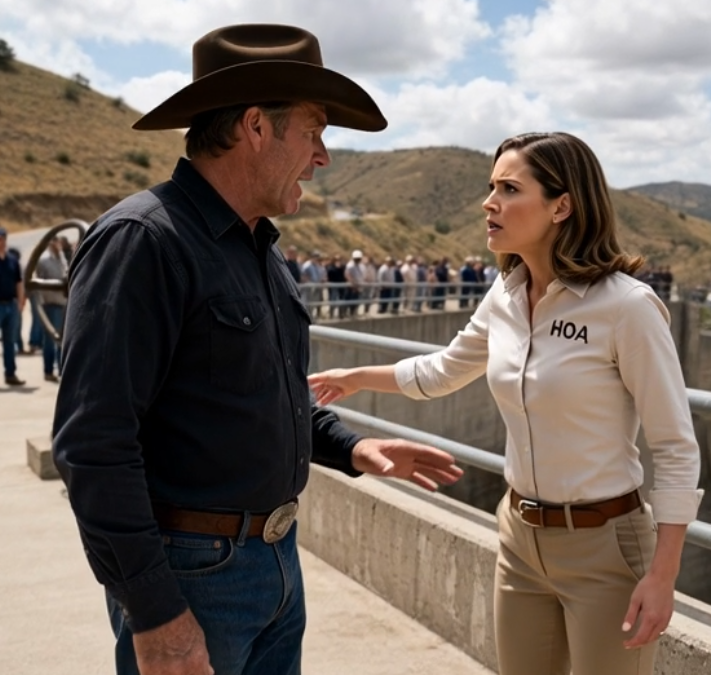
PART3:
HAYLAND CROSSING ESTATES
A PREMIER LEGACY WOODLAND COMMUNITY
FINAL PHASE NOW SELLING
Final phase.
I stared at those words long enough that Margo stopped breathing loudly.
“Dad?”
“Zoom in.”
She did.
There were roads.
Not proposed roads.
Roads.
Fresh black pavement in curved loops through what had been our lower meadow since before Indiana had rail lines through that county. There were rectangular pads, framed houses, rooflines, cleared lots, and construction vehicles caught by satellite like insects in amber.
I stood too fast.
My cane fell.
Margo grabbed my elbow.
“Dad.”
“That is my north bottom.”
“I know.”
“That road is where the old drainage channel crosses.”
“I know.”
“That cannot be there.”
But it was.
A whole fake neighborhood.
Paved streets.
Model-home banners.
Landscaped entrances.
A sales office.
Construction trailers.
My daughter opened another result.
A brochure.
Families on bicycles.
Children with kites.
Couples drinking coffee on porches that did not yet exist.
A smiling paragraph from the HOA president, Marlene Voss-Hayland, welcoming buyers to “legacy woodland living rooted in Indiana heritage.”
Indiana heritage.
On land my great-great-grandfather had registered before the developer’s great-grandfather had likely owned shoes.
I sat back down slowly.
Margo’s face had gone pale.
“How many?” I asked.
She clicked through the county GIS layer.
A plat map opened.
Lots one through one hundred.
One hundred.
Not a clerical mistake.
Not a corner line disagreement.
Not a contractor crossing onto the wrong parcel with a backhoe.
One hundred houses.
I picked up my cane.
“Get your coat.”
“Where are we going?”
“To see how many crimes fit on a floodplain.”
The drive from my farmhouse to the north bottom should have taken six minutes by the old mill road.
It took twenty, because the road was blocked.
Not washed out.
Blocked.
A new gate had been installed across my road, with a temporary sign zip-tied to it.
HAYLAND CROSSING ESTATES
AUTHORIZED PERSONNEL ONLY
PRIVATE HOA PROPERTY
Private HOA property.
My daughter read it aloud in the flat tone she uses when fury has moved past volume.
“Private HOA property.”
I got out of the truck.
Margo followed.
The lock on the gate was new. The posts were set in fresh concrete. The dirt around them was torn up by tire tracks.
My tire tracks.
My road.
My gate, if anyone had asked me before installing it.
Beyond the gate, through the trees, I could hear nail guns.
Air compressors.
Backing alarms.
Men shouting over machinery.
The sounds of construction where no construction should have been.
I had not gone down to the north bottom since late winter. That is one of the things people later asked me, sometimes kindly, sometimes suspiciously, as if land ownership requires daily patrol. The north bottom was not visible from the farmhouse. The old mill road curved behind a ridge, passed through timber, and dropped into low ground near the lake outlet. I had been occupied with the archive, a minor surgery on my left knee, and a long winter that had made the road miserable.
Also, it was private land.
Mine.
I had assumed that still meant something.
Margo was already photographing the gate, the sign, the lock, the disturbed ground, the road.
“Do not cut it,” she said.
“I am seventy-two, not foolish.”
“You are seventy-two and furious. Different thing.”
She was correct.
We drove around by the county road.
That was how we saw the entrance.
Two brick pillars.
Fresh sod.
A stone sign that read:
HAYLAND CROSSING ESTATES
A BROOKMIRE LAKE COMMUNITY
Brookmire Lake.
They used my lake’s name too.
That was the moment the thing inside me shifted from outrage to clarity.
People sometimes think anger clouds the mind. In my experience, true anger can do the opposite. It burns away everything decorative and leaves only structure.
The entrance road curved into the development through what used to be a stand of sycamores.
I remembered those trees.
My grandson had climbed one when he was eight and refused to come down until his mother promised not to make him take piano lessons. That sycamore was gone. So were the others. In their place was a sales office with flags out front and a banner reading:
MOVE-IN READY HOMES COMING SOON
There were no families living there yet.
That mattered.
No cars in driveways. No curtains. No mailboxes with names. No children in yards. The houses were still under construction. Fifty-four framed and weather-tight. Forty-six more in different stages: foundations, framing, piles of lumber, roof trusses waiting like ribs.
And every one stood on the wrong man’s land.
Mine.
We parked by the sales office.
A young woman in a navy blazer came out smiling.
“Welcome to Hayland Crossing. Are you here for a tour?”
“No,” I said.
Margo’s hand tightened around her phone.
The woman’s smile held.
“All visitors do need to check in before entering active construction areas.”
“I am not a visitor.”
“Sir?”
“I own this land.”
The smile changed.
Not disappeared.
Changed.
Professional smile to trained problem smile.
“I’m sorry?”
I pointed with my cane toward the road, the houses, the cut slope, the drainage channel they had filled with riprap and landscaping fabric.
“I own this land.”
She glanced behind her.
“Let me get Mr. Hayland.”
Lex Hayland arrived in a white pickup five minutes later.
I recognized him before he introduced himself.
Not because I had met him.
Because his face was on the brochure.
Mid-fifties. Expensive boots. Pressed jeans. Silver hair arranged to look natural at considerable cost. A developer’s smile. The kind that suggests every objection is merely a misunderstanding waiting to be monetized.
He stepped out of the truck with one hand extended.
“Mr. Brookmire. I was wondering when we might finally meet.”
That sentence told me two things.
First, he knew exactly who I was.
Second, he had been expecting me eventually and had prepared a version of the world in which he was not trespassing.
I did not shake his hand.
“You built a subdivision on my land.”
His smile did not move.
“We acquired clear title to the development parcel last year.”
“No, you did not.”
“I understand this may be emotional. Family land can be complicated.”
“My land is not complicated.”
“Respectfully, the records suggest otherwise.”
Margo stepped beside me.
“Which records?”
Lex looked at her.
“And you are?”
“Margo Brookmire. His daughter. Which records?”
“A 1962 deed transfer out of the Brookmire family line.”
“To whom?”
“To a holding entity that eventually became part of our acquisition chain.”
I almost laughed.
Not because it was funny.
Because it was lazy.
“In 1962,” I said, “this land was owned by my grandfather, Elias Brookmire. He died in 1978. He never sold the north bottom. He never sold the millrace. He never sold the lake frontage. He never sold the floodplain because he spent sixty years telling every man who asked that only an idiot builds there.”
Lex folded his hands in front of him.
“We have title opinions.”
“You have fiction.”
“You may want to consult counsel.”
“I already know the law.”
He smiled slightly.
“Historians often know old law. Real estate law evolves.”
Margo made a sound beside me.
I looked at Lex.
“You built in a mapped floodplain.”
“We have engineering approvals.”
“From whom?”
“County review.”
“No state approval?”
“The lake is ornamental.”
That was when I understood he truly did not know.
He thought Brookmire Lake was a pond.
A pretty feature.
Waterfront marketing.
He did not know it was a regulated impoundment tied to an 1839 mill dam still listed in the state inventory. He did not know the north bottom had been deliberately preserved because it was part of the relief basin. He did not know the low meadow accepted controlled discharge during seasonal drawdowns. He did not know my father and I had maintained the gate, spillway, stone sidewalls, and runout channel for half a century precisely so the lake did not fail unpredictably.
He believed the dam was decorative.
He believed the old white oak sluice gate was history.
That ignorance sat behind one hundred houses like a loaded gun.
“You need to stop work immediately,” I said.
Lex’s voice cooled.
“That will not happen.”
“You are on my land.”
“That is disputed.”
“It is not disputed by me.”
“Then file something.”
“I will.”
“Good.” He glanced toward the houses. “Until a court tells us otherwise, this is an active development site, and you are interfering with lawful construction.”
Margo lifted her phone.
“Say that again.”
Lex looked at the phone.
His smile disappeared.
“I think we’re done here.”
“Not nearly,” I said.
Security arrived before we reached the truck.
Two men in black polo shirts with HAYLAND CROSSING STAFF stitched over the chest. One told us we were trespassing.
On my land.
I did not argue with him. Arguing with the lowest rung on a ladder never moves the roof.
We left.
But before we drove away, I stopped at the county road and looked back over the development.
There were children in the brochure.
There were no children on the land.
Not yet.
That meant there was still time to prevent a theft from becoming a tragedy.
The next seventy-two hours were a blur of records.
Margo stayed.
We pulled every deed, survey, transfer, tax record, plat filing, drainage study, permit application, and historic map we could access. We drove to the county recorder’s office. We drove to the courthouse. We drove to the state archives. I called three former colleagues, one retired surveyor, one preservation engineer, and a lawyer in Indianapolis named Celia Grant who had once helped stop a county from demolishing an 1840s canal lock because someone thought “old stones” meant “free stones.”
Celia listened for six minutes.
Then said, “Do not speak to Hayland again without me.”
“Understood.”
“I mean it, Octavius.”
“I said understood.”
“You said it the way you say things right before ignoring them.”
Margo nodded at the speakerphone.
“She knows you.”
The alleged 1962 deed surfaced on Friday.
A scanned copy had been used in Hayland’s title chain.
It purported to transfer seventy-three acres from a woman named Alma Brookmire to a timber investment company.
There were problems.
Many problems.
First, no Alma Brookmire had ever owned the land.
Second, the legal description lifted language from a 1949 timber lease but altered two boundary calls.
Third, the notary stamp belonged to a notary whose commission had expired in 1958.
Fourth, the signature was witnessed by a man who, according to his obituary, had died in 1960.
Fifth, the deed described a “service road constructed in 1959.”
The road in question had not existed until 1974.
Margo sat at the dining room table surrounded by papers and whispered, “This is not even a good forgery.”
“No,” I said. “It is a confident forgery.”
Those are worse.
Bad lies fail when questioned.
Confident lies survive because people are too busy, too careless, or too invested to question them.
Hayland’s permits were worse.
There were building permits for the houses, yes, but they referenced parcel numbers from a neighboring tract Hayland legitimately owned. The site plan had been shifted on later submissions. The drainage study contained a map with the Brookmire parcel boundary cropped off. The floodplain note had been marked “not applicable” because the consultant had classified Brookmire Lake as “private ornamental water feature.”
Ornamental.
My great-great-grandfather’s millpond had outlasted a Civil War, seven presidents from Indiana’s early statehood period onward, two county courthouse fires, four generations of Brookmires, and one disastrous attempt by my uncle to stock it with catfish in 1972.
It was not ornamental.
By Monday, Celia filed emergency notices.
Quiet title action.
Fraud claim.
Trespass.
Request for injunction.
Demand to preserve documents.
Notice to county planning.
Notice to state environmental authorities.
Notice to the title insurer.
Notice to every builder listed on site.
Notice to Hayland Development Group.
Lex responded through counsel with a statement claiming “good faith reliance on recorded instruments” and “substantial investment.”
Substantial investment was true.
Good faith was not.
But courts are not lightning. They do not strike simply because truth exists. They move through filings, hearings, schedules, continuances, arguments, and paper.
Meanwhile, crews kept working.
Not at full speed.
But working.
That was what made me angriest.
Not that Lex disputed.
Not even that he lied.
That after being told, after receiving notice, after seeing the evidence, he kept adding nails and siding and shingles to my land.
A week later, a woman appeared at my farmhouse.
She drove a pearl-white SUV and wore a cream suit entirely unsuited to a gravel road.
Marlene Voss-Hayland.
HOA president.
Lex’s wife.
The same smiling woman from the brochure.
She knocked with two fingers, as if the door might stain her.
Margo opened it.
I was in the front room.
“Mrs. Hayland,” my daughter said.
“Oh good,” Marlene said. “You know who I am.”
“It was difficult to miss your face on the fraud brochure.”
Marlene’s smile tightened.
“I’m here to speak with your father.”
I came to the door.
She looked past me into the farmhouse with faint disappointment, as though she had expected either decay or wealth and found instead books.
“Mr. Brookmire,” she said. “I think this entire situation has become unnecessarily adversarial.”
“You built one hundred houses on my land.”
“My husband’s company acquired what we understood to be developable property.”
“No.”
“We have buyers under contract.”
“Then you have victims.”
“They are families.”
“Then you should stop lying to them.”
Her eyes cooled.
“Do you understand what you are threatening?”
“Yes.”
“Do you understand how many jobs are attached to this project?”
“Yes.”
“How much money?”
“Yes.”
“How many families are expecting homes?”
“Yes.”
“And you still intend to destroy all of that over a boundary dispute?”
I studied her.
Marlene Voss-Hayland was not stupid. That became clear. She knew the word boundary dispute sounded smaller than land theft. She knew families sounded better than buyers. She knew destroy sounded better than expose.
“This is not a boundary dispute,” I said.
“Then what is it?”
“A crime scene with landscaping.”
For the first time, her face slipped.
Only slightly.
Then she stepped closer.
“My HOA will not be intimidated by an old man trying to preserve his private swamp.”
“My floodplain.”
“Swamp.”
“Floodplain.”
She smiled again.
“You may find that public sympathy does not favor one elderly landowner standing in the way of housing.”
“Public sympathy has poor drainage.”
“I beg your pardon?”
“Nothing built there will stay dry.”
“The engineering says otherwise.”
“The engineering cropped out the water.”
Her eyes flickered.
There it was.
Not ignorance.
Knowledge.
Maybe not the whole fraud.
But enough.
Enough to know what had been hidden.
I leaned on my cane.
“Leave my porch, Mrs. Hayland.”
She lowered her voice.
“You cannot stop this.”
“My dear woman,” I said, “you built houses in the path of a nineteenth-century dam release channel and called me old-fashioned for noticing. I do not need to stop you.”
She stared.
“The water will.”
She left without another word.
The dam release had already been scheduled.
That is the part Lex later tried to twist.
He claimed I opened the dam in retaliation. That I “flooded a neighborhood.” That I endangered property. That I behaved like a vigilante.
None of that was true.
Brookmire Dam requires periodic controlled releases to manage sediment, inspect the lower stonework, and keep pressure off the spillway during spring runoff. My father did them. My grandfather did them. I had done them for forty years.
That year’s release had been delayed because of my knee surgery and because late spring rains kept the lake higher than usual. Three weeks before I discovered Hayland Crossing, I had already applied for and received state approval for a routine drawdown.
After discovering the illegal construction, Celia advised me to provide additional notice.
So I did.
Certified notice to Hayland Development.
Notice to the county emergency manager.
Notice to the sheriff.
Notice to the Indiana Department of Natural Resources.
Notice to the planning commission.
Notice to the site contractors.
Notice posted at the dam.
Notice posted at the mill road entrance.
The release would occur at 5:30 a.m. on May 18.
No occupied homes existed.
No public road would be affected.
The release would remain within the historic floodplain and drainage corridor.
The one Hayland had built on.
Lex sought an emergency order to stop me.
The judge denied it at 4:12 p.m. on May 17 after Celia produced the dam records, the state approval, the 1839 engineering drawings, the modern inspection reports, and photographs of the construction across the release basin.
The judge looked at Hayland’s attorney and asked one question.
“Are there occupied residences on this site?”
“No, Your Honor.”
“Then your client may move his equipment.”
That was all.
At dawn the next morning, I stood at the sluice gate.
Margo stood beside me.
So did Celia.
So did two DNR officers, the county emergency manager, a sheriff’s deputy, three surveyors, one civil engineer hired by the court, and a television crew that Margo swore she had not called.
I did not believe her.
Mist lay over Brookmire Lake.
The dam stretched low and old across the outlet, stone-faced and moss-edged, with the gate house standing where it had stood since 1839. White oak beams. Iron fittings replaced twice. Crank maintained. Gate inspected. Still working.
Below us, beyond the trees, Hayland Crossing Estates sat in the low ground like arrogance with vinyl siding.
Lex was there too.
He stood behind the sheriff’s line in a navy jacket, speaking angrily into his phone.
Marlene stood beside him, arms crossed, face pale.
At 5:29, a DNR officer checked his watch.
“You may proceed, Mr. Brookmire.”
I walked to the crank.
My hands hurt that morning.
Arthritis.
Age.
Anger.
Margo stepped forward.
“Dad?”
“I have it.”
She stepped back.
I wrapped both hands around the iron handle.
For a moment, I thought of my father’s hands there.
My grandfather’s.
Elias Brookmire before them.
Men who had argued with water their whole lives and respected it enough to lose sometimes.
Then I turned the crank.
The old mechanism groaned.
Not broken.
Awake.
The gate lifted inch by inch.
At first, the water came through dark and narrow.
Then wide.
Then white.
It hit the stone channel below with a force that shook the soles of my boots.
A sound rose from the throat of the dam, deep and wooden and old.
Water surged into the historic runout, followed the cut my ancestors had built, took the bend along the millrace, spread across the lower basin, and moved into Hayland Crossing exactly where every legitimate map said it would.
It did not rush like a disaster movie.
It did something more damning.
It behaved predictably.
Calmly.
Professionally.
It followed the truth.
Within thirty minutes, the decorative walking trail disappeared.
Within forty, the model-home lawn was under six inches.
Within an hour, water stood across three streets named after trees Lex had cut down.
Willow Bend.
Sycamore Lane.
Heritage Court.
By seven, twenty-seven foundations sat in standing water.
By eight, the carefully landscaped entrance had become a reflecting pool around the stone sign.
By nine, the old drainage channel they had buried revealed itself beneath the pavement. Water pooled over the asphalt in a long, perfect curve exactly matching the 1841 hand-drawn survey map Margo held in a plastic sleeve.
The court-appointed engineer stood with that map and said nothing for nearly a full minute.
Then he looked at Celia.
“Well,” he said.
Celia smiled.
“Well?”
“This is not ambiguous.”
The water exposed more than floodplain.
It exposed the old boundary markers.
That was the part I had hoped for but did not dare promise.
My great-great-grandfather had set hand-cut limestone stakes along the floodplain edge in the 1840s. Some were still visible if you knew where to look. Others had been buried by time, silt, leaves, and now construction fill.
As the water spread, it washed loose the fresh fill along the north edge and revealed three stones in a line.
Each marked with a B.
Brookmire.
The surveyor photographed them.
Then another.
Then the old millrace wall appeared beneath stripped sod.
Then the original overflow channel.
Then the base of the 1838 witness oak stump, preserved under silt exactly where my family survey said it should be.
The water did not merely flood the site.
It testified.
By noon, the story had moved beyond Brown County.
“Developer Builds Subdivision on Historic Floodplain.”
“Indiana HOA Project Halted After Dam Release Reveals Boundary Fraud.”
“Century-Old Mill System Exposes Modern Land Grab.”
Marlene’s HOA page disappeared by afternoon.
The sales office closed.
The builders pulled crews.
The title company sent lawyers.
The county planning director suddenly developed an urgent interest in “reviewing procedural irregularities.”
Lex held one press conference outside the development entrance.
He said, “This was an act of calculated sabotage by a private landowner.”
Behind him, water lapped against the stone sign reading HAYLAND CROSSING ESTATES.
Margo replayed that clip six times at the kitchen table.
“He picked the worst possible background,” she said.
“He picked the background he deserved.”
The buyers began calling us next.
That was the hardest part.
Not Lex.
Not Marlene.
Not the lawyers.
The buyers.
Because they had not stolen from me.
They had been sold a dream built on stolen ground.
A young couple from Indianapolis had put down nearly everything they had saved for a lot on Sycamore Lane. A retired nurse had planned to move into a single-story home near the lake because she wanted quiet. A widower had chosen Lot 38 because the brochure said his grandchildren could walk to the water.
They called angry at first.
Some cried.
Some accused me of ruining their homes.
Some asked if I could just sell the land now.
I understood the question.
But every time, I answered the same way.
“I cannot sell you a house that should never have been built where water has a legal and physical right to go.”
“But we already paid.”
“Then Hayland stole from you too.”
That truth took time to land.
But it did land.
Especially after the documents came out.
The 1962 forged deed.
The cropped floodplain map.
The altered drainage study.
The internal email from a Hayland project manager warning Lex that “Brookmire title issue and lake release corridor need resolution before vertical construction.”
Lex’s reply was four words:
Build before they notice.
That email ended him.
No speech could survive it.
The injunction became permanent.
Then came the criminal investigation.
Forgery.
Fraud.
Illegal development in a regulated floodplain.
False filings.
Conspiracy.
Wire fraud.
Environmental violations.
The county recorder resigned.
A planning consultant lost his license.
The engineering firm claimed it had been given incomplete information and sued Hayland separately.
Marlene Voss-Hayland insisted she had only managed the HOA marketing and “community identity.” Unfortunately for her, Margo found a webinar where Marlene boasted that she had personally helped “resolve legacy title obstacles” to get the project launched.
Legacy title obstacles.
That meant me.
Or rather, my family’s land patent.
The houses did not survive.
No one ever lived in them.
That is the mercy in this story.
No child slept in a bedroom that would have grown mold by the second spring.
No family discovered during a storm that their dream home sat inside a basin built to accept water.
No elderly couple had to be rescued from a place that never should have been permitted.
The court ordered the structures removed at Hayland’s expense.
Of course, Hayland Development collapsed before paying all of it.
That is how men like Lex operate. Profit privatized. Damage distributed.
But the title insurer, bonding company, and several contractors who had continued work after notice ended up funding the removal. It took nine months. One by one, the framed houses came down. Foundations were broken. Roads were torn up. Fill was removed. The drainage channel was restored under state supervision.
At first, the land looked wounded.
Raw dirt.
Mud.
Tire ruts.
Piles of debris.
A scar where meadow had been.
I went down there every week.
Sometimes with Margo.
Sometimes alone.
The first time I saw grass beginning to return along the old channel, I cried.
Not loudly.
Not dramatically.
But enough that Margo put one arm through mine and said, “Grandpa would be unbearable about this.”
“He would.”
“He’d say the land just needed someone to stop interrupting it.”
“No,” I said. “That sounds like your grandmother.”
Margo smiled.
“What would he say?”
I looked at the water moving gently through the restored channel.
“He’d say, ‘Told you only an idiot builds there.’”
She laughed so hard a heron lifted from the reeds.
A year later, Hayland Crossing no longer existed.
Not on the ground.
Not on the county map.
Not on real estate sites.
The entrance pillars were gone.
The fake stone sign was gone.
Sycamore Lane was gone.
Willow Bend was gone.
Heritage Court was gone.
In their place, we established the Brookmire Millplain Preserve.
Not because I am noble.
Because I am old enough to know my heirs do not need to spend the next century fighting the next Lex Hayland.
Margo and I donated a conservation easement over the floodplain, millrace, dam corridor, and north bottom. The farmhouse, upper woods, and archive remained family property. The preserve allowed controlled educational access, research, and seasonal habitat restoration. No houses. No HOA. No “legacy woodland living” invented by people who cut down the legacy and sold the stumps.
The first school group came that October.
Twenty-six fourth graders in bright jackets stood near the old millrace while I explained how water powered the mill in 1840, how floodplains work, and why maps matter.
A boy raised his hand.
“Is this where the fake houses were?”
His teacher looked mortified.
I smiled.
“Yes.”
“Did you really flood them?”
“I opened a legal dam release,” I said.
He considered that.
“Because they lied?”
“Because the water needed to go where it has always gone. The lying only made that inconvenient for them.”
He nodded solemnly, as if this was the best possible answer.
Maybe it was.
Lex Hayland took a plea eighteen months after the release.
He avoided the longest sentence by cooperating against two partners and the title examiner who helped launder the forged deed into the chain. He still went to prison. Not for as long as I wanted. Longer than he expected.
Marlene moved to Florida and attempted to reinvent herself as a “community lifestyle consultant.”
Margo sends me screenshots sometimes.
I tell her to stop.
She does not.
The buyers recovered some money through insurance, settlements, and restitution. Not all. People rarely get back everything stolen from them, even when the thief wears a suit and calls the theft development. A few wrote to me later. Some apologized for blaming me. Some thanked me for stopping them before they moved in.
The retired nurse visited the preserve one spring.
She stood with me by the restored channel and watched water move through the reeds.
“I was going to put my bedroom there,” she said, pointing.
I looked.
Lot 22.
Now marsh grass.
“I know.”
She shook her head.
“I was angry at you.”
“I know.”
“I thought you ruined my last home.”
I did not answer.
She watched the water a long time.
Then she said, “You saved me from buying a lie.”
That was enough.
People ask me if opening the dam felt satisfying.
The honest answer is yes.
Of course it did.
I am a human being, not a courthouse statue.
Watching water move through that fake neighborhood and reveal every hidden truth felt like seeing a liar interrupted by an older, better witness.
But satisfaction was not the deepest feeling.
The deepest feeling was grief.
For the cut trees.
For the torn ground.
For the buyers deceived.
For the fact that every safeguard had existed and still failed because enough people found profit more persuasive than paper, law, memory, and land.
The deed was there.
The maps were there.
The floodplain was there.
The dam records were there.
The old stones were there.
The truth had not been hidden.
It had merely been inconvenient.
And inconvenience is where dishonest men begin their work.
I still live in the 1839 farmhouse.
I still maintain the dam.
Every spring, the state inspector comes out, younger every year, or perhaps I am simply older. Margo usually joins us now. She brings coffee and a folder full of documents because she trusts systems but verifies them like a woman raised correctly.
At the sluice gate, I keep a small framed copy of Lex Hayland’s email.
Build before they notice.
Not because I enjoy bitterness.
Because it is a useful reminder.
Notice.
That is the work.
Notice the cropped map.
Notice the forged signature.
Notice the road where no road should be.
Notice the phrase ornamental water feature attached to a working dam.
Notice the charming brochure.
Notice the old stone under the mud.
Notice when someone turns history into marketing while destroying the thing itself.
On the second anniversary of the dam release, Margo and I walked the north bottom at sunrise.
The meadow had come back greener than I expected.
Frogs sang in the wet places.
Sycamore saplings stood in protective tubes along the restored channel.
A red-tailed hawk circled over the ridge.
Brookmire Lake lay calm behind the dam, reflecting the pale morning sky as if it had not been dragged into court, television, fraud, and county scandal.
Margo stood beside one of the old boundary stones.
The B carved into it was worn but visible.
“Do you think they’ll try again?” she asked.
“Someone always tries again.”
“That’s comforting.”
“I am a historian. Comfort is not my field.”
She laughed.
Then she grew quiet.
“You know what bothers me most?”
“Only one thing?”
She looked across the meadow.
“They almost got away with it because they thought old things were weak.”
I leaned on my cane.
“No,” I said. “They almost got away with it because too many people agreed with them.”
She nodded.
Below us, water moved gently through the channel.
Not dramatic.
Not angry.
Just persistent.
That is the thing about water.
It does not care about brochures.
It does not respect forged deeds.
It does not pause for ribbon cuttings, HOA covenants, model-home banners, or men with white trucks and confident smiles.
Water reads land by gravity.
It follows the oldest record there is.
So when people ask why I opened the dam, I tell them the simple truth.
Because the state approved it.
Because the dam required it.
Because no one lived there.
Because the court refused to stop it.
Because the land needed to breathe.
Because my family had maintained that gate for nearly two centuries.
But beneath all those reasons is the real one.
I opened the dam because men had lied on paper, and I had one witness left who could not be bribed, rushed, threatened, or confused.
The water.
And when it came through the old white oak gate, it told the truth in a language every foundation understood.








