Family Put Grandpa’s “Old War Rifle” Up for $40—Then a 77-Year-Old Marine Saw the Serial Number and Revealed It Had Saved His Life in Vietnam.
PART2:
Everything a human being once touched reduced to folding tables and masking-tape prices.
Henry understood something about disappearing that way.
He had watched men disappear in Vietnam.
Then watched the world continue.
Later he watched his parents disappear.
Old friends.
His wife.
Margaret had died in 2019 after forty-nine years of marriage.
Four years later, Henry still sometimes reached toward her side of the bed during storms.
He knew very well that death was not simply a person being gone.
Death was thousands of objects suddenly losing their owner.
Estate sales made that visible.
Henry never bought much.
A wrench.
An old Marine Corps book once.
A cast-iron skillet Margaret would have laughed at because he already owned four.
Mostly he walked.
Looked.
Nodded politely at photographs.
Sometimes he took his cap off if he saw a military portrait.
Nobody noticed.
That was fine.
The Mercer farmhouse sat at the end of a gravel drive.
White paint.
Green shutters.
Sagging porch.
A maple in the front yard had turned deep rust-red.
Three folding tables stood on the grass.
Two more filled the garage.
A paper sign taped beside front door said:
GRANDPA TOM PASSED IN AUGUST.
THANK YOU FOR HELPING US CLEAR THE HOUSE.
Henry stopped.
Took off his cap.
Held it against chest for two seconds.
Put it back on.
A young woman with a clipboard was pricing kitchenware.
Two young men sat on porch drinking coffee.
Brothers, Henry guessed.
Late twenties or early thirties.
Tennessee sweatshirts.
One scrolling through his phone.
The other eating biscuit from paper wrapper.
Neither looked disrespectful.
Just tired.
Estate-sale tired.
Grief mixed with logistics.
Henry understood that too.
He started at lawn tables.
Fishing tackle.
Old Craftsman sockets.
Pocket radio.
Three boxes of western novels.
A collection of train magazines.
That made him pause.
Railroad man.
Someone had written:
TOM’S BOOKS — 25¢ EACH.
Henry picked up one magazine.
Norfolk Southern locomotive on cover.
Put it back.
Then entered garage.
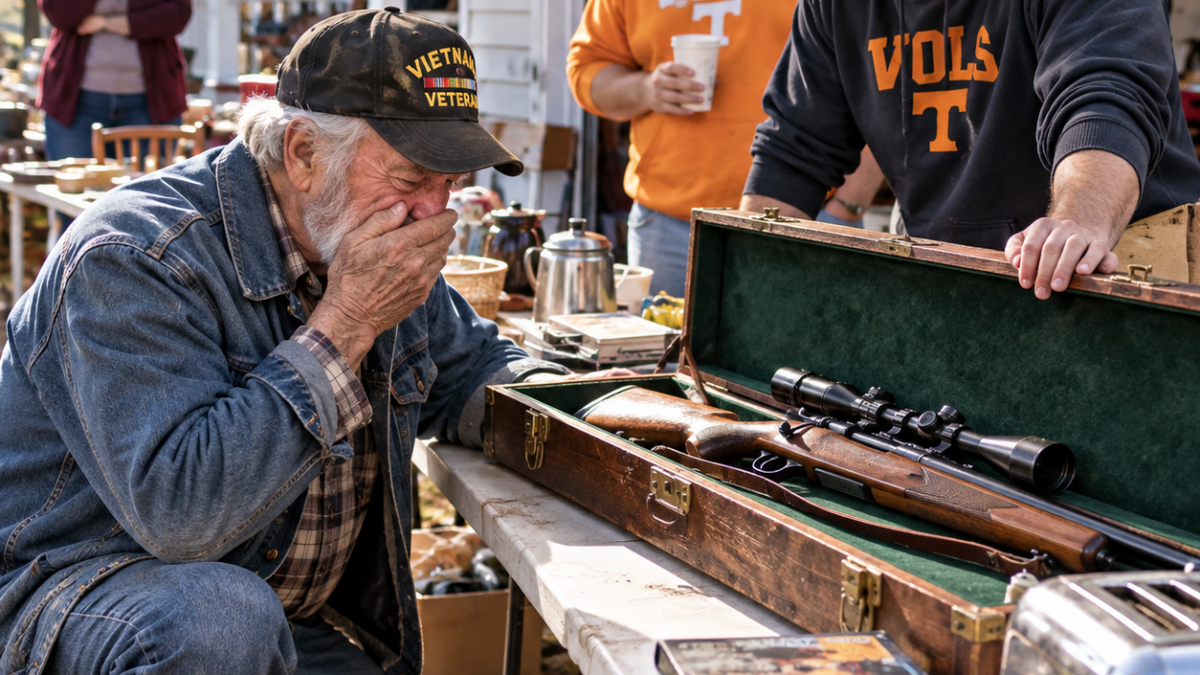
That was where he saw the case.
It sat between a chrome toaster and stacked National Geographic magazines.
Dark walnut.
About forty inches long.
Brass corners green with age.
Two latches.
Leather handle cracked almost through.
Yellow sticker on lid:
$40
WORKS FINE
Henry smiled at wording.
Works fine.
A box.
Then he stopped smiling.
There was a black scuff near lower right edge.
Small.
Curved.
His heart changed rhythm.
Henry stood very still.
That mark meant nothing.
Could mean anything.
A suitcase kicked in garage.
Tool dropped.
Decades of moving.
He told himself this.
Then he noticed brass corners.
Hand-fitted.
One slightly crooked.
He knew that crooked corner.
Impossible.
No.
Fifty-six years.
Different state.
Different family.
Millions of objects crossing country.
Impossible.
Henry did not open it.
Instead he walked back outside.
The older young man looked up.
“Can I help you, sir?”
Henry pointed toward garage.
“That wooden case.”
“Long one?”
“Yes.”
“Is that for sale?”
The young man laughed.
“Everything’s for sale.”
He stood and stretched.
“That’s Grandpa’s old war souvenir.”
The words landed strangely.
War souvenir.
Forty dollars.
“Do you know what’s inside?”
“Old rifle.”
“What kind?”
He shrugged.
“Hunting rifle, maybe.”
His brother said:
“Mom almost threw it away.”
“Figured collectors might want it.”
Henry looked from one to other.
Neither was mocking.
They truly did not know.
“Your grandfather?”
“Tom Mercer.”
Henry felt something move through his chest.
Not yet certainty.
But close.
“Thomas Mercer?”
“Yeah.”
“Thomas Edwin Mercer?”
The brothers exchanged looks.
Older one frowned.
“I think.”
“How do you know?”
Henry did not answer.
“May I open it?”
“Sure.”
“Go ahead.”
Henry returned to garage.
By then young woman with clipboard had noticed something and followed several steps behind.
Henry knelt carefully.
His knee protested.
He ignored.
His fingers rested on brass latches.
The left one had always stuck slightly.
He pushed.
Click.
Then right.
Click.
Same sounds.
He closed eyes.
For a fraction of second he smelled canvas.
Oil.
Wet dirt.
Then nothing but garage.
Henry opened lid.
Green felt.
A rifle.
Winchester Model 70.
.30-06.
Old target scope.
Steel rings.
Walnut stock almost black from decades of oil and handling.
Bluing worn at bolt.
Wear at muzzle.
Small dent near comb.
Henry stopped breathing.
He did not touch it.
That surprised Rachel Mercer later.
She would remember his restraint more than tears.
A collector might have grabbed it.
A buyer might have checked action.
Henry only looked.
At receiver.
At serial number.
He leaned closer.
The last four digits punched straight through fifty-six years.
His hands began to tremble.
The young woman said:
“Sir?”
Henry barely heard.
There was one more thing.
He knew where to look.
He crouched farther.
On underside of receiver was a tiny hand-stamped inscription.
Crude.
Three letters.
A date.
HC
NOV 18 68
Henry’s knees almost gave out despite already kneeling.
His initials.
Henry Caldwell.
November 18, 1968.
He had not seen those marks since Vietnam.
He closed case.
Gently.
Slow enough that hinges made no sound.
Then stood.
He carried nothing.
Walked toward porch.
The two brothers were watching now.
The young woman followed.
Older brother asked:
“Everything okay?”
Henry removed cap.
Held it in both hands.
“What was your grandfather’s full name?”
“Thomas Mercer.”
“Thomas Edwin?”
The woman answered.
“Yes.”
“I’m Rachel.”
“I’m his granddaughter.”
“That’s my brothers Caleb and Ryan.”
Henry nodded.
“Was he a Marine?”
Caleb shrugged.
“Yeah.”
“I think.”
“We know he was in Vietnam.”
“For how long?”
Ryan said:
“Couple years?”
“Maybe four?”
“He never talked about it.”
Rachel stepped closer.
“Did you know him?”
Henry stared toward garage.
Then at three grandchildren.
A few shoppers had gone quiet nearby.
One woman stopped holding Pyrex bowl.
Henry sat on porch step because his knee suddenly would not trust him.
Rachel dragged over folding chair.
“No.”
Henry said.
Then corrected.
“Yes.”
“I knew him.”
“How?”
Henry looked at his hands.
Old hands.
Spots.
Scars.
One finger crooked from injury that had nothing to do with war.
“We were together in Vietnam.”
Caleb’s posture changed.
“Together how?”
Henry swallowed.
“He was my partner.”
The younger brother Ryan frowned.
“Like unit?”
“Closer.”
Henry pointed toward garage.
“The rifle in that case belonged to your grandfather.”
“Yes.”
Caleb said.
“No.”
Henry shook head.
“I mean before it became his souvenir.”
“That rifle was a working rifle.”
“I know the serial number because I wrote it down.”
Rachel stared.
“You wrote his rifle’s serial number?”
“Every rifle in our section.”
“Why?”
“Because that was my job.”
Henry looked toward road.
He had not told this story in decades.
Not fully.
Not to Margaret.
Not to daughter.
Pieces.
Never whole.
Vietnam had lived in locked rooms.
Some men came home and talked.
Some did not.
Henry admired both.
He had been the kind who said:
“Bad place.”
Then changed subject.
Tom apparently had been the same.
Henry realized with sudden ache that Tom’s grandchildren might know less than his own daughter.
He breathed.
“Your grandfather served with Marines in Vietnam.”
“He worked in a scout-sniper element for part of his tour.”
“Tom was shooter.”
“I spotted.”
Caleb looked toward garage.
“That was his sniper rifle?”
“Yes.”
Silence.
Henry continued.
“Not exactly in the modern sense people imagine.”
“Equipment and organization were different then.”
“But yes.”
“That Winchester went into field with us.”
“How do you know it’s same one?”
Ryan asked.
Henry almost smiled.
“Serial number.”
“And that.”
He pointed toward case.
“The initials?”
Rachel asked.
Henry looked at her.
“Mine.”
Everything became still.
Caleb said:
“Why are your initials on Grandpa’s rifle?”
Henry stared down at cap.
Because the answer required going back.
He had spent most of his adult life avoiding going back.
But Tom’s family deserved.
“November eighteenth.”
Henry said.
“Nineteen sixty-eight.”
He closed eyes.
And suddenly he was twenty-one.
The Que Son Valley was green in a way Tennessee could never be.
Too green.
Thick.
Wet.
Everything smelled alive and rotting at same time.
Henry remembered leeches.
Sweat.
Red mud.
The weight of radio batteries.
Mosquitoes.
He remembered Tom Mercer twenty-three years old.
Pennsylvania accent.
Too skinny.
A cigarette always stuck in corner of mouth when situation allowed.
Tom had a way of humming Hank Williams when nervous.
Not loudly.
Barely audible.
Your Cheatin’ Heart.
Cold, Cold Heart.
Half the lyrics wrong.
Henry used to threaten to shoot him himself if he did not learn words.
Tom always answered:
“That would improve your shooting.”
That was friendship.
They had not begun close.
Henry from Tennessee.
Tom from western Pennsylvania.
Henry quiet.
Tom quieter.
What made partnership work was not similarity.
It was predictability.
Tom never moved carelessly.
Henry never lied about what he could see.
Two-man work depends on trust so complete it becomes physical.
Distance.
Wind.
Direction.
Movement.
Time.
One watched while one acted.
Then roles shifted.
The rifle mattered because it belonged to that rhythm.
The Winchester had a personality.
Bolt stiff in humid weather.
Scope adjustment that wandered if somebody abused it.
Stock ding from a helicopter loading incident Tom blamed on Henry.
Henry insisted Tom did it.
They never settled.
By November 1968, they knew it like instrument.
On November 18, their patrol moved through a draw south of a ridgeline identified on their map as Hill 425.
Henry remembered heat first.
Then insects.
Then first shot.
The lieutenant went down almost immediately.
Everything broke.
Gunfire from tree line.
Men dropping.
Some yelling.
Others too disciplined to yell.
Henry remembered throwing himself toward a fallen trunk.
Then impact in thigh.
Like sledgehammer followed by fire.
He hit ground.
Tried to stand.
Leg folded.
Blood.
Too much.
His radio? Not his. Patrol radio went down with lieutenant/radioman area amid fire.
Henry crawled.
Tree gave partial cover.
Tom was farther upslope.
Henry could not see him.
Gunfire walked closer.
Someone shouted.
Henry wrapped belt? He had field dressing. Let’s make accurate: he pressed field dressing and improvised pressure, later tourniquet maybe.
He pressed field dressing into wound.
Hands slick.
He thought:
This is it.
Not dramatic.
Just certainty.
Then Tom appeared.
Crawling.
Forty yards under fire, Henry later estimated.
Maybe thirty.
Maybe fifty.
Memory is unreliable under gunfire.
Tom reached him.
Said:
“Still ugly?”
Henry answered:
“Go away.”
Tom said:
“No.”
That was all.
He pulled Henry deeper behind cover.
Set rifle across folded gear.
Started working.
Henry would never glorify shooting.
He hated when people wanted numbers.
“How many did Tom kill?”
Wrong question.
The question was:
How many Marines got to keep breathing because positions stopped firing?
Henry remembered four enemy firing points suppressed or silenced over about eleven minutes.
Maybe more men.
Maybe fewer.
Tom fired only when he had target.
Henry, bleeding, still spotted when conscious enough.
Distance.
Movement.
Left.
Tree.
Muzzle flash.
Then relief element came.
Tom kept one hand hooked through Henry’s web gear whenever he could.
That detail stayed.
Not heroic pose.
A hand.
Holding.
As darkness arrived, Marines reached them.
Henry remembered being carried.
Remembered Tom walking beside litter still carrying Winchester.
Remembered asking:
“Did you lose rifle?”
Tom replied:
“Priorities.”
Henry laughed until pain made him vomit.
The next clear memory was field hospital.
Tom visited days later.
He had changed.
So had Henry.
Nobody admitted.
Several Marines from patrol were dead.
Lieutenant among them.
A young man engaged to woman in Georgia.
Tom had been recommended for valor decoration.
Henry learned later.
Tom did not care.
“People died.”
He said.
That was answer.
Three weeks after ambush, when Henry returned temporarily to rear area before evacuation farther out, Tom showed him rifle.
He had stamped underneath:
HC
NOV 18 68
Henry stared.
“What is that?”
Tom shrugged.
“Reminder.”
“Of me?”
“Of why rifle matters.”
Henry had made joke.
“Romantic bastard.”
Tom said:
“Shut up.”
Then that was it.
No speech.
No hug.
No promise they would be brothers forever.
War interrupted everything.
Assignments shifted.
Henry went stateside eventually.
Tom completed service.
They exchanged letters for a few years.
Then life.
Henry moved.
Tom moved.
Addresses changed.
A letter returned.
Another never answered.
Before internet, finding one quiet Thomas Mercer in America was not simple.
Henry tried.
Veterans’ groups.
Old contacts.
Occasional directory search.
Each attempt faded.
He assumed Tom was alive because believing otherwise easier.
Then decades passed.
On Mercer porch in Tennessee, Henry finished first version of story.
Not all details.
Enough.
Nobody moved.
Rachel’s eyes were wet.
Caleb sat on concrete floor against garage wall.
Ryan stood with arms hanging.
Finally Caleb whispered:
“Grandpa saved your life.”
“Yes.”
“With that rifle.”
“Yes.”
“Why didn’t he ever tell us?”
Henry shook head.
“That isn’t question I can answer for him.”
“But you knew him.”
“Yes.”
“Was he ashamed?”
Henry looked sharply.
“No.”
Then softened.
“No.”
“I don’t think so.”
“Then why hide it?”
Henry considered.
“Some men don’t hide because they’re ashamed.”
“They’re protecting something.”
“Sometimes themselves.”
“Sometimes family.”
“Sometimes dead.”
He looked toward case.
“Your grandfather came from generation that was not encouraged to unpack war at kitchen table.”
“That doesn’t mean silence was healthy.”
“It means silence was common.”
Rachel covered mouth.
“He used to go outside during fireworks.”
Henry nodded.
“He probably hated fireworks.”
“He said noise bothered dog.”
“Did he have dog?”
“No.”
Henry almost laughed.
“That sounds like Tom.”
Caleb began crying.
Quietly first.
Then not.
“We sold his stuff.”
Henry said nothing.
“We’ve been selling everything all morning.”
“That’s what estate sales do.”
“We put forty dollars on that.”
Henry looked at him.
“It was worth forty dollars to you because you didn’t know.”
“That doesn’t make you bad.”
“I called it old war junk yesterday.”
“Not to him.”
“No.”
“But—”
Henry leaned forward.
“Son.”
Caleb looked.
“Do not punish yourself for information nobody gave you.”
“That is waste.”
“Use information now.”
Ryan had tears too.
“We thought he was just quiet.”
Henry nodded.
“He was quiet.”
Then:
“He earned right to be quiet.”
Rachel whispered:
“What else did he do?”
That question opened floodgate.
Henry stayed six hours.
The estate sale quietly stopped.
Rachel turned sign around.
Caleb moved toaster.
National Geographics.
The rifle case sat alone on cleared table.
Nobody touched without asking Henry.
Henry refused ownership of moment.
“This belongs to your family.”
Caleb said:
“We almost sold it.”
“You didn’t.”
“We would have.”
“You didn’t.”
At 11:20, Rachel called mother.
Susan Mercer lived Knoxville.
She arrived after one.
Gray SUV came too fast down gravel.
A woman in early sixties stepped out before engine fully stopped.
She had Tom’s eyes.
Henry knew immediately.
Susan walked toward him.
“Mr. Caldwell?”
“Henry.”
She stopped three feet away.
Then hugged him.
Henry stiffened automatically.
Then returned.
“I’m sorry.”
Susan cried.
“For what?”
“For not knowing.”
“That’s not yours to apologize.”
“My dad never told me.”
“That was his choice.”
“Did you try finding him?”
“Yes.”
“He lived here since 1984.”
“I know now.”
“He was in Pennsylvania before that.”
“That explains some.”
“I wish…”
Susan stopped.
Henry nodded.
There are too many sentences after I wish.
They went through Tom’s boxes.
The family had thought photographs were ordinary.
Most were.
Fishing.
Railroad.
Birthdays.
Christmas.
Then shoebox from attic.
Black-and-white military photos.
Young Marines.
Helicopters.
Sandbags.
Henry recognized faces.
Not all names.
Some names too clearly.
He sat at kitchen table while family gathered.
Susan placed one photo down.
Two men in front of sandbag wall.
Henry on left.
Tom on right.
Both absurdly young.
Tom had arm over Henry.
Two fingers raised.
Henry picked photograph with both hands.
“That was Da Nang?”
He squinted.
“Maybe An Hoa.”
“No.”
“Wait.”
He laughed softly.
“God.”
“I don’t remember.”
Susan said:
“Dad kept this?”
“All these years?”
Henry turned photo.
Nothing written.
He looked at Tom’s face.
“He never threw anything away.”
Rachel said.
“Except receipts.”
“Grandma complained.”
“Your grandmother knew?”
Susan shook head.
“Mom knew he had served.”
“Not details.”
“She said he had nightmares early marriage.”
“He stopped waking her eventually.”
Henry knew what that meant.
Stopped making noise.
Not necessarily stopped dreaming.
Susan brought medal box.
Bronze Star medal.
Citation.
Never displayed.
Henry read.
His memory and document did not match perfectly.
That was important.
Memory had sharpened some things, blurred others.
The citation credited Tom’s composure under fire and actions protecting wounded Marines.
Official wording sparse.
No Hollywood.
No number of positions.
No grand adjectives.
Henry appreciated.
“Why didn’t he put this up?”
Susan asked.
“He didn’t like medal.”
“Why?”
“The lieutenant died that day.”
Henry touched paper.
“Tom said he didn’t want anybody congratulating him for surviving a day other men didn’t.”
“That was Tom’s feeling.”
“Not necessarily fair.”
“But his.”
Susan sat.
“I spent my whole life thinking Dad didn’t talk because he had nothing to say.”
Henry looked up.
“No.”
“He had too much.”
Later that afternoon, local VFW member came.
Not to perform ceremonial salute to rifle as though object were sacred.
He came because Rachel called asking how to preserve military items properly.
Gunnery Sergeant retired? Let’s say retired Marine gunnery sergeant Paul Whitaker, VFW member. He wore ordinary clothes, not dress uniform, more grounded.
Paul Whitaker was seventy-two, retired Marine gunnery sergeant.
He examined case.
Not rifle? For safety and legality, unloaded checked by qualified firearms person. Need ensure no weapon procurement issue? This is fictional. Still can mention safe handling. Paul asked before touching, verified unloaded, noted serial, recommended licensed gunsmith and secure storage rather than wall-mounted loaded. Good.
He said:
“Before anyone displays anything, get it checked.”
Caleb frowned.
“For what?”
“Condition.”
“Safety.”
“Documentation.”
“Also figure out legal ownership and transfer requirements if any.”
Good.
No romantic sloppiness.
A local gunsmith later confirmed rifle safe to preserve but family chose not to fire.
They wanted history, not use.
Henry sat while Paul looked through citation.
Paul asked:
“You were there?”
“Yes.”
He shook Henry’s hand.
That was enough.
No salute to an object.
No spectacle.
At four, people were still there.
Coffee pot empty.
Pizza boxes.
Estate sale forgotten.
A woman who had bought butter churn returned because Rachel had overcharged by five dollars? No need.
Henry told ordinary stories.
Those mattered most.
Tom stealing peaches from supply crate.
Tom writing letter to girl who later did not marry him.
Tom refusing last cigarette then stealing Henry’s ten minutes later.
Tom humming Hank Williams.
Tom once carrying wounded Vietnamese child to aid station after village incident.
Four miles? Could be memory, but let’s make “long muddy stretch” rather than exact heroic overclaim.
Tom hated powdered eggs.
Tom could repair a watch but not tie decent necktie.
Tom wrote left-handed though shot right-handed.
Tom called every lieutenant “sir” with tone that meant opposite.
The family laughed.
That changed atmosphere.
Until then, Grandpa Tom had transformed into war hero statue.
Henry refused.
“Don’t do that.”
Rachel asked:
“What?”
“Turn him into medal.”
“He was man.”
“Annoying sometimes.”
“Cheap.”
“Could hold grudge.”
“Snored.”
“Terrible cards.”
“Loved canned peaches.”
“War is part.”
“Not whole.”
Susan began laughing through tears.
“He was cheap.”
“How cheap?”
“He reused tea bags.”
Henry slapped table.
“That is Tom.”
There.
Now they knew him more completely.
Not saint.
Not souvenir.
Man.
Around five, Henry prepared leave.
Caleb carried rifle case toward truck.
Henry stopped.
“What are you doing?”
“You should have it.”
“No.”
“Sir.”
“No.”
“He saved your life.”
“Yes.”
“Those initials are yours.”
“Yes.”
“It belongs with you.”
Henry shook head.
“No.”
“Why?”
“Because it belonged to Tom.”
“Now it belongs to his family.”
“You keep it.”
Caleb swallowed.
“We almost sold it.”
“Then you almost made mistake.”
“Almost is not did.”
Ryan said:
“Please.”
Henry looked at both young men.
“Listen carefully.”
“The rifle is not valuable because it saved me.”
“It is valuable because it carries your grandfather’s story.”
“If you give it to me, story leaves his house again.”
“Keep it.”
“Tell children.”
“Tell them Tom worked railroad.”
“Tell them he took you fishing.”
“Tell them he was impossible to get talking.”
“And tell them what happened in 1968.”
“Not to make him bigger.”
“To make him whole.”
Rachel began crying again.
Henry took photo instead.
Susan pressed black-and-white picture into his hand.
“You’re in it.”
“So are you.”
“No.”
She smiled.
“My father is.”
Henry accepted.
That evening he drove home with windows cracked.
Wood smoke.
Cold leaves.
Sunset over hills.
The rifle stayed behind.
At home, Henry placed photo on kitchen table.
Margaret’s chair across.
He sat.
For first time in years, he said Tom’s name aloud in empty house.
“Found you.”
Then cried.
Not much.
Enough.
The next Tuesday, Henry began letter.
Pencil.
Four pages.
Then eight.
He started:
Susan,
There are things your father never told you, and there are things I forgot until I saw his face again.
He wrote ordinary memories.
Not battle first.
He wrote how Tom stole Henry’s socks once because his were soaked.
How Tom collected matchbooks.
How he mailed half his pay home.
How he once spent thirty minutes coaxing a terrified puppy from beneath a truck.
How he could sleep in rain.
How he was afraid of snakes and denied it.
How he once carried wounded child toward aid station and would not talk afterward.
Then battle.
What Henry remembered.
What he was uncertain about.
He was careful.
After fifty-six years, memory deserves humility.
He wrote:
I remember distance as forty yards. It may have been less. I remember four firing positions he stopped. Official report may say something different. I know only this with certainty: I was wounded, Tom came back for me, and I am alive because he did.
That sentence mattered.
He did not need improve it.
Susan received letter Friday.
Called Henry Sunday.
“Can I read it to kids?”
“Yes.”
“Can I copy?”
“Yes.”
“Can we record you telling stories?”
Henry’s first instinct:
No.
Then remembered estate sale.
“Okay.”
That began something.
Every few weeks, one Mercer family member visited Henry.
They brought recorder.
Coffee.
Questions.
Not all military.
“What was Grandpa like when angry?”
“What music?”
“Did he talk about Grandma?”
“Did he want children?”
“Was he funny?”
Henry knew some.
Didn’t know others.
When he did not know, he said:
“I don’t know.”
That became important too.
Families fill gaps with fantasy easily.
Henry refused invent.
In November, anniversary of ambush, Susan invited him.
The rifle had been inspected and preserved.
They did not hang functional firearm casually over fireplace as if decoration.
Caleb built a secure display cabinet with locking system, humidity control packets, and separate documentation compartment. The family followed advice of gunsmith and local legal requirements. The ammunition was stored separately, and rifle remained unloaded.
Behind glass:
Winchester.
Beside it:
Photograph.
Bronze Star citation.
A brass plate:
SGT. THOMAS E. MERCER
UNITED STATES MARINE CORPS
QUIET MAN.
BELOVED FATHER AND GRANDFATHER.
WE DIDN’T KNOW THE WHOLE STORY.
NOW WE WILL TELL IT.
Henry stared.
Caleb asked:
“Too much?”
Henry shook head.
“No.”
“You wanted ‘hero.’”
“I did.”
“Mom changed it.”
“Good.”
“Why?”
“Hero makes people stop listening.”
Caleb absorbed.
Henry pointed plate.
“Beloved father.”
“That’s bigger.”
They ate dinner.
After, great-grandchildren asked stories.
One boy maybe nine asked:
“Did Grandpa Tom kill bad guys?”
Room went quiet.
Henry answered carefully.
“Your great-grandfather was a Marine in a war.”
“He fought people trying to kill him and his friends.”
“War makes people do terrible things, sometimes because they have to.”
The boy frowned.
“Was he brave?”
“Yes.”
“Was he scared?”
Henry smiled.
“Anybody who says he wasn’t scared either wasn’t there or is lying.”
“Grandpa was scared?”
“Sure.”
“Then how brave?”
“That’s what brave means.”
The adults looked away.
Children ask better questions.
Henry visited again Memorial Day.
Then November.
A tradition formed.
Not obligation.
He liked house.
Mercers liked him.
Caleb began calling him Uncle Henry as joke.
Then stopped sounding like joke.
One afternoon, Rachel showed him video of Grandpa Tom fishing.
Old camcorder footage.
Tom sat dock.
Silent.
Grandchild beside.
Wind.
Water.
Then Tom hummed.
Henry sat straight.
Hank Williams.
Wrong lyrics.
He laughed until he cried.
“There he is.”
Rachel replayed.
“Is that song?”
“Supposed to be.”
“What do you mean?”
“He never knew words.”
That small discovery meant more than medal.
It connected old man at fishing dock to young Marine behind sandbags.
Same humming.
Same person.
Not two identities.
Family began rebuilding biography.
Tom Mercer born 1945.
Pennsylvania.
Marines.
Vietnam.
Railroad.
Marriage to Evelyn.
Daughter Susan.
Moved Tennessee.
Fishing.
Grandchildren.
Quiet.
Not “secret sniper hero.”
Whole arc.
They found old letters Evelyn had saved.
Tom wrote from Vietnam.
Most mundane.
Rain.
Food.
Missing home.
One line stopped Susan:
There’s a Tennessee kid named Henry here who talks too little even for me. I keep him alive because somebody has to make coffee when we’re old.
Susan called Henry.
Read line.
Henry did not answer for almost minute.
“He wrote that?”
“Yes.”
“He was terrible coffee maker.”
Susan laughed.
Henry cried after hanging up.
The story began spreading locally despite family trying keep private.
First through VFW.
Then newspaper human-interest column.
Headline:
ESTATE SALE REUNITES VIETNAM VETERAN WITH RIFLE OF FRIEND WHO SAVED HIM.
Henry disliked attention.
A television station called.
He refused.
Susan asked:
“Why?”
“Because they’ll make Tom into three-minute miracle.”
“Maybe that helps people care.”
“Maybe.”
He eventually agreed to recorded interview only if family participated.
The reporter asked:
“What did you feel when you saw rifle?”
Henry answered:
“Old.”
Not expected.
He continued:
“I felt how much time passed while I thought I still had time to find him.”
That became most quoted line.
Not heroics.
Regret.
People wrote to Mercer family.
Other veterans.
Children of veterans.
“My dad never talked either.”
“My grandfather left medals in drawer.”
“We found letters after he died.”
One woman said she had thrown away her father’s military footlocker years earlier and still regretted.
Susan responded personally:
“You didn’t throw away your father. You threw away a box because you didn’t know. Keep telling what you do know.”
That was Henry’s lesson spreading.
Not guilt.
Curiosity.
Ask while alive.
That part haunted Henry.
He had spent decades half-looking for Tom.
Why half?
He told himself directories difficult.
Work.
Family.
Time.
But deeper truth:
Finding Tom would require opening war.
Henry had not wanted.
Maybe Tom hadn’t either.
So both men remained quiet on opposite sides of country.
The rifle reunited one survivor with a story, not friend.
Too late for that.
Henry carried regret.
He went to Tom’s grave first time that spring.
Small cemetery.
Susan drove.
Stone:
THOMAS EDWIN MERCER
1945–2024
BELOVED HUSBAND, FATHER, GRANDFATHER
No Marine inscription.
Family asked if should change stone.
Henry said:
“No.”
“Why?”
“Because that’s what he chose.”
“He had DD-214 in papers.”
“He could have put USMC.”
“He didn’t.”
“Honor choice.”
They placed small Marine flag on Memorial Day.
Removable.
Enough.
Henry stood at grave alone ten minutes.
Susan stayed distance.
He said things no one heard.
Maybe:
Sorry.
Maybe:
Thank you.
Maybe:
You still owe me cigarettes.
When he returned, his face calm.
Susan did not ask.
Good.
Two years after estate sale, Caleb had son.
Named Thomas Henry Mercer.
When Henry found out:
“Absolutely not.”
Caleb laughed.
“Too late.”
“You burdened child.”
“He has middle name.”
“Still.”
At baptism? Maybe not. At first meeting, Henry held baby badly and complained.
“You’re doing it wrong.”
Susan said.
“I raised daughter.”
“Fifty years ago.”
“Babies unchanged.”
Baby cried.
Everyone laughed.
Henry looked down.
Tom Henry.
Names carrying.
Not monuments.
Continuity.
The rifle remained locked in display.
Family occasionally asked whether donate museum.
Henry said:
“Maybe someday.”
“Your decision.”
“Do not let object become burden.”
“Stories travel without object.”
That mattered because he did not want family worship weapon.
The rifle had saved him in circumstance.
It had also existed to kill.
Both truths.
In interview with local high school history class, a student asked:
“Is rifle sacred?”
Henry answered:
“No.”
The teacher seemed surprised.
“It’s important.”
“Not sacred.”
“Why?”
“Because people are more important than tools.”
“That rifle did not crawl forty yards.”
“Tom did.”
“That rifle did not choose to come back.”
“Tom did.”
“Don’t confuse instrument with man.”
That quote ended up school yearbook.
Good.
Henry’s health declined.
Knee replacement finally happened, decades after jokes.
Cataract surgery improved vision.
He joked VA timing only slightly faster than geological process. But if specific VA promises since Reagan may be exaggeration; fine as humor.
At eighty, Henry stopped driving long distances.
Mercers came to him.
They brought Thanksgiving.
Rachel brought pie.
Caleb fixed gutter.
Ryan repaired truck vibration Henry ignored.
The families braided.
Henry’s daughter Laura initially cautious.
Who are these people?
Then met.
She cried reading Tom letter references to Henry.
Henry had told Laura almost nothing of war.
That forced father-daughter conversation.
“Why didn’t you tell me?”
Henry looked toward window.
“Same reason Tom didn’t tell Susan.”
“What reason?”
“I thought silence protected you.”
“From what?”
“Me.”
Laura’s face fell.
“Dad.”
“I had nightmares when you were little.”
“I remember.”
“You thought I didn’t?”
Henry looked.
“No.”
“I remember Mom taking me downstairs.”
“I remember you yelling.”
“I remember you sitting outside after.”
Henry had no answer.
Laura took hand.
“Kids know something happened even when adults don’t name it.”
There.
Another lesson too late but still useful.
Henry began telling daughter more.
Not graphic.
Enough.
Names.
Tom.
Lieutenant.
Fear.
Coming home.
Drinking too much first few years.
Margaret’s patience.
Therapy once in 1980s after panic at fireworks.
Things Laura deserved context for.
Tom’s rifle had opened not one family’s silence.
Two.
That made Henry almost grateful for forty-dollar sticker.
Almost.
One day Caleb asked:
“What if some collector had gotten here before you?”
Henry stared.
“Then he buys rifle.”
“Maybe never knows.”
“That makes me sick.”
“Why?”
“Because story disappears.”
Henry shook head.
“No.”
“Not entirely.”
“Tom still did it.”
“History doesn’t stop being true because forgotten.”
“But forgotten history can’t teach.”
“That’s our job now.”
Caleb nodded.
The estate sale remained family joke, painfully.
Someone found photo of original yellow sticker.
$40 WORKS FINE.
Rachel framed sticker beside a photocopy of Henry’s first letter—not beside rifle, but in family scrapbook.
Caption:
THE MOST EXPENSIVE THING WE ALMOST SOLD WASN’T THE RIFLE. IT WAS THE STORY.
Henry liked that.
At eighty-one, he developed heart failure.
Manageable initially.
Then less.
Mercers visited hospital.
Caleb brought photo.
Henry joked:
“If you bring rifle in here, nurses will tackle you.”
“No rifle.”
“Good.”
Tom’s daughter Susan sat beside him.
“You found my dad after all.”
Henry looked.
“No.”
“Found you.”
That was perhaps true.
On November eighteenth, family called video from Tom’s living room.
The display behind.
Henry too weak to travel.
Great-grandson asked:
“Uncle Henry, tell story.”
Henry smiled.
“Which one?”
“The one where Grandpa Tom stole your socks.”
Everyone laughed.
Not ambush.
Socks.
That would have pleased Tom.
Henry died following spring.
Eighty-one.
His obituary mentioned Marine service? Source said three tours with Fifth Marines, but Henry could be former Marine not Navy etc. Let’s keep veteran without overclaim? It says served three tours with Fifth Marines in file. We’ll say Marine veteran, Vietnam.
Laura asked Mercer family to speak at memorial.
Caleb stood.
Held yellow $40 sticker in hand.
Not rifle.
He said:
“My grandfather Tom Mercer died before I understood who he was.”
“Henry Caldwell gave him back to us.”
Then corrected:
“No.”
“He gave us courage to ask.”
“He taught us that quiet people still have stories.”
“And that if somebody you love will not tell you everything, you can still sit beside them long enough to let them tell something.”
That was enough.
After memorial, Susan gave Laura copy of 1968 photo.
Now both families had one.
The rifle remained Mercers.
Henry’s initials still beneath receiver.
HC NOV 18 68.
Caleb sometimes looked.
But he taught his children not to start with rifle.
When they asked about Great-Grandpa Tom, he said:
“He worked railroad.”
“He loved fishing.”
“He reused tea bags.”
“He hummed songs wrong.”
“He served as Marine in Vietnam.”
“He once came back for friend who was wounded.”
In that order.
Because Henry had taught:
Hero is not replacement for person.
Years later, Thomas Henry Mercer—the baby named for both—stood before case.
Old enough to understand some.
He pointed.
“Is this gun Grandpa used?”
“Yes.”
“Did he save Henry?”
“Yes.”
“Was he scared?”
Caleb smiled.
“Probably.”
“Then why go back?”
That question.
The question beneath everything.
Caleb repeated Henry’s answer:
“Because Henry was his friend.”
Simple.
No medals.
No slogans.
No mythology.
A friend was bleeding.
Tom went back.
That was story.
The forty-dollar price tag mattered only because contrast embarrassed us into paying attention.
Objects do not announce meaning.
A wooden case can sit between toaster and magazines.
A medal can hide in drawer.
A photograph can remain in shoebox.
An old man at diner can look ordinary.
Most extraordinary parts of a life are not labeled.
That is why curiosity matters.
Not every quiet veteran has secret battlefield heroism.
Not every heirloom hides lost history.
We should not romanticize strangers into legends.
But every older person has a past larger than the final room we see them in.
Jobs.
Failures.
Love.
Fear.
Friendships.
Things survived.
Things regretted.
Stories die when nobody asks.
Tom Mercer did not owe his family combat memories.
That needs saying.
Trauma is not family property.
Silence can be boundary.
But family can still ask:
What music did you like?
Who was your best friend?
What were you afraid of?
What made you laugh?
Where did you live?
What do you wish we knew?
Questions do not need to pry wounds open.
Sometimes they create doorway.
Tom had closed many doors.
Henry opened one after death.
Too late to hear Tom’s version.
Never forget that.
Henry’s memory was not Tom’s voice.
It was one witness.
Family supplemented with letters.
Photos.
Citations.
Records.
Other Marines.
They discovered some details Henry remembered differently.
That did not ruin story.
It made it honest.
Memory is human.
Truth survives through corroboration and humility.
The rifle’s serial number connected.
The inscription connected.
The photo connected.
The letter connected.
Together, enough.
Rachel eventually digitized family archive.
Not public internet.
Private copies for descendants.
Tom’s letters scanned.
Henry’s recorded interviews.
Military documents.
Photographs.
Railroad retirement papers.
Fishing videos.
Recipes from Evelyn.
Everything.
Because the lesson was not preserve war.
Preserve life.
The locked rifle case became one item among many.
Exactly right.
On the tenth anniversary of estate-sale morning, family gathered.
Henry and Tom both gone.
Susan older.
Caleb gray at temples.
Thomas Henry ten years old.
Rachel placed original case on dining table.
Not rifle; it remained secured in display. The case itself had been preserved too.
The brass latch clicked.
Thomas Henry asked:
“Is this the sound Uncle Henry remembered?”
Caleb nodded.
“Yes.”
“From Vietnam?”
“Yes.”
The boy touched scuff.
“This mark too?”
“Maybe.”
“Henry thought so.”
“Did Grandpa Tom kick it?”
“We don’t know for certain.”
Important.
Stories should keep maybes.
The boy nodded.
Then:
“Why did they put forty dollars?”
Everyone laughed.
Caleb groaned.
“Because your father was idiot.”
Susan smacked his arm.
“Don’t teach him.”
Thomas Henry said:
“Was it worth more?”
Caleb looked at case.
Then photograph.
Then his family.
“Yes.”
“How much?”
That was the old trap.
Price.
Value.
Caleb answered:
“Not a number.”
The boy accepted.
Children can understand things adults overcomplicate.
At end of day, they visited both graves? Henry buried elsewhere. Maybe one trip not necessary.
Susan stood before Tom’s grave.
Caleb beside.
She said:
“I still wish he told me.”
Caleb:
“Me too.”
“Are we allowed to wish that?”
“Yes.”
No lesson erases loss.
Knowing why silence happened does not eliminate sadness caused.
You can honor boundary and still grieve distance.
That complexity remained.
Henry had once said:
“Your grandfather earned right to be quiet.”
Later he added in recording:
“That doesn’t mean silence cost nothing.”
Both true.
Tom’s silence protected him perhaps.
It also left daughter with questions.
Henry’s silence protected him.
It left Laura remembering screams without explanation.
War does not end cleanly when soldier boards plane.
It moves into family systems.
Sometimes unnamed.
The estate sale brought names.
Not cure.
Names.
That alone changed two families.
The rifle still has small brass plate.
Not “hero.”
Caleb eventually simplified it:
THOMAS E. MERCER
USMC
VIETNAM
HENRY CALDWELL’S FRIEND.
Below, in smaller letters:
NOVEMBER 18, 1968 — HE CAME BACK.
That was Henry’s preferred phrasing.
Not saved four positions.
Not legendary sniper.
Not kills.
He came back.
Because that is what mattered to wounded twenty-one-year-old behind tree.
Tom came back.
Fifty-six years later, in a strange way, Henry did too.
He came back into Tom’s family carrying memory.
They gave him photograph.
A chair at table.
A place on holidays.
And finally, a second family that knew enough to ask.
The morning it started, Caleb Mercer saw a wooden box.
Forty dollars.
Old war souvenir.
Take it.
He was not cruel.
He was uninformed.
That distinction matters because everyone inherits objects without stories.
We all throw something away eventually.
The answer is not shame.
It is asking sooner.
Open boxes.
Read backs of photographs.
Record grandparents laughing.
Write names under faces.
Ask who stood beside them when they were twenty.
Ask what songs they ruined.
Ask what job they hated.
Ask what scared them.
Ask what they never told because nobody asked in a way that felt safe.
And if they still do not answer, respect that too.
Love does not entitle us to every memory.
But attention is gift.
Tom Mercer’s family learned almost too late.
Not because rifle expensive.
Its collector value was irrelevant compared with what happened.
They nearly sold context.
The connection between two names.
Two young Marines.
One terrible afternoon.
One hand through a web belt.
One man who came back.
Fortunately, a seventy-seven-year-old veteran happened to turn at a hand-painted sign.
He happened to walk into garage.
He happened to recognize a crooked brass corner.
He happened to ask before case left.
Luck.
Nothing more mystical needed.
Henry Caldwell did not buy rifle.
He did something better.
He gave it back meaning.
And the Mercer family never called it Grandpa’s old war souvenir again.








