An Undefeated Fighter Offered $1,000 to Anyone Who Could Take Him Down—Then a 79-Year-Old Marine Raised His Cane and Dropped Him in Four Seconds.
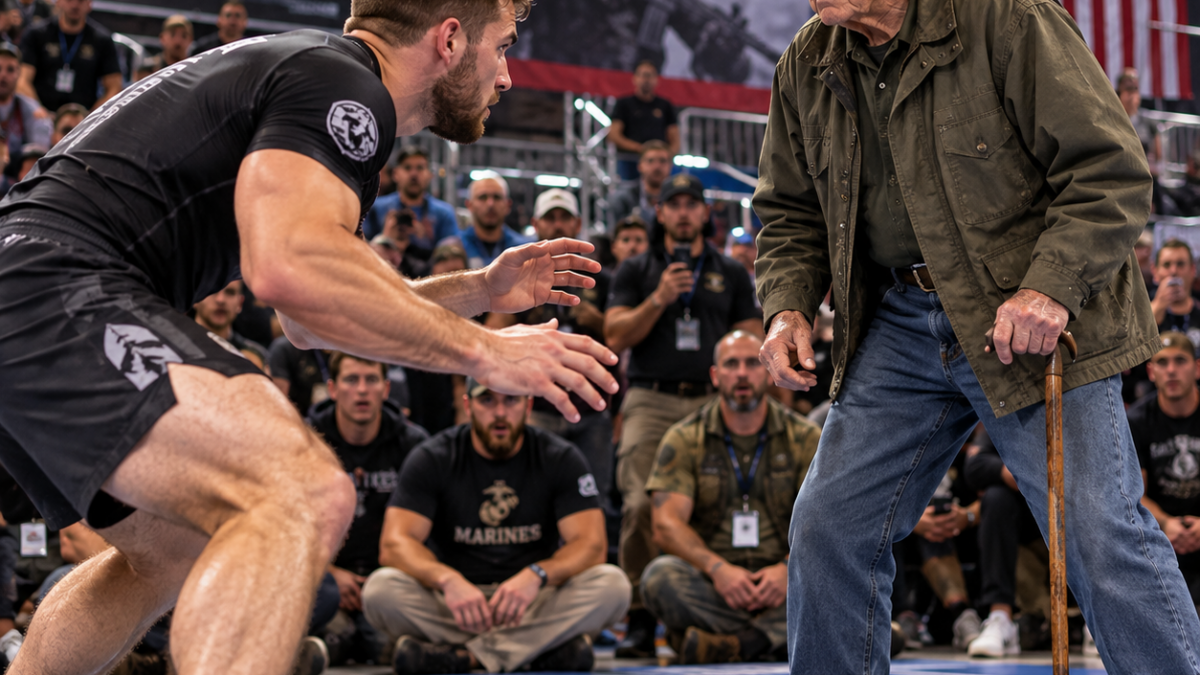
PART3:
At first Cole did not see it.
A teenager pointed.
“There!”
Heads turned.
The hand belonged to an old man in a gray windbreaker.
Seventy-nine years old.
Thin.
White hair.
Weathered face.
A plain tan button-up beneath the jacket.
Dark trousers.
Polished work shoes.
And a hickory cane.
He sat beside a booth displaying knife sharpeners.
His name was Raymond Holloway.
Almost nobody in the building knew that yet.
Cole saw him.
His grin widened.
“YES.”
The crowd laughed before anything had happened.
Cole pointed.
“Sir.”
Ray looked behind himself.
That got another laugh.
Cole waved.
“No, you.”
Ray raised one eyebrow.
“You offering money?”
The microphone caught it faintly.
“Yes, sir.”
Cole laughed.
“Come on down.”
Then, because he was performing:
“Somebody get this man a chair to fall into afterward.”
The crowd laughed harder.
Ray did not.
The young man beside him did not either.
Danny Holloway was thirty-three.
Ray’s great-nephew.
He sold precision knife sharpeners online and at outdoor shows.
The expo organizers had offered him a last-minute booth after another vendor canceled.
Danny hated running tables alone.
So two days earlier he had called Ray.
“Uncle Ray?”
“What?”
“Want to spend Saturday watching people argue about knives?”
“No.”
“I have coffee.”
“What kind?”
“Probably bad.”
Ray sighed.
“What time?”
That was how Ray ended up there.
Danny had known him his entire life.
Sunday dinners.
Thanksgivings.
Birthday cards with twenty-dollar bills.
The quiet uncle who fixed door hinges without being asked.
Who sharpened kitchen knives on the back porch.
Who wore the same brown boots until the soles became smooth.
Who drove a twelve-year-old Buick even though he had enough savings to buy something newer.
Ray lived alone in a modest brick house outside Fredericksburg.
His wife, Mary, had died nine years earlier.
They had never had children.
Danny’s grandmother—Ray’s younger sister—had asked him to “keep an eye on Danny” after Danny’s father left.
Ray had interpreted that assignment literally for thirty years.
He attended baseball games.
High-school graduation.
Danny’s wedding.
Divorce.
The ugly year after the divorce.
When Danny started the sharpening business, Ray was his first customer despite owning enough sharpening stones to supply a restaurant.
But Danny did not know much about Ray’s military career.
Everybody knew Marine.
Everybody knew Vietnam.
There were photographs somewhere.
A folded flag in a display case.
A few ribbons in a drawer Danny had seen once as a teenager.
But Ray never talked about them.
If asked what he had done in the Marine Corps, he usually answered:
“Worked.”
Twenty-six years.
That was the total Danny knew.
Twenty-six years of “worked.”
The cane was newer.
Ray had resisted one until seventy-six.
His left leg had bothered him as long as Danny could remember.
A hitch in the walk.
More pronounced on cold mornings.
Then arthritis, scar tissue, and nerve damage caught up.
A doctor finally told him:
“Use the cane or eventually use the floor.”
Ray chose cane.
Danny once asked:
“What happened to your leg?”
Ray said:
“Vietnam.”
“Bullet?”
“Some.”
“Some?”
“Eat your dinner.”
End of discussion.
Now Ray stood from the bleachers.
Both hands rested on the hickory cane.
He descended the steps slowly.
Not painfully exactly.
Deliberately.
Left foot.
Cane.
Right foot.
Pause.
Again.
The laughter gradually thinned.
Something about watching an old man carefully descend toward a mat where a thirty-one-year-old champion waited began to feel less funny.
Danny hurried behind.
“Uncle Ray.”
Ray looked back.
“What?”
“You’re not doing this.”
“I already stood up.”
“You have an artificial knee.”
“Partly.”
“You use a cane.”
“I’m aware.”
“He’s thirty-one.”
Ray looked at Cole.
“Looks about right.”
“About right for what?”
Ray continued walking.
Danny followed.
“Uncle Ray.”
“You’re going to hurt yourself.”
Ray stopped at bottom.
Turned.
“I have been hurting myself since before your mother was born.”
“That is not reassuring.”
Ray’s mouth twitched.
“Watch the booth.”
Then he stepped toward the mat.
Cole had stopped bouncing.
Up close, the age difference looked worse.
Cole had almost forty pounds on him.
Maybe more.
Ray was five-foot-ten before time stole an inch.
About 170 pounds now.
His hands showed veins and age spots.
The left trouser leg did not hang quite the same as the right because of old tissue damage beneath it.
Cole looked at him.
For first time, something like concern entered his face.
“You sure, sir?”
Ray stopped at edge.
“I thought that was what hand meant.”
More laughter.
Gentler now.
Cole nodded toward cane.
“You want to set that down?”
“No.”
That brought murmurs.
Cole frowned.
“For safety, I really need the mat clear.”
Ray leaned slightly on cane.
“I need it.”
The event referee stepped over.
“Sir, are you medically cleared for physical activity?”
Ray looked at him.
“Son, I drove here.”
“That isn’t quite the same thing.”
Cole raised hand.
“Hang on.”
He stepped closer to Ray.
His showman voice softened.
“We don’t have to do this.”
Ray’s eyes settled on him.
Pale blue.
Steady.
Cole continued:
“I’m serious.”
“I don’t want to make you the joke.”
Ray said:
“Then don’t.”
Cole paused.
Ray handed his paper coffee cup to Danny.
Danny took it automatically.
“Wait.”
Ray stepped onto mat.
Cane first.
Then left foot.
Then right.
Cole looked toward crowd.
The microphone had been handed to announcer.
People were filming.
Dozens of phones.
Cole lowered voice.
“I’ll go easy.”
Ray looked at him.
“You shouldn’t.”
That changed something.
Cole studied him.
Not clothes.
Not age.
Posture.
Ray’s right foot angled slightly outward.
The cane touched the mat about eighteen inches from his left shoe.
His shoulders relaxed.
His free hand hung loose.
No fighting stance.
No fists.
Nothing theatrical.
Cole asked:
“You trained?”
“Some.”
“What?”
Ray shrugged.
“Marine Corps.”
Cole smiled.
“Okay.”
He had taught Marines.
Army.
Police.
He knew what most institutional combatives looked like.
“Long time ago?”
“Very.”
Cole nodded.
“Rules are simple.”
“No strikes.”
“No joint cranks.”
“No choking.”
“Just put me flat or control me for three seconds.”
Ray said:
“You want flat?”
Cole laughed.
“That’s the challenge.”
“All right.”
Danny whispered from edge:
“Oh God.”
Cole heard.
“Don’t worry.”
He smiled at Danny.
“I’ll take care of him.”
Ray looked at Danny.
“Hold my coffee.”
The room laughed.
Even Danny.
That was the last laugh for a while.
The announcer raised microphone.
“Ready?”
Cole nodded.
Ray did not.
He looked down at mat.
Moved cane two inches.
Tested friction.
Then looked up.
“Now.”
The announcer hesitated.
Then:
“GO.”
Cole approached.
Not full attack.
He circled half-step.
Ray barely moved.
Cole feinted.
No reaction.
That interested him.
He reached lightly toward Ray’s shoulder.
Ray shifted just enough that Cole touched air.
The crowd murmured.
Cole smiled.
Okay.
Maybe old Marine had something.
He lowered level.
This time real.
Cole’s best entry was a double-leg takedown modified for demonstrations so he could control impact.
He had done it thousands of times.
Against better athletes than Ray.
He changed level.
Stepped.
Drove forward.
His right hand reached behind Ray’s left thigh.
His left hand moved toward hip.
Ray did not retreat.
That was first thing wrong.
Most untrained people backed up.
Experienced grapplers sprawled.
Ray did neither.
He pivoted.
Small movement.
Barely a quarter turn.
His weight transferred onto cane.
For one fraction of a second, the cane became a third leg.
His free hand caught Cole’s right wrist.
Not gripping violently.
Guiding.
Cole’s momentum traveled where Ray was no longer standing.
At the same time Ray’s right hip moved across Cole’s path.
Not quickly.
Exactly.
Cole realized base had vanished.
His right foot was committed forward.
His upper body continued.
Ray’s hip became fulcrum.
Cane stayed planted.
Then gravity finished.
Cole’s feet left mat.
The crowd made one sound.
Not cheer.
A collective inhale.
Cole turned through air.
Ray never lost balance.
At the last instant, his hand changed pressure on Cole’s wrist and shoulder, rotating him enough to spread impact.
Cole hit on his back and side.
Hard enough to slap mat.
Not hard enough to injure.
Four seconds.
Maybe less.
The microphone lying on table picked up:
WHUMP.
Then nothing.
Four hundred people stopped breathing.
Ray still stood.
Cane planted.
Left hand on top.
Right hand open.
He looked down at Cole.
Not smiling.
No triumph.
No performance.
He almost looked apologetic.
Cole stared at ceiling lights.
For the first time in nine years of doing the challenge, he had no idea what had happened.
He mentally replayed.
Entry was good.
Distance right.
Timing right.
Then—
Nothing.
His structure had disappeared.
Not overpowered.
Corrected.
That was word later.
It felt like being corrected by physics.
Cole sat up.
The crowd remained silent.
Ray extended hand.
Cole looked at it.
Then took.
Ray pulled only enough to help him stand.
Cole stared.
“What was that?”
Ray shrugged.
“You were leaning.”
Cole blinked.
“I was shooting.”
“Same thing if you miss.”
A few nervous laughs.
Cole stepped back.
His ego wanted explanation.
His training wanted another round.
His intelligence stopped both.
“You knew exactly what I was doing.”
“You announced it with your shoulders.”
Cole looked down at own body.
“How?”
Ray said nothing.
Then a voice came from the third row.
Not loud.
It did not need microphone.
“Master Gunnery Sergeant Holloway.”
Ray froze.
The cane remained planted.
But his entire face changed.
Slowly he turned.
A tall silver-haired man stood in the aisle.
Seventy-seven.
Navy-blue sport coat.
White shirt.
Maroon regimental tie.
He had been sitting three rows from mat for nearly two hours with his granddaughter and a retired Marine friend.
Several people recognized him.
Lieutenant General Howard Vance, United States Marine Corps, retired.
Thirty-eight years of service.
Former division commander.
Former deputy commander of a combatant command.
Guest speaker scheduled for veterans leadership panel that morning.
He had stayed afterward because his granddaughter wanted to see the expo.
General Vance walked toward mat.
A slight limp.
Not enough most people would notice.
Ray noticed.
The general stopped.
Ten feet away.
His eyes never left Ray.
“It is you.”
Ray swallowed.
“General Vance.”
The older man’s mouth twitched.
“It’s Howard.”
Ray said nothing.
“It has been Howard since 1968.”
A murmur moved through room.
Danny stared from one to other.
General?
Ray knew him?
Vance stepped onto edge of mat.
He looked at cane.
Then Ray’s left leg.
His expression broke.
Not completely.
But enough.
“You stubborn son of a gun.”
Ray lowered eyes.
“Been called worse.”
Howard Vance laughed once.
Wet-eyed.
“I’ve been sitting behind you for an hour thinking it couldn’t possibly be you.”
“You should trust instincts.”
“I did once.”
Vance looked at audience.
Then back.
“I’ve been trying to find you for years.”
Ray shifted.
“No need.”
“No need?”
Vance’s voice cracked.
The retired general who had addressed thousands of Marines suddenly sounded nineteen.
“No need?”
Ray’s face tightened.
“Howard.”
But Vance was already somewhere else.
He looked toward Cole.
Then crowd.
Somebody handed him microphone.
He did not take it.
He didn’t need it.
“Some of you know who I am.”
The room quieted completely.
“I retired from the Marine Corps as lieutenant general after thirty-eight years.”
He pointed gently toward Cole.
“Mr. Ramsey is very good at what he does.”
Cole nodded automatically.
Vance continued:
“The techniques you just saw him use come through a long evolution of military close-combat systems.”
“Instructors learn from instructors.”
“Methods change.”
“Names change.”
“Programs modernize.”
“But knowledge has a lineage.”
He looked at Ray.
“The man standing here was part of that lineage long before most people in this room were born.”
Ray shook head once.
Vance ignored.
“Master Gunnery Sergeant Raymond Holloway served twenty-six years in the United States Marine Corps.”
Danny’s mouth opened.
Master Gunnery Sergeant?
He had known Marine.
Not rank.
Vance continued:
“He spent the latter part of his career training young Marines in close combat, field movement, survival, and the ugly practical skills designed to get a man home alive.”
Cole stared at Ray.
The room shifted.
But Howard raised one hand.
“That is not why I stood.”
His eyes returned to cane.
“I stood because of that leg.”
Ray looked away.
Vance breathed.
“In February of 1968, I was nineteen years old.”
“Private First Class Howard Vance.”
“Skinny.”
“Scared.”
“Convinced three months of training had prepared me for anything.”
“It had not.”
No one moved.
“The city was Hue.”
His voice slowed.
“We had taken fire all morning.”
“By afternoon, a small group of us became separated near a flooded field outside a wall.”
“Machine-gun fire pinned us.”
“I took fragments and a round.”
“I don’t remember all of it.”
“I remember water.”
“Mud.”
“I remember thinking I could not feel my right hand.”
“And I remember being certain nobody could get to me.”
Ray closed eyes.
Vance continued.
“A Marine came anyway.”
“He went out once.”
“Dragged one wounded man back.”
“He went out again.”
“Brought another.”
“Then somebody told him to stop.”
Vance looked directly at Ray.
“He didn’t.”
Ray whispered:
“Howard.”
“No.”
Vance’s voice broke.
“You never let me say it.”
“So you’re going to stand there and hear it once.”
Ray became still.
Vance faced crowd again.
“The third time, he came for me.”
“A corporal.”
Twenty-one? Source says corporal, maybe Ray around 21-22.
“Twenty-one years old.”
“He barely knew me.”
“We had spoken maybe ten times.”
“He got under my arm and carried me across ground nobody with good sense wanted to cross.”
“A burst caught him through lower left leg before we reached cover.”
Danny looked at cane.
Cole did too.
Vance:
“He went down.”
“I remember hitting water.”
“Then he rolled over me.”
“I thought he had been killed.”
“He wasn’t.”
“He dragged us both.”
“With his hands.”
“Forty feet.”
“Maybe fifty.”
“I don’t know.”
“To this day, I don’t know.”
“They took us to aid station.”
“I went one direction.”
“He went another.”
“Doctors wanted to amputate his leg.”
Ray stared at floor.
Vance looked at him.
“And he told them no.”
Ray muttered:
“It wasn’t that simple.”
“Nothing with you ever was.”
A small laugh moved through room.
Vance continued:
“He recovered.”
“He returned to duty.”
“He served three more tours in Southeast Asia.”
Danny whispered:
“Three?”
Ray heard.
Did not answer.
Vance:
“He stayed in the Corps.”
“He became an instructor.”
“He spent years teaching Marines how to survive violence instead of merely win it.”
“How to control someone without killing them.”
“How to finish quickly.”
“How to create an exit.”
“How to get yourself and the other man home if circumstances allowed.”
Vance pointed toward Cole.
“What happened here four minutes ago was not magic.”
“It was not an old man secretly being stronger.”
“It was timing.”
“Structure.”
“Experience.”
“And fifty years of knowing exactly what happens when a fight goes one second longer than necessary.”
Cole looked at Ray differently now.
Not defeated.
Studying.
Vance inhaled.
Then:
“Ray Holloway was awarded the Navy Cross for what happened in Hue.”
A sound passed through crowd.
Not cheer.
Something lower.
Ray looked uncomfortable.
Deeply.
Vance continued.
“The citation mentions multiple wounded Marines.”
“I was one of them.”
“I have spent more than half a century knowing that the reason I had a career, a wife, three children, six grandchildren, and a life long enough to turn gray was because this man came back for me.”
Howard Vance’s eyes filled completely.
“And in fifty-eight years, he never once contacted me.”
Ray looked up.
“Didn’t need to.”
Vance laughed through tears.
“You see?”
He looked at crowd.
“This is the only thing I have ever known Raymond Holloway to be wrong about.”
Ray’s hand trembled on cane.
Not dramatic.
Age.
Emotion.
Both.
Vance stepped closer.
“You thought I wouldn’t remember?”
Ray answered quietly:
“I hoped you got on with life.”
“I did.”
“Good.”
“Because of you.”
Ray’s jaw moved.
“No.”
“Yes.”
“No.”
“Ray.”
The old Marine finally looked at him.
Vance said:
“You do not get to decide whether what you did mattered to me.”
That stopped him.
The whole building seemed to feel it.
Because perhaps that sentence was bigger than either man.
People who save others often minimize.
People who survive remember.
Both truths can exist until somebody says them aloud.
Cole Ramsey stood three feet away.
The thousand dollars still sat on table.
He looked at it.
Then at Ray.
Then removed the wireless microphone pack clipped at waist.
Set it down.
He straightened.
Feet together.
Shoulders back.
Not theatrical.
He had served Army.
He knew how to stand at attention.
“Master Gunnery Sergeant Holloway.”
Ray turned.
Cole’s voice was no longer amplified.
But room was so quiet everybody heard.
“Sir.”
“I owe you an apology.”
Ray frowned.
“For what?”
“For thinking your age told me what you could do.”
Ray glanced at cane.
“Age tells plenty.”
Cole shook head.
“Not enough.”
Fair.
Cole walked to table.
Picked up the fan of cash.
Twenty-dollar bills.
One thousand.
He returned.
Held it out across both palms.
“It’s yours.”
Ray looked at money.
“That was deal.”
“Yes.”
“Then why do you look like funeral?”
A few people laughed.
Cole swallowed.
“I’ve done this challenge for nine years.”
“I’ve beaten everyone who stepped up.”
“I thought that meant something about me.”
“It does.”
Cole looked surprised.
Ray said:
“It means you’re good.”
Cole blinked.
Ray continued:
“Don’t turn one loss into drama.”
Cole’s eyes shone.
“Sir, I mocked you.”
“Yes.”
“I’m sorry.”
“Accepted.”
“And I want you to have this.”
Ray looked at bills again.
Then reached out.
For half second everyone expected him to take them.
Instead he gently closed Cole’s fingers around money.
“Keep it.”
Cole shook head.
“Sir—”
“You teach?”
“Yes.”
“Kids too?”
“Teen program.”
“How many mats?”
Cole stared.
“Six.”
“How many you need?”
“Twelve would be nice.”
Ray pushed money back toward chest.
“Buy mats.”
Cole’s face broke slightly.
Ray added:
“And teach them the way out.”
Cole frowned.
Ray pointed subtly toward mat.
“Everybody likes teaching way in.”
“Entry.”
“Control.”
“Dominance.”
“Win.”
He tapped cane once.
“But if you don’t teach them how to stop…”
“How to let go…”
“How to leave…”
“You only taught half.”
Cole listened like student.
Ray said:
“The way out is the whole job, son.”
Silence.
Then someone stood.
A Marine veteran near front.
Then another.
Then people throughout bleachers.
Within seconds, four hundred people were standing.
No coordinated cue.
No announcer.
No patriotic music.
Just movement.
Cole remained at attention.
General Vance crossed mat.
Stopped in front of Ray.
For a moment neither man moved.
Then Vance hugged him.
Not formal.
Not careful.
He put both arms around old corporal who had carried him fifty-eight years earlier.
Ray’s cane remained between them.
The hickory shaft touched both men.
Holding some weight from each.
Ray closed eyes.
His free hand came slowly up to Vance’s back.
Danny turned away.
He was crying too hard to hide.
He had spent every Thanksgiving of his life across table from Ray.
Asked him to pass potatoes.
Borrowed money once.
Forgot Ray’s birthday twice.
Complained about business.
Asked advice about divorce.
Never knew.
Not because Ray lied.
Because Danny had never understood how much history could fit inside silence.
The applause eventually came.
Not roaring at first.
Then growing.
Ray hated it.
That much was clear.
He pulled away from Vance.
“All right.”
Vance laughed.
“Still hate crowds?”
“More now.”
The announcer offered microphone.
Ray raised hand.
“No.”
“Just a few words?”
“No.”
People laughed.
“Come on, sir.”
Ray pointed toward Cole.
“He has microphone business.”
“I don’t.”
That ended.
Ray walked back toward edge.
Danny held coffee.
Cold now.
Ray took it.
Sipped.
Made face.
“Terrible.”
Danny could barely speak.
“You’re worried about coffee?”
“What else?”
“Uncle Ray.”
Ray looked.
“What?”
Danny gestured helplessly toward room.
“You never told me.”
“Told you what?”
“Any of this!”
Ray frowned as though Danny had asked why he never mentioned owning socks.
“You knew I was Marine.”
“I knew you were a Marine.”
“I didn’t know you were…”
Danny looked toward General Vance.
“Navy Cross.”
“Master Gunnery Sergeant.”
“Three tours.”
“Training…”
His voice failed.
Ray said:
“Would it have changed Thanksgiving?”
Danny stopped.
“What?”
“Would turkey taste different?”
“No.”
“Would I beat you less badly at cribbage?”
“No.”
“Then what for?”
Danny wiped face.
“That is the most annoying answer possible.”
Ray nodded.
“I work hard.”
Vance laughed behind them.
Cole did too.
Ray started back up bleacher stairs.
Same speed.
Cane.
Left foot.
Right.
One step at a time.
Nobody laughed now.
Nobody offered chair.
People simply made room.
That could have been the end.
For everyone at expo, maybe it was.
For Ray Holloway, it was beginning of problem he had spent fifty-eight years avoiding.
Being remembered.
Video was online before Danny drove him home.
Multiple angles.
The throw.
Vance standing.
The reveal.
Cole offering money.
Ray pushing it back.
By midnight, clips had hundreds of thousands of views.
By Sunday morning:
millions.
Titles were unbearable.
79-YEAR-OLD MARINE DESTROYS UNDEFEATED FIGHTER.
WAR HERO HUMILIATES YOUTUBE CHAMPION.
SECRET MARINE LEGEND REVEALED.
Ray hated every one.
Danny showed him one thumbnail.
It had red arrows pointing to cane.
Ray stared.
“Why arrows?”
“Internet.”
“People can see cane.”
“I know.”
“Then arrows stupid.”
“Yes.”
Ray handed phone back.
Cole hated “humiliates” too.
He posted response.
No dramatic studio.
He sat on same blue mat.
The thousand dollars beside him.
“I’ve seen a lot of headlines saying an old Marine humiliated me yesterday.”
He shook head.
“He didn’t.”
“I embarrassed myself before match.”
“He educated me during it.”
“And then he treated me with more respect than I had given him.”
Cole paused.
“I want that distinction clear.”
He lifted bills.
“Master Gunnery Sergeant Holloway told me to buy mats.”
“So that’s what we’re doing.”
Then announced his youth program would add a scholarship named not after Ray—because Ray had already refused—but after “The Way Out.”
The Way Out Fund.
Equipment for teenagers from low-income families.
Training in de-escalation and defensive escape.
Not fighting for trophies.
Cole ended:
“He beat me in four seconds.”
“What stays with me is what he said after.”
“Teach the way out.”
“That’s what we’re going to do.”
Ray watched because Danny forced him.
At end, Ray said:
“Not bad.”
Danny laughed.
“That might be highest praise you’ve ever given.”
“Don’t tell him.”
Too late.
Cole called Monday.
“Sir?”
“Ray.”
“Ray.”
Pause.
“It feels wrong.”
“Practice.”
Cole laughed.
“I ordered mats.”
“Good.”
“Can I come see you?”
“Why?”
“I want to learn.”
“You have instructors.”
“I want to learn what you showed me.”
Ray sighed.
“That wasn’t technique.”
“It was definitely technique.”
“Technique part is easy.”
“Then what wasn’t?”
Ray was silent.
“Come Thursday.”
Cole arrived Thursday carrying coffee.
Good coffee.
Smart.
Ray’s garage contained no secret dojo.
No wall of weapons.
No preserved Marine training room.
Lawn mower.
Workbench.
Fishing rods.
Old refrigerator.
A heavy canvas bag.
Two faded photographs.
One small mat area because Ray did physical therapy there.
Cole looked disappointed for half second.
Ray noticed.
“What did you expect?”
“Ninja cave?”
Cole laughed.
“Kind of.”
“Leave.”
“No, sir.”
Ray pointed at floor.
“Shoes off.”
They trained.
Slowly.
Ray could not do what he once could.
That surprised Cole.
Ray’s leg restricted movement.
Back stiff.
Hands arthritic.
He demonstrated using Cole as body more than moving himself.
“Here.”
“Feel?”
Cole nodded.
“No.”
“Say if don’t.”
“I don’t.”
“Good.”
Ray repositioned his wrist.
“What changed?”
“Pressure.”
“Where?”
Cole thought.
“My shoulder.”
“No.”
“My hip.”
“Closer.”
Ray tapped foot.
“Base.”
Cole realized.
The throw at expo was not one secret move.
It was reading where Cole had committed weight.
Using tiny redirection.
Cane mattered.
Not as weapon.
As structural support.
Ray had adapted decades-old movement to a seventy-nine-year-old body.
That fascinated Cole more.
“You developed that because of leg?”
“Partly.”
“When?”
“After getting shot.”
“In sixty-eight?”
“After rehab.”
“You were training then?”
“Had to relearn how to stand first.”
Cole stopped.
Ray continued casually.
“Everybody teaches technique like body stays same forever.”
“It doesn’t.”
“Injury.”
“Age.”
“Fatigue.”
“Fear.”
“Bad ground.”
“Dark.”
“You use body you have that day.”
Cole absorbed.
That concept changed his teaching.
Meanwhile General Howard Vance called.
Repeatedly.
Ray ignored first two.
On third:
“Ray.”
“Howard.”
“You screened me.”
“I was outside.”
“You have caller ID.”
“Yes.”
“Then you screened.”
“Yes.”
Vance laughed.
“I want dinner.”
“No.”
“That was not request.”
“You retired.”
“You cannot order me.”
“I outrank you forever.”
“You’re civilian.”
“Damn.”
Eventually Ray agreed.
Howard drove three hours.
No driver.
No staff.
Just old Lexus and bottle of bourbon he claimed had been waiting twenty years for proper occasion.
They sat on Ray’s back porch.
Danny had been instructed:
“Do not hover.”
He hovered from kitchen anyway.
At first two men talked about nothing.
Traffic.
Heat.
Bad knees.
Marine Corps changes.
Then Howard said:
“I looked for you.”
Ray stared yard.
“I know.”
“You knew?”
“Somebody told me after first reunion message years ago.”
“Why didn’t answer?”
Ray waited.
“Howard.”
“Yes?”
“You got home.”
“I did.”
“You made general.”
“Yes.”
“You had family.”
“Yes.”
“Then it worked.”
“What worked?”
Ray looked at him.
“Getting you out.”
Howard’s eyes watered.
“You think that’s end?”
“It was for me.”
“Not for me.”
Ray sighed.
Howard leaned forward.
“You carried me and disappeared.”
“I thought you died twice before I learned you hadn’t.”
“I spent years trying find the man.”
“I wanted to say thank you.”
Ray’s voice softened.
“You didn’t owe.”
“That is not your decision.”
Same sentence from expo.
Ray looked down.
Howard continued.
“I built life.”
“I married Elaine.”
“Raised children.”
“Held my first granddaughter.”
“Stood at my wife’s funeral.”
“Every one of those days exists because you went back across that field.”
Ray’s face tightened.
Howard:
“You don’t have to call yourself hero.”
“I know you hate word.”
“I’m not asking you to.”
“I am asking you to stop pretending your actions belonged only to you.”
Ray looked.
Howard’s voice dropped.
“They belonged to people who got to keep living too.”
That one broke through.
Ray’s eyes filled.
He wiped them angrily.
“Damn you.”
Howard smiled through his own tears.
“There you are.”
They talked until midnight.
Not about every detail.
Some memories stayed closed.
But Ray asked names.
Men Howard remembered.
Who lived.
Who died.
Who married.
Who had children.
Howard brought photocopies of letters.
Old unit photographs.
One photo showed Ray at twenty-one.
Skinny.
Mud-covered.
No cane.
Standing beside Howard weeks after both returned to duty? Maybe Howard likely evacuated. Better photo from later reunion? Let’s say training area before Hue.
Danny eventually joined.
Ray pointed.
“That idiot was Jensen.”
Howard:
“He was your best friend.”
“Still idiot.”
They laughed.
Danny listened.
For first time, Ray’s past became people instead of medals.
That mattered.
The Navy Cross itself stayed in a drawer.
Danny asked why.
Ray said:
“Because it wasn’t mine alone.”
“What does that mean?”
“Men on paper don’t include everybody.”
He would not explain further.
Danny stopped pushing.
The viral attention brought letters.
Hundreds.
Veterans.
Young Marines.
Parents.
Combat instructors.
Men who had lost legs.
Women raising children after spouses died.
One envelope came from Ohio.
No return name familiar.
Inside:
Mr. Holloway,
My father was Sgt. Thomas Avery.
He said a Gunnery Sergeant Holloway kept him from killing a man during a barracks fight in 1984 by putting him on the floor and sitting beside him until he stopped crying.
My father got sober in 1987.
He died last year with 36 years sober.
He always said a Marine taught him that winning a fight meant everybody was alive when it ended.
I think that might have been you.
Thank you.
Ray read it twice.
Set down.
Danny watched.
“You okay?”
“No.”
“Want talk?”
“No.”
“All right.”
Ten minutes later Ray said:
“I remember Tommy Avery.”
Danny stayed quiet.
“Mean drunk.”
“Good Marine.”
Another pause.
“He had kids?”
“Apparently.”
Ray nodded.
“Good.”
He kept that letter.
Most went into box.
That one stayed beside chair.
Cole visited every Thursday for months.
Sometimes no grappling.
They talked.
Ray taught him a concept that irritated Cole initially:
“Stop treating every problem like contest.”
Cole made living on contests.
Ray explained:
“Competition has consent.”
“Rules.”
“Referee.”
“Medical.”
“Known start.”
“Real violence has none.”
“If your students think winning means domination, they’ll stay too long.”
“Staying too long gets people hurt.”
Cole changed classes.
Every defensive scenario ended with disengagement.
Create space.
Get away.
Protect another person.
Call help.
Do not chase.
Do not punish.
One teenager complained:
“But what if guy deserves it?”
Cole stopped class.
He heard Ray in head.
“Not your job.”
The teenager frowned.
“If he attacks me?”
“Stop attack.”
“Then?”
“Leave.”
“What if I can beat him?”
“That’s when you most need leave.”
Cole later told Ray.
Ray said:
“You’re learning.”
The Way Out program grew.
Not huge.
No empire.
Forty kids first year.
Some couldn’t afford fees.
The thousand dollars bought mats.
Cole matched money.
Then followers donated.
One police association donated protective gear.
Ray refused naming.
No “Holloway Center.”
He threatened never return if they put photo on wall.
Cole compromised.
A small wooden sign:
THE WAY OUT
Under it:
THE WHOLE JOB IS TO GET HOME.
Ray approved.
He attended first youth graduation.
Sat back row.
Cane.
Coffee.
Exactly where story began.
A seventeen-year-old boy named Marcus approached.
“Mr. Holloway?”
“Ray.”
“Coach Cole says you beat him.”
“He fell.”
“Same.”
Ray almost smiled.
Marcus looked at cane.
“Can you teach me trick?”
“No trick.”
“Then how?”
“Pay attention.”
“To what?”
“Everything.”
Teenager frowned.
Ray pointed.
“Who is closest exit?”
Marcus turned.
“Door.”
“How many people between?”
“Six.”
“Floor slippery?”
Marcus looked.
“Little.”
“Friend with you?”
“Yes.”
“Where?”
He found.
Ray nodded.
“Most fighting happens before first punch.”
Marcus stared.
That was Ray’s teaching.
Not flashy.
Awareness.
Exit.
Balance.
Choice.
The cane became famous against Ray’s wishes.
People online called it “combat cane.”
Companies offered sponsorships.
One manufacturer wanted Raymond Holloway Signature Tactical Cane.
Ray read email.
“Absolutely not.”
Danny laughed.
“They’d pay.”
“No.”
“You already use cane.”
“I use cane to walk.”
“What if people want learn self-defense with one?”
“They should first learn not to buy nonsense because old man threw influencer.”
Danny nearly choked laughing.
But Ray did teach adaptive movement to injured veterans.
That came unexpectedly.
A Marine named Jason Kelly contacted Cole.
Thirty-nine.
Lost right leg above knee after Afghanistan.
Used prosthetic.
Had stopped martial arts because every gym treated him as fragile or inspiration.
Neither appealed.
Cole called Ray.
“You want meet someone?”
“No.”
“Too bad.”
Jason arrived.
Ray looked at prosthetic.
Jason waited for pity.
Ray said:
“Which side turns easier?”
Jason blinked.
“What?”
“Your turn.”
Jason demonstrated.
Ray asked:
“Pain?”
“Sometimes.”
“Balance?”
“Better left.”
“Good.”
They worked.
No motivational speech.
Ray simply adapted movement.
Cane.
Prosthetic.
Wall.
Chair.
Center of gravity.
Jason later told Danny:
“First person who looked at missing leg and saw mechanics instead of tragedy.”
That became another program.
Adaptive sessions monthly.
Ray complained each time.
Showed anyway.
General Vance visited one.
Watched Ray working with veterans.
Afterward:
“This is what you were always supposed to do.”
Ray glared.
“I did it thirty years.”
“You stopped.”
“I retired.”
“So did I.”
“And yet here you are bothering me.”
Howard grinned.
Their friendship became something neither expected to receive at almost eighty.
Late friendship.
No need to explain youth.
They had shared a moment young and spent fifty-eight years apart.
Now coffee.
Doctor appointments.
Arguments over football.
Howard’s granddaughter taught Ray video calling.
Terrible idea.
Howard began calling unannounced by video.
Ray would answer pointing phone ceiling.
“Your face isn’t there.”
“Good.”
“Ray.”
“What?”
“Turn camera.”
“No.”
Danny received endless entertainment.
Cole changed too.
His public persona softened.
Not dramatically.
He still promoted.
Still competed.
Still trash-talked sometimes.
But $1,000 challenge ended.
At final event, someone asked why.
Cole said:
“Because I already got money’s worth.”
He replaced it with something else.
Open mat:
“Show me one thing I don’t know.”
Anyone.
Older instructors.
Younger fighters.
Disabled athletes.
Cops.
Nurses.
Wrestlers.
People demonstrated.
Cole learned.
That series became more popular than challenge.
One episode featured seventy-two-year-old judo coach.
Another blind grappler.
Another female paramedic teaching escapes from ambulance confined spaces.
Cole ended each:
“Everybody knows something you don’t.”
Ray hated slogan.
“It’s true.”
“Still slogan.”
Cole laughed.
Two years after expo, Ray’s health declined.
Not suddenly.
Slow.
The left leg that had carried him for decades became less reliable.
Circulation problems.
More pain.
Then one morning he fell in kitchen.
Did not break anything.
But doctor gave ultimatum.
Walker.
Ray hated.
Cane had become identity unwillingly.
Walker felt surrender.
Danny brought one.
Ray stared.
“Get that out.”
“Doctor.”
“Doctor isn’t here.”
“I am.”
“You’re annoying.”
“Family trait.”
Ray refused three days.
Then General Vance came.
Saw walker folded by wall.
“You’re an idiot.”
Ray:
“Good morning.”
Howard unfolded.
“You dragged me through machine-gun fire with damaged leg.”
“Yes.”
“And now you’re too proud to use aluminum?”
“Yes.”
Howard stared.
Ray stared back.
Then both laughed.
Ray used walker.
Not happily.
But used.
At The Way Out center, kids did not care.
One asked:
“Can you still throw Coach Cole?”
Ray looked at Cole.
Cole raised both hands.
“No demonstrations.”
Ray said:
“He learns slowly.”
Good.
At eighty-two, Ray attended Marine Corps birthday event.
Not because wanted.
Howard tricked.
Told him dinner.
There were two hundred Marines.
Ray tried leave.
Doors closed? No, not trap. Howard simply said “sit.”
The commanding officer asked Ray to cut cake as oldest Marine present.
Ray refused twice.
Eventually accepted.
He stood beside youngest Marine, nineteen-year-old private.
Ninety? Age gap 63.
Knife.
Cake.
Tradition.
Young private looked terrified.
After ceremony he asked:
“Master Guns, any advice?”
Ray thought.
“Call your mother.”
The private blinked.
“What?”
“Call your mother.”
“Yes, Master Gunnery Sergeant.”
“And listen to sergeants.”
“Yes.”
“Not all.”
Private confused.
Ray smiled.
“You’ll learn.”
The room laughed.
No war wisdom.
Life.
Howard later said:
“You had chance inspire.”
“I did.”
“Call mother?”
“Important.”
Fair.
Ray’s Navy Cross eventually left drawer because Danny asked one request.
“Can I frame it with citation?”
“No.”
“Why?”
“Dust.”
“Inside frame.”
“Still.”
“Uncle Ray.”
Ray looked.
Danny’s voice softened.
“I want family to know.”
Ray stayed quiet.
“You won’t tell us.”
“I’m not asking you to perform.”
“I just don’t want everything disappear when you do.”
That sentence changed.
Ray looked toward box.
Eventually:
“Plain frame.”
“No lights.”
“No plaque saying hero.”
“No flag background.”
Danny nodded fast.
“Plain.”
They framed.
Citation contained formal words Ray disliked.
Conspicuous gallantry.
Intrepidity.
Disregard for personal safety.
Ray read.
“That writer wasn’t there.”
Danny hung it in hallway.
Not center living room.
Compromise.
At Thanksgiving, children asked.
Ray answered only questions they asked.
“Did you save people?”
“Yes.”
“Were you scared?”
“Yes.”
“Then why go?”
Ray thought.
“Because they were scared too.”
That was it.
One child later repeated at school.
Teacher emailed Danny.
He showed Ray.
Ray grumbled.
But kept email.
Cole lost a match at forty.
A real competition.
Younger man submitted him.
Cole came to Ray’s porch afterward.
“I’m done.”
Ray:
“Okay.”
Cole frowned.
“You’re supposed tell me not quit.”
“Why?”
“I don’t know.”
“You want compete?”
“No.”
“Then stop.”
Cole stared.
“That easy?”
“No.”
“But clear.”
Cole looked at hands.
“I thought losing would feel worse.”
Ray nodded.
“Sometimes fear of thing louder than thing.”
Cole retired competition.
Focused teaching.
The belts stayed.
But no longer first thing people saw.
At forty-one, Cole became father.
A daughter.
He brought baby to Ray.
Ray held her like fragile explosive.
“I don’t know babies.”
“You carried Marines.”
“They gave instructions.”
“Babies don’t.”
The little girl grabbed his finger.
Ray froze.
Cole smiled.
“She likes you.”
“She has poor judgment.”
Howard visited same afternoon.
Three generations? Actually Howard and Ray both old, Cole middle, baby young.
Howard took photo.
Ray complained.
Photo became Cole’s favorite.
Not expo.
Not throw.
Ray holding his daughter.
Cane against chair.
General Howard Vance laughing.
The past did not vanish.
It stopped being only thing.
That is what Ray needed.
At eighty-four, Howard died.
Stroke.
Quick.
Ray received call from Howard’s daughter.
He sat for a long time afterward.
Danny came.
Ray said:
“He finally beat me.”
“What?”
“Went first.”
Danny sat.
Funeral full military honors.
Ray wore old Marine dress blues? At 84 may not fit. Better dark suit with Navy Cross lapel ribbon perhaps.
He wore dark suit.
Marine Corps tie Howard had given.
Cane.
At graveside, somebody offered chair.
Ray said no.
Then accepted after two minutes because wind.
Progress.
Howard’s son read letter left for Ray.
Ray,
You spent 58 years thinking you had finished the job when you got me behind cover.
You were wrong.
Every day after was part of it.
Every child, grandchild, Marine I led, mistake I survived, laugh I had—you carried a little farther than you knew.
Stop arguing.
For once in your life, let me be right.
Semper Fi,
Howard
Ray cried openly.
No hiding.
At eighty-four, perhaps finally too tired for armor.
He folded letter.
Put breast pocket.
Kept until death.
Ray died eleven months later.
Not in combat.
Not dramatically on mat.
At home.
Early morning.
Danny had checked night before.
Ray complained about weather.
Next morning did not answer.
He was in recliner.
Howard’s letter on side table.
Coffee mug empty.
Cane leaning where always.
Danny sat on floor.
Held old man’s hand.
For hours afterward, people called.
Cole.
Marines.
Adaptive-training veterans.
Students.
Howard’s family.
Men Danny did not know.
Women whose fathers had trained under Ray.
Messages.
Stories.
One former Marine wrote:
“He taught me how to fall without breaking my neck.”
Another:
“He kept me from getting kicked out after bar fight.”
Another:
“He made me repeat ‘go home’ until I understood winning was walking away.”
Danny realized again:
There had been many Rays.
Uncle.
Marine.
Instructor.
Friend.
Quiet old man drinking bad expo coffee.
All true.
Funeral could not hold everyone.
They moved service to Marine reserve center.
Danny hated publicity.
But Ray had become important to people.
Cole spoke.
He placed thousand dollars—same symbolic amount, not original bills—into envelope and announced donation to The Way Out youth program in Ray’s name.
Then said:
“The first day I met Master Gunnery Sergeant Holloway, I thought I was offering him a thousand dollars.”
“I was wrong.”
“He gave me something.”
“He showed me difference between being undefeated and being untested.”
“That difference changed my life.”
Cole looked at blue mat set beside wall.
“And he taught me that the purpose of knowing how to fight is not to stay in one longer.”
“The whole job is to get home.”
Jason Kelly, veteran with prosthetic, spoke next.
“Ray never told me I was inspiring.”
People laughed.
“He looked at my missing leg and asked which direction I turned better.”
“That was love from him.”
More laughter through tears.
Danny spoke last.
He carried Ray’s cane.
Set beside podium.
“I knew Uncle Ray thirty-three years.”
“I knew about four of them.”
Room quieted.
“That sounds sad.”
“It isn’t.”
“The man who made me pancakes was real.”
“The man who fixed my bike.”
“The man who sat with me after my marriage ended.”
“The man who pretended my knife-sharpener business was good idea before it was.”
“He wasn’t hiding.”
“I just thought ordinary meant small.”
Danny looked at cane.
“It doesn’t.”
Then:
“I think that was his last lesson.”
“Somebody can look ordinary because the extraordinary part already happened and they never felt need to advertise it.”
After funeral, Danny took cane home.
For months it stood beside front door.
People suggested museum donation.
Marine Corps collection.
The expo wanted display.
Danny said no initially.
It was Ray’s.
Then Cole visited.
“Keeping?”
“I don’t know.”
“What would Ray want?”
Danny laughed.
“He’d want us stop talking about him.”
“True.”
Eventually they gave cane to The Way Out center.
Not behind glass.
Mounted simply on wall above the first six mats bought with Cole’s thousand dollars.
No giant portrait.
No heroic mural.
A small brass plate:
RAYMOND HOLLOWAY
USMC
“TEACH THEM THE WAY OUT.”
Kids asked.
Coaches told story.
Not every detail.
Enough.
An old Marine.
A cane.
A young champion.
Four seconds.
Then the reason.
The original video continued circulating.
Every few months it returned.
New audience.
New captions.
Some exaggerated.
“79-YEAR-OLD DESTROYS MMA CHAMPION.”
Cole corrected if saw.
“He didn’t destroy me.”
“What happened then?”
“He improved me.”
That became answer.
One interviewer asked:
“Would you have challenged him if you knew who he was?”
Cole considered.
“No.”
Then smiled.
“And that’s why I’m glad I didn’t.”
Because if he had known:
respect might have stopped test.
Without test, lesson different.
Ray did not need applause.
Cole needed correction.
Both happened.
Years later, Cole’s daughter, Emma, was nine.
She trained at center.
Not because Cole forced.
Because kids often want enter parents’ world.
One afternoon she looked at cane.
“Dad?”
“Yes?”
“Did that old man really throw you?”
“Yes.”
“With cane?”
“Not exactly.”
“Were you embarrassed?”
Cole smiled.
“At first.”
“Then?”
“Grateful.”
She frowned.
“Why?”
“Because he taught me something when I thought I already knew everything.”
Emma considered.
“Were you dumb?”
Cole laughed.
“Yes.”
“Very.”
She nodded as if satisfying.
Then ran back to class.
Cole looked at cane.
Ray would have enjoyed that answer.
The Regional Combatives Expo kept annual challenge tradition differently.
No cash for takedown.
Instead:
THE HOLLOWAY LESSON.
An instructor demonstrates de-escalation scenario.
Goal:
Resolve without unnecessary force.
Participants scored on awareness, communication, control, exit.
Less flashy.
Still popular.
Older attendees understand why.
New ones ask.
Story continues.
Not because old man beat young man.
Stories where age humiliates youth are cheap.
People like reversal.
But this one stayed because neither man remained caricature.
Cole was not fraud.
He was skilled.
That made Ray’s victory meaningful.
Ray was not superhero.
He was injured.
Old.
Needed cane.
That made adaptation meaningful.
Howard was not there to declare legend for applause.
He was there because gratitude had waited fifty-eight years and finally found address.
Danny was not foolish for not knowing.
Ray had chosen silence.
Families know only what people reveal.
Everyone walked out changed differently.
Cole learned humility.
Danny learned history.
Howard received chance to say thank you.
The crowd learned age hides context.
Ray?
Maybe he learned something hardest.
That being remembered is not same as seeking attention.
For most of his life, Ray believed service ended when person reached safety.
You carried him.
Set him down.
Moved on.
Howard taught him another possibility.
Sometimes the person you carried keeps walking.
And every mile after remains connected in ways you never see.
Maybe that was why Ray began accepting letters.
Why he taught adaptive class.
Why he finally let Navy Cross leave drawer.
Not pride.
Witness.
Allowing others to say:
It mattered.
There is generosity in accepting gratitude too.
Ray needed eighty years to learn.
The cane on wall eventually darkened slightly from age.
Hickory polished where Ray’s hand rested.
One small dent near base from expo mat.
Cole could point to it.
“That day.”
Kids touched? Better not, mounted protected.
No glass though maybe. Let’s say they leave cane mounted high.
One evening after classes, Cole stood alone.
Center quiet.
Blue mats stacked.
Ray’s cane overhead.
He remembered first words:
“Somebody get this man a chair to fall into.”
He winced.
How confident.
How ignorant.
Then remembered Ray afterward:
“You shoot well.”
That was what humbled most.
Ray had every right to embarrass him.
Did not.
Power with restraint.
That was real mastery.
Cole turned lights off.
As he reached door, saw motto:
THE WHOLE JOB IS TO GET HOME.
He thought about Ray in Hue.
Twenty-one.
Leg shot.
Dragging Howard.
He thought about Ray at seventy-nine.
Same leg damaged.
Same principle.
Control what needs controlled.
Do not stay longer.
Get home.
The cane was not symbol because weapon.
It was proof he had.
He had made it home.
Not unchanged.
Not unhurt.
But home.
And decades later, he was still teaching others how.
That is why the room froze when the old Marine raised his cane.
Not because anyone knew who he was.
They did not.
Not because he looked dangerous.
He didn’t.
They froze because for four seconds an entire building saw something it had forgotten.
Strength does not always announce itself with muscle.
Experience does not always wear uniform.
Heroes do not always want the word.
And the oldest man in room may not be standing slowly because he has become weak.
Sometimes he is standing slowly because long ago, somewhere nobody around him can imagine, he spent everything he had making sure somebody else got the chance to grow old too.








