An Old Stray Dog Who Trusted No One Became the Eyes of a Blind Puppy—Then One Morning, the Puppy Vanished Without a Sound
PART3:
The television becomes background noise.
You start talking to yourself in the grocery store and pretending you were reading the labels aloud.
And if there happens to be an old stray dog in the park who refuses affection with the same dignity you use to refuse invitations, you notice him.
Every morning before work, I carried a small plastic container of dry food across the apartment lawn and placed it near the old bench.
I worked three days a week at the public library information desk, mostly because retirement had made my apartment feel too loud. Not loud with sound. Loud with absence.
Leone always watched from a distance.
He would sit beneath the maple tree or beside the hedge, eyes narrowed, pretending the food had appeared by natural law and not because I crossed the grass in orthopedic shoes with a container labeled “Not For Human Use” in black marker.
Our agreement was simple.
I left the food.
I stepped back.
He waited until I was at least twenty feet away.
Then, and only then, he ate.
For three years, that was our friendship.
No touching.
No baby talk.
No leash.
No expectations.
Just one lonely woman and one proud old dog respecting each other’s boundaries.
Then Mochi arrived.
It happened after a summer storm, one of those violent Ohio storms that turn the sky green and make every tree look like it is trying to escape its roots. The power had gone out around midnight. By morning, branches littered the courtyard and the gutters overflowed brown water.
I was carrying Leone’s food toward the bench when I heard crying.
Not barking.
Crying.
Thin, high, exhausted.
I stopped beneath the maple tree.
Leone was already there, standing stiffly beside the hedge near the leasing office. His head was lowered. His torn ear twitched. The fur along his spine rose slightly.
At first, I thought he had cornered something.
“Leone,” I said carefully.
He looked at me.
Then he stepped aside.
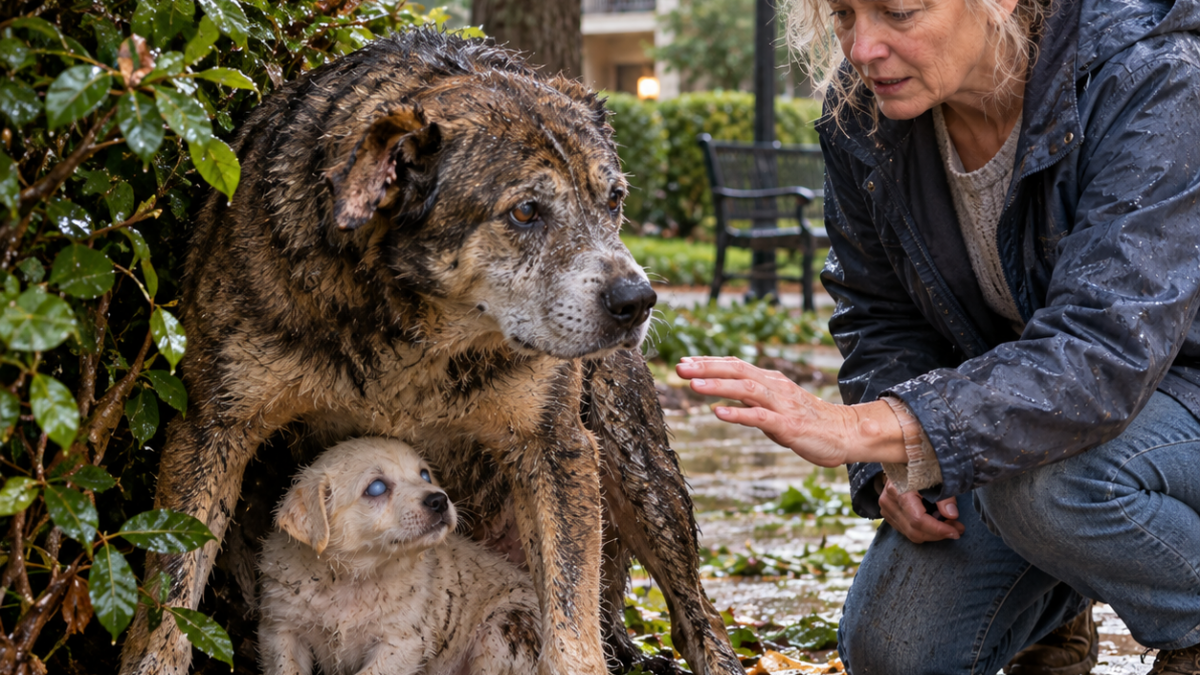
There, beneath the hedge, soaked to the skin and trembling so hard his whole tiny body shook, was a puppy.
He could not have been more than six or seven weeks old. White fur, muddy paws, round belly, ears too big for his head. His eyes were clouded pale blue, filmed over in a way that made my chest tighten.
He lifted his nose toward the sound of my breath but did not look at me.
Because he could not.
“Oh,” I whispered. “Oh, baby.”
The puppy cried again.
I crouched slowly.
Leone moved between us.
Not aggressively.
Not exactly.
He placed his old body in front of the puppy, shoulders squared, head low, watching my hands.
“I’m not going to hurt him,” I said.
Leone did not blink.
The puppy bumped into his back leg, then pressed his face into Leone’s fur as if the old dog were the only solid thing left in the world.
That was how I understood.
Leone had found him.
Or the puppy had found Leone.
Either way, the old stray dog who trusted no one had chosen to stand guard.
I called Cedar Hollow Rescue from my kitchen while Mrs. Alvarez brought towels and Mr. Keane from Building A stood nearby saying useless things like, “Poor little fella,” because men of his generation believed feelings needed to be disguised as observations.
A volunteer named Tessa arrived an hour later with a crate.
The puppy cried the moment she set it down.
Leone growled.
A deep, warning sound that made all of us freeze.
Tessa raised both hands.
“Easy, old man. I’m here to help.”
“He’s blind,” I said.
She knelt low and let the puppy sniff her fingers.
“Looks like it. Maybe congenital. Maybe infection when he was younger. We need a vet.”
When she reached for him, Leone stepped closer.
“Wait,” I said.
I went back upstairs and opened the closet.
My husband’s navy pea coat hung exactly where it had hung for five years.
I took it down with both hands.
For a moment, I stood there holding it against my chest.
Then I carried it outside and laid it over the bottom of the crate.
The puppy sniffed it, then stepped inside.
Leone watched every movement.
“We need a name,” Mrs. Alvarez said.
“He looks like a little rice cake,” Tessa murmured, wiping mud from his cheek.
“Mochi,” I said before I could think too hard.
The puppy sneezed.
And that was that.
The vet confirmed what we feared. Mochi was blind. Likely born that way. Too small, underfed, but otherwise stronger than he looked. No microchip. No collar. No missing puppy report.
Cedar Hollow was full, so Tessa asked if anyone at Willow Creek could foster him for a week.
Every adult in that courtyard found a reason to look at someone else.
I knew what I should have said.
I was too old for a puppy.
My apartment was too small.
I worked three days a week.
I had not even been able to let go of my husband’s coat.
Instead, I heard myself say, “He can stay with me.”
Leone, of course, refused to come inside.
Mochi did not.
He learned my apartment by bumping into everything once and remembering forever. Chair leg. Coffee table. Kitchen mat. Balcony door. My left slipper. The trash can. He navigated by smell, sound, texture, and outrageous confidence. He followed my voice and slept beside my husband’s old coat, curled in a white comma on the floor.
But every morning, the moment I carried him outside, he searched for Leone.
At first, Leone pretended not to care.
He would lie under the maple tree and stare into the middle distance while Mochi stumbled toward him, nose working, paws uncertain, tiny tail wagging so hard his backside swayed. When Mochi bumped into Leone’s chest, Leone would sigh like a disappointed landlord.
Then he would stand.
Mochi learned the courtyard through Leone.
Leone walked slowly beside him, body angled just enough for the puppy to brush against his front leg. When Mochi drifted toward the parking lot, Leone stepped in front of him. When children ran too fast nearby, Leone placed himself between them. When a skateboard clattered across the sidewalk, Leone nudged Mochi behind the bench.
By the end of the month, everyone had seen it.
The old dog had become the puppy’s eyes.
Residents began leaving water bowls near the bench. Someone bought a soft outdoor bed. Someone else posted a sign by the driveway that said, SLOW DOWN. BLIND PUPPY IN AREA.
Even the building manager, Denise, who hated anything that resembled liability, admitted, “They’re kind of sweet.”
But not everyone was charmed.
Brent Haskill in Building C complained constantly.
He was thirty-five, sharp-faced, always on his phone, and angry in the way some people are angry when the world does not rearrange itself fast enough around their comfort.
“That mutt is dangerous,” he told Denise one morning while I was checking my mailbox.
“Leone has never hurt anyone,” I said.
Brent turned.
“Nobody asked you, Nora.”
Mochi stood near my shoe, his nose lifted toward Brent’s voice. Leone moved closer, silent.
Brent pointed at him.
“See? Look at that. Aggressive.”
“He’s standing,” I said.
“He’s a stray. Strays carry disease.”
“He’s vaccinated,” Mrs. Alvarez snapped from behind me. “We paid for it last spring, remember?”
Brent rolled his eyes.
“Of course you did.”
After that, I saw him watching them.
From his balcony.
From the parking lot.
From behind the glass door of Building C.
Two weeks later, Mochi disappeared.
It was a Tuesday morning, clear and cold. I brought him outside after breakfast, the way I always did. Leone waited under the maple tree. Mochi trotted toward him, bumped into his shoulder, and gave his happy little sneeze.
I went upstairs for less than ten minutes to get my library tote.
When I came back down, Leone was running.
I had never seen him run before.
Not like that.
His old legs pounded across the courtyard, his head low, his tail straight, panic breaking through every proud line of his body. He stopped at the curb, spun, sniffed the grass, and let out a sound that turned my blood cold.
It was not a bark.
It was not a howl.
It was grief torn open.
“Mochi?” I called.
No answer.
Leone raced to the parking lot, nose to the ground.
I dropped my tote and ran after him.
Within minutes, the courtyard filled. Mrs. Alvarez in slippers. Mr. Keane with his cane. Denise clutching a walkie-talkie. Teenagers from Building D. Mothers with toddlers. People who had never spoken to one another shouted Mochi’s name into bushes, under cars, behind dumpsters.
Leone kept circling the same place near the visitor parking spaces.
Then he stopped beside a tire mark and scratched at the pavement.
There was no blood.
No fur.
But there was something small and blue caught in the gravel.
Mochi’s collar tag.
The clasp had been cut.
Not broken.
Cut.
I looked up.
Brent Haskill stood on his balcony.
Watching.
When our eyes met, he stepped back inside.
Denise called the police. I called Tessa. Mrs. Alvarez started crying in Spanish and English at the same time. Leone stood over the blue tag, trembling.
For six hours, we searched.
Nothing.
No puppy.
No sound.
No witness willing to admit they had seen anything.
At sunset, Leone lay beside the bench and refused food for the first time since I had known him.
I sat on the cold concrete beside him.
“I’m sorry,” I whispered.
He did not look at me.
That night, I did something I had avoided for five years.
I took my husband’s pea coat from Mochi’s bed and wrapped it around myself.
Then I walked back outside with a flashlight and followed Leone.
He moved slowly now, nose close to the ground, following some invisible thread. Across the courtyard. Past the mailboxes. Behind Building C. To the service road near the dumpsters.
There, he stopped.
A delivery camera above the back entrance blinked red.
Denise pulled the footage twenty minutes later.
We watched in the leasing office.
The screen showed the courtyard at 8:43 a.m.
Mochi stood near the bench.
Leone had walked a few yards away toward the water bowl.
A man in a dark hoodie entered from the side path.
Brent.
He crouched. Held out something. Food, maybe.
Mochi, trusting every human voice because he had never seen cruelty coming, took two steps forward.
Brent grabbed him.
Leone turned instantly.
The footage had no sound, but we saw the old dog charge.
Brent kicked him.
Hard.
Leone stumbled, recovered, lunged again.
Brent swung something metal. A trash grabber from maintenance. It struck Leone’s shoulder. The old dog went down.
Brent lifted Mochi, cut the collar tag with wire cutters, and shoved him into a plastic storage bin with holes drilled in the lid.
Then he carried him toward the back parking lot.
The room went silent.
Denise whispered, “Oh my God.”
I could not speak.
Tessa grabbed her phone.
“Pause it. Zoom in on his car.”
Brent’s silver hatchback left the lot at 8:47.
The deputy arrived fifteen minutes later.
Brent denied everything.
Until Denise showed the footage.
Then he changed his story.
“I didn’t hurt him,” he said, standing in the parking lot while half the complex watched. “I took him to a shelter. That’s all.”
“What shelter?” the deputy asked.
Brent crossed his arms.
“I don’t remember the name.”
Leone growled from beside me.
Brent pointed.
“That thing attacked me. I was protecting myself.”
“You kidnapped a blind puppy,” Mrs. Alvarez shouted.
“He didn’t belong here!” Brent snapped. “None of these animals belong here! This isn’t a rescue farm!”
His face was red now. His voice echoed off the buildings.
“You people are insane. Feeding strays, letting them roam around. That puppy would’ve grown into another useless mutt. I did what management should’ve done months ago.”
Denise stepped forward.
“No,” she said, voice shaking with fury. “You did what cruel people do when nobody tells them no.”
The deputy asked again where Mochi was.
Brent looked away.
Then Leone lifted his head.
From somewhere beyond the road came a faint sound.
Tiny.
Distant.
A puppy crying.
Leone bolted.
I followed as fast as I could, with half the complex behind me. Across the back lot, through the narrow drainage path, toward the abandoned maintenance shed near the old tennis courts.
Leone reached it first.
He scratched at the warped wooden door, barking in sharp, frantic bursts.
The deputy forced the lock.
Inside, in the dark, sat the plastic storage bin.
Mochi was inside.
Alive.
Shaking.
Soaked in his own fear.
When Tessa lifted him out, he cried once and twisted blindly toward the sound of Leone’s breath. Leone pushed forward, ignoring everyone, and pressed his muzzle against the puppy’s body.
Mochi stopped crying.
Just like that.
His tiny paws found Leone’s scarred face. He licked the old dog’s torn ear. Leone closed his eyes.
In that moment, no one at Willow Creek called him a stray.
No one called him dangerous.
No one called him Old Man.
He was Mochi’s guardian.
And everyone knew it.
Brent was arrested for animal cruelty, theft, and false reporting after he tried to claim the puppy had “wandered” into the shed by himself. The video ended that lie. The cut collar tag ended another. His lease ended before the week did.
But justice did not heal everything.
Leone had a bruised shoulder and two cracked ribs from the blows. Mochi refused to be alone. For days, if Leone moved more than a few feet away, the puppy woke crying.
So I made a decision.
The kind grief had kept me from making for years.
I opened my apartment door.
Leone stood outside, suspicious and stiff, with Mochi tucked against his leg.
“You can keep pretending you don’t need anybody,” I told him. “But he does.”
Leone stared at me.
I stepped back.
Mochi sniffed the doorway, recognized the smell of the pea coat, and toddled inside.
Leone remained on the threshold.
For a long time, neither of us moved.
Then the old dog lowered his head and walked in.
Not because I had won.
Because love had.
The first night, Leone slept with his back against the door and one eye open.
The second, he slept beside Mochi’s bed.
By the end of the week, he had claimed my husband’s old armchair like it had always belonged to him. Mochi slept below it, curled on the navy pea coat, one white paw resting against Leone’s front leg.
I adopted them both through Cedar Hollow Rescue.
Officially, Mochi became mine.
Officially, Leone did too.
Unofficially, everyone at Willow Creek understood the truth.
Leone had adopted us first.
Spring came slowly that year.
The maple tree filled with green leaves. Children learned to walk instead of run near Mochi. Residents brought treats, blankets, and too many toys. Denise installed a small fenced pet area beside the courtyard and pretended it had been planned all along.
Every morning, before work, I opened my door and watched Leone guide Mochi down the stairs.
He still walked with that retired boxer swagger.
Still looked annoyed by affection.
Still refused to admit he liked being brushed.
But when Mochi bumped his shoulder and followed his steps into the sun, Leone slowed.
Always.
He made room for him.
And I understood, finally, that some love does not arrive soft.
Sometimes it arrives scarred, suspicious, limping, and old.
Sometimes it growls at the world because the world has not been kind.
Sometimes it stands between a blind puppy and a road, between innocence and cruelty, between loss and the one thing still worth protecting.
Leone had spent years being ignored because nobody knew what to call him.
Stray.
Feral.
Dangerous.
Old Man.
But Mochi knew.
Mochi had known from the beginning.
He was shelter.
He was courage.
He was home with four tired legs and a torn ear.
And on the morning the blind puppy vanished, the old dog who trusted no one forced an entire building to see what had been standing in front of us all along.
Loyalty does not always look gentle.
Sometimes it looks like a scarred gray dog refusing to leave the door until the one he loves comes back.








