A Retired K9 Broke Formation, Crossed the Navy Yard, and Sat at an Old Farmer’s Boots—Then His Handler Realized the Dog Was Alerting to a Scent Preserved for 15 Years.
PART2:
Every October, he took it from the drawer, threaded the bootlace through it, held it in his palm for a moment, then folded it back into his coat pocket.
Then he drove forty minutes to Millbrook Depot and stood outside the fence.
He never asked to enter.
That was the part nobody understood because nobody asked.
If he had shown the right paperwork, or the tag, or said the right name to the right office, he might have walked through.
Instead, he stood at the fence.
Watched.
Waited.
Remembered.
Then drove home to the Prentiss farm, where Opal’s tortoiseshell reading glasses still rested on the kitchen windowsill exactly where she had left them the last evening of her life.
He had dusted around them for nine years.
Careful as a man handling a coal still alive beneath ash.
That Wednesday morning, before the gate, before the dog, before the old records almost went into a shred bin, Newell woke before sunrise.
He always did.
The kitchen was still.
Mist silvered the fields beyond the window.
He filled the kettle and set it on the burner.
The house gave its small familiar sounds around him: pipes settling, old boards cooling, wind touching the porch screen.
He did not look at Opal’s glasses.
He did not need to.
He knew exactly where they were.
Folded closed on the seed catalog she had never finished marking.
PART3:
While the water heated, he hummed four bars of a hymn with no name he ever spoke.
Opal had hummed it over her bee boxes in the side yard, smoke curling from her little tin smoker, her voice carrying low over the hives as if she were offering the bees a kindness they had not asked for but deserved anyway.
Newell still kept two boxes going.
Not for honey.
Not really.
For loyalty.
After breakfast, he took the barn coat from its separate peg.
Not the chore coat.
The other one.
The one with the collar worn shiny where a chain would have sat.
He drew out the bootlace and brass tag.
For a moment, the contractor number lay in his palm.
He did not need to read it.
It lived in him the way a birth date lives in a man.
He folded it back into the pocket and pressed his palm once flat against the outside of the coat.
The way another man might check a lifeline before going down into the dark.
Opal had never known the whole story.
There had been nights early in their marriage when he came close.
Nights when memory dragged him back into cold water and pressure and a voice over comms going thin with fear.
Opal would rest a hand on his chest in the dark and say, without asking him to name anything, “A debt doesn’t stop being owed just because nobody’s asking for it.”
She did not know what debt.
She only knew there was one.
And she let him carry it in peace.
That had been the greatest mercy of his life.
Newell rinsed his cup.
Set it in the rack.
Took his keys.
Then drove east toward the depot.
By the time he reached Millbrook, the mist had burned off into hard October light. Everything looked newly cut from tin: chain-link fence, gravel, flagpole rope, polished shoes, ceremony risers.
Two young sailors stood at the north gate.
One held a clipboard he was not using.
Both looked barely old enough to have been alive when the file first opened.
“Somebody tell that old man the fence isn’t a wishing well,” one said.
His partner laughed.
Newell did not turn.
He stood the way a fence post stands.
Weight settled.
Hands loose.
Eyes on the yard.
The sailor reached for his radio.
“We’ve got a civilian loitering at the north fence. Ceremony day minus three. Requesting escort.”
Standard procedure.
That was all Newell was to them.
A check box.
A line item.
A thing to be handled and forgotten by lunch.
They had no way of knowing that inside the records office, in a box marked for shredding within forty-eight hours, sat the only surviving proof of who he actually was.
They had no way of knowing that the old man outside their fence had spent fifteen years letting the Navy call him missing because silence had once been the price of survival.
Newell turned his head toward the sailors at last.
He said nothing.
Just looked at them in the unhurried way a man looks at weather he dressed for hours ago.
Then went back to watching the yard.
Inside the depot, Kendra Wyckliff was losing a private war against the ceremony timeline.
She was forty yards from the gate, blazer crisp but eyes exhausted, laminated schedule swinging from a lanyard around her neck. She had built the Saturday ceremony from nothing.
Chairs requisitioned from three commands.
Podium placement.
Flag detail timing.
Public affairs approval.
Bronze plaque.
Guest list.
Program text.
Two admirals.
One congressional staffer.
Eleven weeks of work narrowed now to three days.
She had not slept nine real hours in almost as many nights.
When the radio call came about a civilian at the fence, she did not look up from her clipboard.
“Handle it,” she said.
A missing table, a wrong cable, a late caterer, a civilian at the fence—it was all the same category in her tired mind.
Problems to move off the path before Saturday.
It was only when security walked the old man into the rehearsal yard that she finally looked at him.
And made the mistake people make when exhaustion has worn down curiosity.
She thought she understood him.
Barn coat.
Resoled boots.
Stillness.
Age.
Closed rehearsal week.
She put him instantly into a category she had handled twice that year.
Confused elderly visitor.
Well-meaning hoaxer.
Someone chasing a rumor about an uncle or father or grandfather who supposedly belonged to an old Navy story.
“Sir,” Kendra said, clipped but not cruel, “I appreciate you coming out. But this is a closed rehearsal for Saturday’s ceremony. We are not able to accommodate walk-in inquiries about historical cases this week.”
Newell did not answer right away.
He looked past her.
At the risers.
The flag detail practicing a fold.
The stainless podium being leveled.
The sailors moving with purpose around a story they thought had already been written.
Then he said, quietly, “The manifest.”
Kendra blinked.
“The dive log from the sonar recovery,” he said. “Fifteen years back. Somebody still has the contractor pages?”
Her patience closed like a door.
“Sir, that record is sealed. It is part of a case being formally closed Saturday.”
He did not react.
“I cannot discuss specifics with—”
She stopped before saying stranger.
But the word sat there anyway.
Stranger.
Public.
Problem.
Not one of us.
“Petty Officer,” she said, turning slightly, “walk him back to the gate.”
A records assistant named Tessa Ogle heard the number Newell muttered next.
Not loudly.
Not to Kendra.
Almost to himself.
A string of digits spoken with the rhythm of habit.
Tessa was twenty-six and two years into a job that mostly meant filing, scanning, photocopying, and knowing which boxes nobody important remembered existed.
That spring, she had spent four months cataloging old contractor numbers from recovery manifests.
And the cadence of the number Newell murmured snagged in her mind like a splinter.
She did not speak.
Not yet.
There was not enough to say.
But she watched the sailor lead Newell away.
Watched his hand rest briefly against the outside of his coat pocket.
And after he was gone, she could not return to her clipboard for a full minute.
They did not send Newell all the way home.
That was because of Grady Beal.
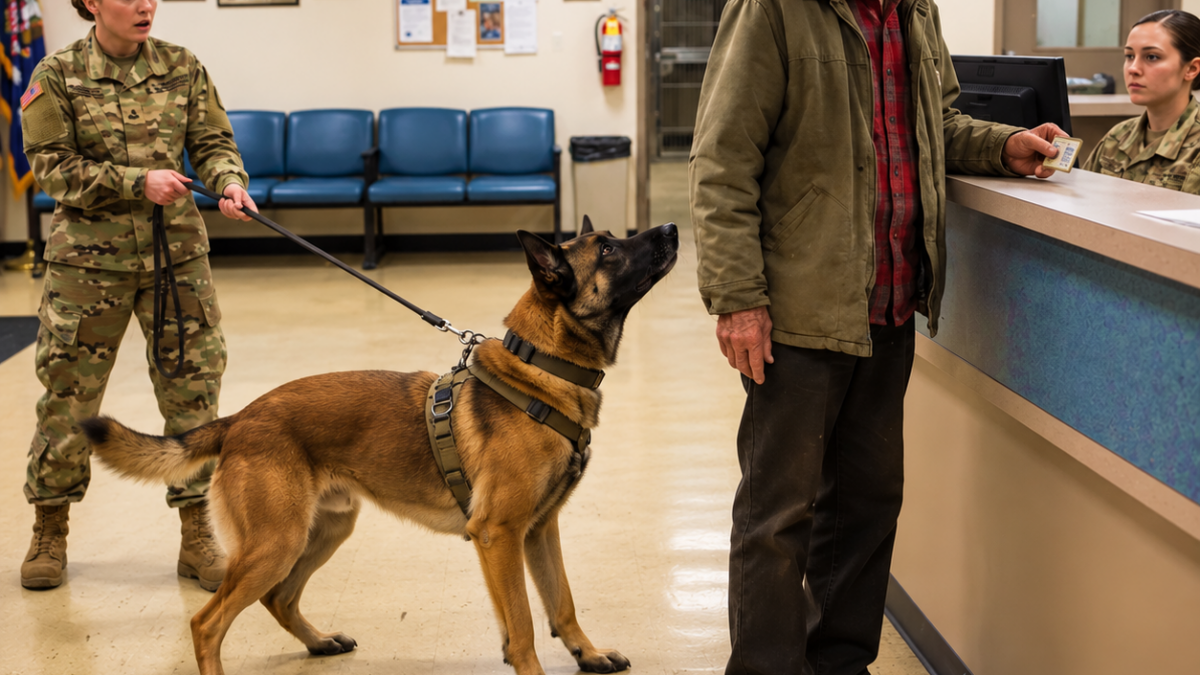
Grady was crossing the yard with Cedar at heel when he saw the old man being walked toward the gate.
Cedar was eleven years old, a Belgian Malinois with silver around his muzzle and a spine still proud enough to make younger handlers straighten when he passed.
Nine years as a working Navy detection dog.
Two years in ceremonial transition work.
He had found things men were grateful for and things men wished he had not found.
He had worked ships, warehouses, training lanes, storage areas, and recovery exercises. He had retired from active search duty only because age catches even the best animals eventually.
Grady had been his handler for six years.
Six years was long enough to know the difference between disobedience and information.
Something about the old man made Grady call out.
“He can wait at the yard edge if he wants,” Grady said. “Out of the way. No harm while we finish rehearsal.”
Newell nodded once.
No gratitude.
No argument.
He walked to the split-rail fence at the far corner of the yard and stood there the way he had stood outside the chain-link.
Weight settled.
Hands loose.
Watching.
Grady ran Cedar through the ceremony sequence.
Heel.
Sit.
Down.
Stay.
Release.
The whole thing timed to the flag fold.
Cedar performed perfectly.
First run.
Second.
Third.
Sailors watching from the edge murmured approval.
On the fourth run, Cedar hesitated.
Only half a second.
Small enough that most people missed it.
Grady did not.
Cedar’s head tilted toward the far fence.
His ears came forward.
His nostrils worked in a particular pattern every handler learns to read the way other people read eyes.
Grady reset him.
Ran it again.
Same hitch.
Sharper.
Cedar’s weight shifted toward his haunches.
A low sound started under his ribs.
Not a whine.
Not a growl.
Something between.
Grady had heard that sound only twice before.
Both times over live scent.
“Bell?” Kendra called across the yard, using Grady’s last name now because irritation had outrun courtesy. “What is he doing?”
“Working through something,” Grady said.
It was true.
He just did not know what.
He reset Cedar a fifth time.
Voice steady.
Hand signal clean.
Cedar held the sit for four seconds.
His body trembled faintly along the haunches.
Then he broke.
Not aggressively.
Not wildly.
Deliberately.
He rose from the sit and crossed the yard at a controlled trot, ignoring Grady’s recall command for the first time in six years.
Past the risers.
Past the podium.
Past the flag detail.
Straight to the split-rail fence.
Straight to Newell Prentiss.
The old farmer did not move.
Cedar stopped one foot from his boots.
Then sat.
Not casually.
Precisely.
Spine straight.
Ears forward.
Muzzle raised.
One paw lifted an inch from the ground and held rigid.
The whole posture locked into a shape every Navy handler in the yard recognized.
Final alert.
I have found the thing I was trained to find.
I am not moving until you come look.
Nobody spoke.
A sailor setting down a folding chair placed it on the ground with exaggerated care, as if noise might break whatever had just happened.
Grady crossed the yard fast.
“Down,” he said softly.
Testing.
Cedar did not move.
Not an ear flick.
Not a blink.
Grady crouched beside him, hand hovering an inch above Cedar’s shoulder without touching.
You did not touch a dog mid-alert.
You confirmed.
“That is not random,” Grady said, mostly to himself. “That is a calibrated signature.”
He looked up at Newell.
And for the first time since the old man had entered the depot, someone looked at him not as a problem, but as a person.
“He’s trained to that scent,” Grady said. “That exact profile.”
Kendra had reached them now, her laminated timeline forgotten.
“Bell, that’s not possible.”
Grady’s voice went quieter.
“We only run him against three archive signatures depot-wide. One of them’s been on file since before I had this job.”
Newell looked down at Cedar.
His face did not change much.
But his hand moved once toward his coat pocket.
Then stopped.
Grady saw it.
“One signature is from a fifteen-year-old recovery manifest,” Grady said. “Contractor sample. Sonar array job.”
Kendra looked at Newell.
Then Cedar.
Then Grady.
“No,” she said, but the word carried less certainty than she needed it to.
“I didn’t put it there,” Grady said. “It’s been there. Built into his line before I ever got him. It has never fired because nobody who carried that scent has ever stood in one of our yards.”
He turned fully to Newell.
“Until now.”
The yard seemed to hold its breath.
The true story, the one waiting beneath a bronze plaque still cooling two counties away, began not with a confession, not with a document, not with a dramatic admission.
It began with an old dog sitting at an old farmer’s boots and refusing to move.
What followed was not clean.
Truth rarely enters institutions through the front door.
The first response was containment.
A retired K9 breaking a live drill to alert on a civilian looked like possible contamination on paper.
A hazard signature.
Old ordnance residue.
A safety issue.
Within four minutes, a perimeter went up around the yard’s corner. Security radios crackled. A young lieutenant began reciting protocol. Two additional handlers were paged.
Grady argued that Cedar’s posture was wrong for a hazard.
Calm.
Final.
Recognition, not warning.
Kendra looked like a woman watching eleven weeks of careful planning begin to tear at the seams.
Then Tessa Ogle came running from the records building with a folder under one arm and a laminated training reference card in her hand.
“It’s not a hazard signature,” she said, breathless. “Look at the ears. Look at the tail. That’s not an ordnance alert posture. That’s a person match posture.”
She turned toward Newell.
Her voice softened despite herself.
“He’s not warning anyone. He’s remembering somebody.”
The perimeter came down slower than it went up.
Embarrassment, in military settings, often sounds like radio static and cleared throats.
Then came the manifest.
And the manifest, everyone learned, was its own problem.
“It’s not digitized,” said Saul, the records clerk Grady reached by phone.
Saul was three buildings over and sounded like a man who had spent his life protecting paper from people who thought paper protected itself.
“That whole box of original contractor paperwork from that job is marked for destruction. Retention schedule flagged it. Shred order already cut.”
“How long?” Grady asked.
“Forty-eight hours. Maybe less if the truck comes early.”
Forty-eight hours.
Three days until Saturday’s ceremony.
Less than two days before the only surviving proof of a contractor number could vanish into a bin because a schedule did not know what it carried.
Kendra turned to Newell.
“For the record,” she said, and there was exhaustion in it now, but something harder too, “I need you to explain plainly who you are and why a Navy working dog just alerted on you like you are physical evidence.”
Newell was quiet.
When he spoke, his sentences were short and true.
“I was a contractor on that job.”
“The sonar array recovery?” Kendra asked.
“Yes.”
“Fifteen years back?”
“Yes.”
“Your name is not on that file.”
“I know.”
“I have read that file cover to cover four times this month.”
“I expect you have.”
“Then how do you explain the alert?”
“I don’t,” Newell said. “Not yet.”
It was the wrong answer for the moment.
It was the right answer for the man.
Kendra heard evasion.
She heard hoax.
She heard a shabby old farmer protecting a story that might collapse in daylight.
What she did not yet know how to hear was thirty-six years of a trade that taught a man to answer only what was safe to surface.
“Then I need you to wait outside the yard,” she said, not unkindly, but final, “until someone can tell me something I can actually put in a report.”
Newell nodded.
He went.
No argument.
Arguing had never loosened a jammed valve, freed a pinned line, or brought a diver back from black water.
He saw no reason to believe it would help now.
Grady did not sleep that night.
At 1900 hours, he drove to the records annex himself, badge in hand, and told Saul to pull the sealed personnel file.
Not the training aid archive.
Not the ceremony summary.
The after-action report.
The original.
The one sitting behind two authorization signatures since the case first closed.
It took four hours under a gooseneck lamp with the shred bin visible through the annex window.
Four hours of manifests.
Contractor rosters.
Old dive logs.
Equipment issue forms.
Handwritten initials.
Redacted notes.
Duplicate pages that were not quite duplicate.
Grady pieced together what the official report had been built to hide.
Fifteen years earlier, the Navy had run a classified sonar array recovery in conditions deeper and more dangerous than the initial op order allowed.
The mission had gone over budget by enough to attract questions if anyone outside the right circle learned what had happened.
The commanding officer, Rear Admiral Osgood Ravenwood, had signed off on an unusually tidy after-action report.
One contractor presumed lost.
Unrecovered.
Case permanently open.
One surviving sailor credited with single-handed heroism under emergency conditions.
That sailor’s name was Alton Hobbs.
Retired petty officer.
Seventy-eight years old now.
Permanent limp.
Still living forty miles north.
In the depot’s own outreach database, Grady found another detail.
Every year since his discharge, Hobbs had politely declined invitations to speak at ceremonies honoring the mission.
Every year.
Fifteen years.
Grady read the pages again.
Then again.
The truth emerged slowly, then all at once.
Newell Prentiss had not vanished from the record by accident.
He had been injured and pushed out of the story because Ravenwood needed a clean close before a retirement review.
Alton Hobbs had been given credit for heroism he did not claim, likely because he was alive, uniformed, and easier to place on a plaque.
Two men buried by the same lie.
One buried under a wrong that called him dead.
One buried under a wrong that called him a hero.
Neither had spoken.
Not once in fifteen years.
Grady sat back from the table and looked at the shred bin through the window glass.
What he held was no longer a K9 anomaly.
No longer a ceremony problem.
No longer a hoax concern.
It was a debt with two names.
And a Saturday deadline.
Kendra read the manifest just after midnight.
Alone in her office.
The ceremony program was open on her computer.
The old pages lay on her desk.
She read until she reached the contractor section.
Then read it again.
The cursor blinked on the program file.
For eleven weeks, she had built a ceremony meant to close a wound cleanly.
Now she understood the wound had been misnamed.
Worse, she thought of that morning.
The way she had said “for the record” to Newell.
The way she had almost called him a hoaxer.
How easily the word had come.
How little it had cost her.
How much it might have cost him to hear it.
At 1:32 a.m., Kendra began retyping the ceremony program by hand.
Not because the printer was broken.
Because some corrections need to pass through a person’s fingers before they feel real.
Alton Hobbs arrived at the depot the next afternoon in a sedan driven by his granddaughter.
He walked with a limp.
The limp the original ceremony program had wrapped in the wrong story.
He stood at the yard’s edge where Newell had stood two days before, uncertain whether he was welcome.
Newell crossed the yard to him without hurry.
For a moment, the two old men simply looked at each other.
Fifteen years between them.
A false plaque between them.
A silence neither had known how to break alone.
“You held the line that day,” Newell said finally. “Every foot of it. I never forgot that.”
Hobbs’s jaw worked once.
“I never earned what they gave me for it.”
“You earned what you did.”
“They gave me yours.”
“No,” Newell said. “They gave you a lie. That is not the same thing.”
Hobbs looked down.
“I knew something was wrong. Every year they asked me to stand up and take a bow for a man they said didn’t come home. I couldn’t say why it felt wrong.”
His voice thinned but did not break.
“Now I know.”
“You did nothing wrong,” Newell said.
“I stayed quiet.”
“So did I.”
Hobbs looked at him then.
Newell’s expression remained mild.
But tired.
Deeply tired.
“Somebody else did the lying,” Newell said. “We just spent too long letting the lie keep house.”
Kendra approached with the retyped program in both hands.
Grady stood beside her.
Cedar sat at heel, calm now, ears forward.
Kendra faced both men.
“For the record,” she said.
Then stopped.
The phrase felt different now.
Heavier.
Truer.
“For the record,” she began again, “the corrected program reads both names together. Neither one above the other.”
Newell shook his head once.
“I don’t need my name on anything.”
Kendra looked at him.
“I did not come back for my name,” he said. “I came back because Opal always said a debt doesn’t stop being owed just because nobody’s asking for it.”
Nobody asked who Opal was.
They understood, somehow, that the name had already cost him enough to say.
Newell looked at Hobbs.
“His name stays beside mine. Not above. Not below. Beside. That is the whole of what I want.”
Saturday came clear and cool.
The kind of October light that made bronze look less like metal and more like something warmed from within.
The chairs filled beyond the count printed on Kendra’s first seating chart.
Sailors.
Families.
Two admirals.
A congressional staffer.
Handlers.
Records clerks.
A few retirees who had heard enough rumors to come see whether the Navy was actually going to say the true thing aloud.
In the second row sat an old farmer in a barn coat gone the color of wet sand and a retired dive tender with a permanent limp.
Newell Prentiss and Alton Hobbs sat side by side like men finally given somewhere to put fifteen years down.
Cedar sat at perfect attention beside Grady.
Silver muzzle still.
Eyes forward.
No alert now.
No tension.
The debt he had been trained to find had been found.
Kendra read the corrected names herself.
Her own choice.
Her own correction.
When she reached the word diver, her voice caught.
Nobody in the yard thought less of her for it.
Least of all Newell, who watched her steady herself and thought, without saying so, that grace costs a person something when it is real.
That is how you know it matters.
The bronze plaque had been changed.
Not remade entirely.
There had not been time.
But corrected.
Newell Prentiss.
Alton Hobbs.
Sonar Array Recovery Team.
Duty Held in Silence.
Truth Restored in Honor.
Newell stared at it for a long time.
Not because his name was there.
Because the lie was not.
Weeks later, the Prentiss farm went back to being a farm.
Morning mist.
Bee boxes.
Fence repairs.
Kettle on the burner.
Opal’s glasses on the windowsill.
But one thing had changed.
For the first time in fifteen years, the brass tag did not sit folded inside the barn coat.
It hung around Newell’s neck on the old bootlace, warmed against his collarbone.
He stood at the kitchen counter while the kettle ticked toward a boil.
He hummed the same four bars.
No louder than before.
No different in any way a stranger could name.
Only he knew what had changed.
He touched the tag once.
Then looked toward Opal’s glasses.
“Paid,” he said softly.
The word sounded like amen.
Finally paid.
Some debts do not expire when the paperwork does.
They wait.
They wait through bad reports, sealed files, and ceremonies built on clean stories that are not true.
They wait in old pockets.
In retired dogs.
In records boxes marked for shredding.
In men too tired to fight for their own names but not too tired to fight for someone else’s.
Newell Prentiss and Alton Hobbs sat together later that week on the depot dock in the last low light of the season.
The tide came in slow against the pilings.
Cedar lay at their feet, his silvered head resting across both pairs of boots.
Neither old man said much.
By then, at last, there was nothing left that needed saying.








