A Pregnant Brindle Dog Crawled 11 Miles Through Winter With Both Front Legs Broken—Then the X-Ray Showed Six Tiny Reasons She Refused to Die
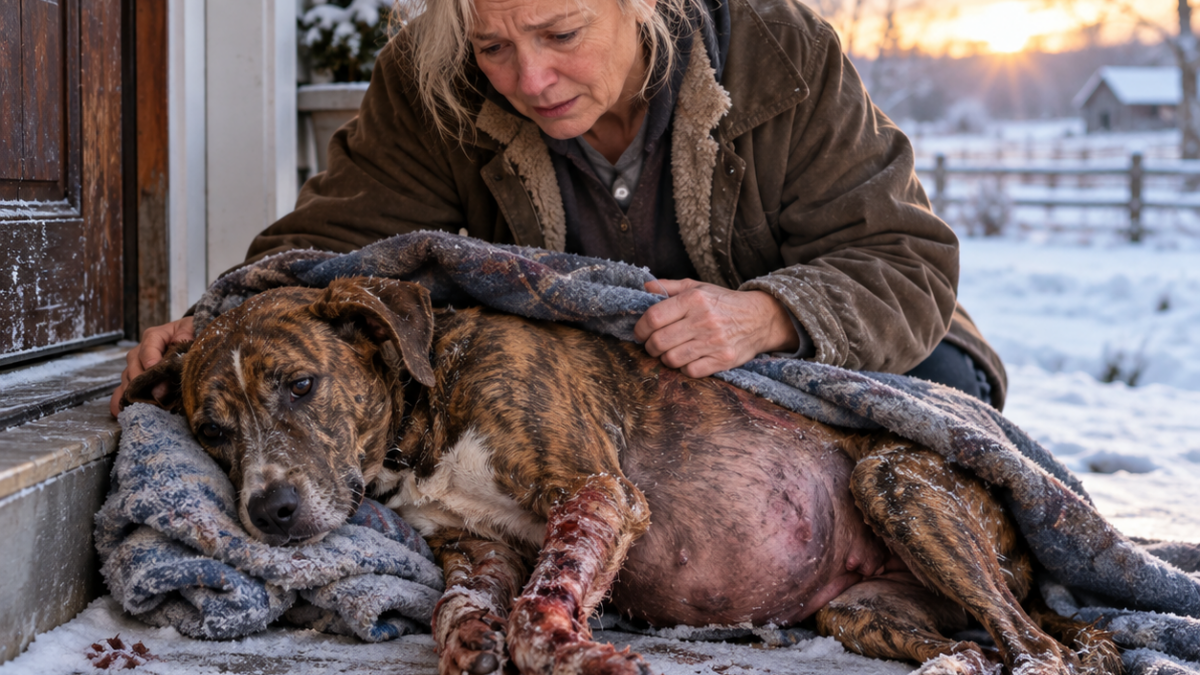
A Pregnant Brindle Dog Crawled 11 Miles Through Winter With Both Front Legs Broken—Then the X-Ray Showed Six Tiny Reasons She Refused to Die.
The surgeon said he had never seen a dog keep moving through that much pain and still look at people like she was asking for nothing.
A pregnant brindle stray had dragged herself across frozen gravel, empty roads, and fields white with frost, leaving bloody pawprints behind her for nearly eleven miles.
But when the X-ray lit up on the screen, everyone in that clinic finally understood that she had not been walking for her own life.
In February of 2022, on a morning so cold the porch boards had turned white with frost, Margaret Ellis opened her front door and found a dog dying on the welcome mat.
At first, Margaret thought it was a bundle of rags.
A dark shape.
A mess of wet fur.
Something blown against the door by the night wind.
The sun had not fully risen yet, and the world beyond her porch was still blue-gray and silent. Her small property sat at the end of a gravel drive outside a rural Ohio town where winter did not arrive dramatically. It simply stayed. It lay over the fields, hardened the ground, iced the water troughs, and pressed its cold hands against windows until spring finally got tired of resisting.
Margaret had lived alone there for nine years.
She was fifty-eight years old, widowed, practical, and used to mornings beginning before the coffee finished brewing. She had two acres, a little vegetable garden sleeping under straw, a half-collapsed shed she kept meaning to fix, and an old yellow porch light that made the winter fog look haunted.
That morning, she opened the door to shake crumbs from a dish towel.
Then she stopped.
The dog lay on her side.
She was not curled like a sleeping animal.
She was collapsed.
Her eyes were open, but they were not focused on anything Margaret could see. Her breathing came fast and shallow, each breath lifting her ribs only a little, as if even the work of staying alive had to be rationed.
Margaret did not move for several seconds.
She had found animals before.
Raccoons in the feed bin.
A fox hit by a car near the ditch.
Stray dogs that passed through for a day or two, accepting food only if she pretended not to watch them eat.
But this was different.
This dog had not wandered onto the porch.
PART2:
She had arrived there the way a shipwreck reaches shore.
By the time Margaret knelt beside her, she saw the blood.
Not a lot in one place.
Worse than that.
A trail.
Small, broken pawprints crossed the porch steps, the frost, the gravel, and the hard dirt drive beyond. They continued toward the road, faded where the ground turned pale and frozen, then disappeared around the bend.
Margaret followed the line with her eyes.
The dog had come from the road.
No.
From farther than the road.
The pawprints were not the first steps of an injured animal looking for somewhere to hide.
They were the last steps of an animal that had been walking long after walking should have been impossible.
“Oh, sweetheart,” Margaret whispered.
The dog’s ears did not move.
She was a medium-sized brindle mix, maybe part hound, maybe part shepherd, maybe just the kind of dog rural counties produce when nobody takes responsibility for anything soft. Her coat was striped with brown and black, but mud and blood had darkened most of it. Her belly was swollen.
Pregnant.
Very pregnant.
Her two front legs were twisted beneath her at angles that made Margaret’s stomach turn. The left front leg was swollen nearly twice its normal size, bent just above the wrist. The right was worse. The fur was dark with blood and dirt, and something pale showed near the break in the skin.
PART3;
Margaret knew enough not to touch it.
The dog’s paw pads were shredded.
Not scratched.
Not sore.
Shredded.
The pads on all four feet were torn open, raw, some worn away so badly the pink tissue underneath showed. Small pieces of gravel clung to the blood. One pad looked almost gone.
Margaret ran inside, grabbed the cleanest towel from the laundry basket, and came back barefoot in the cold because she had forgotten shoes.
The dog did not fight when Margaret wrapped her.
That frightened her more than resistance would have.
A frightened dog will growl.
A dying one saves its strength.
Margaret lifted her carefully, supporting the broken front legs as best she could without knowing how. The dog made one sound then.
Not a bark.
Not a whine.
A thin, breathy cry that barely escaped her throat.
“I know,” Margaret said, though she did not know anything yet. “I know. I’m sorry. I’m so sorry.”
The nearest emergency veterinary hospital was thirty-four minutes away in good weather.
That morning, the roads were slick.
Margaret drove with the heat on high and the dog wrapped in towels on the passenger seat. Every few minutes, she glanced over, terrified she would see the brindle chest stop moving.
“Stay with me,” she whispered. “Please, girl. Stay with me.”
The dog’s eyes opened once.
Amber eyes.
Clouded with pain, but not empty.
Margaret had expected fear.
Instead, she saw something that looked almost like determination.
At Cedar Ridge Veterinary Emergency, a young tech met them at the door with a stretcher. The moment he saw the dog, his face changed.
“We need Dr. Landry now,” he called over his shoulder.
Within seconds, the quiet morning exploded into movement.
Warm blankets.
IV fluids.
Pain medication.
A heated table.
Careful hands.
Someone asked Margaret questions while two people worked over the dog.
“Where did you find her?”
“My porch.”
“Was she hit by a car?”
“I don’t know.”
“How long was she there?”
“I don’t know.”
“Is she yours?”
Margaret looked through the treatment room window at the dog fighting to breathe under a pile of warm towels.
“No,” she said. “But she came to my door.”
That was the only answer she had.
Dr. Samuel Landry arrived with gray hair, tired eyes, and the steady calm of a man who had spent eighteen years walking into rooms where panic was already waiting. He examined the dog silently at first. He checked the gums, the abdomen, the broken legs, the open wound, the ragged paws.
Then he looked at Margaret.
“She is in critical condition.”
Margaret nodded, her hand clamped around the strap of her purse.
“She’s pregnant.”
“Yes.”
“Can you save her?”
Dr. Landry did not answer quickly.
That was how Margaret knew he was honest.
“We’re going to try,” he said. “But I need you to understand how serious this is. Both front legs are fractured. One is open, meaning the bone has broken through the skin. Her paw pads are severely damaged. She is hypothermic, dehydrated, and likely infected. If she walked any distance like this, I honestly don’t know how she is conscious.”
Margaret looked at the dog.
“What kind of distance?”
“We don’t know yet.”
But they would.
Because while Margaret sat in the waiting room with her coat still dusted in frost, Deputy Caroline Watts arrived from animal control. Someone at the clinic had called her because an injured pregnant dog with wounds that severe was not just a medical case.
It was a question.
And sometimes a question means cruelty.
Caroline was broad-shouldered, soft-spoken, and had the kind of face that looked kind until someone gave her a reason not to be. She asked Margaret to show her where the dog had been found.
Margaret did not want to leave.
Dr. Landry promised to call if anything changed.
So Margaret led Caroline back to the house.
By then, the sun had climbed higher, and the blood trail was easier to see.
It began at Margaret’s welcome mat.
Down the porch steps.
Across the gravel.
Along the ditch.
Past the mailbox.
Then toward the rural road that curved between open fields and old properties, some tended, some forgotten.
Caroline photographed everything.
Every print.
Every smear.
Every place where the dog seemed to have fallen and dragged herself forward again.
They followed the trail slowly in Caroline’s truck, stopping whenever the marks faded. Sometimes the blood disappeared on asphalt, then reappeared where the shoulder turned muddy. Sometimes there were scratches in the frozen ground where broken front legs had not stepped so much as pulled.
Margaret sat in the passenger seat, one hand over her mouth.
“How did she do this?” she whispered.
Caroline did not answer.
Mile after mile, the trail kept going.
Past a closed feed store.
Past a frozen creek.
Past a church with a white steeple.
Past an abandoned roadside stand where someone used to sell sweet corn in summer.
Finally, nearly eleven miles from Margaret’s porch, the marks led to a gravel turnout near a property with sagging chain-link fencing and a faded sign half-hidden behind weeds.
WATKINS FAMILY KENNELS.
Margaret’s stomach went cold.
Caroline got out first.
From somewhere beyond the fence came barking.
Not happy barking.
Sharp, frantic, hungry barking.
A man stepped out of a metal-sided building before they reached the gate. He wore a heavy brown coat, work boots, and a ball cap pulled low over his forehead.
“Can I help you?” he called.
Caroline held up her badge.
“Animal control. We’re looking into an injured brindle female dog.”
The man’s face did not change enough.
That was what Margaret noticed.
A normal person would ask what happened.
A guilty person waits to see how much you know.
“Lots of dogs run loose out here,” he said.
“What’s your name?” Caroline asked.
“Earl Watkins.”
Margaret had heard the name. Not directly. In the way people in small towns hear things. Dogs for sale. Cheap puppies. Cash only. No questions if you didn’t ask any.
Caroline glanced toward the kennels.
“You mind if we take a look?”
Earl smiled.
“Without a warrant? Yes, I mind.”
One of the dogs behind the building barked again. Then another. Then a thin chorus rose in the cold air.
Margaret felt something in herself harden.
“Did she come from here?” she asked.
Earl looked at her for the first time.
“Lady, I don’t even know what dog you’re talking about.”
But his eyes flicked toward the road.
Just once.
Caroline saw it too.
They left, but not for long.
By the time Margaret returned to Cedar Ridge, Dr. Landry had taken the X-rays.
He met her in a small consultation room.
The lights were dim. The screen on the wall glowed blue-white.
For a moment, Margaret could not understand what she was seeing.
Bones.
Broken ones.
Both front legs.
Shattered radius and ulna on one side.
Compound fracture on the other.
A tiny metal fragment near the shoulder, old or new, he could not yet say.
Then Dr. Landry clicked to the next image.
Margaret pressed both hands to her mouth.
Inside the dog’s swollen belly were puppies.
Not a blur.
Not a guess.
Six of them.
Six tiny curled skeletons, lined like secrets beneath her ribs, impossibly delicate and impossibly real.
Dr. Landry’s voice softened.
“They’re alive. We confirmed heartbeats.”
Margaret started crying then, quietly, the kind of crying that comes when horror and hope arrive in the same room.
“She walked all that way,” she whispered.
Dr. Landry looked at the X-ray.
“I’ve been doing this eighteen years,” he said. “I have never seen anything like it.”
“Why would she keep going?”
He glanced toward the treatment room.
“Because animals know more than people give them credit for. She was cold, injured, probably terrified, and close to labor. Maybe she was looking for shelter. Maybe she had been there before. Maybe she smelled your house, the porch, warmth, safety. I can’t prove why she chose your door.”
He touched the glowing image gently with one finger, near the six small shapes.
“But I know this. She didn’t quit because they couldn’t afford for her to quit.”
Margaret named her Hope.
Not because it was original.
Because it was true.
Hope survived the first surgery.
Dr. Landry cleaned the open fracture, stabilized the worst leg, treated infection, and did everything possible without endangering the puppies. The second leg would need more work later if Hope lived long enough.
That became the sentence everyone carried around the clinic.
If Hope lives long enough.
By evening, her temperature rose.
By midnight, she lifted her head.
At 3:12 in the morning, she went into labor.
Margaret had gone home only to shower, change, and feed the chickens, but when the clinic called, she drove back in the dark so fast she barely remembered the road.
Hope delivered the first puppy just before dawn.
A brindle girl with a white chin.
Then a brown boy.
Then a black puppy so small the tech had to rub him for nearly two minutes before he squeaked.
Then another.
And another.
The sixth took longer.
Hope was exhausted by then, her body shaking, her broken legs immobilized, her eyes half-closed. Dr. Landry was preparing to intervene when Hope lifted her head, made that same thin breathy sound Margaret had heard on the porch, and pushed one final time.
The last puppy arrived silent.
For three terrible seconds, nobody moved except the tech working over him.
Then he gasped.
A tiny, angry sound filled the room.
Margaret sobbed into both hands.
Hope turned her head weakly and began licking him with the last of her strength.
Six puppies.
All alive.
The story spread before anyone could stop it.
Not because Margaret wanted attention.
She didn’t.
But Caroline needed witnesses. The clinic needed donations. Hope needed surgeries, antibiotics, care, and a safe place for six puppies who had already survived more than some animals survive in a lifetime.
The local paper ran the headline: Pregnant Dog Walks Nearly 11 Miles With Broken Legs, Gives Birth to Six Surviving Puppies.
People called her miracle dog.
Margaret called her Hope.
Earl Watkins called the sheriff’s office and said someone had stolen his property.
That was his first mistake.
His second was giving a description of Hope so specific that no one had to ask whether he knew her.
His third was claiming she had been “fine” when she left his property.
Caroline got her warrant the next morning.
What they found at Watkins Family Kennels made even seasoned officers go quiet.
Rows of dirty outdoor runs.
Frozen water bowls.
Dogs with untreated skin infections.
Females bred too many times.
Puppies kept in small cages beneath heat lamps that barely worked.
No proper records.
No veterinary care.
No clean bedding.
And in one run near the back, blood on the gate.
Hope’s blood.
Earl tried to say she had been hit on the road after escaping.
But the X-rays told a different story. The angles of the fractures, the old bruising, the open wound, the torn pads from distance traveled, and the blood trail from his property to Margaret’s porch told another.
Then one of his former employees came forward.
A young woman named Lisa who had quit three months earlier after Earl told her, “A dog that can’t produce is a dog that costs money.”
She told investigators Hope had been one of his breeding females.
She told them Hope was gentle.
She told them Hope had tried to crawl under a loose section of fence during a storm the week before, heavy with puppies and desperate to get away from the barking, filth, and cold.
When Earl found her injured after forcing her back into the run, he did not call a vet.
He left her.
Somehow, sometime in the night, Hope escaped again.
With both front legs broken.
Pregnant.
Bleeding.
And she walked.
Earl Watkins was charged with multiple counts of animal cruelty and neglect. The remaining dogs were seized. Rescue groups from three counties came to help. Reporters stood outside the courthouse asking questions he no longer wanted to answer.
He went from selling puppies for cash out of dirty kennels to standing in front of a judge while photos of frozen bowls and untreated wounds were entered into evidence.
Margaret attended every hearing.
She did not shout.
She did not make speeches.
She sat in the second row with her hands folded in her lap, wearing the same winter coat she had worn the morning Hope arrived.
When Earl’s attorney called Hope “livestock” and “breeding stock,” Margaret closed her eyes.
When Dr. Landry testified, his voice stayed calm until he described the paw pads.
Then he paused.
The judge noticed.
Everyone did.
“This dog walked until there was almost nothing left of her feet,” Dr. Landry said. “In my medical opinion, she endured extreme pain over an extended distance while heavily pregnant. Her survival was extraordinary. The survival of all six puppies was even more so.”
Earl stared at the table.
He did not look sorry.
Only cornered.
That was enough for Margaret to stop wondering whether mercy had ever lived in him.
Months passed.
Hope healed slowly.
One leg took a metal plate. The other would always be crooked. She learned to walk again with a rolling, careful gait, placing weight like every step required thought. Her paw pads grew back tender and scarred. Her coat filled in glossy and dark, the brindle stripes appearing like sunlight through old wood.
The puppies grew fat and loud.
Margaret named them Grace, February, Scout, Penny, Little Sam, and Porchlight.
The clinic laughed at Porchlight until everyone admitted it fit him. He was the last one born, the one who had arrived silent, the one who slept under Hope’s chin as if he understood he had come closest to never seeing morning.
When the puppies were old enough, all six went to carefully chosen homes.
Margaret cried every time.
Hope watched each adoption with calm, tired eyes, then leaned against Margaret’s leg as if reminding her they had done what they came to do.
The last to leave was Porchlight.
A retired firefighter adopted him.
Before he carried the puppy out, he knelt in front of Hope.
“You did good, Mama,” he said.
Hope sniffed his hand, then licked Porchlight’s head once.
A blessing.
A goodbye.
A release.
When they were gone, Margaret expected Hope to grieve.
Instead, Hope slept.
For almost an entire day, she slept on the thick orthopedic bed Margaret had placed beside the kitchen stove.
Not the shallow sleep of fear.
Real sleep.
Safe sleep.
The kind she had been denied for too long.
A year after that frozen morning, Margaret opened her front door again before sunrise.
The porch boards were white with frost.
The yellow light hummed softly overhead.
And Hope, now warm, healthy, and wearing a red collar with her name engraved in silver, stepped carefully onto the welcome mat where Margaret had first found her.
She lowered her nose to the wood.
Sniffed.
Then looked up at Margaret.
Her tail moved slowly.
Once.
Twice.
Margaret sat beside her on the cold porch and rested a hand on her scarred shoulder.
“I know,” she whispered. “I remember too.”
People still called Hope a miracle.
Margaret never corrected them.
But in her heart, she knew Hope was more than that.
A miracle sounds like something that simply happens.
Hope had chosen every inch.
Every frozen road.
Every bloody pawprint.
Every breath she refused to surrender.
She had crossed nearly eleven miles of winter with broken legs because six tiny lives inside her were depending on a mother who would not stop moving.
And when she finally reached Margaret’s door, she did not bring tragedy with her.
She brought proof.
That cruelty can be exposed.
That love can outwalk pain.
And that sometimes the strongest thing in the world is not a person with power, money, or a loud voice.
Sometimes it is a broken dog in the snow, carrying the future inside her, crawling toward the one porch light still burning in the dark.








