A Homeless Man Died on a Bench in December—His Orange Cat Waited There for 63 Days Through Two Snowstorms, Until One Morning a Retired Nurse Found Him Too Weak to Stand.
PART3:
Across the street, I saw two police cars near the bus station.
Then an ambulance.
No sirens.
No urgency.
That told me before anyone did.
The man was on the bench.
The orange cat was under it.
He did not run when the paramedics came close. He crouched low, tail wrapped tight around his body, eyes fixed on the blanket covering the man.
A police officer bent down and tried to coax him out.
The cat hissed.
The officer stepped back.
Someone from animal control arrived twenty minutes later. He carried a plastic carrier and a catch pole. I watched him try twice. The cat bolted behind the bench, then up onto the seat, then back underneath when anyone came too close.
The ambulance workers lifted the man.
That was when the cat made a sound I still hear sometimes.
Not a scream.
Not a normal meow.
A broken, hoarse cry that cut through the bus station noise and made three people turn around at once.
The man was placed inside the ambulance.
The doors closed.
The cat jumped onto the bench.
He put both front paws on the cold wood where the man had been lying.
The ambulance drove away.
The cat stayed.
By noon, the police were gone.
The bench was empty except for the orange cat.
By nightfall, he was still there.
The next morning, I crossed the street with a bowl of food.
He watched me approach but did not move.
“I’m not going to hurt you,” I said.
That was a foolish thing to say to a cat who had probably heard plenty of humans lie.
I set the bowl near the bench and backed away.
He waited until I returned to the laundromat before eating.
He ate half.
Then he climbed back onto the bench and sat facing the place where the man used to sit.
Four days later, the first snowstorm came.
It started before dawn and kept falling until the city disappeared under white.
Buses ran late.
Cars slid through intersections.
People cursed the sidewalks, pulled scarves over their faces, and hurried past the station with their heads down.
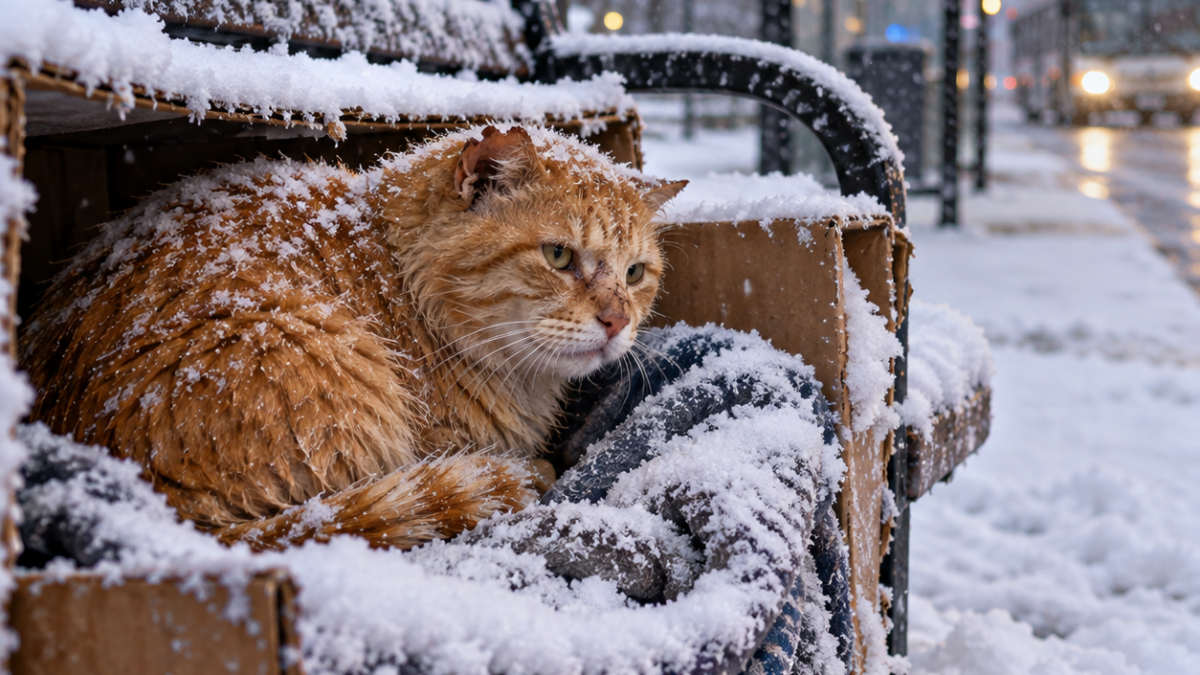
The cat stayed on the bench.
For six hours, I watched him from the laundromat window.
Snow collected on his back.
It gathered around his paws.
It lined the torn edge of his ear.
Every so often, he shook himself off, stepped down to eat from the bowl I had placed beneath the bench, and climbed back up again.
He did not shelter beneath the awning.
He did not hide behind the station wall.
He sat on that bench like a guard at a post no one had relieved him from.
Near noon, I called animal control again.
They said they had already tried.
They said the shelter was full.
They said the cat was feral.
They said someone could bring him in if they caught him.
I looked across the street at the orange cat sitting in a storm because the only person he trusted had vanished.
“He is not feral,” I said.
The woman on the phone sighed.
“Ma’am, I understand you’re upset.”
That is what people say when a problem has moved from their desk into your heart.
I hung up.
That afternoon, someone placed a cardboard box beside the bench.
I never found out who.
The box was taped along the seams and lined with an old towel. A plastic flap had been cut into one side to block the wind. It was not much, but it was something.
The cat inspected it for almost an hour.
Then he climbed inside.
But he did something strange.
He turned the box with his front paws until the opening faced the bench.
Then he lay down where he could still see the seat.
That was when I realized he was not simply staying near the place.
He was watching for the man.
Nine days later, the second storm came.
This one was worse.
The temperature dropped to seven degrees.
The wind came hard after midnight, so hard it blew snow sideways under the awning and pushed the cardboard box six feet down the sidewalk.
When I arrived at dawn, I found the box wedged against the side of the bus station.
The cat was not inside.
For one terrible minute, I thought he had finally left.
Then I saw him.
He was on the bench.
Curled into a tight orange circle, his nose tucked beneath his tail, his body shaking so badly I could see it from across the street.
I ran out with a towel from the laundromat dryer still warm in my hands.
He hissed when I came close.
Not loudly.
Weakly.
A warning he barely had the strength to finish.
“I know,” I said. “I know.”
I placed the warm towel beside him.
He did not move onto it until I stepped away.
That morning, a retired nurse named Margaret saw me standing outside the laundromat, crying into my gloves.
Margaret lived three blocks away. She was seventy-one, widowed, and the sort of woman who still wore real wool coats and walked everywhere because she did not trust winter drivers. She came into the laundromat every Thursday with one canvas bag of clothes and exact change folded inside a paper envelope.
She followed my eyes to the bench.
“Oh,” she said softly.
I told her what had happened.
The man.
The ambulance.
The shelter.
The cat waiting.
Margaret did not interrupt.
When I finished, she crossed the street without saying anything.
The cat watched her approach.
She did not bend down.
She did not reach out.
She stood beside the bench and looked at him the way nurses look at suffering after many years: not shocked, not helpless, but already making a list of what must be done first.
Then she came back to my side.
“He needs heat,” she said.
“I know.”
“He needs a proper shelter.”
“I tried calling.”
“No,” she said. “I mean he needs people who will keep showing up.”
That became Margaret’s work.
Every morning at six, she came to the bench.
Every morning.
Snow, rain, wind, freezing sidewalks, no matter what.
She brought warm water in a thermos.
Soft food.
A thermal blanket she tucked inside the box.
Sometimes she brought hand warmers wrapped in cloth and placed them beneath the towel so the box held heat for a little while.
The cat learned her routine.
He did not let her touch him.
But he stopped hissing.
That felt like progress at the time.
Now, thinking back, I understand it differently.
He was not learning to trust.
He was learning to survive while continuing to wait.
For nine full weeks, he stayed near that bench.
Sixty-three days.
The volunteers who distributed food near the station saw him every afternoon.
Bus drivers saw him.
Commuters saw him.
The man from the coffee cart saw him.
People left bowls, scraps, towels, even a small plastic tub someone turned into another shelter.
But the cat never moved far.
He slept in the box only if he could see the bench.
He ate quickly, then returned to his place.
When buses arrived, he lifted his head.
When someone in a long dark coat walked past, he sat up.
When footsteps stopped near him, his whole body went still with expectation.
Then the person would pass.
And the cat would lower himself again.
That was the cruelest part.
The hope never left all at once.
It left by inches.
His coat dulled.
The orange fur that had once been thick and rough became matted and brittle.
He lost weight even though people were feeding him.
The food was there.
But wanting to live is not only about calories.
The tips of his ears darkened from frostbite.
His left back paw cracked from walking on frozen pavement.
His breathing grew noisy.
Some mornings, when Margaret arrived, she found cloudy discharge around his nose.
She begged him in a voice I had never heard from her before.
“Come on, sweetheart. Let me help you.”
He only watched the bench.
On the sixty-third morning, Margaret came at six and found him lying at the bottom of the cardboard box.
He did not lift his head.
That was the first time he failed to look at the bench.
Margaret told me later that she knew then.
Not that he was dying.
Though he was close.
She knew the waiting had finally become heavier than his body could carry.
She did not ask permission.
She did not call animal control.
She took off her wool coat, wrapped him inside it, and lifted him.
For the first time, the cat did not fight.
He made one small sound.
Margaret held him against her chest and walked three blocks through the snow to her car.
Then she drove straight to the veterinary clinic on Monroe Street.
He weighed barely six pounds.
A healthy cat his size should have weighed nearly twelve.
The vet treated him for hypothermia, severe dehydration, malnutrition, respiratory infection, frostbite, and a cracked rear paw pad.
The tips of both ears could not be saved.
They were amputated a few days later.
Margaret visited him every day.
At first, he sat at the back of the clinic kennel, wrapped in blankets, eyes half open, too tired to resist care. He received fluids. Antibiotics. Warmth. Food offered in tiny amounts. Ointment for his paw.
For a week, nobody knew if he would live.
On the eighth day, Margaret called me from the clinic.
“He ate from my hand,” she said.
Then she started crying.
The recovery took four weeks.
Four weeks before he could walk steadily.
Four weeks before his breathing stopped rattling.
Four weeks before his eyes looked fully present again.
The clinic staff called him the bench cat.
Margaret hated that at first.
She said it sounded too much like a wound.
Then, the day the vet cleared him to leave, she filled out the adoption paperwork.
When the receptionist asked what name to put on the file, Margaret looked down at the orange cat in the carrier.
His ears were shortened forever.
His nose still held that old scar.
His body was thin, but his eyes had changed.
Not soft exactly.
Not healed.
But awake.
“Bench,” she said.
The receptionist paused.
“Bench?”
Margaret nodded.
“Bench.”
Later, she told me why.
“Because no one else remembered the man,” she said. “Someone should.”
The first night in Margaret’s apartment, Bench walked slowly from room to room.
He sniffed the couch.
The kitchen chair.
The radiator.
The bathroom door.
He did not hide.
He did not eat much either.
At nine o’clock, he jumped onto the living room windowsill and looked out at the street.
Margaret thought he was watching cars.
But after three hours, he had not moved.
She sat in the chair behind him and kept him company.
The next night, he did it again.
And the next.
And the next.
For two months, Bench spent every evening on that windowsill, facing the street.
Margaret never closed the curtain.
She told me she understood eventually that he was not looking for anything specific.
He was keeping watch.
It was the only role he had ever known.
For three years, he had watched over a man sleeping on a bench.
He had slept against that man’s chest.
Shared his food.
Guarded his place.
Waited through snow after the man disappeared.
Now he had warmth.
Food.
Medicine.
A bed.
A woman who spoke gently and always came home.
But some part of him still believed love meant watching the door.
Time helped.
Not quickly.
Not the way people like to imagine.
There was no magical moment when Bench forgot the bench.
No single morning when he woke up and became a normal house cat.
He remained easily startled.
The sound of a bus braking outside made him lift his head.
A man coughing in the hallway made his tail puff.
If Margaret’s front door opened too suddenly, Bench sometimes ran beneath the table.
Then he would see it was her.
And slowly, his body would soften.
He would step out.
Stretch.
Pretend he had not been frightened.
Cats have pride too.
Margaret let him have it.
She never grabbed him.
Never forced affection.
Never scolded him for being afraid of a world that had already taken too much.
At night, Bench began sleeping on her bed.
Always on the left side.
Always facing the window.
The first time he did it, Margaret woke at two in the morning and found him sitting upright at the edge of the mattress, watching the dark glass.
“You can sleep,” she whispered.
He did not.
So she reached one hand toward him and rested it on the blanket, palm up.
After a long time, Bench lay down with his back against her wrist.
That was how trust began.
Not with purring.
Not with climbing into her lap.
With one tired animal deciding that maybe he could rest if someone else kept breathing nearby.
I visited him three months after Margaret brought him home.
He had gained weight by then.
His coat looked better, though it still grew unevenly around the frostbitten places.
His shortened ears gave him a permanently startled expression. The scar across his nose looked paler against his orange fur.
When I stepped inside, he ran to the hallway.
Margaret smiled.
“Give him a minute.”
I sat on her couch and waited.
Bench watched me from behind a bookcase.
“You probably don’t remember me,” I said. “I’m the laundromat lady.”
His ears moved.
Margaret brought tea.
We talked quietly.
After twenty minutes, Bench came out.
He walked past me once.
Then again.
The third time, he stopped beside my shoe and sniffed it.
I did not move.
He looked up at me.
For a moment, I saw the cat on the bench again.
Snow on his back.
Eyes fixed on an empty seat.
Then Bench blinked.
He pressed his forehead lightly against my ankle.
I looked at Margaret.
She was crying.
So was I.
Six months after the man died, the city removed the bench during a renovation near the bus station.
No announcement.
No ceremony.
Workers in orange vests came early one morning, unbolted it from the concrete, loaded it into a truck, and drove away.
By noon, there was nothing there but a lighter rectangle on the pavement where the bench had been.
No plaque.
No marker.
No sign.
Nothing to tell commuters that a man had once chosen that bench because he refused to abandon his cat.
Nothing to tell them that the cat had nearly died on that same bench because he refused to abandon the man.
The place looked cleaner after the renovation.
That was what people said.
Cleaner.
Brighter.
Safer.
Maybe it was.
But every time I looked across the street from the laundromat, I saw absence.
Not only of the bench.
Of the man.
Of the cat curled under his coat.
Of a love that had been too quiet for most people to notice until it became grief.
I asked once whether the city would consider placing a small marker there.
The woman I spoke with was polite.
She said there was a process.
A form.
A review.
A requirement that the person being memorialized be identified.
I explained that nobody knew his name.
She was sorry.
Truly, I think she was.
But sorrow does not always change policy.
So there is no marker.
No official remembrance.
Nothing permanent.
Except Bench.
Bench is about eight years old now.
He is still alive.
He lives with Margaret in her second-floor apartment with the blue curtains she never fully closes. He sleeps on her bed every night, always on the left side, always turned toward the window.
He has a heated bed in the living room, which he ignores unless he believes no one is watching.
He has a soft orange blanket, a ceramic bowl, and a small toy mouse he carries into the hallway whenever Margaret takes too long to open a can of food.
He still jumps sometimes when the front door opens.
Then he relaxes when he sees her.
Every December, Margaret puts an extra blanket on the windowsill.
On the anniversary of the man’s death, she takes a cup of coffee and walks to the place where the bench used to be.
She does not make a speech.
She does not bring flowers.
She only stands there for a few minutes.
Then she comes home to Bench.
The first year, he smelled the cold on her coat and pressed his face into it for a long time.
Margaret told me she whispered, “I saw him for you.”
I do not know what Bench understood.
Maybe nothing.
Maybe everything that mattered.
People like to say animals live in the present.
Maybe they do.
But I have seen a cat wait for a dead man through two snowstorms.
I have seen him starve beside an empty seat because leaving felt more impossible than dying.
I have seen him learn a new home without surrendering the old one.
So I am careful now when people tell me animals do not grieve the way we do.
Maybe they do not.
Maybe their grief has no language.
No memorial.
No folded photographs.
No old coat kept in a closet.
Maybe grief, for a cat, is simply staying where love last made sense.
Maybe it is watching the place where a person used to be.
Maybe it is refusing food.
Refusing warmth.
Refusing safety.
Because the one who stayed is gone, and the world has become too confusing to trust.
No one taught Bench loyalty.
It was not trained into him with treats.
It was not bought with comfort.
It was born from one thing.
Someone stayed.
A man with no house, no ID, no emergency contact, and no name anyone could prove had shared every meal, every night, and every inch of warmth he had with an orange cat who had nowhere else to go.
And when that man disappeared, the cat did the only thing he knew how to do.
He stayed too.
He waited.
For nine weeks.
Through hunger.
Through frostbite.
Through snow.
Through a city that walked past him every day.
He waited for someone who would never come back.
And maybe that sounds heartbreaking because it is.
But I think it is something else too.
A kind of testimony.
A record no city file kept.
A memorial no plaque was willing to hold.
Proof that even a man the world failed to name had been loved with a loyalty fierce enough to survive winter.
Bench does not wait on that street anymore.
He waits at Margaret’s window now.
He waits for her key in the lock.
For her footsteps in the hall.
For the soft sound of her saying, “I’m home.”
And every time she returns, he rises from the windowsill and goes to meet her.
Because somewhere inside that battered orange body, after everything he lost, Bench still believes in coming back.
That is why I tell his story.
Not because it is neat.
Not because it makes the world look kind.
It does not.
I tell it because the man had no obituary.
No headstone.
No family standing beside a grave saying what he meant.
But he meant something to that cat.
Enough that Bench nearly died proving it.
And maybe, in the end, that is the truest memorial any forgotten person could have.
To be missed.
To be waited for.
To have one living soul look at an empty place in the world and refuse, for as long as his body could bear it, to believe that love was gone.








