A Former Navy SEAL Chose One Retired K9—Then the Dog Left Behind Screamed Until He Learned the Two Had Survived War Together.
PART2:
Sarah hesitated.
“Dead.”
That word changed something.
Not visibly.
Dash had spent too many years training himself not to react visibly.
“Where?”
“Overseas.”
“Compound attack.”
“His last handler was a Marine named Corporal Aaron Miller.”
“When?”
“Two years ago.”
“What happened to Havoc after?”
“Reassigned briefly.”
“Then stateside.”
“Then retirement.”
“Three placements.”
“All failed.”
“Why?”
Sarah looked at Havoc.
“He does what he’s asked.”
“He doesn’t destroy houses.”
“He isn’t randomly aggressive.”
“He’s house-trained.”
“Obedience is excellent.”
“So?”
“He doesn’t connect.”
Dash almost smiled.
“That’s a problem?”
“For families adopting a dog, yes.”
“I’m not looking for a family dog.”
“I know.”
“You read my file.”
“I did.”
“What did it say?”
Sarah met his eyes.
“That you live alone.”
“That you have no children.”
“No other pets.”
“Remote property.”
“Previous working-dog experience.”
“And that you specifically requested a dog that does not require a highly social household.”
Dash nodded.
“That one.”
“You haven’t met him outside the kennel.”
“I’ve seen enough.”
Sarah sighed.
“That sentence usually makes me nervous.”
She unlocked the enclosure.
Havoc stood immediately.
Not excited.
Ready.
The kennel door opened.
The shepherd stepped through.
Then, without being told, moved to Dash’s left leg and sat.
Exact heel position.
Shoulder aligned with knee.
Dash looked down.
Havoc looked ahead.
For the first time in months, maybe years, Dash felt something in another living creature that made immediate sense.
Control.
Stillness.
Readiness.
He lowered one hand.
Touched Havoc’s scarred head.
The dog did not lean.
Did not duck.
Accepted contact.
That was enough.
“Good dog.”
One ear moved.
Sarah watched.
“Well.”
“What?”
“He usually gives strangers more evaluation than that.”
“Maybe he has standards.”
“You haven’t signed anything yet.”
“I will.”
Sarah should have told him then.
She would spend a long time regretting that she did not.
But to understand why she kept quiet, you have to understand what Havoc looked like to the rescue.
Adoptable.
Barely.
And what Echo looked like.
Impossible.
Valor K9 Haven sat outside San Antonio on fourteen dusty acres that had once belonged to a horse trainer.
The organization specialized in retired working dogs and difficult placements.
Not all were military.
Some had worked law enforcement.
Some government contracts.
Some search-and-rescue.
Some had simply washed out of working programs with behavioral problems too complicated for ordinary shelters.
Valor did not describe dogs as heroes to make them easier to adopt.
Sarah hated that kind of marketing.
A dog could have served overseas and still be unsafe around toddlers.
A retired patrol dog could be loyal and still have bite history.
A detection dog could be brilliant and panic during thunderstorms.
Past service did not erase present needs.
Havoc had needs.
Echo had needs that had nearly exhausted the rescue.
Dash did not know Echo existed yet.
He only knew Havoc.
And that was exactly how Sarah intended it to remain until the truck left.
Dashiell Garcia had come to Texas for one dog.
Nothing more.
He had spent twelve years in Naval Special Warfare.
The public version of his service fit into a few clean phrases.
Navy SEAL.
Multiple combat deployments.
Decorated.
Medically retired.
The real version was less useful at dinner parties.
Night operations.
Dust.
Metal.
Radio static.
People whose voices he still heard at three in the morning.
A femur shattered during an operation that ended his ability to do the work he had built his identity around.
A surgical plate.
Months of rehabilitation.
Then the part nobody trained him for.
Home.
People congratulated him.
“Now you can relax.”
Dash learned to hate that word.
Relax.
As if his nervous system had been waiting for permission.
He lasted nine months in Virginia.
Too many cars.
Too many neighbors.
Fireworks.
Doors.
Questions.
People asking what he did overseas.
People asking what he missed.
People saying thank you.
Eventually he bought twenty-seven acres in Montana near the Bitterroot Mountains.
Not seventy miles from all civilization exactly, but far enough that the closest decent grocery trip required planning and winter roads could turn isolation into fact.
He built a cabin with help from a former teammate.
Heavy timber.
Metal roof.
Long porch.
Backup generator.
Satellite internet he rarely used.
He told everyone he wanted quiet.
That was partly true.
What he really wanted was a place where he could control every sound.
He did not sleep well.
Never had after leaving.
A branch scraping siding could wake him standing.
A truck backfiring twenty miles away could put his hands around a weapon before his brain caught up.
On the Fourth of July, he drove farther into the mountains and camped alone.
He had tried therapy.
More than once.
He did not hate therapists.
He hated the feeling of explaining something his body already understood too well.
The best one told him:
“You don’t need to become the person you were before.”
Dash answered:
“That person doesn’t exist.”
She said:
“Exactly.”
He stopped going two months later.
Not because she was wrong.
Because she was too close.
A dog made sense.
Not emotional support.
That was how Dash framed it to himself.
Security.
Companionship without conversation.
Something that understood routine.
He had owned working shepherds years before service.
He knew training.
He knew structure.
When he found Valor’s placement page, Havoc’s profile caught him.
NO YOUNG CHILDREN.
EXPERIENCED HANDLER.
RURAL PLACEMENT PREFERRED.
STRONG OBEDIENCE.
LOW SOCIAL ENGAGEMENT.
That last line made Dash call.
Sarah interviewed him three times.
References.
Veterinary plan.
Property fencing.
Daily routine.
Emergency care.
She asked about PTSD directly.
Dash almost ended call.
Then answered.
She did not pity him.
That helped.
Three days later he was in Texas.
Now Havoc sat against his leg.
Selection complete.
Or so he thought.
Sarah walked them toward the office.
The kennel next to Havoc’s appeared empty at first.
Then something moved in the shadows.
A black-and-tan shepherd.
Smaller.
Thin enough that the ribs showed when he breathed.
Left ear missing its upper tip.
Coat sparse around shoulders and front legs.
Scars circling both forepaws.
The dog pressed against the divider.
His body trembled continuously.
Tags clicked against collar.
Echo.
Dash glanced.
“What’s wrong with that dog?”
Sarah did not answer immediately.
“Echo.”
“What’s wrong with Echo?”
“Trauma history.”
“That’s broad.”
“Noise sensitivity.”
“Separation distress.”
“Startle response.”
“Medical issues.”
“Previous aggression?”
“Defensive snapping.”
“Mostly during panic.”
“Adoptable?”
Sarah looked away.
“No.”
Echo was not looking at Dash.
He was looking at Havoc.
Entire body pointed toward him.
Havoc stopped.
It lasted maybe two seconds.
His posture softened.
One ear went back.
His tail lowered.
Then Sarah said:
“Havoc.”
The shepherd continued.
Dash followed.
Echo made a low whining sound.
Not yet the scream.
Just grief beginning.
Dash frowned.
“They know each other.”
Sarah adjusted the clipboard.
“They were housed near each other.”
That was technically true.
It was also deliberately incomplete.
Dash walked on.
At the office, Havoc lay beside chair while papers were reviewed.
Transfer agreement.
Medical records.
Feeding schedule.
Medication for arthritis.
Veterinary recommendations.
Liability acknowledgments.
Emergency contacts.
Sarah explained trigger management.
Havoc did poorly with certain metallic impact noises.
Did not like unfamiliar men reaching toward his collar.
Preferred sleeping near exits.
Dash listened.
All manageable.
“What does he eat?”
“Two meals.”
“High-quality senior working-dog diet.”
“Any resource guarding?”
“No.”
“Recall?”
“Excellent.”
“Off leash?”
“Not until bond established.”
“Fine.”
“Transportation?”
“Use secured crate or harness.”
“I have setup.”
Twenty-three minutes.
Then Sarah signed.
Dash signed.
Havoc became his responsibility.
Sarah should have felt relieved.
Instead she felt sick.
Because in another building, paperwork already existed for Echo.
Medical euthanasia assessment scheduled for 8:30 the next morning.
Valor did not routinely euthanize “unadoptable” dogs.
That version would be easier for a dramatic story.
The reality was harder.
Sanctuary space was finite.
Echo had deteriorated for months despite medication, behavior plans, foster trials, and placement efforts.
During panic episodes, he injured himself.
He had broken two teeth against kennel wire.
Torn nails.
Once smashed through a hollow-core door during fireworks.
He had stopped maintaining weight.
Every separation from Havoc made him worse.
Keeping them adjacent had stabilized him enough to eat.
But Valor had another problem.
Nobody who qualified for Havoc wanted Echo.
And nobody capable of Echo’s level of management wanted a second large working dog.
Sarah had tried advertising them together once.
No applications.
Havoc alone received interest.
Board eventually made brutal recommendation:
Place Havoc.
Then evaluate Echo’s quality of life after separation.
Sarah already knew likely outcome.
She convinced herself saving one was better than losing both to indefinite kennel life.
That belief lasted until she heard the scream.
Dash walked Havoc toward his truck.
A dark F-150.
Rear cab configured with crash-tested transport harness.
Truck bed had secure crate as backup.
Dash opened rear door.
Havoc waited.
“Up.”
The shepherd jumped.
Dash clipped restraint.
Closed door halfway.
Then the sound came.
Not a howl.
A howl rises.
This tore.
One violent, broken scream from the kennel building.
Dash froze.
Havoc transformed.
The dog who had ignored barking, strangers, truck doors, and desert heat slammed against his harness.
Barked once.
Deep.
Then again.
He spun toward building.
Dash grabbed handle.
“Havoc.”
No response.
“Havoc, down.”
The shepherd fought restraint.
Not aggression toward Dash.
Desperation.
He bit at strap.
Scrambled.
Sarah came running from office.
Then another scream.
Metal crashed inside.
Sarah went white.
“Echo.”
Dash unclipped restraint.
Not because he intended to release dog.
He meant to grab collar and calm him.
Havoc launched.
Dash barely caught leash.
His bad leg screamed as the shepherd dragged him across gravel.
“Havoc!”
Nothing.
They hit kennel doors.
Sarah unlocked.
Inside, Echo was throwing himself against front gate.
Blood on chain link.
Blood on muzzle.
One front paw through gap.
Clawing empty air.
The moment Havoc entered corridor, Echo collapsed against door.
The sound that came from him then was quieter.
A strangled whine.
Havoc surged forward.
Dash released several feet of leash.
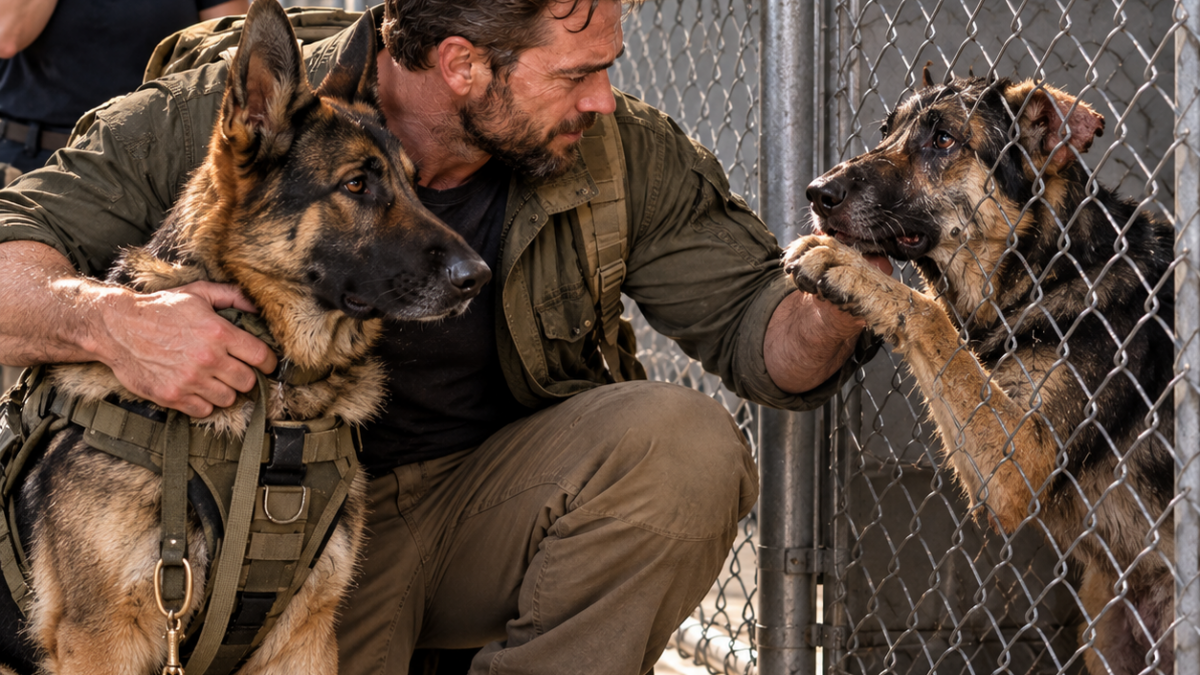
The sable shepherd pressed his body against chain link.
Echo pressed back.
Noses met through wire.
Havoc licked blood from Echo’s muzzle.
Echo’s shaking eased almost immediately.
Dash stared.
He looked at Sarah.
“What is this?”
She did not answer.
“What is this?”
“Dash—”
“You said Havoc doesn’t bond.”
“With people.”
“That is not what you said.”
Sarah’s eyes filled.
“They’re bonded.”
The word hit harder than it should have.
“How?”
“They served together.”
“Same unit?”
“Attached to same operating location for part of deployment.”
“Handler?”
“Havoc’s handler was Corporal Miller.”
“And Echo?”
“Different handler.”
“Where is he?”
“Alive.”
“Transferred after injury.”
“What happened?”
Sarah sat against wall.
Maybe because she could no longer stand.
“The compound was hit.”
“Indirect fire and secondary structural collapse.”
“Miller died.”
“Havoc was trapped.”
Dash looked at scars on Echo’s forelegs.
Sarah continued:
“Echo was a tracking dog.”
“Smaller.”
“Fast.”
“Nervous even before.”
“He got out.”
“Havoc didn’t.”
“The teams started digging.”
“Fire.”
“Concrete.”
“Rebar.”
“Secondary danger.”
“They pulled dogs back.”
“Echo kept returning.”
“He found where Havoc was.”
“He dug until his paws were destroyed.”
“How long?”
“Hours.”
“Reports say almost six.”
Dash swallowed.
“He got Havoc out?”
“With people.”
“Yes.”
“He kept digging at same void until rescuers reached him.”
“Afterward?”
“Echo stopped functioning.”
“Loud noises.”
“Confinement.”
“Separation.”
Sarah pointed.
“Havoc changed too.”
“He stopped engaging with people.”
“But put them beside each other?”
“Echo sleeps.”
“Havoc rests.”
“They eat.”
“Separate them and Echo spirals.”
Dash’s voice became flat.
“You were letting me take Havoc anyway.”
Sarah flinched.
“Yes.”
“Why?”
“Because Havoc can live outside here.”
“And Echo?”
She said nothing.
Dash understood.
“When?”
“Tomorrow.”
His face went still.
Sarah started:
“We’ve tried—”
“When?”
“Tomorrow morning.”
Havoc lay down outside Echo’s kennel.
Nose against bottom gap.
Echo mirrored him inside.
Dash turned toward Sarah.
“You were going to let me drive away with the only thing keeping that dog stable.”
“I was trying to save Havoc.”
“You lied.”
“Yes.”
“At least say it.”
“I lied.”
“Why?”
“Because if I had told you they were a bonded pair, would you have driven eighteen hundred miles with both?”
Dash opened mouth.
Stopped.
Sarah wiped face.
“That’s why.”
“I had to choose.”
Dash’s stomach tightened.
I had to choose.
Military life was full of that sentence.
Limited aircraft.
Limited time.
Limited blood.
Limited seats.
Limited options.
Choose.
Move.
Leave.
He looked at Echo.
The dog had stopped hurting himself.
Only because Havoc was on other side.
Sarah said quietly:
“You can still take Havoc.”
“No.”
Her face changed.
“You’re canceling?”
Dash did not answer.
He walked toward kennel.
Knelt.
His left leg resisted.
Metal plate always did in deep bend.
He ignored.
Echo saw him.
The dog pulled back.
Dash put fingers through chain link.
Still.
No reaching.
No baby voice.
No command.
Echo sniffed from distance.
Havoc watched.
After almost a minute, Echo crawled closer.
His muzzle was bloodied.
Eyes brown.
Exhausted.
He sniffed Dash’s fingers.
Then rested chin against them.
Something opened in Dash that had been shut too long.
Not sentimentality.
Recognition.
A creature embarrassed by needing anyone.
Dash knew that posture.
He looked over shoulder.
“Open it.”
Sarah stood.
“Dash.”
“Open the kennel.”
“If you’re angry—”
“I’m not taking Havoc alone.”
Sarah stared.
“You’re serious?”
“No.”
He looked at two dogs.
“I drove three days for one dog.”
He paused.
“Apparently I was wrong.”
“Dash, Echo is not just extra dog.”
“I understand.”
“No.”
“You need to hear everything.”
“I’ll hear it.”
“He may panic.”
“He may bite during panic.”
“He has medication.”
“He needs behavior veterinary follow-up.”
“He cannot be left alone long.”
“Storms are bad.”
“Gunfire audio.”
“Fireworks.”
“Construction noises.”
“He may destroy your house.”
Dash almost smiled.
“Have you seen my house?”
“This isn’t joke.”
“I know.”
“You live alone.”
“Yes.”
“If something happens to you, who takes two dogs?”
“My former teammate in Missoula is backup.”
“You already had backup for one.”
“He’ll be thrilled.”
“He won’t.”
“No.”
“He won’t.”
Sarah stared another second.
Then unlocked gate.
Havoc entered first.
Echo backed into corner.
Havoc touched nose to shoulder.
Waited.
Echo stood.
Dash held slip lead open.
No forcing.
Havoc exited.
Echo took one step.
Stopped.
The whole corridor seemed to hold breath.
Then Echo followed Havoc.
Dash slipped lead gently.
No celebration.
No miraculous trust.
Echo glued himself to Havoc’s flank.
Sarah started crying.
Dash said:
“Medical files.”
She nodded.
“Medication.”
“Yes.”
“Food.”
“Yes.”
“Everything.”
“I’ll print.”
“And I want vet on phone.”
“Today.”
“Yes.”
Sarah moved.
Dash called his friend Cole in Montana.
Cole answered:
“You got dog?”
“Two.”
Silence.
“What happened?”
“Long story.”
“You said one.”
“I know.”
“You live in cabin.”
“I know.”
“Are these normal dogs?”
“No.”
Longer silence.
Then:
“Need help when you get back?”
Dash closed eyes.
“Yes.”
That word was harder than adopting a second dog.
Cole did not make anything of it.
“Okay.”
An hour later, truck looked different.
Dash removed hard crate from rear.
Folded seats.
Bought memory foam pads.
Blankets.
Water.
Barrier behind front seats.
Echo’s medication.
Emergency sedative protocol prescribed by shelter veterinarian for severe panic—not casual sedation.
Muzzle conditioned but not forced.
First-aid kit.
Havoc loaded.
Echo stopped at door.
Too high.
Too enclosed.
Dash waited.
Five minutes.
Ten.
Sarah brought ramp.
Echo refused.
Havoc jumped down.
Walked up ramp.
Turned.
Echo watched.
Havoc came down.
Did it again.
Second time Echo put front paw.
Then another.
He climbed only because Havoc waited inside.
Dash closed door slowly.
Echo pressed into Havoc.
Sarah stood outside.
“I’m sorry.”
Dash looked.
“For lying?”
“Yes.”
“You should be.”
She nodded.
“But?”
“No but.”
That surprised her.
“You should have told me.”
“I might have walked away.”
“That would have been my choice.”
She swallowed.
“Yes.”
Dash softened slightly.
“Send me every record you have.”
“I will.”
“And don’t tell yourself this worked, so lying was right.”
Sarah nodded again.
“Fair.”
Then:
“Thank you.”
Dash shut door.
The drive north took four days because Echo could not tolerate long stretches.
They stopped often.
Quiet areas.
No crowded truck plazas if avoidable.
Havoc adjusted immediately.
Echo barely ate first day.
Dash slept in truck the first night because motel doors and hallways overloaded him.
On second afternoon, Echo accepted food from Dash’s hand.
Not touch.
Food.
Progress.
Then Colorado brought the storm.
The sky darkened over high plains.
Dash noticed pressure change before rain.
Havoc noticed too.
Echo began panting.
Dash exited interstate before worst.
Pulled into empty county rest area.
Thunder cracked.
Echo exploded.
He slammed against barrier.
Scratched window.
Spun.
Havoc tried to block him.
Echo snapped blindly.
Dash remembered Sarah’s instructions.
Do not grab face.
Reduce stimulation.
Create space.
Use familiar cue only if dog can hear it cognitively.
Avoid escalating restraint unless required for immediate safety.
Dash opened rear passenger door only after securing external leash system so Echo could not bolt.
Another thunderclap.
Echo screamed.
Dash climbed into rear.
Not wrapping the dog in some movie-perfect combat hold.
That could make panic worse.
He sat sideways.
Lowered voice.
“Havoc.”
Havoc lay close.
Dash placed blanket over part of window.
Reduced flashes.
He began breathing deliberately.
Slow.
In.
Out.
Same method his therapist had tried teaching him.
He had hated it.
Now he did it for dog.
Echo paced.
Panting.
Havoc pressed shoulder against him.
Dash kept talking.
“You’re here.”
“Truck.”
“Colorado.”
“Nothing’s hitting us.”
“You’re here.”
Not military jargon.
Not commands.
Orientation.
Reality.
Echo finally crawled into space between Havoc and seat.
Then, after another hour, placed front paw on Dash’s boot.
Dash did not move.
The storm passed.
They slept there.
At dawn, Dash woke leaning against door.
Havoc upright.
Echo asleep with nose against Dash’s leg.
He looked down.
“Hell.”
Havoc’s tail thumped once.
“Don’t get sentimental.”
Another thump.
Montana greeted them with early frost.
Cole met at cabin.
Former Navy corpsman.
Broad shoulders.
Beard.
Two daughters.
He stood in yard.
Havoc evaluated.
Echo hid behind truck seat.
Cole said:
“That him?”
“Echo.”
“The difficult one?”
“They’re both difficult.”
“That makes three.”
Dash glared.
Cole smiled.
Good.
They gave Echo space.
Havoc inspected property like he had been assigned sector.
Porch.
Woodshed.
Tree line.
Creek.
Barn.
Back.
Echo made it three feet from truck before freezing.
Havoc returned.
Touched nose.
Echo followed to porch.
That was enough for day one.
The first month was ugly.
Not inspirational.
Echo urinated inside twice during panic.
Chewed one doorframe.
Would not cross open meadow.
Refused food when Havoc went too far.
Could not tolerate vacuum cleaner.
Once broke skin on Dash’s forearm when a metal pan crashed and Dash moved too quickly.
Dash did not punish.
Cleaned wound.
Called behavior veterinarian.
Adjusted plan.
Veterinary behavior consult happened by telehealth first, then in person with regional specialist.
Medication evaluated.
Noise desensitization carefully structured.
No flooding.
No “make him face fear.”
Routine.
Predictability.
Safe room.
Covered crate with open access, never forced during panic.
Havoc’s presence used as support but not only strategy.
Dash learned something uncomfortable.
He could not heal Echo through toughness.
The dog did not need stronger leadership.
He needed safety repeated until his nervous system believed it.
Dash found that irritating.
Mostly because same might be true of him.
Havoc changed too.
At first he patrolled constantly.
Every fifteen minutes, back to porch.
Check Echo.
Then out again.
Dash thought it was guarding.
Behaviorist said:
“Could be checking.”
“So?”
“It means Havoc may also be anxious when separated.”
“He doesn’t look anxious.”
“Neither do you.”
Dash stopped liking her.
She smiled.
“Good.”
He returned next appointment anyway.
Winter arrived.
Snow silenced valley.
Echo discovered snow cautiously.
One paw.
Then two.
Back to porch.
Next day farther.
By December he could walk to woodshed.
January, half meadow.
No grand sprint yet.
His coat filled.
Weight improved.
Scars remained.
Havoc’s arthritis required medication and shorter patrols.
Dash built heated dog platform by stove.
Both ignored it and slept near bedroom door.
The cabin became louder.
Water bowls.
Tags.
Paws.
Havoc grumbling in sleep.
Echo whining when dreaming.
Dash talking.
That last part surprised him.
He had gone weeks before without speaking more than necessary.
Now:
“Move.”
“Breakfast.”
“No, that’s mine.”
“Echo, leave sock.”
“Havoc, stop staring at elk through glass.”
He caught himself laughing once.
Stopped.
Then laughed again.
Cole noticed when he visited.
“You look less terrible.”
“Thank you.”
“House smells worse.”
“Leave.”
Cole brought daughters only after months and only when specialists felt dogs could safely tolerate controlled visit.
Havoc wore basket muzzle initially.
Echo stayed behind gate by choice.
No forced socialization.
The girls sat on floor and read.
Echo appeared after twenty minutes.
Listened.
Did not approach.
Next visit, six feet closer.
Children accepted.
No touching.
Dash found himself watching with something like hope.
Then February brought the night everything reversed.
Dash had been sleeping better.
Not well.
Better.
Enough that improvement made bad nights feel worse.
The nightmare began in a place that did not exist exactly.
Part Afghanistan.
Part Iraq memory borrowed from teammates.
Part hospital.
Dreams do not respect geography.
Burning vehicle.
Radio.
Someone screaming his name.
He could not reach.
The old failure.
Always same core.
Move faster.
Too slow.
Wake.
Dash came upright in darkness.
Could not breathe.
Hands searching.
Heart beating so hard chest hurt.
For a few seconds he did not know Montana.
Did not know year.
He was back there.
His body believed completely.
Then weight landed across his thighs.
He flinched.
Echo.
Not Havoc.
Echo climbed partially onto bed, something he almost never did.
Placed front paws on mattress.
Pressed shoulder against Dash.
Whined.
Dash tried to push him away reflexively.
Echo returned.
Not frantic.
Steady.
Havoc stood in doorway.
Watching.
Echo nudged Dash’s forearm.
Then pushed his head beneath Dash’s hand.
Dash’s breathing hitched.
“Echo.”
Dog stayed.
Dash heard therapist’s voice:
Name five things.
He hated exercise.
Did it anyway.
“Bed.”
“Wall.”
“Window.”
“Dog.”
“Other dog.”
His hands shook.
Echo pressed.
Havoc came closer.
Dash put one hand on Echo’s rib cage.
Felt breathing.
Slow.
He matched.
Not perfectly.
Enough.
Minutes passed.
Panic loosened.
Dash bent over dog.
Face in fur.
No heroic speech.
Just:
“Okay.”
Then:
“I’m here.”
The same words he had used for Echo in truck.
Now dog gave them back without language.
That morning Dash called therapist.
The one he had stopped seeing in Virginia was too far; he found veteran-focused clinician in Montana months earlier but had postponed.
He finally scheduled.
Not because Echo cured him.
Because Echo proved panic could pass without him running from it.
There is a difference.
Healing did not happen when traumatized dog magically became service dog.
Echo was not trained for psychiatric assistance.
He was simply sensitive to fear.
He responded to familiar person’s distress.
Dash still needed professional help.
So he got it.
Weeks became months.
Spring thaw.
Mud.
Havoc slowed with age.
Echo became stronger.
One May morning Dash opened door.
Echo stepped off porch without waiting for Havoc.
Five yards.
Ten.
Stopped.
Looked back.
Dash stood with coffee.
“Go.”
Echo turned.
Walked into meadow.
Not running.
Just walking alone.
Havoc watched from porch.
That moment almost meant more than the later sprint.
Because trust had become internal.
Echo no longer needed body glued to Havoc every second.
He still loved him.
Needed him.
But dependency softened.
Havoc also learned Echo could return.
The behavioral specialist called that healthy separation tolerance.
Dash called it both dogs finally unclenching.
By first anniversary, Sarah flew to Montana.
She asked first.
Dash nearly said no.
Then agreed.
When she arrived, Echo barked from distance.
Havoc recognized her immediately.
He walked over.
Tail low wag.
Sarah knelt.
Cried.
“I didn’t think I’d see you again.”
Havoc allowed her to hold face.
Then Echo approached.
Slow.
She froze.
He sniffed.
Touched nose to her hand.
Sarah’s face crumpled.
“I’m sorry.”
Dash heard.
Maybe Echo did not understand.
Still.
That evening they sat porch.
Sarah said:
“I was wrong.”
“About what?”
“Thinking I had to choose.”
“You had real constraints.”
“That doesn’t make lying right.”
“No.”
“I convinced myself if Havoc got home, outcome justified it.”
Dash nodded.
“People do that.”
“Do you forgive me?”
He thought.
“I understand you.”
“That’s not same.”
“No.”
She accepted.
Then:
“Would you have taken both if I had told you from beginning?”
Dash looked at Echo asleep against Havoc.
“Probably not.”
Sarah laughed once through tears.
“There it is.”
“So your lie worked.”
“No.”
He shook head.
“It worked out.”
“Different.”
She nodded.
Good.
Valor changed policy afterward.
Bonded working-dog placements received stronger behavioral assessment.
No deliberate separation for adoption convenience without documented welfare plan.
More fundraising for sanctuary.
Sarah used Havoc and Echo’s case—not names publicly at first—to explain why “adoptability” can be relational.
Sometimes a dog considered impossible alone functions differently with bonded partner.
That does not mean all pairs must stay together.
But it must be assessed honestly.
Dash donated.
Quietly.
Then less quietly when Sarah convinced him to speak by video at fundraiser.
He hated camera.
Said twelve words:
“Don’t ask which dog deserves saving more before you ask what they mean to each other.”
Sarah played it twice.
The rescue raised enough for new kennel wing.
Dash regretted participating but not result.
Havoc lived another three years.
That matters because no story about old working dog lasts forever.
His hip worsened.
Then spine.
He stopped doing full property loops.
Echo adjusted.
At first he panicked when Havoc could not follow.
Dash and therapist—canine and human—prepared.
Short separations.
Echo with Dash while Havoc rested.
Then Havoc at vet while Echo stayed with Cole briefly.
Build tolerance before crisis.
Because grief can be anticipated but not prevented.
Havoc’s final winter was gentle.
He slept by stove.
Still alert when truck came.
Still placed body between Echo and unfamiliar noise.
But more tired.
One February morning he could not stand without pain.
Dash knew.
Vet came to cabin.
Havoc lay on blanket near fireplace.
Echo beside him.
No kennel.
No fluorescent lights.
Dash held scarred head.
Sarah joined by phone briefly, then left them privacy.
Cole sat outside.
The veterinarian explained.
Dash listened.
Havoc died with Echo’s nose against his cheek.
Echo did not scream.
That frightened Dash more.
He simply lay beside body.
Hours.
Dash allowed.
Then when it was time, Echo stood.
Watched Havoc carried out.
Whined once.
For days he searched.
Door.
Porch.
Woodshed.
Tree line.
Dash walked with him.
Did not distract constantly.
Did not bring another dog immediately.
Did not demand recovery.
They grieved.
Together.
The first thunderstorm after Havoc died came in June.
Dash feared it for weeks.
He prepared medication plan with veterinarian.
Safe room.
Sound masking.
Storm forecast.
When thunder hit, Echo trembled.
Looked toward door where Havoc used to lie.
Then toward Dash.
Dash sat on floor.
No words.
Echo came.
Pressed against him.
They waited.
He shook.
But he did not break.
Dash shook too.
But neither ran.
That was their new pact.
Not warrior and rescue.
Two nervous systems saying:
Stay.
Eventually Dash adopted another dog.
Years later.
Not replacement.
A ridiculous three-legged hound mix named Pete who had zero tactical ability and slept through thunderstorms.
Echo hated him for six days.
Then tolerated.
Then secretly loved.
Dash’s cabin stopped being fortress.
It became home.
Visitors.
Cole.
Daughters.
Sarah when traveling north.
A therapist appointment every other week in town.
Veterinary appointments.
Food delivery.
Mud.
Dog hair.
Life.
Echo lived until fourteen.
Longer than anyone expected.
His muzzle turned white.
He stopped trembling most days.
Still disliked fireworks.
Always would.
On his final morning, Dash carried him onto porch.
The dog who once could not step into open meadow rested wrapped in blanket facing mountains.
Snow on peaks.
Spring grass.
Pete asleep nearby.
Dash put hand on Echo’s chest.
Echo placed paw over wrist.
That gesture made Dash smile.
“Yeah.”
“I know.”
He thought of Texas.
Chain link.
Bloodied paws.
Havoc refusing to leave.
A kennel door opening.
The decision that had terrified him.
Two dogs.
Too much work.
Too much risk.
Too much attachment.
He had gone to Valor wanting something useful.
A perimeter dog.
A living alarm system.
Something disciplined enough not to ask anything emotional.
Instead he had brought home Havoc.
Then Echo.
And both demanded exactly what Dash had spent years avoiding.
Attachment.
Responsibility.
Fear.
Loss.
Grief.
Presence.
The things he thought would make him weaker.
They did not.
They made hiding harder.
That was different.
Echo’s breathing slowed.
Dash stayed.
When it ended, there was no dramatic rescue coming.
No brother digging through rubble.
No second chance.
Just death after a long life.
Dash cried.
Then buried Echo near Havoc beneath two ponderosa pines.
No military monument.
No rank.
No exaggerated hero plaque.
Two flat stones.
HAVOC
ECHO
Under both, one line:
NO ONE LEAVES ALONE.
Years afterward, visitors sometimes asked about stones.
Dash told short version.
“They came together.”
“Stayed together.”
One person once said:
“So you rescued both.”
Dash shook head.
“No.”
“What?”
“I gave them place.”
“That’s different.”
He had learned to dislike rescue language when it made one side hero.
Havoc had kept Echo alive.
Echo had once helped keep Havoc alive.
Both helped Dash choose life outside isolation.
Dash gave food.
Land.
Veterinary care.
Structure.
They gave him reasons to use what care he already had in him.
No one saved anyone alone.
That was the truth.
Sarah later mailed him an old photograph from Valor.
Taken before adoption.
Havoc asleep against one side of divider.
Echo against other.
Back to back through chain link.
Dash had never seen it.
He stared a long time.
On back Sarah wrote:
This is what I should have shown you first.
Dash framed it.
Not medals.
Not military photographs.
That one.
Two dogs separated by steel but sleeping as though wall did not count.
That image explained whole story better than scream.
The scream was what humans heard.
The bond had existed in silence long before.
Sometimes the thing holding a broken creature together is invisible until someone tries to remove it.
Dash understood that personally.
For years he had removed everything.
Crowds.
Noise.
Relationships.
Expectations.
He called isolation treatment.
Some of it helped.
Too much became another cage.
Havoc and Echo did not cure that.
They gave him something worth opening gate for.
That is why, when people ask what moment changed him, Dash does not say the truck.
Not the scream.
Not even Echo pressing against him during nightmare.
He says it happened when he knelt outside Echo’s kennel and extended his hand.
He expected fear.
Echo expected abandonment.
Neither knew the other.
Havoc lay between them.
And for one second everybody stopped trying to decide who was too broken to keep.
That was enough.
Dash looked at Sarah.
Said:
“Unlock the gate.”
Everything after came from that.
A truck headed north with two dogs instead of one.
A storm survived.
A porch crossed.
A nightmare interrupted.
A meadow entered.
A brother mourned.
A man returning to therapy.
A cabin becoming home.
He had gone to Texas looking for one dog who could hold a perimeter.
He came home with two who taught him that sometimes the strongest thing you can hold is not a line.
It is each other.








