“YOU’RE WORTHLESS, REBECCA! TAKE THAT LITTLE GIRL AND GET OUT!” My Husband Slapped Me on Christmas Eve While Our Three-Year-Old Daughter Watched in Terror — I Held My Crying Child Close and Walked Away Without a Word, But He Had No Idea What Was Hidden Inside the Folder I Took With Me
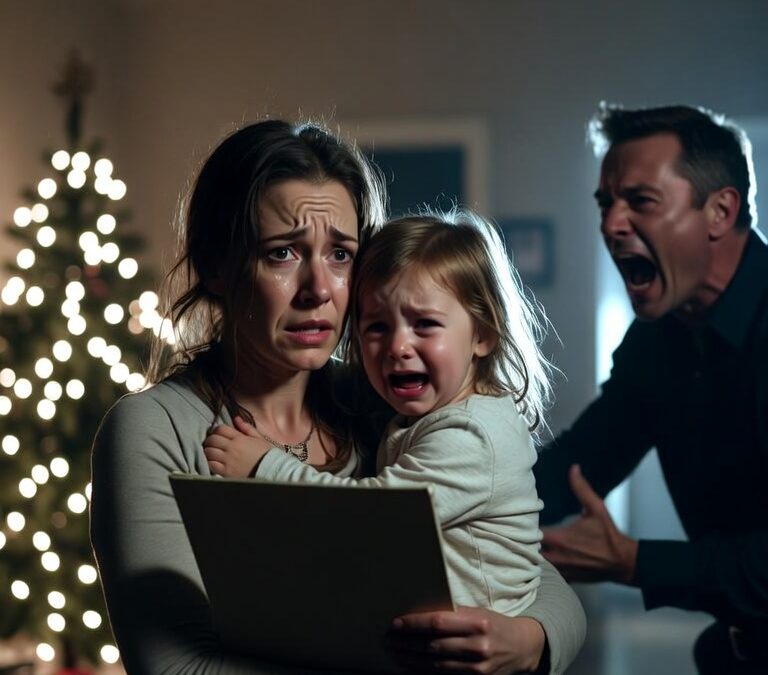
“YOU’RE WORTHLESS, REBECCA! TAKE THAT LITTLE GIRL AND GET OUT!” My Husband Slapped Me on Christmas Eve While Our Three-Year-Old Daughter Watched in Terror — I Held My Crying Child Close and Walked Away Without a Word, But He Had No Idea What Was Hidden Inside the Folder I Took With Me
“YOU’RE A WORTHLESS WIFE, REBECCA! I DESERVE A BETTER WOMAN THAN YOU!” my husband Daniel screamed before slapping me across the face so hard that my head snapped sideways, then pointing at our three-year-old daughter and shouting, “TAKE THAT BRAT AND GET OUT OF MY HOUSE!” while little Lily sat frozen in her booster seat, still holding a piece of Christmas dinner in her trembling hand.
After twelve years of marriage, I walked into the freezing Ohio night with our daughter, a half-packed overnight bag, and the sickening belief that the man I’d built my entire adult life around had stopped loving us—but before midnight, Daniel was calling me repeatedly, begging me to come home, not because he regretted hurting me, but because he had discovered that I’d accidentally taken a folder containing the secrets he’d spent six months hiding.
Inside were bank transfers, hotel receipts, a secret apartment lease, evidence of his affair with a coworker named Melissa, and a handwritten plan to make everyone believe I had willingly abandoned my marriage and surrendered our family home; what Daniel didn’t know was that I had spent years working as a bookkeeper, and the one thing I understood better than his lies was how to make the dates, numbers, and documents tell the truth.
The sound of my husband’s hand striking my face was louder than the Christmas music playing in our living room.
For a second, I didn’t move.
I just sat there, staring at Daniel across the dining table.
My cheek burned.
My ears rang.
The room seemed strangely distant.
The Christmas lights reflected in the window behind him, and the mashed potatoes were still sitting in the serving bowl beside the roast.
Only minutes earlier, I’d been worrying about whether dinner needed more butter.
Now my husband was standing over me, breathing heavily, as though I had committed some terrible offense simply by asking him a question.
“Don’t look at me like that,” he snapped.
I blinked.
“What?”
“You heard me.”
His jaw tightened.
“I am done being questioned in my own house.”
Across the table, Lily dropped her crayon.
The tiny plastic sound it made against her plate seemed impossibly loud.
“Mommy?”
I turned.
My three-year-old daughter was staring at me.
Her pink socks were crooked.
A little smear of gravy marked her sleeve.
She still had one hand wrapped around a piece of dinner.
Her eyes were enormous.
I wanted to tell her everything was fine.
I wanted to reach across the table and make the last ten seconds disappear.
Instead, Daniel pointed at her.
“Take that brat and get out.”
Lily’s face crumpled.
“Daddy?”
He didn’t answer her.
He looked at me instead.
“Now, Rebecca.”
I stared at the man I’d been married to for twelve years.
The man who had once held my hand during a difficult labor and cried when Lily was born.
The man who kissed me every morning before work.
The man who had spent the previous four hours somewhere he refused to explain.
The man whose phone had just displayed a message from another woman.
And suddenly I understood that arguing would accomplish nothing.
Not while Lily was watching.
Not while Daniel was standing there with his fists clenched.
I pushed back my chair.
My legs felt weak.
“Come on, sweetheart.”
Lily looked toward her father.
“Where are we going?”
I swallowed.
“To Aunt Karen’s.”
She blinked.
“Is Daddy coming?”
I looked at Daniel.
He’d turned toward the kitchen counter.
His phone was already in his hand.
He didn’t even look at our daughter.
“No, honey,” I whispered.
“Not tonight.”
I lifted her from the booster seat.
She immediately wrapped both arms around my neck.
Her little body was warm against mine.
I carried her toward the hallway.
Daniel said nothing.
Not when I grabbed her winter coat.
Not when I put her shoes on.
Not when I picked up my purse and the overnight bag I’d prepared earlier that week for an upcoming visit to Karen’s.
And not when Lily began crying because she didn’t understand why we were leaving before opening her Christmas presents.
I reached for a black accordion folder near the front door.
I thought it contained Lily’s insurance information and a few household papers.
I slipped it into the overnight bag without checking.
Then I opened the door.
Cold December air swept into the hallway.
Lily buried her face against my shoulder.
I turned back once.
Daniel was standing near the dining room.
His wedding ring caught the light.
For one desperate moment, I wanted him to say my name.
To tell me he’d made a terrible mistake.
To come toward us with an apology.
Instead, he looked away.
I stepped outside.
The door closed behind us.
And just like that, twelve years of marriage became a house I was no longer sure I could safely enter.
It was December 24, 2026, around 7:40 in the evening.
We lived in a two-story house outside Columbus, Ohio.
My name is Rebecca.
I was forty-three years old.
Daniel was forty-six.
Our daughter, Lily, was three.
Until that evening, I believed we were an ordinary family going through a difficult season.
We had bills.
Stress.
A busy work schedule.
A young child who sometimes refused to sleep.
But we had a home.
A marriage.
A future.
At least, I thought we did.
I worked as a bookkeeper for a small HVAC company in Columbus.
Daniel worked in sales for a construction-supply business.
I handled most of our household finances because I was organized and comfortable with numbers.
He hated paperwork.
Or so he told me.
For years, I took care of the mortgage, insurance, daycare payments, utilities, and credit-card bills.
I knew when every major payment was due.
I knew what we owed.
I believed I knew what we could afford.
What I didn’t know was that my husband had begun building a second life behind my back.
The argument started with a text message.
That afternoon, Daniel had told me he needed to stop by his office.
“Just an hour,” he’d said.
I’d been standing in the kitchen preparing dinner.
I remember looking toward the Christmas tree.
Lily had spent the morning hanging paper ornaments on the lower branches.
“It’s Christmas Eve,” I reminded him.
“I know.”
He kissed my cheek.
“Work doesn’t stop just because Santa’s coming.”
I laughed.
“All right. But don’t be late.”
He smiled.
“Promise.”
Then he left.
Four hours passed.
When he finally came home, he looked irritated.
He was gripping his phone so tightly that his knuckles were white.
I asked whether everything was okay.
He said it was fine.
I asked why he’d been gone so long.
He told me to stop questioning him.
Then he went upstairs to change.
His phone remained on the kitchen counter.
The screen lit up.
I didn’t pick it up.
Didn’t unlock it.
Didn’t search through anything.
I simply saw the notification.
Melissa Carter: Are you sure tonight is still happening?
I recognized her name.
She worked at Daniel’s office.
I’d met her at a company picnic two summers earlier.
Red hair.
Friendly smile.
An easy way of laughing at Daniel’s jokes.
At the time, I hadn’t thought anything of it.
Now, staring at her message, I felt a small, cold weight settle in my stomach.
When Daniel returned, I asked what it meant.
He accused me of going through his phone.
I explained that the screen had lit up while it was sitting on the counter.
He didn’t believe me.
Or didn’t want to.
I asked again.
He grew angrier.
Then he said he was tired of our marriage.
Tired of being controlled.
Tired of explaining himself.
And finally, tired of me.
“I deserve a better wife.”
Those were his words.
I remember them almost as clearly as the slap.
Because before he struck me, he made sure I understood how little he believed I was worth.
Outside, I buckled Lily into her car seat.
My hands were shaking so badly that I had to try twice.
She clutched her stuffed rabbit.
“Mommy, are you sad?”
I swallowed.
“A little, sweetheart.”
She reached toward my cheek.
“Did Daddy hurt you?”
For a moment, I couldn’t speak.
Then I gently took her hand.
“Yes.”
Her bottom lip trembled.
“Was I bad?”
The question nearly broke me.
I leaned closer.
“No, Lily.”
My voice shook.
“You didn’t do anything wrong.”
She looked at me for a long moment.
Then whispered, “Okay.”
I kissed her forehead.
Closed the car door.
And climbed behind the steering wheel.
My cheek still burned.
I looked at myself in the rearview mirror.
There was a red mark across the side of my face.
I stared at it.
Then started crying.
Not loudly.
Not dramatically.
Just tears slipping down my face while I sat in the driveway of a house I’d spent twelve years helping pay for.
Lily called from the back seat.
“Mommy?”
I wiped my cheeks.
“I’m here, baby.”
Then I started the engine.
And drove toward Karen’s house.
Karen lived about twenty minutes away in Dublin.
She was my closest friend.
The person I called when Lily had a fever and Daniel couldn’t leave work.
The person who remembered my birthday without needing a reminder.
The person who brought me soup when I was exhausted.
She opened the door wearing flannel pajamas and slippers.
One look at my face was enough.
She didn’t ask why I was standing on her porch on Christmas Eve.
She simply stepped aside.
“Come inside.”
Lily ran toward the Christmas tree.
Karen watched her disappear into the living room.
Then turned toward me.
Her expression changed.
“Rebecca.”
I tried to smile.
I couldn’t.
Her eyes moved toward my cheek.
“Did he do that?”
I nodded.
For a moment, Karen didn’t speak.
Then she wrapped her arms around me.
And I finally let myself cry.
At approximately 9:30, my phone rang.
Daniel.
I watched his name flash across the screen.
I didn’t answer.
He called again.
Then again.
On the fourth call, I picked up.
“Rebecca.”
His breathing sounded uneven.
“Where are you?”
I closed my eyes.
“You know where I am.”
“Come home.”
I stared toward the living room.
Lily was sitting on Karen’s rug, quietly pushing a wooden train around the Christmas tree.
“No.”
“Rebecca, please.”
There was panic in his voice.
I’d never heard him sound like that before.
I thought, foolishly, that perhaps he’d finally realized what he’d done.
Then he said something that made my stomach turn.
“Something’s wrong with the bank account.”
I sat straighter.
“What?”
“Some transfers.”
“What transfers?”
“I don’t know yet.”
I frowned.
Daniel rarely handled our household banking.
He relied on me to track the balances.
The bills.
The payments.
Why would he suddenly be reviewing our joint account on Christmas Eve?
“Daniel, what happened?”
His voice became urgent.
“Just come home.”
I took a breath.
“No.”
“Rebecca—”
“You hit me.”
There was silence.
Then he whispered, “I know.”
No apology.
No explanation.
Only an acknowledgment.
I ended the call.
Karen came over.
“What did he want?”
I looked toward my phone.
“He says there are transfers from our account.”
Her expression changed.
“Do you know anything about them?”
“No.”
She pulled out a chair.
“Then check.”
I opened my banking app.
And within thirty seconds, I realized that Daniel had been lying about much more than where he’d spent Christmas Eve.
The balance was almost eight thousand dollars lower than I expected.
At first, I thought the application hadn’t updated.
I refreshed it.
Same number.
I checked the date.
Then the account.
Then the available balance.
Nothing changed.
I opened the transaction history.
And began reading.
A hotel in Indianapolis.
$486.17.
A restaurant I’d never visited.
A transfer for $3,200.
Another for $1,850.
Smaller charges.
Seventy-two dollars.
One hundred forty-five.
Three hundred eighteen.
Some were months old.
Payments I’d overlooked because they had been mixed among groceries, insurance, gas, daycare, and all the ordinary expenses of running a household.
I stared at the screen.
“Karen.”
She pulled her chair closer.
“What?”
“I don’t recognize these.”
She read the transactions.
Then looked toward me.
“Could Daniel have made them?”
I swallowed.
“Yes.”
“Did you authorize them?”
“No.”
The word felt strange.
For twelve years, I’d trusted my husband to use our money in ways that supported our family.
We’d never needed permission for every purchase.
But we had an understanding.
Large expenditures were discussed.
Savings were protected.
Major decisions were made together.
Or so I believed.
Now I was staring at evidence that Daniel had been making expensive decisions without telling me.
And I couldn’t explain where the money was going.
I opened our credit-card account.
That was worse.
The balance had climbed above six thousand dollars.
I knew we’d been carrying some debt.
Christmas had been expensive.
Lily’s daycare costs were high.
The heating bill had increased.
But Daniel had repeatedly assured me that we were doing fine.
He had even complained when I purchased a twenty-nine-dollar wooden train set for Lily.
“Do we really need another toy?” he’d asked.
I’d laughed.
“It’s Christmas.”
He’d frowned.
“We should be careful with money.”
I remembered that conversation as I stared at the credit-card statement.
Hotel charges.
Restaurants.
An apartment-furnishing store.
And several expenses that had nothing to do with our household.
I felt something cold spreading through me.
He’d made me feel irresponsible for buying our daughter a small gift.
While quietly spending thousands of dollars on things he didn’t want me to know about.
Karen reached for my hand.
“Rebecca, you don’t have to figure everything out tonight.”
I shook my head.
“I need to know.”
She looked at me.
“I understand.”
I scrolled farther.
Then noticed a recurring payment.
Midwest Storage — $219.
I frowned.
“Why would Daniel need a storage unit?”
Karen studied the screen.
“Maybe something from work?”
I shook my head.
“His company has warehouses.”
We stared at the transaction.
The payment had repeated for months.
It wasn’t new.
It wasn’t accidental.
Someone had arranged it.
Budgeted for it.
And kept it hidden.
I looked toward my overnight bag.
Something about the word storage stirred a memory.
Then I remembered the black accordion folder I’d grabbed near our front door.
At the time, I thought it contained Lily’s insurance information.
Now I wondered what else was inside.
I opened the bag.
Moved aside Lily’s pajamas.
Her toothbrush.
The little pink sweater I’d packed.
Then pulled out the folder.
It was heavier than I remembered.
Karen stood beside me.
“What’s that?”
“Household documents.”
I hesitated.
“At least, I thought so.”
I opened it.
There were receipts.
Statements.
Insurance documents.
A copy of an unfamiliar bank record.
And beneath them, a storage-unit lease.
I stared at the date.
June 3.
Six months earlier.
I read it again.
Daniel had rented the unit in June.
Not after our argument.
Not when he’d supposedly decided our marriage wasn’t working.
Six months before Christmas.
I felt sick.
Karen leaned closer.
“Rebecca?”
I looked up.
“He’s been preparing something.”
She glanced toward the folder.
“What?”
I swallowed.
“I don’t know.”
Then I opened our shared household email and found a folder Daniel had created.
HOUSE.
Inside were scanned statements.
Property photographs.
Account information.
And documents I’d never seen.
I began opening them.
One by one.
Until I found a lease agreement.
A furnished apartment in Columbus.
Start date: October 1.
I stared.
October.
Nearly three months before Daniel struck me.
Before he told me he wanted a better wife.
Before he ordered me out.
He’d already rented somewhere else.
For several minutes, I couldn’t speak.
Karen read the lease.
Then set my phone on the table.
“Oh, Rebecca.”
I looked at her.
My throat tightened.
“He was going to leave.”
She didn’t answer.
I stared at the paperwork.
“Or make me leave.”
The words frightened me.
Because suddenly everything seemed connected.
The secret money.
The apartment.
The storage unit.
The photographs of our house.
The unusual transfers.
And Daniel’s panic when he discovered I’d taken the folder.
He hadn’t called to check whether Lily was frightened.
He hadn’t asked if my cheek was injured.
He wanted me home because there were things he didn’t want me to see.
My phone rang again.
Daniel.
I let it go to voicemail.
When the notification appeared, Karen looked toward me.
“Do you want to hear it?”
I hesitated.
Then pressed play.
“Rebecca, please call me.”
His voice was softer.
“I need you to understand that tonight got out of control.”
A pause.
“I never meant for things to go this far.”
Then silence.
The message ended.
I stared at the phone.
He hadn’t mentioned the money.
Or the apartment.
Or the storage unit.
He’d described the assault as something that simply got out of control.
As though it had happened without anyone making a choice.
I looked at Karen.
“He doesn’t even sound sorry.”
She took a breath.
“He sounds frightened.”
I swallowed.
“Of what?”
Then I remembered the final sheet still tucked inside the accordion folder.
I reached for it.
Unfolded it.
And saw the printed email.
From Melissa Carter.
The subject line read:
When are you finally telling Rebecca?
My heart seemed to stop.
I read the first sentence.
Daniel, you promised me Rebecca would know by Christmas.
Then I turned toward Karen.
And whispered, “He’s not trying to save our marriage.”
I looked back at the paper.
“He’s trying to save whatever he’s been hiding.”
PART2
Karen took the email from my trembling hand.
She read it slowly.
Then looked up.
“Melissa Carter?”
I nodded.
“The woman from his office.”
“The redhead?”
“Yes.”
Karen looked toward the living room.
Lily was asleep on the sofa beneath a blanket.
Her stuffed rabbit rested beside her face.
For several seconds, neither of us spoke.
Then Karen lowered her voice.
“Rebecca, I think you need to sit down.”
I gave a small, bitter laugh.
“I am sitting down.”
She glanced toward me.
I looked at the email again.
The words hadn’t changed.
You promised me Rebecca would know by Christmas.
I thought about the message I’d seen on Daniel’s phone.
Are you sure tonight is still happening?
And suddenly I understood the question.
Melissa had expected something to happen that evening.
Perhaps Daniel had promised to tell me about their relationship.
Perhaps he’d told her Christmas would be the moment he ended our marriage.
Perhaps he’d planned to say something after dinner.
I didn’t know.
But whatever he’d intended, it had already been decided without me.
I read the rest of the email.
Melissa mentioned the apartment.
The money.
And what she called the next step.
Her tone wasn’t affectionate.
It was impatient.
She sounded like someone who’d been waiting for a promise and had grown tired of excuses.
I stared at the page.
For twelve years, I’d been building one life with Daniel.
Apparently, he’d been promising another woman an entirely different future.
One that required me to disappear from the picture.
Karen sat across from me.
“Do you want me to put this away?”
I shook my head.
“No.”
“Rebecca—”
“I need to know what he’s done.”
She looked toward the documents.
Then nodded.
“Okay.”
I opened the email folder again.
I knew Daniel’s password because years earlier he’d asked me to help recover the account.
We had used this shared household account for bills and paperwork.
Now I found messages that revealed how much of our marriage he’d been discussing with another woman.
The earliest messages were ordinary.
Work schedules.
Customer questions.
Office meetings.
Then the tone changed.
Dinner arrangements.
Hotel bookings.
Private jokes.
Messages sent late at night.
Then references to the apartment.
One message from Daniel read:
Once I get everything sorted, we can finally have our own place.
Another said:
Rebecca doesn’t know how much is in the investment account.
I stopped.
My fingers went numb.
Karen leaned closer.
“What?”
I turned the screen toward her.
She read it.
Then looked at me.
“Rebecca.”
I shook my head.
“He’s talking about our savings.”
For twelve years, I had been the person balancing our household accounts.
I knew how hard it was to save.
I knew what a car repair could do to a month’s budget.
What daycare cost.
How much insurance premiums had risen.
How carefully we had to manage the mortgage.
I’d worked through Lily’s illnesses.
Prepared spreadsheets on weekends.
Skipped little things I wanted because there was always something more important for the family.
Now Daniel was discussing our joint investment account with the woman he’d apparently been seeing behind my back.
And he wasn’t discussing it with me.
I continued reading.
In one email, Daniel described me as controlling.
In another, he said I was emotionally unstable.
He told Melissa I always needed to know where he was.
That I questioned every expense.
That I would probably try to keep Lily away from him.
Then I saw the sentence that hurt almost as much as the slap.
Rebecca has always been difficult.
Always.
The word seemed to stretch backward through our marriage.
I remembered our first apartment.
The brown carpet neither of us liked.
The secondhand sofa we’d bought from a couple in Westerville.
The day we moved it ourselves because we couldn’t afford professional movers.
Daniel standing beside me in the rental truck.
Laughing.
Telling me that someday we’d have a beautiful house.
I remembered the Christmases when we exchanged inexpensive gifts because money was tight.
The evenings he fell asleep on the sofa while I finished paying bills.
The day Lily was born.
Daniel crying as the nurse placed her in his arms.
He had looked at me then and whispered, “You’re the strongest woman I know.”
Now he was describing me as a problem.
Something to manage.
Someone who needed to be removed from the future he’d already planned.
I put down the phone.
“I feel stupid.”
Karen shook her head.
“Rebecca.”
“I didn’t see it.”
She reached across the table.
“People don’t usually announce when they’re lying.”
I stared at her.
She continued.
“They still buy groceries.”
A pause.
“Still ask whether you need anything from the store.”
“Still kiss you goodnight.”
My eyes filled.
Because that was exactly what made it so difficult to understand.
Daniel hadn’t become a stranger overnight.
He had carried on with our ordinary life.
He’d taken Lily to the park.
Complained about traffic.
Discussed the price of groceries.
Sat beside me watching television.
Then gone elsewhere and made plans with another woman.
I hadn’t failed to understand an obvious announcement.
I’d believed the life he continued pretending to share with me.
I wanted to call Melissa.
I wanted to hear her voice.
Ask whether she knew we were married.
Whether she knew Lily existed.
Whether Daniel had told her that I’d agreed to a separation.
I wanted to ask how a person could discuss moving into another woman’s home while the man’s wife was putting their daughter to bed.
My finger hovered over her number.
Karen reached toward me.
“Don’t.”
I looked up.
“Why?”
“Because you’re hurt.”
I laughed bitterly.
“Of course I’m hurt.”
“I know.”
Her voice softened.
“But you don’t know what Daniel has told her.”
I stared at the screen.
Karen continued.
“You might give her information she doesn’t have. Or say something he’ll use against you.”
I looked toward Lily.
She was sleeping peacefully.
Unaware that the adults who were supposed to protect her had begun unraveling everything she understood as home.
I lowered the phone.
Karen nodded.
“Right now, you need to protect yourself and your daughter.”
That was the first night I began understanding the difference between confronting someone and protecting myself.
For years, I believed that when something went wrong in a marriage, you sat down and talked.
You explained.
You listened.
You compromised.
You tried to understand what the other person needed.
I still believed communication mattered.
But Daniel had already been communicating.
Just not honestly with me.
He’d been telling Melissa one story.
Me another.
His family something else.
And our financial records revealed yet another version.
I didn’t need to rush into a confrontation simply because I was frightened.
I needed to know what was true.
By two in the morning, we’d organized the documents into separate piles.
Banking.
Credit cards.
Apartment lease.
Storage unit.
House documents.
Emails.
Insurance.
Investments.
I made copies of what was already lawfully in my possession and kept the original papers intact.
I photographed dates and page numbers.
Wrote down where I’d found each item.
And resisted the temptation to alter anything.
Karen watched me working.
Then said quietly, “You look like you’re back at your office.”
I stared at the pages.
For a moment, I almost smiled.
“It’s the only thing I know how to do right now.”
She nodded.
“Then do it.”
I returned to the statements.
Because numbers didn’t care which person sounded more convincing.
A transfer made on November 3 existed regardless of whether Daniel denied it.
A lease beginning October 1 had a date.
A storage agreement from June 3 didn’t disappear because someone claimed to have made a last-minute decision on Christmas Eve.
And an email saying Rebecca doesn’t know was not the same as an agreement I’d supposedly given.
I kept reading.
And slowly, my fear began turning into clarity.
At some point, Karen put a cup of tea beside me.
I barely noticed.
She went upstairs to check on Lily.
When she returned, she rested one hand on my shoulder.
“She’s asleep.”
I nodded.
“Good.”
“Rebecca, you need some rest too.”
I looked toward the documents.
“I can’t.”
She pulled out a chair.
“Then tell me what you’re afraid will happen if you stop.”
I stared at her.
For a moment, I didn’t know.
Then the answer came.
“He’ll convince everybody I’m the problem.”
My voice broke.
“He’s already telling Melissa I’m unstable.”
Karen remained quiet.
I continued.
“He’s been preparing for months. What if he tells people I walked out? What if he claims I wanted to leave?”
I looked toward the staircase.
“What if he makes Lily think I broke our family apart?”
Karen took my hand.
For a long moment, neither spoke.
Then she said, “You don’t have to win every argument tonight.”
I swallowed.
“You need to make sure you and Lily are safe.”
Her voice softened.
“The rest can be dealt with one piece at a time.”
I closed my eyes.
And for the first time that night, I allowed myself to stop working.
The next morning, Christmas Day, Lily woke before seven.
She came downstairs carrying her stuffed rabbit.
Her hair was tangled.
One sock had disappeared during the night.
She found me sitting at Karen’s kitchen table.
“Mommy!”
I stood.
She ran into my arms.
I lifted her.
Held her against my chest.
And kissed her cheek.
“Merry Christmas, baby.”
She looked around.
“Where are our presents?”
My throat tightened.
I glanced toward Karen.
My friend immediately smiled.
“Santa left a few things here.”
Lily gasped.
“Really?”
Karen nodded.
“Santa knows where Aunt Karen lives.”
My daughter squealed.
Then ran toward the tree.
I watched her.
The joy on her face.
The way she knelt beside the presents.
The ordinary excitement of a three-year-old on Christmas morning.
And I felt an ache so deep that I had to turn away.
Because somewhere across Columbus, the Christmas tree we’d decorated together was still standing in our house.
The presents we’d bought were still beneath it.
The dinner I’d prepared had gone unfinished.
And my marriage had shattered before my daughter could open a single gift.
Karen found me near the sink.
I was gripping the edge of the counter.
“Rebecca.”
I shook my head.
“I don’t want her to remember Christmas like this.”
Karen stood beside me.
For a moment, she didn’t speak.
Then she said, “She’ll remember you being with her.”
I looked toward the living room.
Lily was laughing over a toy Karen had wrapped.
My eyes filled.
Karen continued.
“She knows you came with her.”
A pause.
“She knows she’s safe here.”
I swallowed.
“That’s what matters right now.”
I nodded.
Then wiped my face.
And joined my daughter beneath the Christmas tree.
At nine o’clock, I called a family-law attorney Karen recommended.
Susan Miller.
Her office was on Riverside Drive in Columbus.
It was Christmas Day, and I didn’t expect her to answer.
But she returned my message and spoke with me briefly.
I told her about Daniel striking me.
About leaving with Lily.
The bank transactions.
The apartment.
The storage unit.
And the messages I’d found.
Susan listened.
Then asked whether I was somewhere safe.
“Yes.”
“Good.”
Her voice was calm.
“Don’t return to the house alone.”
I swallowed.
“Okay.”
“Preserve the documents and messages. Keep the originals secure. Don’t publish anything or send the material around to relatives.”
I wrote everything down.
Then she advised me to obtain medical documentation of my injury and discuss appropriate protective options, custody arrangements, and financial safeguards.
She also cautioned me against making large unilateral transfers from joint assets without legal advice.
There were ways to protect myself.
But those steps needed to be taken carefully.
I listened.
For the first time since Daniel struck me, I felt as though someone was explaining a path forward that didn’t depend on persuading him to behave differently.
After the call, I looked toward the bathroom mirror.
The mark on my cheek had changed.
It was no longer simply red.
There was swelling.
Tenderness.
A faint discoloration.
I touched it carefully.
Then heard Daniel’s voice in my memory.
Take that brat and get out.
My daughter.
Our daughter.
A little girl who loved her father.
Who ran to the window when his car pulled into the driveway.
Who drew him pictures.
Who called him Daddy and expected him to smile.
He had called her a brat.
Then watched me carry her outside.
I looked at my reflection.
And whispered, “I’m not going to pretend this didn’t happen.”
Karen drove me to urgent care.
We arranged for someone trusted to watch Lily while we went.
The waiting room was brightly lit.
A television played a cooking program.
An older man complained about the temperature.
Someone coughed repeatedly near the entrance.
Everything was ordinary.
And I felt terribly exposed.
I wanted to tell the receptionist I’d fallen.
That I’d bumped into something.
That the swelling was an accident.
Because admitting what happened meant allowing a stranger to know something I’d spent twelve years believing would never be part of my life.
Then the nurse asked.
“What happened to your face?”
I hesitated.
Looked at Karen.
She waited.
Didn’t speak for me.
I took a breath.
“My husband slapped me.”
The words were quiet.
But once they were spoken, I couldn’t take them back.
The nurse’s expression softened.
She asked whether I was safe.
Whether I needed additional assistance.
Whether I wanted information about domestic violence resources.
Then she documented the injury and arranged the appropriate examination.
There was no dramatic speech.
No instant solution.
Only a record.
A few careful questions.
And the unfamiliar feeling of having told the truth without immediately trying to protect Daniel from it.
When we returned to Karen’s car, I sat silently.
She started the engine.
Then looked toward me.
“You okay?”
I shook my head.
“No.”
She nodded.
We sat quietly.
Then I whispered, “I’ve never said that sentence out loud before.”
Karen turned toward me.
“What sentence?”
I swallowed.
“My husband hit me.”
For a moment, she didn’t answer.
Then she took my hand.
And I began crying again.
That evening, I returned to the storage-unit paperwork.
It bothered me more than almost anything else.
An apartment could mean an affair.
Hotel charges could mean secrecy.
But six months of storage payments suggested planning.
And I wanted to know what Daniel had been moving.
The lease identified the facility.
The unit number.
And listed both Daniel and me as authorized household members.
Karen agreed to come with me.
We checked the paperwork before going.
Then drove through light snow toward Midwest Storage.
I felt frightened the entire way.
Not because I expected a physical confrontation.
Because I knew that opening the unit might reveal how long Daniel had been preparing to erase the life we shared.
The office clerk checked my identification and the authorization listed on the agreement.
Once access was confirmed, Karen and I walked toward the unit.
The corridor was cold.
Concrete floors.
Metal doors.
Numbers painted near each lock.
I stopped in front of ours.
For a moment, I couldn’t move.
Then Karen touched my arm.
“Rebecca.”
I took a breath.
And opened the door.
The metal panel rattled upward.
Inside were boxes stacked almost to the ceiling.
Christmas decorations.
Kitchen items.
Old photographs.
Lily’s baby clothes.
A box containing picture frames.
The wedding album.
I stared.
For a moment, I felt as though somebody had opened a door into a life I’d already lost.
There were things I hadn’t even realized were missing.
The little blue serving dish my mother had given us.
The framed photograph from our honeymoon.
Lily’s first pair of shoes.
Our wedding album.
I walked toward it.
Picked it up.
And ran my fingers over the cover.
Twelve years of marriage.
Packed into a storage unit without my knowledge.
Karen stood beside me.
“Rebecca?”
I looked up.
My voice broke.
“He was moving our life.”
She didn’t answer.
I looked around.
Months of planning.
Boxes.
Documents.
Personal belongings.
Daniel had been removing pieces of our shared home while I continued believing we were an ordinary married couple.
He hadn’t simply become unhappy on Christmas Eve.
He’d been preparing for a different future.
And apparently he expected to decide how I would fit into it.
Or whether I would fit at all.
Near the back were three plastic tubs.
Their labels had been written in black marker.
FINANCIAL.
PERSONAL.
MELISSA.
I stared at the third one.
My heart began pounding.
Karen looked toward it.
Then toward me.
I slowly lifted the lid.
Inside were printed emails.
Receipts.
A small envelope.
And several papers arranged neatly in folders.
On the envelope, Daniel had written:
For Melissa — After Rebecca Is Gone.
I felt sick.
Not after the divorce.
Not after we separated.
After Rebecca is gone.
As though I were something he expected to remove.
I opened the envelope.
And found a handwritten letter.
The first sentence made my blood run cold.
“Rebecca knows our marriage has been difficult, and she has agreed to let me keep the house while she starts over.”
I stared.
Read it again.
Then whispered, “I never agreed to that.”
Karen moved closer.
“What?”
I handed her the page.
She read it.
Her expression changed.
I looked toward the boxes.
The wedding album.
Lily’s baby clothes.
Our Christmas decorations.
Then back at the letter.
Daniel hadn’t only been planning an affair.
He’d been preparing a story in which I voluntarily gave up the home we’d built together.
And he had written that story before he ever told me our marriage was over.
I took photographs of the letter.
Then the envelope.
Then the printed emails.
The dates.
The labels on the tubs.
The documents that might become relevant to our separation and finances.
Karen stood beside me.
Neither of us spoke much.
I couldn’t stop looking at the wedding album.
I remembered the day Daniel and I married.
The photographs.
The reception.
My mother crying when she watched us dance.
The promises.
The certainty that whatever difficulties came, we’d face them together.
Now I was standing inside a storage unit looking at a letter that claimed I’d agreed to leave him our house.
A conversation we’d never had.
An agreement I’d never made.
A future he’d written for me without asking.
On the drive back, I asked Karen something I’d been afraid to say.
“Why would he go to all this trouble?”
She kept her eyes on the road.
“What do you mean?”
“If he wanted a divorce, he could have told me.”
I stared through the windshield.
“He could have said he’d fallen in love with somebody else.”
My voice broke.
“I would have been devastated.”
A pause.
“But we could have dealt with it.”
Karen remained quiet.
I continued.
“Instead, he moved money.”
I swallowed.
“Rented an apartment.”
“Moved our belongings.”
“Wrote letters claiming I’d agreed to things I didn’t even know about.”
I looked toward her.
“Why?”
Karen took a breath.
“I don’t know everything he was thinking.”
Then she glanced toward me.
“But it sounds like he wanted the benefits of leaving without accepting responsibility for how he left.”
I stared toward the road.
And knew she was right.
Daniel had spent months creating a new life.
Then he’d tried to make me appear responsible for the end of the old one.
On Monday morning, I sat across from Susan Miller.
Her office smelled faintly of coffee.
There were bookshelves along one wall and a large window overlooking the street.
She was in her early fifties.
Short gray hair.
A calm voice.
The kind of person who could ask a difficult question without making you feel foolish.
I brought everything.
Statements.
Emails.
The storage lease.
Apartment lease.
Medical documentation.
The letter.
Photographs.
Notes.
Susan spread the documents across her desk.
Then asked, “Where did you obtain these?”
I explained carefully.
The shared household email.
The accordion folder.
The storage unit where the agreement listed me as authorized.
She made notes and explained the importance of handling access to private accounts and documents lawfully, including avoiding any further access that might raise legal concerns.
Then she turned to the timeline.
“Storage unit in June.”
I nodded.
“Apartment in October.”
“Yes.”
“Financial transfers over several months.”
I swallowed.
“Yes.”
She looked toward the handwritten letter.
“And Daniel claims you agreed to leave him the house.”
I shook my head.
“We never had that conversation.”
Susan leaned back.
For a moment, she seemed to be assembling the sequence in her head.
Then she said, “Rebecca, these records are important.”
I nodded.
“Because they show he was planning to leave?”
“Because they may help establish what was happening before Christmas and whether financial representations he’s making are accurate.”
I stared toward the documents.
Then asked, “What do I do?”
Susan explained the practical steps.
We needed to address the safety concerns resulting from the assault.
Protect Lily’s wellbeing.
Review our shared finances.
Identify the ownership and obligations associated with the house.
And establish a plan for custody, support, and the separation process.
She advised me to maintain records without using them to threaten Daniel or embarrass him publicly.
I wasn’t to empty joint accounts out of anger.
Or assume that Daniel’s affair automatically resolved every property issue in my favor.
There would be legal procedures.
Disclosure requirements.
Negotiations.
Possibly court involvement.
But the records mattered.
And so did the fact that I’d been assaulted and ordered out of the home with our daughter.
“Rebecca,” Susan said, “I want you to understand something.”
I looked up.
“You don’t need to persuade Daniel to agree with your experience before you can protect yourself.”
For a moment, I couldn’t speak.
She continued.
“He may describe Christmas Eve differently.”
I nodded.
“He may insist you were unhappy.”
Another nod.
“He may deny certain things or challenge the documents.”
I swallowed.
Susan looked directly at me.
“That’s why we work from evidence.”
I stared at the binder.
Then slowly nodded.
For the first time since Daniel slapped me, I felt a little steadier.
Not because I knew the outcome.
Because I no longer had to make my future depend on whether my husband was willing to tell the truth.
With Susan’s guidance, I opened an account in my own name.
I redirected my paycheck.
Updated passwords for my personal accounts.
Secured my banking access.
And organized copies of important records.
I also made sure I understood which assets were joint and what obligations needed to be handled through the legal process.
Every step hurt.
Not because the paperwork was difficult.
That part was easy.
I was a bookkeeper.
I lived in spreadsheets.
But changing an account meant admitting that our finances were no longer something I could assume we would manage together.
Updating a password meant acknowledging that privacy had become necessary where trust used to exist.
And opening a separate account felt like drawing a line through twelve years of marriage.
I sat in my car outside the bank afterward.
The engine was off.
My hands rested on the steering wheel.
Then I began crying.
I thought about the first checking account Daniel and I opened after our wedding.
We had been so excited.
Not because there was much money in it.
There wasn’t.
But because everything suddenly belonged to us.
Our paychecks.
Our bills.
Our future.
Now I had opened an account that belonged only to me.
And although I knew I needed it, I mourned what the decision represented.
I returned to work the next morning.
My office at the HVAC company looked exactly as it always had.
The same invoices.
The same computer.
The same filing cabinet.
A calendar still turned to December.
A small artificial Christmas tree stood beside the printer.
I sat down.
Opened a spreadsheet.
And stared at the numbers.
For ten minutes, I couldn’t concentrate.
Then I forced myself to begin.
One invoice.
Then another.
A payment record.
A vendor statement.
The familiar work helped.
Because for a few hours, I was simply Rebecca.
The woman who knew how to reconcile accounts.
Who remembered which suppliers preferred electronic payments.
Who could find a twenty-dollar discrepancy in a long report.
I wasn’t only a betrayed wife.
I wasn’t only the mother who fled her house on Christmas Eve.
I still had skills.
A job.
People who depended on me.
And a life that existed beyond Daniel.
At lunch, I warmed soup in the break room.
Denise, one of my coworkers, came in carrying a sandwich.
She looked at me.
Then frowned.
“Rebecca, are you okay?”
I tried to smile.
“Not really.”
She set down her lunch.
“What happened?”
For a moment, I couldn’t speak.
Then I answered.
“I’m getting divorced.”
Denise nearly dropped her spoon.
“What?”
I laughed weakly.
“Apparently, I’m the last person to know.”
Her face changed.
She didn’t demand details.
Didn’t ask whether I was sure.
Didn’t tell me marriage was something I needed to fight for at any cost.
She simply pushed a packet of crackers toward me.
“Eat something.”
I stared at them.
Then began crying.
It was such a small kindness.
But after days of feeling as though my entire identity had been rewritten by someone else, being treated like a person who needed lunch almost broke me.
Daniel began telling people his version of Christmas Eve.
I learned that from a neighbor named Tom.
I’d returned to our house during an arranged visit to collect clothes and a few of Lily’s belongings.
Tom approached while I was carrying a bag toward my car.
“Rebecca.”
I looked up.
“Hi, Tom.”
He seemed uncomfortable.
“Listen, I don’t want to get involved.”
My stomach tightened.
“Okay.”
He cleared his throat.
“Daniel said you left on Christmas Eve without warning.”
I stared.
Tom continued.
“That you were angry and took Lily.”
I felt something cold settle inside me.
Of course.
The story had begun.
Daniel wasn’t telling people he’d slapped me.
Or that he’d ordered me out.
Or that he’d been having an affair.
He was describing himself as the confused husband whose wife suddenly abandoned him on Christmas.
I looked at Tom.
For a moment, I wanted to tell him everything.
The assault.
Melissa.
The storage unit.
The money.
The apartment.
The letter.
I wanted to watch his expression change.
Then I remembered Susan’s advice.
Keep the records.
Handle the legal matters properly.
Don’t turn every conversation into an attempt to defend yourself.
So I took a breath.
“Tom, there are things you don’t know.”
He nodded slowly.
“I figured there might be.”
I gave him a small smile.
Then carried Lily’s clothes to the car.
Inside the house, everything looked familiar.
That made it worse.
Her toys remained scattered near the living-room rug.
A small pair of shoes sat beside the hallway.
Our family photographs hung on the wall.
The dining table still stood where it had on Christmas Eve.
I stopped beside it.
For a moment, I could almost hear Daniel’s voice.
I deserve a better wife.
My cheek seemed to burn again.
I looked toward Lily’s booster seat.
Then opened the cupboard and began packing her things.
I wasn’t ready to stay there.
Not while Daniel was using the house as though the marriage belonged to him alone.
But I wasn’t going to mistake leaving for a legal surrender of my interest in the property.
Susan had been clear.
The ownership and financial issues would have to be resolved properly.
And I intended to make sure the facts were considered.
On the kitchen counter, I found a Christmas card from Daniel’s parents.
It was addressed to both of us.
Inside, they’d written:
To Rebecca and Daniel, another wonderful year together.
I stared.
Another wonderful year.
I almost laughed.
There were so many ordinary objects in that house carrying memories that no longer matched the truth.
A wedding photograph.
An anniversary card.
The calendar where we’d written our plans for January.
A note reminding us to schedule the furnace inspection.
Everything looked like evidence of a functioning marriage.
Yet Daniel had been renting another apartment.
Moving possessions into storage.
Transferring money.
Planning a future with Melissa.
I put down the card.
Finished collecting Lily’s clothes.
And left.
That evening, Daniel sent a text.
If you keep fighting me, you’re going to regret it.
I read it.
Then read it again.
My first instinct was to respond.
To ask exactly what he meant.
To tell him I wasn’t frightened of his threats.
To demand an explanation.
Instead, I took a screenshot.
Saved it.
Forwarded it to Susan.
Then placed my phone facedown on the table.
I wasn’t going to argue about whether the message sounded threatening.
I was going to preserve it.
That became my new habit.
Whenever Daniel made a claim, I checked the records.
Whenever he sent something aggressive, I kept a copy.
Whenever he described the separation differently, I documented what I actually knew.
Date.
Event.
Supporting record.
Nothing dramatic.
Nothing that would make an exciting movie scene.
But gradually I was creating something Daniel hadn’t anticipated.
A timeline he couldn’t rewrite simply by repeating his preferred version more confidently.
A few days later, Susan called.
“Rebecca, I’ve received documents from Daniel’s attorney.”
I sat straighter.
“What documents?”
“His proposed account of the separation.”
My stomach tightened.
Susan continued.
“He claims you left voluntarily.”
I closed my eyes.
“Of course he does.”
“He claims the marriage was already effectively over.”
I swallowed.
“He never told me that.”
“And he claims you had agreed he could retain the house.”
For a moment, I couldn’t breathe.
Then I looked toward the binder.
The letter from the storage unit.
The handwriting.
The words she has agreed.
He was using the story he’d written before Christmas as though it were a genuine agreement.
I took a breath.
“Susan.”
“Yes?”
“I have the original storage agreement.”
“I know.”
“And the apartment lease.”
“Yes.”
“And the letter in his handwriting.”
A pause.
“I know.”
Her voice softened.
“Rebecca, that’s why documenting everything mattered.”
I stared toward the window.
Then whispered, “He planned it.”
Susan remained careful.
“The records show preparations and statements that need to be evaluated.”
I nodded.
But inside, I knew what hurt most.
Daniel hadn’t merely decided our marriage was over.
He’d been trying to decide how everyone else would understand its ending.
And he wanted me to carry the blame.
By the second week of January, Karen helped me find a small two-bedroom apartment in Dublin.
It wasn’t glamorous.
The kitchen had old oak cabinets.
The living-room carpet was worn.
One bedroom window rattled whenever the wind picked up.
But it was close to Karen.
Close enough that I could reach her quickly if I needed help.
And most importantly, it was a place where I could begin building a stable routine with Lily.
We moved on a Saturday.
Lily carried one stuffed rabbit and a plastic bag containing three crayons.
Apparently, those were the only possessions she considered essential.
I carried boxes.
Karen helped with bedding.
Her husband helped with furniture.
When Lily walked into the empty living room, she stopped.
Looked around.
Then asked, “Mommy?”
“Yes, honey?”
“Where’s the couch?”
I smiled.
“Coming tomorrow.”
She considered.
“Where’s the TV?”
“Also tomorrow.”
She nodded.
Then looked toward the corner.
“Where’s Daddy?”
The question stopped me.
For a moment, I couldn’t speak.
I crouched beside her.
“Daddy has his own place now.”
She stared.
“Can he come here?”
I swallowed.
“We’ll make sure you can spend time with Daddy in ways that are safe and work with the grown-up arrangements.”
She considered that.
Then looked around again.
“Can we put a Christmas tree here?”
I blinked.
It was January.
Christmas had already ended.
Most people were taking their decorations down.
But Lily was looking at me with such hope that I couldn’t say no.
“Of course, sweetheart.”
That evening, we placed a little artificial tree in the corner.
It leaned slightly to one side.
The lights didn’t all work.
But Lily loved it.
She hung paper ornaments.
Placed her rabbit beneath it.
Then announced that it was beautiful.
I looked at the tree.
At my daughter.
At the boxes stacked beside the wall.
And for the first time since Christmas Eve, I felt the beginning of something I hadn’t expected.
Not happiness.
Not yet.
But possibility.
Money was tighter than I anticipated.
Rent.
Daycare.
Groceries.
Insurance.
Legal fees.
Utilities.
The ordinary expenses continued, except now I was carrying more of them independently while the separation finances were unresolved.
I started buying store-brand cereal.
Canceled two streaming subscriptions.
Stopped ordering takeout.
Planned meals around what was on sale.
There were evenings when I lay awake calculating expenses in my head.
Wondering whether I’d be able to replace the furniture we’d left behind.
Whether Lily would feel secure.
Whether I’d made a terrible mistake by starting again.
Then I’d hear her breathing softly in the next room.
And remember that the alternative had been returning to a man who hit me and told me to leave.
I couldn’t do that.
Not to myself.
Not to Lily.
One Saturday, I sold an old dining table.
I’d loved it.
The finish was scratched.
One leg had been repaired.
But it was sturdy.
And I’d imagined keeping it for years.
A woman arrived with her teenage son.
They paid in cash.
Carried the table to their truck.
And drove away.
I closed the apartment door.
Then sat on the floor where the table had been.
For five minutes, I cried.
Not because a table was important.
Because every object I sold reminded me that I was dismantling a life I’d expected to keep.
Then Lily wandered into the room holding a cracker.
“Mommy?”
I wiped my face.
“Yes?”
She held it toward me.
“Do you want half?”
I stared at her.
Then laughed through tears.
“Sure, baby.”
She broke the cracker.
Gave me the larger piece.
Then climbed into my lap.
We sat on the floor eating half a cracker together.
And somehow, for that moment, it was enough.
Daniel continued telling people that I’d abandoned him.
I heard different versions.
That I’d become unreasonable.
That I’d been unhappy for months.
That I’d taken Lily without warning.
That he’d been trying to save the marriage.
I stopped responding.
Not because the lies didn’t hurt.
They did.
But I was tired of letting Daniel dictate where my energy went.
I had a daughter to raise.
A job to keep.
An apartment to furnish.
And a legal process to navigate.
I couldn’t spend every day arguing with people who preferred his story.
So I kept the binder.
And added to it.
One afternoon, Daniel’s mother called.
“Rebecca?”
Her voice sounded nervous.
“Yes?”
“We’d like you to come for Sunday dinner.”
I hesitated.
“Why?”
“Just to talk.”
A pause.
“Everyone’s worried.”
I looked toward Lily.
She was sitting on the carpet coloring.
I considered refusing.
Then remembered the stories Daniel had been telling.
Perhaps a conversation with his parents would help them understand that things weren’t as simple as he claimed.
After discussing the situation and ensuring the arrangements felt safe, I agreed to attend.
Daniel’s parents lived in Westerville.
His father, Frank, greeted me at the door.
He looked tired.
“Rebecca.”
“Frank.”
His mother hugged me briefly.
Then stepped back.
Her eyes were red.
“Thank you for coming.”
Dinner was uncomfortable.
Nobody seemed to know what to say.
Daniel barely looked at me.
He sat across the table.
His expression hard.
His parents tried to keep the conversation ordinary.
Work.
Weather.
Lily’s daycare.
Then Daniel’s aunt asked Lily whether she liked her new bedroom.
Lily smiled.
“Mommy’s apartment?”
The table went quiet.
Daniel set down his fork.
“See?”
I looked toward him.
“What?”
He gestured toward Lily.
“This is what I mean.”
My stomach tightened.
“You’ve made her think she belongs somewhere else.”
I stared.
“Daniel, she does have a bedroom at my apartment.”
He shook his head.
“I don’t want to fight.”
I took a breath.
“Then don’t.”
His mother looked toward him.
“Daniel.”
He leaned back.
“I just want everyone to know what happened.”
For a moment, I wanted to say, Then tell them.
Tell them about Melissa.
The apartment.
The storage unit.
The money.
The slap.
But I looked toward Lily.
She was quietly eating.
And I refused to turn dinner into another confrontation in front of her.
I said nothing.
Later, while people were clearing plates, Daniel’s cousin Mark approached me in the kitchen.
He looked uncomfortable.
“I thought you two were going to separate after Christmas.”
I stared.
“What?”
He frowned.
“That’s what I heard.”
Before I could answer, Daniel’s aunt came into the kitchen.
She mentioned an apartment Daniel had supposedly discussed before Christmas.
Her recollection was of a place in Cincinnati.
I knew the lease I’d found identified Columbus.
Perhaps she remembered the city incorrectly.
But the important detail wasn’t the location.
It was that Daniel had apparently discussed a separate apartment long before he claimed I’d unexpectedly left.
The room grew quiet.
Daniel appeared near the doorway.
His mother turned toward him.
“Daniel, what apartment?”
He stared.
“Nothing.”
His aunt frowned.
“You told me you were looking at one months ago.”
Daniel’s face tightened.
“I never said that.”
She shrugged nervously.
“Maybe I misunderstood.”
But the moment had already changed the room.
Frank looked toward Daniel.
Then toward me.
And I realized something.
I didn’t have to tell every person the full story for the inconsistencies to begin appearing.
Daniel had been giving different people slightly different explanations.
Eventually, those explanations would collide.
On the drive home, I thought about what had happened.
For months, Daniel had been controlling the story.
He’d spoken confidently.
Made accusations.
Described me as unstable.
Presented himself as the husband trying to preserve a marriage his wife had supposedly abandoned.
But the truth wasn’t dependent on whether he could tell the most convincing story.
There were dates.
Documents.
Transactions.
People who remembered conversations.
And eventually, somebody would ask a question he couldn’t answer without contradicting himself.
The following morning, Susan called.
“Rebecca, Daniel’s attorney has sent another proposal.”
I sat down.
“What does he want?”
“The house.”
I closed my eyes.
Of course.
She continued.
“He maintains that you agreed to let him keep it.”
I stared toward the binder.
Then said, “I have something.”
Susan waited.
“The storage agreement from June.”
“Yes.”
“The apartment lease from October.”
“Yes.”
“And the handwritten letter saying I’d agreed to leave.”
I took a breath.
“He wrote that before he ever asked me.”
Susan was quiet.
Then said, “Send me the clearest copies you have.”
I nodded.
“Already organized.”
For a moment, she almost sounded amused.
“Of course they are.”
I looked toward my computer.
The spreadsheet.
The dated records.
The pages arranged in chronological order.
And I realized that the work I’d spent years doing for our household was now helping me protect my future.
Daniel sent another note.
You could make this easier for everyone if you stopped fighting me.
I read it.
Then placed it in the binder.
I didn’t answer.
That evening, I made chicken, rice, and frozen peas.
Lily pushed the peas around her plate.
Then asked whether we’d visit Grandma for Christmas the following year.
I smiled gently.
“We’ll see, baby.”
She nodded.
Then went back to eating.
I looked around our small apartment.
The secondhand lamp.
The worn carpet.
The little Christmas tree still standing in the corner.
It wasn’t the home I expected.
But nobody was shouting.
Nobody was calling me worthless.
Nobody was making our daughter frightened to ask a question.
For the first time, I understood that leaving Daniel hadn’t ended my life.
It had ended a life I had been trying far too hard to save.
And now I could begin building another.
The conference room was colder than I expected.
It was a Tuesday morning in February.
Gray clouds hung over Columbus, and dirty piles of snow still lined the parking lot.
I arrived with Susan.
My binder rested against my chest.
On the cover, I’d written one word.
TIMELINE.
Inside were months of documents.
June.
October.
November.
December.
The transfers.
Hotel receipts.
Messages.
The storage unit.
The apartment.
Daniel’s letter.
The threat he’d sent after Christmas.
And the medical record documenting what happened to my face.
I wasn’t carrying the binder because I wanted to humiliate him.
I was carrying it because he had spent months telling people what supposedly happened to me.
And for the first time, I was prepared to show them what actually happened.
Daniel sat across the table.
His attorney was beside him.
Frank and Daniel’s mother sat nearby.
Karen was with me.
A mediator opened the meeting by explaining that we were there to discuss the separation and the disputed financial and family issues.
She reminded everyone to remain respectful.
No shouting.
No threats.
No personal insults.
I appreciated that.
Because I’d spent months living with the consequences of Daniel deciding that whoever spoke the loudest got to define the truth.
I wanted the opposite.
A quiet room.
Clear questions.
Records.
And answers.
Daniel began.
“I didn’t want this divorce.”
His voice was steady.
Almost rehearsed.
I looked down at my hands.
He continued.
“Rebecca left our home on Christmas Eve without warning.”
I felt my stomach tighten.
“She took Lily.”
A pause.
“And refused to come back.”
Susan lightly touched my arm.
I looked toward her.
She gave the smallest shake of her head.
Wait.
So I waited.
Daniel continued describing himself as someone trying to repair the marriage.
He said our relationship had been difficult.
That I had been unhappy.
That we’d already discussed separating.
I sat quietly.
Then the mediator asked whether I agreed with his account.
I looked up.
“No.”
Daniel shifted in his chair.
I continued.
“I never agreed to give him the house.”
A pause.
“And I never agreed that our marriage was over before Christmas.”
Daniel leaned forward.
“Rebecca, you know that’s not true.”
I opened my binder.
Then looked directly at him.
“Let’s look at the dates.”
The first document was the storage-unit agreement.
June 3.
I placed it on the table.
The mediator examined it.
Then handed it toward Daniel’s side.
Frank leaned forward.
“June?”
Daniel cleared his throat.
“Extra storage.”
I nodded.
“That’s what the agreement says.”
Then I removed the second document.
The furnished apartment lease.
October 1.
Daniel’s mother looked up.
“You rented an apartment?”
He shifted.
“I was considering it.”
“Before Christmas?”
He stared toward the table.
“Just in case.”
I watched his mother.
Her expression changed.
Not into anger yet.
Into confusion.
The slow realization that something she’d been told might not be true.
Then came the bank statements.
I didn’t make a speech.
I simply showed the relevant dates and amounts.
The hotel.
The restaurant charges.
The transfers.
The apartment-related expenses.
The storage payments.
The transactions that had begun months before the Christmas argument.
Susan helped explain what was relevant to the financial dispute and what required further verification.
Daniel’s attorney asked questions.
Some were difficult.
I answered carefully.
When I didn’t know something, I said I didn’t know.
I had nothing to gain by pretending.
Then came the emails.
Daniel’s mother picked up a printed page.
She read it.
Then another.
Her face went pale.
“Who is Melissa?”
Daniel stopped moving.
He looked at his attorney.
Then toward me.
“She works with me.”
His mother stared at the page.
“Then why is she asking when Rebecca will know?”
For several seconds, nobody spoke.
Daniel rubbed his forehead.
“It’s complicated.”
I almost laughed.
Twelve years of marriage.
Months of planning.
Thousands of dollars spent secretly.
A daughter frightened on Christmas Eve.
And he was still trying to reduce everything to a complication.
The mediator asked him directly whether he’d been involved in a romantic relationship with Melissa.
Daniel’s attorney leaned toward him.
They spoke quietly.
Then Daniel looked down.
“Yes.”
His mother covered her mouth.
Frank leaned back in his chair.
And for the first time, the affair wasn’t merely something I knew from documents.
My husband had acknowledged it in front of his own family.
Daniel immediately tried to move past it.
“Can we please stop making this about Melissa?”
I looked at him.
Then said quietly, “You made it about Melissa when you began planning a life with her.”
His face tightened.
For a moment, I thought he might argue.
But the mediator moved the discussion back to the disputed documents.
I opened the binder again.
This time, I removed the handwritten letter from the storage unit.
The one marked for Melissa.
I placed it in front of Daniel.
“You wrote this.”
He looked down.
“I don’t remember.”
I pointed toward the handwriting.
“You don’t remember writing it?”
He hesitated.
“I might have written something like that.”
I turned the page toward the mediator.
Then pointed to the sentence.
Rebecca has agreed to let me keep the house while she starts over.
I looked toward Daniel.
“I never agreed to that.”
He stared at the paper.
For a moment, nobody spoke.
Then he said something that made everything terribly clear.
“I thought you would.”
I felt a strange stillness settle over me.
Not surprise.
Not triumph.
Clarity.
Daniel hadn’t accidentally misunderstood something we’d discussed.
He had written down what he wanted me to agree to.
Then behaved as though that was the same as my consent.
The mediator asked whether I’d signed any agreement giving up my interest in the house.
“No.”
She asked Daniel whether he had a signed agreement.
He looked down.
“No.”
Had I verbally agreed?
He hesitated.
Then said, “I believed she would.”
For a moment, the entire room was silent.
And I realized I no longer needed to argue.
His own words had exposed the difference between what happened and what he’d planned.
Susan introduced the threatening text Daniel had sent after Christmas.
If you keep fighting me, you’re going to regret it.
Daniel acknowledged sending it.
He said he’d been angry.
I didn’t dispute that.
Then Frank spoke.
His voice was quiet.
“Daniel, did you hit her?”
My stomach tightened.
Daniel looked toward his father.
His jaw hardened.
“That was one moment.”
Frank stared.
For a moment, I thought he might repeat the question.
Instead, Daniel’s mother covered her mouth.
Tears filled her eyes.
I looked toward Frank.
Then answered for myself.
“Yes.”
My voice was steady.
“He struck me across the face.”
I swallowed.
“And told me to take Lily and leave.”
The room went silent.
Then came something I hadn’t expected.
The door opened.
Melissa Carter stepped inside.
Her red hair was pulled back.
She wore a dark coat.
Her expression was strained.
Daniel stood so quickly his chair scraped against the floor.
“What are you doing here?”
His attorney motioned for him to sit down.
Melissa looked toward the mediator.
She had been contacted as part of the legal process and had agreed to provide relevant documentation.
She carried a folder.
For a moment, she hesitated.
Then she looked at Daniel.
“You told me Rebecca already knew.”
I stared.
Melissa’s eyes moved toward me.
She swallowed.
“I believed you.”
I didn’t know whether to feel angry.
Sad.
Or simply exhausted.
Then she handed over the messages.
One was dated December 18.
Several days before Christmas Eve.
Daniel had written:
“Once Rebecca is out, everything will finally be simple.”
I looked at the page.
For a moment, the room seemed far away.
He hadn’t merely hoped our marriage would end.
He’d been planning around my removal from the household.
And on Christmas Eve, when he struck me and told me to leave, he had acted in a way that fit the future he’d already described to Melissa.
I closed my eyes.
The realization was painful.
But it also ended something.
The lingering doubt.
The questions.
The fear that perhaps I’d misunderstood how unhappy Daniel was.
He had made his plans.
Then tried to make me accept them as though I’d chosen them myself.
Daniel stared at the table.
His face was red.
Then he looked toward me.
“You could have just talked to me.”
For a moment, I couldn’t believe what I’d heard.
I thought about every conversation I’d attempted.
Every question he’d dismissed.
Every time he accused me of controlling him because I wanted an explanation.
Then I remembered Christmas Eve.
Standing beside the dining table.
Asking what Melissa meant by tonight.
His expression changing.
His voice rising.
His hand striking my face.
I looked directly at him.
“I did.”
He said nothing.
I continued.
“I tried to talk to you.”
My voice shook.
“You just didn’t tell me the truth.”
The rest of the meeting was practical.
Not dramatic.
There were financial issues to resolve.
Property interests to review.
Parenting arrangements to discuss.
Disclosures.
Dates.
Documents.
Negotiations.
Nothing happened magically.
The mediator didn’t award me the house because Daniel had been unfaithful.
Nobody waved a piece of paper and made the mortgage disappear.
There were still complicated issues.
But the inaccurate claim that I’d agreed to give up the house had been challenged by the records.
The financial transfers had been identified.
The timeline had been laid out.
And Daniel’s own admissions made it harder for him to keep insisting that I’d simply abandoned the marriage without warning.
When the meeting ended, I closed my binder.
The sound was small.
A quiet click.
But to me, it felt like the end of a long, exhausting chapter.
Karen helped gather the papers.
Susan explained the next steps.
Then we walked outside.
The afternoon was brighter than the morning had been.
Lily was waiting with Karen’s husband, who had been looking after her during the meeting.
When she saw me, she ran across the sidewalk.
“Mommy!”
I crouched.
She threw herself into my arms.
I held her tightly.
For a moment, I closed my eyes.
The smell of her hair.
Her little hands against my neck.
The warmth of her body.
Those things mattered more than any word Daniel had spoken in that room.
He came out of the building a few moments later.
I saw him from the corner of my eye.
For a second, I thought he might approach.
Say something.
Apologize.
Ask about Lily.
But he remained near the entrance.
Standing alone.
I took my daughter’s hand.
We walked toward the car.
And I didn’t look back.
For months, I’d imagined what revenge would feel like.
Perhaps Daniel losing his confidence.
Perhaps his family discovering the truth.
Perhaps Melissa learning how he’d lied.
Perhaps everyone who believed his story finally realizing what happened.
But the meeting didn’t make me happy.
It made me tired.
And strangely peaceful.
I had spent so long trying to prove I wasn’t the woman Daniel described.
Controlling.
Unstable.
Difficult.
Vindictive.
Now I realized I didn’t need his permission to know who I was.
I knew what happened.
I had the records.
And Lily knew the person who came for her when she was frightened.
That was enough to begin moving forward.
The divorce process continued through the spring.
There were documents.
Negotiations.
Financial disclosures.
Parenting discussions.
The house and shared accounts required careful review.
The money Daniel had transferred had to be accounted for.
Not every dispute ended exactly as I hoped.
I didn’t suddenly become wealthy.
I didn’t receive a perfect judgment that erased every difficult year.
But the final arrangements gave me something I desperately needed.
A clearer financial picture.
A stable home for Lily.
A predictable parenting routine.
And the ability to make decisions about my own future without discovering that Daniel had been making secret decisions behind my back.
Our little apartment remained imperfect.
The carpet was worn.
The kitchen cabinets were old.
The bedroom closet was too small.
One window rattled when the wind blew.
For months, the living room looked unfinished.
I couldn’t afford to replace everything at once.
But I slept better there.
That surprised me.
For twelve years, I’d believed home meant the house we purchased.
The mortgage.
The dining table.
The Christmas tree.
The framed photographs.
The furniture we’d carried inside together.
I’d believed losing those things would mean losing my entire life.
But in the small apartment, I began discovering something different.
Home was Lily running into my room on Saturday mornings.
Home was pancakes that sometimes burned because I was distracted.
Home was the little basket where we kept her crayons.
Home was knowing where I’d put my keys.
Knowing how much money was in my account.
Knowing that I could ask a question without someone shouting.
Knowing my daughter could make a mistake without being frightened.
Daniel and I still communicated because of Lily.
At first, every message made my stomach tighten.
I would see his name and remember Christmas Eve.
The slap.
The accusation.
The words take that brat.
But over time, the messages became practical.
Lily needs her winter coat.
Okay.
Can you pick her up at five?
Yes.
She has an appointment Thursday.
I’ll take her.
There were rules.
Schedules.
Boundaries.
Some arrangements were difficult.
But the communication became more predictable.
And gradually, I stopped expecting every message to become another argument about the past.
I heard through mutual acquaintances that Daniel’s relationship with Melissa had become complicated.
I never asked for details.
I didn’t want to know whether they were happy.
Whether they argued.
Whether she regretted believing him.
Whether he missed me.
Those questions had once consumed me.
Now they seemed strangely unimportant.
Melissa had been central to the story of how my marriage ended.
But she didn’t need to remain central to the story of how I lived afterward.
Daniel’s parents eventually apologized.
His mother called one evening.
Her voice was quiet.
“Rebecca, I’m sorry.”
I sat on the sofa.
“For what?”
“For not understanding sooner.”
A pause.
“For believing Daniel’s version without asking enough questions.”
I closed my eyes.
I appreciated her words.
But I also recognized that I couldn’t make my healing depend on whether every person eventually admitted they were wrong.
Some people would apologize.
Others wouldn’t.
Some would never understand.
And my life still had to move forward.
By October, Lily and I had routines.
Saturday mornings meant pancakes.
Sunday afternoons meant the library.
Sometimes we walked through the neighborhood.
Lily liked looking for squirrels.
She carried a little paper bag of crackers and tried to persuade me that every squirrel we saw was hungry.
I usually redirected her toward watching them rather than feeding them.
She loved the children’s section at the Dublin library.
Especially books about animals.
She liked rabbits.
Dogs.
Horses.
And anything with a bright illustration.
Sometimes she’d choose the same book three weeks in a row.
I’d pretend to be surprised.
She’d giggle.
And we’d carry it home.
One rainy afternoon, we sat together on the sofa.
A picture book rested across both our laps.
The apartment smelled of cinnamon toast.
A basket of laundry sat near the hallway.
Three crayons were scattered beneath the coffee table.
Lily leaned against me.
Then asked, “Mommy?”
“Yes, sweetheart?”
“Are we home?”
For a moment, I couldn’t speak.
I looked around.
The secondhand lamp.
The worn carpet.
The crooked little bookshelf.
Our photographs.
Her toys.
The place I’d once considered a temporary refuge.
Then I looked at my daughter.
“Yes.”
My voice softened.
“We are.”
She smiled.
Then turned the page.
As though the question had been settled forever.
I held her a little closer.
And realized it had been settled for me too.
When the following Christmas approached, Lily wanted a tree.
A real one.
With lights.
And a star.
I found a small artificial tree that fit our living room.
One side was thinner than the other.
The branches didn’t spread evenly.
But Lily didn’t care.
She made paper ornaments at preschool.
Little circles.
Stars.
A crooked snowman.
And one yellow star that leaned dramatically to the left.
On Christmas Eve, she stood on a chair while I supported her safely and helped her reach the higher branches.
“Mommy, this one goes at the top.”
I smiled.
“Okay.”
She carefully placed the crooked yellow star.
It tilted.
Then leaned farther.
We both laughed.
Lily looked at it seriously.
“It doesn’t look perfect.”
I looked toward the tree.
Then at my daughter.
“No.”
I smiled.
“It doesn’t.”
Her face fell slightly.
I brushed a strand of hair away from her forehead.
“But it’s ours.”
She considered that.
Then smiled.
“It’s beautiful.”
I nodded.
“It is.”
Later that evening, after Lily fell asleep, I sat beside the glowing tree.
For the first time in a year, I let myself remember Christmas Eve without immediately feeling afraid.
The dining room.
The half-eaten dinner.
The message from Melissa.
The slap.
The cold night.
Karen opening her door.
Then the folder.
The statements.
The secret apartment.
The storage unit.
The letters.
The months of documents.
The conference room.
All the things that had happened.
I understood that none of it had been fair.
I hadn’t deserved to be hit.
I hadn’t agreed to give away my home.
I hadn’t known Daniel was planning a second life.
And I had spent far too long questioning my own judgment because he repeatedly told me I was difficult.
But I wasn’t living inside those moments anymore.
They were part of my past.
They had changed my future.
They didn’t have to control every day of it.
I thought about the black accordion folder.
It was still in a drawer.
The binder was there too.
TIMELINE.
I didn’t keep them because I wanted to relive the betrayal.
I kept them because they had helped me distinguish what I feared from what I could prove.
In the middle of the most frightening period of my life, that distinction gave me enough clarity to make careful decisions.
The documents didn’t make me brave overnight.
They didn’t prevent me from crying.
They didn’t make the divorce painless.
But they stopped Daniel’s story from becoming the only story people were allowed to hear.
There were days when I still grieved the marriage.
That might sound strange.
After the affair.
The lies.
The slap.
The plan to make me surrender our home.
But twelve years contained more than the ending.
There had been good days.
Real laughter.
Shared memories.
The birth of our daughter.
I couldn’t erase those things.
Nor did I want to pretend I’d never loved Daniel.
I had.
Deeply.
That was why the betrayal hurt.
But loving someone in the past didn’t require me to return to a relationship where I no longer felt safe.
And remembering good moments didn’t mean the harmful ones were acceptable.
Sometimes Lily asked questions about Daddy.
I answered as carefully as I could.
I didn’t tell her adult details she couldn’t understand.
Didn’t ask her to choose between us.
Didn’t use her as a messenger.
I wanted her to grow up knowing that her parents’ separation wasn’t something she caused.
And that she deserved to be treated with love and respect.
I wanted her to understand, as she grew older, that disagreement is not permission for cruelty.
That a person can feel angry without striking someone.
That relationships should not require surrendering your voice.
I couldn’t control every lesson life would teach my daughter.
But I could control what I demonstrated in our home.
That Christmas night, I walked into Lily’s bedroom.
She was asleep.
Her stuffed rabbit rested against her cheek.
One hand lay outside the blanket.
I stood beside the bed.
For a moment, I remembered carrying her out of our old house.
Her pink socks.
The coat.
The question about whether Daddy was coming.
I felt tears gathering.
Then she stirred.
Opened one eye.
“Mommy?”
I smiled.
“Yes, baby?”
“Is Santa coming?”
I laughed softly.
“I think so.”
She smiled sleepily.
“Good.”
Then closed her eyes again.
I tucked the blanket around her.
Kissed her forehead.
And whispered, “Merry Christmas, sweetheart.”
I returned to the living room.
The little tree glowed in the corner.
The crooked yellow star leaned slightly to one side.
For a long time, I simply sat looking at it.
A year earlier, I’d believed losing my marriage meant losing everything.
Now I understood that I’d lost something painful and important.
But I had also recovered things I didn’t realize I’d been surrendering.
My voice.
My judgment.
My ability to trust what I saw.
My right to ask questions.
My right to say no.
And my freedom to leave when someone treated me cruelly.
On Christmas Eve, Daniel slapped me, called me worthless, and ordered me to take our three-year-old daughter out of the house. He believed he could make everyone think I’d abandoned our marriage, but the folder I accidentally carried away contained months of evidence showing he’d already rented a secret apartment, moved money, stored our belongings, and planned a future with another woman.
I didn’t ruin his life or launch a public campaign against him. I preserved the records, protected my daughter, obtained legal advice, and allowed his own documents and admissions to challenge the story he’d been telling. The divorce ended our marriage, but it also gave Lily and me the chance to build a home where we no longer had to be afraid of the next angry word.
I used to imagine revenge as something dramatic.
A confrontation.
A confession.
A room full of people gasping when a secret was exposed.
But the most important moment didn’t happen in the conference room.
It happened when my three-year-old daughter sat beside me in our small apartment and asked whether we were home.
And I could finally answer yes without wondering whether someone would order us to leave.
I didn’t need Daniel to regret losing me.
I didn’t need Melissa to apologize.
I didn’t need every relative to believe my account.
I needed to be able to look at myself in the mirror and know I hadn’t abandoned the person I was simply to keep a marriage that was already breaking behind my back.
I had spent months documenting what Daniel wanted to hide.
But the greatest truth I discovered wasn’t written in any email or bank statement.
It was the realization that my daughter and I deserved a life where love did not come with fear.
The crooked star is still part of our Christmas decorations.
Every year, Lily asks me to put it near the top.
Every year, it leans.
And every year, we laugh.
Sometimes I think about the woman I was on December 24, standing in a dining room with one burning cheek, staring at the husband who had just told her she was worthless.
I wish I could go back to that moment.
Not to change what Daniel did.
I couldn’t control his choices then any more than I can now.
But to tell that frightened woman something she didn’t yet understand.
That walking out of the house wasn’t the end of her story.
That she would find people willing to help.
That she would survive the heartbreak.
That the small apartment would eventually feel like home.
And that her daughter would learn to smile freely again.
Daniel told me to take our little girl and get out because he believed he had already written the ending of our marriage. What he never understood was that the moment I walked through that door, I stopped living inside the story he had written for me—and finally began writing my own.








