“YOUR HUSBAND IS DE@D, EVELYN! THIS HOUSE BELONGS TO US NOW!” My Daughter-in-Law Started Taking My Late Husband’s Belongings Just Three Days After His Funeral While My Own Son Watched in Silence — But When the Solicitor Finally Read Bernard’s Secret Instructions, Everything They Thought They Owned Was Suddenly in Question
“YOUR HUSBAND IS DE@D, EVELYN. THIS HOUSE ISN’T YOURS TO CONTROL FOREVER!” My Daughter-in-Law Started Claiming His Things Three Days After the Funeral—She Never Expected What Was Waiting in His Will
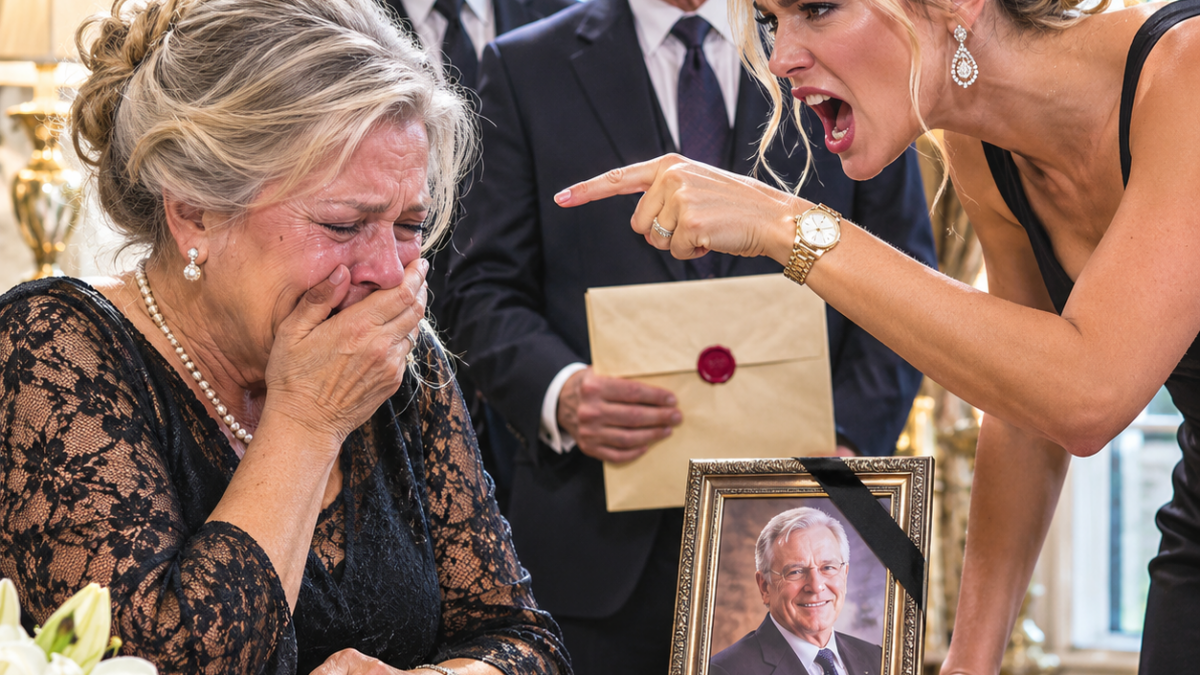
“BERNARD IS DE@D, EVELYN! STOP ACTING LIKE HIS TOOLS ARE SACRED WHEN LIAM AND I HAVE A FUTURE TO BUILD!” my daughter-in-law snapped as she dropped my husband’s drill into a laundry basket, only three days after I’d watched them lower his coffin into the ground. My own son stood in the kitchen and said nothing while his wife began treating the home Bernard had spent nineteen years building as property she was already entitled to rearrange, and I realized with sickening clarity that they weren’t waiting for me to finish grieving—they were waiting for me to get out of their way. But Bernard, the quiet pipefitter who had loved us for thirty-five years and rarely wasted a word, had left instructions neither of them understood, and the day his solicitor read those words aloud would reveal exactly how much my husband had seen before he died.
The first thing I heard was a wrench hitting the concrete floor.
Then another.
Then the scrape of something heavy being dragged across Bernard’s workbench.
I stood at the kitchen sink with my hands submerged in warm water, staring at the white casserole dish our neighbor had brought over after the funeral.
A little card had been tucked beneath the lid.
Thinking of you, Evelyn. Please remember you’re not alone.
I’d read it three times that morning.
Now, listening to somebody moving my husband’s tools, I’d never felt more alone in my life.
“Liam could use this one,” a woman’s voice said from the garage.
Tasha.
My daughter-in-law.
There was another metallic clatter.
I turned off the faucet.
For a moment, I couldn’t move.
Bernard had been DE@D exactly three days.
Three days since I stood beside his grave in a dark coat, holding our thirty-seven-year-old son’s hand while the minister spoke about faith, family, and a life well lived.
Three days since I came home to a house filled with flowers and people who kept saying I was strong.
Three days since I had last heard my husband called someone’s father, someone’s friend, someone’s beloved husband, in the past tense.
And now Tasha was dismantling his workshop.
I dried my hands.
Walked down the hallway.
And stopped at the garage doorway.
There she was.
Standing in front of the pegboard Bernard had installed in 1991.
A laundry basket rested beside her expensive shoes.
Inside it were socket wrenches, screwdrivers, measuring tapes, and the old metal level he’d owned since his apprenticeship.
She was holding his drill set.
Turning it over.
Studying it like merchandise.
“What are you doing?”
My voice sounded strange.
Thin.
She glanced at me without lowering the drill.
“Sorting things.”
I stared at the basket.
“Whose things?”
Tasha sighed.
“Oh, Evelyn.”
Two words.
Spoken as though my grief were a tiresome habit.
“Liam needs a proper drill set. This is all just sitting here.”
I looked toward the empty spaces on the pegboard.
Bernard had drawn the arrangement on graph paper before mounting a single hook.
He measured every gap.
Labeled every position.
Once, when Liam was eight, he spent an entire Saturday teaching our son where each tool belonged.
I’d teased Bernard that he was more organized than the hospital administration department where I worked.
He’d smiled and said, “A tool is only useful if you can find it when you need it.”
Now the hooks stood empty.
And my husband’s workbench looked as though someone had begun stripping the house for parts.
“Put it back.”
Tasha blinked.
“Excuse me?”
“Put his things back.”
Her mouth tightened.
“Evelyn, somebody has to think practically.”
I felt my throat close.
“Practically?”
She gestured around the garage.
“Half this equipment is never going to be used again.”
The words hit harder than I expected.
Never going to be used again.
I imagined Bernard’s hands.
The calluses.
The small scars.
The way he cleaned his tools before returning them to their places.
Thirty-four years as a pipefitter.
Nineteen years slowly building this home.
Thirty-five years loving me.
And now the evidence of his life was being placed into a plastic laundry basket because his daughter-in-law had decided he no longer needed it.
“Tasha.”
I spoke carefully.
“Leave this garage.”
She gave me a look of exaggerated patience.
“I’m not stealing anything. Liam is his son.”
“I know who Liam is.”
“Then you should understand that his father’s tools belong with him.”
I stared at her.
“The will hasn’t even been read.”
She smiled.
Not warmly.
The kind of smile someone gives when they believe the outcome is obvious.
“Evelyn, we’re family. We don’t need lawyers to tell us what’s sensible.”
I took one step forward.
“You will not decide what happens to Bernard’s belongings.”
Her face hardened.
“Then I guess we’ll wait for the paperwork.”
She picked up the basket.
And walked past me.
Without returning a single tool.
Without asking permission.
Without even looking at my face.
I stood motionless.
Then heard her enter the kitchen.
“Liam, your mother’s being impossible again.”
I waited.
My son answered quietly.
“She’s grieving, Tasha. Give her time.”
A pause.
Then his wife said:
“That’s exactly the problem. Nobody can make any decisions because she’s grieving.”
I pressed one hand against the workbench.
My knees weakened.
There were seventeen sympathy cards on our dining-room table.
Bernard’s funeral coat still hung behind the bedroom door.
His coffee mug hadn’t been washed because I couldn’t bear to erase the faint mark he’d left on its rim.
And my daughter-in-law was talking about my mourning as though it were an administrative delay.
I looked at the wall.
At the outlines where the missing tools belonged.
Then at the dark circular mark Bernard had left on the workbench years earlier while varnishing our cedar deck.
I touched it.
And suddenly I remembered him laughing when I teased him about the stain.
“I’ll sand it out one day, Ev.”
He never did.
Now I was grateful.
Because the mark was still there.
Something his hands had left behind.
I bent over the bench.
My shoulders began shaking.
And I whispered:
“Bernard, they’re already taking your things.”
For a moment, I couldn’t breathe.
Then I heard Tasha opening cupboards in the kitchen.
And my grief changed.
Not into hatred.
Not even into anger.
Into a cold, terrible realization.
If I didn’t protect what Bernard and I had built, the people who were supposed to love me might begin deciding that I no longer had a say in my own life.
I didn’t yet know what I would do.
But I knew one thing.
My husband had spent a lifetime teaching me that every solid structure needed a foundation—and I was not going to let somebody else tear mine apart while I was still standing on it.
FULL STORY CONTINUATION
I stayed in the garage long after Tasha carried the basket away.
The house was quiet except for distant voices from the kitchen.
Bernard’s workbench stood beneath the narrow window.
His old vise was clamped to one corner.
A pencil rested beside an unfinished sketch of a shelf.
There was sawdust caught in a crack along the surface.
I could have cleaned it.
I’d cleaned that garage hundreds of times.
But I didn’t want to touch anything.
I wanted it to remain exactly as Bernard had left it.
That was the part Tasha didn’t understand.
I knew tools weren’t people.
I knew objects couldn’t bring my husband back.
But when someone dies, the smallest ordinary things begin carrying unbearable weight.
A pair of reading glasses.
A worn sweater.
A coffee mug.
A pencil sharpened by the same hand that once held yours.
They become proof that somebody was here.
That their life wasn’t something you imagined.
And when Tasha dropped Bernard’s tools into a basket, it felt as though she were asking me to accept his absence before I’d even learned how to breathe through it.
I rested both palms on the workbench.
Closed my eyes.
And remembered the first time Bernard brought me to the empty lot on Sycamore Crescent.
We were twenty-nine.
Young enough to believe that exhaustion was temporary and that every problem could be solved if we worked hard enough.
Bernard had been saving for the land for years.
He worked long hours as a pipefitter and took on whatever additional work he could manage responsibly.
I was building my career in hospital administration.
Money was always spoken for.
Rent.
Groceries.
Transportation.
Bills.
Savings.
We didn’t have much left at the end of the month.
But Bernard had a plan.
He always had a plan.
One Saturday morning, he drove me to a bare lot bordered by a few trees.
The ground was uneven.
Weeds grew along one side.
There was nothing to suggest that it would someday become the home of a family.
Bernard climbed out of the car.
Then stood in the middle of the property with a rolled-up drawing beneath his arm.
I followed him.
“Bernard?”
He turned.
I looked around.
“Why are we here?”
He smiled.
“Because I bought it.”
For a moment, I thought he’d made a joke.
Then I looked at his face.
He was serious.
“You bought this?”
He nodded.
My heart began pounding.
“Bernard, we can barely afford our rent.”
“I know.”
“Then how are we supposed to build a house?”
He unrolled the drawing.
A simple floor plan.
A kitchen.
A living room.
Three bedrooms.
A garage.
A small backyard.
He pointed to the center.
“One piece at a time.”
I stared at him.
Then at the drawing.
Then back at the empty land.
“You really think we can do this?”
He looked toward me.
And said the words I would remember for the rest of my life.
“I don’t think we can do everything at once, Evelyn.”
He smiled.
“But I know we can do the next thing.”
That was how we built our home.
The foundation and framing required professional crews, and Bernard made sure the necessary work was done correctly.
Then he spent evenings and weekends completing projects he could handle.
He was careful about the work.
Meticulous.
He believed the point of building something yourself wasn’t to prove you could do everything.
It was to take responsibility for the quality of what you did.
The kitchen cabinets took two winters.
Two entire winters.
Our friends teased us.
Some said we should simply hire someone to finish.
Others asked why Bernard cared so much about details nobody would notice.
But I understood.
He wanted the kitchen to last.
He wanted drawers that opened smoothly.
Doors that stayed aligned.
Shelves strong enough to hold our dishes without sagging.
And when he finally finished, he stood in the doorway with sawdust on his sleeves, looking at the cabinets as though he’d just completed a cathedral.
I remember walking up beside him.
“They’re beautiful.”
He shook his head.
“Left door needs a little adjustment.”
I laughed.
“Bernard.”
He looked at me.
“It’s perfect.”
He considered that.
Then smiled.
“Almost.”
I put my arms around him.
And he held me in the kitchen he’d spent two winters building.
We were married thirty-five years.
That sounds like a lifetime.
In some ways, it was.
But when I look back, it feels frighteningly short.
I remember our wedding.
The nervous way Bernard adjusted his tie.
The fact that his hands shook while he placed the ring on my finger.
The first apartment.
The first winter when the heating barely worked.
The nights we ate inexpensive meals and laughed about how rich we’d be someday.
Then Liam arrived.
Our only child.
A serious little boy with his father’s eyes.
Bernard held him for the first time and became so quiet that I thought something was wrong.
I asked:
“Are you all right?”
He nodded.
But tears were running down his face.
I smiled.
“Bernard?”
He looked at the baby.
Then whispered:
“I didn’t know you could love someone this much.”
For years afterward, I would remember that sentence whenever our son needed something.
And perhaps that was part of our mistake.
We remembered how fiercely we loved him.
But sometimes forgot that love was supposed to help him become independent.
Not keep him a child forever.
The cedar deck came when Liam turned eight.
Bernard called it a family birthday present.
Liam believed him.
I knew my husband had wanted that deck for years.
He worked for months preparing.
Measured the space.
Reviewed the materials.
Saved carefully.
Then began building.
Liam followed him everywhere.
He carried a tiny tool belt that Bernard had bought for him.
It contained a little tape measure, a pencil, and a child-sized hammer.
“Dad, can I help?”
Bernard would smile.
“Of course.”
He’d hand Liam the tape measure.
Then ask him to check a board.
Sometimes our son got the number wrong.
Bernard never shouted.
He’d kneel.
Point to the markings.
And say:
“Let’s try again.”
I watched them through the kitchen window.
My husband and son kneeling beside a piece of lumber.
Two heads bent close together.
One teaching.
The other learning.
Those were some of the happiest moments of my marriage.
Not because the deck was extraordinary.
Because I could see the kind of father Bernard wanted to be.
Patient.
Steady.
Present.
When the final board was installed, he stood back.
Looked at Liam.
Then said:
“We did it.”
Our son beamed.
“I helped?”
Bernard smiled.
“You sure did.”
Liam ran into the house shouting that he’d built a deck.
Bernard watched him go.
Then laughed.
And I remember thinking that our little boy would grow into a man who understood the value of doing things carefully.
I was wrong about how easy that would be.
Liam was thirty-seven when Bernard died.
He worked in project management for a construction company.
He was competent at his job.
Intelligent.
Well liked.
Capable of organizing complex work and dealing with demanding schedules.
Which made his dependence on us even harder to understand.
He could manage large projects professionally.
But struggled to manage his personal finances without calling his father.
At first, we didn’t recognize the pattern.
A car repair.
A rent shortfall.
A dental bill.
Money needed for moving.
There was always a reason.
A difficult month.
An unexpected expense.
A promise that things would improve soon.
And Bernard would help.
Sometimes I knew.
Sometimes I learned about it afterward.
I’d ask whether Liam had called.
Bernard would nod.
“Needed a little help.”
“How much?”
He’d tell me.
I’d sigh.
Then we’d discuss it.
And almost always, we’d agree to send the money.
Because he was our son.
Because we loved him.
Because the thought of him struggling made us uncomfortable.
But over time, the assistance stopped being exceptional.
It became expected.
And none of us wanted to admit what that meant.
Tasha entered Liam’s life four years before Bernard died.
They married two years later.
I wanted to like her.
I truly did.
She was confident and polished.
Always dressed well.
Always seemed to know what she wanted.
She could enter a room and make people listen.
At first, I mistook that confidence for maturity.
But gradually, I noticed a difference between asking for something and assuming it belonged to you.
Tasha rarely asked.
She announced.
“We’ll need the van this weekend.”
“We’re doing Christmas at your place this year.”
“We should replace that old furniture.”
“Liam could use some help with the rent.”
She spoke as though every decision had already been made.
And Liam usually agreed.
Sometimes I would look toward him, waiting for an opinion.
He’d shrug.
“Whatever works.”
Then Tasha would smile.
And the conversation would be over.
Bernard noticed.
Of course he did.
He noticed almost everything, even when he said very little.
One evening, after Tasha and Liam left, he was washing dishes beside me.
He’d been unusually quiet during dinner.
I asked what was wrong.
He dried his hands.
Then said:
“That boy doesn’t know how to tell anybody no.”
I looked toward him.
“Liam?”
He nodded.
I sighed.
“He’s just trying to keep his marriage peaceful.”
Bernard stared toward the window.
Then answered:
“Peace that depends on one person never having an opinion isn’t much of a peace.”
I didn’t respond.
Not because I disagreed.
Because I didn’t want to think about what it meant.
When Bernard became ill, I stopped paying attention to almost everything else.
The world narrowed.
Appointments.
Medical information.
The days he felt better.
The days he didn’t.
The medications.
The fatigue.
The uncertainty.
I had spent twenty-six years in hospital administration, including many years in a major trauma hospital.
I knew how healthcare systems worked.
I knew how to ask questions.
I knew how to listen carefully when a physician explained something frightening.
But none of that prepared me for being the wife sitting beside the bed.
The person who wanted the impossible.
More time.
One more healthy year.
One more Christmas.
One more summer evening on the deck.
One more morning hearing Bernard ask whether I’d like coffee.
He remained himself as long as he could.
Quiet.
Thoughtful.
Concerned about things I thought shouldn’t matter anymore.
He wanted the paperwork organized.
Wanted to make sure I knew where the financial records were.
Wanted to discuss the house.
I kept trying to change the subject.
“Bernard, we’ll figure it out.”
He looked at me.
“I know you will.”
His expression softened.
“But I want to make sure you can do it without anybody making things difficult.”
At the time, I thought he meant practical problems.
Accounts.
Documents.
Repairs.
I didn’t realize he was also thinking about our son.
Bernard died before I had said everything I wanted to say.
I think most people who lose someone they love understand that feeling.
You can spend decades together.
You can speak every day.
Share a home.
A bed.
A life.
And still find yourself standing beside a coffin thinking about things you didn’t say often enough.
Thank you.
I love you.
You made my life better.
I noticed everything you did.
I didn’t always understand you, but I trusted you.
I wish we’d had more time.
After the funeral, people filled our house.
They brought food.
Flowers.
Cards.
They told stories.
Some of Bernard’s old coworkers came.
One of them stood in the kitchen holding a cup of coffee and crying.
“He helped me when I was laid off.”
I stared.
Bernard had never mentioned it.
The man wiped his eyes.
“Found me work.”
A pause.
“Wouldn’t let me repay him.”
My throat closed.
I wanted to ask why Bernard had never told me.
Then I realized I already knew.
He didn’t help people because he wanted them to thank him in public.
He helped because he believed somebody needed it.
That was the man I’d married.
And that was the man I was trying to remember when Tasha began removing his tools.
I eventually returned the contents of the laundry basket to the garage.
Not immediately.
I couldn’t bear to handle everything that night.
But the following morning, before anyone else was awake, I carried the basket to Bernard’s workbench.
I began placing the tools back on their hooks.
One by one.
A socket wrench.
A screwdriver.
The tape measure.
The old level.
I knew where most belonged.
Bernard had taught me.
Sometimes while I helped him.
Other times while he talked through whatever project occupied his mind.
I remembered him standing beside the pegboard, holding a wrench.
“This one goes here.”
I’d smiled.
“Bernard, I don’t need to memorize your garage.”
He’d laughed.
“Never know.”
Now I did.
I returned the last screwdriver to its place.
Then stepped back.
The wall looked almost right.
But not completely.
Because Bernard wasn’t standing in front of it.
And I knew he never would again.
The next day, I went searching for his insurance documents.
His desk stood near the study window.
Everything was neatly arranged.
Folders labeled in his careful handwriting.
A stack of receipts.
Manuals.
Account statements.
I opened the drawer.
Then found a small leather notebook beneath the insurance folder.
The cover was worn.
The corners soft.
I’d seen Bernard writing in it before.
But I hadn’t known what it contained.
I opened it.
The first page held a date.
Then an amount.
Then one word.
Car.
I turned the page.
Rent shortfall.
Another.
Dental.
Another.
Moving costs.
I sat down.
The entries continued for years.
Each transfer recorded.
Each amount carefully written.
I recognized some.
Others surprised me.
I found a calculator.
Then began adding the amounts.
By the time I finished, the total was more than thirty-eight thousand dollars.
I checked it again.
The number didn’t change.
I stared.
Then looked toward Bernard’s photograph.
For a moment, I felt angry.
Not only at Liam.
At myself.
At Bernard.
At all the conversations we’d postponed because it was easier to send money than face the possibility that we were making things worse.
Then I noticed something else.
Bernard had written a few brief observations in the margins of later pages.
Nothing dramatic.
Just small notes to himself.
The dates became more deliberate.
The reasons more specific.
The writing remained even.
But the pattern told its own story.
My husband had been counting.
Not because he wanted our son to repay every dollar.
Because he was beginning to understand the cost of never requiring him to manage without us.
I closed the notebook.
And cried.
The will reading was scheduled soon afterward.
Ms. Harriet Lowe had handled Bernard’s affairs for twelve years.
She was efficient, discreet, and direct.
The sort of professional Bernard respected.
Two days before the formal meeting, she explained the arrangements privately to me.
She reviewed the estate documents.
Clarified how the property and accounts were intended to pass.
Then showed me the written addendum.
I read it.
And for a long time afterward, I couldn’t speak.
Because Bernard had seen exactly what I was afraid to admit.
He knew our son had become too dependent.
He knew Tasha liked to take charge.
And he knew I might be tempted to surrender my own decisions simply to avoid conflict.
He had addressed all of it.
Quietly.
Precisely.
In writing.
When I finally looked up, Ms. Lowe asked:
“Are you all right, Evelyn?”
I nodded.
Then shook my head.
Then began crying.
She handed me a tissue.
I whispered:
“He knew.”
She remained quiet.
I looked down at the document.
“He knew what I was going to face.”
My voice broke.
“And he was still trying to take care of me.”
On the morning of the formal reading, Tasha arrived wearing a dark blazer.
Her hair was carefully styled.
Her jewelry understated.
She carried a structured bag and a notebook.
Liam sat beside her.
He looked tired.
Uncertain.
His hands kept moving over the edge of the table.
I watched him and remembered the little boy standing beside Bernard on the deck.
Then I looked away.
Because I didn’t know how to reconcile that child with the grown man who had allowed his wife to strip his father’s workshop before the will had even been read.
Ms. Lowe opened the file.
The room became quiet.
She explained the estate provisions.
The primary residence.
The registered retirement savings.
The applicable pension disbursements.
The two investment accounts.
All passing to me.
I saw Tasha’s pen stop.
A small movement.
But unmistakable.
Her eyes narrowed.
Then Ms. Lowe turned to the written addendum.
And began reading Bernard’s words aloud.
“To my son, Liam…”
Ms. Lowe’s voice was even.
Professional.
She didn’t dramatize the words.
She didn’t need to.
Bernard had written them in the same deliberate way he approached everything else.
He stated that over seven years he had provided Liam with $38,400 in financial assistance.
The figure seemed to settle over the room.
Liam stared at the table.
Tasha’s jaw tightened.
Ms. Lowe continued.
Bernard explained that he had helped because he loved his son.
Because he believed a father’s responsibility included supporting his child when life became difficult.
Then came the sentence that made me close my eyes.
“I’ve come to understand that what I was doing was holding you up instead of teaching you to stand, and that is a different thing entirely.”
For a moment, I could hear Bernard’s voice.
Not Ms. Lowe’s.
His.
Quiet.
Steady.
Sad.
I remembered him teaching Liam to measure lumber.
Showing him how to repair a hinge.
Explaining that mistakes could be corrected if you stopped pretending they hadn’t happened.
Now he was asking our son to apply the same lessons to his own life.
Ms. Lowe continued.
She read about my twenty-six years in hospital administration.
The economic downturns.
The year Bernard was laid off.
The responsibilities I’d carried for our family.
And then:
“Your mother does not need to be managed.”
I felt my throat tighten.
“She does not need supervision.”
Across the table, Tasha’s pen rested motionless against the paper.
“She does not need someone to decide for her what she can and cannot handle.”
I swallowed.
For weeks, I’d been hearing almost the opposite.
The house might be too much for me.
The workshop needed sorting.
The furniture should be rearranged.
I needed somebody practical to make decisions.
Yet here was my husband, speaking from a document prepared before his death, reminding our son of something I was beginning to forget.
I was capable.
I had always been capable.
Grief hadn’t taken that away.
Ms. Lowe continued reading.
Bernard wrote that the house had been built with his hands and belonged to me.
He explained that what Liam inherited was the opportunity to build a life of his own.
Then came the bequest.
His tools.
His lumber rack.
The equipment he’d spent a lifetime using and maintaining.
He left them to Liam.
And he wrote that their value was greater than money if our son learned how to use them.
I looked at Liam.
For the first time, his expression seemed truly troubled.
Not simply disappointed.
As though he were beginning to understand that his father had not forgotten him.
He had chosen a very specific gift.
One that carried a message.
Ms. Lowe finished.
“I hope you will learn. I love you more than I’ve been able to show you correctly. Your father.”
The room was silent.
I stared at my hands.
I wanted Bernard beside me.
Wanted to hold his fingers beneath the table.
Wanted to tell him he’d done the right thing.
And I wanted to ask whether he understood how much it would hurt to hear his final words spoken aloud.
Tasha was the first to break the silence.
“This isn’t the current version.”
Her voice sounded sharp.
Controlled.
Ms. Lowe looked toward her.
“The documents before us are the current estate instructions.”
Tasha sat straighter.
“Bernard told Liam last spring that things would be reviewed.”
Liam looked toward his wife.
I watched him closely.
He didn’t confirm the statement.
Didn’t deny it.
He simply looked uncomfortable.
Ms. Lowe removed her glasses.
“The document was revised eight months ago and witnessed by two independent parties.”
Tasha’s expression hardened.
“It has to be wrong.”
Ms. Lowe remained calm.
“There’s no indication in the file that it was replaced.”
Tasha turned toward me.
Then said:
“She influenced him.”
The accusation hung in the air.
I felt my face grow hot.
For a moment, I wanted to stand.
I wanted to tell Tasha everything.
How much money Bernard had given them.
How many times I’d defended Liam.
How often I’d told my husband to be patient.
How I’d argued that our son deserved another chance.
But I remembered Bernard standing beside the workbench.
His quiet expression.
The way he’d wait until he knew what needed saying.
And I realized that defending myself against every accusation would only allow Tasha to turn the meeting into another argument she controlled.
I remained seated.
Ms. Lowe addressed the allegation directly.
She explained that Bernard had reviewed his instructions, understood their effect, and signed the documents through the proper process.
Tasha looked furious.
Then she turned toward Liam.
“Say something.”
My son rubbed his forehead.
For a moment, he seemed unable to lift his eyes.
Then he whispered:
“There has to be something for us.”
The words hurt.
Not because he was disappointed.
I understood that.
But because his first response to his father’s final message was to ask what more he might receive.
I looked toward him.
And for one terrible moment, I wondered whether Bernard had been trying to teach a lesson our son would never understand.
After the meeting, I returned to Sycamore Crescent feeling more exhausted than I had after the funeral.
The house looked exactly the same from outside.
The maple tree.
The driveway.
The cedar deck visible beyond the side gate.
The porch light Bernard had installed years earlier.
But everything felt altered.
Bernard’s intentions were now known.
The house was mine.
The principal financial security he’d accumulated for our retirement was left to me.
And Liam had been given something personal but very different from the inheritance he apparently expected.
I thought that might settle things.
I was wrong.
Tasha and Liam continued staying in the house.
He explained that they needed a few weeks to make arrangements.
Tasha said she was overwhelmed by the situation and hoped I would show some understanding.
I wanted to be compassionate.
Liam had lost his father.
That grief was real, even if his behavior disappointed me.
So I agreed to a short temporary stay.
I didn’t yet understand how quickly that kindness would begin feeling like a surrender.
Within days, Tasha started rearranging the house.
The first change was small.
A decorative bowl moved from the kitchen counter.
Then the hallway table.
Then the cushions in the living room.
She replaced the faded cream-colored pillows Evelyn—no, I, I reminded myself—had chosen with copper-colored ones she preferred.
It was a strange moment.
After decades of introducing myself as Bernard’s wife and Liam’s mother, I had begun hearing my own thoughts in someone else’s voice.
Tasha seemed determined to turn my house into a space that reflected her taste.
I found an abstract print hanging in the hallway.
It occupied the hook where Bernard’s fishing cap had rested for years.
The cap had been moved to a drawer.
I stood staring at the picture.
It was expensive-looking.
Bold.
Probably quite fashionable.
But it meant nothing to me.
The cap had belonged to the man I’d married.
It had traveled with him on quiet fishing mornings.
He’d worn it on the deck.
Sometimes he’d come inside with the brim damp from rain and place it on that same hook.
Now the hook held a decorative print Tasha preferred.
I removed the picture.
Then found his cap.
I held it for a moment.
Brought it near my face.
And inhaled.
There was almost no familiar scent left.
Just fabric.
Dust.
Time.
But I began crying anyway.
I returned the cap to its hook.
Then stood there until I felt steady enough to walk away.
When Tasha noticed, she frowned.
“Did you move my picture?”
I looked up from the kitchen table.
“Yes.”
Her eyebrows lifted.
“Why?”
I took a breath.
“Bernard’s cap belongs there.”
She stared.
Then gave a short laugh.
“Evelyn, it’s a hook.”
I closed my eyes.
Of course.
To her, it was a hook.
To me, it was the place where my husband had left his cap every evening for years.
I looked at her.
“Tasha, I’d like you to ask before changing things.”
She folded her arms.
“I’m trying to make the house feel more modern.”
I stared.
“I’m not trying to make it more modern.”
Her mouth tightened.
“Fine.”
She turned away.
A moment later, I heard her speaking to Liam in the hallway.
“Your mother is impossible to help.”
I looked down at my hands.
And felt my exhaustion deepen.
The sunroom was worse.
Bernard had loved that room.
We used it on cool mornings and mild afternoons.
He’d sit in his armchair with a book.
I’d bring coffee.
Sometimes we talked.
Other times we simply watched the trees.
In the winter, we’d close the room and use it less frequently.
That was perfectly normal for us.
Tasha apparently saw it as wasted space.
I found her standing in the middle of the room with her phone raised.
She was taking photographs.
Slowly turning in a circle.
Capturing the windows.
The furniture.
The light.
I stopped in the doorway.
“What are you doing?”
She smiled.
“Getting a feel for the room.”
“For what?”
She glanced toward the windows.
“It has so much potential.”
I felt a familiar tightness in my chest.
“Potential for what?”
Tasha lowered the phone.
“Evelyn, you barely use it.”
I looked toward Bernard’s empty chair.
Then back at her.
“That’s not the same as saying it’s available for you to redesign.”
She sighed.
“You don’t have to take everything personally.”
I stared at her.
It was such a strange accusation.
She was standing in my home.
Photographing my room.
Discussing what she intended to change.
And somehow I was being unreasonable for asking why.
I looked around the sunroom.
Then said:
“Please put your phone away.”
Her smile disappeared.
“Seriously?”
“Yes.”
She stared.
Then walked past me.
I remained in the doorway.
For several seconds, I couldn’t move.
Then I went to Bernard’s chair.
Sat down.
And cried.
Liam found me there an hour later.
“Mom?”
I wiped my face.
He stood near the doorway.
For a moment, he looked uncomfortable.
“Tasha says you two had another disagreement.”
I stared toward the window.
“Is that what she called it?”
He sighed.
“Mom.”
I looked up.
“Liam, she was photographing the room.”
He glanced around.
“So?”
I felt something inside me go cold.
“So this is my home.”
He rubbed his forehead.
“She’s just thinking about how things could work.”
“For whom?”
He didn’t answer.
I continued.
“Liam, your father died less than a month ago.”
His expression softened.
“I know.”
“His things are still here.”
I gestured toward the chair.
“His books.”
My throat tightened.
“His memories.”
Liam looked down.
I swallowed.
“And your wife keeps talking about improving everything as though the life we built was an inconvenience.”
He was quiet.
Then he whispered:
“She means well.”
I looked at him.
For a moment, I couldn’t speak.
Then I asked:
“Do you believe that?”
He hesitated.
I watched the hesitation.
And understood.
My son didn’t know what he believed.
He knew what Tasha wanted.
He knew what would make her angry.
He knew what would keep the conversation peaceful for another evening.
But he hadn’t learned to ask himself whether the decision was right.
I stood.
Looked toward Bernard’s chair.
Then said quietly:
“I need some time alone.”
Liam nodded.
And left.
That evening, I took Bernard’s leather notebook from the study.
I sat at the kitchen table.
Turned its pages.
Read the entries.
The dates.
The amounts.
The brief explanations.
Then I looked toward the photograph from our twenty-fifth anniversary.
Bernard was standing beside me on the cedar deck.
His arm around my shoulders.
His smile calm.
I remembered asking him years earlier why he kept such careful records.
He’d laughed.
“Because one day, somebody might need to understand how we got here.”
At the time, I thought he meant our household finances.
Now I wondered whether he had meant something larger.
The decisions.
The patterns.
The consequences.
The things we allow because confronting them seems uncomfortable.
I closed the notebook.
Then looked toward the hallway.
Tasha was upstairs.
Liam was in the living room.
The house was full of people.
Yet I’d never felt more alone.
I took out my phone.
Found Beverly’s number.
And called.
Beverly had been my friend for almost thirty years.
She was a retired real estate professional who still kept her license active.
She knew the local market.
Knew how to evaluate properties.
And had always been the kind of woman who asked hard questions without apologizing.
When she answered, I tried to sound composed.
“Beverly?”
“Evelyn.”
Her voice softened.
“How are you doing?”
I looked toward Bernard’s photograph.
And suddenly I couldn’t pretend.
“I don’t know.”
There was a pause.
Then she asked gently:
“Do you want me to come over?”
I closed my eyes.
“Yes.”
Another pause.
“I’ll be there tomorrow.”
I swallowed.
“Thank you.”
Then, before she could hang up, I whispered:
“Beverly, I think I need to leave this house.”
She was quiet for a moment.
Then answered:
“Then we’ll talk about what that would look like.”
No lecture.
No accusation that I was abandoning Bernard.
No insistence that I was too old to make a major decision.
Just the promise of a conversation.
For the first time in weeks, I felt something inside me loosen.
Beverly arrived the next morning carrying pastries and a notebook.
She was wearing a long gray coat and comfortable shoes.
Her hair was pulled back.
She looked practical.
Calm.
Exactly the person I needed.
We sat at the kitchen table.
I told her everything.
The garage.
The will.
Tasha’s accusations.
Liam’s silence.
The sunroom.
The way the house had begun feeling less like my home and more like a place where I was expected to wait while somebody else made plans.
Beverly listened.
When I finished, she rested one hand against her notebook.
Then asked:
“What do you want, Evelyn?”
I stared.
“What?”
She looked directly at me.
“I didn’t ask what Tasha wants.”
A pause.
“I didn’t ask what Liam thinks.”
Another.
“What do you want?”
For a long moment, I couldn’t speak.
Then I looked toward Bernard’s armchair.
The house was full of his work.
His memories.
His presence.
But I was beginning to understand that staying wasn’t the only way to honor him.
I swallowed.
“I want peace.”
Beverly nodded.
I continued.
“I want to wake up and know I can decide where the furniture goes.”
My voice broke.
“I want to miss Bernard without somebody calling me unreasonable.”
Tears filled my eyes.
“And I want to live somewhere that doesn’t make me feel as though I’m waiting to be replaced.”
Beverly reached across the table.
Took my hand.
And said:
“Then let’s find out whether selling would give you that.”
We toured the house.
Beverly made notes.
Checked the rooms.
Asked about maintenance.
The improvements Bernard had made.
The condition of the roof.
The kitchen.
The deck.
The garage.
She treated the property with respect.
And that mattered to me.
She didn’t speak as though Bernard’s work were simply a selling point.
She understood that every room held a history.
When we reached the sunroom, she stopped near his chair.
For a moment, her expression softened.
“He loved sitting here.”
I nodded.
“Yes.”
She touched the chair.
Then looked toward me.
“Selling the house doesn’t mean losing him.”
I swallowed.
She continued.
“Evelyn, you spent thirty-five years building a marriage.”
Her eyes filled.
“That marriage doesn’t live only in the walls.”
I looked toward the window.
And began crying.
Because a part of me had been afraid that leaving Sycamore Crescent would mean abandoning my husband a second time.
Beverly waited until I could speak.
Then we returned to the kitchen.
She opened her notebook.
Reviewed her assessment.
And told me a realistic figure for the property.
I stared.
It was fair.
More than I had expected.
Enough to let me consider a smaller, more manageable home without sacrificing the security Bernard had worked so hard to provide.
I looked toward her.
“Could we sell quietly?”
She nodded.
“There may be a way through my network.”
I took a breath.
“Without a sign?”
“Yes.”
I looked around the kitchen.
Then whispered:
“Let’s do it.”
Beverly studied me.
“Are you sure?”
I looked toward Bernard’s photograph.
For a moment, I imagined him standing beside me.
Listening.
Thinking.
Then giving one small nod.
I turned back to Beverly.
“I’m sure I want to decide for myself.”
We proceeded carefully.
I spoke with Ms. Lowe about the estate documents and the requirements for selling the property.
I wanted the paperwork handled correctly.
The property was mine under Bernard’s estate instructions, subject to the necessary legal administration.
Liam and Tasha’s temporary stay needed to be addressed properly before the buyers took possession.
I wasn’t going to create a dispute that could jeopardize the sale.
Nor was I going to pretend they owned the house simply because they’d been staying there.
Ms. Lowe helped me understand the steps.
Beverly quietly contacted potential buyers.
The house wasn’t advertised with a large sign.
There were no dramatic announcements.
No family confrontation.
I continued preparing meals.
Answering ordinary questions.
And enduring Tasha’s increasingly confident suggestions about what ought to change.
But inside, something had shifted.
For the first time since Bernard died, I was making a decision about my future rather than reacting to someone else’s demands.
Eleven days after Beverly began working through her network, she called.
“Evelyn, we have an offer.”
I was sitting in Bernard’s study.
I looked toward the window.
“Already?”
“Yes.”
She explained that a couple relocating from Vancouver had sold their previous home and wanted a quick closing.
They appreciated the house.
Its condition.
Its location.
The practical improvements Bernard had made.
Their offer was reasonable.
The proposed timeline was twenty-one days to possession.
I listened.
Asked questions.
Reviewed the terms with Beverly and Ms. Lowe.
Then sat alone for a long time after the call.
Because the offer made everything real.
Someone else wanted to live in the house Bernard built.
Someone else would use our kitchen.
Sit on the cedar deck.
Watch the maple tree grow.
For a moment, I felt physically ill.
I walked through the rooms.
Touched the cabinets.
Stood in the sunroom.
Then went into the garage.
I ran my hand over the workbench.
And whispered:
“Bernard, they’re going to live here.”
My voice broke.
“Somebody else.”
I cried.
Longer than I expected.
Then I wiped my face.
Looked around the workshop.
And remembered something my husband used to say whenever a project came to an end.
“You can’t keep building if you refuse to finish the part you’re working on.”
I closed my eyes.
Then whispered:
“I think this part is finished.”
I accepted the offer.
The documents were signed after the appropriate review.
Then I drove east toward the river to look at a townhouse Beverly had recommended.
The development was quiet.
The homes were smaller.
Well maintained.
A trail ran along the water.
There was a gas fireplace.
A sensible kitchen.
A second bedroom that could become a study.
And a patio just large enough for a table, two chairs, and a container garden.
I stood beside the patio door.
Sunlight moved through the trees.
Beyond them, the river flowed quietly.
For a moment, I felt something I hadn’t experienced in weeks.
Not happiness exactly.
The possibility of it.
I imagined myself waking in that room.
Making coffee.
Reading.
Walking beside the river.
Learning how to live with Bernard’s absence without strangers rearranging every object around me.
I visited again.
Reviewed the practical details.
Then paid the deposit.
And began planning the move.
Packing was painful.
I had expected that.
But I hadn’t understood how often grief would interrupt the most ordinary decisions.
A box of books.
A photograph.
An old tablecloth.
A chipped mug.
Each object asked a question.
Take it?
Leave it?
Keep it because Bernard loved it?
Let it go because it belonged to a life I couldn’t continue exactly as before?
I found myself standing in front of the kitchen cupboard holding a saucepan we’d owned since the early years of our marriage.
The handle was worn.
The bottom scratched.
It wasn’t valuable.
I could replace it easily.
But Bernard had used it to make soup when I was sick.
And suddenly I couldn’t place it in the donation box.
I sat down on the kitchen floor.
Held the saucepan.
And cried.
Eventually, I wiped my eyes.
Then put it in the box going to the townhouse.
Not because I needed the pan.
Because I wasn’t ready to let that memory go.
And I decided I didn’t have to justify it to anyone.
I selected Bernard’s books.
The field guides he’d used for fishing.
The worn Farley Mowat paperbacks.
The thick history of the Trans-Canada Highway he’d read repeatedly.
I laughed when I found that one.
“Of course you’re coming with me.”
I could almost hear Bernard answering:
“Good infrastructure matters, Ev.”
I smiled through tears.
Then placed the book carefully in a box.
I chose our twenty-fifth anniversary photograph.
A ceramic pot that had belonged to my mother.
A few pieces of furniture.
And Bernard’s armchair.
That chair was never going to be left behind.
I wanted it beside the new fireplace.
Not because I imagined he might someday sit there again.
Because I could still remember the way he looked when he did.
The tool collection was handled separately.
Bernard had left it and the lumber rack to Liam.
That was explicit.
So I made sure the items were protected for him.
They weren’t available for Tasha to take whenever she pleased.
They were our son’s inheritance, and the handover would be arranged properly.
I thought about the drill she’d placed in the laundry basket.
The contempt in her voice.
Half this stuff will never be used again.
I hoped she was wrong.
I hoped Liam would one day pick up those tools and understand what his father had really left him.
But I also understood I couldn’t make that happen.
Bernard had already given our son the opportunity.
What Liam did with it was his decision.
The movers arrived on a Wednesday.
Three men in blue coveralls.
They worked efficiently.
Wrapped the armchair.
Labeled the boxes.
Protected the fragile pieces.
I watched them carry our life through the front door.
The house began changing around me.
The living room became hollow.
The dining room seemed larger.
The hallway echoed.
I stood near the kitchen window and looked toward the cedar deck.
For a moment, I saw Bernard there.
Not literally.
In memory.
Wearing his work clothes.
Holding a piece of lumber.
Looking toward the house to see whether I was watching.
I remembered waving.
He’d waved back.
Then returned to his work.
The memory was so vivid that I had to close my eyes.
I took a breath.
Then went outside.
I walked onto the deck.
The wood felt familiar beneath my shoes.
Bernard had sanded the boards by hand when he built it.
He’d replaced the railings twice.
Every spring, he checked for soft spots with his boot.
Sometimes I’d tease him about treating the deck like a national monument.
He’d smile.
“Just keeping us safe.”
Now I stood there alone.
The yard was quiet.
The maple tree moved in the breeze.
I rested one hand against the railing.
And whispered:
“Thank you.”
My voice broke.
“For the house.”
A pause.
“For the life.”
I looked toward the kitchen window.
“And for loving me.”
Then I stepped back inside.
Because there were still boxes to move.
And I was the person responsible for finishing what I’d begun.
I was carrying the final box toward my car when Tasha returned.
Her vehicle turned sharply into the driveway.
For a moment, she remained behind the wheel.
Then she climbed out.
Keys in one hand.
Handbag in the other.
Her eyes moved toward the moving truck.
The open front door.
The men carrying boxes.
Then toward me.
“What is happening?”
Her voice wasn’t curious.
It was furious.
I set the box carefully in the back of my car.
“I’m moving.”
She stared.
“Moving where?”
“To my new home.”
Her face changed.
For several seconds, she seemed unable to speak.
Then she laughed.
“Evelyn, what are you talking about?”
I closed the car door.
“I’ve sold the house.”
The words seemed to stop her completely.
I continued.
“Transfer of possession is in three weeks. You’ll need to finish making arrangements.”
Her mouth opened.
Then closed.
“You can’t have sold this house.”
I looked at her.
“I can.”
A pause.
“And I did.”
Tasha’s face reddened.
“WE LIVE HERE!”
I took a breath.
“You and Liam have been staying here temporarily.”
She stepped closer.
“He’s been helping with the yard!”
I nodded.
“He has.”
“Maintaining things!”
“Yes.”
She looked triumphant for a moment.
Then I continued:
“Guests sometimes help maintain a home while they’re staying in it.”
Her expression hardened.
“Evelyn, we’ve been making plans.”
I studied her.
“What plans?”
She hesitated.
For the first time since I’d known her, she seemed unable to produce a confident answer immediately.
Then she said:
“Plans for our future.”
I nodded slowly.
“And you’re welcome to make them.”
Her expression softened slightly.
Then I added:
“But not by deciding what happens to my property without consulting me.”
She stared.
“Your property?”
I felt something cold move through my chest.
“Yes.”
Her eyes narrowed.
“Bernard built this house for his family.”
I swallowed.
“He built it for the family we made together.”
My voice trembled.
“And he left it to me.”
Tasha shook her head.
“You’re using his death to punish us.”
For a moment, I couldn’t breathe.
Then I looked toward the house.
The rooms I’d packed.
The memories I’d carried out.
The garage where I’d cried three days after his funeral.
I turned back.
“No.”
My voice was quiet.
“I’m refusing to let his death become an excuse for somebody else to decide how I live.”
Tasha started speaking rapidly.
About financial plans.
About the inconvenience.
About how much she and Liam had been counting on the house.
About how difficult everything had become since Bernard died.
I listened.
Then asked one question.
“Tasha, did you ever ask what I wanted?”
She stopped.
I waited.
Her face tightened.
“That’s not fair.”
I looked toward her.
“I’ve spent weeks being told what rooms should change, what tools should be moved, and what responsibilities I’m supposedly too old to handle.”
She stared at me.
I continued.
“Not once did you ask whether I was comfortable with any of it.”
For a moment, she seemed almost offended.
Then she said:
“We were trying to help.”
I nodded.
“Then hear me clearly.”
My voice remained steady.
“I don’t want that kind of help.”
She stared.
I took a breath.
“The paperwork is being handled properly. The necessary arrangements concerning your stay have been addressed. If you have questions, Ms. Lowe can explain them.”
Tasha opened her mouth.
I continued.
“But I won’t argue about whether I’m allowed to choose my own home.”
The first time my phone rang after I left Sycamore Crescent, Liam’s name appeared on the screen.
I let it ring while I drove.
Then again.
Tasha called.
Then Liam.
I didn’t answer.
I needed to concentrate on the road.
And I needed time to understand what I’d just done.
The highway stretched ahead.
Clouds moved across the sky.
The familiar streets disappeared behind me.
For thirty-five years, my life had been anchored to the man who built that house.
Now I was driving toward a place where he had never lived.
I felt tears gathering.
Then more.
I pulled into a safe rest area.
Stopped.
Put the car in park.
And began sobbing.
Not because I’d made the wrong decision.
Because the right decision could still hurt.
Because selling the house hadn’t made Bernard’s death easier.
Because independence didn’t mean I stopped needing him.
I lowered my head against my hands.
And whispered:
“Bernard, I wish you were here.”
Then I cried until I could breathe again.
By six that evening, I was sitting in my new living room.
The armchair was beside the gas fireplace.
The boxes were stacked neatly.
My mother’s ceramic pot stood near the patio door.
The study contained Bernard’s books, our anniversary photograph, and his leather notebook.
Outside, the river moved beneath the evening light.
I sat down.
For a long time, I listened to the unfamiliar sounds.
The heating system.
The occasional footsteps along the trail.
The faint hum of the refrigerator.
Then I realized something.
Nobody was upstairs moving my belongings.
Nobody was planning how to redecorate my sunroom.
Nobody was telling me that I needed supervision.
The silence was different.
It didn’t feel like somebody had taken my home away.
It felt like a room waiting for me to decide what belonged in it.
I rested my hand against Bernard’s chair.
And whispered:
“Good night, sweetheart.”
The first eleven days in the townhouse were not as easy as I’d hoped.
I unpacked slowly.
Sometimes one box took an entire afternoon.
Not because it contained many things.
Because I would lift out something Bernard had touched and find myself unable to move.
A book with a folded corner.
An old photograph.
A Christmas ornament.
One of the ceramic bowls we’d bought during our early marriage when money was so tight that purchasing a matching set had felt extravagant.
I’d hold the object.
Remember the moment attached to it.
Then sit down.
Sometimes I cried.
Other times I laughed.
Usually, I did both.
I had spent decades helping people manage complicated lives and difficult decisions.
Yet there I was, sixty-four years old, learning how to arrange a kitchen without my husband.
Grief didn’t disappear because I’d moved.
I hadn’t expected it to.
But something important had changed.
I was finally allowed to grieve without somebody treating my mourning as an obstacle to their plans.
Each morning, I stood by the kitchen window with coffee.
The river trail ran behind the development.
People walked along it.
Sometimes alone.
Sometimes holding hands.
Occasionally with dogs.
The trees were beginning to change color.
The light fell differently every day.
I began noticing things.
The way the water looked silver on overcast mornings.
The warm gold that appeared between the branches when the sun rose.
The sound of leaves moving in the wind.
For years, I’d been looking out toward Bernard’s cedar deck.
Now there was a river.
At first, the unfamiliar view made me sad.
Then, gradually, I began enjoying it.
Not because I loved Bernard less.
Because I was still alive.
And there were still beautiful things in the world I hadn’t seen.
I didn’t answer every message Liam sent after the move.
Some were angry.
Some confused.
Some asked why I hadn’t discussed the sale with him.
When I felt ready, I responded calmly.
I explained that the house was mine under Bernard’s estate arrangements, that the sale and possession had been handled properly, and that I needed time.
I wasn’t going to engage in arguments by telephone.
Nor was I going to apologize for making a decision I had carefully considered.
For years, I’d tried to prevent Liam from experiencing disappointment.
Now I was learning that allowing someone to be disappointed wasn’t the same as being cruel.
I could love my son.
And still refuse to organize my life around his expectations.
That was a difficult lesson.
But I needed it.
On the eleventh day, my doorbell rang.
I was in the study arranging books.
I hadn’t been expecting anyone.
When I looked through the window, I saw Liam.
He stood on the front step wearing his work clothes.
His high-visibility vest was dusty.
His shoulders slumped.
He looked as though he’d come directly from a construction site.
For a moment, I couldn’t move.
My son.
The child Bernard and I had raised.
The man whose silence had hurt me almost as deeply as Tasha’s words.
I opened the door.
“Liam.”
He looked up.
“Hi, Mom.”
His voice was quiet.
For several seconds, he simply stood there.
Then he asked:
“Can I come in?”
I stepped aside.
“Yes.”
He entered slowly.
Looked around the living room.
Then stopped.
His eyes had found Bernard’s armchair.
For a moment, his face changed.
He moved toward it.
Touched the worn armrest.
Then whispered:
“You brought Dad’s chair.”
I nodded.
“Of course.”
His eyes filled.
“He used to sleep in this.”
I smiled sadly.
“He called it resting his eyes.”
Liam laughed.
A small, broken sound.
Then his face crumpled.
I watched him.
For a moment, I wanted to pull him into my arms.
But something told me he needed to speak first.
He looked down at his hands.
Then whispered:
“Tasha left.”
I sat down.
For several seconds, I couldn’t answer.
“When?”
“Three days after you sold the house.”
His voice was flat.
He looked toward the window.
“She said it was part of a pattern.”
I waited.
“That you didn’t respect our future.”
He laughed bitterly.
“Or maybe the future she thought we’d inherit.”
I didn’t speak.
Liam lowered himself onto the sofa.
His expression was exhausted.
“She took most of the furniture from our storage unit.”
A pause.
“She says it belongs to her.”
He rubbed his forehead.
“I don’t even know whether she’s right.”
For a moment, I watched him.
There were so many things I could have said.
I warned you.
You should have listened.
Now you understand.
But none of those words would have helped.
So I asked:
“Would you like tea?”
He looked up.
His eyes were wet.
Then he nodded.
“Yeah, Mom.”
A pause.
“I’d like that.”
While the kettle heated, I looked toward the living room.
Liam sat with his elbows on his knees.
His head lowered.
For a moment, I remembered him at eight years old.
Sitting beside Bernard on the cedar deck.
Holding a tape measure.
Listening carefully.
I wondered when he’d stopped trusting himself to make decisions.
And how much responsibility Bernard and I carried for allowing that to happen.
It would’ve been easy to blame Tasha for everything.
She had certainly played a significant role.
But our son had made his own choices.
He had allowed his wife to treat me dismissively.
He’d accepted financial support for years without building a sustainable alternative.
And he’d stood quietly by while the woman he married made plans involving a home that wasn’t hers.
I loved him.
But love didn’t require pretending those things hadn’t happened.
I carried the tea into the living room.
Sat opposite him.
Then waited.
Eventually, Liam reached into his vest pocket.
He removed a folded sheet of paper.
His hands were shaking.
“Mom.”
I looked up.
“Yeah?”
“Ms. Lowe gave me an envelope from Dad’s estate papers.”
I nodded.
He continued.
“There was a copy of the will addendum.”
A pause.
“And another page.”
I felt my heart begin pounding.
He held it out.
I took the paper.
Unfolded it carefully.
Bernard’s handwriting.
The same precise letters.
The same deliberate spacing.
I read:
Liam,
I am not angry with you.
I am disappointed in the direction, not the person.
The person I remember knew to measure twice before cutting.
I hope you find your way back to that boy.
He was good.
Dad.
For a moment, I couldn’t see the page.
Tears blurred the words.
I touched the paper gently.
Then closed my eyes.
My husband had been quiet.
But he had known exactly what needed saying.
He hadn’t written a cruel farewell.
He hadn’t accused our son of being worthless.
He hadn’t demanded repayment.
He had separated Liam’s choices from the person he still believed his son could become.
And somehow, that was more powerful than any punishment.
Liam began crying.
Not the restrained tears I’d seen at the funeral.
Deep, shaking sobs.
He covered his face.
For a long time, I let him cry.
Then he whispered:
“He was disappointed in me.”
I looked at him.
“Yes.”
The truth hurt both of us.
But I wasn’t going to soften it until it meant nothing.
Then I added:
“He was disappointed in some of your decisions.”
Liam raised his eyes.
I continued.
“He still loved you.”
My son’s lower lip trembled.
“I know.”
He looked toward the paper.
Then whispered:
“I kept thinking there’d be time.”
My chest tightened.
He continued.
“Time to talk to him.”
A pause.
“Time to ask him what I should do.”
His voice broke.
“Time to make him proud.”
I moved beside him.
Rested one hand on his shoulder.
Liam leaned toward me.
And suddenly I was holding my grown son while he cried for his father.
The same child Bernard had once lifted into his arms.
The same boy who had followed him around the garage.
Only now Bernard wasn’t coming back to tell him how to begin.
“Mom?”
I looked down.
“Yes?”
“I don’t know how to do this.”
His voice was small.
“Do what?”
“Everything.”
He looked around the townhouse.
“The marriage.”
A pause.
“The money.”
Another.
“Being on my own.”
I swallowed.
Then asked:
“What would your father tell you?”
Liam stared at me.
For a long moment, he didn’t answer.
Then he whispered:
“To start with something useful.”
I felt tears gathering.
I nodded.
“Yes.”
He looked toward Bernard’s chair.
I continued.
“One thing, Liam.”
He turned toward me.
“Not a whole new life overnight.”
A pause.
“One useful thing you can do today.”
He swallowed.
I continued.
“Your father built our house one project at a time.”
My voice trembled.
“He made mistakes.”
Liam smiled weakly.
“I remember.”
“He had to redo things.”
Another small smile.
“Lots of things.”
I laughed through tears.
“But he didn’t stop because the work was difficult.”
Liam looked toward his father’s letter.
Then nodded.
Slowly.
As though the words had finally reached somewhere they’d never reached before.
After a while, he asked:
“Mom, can I take the drill set?”
I looked at him.
For a moment, the garage came back.
Tasha.
The laundry basket.
The empty hooks.
The way my grief had made me grip the workbench just to remain standing.
Then I looked at Liam.
“Why?”
He swallowed.
“I’m renting a room on Dunbar Street.”
I nodded.
“It’s small.”
He gave a nervous little laugh.
“The window frame is drafty.”
I waited.
“I talked to the landlord. There’s a minor repair I’m allowed to handle.”
He looked down.
“I thought maybe I could do it myself.”
My throat tightened.
He continued.
“I don’t know exactly how.”
A pause.
“But I think Dad taught me enough to figure out where to start.”
I smiled.
“Then yes.”
His eyes filled.
“Really?”
I nodded.
“Your father left those tools to you.”
For a moment, Liam looked stunned.
Then he whispered:
“I know.”
This time, he sounded as though he understood what that meant.
We went into the storage room.
The lumber rack had been carefully dismantled and stored.
The tools were organized in labeled containers.
I opened the box holding the drill set.
Liam crouched beside it.
For several seconds, he simply stared.
Then he picked up the case.
His hands moved over the worn handle.
I recognized the gesture.
Bernard used to do the same thing before starting a project.
Not reverently.
Simply with care.
Liam looked up.
“Dad used this when we built the deck.”
I nodded.
“Yes.”
He smiled sadly.
“He let me hold it.”
“You were very proud.”
His eyes filled.
“I thought I was helping him.”
I crouched beside him.
“You were.”
Liam looked toward the drill.
Then whispered:
“I wish I could ask him how to fix the window.”
My throat closed.
I rested a hand on his shoulder.
“You can remember what he taught you.”
He nodded slowly.
Then lifted the drill case.
This time, nobody was carrying it away in a laundry basket without permission.
My son was taking his father’s tools because he had something of his own to build.
And the difference meant everything.
He stayed for another half hour.
We talked about Bernard.
Not only his death.
His life.
The time he accidentally varnished the sole of his own shoe.
The fishing trip when Liam tangled the line so badly that Bernard spent an hour fixing it.
The winter he finished our kitchen cabinets.
The way he always insisted on checking every measurement twice.
We laughed.
Cried.
Then laughed again.
For the first time since Bernard’s funeral, I felt as though my son and I were remembering the same man rather than arguing over what he had left.
When Liam stood to leave, the sky was beginning to darken.
He picked up the drill case.
Then stopped at the door.
“Mom?”
I looked toward him.
“Yes?”
“I’m sorry.”
His voice broke.
“For the way I let Tasha talk to you.”
I swallowed.
He continued.
“And for not standing up for you.”
I felt tears gathering.
I wanted to tell him it was all right.
But it hadn’t been.
So I answered:
“Thank you for saying that.”
He nodded.
I continued.
“I love you, Liam.”
His eyes filled.
“But things need to be different.”
He swallowed.
“I know.”
I rested my hand against his arm.
“I can be your mother without being responsible for every problem in your life.”
He nodded again.
“And I can love you without letting anyone else decide how I live.”
For a moment, he couldn’t speak.
Then he whispered:
“I understand.”
I hoped he did.
But I knew understanding would have to become action.
And that would take time.
Before leaving, Liam looked toward Bernard’s chair one last time.
His expression softened.
Then he whispered:
“Bye, Dad.”
The words nearly broke me.
I looked away.
Liam stepped outside.
I followed him to the doorway.
He walked down the path carrying the drill set.
At the sidewalk, he turned.
Raised one hand.
I waved.
Then watched him disappear into the evening.
For a long time, I remained there.
Feeling two things at once.
Grief for the years we’d spent protecting Liam from consequences.
And a small, uncertain hope that he might finally learn how to stand on his own.
The first frost arrived the following week.
I prepared the patio containers for winter.
Covered the dahlias.
Moved the smaller pots nearer the wall.
The air was sharp and clean.
The trees along the river had begun losing their leaves.
I stood outside wearing Bernard’s old cardigan.
It was too large.
The sleeves covered part of my hands.
But I liked the warmth.
For a moment, I remembered him wearing it while reading beside the fireplace.
I smiled.
Then went inside.
I joined a watercolor class at the community center on Tuesday evenings.
I’d wanted to try painting for six years.
There had always been a reason not to.
Work.
An appointment.
A family obligation.
Something that needed fixing.
Now I had the time.
My first painting was terrible.
The river leaned.
The trees looked like clouds.
And I’d used so much water that the paper warped.
I stared at it.
Then laughed.
Not politely.
A real laugh.
The instructor smiled.
“First time?”
I nodded.
“Is it that obvious?”
She laughed.
“Everyone starts somewhere.”
I looked down at the crooked river.
Then remembered Bernard.
One project at a time.
For a moment, my eyes filled.
Then I picked up the brush.
And tried again.
Liam began sending messages.
Short ones.
Practical.
Fixed the window frame.
I smiled.
Then:
Had to redo one section.
I laughed.
I replied:
Your father would understand.
A few days later:
Starting a small shelf unit.
Then:
Using the lumber rack this weekend.
I answered:
Measure twice.
He replied:
Cut once. I remember.
I stared at the message for a long time.
Then began crying.
Because those were Bernard’s words.
And now our son was finally using them to do something for himself.
Weeks later, Liam visited again.
He called ahead this time.
When I opened the door, he was holding a small wooden shelf.
It wasn’t perfect.
One edge was a little uneven.
The finish could have been smoother.
But it was sturdy.
And I could see he’d worked hard on it.
He looked embarrassed.
“Mom, it’s not much.”
I stared.
“Did you make this?”
He nodded.
“With Dad’s tools.”
My throat tightened.
He continued.
“I had to redo a few pieces.”
I smiled through tears.
“That’s how you learn.”
Liam looked toward the shelf.
Then back at me.
“Do you think Dad would’ve liked it?”
For a moment, I couldn’t answer.
I imagined Bernard standing beside the workbench.
Studying the shelf.
Noticing the uneven edge.
Then smiling at the son he loved.
I looked at Liam.
“Yes.”
My voice broke.
“I think he’d be proud you finished it.”
Liam began crying.
I pulled him into my arms.
And for a long time, we stood together holding the grief we’d both carried in different ways.
After he left, I placed the shelf in my study.
Beside Bernard’s notebook.
Near our twenty-fifth anniversary photograph.
The three objects looked ordinary together.
A small wooden shelf.
A worn leather notebook.
A photograph of a married couple standing on a cedar deck.
But to me, they told the entire story.
The notebook showed how much Bernard had given.
The photograph showed what we’d built together.
And the shelf showed what our son might finally begin building for himself.
I stood looking at them.
Then whispered:
“You were right, Bernard.”
My eyes filled.
“You can’t do everything for them.”
I smiled sadly.
“Sometimes you have to let them learn.”
I don’t hear from Tasha.
I don’t expect to.
She chose to leave when the future she’d imagined no longer seemed available.
I don’t know how her life will unfold.
I don’t wish her harm.
But I don’t intend to invite her back into a position where she can dictate what happens in my home.
Some relationships reach an ending without a dramatic confrontation.
No courtroom.
No apology.
No grand speech.
Just the quiet recognition that a boundary has finally been drawn and will remain in place.
For me, that is enough.
I still miss Sycamore Crescent.
There are mornings when I imagine the cedar deck.
The maple tree Bernard planted for our tenth anniversary.
The kitchen cabinets.
The perennial bed along the south fence.
I remember the garage.
The pegboard.
The level.
The old workbench with its dark varnish mark.
Sometimes those memories make me cry.
But I no longer mistake the pain for regret.
I can love the house.
Miss the house.
And still know I made the right decision by leaving.
Because a home isn’t supposed to become a place where you feel powerless.
And honoring a marriage doesn’t require remaining inside the same walls until the end of your life.
This morning, I stood at my kitchen window holding a cup of coffee.
The river moved quietly beyond the trees.
Sunlight touched the trail.
A woman walked past with a dog.
The townhouse was warm.
My books were on the shelves.
The watercolor painting I’d finally finished hung beside the kitchen.
Bernard’s chair rested near the fireplace.
And the little shelf Liam made stood in my study.
I thought about the morning Tasha entered the garage.
The metal hitting concrete.
Her voice.
Half this stuff will never be used again.
Then I thought about Liam leaving my townhouse carrying that same drill set.
Not because someone had decided he was entitled to it.
But because he wanted to learn how to fix something.
I smiled.
Tasha had been wrong.
The tools were being used again.
Not by Bernard.
But by the son he had always hoped would learn what they meant.
I set down my coffee.
Walked into the study.
And opened the leather notebook.
Bernard’s handwriting remained clear.
Every date.
Every amount.
Every small record of a father trying to help his child.
I touched the page.
Then looked toward our anniversary photograph.
For a moment, I remembered Bernard standing beside me on the deck.
His arm around my shoulders.
The easy smile he wore when we were alone.
The quiet confidence that had held our marriage together through thirty-five years of work, mistakes, laughter, and love.
I whispered:
“I miss you.”
My voice trembled.
“I still miss you every day.”
Then I looked toward Liam’s shelf.
And smiled through tears.
“But I think he’s beginning to understand.”
Bernard never needed the house to be perfect.
He wanted it to be strong.
He wanted its foundation sound.
Its doors aligned.
Its shelves level.
And the people inside it safe.
For years, I’d thought that meant keeping everything exactly as we’d made it.
But after he died, I learned a different lesson.
Sometimes the strongest thing you can build is a boundary.
Sometimes the kindest thing you can give an adult child is the responsibility to make his own decisions.
And sometimes loving the person you’ve lost means carrying their lessons into a future they won’t be there to see.
I’m sixty-four years old.
A widow.
A mother.
A retired hospital administrator.
For thirty-five years, I shared my life with a man who believed in building things carefully.
He built a house.
A marriage.
A family.
And a collection of memories I will carry until the end of my life.
Then he died.
And for a while, I thought everything we’d made was being taken from me.
But it wasn’t.
The house changed hands.
The tools went to Liam.
The cedar deck stayed behind.
Yet the love remained.
In a photograph.
In a leather notebook.
In an old armchair.
And in a small shelf my son built with his father’s drill.
That evening, Liam sent another message.
Mom, the shelf I made for my room is holding up fine. I think I’m getting better at this.
I smiled.
Then replied:
Your father always said good work takes practice.
A moment later, another message appeared.
I know. I wish I could tell him.
I stared.
My eyes filled.
Then I typed:
You can honor him by continuing what he taught you.
I sent it.
And sat quietly.
A few minutes later, Liam answered.
I will, Mom.
For a long time, I looked at those words.
Then placed the phone beside Bernard’s photograph.
That night, I made tea.
Sat in the worn armchair.
And watched the fire.
Outside, the river moved beneath the dark sky.
The trees were nearly bare.
Winter was coming.
But the townhouse was warm.
For the first time since Bernard’s death, I didn’t feel as though my life had ended alongside his.
It had changed.
Painfully.
Irreversibly.
But it hadn’t ended.
There were still mornings ahead.
Books to read.
Paintings to ruin and try again.
Friends to visit.
Meals to cook exactly the way I liked them.
And a son who might, one small project at a time, find his way back to the responsible man his father believed he could become.
I looked toward the photograph.
Then whispered:
“Bernard, I think we’re going to be all right.”
A tear slipped down my cheek.
I wiped it away.
And smiled.
Tasha thought Bernard’s death meant his tools, our house, and eventually my future were available for her to claim. But my husband’s final instructions gave me the security to make my own choices, left Liam the tools to build his own life, and exposed the difference between loving someone and allowing them to control you.
I didn’t need Tasha to apologize or my son to inherit a fortune for the ending to be right. I needed a home where I could grieve in peace—and the day Liam brought me a shelf he’d built with his father’s tools, I finally saw the beginning of the independence Bernard had spent his last years trying to teach him.
I finished my tea.
Turned off the fireplace.
And walked toward the study.
Bernard’s notebook rested beside the photograph.
I touched its worn leather cover.
Then closed the door gently.
For thirty-five years, my husband had taught me to measure twice before making a difficult cut.
I’d measured the cost of staying.
I’d measured the grief of leaving.
And I’d chosen carefully.
At sixty-four, I was beginning a new life.
One project at a time.
And everything that came next was finally mine.








