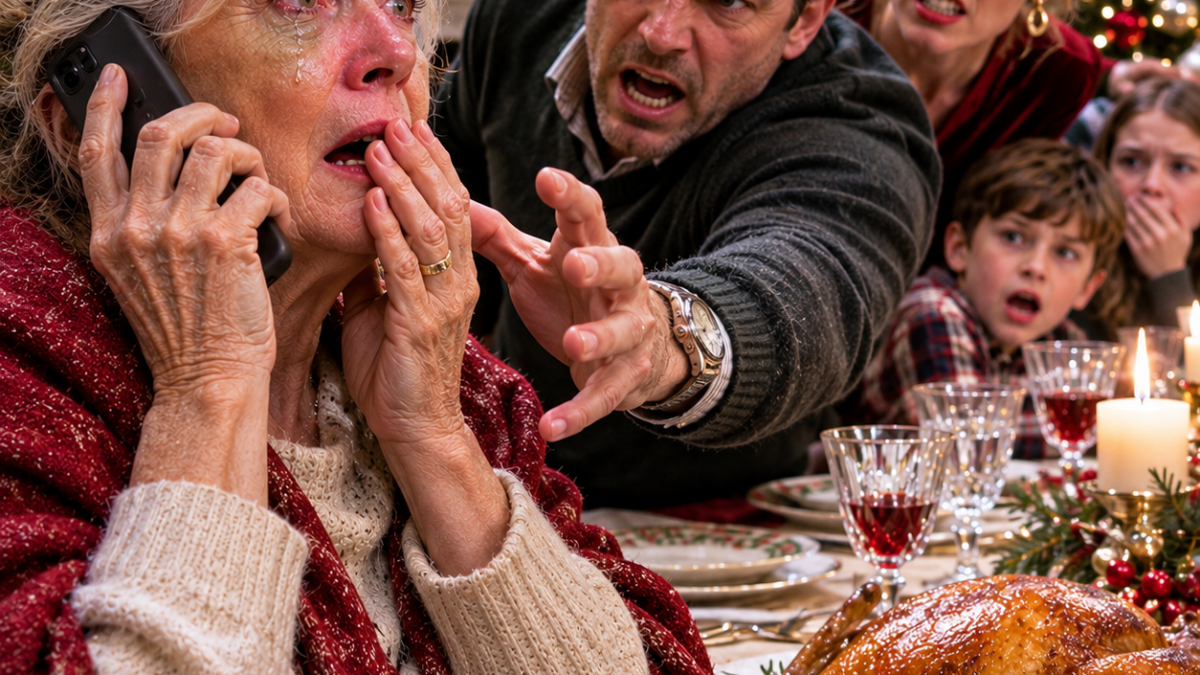
“YOU NEED TO LEAVE BEFORE YOUR SON FINDS OUT!” A Stranger Called Me in the Middle of Christmas Dinner — Robert Had Begged Me to Come, but I Was About to Discover the Terrifying Reason He Suddenly Changed His Mind.
FULL STORY CONTINUATION
I held the phone against my ear and tried to keep my breathing quiet.
“911. What’s your emergency?”
“Someone has broken into my house.”
My voice sounded distant, almost unrecognizable.
I gave the dispatcher my address, then looked toward the upstairs window.
The flashlight moved again.
Slowly.
Deliberately.
It stopped near my bedroom closet.
Then disappeared.
“Are you inside the house, ma’am?”
“No. I’m outside. Across the street.”
“Do not enter the property. Officers are being dispatched. Stay somewhere safe and keep your distance.”
I looked toward the broken basement window.
“I can see where they got in.”
“Please don’t approach the house.”
I promised I wouldn’t.
But the moment the call ended, a terrible anger rose through my fear.
That was my house.
The home John and I had bought when we were young enough to believe we’d have forever.
The house where our son had taken his first steps.
Where we’d celebrated birthdays, anniversaries, graduations, and every Christmas we could manage.
My husband’s belongings were inside.
His photographs.
His letters.
His watch.
His carefully preserved financial documents.
Some stranger had smashed a window and entered the place where I’d spent forty years building a life.
And now he was moving through it as though he had every right.
I stayed behind the fence, trying to obey the dispatcher’s instructions.
But my eyes kept returning to the windows.
The flashlight appeared upstairs again.
Then the beam moved down the hall.
I realized something strange.
The intruder didn’t seem hurried.
There was no frantic grabbing.
No furniture crashing.
No random movement from room to room.
Whoever was inside appeared to know where to look.
My stomach tightened.
John had kept important documents in several places.
There was a file cabinet in the small basement office, a locked drawer in our bedroom, and a fire-resistant document box we’d bought after a neighbor lost precious papers in a house fire.
I knew exactly what those locations contained.
But how would an ordinary burglar know?
Then I remembered Robert’s behavior at dinner.
The way he’d checked his watch.
The way he’d looked at his phone.
The slight panic in his face when I said I needed to leave.
I shook my head.
No.
I refused to let myself make that connection.
Robert was my son.
Whatever distance had grown between us, whatever coldness I’d heard in his voice before Christmas, he wouldn’t send someone to rob his mother’s house.
Would he?
I stared at the flashlight.
And for the first time, I became frightened of the answer.
Snow crunched beneath my shoes as I moved farther along Frank Morris’s fence to get a clearer view of the basement window.
I kept my distance from the house, but I could see the broken glass scattered beneath the sill.
The intruder had entered through that opening.
The basement office was only a short distance inside.
I remembered John sitting there late at night, reading financial newspapers under an old brass lamp.
He had been a teacher, just as I’d been proud to say throughout our marriage.
We never lived extravagantly.
John bought used cars, repaired appliances rather than replacing them, and kept careful records of every investment.
Sometimes I teased him.
“John, you plan for retirement as though we’re going to live to be a hundred and twenty.”
He would smile.
“Then we’ll be very comfortable at a hundred and twenty.”
That was John.
Practical.
Patient.
Quietly optimistic.
He believed in building security one small decision at a time.
And now someone was inside the room where he’d recorded those decisions.
I heard a faint noise from the house.
A drawer closing.
Then footsteps.
The beam of light appeared near the basement window.
I crouched lower.
My heart hammered so violently that I could feel it against my winter coat.
A dark canvas bag emerged first.
It was pushed carefully through the broken opening.
Then an arm.
A shoulder.
The person climbed slowly out.
I held my breath.
He straightened in the snow, gripping the bag.
And I recognized him.
Albert Rivers.
Robert’s lifelong friend.
A man who had been in my kitchen hundreds of times.
A man who had eaten John’s cooking, borrowed our tools, and attended our family celebrations.
For a moment, I thought my mind was playing tricks on me.
Then he turned his face toward the streetlight.
There was no mistake.
“Albert?”
My voice came out louder than I intended.
He spun around.
His eyes widened.
“Hope?”
The bag slipped from his hand.
Papers spilled across the snow.
He looked toward the street, then back at me.
And in his expression, I saw something that frightened me more than any threat.
Recognition.
Not the recognition of a burglar surprised by a stranger.
The recognition of a man who knew exactly whose house he had broken into.
“Hope, please,” he said. “I can explain.”
I stared at him.
“Why are you in my house?”
He swallowed.
His face was white.
“This wasn’t supposed to happen.”
I took a step forward before remembering the police were on their way.
“What’s in that bag?”
He glanced down.
The documents lay scattered around his shoes.
A familiar cream-colored folder rested on top.
John’s handwriting was visible on the label.
My chest tightened.
“Albert.”
He didn’t answer.
“Why do you have my husband’s papers?”
He looked at me with eyes full of terror.
And then he said something that changed the meaning of the entire Christmas dinner.
“Robert told me you wouldn’t be home.”
I stood completely still.
The cold seemed to disappear.
So did the sound of the wind.
For a moment, the only thing I could hear was my own heartbeat.
“What did you say?”
Albert looked toward the street.
“Hope, please don’t make this worse.”
“Worse?”
My voice rose.
“You broke into my house.”
“I know.”
“You smashed my basement window.”
“I know.”
“You took my husband’s documents.”
He pressed his hands together.
“I didn’t want to.”
I stared at him.
“Then why did you?”
He looked down.
For a moment, I thought he wouldn’t answer.
Then he whispered, “Robert asked me to.”
I shook my head.
“No.”
“Hope—”
“No.”
It came out as a sharp, desperate refusal.
Because if I accepted what he was saying, then I would have to reconsider everything that had happened over the last several days.
The cold telephone call.
The apology.
The sudden invitation.
The turkey.
The gifts.
The grandchildren.
The carefully arranged dinner.
The way Robert checked his watch.
The way he questioned me when I announced I had to leave.
I looked at Albert.
“You’re lying.”
He began crying.
“I wish I was.”
I felt my knees weaken.
I reached for the fence.
“Tell me exactly what happened.”
Albert glanced toward the scattered papers.
“Robert needed some documents.”
“What documents?”
“John’s will. The stock certificates. The investment records.”
I looked down.
There they were.
Documents John had spent decades protecting.
Financial papers I’d rarely needed to touch after he died.
The inheritance he’d left me so I wouldn’t have to worry about money as I grew older.
“Why?”
Albert didn’t answer.
I moved closer, stopping several feet away.
“Why would Robert need to steal his father’s records?”
He swallowed.
“He’s in trouble.”
“What kind of trouble?”
“Financial.”
I stared at him.
“How much?”
He looked away.
“Albert.”
His voice dropped.
“Close to two hundred thousand dollars.”
The number hit me like a physical blow.
“Two hundred thousand?”
He nodded.
“Bad investments. Gambling. Things got out of control.”
I looked toward my house.
The Christmas wreath was still hanging on the front door.
I’d put it there myself.
John’s favorite red ribbon curled around the greenery.
I stared at that wreath while trying to understand what I was hearing.
My son owed someone two hundred thousand dollars.
And instead of coming to me, he’d arranged for his friend to break into my home on Christmas.
“Why the documents?”
Albert wiped his face.
“Because of the Boeing stock.”
My breath caught.
John’s investments.
The shares he’d bought over thirty years.
The money he’d built slowly, patiently, carefully.
Albert continued.
“Robert knew the stock was valuable. He thought if we got the certificates and the paperwork, he could figure out how to take control of the money.”
I shook my head.
“Those assets are mine.”
“I know.”
“John left them to me.”
“I know, Hope.”
I stared at him.
“Then why would Robert think he could take them?”
Albert’s expression twisted.
“He said it was family money.”
I stopped breathing.
Family money.
The phrase echoed through my mind.
John’s lifetime of work.
His careful investments.
The savings he’d preserved to protect his wife after his death.
Reduced to family money by a son who believed that being related to me gave him a claim to everything I owned.
Albert looked toward the road.
“Robert said you were planning to give most of it away.”
I stared at him.
“Give it away?”
“To charities. Veterans’ organizations. Scholarships.”
My throat tightened.
That was true.
I’d been considering a substantial charitable gift in John’s memory.
He had always believed education could change lives.
He admired veterans and the families who supported them.
After his death, I’d begun thinking about using some of the investment income and eventually a significant portion of the estate to support causes that mattered to him.
I’d spoken about the idea.
But I’d never told Robert that everything had been finalized.
“He said you were going to leave him nothing,” Albert continued.
I looked at him.
“And that frightened him enough to rob me?”
Albert lowered his head.
“He thought he was entitled to the money.”
I couldn’t speak.
Then he added quietly, “He said you wouldn’t even notice it was gone.”
That was the moment something inside me broke.
Not because I believed the money was unimportant.
It was extraordinarily important.
The Boeing investments were worth more than two million dollars.
But the idea that my own son believed I wouldn’t notice losing the financial legacy my husband had spent decades building was almost impossible to comprehend.
I looked down at the papers scattered in the snow.
Then I looked at Albert.
“You’re telling me Robert invited me to Christmas dinner so you could rob my house.”
Albert’s silence answered before his words did.
Finally, he nodded.
“Yes.”
My phone began ringing.
The sound made both of us flinch.
I pulled it from my coat.
Robert.
His name glowed on the screen.
I stared at it.
Somewhere across town, my son was probably standing in his warm living room beside a beautifully decorated Christmas tree.
My grandchildren were playing with the gifts I’d bought them.
Victoria was clearing the dishes.
And Robert was calling because his mother had left the dinner table too early.
Because the plan wasn’t unfolding the way he’d expected.
The ringing stopped.
Then began again.
I didn’t answer.
Albert looked at the screen.
“He’s going to be furious.”
I turned toward him.
“With whom?”
“Me.”
I almost laughed.
My son had arranged a burglary.
His friend had been caught.
And somehow, Albert was afraid Robert would be angry because the theft had failed.
“What did he promise you?” I asked.
Albert looked miserable.
“Money.”
“How much?”
He hesitated.
“Enough to help me out of my own problems.”
I shook my head slowly.
Two grown men.
Men I’d known for decades.
Men who had eaten at my table.
Who had known John.
Who had seen the care with which we lived.
And they had decided that my husband’s savings were something they could simply take.
In the distance, I heard sirens.
Albert heard them, too.
His face changed.
“Hope, please.”
I looked at him.
“Don’t ask me to protect you.”
He began crying again.
“I made a terrible mistake.”
I glanced toward the broken window.
Then toward the documents lying in the snow.
“No, Albert. You made a decision.”
The sirens grew louder.
Red and blue lights appeared between the houses.
And as the police cars turned onto my street, I realized that Christmas had changed forever.
The officers arrived quickly.
One approached me while the other directed Albert to remain where he was.
“Ma’am, are you the homeowner?”
“Yes. Hope Davis.”
I pointed toward the broken basement window.
“That man broke into my house.”
The officer looked at Albert.
Then at the scattered documents.
“What was taken?”
I bent carefully and lifted the top folder from the snow.
John’s will.
The familiar paper felt cold and damp in my hands.
“Financial records,” I said. “My husband’s will. Bank documents. Investment records. Stock certificates.”
The officer’s expression grew serious.
“Do you know the value of the assets involved?”
I swallowed.
“Approximately two-point-three million dollars in Boeing stock.”
She looked at me.
“Two-point-three million?”
I nodded.
“My husband accumulated the investments over many years. They were part of the estate he left me.”
She looked toward the other officer.
The situation had become considerably more serious than an ordinary residential break-in.
I told her that Albert was my son’s friend.
That he’d admitted Robert had sent him.
That Robert knew I would be away at Christmas dinner.
That the suspected motive involved financial debts and the investments John had left me.
The officer listened carefully.
She asked what I’d seen.
What Albert had said.
Whether anyone else had access to the house.
Whether I had confronted him physically.
I answered as clearly as I could.
I was frightened.
Angry.
Shaking.
But I knew those details mattered.
The officers secured Albert and began documenting the scene.
I watched him being placed in the patrol car.
For years, he had been Albert.
The boy who used to come over after school.
The teenager who raided my refrigerator with Robert.
The young man who attended our family gatherings.
Now he sat handcuffed in a police vehicle because he’d broken into my home.
I turned away.
Then I heard someone calling my name.
“Hope!”
Frank Morris was crossing the street in a robe and winter slippers.
He looked worried.
“Are you all right?”
I stared at him.
“Frank?”
He nodded.
“I saw the police cars.”
Something clicked.
I stepped toward him.
“Was it you?”
He looked confused.
“Was what me?”
“The telephone call.”
His expression changed.
“Oh, Hope.”
He nodded.
“Yes.”
I felt my throat close.
“You called me?”
“I saw someone moving around inside your house with a flashlight. I knew you were supposed to be at Robert’s for Christmas.”
He glanced toward the broken window.
“I couldn’t understand why anyone would be upstairs with the lights off.”
I covered my mouth.
Frank continued.
“I found your number and called. I didn’t want to waste time trying to explain everything. I just wanted you to know something was wrong.”
I stared at him.
The anonymous voice.
The urgent warning.
The words that had sounded almost absurd when I first heard them.
Trust me and go now.
I reached for his hand.
“You saved me.”
He shook his head.
“I just made a phone call.”
“No.”
My voice broke.
“You saved far more than you realize.”
I thought about what might have happened if I’d ignored him.
If I’d remained at Robert’s house until late that night.
If I’d stayed for another cup of coffee.
Another story.
Another hour watching my grandchildren play.
Albert might have disappeared with John’s documents.
Robert might have gained access to information that could help him exploit the investments.
I might not have discovered the betrayal until much later.
Frank squeezed my hand.
“I’m glad you came home.”
I began crying.
“Me, too.”
The police finished their initial work at the house.
The broken window would need repair.
The rooms would have to be checked.
The documents needed to be handled as evidence and accounted for.
I gave the officers everything I knew.
They explained that Albert would face charges connected to the unlawful entry and attempted theft, with further investigation needed regarding Robert’s involvement.
I understood that an accusation wasn’t a conviction.
The police would need statements, records, and corroborating evidence.
But Albert had already admitted enough to make the situation terrifyingly clear.
My own son had planned for me to be away.
He had used Christmas dinner to keep me occupied.
And he had sent his friend into my home.
My phone rang again.
Robert.
I looked at the officer.
“Should I answer?”
She explained that I could speak with him if I wished, but cautioned me not to make threats or interfere with the investigation.
I nodded.
Then I accepted the call.
“Hello, Robert.”
“Mom!”
He sounded relieved.
“Where are you? We’ve been worried sick.”
I closed my eyes.
Worried sick.
The performance was almost perfect.
“I went home.”
A pause.
“Is everything okay?”
I looked toward my broken basement window.
“No.”
His voice changed slightly.
“What happened?”
“Someone broke into the house.”
Silence.
Then he said, “Oh, my God.”
I waited.
“Are you hurt?”
“No.”
“Did they take anything?”
I stared into the darkness.
“Some documents were removed.”
Another pause.
“Documents?”
“Yes.”
“What kind?”
I could almost hear him calculating.
I looked toward the patrol car.
“Robert, I think we need to have a conversation.”
“Mom, you’re scaring me.”
I almost laughed.
“You should be scared.”
He went quiet.
Then he asked, very carefully, “What does that mean?”
I looked at the police officer standing nearby.
“It means I’ll be coming back.”
“Mom—”
I ended the call.
My hands were trembling.
But I felt something unexpected.
Clarity.
For days, I’d been confused by Robert’s behavior.
His sudden decision to exclude me.
His abrupt apology.
His overly enthusiastic invitation.
His nervousness during dinner.
Now the pieces fit together.
The entire Christmas celebration had been designed to keep me away from my house.
And I was going to confront him with that truth.
Frank walked me to my car after the police completed the immediate scene work.
The documents that could be returned to me were carefully secured, while the officers documented and retained what they needed for the investigation.
John’s will and the recovered financial papers were no longer scattered across the snow.
The sight of them had made my chest ache.
I knew their value wasn’t only financial.
Every document represented decisions John had made while he was alive.
Hours spent researching.
Money saved instead of spent.
The quiet discipline that had allowed us to build a secure future without high salaries or extravagant opportunities.
I thought about the nights he’d sat at the kitchen table reviewing investments.
Sometimes, I’d bring him tea.
“What are you working on now?”
He’d smile.
“Making sure you’re taken care of.”
I used to tell him not to worry so much.
Now, standing beside my car on Christmas night, I wished I could tell him how grateful I was.
And how devastated I felt that our own son had tried to take what he’d left behind.
Frank touched my shoulder.
“Hope, are you sure you want to go back to Robert’s tonight?”
I looked at him.
“Yes.”
“You’re shaken.”
“I know.”
“You could wait until morning.”
I considered it.
But then I remembered Victoria.
She was still sitting in that house.
She had welcomed me with genuine warmth.
She had prepared the table.
She had laughed with the children.
I thought of the confusion on her face when I left.
Had she known?
I didn’t believe so.
But I needed to hear the truth.
And I needed Robert to know I wasn’t going to spend another night believing his lies.
“I have to go.”
Frank sighed.
“Be careful.”
I nodded.
“I will.”
I got into my car.
The engine started with a low rumble.
As I pulled away, I glanced toward my house.
The Christmas wreath still hung on the front door.
Snow covered the lawn.
The broken window remained dark.
The home John and I had built had been violated.
But the documents were recovered.
And whatever Robert had intended, his plan had failed.
I gripped the steering wheel.
Then I drove toward my son’s house.
The drive back felt longer than the journey home.
The streets were almost empty.
Christmas lights glowed from windows where families were probably finishing dessert, watching movies, or putting tired children to bed.
I passed a house with an enormous inflatable Santa Claus leaning sideways in the snow.
Another had a wooden nativity scene lit by small white bulbs.
A few streets farther on, I saw a family walking together, the youngest child riding on someone’s shoulders.
Ordinary Christmas scenes.
The kinds of moments I’d spent the last several days dreaming about.
I wanted to feel that warmth again.
Instead, I kept seeing Robert’s face at dinner.
His smile when I arrived.
The way he’d thanked me for bringing the turkey.
His hand resting briefly on my shoulder.
The sound of his laughter when Dany told a joke.
Every detail had felt meaningful at the time.
Now each one seemed calculated.
Had he been watching the clock because he’d arranged a time for Albert to enter my house?
Had he invited Victoria’s parents to make the gathering seem more natural?
Had he asked me to bring the turkey because he knew preparing it would make me emotionally invested in the dinner?
I didn’t know how much of the evening he’d deliberately arranged.
But I knew the most important part.
He had wanted me away from home.
Albert had said so.
And the invitation had worked.
I remembered the call where Robert first excluded me.
We’re keeping Christmas to immediate family this year.
I’d cried over those words.
Then, suddenly, he changed his mind.
He apologized.
He told me Victoria wanted me there.
He reminded me the children missed their grandmother.
At the time, I’d thought my prayers had been answered.
Now I wondered whether the rejection had been genuine and the apology merely convenient.
Perhaps he’d first planned to spend Christmas without me.
Then realized he needed me somewhere predictable while Albert searched my house.
The thought hurt so much that I had to pull over briefly.
I parked beneath a streetlight and pressed my hands against the steering wheel.
“John,” I whispered.
My husband’s name sounded painfully small inside the car.
“What happened to our son?”
There was no answer.
Only the faint hum of the engine and the distant sound of someone setting off holiday fireworks.
I thought about John’s last Christmas.
He’d been too weak to carry the turkey from the oven.
His hands trembled while wrapping gifts.
He’d insisted on helping anyway.
“Christmas isn’t about doing everything perfectly,” he’d told me. “It’s about showing up for the people you love.”
Robert had barely visited that year.
Work was busy.
The children had activities.
There were obligations.
There were always reasons.
John never complained.
But I knew he’d been hurt.
Now I wondered whether the distance had begun long before I recognized it.
I wiped my face.
Then I started driving again.
I wasn’t going back to Robert’s house to beg for his love.
I was going back because he needed to face what he’d done.
When I pulled into his driveway, the house looked exactly as it had earlier.
Warm yellow light spilled through the front windows.
The Christmas tree stood tall beside the fireplace.
Wrapped paper lay scattered on the living-room rug.
From outside, anyone passing would have seen a beautiful family celebration.
They would never have imagined what had happened while we were eating dinner.
I turned off the engine.
For several seconds, I sat there.
Then I gathered the recovered documents I had been permitted to take with me.
John’s will.
Copies of the investment information.
The papers that had nearly disappeared into Albert’s canvas bag.
I held them against my chest as I walked toward the front door.
My hands were trembling, but my anger had become strangely quiet.
I didn’t want to scream.
I wanted answers.
Real answers.
Not another performance.
Before I reached the steps, the door opened.
Victoria stood there.
“Hope!”
She rushed toward me.
“Oh, thank God. Are you all right?”
Her face was pale.
There were worry lines around her eyes.
She touched my arm.
“Robert said something happened at the house.”
I looked at her.
Her concern seemed genuine.
But after what I’d discovered, I no longer knew how easily I could trust appearances.
“I’m all right physically.”
She frowned.
“What does that mean?”
I stepped inside.
The familiar smell of cinnamon and roasted turkey filled the hallway.
Dany’s model airplane lay on the carpet.
Sarah was sitting beside the tree, drawing with the pencils I’d given her.
Joseph Harrison, Victoria’s father, looked up from his chair.
His wife, Martha Harrison, had been helping the children organize their gifts.
Everyone turned toward me.
Robert stood near the fireplace.
The instant he saw the documents in my hands, his expression changed.
It was brief.
Barely a second.
But I saw it.
The smile vanished.
His eyes widened.
Then he forced a look of concern.
“Mom, what happened?”
I looked directly at him.
“You tell me.”
Victoria stepped back.
“Hope?”
I walked to the coffee table.
Carefully, I placed John’s will and the recovered investment documents on the polished surface.
The room became silent.
Robert stared at them.
I watched his face.
The color seemed to drain from it.
“Where did you get those?”
My heart gave one terrible beat.
Not Are you hurt?
Not Did the police catch the burglar?
Not What happened to the house?
His first concern was the documents.
I folded my hands.
“They were found in a bag outside my broken basement window.”
Victoria looked toward Robert.
“What?”
I continued.
“Albert Rivers was carrying them.”
Robert’s mouth opened.
Nothing came out.
I watched him.
“He’s in police custody.”
Dany stopped playing.
Sarah raised her head.
Victoria pressed a hand against her chest.
“Albert?”
I nodded.
“Robert’s friend Albert.”
Robert took a step forward.
“Mom, I don’t understand.”
I looked at him.
“Don’t.”
He froze.
“Don’t stand there and tell me you don’t understand.”
His jaw tightened.
“Mom—”
“Albert told me everything.”
The room went completely still.
Robert’s eyes moved toward Victoria.
Then Joseph.
Then the children.
And I knew.
He’d been hoping the lie would survive.
Victoria moved toward the coffee table.
She looked down at the papers.
“Robert, what is this?”
He didn’t answer.
I did.
“Your husband arranged for Albert to break into my house while I was here having Christmas dinner.”
Victoria turned sharply.
“That’s impossible.”
I looked at her.
“I wish it were.”
She stared at Robert.
“Tell me she’s mistaken.”
He ran a hand through his hair.
“Victoria, this is complicated.”
Her face changed.
“Complicated?”
Joseph set down his magazine.
“Robert, did you send someone into your mother’s home?”
Robert looked at the floor.
I waited.
The silence stretched.
Finally, he said, “I didn’t know Albert would break the window.”
I almost fell backward.
There it was.
Not a denial.
Not an apology.
A complaint about how the burglary had been carried out.
Victoria made a sound as though she’d been struck.
“You knew he was going there?”
Robert looked at her.
“Please, let me explain.”
I stared at my son.
“You told him I’d be here.”
He didn’t answer.
“You told him I would be away for hours.”
He rubbed his forehead.
“Mom, I was going to make everything right.”
I felt something inside me turn cold.
“By stealing from me?”
His eyes flashed.
“I wasn’t stealing.”
Joseph stood.
“Then what do you call sending a man into someone else’s house to take documents?”
Robert looked desperate.
“Those papers concern family assets.”
I laughed once.
The sound startled even me.
“Family assets?”
I pointed to John’s will.
“Your father left those investments to me.”
“Because he trusted you to protect the family.”
I stared at him.
“Protect the family?”
Robert’s voice grew louder.
“Yes, Mom. Protect the family. Not give everything away to strangers.”
Victoria frowned.
“What are you talking about?”
Robert looked toward her, then away.
I understood.
He hadn’t told her.
He hadn’t told his wife about the stock.
The debts.
The plan.
He’d used her hospitality and the children to make the dinner believable.
But he hadn’t trusted her with the truth.
I looked at Victoria.
“John left me a substantial investment portfolio. Robert apparently believes it belongs to him.”
Joseph’s expression hardened.
“How substantial?”
I took a breath.
“Approximately two-point-three million dollars in Boeing stock.”
The room became silent.
Martha Harrison lowered herself slowly onto the sofa.
Victoria stared at me.
“Two-point-three million?”
I nodded.
“John accumulated those investments over decades.”
Robert shook his head.
“And you’ve been planning to give it away.”
I turned toward him.
“I’ve been considering charitable gifts in your father’s memory.”
“All of it!”
“That was never your decision to make.”
His face flushed.
“I’m your son!”
“Yes.”
“Your only son!”
“I know.”
“Then how can you even consider leaving that money to people you don’t know?”
I stared at him.
“Because it belongs to me.”
His jaw tightened.
“And because your father believed wealth should be used responsibly.”
Robert gave a bitter laugh.
“Responsible? You were going to give millions to charity while your own family is struggling.”
Victoria looked sharply at him.
“Struggling?”
I turned toward her.
That was when Robert realized he’d said too much.
Joseph stepped closer.
“Robert, what financial trouble are you talking about?”
Robert looked around the room.
The children were watching us.
Dany clutched his model airplane.
Sarah held her colored pencils against her chest.
I hated that they were witnessing this.
I hated that Christmas had become a scene of accusation and fear.
But I wasn’t the one who had arranged a burglary.
“Victoria,” I said gently, “perhaps the children should go into the other room.”
She looked toward them.
Her face crumpled.
“Sweethearts, go upstairs for a little while.”
Dany frowned.
“Why is everyone angry?”
My heart broke.
I knelt carefully beside him.
“Your father made some very serious decisions that the adults need to discuss.”
He looked at Robert.
“Did Dad do something bad?”
I swallowed.
“Your father has some things he needs to explain.”
Sarah stepped closer.
“Grandma, are you leaving again?”
I brushed her hair away from her face.
“I’ll see you soon, sweetheart.”
Martha Harrison gathered them gently.
“Come on, darlings. Let’s go find a movie.”
They followed her upstairs, looking confused.
I watched until they disappeared.
Then I turned toward Robert.
“Now answer your father-in-law.”
Robert sat heavily on the sofa.
For several seconds, he stared at the floor.
Finally, he whispered, “I owe money.”
Joseph crossed his arms.
“How much?”
Robert didn’t answer.
“How much, son?”
The word son sounded stern.
Not affectionate.
Robert swallowed.
“Almost two hundred thousand.”
Victoria staggered backward.
“What?”
He looked at her.
“I was going to fix it.”
“Two hundred thousand dollars?”
His voice rose.
“Victoria, please.”
She pressed both hands against her mouth.
“How?”
He looked toward the documents.
And that glance told her everything.
She shook her head.
“No.”
“Victoria—”
“No, Robert.”
Her voice cracked.
“Please tell me you didn’t plan to steal your mother’s money because you’re in debt.”
He began crying.
“I was desperate.”
Joseph’s face became rigid.
“Desperate from what?”
Robert wiped his eyes.
“Investments that went wrong.”
“What investments?”
He didn’t answer.
Joseph stepped closer.
“Robert.”
“Gambling,” he whispered.
Victoria made a broken sound.
I closed my eyes.
Albert had told me.
But hearing it from my son made the truth somehow worse.
Gambling.
Bad investments.
Two hundred thousand dollars.
And he’d decided that the solution was to steal from his widowed mother.
Victoria sank onto the sofa.
Her face had gone white.
“How long?”
Robert looked at her.
“What?”
“How long have you been hiding this from me?”
He rubbed his forehead.
“Things only got bad recently.”
She shook her head.
“Don’t do that.”
“Victoria—”
“Don’t give me another vague answer.”
Her voice rose.
“We have children. A mortgage. Bills. Savings. Are you telling me you’ve been gambling away money while pretending everything is fine?”
Robert looked at Joseph.
As though hoping another man might rescue him from his wife’s questions.
Joseph didn’t move.
Victoria’s eyes filled with tears.
“Have you taken money from our accounts?”
Robert hesitated.
And that hesitation seemed to devastate her.
“Oh, my God.”
She covered her mouth.
I watched her shoulders begin shaking.
She had welcomed me into her home that morning.
She had praised John’s turkey.
She had helped the children unwrap their gifts.
She’d had no idea that while we sat around the dinner table, her husband’s friend was breaking into my house.
Robert leaned toward her.
“Victoria, listen.”
She recoiled.
“Don’t touch me.”
He froze.
“I did it for us.”
She stared at him.
“For us?”
“We could lose everything.”
She shook her head.
“So you decided to steal from your mother?”
“I was trying to protect the family.”
Her expression hardened.
“You used our family to commit a crime.”
He looked away.
I stepped forward.
“Robert, you told me not to come for Christmas.”
He closed his eyes.
I continued.
“Then you suddenly changed your mind.”
“Mom—”
“You apologized. You said Victoria wanted me here.”
He looked down.
“You told me the children missed me.”
My voice broke.
“And I believed you.”
He began crying harder.
I wanted him to look at me.
Not at the floor.
Not at his hands.
At me.
“Look at me, Robert.”
Slowly, he raised his head.
I stared into his eyes.
“I spent days preparing that dinner.”
Tears gathered in my own eyes.
“I bought the turkey. I made your father’s marinade. I wrapped gifts for the children. I stayed awake worrying whether everything would be perfect.”
He whispered, “I know.”
“No.”
My voice sharpened.
“You don’t know.”
I gestured toward the Christmas tree.
“I thought you wanted your mother back at Christmas.”
He looked away.
“I thought we were becoming a family again.”
My throat tightened.
“But you only wanted me out of my house.”
He began sobbing.
“Mom, please.”
I shook my head.
“Every loving word you said to me today was part of a plan to keep me occupied while Albert searched through your father’s things.”
Robert stood.
“It wasn’t supposed to hurt you.”
I stared at him.
“How could it not?”
He spread his hands.
“I was going to take what I needed and straighten everything out.”
“Without telling me?”
He didn’t answer.
“Without asking?”
Silence.
“Without caring whether I agreed?”
He began crying again.
I looked at him.
“Then it wasn’t help you wanted, Robert. It was control.”
Joseph walked to the fireplace.
He stood there for a moment, staring into the flames.
Then he turned.
“I want to understand something.”
Robert looked up.
Joseph’s voice was calm.
Almost frighteningly calm.
“You owed nearly two hundred thousand dollars.”
Robert nodded.
“You knew your mother had valuable investments.”
Another nod.
“You arranged for your friend to enter her house during Christmas dinner.”
Robert lowered his eyes.
“And you involved my daughter and grandchildren in the deception without telling them.”
Silence.
Joseph stepped forward.
“Is that correct?”
Robert began shaking.
“I didn’t have a choice.”
Joseph’s expression changed.
“You had choices.”
Robert looked up.
“You could have told your wife the truth.”
“I was ashamed.”
“You could have stopped gambling.”
“I tried.”
“You could have sought legitimate financial advice.”
“I needed money immediately.”
“You could have spoken to your mother honestly.”
Robert’s face twisted.
“She wouldn’t have helped.”
I stared at him.
There it was.
The assumption beneath everything.
He’d decided what I would do.
And because he feared I might refuse, he’d taken away my right to choose.
I stepped toward him.
“You never asked me.”
His eyes filled.
“I knew what you’d say.”
“No, you didn’t.”
“Mom, you were planning to give away millions!”
I shook my head.
“You knew what you wanted me to say.”
He went quiet.
“And you weren’t willing to hear anything else.”
Victoria stood.
Her voice trembled.
“Robert, I don’t know who you are.”
He turned toward her.
“Don’t say that.”
She looked at the Christmas tree.
At the gifts.
At the beautifully decorated room.
Then at me.
“You planned this while I was buying groceries and helping the children wrap presents.”
Robert looked down.
“You let me tell Hope how happy I was that we’d all be together.”
Tears ran down her face.
“You let our children believe their grandmother was here because you wanted to celebrate Christmas.”
He tried to approach.
She moved away.
“And the whole time, you were waiting for Albert to steal from her.”
I watched my daughter-in-law begin to cry in earnest.
I knew that sound.
The shock of discovering that someone you trusted had been living a lie.
I’d heard it coming from my own mouth less than an hour earlier.
Now I heard it from hers.
I felt compassion for her.
But I also understood something new.
Robert hadn’t only betrayed me.
He’d betrayed his wife.
His children.
His father-in-law.
His mother-in-law.
And the memory of the man who had raised him.
He had used all of us as pieces in a plan built around his own desperation.
Robert finally dropped into a chair.
His shoulders sagged.
For a moment, he looked older than his years.
He covered his face.
“I didn’t know what else to do.”
I stood beside the coffee table.
John’s papers lay between us.
I looked at my son.
“Tell me what you thought would happen.”
He didn’t answer.
“Did you imagine Albert would bring you the documents, and I’d never discover they were missing?”
Robert rubbed his face.
“I thought you’d be at dinner until late.”
“And then?”
“I would have figured something out.”
“How?”
He looked at the stock certificates.
My stomach tightened.
“Robert.”
He swallowed.
“I knew the investments were worth a lot.”
“They belong to me.”
“I know.”
“Do you?”
His jaw tightened.
“Mom, you don’t need two-point-three million dollars.”
I stared at him.
He continued.
“You live alone. Your house is paid off. You don’t spend money on anything.”
The cruelty of the words took my breath away.
I had spent my life being careful.
I hadn’t bought expensive clothes.
I hadn’t taken extravagant vacations.
I’d preserved John’s savings because financial security mattered to me.
And my son was using that very restraint as an argument that I didn’t deserve the money.
“You think because I don’t spend it, you have a right to take it?”
He looked frustrated.
“That’s not what I’m saying.”
“Then what are you saying?”
He raised his voice.
“I’m saying the money could save us!”
I looked at him.
“From the consequences of your gambling.”
He flinched.
“Yes.”
I nodded slowly.
“And what happens after that?”
He stared at me.
“What?”
“What happens when you owe another two hundred thousand?”
“I won’t.”
“How do you know?”
He looked away.
I stepped closer.
“Would you steal again?”
“Mom, stop.”
“Would you send someone else into my house?”
“Stop!”
His voice filled the room.
For a moment, everyone froze.
Then he lowered his head.
I took a breath.
“That’s what frightens me, Robert.”
My voice was quiet.
“Not just what you did tonight.”
He looked at me.
“But that you still seem to believe your problems entitle you to take whatever you want from the people who love you.”
I picked up John’s will.
The paper was slightly damp from the snow.
I ran my thumb along the edge.
His signature was still clear.
John had always signed his name carefully.
Even simple notes had been written with a kind of precision that made me smile.
I remembered him teaching Robert how to write his name.
Our son had been five.
He’d pressed too hard with the pencil and torn the paper.
John laughed.
“Easy, buddy. You don’t have to force it.”
Then he’d guided Robert’s hand.
“Slow and steady.”
I looked at the signature.
Slow and steady.
That had been John’s entire approach to life.
He didn’t chase riches.
He didn’t gamble.
He didn’t believe in shortcuts.
He believed in work.
Education.
Patience.
Taking responsibility.
And over thirty years, he’d built investments that had become far more valuable than either of us imagined when he began.
I looked up at Robert.
“Your father wasn’t a wealthy man when we married.”
He remained silent.
“We rented a tiny apartment. We drove an old car that barely survived the winter. We planned every grocery trip.”
Victoria sat quietly, wiping her face.
“Your father saved because he believed our future mattered.”
I held up the papers.
“He bought those shares little by little.”
Robert stared at them.
“He never imagined they’d become worth this much.”
My voice softened.
“But he hoped that if something happened to him, I’d be safe.”
I looked directly at my son.
“That was his gift to me.”
Robert’s eyes filled.
“And you tried to steal it.”
He began shaking his head.
“Mom—”
“You didn’t merely want money.”
I looked around the room.
“You wanted to take your father’s life’s work and turn it into payment for your gambling debts.”
Robert buried his face in his hands.
I continued.
“I have spent years thinking about how best to honor John.”
My throat tightened.
“He believed in helping veterans. He believed in education. He believed that a person fortunate enough to have more than they needed should consider what good that money could do.”
I looked at the stock certificates.
“I wanted part of his legacy to support scholarships and charitable programs.”
Robert looked up sharply.
“Instead of his own family.”
I felt the last remaining softness in my expression disappear.
“Your father helped his family his entire life.”
I placed the document on the table.
“His legacy isn’t a prize you win because you share his last name.”
Silence filled the room.
I looked at Victoria.
Her cheeks were wet.
Then at Joseph.
His face was rigid.
Then at Robert.
My only son.
The boy John had loved.
The man who had used Christmas to arrange a burglary.
“I will decide how those assets are used,” I said.
“And I will not allow you to turn them into an escape route from choices you refuse to take responsibility for.”
Robert began pleading again.
“Mom, please don’t do this.”
I looked at him.
“Do what?”
“Turn everyone against me.”
I almost couldn’t believe what I’d heard.
I glanced around the room.
Victoria was crying.
Joseph looked devastated.
Martha Harrison had returned quietly from upstairs and stood near the hallway.
Our family had been shattered.
And Robert was still worried about how he looked.
“Robert, I didn’t turn anyone against you.”
He shook his head.
“You told them everything.”
“Yes.”
“You didn’t have to humiliate me.”
I took a long breath.
“Your friend broke into my house.”
He looked away.
“Because you sent him.”
“I was desperate.”
“Because you wanted my money.”
He covered his face.
I stepped back.
“You’re asking me to protect your reputation from the truth.”
He didn’t answer.
I thought about the moment I’d seen Albert climbing out of my basement window.
The bag.
The documents.
The broken glass.
The way he’d said Robert had planned the dinner.
I looked at my son.
“What did you think I would feel when I discovered this?”
He whispered, “I hoped you wouldn’t.”
That answer was worse than another lie.
He hadn’t planned to explain.
He hadn’t planned to apologize.
He hadn’t planned to ask forgiveness.
He had simply hoped I would never find out.
I stared at him.
“Then you weren’t planning to make things right.”
He looked up.
“You were planning to get away with it.”
Martha Harrison stepped into the room.
Her face showed that she’d heard enough to understand what had happened.
“Hope,” she said softly, “the children are upstairs watching a movie.”
I nodded.
“Thank you.”
She looked at Robert.
For a long moment, she didn’t speak.
Then she said, “Do you understand what you’ve done to your family?”
He looked down.
“I know.”
“No,” she said.
Her voice was unusually firm.
“I don’t think you do.”
She gestured toward the Christmas tree.
“Your children will remember tonight.”
Robert closed his eyes.
“They’ll remember the shouting. Their mother’s tears. Their grandmother leaving.”
She paused.
“And someday, they’ll need an explanation.”
Victoria began crying again.
Martha continued.
“Make sure that when the time comes, you tell them the truth.”
Robert whispered, “I’m sorry.”
Joseph shook his head.
“Sorry is where responsibility begins. It isn’t where it ends.”
I looked at the four adults around me.
Then toward the stairs.
I could hear faint sounds from the television.
The children were still young enough to believe Christmas was about gifts, family dinners, and the excitement of being together.
They deserved that innocence for as long as it could safely last.
Robert had placed it in danger.
And I wasn’t going to help him conceal the truth at the expense of everyone else’s safety.
I gathered John’s documents.
Victoria looked up.
“Hope, please don’t go.”
I touched her shoulder.
“I need to.”
She began crying harder.
“I’m so sorry.”
I looked into her eyes.
“Did you know?”
She shook her head immediately.
“No.”
I believed her.
Not because I was naïve.
But because I’d watched her reaction.
Her shock.
Her questions.
The realization that her own husband had been lying to her.
She had been used just as I had.
I took her hand.
“You and the children are welcome in my home.”
Her mouth trembled.
“Even after all this?”
I nodded.
“You didn’t cause it.”
She stepped forward and embraced me.
I held her.
For one brief moment, the evening felt less like a complete destruction.
There were still people in this family who loved honestly.
Still relationships worth protecting.
Then I looked toward Robert.
He remained in his chair.
His face was hidden in his hands.
I wanted to go to him.
That old maternal instinct rose so strongly that it almost overwhelmed me.
But I stayed where I was.
“I love you, Robert,” I said.
He lifted his head.
Hope flashed across his face.
Then I continued.
“But loving you doesn’t mean I can excuse what you’ve done.”
His expression collapsed.
I held the documents closer.
“You’re going to have to face the consequences.”
He began crying again.
I turned toward the door.
And walked out.
The cold hit my face as soon as I stepped outside.
Snow had begun falling again.
Soft white flakes drifted past the porch lights.
The neighborhood was quiet.
Somewhere nearby, a dog barked.
I paused beside my car and looked back at Robert’s house.
Through the window, I could see the Christmas tree.
The presents.
The softly lit room.
Everything looked beautiful.
But I knew what had happened inside.
I knew Victoria was crying.
I knew Joseph and Martha were trying to understand the damage.
I knew my grandchildren were confused.
And I knew Robert was facing the consequences of something he’d planned while believing none of us would ever find out.
I thought about the turkey.
The careful marinade.
The gifts.
The days I’d spent preparing.
I had wanted Christmas to bring my family closer.
Instead, it had revealed how far my son had already moved away from the values John and I had tried to teach him.
I unlocked the car.
Then I stopped.
For a moment, I thought about calling Robert back.
Telling him I was sorry.
Not for accusing him.
Not for protecting my property.
But for the pain of the confrontation.
Then I remembered his words.
I hoped you wouldn’t find out.
I put the phone away.
There would be time to deal with the grief.
But I would not spend Christmas night comforting the person who had arranged for my home to be robbed.
I got into the car.
Started the engine.
And drove away.
When I reached home, the police had already left.
The broken basement window had been temporarily secured, and the house was quiet.
Frank had left a note on my front door.
Hope, I’m next door if you need anything. Please don’t hesitate.
I stood reading those words for several seconds.
Earlier that evening, my own son had been arranging to steal from me.
Meanwhile, a neighbor with no legal or financial obligation to protect me had noticed something wrong and made a telephone call.
The difference was almost impossible to comprehend.
I unlocked the front door.
Inside, the house smelled faintly of pine from the Christmas tree and the cinnamon candles I’d lit before leaving.
My wrapped presents for the grandchildren were gone, but everything else looked exactly as it had that morning.
Except now I knew someone had been inside.
Someone had opened drawers.
Handled documents.
Searched through the private records of my marriage.
I walked toward John’s old office.
Several drawers stood open.
Folders had been disturbed.
The document box had been moved.
I touched the edge of his desk.
There was a small scratch near the corner.
John had made it years ago while trying to repair a broken table lamp.
He’d apologized as though he’d damaged a priceless antique.
I’d laughed and told him that a desk was meant to be used.
Now I traced that scratch with my fingers.
And the tears came.
Not because I was frightened of the burglar anymore.
Albert had been caught.
The police were involved.
The documents had been recovered.
I cried because someone who knew what this room meant to me had deliberately sent another man into it.
Robert had played in this office as a child.
He had sat on the floor beside John’s chair, building wooden airplanes and asking questions about the papers on his desk.
John had been so proud when Robert showed an interest in numbers.
“Maybe he’ll be a businessman,” he’d joked.
I’d smiled.
“Maybe he’ll be a teacher like us.”
Neither of us had imagined that one day Robert would look at those same papers and see an opportunity to steal.
I sat in John’s chair.
For several minutes, I couldn’t move.
Then I looked toward the framed photograph on his desk.
He was smiling.
His hair was silver.
His eyes were warm.
I picked it up.
“I’m sorry,” I whispered.
The words surprised me.
What was I apologizing for?
Robert’s crime?
My failure to recognize what he’d become?
My inability to keep the family together, as John had asked?
I held the photograph against my chest.
“I tried.”
The room remained silent.
“I really tried.”
Eventually, I set the picture back on the desk.
And something inside me began to change.
I could grieve what Robert had done.
I could mourn the family I’d believed we still had.
But I couldn’t spend the rest of my life treating my son’s choices as proof that I had failed my husband.
John had raised Robert to understand honesty.
So had I.
Our son had chosen something else.
That truth hurt.
But it belonged to Robert.
Not to me.
The next morning was December 26.
Sunlight poured through the kitchen window.
The snow outside was smooth except for the marks left by police vehicles and footsteps.
John’s recovered documents were arranged on the table.
I had spent much of the night checking the house, making sure the doors were secure and that nothing else appeared to be missing.
I barely slept.
Every creak startled me.
Every passing car made me look toward the windows.
When I finally made coffee, my hands were still trembling.
I poured it into John’s old mug.
The one I’d given him for our twentieth anniversary.
The lettering had faded over the years.
He’d loved that ridiculous mug.
He used it every morning even after the handle developed a small chip.
I sat at the table and looked at the financial papers.
The investments were worth approximately $2.3 million.
John had accumulated the shares over many years, buying and holding through changing markets.
Some purchases had been made during difficult economic periods.
Others came when he had a little extra money from teaching.
The paperwork told the history of his patience.
He’d never expected to become wealthy overnight.
He’d simply believed that steady effort mattered.
I ran my fingers over the dated statements.
Then I thought about Robert.
Two hundred thousand dollars in debt.
Gambling.
Bad investments.
A desperate plan to steal documents from his mother.
The difference between father and son seemed unbearably stark.
John had built security slowly.
Robert had tried to seize it in a single night.
I wondered whether my son had ever truly understood what money represented to his father.
Not status.
Not luxury.
Not the ability to impress other people.
Security.
Freedom from unnecessary fear.
The chance to help those who needed it.
I looked at the papers again.
Robert believed I intended to give everything away.
That wasn’t quite true.
I’d been considering a substantial charitable commitment, including future gifts and changes to my estate plans.
But I had not made every final decision.
Even if I had, the money was mine to allocate.
I was sixty-eight.
I could need medical care in the future.
I might need help maintaining my home.
I might decide to travel.
I might simply want the security of knowing I could support myself.
My son had no right to decide that because I lived modestly, I no longer needed my savings.
I reached for my notebook.
At the top of a fresh page, I wrote:
Protect John’s legacy. Protect my independence.
Then I began listing the calls I needed to make.
Victoria telephoned shortly after breakfast.
I stared at her name before answering.
“Hello?”
“Hope?”
Her voice was hoarse.
She’d clearly been crying.
“Are you all right?”
I looked around my quiet kitchen.
“I’m managing.”
A long silence followed.
Then she whispered, “I’m so sorry.”
I closed my eyes.
“Victoria, you don’t have to apologize for Robert.”
“I feel like I do.”
“Why?”
“Because I invited you into our home. I welcomed you. I helped create that Christmas dinner.”
Her voice broke.
“And I didn’t know what he was doing.”
I leaned back in my chair.
“Neither did I.”
She began crying.
“He lied to me about everything.”
I waited.
“He told me our finances were fine. He told me the business investments were secure.”
She swallowed.
“Now I’m finding out he owes nearly two hundred thousand dollars.”
I felt a fresh ache.
“Have you spoken to him?”
“Not really.”
She paused.
“He kept asking me to calm down. He said he could fix everything if I stopped making it worse.”
I closed my eyes.
Those words sounded painfully familiar.
Robert had always wanted problems to disappear without requiring him to face the full consequences.
Victoria continued.
“I asked how long he’d been gambling.”
“What did he say?”
“He wouldn’t give me a straight answer.”
She took a shaky breath.
“I asked whether he’d used our savings.”
I waited.
“He said there had been some losses.”
Her voice cracked.
“Some losses, Hope. As though this were a minor problem.”
I looked toward John’s photograph.
“I’m sorry.”
Victoria was silent for several seconds.
Then she said, “I’m filing for divorce.”
The words seemed to settle heavily between us.
I didn’t respond immediately.
I understood why she felt that way.
But I also knew that a marriage ending was not a small decision, especially with children involved.
“Are you certain?”
“Yes.”
Her answer was quiet but firm.
“I can’t stay married to someone who arranged a burglary against his own mother and lied to me while our children sat at the dinner table.”
I closed my eyes.
“Victoria—”
“The children deserve stability.”
She began crying again.
“I don’t even know what our financial situation is.”
“Then speak to an attorney. Make sure you understand everything before taking any steps.”
“I will.”
I hesitated.
“Whatever happens between you and Robert, I don’t want to lose you or the children.”
She began crying harder.
“Oh, Hope.”
“I mean it.”
“After everything?”
“Yes.”
She took a breath.
“I was afraid you’d never want to see us again.”
I looked at the little drawing Sarah had given me the previous month.
It was pinned to my refrigerator.
A colorful picture of our family beneath a bright yellow sun.
“Victoria, you’re my daughter-in-law. Dany and Sarah are my grandchildren. None of you arranged that robbery.”
She whispered, “Thank you.”
I wiped my eyes.
“You’re welcome in my home.”
Another silence.
Then she said, “The children are asking when they can see you.”
My throat tightened.
“Whenever you’re ready.”
“Sarah wants to finish the family picture she started yesterday.”
I closed my eyes.
I could almost see her sitting beside the Christmas tree with her colored pencils.
“Tell her Grandma Hope would love to see it.”
Victoria gave a small, tearful laugh.
“I will.”
When we ended the call, I remained seated for a long time.
My relationship with Robert might never recover.
But I hadn’t lost everyone.
There was still love in this family.
Real love.
And I intended to protect it.
Frank knocked on my door later that morning.
He stood on the porch wearing a heavy winter coat and carrying a small container of soup.
“Thought you might not feel like cooking.”
I smiled for the first time since Christmas dinner.
“You’re right.”
He stepped inside.
His gaze moved toward the basement door.
“How’s everything?”
“The window needs replacing. The police have the information they need for now. I’m trying to organize the financial side.”
He nodded.
“And you?”
I looked at him.
The question was simple.
But I knew he wasn’t asking whether the house was secure.
I took a breath.
“It hurts.”
Frank’s expression softened.
“I imagine it does.”
I looked down.
“Robert planned all of it.”
He nodded slowly.
“I heard enough last night to understand.”
“I keep thinking about the dinner.”
Frank waited.
“The turkey. The presents. The children.”
My throat tightened.
“I thought he wanted me there because he missed me.”
Frank said nothing.
“He wanted me there because he needed an empty house.”
I wiped my eyes.
Frank reached across the table and rested his hand over mine.
“Hope, I don’t know why people sometimes choose greed over the people who love them.”
I looked at him.
“But I know you didn’t deserve what happened.”
I nodded.
“Thank you.”
He glanced toward John’s documents.
“What are you going to do now?”
I looked at the papers.
“Protect them.”
“Good.”
“I’m calling my attorney. I want the will reviewed. I want the accounts secured. I want everything documented.”
Frank nodded.
“And the charitable plans?”
I looked toward John’s photograph.
“I’m going forward with them.”
His expression softened.
“John would have liked that.”
I smiled sadly.
“He believed education could change a person’s life.”
“That’s true.”
“And he always respected veterans.”
Frank nodded.
“He talked about that often.”
I looked at the papers.
“I want some of these investments to help people who need opportunities. Scholarships. Veterans’ programs. Community education.”
I paused.
“But I’m also going to make sure I remain financially secure.”
Frank smiled.
“That sounds like something John would have approved of.”
For the first time since Christmas, I felt a small measure of peace.
Not because the betrayal had become less painful.
But because I had begun making decisions based on what mattered to me rather than what Robert expected me to surrender.
The following days were filled with practical work.
I met with my attorney.
I reviewed John’s will and the legal ownership of the investment assets.
I contacted the financial institutions involved and strengthened security around my accounts and records.
I arranged repairs to the basement window.
I changed locks and reviewed who had keys.
I requested additional safeguards for sensitive documents.
Every task was exhausting.
But every completed step helped me feel less vulnerable.
I had spent Christmas night discovering how easily someone close to me could exploit my trust.
Now I was rebuilding that trust in myself.
There were still moments when I felt overwhelmed.
One afternoon, I stood in John’s office holding a folder and suddenly began crying.
The folder contained nothing remarkable.
Old tax documents.
A few account statements.
Notes in his handwriting.
But I remembered the last time he’d reviewed them.
He had been ill.
His hands had begun shaking.
I’d told him not to worry about paperwork.
He’d smiled.
“Hope, I want to make sure you don’t have to worry later.”
I sat in his chair and cried.
He had tried so hard to protect me.
And his own son had nearly undone that protection.
After a while, I wiped my face.
Then I returned the folder to its place.
I couldn’t change what Robert had done.
But I could make sure John’s work was not lost.
The police investigation continued.
Albert faced the consequences of breaking into my home and attempting to remove valuable documents.
Robert’s role was examined through the statements, communications, and other evidence available to investigators.
I cooperated.
I gave the information I had.
I explained the Christmas invitation, the sudden change in plans, the warning telephone call, and Albert’s statements after I discovered him outside the basement window.
It was painful to discuss my son’s actions with investigators.
Every question seemed to make the betrayal more concrete.
But I didn’t withdraw my cooperation.
I no longer believed family loyalty required me to conceal a crime.
The legal process would determine the appropriate consequences.
My responsibility was to tell the truth.
One afternoon, after discussing the case with my attorney, I sat alone in my kitchen.
My phone lay on the table.
Robert’s name had appeared several times over the preceding days.
I hadn’t answered.
I wasn’t ready.
I knew what he would probably say.
He was desperate.
He hadn’t meant to hurt me.
He loved me.
He needed help.
The words might be sincere in some limited way.
But they couldn’t erase the plan he’d made.
He had used our family Christmas gathering as cover for a burglary.
He had exploited my loneliness and my hope for reconciliation.
He had placed his wife and children in the middle of a deception they hadn’t understood.
And he had treated his father’s legacy as something available to satisfy his own debts.
If Robert ever wanted to rebuild even a small part of our relationship, he would have to begin by taking responsibility.
Not by asking me to make everything comfortable again.
For once, I decided that his discomfort was not mine to solve.
The hardest days were the quiet ones.
When the police weren’t calling.
When there were no documents to review.
When no one needed an answer.
Those were the days when grief settled over the house.
I would see Dany’s model airplane in a photograph and remember how excited he’d been.
I’d hear a Christmas song and remember John singing off-key while preparing dinner.
I’d find an old note from Robert tucked inside a book.
And suddenly, the pain would return.
I missed my son.
That was the part I couldn’t explain to people who expected me to feel only anger.
I missed him even though I knew what he’d done.
I missed the little boy who ran into my arms.
I missed the teenager who brought home his first report card.
I missed the young man who cried at his father’s funeral.
I missed the idea that when Robert said he loved me, I could believe him without hesitation.
But I also knew that missing someone didn’t mean I had to trust them.
Love and trust weren’t the same thing.
I could love my son and still recognize that he’d made dangerous, dishonest choices.
I could grieve our relationship and still protect myself.
I could hope he eventually became a better man without financing or concealing the consequences of his actions.
Those thoughts didn’t remove the pain.
But they helped me understand what I needed to do.
A few weeks after Christmas, Victoria brought the children to visit.
I had been nervous all morning.
I didn’t know what they’d heard.
I didn’t know whether they’d blame me for the conflict.
I didn’t know whether Robert had told them a version of events that made me seem cruel.
Then the doorbell rang.
I opened it.
Dany ran straight into my arms.
“Grandma!”
I bent down and hugged him.
Sarah followed, holding a large sheet of paper.
“I finished your picture!”
My throat tightened.
“Can I see?”
She unfolded it proudly.
There was our family.
Bright colors.
Smiling faces.
A Christmas tree.
And near the top, she’d drawn John with a little golden halo.
“That’s Grandpa,” she said.
I smiled through tears.
“I can see that.”
She pointed toward me.
“And that’s you.”
My figure wore a purple dress and stood beside the children.
I noticed Robert was in the drawing, too.
For a moment, the sight hurt.
But I didn’t say anything.
Sarah was a child.
She loved her father.
She loved her grandmother.
She shouldn’t have to choose between us because of what the adults had done.
“This is beautiful,” I told her.
Her face lit up.
“Can you put it on your refrigerator?”
I hugged her.
“Absolutely.”
Victoria watched us from the doorway.
Her eyes filled.
We spent the afternoon together.
Dany showed me how he’d begun assembling the model airplane.
Sarah drew another picture at my kitchen table.
We ate cookies.
Talked about school.
And for a few hours, the house felt alive again.
Not because everything had returned to normal.
It hadn’t.
But because the children were still children.
They still needed love.
Laughter.
Stability.
And I could give them those things without pretending their father’s actions were acceptable.
When they left, Dany hugged me tightly.
“Can we come back next weekend?”
I looked at Victoria.
She nodded.
I smiled.
“Of course.”
Sarah kissed my cheek.
“Love you, Grandma.”
I held her close.
“I love you, too.”
After they drove away, I stood at the front window watching the car disappear.
For the first time since Christmas, I cried from relief.
I had lost something precious.
But I hadn’t lost everything.
As winter continued, I began thinking about the traditions John and I had built.
Christmas had always been his favorite holiday.
He loved cooking.
Loved decorations.
Loved telling stories.
Loved watching children open presents.
After his death, I’d tried desperately to preserve everything exactly as he’d left it.
The same recipes.
The same ornaments.
The same place settings.
The same expectations.
I thought that if I kept the traditions unchanged, I could keep some part of him alive.
But Christmas had taught me something difficult.
Traditions are meaningful because of the love behind them.
Without honesty, they become performances.
Robert had used our traditions as a tool.
He had known exactly how much I wanted to spend Christmas with him.
He had known the invitation would make me happy.
He had known I’d bring John’s turkey.
And he’d used all of that knowledge to create the perfect opportunity for Albert.
That hurt.
But I refused to let his actions destroy every good memory associated with Christmas.
John hadn’t created those traditions for Robert alone.
He’d created them because he loved bringing people together.
So I decided that future holidays would look different.
I would still cook.
Still decorate.
Still welcome people into my home.
But I would no longer measure the success of Christmas by whether Robert attended.
I would invite people who wanted to be there honestly.
Victoria.
Dany.
Sarah.
Frank.
Friends who had stood beside me.
Family members who respected me.
The traditions would continue.
Not unchanged.
But alive.
One evening, I took John’s photograph from the mantelpiece and carried it into the kitchen.
I placed it beside his handwritten stuffing recipe.
Then I sat at the table.
“Well, John,” I said softly, “that wasn’t the Christmas we planned.”
I almost smiled at the absurd understatement.
The house was quiet.
Outside, fresh snow covered the garden.
I looked at his picture.
“I tried to keep our family together.”
My throat tightened.
“I really did.”
For a moment, I imagined him sitting across from me.
His familiar expression.
His patient eyes.
The way he used to listen without interrupting.
Then I spoke the words I’d been struggling to accept.
“But I can’t keep us together by allowing Robert to hurt everyone.”
The room remained silent.
I looked down at the recipe.
John’s handwriting was careful and familiar.
For years, I’d treated his last request as an obligation that could never change.
Keep the family together.
Now I understood that perhaps I’d been interpreting it too narrowly.
Keeping a family together didn’t mean protecting one person’s dishonesty.
It didn’t mean forcing everyone to pretend nothing was wrong.
It didn’t mean allowing greed to replace respect.
Sometimes, preserving what was good required refusing to support what was destructive.
I touched the photograph.
“I’ll take care of the people who still want to care for one another.”
My eyes filled.
“And I’ll protect what you left us.”
I sat there until the kitchen grew dark.
Then I stood.
Turned on the light.
And began putting away the Christmas decorations.
Not because I wanted to erase the holiday.
But because I was ready to let it end.
In the weeks that followed, I finalized plans with my attorney and financial advisers to protect the Boeing investments and my estate.
The charitable goals I’d discussed before Christmas became more important, not less.
I wanted to support veterans’ organizations.
Educational scholarships.
Community programs that helped people build stable lives through opportunity and effort.
I wanted John’s money to continue reflecting his values.
He had never believed wealth existed simply to display status.
He believed it could provide security and do meaningful good.
But I also made sure my own future was protected.
At sixty-eight, I still had years ahead of me.
I might need care.
I might want to travel.
I might decide to move.
I might simply want the peace of knowing I could remain independent.
Robert had tried to use my age as an argument that I didn’t need the investments.
I rejected that completely.
My life wasn’t finished.
My needs weren’t irrelevant.
And my financial security wasn’t something my son could claim merely because he expected to inherit someday.
I made appropriate changes to my estate arrangements and security measures so that no one could gain control of the assets through the kind of deception Robert had attempted.
The legal details were handled professionally.
I didn’t need revenge.
I needed protection.
And I wanted the work John had spent decades doing to serve purposes he would have respected.
One afternoon, Frank visited while I was sorting old photographs.
He noticed a picture of Robert at five years old, holding a wooden airplane beneath our Christmas tree.
“That’s a good photograph,” he said.
I smiled sadly.
“John took it.”
Frank sat across from me.
“How are you doing?”
I considered the question.
“Better.”
He nodded.
“That’s good.”
I looked at the picture.
“Some days I still can’t believe it.”
“I imagine so.”
“I keep wondering whether I should have recognized the signs.”
Frank shook his head.
“People are very good at hiding things they don’t want others to see.”
I looked up.
“Especially from someone who loves them.”
He nodded.
“Especially then.”
I studied the photograph again.
Robert’s little face was full of joy.
His smile was missing a tooth.
He held the airplane as though it were the most valuable object in the world.
I felt a familiar ache.
“I loved that boy.”
Frank’s expression softened.
“I know.”
“I still do.”
He nodded.
“I know that, too.”
I looked toward the window.
“But I can’t trust the man he became.”
Frank didn’t offer a simple answer.
He didn’t tell me to forgive Robert.
He didn’t tell me to cut him out of my life forever.
He simply sat with me.
And that quiet companionship was more helpful than anything dramatic he could have said.
Months later, I found myself standing in the kitchen with Victoria and the children.
We were preparing a Sunday dinner.
Sarah was helping set the table.
Dany was explaining the progress he’d made with his airplane model.
Victoria was slicing vegetables.
The house smelled of rosemary and warm bread.
For a moment, I felt a familiar sadness.
John should have been there.
Robert should have been there, too, if he’d chosen a different path.
But neither was.
And somehow, the room was still full of life.
I looked at Victoria.
She met my eyes.
Then smiled.
A small, tired, genuine smile.
We had both been hurt.
Both deceived.
Both forced to reconsider what family meant.
But we were still standing.
The children were laughing.
Dinner was cooking.
And the people gathered around my table were there because they wanted to be.
No hidden plan.
No false invitation.
No friend waiting to break into an empty house.
Just an ordinary afternoon.
I turned toward John’s photograph on the mantelpiece.
For the first time in a long while, the memory of him brought more warmth than pain.
I could almost hear his voice.
This is what matters, Hope.
Not the size of the house.
Not the amount of money.
Not the appearance of a perfect family.
The honesty.
The care.
The people who showed up because they loved one another.
I smiled.
“All right, everyone,” I said. “Dinner’s ready.”
Dany cheered.
Sarah hurried toward the table.
Victoria laughed.
And I carried the food into the dining room.
I will always remember that Christmas.
The snow.
The turkey.
The children’s faces.
The mysterious telephone call.
The broken basement window.
Albert standing in the yard with John’s documents scattered around his feet.
The horrible moment I realized my own son had arranged the entire evening to keep me away from home.
Some memories never lose their power.
I still feel a tightening in my chest when I think about Robert checking his watch.
I still remember the look on his face when I placed the recovered papers on the coffee table.
I still hear Victoria crying as she realized how much he’d hidden from her.
And I still remember my grandchildren sitting among their Christmas presents, unable to understand why the adults around them were suddenly devastated.
But those memories no longer control every part of my life.
The attempted theft was interrupted.
The documents were recovered.
The authorities became involved.
I secured the investments John had left me.
Victoria began rebuilding her life with the children.
And I learned that protecting my own peace was not a betrayal of the family I’d spent decades loving.
Robert had made his decisions.
He would have to live with them.
I could not erase the debt.
I could not undo the gambling.
I could not make the burglary disappear.
And I could not manufacture the honest apology and accountability he had failed to offer.
Those things belonged to him.
My responsibility was to stop allowing his choices to determine the safety and happiness of everyone around him.
Today, when I look at John’s photograph, I no longer feel that I have failed him.
I kept his legacy safe.
I protected the investments he’d worked so hard to build.
I honored his belief that money should be used responsibly.
And I preserved the relationships that still had honesty at their foundation.
I didn’t keep our family together in the way I’d once imagined.
Robert’s actions made that impossible.
But the family didn’t disappear.
Victoria still brings the children to visit.
Dany still wants help with his airplane projects.
Sarah still draws pictures and proudly adds Grandpa John to them.
Frank remains the neighbor who saved me with one urgent telephone call.
And I continue building a life that doesn’t depend on pretending my son did nothing wrong.
I sometimes think about how close I came to staying at Christmas dinner.
If I’d ignored the stranger’s call, the story might have ended very differently.
Albert might have escaped.
The documents might have disappeared.
Robert might have gained access to sensitive information.
And I might have continued believing that the Christmas invitation had been an expression of love.
Instead, one phone call exposed the truth.
A painful truth.
But a necessary one.
I was sixty-eight years old when I learned that the people who share your blood are not always the people who will protect your heart.
Sometimes, real loyalty comes from the neighbor who notices a light moving through your empty house.
From the daughter-in-law who refuses to defend a husband’s dishonesty.
From grandchildren who love you without knowing the value of your bank accounts.
From friends who stand beside you when the truth becomes unbearable.
And sometimes, loyalty means honoring the person you used to be by refusing to let someone else take away the future you’ve earned.
John spent decades building security for us.
Robert tried to turn that security into a solution for his own reckless decisions.
But the money remained protected.
And the life John and I had built was not reduced to the crime our son attempted.
I still have my home.
My memories.
My independence.
My grandchildren.
And the chance to use John’s legacy to help people whose lives might genuinely be changed by it.
The Christmas after the burglary, I decorated the tree again.
I hung the old ornaments.
I brought out John’s recipe.
I prepared the turkey.
And when Victoria arrived with the children, I opened the door with a genuine smile.
Dany rushed inside.
Sarah held up a new drawing.
The house filled with laughter.
I looked toward John’s photograph.
For a brief moment, I felt the ache of everything we’d lost.
Then I looked around the room.
At the people who had come because they wanted to be there.
At the children making new memories.
At the warm table waiting for us.
And I understood something that had taken me far too long to learn.
A family isn’t held together by the money one person leaves behind or by the sacrifices another person is willing to endure. It’s held together by people who can be trusted with one another’s love.
Robert had broken that trust.
But he hadn’t destroyed everything.
John’s legacy was safe.
My home was mine.
And the family built on genuine love and respect would continue.
I turned toward the dining room and heard Sarah calling for me.
“Grandma Hope! Come sit with us!”
I smiled.
“I’m coming, sweetheart.”
And I went to join them.








