“WHY DOES HE KEEP STARING AT THE RUINS?” A Little Dog Waited 9 Days Outside His Burned Home—Until One Familiar Sound Made Him Do the Impossible
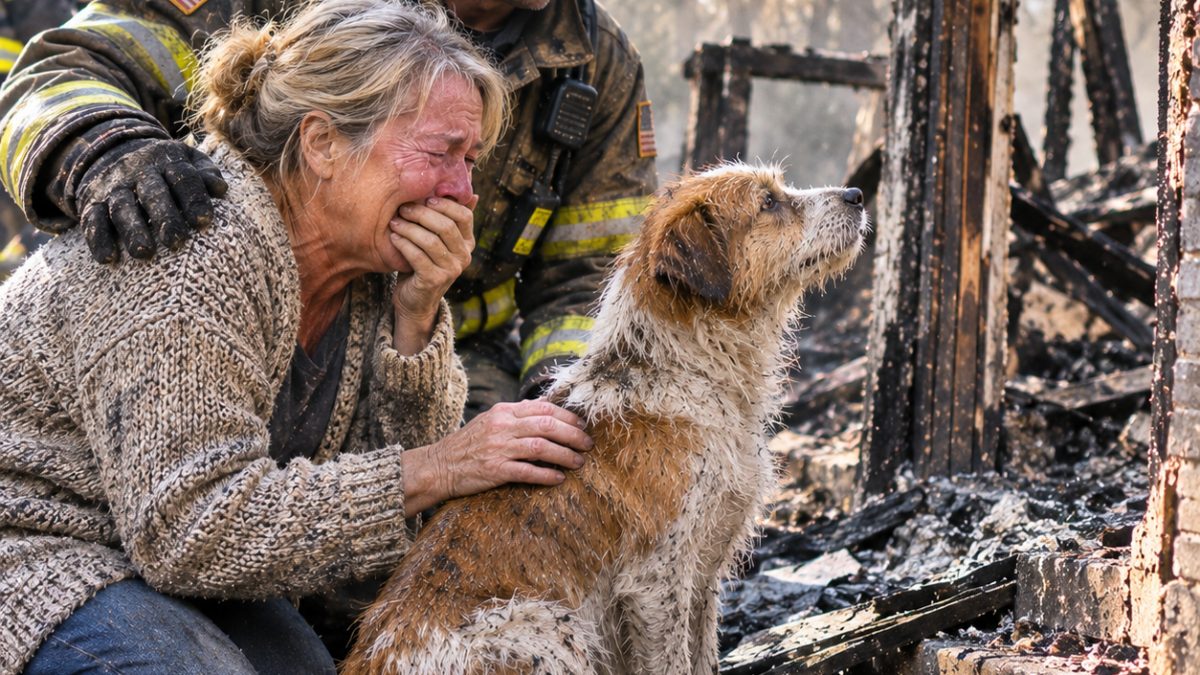
“BARNEY, PLEASE! YOUR HOUSE IS GONE! YOU CAN’T KEEP WAITING HERE!” Mrs. Greenwood sobbed as she knelt beside a little mixed-breed dog sitting in the blackened ruins of a family home, his eyes fixed on the empty space where the front door had stood before the flames destroyed everything. I had been a firefighter for eighteen years, and I had carried the Anderson family—two parents and their two children—out of that burning house, but nobody could explain to Barney that the people he loved were alive in a hospital rather than somewhere behind the doorway that no longer existed. By the ninth morning, when I found him sitting in the same place beneath the gray sky, surrounded by the kindness of an entire neighborhood, I realized this little dog wasn’t simply refusing to leave the ashes—he was waiting for the only family he’d ever known to come home.
The first time I saw Barney sitting in the ashes, I thought he was in shock.
That was the only explanation that made sense.
The house was gone.
Not damaged.
Not partially burned.
Gone.
The walls that had once sheltered a family had collapsed into a blackened skeleton of charred timber, twisted metal, and broken furniture.
Where windows had been, there were empty gaps.
Where the living room had been, there was a mound of ruined material.
And where the front door had stood, there was nothing but a scorched threshold surrounded by debris.
But Barney sat facing that empty doorway.
Waiting.
I remember standing beside the fire engine, still wearing my smoke-stained turnout gear, and watching him.
He was a small, scruffy mixed-breed dog with a brown-and-white coat, short legs, and ears that seemed too large for his head.
Ordinarily, he probably looked like the kind of dog who greeted everyone on the sidewalk.
The sort who followed children around the backyard and curled up beneath the dinner table.
But that morning, he looked different.
His fur was dusty.
His eyes were wide.
His body trembled whenever someone moved too quickly.
And he kept looking toward the spot where the front door had been.
As though any moment, someone might step through it.
“Come on, little buddy,” I whispered.
He turned his head toward me.
For one brief second, I thought he might stand.
Instead, he looked back at the ruins.
I swallowed.
“Your family’s not in there.”
He didn’t move.
I crouched several feet away.
“They’re safe.”
His ears shifted.
I felt my throat tighten.
“They got out, Barney.”
But he kept watching the doorway.
I was exhausted.
My shoulders ached.
My uniform smelled of smoke.
And the muscles in my legs trembled from hours of work.
Yet seeing that little dog waiting for his family hurt more than I expected.
Because I knew something he didn’t.
The Andersons weren’t coming through that doorway.
Not today.
Not tomorrow.
Not ever again.
The house where Barney had spent his life no longer existed.
And nobody had figured out how to tell him.
The fire had started during the night.
I still remembered the dispatch call, the urgency in the voice coming through the radio, and the way the street looked when our engine arrived.
Orange flames were pushing through part of the house.
Smoke rolled across the roof.
Neighbors stood in the street wearing pajamas and coats thrown over their sleepwear.
Someone was shouting that children were still inside.
The sound cut through me.
Even after eighteen years as a firefighter, those words never became ordinary.
Children are still inside.
We moved fast.
The crew established the response.
We entered under dangerous conditions, searching through smoke and heat for the people who hadn’t made it out.
I found Tommy first.
He was a little boy, curled beneath his blanket, frightened and coughing.
I remember lifting him into my arms.
He grabbed my jacket.
And before I could get him toward safety, he asked a question that I would hear in my dreams for weeks.
“Where’s Barney?”
I looked down.
“What, buddy?”
“My dog.”
His little voice broke.
“Where’s Barney?”
I held him closer.
“We’re going to get you out.”
He started crying.
“DON’T LEAVE BARNEY!”
Then the smoke thickened, and I had to keep moving.
The rest of the rescue came in fragments.
My crew locating the other family members.
Their mother.
Their little girl, Emma.
Their father.
The rush of moving them out to emergency medical care.
The roar of the fire behind us.
The terrible knowledge that even a few more seconds inside could change everything.
But all four Andersons survived the fire.
They were injured and needed hospital treatment.
Yet they were alive.
When the last family member was safely out, I thought the worst part of the night was over.
Then, after the flames were brought under control, I found Barney.
Sitting in front of the ruins.
Waiting for a door to open.
A door that no longer existed.
A woman from the house next door approached him with a bowl of water.
“Here, sweetheart,” she whispered.
Barney barely glanced at her.
She put the bowl down.
He looked toward the doorway again.
I watched him for a moment.
Then asked the woman, “Do you know him?”
She nodded.
“Barney. The Anderson family’s dog.”
Her voice trembled.
“He’s been with them for years.”
I looked at the ruins.
“Does he usually stay outside?”
She shook her head.
“No.”
Then she began crying.
“He usually waits at that very door when the children are at school.”
I felt a cold ache spread through my chest.
She pointed toward the charred threshold.
“Every afternoon, he’d hear the car coming, and he’d start wagging his tail.”
I closed my eyes.
“He’d run in circles until Tommy and Emma came out.”
Her voice broke.
“And now he doesn’t understand why they’re taking so long.”
I looked toward Barney.
The little dog was sitting perfectly still.
Facing the doorway.
I wanted to pick him up.
Carry him somewhere warm.
Tell him the people he loved were alive.
But he didn’t know me.
He didn’t know where his family had gone.
And all he’d seen was the world he’d trusted disappear in smoke.
I crouched again.
“Hey, Barney.”
His ears moved.
I swallowed.
“Listen to me, buddy.”
He looked at me.
“Your family made it out.”
His tail didn’t move.
“They’re alive.”
He stared.
“Tommy’s alive.”
At the boy’s name, Barney lifted his head slightly.
My chest tightened.
“Emma’s alive too.”
He looked toward the doorway.
And I realized that the names meant something to him.
But the words hospital and recovering couldn’t explain why the voices he recognized had disappeared.
So I stayed beside him for a while.
And when I finally left that morning, I promised myself I’d come back.
I believed he’d be ready to move by then.
I couldn’t have been more wrong.
PART2
FULL STORY CONTINUATION
When I returned that afternoon, the street was quieter.
The fire engines were gone.
Most of the emergency vehicles had left.
The crowd that had gathered in the middle of the night had scattered back to homes and jobs and responsibilities.
Yellow tape marked areas that were still unsafe.
The smell of smoke hung in the air.
It clung to the trees.
The sidewalk.
The clothes of anyone who came too close.
I parked beside the curb and climbed out.
For a moment, I couldn’t see Barney.
My heart lifted.
Maybe someone had persuaded him to leave.
Maybe a neighbor had taken him inside.
Maybe he’d finally understood there was nothing left to wait for.
Then I saw him.
Same little body.
Same dusty coat.
Same position facing the ruined doorway.
He had barely moved.
I stood beside my truck and watched him.
It was early afternoon.
The sun had risen higher, illuminating the full extent of the damage.
The Anderson house looked worse in daylight.
At night, the flames had made everything terrifying but indistinct.
Now I could see the ordinary things that had been destroyed.
A bent bicycle frame.
The metal skeleton of a chair.
A child’s toy partially hidden beneath fallen debris.
The remains of a picture frame near the front steps.
Things that had once belonged to the routines of a family.
Dinner.
Homework.
Bedtime stories.
Birthday celebrations.
Now they were scattered among ash and broken wood.
And Barney sat among them, facing the place where his people used to appear.
I approached slowly.
“Hey, buddy.”
He turned toward me.
For half a second, his ears lifted.
Then he looked back at the ruins.
I crouched.
“Still waiting?”
His tail didn’t move.
Someone had placed a fresh bowl of water nearby.
The surface was untouched.
I frowned.
“You need to drink.”
Barney looked at me.
I moved the bowl slightly closer without crowding him.
He sniffed the air.
Then turned back toward the door.
I felt frustration rise in my chest.
Not at him.
At the helplessness of it.
I’d spent years being trained to act.
Find the danger.
Make a plan.
Use the equipment.
Get people to safety.
But there was no hose that could put out this kind of grief.
No ladder that could reach into a dog’s mind and show him that his family was alive.
No command I could give that would make him understand what had happened.
I sat on the curb.
And for a long time, we simply looked at the ruins together.
Mrs. Greenwood came out of the neighboring house carrying a plate.
She was an older woman with tired eyes and a cardigan pulled tightly around her shoulders.
“Officer?”
I turned.
“Firefighter,” I said gently. “David.”
She managed a sad smile.
“David. I’m Mrs. Greenwood.”
She looked toward Barney.
“I brought him some food.”
I stood.
“Has he eaten anything?”
She shook her head.
“Not that I’ve seen.”
Her eyes filled.
“I tried this morning.”
She held up the plate.
“I even brought him some beef last night.”
I looked toward the dog.
“What did he do?”
“He sniffed it.”
She paused.
“Then he turned back toward the house.”
Her voice broke.
“As though he was afraid the door might open while he was eating.”
I swallowed.
That thought was unbearable.
Mrs. Greenwood put the plate down a little distance from Barney.
He glanced toward it.
Then toward the empty threshold.
He didn’t move.
“Maybe he’ll eat when we’re gone,” I said.
She nodded, though I could tell she wasn’t convinced.
We stood together.
A breeze pushed a little ash across the ground.
Mrs. Greenwood wiped her cheeks.
“You know, he used to bark at my mailman.”
I glanced toward her.
She gave a small, broken laugh.
“Every single morning.”
I smiled faintly.
“Did he?”
“Oh, yes. Thought he was the neighborhood security officer.”
She shook her head.
“The mailman always carried treats for him.”
I looked at Barney.
A stubborn little dog who used to bark at the mailman.
Who ran in circles when the children came home.
Who probably believed protecting the Anderson family’s front door was his most important job.
Now the door was gone.
The family was gone.
And he was still on duty.
Mrs. Greenwood followed my gaze.
“He’s not going to leave, is he?”
I hesitated.
“We’re going to keep trying to help him.”
She looked toward the empty doorway.
“I don’t think he’ll believe they’re gone unless they come back.”
I swallowed.
“Then we need to find a way to help him understand they’re safe.”
That night, I couldn’t sleep.
I had worked fires before.
Big ones.
Small ones.
House fires.
Vehicle fires.
Incidents where people lost everything they owned.
In eighteen years of service, I’d seen what flames could do to a family.
I’d stood beside people staring at the charred remains of homes they’d spent decades paying for.
I’d watched parents hold children close on sidewalks while their belongings burned behind them.
I’d carried the memories of rescues that went well.
And others that still woke me in the middle of the night.
I understood the terror of fire.
But Barney was different.
He wasn’t a person standing beside a ruined house, able to hear someone explain that his family had been taken to a hospital.
He had no way to understand why the front door was gone.
No way to call his people.
No way to ask whether they were alive.
He only knew that something terrible had happened.
The world had filled with smoke and noise.
The house had disappeared.
His family had vanished.
And the doorway where they had always returned was empty.
I lay in bed staring at the ceiling.
My wife asked whether I was all right.
I told her about Barney.
About the little dog sitting in the ashes.
About the untouched food.
And the way he kept turning back toward the doorway.
She listened quietly.
Then said, “He doesn’t know they’re alive.”
I swallowed.
“No.”
She reached for my hand.
“Can you bring him somewhere safe?”
“We’re working on it.”
I stared toward the window.
“I thought he’d move once the shock wore off.”
My voice tightened.
“But every time I see him, he’s in the same place.”
My wife squeezed my hand.
“He’s waiting for them.”
I closed my eyes.
“Yeah.”
For a long time, neither of us spoke.
Then I whispered, “I wish I could tell him they’re coming back.”
I returned early the next morning.
The second day.
The sun was barely above the rooftops.
The street was quiet except for a few cars heading toward work.
A thin layer of moisture covered the sidewalk.
The ruins looked cold.
And Barney was awake.
Sitting in the same place.
Facing the missing doorway.
The plate of food was untouched.
My heart sank.
Then I noticed the water bowl.
Empty.
I crouched beside it.
“You drank.”
The relief in my voice surprised me.
“At least you drank.”
Barney looked toward me.
His ears moved.
I was grateful, but I knew one drink wasn’t enough to keep him healthy if he continued refusing food.
We’d need to monitor him closely, arrange appropriate veterinary assessment, and keep him away from dangerous debris.
I couldn’t simply admire his loyalty while allowing him to become sick.
I sat on the curb.
He watched me.
Then returned his gaze to the threshold.
I took a breath.
“Hey, Barney.”
His ear moved.
“My name’s David.”
He looked toward me.
“I’m a firefighter.”
I paused.
“I was here the night your house caught fire.”
Barney tilted his head slightly.
I looked toward the ruins.
“I helped get your family out.”
My throat tightened.
“Your people are alive, buddy.”
He watched me.
“Your mom and dad.”
I swallowed.
“Tommy.”
At the boy’s name, Barney’s ears lifted.
I leaned forward.
“Yeah. Tommy.”
He stared.
“He’s alive.”
I felt tears gathering.
“Your little girl, Emma. She’s alive too.”
Barney shifted his front paws.
For one second, I thought he might stand.
Then he settled again.
I took a breath.
“They’re at the hospital.”
His eyes moved toward the ruins.
“They can’t come home yet.”
I pressed my hands together.
“But they’re getting help.”
Barney looked at me.
And I remembered Tommy’s voice inside the burning house.
Where’s Barney?
Don’t leave Barney.
The little boy had been frightened.
He’d been struggling to breathe.
But he’d asked about his dog.
I looked directly at Barney.
“You know what Tommy said when I carried him out?”
His ears moved.
“He asked where you were.”
My voice broke.
“He was worried about you.”
For several seconds, Barney held my gaze.
Then he slowly lowered his head.
I couldn’t know how much he understood.
But the sound of his family’s names had clearly caught his attention.
I sat beside him.
“Just because they’re gone doesn’t mean they stopped loving you.”
Barney looked toward the doorway again.
I swallowed.
“And just because the door is gone doesn’t mean they aren’t coming back.”
That morning, I stayed longer than I’d planned.
The fire station was managing follow-up responsibilities, and I remained in contact with the appropriate people about the site and Barney’s welfare.
We worked to keep him in a safe area away from unstable debris while preserving his view toward the doorway he seemed determined to watch.
A dog sitting beside the remains of a burned house wasn’t automatically safe simply because the flames were extinguished.
There were sharp materials.
Ash.
Potentially unstable structures.
And other hazards that could seriously injure him.
But every time someone tried to lead Barney farther away, he resisted or returned toward the place he’d chosen.
So we adjusted.
We kept the dangerous areas restricted.
Made sure the neighbors knew not to move debris around him.
And began arranging for someone experienced with animals to help monitor his condition.
Mrs. Greenwood kept fresh water nearby.
I continued trying to encourage him to eat.
But mostly, I sat.
Sometimes I spoke.
Sometimes I didn’t.
At one point, Barney shifted closer to the curb.
He was still facing the doorway.
But his body was no longer pressed so tightly against the rubble.
I took that as a small victory.
Not because I wanted him to forget where home had been.
Because I wanted him to survive long enough to see his family again.
Later that day, I took a photograph.
I didn’t usually post personal stories from my work.
Most of what firefighters encounter involves people at vulnerable moments.
I don’t believe their suffering should become entertainment for strangers.
But with care for the family’s privacy, I wanted people nearby to understand Barney’s situation and help us keep him safe.
The photograph showed only the little dog.
Sitting near the charred entrance.
Looking toward the space where the front door had been.
I wrote a short message about him.
About how his family’s home had burned.
How the Andersons were receiving hospital care.
How Barney had remained near the ruins, waiting.
And how we were working with neighbors to make sure he had water, food, shelter, and appropriate care until he could be reunited with his family.
I didn’t expect much response.
Maybe a few neighbors would ask whether we needed supplies.
Maybe someone experienced with frightened animals would offer advice.
I put my phone away and went back to work.
By the following morning, the neighborhood had already begun to change.
And when I turned onto the Andersons’ street, I saw something that made me pull over before I could reach the ruins.
There were people around Barney.
Not a crowd pressing against him.
A small group.
Five or six people gathered nearby.
One young woman was kneeling several feet away, speaking softly.
An older man stood beside her holding a folded blanket.
A teenage girl was replacing a water bowl.
Another neighbor carried food.
And Mrs. Greenwood stood nearby, watching as though she had become the little dog’s unofficial guardian.
I parked.
For several seconds, I sat with my hands on the steering wheel.
Barney was still in his place.
Still facing the ruins.
But something had changed.
He wasn’t ignoring everyone.
He watched the young woman as she spoke.
His ears moved when the teenager put down the fresh water.
And when Mrs. Greenwood approached, he turned his head toward her.
I felt tears gathering.
For two days, he’d looked as though the entire world had disappeared except for the empty doorway.
Now, slowly, he was noticing the people who were trying to care for him.
I got out of the truck.
The young woman looked up.
“Are you David?”
I nodded.
“Yeah.”
She stood.
“I saw your post.”
Her eyes were red.
“I live on the other side of town.”
I looked at her.
“You came all this way?”
She nodded.
“I couldn’t stop thinking about him.”
Her voice trembled.
“A dog waiting for a family who doesn’t know he’s here.”
I swallowed.
She looked toward Barney.
“I didn’t know what I could do.”
Her eyes filled.
“So I came to sit with him.”
For a moment, I couldn’t speak.
Then I said, “That’s a good place to start.”
The older man stepped forward.
His name was Mr. Collins.
He had a gentle face, silver hair, and hands that trembled slightly as he held the blanket.
“I brought this,” he said.
I looked at it.
A thick, warm blanket.
“Thank you.”
He glanced toward Barney.
“It’s supposed to get cold tonight.”
I nodded.
“We can make sure he has a dry, comfortable place to rest.”
Mr. Collins looked toward the burned house.
For a long moment, he said nothing.
Then he spoke quietly.
“I lost my wife five years ago.”
I turned toward him.
He kept looking at the ruins.
“After the funeral, I used to sit on our front porch.”
His voice trembled.
“Every afternoon.”
I swallowed.
He continued.
“I’d look down the street at the time she used to come home.”
He gave a small, sad smile.
“Sometimes I’d hear a car that sounded like hers, and for a second I’d forget.”
His eyes filled.
“I’d think she was coming around the corner.”
The young woman lowered her head.
Mr. Collins looked toward Barney.
“I know he doesn’t understand what’s happened.”
He swallowed.
“But I understand what it means to wait for somebody you love.”
I felt tears run down my cheeks.
For a moment, nobody spoke.
Then Mr. Collins added, “The difference is, his family’s alive.”
I nodded.
“Yes.”
His voice became firmer.
“Then we’ve got to make sure this little fellow is here when they come back.”
I looked toward Barney.
He was watching Mrs. Greenwood as she placed a bowl of food nearby.
Then he looked toward the doorway again.
I wiped my eyes.
“We will.”
By the fourth day, Barney had a little shelter.
A young couple from the neighborhood had built it with plywood, weather-resistant material, and a small roof to keep off the rain.
They positioned it in a safe place where Barney could still see the ruined entrance.
There was a thick cushion inside.
Mr. Collins’s blanket lay across it.
Mrs. Greenwood provided fresh water.
And several neighbors organized a simple schedule so someone could check on him regularly.
I remember standing beside the shelter, looking at how carefully they’d arranged everything.
It wasn’t elaborate.
Just a little protected space beside a house that no longer existed.
But the meaning of it hit me hard.
The Andersons had lost their home.
And without anyone asking, their neighbors had begun building something for the smallest member of the family.
Not a replacement house.
Not a solution to the fire.
Just a safe place where Barney could rest until his people returned.
Mrs. Greenwood stood beside me.
“He went inside last night.”
I turned.
“What?”
“The shelter.”
I looked at her.
She smiled through tears.
“Only for a little while.”
My chest tightened.
“But he used it?”
She nodded.
“I saw him curl up on the cushion.”
I stared toward Barney.
He was sitting just outside the shelter, facing the old doorway.
I smiled.
“That’s good.”
Mrs. Greenwood looked toward the ruins.
“He came back out before morning.”
I nodded.
“Of course he did.”
She glanced at me.
“Still waiting.”
“Yeah.”
I swallowed.
“But at least he’s learning he can wait somewhere comfortable.”
That afternoon, I watched Barney eat for the first time.
Not a full meal.
Nothing close to it.
But a few bites.
Mrs. Greenwood had placed appropriate dog food near the shelter.
We had veterinary guidance on his condition and were keeping an eye on his intake because several days of refusing meals could become dangerous.
The bowl sat untouched for almost an hour.
Then the street grew quiet.
The few volunteers nearby stepped away.
I watched from a respectful distance.
Barney looked toward the ruined doorway.
Then toward the bowl.
He stood.
I held my breath.
He walked over.
Sniffed the food.
Paused.
Then took one small bite.
I pressed a hand against my mouth.
Another bite.
Then a third.
He stopped and turned toward the house.
For a moment, I thought he was going to run back.
But he looked toward the food again.
And ate a little more.
Mrs. Greenwood was standing behind me.
I heard her whisper, “Oh, thank God.”
I turned.
Tears were running down her face.
“He’s eating.”
I nodded.
“Yeah.”
Her voice broke.
“Finally.”
Barney finished the small amount he wanted.
Then walked back to his place.
He sat down.
Facing the empty doorway.
Nothing dramatic had happened.
He hadn’t forgotten his family.
He hadn’t decided to leave.
But he’d accepted food.
He’d allowed himself one small moment of ordinary survival.
And it felt like a victory.
The neighborhood began bringing supplies.
Water.
Suitable dog food.
Clean bedding.
Towels.
Toys.
A few people offered foster care.
Others asked whether Barney could stay with them until the family recovered.
I appreciated every offer.
But we had to balance his physical safety with the obvious distress that came whenever anyone tried to move him away from the area.
Barney wasn’t a public attraction.
He was a frightened animal whose family had been hospitalized after a traumatic event.
We needed calm care.
Not crowds.
So we organized visits and made sure people understood how to approach him.
No sudden grabbing.
No forcing him to interact.
No surrounding him for photographs.
No encouraging children to enter dangerous areas near the damaged structure.
Just quiet help.
Fresh water.
Food.
Shelter.
Appropriate monitoring.
And companionship when he welcomed it.
People listened.
That surprised me.
In my work, emergencies sometimes bring out impatience.
Everyone wants to do something.
Sometimes they want to act before they’ve understood the situation.
But with Barney, the neighborhood gradually learned to slow down.
To let him remain calm.
To notice when he needed space.
To offer care without demanding affection in return.
It was as though this little dog was teaching all of us the same lesson.
Love isn’t always about getting someone to respond the way you want.
Sometimes it’s about showing up without expecting anything.
The children at a nearby school made drawings.
I first saw them on the fifth day.
Mrs. Greenwood had collected a small stack of colorful papers and placed them in a folder so they wouldn’t blow away or become wet.
She showed them to me when I arrived.
There were crayon pictures of Barney beneath a blue sky.
A dog sitting beside a house.
A family holding hands.
Hearts.
Flowers.
Sunshine.
One child had drawn a little brown-and-white dog wearing a red collar, with the words WE LOVE YOU, BARNEY written above him.
Another had drawn a rainbow over a house and four stick figures standing beside a dog.
I studied that one for a long time.
The drawing showed something the real world hadn’t yet given Barney.
His family.
Together.
Smiling.
Standing beside him.
Mrs. Greenwood watched my expression.
“The children wanted to help.”
I nodded.
“They did.”
She smiled sadly.
“They asked whether Barney would like pictures.”
I looked toward the dog.
He was lying on his cushion.
His head was raised.
His eyes were still watching the doorway.
“I think the Andersons will love them when they’re able to see them.”
Mrs. Greenwood wiped her eyes.
“I’ll keep every one.”
I looked at the drawings.
Then nodded.
“Please do.”
Because someday, when the family came home, I wanted Tommy and Emma to know that other children had been thinking about their dog.
Even while they were too sick to be beside him.
That evening, a local restaurant owner arrived carrying food for the people who had been taking shifts watching Barney.
He also asked what appropriate meal could be provided for the dog.
I remember standing beside his car while he unloaded containers.
“You didn’t have to do this.”
He shrugged.
“People have been out here all day.”
I nodded.
He looked toward the ruins.
“And that family has been through enough.”
His voice softened.
“Figured I could at least make sure the neighbors got something to eat.”
I smiled.
“That’s generous.”
He shook his head.
“It’s dinner.”
Then he looked toward Barney.
“Seems like everybody’s doing what they can.”
I followed his gaze.
Mrs. Greenwood was replacing the water.
Mr. Collins was checking the shelter roof.
The young woman who’d traveled across town was sitting nearby, speaking quietly to Barney.
A teenager was organizing the drawings into the folder.
And several people were standing back, simply making sure the little dog wasn’t alone.
I looked toward the restaurant owner.
“Yeah.”
My throat tightened.
“I guess they are.”
The sixth day brought rain.
Not a violent storm.
Just a cold, steady rain that began before sunrise and continued through much of the morning.
I woke to the sound against my bedroom window.
And immediately thought about Barney.
I dressed quickly.
Then drove toward the Andersons’ street.
When I arrived, the road was wet.
Water ran along the curb.
The remains of the house looked darker than ever.
And Barney was inside the little shelter.
His body was curled on the cushion.
The blanket covered part of the bedding.
His head rested near the opening.
He was still facing the empty doorway.
But he was dry.
I stood beside the curb for a moment.
Then let out a breath I hadn’t realized I was holding.
Mrs. Greenwood came out with an umbrella.
“Morning, David.”
I turned.
“Morning.”
She looked toward the shelter.
“He stayed inside.”
I nodded.
“That’s good.”
She smiled faintly.
“I checked on him when the rain started.”
I looked at her.
“Were you awake all night?”
She shrugged.
“Couldn’t sleep.”
I sighed.
“Mrs. Greenwood—”
She held up one hand.
“I know. I know.”
Then she looked toward Barney.
“But that family has been our neighbors for years.”
Her voice softened.
“Mrs. Anderson used to bring me soup when I was sick.”
She paused.
“Mr. Anderson fixed my porch light last winter.”
I listened.
“And Tommy used to come over to help carry groceries.”
Her eyes filled.
“Emma made me a birthday card last year.”
She looked toward the ruins.
“They’ve always been kind to us.”
I swallowed.
She continued.
“Now they’re in the hospital, and I can’t do anything for them.”
I looked toward Barney.
“That’s not true.”
Mrs. Greenwood turned.
I nodded toward the shelter.
“You’re taking care of someone they love.”
Her face crumpled.
For a moment, she couldn’t speak.
Then she whispered, “I hope they know.”
I looked at the little dog.
His head was resting on the cushion.
His eyes were open.
“I think they will.”
The rain continued.
I sat beneath an umbrella near Barney’s shelter.
Mrs. Greenwood eventually returned home to make breakfast.
The street was quiet.
For a while, I listened to rain tapping against the little roof.
Then I began talking.
“Hey, buddy.”
Barney’s ears moved.
“Pretty miserable weather.”
He looked toward me.
I smiled.
“Not exactly a great day for sitting outside.”
His head lowered again.
I glanced toward the ruins.
“Your family would probably tell you to come inside.”
My voice caught.
I remembered that there was no inside.
Not here.
Not anymore.
I looked down.
“I’m sorry.”
Barney watched me.
I took a breath.
“I know you’re waiting.”
He blinked.
“And I wish I could make the waiting easier.”
For a moment, the rain was the only sound.
Then I said something that surprised me.
“Sometimes I think you’ve got more patience than any of us.”
Barney’s ear moved.
I smiled sadly.
“Maybe that’s why dogs are better at love than people.”
He looked toward the doorway.
I followed his gaze.
A little water was running near the old threshold.
Nothing moved behind it.
No family appeared.
No voice called his name.
But Barney kept watching.
And I stayed beside him until the rain eased.
On the seventh day, something else changed.
Mrs. Greenwood arrived with food.
Barney saw her coming.
He stood.
His ears lifted.
Then his tail moved.
Once.
Just a small movement.
Almost nothing.
But enough that Mrs. Greenwood stopped walking.
She looked toward me.
“David.”
I stared.
Barney’s tail moved again.
She pressed a hand against her mouth.
“Did you see that?”
I nodded.
My throat tightened.
“He’s wagging.”
Her eyes filled.
“He knows me.”
I smiled.
“I think he does.”
She crouched near the shelter.
“Hello, sweetheart.”
Barney approached.
Slowly.
He sniffed the food.
Then looked at her.
His tail moved again.
Mrs. Greenwood began crying.
“Oh, Barney.”
She put the bowl down.
And this time, instead of waiting until everyone left, he ate while she was nearby.
Not much.
But enough that we looked at each other in disbelief.
He was beginning to accept care from the people around him.
He still returned to the doorway.
Still looked toward the ruins.
Still refused to leave the area for any length of time.
But the world beyond his lost home was becoming less frightening.
He was allowing people into it.
Mr. Collins visited that afternoon.
He sat on the curb with his hands resting on his knees.
Barney was lying near the shelter.
I stood beside the old man for a while.
Then asked, “How are you doing?”
He smiled sadly.
“Better than him, I suppose.”
I looked toward Barney.
Mr. Collins continued.
“Seeing him like that brings things back.”
I nodded.
“Your wife?”
He swallowed.
“Yes.”
For a moment, he looked toward the sky.
Then he said, “The hardest part wasn’t the funeral.”
I waited.
“It was coming home afterward.”
His voice trembled.
“I’d open the door, and everything would be exactly where she’d left it.”
I listened.
“Her sweater on the chair. Her book beside the bed. Her coffee cup in the cupboard.”
He lowered his eyes.
“I kept expecting to hear her voice.”
I felt a knot form in my throat.
Mr. Collins looked toward Barney.
“This little fellow doesn’t know what happened.”
I nodded.
“No.”
“He knows what he remembers.”
The old man’s voice grew quiet.
“The door. The footsteps. The voices.”
He swallowed.
“That’s what he’s holding on to.”
For several seconds, neither of us spoke.
Then Mr. Collins looked at me.
“But his people are alive.”
I nodded.
“Yes.”
His expression softened.
“Then one day, those footsteps are going to come back.”
I looked toward Barney.
He was still watching the threshold.
And for the first time, I allowed myself to imagine what it might look like when he finally heard Tommy’s voice again.
By the eighth day, Barney had become a quiet part of the neighborhood’s daily routine.
People checked on him before work.
Mrs. Greenwood made sure his water was fresh.
The young woman from across town came when she could.
Mr. Collins sat with him in the afternoons.
The children added more drawings to the folder.
And the restaurant owner continued making sure the volunteers had something to eat.
I came whenever my schedule allowed.
Sometimes I stayed for ten minutes.
Sometimes longer.
I wasn’t the only person responsible for Barney’s care.
That was important.
The neighborhood had become a team.
Each person contributed something small.
And together, those small acts were keeping a frightened dog safe while his family recovered.
I remember arriving that evening and finding Barney resting on his cushion.
His eyes were closed.
For a moment, I stopped walking.
I’d spent so many days seeing him stare toward the doorway that the sight of him sleeping caught me off guard.
He wasn’t sitting rigidly.
He wasn’t alert to every passing car.
He was sleeping.
A deep, peaceful sleep.
I looked toward Mrs. Greenwood.
She smiled.
“He finally rested.”
I nodded.
For a moment, I couldn’t speak.
Then I whispered, “Good boy.”
Barney’s ear moved.
He didn’t wake.
I smiled through tears.
“Get some sleep, buddy.”
And for the first time since the fire, I left the street believing that Barney might be beginning to understand something.
He didn’t have to spend every second watching the doorway in order to remain loyal to his family.
He could rest.
He could eat.
He could accept kindness.
And the people he loved would still be the people he loved when he woke up.
On the ninth morning, the hospital called.
I was at the fire station when the message came through.
For a moment, I thought something had gone wrong.
After nine days of worrying about Barney, I’d almost forgotten how frightened I still was for the Anderson family.
They’d survived the fire.
That much we knew.
But recovery from smoke exposure, injuries, and the shock of losing a home wasn’t simple.
There had been days when the medical updates were cautious.
Days when everyone seemed to be waiting for the next improvement.
Now the hospital had news.
Mr. Anderson was awake and able to speak.
I sat down.
For several seconds, I stared at the wall.
Then I asked about the rest of the family.
His wife was recovering.
Tommy and Emma were out of immediate danger.
All four were alive.
Still needing care.
Still facing a difficult recovery.
But alive.
I pressed my hand against my forehead.
Relief washed over me so suddenly that I nearly laughed.
Then the person on the phone said that Mr. Anderson had been told about Barney.
And one of his first responses was a message for the dog.
“Please tell Barney we’re coming back. Tell him we didn’t abandon him.”
I closed my eyes.
For nine days, I’d been trying to explain that exact thing to a little dog sitting in the ashes.
Now his owner had finally said it.
The words I’d wanted Barney to hear.
The words I’d been unable to give him with the certainty of someone who belonged to his family.
I wrote them down.
Not because I thought I’d forget.
Because they felt too important to leave to memory.
Then I arranged to visit the hospital that evening.
Before leaving the station, I told my crew.
The response was immediate.
Someone smiled.
Another officer leaned back in his chair and let out a breath.
One of the firefighters who’d been at the original incident looked toward me.
“The dad’s awake?”
I nodded.
“Yeah.”
“And the kids?”
“Recovering.”
He closed his eyes.
“Thank God.”
For a moment, the station felt lighter.
People sometimes think firefighters move from one call to another without carrying the people they rescue into the days that follow.
We try to keep functioning.
We have to.
There are always more emergencies.
Another alarm.
Another accident.
Another family whose life can change in minutes.
But certain calls remain with you.
The Anderson house was one of them.
I’d carried Tommy through the smoke.
I still remembered his small hands gripping my jacket.
Still heard him asking about Barney.
Other members of our crew had helped bring Emma and her parents to safety.
We’d worked together in a house that was rapidly becoming too dangerous to remain inside.
Now we knew the family was recovering.
I looked toward the crew.
“I’m going to see Mr. Anderson tonight.”
One of them nodded.
“Tell him we’re glad they’re doing better.”
“I will.”
Then another firefighter asked, “What about the dog?”
I smiled sadly.
“Still waiting.”
The room grew quiet.
I looked toward the window.
“But now we’ve got something to tell him.”
I arrived at the hospital that evening with a knot in my stomach.
I’d seen Mr. Anderson during the rescue, but not like this.
Not awake.
Not able to speak.
Not sitting in a bed with medical equipment nearby and a hospital gown replacing the clothes he’d worn on the night of the fire.
When I entered the room, he looked toward me.
His face bore signs of what he’d endured.
He was tired.
Weak.
Still recovering.
But his eyes were clear.
“David?”
I nodded.
“Mr. Anderson.”
He tried to sit straighter.
I stepped forward.
“Please, don’t strain yourself.”
He looked at me.
Then his eyes filled.
“You were there.”
I nodded.
“Yes, sir.”
“You helped get us out.”
I swallowed.
“My crew and I did.”
He pressed his lips together.
For a moment, he couldn’t speak.
Then he whispered, “My children.”
His voice broke.
“You saved my children.”
I looked down.
Images from the fire returned.
Smoke.
Heat.
Tommy beneath the blanket.
His terrified voice asking for Barney.
I took a breath.
“We’re glad all of you made it out.”
Mr. Anderson began crying.
Not loudly.
The tears simply rolled down his face.
He wiped them away with a trembling hand.
“I don’t remember everything.”
I nodded.
“That’s understandable.”
“I remember the smoke.”
His eyes moved toward the window.
“And then somebody telling me to keep moving.”
I didn’t interrupt.
He looked back at me.
“If you hadn’t come…”
His voice failed.
I shook my head gently.
“We’re here now.”
He stared at me.
Then nodded.
I pulled a chair closer.
“There’s something I want to tell you.”
His expression changed.
He leaned forward.
“Barney?”
I smiled sadly.
“Yes.”
His eyes immediately filled again.
“Is he all right?”
The question came so quickly that it caught me off guard.
I nodded.
“He’s alive, and we’ve been making sure he’s cared for.”
Mr. Anderson closed his eyes.
“Oh, thank God.”
I waited.
He looked at me.
“Where is he?”
I took a breath.
“Near the house.”
His face tightened.
“The house?”
I nodded.
“Mr. Anderson, Barney didn’t leave the area after the fire.”
He stared.
I continued.
“He’s been sitting near the old front entrance.”
For several seconds, he didn’t move.
Then he whispered, “What?”
I swallowed.
“He keeps looking toward the place where the front door used to be.”
Mr. Anderson’s eyes widened.
“Since the fire?”
“Yes.”
He shook his head slowly.
“No.”
His voice broke.
“No, not Barney.”
I leaned forward.
“He’s been receiving food, water, shelter, and attention. Neighbors are helping, and we’re monitoring his condition.”
But Mr. Anderson was already crying.
“He’s waiting for us.”
I nodded.
“Yes.”
He pressed a hand over his face.
“Oh, my God.”
I waited.
His shoulders began shaking.
“Barney…”
He could barely speak.
“That little dog.”
I looked down.
“I’ve been trying to tell him you’re alive.”
Mr. Anderson looked toward me.
I continued.
“I tell him Tommy and Emma are safe.”
His eyes filled again.
“He reacts when I say their names.”
Mr. Anderson began crying harder.
“Of course he does.”
He shook his head.
“He loves those kids.”
I nodded.
“I can tell.”
For a long moment, the room was quiet except for his breathing.
Then he whispered, “We got him before Tommy was born.”
I looked up.
Mr. Anderson smiled through tears.
“Barney was our first baby.”
He told me about the day they’d brought Barney home.
A little scruffy puppy who had been too small to climb onto the couch without help.
He’d slept in a basket beside their bed.
Chewed a pair of shoes.
Stolen socks.
And once managed to knock over a plant that had been sitting in the same place for years.
Mr. Anderson laughed through his tears.
“My wife said he was going to drive us crazy.”
I smiled.
“Did he?”
“Every day.”
Then his expression softened.
“But she adored him.”
I listened.
“When Tommy was born, we brought him home from the hospital.”
He looked toward the ceiling.
“Barney sniffed his blanket.”
His voice broke.
“And after that, wherever Tommy was, Barney wanted to be nearby.”
I felt my throat tighten.
Mr. Anderson continued.
“When Emma started learning to walk, Barney followed her around the living room.”
He smiled.
“She’d wobble two steps and fall onto her bottom.”
He paused.
“And Barney would go right over and sit beside her.”
I pictured it.
A little girl learning to balance.
A scruffy mixed-breed dog following close behind.
Mr. Anderson wiped his eyes.
“He slept near their bedrooms.”
He looked at me.
“Every night.”
I nodded.
“He sounds like a wonderful dog.”
Mr. Anderson’s face crumpled.
“He’s family.”
The words came out with such force that I sat completely still.
“He’s not just some animal we kept in the yard.”
His voice shook.
“He was there before the children.”
He swallowed.
“He watched them grow up.”
I looked toward the floor.
“And now he’s sitting in the ashes because he doesn’t know where we went.”
I felt tears filling my eyes.
Mr. Anderson covered his face.
“I wish I could go to him.”
For several minutes, I let him cry.
He’d lost his home.
His family had been hospitalized.
They’d survived, but their lives had been turned upside down.
And now he’d learned that the dog who had been part of every family routine for years was sitting outside the ruins, waiting.
There wasn’t anything I could say that would make that painless.
Finally, he looked up.
“Can you bring him here?”
I hesitated.
“We’d need to coordinate with the hospital and the people caring for him. I don’t want to promise something we haven’t arranged.”
Mr. Anderson nodded.
His expression fell.
“I understand.”
I looked at him.
“But we’re going to keep working toward getting you together as soon as it’s appropriate.”
His eyes filled again.
He whispered, “Please.”
I nodded.
“We will.”
He looked toward the window.
Then something changed in his expression.
“Could you bring him something?”
I sat straighter.
“Something from us?”
“Yes.”
He swallowed.
“Something that smells like home.”
My heart tightened.
He looked at me.
“Barney knows our clothes.”
I nodded.
“He always sleeps near the kids’ things.”
His eyes filled.
“Maybe if he smelled them, he’d understand we’re still here.”
I took a breath.
“I think that’s worth exploring.”
He reached for my hand.
“Please tell him we didn’t leave him.”
His voice broke.
“Tell him we didn’t choose to go.”
I swallowed hard.
“I will.”
With the family’s permission and help from hospital staff, we gathered a few familiar belongings.
A small blanket that had been with Emma.
Tommy’s favorite baseball cap.
And a T-shirt belonging to their mother.
Nothing expensive.
Nothing irreplaceable.
Just ordinary things that carried familiar scents.
I held them carefully.
The blanket was soft.
The cap looked well worn.
The shirt was folded neatly.
For a moment, I thought about how much meaning people attach to things that seem unimportant to strangers.
A cap wasn’t merely a cap to Tommy.
It was something he loved wearing.
A little blanket could make Emma feel safe.
A familiar shirt was part of the everyday smell of home.
And for Barney, those objects might offer a connection no explanation from me had been able to provide.
Mr. Anderson watched as I prepared to leave.
“David?”
I turned.
“Yes?”
He swallowed.
“Will you tell me what he does?”
I nodded.
“Of course.”
His eyes filled.
“And please…”
He paused.
“Don’t let him think we’ve forgotten him.”
My throat tightened.
“We won’t.”
It was dark when I returned to the Anderson house.
The streetlamps cast pale circles across the sidewalk.
The ruins stood behind the safety perimeter, silent and black.
The little shelter sat near the place where Barney had kept watch.
I could see him beneath it.
A small shape on the cushion.
Head raised.
Facing the empty doorway.
I stopped walking.
For a moment, my chest hurt.
Nine days.
Nine nights.
And still, he looked toward the place where his family should have appeared.
I approached slowly.
“Barney.”
His ears lifted.
He turned.
“Hey, buddy.”
His tail moved slightly.
I crouched.
“I saw your dad.”
He looked at me.
“Mr. Anderson.”
His ears lifted again.
I smiled through tears.
“He’s awake.”
Barney took a step toward me.
I swallowed.
“And he asked about you.”
I set the bundle down gently.
“I brought something.”
Barney sniffed the air.
His posture changed.
He lowered his head.
Moved closer.
And approached the blanket.
At first, he simply sniffed it.
Then he paused.
His ears moved forward.
He sniffed again.
Longer this time.
Then his nose moved toward the baseball cap.
I watched him.
He pressed his muzzle into the cap.
His entire body became still.
Then he moved toward the T-shirt.
He sniffed it.
And began trembling.
I felt tears spilling down my cheeks.
“Oh, Barney.”
He returned to the blanket.
Sniffed it again.
Then lowered himself onto the familiar belongings.
His muzzle disappeared into the soft fabric.
And he made a sound I’d never heard from him before.
A low, trembling whine.
Not the sharp cry of an animal in sudden pain.
Something quieter.
Almost like a breath that had been held too long.
I pressed a hand against my mouth.
Because I couldn’t know exactly what he understood.
But I could see that those familiar scents mattered.
They had reached him in a way my words couldn’t.
I leaned closer.
“That’s Emma’s blanket.”
His ears moved.
“That’s Tommy’s hat.”
He pressed his nose deeper into the fabric.
“And that’s your mom’s shirt.”
His tail moved once.
I swallowed.
“They’re still here, buddy.”
The tears wouldn’t stop.
“Your family’s still here.”
Mrs. Greenwood appeared beside me a few minutes later.
She had seen my vehicle and come outside.
When she noticed the belongings, she stopped.
“Oh, David.”
I looked up.
Her eyes were already wet.
“Where did you get those?”
“The hospital.”
She pressed a hand against her chest.
“The Andersons?”
I nodded.
“Mr. Anderson’s awake.”
Her face crumpled.
“Oh, thank God.”
I glanced toward Barney.
“He asked me to bring something familiar.”
Mrs. Greenwood looked down.
Barney had settled completely onto the blanket.
His muzzle rested against Tommy’s cap.
The T-shirt was partly beneath his paws.
For a moment, she couldn’t speak.
Then she whispered, “He recognizes them.”
I nodded.
“It certainly seems that way.”
She crouched slowly.
“Oh, Barney.”
The little dog closed his eyes.
Mrs. Greenwood began crying.
“He’s finally resting with something from home.”
I looked toward the ruined house.
The old home was gone.
The rooms.
The furniture.
The front door.
But Barney still had the smell of the people he loved.
And for that night, it was enough to let him close his eyes.
I called Mr. Anderson afterward.
He answered with a weak voice.
“David?”
I swallowed.
“I brought the things.”
There was silence.
Then, “What happened?”
I looked toward Barney.
He was resting on Emma’s blanket.
“He recognized the scents.”
Mr. Anderson made a small sound.
I continued.
“He sniffed every item.”
My voice trembled.
“Then he lay down on the blanket and put his nose against Tommy’s cap.”
The line went quiet.
For several seconds, I heard only breathing.
Then Mr. Anderson began crying.
“He remembers us.”
I closed my eyes.
“Yes.”
He swallowed.
“My boy remembers us.”
I looked toward the shelter.
The little dog was finally sleeping.
“He hasn’t forgotten you.”
Mr. Anderson cried harder.
Then whispered, “Tell him we’re coming.”
I stared at the ruins.
“I will.”
He paused.
“And David?”
“Yes?”
“Thank you for not giving up on him.”
I swallowed.
I thought about Mrs. Greenwood.
Mr. Collins.
The young woman from across town.
The children and their drawings.
The couple who’d built the shelter.
The restaurant owner who kept bringing food.
I shook my head.
“I’m not the only one helping.”
Mr. Anderson’s voice broke.
“I know.”
I looked toward Barney.
“Your whole neighborhood is waiting with him.”
The tenth day felt different.
Barney was still beside the ruins.
Still watching the doorway.
But he was no longer sitting on bare ground with nothing familiar around him.
Emma’s blanket lay on his cushion.
Tommy’s baseball cap rested near his paws.
Their mother’s T-shirt had been folded beside the bedding.
He moved between those things and the spot where he had kept watch.
Sometimes he rested.
Sometimes he approached the ruined threshold as far as the safe area allowed.
Sometimes he returned to the shelter, sniffed the blanket, and settled down again.
Mrs. Greenwood told me he’d eaten that morning.
A proper amount.
Not just a few reluctant bites.
I felt relief spread through my chest.
“Really?”
She nodded.
“He was hungry.”
I looked toward Barney.
The little dog was drinking from his bowl.
I smiled.
“Good.”
Mrs. Greenwood wiped her eyes.
“He still watches the door.”
I nodded.
“I know.”
“But he’s sleeping now.”
I looked at her.
“And eating.”
She smiled sadly.
“Maybe he’s starting to believe he can wait without hurting himself.”
I looked toward the ruined house.
That was exactly what I’d been hoping for.
Barney’s loyalty was beautiful.
But I never wanted his devotion to become the reason he stopped caring for his own body.
He needed to survive.
He needed rest.
And he needed to be healthy enough for the moment everyone was waiting for.
The moment his family came back.
That afternoon, I visited the hospital again.
Mr. Anderson looked stronger.
He was still recovering, but he was more alert and able to speak for longer periods.
His wife remained under care nearby.
The children were doing better.
And whenever someone mentioned Barney, Mr. Anderson’s expression changed.
The exhaustion remained.
The sadness over the house remained.
But there was something else now.
Determination.
He wanted to recover.
Not just for himself.
For his wife.
For Tommy and Emma.
And for the little dog who had spent ten days waiting outside a doorway that no longer existed.
I sat beside his bed.
“How are you feeling?”
He gave a tired smile.
“Better.”
Then he looked directly at me.
“How’s Barney?”
I laughed softly.
“I knew that was coming.”
He smiled.
“Sorry.”
“Don’t be.”
I told him about the food.
The water.
The shelter.
The blanket.
And the way Barney was becoming more comfortable around the neighbors.
Mr. Anderson listened to every word.
Then asked, “Does he still sit in front of the house?”
I hesitated.
“Yes.”
His eyes filled.
I continued.
“But he’s resting more. He’s accepting care. He’s not ignoring everyone anymore.”
Mr. Anderson nodded slowly.
“That sounds like Barney.”
I looked at him.
“He’s stubborn?”
He laughed.
“Oh, you have no idea.”
I smiled.
He looked toward the window.
“When Tommy was little, he used to try to teach Barney tricks.”
I leaned back.
“How’d that go?”
Mr. Anderson laughed.
“Barney would sit if he felt like it.”
I chuckled.
“And if he didn’t?”
“He’d stare at Tommy until Tommy gave him the treat anyway.”
I laughed.
Mr. Anderson smiled through tears.
“That dog has always known exactly what he wants.”
His expression softened.
“And right now, he wants us.”
I swallowed.
“Yeah.”
He looked toward me.
“Is there any way he could hear my voice?”
I sat straighter.
“What do you mean?”
“On the phone, maybe.”
I thought about it.
Then nodded slowly.
“We may be able to arrange a video call with the hospital’s permission.”
His eyes brightened.
“Really?”
“We’ll need to coordinate it.”
He reached toward me.
“Please.”
I smiled.
“Let’s see what we can do.”
Mrs. Greenwood loved the idea.
When I called her, she immediately offered her tablet.
“I can bring it down tomorrow.”
I smiled.
“Thank you.”
“Do you think Barney will recognize them?”
I paused.
“I don’t know how he’ll respond to a screen.”
She was quiet.
“But he knows their voices.”
I thought about the way his ears lifted when I said Tommy’s name.
“Yes.”
“He certainly recognizes familiar sounds.”
Mrs. Greenwood took a breath.
“Then maybe hearing Mr. Anderson will help.”
I looked toward the hospital arrangements.
“That’s what we’re hoping.”
She was silent for a moment.
Then asked, “Should we have everybody there?”
I shook my head.
“I think it should be quiet.”
She understood immediately.
“Just a few of us.”
“Yes.”
“We don’t want to overwhelm him.”
“Exactly.”
She sighed.
“Okay.”
Then her voice softened.
“David?”
“Yes?”
“I’ve been praying for that little dog.”
I looked down.
“I know.”
“And for the family.”
I swallowed.
“Me too.”
The video call happened on the eleventh day.
I arrived early.
Mrs. Greenwood was already there.
She had her tablet, a portable stand, and a towel she’d brought to protect it from dust.
Barney was resting beneath the little shelter.
His muzzle lay against Emma’s blanket.
Tommy’s cap was tucked near his front paws.
When I approached, his ears lifted.
“Hey, buddy.”
His tail moved.
I smiled.
“Got a surprise for you.”
He looked toward me.
Then toward the ruins.
I crouched.
“I think you’re going to like this one.”
Mrs. Greenwood set up the tablet.
We kept the area quiet.
Mr. Collins sat farther down the sidewalk.
The young woman from across town stood nearby.
None of us knew what to expect.
Maybe Barney would ignore the screen.
Maybe he’d be confused by the sounds.
Maybe hearing his family without being able to reach them would upset him.
We had to be ready to stop if he became distressed.
But we also knew how much he reacted to the familiar names and belongings.
The call connected.
For a moment, the screen showed the hospital room.
Then Mr. Anderson’s face appeared.
He was sitting upright.
His expression was tired.
But when he saw Barney, his eyes immediately filled.
“Oh, my God.”
I swallowed.
“Mr. Anderson?”
He nodded.
“I’m here.”
Mrs. Greenwood adjusted the tablet so he could see Barney.
For a moment, the little dog looked toward the screen.
His head tilted.
He sniffed the air.
Then looked away.
I felt my heart sink.
Maybe this wouldn’t work.
Maybe the image meant nothing to him.
Then Mr. Anderson spoke.
“Barney.”
The dog’s ears lifted.
Every muscle in his body seemed to change.
Mr. Anderson leaned toward the camera.
“Barney, buddy.”
The dog stood.
I froze.
Mr. Anderson’s voice broke.
“Hey, my boy.”
Barney turned directly toward the tablet.
His head tilted.
His ears stood forward.
Then he took a step.
Another.
And rushed toward the sound.
“Barney!”
Mr. Anderson was crying now.
“That’s my boy!”
Barney reached the tablet.
He sniffed it.
His nose bumped the screen.
Then he began licking it.
Once.
Twice.
Again.
His tail was moving so fast his whole body shook.
I stared.
For eleven days, I’d watched this dog sit facing a ruined doorway.
I’d watched him ignore food.
Refuse to move.
Wait through rain.
Sleep beneath a little shelter while a neighborhood tried to keep him safe.
Now he was standing in front of a tablet, wagging his tail with a joy I hadn’t seen since the fire.
He made a high, trembling whine.
Then another.
Mrs. Greenwood covered her mouth.
Mr. Collins bowed his head.
The young woman beside us began crying.
On the screen, Mr. Anderson was holding one hand over his face.
“Barney.”
The dog’s ears lifted again.
“It’s Daddy.”
Barney pushed his nose toward the tablet.
I felt tears spill down my cheeks.
Mr. Anderson smiled through his own tears.
“I’m here, buddy.”
Barney whimpered.
His tail kept moving.
Mr. Anderson leaned closer.
“We’re coming back.”
His voice broke.
“Do you hear me?”
Barney stared at the screen.
“We haven’t forgotten you.”
I covered my mouth.
Mr. Anderson continued.
“Mommy’s getting better.”
He swallowed.
“Tommy and Emma are getting better too.”
Barney’s ears moved at the children’s names.
Mr. Anderson began crying harder.
“We’re coming home to you.”
For a moment, he couldn’t speak.
Then he whispered, “Just a little longer.”
Barney slowly sat down.
Not facing the ruined doorway.
Facing the tablet.
His tail still moved gently against the ground.
Mr. Anderson smiled through tears.
“That’s my good boy.”
I knelt beside Barney.
He glanced at me.
Then immediately returned his attention to the screen.
I laughed through my tears.
“Yeah, buddy.”
My voice broke.
“That’s him.”
The call lasted only as long as everyone could comfortably manage.
Mr. Anderson was still recovering, and we didn’t want to exhaust him.
But before it ended, he asked if he could speak to Barney one more time.
Mrs. Greenwood nodded.
“Of course.”
She positioned the tablet carefully.
Barney was sitting in front of it.
His ears lifted when his owner’s face filled the screen again.
Mr. Anderson smiled.
“Hey, buddy.”
Barney’s tail moved.
“You’ve been taking care of everybody, haven’t you?”
I felt my throat tighten.
Mr. Anderson swallowed.
“Good boy.”
He looked directly toward the camera.
“We’re going to see you soon.”
Barney tilted his head.
Mr. Anderson smiled through tears.
“And when we do, I’m going to hold you so tight.”
His voice broke.
Then he whispered, “I love you, Barney.”
The little dog gave one short bark.
I froze.
Mrs. Greenwood gasped.
Mr. Anderson stared.
Then he began laughing and crying at the same time.
“There he is!”
Barney barked again.
A small, excited sound.
Mr. Anderson wiped his face.
“That’s my boy.”
The call ended a moment later.
For several seconds, nobody moved.
Barney kept looking at the darkened screen.
Then he sniffed it once more.
He turned toward me.
His tail moved.
I crouched beside him.
“Pretty good surprise, huh?”
He approached my hand.
Touched it with his nose.
Then walked back toward the shelter.
He settled on Emma’s blanket.
But this time, when he looked toward the ruined doorway, I didn’t see the same desperate stillness I’d seen on the first morning.
I saw a dog who had heard his family again.
I didn’t know what he understood.
But I knew what I’d witnessed.
For eleven days, Barney had waited.
And finally, a familiar voice had answered him.
After the video call, the neighborhood’s mood changed.
People were still worried about the family.
Still helping Barney.
Still saddened by the house.
But hope had become something we could talk about with greater certainty.
The Andersons were recovering.
Mr. Anderson was awake.
The children were safe.
And Barney had heard his owner’s voice.
Mrs. Greenwood continued bringing food.
Mr. Collins still visited.
The young woman from across town returned with quiet words and a gentle smile.
The drawings from the school grew into a small collection that Mrs. Greenwood promised to give the children.
But now, when people came to see Barney, they didn’t speak only about what had been lost.
They spoke about the reunion.
About how excited Tommy would be.
About whether Emma would cry when she saw him.
About how Barney might react when the family finally appeared.
Sometimes I worried we were getting ahead of ourselves.
The Andersons still needed to recover.
Their home was gone.
They didn’t yet have a permanent place to live.
There were medical and practical problems that wouldn’t disappear simply because Barney was waiting.
But when I looked at that little dog lying beside his family’s belongings, I understood why everyone needed something hopeful to imagine.
The fire had taken so much.
The reunion was something it hadn’t managed to take.
Over the following days, Barney continued improving.
He ate.
Drank.
Rested.
And increasingly accepted the care offered by the neighbors.
He still spent much of his time near the ruined doorway, but he no longer seemed unable to move away for even a moment.
He would approach Mrs. Greenwood when she arrived.
Sometimes he walked a short distance with someone he trusted, within the arrangements made for his safety.
Then he’d return to the shelter and settle on the blanket.
I watched those changes with relief.
The little dog was no longer simply enduring the days.
He was beginning to participate in them.
One afternoon, I found him investigating a toy someone had brought.
It was a small rubber ball.
He sniffed it.
Pushed it with his nose.
Then watched it roll a few inches across the ground.
I stared.
“Barney?”
His ears lifted.
I smiled.
“You remember how to play?”
He looked toward the ball.
Then nudged it again.
It rolled toward my boot.
I picked it up.
Held it where he could see it.
Then set it down nearby.
He sniffed it.
His tail moved.
I laughed.
For the first time since the fire, I heard myself laugh while standing near the ruins.
And the sound felt almost strange.
There was still grief here.
Still loss.
Still a family trying to recover.
But there was life too.
A little dog nudging a ball across the pavement.
A neighbor smiling at his progress.
A firefighter realizing that recovery sometimes announces itself through the smallest, most ordinary things.
By the end of the third week, the news everyone had been waiting for finally arrived.
The Anderson family was going to be discharged from the hospital.
All four of them.
Still recovering.
Still needing time to heal.
And still facing the enormous challenge of rebuilding their lives after losing their home.
But they would be together.
I was at the station when I received confirmation of the reunion arrangements.
For a moment, I couldn’t speak.
Then I sat down and looked at the little photograph of Barney I’d kept on my phone.
The one from the second day.
His dusty body sitting in the ashes.
His eyes fixed on the missing doorway.
I remembered thinking he might never understand what had happened.
Now I was about to help bring his family back to him.
I closed my eyes.
And began crying.
One of my fellow firefighters came over.
“David?”
I wiped my face.
“Yeah?”
“Everything okay?”
I nodded.
Then laughed weakly.
“Yeah.”
He looked concerned.
I held up the phone.
“Barney’s family.”
His expression changed.
“What about them?”
“They’re coming out of the hospital.”
He stared.
“All of them?”
I nodded.
“All four.”
For a moment, he just stood there.
Then he smiled.
A huge, genuine smile.
“Man.”
He shook his head.
“That little dog is going to lose his mind.”
I laughed through tears.
“Yeah.”
I looked at the photograph again.
“I think he is.”
We chose a small park near the Andersons’ neighborhood for the reunion.
The family wasn’t ready for a long, exhausting event.
They had been through too much.
The parents were still weak.
The children needed rest.
And none of them was physically prepared to stand for hours surrounded by people.
So we planned something simple.
A quiet place with grass.
A few benches.
Enough room for Barney to move comfortably.
And people he already recognized nearby.
That was the plan.
But the word spread through the neighborhood.
Mrs. Greenwood wanted to be there.
Mr. Collins wanted to come.
The young woman who’d driven across town on the third day asked if she could watch from a distance.
The couple who built Barney’s shelter arrived.
The restaurant owner came.
Some of the children who had drawn pictures wanted to give them to Tommy and Emma.
Before long, it seemed as though everyone who had helped Barney through those terrible weeks wanted to witness the moment he’d been waiting for.
I understood.
They had all become part of his story.
They’d brought water when he wouldn’t drink.
Food when he wouldn’t eat.
Blankets when he wouldn’t rest.
A shelter when the rain came.
And patient company when he refused to leave the place where the front door had stood.
They didn’t want applause.
They wanted to see the little dog finally stop waiting.
I arrived at the park early.
Barney was there with Mrs. Greenwood.
He stood on the grass beside her, sniffing the ground.
For a moment, the sight startled me.
Grass.
Not ash.
Sunlight.
Not smoke.
A park.
Not the ruins.
He looked almost like an ordinary family dog again.
His coat had been cleaned.
His eyes were bright.
His tail moved when Mrs. Greenwood spoke.
I approached slowly.
“Hey, Barney.”
He lifted his head.
Then trotted toward me.
I crouched.
“Well, look at you.”
He sniffed my hand.
His tail wagged.
I smiled.
“Got a big day ahead of you, buddy.”
His ears lifted.
I stroked his neck gently.
“You have no idea.”
Mrs. Greenwood stepped closer.
“Do you think he’ll know them?”
I looked up.
Her eyes were filled with tears.
I smiled.
“Mrs. Greenwood, he recognized Mr. Anderson’s voice through a tablet.”
She laughed nervously.
“I know.”
I glanced toward the road.
“I think he’s going to know.”
She nodded.
Then looked toward Barney.
“He’s been waiting so long.”
I swallowed.
“Yeah.”
For a moment, we stood quietly.
Then Mrs. Greenwood whispered, “I can’t believe it’s finally happening.”
Mr. Collins arrived carrying the blanket he’d brought for Barney during the first days.
He’d washed it carefully.
Folded it.
And tucked it beneath his arm.
I smiled when I saw him.
“Still looking after him?”
The old man gave a small laugh.
“Somebody has to.”
I looked toward the blanket.
“Are you going to give that to the family?”
He nodded.
“I thought they might want it.”
His expression softened.
“Barney seemed to like it.”
I swallowed.
“I’m sure they will.”
He looked toward the dog.
Barney was standing beside Mrs. Greenwood.
His tail moved gently.
Mr. Collins watched him for a moment.
Then said, “You know, I’ve been thinking about what I told you.”
I turned.
“About your wife?”
He nodded.
I waited.
“About sitting on the porch after she died.”
His eyes lowered.
“I used to think the waiting was the worst part.”
I said nothing.
He looked toward Barney.
“But sometimes the hardest thing isn’t waiting.”
His voice trembled.
“It’s believing there’s no reason to hope anymore.”
I felt my throat tighten.
Mr. Collins wiped one eye.
“That little dog never stopped expecting his people to come back.”
He smiled sadly.
“And this time, the people he was waiting for really are coming.”
I looked toward the road.
“Yes.”
Mr. Collins took a long breath.
“Then I think this is going to be a good day.”
The children who had made the drawings stood with their parents near the benches.
They held the pictures in a neat folder.
One little girl asked me whether Barney would remember them.
I crouched beside her.
“I think he’ll remember the people who have been kind to him.”
She looked toward the dog.
“Even though we didn’t know him before?”
I smiled.
“Kindness doesn’t require knowing someone for years.”
She thought about that.
Then looked toward the folder.
“I made him a rainbow.”
I nodded.
“It’s beautiful.”
She smiled.
“Can I give it to Tommy?”
“Of course.”
She looked toward the road.
Then whispered, “I hope they’re happy.”
My throat tightened.
“Me too.”
The car arrived in the late afternoon.
I saw it turn toward the park.
For a moment, everything inside me went still.
I recognized the vehicle.
We’d coordinated the family’s arrival.
I knew exactly when to expect them.
But knowing wasn’t the same as seeing.
I looked toward Mrs. Greenwood.
She saw my expression.
Then turned.
The car slowed near the curb.
Barney lifted his head.
His ears moved forward.
He stared.
I felt my heart begin pounding.
“Barney,” I whispered.
The car stopped.
For one second, nobody moved.
Then a door opened.
And Tommy stepped out.
He was still recovering.
He moved carefully.
But when he saw Barney, his face changed completely.
“BARNEY!”
The sound tore through the park.
Barney froze.
His ears shot up.
Then his entire body seemed to come alive.
His tail began wagging.
He took one step.
Then another.
Then he ran.
I’ve watched firefighters run toward burning buildings.
I’ve watched frightened people run toward safety.
I’ve watched children run into the arms of parents they thought they’d lost.
But I have never seen anything quite like Barney running toward Tommy that afternoon.
His short legs moved as fast as they could.
His ears bounced.
His tail swung wildly behind him.
And he didn’t look toward the ruins.
Didn’t stop to investigate the grass.
Didn’t hesitate.
He had heard the voice he’d been waiting for.
And nothing else mattered.
“BARNEY!”
Tommy dropped carefully to his knees.
The little dog reached him.
Then launched himself into the boy’s arms.
Tommy wrapped both arms around him.
Not tightly enough to hurt him.
Just desperately enough to hold him close.
And began crying.
“Oh, Barney!”
The dog whimpered.
Licked his face.
Wagged his tail.
Turned in his arms.
Then pushed closer.
Tommy buried his face in the dog’s fur.
“I’M HERE!”
His voice broke.
“I’m here, Barney!”
I pressed a hand against my mouth.
Because I remembered another version of that voice.
A frightened boy beneath a blanket.
Smoke surrounding us.
His little hands gripping my turnout jacket.
Where’s Barney?
Don’t leave Barney.
Now that same boy was kneeling on green grass with his dog alive in his arms.
And I couldn’t stop crying.
Emma came next.
She stepped out of the car and saw her brother holding Barney.
For a moment, she stopped.
Then her face crumpled.
“BARNEY!”
The dog lifted his head.
His ears turned toward her voice.
He wriggled free from Tommy’s arms.
Then ran to Emma.
She knelt.
He reached her.
And began licking her face so enthusiastically that she burst into laughter and tears at the same time.
“BARNEY, STOP!”
But she was hugging him even as she said it.
He licked her cheek.
Then her chin.
Then her nose.
Emma laughed harder.
“I MISSED YOU!”
Her voice broke.
“I missed you so much!”
Barney whimpered.
His tail never stopped moving.
He turned toward Tommy again.
Then back to Emma.
As though he couldn’t decide which child to greet first.
And after spending so many days waiting for both of them, he didn’t seem willing to let either disappear from his sight.
I watched Emma bury her face in his fur.
Then whisper something I could barely hear.
“I thought you were gone.”
My throat tightened.
She held him close.
“I thought the fire took you too.”
Barney pressed against her.
Emma began crying again.
Then whispered, “You’re here.”
I closed my eyes.
For a moment, I could hear nothing but her voice.
“You’re really here.”
Mrs. Anderson stepped out of the car.
She moved slowly, still recovering from the injuries and exhaustion of the fire.
Her eyes were already filled with tears.
She saw Barney between the children.
Then pressed one hand over her mouth.
“Oh, my baby.”
Barney turned.
His ears lifted.
Then he ran toward her.
She lowered herself carefully onto a bench near the car.
Barney reached her knees.
He stood on his hind legs for a moment, trying to get closer.
Then settled as she stroked his head.
“Oh, Barney.”
Her voice broke.
“My sweet boy.”
He licked her fingers.
She began crying.
“I thought we’d lost you.”
Barney whined softly.
She rested her forehead against his.
“I thought we’d lost everything.”
Her shoulders shook.
Then she looked toward Tommy and Emma.
Her children were alive.
Her husband was recovering.
And the little dog they’d loved before either child was born was standing beside her.
She stroked his ears.
“Not everything.”
Her voice became a whisper.
“We didn’t lose everything.”
Then Mr. Anderson stepped out.
He moved slowly.
His face still carried the signs of his injuries.
He paused beside the open car door.
For several seconds, he simply watched.
His children.
His wife.
And Barney.
The little dog he’d told me about in the hospital.
The puppy who’d come home before Tommy was born.
The dog who’d been there when Emma took her first steps.
The dog who slept near the children’s rooms.
The dog who had waited outside a burned house for nine days because he didn’t know his family was alive.
Mr. Anderson pressed one hand against his chest.
His eyes filled.
“Barney.”
The dog stopped.
Slowly, he turned.
Then he heard the voice again.
“Hey, buddy.”
Mr. Anderson’s face crumpled.
“It’s Daddy.”
Barney ran.
Not as wildly this time.
Almost as though he had to look twice to believe what he was seeing.
He reached Mr. Anderson.
Stopped.
Sniffed him.
Then his whole body began trembling with excitement.
Mr. Anderson bent carefully, allowing Barney to approach without jumping against his injured body.
The dog pushed his head into his hands.
And Mr. Anderson began sobbing.
“Oh, Barney.”
He stroked the little dog’s face.
“I’m sorry.”
His voice broke.
“I’m so sorry we were gone.”
Barney wagged his tail.
Mr. Anderson pressed his forehead gently against the dog’s head.
“We didn’t leave you.”
I felt tears roll down my cheeks.
“We didn’t forget you.”
Barney whimpered softly.
Mr. Anderson looked into his eyes.
“We came back.”
Then he said the words I’d been waiting three weeks to hear.
“We’re all here now, buddy. Your whole family is here.”
The park went quiet.
Not completely.
There were still birds calling.
Cars passing beyond the trees.
The wind moving through the grass.
But the people watching seemed to fall silent together.
Mrs. Greenwood was crying.
Mr. Collins had one hand over his eyes.
The young woman from across town stood beside the benches, tears running freely down her face.
The restaurant owner looked away, swallowing hard.
The children holding their drawings stood motionless.
And I remained a little distance from the reunion, wearing my firefighter’s uniform, watching the family I’d carried out of a burning house hold the dog who had waited for them.
I didn’t move closer.
Didn’t interrupt.
Didn’t try to become part of their moment.
Because it wasn’t mine.
I’d helped save the Andersons.
The neighborhood had helped care for Barney.
But that moment belonged to a family and their dog.
I stood quietly and watched.
Barney moved between them.
Tommy.
Emma.
Their mother.
Their father.
Back to Tommy.
Then Emma again.
He whimpered.
Barked.
Wagged his tail.
Pressed his body against their legs.
Every few seconds, he seemed to need another touch.
Another familiar voice.
Another confirmation that they were all really there.
For days, he’d stared toward an empty doorway.
Now his family was surrounding him.
And he couldn’t seem to get enough of them.
After a while, Mr. Anderson looked toward me.
“David?”
I stepped closer.
He was sitting on the bench with Barney pressed against his knee.
“Yes, sir?”
His eyes filled.
“I don’t know what to say.”
I smiled gently.
“You don’t have to say anything.”
He shook his head.
“No.”
His voice broke.
“I do.”
He looked toward his wife and children.
Then toward Barney.
“You saved us.”
I swallowed.
“My crew and I did our jobs.”
Mr. Anderson nodded.
“But you came back for him.”
I looked toward the dog.
He was resting his chin on Tommy’s knee.
Mr. Anderson continued.
“You made sure he wasn’t forgotten.”
My eyes filled.
I shook my head.
“Your neighbors did most of that.”
He looked around.
Mrs. Greenwood smiled through tears.
Mr. Collins lowered his eyes.
The young woman from across town wiped her cheeks.
Mr. Anderson stared at them.
Then said, “You all took care of him?”
Mrs. Greenwood stepped closer.
“Of course we did.”
Her voice broke.
“He’s family.”
Mr. Anderson began crying again.
He looked at the people gathered near the benches.
“I don’t know how to thank you.”
Mr. Collins stepped forward.
He was still carrying the folded blanket.
He handed it to Mr. Anderson.
“This was Barney’s.”
Mr. Anderson looked at the fabric.
His face crumpled.
Mr. Collins smiled sadly.
“He used it while he waited.”
For a moment, Mr. Anderson couldn’t speak.
Then he took the blanket.
Held it against his chest.
And whispered, “Thank you.”
The children brought their drawings.
Tommy opened the folder.
Emma leaned beside him.
They looked through the pictures one by one.
Barney beneath a rainbow.
Barney beside a house.
Barney surrounded by hearts.
A little brown-and-white dog standing with four smiling people.
Emma began crying when she saw that one.
“Look, Daddy.”
Mr. Anderson leaned closer.
She pointed toward the drawing.
“That’s us.”
He swallowed.
“Yes, sweetheart.”
She touched the picture.
“And Barney.”
He nodded.
“And Barney.”
Tommy looked toward the children who’d made the drawings.
“Thank you.”
His voice was quiet.
But everyone heard him.
One of the children smiled shyly.
“We wanted him to know people loved him.”
Tommy looked down at his dog.
Barney was sitting beside his feet.
His tail moved gently.
Tommy stroked his head.
“He knows.”
The Andersons didn’t have a permanent home to return to that evening.
The fire had destroyed the house.
There were belongings to replace.
Documents to recover.
Medical appointments to attend.
And all the practical difficulties that come when a family survives a disaster but loses the place where their daily lives had unfolded.
Their recovery would take time.
I understood that.
I’d seen it before.
Being rescued from a burning house doesn’t mean the suffering ends when the fire is extinguished.
Sometimes the hardest work begins afterward.
But as I watched Mr. Anderson help his wife toward the car, with Tommy, Emma, and Barney close beside them, I knew something important had changed.
They were facing those difficulties together.
The children had their parents.
The parents had their children.
And Barney had all four of them.
He no longer needed to sit in the ashes, listening for footsteps that never came.
He had heard those footsteps.
He had recognized those voices.
And now, when the family prepared to leave the park, Barney walked toward the car with them.
He paused only once.
He looked toward me.
His ears lifted.
For a brief moment, I remembered the dog from the first day.
Dusty.
Still.
Staring through the place where the front door had disappeared.
I crouched.
“Go on, buddy.”
His tail moved.
“Your family’s waiting.”
Tommy called from beside the car.
“Barney!”
The little dog turned immediately.
And ran to him.
I laughed through tears.
“That’s right.”
I watched him climb safely into the vehicle with his family.
“Go home.”
The crowd began dispersing slowly.
People hugged one another.
Mrs. Greenwood cried against Mr. Collins’s shoulder.
The young woman from across town stood beside the bench for a long moment, staring toward the road where the Andersons had driven away.
Then she turned toward me.
“I don’t think I’ll ever forget that.”
I nodded.
“Neither will I.”
She looked toward the grass.
“Do you think Barney understood that they were coming?”
I thought about the question.
About the nine days of waiting.
The familiar belongings.
The video call.
The way he’d reacted to Mr. Anderson’s voice.
Then I looked toward the road.
“I don’t know exactly what he understood.”
I paused.
“But I know he recognized them when they came.”
Her eyes filled.
I continued.
“And I know he wasn’t going to let them out of his sight again.”
She smiled through tears.
Then nodded.
Mrs. Greenwood walked beside me toward the parking area.
She looked exhausted.
For three weeks, she’d spent much of her time caring for a dog who wasn’t hers.
Bringing food.
Replacing water.
Checking on him when it rained.
Keeping the little shelter clean.
And making sure he didn’t face every night alone.
Now Barney was gone.
I wondered how empty her mornings would feel.
I turned toward her.
“You okay?”
She smiled.
“I think so.”
Then her eyes filled.
“I got used to seeing him outside.”
I nodded.
“Yeah.”
She looked toward the road.
“It’ll be strange tomorrow.”
I smiled gently.
“He’ll be with his family.”
She laughed softly.
“I know.”
Then she began crying.
“That’s why I’m happy.”
I touched her shoulder.
“You did a wonderful thing.”
She shook her head.
“I only fed him.”
I looked at her.
“You fed him when he wouldn’t eat.”
Her expression changed.
I continued.
“You brought water when he wouldn’t drink.”
I looked toward the empty park.
“You kept coming back when he couldn’t understand why his family hadn’t.”
Mrs. Greenwood wiped her eyes.
I smiled.
“That wasn’t a small thing.”
She looked down.
Then whispered, “I just couldn’t leave him there.”
I nodded.
“Neither could I.”
Three weeks earlier, I’d stood in front of a burning house and believed the only thing that mattered was getting the family out alive.
And it was the most urgent thing.
The lives of the Andersons depended on what our crew did that night.
But the days that followed taught me something I hadn’t fully understood in eighteen years of service.
Rescue isn’t always finished when the emergency vehicles leave.
Sometimes there are lives that remain frightened after the danger has passed.
Sometimes the people you’ve saved are lying in hospital beds, wondering whether they’ll ever see their loved ones again.
Sometimes a dog sits beside the ashes because the only world he understands has vanished.
And sometimes an entire neighborhood has to help carry the weight of what happened until a family is strong enough to come together again.
I thought about the people who had gathered around Barney.
Mrs. Greenwood with her bowls of food.
Mr. Collins with his blanket.
The young woman who traveled across town to sit quietly beside him.
The couple who built his shelter.
The children who drew pictures.
The restaurant owner who brought meals.
None of them could rebuild the Anderson house overnight.
None could erase the injuries or undo the terror of the fire.
But they could make sure Barney was fed.
Warm.
Safe.
And never entirely alone.
That mattered.
It mattered more than any of them seemed willing to admit.
Several months later, the Anderson family moved into a new house.
It wasn’t as large as the old one.
The rooms were different.
The yard was smaller.
There were still boxes stacked in corners and possessions they hadn’t been able to replace.
But it was theirs.
A place where Tommy could put his school things by the door.
Where Emma could leave her shoes in the hallway.
Where Mr. and Mrs. Anderson could sit together at the dinner table.
And where Barney had a soft bed waiting for him.
I visited not long after they moved in.
Mr. Anderson opened the door.
He looked healthier.
Still tired at times, but stronger.
“David.”
I smiled.
“Good to see you.”
He stepped aside.
“Come in.”
Before I could take another step, I heard claws clicking against the floor.
Then a familiar bark.
Barney appeared from the hallway.
His ears lifted.
His tail began wagging.
I laughed.
“Hey, buddy!”
He hurried toward me.
Sniffed my boots.
Then looked up as though he recognized the man who had spent so many mornings sitting beside him in the ashes.
I crouched.
“Look at you.”
He pressed his head against my hand.
I stroked his ears.
“No more waiting outside, huh?”
His tail moved.
Mr. Anderson smiled.
“He still likes the front door.”
I looked up.
“Really?”
He nodded.
“Every morning.”
I felt my stomach tighten.
I followed him toward the living room.
A window looked out across the small front porch.
And there, near the entrance, was a comfortable spot where Barney could sit in the sunlight.
Mr. Anderson looked toward it.
“He sits there after breakfast.”
I stared.
The memory of the ruined doorway returned so suddenly that I had to swallow.
“Does he wait for you?”
Mr. Anderson smiled.
“Sometimes.”
He looked toward Barney.
“But now he knows we’re coming back.”
Tommy joined us.
He was carrying a small rubber ball.
Barney immediately noticed.
His tail began moving faster.
Tommy laughed.
“He wants to play.”
I smiled.
“Looks like it.”
The boy rolled the ball gently across the floor.
Barney trotted after it.
Picked it up.
Then returned.
He dropped it near Tommy’s shoes.
Tommy laughed.
“Good boy!”
I watched them.
And thought about the first morning.
The dog who wouldn’t move from the ashes.
The boy who’d been carried through smoke while asking where his best friend was.
Now they were playing together in a living room.
Ordinary.
Safe.
Alive.
My eyes filled.
Emma appeared next.
She walked toward Barney and wrapped her arms gently around his neck.
“He sleeps near my room now.”
I smiled.
“Does he?”
She nodded.
“Sometimes he comes to check on me.”
Mr. Anderson laughed.
“Every night.”
Emma looked toward her father.
“He’s making sure I’m okay.”
I swallowed.
Then looked toward Barney.
Maybe she was right.
Or maybe he simply liked being close to his family.
Either way, watching him move from one child to the other made me happier than I could explain.
Mrs. Anderson came into the room carrying coffee.
She smiled when she saw me.
“David.”
I stood.
“Mrs. Anderson.”
She set the tray down.
Then stepped closer.
For a moment, her eyes filled.
“Thank you.”
I shook my head.
“Your family has thanked me more than enough.”
She smiled sadly.
“I don’t think we ever could.”
I looked toward Barney.
He was lying beside Tommy, the rubber ball between his paws.
Mrs. Anderson followed my gaze.
“He’s different now.”
I turned.
“What do you mean?”
She thought for a moment.
“He still loves the door.”
She smiled.
“But he isn’t frightened every time somebody leaves the room.”
I nodded.
“He knows this is home.”
Her expression softened.
“I think so.”
She looked toward her children.
“And I think we all needed time to learn that.”
For a moment, none of us spoke.
Then she added, “Some nights I still wake up thinking I smell smoke.”
My throat tightened.
She looked down.
“Sometimes Tommy gets scared when he hears a loud noise.”
I nodded slowly.
“That’s understandable after what you’ve been through.”
She took a breath.
“We’re getting help. We’re working through it.”
I smiled gently.
“I’m glad.”
She looked toward Barney.
“He helps.”
I turned.
She continued.
“When one of the kids gets upset, he goes over and sits beside them.”
Her eyes filled.
“He doesn’t fix anything.”
She smiled sadly.
“But somehow, having him there makes the room feel less frightening.”
I looked at the little dog.
His eyes were half closed.
His tail moved whenever Tommy touched him.
I swallowed.
“He did that for the neighborhood too.”
Before I left, Mr. Anderson walked me to the porch.
The sun was beginning to set.
Barney followed us.
He settled near the front door and looked out toward the street.
For a moment, I stopped walking.
Because the sight was so familiar.
A little brown-and-white dog.
Sitting beside a doorway.
Looking toward the world outside.
But this time, everything was different.
The door was intact.
The house was standing.
His family was inside.
The air smelled of dinner instead of smoke.
And when Tommy called his name from the living room, Barney turned immediately.
His tail moved.
I looked toward Mr. Anderson.
“He still sits in the same kind of place.”
Mr. Anderson nodded.
“Yeah.”
I smiled.
“But he doesn’t have to wonder where everybody went anymore.”
Mr. Anderson looked down at his dog.
His eyes filled.
“No.”
He crouched beside Barney.
The little dog pressed his head against his hand.
Mr. Anderson stroked his ears.
“He knows we’re here.”
I looked toward the open doorway.
Inside, Emma was laughing.
Tommy was calling Barney to play.
Mrs. Anderson was moving around the kitchen.
The sounds of an ordinary family evening drifted onto the porch.
Sounds that had once existed in a house reduced to ashes.
And for a moment, I couldn’t speak.
I still pass the Anderson family’s new home sometimes.
Usually on my way back from the station.
When I do, I slow down.
Not enough to disturb traffic.
Just enough to glance toward the porch.
Sometimes Barney is there.
Lying in the sunlight.
Sometimes he’s sitting beside the front door.
Sometimes Tommy is in the yard throwing a ball.
Sometimes Emma is crouched beside him, laughing.
And sometimes I don’t see him at all.
Which makes me smile.
Because it means he may be inside.
Sleeping.
Eating.
Playing.
Living the ordinary life that seemed impossible during those nine days beside the ashes.
Every time I pass, I remember the burned house.
The empty doorway.
The untouched food.
The little dog refusing to move.
I remember the water bowl that was finally empty on the second morning.
The first few bites of food.
The blanket Mr. Collins brought.
The rain falling against the little shelter.
The drawings made by children who’d never met the Andersons.
The video call.
And Barney rushing toward a tablet because he’d recognized his father’s voice.
But most of all, I remember the park.
Tommy climbing out of the car.
The sound of his voice.
“BARNEY!”
And the little dog running toward him.
No hesitation.
No confusion.
Just recognition.
Joy.
And a reunion that made an entire neighborhood cry.
I’ve been a firefighter for eighteen years.
I’ve rescued people from smoke-filled homes.
Responded to accidents.
Watched families lose things they could never replace.
And learned that courage often looks nothing like it does in movies.
Sometimes it looks like a firefighter entering a dangerous building.
Sometimes it looks like a parent shielding a child.
Sometimes it looks like a neighbor bringing food to someone who has lost everything.
And sometimes it looks like a little dog sitting beside the ruins of his home, refusing to give up on the people he loves.
I don’t believe Barney understood the fire the way we did.
He didn’t know why the house had burned.
He didn’t know what a hospital was.
He couldn’t understand why his family had vanished while strangers came and went.
But he knew their voices.
Their scents.
Their routines.
The front door where they’d always appeared.
And he held on to those familiar things until we could help him find the people who mattered most.
We didn’t save Barney by forcing him to forget.
We helped him survive while he remembered.
And when his family was finally strong enough to come back, he was there to greet them.
The night after my visit to their new house, I sat on my own porch for a while.
The air was cool.
The street was quiet.
A few lights glowed in the neighboring windows.
I thought about something Mr. Collins had told me.
How he’d sat on his porch after losing his wife.
How he’d listened for a familiar car.
How he’d struggled with the empty space where someone he loved used to be.
Then I thought about Barney.
And about the difference between their stories.
Mr. Collins had to learn to live with a loss that couldn’t be undone.
Barney had been waiting for a family that was still alive.
The neighborhood couldn’t promise him a reunion until we knew the family would recover.
But people could sit with him.
Feed him.
Keep him safe.
And remind him, through their presence, that he hadn’t been forgotten.
I looked toward the stars.
For the first time, I understood something that years of firefighting hadn’t fully taught me.
You don’t always have to take someone away from their grief to help them.
Sometimes you have to sit beside them while they move through it.
Sometimes you have to bring a blanket.
A bowl of water.
A familiar shirt.
Sometimes you simply have to keep coming back.
Until the day when something changes.
Until the day when a voice returns.
Until the day when the waiting finally ends.
People sometimes ask me what happened to Barney.
I tell them he went home.
Not to the house that burned.
Not to the doorway he watched for nine days.
That doorway was gone forever.
He went home to his family.
To Tommy.
To Emma.
To their mother and father.
To a different house with a new front door.
And a patch of sunlight on the porch.
The house was smaller.
The rooms were unfamiliar.
But Barney didn’t seem to care about the size of the living room or the shape of the windows.
He cared about the voices inside.
The hands that reached down to pet him.
The children calling his name.
The sound of his family returning at the end of the day.
That’s what home had always meant to him.
Not bricks.
Not wood.
Not a particular address.
The people he loved.
And when they walked through that new front door, Barney finally had the one thing he’d been waiting for.
I still remember the ninth morning most clearly.
The gray sky.
The cold air.
The little shelter.
The dog sitting beside the ruins.
And the certainty in his posture.
He didn’t know whether anyone would come.
He couldn’t understand how the fire had changed everything.
But he hadn’t forgotten the family that had loved him.
Then, three weeks after the flames destroyed their house, Barney heard Tommy’s voice in a park and ran faster than I’d ever seen his little legs move.
That sound—the boy shouting his dog’s name—will stay with me for the rest of my life.
Because I’d heard the same boy speak that name through smoke.
Terrified.
Clinging to my jacket.
Begging me not to leave Barney behind.
And somehow, after everything they’d been through, they found each other again.
The fire destroyed the Anderson family’s home, but it never destroyed the bond that had made Barney sit beside the ashes and wait.
He had no way to understand where his people had gone.
So the neighborhood came to him.
They kept him warm.
They made sure he ate.
They stayed with him through the rain and the lonely nights.
And when the day finally came, they stood together and watched his world become whole again.
Today, Barney still sits beside a front door.
But he no longer sits in ashes.
He sits in sunshine.
He no longer watches a doorway that can never open.
He watches a real one.
A door that opens when Tommy comes home.
When Emma runs outside.
When Mr. Anderson steps onto the porch.
When Mrs. Anderson calls everyone in for dinner.
And when Barney hears those familiar footsteps, his tail begins to move.
Because this time, he doesn’t have to wonder whether his family is coming back.
They’re already home.








