The Five-Week-Old Kitten Didn’t Even Try to Run When I Reached for Him — But What I Discovered After Taking Him Home Made My Blood Run Cold.
FULL STORY CONTINUATION
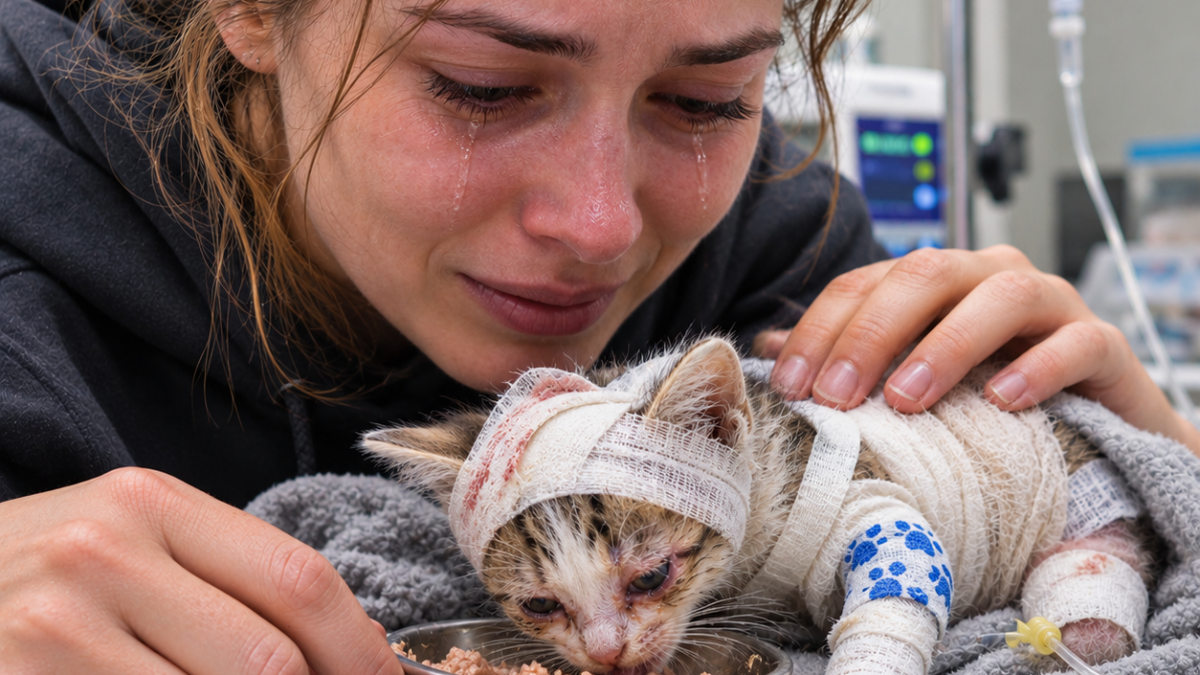
He paused after only a few bites.
For a second, I felt the familiar knot of worry tighten inside me.
“That’s okay,” I whispered. “You don’t have to rush.”
Kefir looked down at the food again.
Then he took another bite.
And another.
It wasn’t a dramatic moment. There was no sudden burst of strength, no miraculous transformation, no triumphant leap from his blankets.
It was simply a tiny kitten eating.
But I had never been so grateful to watch an animal do something so ordinary.
I stayed close, careful not to crowd him.
He ate a little more, stopped, and seemed content to rest.
I wanted him to finish everything. I wanted him to grow stronger immediately. I wanted to skip ahead to the day when he would be healthy, playful, and completely unconcerned with the world outside his safe little room.
But none of those things could be rushed.
Kefir was only five weeks old when he was found.
His body was small. His needs were constant. His recovery would have to happen at its own pace.
So I learned to celebrate what he could do instead of demanding more.
That day, he had eaten.
That was enough.
I couldn’t know what he understood about the people surrounding him. Perhaps he recognized the smell of his blankets or the familiar movements of the people who brought his meals.
Perhaps he was simply beginning to feel more comfortable.
But something was changing.
In the days that followed, I saw him take a little more interest in the food we offered.
Sometimes he ate eagerly enough to make me smile.
Other times, he took a few bites and settled back down.
I stopped expecting every meal to look the same.
What mattered was that he was eating, resting, and receiving the attention he needed.
I began noticing how much of my own day revolved around his tiny routines.
Had he eaten?
Was he comfortable?
Was his blanket still arranged the way he liked it?
Had he changed his resting position?
Was he watching us when we entered?
These questions might have sounded ridiculous to someone who had never rescued an animal as young as Kefir.
But when you have held a kitten so small that his entire body fits easily in your hands, you discover that the smallest details can occupy your whole heart.
I knew he wasn’t the first kitten to be rescued from the street.
There were countless animals who needed warmth, food, shelter, and veterinary attention.
I knew that caring for him wouldn’t change the circumstances facing every abandoned or vulnerable animal.
But it changed his circumstances.
And at that moment, that was what mattered.
Kefir didn’t need me to save the whole world.
He needed me to help make his world safe.
So I kept returning.
Sometimes, I would sit near him without reaching for him immediately.
He would rest in his blankets, his tiny body looking almost lost among the soft folds.
I learned to appreciate the quiet.
Before finding him, I might have expected a kitten’s recovery to be measured by how quickly he began running around.
Now I understood that peace was a milestone of its own.
He could sleep without the noise and uncertainty of the street surrounding him.
He had a warm place to return to.
He didn’t need to search for shelter when he grew tired.
For a young kitten, those things were not luxuries.
They were necessities.
And Kefir was finally receiving them.
I still remembered the moment I found him.
Sometimes the memory came back while I watched him sleep.
The empty space around his tiny body.
The way he sat without moving.
The terrible feeling of lifting him and realizing how little he weighed.
I wondered what had happened before I arrived.
Had he been separated from his mother only recently?
Had he wandered somewhere unfamiliar and become too tired to go farther?
Had someone passed him without realizing he needed help?
There was no way to know.
I could have invented explanations, but they wouldn’t have changed anything.
The truth was simple.
Kefir had been alone when I found him.
And now he wasn’t.
That was the beginning of everything.
One afternoon, as I approached his resting place, I noticed that he was watching my hand.
I moved carefully, letting him see me coming.
“Hello, little Kefir.”
He stayed where he was.
That wasn’t unusual.
But as my fingers moved closer, his little head shifted.
For a moment, I thought he was simply adjusting his position.
Then he moved toward my hand.
Only slightly.
The movement was so small that I almost missed it.
I stopped.
“Did you just do that?”
He leaned closer.
My throat tightened.
I let my fingers gently touch him.
He remained there, allowing the contact.
Then, rather than pulling away or merely tolerating my hand, he leaned into it.
I couldn’t help smiling.
“Oh, sweetheart.”
He didn’t know why this felt so important.
To him, perhaps it was nothing more than a pleasant touch.
But to me, it was a glimpse of the kitten I had been hoping to meet since that first day on the street.
The kitten beneath the exhaustion.
The kitten beneath the uncertainty.
The kitten who had been too small to defend himself and too quiet to explain what he needed.
He was beginning to show us what he liked.
And one of the things he liked was being close.
I stayed with him a little longer.
I stroked him gently, stopping whenever he seemed ready to rest.
I didn’t want to overwhelm him with the affection I had spent days wanting to give.
Trust, I reminded myself, was something an animal needed to experience, not something a human could demand.
So when he settled back into his blanket, I let him.
“Good boy,” I whispered.
He closed his eyes.
And for the first time, the image of Kefir curled up in silence didn’t make my heart ache in quite the same way.
He looked comfortable.
Safe.
At peace.
That night, I thought about how often we misunderstand what a rescued animal needs from us.
We want visible gratitude.
We want the dramatic moment when the animal leaps into our arms, licks our faces, or seems to understand that we have saved its life.
But animals don’t owe us those moments.
Kefir didn’t owe me affection simply because I had lifted him from the street.
He didn’t owe anyone playfulness, confidence, or a quick recovery.
He was a baby who needed care.
My responsibility wasn’t to make him demonstrate how grateful he was.
It was to give him enough safety that he could begin behaving like himself.
And slowly, that was happening.
His world was becoming bigger than his blanket.
At first, it happened almost without my noticing.
He would lift his head when something moved nearby.
His gaze would follow an object a little longer.
He would shift his front paws, as though considering whether whatever had caught his attention was worth investigating.
Sometimes, he decided it wasn’t.
He would settle down again.
Other times, his curiosity lasted.
He would move closer to the edge of his resting space and look around.
I watched these little decisions with ridiculous fascination.
“What’s that, Kefir?”
He would study whatever had caught his attention.
“Are you going to investigate?”
Sometimes he did.
Sometimes he looked at me and seemed to decide that sleeping was a better idea.
I laughed more during those moments than I had during the first few days.
There was something wonderful about seeing a little personality emerge.
Not a personality that someone had invented for him.
His own.
Quiet.
Curious.
Increasingly interested in the people around him.
I began noticing how he responded when someone entered his space.
He wasn’t always eager to move.
Some days he still preferred the comfort of his blankets.
But he seemed more aware of the familiar presence surrounding him.
When a hand approached, he often leaned toward it.
When someone remained nearby, he sometimes stayed close rather than retreating to his resting place.
And before long, he began choosing the company of the people caring for him.
The first time I noticed him settling beside someone without being placed there, I found myself staring.
He wasn’t asking for food.
He wasn’t being held.
He had simply moved close and stayed.
“Look at you,” I whispered.
Kefir remained where he was.
I sat down nearby, afraid that my excitement might disturb the quiet little moment.
It was strange how much emotion could fit into something so simple.
A kitten sitting beside a person.
That was all.
But I remembered the street.
I remembered walking toward him and seeing no movement.
I remembered the terrible uncertainty I felt as I carried him away.
And now, instead of being alone in a place he didn’t understand, he was choosing to rest near someone familiar.
He had somewhere he wanted to be.
More importantly, he seemed to believe he was allowed to stay there.
I didn’t know whether Kefir remembered the street.
Perhaps he had no clear memory of it at all.
He was so young that I couldn’t begin to guess what those first experiences meant to him.
But I remembered.
And I always would.
I remembered enough for both of us.
There were moments when the tenderness of caring for him surprised me.
I could be doing something completely ordinary when I suddenly thought of how he had looked on the day we met.
Then I would look over and find him resting comfortably, and the contrast would take my breath away.
His situation had changed without a single grand gesture.
No one had needed to make a speech.
No one had performed a miracle.
Someone had noticed him.
Someone had carried him somewhere safe.
And people had continued caring for him afterward.
That was how his life began to improve.
One ordinary act of kindness followed by another.
I wished more people understood how important that second part was.
Finding an animal in distress is emotional.
You see a creature who needs help, and the instinct to act can be overwhelming.
But rescue doesn’t end when the animal leaves the street.
For a kitten like Kefir, that moment was only the beginning.
He needed food the following day.
He needed warmth the following night.
He needed someone to notice whether he was improving.
He needed patience when he wasn’t ready to play.
He needed people who wouldn’t become discouraged because his recovery didn’t happen as quickly as they hoped.
And he needed those things again and again.
I began to understand that the most important promises are often the quiet ones.
The promises we keep through our actions.
I couldn’t explain to Kefir that he was safe.
I couldn’t tell him that his meals would continue.
I couldn’t make him understand why I had picked him up or why strangers were now caring for him.
But I could keep making sure he had what he needed.
And over time, he could experience that consistency for himself.
Perhaps that was why he began leaning into our hands.
Perhaps that was why he started sitting near us.
Perhaps he simply liked being warm and comfortable.
Whatever the explanation, I loved watching him discover affection on his own terms.
There was no dramatic turning point where he suddenly became a different kitten.
He was still Kefir.
The same little life I had found on the street.
But he was gaining the freedom to do things that fear, exhaustion, or uncertainty might once have prevented.
And that freedom revealed itself most clearly when he began to explore.
The first time I saw him reach toward something nearby, I held still.
His paw extended.
He touched the unfamiliar object.
Then he looked at it.
I waited.
He reached again.
A small, tentative movement.
Nothing spectacular.
But I found myself smiling so widely that my cheeks hurt.
“That’s it,” I whispered. “Go ahead.”
He investigated a little more.
And I realized that we were seeing something I had desperately wanted for him.
Curiosity.
At five weeks old, he should have been full of it.
He should have been learning about the world through touch, movement, and play.
Now, at last, he was beginning to reclaim those experiences.
The space around him was no longer merely somewhere to survive.
It was somewhere to explore.
He could notice something new without having to run from danger.
He could move toward an object and discover that nothing frightening happened.
He could retreat when he became tired.
And when he did, his blankets were waiting.
I wondered whether anyone who had seen him on the street would recognize the difference.
Physically, he was still a small kitten.
But his behavior was changing.
There was more intention in his movements.
More interest in his surroundings.
More willingness to interact.
One day, that curiosity became something unmistakable.
Play.
It began with the same little movements I had been watching for days.
A paw stretching forward.
A small shift in position.
A moment of attention directed at something nearby.
Then he reached again with an unmistakable playfulness that made me laugh.
“Kefir!”
He continued.
I covered my mouth for a moment because I was smiling so hard.
There he was.
A kitten doing what kittens are supposed to do.
He wasn’t performing for anyone.
He wasn’t trying to prove he had recovered.
He was simply interested in the world.
And for me, that was enough to make the entire journey feel different.
I remembered the first day when he had done little more than curl into his blanket.
I remembered watching him eat those first few bites, hoping he would take one more.
I remembered the first time he leaned into my hand.
Every one of those small moments had led here.
To a tiny paw reaching toward something interesting.
To a young animal discovering that life contained more than resting and waiting.
To the simple joy of play.
“Look at you,” I said softly. “You’re finally getting to be a kitten.”
He couldn’t understand the words.
But I hoped the gentleness of my voice felt familiar.
I didn’t want to turn his first playful moments into something overwhelming.
He still needed rest.
He still needed care.
He was still growing.
So I let him explore at his own pace.
When he became tired, he could settle down.
When he was interested again, he could try something new.
There was no pressure.
No expectation.
No need to hurry.
And that, I realized, might have been one of the greatest gifts we could give him.
Time.
A kitten doesn’t understand recovery schedules.
He doesn’t know how quickly humans hope to see progress.
He doesn’t know how worried someone becomes when a meal is smaller than expected or when he spends another afternoon sleeping.
Kefir simply lived through each day.
He ate when he was ready.
He slept when he was tired.
He approached people when he wanted affection.
He explored when curiosity overcame caution.
Our job was to support those ordinary needs and make sure he received proper care.
The longer I watched him, the more I understood how much his little choices mattered.
When he leaned into my hand, he was choosing contact.
When he followed someone, he was choosing company.
When he explored, he was choosing curiosity.
And when he settled down to sleep, he was doing so in a place where he could rest undisturbed.
The difference between his life on the street and his life now wasn’t merely the presence of walls and blankets.
It was the presence of reliable care.
Someone noticed him.
Someone responded to his needs.
Someone was there when he needed help.
For a kitten who had been found alone at five weeks old, those things changed everything.
I began looking forward to the small moments when he would approach.
There was something especially touching about the way he sometimes seemed content just to be near someone.
He didn’t always need to be picked up.
He didn’t always need to play.
Sometimes he simply sat beside a familiar person.
I would glance down and see him there.
“Hello again, Kefir.”
He would remain close, comfortable in the ordinary presence of another living creature.
At first, I tried to make every moment meaningful.
I wanted to remember each little change.
But gradually, I realized that the beauty of his new life was how ordinary it was becoming.
He didn’t need every day to contain a milestone.
He didn’t need an audience every time he played.
He didn’t need me to compare him constantly with the frightened little kitten I had found.
He needed to live.
To eat.
To sleep.
To explore.
To grow.
And to receive the attention and care that every young animal deserves.
I began allowing myself to enjoy him without always worrying about the next sign of progress.
I could watch him resting and simply appreciate that he looked comfortable.
I could see him eating and feel grateful without holding my breath.
I could stroke him gently without searching for evidence that he trusted me more than yesterday.
And I could laugh when his little paws became interested in something new.
That was a change in me as much as it was in him.
The first days had been filled with uncertainty.
Everything seemed important because he was so small and vulnerable.
But as Kefir settled into his new routine, I learned to appreciate what was already there.
A kitten who had people caring for him.
A kitten who was beginning to play.
A kitten who no longer had to spend his days alone on a street.
I couldn’t ask for a more meaningful beginning.
Sometimes I thought about his mother.
It was impossible not to.
At five weeks old, he should have been near her.
I wondered whether she had searched for him.
Whether she had been frightened.
Whether she had been somewhere nearby when I found him.
Those questions hurt because I couldn’t answer them.
But I also knew that imagining the worst wouldn’t help Kefir.
There was no verified story about how he had become separated from her.
No one had given me an explanation.
I didn’t know whether he had been abandoned, lost, or separated by circumstances no one had witnessed.
The only thing I could say with certainty was that he had been alone and needed care.
And I had found him.
I couldn’t change what had happened before that moment.
But I could help protect what came afterward.
That became the thought I returned to whenever sadness threatened to overshadow the joy of watching him recover.
His beginning had been uncertain.
His future didn’t have to be defined by it.
Kefir didn’t need me to explain the cruelty or indifference that animals sometimes encounter.
He needed gentle hands.
Full meals.
Warmth.
Familiar company.
And the opportunity to grow.
So those were the things I focused on.
As time passed, I began noticing that he had favorite resting places.
Somewhere comfortable would catch his attention, and he would settle there as though he had made an important decision.
I found that endlessly endearing.
A creature who once had no secure place to sleep was now developing preferences about where he wanted to rest.
It was such a small expression of comfort.
But to me, it represented something enormous.
He had choices.
He could choose one soft spot over another.
He could move closer to a person he trusted.
He could follow someone around, then stop when he became tired.
He could investigate something new and retreat without being afraid that his safe place would disappear.
His days were becoming filled with the normal little decisions of a growing kitten.
And every one of them made me grateful that someone had stopped for him.
There was a moment I kept imagining.
Not because it was dramatic, but because it captured everything I wanted for him.
Kefir would explore for a while, using his little paws and curious eyes to examine whatever caught his attention.
Eventually, he would grow tired.
He would return to a familiar place.
Perhaps someone would be sitting nearby.
He would settle beside them.
And that would be enough.
No fear.
No desperate search for shelter.
No need to sit alone, hoping that someone would notice him before the day ended.
Just a kitten who had played, eaten, and grown sleepy.
It was the kind of ending that wouldn’t impress anyone looking for a spectacular rescue story.
But I wasn’t looking for spectacle.
I wanted Kefir to have ordinary happiness.
The more time I spent with him, the more I understood that ordinary happiness was not ordinary at all to an animal who had been found in such vulnerable circumstances.
It meant the difference between uncertainty and routine.
Between isolation and familiar company.
Between being exposed to the dangers of the street and having a protected place to grow.
I didn’t need him to become extraordinary.
I needed him to have the chance to become himself.
And he was doing exactly that.
His curiosity continued growing.
He became more comfortable moving around.
He explored the space available to him.
He showed interest in play.
And he continued seeking the company of the people who cared for him.
I began to recognize the quiet confidence in the way he approached.
He wasn’t simply being carried from one place to another.
He was making his own little journeys.
Sometimes those journeys took him toward something interesting.
Sometimes they took him toward a familiar person.
And sometimes they ended in one of his favorite resting places.
Every small journey reminded me that he was no longer the motionless kitten I had first seen on the street.
He was becoming active.
Inquisitive.
Affectionate.
Still vulnerable, of course.
Still in need of attention.
But increasingly able to enjoy the world around him.
There is a kind of emotional exhaustion that comes from caring deeply about something you cannot completely control.
I had felt it during Kefir’s first days.
I couldn’t force him to eat more quickly.
I couldn’t make him gain strength overnight.
I couldn’t make him understand why he was safe.
All I could do was ensure that he received appropriate care and watch as he responded.
It was a lesson in patience that I hadn’t expected.
I wanted the happy ending immediately.
But Kefir didn’t move according to my hopes.
He moved according to what his little body was ready to do.
And in allowing him that time, I learned to see progress differently.
Progress wasn’t always a dramatic change.
Sometimes it was a kitten who seemed a little more comfortable.
Sometimes it was the willingness to accept another gentle touch.
Sometimes it was the decision to move closer rather than remain alone.
Sometimes it was the sudden appearance of curiosity.
And sometimes it was nothing more than a peaceful afternoon.
I came to treasure those afternoons.
Kefir would be resting.
The people around him would continue their ordinary routines.
And for a little while, nothing frightening or uncertain would happen.
No emergency.
No dramatic rescue.
No desperate question about whether anyone would stop to help.
Just life continuing gently around a small kitten who had become part of it.
I wondered whether people would understand why that moved me so deeply.
Perhaps they would see photographs of him curled in his blanket and think he was simply adorable.
He was adorable.
But to me, his little body resting comfortably represented every act of care that had brought him to that moment.
The decision to stop.
The gentle hands that lifted him.
The journey to the clinic.
The people who checked on him.
The meals.
The blankets.
The time.
The patience.
The willingness to keep caring even before there were obvious signs of improvement.
It was all there in the simple sight of Kefir sleeping peacefully.
One day, while sitting near him, I thought about what might have happened if I had continued walking.
The thought was painful.
There was no way to know what his circumstances would have become.
Perhaps another person would have noticed him.
Perhaps someone else would have carried him to safety.
Perhaps his mother would have appeared.
I couldn’t know.
I didn’t want to pretend that I could.
But I knew how vulnerable he had been when I found him.
And I knew that leaving a five-week-old kitten alone on the street would have meant leaving him exposed to dangers he was far too young to handle.
I was grateful I had seen him.
Grateful I had approached.
Grateful he had allowed me to pick him up.
Most of all, grateful that the clinic had been able to give him the attention he needed.
Because stopping was only the first step.
The people who continued caring for him gave that moment lasting meaning.
I couldn’t separate his progress from their patience.
Every time someone brought him food, checked that he was comfortable, or offered a gentle hand, they contributed to the safe world he was beginning to recognize.
It was easy to focus on the dramatic rescue.
But the quiet care that followed deserved just as much attention.
Perhaps more.
Because love isn’t always loud.
Sometimes it is a person noticing that a kitten has eaten a little more today.
Sometimes it is someone making sure a blanket is comfortable.
Sometimes it is resisting the temptation to wake a sleeping animal simply because you want to hold him.
Sometimes it is sitting nearby and allowing him to decide whether he wants company.
And sometimes it is returning the next day, ready to do all of those things again.
Kefir taught me that without ever knowing he was teaching me anything.
He didn’t perform gratitude.
He didn’t understand the larger story unfolding around him.
He simply responded to the care he received.
Slowly, quietly, in his own way.
And that was enough.
There were still moments when I felt protective of him in a way that surprised me.
He was so small.
Even as he became more curious and playful, I couldn’t forget how vulnerable he remained.
I wanted to shield him from every frightening experience.
I wanted his future to contain nothing but kindness.
But I knew that caring for an animal wasn’t about controlling every moment of its life.
It was about providing safety, meeting its needs, and helping it develop confidence within that protection.
Kefir needed room to explore.
He needed to discover his own interests.
He needed opportunities to play and rest.
And he needed the freedom to approach people when he wanted affection.
So I tried to balance my instinct to protect him with my desire to see him grow.
When he became curious, I encouraged him gently.
When he rested, I let him sleep.
When he approached, I welcomed him.
And when he chose to sit nearby, I stayed.
It wasn’t complicated.
But it mattered.
One of the most touching things about Kefir was how little he seemed to ask for.
A comfortable place.
A meal.
A gentle hand.
Someone nearby.
He didn’t know the world was supposed to be more complicated than that.
He didn’t know how often people overlooked the needs of vulnerable animals.
He didn’t know that his story could make someone cry.
He was simply a young kitten learning that the people around him were safe.
And when he leaned into affection, it felt as though he was acknowledging that safety in the only way he knew how.
I remember looking at him one afternoon and saying, “You’ve come a long way, little guy.”
He was resting comfortably.
He didn’t look particularly interested in my reflections.
I laughed.
“That’s okay. You don’t have to listen.”
He stayed where he was.
And I realized how different that moment felt from the first time I had spoken to him.
On the street, I had asked him what he was doing there.
I had spoken softly because I was afraid of frightening him.
I had reached toward him with a terrible uncertainty in my chest.
Now I could speak to him simply because he was nearby.
There was no crisis to manage.
No urgent decision to make.
I could enjoy his company.
That was a privilege I hadn’t expected to feel so strongly.
The weeks continued passing.
Kefir grew more accustomed to his surroundings.
His little world was filled with familiar routines.
Meals arrived.
He rested in comfort.
He explored whenever he felt curious.
And he had people whose presence he seemed to welcome.
The first time I watched him follow someone, I felt the familiar warmth rise in my chest.
He was no longer remaining in one place and waiting for the world to come to him.
He was moving toward the company he wanted.
It was a small, ordinary behavior.
But I remembered the kitten who had been found alone.
I remembered how little he had moved.
And I could hardly believe that the same tiny creature was now choosing to follow a person around.
“Where are you going, Kefir?” I asked.
He continued his little journey.
I smiled.
“Just making sure nobody forgets about you?”
Of course, he had no idea what I was saying.
And I couldn’t know what motivated every movement.
Perhaps he was curious.
Perhaps he liked the familiar company.
Perhaps he was simply interested in where someone was going.
But the important thing was that he felt comfortable enough to follow.
He was participating in the world around him.
And that was what I had wanted from the beginning.
I had never needed him to become a particularly adventurous kitten.
I didn’t care whether he would one day be bold or cautious, mischievous or quiet.
Those things were part of his personality, and he would reveal them over time.
What mattered was that he had the chance.
The chance to explore.
The chance to play.
The chance to develop preferences.
The chance to seek affection.
The chance to rest without fear.
For an animal found alone at such a young age, those opportunities were precious.
Sometimes I thought about the word rescue.
It sounds decisive.
You rescue an animal, and the danger is over.
But Kefir’s story taught me that rescue was not a single moment.
It was a beginning.
When I picked him up, I removed him from the immediate uncertainty of the street.
When I brought him to the clinic, I placed him where he could receive care.
When the people there fed him, watched over him, and provided warmth, they helped him through the next stage.
And when he began eating, relaxing, seeking affection, and exploring, he showed us the difference that ongoing care could make.
None of those steps erased what had happened before he was found.
But together, they gave him a different experience of the world.
One in which his needs mattered.
One in which someone would notice if he was uncomfortable.
One in which he could be small and vulnerable without being left to manage alone.
The more I watched him, the more deeply that truth settled into me.
Kefir didn’t need to become brave enough to survive the street.
He needed a safe place where he didn’t have to.
That distinction mattered.
I didn’t want him to learn how to endure hardship simply because he had already faced it.
I wanted him to experience comfort, security, and care.
I wanted him to have the ordinary kittenhood that had been interrupted.
And every time he played, even for a little while, I felt as though some of that lost time was being returned to him.
Not literally.
No one could undo the past.
But the days ahead could still contain the things he had been missing.
Warmth.
Food.
Affection.
Curiosity.
Rest.
And companionship.
His life wasn’t perfect because no living creature’s life is perfect.
He still needed attentive care.
He still had growing to do.
There would be ordinary challenges that came with being a young animal.
But he was no longer alone.
That was the difference I returned to again and again.
I couldn’t give him his earliest days back.
I couldn’t tell him why he had ended up on the street.
I couldn’t promise that life would never be difficult.
But I could make sure that the care he was receiving continued to support him.
And I could appreciate the kitten he was becoming without comparing every moment to the frightened image I carried in my memory.
Eventually, I stopped being surprised when he settled near someone.
It had become part of his routine.
He liked company.
He liked gentle contact.
He liked having familiar people nearby.
And when he was tired, he knew where to rest.
It was everything I had hoped to see, expressed in the simplest ways imaginable.
One afternoon, I watched him lean toward a hand that reached down to stroke him.
The movement was easy and familiar.
There was no hesitation that I could see.
He simply moved closer.
I remembered the first time he had done that.
How carefully I had watched.
How afraid I had been of imagining progress that wasn’t there.
Now it was an ordinary part of his day.
He had learned that gentle hands could be something to welcome.
And I felt an overwhelming tenderness for him.
Not because he had learned to trust every person or because I could somehow know what he believed about the world.
But because he had developed a comfortable relationship with the people who cared for him.
That was visible.
That was real.
And it meant more to me than any dramatic story I could have invented.
He had people he wanted to be near.
He had places he liked to rest.
He had a growing interest in his surroundings.
And he had the opportunity to be a kitten.
That was enough.
Sometimes, when I think about Kefir, I imagine how easily his story could have been overlooked.
A kitten on a street.
A stranger stopping.
A trip to a clinic.
Weeks of food, warmth, and attention.
There was no spectacular event.
No shocking revelation.
No sudden reversal that changed everything overnight.
The most important changes happened quietly.
And yet, those changes were profound.
A kitten who had barely moved when someone approached him began reaching toward the world.
A kitten who had spent his first days resting began to play.
A kitten found alone began seeking the company of familiar people.
A kitten who had needed someone to carry him somewhere safe began moving confidently through his own little surroundings.
The transformation was not one of magic.
It was one of care.
And that, to me, was far more meaningful.
I often thought about how much of Kefir’s life still lay ahead of him.
He was so young when I found him.
Five weeks.
Barely the beginning.
He had so much growing left to do.
So many ordinary experiences waiting for him.
There would be new things to explore, new skills to learn, and countless moments when his curiosity would lead him somewhere unexpected.
I couldn’t predict what kind of cat he would become.
Perhaps he would remain especially affectionate.
Perhaps he would become more independent as he grew.
Perhaps he would always prefer a familiar resting place close to the people he trusted.
Those were questions for the future.
For now, I was grateful that he had a future to grow into.
I was grateful for his meals.
For his peaceful sleep.
For his gentle curiosity.
For the little paws that had begun to play.
And for the way he sometimes settled beside someone, content to remain close.
There was a quiet happiness in knowing that I no longer needed to wonder whether anyone was looking after him.
People were.
They had been looking after him since the day he arrived.
And he was responding in his own time.
I tried not to think of his story as a lesson about how cruel the world could be.
There was already enough cruelty in the knowledge that a kitten so young had been found alone.
I wanted his story to be about what happened when someone chose not to look away.
One person noticed a vulnerable animal.
That person stopped.
The kitten was carried to safety.
And then the patient work began.
The feeding.
The warmth.
The resting.
The gentle contact.
The careful observation.
The willingness to let him become stronger without demanding that he do it on anyone else’s schedule.
Those were the things that changed his life.
And they were things ordinary people could understand.
You didn’t need to be extraordinary to recognize that a five-week-old kitten shouldn’t be sitting alone on a street.
You needed to care enough to respond.
I knew I hadn’t solved every problem Kefir might face.
He still needed protection.
He still needed attention.
But watching him develop confidence reminded me that small acts of care can have consequences far beyond the moment when they happen.
The first time I lifted him, I couldn’t have known that weeks later I would be watching him play.
I couldn’t have known that he would begin leaning toward gentle hands.
I couldn’t have known how much joy I would feel simply because he chose to sit beside someone.
At the time, I had only known that he needed help.
So I helped him.
And now, when I saw him comfortable and curious, I felt grateful for every person who had contributed to his care.
Kefir’s world had become filled with things that should never have been uncertain in the first place.
There was food when he needed it.
There were blankets when he wanted to sleep.
There were people who paid attention to his comfort.
There was room to explore.
And there were gentle hands when he wanted affection.
He had no reason to understand why those things mattered so much to me.
For him, they were simply part of his life.
And that was the point.
I didn’t want safety to remain a surprising gift.
I wanted it to become ordinary.
I wanted him to expect that his needs would be met.
To feel comfortable resting.
To be able to approach people without uncertainty.
To grow up knowing that the world around him contained familiar, gentle routines.
Over time, that was exactly the kind of life he was beginning to experience.
There were still moments when I looked at him and felt the ache of remembering how we had met.
But the ache no longer overwhelmed everything else.
It existed alongside joy.
I could remember the street while watching him play.
I could remember his tiny weight while seeing him explore.
I could remember his silence while enjoying the simple sight of him settling beside someone.
The memories didn’t disappear.
They changed their place in the story.
The street was where I found him.
It wasn’t where he had to remain.
The quietness of his first days was part of his recovery.
It wasn’t the whole of his personality.
And his vulnerability was something we needed to respect.
It wasn’t something that had to define his entire future.
That realization brought me a kind of peace I hadn’t expected.
I could finally look at Kefir without seeing only the frightened baby I had rescued.
I could see the kitten in front of me.
The one who liked soft resting places.
The one who leaned into gentle hands.
The one who followed familiar people.
The one who had begun to play.
He was not simply a rescue story.
He was a living creature with his own little world.
And that world was expanding.
I began to understand why his quiet companionship felt so special.
When an animal chooses to stay near you, there is a tenderness in the moment that doesn’t require words.
You don’t need to explain yourself.
You don’t need to fill the silence.
You can simply sit together.
That was something Kefir seemed increasingly comfortable doing.
He would settle close to someone.
Sometimes a hand would gently stroke him.
Sometimes he would simply rest.
And no one needed to turn the moment into anything more.
I found those ordinary minutes surprisingly moving.
They reminded me that affection doesn’t always arrive with dramatic gestures.
Sometimes it is a tiny kitten moving closer.
Sometimes it is a quiet decision to remain beside someone.
Sometimes it is a little body relaxing because the place is comfortable and the company is familiar.
I could never know exactly what Kefir felt.
But I could see what he did.
And his behavior told a simple, encouraging story.
He was eating.
He was resting.
He was exploring.
He was playing.
And he was seeking the company of the people caring for him.
Those were the changes that mattered.
As the weeks passed, I found myself remembering fewer moments of anxiety and more moments of happiness.
I remembered seeing him reach toward something new.
I remembered how carefully he had investigated his surroundings.
I remembered the first time play became unmistakable.
I remembered his gentle movements toward a familiar hand.
And I remembered the way he settled into the comforting routine of his days.
They weren’t the sort of events that would make headlines.
But they were the milestones of his life.
And they were enough.
One day, I watched Kefir resting beside someone and realized that I was no longer waiting for the story to become more dramatic.
I wasn’t expecting some extraordinary event to prove that he was safe.
The evidence was already there.
He had a warm place to sleep.
He had regular meals.
He had people he trusted enough to approach.
He had begun to enjoy being a kitten.
And when he wanted to rest near someone, he was allowed to remain.
I thought about the first time I had reached down toward him.
He had stayed still.
I had lifted him carefully, frightened by how vulnerable he seemed.
I had wanted to protect him before I knew anything else about him.
Now I watched him choose where to settle.
The difference was almost too beautiful to describe.
He no longer needed a stranger to decide whether he deserved a safe place.
He had one.
He no longer needed someone to notice him sitting alone.
He had people who noticed him every day.
And he no longer spent his time simply curled in blankets, recovering from whatever difficulties had brought him to us.
He could explore.
He could play.
He could seek affection.
He could rest.
His kittenhood was unfolding.
I knew he still needed care and attention.
I didn’t mistake his playful moments for proof that every challenge was behind him.
He was growing, and we would continue watching over him.
But the direction of his story had changed.
From uncertainty to routine.
From isolation to companionship.
From stillness to curiosity.
From needing to be carried somewhere safe to feeling comfortable enough to explore the world around him.
There was no need to invent a happier ending.
The one he had was already beautiful.
Kefir had been found at five weeks old, weighing less than 700 grams.
He had sat alone on the street, offering no resistance when a stranger reached down to help him.
He had spent his first days at the clinic mostly resting.
Then he had begun eating more readily.
Then he had started welcoming gentle touch.
Then he had sought out the company of the people caring for him.
And finally, little by little, curiosity and play had returned to his days.
He wasn’t a kitten who had suddenly forgotten the world could be frightening.
I couldn’t know what he remembered.
But he was a kitten who now had safety around him.
He was a kitten who could sleep peacefully.
A kitten who could follow familiar people.
A kitten who could decide where he wanted to rest.
A kitten who could lean into a hand without being forced to remain there.
Those changes were real.
And I was grateful for every one of them.
I think the moment I will remember most isn’t the first time he played.
It isn’t even the first time he ate more confidently.
It is the simple sight of him settling beside someone.
No urgency.
No struggle.
No need for anyone to pick him up and carry him away from danger.
He is simply there because he wants to be.
He can remain close.
He can close his eyes.
He can rest.
And when he wakes, there will still be people caring for him.
That is what I wanted for Kefir from the moment I saw him sitting on the street.
Not a life filled with extraordinary events.
Not a story that would make him famous.
Just the chance to be a kitten.
To grow.
To feel safe.
To discover the world without having to face it alone.
Sometimes, when I look at him now, I whisper the same words I said when I first lifted him.
“I’ve got you, little guy.”
But they feel different now.
On the street, they were words spoken out of worry.
I wanted to believe I could help him, but I didn’t know what would happen next.
Now they are words of affection.
A quiet reminder that he has people looking after him.
That his needs matter.
That his small life is worth the time and care it takes to protect it.
He doesn’t understand the promise behind those words.
He doesn’t need to.
He experiences it when his food arrives.
When his blanket is warm.
When a familiar hand gently strokes him.
When someone notices that he wants company.
And when he settles beside a person and is allowed to stay.
Kefir is still growing.
There are so many ordinary moments waiting for him.
More meals.
More naps.
More discoveries.
More little adventures that begin with a curious paw and end in a comfortable place to sleep.
And I hope he experiences every one of them without ever needing to understand how close his earliest days came to being defined by loneliness.
I hope the street becomes nothing more than part of his history.
I hope warmth, food, affection, and familiar company become the things he expects from the world.
Most of all, I hope he continues to be exactly what he is beginning to become.
A happy, curious little kitten who knows where to go when he needs rest.
Because the world was far too big for Kefir when I first found him.
He was too young, too small, and too vulnerable to face it alone.
But he doesn’t have to face it alone anymore.
He has soft blankets beneath him.
He has meals to fill his tiny stomach.
He has gentle hands to lean into.
He has familiar people to follow.
And when the excitement of exploring becomes too much, he has somewhere safe to return.
Sometimes I sit beside him and remember that first terrible moment when he didn’t even try to run.
Back then, I was frightened by his stillness.
Now, when he curls up beside someone and closes his eyes, the stillness means something entirely different.
It means he can rest.
It means there is no need to hurry away.
It means he has finally found a place where someone is watching over him.
And every time I see him settle comfortably beside a person who cares for him, I think about how little it took to begin changing his life.
One stranger stopped.
One tiny kitten was lifted from the street.
And afterward, people kept showing up for him.
Not just once.
Not just when his story was heartbreaking.
But through the quiet days, the small meals, the uncertain moments, the first signs of trust, and the joyful return of play.
Kefir may never understand how deeply those moments have touched the people who know his story.
He may never know why someone smiles when he eats or becomes emotional when he leans into a gentle hand.
And that is perfectly fine.
He doesn’t have to carry the sadness of his beginning.
He only has to live the life that is opening before him.
A life where he can grow stronger.
A life where he can be curious.
A life where he can play until he is tired.
A life where he can approach someone for affection and discover that he is welcome.
And a life where, when he finally curls up to sleep, he doesn’t have to wonder whether he will still have somewhere safe to be when he wakes.
I can’t give Kefir the mother he was missing when I found him.
I can’t answer the questions about his earliest weeks.
I can’t go back and change the moment when a kitten weighing less than 700 grams was left sitting alone on a street.
But I can look at him now and see what kindness, patience, and consistent care have made possible.
And when his little eyes grow heavy, when he settles into his favorite resting place, and when he leans comfortably against someone who loves caring for him, I no longer see only the helpless kitten I picked up that day.
I see Kefir.
A little kitten who is finally getting the chance to enjoy being alive.
And when he settles beside me, I don’t need him to do anything extraordinary.
I don’t need him to prove that he is grateful.
I don’t even need him to look up.
I simply stay.
Because on the day I found him, Kefir had no one beside him.
Now, when he chooses to curl up next to someone, he gets to stay there—and someone stays with him.








