“THAT ROTTWEILER WILL NEVER LOVE YOU!” Everyone Warned Me About the Silent Shelter Dog I Brought Home—Then I Fell in My Backyard, and He Did Something Nobody Expected
“THAT ROTTWEILER WILL NEVER LOVE YOU!” Everyone Warned Me About the Silent Shelter Dog I Brought Home—Then I Fell in My Backyard, and He Did Something Nobody Expected
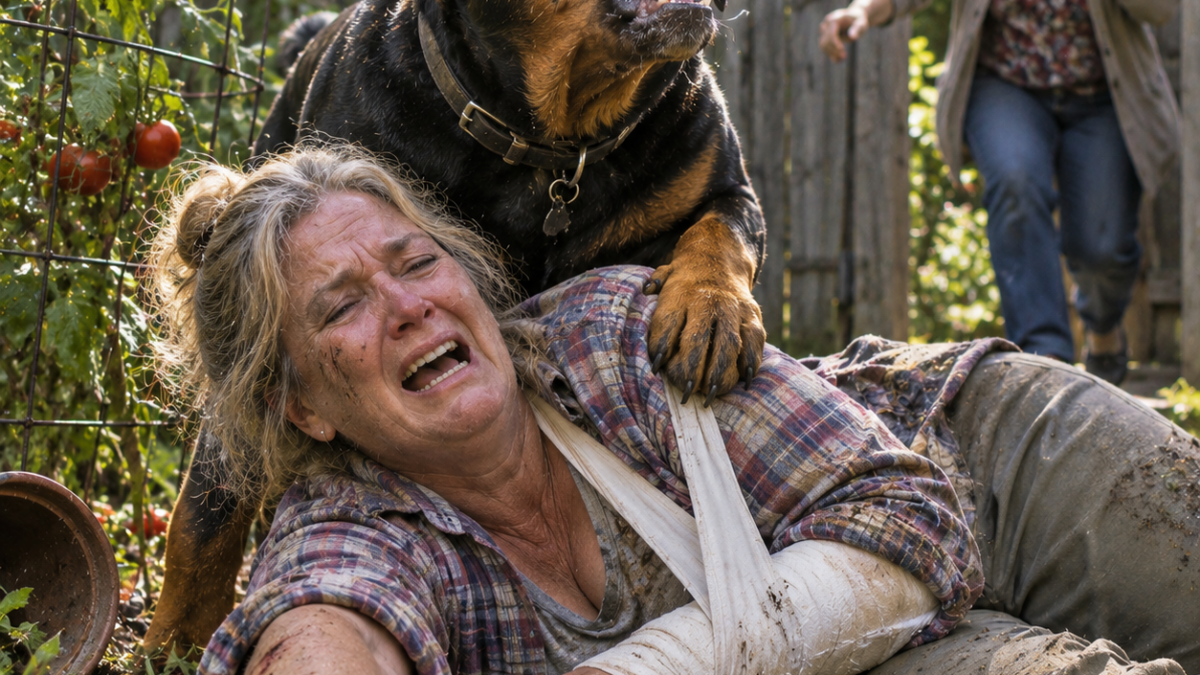
“HELP! SOMEBODY, PLEASE HELP ME!” I screamed from the ground beside my tomato plants, clutching my broken arm against my chest, but the afternoon heat swallowed my voice, my phone was inside the house, and the nearest neighbor was too far away to hear me.
For two months, the enormous Rottweiler I’d rescued from the back of an animal shelter had barely looked at me, never barked, never wagged his tail, and spent every night sleeping beside my front door as though he was waiting for someone else to come take him away—but when I collapsed in my garden, he suddenly ran toward the fence and began barking with a desperation I’d never heard from him before.
And when Mrs. Benson finally appeared beyond the fence, Ranger did something that made her drop the book she was holding, rush toward my house, and discover the woman who had spent sixty days loving a dog that seemed incapable of loving her back.
My name is Elizabeth Thornton. I’m fifty-eight years old, and until the day I broke my arm in my backyard, I believed the most important chapters of my life were already behind me.
I lived alone in a little house with white kitchen cabinets, a narrow front porch, and a backyard where I grew tomatoes every summer.
It wasn’t an impressive house.
The floors creaked in places. The kitchen faucet occasionally dripped. There was an old rocking chair beside the garden that needed a fresh coat of paint.
But it was mine.
And for a long time, I told everyone I was perfectly happy there.
I said I liked the quiet.
I said I enjoyed choosing my own schedule.
I said I didn’t mind eating dinner alone, watching television alone, or waking up to a house where the only sound was the clock ticking above the kitchen doorway.
I said those things so often that I almost convinced myself they were true.
But there’s a difference between enjoying solitude and becoming accustomed to loneliness.
I didn’t understand how large that difference had grown until I met Ranger.
He was sitting in the farthest kennel at the animal shelter when I first saw him.
A large Rottweiler with a black-and-rust coat, broad shoulders, and beautiful dark amber eyes.
He wasn’t barking like the other dogs.
He wasn’t jumping against the kennel door.
He wasn’t trying to attract attention.
He was sitting with his body turned slightly away from the entrance, his gaze resting on a blank section of wall.
The volunteer walking beside me stopped.
“That’s Ranger.”
I looked at him.
“He’s beautiful.”
She sighed.
“He’s been through a difficult time.”
I waited for more.
But she didn’t have a complete story to tell.
There were gaps in his history.
Unanswered questions.
Things people suspected but couldn’t prove.
What everyone did know was that Ranger had become deeply withdrawn.
He rarely responded when someone called his name.
He avoided unfamiliar hands.
He had no interest in toys.
And he seemed to have stopped expecting anything good from the people who approached his kennel.
“Does he ever bark?” I asked.
The volunteer shook her head.
“Not since I’ve been working with him.”
I moved a little closer.
“Ranger?”
Nothing.
Not even an ear twitch.
I crouched outside the kennel.
“Hello, sweetheart.”
His eyes moved toward me for a fraction of a second.
Then returned to the wall.
The volunteer looked apologetic.
“He’s not very interactive.”
I nodded.
But something about him held me there.
I had come to the shelter thinking I might adopt a smaller, friendly dog.
One who would greet me at the door.
Follow me into the kitchen.
Curl up beside my chair while I read.
I hadn’t expected to become attached to a silent Rottweiler who seemed unwilling to acknowledge that I existed.
Yet I couldn’t walk away.
I sat on the floor outside his kennel.
For several minutes, I said nothing.
Then I began talking.
About my garden.
The weather.
How I’d planted too many tomatoes again.
How my neighbor, Mrs. Benson, insisted I was trying to feed the entire neighborhood.
Ranger didn’t move.
I smiled faintly.
“Well, you’re a very good listener.”
Still nothing.
I remained there until the volunteer gently reminded me that the shelter was closing soon.
Before leaving, I looked at him one last time.
“Goodnight, Ranger.”
He didn’t turn around.
I went home.
Made myself dinner.
Sat at my empty kitchen table.
And found that I couldn’t stop thinking about the dog who hadn’t looked at me.
The next morning, I returned.
And the morning after that.
For days, I sat near his kennel.
Sometimes I read.
Sometimes I talked.
Sometimes I simply stayed quiet.
I didn’t try to force him to come closer.
I didn’t reach through the bars.
I didn’t demand that he show affection because I was offering it.
I just kept coming back.
One afternoon, I brought a small sleeping bag so I could sit more comfortably during a longer permitted visit.
I spread it on the floor near him.
Opened my book.
And began reading aloud.
For almost an hour, Ranger ignored me.
Then, very slowly, he moved from his usual corner.
He approached the part of the kennel nearest where I was sitting.
And lay down.
Not touching me.
Not looking at me.
But near me.
I stopped reading.
My heart began pounding.
For the first time, he’d chosen to be closer.
I didn’t move.
I didn’t want to ruin it.
Eventually, he released a long, quiet sigh.
And settled.
That was the moment I knew I wanted to bring him home.
Not because he’d suddenly become affectionate.
Not because I believed I could magically fix whatever had happened to him.
But because I wanted him to have somewhere he could rest without being expected to become a different dog.
Two months later, I would be lying helpless in my backyard, my arm broken, the heat pressing down on me, and Ranger would be the only living creature who knew where I was.
But on the day I signed his adoption papers, I knew none of that.
I only knew that I loved him.
And that I was prepared to love him even if he never learned to love me back.
What I didn’t understand was that while I spent those sixty quiet days trying to convince Ranger he was safe, he was learning something about me that would become the difference between lying alone in my garden and getting the help I desperately needed.
FULL STORY CONTINUATION
The volunteer looked surprised when I told her I wanted to adopt him.
“Ranger?”
I nodded.
“Yes.”
She glanced toward the kennel.
“The Rottweiler?”
I almost laughed.
“Unless you’ve got another Ranger hiding somewhere.”
She smiled faintly, but I could see the concern in her eyes.
“Elizabeth, I want to make sure you understand what you’re taking on.”
“I do.”
She hesitated.
“I’m not sure you do yet.”
I looked toward Ranger.
He was lying in his usual corner, his broad head resting between his paws.
The volunteer continued.
“He’s a very withdrawn dog. He may need a great deal of time to settle into a home.”
I nodded.
“I understand.”
“He may never become the kind of affectionate companion you’re imagining.”
I looked at her.
“I’m not imagining anything.”
She studied my face.
“I mean it. Some dogs make progress quickly. Others take months, sometimes longer. And some continue needing significant space and support.”
I folded my hands in my lap.
“Then I’ll give him space.”
She sighed.
“He might not want to be touched.”
“I won’t touch him unless he’s comfortable.”
“He might not play.”
“Then he doesn’t have to play.”
“He might not come when you call him.”
I looked toward the kennel.
“Then I’ll make sure he knows where to find me.”
For a moment, the volunteer said nothing.
Then she asked quietly, “Why him?”
I could have offered several answers.
Because he was beautiful.
Because I felt sorry for him.
Because I had enough time to care for a dog.
Because my house was too quiet.
But none of those answers seemed complete.
I looked at Ranger.
“Because everyone keeps telling me what he might never do.”
The volunteer waited.
I continued.
“But nobody can tell me what he’ll be like after he’s had a chance to feel safe.”
My voice softened.
“I’d like to give him that chance.”
The adoption process wasn’t immediate.
The shelter needed to make sure my home was suitable for a large dog with Ranger’s behavioral needs.
We discussed his routine.
His history, as far as it was known.
His reactions to unfamiliar people.
His comfort with handling.
How to introduce him to a new environment.
How to keep visitors from overwhelming him.
And what to do if he remained withdrawn after arriving home.
I listened carefully.
I took notes.
I asked questions.
I wanted to do this properly.
I was fifty-eight years old, not a teenager choosing a puppy because he looked adorable.
I understood that love was a responsibility.
And caring for a frightened animal meant accepting that progress might arrive slowly.
I bought a sturdy bed.
Food bowls.
A leash and harness recommended for his size.
A few simple toys.
And a soft blanket.
Then I rearranged part of my living room.
I chose a quiet corner where Ranger could rest without people constantly walking past him.
I wanted him to have a place that belonged to him.
A place where he wouldn’t be disturbed.
When everything was ready, I stood in the middle of the room and looked around.
There was a large dog bed beside the wall.
A water bowl near the kitchen.
A folded blanket.
And a little basket containing a tennis ball and two other toys.
For the first time in years, I felt nervous about someone coming to live with me.
I smiled to myself.
“Well, Elizabeth.”
I looked toward the dog bed.
“You’ve certainly done something unexpected.”
The day I brought Ranger home, the weather was beautiful.
The sky was clear.
Sunlight warmed the pavement.
I drove to the shelter with a strange mixture of excitement and fear.
I had imagined this day several times.
In some versions, Ranger would walk happily beside me.
In others, he’d hesitate at the entrance.
Maybe he’d look back toward the kennel.
Maybe he wouldn’t understand what was happening.
I knew better than to expect some dramatic moment of recognition.
He wasn’t going to hear the word home and suddenly understand that his life had changed.
He would need time.
The shelter staff helped us prepare him for the journey.
He remained quiet.
His expression guarded.
When I spoke, his ears shifted slightly, but he didn’t approach eagerly.
I crouched at a comfortable distance.
“Ready, sweetheart?”
He looked toward the doorway.
I smiled.
“I don’t blame you for being uncertain.”
We moved carefully toward the car.
He climbed in with patient assistance.
Then settled.
I checked that he was safely secured.
And got behind the wheel.
For a moment, I simply sat there.
I looked in the mirror.
Ranger was watching the window.
I took a breath.
“Well.”
My voice trembled.
“Here we go.”
I talked the entire drive home.
Not because I expected him to understand every sentence.
Because I wanted him to become familiar with my voice.
I told him about Mrs. Benson, who lived next door.
About the garden.
The tomatoes.
The little porch.
The rocking chair.
And the squirrels that seemed determined to steal everything I planted.
“You’re going to discover that the squirrels around here have absolutely no manners.”
Ranger stared through the window.
I smiled.
“Although I suppose you might not care.”
We stopped at a traffic light.
I glanced toward him.
He remained still.
His body was tense.
I softened my voice.
“You don’t have to do anything today.”
The light changed.
I continued driving.
“You can just look around.”
I swallowed.
“And rest.”
For a moment, I wondered what he was thinking.
Did he know he’d left the shelter?
Was he frightened by the car?
Did he expect another unfamiliar kennel?
I couldn’t know.
All I could do was make the transition as gentle as possible.
When we reached my house, Ranger hesitated at the front door.
I opened it.
Stepped aside.
And gave him room.
He looked into the hallway.
Then toward me.
I smiled.
“Come on in, sweetheart.”
He didn’t move.
I waited.
The afternoon sun warmed the porch boards.
A bird called from the maple tree.
Somewhere down the street, a car door closed.
Ranger’s ears shifted.
He looked toward the sound.
I remained quiet.
Eventually, he stepped inside.
One paw.
Then another.
He stopped in the hallway.
Sniffed the floor.
The wall.
The air.
He moved cautiously into the living room.
His claws made soft clicking sounds against the floor.
I watched him examine the couch.
The table.
The window.
Then he noticed the bed I’d prepared.
He approached it.
Sniffed.
And walked away.
I smiled faintly.
“That’s okay.”
He moved toward the front door.
Then lowered himself onto the floor beside it.
I looked at the unused dog bed.
Then at Ranger.
And felt a small ache.
He’d entered a home.
But he hadn’t yet found somewhere he felt comfortable enough to rest.
I crouched several feet away.
“You can stay there if you want.”
He didn’t look at me.
I nodded.
“All right.”
Then I went into the kitchen to prepare his first meal.
He didn’t eat while I was watching.
I placed his food in the designated area.
Checked that he had water.
Then moved away.
Ranger remained near the door.
For a long time, he ignored the bowl.
I sat in the living room reading a book.
Every few minutes, I glanced toward him.
He stayed still.
Eventually, I heard movement.
I kept my eyes on the page.
Ranger approached the kitchen.
His nails clicked softly.
Then I heard him eating.
I smiled.
But I didn’t turn around.
I didn’t praise him loudly.
Didn’t rush toward him.
I simply kept reading.
When he finished, he returned to the hallway.
And settled beside the door again.
I looked down at my book.
I’d been staring at the same paragraph for twenty minutes.
I laughed softly.
“Well.”
I looked toward Ranger.
“At least one of us had dinner.”
That night, I showed him the way toward the bedroom.
I didn’t force him to follow.
I simply walked down the hallway, turned on a small lamp, and spoke gently.
“Goodnight, Ranger.”
He remained beside the front door.
I paused.
Then said, “I’ll be here in the morning.”
His ears moved faintly.
I went to bed.
But sleep didn’t come easily.
I kept listening.
For movement.
For whining.
For barking.
For signs that he was frightened.
Nothing.
The house was quiet.
Almost too quiet.
Eventually, I got up.
Walked carefully toward the hallway.
And looked.
Ranger was lying beside the front door.
His eyes were open.
He was watching the darkness beyond the small window.
I stood still.
For a moment, I felt an ache so sharp that I had to lean against the wall.
I wondered whether he was waiting for someone.
A previous owner.
A familiar voice.
A person who had once opened a door and called his name.
Perhaps.
I couldn’t know.
But the possibility hurt.
I crouched a comfortable distance away.
“Ranger.”
He didn’t turn.
I swallowed.
“I don’t know who you’re waiting for.”
His ears shifted.
“But you’re safe here.”
I waited.
Nothing.
I smiled sadly.
“Goodnight, sweetheart.”
Then I returned to bed.
The second morning, Ranger was still beside the door.
I found him when I went to make coffee.
He lifted his head slightly as I passed.
That was all.
“Good morning.”
He watched the hallway.
I filled the kettle.
Prepared breakfast.
Opened the curtains.
Sunlight filled the kitchen.
I looked toward him.
He remained quiet.
I had imagined having a dog would make my mornings noisier.
A wagging tail.
Paws following me.
Maybe a bark when the mail carrier came.
Instead, the house was almost as quiet as before.
Except now there was another living creature inside it.
A creature who seemed determined to remain at a distance.
I poured my coffee.
Sat at the table.
And watched the sunlight move across the floor.
Then I said, “I’m glad you’re here.”
Ranger didn’t respond.
I smiled.
“Even if you don’t believe me yet.”
During the first week, I learned how to live around his silence.
I stopped trying to measure whether he liked me.
That was harder than it sounds.
Human beings want signs.
A smile.
A thank-you.
A gesture.
Something that tells us our effort is being received.
With Ranger, there were almost no signs.
He ate when he felt comfortable.
Rested near the door.
Moved through the house cautiously.
Avoided unnecessary contact.
And rarely looked directly at me.
Sometimes I called his name.
“Ranger?”
Nothing.
I’d try again.
Softly.
Still nothing.
Eventually, I stopped repeating it.
Not because I was giving up.
Because I didn’t want his name to become another sound demanding something from him.
I began using it only when I had a gentle reason.
“Good morning, Ranger.”
“Your breakfast is ready.”
“Would you like to go outside?”
Simple.
Predictable.
Calm.
I wanted his name to belong to ordinary, safe moments.
Mrs. Benson noticed him on the third day.
She stood beside the fence while I was watering the tomato plants.
“Elizabeth!”
I looked up.
“Good morning!”
She smiled.
“I hear you adopted a dog.”
I laughed softly.
“News travels fast.”
She glanced toward the house.
“Where is he?”
“Inside.”
“What kind?”
“A Rottweiler.”
Her eyebrows rose.
“A Rottweiler?”
I smiled.
“Yes.”
“Goodness.”
She looked concerned.
“Isn’t that rather a lot of dog for one woman?”
I set down the watering can.
“He’s very quiet.”
Mrs. Benson shook her head.
“Quiet doesn’t always mean easy.”
I nodded.
“I know.”
She looked toward the house again.
“Does he bark?”
“Not so far.”
“Does he come when you call?”
I hesitated.
“Not yet.”
She stared.
“Not yet?”
I smiled faintly.
“We’re getting acquainted.”
Mrs. Benson softened.
“Oh, Elizabeth.”
She leaned against the fence.
“Just be careful.”
I nodded.
“I will.”
She looked at me for a moment.
Then smiled.
“You always did have a soft spot for creatures that needed looking after.”
I laughed.
“Maybe.”
She waved.
“Well, if you need anything, you know where I am.”
I smiled.
“Thank you.”
I didn’t know then how important that promise would become.
The weeks passed slowly.
I began spending time on the floor near Ranger.
Not close enough to crowd him.
Just near enough that he could become accustomed to my presence.
Sometimes I read.
Sometimes I folded laundry.
Sometimes I talked about things that didn’t matter.
The weather.
The neighbor’s roses.
The price of tomatoes at the grocery store.
A television program I’d watched.
He rarely responded.
But I noticed small changes.
At first, he’d turn away when I entered a room.
Later, he’d remain where he was.
At first, he’d avoid eating if I was nearby.
Later, he’d approach his bowl while I sat at the far end of the kitchen.
At first, he’d tense whenever I moved.
Later, he sometimes watched without retreating.
Tiny changes.
Easy to overlook.
But they mattered to me.
I kept reminding myself that trust had to belong to Ranger.
I couldn’t demand it.
Couldn’t buy it with food.
Couldn’t force it through affection.
I could only make my behavior predictable.
Then allow him to decide what that meant.
One afternoon, I carried a book into the living room and sat near his bed.
He wasn’t using the bed yet.
He still preferred the front door.
I opened the book.
Read for a while.
Then looked up.
Ranger was watching me.
Directly.
I froze.
His amber eyes met mine.
For a moment, neither of us moved.
Then he looked away.
I lowered my gaze.
My heart was pounding.
It had lasted only a second.
But he’d looked at me.
Not past me.
Not toward the door.
At me.
I smiled.
“Hello, sweetheart.”
His ears shifted.
I returned to reading.
And for the rest of the afternoon, I felt absurdly happy.
There were difficult evenings.
I won’t pretend otherwise.
Sometimes I’d sit at the kitchen table while Ranger rested near the front door and wonder whether I’d made a mistake.
Not because he was aggressive.
He wasn’t.
Not because he caused trouble.
He rarely did.
But because I’d wanted companionship.
And I’d brought home a dog who seemed to prefer the company of a door.
I felt ashamed whenever the thought came.
He didn’t owe me affection.
He hadn’t asked me to adopt him.
He was adjusting to an unfamiliar home after an uncertain history.
My expectations weren’t his responsibility.
Still, I was human.
And sometimes I felt lonely.
One evening, I sat beside the living room window watching rain fall.
Ranger lay in the hallway.
I looked toward him.
“Do you know something?”
His ears moved.
“I think we’re both a little lost.”
He remained still.
I swallowed.
“I thought bringing you here would make the house feel different.”
I smiled sadly.
“And it has.”
Rain tapped against the window.
I continued.
“But I guess I imagined we’d be friends faster.”
Ranger lowered his head.
I sighed.
“That’s all right.”
I looked toward the darkening sky.
“I have time.”
At night, he continued sleeping near the front door.
I’d placed his bed nearby, hoping he’d gradually choose it.
Sometimes he did rest on it during the day.
But when the house became quiet, he returned to the entrance.
I began leaving a small hallway light on.
Not because I knew he needed it.
Because I wanted the space to feel less stark.
Every night, before going to bed, I stopped nearby.
“Goodnight, Ranger.”
His ears would sometimes shift.
I’d smile.
“See you in the morning.”
Then I’d turn off the living room lamp.
And leave him to rest.
It became our routine.
A quiet woman.
A silent dog.
Two beings in the same house, still uncertain how close they were allowed to become.
The second month brought a change so gradual I didn’t recognize it immediately.
Ranger began appearing in doorways.
Not following me exactly.
Just watching from a distance.
If I worked in the kitchen, he might settle where he could see me.
If I sat in the living room, he’d sometimes leave the front door and rest nearby.
When I went into the garden, he occasionally stood behind the screen door and watched.
I noticed.
But I tried not to react too enthusiastically.
I knew sudden excitement might frighten him.
So I’d simply smile.
“Hello, Ranger.”
Then continue what I was doing.
He could decide whether to stay.
And increasingly, he did.
One morning, I was kneeling near the tomato plants when I noticed him standing on the porch.
The screen door was open to the fenced yard.
Ranger watched me.
I smiled.
“Good morning, sweetheart.”
His ears shifted.
I returned to the plants.
A few minutes later, I heard paws on the porch steps.
I looked up.
Ranger had come into the garden.
He stood a few feet away.
Watching.
I smiled.
“Well, look at you.”
He lowered his head to sniff the grass.
I returned to my work.
For several minutes, we remained there together.
I planted.
He investigated.
The sun warmed the yard.
A breeze moved through the leaves.
Nothing extraordinary happened.
But I felt something warm settle inside my chest.
It was the first morning that felt like we were sharing the same life.
I’d always loved gardening.
The tomato plants were my favorite.
Every spring, I promised myself I wouldn’t plant too many.
Every spring, I ignored that promise.
By summer, the garden would be overflowing.
I’d give tomatoes to Mrs. Benson.
Leave bags on neighbors’ porches.
Make sauce.
Freeze what I couldn’t use.
And still somehow have more.
I liked the routine.
The smell of damp soil.
The feeling of sunlight on my shoulders.
The satisfaction of seeing small green tomatoes become heavy red fruit.
Gardening gave my days structure.
When I retired from my old routines, it had become one of the ways I measured time.
New leaves.
Flowers.
Fruit.
Harvest.
The seasons continuing whether I felt ready or not.
Now Ranger sometimes watched from the porch.
And I began talking to him while I worked.
“That one’s almost ready.”
I’d point toward a tomato.
“See?”
He’d stare at the garden.
I’d laugh.
“You’re not impressed.”
Sometimes I’d tell him stories about my childhood.
About the first garden I helped plant.
About the way my mother insisted tomatoes tasted better when you picked them warm from the vine.
Ranger didn’t understand the stories the way another person might.
But he listened to my voice.
And perhaps that was enough.
The afternoon everything changed began like any other.
The weather was hot.
The kind of summer heat that makes the air feel heavy even before noon.
I had finished washing dishes and decided to check the tomato plants before the afternoon grew worse.
Ranger was resting near the kitchen doorway.
I glanced toward him.
“Coming outside?”
He lifted his head.
I smiled.
“Suit yourself.”
I took my gardening gloves.
Opened the back door.
And stepped into the yard.
The sun was already strong.
I should have taken my phone.
I usually did.
But that afternoon, I left it on the kitchen counter beside my coffee cup.
Such a small mistake.
So ordinary.
I wouldn’t have thought about it twice.
Until I needed help.
The garden looked beautiful.
The tomato vines were full.
A few leaves had begun drooping in the heat.
I made a mental note to check the watering later.
I moved along the row, inspecting the fruit.
One tomato had ripened almost overnight.
I smiled.
“Well, hello there.”
I reached toward it.
Then noticed a stem tangled near the edge of the planting bed.
I bent to adjust it.
My foot shifted on the uneven ground.
For one moment, I felt myself lose balance.
I tried to catch myself.
My shoe slipped.
My body twisted.
And I fell.
It happened so fast that I barely understood what was happening.
One second, I was standing among the tomato plants.
The next, I was on the ground.
A sharp pain shot through my arm.
I cried out.
Then everything seemed to stop.
I lay on my side, stunned.
For a moment, I couldn’t breathe properly.
Then the pain came fully.
Hot.
Deep.
Terrible.
I looked toward my arm.
The position was wrong.
I knew immediately that something serious had happened.
I tried to move.
Pain tore through me.
I screamed.
Then curled around the injured arm, holding it against my chest.
“Oh, God.”
My voice shook.
“Oh, please.”
I tried to sit.
Couldn’t.
I lowered myself back onto the ground.
The soil smelled warm beneath me.
The tomato leaves brushed my shoulder.
The sun burned against my face.
And for the first time in a very long time, I was truly frightened of being alone.
I called for help.
“Mrs. Benson!”
My voice sounded weak.
I swallowed.
Tried again.
“HELP!”
The yard remained quiet.
A bird called from the fence.
Somewhere beyond the houses, a lawn mower hummed.
I looked toward the kitchen window.
My phone was inside.
On the counter.
Only a short distance away.
But it might as well have been miles.
I tried moving again.
Pain shot through my arm.
I gasped.
The world seemed to tilt.
I stopped.
I knew I needed to remain as still and safe as possible while seeking help.
But how?
My nearest neighbor was inside her house.
The fence blocked most of the view.
And the afternoon heat was pressing down on me.
I called again.
“Mrs. Benson!”
No answer.
I could hear my own breathing.
Fast.
Uneven.
I tried not to panic.
I had always considered myself independent.
A woman who could manage her house.
Her garden.
Her daily life.
Now I couldn’t even reach my phone.
Tears ran down my face.
“Please.”
I didn’t know whom I was speaking to.
“Somebody.”
Then I heard paws.
I turned my head.
Ranger stood near the back door.
He looked toward me.
For a moment, neither of us moved.
I felt a sudden surge of relief.
“Ranger.”
My voice broke.
“Sweetheart.”
He approached.
Slowly at first.
His head lowered.
His ears alert.
He stopped beside me.
I looked up into his amber eyes.
“Help me.”
It was a ridiculous thing to say.
He wasn’t trained as a service dog.
He didn’t know how to call emergency services.
He didn’t understand that my arm was broken in two places.
But he could see that something was wrong.
I knew that much from the way he looked at me.
He sniffed near my shoulder.
Then stepped back.
I tried to reach toward him with my uninjured hand.
“Ranger.”
Pain made me gasp.
He moved around me.
Then looked toward the house.
I started crying.
“Please don’t leave.”
He stopped.
Looked back.
For a moment, I was ashamed of how desperate I sounded.
I had spent two months trying not to demand affection from this dog.
Now I was lying on the ground begging him not to walk away.
Ranger stood beside me.
Then turned toward the fence.
And began moving.
At first, I thought he was leaving.
My heart sank.
“Ranger!”
He continued toward the fence separating our yard from Mrs. Benson’s property.
I heard his paws against the ground.
Then silence.
I turned my head as far as I could.
The movement made me dizzy.
I couldn’t see him clearly through the plants.
Then I heard a bark.
A deep, powerful bark.
I froze.
For two months, Ranger had been silent.
He hadn’t barked at the mail carrier.
At passing cars.
At birds.
At neighbors.
I had almost forgotten what a dog his size could sound like.
Now his voice exploded across the backyard.
Once.
Then again.
And again.
I stared toward the fence.
“Ranger?”
He kept barking.
The sound was loud.
Urgent.
Rhythmic.
Nothing like the quiet dog who slept beside my front door.
I felt tears gathering.
“Good boy.”
My voice broke.
“Good boy, keep going.”
He barked again.
Then again.
I couldn’t know whether Mrs. Benson could hear him.
But I knew that sound was reaching farther than my weak calls for help.
I closed my eyes.
And prayed someone would listen.
Mrs. Benson later told me she’d been sitting in her living room reading when the barking began.
At first, she thought another dog had wandered into the neighborhood.
It was an unusual sound.
Deep.
Insistent.
Not the occasional bark of a dog noticing a passing car.
This was continuous.
She tried returning to her book.
But the barking didn’t stop.
It grew louder.
More urgent.
Finally, she put the book down.
“What on earth?”
She walked toward the back of her house.
Opened the door.
And stepped onto the porch.
That’s when she saw Ranger.
He stood beside the fence.
His broad muzzle pressed near a gap between the boards.
His front paws lifted against the fence as he barked toward her.
Mrs. Benson stopped.
She had never seen him behave that way.
Until then, Ranger had kept his distance whenever she was outside.
Sometimes he’d watched from Elizabeth’s porch.
Sometimes he’d disappeared into the house.
He had never approached the fence.
Never demanded attention.
Now he stood there barking as though something terribly important depended on her listening.
Mrs. Benson admitted she was frightened.
Ranger was a large dog.
His voice was powerful.
And she couldn’t immediately understand what he wanted.
But as she watched, she noticed something.
He wasn’t advancing toward her aggressively.
His attention moved between her and my house.
He barked.
Then looked back.
Barked again.
When she took a careful step closer, he stopped.
For a moment, he simply stared at her.
Then he turned.
Ran toward my garden.
Stopped.
Looked back.
Mrs. Benson frowned.
“Ranger?”
He moved again.
Then paused.
She later told me that was when she began wondering whether he wanted her to follow.
I was still lying beside the tomato plants.
The pain had become a terrible, constant pressure.
My arm felt swollen.
I held it tightly against my body.
I was afraid to look at it.
Afraid to move.
Afraid of what might happen if nobody came.
The sun was relentless.
Sweat ran down my face.
My mouth felt dry.
I had called for help until my throat hurt.
Now I barely had the energy to speak.
But I could hear Ranger.
His paws moved across the yard.
Toward the fence.
Then back toward me.
Again.
And again.
Sometimes he barked.
Sometimes he stopped.
His movements sounded purposeful, though I couldn’t know exactly what he understood.
I whispered, “Please.”
Then heard a voice.
“Elizabeth?”
My eyes opened.
For a moment, I thought I’d imagined it.
Then the voice came again.
“Elizabeth!”
Mrs. Benson.
I began crying.
“Here!”
The word was barely audible.
I tried again.
“In the garden!”
Footsteps approached.
Then Mrs. Benson came around the corner.
She stopped.
Her face changed.
“Oh, my God.”
She hurried toward me.
“Elizabeth!”
I tried to smile.
“Hello, Margaret.”
Her first name was Margaret, though I’d called her Mrs. Benson for so many years that the habit remained.
She dropped to her knees beside me.
“What happened?”
“I fell.”
My voice shook.
“My arm…”
Her eyes moved toward it.
She went pale.
“Oh, Elizabeth.”
I began crying harder.
“My phone’s in the kitchen.”
She looked at me.
“Don’t move. I’m going to call for help.”
I nodded.
Then she looked toward Ranger.
He sat beside me.
Quiet.
Perfectly still.
The barking had stopped.
Mrs. Benson stared at him.
Then whispered, “He brought me here.”
I looked toward the dog.
His amber eyes watched her.
She swallowed.
“That dog brought me right to you.”
Mrs. Benson ran inside to call emergency services.
Ranger stayed.
He didn’t follow her.
Didn’t return to the fence.
Didn’t begin barking again.
He simply sat beside me.
His body upright.
His head lifted.
His attention focused toward the direction Mrs. Benson had gone.
I looked at him.
The dog who had spent two months avoiding eye contact was sitting close enough that I could see the individual hairs along his dark muzzle.
For a moment, I wanted to touch him.
But moving hurt.
I remained still.
“Ranger.”
His ears moved.
I swallowed.
“Good boy.”
He looked toward me.
My eyes filled.
“You helped me.”
He stayed quiet.
I knew better than to assume he understood the situation as a person would.
But I also knew he had responded to my distress by behaving in a way I’d never seen before.
He had barked.
Drawn attention.
Moved between the fence and my garden.
And remained beside me when help arrived.
I looked toward his face.
“Thank you.”
My voice broke.
“Thank you, sweetheart.”
The wait for the ambulance felt endless.
Mrs. Benson returned and crouched beside me.
She had brought a towel to help shade me from the sun as best she could without moving me unnecessarily.
She spoke calmly.
“Help is coming.”
I nodded.
Ranger sat beside us.
Mrs. Benson glanced toward him.
“I’ve never heard him bark before.”
I tried to laugh.
“Neither have I.”
My voice sounded thin.
She looked at me.
“Not once?”
I shook my head carefully.
“Not in two months.”
Her eyes filled.
She looked toward Ranger again.
“Well.”
Her voice trembled.
“He certainly found his voice today.”
I began crying.
Mrs. Benson squeezed my uninjured hand.
“You’re going to be all right.”
I wanted to believe her.
The pain was terrible.
I was frightened.
But I wasn’t alone anymore.
That changed everything.
The ambulance arrived about fifteen minutes after Mrs. Benson called.
I heard it before I saw anyone.
The distant sound.
Then the vehicle stopping near the house.
Voices.
Footsteps.
Ranger rose when the responders entered the yard.
For one moment, I worried he might become frightened or defensive.
But Mrs. Benson spoke to him calmly and helped maintain a safe distance.
He moved aside.
The responders approached me.
Asked questions.
Assessed my condition.
And began helping me.
I tried to answer clearly.
“My arm.”
One of them nodded.
“We’re going to take care of you.”
I looked toward Ranger.
He stood a short distance away.
Watching.
The responder followed my gaze.
“Is he your dog?”
I nodded.
“Yes.”
My voice broke.
“He got help.”
The responder looked toward Mrs. Benson.
She nodded.
“He alerted me.”
I closed my eyes.
For a moment, I felt tears gathering again.
Then the responders began preparing to move me safely.
I was afraid.
The idea of being lifted made my arm throb.
But they explained what they were doing.
I listened.
And trusted them.
Before they carried me away, I turned toward Ranger.
“Goodbye, sweetheart.”
His ears shifted.
“I’ll come back.”
The words sounded familiar.
I’d said them almost every night since bringing him home.
But this time, I desperately hoped he understood that I meant them.
At the hospital, the X-rays showed two fractures in my arm.
The doctor explained the injuries and the treatment plan.
My arm was immobilized in a cast, and I received pain relief and instructions for recovery.
It was frightening, uncomfortable, and exhausting.
But the doctors expected it to heal.
That knowledge made me feel enormously grateful.
I kept thinking about the afternoon.
How I’d fallen.
How helpless I’d felt.
How my phone had been inside the house.
How the heat had pressed against my skin.
And how Ranger’s barking had brought Mrs. Benson to the fence.
A nurse came into the room while I was resting.
“How are you feeling?”
I tried to smile.
“Like someone broke my arm.”
She laughed gently.
“That’s understandable.”
I looked toward the window.
Then asked, “Can I tell you something strange?”
She smiled.
“Of course.”
I told her about Ranger.
The silent Rottweiler.
The two months without a bark.
The way he’d alerted my neighbor.
By the time I finished, my eyes were wet.
The nurse listened.
Then said, “Sounds like he knew something was wrong.”
I nodded.
“Yes.”
She smiled.
“And he got someone’s attention.”
I looked down at my cast.
“He did.”
My throat tightened.
“He really did.”
Mrs. Benson drove me home that evening.
The sun was beginning to set.
I sat carefully in the passenger seat, my injured arm supported as instructed.
Everything hurt.
Even small movements made me cautious.
Mrs. Benson drove slowly.
For a while, we were quiet.
Then she glanced toward me.
“Elizabeth?”
“Yes?”
“I need to tell you what happened.”
I looked at her.
She explained the barking.
How she’d been reading.
How unusual the sound was.
How she’d opened the back door and seen Ranger pressed toward the fence.
“He frightened me at first,” she admitted.
I nodded.
“I understand.”
“He’s a large dog.”
“Yes.”
She looked toward the road.
“But he wasn’t trying to frighten me.”
I remained quiet.
She continued.
“He kept looking toward your house.”
My throat tightened.
“Then he ran back.”
She smiled faintly.
“Stopped.”
Her voice softened.
“Looked over his shoulder.”
I pressed my lips together.
“And when I followed, he led me straight to you.”
I stared through the windshield.
Tears gathered.
Mrs. Benson continued.
“Elizabeth, I’ve lived beside you for years.”
I nodded.
“And I’ve never seen anything like that.”
My voice broke.
“Neither have I.”
She was quiet for a moment.
Then said, “You were right about him.”
I turned toward her.
“What?”
She smiled.
“Ranger.”
My throat tightened.
“You said he just needed time.”
I looked toward my cast.
Then whispered, “I hope I was.”
Mrs. Benson nodded.
“I think he showed us something today.”
When we reached the house, I became nervous.
I didn’t know how Ranger would react.
He’d watched strangers take me away.
He’d remained behind with Mrs. Benson’s help.
Now I was returning with a cast.
An altered movement.
The smell of the hospital.
I wondered whether he’d retreat.
Whether he’d return to the front door.
Whether the afternoon had simply been a reaction to an emergency and nothing more.
I didn’t want to expect too much.
Mrs. Benson helped me toward the entrance.
She opened the door.
Ranger stood just inside.
He was waiting.
Not lying down.
Not turned away.
Standing.
His head lifted.
His eyes fixed on me.
I stopped.
“Ranger.”
He looked directly at my face.
I felt my throat tighten.
“Hello, sweetheart.”
He didn’t jump.
Didn’t bark.
Didn’t rush forward.
He simply watched as I came inside.
Mrs. Benson helped me settle.
Ranger remained nearby.
I looked at him.
“You kept an eye on the house?”
His ears shifted.
I smiled.
“Thank you.”
For a moment, I thought his tail might move.
But it didn’t.
Not yet.
He remained quiet.
Still guarded.
Still Ranger.
And somehow, that made the moment feel more real.
The emergency hadn’t transformed him into a completely different dog.
But something between us had changed.
I could feel it.
Even if I couldn’t yet explain it.
Mrs. Benson stayed until I was settled.
She helped arrange what I’d need for the evening.
Water.
Medication.
A light meal.
My phone within reach.
Everything the hospital had recommended.
When she was ready to leave, she looked toward Ranger.
He was resting near the living room doorway.
“He’s a good dog.”
I smiled.
“Yes.”
She nodded.
“A very good dog.”
I swallowed.
“Thank you for coming.”
Mrs. Benson looked at me.
“Thank Ranger.”
My eyes filled.
She smiled gently.
“He’s the one who made sure I knew something was wrong.”
Then she hugged me carefully.
“Call if you need anything.”
“I will.”
She left.
The door closed.
And the house became quiet again.
But this time, I was not the only person who seemed to understand that something important had happened.
I couldn’t sleep comfortably in my bed that night.
The cast made it awkward.
Every time I tried to settle, my arm throbbed.
Eventually, I moved to the couch.
I arranged pillows.
Pulled a blanket over myself.
And turned on a small lamp.
Ranger watched from the hallway.
I smiled.
“Well, sweetheart.”
My voice sounded tired.
“Looks like we’re camping in the living room.”
He remained still.
I shifted carefully.
Pain made me gasp.
Ranger lifted his head.
I stopped moving.
“Sorry.”
I took a breath.
“Just trying to get comfortable.”
He watched.
Then stood.
I stared.
Ranger walked into the living room.
Not toward the front door.
Toward me.
He stopped beside the couch.
Sniffed the edge of the blanket.
Then lowered himself onto the rug.
Close.
Closer than he’d ever chosen to lie before.
I froze.
For two months, he had spent almost every night near the entrance.
Now he was lying beside me.
So close that I could feel the warmth of his body without reaching out.
I stared at him.
“Ranger?”
His ears moved.
I swallowed.
“Are you staying?”
He lowered his head.
Then closed his eyes.
I felt tears gathering.
I didn’t try to touch him.
Didn’t call him closer.
I simply lay there.
Watching him settle.
And for the first time since bringing him home, I fell asleep knowing he had chosen to rest beside me.
I woke early the next morning.
Sunlight was entering through the curtains.
My arm ached.
My mouth felt dry.
For a moment, I forgot why I was on the couch.
Then I saw the cast.
The memories returned.
The garden.
The fall.
The barking.
Mrs. Benson.
The ambulance.
I took a careful breath.
Then noticed Ranger.
He was lying beside the couch.
His head rested near the edge of the cushion, close to my feet.
His eyes were open.
Watching me.
I froze.
Not because I was afraid.
Because he’d never looked at me like that before.
For two months, his gaze had passed over me.
Around me.
Toward doors and walls and spaces beyond the room.
Now he was looking directly at me.
Attentively.
Quietly.
I swallowed.
“Good morning, Ranger.”
His ears shifted.
Then his tail moved.
One small movement against the rug.
I stared.
Another movement.
Barely noticeable.
But real.
My eyes filled.
“Oh, sweetheart.”
He continued watching.
I smiled through tears.
“Good morning.”
His tail moved again.
I laughed softly.
And suddenly I was crying.
Because the dog who had spent two months avoiding my gaze was looking directly into my eyes.
He had stayed beside me through the night.
And now he was greeting me.
Not with a dramatic display.
Just a small movement of his tail.
But it felt like the beginning of something I’d almost stopped daring to imagine.
I wanted to hug him.
Of course I did.
I wanted to bury my face in his thick fur.
Tell him how much he meant to me.
Thank him for what he’d done.
But I knew better.
Ranger still needed his space.
And my own arm was injured.
So I remained still.
I smiled.
“Good boy.”
His tail moved.
I laughed through tears.
“Such a good boy.”
He watched me.
Then slowly lowered his head again.
I looked toward the ceiling.
For a moment, the house seemed full of something I couldn’t name.
Relief.
Affection.
The fragile beginning of trust.
I’d spent two months hoping Ranger would learn that he was safe.
Now, after the most frightening afternoon of my life, he’d chosen to remain close.
It wasn’t a miracle that erased his past.
It wasn’t proof he’d never be afraid again.
But it was a change.
And I knew I would remember it forever.
Recovering from a broken arm was more difficult than I’d expected.
I had always done everything myself.
Cooking.
Cleaning.
Gardening.
Grocery shopping.
Basic repairs.
I wasn’t someone who enjoyed asking for help.
Now ordinary tasks had become complicated.
Opening jars.
Carrying laundry.
Preparing meals.
Even getting dressed required patience.
I felt frustrated.
Some mornings, I wanted to cry before breakfast.
Mrs. Benson helped when she could.
She brought groceries.
Checked on me.
Made sure I had what I needed.
And occasionally reminded me that accepting help didn’t make me helpless.
Ranger observed all of it.
At first, from a distance.
Then increasingly close.
He began appearing wherever I was.
If I sat in the kitchen, he’d settle near the doorway.
If I moved to the living room, he’d follow.
If I rested on the couch, he’d lie nearby.
He didn’t crowd me.
Didn’t demand attention.
He simply stayed close enough to know where I was.
One afternoon, I was standing in the kitchen trying to open a container with my uninjured hand.
The lid wouldn’t move.
I sighed.
“Oh, for heaven’s sake.”
I tried again.
Nothing.
I set it down.
Stared at it.
Then began crying.
It was ridiculous.
A plastic container.
An ordinary household object.
But after days of discomfort and dependence, it felt like one more reminder that I couldn’t manage things the way I used to.
I covered my face with my good hand.
“I’m so tired.”
The kitchen was quiet.
Then I heard paws.
Ranger approached.
I lowered my hand.
He stopped a short distance away.
Looked at me.
Then sat.
I swallowed.
“Hello, sweetheart.”
He remained still.
I laughed through tears.
“Don’t worry. I’m not angry at you.”
His ears moved.
I looked down at the container.
“Just having a difficult day.”
Ranger watched.
I sat at the table.
He lowered himself onto the floor nearby.
For a while, we simply stayed there.
I cried.
He rested.
And somehow, the presence of that large quiet dog made the frustration easier to bear.
There were moments when I wondered whether Ranger had changed because of the emergency or because all those weeks of patience had finally begun to matter.
Perhaps both.
Perhaps the accident had created an unfamiliar situation in which he responded to my distress.
Perhaps the weeks of predictable care had already been building a sense of safety.
I couldn’t know exactly what had happened inside his mind.
But I knew the bond between us was changing.
And it didn’t happen all at once.
Some days, Ranger still retreated when startled.
Sometimes he preferred resting alone.
Sometimes he ignored his name.
Other days, he followed me from room to room.
Watched me prepare meals.
Or settled beside my chair.
I learned not to demand consistency from a process that was still developing.
He was allowed to have difficult days.
So was I.
We were both recovering.
In different ways.
The first time Ranger ate while I sat at the kitchen table, I nearly stopped breathing.
It happened on a quiet morning.
I was drinking coffee.
The window was open.
A breeze moved through the curtains.
Ranger stood near his food bowl.
Usually, he waited until I left the room before eating.
That morning, he glanced toward me.
I kept my eyes on my cup.
He approached the bowl.
Sniffed.
Then began eating.
I froze.
My heart began pounding.
He was eating while I remained in the room.
It might sound like nothing.
But I remembered the shelter.
How he avoided attention.
How he preferred distance.
How he seemed uncomfortable when people moved close to him.
Now he was choosing to eat while I sat nearby.
I didn’t praise him loudly.
Didn’t turn toward him.
I simply remained calm.
When he finished, he looked toward me.
I smiled.
“Good boy.”
His tail moved faintly.
Then he walked toward the living room.
I sat at the table for several minutes.
Smiling into my coffee.
One afternoon, Mrs. Benson came over with homemade soup.
She stepped into the kitchen carrying a large container.
“How’s the patient?”
I laughed.
“Still stubborn.”
She smiled.
“Good. That means you’re improving.”
I helped her find space on the counter.
Ranger stood near the doorway.
Mrs. Benson noticed him.
“Well, hello there.”
He watched her.
She didn’t approach.
Didn’t reach toward him.
She simply spoke gently.
“You’re the famous Ranger.”
His ears shifted.
I smiled.
Mrs. Benson looked toward me.
“Does he still sleep by the front door?”
I shook my head.
“Not every night.”
Her eyebrows rose.
“Really?”
I nodded.
“Sometimes he stays beside the couch.”
She smiled.
“That’s wonderful.”
I looked toward him.
“He follows me around now too.”
Mrs. Benson’s expression softened.
“Elizabeth.”
My eyes filled.
She reached for my good hand.
“That dog is beginning to trust you.”
I looked down.
“Maybe.”
She smiled.
“More than maybe.”
The garden remained difficult for me during the early part of my recovery.
Not because the tomatoes needed attention.
Mrs. Benson helped with those.
But because stepping outside reminded me of the fall.
The heat.
The pain.
The helplessness.
The fear that nobody would hear me.
For a while, I avoided the exact place where it happened.
I’d stand on the porch.
Look toward the tomato plants.
Then return inside.
I felt foolish.
It was my own backyard.
A place I’d loved for years.
But memories have a way of attaching themselves to ordinary locations.
One afternoon, Mrs. Benson noticed.
“Elizabeth?”
I looked toward her.
“Yes?”
She followed my gaze.
“The garden?”
I nodded.
She sat beside me.
For a moment, neither of us spoke.
Then she said, “You don’t have to go back there before you’re ready.”
My eyes filled.
“I know.”
She smiled.
“But you will.”
I looked toward the plants.
“I hope so.”
Then I felt movement beside my chair.
Ranger stepped onto the porch.
He looked toward the garden.
Then toward me.
I smiled weakly.
“Hello, sweetheart.”
He settled near my feet.
And for the first time since the accident, I sat outside long enough to watch the sunset.
One evening, I spoke to Ranger about the accident.
I know that sounds strange.
But after everything, talking to him had become part of my routine.
I sat on the couch with my cast resting on a pillow.
Ranger lay nearby.
I looked toward him.
“Do you know what frightened me most?”
His ears shifted.
“It wasn’t even the pain.”
I stared toward the window.
“It was thinking no one would find me.”
My voice trembled.
“I was lying there, and my phone was inside, and I couldn’t get up.”
I swallowed.
“I thought about how long it might be before someone noticed.”
Ranger remained still.
I looked down.
“Then I heard you bark.”
His eyes moved toward me.
I smiled through tears.
“That was the loudest, most beautiful sound I’ve ever heard.”
He lowered his head.
I laughed softly.
“And Mrs. Benson says you frightened the life out of her.”
His tail moved.
I smiled.
“Well, you certainly got her attention.”
I leaned back.
“Thank you, Ranger.”
For a moment, his eyes met mine.
Then he settled.
I didn’t need him to understand the words.
I needed to say them.
And perhaps he needed to hear the familiar tone.
The first time he followed me all the way into the bedroom, I nearly laughed.
I was preparing for bed.
Still moving carefully because of my arm.
Ranger appeared in the doorway.
I looked up.
“Hello.”
He stood quietly.
I smiled.
“Did you need something?”
He looked around the room.
Then entered.
Sniffed the edge of the bed.
The rug.
The small table.
Then settled near the doorway.
I stared.
“Well.”
I laughed softly.
“Looks like I have company.”
He rested his head on his paws.
I climbed into bed carefully.
Turned off the lamp.
Then whispered, “Goodnight, Ranger.”
His tail moved against the rug.
I closed my eyes.
And smiled.
For the first time since bringing him home, I didn’t have to imagine that he was waiting alone beside the front door.
He was resting nearby.
Because he’d chosen to be.
As the weeks passed, the cast became less frightening.
I learned how to manage daily tasks.
Mrs. Benson continued helping.
The doctors monitored my healing.
The pain gradually improved.
And Ranger became increasingly comfortable with the routine.
He followed me into the kitchen.
Waited while I prepared food.
Rested beside my chair.
Sometimes watched me from the porch while I tended the garden.
We were becoming companions.
Not in the noisy way I’d once imagined.
There were still long stretches of silence.
But the silence felt different.
Before Ranger, the house had been quiet because I was alone.
During his first weeks, it had been quiet because he was frightened.
Now it was quiet because we were comfortable together.
We didn’t need constant activity.
I could read.
He could rest.
And the room felt full.
One afternoon, I found an old tennis ball in the basket of toys I’d bought before bringing Ranger home.
It had remained untouched for months.
I picked it up.
Looked toward him.
He was resting near the kitchen doorway.
“Ranger?”
His ears shifted.
I smiled.
“Want to try something?”
He watched me.
I walked carefully into the backyard.
The weather was pleasant.
My arm was healing, though I still had to respect the doctor’s restrictions.
I rolled the tennis ball gently across the grass with my good hand.
Ranger watched it.
The ball stopped near a flowerbed.
He remained still.
I laughed.
“Not impressed?”
He looked toward me.
I smiled.
“Fair enough.”
I retrieved the ball.
Rolled it again.
This time, Ranger stood.
His ears lifted.
He moved toward it.
Stopped.
Sniffed.
Then looked back at me.
I smiled.
“That’s it.”
He touched the ball with his nose.
It rolled slightly.
He stepped back.
Then barked.
One short, sharp bark.
I froze.
My heart began pounding.
For a moment, I was back on the ground beside the tomato plants.
The pain.
The heat.
The desperate sound of Ranger calling for help.
But this bark was different.
Short.
Bright.
Almost playful.
I stared.
“Ranger?”
His tail moved.
I began laughing.
“Oh, sweetheart!”
He looked toward the ball.
Then barked again.
I laughed harder.
“Are you talking to me?”
His tail wagged.
And suddenly, I was crying.
Because the voice that had first reached me through terror was now filling my garden with something like joy.
I sat in the rocking chair afterward.
Ranger rested nearby.
The tennis ball lay in the grass.
I looked at him.
Then toward the fence.
The same fence where he’d barked at Mrs. Benson.
The same yard where I’d lain helpless.
The same garden I’d avoided for weeks.
Now the afternoon air was warm.
The tomatoes were growing.
Ranger was resting near my feet.
And the sound of his playful bark still echoed in my mind.
I smiled.
“Well, sweetheart.”
He lifted his head.
“I think we’re both getting better.”
When the doctor finally removed my cast, I was relieved.
My arm had healed, though some stiffness remained.
I was given guidance for gradually regaining comfortable movement.
I followed it.
The process wasn’t instant.
Some tasks still felt awkward.
I couldn’t immediately do everything I’d done before the fall.
But I was improving.
One of the first things I wanted to do was return to my garden without feeling afraid.
I started slowly.
Short visits.
Light tasks.
Nothing that strained my arm.
Ranger accompanied me.
Sometimes he lay on the porch.
Sometimes beneath the shade of the fence.
Sometimes beside the rocking chair.
I noticed that when I moved around the garden, he often kept me within sight.
I couldn’t know whether that behavior was connected to the accident.
But I found it comforting.
There was something reassuring about looking up and seeing him nearby.
Not because I wanted him to become responsible for my safety.
He was my companion, not a substitute for emergency planning or medical help.
But because we’d developed a bond.
And his presence made the garden feel like a place I could enjoy again.
I also changed a few things.
I began carrying my phone whenever I went outside.
I checked the uneven patch near the tomatoes.
Made sure the walking paths were safer.
And arranged a simple way to contact help if I ever needed it.
Mrs. Benson approved.
“Good.”
She stood beside the fence.
“I don’t want to repeat that afternoon.”
I laughed.
“Neither do I.”
She looked toward Ranger.
He was resting in the shade.
“Although I suppose we know who to call if we need a very loud alarm.”
I smiled.
“Apparently.”
Mrs. Benson laughed.
Then her expression softened.
“He’s a wonderful dog, Elizabeth.”
I looked at Ranger.
His eyes were half closed.
His body relaxed.
“Yes.”
My voice grew quiet.
“He is.”
The most beautiful moment came at the beginning of summer, about three months after the accident.
My arm had healed enough that I could return to many of my usual activities.
There was still some stiffness.
But the sharp pain was gone.
The garden was green.
The tomato plants were growing beautifully.
The afternoon air smelled of warm grass and flowers.
I carried a book outside and sat in the old rocking chair.
Ranger followed me.
He settled on the ground near my feet.
The sunlight warmed his dark coat, bringing out reddish highlights along his shoulders.
For a while, I read.
The yard was quiet.
A breeze moved through the leaves.
Somewhere nearby, children laughed.
Then a bird landed on the fence.
Ranger lifted his head.
His ears moved.
He watched the bird.
I glanced up from my book.
“It’s just a bird, sweetheart.”
He turned toward me.
I smiled.
“Nothing to worry about.”
Then I returned to reading.
A few seconds later, I heard him stand.
I looked up.
Ranger was moving toward me.
Slowly.
Calmly.
He stopped beside the rocking chair.
For a moment, we looked at each other.
Then he lowered his enormous head.
And placed it in my lap.
I stopped breathing.
The book slipped slightly in my hand.
I stared down at him.
His dark amber eyes looked up at me.
Then he released a long, quiet sigh.
A deep sigh.
The kind I’d heard once before, on the day he’d settled near my sleeping bag at the shelter.
But this time, something felt different.
He wasn’t merely tolerating my presence.
He had approached me.
Chosen contact.
And rested his head against my body.
I felt tears gathering.
“Ranger?”
His ears shifted.
I didn’t move.
I was afraid to ruin the moment.
For months, I’d waited.
I’d sat on floors.
Read aloud.
Prepared meals.
Offered space.
Accepted silence.
Tried not to demand anything.
And now he was standing beside my chair with his head resting on my knees.
I slowly lifted my hand.
Paused.
Watched his body language.
He remained relaxed.
I lowered my palm gently onto his head.
His eyes closed.
And I began crying.
I don’t know how long we stayed like that.
The afternoon sun warmed the garden.
The rocking chair barely moved.
Ranger’s head rested heavily on my lap.
My fingers moved slowly through his fur.
He didn’t pull away.
Didn’t stiffen.
Didn’t retreat.
He simply stood close.
His eyes closed.
His breathing calm.
I felt something inside me soften.
For two months, I’d wondered whether he’d ever look at me.
After the accident, he’d begun following me.
Then eating while I sat nearby.
Then resting beside my couch.
Then barking with joy in the garden.
And now this.
A head on my lap.
A sigh.
A moment of trust.
I looked toward the sky.
Tears ran down my cheeks.
“Oh, sweetheart.”
My voice broke.
“You’ve been listening all along.”
Ranger remained still.
I smiled through tears.
“I thought I was talking to myself.”
His tail moved gently.
I laughed.
“But you were here.”
I stroked his head.
“And now I know.”
People usually focus on the day Ranger saved me.
I understand why.
It was dramatic.
Unexpected.
A silent dog suddenly barking.
A neighbor following him to find an injured woman.
An ambulance arriving.
A broken arm.
A life changed by one animal’s behavior.
It’s the kind of story people remember.
But for me, the most important part wasn’t only the emergency.
It was everything that followed.
The first night he slept beside the couch.
The morning he looked directly at me.
The little tail movement.
The first time he ate while I remained in the kitchen.
The way he began following me from room to room.
The playful bark.
And finally, the moment he placed his head in my lap.
Those were the moments that taught me what trust looks like when it develops slowly.
Not a single dramatic transformation.
A series of small choices.
One after another.
Until an animal who once seemed unreachable became a companion.
I sometimes wonder whether Ranger had been changing long before I noticed.
Perhaps he began feeling safer during the quiet shelter visits.
Perhaps he recognized my routine after arriving home.
Perhaps my voice became familiar before he ever looked toward me.
Perhaps every time I placed his food down and walked away, he learned that I wouldn’t force him to interact.
Every time I sat nearby without reaching for him, he experienced another moment without pressure.
Every morning I returned, I demonstrated that my presence was predictable.
I couldn’t see the trust growing.
Not clearly.
But perhaps it was accumulating.
Like rain soaking slowly into dry earth.
Like roots growing beneath the surface before a plant begins to bloom.
Then one day, the change became visible.
Not because something magical happened.
Because all those small experiences had begun to matter.
Ranger taught me something about my own loneliness too.
Before adopting him, I’d believed companionship had to be obvious.
Conversation.
Laughter.
Shared meals.
Someone asking how my day had been.
Those things matter.
But I learned that companionship can also be quiet.
A dog resting beneath my desk.
A familiar presence in the doorway.
Paws moving through the hallway.
A large head appearing beside my chair.
A tail moving when I whisper a name.
Ranger didn’t fill the house with noise.
He filled it with life.
And that was what I’d been missing.
There were still days when he needed space.
I never expected him to become an entirely different dog.
Sometimes unfamiliar visitors made him uncomfortable.
Sometimes sudden sounds startled him.
Sometimes he preferred lying alone.
I learned to respect that.
I didn’t want his progress to become another demand placed upon him.
He didn’t need to greet every stranger.
Perform tricks.
Enjoy constant petting.
Or prove that his past no longer affected him.
He was allowed to be Ranger.
Quiet.
Thoughtful.
Sometimes reserved.
And increasingly affectionate in his own way.
Our relationship became easier when I stopped measuring it against the kind of dog I’d imagined adopting.
He wasn’t the dog I’d planned for.
He was the dog I’d chosen.
And I was grateful.
Mrs. Benson became one of Ranger’s greatest admirers.
She never rushed him.
Always allowed him space.
And often spoke to him across the fence.
“Good morning, handsome.”
Ranger would sometimes lift his head.
Mrs. Benson laughed.
“Still not much of a conversationalist, are you?”
I’d smile from the garden.
“He’s improving.”
She nodded.
“I know.”
Then she’d look toward me.
“And so are you.”
I laughed.
“What do you mean?”
She smiled gently.
“You seem happier.”
I looked toward Ranger.
He was resting near my chair.
I thought about the quiet house before he arrived.
The evenings when I’d sat alone wondering whether the most meaningful parts of my life were already finished.
Now I had routines that included another living creature.
Walks.
Meals.
Gentle conversations.
And the comfort of knowing someone would be waiting when I came home.
I looked toward Mrs. Benson.
“Yes.”
I smiled.
“I think I am.”
One evening, I sat at the kitchen table looking through the photographs on my phone.
There were pictures of the garden.
The tomatoes.
Mrs. Benson holding an enormous basket of vegetables.
The old rocking chair.
And Ranger.
I’d started taking photographs after he became more comfortable.
At first, most showed him sleeping.
Near the door.
Beside the couch.
Under the kitchen table.
Then the pictures changed.
Ranger looking toward me.
Ranger standing in the garden.
Ranger resting in a patch of sunlight.
Ranger investigating his tennis ball.
And finally, a photograph Mrs. Benson had taken of him standing beside my rocking chair with his head resting on my knees.
I stared at that picture.
His eyes were closed.
My hand rested gently on his head.
I was smiling.
Not a posed smile.
Not the kind people put on when someone tells them to look at a camera.
A real smile.
The kind I hadn’t realized I’d stopped wearing so often.
I felt tears gathering.
Then I looked toward Ranger.
He was sleeping beneath the table.
His large body curled comfortably.
I whispered, “Look what you’ve done to me.”
His ear moved.
I laughed softly.
“You’ve made me sentimental.”
Sometimes I think about the woman I was before I went to the shelter.
I wasn’t unhappy all the time.
I had friends.
Neighbors.
Interests.
A garden I loved.
But there was a part of my life that had become very quiet.
Too quiet.
I’d gotten used to moving through each day without anyone needing me.
I’d wake up.
Make coffee.
Work in the garden.
Read.
Cook dinner.
Watch television.
Go to bed.
And repeat.
There was nothing wrong with those things.
But I’d begun feeling as though my life was no longer changing.
As though the important decisions had already been made.
The meaningful relationships already lived.
The adventures already finished.
Then I walked into a shelter.
Saw a silent Rottweiler sitting in a corner.
And made a decision I couldn’t fully explain.
I took him home.
He didn’t greet me with affection.
Didn’t make me feel instantly needed.
Didn’t even look at me most days.
But caring for him gave me something I hadn’t realized I’d lost.
A reason to be patient with the future.
A reason to believe that something meaningful could still develop.
Even slowly.
Even after disappointment.
Even when there was no guarantee.
There was a morning when I sat beside Ranger and told him about the shelter again.
I know he couldn’t follow the story the way a person would.
But I liked speaking to him.
“You remember that place?”
He looked toward me.
“The shelter?”
His ears shifted.
I smiled.
“You were sitting in the back.”
I leaned against the couch.
“Wouldn’t even look at me.”
His tail moved faintly.
I laughed.
“Not once.”
I paused.
“Everybody kept telling me you might never become affectionate.”
Ranger lowered his head.
I smiled sadly.
“And I told them that was okay.”
I reached toward him slowly.
He leaned into my hand.
My throat tightened.
“I meant it.”
I stroked his head.
“Even if you’d never done this.”
His eyes closed.
“Even if you’d never wagged your tail.”
I swallowed.
“Even if you’d never looked at me.”
He sighed.
“I would’ve kept taking care of you.”
I paused.
Then whispered, “But I’m so glad you let me know you were there.”
I think people sometimes misunderstand what it means to help a frightened animal.
They imagine love as a powerful force that can immediately erase fear.
Someone adopts a dog.
Gives it a warm bed.
A full bowl.
A gentle voice.
And by the next morning, the dog is supposed to understand that the past is over.
But recovery rarely works that way.
Ranger didn’t know my intentions when I brought him home.
He only knew what he experienced.
A new house.
Unfamiliar smells.
An unfamiliar person.
A routine he didn’t understand.
He needed time to decide what those changes meant.
And I needed to learn that my good intentions didn’t entitle me to his trust.
I could offer safety.
Consistency.
Appropriate care.
And patience.
But the relationship had to develop at a pace he could tolerate.
When I finally understood that, I stopped feeling rejected by his silence.
And something in our home began to change.
There were moments when the memory of the accident still frightened me.
Sometimes I’d step into the garden and suddenly remember the pain.
The way the ground rushed toward me.
The helplessness afterward.
The heat.
The desperate calls for help.
But those memories no longer controlled the space.
The garden had become something else too.
The place where Ranger stood watching me in the sunshine.
Where he discovered a tennis ball.
Where I heard his playful bark.
Where he rested beside my rocking chair.
Where he finally placed his head in my lap.
The same ground held both fear and healing.
And somehow, that made me feel stronger.
Not because the accident had been good.
It hadn’t.
I wouldn’t wish it on anyone.
But because it hadn’t taken away the garden I loved.
Or the relationship I was building.
We had continued.
Ranger and I.
One ordinary day after another.
One afternoon, Mrs. Benson came over while I was sorting tomatoes.
Ranger lay beneath the shade of the porch.
She looked at the enormous basket on my table.
“Elizabeth Thornton, you’ve done it again.”
I laughed.
“What?”
“Planted enough tomatoes for an entire county.”
I smiled.
“I warned you.”
She shook her head.
“What am I supposed to do with all these?”
“Make sauce.”
“Elizabeth.”
“Give some away.”
“Elizabeth.”
I laughed harder.
“Eat them?”
She sighed dramatically.
Then we both began laughing.
Ranger lifted his head.
Watched us.
Then let out one short bark.
Mrs. Benson froze.
I stared at him.
Then we both laughed even harder.
“Well!” she exclaimed.
She looked toward Ranger.
“Apparently he has an opinion.”
I smiled.
“He probably thinks I’m growing too many tomatoes too.”
Mrs. Benson crouched at a respectful distance.
“You’re a good boy, Ranger.”
His tail moved.
She looked up at me.
Her eyes softened.
“You know, I still think about that afternoon.”
My laughter faded.
“So do I.”
She nodded toward the garden.
“If he hadn’t barked…”
She stopped.
I swallowed.
Neither of us needed to finish the sentence.
We knew how frightened I’d been.
We knew the heat had been intense.
We knew I needed help.
And we knew Ranger’s unusual behavior had brought her to me.
Mrs. Benson stood.
Then smiled.
“Well.”
She looked toward Ranger.
“I suppose he deserves a tomato-free treat.”
I laughed.
“That he does.”
I still don’t know exactly why Ranger barked that day.
Perhaps he recognized that my movement and sounds were different.
Perhaps he responded to my distress.
Perhaps he’d learned enough about our routine to understand that something unusual was happening.
The precise reason remains something I can only wonder about.
But his actions were clear.
He went to the fence.
Barked repeatedly.
Drew Mrs. Benson’s attention.
Moved back toward the garden.
And remained beside me until help arrived.
I don’t need to turn those actions into something supernatural.
They’re remarkable enough as they are.
An animal who had been silent for months responded to an emergency by attracting help.
And that response mattered enormously.
The first time I told the whole story to someone outside our neighborhood, I found myself crying halfway through.
I’d been talking to an old friend on the phone.
She asked how my arm had healed.
I told her.
Then she asked about Ranger.
I smiled.
“He’s wonderful.”
She sounded surprised.
“Really? I thought you said he barely looked at you.”
I laughed.
“He didn’t.”
“What changed?”
I thought for a moment.
Then told her about the accident.
The tomato plants.
The broken arm.
The barking.
Mrs. Benson.
The ambulance.
The first night Ranger slept beside my couch.
The morning he looked directly at me.
By the time I finished, my friend was quiet.
Then she whispered, “Elizabeth.”
I swallowed.
“Yes?”
“You saved each other.”
I looked toward Ranger.
He was resting beside my chair.
I thought about the shelter.
The long weeks.
The loneliness I’d carried before him.
Then I smiled faintly.
“Maybe.”
But later, after the call ended, I thought about her words.
I had given Ranger a home.
He had brought help when I desperately needed it.
And through our slow relationship, we’d both discovered a kind of companionship neither of us had known was possible at the beginning.
I suppose there are worse ways to describe that than saying we’d saved each other.
Now, when I wake in the morning, I often find Ranger resting near my bedroom.
Not always directly beside the bed.
Sometimes in the hallway.
Sometimes near the living room.
But close.
If I whisper his name, his ears move.
Sometimes he lifts his head.
Sometimes his tail gives a soft thump against the floor.
I smile.
“Good morning, sweetheart.”
Then I make coffee.
He follows me into the kitchen.
We have breakfast.
I open the curtains.
The sunlight moves across the floor.
And the house no longer feels empty.
There are paws.
Breathing.
A water bowl.
A leash hanging beside the door.
A tennis ball that occasionally appears beneath the couch.
And a large dog who seems to have decided that my routines are worth participating in.
At night, Ranger sometimes settles beneath my desk while I write.
I like that.
The quiet sounds of him breathing.
The faint movement when he changes position.
The comforting weight of another living creature nearby.
Sometimes I look down.
His dark coat catches the warm light.
His broad head rests between his paws.
He looks peaceful.
And I remember the dog in the shelter.
The one who seemed to have disappeared into himself.
Who rarely lifted his head when people spoke.
Who didn’t respond when I called his name.
I look at him now.
Then whisper, “Ranger.”
His ears shift.
He lifts his head.
Looks directly at me.
And his tail begins moving.
Slowly.
Rhythmically.
Confidently.
I smile.
“There you are.”
I’ve often thought about the afternoon I fell.
The way I called for help.
How my voice weakened.
How frightened I became when nobody answered.
Then the sound of Ranger’s bark.
So loud.
So urgent.
So completely unlike him.
I remember closing my eyes and hoping someone would hear.
I remember Mrs. Benson calling my name.
And Ranger sitting beside me as help arrived.
But the memory that moves me most isn’t the barking.
It’s the following morning.
Waking on the couch.
Looking down.
And finding Ranger watching me.
Not past me.
Not through me.
At me.
His head resting near my feet.
His tail moving softly against the rug when I said good morning.
That moment felt like the beginning of a new life.
Not because he had suddenly become a perfect dog.
But because he had begun allowing himself to be part of my world.
People sometimes ask whether I regret adopting a dog who required so much patience.
I tell them no.
Not for a moment.
I won’t pretend every day was easy.
There were difficult weeks.
Uncertainty.
Disappointment.
Moments when I wondered whether I’d ever feel close to him.
But those moments taught me something.
They taught me that affection isn’t always immediate.
That trust doesn’t arrive simply because we want it.
That being gentle means respecting another creature’s limits.
And that some relationships grow so quietly we don’t recognize their depth until something happens that reveals it.
With Ranger, that moment came in my garden.
But the relationship had been developing long before.
During the mornings I sat beside him.
The evenings I spoke softly.
The nights I let him choose where to sleep.
The meals I placed down without demanding attention.
The time I gave him.
All of it mattered.
Even when I couldn’t see the change.
One evening, I sat outside with Ranger while the sun disappeared behind the neighboring houses.
The sky turned orange.
The garden smelled of warm earth.
Mrs. Benson’s wind chimes moved gently beyond the fence.
I sat in the rocking chair.
Ranger rested at my feet.
For a while, I watched the fading light.
Then I looked down.
“Do you know something, sweetheart?”
His ears moved.
“I used to think my life had become very small.”
He watched me.
I smiled sadly.
“I thought everything important had already happened.”
I looked toward the garden.
“I thought there wouldn’t be much left to surprise me.”
Ranger shifted closer.
I laughed softly.
“Then you came along.”
His tail moved.
I leaned back.
“And you proved me wrong.”
The breeze stirred his fur.
I looked toward the sky.
“There’s still plenty of life left, isn’t there?”
Ranger rested his head on my foot.
I smiled.
“I thought so.”
A few weeks ago, I returned to the animal shelter for a visit.
I wanted to thank the staff again.
I also wanted them to know how Ranger was doing.
When I arrived, the volunteer who had first introduced us recognized me.
“Elizabeth!”
I smiled.
“Hello.”
She looked toward the parking lot.
“Is Ranger with you?”
I nodded.
“He’s waiting safely outside with someone helping me.”
Her face brightened.
“How is he?”
I laughed.
“Wonderful.”
She looked relieved.
Then asked the question I’d been expecting.
“Does he still avoid everyone?”
I smiled.
“He’s still reserved.”
She nodded.
“But he’s much more comfortable now.”
Her eyes softened.
I continued.
“He follows me around the house.”
She smiled.
“He does?”
“Yes.”
“And he eats while you’re in the room?”
I laughed.
“Every day.”
Her expression changed.
I swallowed.
“And he barks.”
She stared.
“Ranger?”
I nodded.
She covered her mouth.
“Really?”
I told her about the accident.
By the time I finished, her eyes were filled with tears.
She shook her head.
“I can’t believe it.”
I smiled.
“Neither could I.”
Then I showed her the photograph Mrs. Benson had taken in the garden.
Ranger’s head resting in my lap.
My hand on his head.
His eyes closed.
The volunteer stared at it.
For a long moment, she said nothing.
Then whispered, “He looks peaceful.”
I felt tears gathering.
“Yes.”
My voice broke.
“He does.”
Before leaving, I walked past the kennel where Ranger had once lived.
Another dog was there now.
A smaller animal.
Resting quietly.
I stopped.
For a moment, I remembered the first day.
Ranger sitting in the back.
His head turned toward the wall.
The volunteer warning me not to expect affection.
Me sitting on the floor, talking about tomatoes.
I smiled.
Then looked toward the current occupant.
A dog I didn’t know.
A life with its own history.
Its own needs.
Its own possibility of a future.
I felt a familiar ache.
The world holds so many animals waiting for suitable homes.
Not all are ready for the same kind of household.
Not all need the same care.
Some are confident.
Some frightened.
Some energetic.
Some quiet.
And some, like Ranger, need people willing to accept a slow beginning.
I looked toward the kennel.
Then whispered, “I hope somebody sees you.”
Because that’s how our story had started.
I saw Ranger.
Not the affectionate dog I hoped he’d become.
Not a future hero.
Just the dog he was.
And I brought him home.
Today, Ranger is lying beneath my desk.
His breathing is deep and calm.
Outside, the afternoon light is fading.
A warm orange glow moves across the floor and catches the rust-colored markings along his face.
My arm has healed.
There is still occasional stiffness, a reminder of the fall.
But I can tend my garden again.
Carry groceries.
Read in my rocking chair.
And enjoy the summer evenings I once feared returning to.
Mrs. Benson still comes over for tea.
She still makes jokes about my tomato plants.
And Ranger still seems to regard her with quiet interest.
Sometimes he wags his tail when she speaks.
Sometimes he simply watches.
She always smiles.
And says, “There’s my favorite lifesaver.”
I laugh.
“Don’t let it go to his head.”
She looks toward him.
“Too late.”
I don’t think Ranger saved me because I had earned some extraordinary reward for loving him.
I don’t think kindness creates a debt that animals are required to repay.
That isn’t what adoption means.
I brought Ranger home because he needed a suitable place to live.
I cared for him because he was my responsibility.
I gave him patience because fear isn’t something that disappears on command.
What happened in the garden was unexpected.
A response to my distress that brought help when I couldn’t reach it myself.
I am deeply grateful.
But even if he’d remained quiet that afternoon, even if he’d never barked or looked at me, I still would have wanted him to be safe.
That was the promise I made when I adopted him.
And it remains true.
When I look at him now, I don’t see a broken dog I repaired.
I see Ranger.
A Rottweiler with amber eyes.
A quiet disposition.
A love of resting in the sun.
A developing interest in tennis balls.
And a habit of placing his enormous head on my knees whenever he wants to be close.
He isn’t completely different from the dog I met at the shelter.
He’s still thoughtful.
Still sometimes wary.
Still happiest when the world is calm.
But he has learned that this house is familiar.
That meals arrive.
That his bed is his own.
That I don’t demand affection.
And that I return.
Every day.
There is one thing I still do every evening.
Before going to bed, I look toward Ranger and say, “Goodnight, sweetheart.”
In the beginning, there was no response.
He would lie beside the front door, facing away from me.
Sometimes he wouldn’t even move an ear.
I’d smile sadly.
Then go to bed.
Now, when I whisper those words, he often lifts his head.
Looks toward me.
And moves his tail.
Sometimes he follows me down the hallway.
Sometimes he stays where he is.
Either way, I smile.
Because I know he’s comfortable enough to choose.
And because the sound of his tail against the floor has become one of the most beautiful sounds in my home.
Tonight, I will finish writing this story.
Then I’ll make a cup of tea.
Perhaps sit outside for a while.
The garden is beautiful at sunset.
The tomatoes are nearly ready to pick.
The air smells of warm grass.
Mrs. Benson’s wind chimes will ring beyond the fence.
And Ranger will probably follow me out.
He may lie beneath the rocking chair.
Or beside the porch steps.
Or in the patch of sunlight near the flowerbed.
I won’t need him to do anything extraordinary.
I won’t need him to bark.
Or save me.
Or prove how much he trusts me.
I’ll simply be glad he’s there.
And perhaps, when the sun grows low, he’ll stand.
Walk toward me.
Rest his enormous head in my lap.
And sigh.
I’ll stroke his fur gently.
Tell him he’s a good boy.
And remember how far we’ve come.
There was a time when I thought the story of my life had already been written.
Fifty-eight years old.
Living alone.
A quiet house.
A familiar routine.
A garden full of tomatoes.
I thought the rest would be more of the same.
Then I met a dog who wouldn’t look at me.
I brought him home.
Gave him space.
Talked to him when he couldn’t answer.
Sat beside him when he didn’t want to be touched.
And waited.
For two months, I wondered whether anything I did mattered.
Then one afternoon, I fell in my garden.
My arm broke.
My phone was out of reach.
And I discovered that while I’d been waiting for Ranger to notice me, he had been paying attention in ways I hadn’t recognized.
He heard my distress.
Went to the fence.
Barked until someone came.
And stayed beside me while I waited for help.
The next morning, he looked into my eyes.
And wagged his tail.
That wasn’t the end of our story.
It was the beginning of a different part.
The part where a frightened dog began following me through the house.
Where he learned to eat while I sat nearby.
Where his bark became playful.
Where he rested his head on my lap and closed his eyes beneath my hand.
The part where my home stopped feeling quite so empty.
I sometimes wonder what I would say to the woman I was on the day I first walked into the shelter.
The woman who stood outside Ranger’s kennel and wondered whether she could give him a good life.
The woman who worried that he might never trust her.
The woman who brought him home without expecting affection.
I think I’d tell her something simple.
Don’t rush.
Don’t measure love by how quickly it’s returned.
Don’t assume silence means nothing is happening.
Be patient.
Be gentle.
Keep your promises.
And pay attention to the small changes.
Because one day, the dog who won’t look at you may choose to sit beside you.
One day, he may eat while you’re in the room.
One day, he may follow you into the garden.
And one day, when you need help, he may surprise you in a way you could never have predicted.
But even if none of those moments happens exactly as imagined, the care you offer still matters.
Because love isn’t valuable only when someone returns it in the form you expect.
The sun is setting now.
I can see the orange light through my window.
Ranger is asleep beneath the desk.
His breathing is slow.
His paws rest near my feet.
I look down.
“Ranger.”
His ears move.
He opens his eyes.
Looks directly at me.
And his tail gives a gentle thump against the floor.
I smile.
“There you are.”
He sighs.
Then settles again.
For a moment, I sit quietly, remembering that first day at the shelter.
The silent kennel.
The turned head.
The eyes that seemed to look through everything.
I remember the long nights.
The uncertainty.
The garden.
The fall.
The barking.
Mrs. Benson calling my name.
And the morning I woke to find Ranger watching over me.
Then I look at the dog resting near my feet.
And I realize that I no longer need to wonder whether he knows I am here.
He does.
And I know he’s here too.
My name is Elizabeth Thornton.
I’m fifty-eight years old.
I live in a little house with a garden full of tomatoes.
And I’m no longer lonely in the way I used to be.
Because the dog I adopted without expecting him to love me has become the companion I never knew I needed.
For two months, Ranger never barked, never wagged his tail, and almost never looked at the woman who brought him home. But when I fell in my garden and broke my arm, that silent Rottweiler found his voice, brought my neighbor to me, and refused to leave my side until help arrived.
I thought the greatest thing Ranger would ever do was save me that afternoon. I was wrong. The greatest gift came afterward, when the dog who had spent so long hiding from the world finally rested his head in my lap, closed his eyes beneath my hand, and showed me that the quietest hearts can still learn to trust—and that sometimes, two lonely lives find their way home together.








