“THAT PIT BULL WILL TURN ON YOU!” Everyone Told Me to Return the Dog Nobody Wanted—Then I Fell Beside My Gate and Watched Him Run Away
“THAT PIT BULL WILL TURN ON YOU!” Everyone Told Me to Return the Dog Nobody Wanted—Then I Fell Beside My Gate and Watched Him Run Away
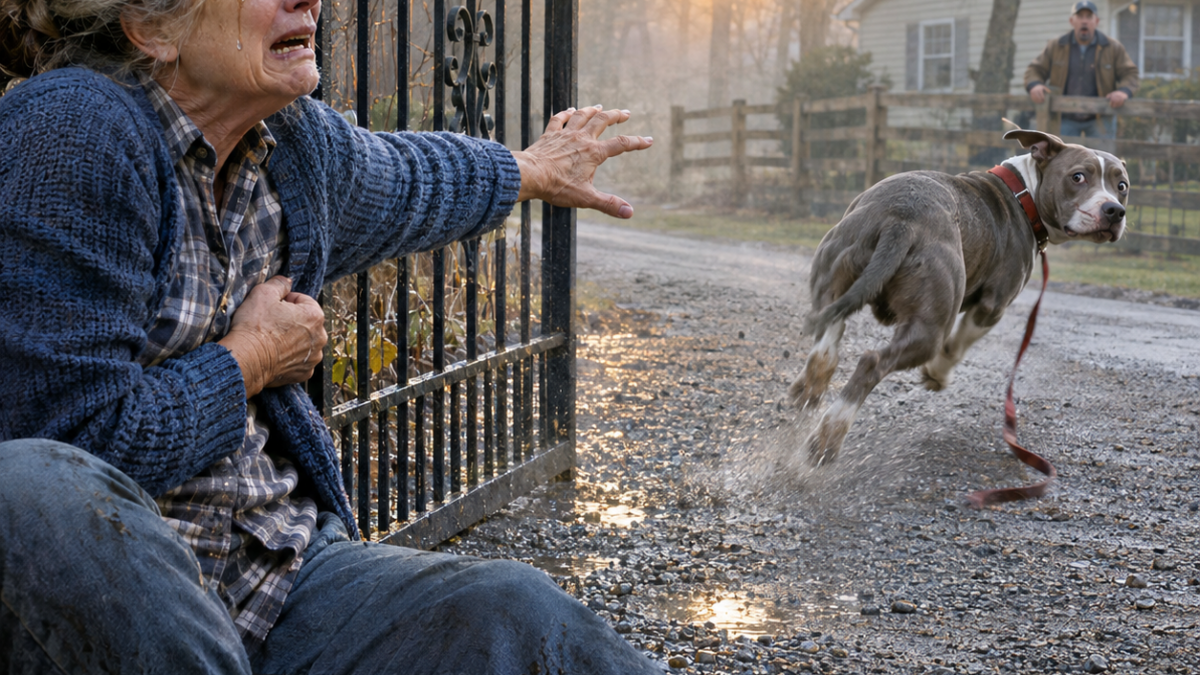
“THAT DOG IS A DISASTER WAITING TO HAPPEN—TAKE HIM BACK BEFORE HE HURTS SOMEBODY!” my neighbor had warned me when I brought Brucer home for a two-week trial, and three mornings later I was lying helpless beside my iron gate with a broken wrist while the frightened pit bull suddenly turned and sprinted away.
My phone was inside the house, the pain was so intense I couldn’t stand, and as Brucer disappeared around the corner, I felt the terrible emptiness of believing the one creature I’d defended against an entire neighborhood had abandoned me when I needed him most.
Then, ten agonizing minutes later, I heard furious barking, pounding footsteps, and a woman’s voice screaming, “OVER HERE—SOMEBODY CALL AN AMBULANCE!”—and what those strangers witnessed would change Brucer’s life, my life, and the way our neighborhood looked at a dog everyone had condemned without ever looking into his eyes.
My name is Thomas Bennett.
I was fifty-eight years old when I agreed to take home a dog the local rescue organization couldn’t seem to place.
His name was Brucer.
He was a stocky, gray-and-white pit bull–type dog with a broad chest, a blocky head, small scars on his muzzle, and amber eyes that seemed to expect disappointment before anyone had even spoken to him.
The rescue coordinator, Barbara Mitchell, told me he needed a patient home.
“Just two weeks, Thomas,” she’d said. “That’s all I’m asking you to try.”
Two weeks.
Fourteen days.
It sounded manageable.
I had an enclosed yard, a quiet house, and enough time to help an animal settle.
I didn’t have children living at home.
I didn’t own another dog.
And I had spent the better part of three years discovering that an empty house could be a lonely place, even when you told everybody you enjoyed the peace.
But the moment I brought Brucer into my neighborhood, I began hearing warnings.
A woman across the street pulled her little terrier into her arms when she saw us.
A delivery driver refused to approach my front steps.
And my neighbor, Richard Collins, stood beside his mailbox staring at Brucer as though I’d brought home a loaded weapon.
“That’s a pit bull,” he said.
I nodded.
“He’s a dog, Richard.”
Richard’s expression hardened.
“You know what I mean.”
I looked down at Brucer.
He stood beside me, body low, eyes moving between the stranger and the sidewalk.
He wasn’t growling.
Wasn’t barking.
Wasn’t pulling toward anybody.
He looked frightened.
Richard pointed toward him.
“You’re going to regret this.”
I said nothing.
Because at the time, I wasn’t entirely sure he was wrong.
Brucer had already been passed over by more potential adopters than Barbara could comfortably count.
Two earlier placements had ended almost immediately.
One person said he looked intimidating.
Another said he wouldn’t approach visitors.
Neither had reported that he’d bitten anyone.
But stories travel quickly.
Fear travels even faster.
And somewhere along the way, Brucer had become a dog people described as dangerous without knowing very much about him.
The first two days at my house were almost painfully quiet.
He stayed in the corner of the living room I’d prepared for him.
A soft bed.
Fresh water.
A few toys he ignored.
He watched me whenever I moved.
If I approached too directly, he stepped backward.
If I offered food from my hand, he turned his head.
But when I placed his bowl on the floor and walked away, he eventually approached and ate.
I counted those moments as victories.
A meal eaten.
A drink of water.
A nap with his head resting on his paws instead of his eyes fixed on the doorway.
I didn’t expect him to love me.
I didn’t even expect him to like me.
I wanted him to learn that this house was somewhere he could rest without being frightened.
On the second evening, he followed me into the kitchen.
Not close enough to touch.
Just close enough to watch while I made dinner.
I looked down at him.
“Getting curious, huh?”
His ears shifted.
I smiled.
“That’s okay. You can be curious.”
He lowered himself onto the floor.
For the first time, he rested near me without immediately turning toward the exit.
I remember thinking that perhaps two weeks would be enough to help him begin trusting people.
I had no idea that the following morning, before I’d even learned how he liked to play, I’d be lying on wet pavement outside my gate with pain shooting through my arm.
And when Brucer ran away, I didn’t know whether the dog I’d promised to protect was frightened of me, frightened of the accident, or simply trying to escape.
All I knew was that he was gone.
Then came the barking.
And the sound of people running toward my house.
PART2
The first voice belonged to a woman.
“THIS WAY! HE KEEPS RUNNING BACK HERE!”
Then a man shouted:
“Is somebody hurt?”
I tried to answer.
The words came out as a broken gasp.
I was lying on my side beside the iron gate, my right arm cradled against my chest.
Every time I tried to move my wrist, a bolt of pain shot toward my elbow.
The wet paving stones pressed against my shoulder.
I could feel cold moisture soaking through the back of my shirt.
And then I saw him.
Brucer.
The dog who had vanished around the corner.
He was running toward me with three people following.
A middle-aged man in a blue jacket.
A woman carrying a grocery bag.
And a younger woman wearing running shoes and a red sweatshirt.
Brucer reached the gate first.
He slowed.
Looked at me.
Then turned toward the people behind him.
He barked twice.
Not with the deep, threatening sound everyone had warned me about.
With short, urgent bursts.
As if he couldn’t understand why the humans weren’t moving faster.
The man stopped a few yards away.
“Sir? Can you hear me?”
I nodded.
“Please.”
My voice shook.
“I fell.”
The younger woman stepped forward.
Then froze when she saw Brucer.
“Oh, my God.”
She stared at his broad head.
His muscular body.
The way he stood beside me.
“Is that your dog?”
I nodded.
The man looked uneasy.
“He was running up and down the street barking at everybody.”
Brucer moved closer to me.
Sniffed my face.
Then my injured arm.
I winced.
He immediately drew back.
“He went for help,” I whispered.
The woman with the grocery bag stared at me.
“What?”
“He went for help.”
I swallowed against the pain.
“He saw me fall. He ran out to find somebody.”
The three strangers looked at one another.
The younger woman lowered her eyes to Brucer.
For the first time, her expression changed.
Not completely.
But enough.
She took out her phone.
“I’m calling 911.”
The man moved to open the gate wider so the paramedics could reach me.
The woman with the grocery bag crouched several feet away.
“What’s your name?”
“Thomas.”
“Okay, Thomas. I’m Linda.”
I tried to smile.
It didn’t work.
“I’m going to stay here until help comes.”
I looked toward Brucer.
He was sitting beside my shoulder.
His tail moved slowly against the wet stones.
I stared at him.
“Buddy,” I whispered.
His ears lifted.
I fought back tears.
“You came back.”
He moved his head closer.
Then rested it gently against the uninjured side of my chest.
And I understood that Brucer hadn’t been running away from me.
He’d been running toward the only help he knew how to find.
For several minutes, nobody said anything about Brucer’s breed.
Nobody called him dangerous.
Nobody ordered him away.
They were too busy helping me.
Linda stayed on the phone with emergency dispatch while Richard moved a loose garden pot away from the gate so the paramedics would have room.
The younger woman introduced herself as Hannah Brooks.
She lived three blocks away and had been out for her morning run.
“I heard this dog barking like crazy,” she explained while kneeling near my feet. “He came up to me, backed away, and kept barking toward the corner.”
I looked at Brucer.
He watched her closely.
Hannah continued:
“I thought he wanted something from me. Honestly, I was scared.”
She swallowed.
“Then he ran a few yards, looked back, and did it again.”
Linda nodded.
“He did the same thing to me. I nearly dropped my groceries.”
Richard rubbed the back of his neck.
“I was checking my driveway when he came running down the street.”
He glanced toward Brucer.
“I thought he was going after somebody.”
My stomach tightened.
Just three days earlier, Richard had warned me that Brucer was a danger waiting to happen.
Now that same man was standing beside me, staring at the dog who had brought him to my rescue.
Richard looked down.
“Then he kept running away and coming back, like he wanted us to follow.”
Hannah nodded.
“I finally said, ‘All right, show me,’ and started walking after him.”
Linda gave a shaky laugh.
“That’s when he practically dragged the whole neighborhood down the sidewalk.”
I looked at Brucer.
He had stopped barking.
His body was low beside me, one paw resting near my left hand.
I could barely believe what I was hearing.
The dog who had spent two days avoiding my touch had gone into an unfamiliar street, approached people who were afraid of him, and kept trying until somebody followed.
Not because I’d trained him to summon help.
I hadn’t.
Not because he’d been taught an emergency command.
He hadn’t.
I couldn’t know exactly what he intended.
But there was no denying the result.
Three people had followed him to my gate.
And I was no longer lying there alone.
“Good boy,” I whispered.
Brucer’s tail moved.
I tried to reach toward him with my left hand.
He hesitated.
Then leaned forward just enough to touch his nose against my fingers.
That tiny gesture almost hurt more than my wrist.
Because it was the first time he’d chosen to touch me.
And he’d done it while I was lying on the ground, unable to offer him anything in return.
The ambulance arrived twelve minutes later.
I remember the sound before I saw it.
The engine approaching.
The crunch of tires along the curb.
The quick footsteps of two paramedics moving through the gate.
One was a woman named Sarah.
The other was a man named Kevin.
They carried their equipment toward me and began asking questions.
My name.
My age.
Whether I’d hit my head.
Whether I could move my fingers.
Whether I felt pain anywhere else.
I answered as best I could.
Then Kevin noticed Brucer.
He stopped.
“Is that your dog?”
“Yes.”
“He looks nervous.”
I glanced toward Brucer.
His ears were forward.
His body had become stiff.
He was watching the strangers approaching me with equipment.
I knew the scene might frighten him.
“He just led these people here,” I said.
Sarah crouched near me, keeping an eye on the dog.
“All right, Thomas. We’re going to help you.”
Richard moved beside the gate.
“I can give you some room.”
“Thank you,” Sarah said.
Brucer looked at Richard.
Then at me.
He didn’t growl.
Didn’t charge.
Didn’t snap.
He simply seemed uncertain about what was happening.
Kevin paused.
“Let’s make sure he has enough space.”
I nodded.
“Brucer.”
His ears moved.
“Buddy, it’s okay.”
He looked at my face.
I wanted to tell him everything.
That these were good people.
That the equipment wasn’t meant to hurt me.
That I wasn’t being taken away forever.
That he had done exactly what I needed.
But I couldn’t explain those things in words he understood.
So I kept my voice calm.
“Good boy.”
Sarah examined my wrist.
The swelling was already becoming obvious.
She told me not to try moving it.
I nodded.
Then asked the question that mattered most to me.
“What’s going to happen to my dog?”
Kevin looked surprised.
“Let’s get you taken care of first.”
I swallowed.
“He’s only been with me three days.”
Sarah glanced toward Brucer.
Then toward the people standing by the gate.
“Is there someone here who can look after him?”
I looked at Richard.
Then Linda.
Then Hannah.
All three had been frightened of Brucer less than twenty minutes earlier.
Now I needed one of them to help him.
I hated asking.
But I had no choice.
“Could somebody stay with him until I call the rescue?”
For a moment, nobody answered.
Then Linda stepped forward.
“I can.”
I stared.
“Are you sure?”
She looked toward Brucer.
He was watching me.
“He brought us here,” she said quietly. “I think I can at least make sure he isn’t left alone.”
My eyes filled.
“Thank you.”
The paramedics helped me onto the stretcher.
Every movement hurt.
I tried not to cry out, but the pain was sharp enough that my vision blurred.
Brucer followed.
He stayed beside the stretcher until we reached the ambulance.
Then, when Kevin opened the rear doors, Brucer made a sudden leap.
Before anyone could react, he had climbed inside.
I stared.
“Brucer!”
He turned toward me.
His tail moved once.
Then he sat.
Right beside the stretcher.
As though the matter had been settled.
For one extraordinary second, nobody spoke.
Then Sarah looked toward Kevin.
Kevin looked toward the dog.
Richard let out a disbelieving laugh.
“Well, I’ll be.”
I felt tears sliding down my cheeks.
“Buddy, you can’t come like this.”
Brucer didn’t move.
Sarah spoke gently.
“We need to transport you safely, Thomas, and we can’t have an unsecured dog moving around while we’re treating you.”
I nodded.
I understood.
But understanding didn’t make it easier to watch Kevin encourage Brucer back toward the door.
The dog resisted at first.
Not aggressively.
He simply remained beside me, looking from one face to another.
Linda stepped closer.
“Brucer?”
His ears moved.
I took a breath.
“Go with Linda, buddy.”
He looked at me.
I swallowed.
“I’m coming back.”
Finally, with calm encouragement and a safe way down, he stepped out.
Linda gently guided him away from the doors.
He turned immediately.
Watched the paramedics adjust the stretcher.
Then tried to approach again.
“It’s okay,” I called.
He stopped.
His tail lowered.
Something in his expression made my chest hurt.
For two days, he’d barely trusted me enough to eat nearby.
Now he was trying to follow me into an ambulance.
I looked at Linda.
“Please don’t let him think I abandoned him.”
Her expression softened.
“I won’t.”
I held her gaze.
“Promise?”
She nodded.
“I promise.”
The doors closed.
As we drove away, I caught one last glimpse of Brucer standing beside Linda at the gate.
Watching.
Waiting.
And suddenly, the pain in my wrist was no longer the thing making me cry.
At the hospital, X-rays confirmed a fracture of my right wrist.
There was no dangerous head injury.
No internal bleeding.
Nothing that required the kind of emergency intervention I’d feared during those first minutes on the pavement.
But the wrist needed treatment and immobilization, and I’d have to return for orthopedic follow-up.
The doctor explained the recovery process.
The importance of protecting the injured arm.
What symptoms would require urgent reassessment.
And the limitations I’d have to accept while the bone healed.
I nodded.
Then asked:
“Can I use my left hand to walk a dog?”
The doctor looked at me.
For a moment, I thought he hadn’t heard correctly.
“You have a dog?”
“Yes.”
“How large?”
“About sixty-five pounds.”
He raised his eyebrows.
“Then I wouldn’t recommend personally managing an excitable dog on a leash until we know you’re able to do so safely.”
I sighed.
“He isn’t excitable.”
The doctor gave me a look.
“He just ran through a neighborhood barking until three people followed him.”
I blinked.
“How did you know that?”
He smiled.
“Your paramedics mentioned it.”
I laughed.
Then winced when the movement jarred my wrist.
“Apparently I’m becoming a local story.”
“Maybe.”
He looked at the cast.
“Let’s focus on making sure you recover without another fall.”
I nodded.
But as soon as he left, I asked the nurse whether anyone had called about a dog waiting outside.
She smiled.
“A gray pit bull?”
My heart jumped.
“Yes.”
“He’s out in the courtyard near the entrance.”
I stared.
“What?”
“Someone brought him over in a car and is staying with him while you receive treatment.”
Linda.
She’d kept her promise.
I turned toward the window.
From my room, I could see part of the hospital grounds.
A small tree.
A patch of grass.
A bench near the walkway.
And beneath the tree, a stocky gray-and-white dog lying beside a woman in a blue jacket.
Brucer.
He was watching the entrance.
Not barking.
Not pulling.
Just lying there with his head on his paws.
My throat tightened.
“He’s still here.”
The nurse moved beside me.
I pointed.
“That’s him.”
She smiled.
“He’s had some water, and his volunteer handler says he’s being very patient.”
I looked at her.
“He isn’t a trained service dog.”
“I understand.”
“He’s a rescue I’m fostering.”
She nodded.
“Then he’s doing a pretty good job of waiting for somebody he knows.”
I began crying.
Because three days earlier, I hadn’t been sure Brucer knew who I was.
Now he had run through the neighborhood to find help and was waiting outside a hospital for me to return.
I called Barbara from the examination room.
She answered on the second ring.
“Thomas?”
“Barbara, I need to tell you something.”
Her voice changed immediately.
“Is Brucer okay?”
“Yes.”
“Did something happen?”
I looked down at my cast.
“A few things.”
I explained the fall.
The broken wrist.
Brucer running into the street.
The barking.
The three neighbors.
The ambulance.
The dog jumping inside.
Then the hospital courtyard.
Barbara remained silent throughout.
When I finished, she whispered:
“Oh, Thomas.”
I closed my eyes.
“I’m sorry.”
There was a pause.
“For what?”
“I know I was supposed to keep him safe. I didn’t expect—”
“Thomas.”
I stopped.
She took a shaky breath.
“Are you all right?”
I stared at the wall.
For the first time since the fall, somebody had asked about me before asking what would happen next.
“Yes,” I whispered. “I’m going to be okay.”
Barbara exhaled.
Then asked:
“And Brucer?”
“He’s waiting outside.”
A long silence.
Then I heard her crying.
I swallowed.
“Barbara?”
She gave a small laugh through tears.
“I’m here.”
I looked toward the window.
“Can you help us?”
“Of course.”
I closed my eyes.
“I don’t want him going back to the rescue because I broke my wrist.”
“We’ll talk about a safe plan.”
I swallowed.
“Please.”
Her voice softened.
“Thomas, listen to me.”
I waited.
“You’ve only had that dog three days.”
“I know.”
“And he’s already found a way to tell you what kind of heart he has.”
I looked down.
She continued:
“Let’s make sure both of you are cared for.”
Barbara arrived at the hospital an hour later.
She was fifty-four, with short silver hair, sturdy walking shoes, and an expression that suggested she’d spent most of her adult life trying to solve problems people insisted were impossible.
She brought Brucer’s temporary foster paperwork, a leash, water, and a bag containing food and treats.
When she reached the courtyard, Linda stood to greet her.
I could see them through the window.
They spoke.
Barbara knelt a comfortable distance from Brucer.
The dog lifted his head.
His tail began moving.
Then he stood.
Walked toward her.
And rested his head briefly against her arm.
Barbara covered her mouth.
Even from the hospital window, I could see she was crying.
A few minutes later, she came upstairs to see me while Linda remained with Brucer.
She entered my room.
Stopped.
Looked at my cast.
Then shook her head.
“Thomas Bennett.”
I smiled weakly.
“Barbara Mitchell.”
“What have you two been doing?”
“Apparently, causing trouble.”
She moved closer.
Then hugged me carefully around my good shoulder.
I wasn’t expecting that.
I had known Barbara only a short time.
We’d met at the rescue.
Spoken by phone.
Exchanged a few messages.
Now she held me as though we’d been friends for years.
When she stepped back, her eyes were wet.
“You scared me.”
“Sorry.”
She shook her head.
“Don’t apologize.”
Then she looked toward the window.
“I need to tell you something about Brucer.”
I swallowed.
“What?”
Barbara sat in the chair beside me.
“When you agreed to foster him, I was worried nobody would ever give him enough time.”
I looked down.
She continued:
“People see his head. His shoulders. The breed label.”
“Pit bull,” I whispered.
She nodded.
“And they decide the rest before he gets a chance to show them who he is.”
I looked toward the courtyard.
Barbara continued:
“He’s been returned twice.”
“I know.”
“But you don’t know what happened the second time.”
I turned toward her.
“What happened?”
She looked down.
“The adopter called after one night and said Brucer was unmanageable.”
My stomach tightened.
“Had he bitten somebody?”
“No.”
“Growled?”
“Not according to what they reported.”
“Then what?”
Barbara swallowed.
“He wouldn’t come out from behind the sofa.”
I stared.
She nodded.
“That was enough.”
For several seconds, I couldn’t speak.
Then she said:
“They told me they wanted a dog who was happy to see them.”
I looked toward Brucer.
Barbara’s voice cracked.
“Thomas, sometimes people want trust from an animal before they’ve given that animal a single reason to feel safe.”
I wiped my eyes.
She continued:
“And now that same dog has gone looking for help because you were hurt.”
I laughed through tears.
Barbara took my good hand.
“Whatever happens with his adoption, you have already done something important for him.”
I shook my head.
“No.”
She looked surprised.
I glanced toward the window.
“He’s the one who did something important.”
Then I whispered:
“He came back.”
Barbara’s eyes filled.
And for a while, neither of us spoke.
From my hospital window, I watched Brucer become the center of a very unusual gathering.
It began with an elderly man who had been sitting on a nearby bench.
He wore a brown cap and used a wooden walking stick.
When Linda moved toward the hospital entrance to speak with Barbara, the man noticed Brucer lying beneath the tree.
He hesitated.
Then asked something I couldn’t hear.
Linda apparently explained the situation.
The man looked toward Brucer.
Then sat on the other end of the bench.
A careful distance away.
Brucer raised his head.
Watched him.
Then lowered it again.
The man remained there.
A few minutes later, a nurse brought a fresh bowl of water.
Barbara placed it where Brucer could reach it without being surrounded by strangers.
He stood.
Drank.
Then settled back down.
I watched the nurse smile.
Another person walking through the courtyard stopped to ask about him.
Barbara spoke.
The person looked toward the dog.
Then continued on.
Nothing dramatic.
No sudden cheering crowd.
Just ordinary people discovering that the frightening animal they’d noticed under the tree was waiting for the man he’d helped.
An hour later, the elderly man approached Barbara again.
This time, he sat a little closer.
Brucer looked toward him.
His tail moved once.
The man smiled.
From my window, I could see him speaking quietly.
I wondered what he was saying.
Later, Barbara told me.
His name was Harold Jenkins.
He was seventy-nine and had been visiting his wife, who was recovering from surgery.
When he’d first seen Brucer, he’d thought about moving to another bench.
“I’ve never been comfortable around those dogs,” he’d admitted.
Barbara didn’t argue.
She simply told him Brucer’s story.
Harold listened.
Then looked at the dog.
“He went looking for help?”
“Yes.”
“And he stayed while they loaded the man into the ambulance?”
“Yes.”
Harold stared.
Then said:
“Well, maybe I’ve got a few things to learn.”
He remained on the bench for nearly forty minutes.
At one point, Brucer approached slowly and sniffed his shoe.
Harold stayed still.
Barbara watched the interaction carefully.
Brucer took a step back.
Then sat beside the bench.
Harold looked down at him.
“You’re a good fellow, aren’t you?”
Brucer’s tail moved.
Later, Harold told one of the nurses:
“I thought he might attack somebody, but he just sat there beside me like an old friend.”
When Barbara repeated those words, I began crying again.
Because that was the dog I’d brought home.
Not a monster.
Not a miracle.
Not an animal who could never make a mistake.
A frightened creature who was finally being allowed to show people how gently he could behave.
My discharge took longer than expected.
There were instructions.
Follow-up arrangements.
Pain management.
Questions about whether I had help at home.
I listened carefully.
Told the staff that Barbara and my neighbors had offered assistance.
And promised not to do anything foolish with the cast.
The nurse gave me a skeptical look.
“You fell while collecting the mail.”
I sighed.
“I know.”
“Which suggests you should be especially careful about what you call foolish.”
I laughed.
“Fair enough.”
When I was finally ready to leave, Linda and Barbara were waiting outside.
Richard had gone home to retrieve my keys and make sure the gate was secured.
Hannah had returned to work after leaving her contact information.
I walked through the hospital doors with my right arm supported.
And saw Brucer.
He was lying under the same tree.
His head rested on his paws.
His eyes were fixed toward the entrance.
Barbara spoke softly.
“Brucer.”
His ears moved.
Then he saw me.
I stopped.
For one impossible second, he simply stared.
Then he sprang to his feet.
His tail began wagging so quickly that the entire back half of his body seemed to move.
He took several eager steps toward me.
Then stopped.
One step away.
Exactly one step.
He sat.
And waited.
I stood there with tears running down my face.
Barbara smiled.
“Looks like somebody recognizes you.”
I laughed through tears.
“Hey, buddy.”
Brucer’s tail swept across the pavement.
I slowly lowered my left hand.
He leaned forward.
Sniffed it.
Then touched his nose to my fingers.
I swallowed.
“I’m okay.”
His eyes stayed on me.
“I came back.”
He moved closer.
For a moment, I thought he might jump.
Instead, he pressed his broad forehead gently against my thigh.
I stood completely still.
Then rested my left hand against his shoulder.
He didn’t retreat.
Didn’t flinch.
Didn’t look toward the street.
He simply stayed.
Three days earlier, he wouldn’t eat from my hand.
Now he was standing beside me in a hospital courtyard, allowing me to touch him because he had decided I was someone he knew.
Someone he trusted.
I looked toward Barbara.
She was crying.
Then I looked at Linda.
She wiped her eyes.
“I told you I’d make sure he knew you were coming back.”
I nodded.
“You did.”
Brucer leaned against me a little more.
I looked down.
And whispered:
“So did he.”
Getting home required more planning than I’d expected.
Barbara drove me.
Linda followed with supplies I’d need during recovery.
Richard met us at the house.
He had swept the wet paving stones near the gate and placed a temporary warning marker beside the area where I’d slipped.
When I saw him standing in the driveway, I felt a strange embarrassment.
This was the same man who had told me to return Brucer before he hurt someone.
Now he was carrying groceries into my kitchen.
He approached carefully.
“Thomas.”
“Richard.”
He looked at my cast.
“That looks painful.”
“It is.”
He nodded.
Then glanced toward Brucer.
The dog stood beside Barbara.
Watching.
Richard rubbed the back of his neck.
“I owe you something.”
I waited.
He swallowed.
“An apology.”
I stared.
Richard looked toward the driveway.
Then back at me.
“I judged that dog before I knew him.”
I said nothing.
He continued:
“When I saw him running down the street this morning, I thought exactly what I’d told you would happen.”
My throat tightened.
“That he was going after somebody.”
Richard nodded.
“I nearly called animal control before I realized he was trying to get us to follow.”
I looked down at Brucer.
The dog shifted his weight.
His tail moved slightly.
Richard continued:
“Then I saw you on the ground.”
He swallowed.
“And I saw him come back to you.”
For several seconds, the driveway was silent.
Then Richard said:
“I was wrong about him.”
I looked at the man who had spent the previous three days warning me that Brucer was dangerous.
I wanted to say something clever.
Something sharp.
Something that would make him feel as embarrassed as he’d made me feel.
But then I looked at the dog.
He was standing quietly beside Barbara.
Not demanding an apology.
Not interested in who had been right.
Simply waiting for us to go inside.
I took a breath.
“Thank you, Richard.”
He nodded.
Then asked:
“Can I help with anything while your wrist heals?”
I looked down at my cast.
Then toward the house.
“Well, I could use somebody to carry my groceries.”
Richard smiled.
“I think I can manage that.”
For the first time since bringing Brucer home, I saw my neighbor look at him without fear.
Not entirely without caution.
But without the instant judgment.
And that was enough for one morning.
Inside the house, Brucer stopped just beyond the doorway.
He looked around.
Sniffed the air.
Then turned toward me.
I smiled.
“Home, buddy.”
His tail moved.
Barbara helped me settle into a chair while Linda put groceries away.
Richard checked that the back gate closed properly.
For a little while, my kitchen was full of people.
Three days earlier, I’d been eating dinner alone while a frightened dog watched me from the living-room corner.
Now the house smelled of coffee.
People were laughing.
Someone was asking where the clean towels belonged.
Linda was reorganizing my refrigerator despite my protests.
Richard was checking the outdoor steps.
And Brucer was standing in the middle of it all, trying to understand why so many people were suddenly interested in the quiet little house he’d only just begun to know.
I watched him carefully.
His ears moved constantly.
His body remained a little tense.
He didn’t seem comfortable with the crowd.
I asked everyone to give him space.
Barbara nodded immediately.
“He’s had a big day.”
Linda stepped back.
Richard moved away from the doorway.
Brucer looked toward his bed.
Then slowly walked into the living room.
He circled once.
Lay down.
And watched us from a distance.
I smiled.
“That looks more like him.”
Barbara glanced toward me.
“What do you mean?”
“He likes knowing where everybody is.”
She nodded.
“That’s useful information.”
I watched him.
Then whispered:
“He hasn’t had much time to learn this is home.”
Barbara’s expression softened.
“No.”
She looked toward the dog.
“But I think he’s learning.”
That afternoon, Barbara sat with me at the kitchen table.
The others had gone home.
Brucer was sleeping nearby.
My wrist throbbed.
The pain medication was beginning to make me tired.
Barbara opened her notebook.
“We should talk about the rest of the foster period.”
My stomach tightened.
I had almost forgotten the agreement.
Fourteen days.
A temporary placement.
A chance for Brucer to settle while the rescue considered what came next.
“Do we have to?”
She smiled gently.
“Yes.”
I looked toward Brucer.
Then back at her.
“I don’t want him going back.”
Barbara didn’t answer immediately.
She looked at my cast.
Then toward the yard.
“Thomas, we need to make sure you’re physically able to manage his care while you recover.”
I swallowed.
“I know.”
“He’s a strong dog.”
“I know.”
“You can’t put all the strain of his leash on an injured wrist.”
“I won’t.”
“And we need to be honest about what happens if he becomes frightened around visitors or unfamiliar dogs.”
I nodded.
Barbara’s expression softened.
“I’m not trying to take him away.”
I looked at her.
“Then why does it feel like you are?”
She sighed.
“Because you already care about him.”
My eyes filled.
I looked down.
Barbara continued:
“Caring is important, Thomas. But Brucer also needs a stable home with a realistic plan.”
I nodded.
We discussed everything.
How I’d feed him.
How I’d manage the yard.
Who could help with walks during my recovery.
Whether my home was secure.
How we would continue his veterinary care.
What we’d do if he became overwhelmed by visitors.
How we’d help him learn to trust without forcing contact.
Barbara didn’t ask whether I believed every pit bull was harmless.
She asked whether I understood that every dog, whatever his breed, deserved careful handling, supervision, training, and respect for his individual needs.
I did.
And the more we discussed it, the more certain I became.
I wasn’t trying to keep Brucer because he’d made me feel like a hero.
I wanted to keep him because he had already begun building a life in my house.
A bed in the corner.
A bowl beside the kitchen.
A place where nobody expected him to become friendly on command.
And a person who had decided he was worth waiting for.
Barbara closed her notebook.
“We can continue the foster arrangement while we evaluate the support plan.”
I exhaled.
Then whispered:
“Thank you.”
She looked toward Brucer.
“And Thomas?”
“Yes?”
“Don’t confuse what he did today with a promise that he’ll always know what to do.”
I nodded.
“I won’t.”
“He’s still learning.”
“So am I.”
Barbara smiled.
“Good.”
That first night after the accident, I tried to sleep in my bedroom.
Brucer had his bed in the living room.
He seemed comfortable there.
I didn’t want to change too much at once.
I turned off the lights.
Walked upstairs carefully.
Then lay down.
My wrist ached beneath the cast.
Every time I shifted, I felt a dull pain.
I stared at the ceiling.
Thought about the fall.
The crack against the gatepost.
The sight of Brucer running away.
Then the barking.
The voices.
The ambulance.
I closed my eyes.
For a moment, I heard Linda shouting.
He’s coming back this way!
I opened my eyes again.
I wondered what would have happened if nobody had followed him.
How long would I have lain beside the gate?
Would another neighbor have seen me?
Would I have managed to crawl toward the house?
I knew the fracture itself wasn’t likely to have killed me.
But I also knew how frightened and helpless I’d felt lying there alone.
Brucer had brought people before my situation became more dangerous.
I turned toward the doorway.
The house was quiet.
Then I heard something.
Soft footsteps.
A pause.
Another step.
I sat up slightly.
“Brucer?”
The footsteps stopped.
I looked toward the bedroom door.
There he stood.
His broad gray head appeared around the frame.
His ears were lowered.
His body remained mostly in the hallway.
He didn’t enter.
Just watched.
I stared.
For two nights, he’d preferred staying downstairs.
Now he had climbed the stairs on his own.
I swallowed.
“Hey, buddy.”
His tail moved once.
I smiled.
“You checking on me?”
He looked toward the bed.
Then back at the hall.
I moved my left hand toward the floor.
“It’s okay.”
He hesitated.
Then entered slowly.
Sniffed the edge of the rug.
Walked toward the foot of the bed.
And lay down.
I stared at him.
He rested his head against the side of the mattress.
Close enough that I could touch his ears with my left hand.
I did.
Gently.
Brucer closed his eyes.
I began crying.
“Three days,” I whispered.
“That’s all it took you.”
His tail moved.
I laughed through tears.
Then corrected myself.
“No.”
I looked toward his scarred muzzle.
“It took you a lot longer than three days to learn what people can do to a dog.”
My voice broke.
“And I’m going to spend the rest of your life showing you what people can do for one.”
Brucer sighed.
A deep, tired sound.
Then settled beside the bed.
I watched him for a long time.
And when sleep finally came, it was the first night in years that I didn’t feel quite so alone.
The following morning, Richard knocked at my door at eight.
I opened it with my left hand.
He stood on the porch holding two paper cups of coffee and a small brown bag.
“I brought breakfast.”
I stared.
“Why?”
He shrugged.
“Because you’re not supposed to use that arm much.”
“Richard, I can make toast.”
“Then consider this a more sophisticated version of toast.”
I looked inside the bag.
Two breakfast sandwiches.
I smiled.
“You didn’t have to.”
He looked toward the living room.
“Where’s Brucer?”
My stomach tightened.
For a second, I expected another warning.
Then I remembered the apology in the driveway.
“He’s inside.”
Richard nodded.
“Can I see him?”
I hesitated.
“Let’s see how comfortable he feels.”
Brucer stood near his bed.
He watched Richard through the doorway.
His body became still.
Not aggressive.
Uncertain.
Richard noticed.
He stopped several feet away.
“Hey, fella.”
Brucer’s ears moved.
Richard looked at me.
“Should I give him something?”
I smiled faintly.
“Probably not yet.”
Richard nodded.
“Okay.”
We sat at the kitchen table.
Brucer remained where he could see us.
Every few minutes, Richard glanced toward him.
Then looked away, respecting his space.
After breakfast, he stood.
“I’m going to check those paving stones again.”
“You already did.”
“I know.”
“Richard.”
He smiled.
“Thomas.”
I sighed.
“Don’t make a whole project out of it.”
He looked toward my cast.
“Too late.”
I laughed.
For the first time since bringing Brucer home, a neighbor was visiting because he wanted to help rather than because he wanted the dog removed.
I hadn’t realized how much that difference would mean.
News of the accident spread quickly.
Not through a television station.
Not through some dramatic headline.
Through neighbors talking across fences and people sharing messages in our small community group.
At first, the story wasn’t entirely accurate.
Someone posted that a pit bull had chased three residents through the streets before emergency services arrived.
Another person claimed the dog had attacked a man outside his home.
I stared at my phone in disbelief.
I was the man outside his home.
And Brucer hadn’t attacked me.
He’d helped bring people to me.
Before I could decide whether to respond, Linda posted a correction.
I was there. The dog did not attack anyone. He repeatedly approached us, barked, and ran back toward his owner’s house. We followed him and found Thomas injured on the ground. Please stop spreading stories that aren’t true.
Hannah added her account.
Then Richard.
That surprised me most.
His message was brief.
I was one of the people who followed Brucer. I had previously warned Thomas about the dog based on his appearance and breed. I was wrong to judge him without knowing his behavior. He led us directly to Thomas, who needed medical help.
I read the words twice.
Then a third time.
For days, Richard had been the loudest person telling me the dog was a danger.
Now he was using that same public voice to correct the record.
Comments followed.
Some people apologized.
Others asked how I was recovering.
A few remained skeptical.
I didn’t expect every frightened person to change their mind because of one good story.
I understood that dogs needed to be evaluated as individuals, and any large, powerful dog required responsible care.
But I hoped people might begin asking questions before making declarations.
I looked toward Brucer.
He was lying beside the kitchen doorway, watching a patch of sunlight move across the floor.
He had no idea strangers were arguing about him on the internet.
I smiled.
Lucky dog.
Hannah visited on the fifth day after the accident.
She brought a small bag of dog treats approved by Barbara and a handwritten card.
The card showed a gray dog beside a stick figure with an enormous cast.
Across the top, in uneven letters, someone had written:
THANK YOU, BRUCER!
I laughed.
“Who made this?”
“My niece, Olivia.”
I looked up.
“How old?”
“Eight.”
I stared at the drawing.
The dog’s head was almost as big as the stick figure’s entire body.
His tail curved like a question mark.
He wore a bright red cape.
I began laughing harder.
Hannah smiled.
“She heard what happened and decided he was a superhero.”
I looked toward Brucer.
He was sleeping.
“A superhero, huh?”
Hannah nodded.
“She asked whether he could fly.”
I smiled.
“Not that I’ve noticed.”
“She was disappointed.”
I laughed.
Then looked at the card again.
Something tightened in my chest.
Three days earlier, people had crossed the street to avoid Brucer.
Now an eight-year-old girl had drawn him wearing a cape.
He hadn’t changed breeds.
Hadn’t become a different color.
Hadn’t suddenly grown into a harmless stuffed animal.
He was the same dog.
The same broad head.
The same scars.
The same uncertain eyes.
The thing that had changed was the story people knew about him.
I looked at Hannah.
“Would you thank her for me?”
She smiled.
“Of course.”
I placed the card on the refrigerator.
Where I could see it every morning.
By the end of the first week, Brucer had begun following me through the house.
Carefully at first.
He didn’t press himself against my legs.
Didn’t demand attention.
If I stood to get water, he lifted his head.
If I moved toward the kitchen, he often followed a few steps behind.
If I sat in my favorite chair, he settled where he could see me.
When my wrist throbbed and I leaned back with a tired sigh, he sometimes approached.
Sniffed my cast.
Then lay nearby.
I wanted to believe he was making sure I was all right.
Maybe he was.
Maybe he simply preferred keeping the person who fed him in sight.
Either way, it comforted me.
The house no longer felt like a place where I lived alone.
There was another presence.
Quiet.
Watchful.
Learning my routines as I learned his.
I began talking to him throughout the day.
“Coffee’s ready, Brucer.”
His ears moved.
“Not for you, obviously.”
He looked disappointed.
“Don’t give me that face.”
His tail moved.
I laughed.
Later, while making lunch, I’d ask:
“What do you think? Soup or a sandwich?”
He would stare.
“Yeah, I’m leaning sandwich too.”
One afternoon, Richard came through the back gate to help carry some supplies.
He heard me talking.
Then stopped.
“Thomas?”
I looked up.
“What?”
“Are you having a conversation with the dog?”
“Of course.”
Richard stared.
I added:
“He’s a better listener than you.”
Richard burst out laughing.
Brucer lifted his head.
His tail moved.
And for a moment, the house felt so full of ordinary happiness that I had to look away.
Barbara visited twice during the second week.
She watched Brucer move around the house.
Checked his food and water arrangements.
Asked about his sleeping routine.
Observed how he responded to visitors.
And helped me adjust our plan for walks while my wrist healed.
Richard and Hannah had offered assistance.
But Barbara wanted us to introduce those arrangements carefully.
Brucer didn’t yet trust every person who approached.
And that was all right.
We weren’t trying to force him into becoming a neighborhood attraction.
His safety mattered.
So did the safety of the people around him.
A qualified trainer helped us begin using reward-based methods to build his confidence with ordinary handling, leash equipment, and predictable routines.
Some sessions went well.
Others were short because Brucer became tired or uncertain.
We stopped when necessary.
Started again another day.
Nobody called him stubborn because he needed space.
Nobody described fear as bad behavior.
We simply worked with the dog in front of us.
By the tenth day, Brucer could accept a small treat from my left hand.
I remember that moment more clearly than I remember what I ate for lunch that week.
I was sitting beside the kitchen table.
Brucer approached.
Sniffed my fingers.
Then took the treat gently.
I froze.
He stepped back.
Chewed.
Then looked at me.
I stared.
“Did you just do that?”
His tail moved.
I laughed.
“Brucer.”
He tilted his head.
“You took it.”
I began crying.
The dog looked slightly confused.
Then approached for another treat.
I laughed through tears.
“Of course you would.”
Barbara was on the phone when I told her.
She smiled in her voice.
“That’s a good sign.”
I stared at Brucer.
For months, he’d been described as difficult.
Unfriendly.
Impossible to connect with.
Now he’d taken a treat from my hand.
Not because I’d demanded it.
Because he’d chosen to come close enough.
I felt absurdly proud.
And I wasn’t ashamed of that.
The thirteenth night arrived with rain.
Brucer lay at the foot of my bed.
My cast rested on a pillow.
The house was quiet except for water tapping against the windows.
I looked at the calendar.
The following day marked the end of the two-week foster arrangement.
For almost fourteen days, I’d been telling myself I needed to be practical.
My wrist was fractured.
I was fifty-eight.
Brucer was a powerful dog with a history I didn’t fully understand.
Adoption meant responsibility for years, not a sentimental decision made after one dramatic incident.
I knew all of that.
But every time I imagined returning him to the rescue, the house seemed to grow cold.
I pictured his bed empty.
The water bowl removed.
No paws clicking along the kitchen floor.
No amber eyes watching me when I stood.
I looked toward the dog.
He was asleep.
One ear rested against the rug.
The other folded slightly backward.
He looked comfortable.
Safe.
He’d begun spending time in the yard without searching constantly for a way out.
He knew where his food was.
Where his bed was.
And when I usually turned off the lights.
I wondered what he would think if I loaded him into the car and took him back to the place where so many people had already rejected him.
Would he understand?
Would he believe he’d done something wrong?
Would he sit in another corner waiting for someone else to decide whether he was worth keeping?
My throat tightened.
I sat up.
Reached for my phone.
And called Barbara.
She answered sleepily.
“Thomas?”
“Barbara.”
A pause.
“Is everything okay?”
“Yes.”
“Is Brucer okay?”
“Yes.”
She exhaled.
“Then what’s wrong?”
I looked toward the dog.
He lifted his head at the sound of my voice.
I swallowed.
“Tomorrow’s the last day.”
Barbara was quiet.
Then she said:
“I know.”
I stared at him.
“I can’t bring him back.”
The words came out rough.
My voice broke.
“Barbara, I can’t do it.”
She didn’t answer immediately.
I continued:
“He has a bed here.”
Tears filled my eyes.
“He knows the kitchen.”
“He waits for me when I go upstairs.”
I swallowed.
“And when I was lying by that gate, he came back for me.”
Brucer’s ears moved.
I wiped my face.
“I know he’s not perfect.”
My voice shook.
“I know he needs training, and I know my wrist isn’t healed, and I know there will be work.”
Barbara remained silent.
“But he’s my family now.”
I looked at him.
“He’s not a dog I’m borrowing anymore.”
For several seconds, all I could hear was Barbara breathing on the other end of the line.
Then she whispered:
“Thomas.”
I closed my eyes.
“Yes?”
“I was hoping you’d call.”
I began crying.
She continued:
“We still need to complete the adoption process properly, but we’ve been reviewing your care plan and support. I think you could give Brucer a good permanent home.”
I covered my face.
“Really?”
“Yes.”
I laughed through tears.
Barbara’s voice cracked.
“Thomas, that dog has spent so much time being returned by people who never waited long enough to know him.”
I looked down.
She continued:
“If you’re prepared to love him responsibly for the rest of his life, then let’s take the next steps.”
I couldn’t speak.
Finally, I whispered:
“Thank you.”
She laughed softly.
“Now get some sleep.”
I nodded.
Then remembered she couldn’t see me.
“Okay.”
“And Thomas?”
“Yes?”
“Give Brucer a good-night pat for me—if he’d like one.”
I smiled through tears.
“I think he will.”
I ended the call.
Then looked toward the foot of the bed.
Brucer was awake.
Watching me.
I lowered my left hand.
He stood.
Walked toward me.
And rested his head beneath my fingers.
I stroked his ears.
“Hey, buddy.”
His tail moved.
“You’re staying.”
He looked up.
I smiled through tears.
“Two weeks turned out to be a little too short.”
Brucer sighed.
Then lay down again.
As though he had known all along.
The adoption became official the following week.
Barbara arrived carrying a folder, a new identification tag, and a bag of treats.
Richard came over to help with the paperwork because writing with my right hand was still difficult.
Linda brought muffins.
Hannah stopped by after her morning run.
For a dog who’d once been rejected because people didn’t want him in their homes, Brucer had somehow acquired a small committee of people determined to make sure he stayed in mine.
Barbara reviewed the documents with me.
We discussed his continued veterinary care, training, and how I would manage safely while my wrist recovered.
Then she placed the final page in front of me.
“Ready?”
I looked toward Brucer.
He was sitting beside the kitchen doorway.
Watching us with his familiar, serious expression.
I smiled.
“I’ve been ready longer than I realized.”
I signed.
Barbara checked the paperwork.
Then smiled.
“Congratulations, Thomas.”
My throat tightened.
“Thank you.”
She turned toward Brucer.
“Well, big guy. You’re home.”
His tail moved.
Linda began crying.
Hannah laughed.
Richard looked toward the ceiling as though something up there had suddenly become fascinating.
I knew better.
His eyes were wet too.
Barbara handed me the identification tag.
It was small.
Silver.
Ordinary.
On the front was one word.
BRUCER.
On the back were my contact details.
I held it in my good hand.
For a long moment, I couldn’t speak.
Then I looked toward the dog.
“Hey, buddy.”
He stood.
Approached.
And pressed his forehead gently against my leg.
I bent carefully.
Rested my left hand on his neck.
And whispered:
“Nobody’s sending you away again.”
My wrist took weeks to heal.
There were follow-up appointments.
A period of limited movement.
Exercises as my doctor advised.
And far more frustration than I expected.
I had spent most of my adult life doing things for myself.
Fixing a loose cabinet.
Carrying groceries.
Cleaning the yard.
Changing light fixtures.
Working on my car.
I didn’t like asking for help.
But suddenly, even opening a stubborn jar could become a challenge.
Some days, I became impatient.
With myself.
With the cast.
With the slow progress.
One afternoon, I dropped a bag of groceries in the kitchen.
A carton fell sideways.
Apples rolled across the floor.
I stood there staring.
Then muttered something I wouldn’t repeat in front of children.
Brucer lifted his head.
He watched me.
Then stood.
Walked toward the nearest apple.
Sniffed it.
Looked at me.
And sat down.
I stared.
“Really?”
His tail moved.
“You’re just going to supervise?”
He tilted his head.
I laughed despite myself.
“Unbelievable.”
Then I carefully gathered the apples using my good hand and the help of a neighbor who had come by.
Brucer remained nearby.
Not fixing anything.
Not making the cast disappear.
Just keeping me company.
I began realizing that the accident had taught me something I hadn’t expected.
For years, I’d believed independence meant never needing anybody.
Now I had neighbors bringing groceries.
Friends helping with errands.
Barbara checking in.
And a dog who seemed happiest when I was somewhere he could see me.
I hadn’t become weaker by accepting help.
I’d become less alone.
There was a difference.
Brucer wasn’t suddenly fearless because he had become a hero in the neighborhood.
He still startled at unexpected noises.
He sometimes retreated when unfamiliar visitors came through the door.
There were days when he didn’t want to be touched.
And he remained cautious around dogs he didn’t know.
We kept training.
Slowly.
Patiently.
With a professional who understood how to work with fearful animals.
I learned to recognize when his body became tense.
When he needed distance.
When he was ready to approach.
We used well-fitted equipment, safe walking routines, and positive reinforcement.
Nobody expected him to greet every person.
Nobody forced him to tolerate strangers leaning over his head.
I wanted Brucer to feel secure, not perform friendliness for an audience.
Richard began helping with walks after Brucer had become comfortable with him and we had a safe plan.
At first, they only moved along the quiet sidewalk near my house.
Then a little farther.
Richard called me one afternoon.
“Thomas.”
I looked at my phone.
“What?”
“Your dog has discovered squirrels.”
I laughed.
“He has?”
“Yes.”
“Congratulations.”
“Don’t congratulate me. He’s looking at one like it owes him money.”
I laughed harder.
“Keep your distance and follow the training plan.”
“I am.”
Then Richard became quiet.
I waited.
“Thomas?”
“Yes?”
“I really was wrong about him.”
I looked toward the window.
I could see them returning along the sidewalk.
Richard carrying the leash with both hands.
Brucer walking beside him, watching the trees.
I smiled.
“I know.”
Richard paused.
Then said:
“Thanks for letting me find that out.”
My throat tightened.
I looked at Brucer.
“Thank him yourself.”
Six months after the accident, I went out to collect the mail again.
The gate had been repaired.
The slippery paving stones had been treated.
The weather was clear.
My wrist had recovered enough for ordinary daily tasks, although I remained careful about putting sudden strain on it.
I stood near the place where I’d fallen.
For a moment, I stopped.
I could still remember the sound.
That dull crack when my wrist struck the iron post.
The pain.
The helplessness.
The terrible feeling of watching Brucer disappear into the street.
I looked down.
He stood beside me.
Older than he’d been that morning.
Healthier.
More confident.
His coat had become glossy.
The sharp outline of his ribs had disappeared.
His collar fit comfortably.
And his amber eyes moved between me and the mailbox.
I smiled.
“Remember this place?”
Brucer sniffed the ground.
Then looked up.
Of course, he couldn’t answer.
I didn’t know what he remembered about that day.
But I remembered everything.
I opened the mailbox.
Took out two envelopes.
Then turned toward the house.
Brucer moved beside me.
No barking.
No running.
No emergency.
Just a man collecting his mail with his dog.
I laughed quietly.
It was such an ordinary moment.
And after everything, ordinary felt wonderful.
The following summer, Barbara organized a small adoption event at the rescue.
She asked whether Brucer and I would visit.
Not to show him off as a miracle dog.
To let prospective adopters see that a dog who needed time to adjust could become a loved family companion.
I agreed, provided Brucer was comfortable and we could leave whenever he needed a break.
We arrived early.
Barbara met us outside.
When Brucer saw her, his tail began moving.
He approached.
Sniffed her hand.
Then leaned toward her.
Barbara laughed.
“Well, look at you.”
I smiled.
“He remembers.”
She stroked his shoulder.
“I hope he does.”
Inside, several dogs waited for homes.
Some barked.
Some paced.
Some rested quietly.
I looked around.
Then remembered the first day I’d met Brucer.
How uncertain I’d been.
How many people had warned me.
How little I understood about the dog standing beside me.
Barbara watched my face.
“Thinking about that day?”
I nodded.
“Yeah.”
She smiled.
“Two weeks.”
I laughed.
“That’s what you said.”
“And look what happened.”
I glanced down.
Brucer was sitting beside me, watching the activity calmly from a comfortable distance.
I rested my hand against his shoulder.
“I think we both got more than we bargained for.”
A man approached with his teenage daughter.
They’d been looking at an older dog that seemed nervous around strangers.
The man asked whether shy dogs ever learned to trust a family.
Barbara looked at me.
I smiled.
“Would you like to hear a story?”
The man nodded.
So I told him about Brucer.
Not just the accident.
The first two days.
The corner of the living room.
The food bowl.
The way he watched me from a distance.
The long pauses before he approached.
Then I told him about the fall.
How he’d run into the street.
How three people followed.
How he’d come back.
The man’s daughter knelt several feet away from Brucer.
She didn’t reach toward him.
Just watched.
Then she said:
“He must really love you.”
I looked down at my dog.
His tail moved.
I swallowed.
“I think he does.”
She smiled.
Then asked:
“Were you scared of him at first?”
I thought about that.
“Yes.”
She looked surprised.
“Really?”
I nodded.
“Not because I thought every pit bull was dangerous.”
I paused.
“Because I didn’t know him yet, and I wanted to make sure we understood each other.”
She considered the answer.
Then smiled.
“That’s fair.”
I looked toward the older dog she’d been considering.
He was sitting near the back of his enclosure, watching the room.
I thought of Brucer.
Then said:
“Sometimes the dog who doesn’t rush toward you is the one who needs you to slow down.”
The girl looked at her father.
Then back at the kennel.
And I hoped that whatever choice they made, they’d make it thoughtfully.
Today, three years have passed since the morning I fell beside my gate.
Brucer still lives with me.
He sleeps near my bed every night.
Sometimes on his own cushion.
Sometimes stretched across the rug like a gray-and-white bear who has forgotten how much space he takes up.
He has a collection of toys.
His favorite is a battered blue ball he insists on carrying into the kitchen whenever I prepare dinner.
He greets familiar visitors with a wagging tail.
He enjoys calm walks.
Loves sunny afternoons.
And has discovered that the best place in the house is the patch of light beside the living-room window.
He’s still himself.
He doesn’t enjoy every stranger.
He still needs space in unfamiliar situations.
He isn’t a perfect dog.
No dog is.
But he is gentle with the people he knows, secure in the routines we’ve built, and far more confident than the frightened animal Barbara brought to my car three years earlier.
Richard no longer watches us from behind his mailbox.
Now he comes over most Saturday mornings with coffee.
Brucer usually hears his footsteps before I do.
He gets up.
Walks toward the door.
And waits.
When Richard enters, Brucer’s tail starts moving.
Richard crouches and greets him according to the routine we’ve practiced.
Then he looks at me.
“Morning, Thomas.”
“Morning.”
He glances toward Brucer.
“How’s the neighborhood hero?”
I smile.
“Demanding breakfast.”
Richard laughs.
“Just like his owner.”
It’s an ordinary joke.
One we’ve repeated dozens of times.
But every time Richard calls Brucer the neighborhood hero, I remember the man who once told me I’d regret bringing him home.
And I remember how much a person can learn when they’re willing to admit they were wrong.
Linda still visits.
She sometimes brings flowers from her garden.
Hannah stops by during her runs.
Her niece Olivia, the little girl who drew Brucer wearing a red cape, is eleven now.
She knows how to respect his space and follows the adults’ instructions when she’s around him.
Whenever she visits, she asks about his toys.
She likes showing him the drawings she makes.
One afternoon, she brought another picture.
It showed an older man with gray hair sitting beside a broad-headed dog.
Both were smiling.
Above them, she had written:
BEST FRIENDS FOREVER.
I stared.
Then looked at Olivia.
“Did you make this?”
She nodded proudly.
“That’s you and Brucer.”
I smiled.
“I can see that.”
She pointed toward the dog’s head.
“I made his ears extra big so people can tell it’s him.”
I laughed.
Then my eyes filled.
Because three years earlier, Brucer’s broad head had been the thing people used to decide he was dangerous.
Now a child was drawing it with affection.
I hung the picture beside the first one.
The drawing of Brucer wearing his superhero cape.
Sometimes I look at them both.
The first says thank you.
The second says best friends.
And I think those are two of the finest things anyone has ever called us.
Barbara still calls every few months.
She asks about Brucer’s health.
His training.
His routines.
Whether I’m managing well.
I send photographs.
Brucer asleep on the sofa.
Brucer beside the flowers.
Brucer looking deeply offended because I moved his blanket to wash it.
Barbara laughs at every one.
One evening, she asked me:
“Thomas, do you ever think about what would have happened if you hadn’t agreed to foster him?”
I looked toward the dog.
He was sleeping near the fireplace.
The blue ball lay beside his paws.
I thought about those first two days.
The silence.
The distance.
The way he’d watched me while pretending not to care.
Then I remembered the morning by the gate.
His footsteps disappearing.
The barking.
The three people running toward me.
“I think about it sometimes.”
Barbara was quiet.
Then asked:
“What do you think?”
I swallowed.
“I think I would have missed knowing him.”
Her voice softened.
“Yes.”
I looked down.
“And I think he might have missed finding out that somebody could love him without asking him to become a different dog first.”
For several seconds, neither of us spoke.
Then Barbara whispered:
“That’s a good answer.”
I smiled.
“It’s the only one I’ve got.”
Sometimes, when the house grows quiet, I think about all the people who were afraid of Brucer that morning.
The neighbor who crossed the street.
The man who warned me.
The woman who hesitated when she saw him beside my injured body.
The paramedics who approached carefully.
The people outside the hospital who kept their distance at first.
I don’t blame someone for being cautious around an unfamiliar dog.
Caution can be sensible.
A frightened animal deserves respectful handling, and people deserve to feel safe.
What I wish we’d all remember is that caution doesn’t have to become condemnation.
We can be careful without being cruel.
We can ask questions without inventing answers.
And we can recognize that an animal’s appearance doesn’t tell us the whole story of who that animal is.
Brucer was never required to become a hero to deserve patient, responsible care.
He deserved that before my accident.
Before he ran through the neighborhood.
Before Linda followed him.
Before Richard apologized.
Before anybody drew him wearing a cape.
He deserved a chance simply because he was a living creature with needs, fears, and the capacity to form a bond.
I wish I could go back to those first two days and tell him that.
But perhaps I did.
Not with words.
With food placed quietly on the floor.
With a bed in a peaceful corner.
With space to decide when to come closer.
With the simple decision to let him stay without demanding that he immediately prove he was worth keeping.
Last Sunday, I sat on the porch as the sun disappeared behind the houses.
Brucer lay beside my chair.
His head rested near my shoe.
A cool breeze moved through the trees.
Somewhere down the block, children laughed.
A car passed slowly.
The neighborhood settled into evening.
I looked toward the gate.
Three years earlier, I’d been lying beside it wondering whether I could get up.
I remembered the cold stones.
The pain.
The fear.
And the terrible sight of Brucer running away.
For a few minutes that morning, I’d believed he had abandoned me.
I had thought the dog I’d defended against everyone else had decided to save himself.
Now I understood how wrong that moment had been.
He hadn’t run away because I wasn’t important.
He’d run toward strangers because something about my distress had made him seek them out.
He’d gone farther into the frightening world than I’d ever seen him go before.
And he had returned.
With help.
I leaned down.
Rested my hand gently on his broad shoulder.
“Hey, Brucer.”
His ears moved.
I smiled.
“You know what?”
He lifted his head.
“I was supposed to be the one saving you.”
His tail moved once.
I laughed softly.
“And then you went and did that.”
Brucer stood.
Turned toward me.
And rested his head against my knee.
I felt tears gather.
For a long moment, I simply stroked his fur.
Then I whispered:
“Thank you for coming back.”
He looked up.
His amber eyes met mine.
No fear.
No expectation of rejection.
Just the quiet trust we’d spent three years building.
I thought of the two-week trial.
Fourteen days.
That was all I’d promised Barbara.
Two weeks to give a dog nobody wanted a chance to settle.
Two weeks to see whether he could become part of my home.
Two weeks to learn whether we might be right for each other.
Instead, those two weeks became a lifetime.
Not because Brucer rescued me.
Though he did something extraordinary that morning.
Not because the neighborhood finally recognized his goodness.
Though that mattered too.
They became a lifetime because somewhere between a frightened dog hiding in my living-room corner and a man lying helpless beside his gate, we both discovered something we’d been missing.
A reason to trust.
A reason to come home.
And somebody worth coming back for.
I looked toward the porch light glowing beside the door.
Then toward Brucer.
“Come on, buddy.”
He stood.
Wagged his tail.
And followed me inside.
This time, he didn’t hesitate at the threshold.
He didn’t search the street.
Didn’t turn toward the gate.
He simply walked into the house that had become his.
His bed was waiting.
His bowl was full.
His favorite blue ball lay beside the sofa.
And I was there.
The man who’d once promised to give him only two weeks.
The man who now couldn’t imagine a single day without him.
As I closed the door, Brucer looked back at me.
I smiled.
“Home, buddy.”
His tail moved.
Then he settled onto his bed with a deep, contented sigh.
And I realized that the greatest thing Brucer ever gave me wasn’t proof that my neighbors had been wrong.
It was proof that love can begin when someone finally stops judging and starts giving another living being the time, safety, and patience to be known.
People still call him the dog who saved me.
They’re not wrong.
But whenever I hear those words, I think about the quiet first two days.
The dog who wouldn’t take food from my hand.
The frightened eyes.
The little bed in the corner.
The patient waiting.
And I know the truth is bigger than one rescue.
I opened my door for a dog the world had already rejected. Three days later, he came running back with help when I needed him—and for the rest of his life, I intend to make sure he never has to wonder whether anyone will come back for him.








