“TELL YOUR FATHER TO EAT ALONE! HE’S NOT WELCOME AT CHRISTMAS!” My Son Let His Wife Humiliate Me While They Secretly Planned to Take My $60,000 and My Home — I Didn’t Argue or Fight Back, But When I Finally Played the Recording, My Son’s Face Turned Ghostly White
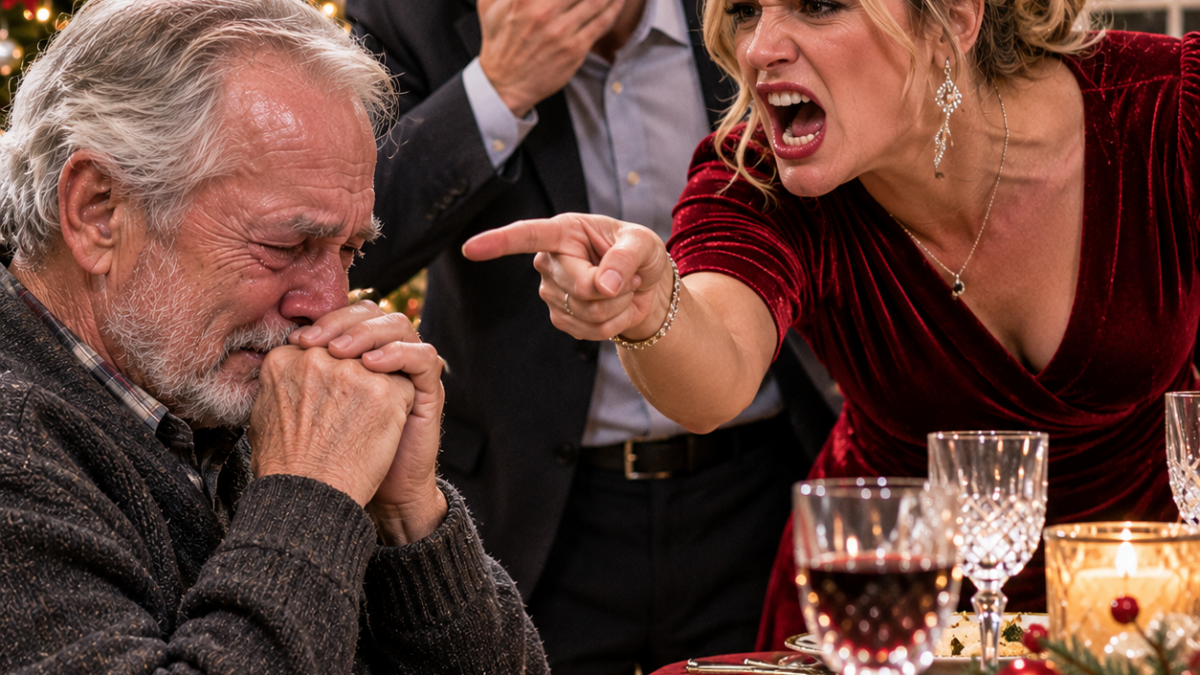
“TELL YOUR FATHER TO EAT BY HIMSELF, SHANE! I DON’T WANT THAT LONELY OLD MAN RUINING CHRISTMAS WITH MY FAMILY!” my daughter-in-law Natalie snapped while I stood in a crowded Toronto grocery store holding Christmas presents for her children, and then my own son said six words that nearly brought me to my knees: “Tell Dad to eat by himself.”
I was sixty-six years old, a retired Toronto subway mechanic who had buried his wife two winters earlier, and for years I’d paid my son’s bills, covered his children’s lessons, and promised him $60,000 from his mother’s life insurance so he could buy a beautiful new house—but when I heard him agree that I wasn’t welcome at Christmas dinner, I finally understood that my money had a place in his family even when I didn’t.
That evening, an accidental nine-minute voicemail revealed something far worse than a canceled invitation: Natalie and her mother were planning to obtain control of my house, move me into a retirement residence, and use the proceeds to finance their future—and by 10:07 the following morning, Shane was pounding on my front door, demanding to know whether I’d really stopped the $60,000 transfer that held his entire dream together.
The little red fire truck was still tucked beneath my arm when I heard my son say it.
“Tell Dad to eat by himself.”
Six words.
Quiet.
Casual.
Almost bored.
As though he were talking about canceling a newspaper subscription instead of turning his father away on Christmas Eve.
I stood in the toy aisle of a Loblaws on Danforth Avenue, surrounded by shoppers carrying groceries, wrapping paper, and last-minute presents.
A child was crying near the bakery.
Someone pushed a cart into a display of holiday chocolates.
Christmas music drifted from the ceiling speakers.
Everything around me was moving.
But I couldn’t.
I pressed the phone harder against my ear.
For a moment, I honestly believed I’d misunderstood.
“Shane?”
A woman’s laugh came through the speaker.
Natalie.
My daughter-in-law.
She’d apparently answered my son’s phone.
“Roy, I already told you. This Christmas is for my family. Don’t come and ruin it.”
My fingers tightened around the fire truck box.
The cardboard creased beneath my thumb.
I’d called to ask whether I should bring another bottle of wine.
That was all.
I wasn’t asking for money.
Wasn’t inviting myself to an event where I didn’t belong.
I’d been planning to spend Christmas Eve with the family I’d helped support for years.
My son.
His wife.
My granddaughter Olivia.
My grandson Finn.
I’d already bought the turkey.
The gifts.
The shortbread.
And the bottle of Niagara Cabernet that Darlene, my late wife, would have insisted was proper for a family dinner.
I swallowed.
“Is Shane there?”
Natalie sighed.
“He’s busy.”
Then, farther from the phone, I heard him again.
“Just tell him we’re not doing Christmas with him.”
Something cold spread through my chest.
I looked down at the fire truck.
Finn was six.
He’d told me three weeks earlier that he wanted a red one with a ladder that moved.
I’d spent nearly an hour choosing it.
Olivia was eight and learning to play the upright piano that had belonged to her grandmother.
I had a book of easy Christmas carols for her in my cart.
She’d promised to play something for me after dinner.
I thought about those children.
About their small hands opening presents.
Their excited voices.
Their faces lighting up.
Then I looked toward the shelves and realized I might not see any of it.
“All right,” I whispered.
Natalie didn’t ask whether I was upset.
Didn’t offer another day.
Didn’t suggest I could stop by to see the children.
“Great,” she answered.
Then the call ended.
I stood there staring at my phone.
For thirty-four years, I’d worked as a subway mechanic for the Toronto Transit Commission.
I’d repaired equipment under conditions that would make most people uncomfortable.
I’d worked overnight shifts.
Spent holidays at maintenance facilities.
Gone home exhausted, with sore hands and oil beneath my nails.
I’d learned how to remain calm when machinery failed and trains had to be returned safely to service.
But standing in that grocery store, I didn’t know what to do with my hands.
I didn’t know where to look.
I didn’t know how a father was supposed to respond when his grown son decided Christmas would be better without him.
A teenage cashier smiled when I reached the checkout.
“Big Christmas plans, sir?”
I looked at the turkey.
The toys.
The wine.
Then forced a smile.
“You bet.”
My voice broke.
The girl’s expression softened.
“Merry Christmas.”
I nodded.
“Merry Christmas, sweetheart.”
I paid for everything.
Because putting the gifts back felt like admitting something I wasn’t ready to admit.
Then I carried the bags outside and climbed into my Silverado.
The cab was cold.
I started the engine.
Turned the heater up.
And sat there with both hands on the steering wheel while tears slipped down my face.
Darlene had been gone almost two years.
And suddenly I wanted my wife so desperately that I could barely breathe.
“Dar,” I whispered into the empty truck.
“What happened to our boy?”
I closed my eyes.
For a moment, I imagined her sitting beside me.
Her warm brown coat.
The small silver earrings she loved.
The way she’d reach across the console and rest her hand on mine when she knew something was wrong.
Then I remembered something she said during the final weeks of her life.
Roy, promise me you’ll stop saying yes to Shane every time he asks.
I’d promised.
And then I’d spent nearly two years breaking that promise.
I looked toward the shopping bags.
The turkey.
The wine.
The little red fire truck.
Then I put the truck in gear.
But I didn’t drive home.
I turned toward the Royal Canadian Legion on Pape Avenue.
Because I knew there would be people there who hadn’t been invited anywhere for Christmas.
And for the first time in my life, I understood how that felt.
Phil Murray was standing near the kitchen stove when I entered through the side door.
Seventy-one years old.
Retired navy cook.
Broad shoulders.
Strong hands.
An expression that suggested he’d spent most of his life dealing with people who complicated things unnecessarily.
He wore an apron that said:
KISS THE COOK, THEN PAY UP.
He looked at the turkey in my arms.
Then at my face.
“Roy?”
I tried to smile.
“Brought you something.”
He stared.
“You look like somebody knocked the air out of you.”
I set the turkey on the counter.
For a moment, I tried to answer.
Nothing came out.
Phil’s expression changed.
“Is it Shane?”
My eyes filled.
I nodded.
He waited.
I swallowed.
“I called to ask whether they needed wine.”
Phil said nothing.
“Natalie told me not to come.”
My throat tightened.
“Then I heard Shane tell her to tell me to eat alone.”
For a moment, Phil stood motionless.
Then he removed an extra apron from a hook.
He dropped it over my head.
Tied it behind my back.
And pointed toward the sink.
“Potatoes.”
I stared.
“What?”
“Potatoes need peeling.”
I looked at him.
He picked up a knife.
“Roy, nobody eats alone in this building on Christmas Eve.”
Something inside my chest collapsed.
I lowered my head.
And cried.
Phil didn’t make a speech.
Didn’t tell me everything would be fine.
He simply moved the bag of potatoes toward me.
Then started peeling.
After a minute, I picked one up.
And began helping.
The kitchen was warm.
Steam rose from pots.
People moved around carrying trays.
Some were veterans.
Some were elderly neighbors.
Some were people who had lost their families.
Others simply had nowhere else to go.
At the end of the counter sat Mr. Dobbs.
Eighty-two years old.
A retired tradesman with hands as rough as mine.
He watched me attack a potato with the peeler.
Then said, “Son, that potato didn’t insult your mother.”
I stared at him.
Phil snorted.
I looked down.
I’d practically carved the thing in half.
For one brief moment, I laughed.
Then the laughter turned into tears.
Mr. Dobbs reached over.
Patted my shoulder twice.
“Family trouble?”
I nodded.
He picked up another potato.
“Everybody here has some.”
Then he said something I would remember long after Christmas.
“Some of us just ran out of family before we ran out of love.”
I stopped peeling.
He looked toward the dining hall.
“Tonight belongs to the people who show up.”
I swallowed.
Then returned to work.
For the next hour, Phil and I prepared vegetables.
Chopped.
Peeled.
Washed.
Worked.
I was grateful for something practical to do.
Finally, Phil glanced toward me.
“Tell me how much you’ve given Shane.”
I looked up.
“What?”
“You heard me.”
I hesitated.
Then began counting.
The transmission repair on his Honda Civic.
Thirty-four hundred dollars.
The first rental apartment where I’d co-signed the lease.
Eight hundred dollars every month toward Olivia’s piano and French lessons.
Emergency expenses.
Bills.
Small transfers.
Money I’d stopped tracking because each payment seemed easier than having another uncomfortable conversation.
Then I mentioned the house.
Phil’s knife stopped moving.
“What house?”
I swallowed.
“Shane and Natalie are buying a place in Oakville.”
“How much?”
“About $1.3 million.”
Phil stared.
I continued.
“They need help with the down payment.”
“How much help?”
I looked down at the potato.
“Sixty thousand dollars.”
Phil set the knife on the counter.
For a moment, he said nothing.
Then he asked, “Where’s that money coming from?”
My throat tightened.
“Darlene’s life insurance.”
Phil stared at me.
“Roy.”
I looked away.
“She would have wanted Shane to have a good home.”
Phil leaned closer.
“Would she?”
The question struck harder than I expected.
Because three weeks before Darlene died, she’d gripped my wrist across our kitchen table.
Her fingers were thin.
Her voice weak.
But her eyes were clear.
Roy, stop teaching our son that love means never saying no.
I’d argued.
He’s our boy.
She squeezed my hand.
He’s a grown man. We need to let him become one.
I promised her.
Then she died.
And I kept giving.
Because every time Shane asked, I heard the little boy he used to be.
The child who ran to me when he was frightened.
The teenager who needed a ride.
The young father who placed Olivia in my arms and whispered, “Dad, look at her.”
I thought giving him money kept that closeness alive.
Now I was beginning to wonder whether the money was the only reason he kept calling.
By eight o’clock, the hall was full.
People sat beneath Christmas decorations made from paper and ribbon.
The smell of gravy drifted through the rooms.
Phil was telling a story about cooking aboard a naval ship during a storm.
Mr. Dobbs was arguing that the potatoes needed more butter.
For the first time since the grocery store, I felt a little less alone.
Then my phone buzzed.
Shane.
I stared at his name.
Phil looked toward me.
“You going to answer?”
I shook my head.
The call ended.
Thirty seconds later, a voicemail notification appeared.
Nine minutes.
Phil raised an eyebrow.
“That’s a long apology.”
I almost smiled.
Then pressed play.
At first, I heard only muffled voices.
Cutlery.
Laughter.
A plate moving across a table.
Then I realized something.
Shane hadn’t intentionally left a message.
He’d accidentally called me from his pocket.
And he didn’t know I was listening.
I carried the phone into the back corridor.
Sat on a stack of folding chairs.
Held it close to my ear.
And heard Natalie’s mother ask a question that changed the rest of my life.
“Is Roy still going to wire that sixty thousand dollars on the twenty-ninth?”
For a moment, I forgot how to breathe.
Marilyn Boyd.
Natalie’s mother.
A woman who wore expensive scarves, spoke constantly about property values, and somehow always managed to turn an ordinary family dinner into a competition over whose children were doing better.
I knew her voice.
I’d heard it at birthday parties.
At Olivia’s school concerts.
At Finn’s baptism.
At Thanksgiving dinners where she held court and told everyone how much the houses in her neighborhood were worth.
Now she was asking about my money.
I pressed the phone against my ear.
Natalie answered.
“Of course he is.”
Her voice sounded amused.
“Roy doesn’t change his mind.”
Someone laughed.
Then Natalie added, “He doesn’t know how.”
I stared at the wall.
For years, I’d thought my willingness to help made me a dependable father.
Apparently, Natalie viewed it as a weakness she could count on.
Marilyn spoke again.
“The lender has the gift letter?”
“Yes, Mom. Shane handled that.”
A pause.
“He signed everything in October.”
I closed my eyes.
The gift letter.
I remembered it.
Shane had brought it to me after Thanksgiving dinner.
He’d explained that the mortgage lender needed proof the money was a gift rather than a loan.
I’d read it.
Asked a few questions.
Then signed.
Because I wanted my grandchildren to grow up in a good home.
Because Shane looked so hopeful.
Because sixty thousand dollars sounded like a large amount until I compared it with a lifetime of regretting that I hadn’t helped my son.
But now I heard Natalie speak about the letter as though it were a guarantee that I had no remaining right to change my mind.
“Non-repayable,” she said. “No strings. Done.”
Marilyn sounded pleased.
“And closing?”
“January tenth.”
“What about the basement?”
Natalie laughed.
“Your suite should be ready by March.”
For a moment, I frowned.
Her suite?
I had never heard of a basement suite for Marilyn.
The house was supposed to be for Shane, Natalie, Olivia, and Finn.
Nobody had mentioned Natalie’s mother living there.
Marilyn continued.
“And what about Roy?”
The hallway seemed to grow colder.
I held the phone tighter.
Natalie answered without hesitation.
“He’ll keep rattling around that big old house in Leaside.”
She gave a little laugh.
“Honestly, Mom, it’s ridiculous for someone his age to live there alone.”
I stopped breathing.
She continued.
“In spring, we’ll start talking to him about a power of attorney.”
I stared at the gray wall.
A power of attorney?
For me?
I wasn’t sick.
I wasn’t confused.
I was sixty-six, retired, and perfectly capable of managing my life.
I maintained my own home.
Paid my bills.
Drove.
Handled investments.
And occasionally repaired things for neighbors because after thirty-four years as a mechanic, sitting still for too long made me restless.
Natalie continued.
“Once the paperwork’s in place, we can deal with the Leaside house.”
Marilyn made a pleased sound.
“And move him somewhere suitable?”
“Exactly.”
A pause.
“One of those retirement residences. He won’t need much room.”
I felt the blood drain from my face.
Natalie went on.
“The house is worth far too much to sit there doing nothing.”
Her voice became almost cheerful.
“We could sell it, use some of the proceeds for his care, and put the rest where it makes sense.”
Marilyn said something about property values.
Then asked Shane what he thought.
For several seconds, nobody answered.
I could hear dishes.
A glass being set down.
Someone walking past the table.
Then Marilyn repeated his name.
“Shane?”
My son sighed.
And said three words that hurt even more than the six I’d heard at Loblaws.
“Whatever’s easiest.”
I stopped the recording.
Then stared at the screen.
For a moment, I couldn’t process what I’d heard.
The woman my son married had been discussing how to gain authority over my finances.
How to sell the house Darlene and I had spent decades paying for.
How to move me somewhere I hadn’t chosen.
And my son, the child I’d raised, hadn’t objected.
He’d said whatever was easiest.
As though I were a broken appliance.
A piece of furniture.
A problem somebody else needed to remove.
I pressed my palm against my chest.
It hurt.
Not physically.
Not exactly.
It felt as though something I’d relied upon for years had quietly collapsed.
I thought about my house.
The front porch.
The maple tree.
Darlene’s garden.
The little marks inside a kitchen cupboard where we’d measured Shane’s height as he grew.
The upright piano Olivia loved.
My wife’s green armchair beside the window.
The house wasn’t simply valuable land in Leaside.
It was the place Darlene and I had built our life.
And Natalie was already calculating what she might do with the proceeds.
Phil appeared at the end of the corridor.
He took one look at my face.
Then came over.
“Roy?”
I handed him the phone.
He listened to part of the recording.
His expression hardened.
When it finished, he didn’t swear.
Didn’t make a dramatic speech.
He simply sat beside me.
For a long moment, neither of us spoke.
Then he said, “Save that.”
I nodded.
“I’m going to.”
He looked toward the phone.
“Make a copy.”
I nodded again.
Then I whispered, “Phil, they’re planning to sell my house.”
His jaw tightened.
“Not if you have anything to say about it.”
I stared at him.
“They think I’ll just sign.”
He shook his head.
“Then let them learn something.”
I thought about driving to Shane’s house.
Marching through the front door.
Playing the recording in front of Natalie and Marilyn.
Demanding explanations.
I imagined the shouting.
The excuses.
The accusations that I’d misunderstood.
That it was all hypothetical.
That they were only discussing what might happen if I became ill.
Then I imagined Shane standing quietly while his wife told me I was overreacting.
And I knew I couldn’t bear another evening like that.
Not yet.
I needed to think.
To act carefully.
To protect myself before anyone had time to pressure me.
So I looked toward Phil.
“Can I use your office?”
He nodded.
“What for?”
“Some phone calls.”
He stood.
“Come on.”
Phil’s office was barely large enough for a desk and two chairs.
The corkboard was crowded with cards from veterans.
The filing cabinet had a dent near the bottom.
A little Canadian flag stood beside the telephone.
It wasn’t an impressive room.
But the door closed.
And for the first time that evening, I had somewhere quiet to think.
I sat at the desk.
Opened my banking app.
Then found the scheduled transfer.
$60,000 — December 29 — real estate lawyer’s trust account.
I stared at the amount.
That money had come from Darlene’s life insurance.
I could still remember the day the payment arrived.
The envelope.
The paperwork.
The terrible feeling of seeing my wife’s death translated into a number on a bank statement.
I’d left most of it untouched.
Not because I needed luxury.
Because it represented the last financial protection she’d been able to leave me.
I had planned to use part of it to help Shane.
Now I understood that giving away sixty thousand dollars wasn’t enough.
Natalie and Marilyn wanted access to the house too.
And apparently my son was willing to let them have it.
I took a breath.
Then canceled the scheduled transfer while the funds remained under my control.
The app asked me to confirm.
I read the confirmation.
Pressed the button.
And watched the scheduled payment disappear.
My hands were steady.
That surprised me.
I had expected to feel guilty.
Perhaps frightened.
Instead, I felt as though I’d finally stopped a train before it reached a damaged section of track.
But I knew clicking a button didn’t resolve every legal issue.
I’d signed a gift letter.
The lender might have relied upon it.
Shane and Natalie had entered a purchase agreement.
They might face serious consequences if financing failed.
And I needed professional advice about the representations already made.
I wasn’t interested in pretending a canceled transfer automatically erased everything I’d signed.
So I opened my email.
And wrote to Aaron Stone.
Aaron had handled Darlene’s estate.
She was fifty-two.
A careful attorney who rarely seemed impressed by anyone’s title or expensive office.
During the months after my wife’s death, she’d helped me organize documents I could barely look at.
Now I needed her again.
I wrote out what had happened.
The Christmas invitation.
The voicemail.
The scheduled transfer.
The conversation about gaining authority over my home.
I attached the gift letter and asked for urgent guidance about the proper steps to notify the lender and protect my assets.
I read the email four times.
Then sent it.
I expected to hear from Aaron after Christmas.
Eleven minutes later, my phone rang.
“Roy?”
Her voice was serious.
“Are you somewhere private?”
“Yes.”
“Are you safe?”
The question caught me off guard.
I looked around Phil’s cramped office.
“Yes.”
She took a breath.
“I’ve read your email.”
I swallowed.
“I canceled the transfer.”
“I understand.”
She paused.
“We need to distinguish what you agreed to in the gift letter from what has actually been transferred, and make sure the lender receives accurate information immediately.”
I nodded.
Then remembered she couldn’t see me.
“Okay.”
Aaron continued.
“Don’t sign anything else. Don’t authorize anyone to act for you. And don’t give Shane or Natalie access to your accounts while we review the situation.”
My throat tightened.
“They want a power of attorney.”
“I read that.”
A pause.
“Roy, nobody acquires authority to sell your house simply by discussing it over Christmas dinner. A valid power of attorney has legal requirements, and you retain the ability to decide whether to appoint someone while you have capacity.”
I closed my eyes.
For the first time that evening, I could breathe a little easier.
Aaron continued.
“If anyone brings you documents, send them to me.”
“I will.”
“And save the original voicemail.”
I nodded.
“Already doing that.”
She sighed.
“Good.”
Then she asked the question I had been avoiding.
“Roy, what do you want to happen to the sixty thousand dollars?”
For a moment, I couldn’t speak.
I looked toward the little Canadian flag beside Phil’s desk.
Then thought about Olivia.
Finn.
The red fire truck.
The piano book.
The children who hadn’t done anything wrong.
Finally, I whispered, “I still want it to help my grandchildren.”
Aaron was quiet.
I continued.
“Just not through Shane and Natalie.”
We discussed education savings.
The possibility of using registered education savings plans for the children.
Appropriate ownership and subscriber arrangements.
Contribution limits.
Government grant rules.
And the importance of ensuring the money would be managed in accordance with the relevant requirements rather than assuming an RESP could simply receive unlimited contributions.
Aaron suggested that we could build a structured education fund with registered plans where appropriate and a separate protected account for amounts that couldn’t or shouldn’t be placed into them immediately.
I listened.
Asked questions.
Then made the decision that mattered most.
The money would be set aside for Olivia and Finn under arrangements I could properly establish.
Not paid into Shane and Natalie’s home purchase.
Not transferred to Marilyn.
Not left accessible to anyone planning to use it for something other than the children’s benefit.
That Christmas Eve, I instructed Aaron to begin preparing the arrangements.
The formal documents and transfers would be completed through the appropriate process.
But the decision was made.
For the first time in years, I was choosing how to help my family without allowing my son to choose for me.
By ten o’clock, we’d prepared the necessary written notice that the promised gift would not be funded and that the lender should not continue treating the sixty thousand dollars as available.
Aaron would handle any required follow-up.
I sat back.
Looked toward the office door.
Then closed my eyes.
I had expected Christmas Eve to end with presents and dinner.
Instead, it had ended with a lawyer, a canceled bank transfer, and the knowledge that my son had participated in discussing how to remove me from my own home.
I didn’t feel victorious.
I felt exhausted.
Phil knocked quietly.
“Roy?”
I looked up.
He held a paper plate.
Turkey.
Potatoes.
Vegetables.
Gravy.
A generous slice of pie.
“You missed dinner.”
I stared.
He set it on the desk.
Then pulled up the second chair.
For a while, we ate in silence.
Finally, Phil asked, “You okay?”
I looked at him.
“No.”
He nodded.
“Fair enough.”
I swallowed.
“I stopped the transfer.”
Phil set down his fork.
“Good.”
“I may have created a mess.”
He looked at me.
“Maybe.”
Then he said, “But you didn’t create the mess by deciding not to let somebody take your home.”
My eyes filled.
For a moment, I stared at the plate.
Then whispered, “Darlene warned me.”
Phil didn’t answer.
I continued.
“She told me to stop rescuing him.”
My voice broke.
“And I promised her I would.”
Phil rested one hand on my shoulder.
“Then perhaps tonight you finally kept that promise.”
I drove home late.
Toronto was quiet.
Christmas lights glowed along the streets.
The toys rested on the back seat.
The wine rolled gently in the footwell.
I had planned to give Olivia her piano book after dinner.
I had imagined Finn tearing open the fire truck.
Instead, I parked alone outside the house Darlene and I had shared.
The porch light was on.
The windows were dark.
For a moment, I sat staring at the front door.
Then I carried the gifts inside.
Placed them beside the Christmas tree.
And walked toward my wife’s green armchair.
I lowered myself into it.
The fabric was worn along the arms.
There was a small stain near one cushion from the time Finn spilled juice during a visit.
Darlene had never been able to remove it completely.
She said she didn’t mind.
“It means the chair’s been loved.”
I looked toward her photograph.
She was smiling at the camera.
Her eyes warm.
Her expression familiar.
I picked up the frame.
Held it against my chest.
And whispered, “I finally said no, Dar.”
For a moment, I couldn’t speak.
Then I added, “I’m scared.”
Tears ran down my face.
“I don’t know what happens to Shane now.”
The room remained silent.
I closed my eyes.
And cried until I fell asleep.
At 10:07 on Christmas morning, somebody began pounding on my front door.
Hard enough to rattle the storm window.
I woke with a start.
My neck hurt from sleeping in the chair.
For a moment, I didn’t know where I was.
Then the pounding came again.
“DAD!”
Shane.
I stood.
Walked toward the foyer.
And looked through the glass.
My son stood outside in a fleece jacket.
His hair was messy.
His face pale.
Snowflakes clung to his shoulders.
He looked as though he hadn’t slept.
I opened the door.
“Merry Christmas, Shane.”
He stared.
“Dad, tell me you didn’t actually do it.”
I stepped back.
“Wipe your feet.”
He walked inside without bothering.
For a moment, I almost smiled.
Some habits apparently survived everything.
Then he turned toward me.
His voice shook.
“The lender called us.”
I nodded.
“They said the gift had been withdrawn.”
“Yes.”
Shane stared.
“Dad.”
I waited.
“We need that money.”
I looked at him.
And for the first time, I didn’t immediately try to make his fear disappear.
Shane stood in the living room with his fists clenched.
Behind him, the Christmas tree glowed beside Darlene’s armchair.
The red fire truck sat beneath it.
Olivia’s piano book rested beside a small package of shortbread.
My son’s eyes moved across the presents.
For one brief moment, his expression softened.
Then he looked back at me.
“Dad, you don’t understand what you’ve done.”
I remained standing.
“Then explain it.”
He rubbed both hands over his face.
“We bought a house.”
“I know.”
“A real house.”
I nodded.
“In Oakville.”
He stared.
“You knew?”
“You told me.”
He started pacing.
“Four bedrooms. Briarwood Crescent. Nearly thirteen hundred thousand dollars.”
I watched him.
He continued.
“There were five other offers.”
A pause.
“Our realtor said we’d lose unless we made the offer more attractive.”
I waited.
“So we waived the financing condition.”
For a moment, I stared at him.
“Shane.”
He looked up.
“You signed an unconditional purchase agreement?”
His face tightened.
“We had to.”
“Did you have the down payment?”
He said nothing.
I took a breath.
“Did you actually have sixty thousand dollars from me?”
“No, but—”
“Then you committed money that wasn’t in your account.”
His expression hardened.
“Dad, you promised.”
I nodded slowly.
“Yes.”
His face brightened slightly.
Then I continued.
“And I signed a letter based on what I understood at the time.”
He swallowed.
“But yesterday I learned that you and your wife were making plans for my finances and my home without telling me.”
His face changed.
“What?”
I looked directly at him.
“Sit down.”
He hesitated.
Then lowered himself onto the sofa.
I sat across from him.
For a moment, I looked toward Darlene’s photograph.
Then took out my phone.
“I need you to hear something.”
The recording lasted nine minutes.
I played every second.
Shane listened.
At first, he seemed confused.
Then his eyes widened.
Marilyn’s voice filled the room.
Is Roy still going to wire it on the twenty-ninth?
Natalie’s answer followed.
Roy doesn’t change his mind.
He looked toward me.
I didn’t speak.
Then came the discussion about closing.
The basement suite.
The gift letter.
And finally, the plans for my home.
We talk to him about a power of attorney.
Then we sell the place in Leaside.
Shane’s face turned white.
I watched him.
Then his own voice came through the phone.
Whatever’s easiest.
He lowered his head.
Covered his mouth.
And made a sound I had never heard from him before.
Not quite a sob.
Not quite a gasp.
Something in between.
When the recording ended, the room was silent.
I set the phone on the coffee table.
For a long time, neither of us spoke.
Finally, Shane whispered, “Dad.”
I looked at him.
“I didn’t know you heard that.”
The words struck me.
Not I shouldn’t have said it.
Not I should have defended you.
Not I’m sorry.
He was surprised I’d heard.
I took a breath.
“I know.”
His eyes filled.
“Dad, I didn’t mean—”
I shook my head.
“Please don’t tell me you didn’t mean anything.”
He stopped.
I continued.
“I heard what your wife said.”
My voice trembled.
“I heard what Marilyn planned.”
A pause.
“And I heard what you said.”
Shane looked toward the floor.
“Whatever’s easiest.”
His shoulders shook.
I nodded.
“Yes.”
For a moment, I couldn’t speak.
Then I whispered, “Do you know what that sounded like to me?”
He shook his head.
“It sounded like my own son didn’t care whether I kept the home his mother and I spent our lives paying for.”
Tears filled his eyes.
“Dad, I wasn’t thinking.”
I gave a small, painful laugh.
“That’s exactly the problem.”
I leaned forward.
“Shane, when did you decide I was too old to live independently?”
His head lifted.
“I didn’t.”
“Then why were they discussing a retirement residence?”
He looked uncomfortable.
“Natalie worries about you.”
I stared.
“Does she?”
He swallowed.
I continued.
“I’m sixty-six.”
My voice became firmer.
“I maintain my own house.”
A pause.
“I drive.”
Another.
“I manage my accounts.”
I looked toward him.
“And last week I repaired Mrs. Abernathy’s snowblower because she couldn’t find anybody willing to work on the old thing.”
Shane gave a faint, miserable smile.
I didn’t.
“I’m not incapable because I live alone.”
He looked down.
“I know.”
“Then why didn’t you say that?”
He rubbed his eyes.
For a long moment, he remained silent.
Then he whispered, “Natalie gets upset when I argue with her.”
I stared.
“And?”
He swallowed.
“Marilyn too.”
I took a breath.
“So you decided it would be easier to let them plan my future without asking me.”
His eyes filled.
“Yes.”
The admission came quietly.
Almost too quietly to hear.
But it was the first honest thing he’d said since arriving.
I looked toward Darlene’s armchair.
For a moment, I imagined her sitting there.
Listening.
The way she used to when Shane was a teenager and made a mistake he didn’t want to acknowledge.
She’d wait.
Let him finish explaining.
Then ask what he intended to do differently.
I took a breath.
“Your mother warned me.”
Shane looked up.
“What?”
“Before she died.”
His expression changed.
“She told me I’d been rescuing you too often.”
He stared.
I continued.
“She said I’d taught you that whenever something went wrong, I’d be there with a check.”
Tears ran down his face.
“Dad.”
I shook my head.
“No. I need to say this.”
My throat tightened.
“I thought I was helping.”
A pause.
“Every time you called, I remembered the little boy I used to carry on my shoulders.”
I looked toward the Christmas tree.
“I remembered the nights I worked late and promised myself I’d give you a better life than the one I had growing up.”
My voice broke.
“And I kept saying yes.”
Shane covered his face.
I continued.
“But I think somewhere along the way, you stopped hearing yes as a gift.”
I swallowed.
“You began hearing it as something you were owed.”
He didn’t answer.
He didn’t need to.
For years, I’d paid for things because I didn’t want him to struggle.
The transmission.
The rent.
The lessons.
The emergencies.
But each time I solved a problem for Shane, I also removed a reason for him to learn how to solve it himself.
That didn’t make me responsible for Natalie’s cruelty.
Or for my son’s silence.
Those were their choices.
But it meant I had to recognize how I’d helped create a pattern that was hurting all of us.
I looked toward him.
“I’m not giving you the sixty thousand.”
His face tightened.
“Dad, we’ll lose the house.”
I nodded.
“That may happen.”
He stared.
“We already put down twenty-five thousand dollars.”
My stomach tightened.
“Then you need legal advice about your purchase agreement.”
He leaned forward.
“The seller could keep it.”
“Possibly.”
His voice rose.
“They could sue us for more.”
I took a breath.
“That’s something you need to discuss with your lawyer.”
Shane stared.
For a moment, he looked almost offended that I wasn’t immediately finding a solution.
Then he lowered his head.
“I don’t know what to do.”
I felt the old instinct.
The pull.
The urge to offer money so he could stop being frightened.
But Darlene’s voice returned.
Let him stand.
I took a breath.
“Start by telling the truth.”
He looked up.
“To whom?”
“Your lender.”
A pause.
“Your real estate lawyer.”
Another.
“Your wife.”
His face tightened.
I continued.
“And yourself.”
For a moment, the room was quiet.
Then Shane whispered, “Natalie’s going to be furious.”
I looked at him.
“Shane, I’m not responsible for protecting you from your wife’s disappointment.”
His eyes filled.
“She’ll blame me.”
I nodded.
“She may.”
“And Marilyn—”
I stopped him.
“Your mother-in-law isn’t part of this conversation.”
He stared.
Then I said something I should have told him years earlier.
“You’re a grown man, son.”
A pause.
“You don’t need everybody to approve of the truth before you’re allowed to tell it.”
Shane sat quietly for several minutes.
Then stood.
He looked toward the presents beneath the tree.
“Are those for Olivia and Finn?”
I nodded.
“Yes.”
His eyes filled.
He approached the little red fire truck.
Picked it up.
Then set it down again.
“Finn’s been talking about one of these.”
I smiled sadly.
“I know.”
Shane stared at the presents.
Then whispered, “They asked why you weren’t there last night.”
My throat tightened.
“What did you tell them?”
He looked down.
“Natalie said you were tired.”
For a moment, I couldn’t breathe.
I thought about Olivia.
Eight years old.
Playing Darlene’s piano.
Waiting for a grandfather who’d promised to come.
Then hearing that I was too tired to spend Christmas with her.
I looked toward Shane.
“And you let her say that?”
He nodded.
My eyes filled.
I could barely speak.
“Your children deserve better than lies.”
Shane began crying.
“I know.”
At the door, he stopped.
His hand rested on the knob.
For a moment, I thought he might ask for money one final time.
Instead, he looked toward me.
“Dad.”
“Yes?”
“Natalie’s going to come here.”
I remained quiet.
He swallowed.
“She won’t be as calm as I was.”
I looked at my son.
The boy I’d taught to ride a bicycle.
The young man who’d stood beside me at Darlene’s funeral.
The father of my grandchildren.
Now warning me that his wife might come to pressure me.
I took a breath.
“Then she’ll have to learn to accept the word no.”
Shane nodded weakly.
Then opened the door.
I watched him walk toward his car.
Snow blew across the driveway.
He got inside.
Sat for a long time.
And finally drove away.
After he left, I walked into the kitchen.
Darlene’s old recipe tin sat above the stove.
It was blue and white.
A little chipped.
She’d kept recipes inside it for decades.
Shortbread.
Apple pie.
Pot roast.
Chocolate cake.
Some were written in her handwriting.
Others came from her mother.
I opened it.
Then found a small folded note near the back.
I recognized the paper.
A pale blue sheet from a stationery set I’d bought Darlene years earlier.
I unfolded it.
My wife’s handwriting appeared.
For a moment, I couldn’t breathe.
At the top, she’d written Shane’s name.
I read the first few lines.
Then carefully folded it again.
My eyes filled.
I had known she’d written something for our son during her final autumn.
She’d asked me to keep it until the time was right.
But after she died, I couldn’t bring myself to look for it.
Now I was holding it.
And I understood that perhaps the time hadn’t arrived until I could give Shane something without also handing him another check.
I returned the note to its place.
Closed the tin.
Then sat down.
For the first time since Christmas Eve, I felt as though Darlene had left me a way to speak to our son when I no longer knew how.
Over the next three days, I made arrangements to protect my independence.
I met with Aaron.
Reviewed my accounts.
Updated my estate planning.
Checked what access anyone else had to my financial information.
And arranged for the locks on the house to be re-keyed.
Not because I believed Shane would necessarily enter without permission.
Because Natalie had a key.
And after hearing her plans for my home, I no longer wanted her to have unrestricted access.
Gus Petrakis arrived with a heavy toolbox.
He was a locksmith with broad shoulders and an easy manner.
As he worked, he asked whether I’d lost my keys.
“Something like that,” I answered.
He looked at me.
Then smiled faintly.
“Most people think a lock solves everything.”
I nodded.
“It doesn’t?”
“Not family trouble.”
He tightened a screw.
“But a lock can remind people to knock.”
I looked toward the door.
For a moment, I felt tears gathering.
Then I smiled.
“I think that’s what I need.”
I also reviewed the monthly payments I’d been making.
The cell phone plan.
The eight hundred dollars toward lessons.
Other assistance I’d provided without an agreed end date.
I didn’t stop caring about Olivia or Finn.
I wasn’t going to use the children as punishment for their parents.
But I needed to separate help given for the children’s benefit from money that had become part of Shane and Natalie’s ordinary household budget.
I arranged for essential commitments to be handled properly while discontinuing voluntary support I could no longer sustain or trust.
The education funds would remain protected for the children.
I could still buy them books.
Take them for lunch.
Help with school expenses through arrangements I controlled.
But I wasn’t going to keep providing open-ended transfers to adults who treated my money as theirs.
Natalie arrived on December twenty-eighth.
A white leased Audi stopped outside my house.
I saw her through the window.
She wore a camel coat.
High heels.
Her hair was perfectly arranged.
She carried a tin tied with red ribbon and a manila envelope.
I watched her walk toward the front door.
Then something happened that told me more than any greeting could.
She reached into her purse.
Removed her key.
And tried the lock.
It didn’t turn.
She tried again.
Then stared.
For a moment, her face changed.
The pleasant expression disappeared.
She looked annoyed.
Almost offended.
As though my decision to secure my own house were a personal insult.
Then she put the key away.
Straightened her coat.
And rang the bell.
I opened the door.
But didn’t step aside.
“Roy.”
She smiled.
A beautiful, polished smile.
“I brought shortbread.”
I looked at the tin.
“That’s thoughtful.”
She lifted it.
“Olivia helped bake it.”
My throat tightened.
I thought about my granddaughter.
Then asked, “How is she?”
Natalie blinked.
“Fine.”
“And Finn?”
“Fine.”
A pause.
Then she tilted her head.
“Are you going to invite me in?”
I looked toward the front steps.
“I think we can speak here.”
Her smile hardened.
“Roy, it’s freezing.”
I nodded.
“Then perhaps you’d better tell me why you’re here.”
For a moment, she stared.
Then she laughed softly.
“Really?”
I waited.
She shifted the envelope beneath her arm.
“I came to make peace.”
I looked at her.
“Did you?”
“Of course.”
A pause.
“Shane’s devastated.”
My throat tightened.
I said nothing.
Natalie continued.
“He hasn’t slept properly since Christmas.”
I studied her.
“I’m sorry he’s having a difficult time.”
Her expression brightened.
Then I added, “But that isn’t an explanation for how you treated me.”
She sighed.
“Roy, we already discussed this.”
I stared.
“No.”
My voice was steady.
“You told me not to come to Christmas dinner.”
She folded her arms.
“Things were complicated.”
“And you told Olivia I was too tired to visit.”
A flicker crossed her face.
“Children get confused.”
I looked at her.
“Olivia told me she wanted me there.”
Natalie said nothing.
I continued.
“She asked why you told her otherwise.”
Her mouth tightened.
“Roy, are you really going to involve an eight-year-old in an adult disagreement?”
I stared at her.
“You told the lie to the eight-year-old.”
For a moment, she had no answer.
Then Natalie held out the envelope.
“Anyway.”
Her voice became businesslike.
“We need to discuss the house.”
I felt cold.
“Which house?”
“The Oakville house.”
I didn’t move.
She continued.
“The sellers may be willing to extend the closing date.”
I nodded slowly.
“That’s something you should discuss with your lawyer.”
She gave an impatient little sigh.
“Roy, we need your cooperation.”
My stomach tightened.
There was that word.
Cooperation.
Natalie opened the envelope.
Removed a document.
Then extended it toward me.
“The sixty thousand can be advanced as planned.”
I shook my head.
“No.”
She continued as though she hadn’t heard.
“And this will make everything easier.”
I looked down.
A continuing power of attorney.
My name appeared at the top.
Shane’s as the proposed attorney.
Natalie’s as an alternate.
I read enough to understand that she wanted me to authorize them to manage significant financial and property matters.
I looked up.
“Natalie.”
She smiled.
“Yes?”
“I’m not signing that.”
Her smile faded.
“Roy, it’s standard estate planning.”
I nodded.
“Estate planning is something I do with my own lawyer.”
She sighed.
“We had someone prepare it for you.”
“Who?”
“A friend of my mother’s.”
I stared.
Of course.
Marilyn.
The woman who had been discussing how to sell my house before I even knew my son didn’t want me at Christmas.
Natalie tried again.
“Roy, you’re under a lot of strain.”
I looked at her.
“Am I?”
She nodded sympathetically.
“Living alone. Grieving Darlene. Managing a large property.”
I felt my chest tighten.
She continued.
“We’re only concerned about you.”
I took a breath.
“Then why didn’t you ask whether I was lonely before deciding I wasn’t welcome for Christmas?”
Her expression hardened.
“That’s unfair.”
I shook my head.
“No.”
I looked toward the document.
“What’s unfair is presenting me with a power of attorney while asking me to finance a home you plan to share with your mother.”
Natalie stopped breathing.
For one brief moment, she looked genuinely frightened.
I continued.
“And discussing how to sell my house without asking me.”
Her face went pale.
“How do you know about that?”
I took out my phone.
She stared.
I didn’t need to play the recording.
I simply said, “Shane accidentally called me during Christmas dinner.”
For a moment, Natalie didn’t move.
Then she whispered, “You recorded our private conversation?”
I looked directly at her.
“Your husband made the call.”
Her mouth opened.
Nothing came out.
I continued.
“And the voicemail saved what I heard.”
Her expression changed.
The smile disappeared completely.
I could almost see her trying to calculate what I’d heard.
The sixty thousand.
The basement suite.
The plan for my home.
The retirement residence.
Marilyn’s role.
Shane’s agreement.
Finally, Natalie straightened.
“That was just a discussion.”
I nodded.
“Then it should be easy for you to understand why I’m not signing anything.”
She stared.
“Roy, you can’t leave us like this.”
I looked toward the Christmas decorations beside the door.
Then back at her.
“You left me alone at Christmas.”
Her cheeks reddened.
“That was different.”
I took a breath.
“No.”
I shook my head.
“You wanted me out of the way.”
Her voice sharpened.
“Because every time we make plans, you have to be involved.”
I stared.
“I was involved because you needed my money.”
She looked away.
I continued.
“You don’t want me at the table, Natalie.”
A pause.
“But you want my signature on the check.”
For a moment, neither spoke.
Then she leaned forward.
“If this house purchase fails, Shane will never forgive you.”
The words hurt.
I won’t pretend otherwise.
But I had spent years allowing the possibility of Shane’s disappointment to determine my decisions.
This time, I remained still.
I looked at her.
“Then Shane will have to decide what kind of relationship he wants with his father.”
Natalie’s eyes narrowed.
“And the children?”
I felt my stomach tighten.
She continued.
“Do you think Olivia and Finn won’t notice when their parents lose the house?”
I took a breath.
“Children deserve honesty.”
Her face hardened.
“And stability.”
I nodded.
“Exactly.”
Then I said, “That’s why I’ve arranged to protect money for their education rather than putting it into a purchase you committed to without secured financing.”
She stared.
“What?”
I held her gaze.
“The sixty thousand is no longer available for your down payment.”
Her mouth fell open.
“You gave it away?”
“I made arrangements for the children.”
Natalie began speaking quickly.
“But we need it now.”
“I understand.”
“We’ll lose the deposit.”
“You need legal advice.”
She shook her head.
“Roy, you are destroying your son’s future.”
I looked at her for a long moment.
Then answered quietly.
“No.”
My voice trembled.
“I’m refusing to let you destroy mine.”
Natalie stared at me.
Then slowly returned the documents to the envelope.
For a moment, I thought she might apologize.
Instead, she reached for the tin of shortbread.
Lifted it from the porch railing.
Then set it down again.
Her hands were trembling.
Finally, she whispered, “You’ll regret this.”
I looked at her.
“I regret a great many things.”
A pause.
“But not protecting my home.”
She turned.
Walked down the steps.
Climbed into the Audi.
And drove away.
I closed the door.
Locked it.
Then stood in the hallway with my forehead resting against the wood.
My hands shook.
My knees felt weak.
For a moment, I wanted to call Darlene.
Tell her what happened.
Ask whether I’d been too harsh.
Then I remembered she wasn’t there.
I pressed one hand against my chest.
And whispered, “I hope I’m doing this right.”
January arrived.
The city returned to work.
Christmas trees appeared along curbs.
Snow gathered in parking lots.
People resumed ordinary routines.
But Shane and Natalie’s house purchase had become a crisis.
They had an agreement to buy the Oakville property.
They had waived the financing condition.
They had committed a substantial deposit.
And now their lender couldn’t rely on the sixty-thousand-dollar gift.
Aaron had ensured the lender and relevant parties received accurate information.
What happened next depended on the purchase agreement, financing, and the negotiations between the buyers and sellers.
I didn’t control those things.
And I wasn’t going to pretend that handing over my money was the only way to resolve them.
January tenth came.
Then passed.
The transaction didn’t close.
The next morning, Shane called.
I was standing in the kitchen when his name appeared.
For a moment, I hesitated.
Then answered.
“Hello, son.”
His voice sounded strange.
“Dad.”
I waited.
“We lost it.”
My throat tightened.
“The house?”
“Yes.”
He took a shaky breath.
“The deposit too.”
I closed my eyes.
Twenty-five thousand dollars.
Money he and Natalie couldn’t afford to lose.
Shane continued.
“The seller’s lawyer confirmed they were keeping the deposit under the agreement.”
I took a breath.
“Have you had independent advice?”
He nodded, though I couldn’t see him.
“Yes.”
His voice broke.
“We’re still dealing with the paperwork, but the sale isn’t happening.”
I stood quietly.
For a moment, I wanted to tell him I’d warned him.
That he should never have waived the financing condition.
That buying a $1.3 million home without secure funding was irresponsible.
But he already knew.
He was living with the consequences.
So I asked, “Where are you?”
There was a pause.
Then he whispered, “Your street.”
I opened the front door.
Shane stood beside his car.
Snow clung to his hair.
His fleece jacket looked too thin for the weather.
He was staring toward the ground.
For a moment, I saw him at seventeen.
The year he worked part-time at a local garage.
He used to come home with grease on his hands.
Darlene would scold him for leaving fingerprints on the refrigerator.
He’d laugh.
Then help me fix something in the basement.
The memory hurt.
Because the man standing before me looked so much like that boy.
And yet I no longer knew how to reach him.
“Shane.”
He looked up.
His eyes were red.
“I’m not here for money.”
I remained quiet.
“I swear.”
Then I asked, “Why are you here?”
He swallowed.
“I don’t know.”
A pause.
“I think I need somebody to tell me what happened without pretending it was everybody else’s fault.”
For the first time since Christmas Eve, I heard something in my son’s voice that sounded like honesty.
I stepped onto the porch.
And we talked.
Shane told me about Natalie’s anger.
How she blamed him for allowing me to withdraw the money.
How Marilyn accused him of failing to manage his own father.
How he’d spent days trying to negotiate a solution.
He said he felt ashamed.
Frightened.
And furious.
Sometimes at me.
Sometimes at Natalie.
Mostly at himself.
I listened.
Then asked, “What do you think you did wrong?”
He looked toward the driveway.
For a long moment, he didn’t answer.
Then whispered, “I counted money before I had it.”
I nodded.
“And?”
He swallowed.
“I let Natalie tell you not to come.”
My eyes filled.
He looked toward me.
“And I didn’t stop Marilyn from talking about your house.”
A pause.
“I just wanted them to stop arguing.”
I nodded slowly.
Then said, “You let me become the cost of keeping the peace.”
Shane closed his eyes.
“Yes.”
For a moment, the only sound was the wind.
Then my son whispered, “Dad, I don’t know how to fix this.”
I took a breath.
“Then don’t try to fix it with another check.”
He looked up.
I continued.
“You need to decide what you can afford.”
A pause.
“What kind of life you want.”
Another.
“And how you’re going to treat the people who love you.”
Shane looked down.
I softened my voice.
“I’ll always be your father.”
His eyes filled.
“But I’m not going to keep rescuing you from decisions you make without thinking.”
He nodded.
For a moment, neither spoke.
Then I went inside.
Opened the hall closet.
And removed an old canvas barn coat.
It had belonged to Shane when he was seventeen.
He’d worn it while working beside me at the shop.
There were faint oil stains near one pocket.
A small tear in the lining.
I handed it to him.
He stared.
“Dad?”
I smiled sadly.
“It’s warmer than that fleece.”
He took it.
Held it against his chest.
Then whispered, “It still smells like the garage.”
I nodded.
“The oil never really washes out.”
He gave a broken little laugh.
Then started crying.
I wanted to hug him.
But I didn’t.
Not yet.
I simply stood beside him until he could breathe.
Then he put on the coat.
And drove home.
The following weeks were difficult.
Shane and Natalie were still married, but something fundamental had changed.
For years, Shane had avoided disagreement.
When Natalie wanted something, he looked for a way to provide it.
When Marilyn criticized their lifestyle, he spent more.
When bills became difficult, he called me.
I would listen.
Ask a few questions.
Then offer to help.
I believed I was preserving peace in my son’s family.
But what I’d actually done was make it possible for him to avoid deciding what kind of husband and father he wanted to be.
Now the money was no longer arriving.
And the conflicts he had spent years postponing were waiting for him.
Aaron called during the first week of February.
“Roy, I need you to come to the office.”
Her voice was unusually serious.
I sat down.
“What’s happened?”
She paused.
“New information concerning the mortgage application.”
My stomach tightened.
“What kind of information?”
“I’d rather explain it in person.”
I looked toward Darlene’s photograph.
Then asked, “Should I bring Shane?”
“No.”
The answer was immediate.
A cold sensation spread through my chest.
Aaron continued.
“Come alone. We have some documents to review.”
Her office was on Eglinton Avenue.
I arrived just before ten.
The sky was gray.
Snow lined the sidewalks.
I wore the same winter coat I’d owned for years.
The receptionist led me into a boardroom with a long walnut table.
Aaron sat near the window.
Beside her was a woman from the legal department of Jenkins Financial.
She wore a dark suit and carried a leather portfolio.
I recognized the company name.
Natalie worked there.
In loan administration.
For years, she’d spoken proudly about understanding mortgage processes better than most people.
Now I wondered why representatives of her employer needed to speak with me.
I sat down.
Aaron folded her hands.
“Roy, thank you for coming.”
I looked from one woman to the other.
“What’s going on?”
Before Aaron could answer, the door opened.
Natalie entered.
Marilyn followed.
For a moment, my stomach tightened.
Natalie wore a charcoal blazer.
Her hair was pulled back.
She looked pale.
Marilyn held her handbag so tightly that her knuckles were white.
Nobody smiled.
Nobody offered to shake hands.
And for the first time since I’d met her, Marilyn Boyd didn’t appear to have a speech prepared.
The woman from Jenkins began.
“Mr. Cooper, after the gift funding was withdrawn, our compliance team reviewed the underlying application.”
I nodded.
She continued.
“The file contained an inconsistency involving verification of the down-payment funds.”
My heart began pounding.
“What inconsistency?”
She opened the portfolio.
Removed a printed document.
Then placed it in front of me.
The mortgage application listed my sixty thousand dollars as funds already available.
Not merely promised.
Not scheduled.
Available.
I stared at the page.
For a moment, I didn’t understand.
Then I looked toward Natalie.
Her eyes remained fixed on the table.
The woman continued.
“An internal review found that the funds-verification entry had been altered on December twentieth.”
She paused.
“The change was associated with Natalie’s employee login.”
My stomach dropped.
For a moment, the room went silent.
Then I whispered, “But I hadn’t transferred the money.”
Aaron nodded.
“Exactly.”
The representative explained that the records had been reviewed, Natalie’s employment had ended, and the matter had been referred to the appropriate authorities.
There would be further investigation.
Any criminal consequences would depend on the legal process.
I listened.
But all I could think was that Natalie had apparently used her position at a financial institution to make money she didn’t have appear available for a mortgage transaction.
My money.
Darlene’s life insurance.
A promise she treated as something she could already spend.
Marilyn spoke first.
“It was a clerical shortcut.”
I turned toward her.
She continued.
“The money was coming anyway.”
Aaron’s expression remained calm.
“That isn’t an adequate explanation for an inaccurate funds-verification record.”
Marilyn waved a hand.
“There was a deadline.”
Natalie closed her eyes.
“Mom.”
But Marilyn kept speaking.
“Everybody knows these things happen.”
I stared at her.
Then said quietly, “The money wasn’t there.”
She looked toward me.
“Roy, you’d signed the gift letter.”
I nodded.
“Yes.”
My voice trembled.
“And that didn’t put sixty thousand dollars in Shane’s bank account.”
For a moment, Marilyn had no answer.
Natalie finally looked up.
Her eyes were red.
“I changed the entry.”
The words came out quietly.
Almost mechanically.
Marilyn turned.
“Natalie, don’t.”
But her daughter continued.
“The lender wanted proof of funds.”
She swallowed.
“The seller wanted an answer.”
A pause.
“I told myself it was only temporary.”
I stared at her.
She looked toward me.
“I thought you’d transfer it on the twenty-ninth.”
Her voice cracked.
“I thought nobody would even notice.”
For a moment, I couldn’t speak.
Then I asked, “Did Shane know?”
Natalie closed her eyes.
“No.”
I studied her face.
I didn’t know whether that was true.
It would be something for the investigators to determine.
But I wasn’t going to turn the meeting into a contest of accusations.
Instead, I asked, “Did you ever think about what would happen to my finances?”
She looked confused.
I continued.
“You were planning to ask me to give Shane a power of attorney.”
My throat tightened.
“And to have my home sold.”
Natalie lowered her head.
I looked toward Marilyn.
“While you planned a suite for yourself in their new house.”
Marilyn’s face reddened.
Then she snapped, “You have destroyed this family.”
For a moment, I couldn’t believe her.
The words echoed through the boardroom.
You destroyed this family.
I looked at Natalie.
At the altered document.
At my attorney.
Then back at Marilyn.
“No.”
My voice was quiet.
“I discovered what was happening before you had access to anything more.”
Aaron placed the proposed power-of-attorney document on the table.
The same one Natalie had brought to my porch.
She explained that it had been prepared without my instructions and that I had never agreed to sign it.
The document had no operative authority over my home simply because Natalie and Marilyn wanted it.
But its existence, alongside the recorded conversation, helped explain why I’d sought legal advice urgently.
Marilyn looked toward the page.
Her face changed.
For the first time, she seemed to understand that the paperwork she had treated as a formality was now being examined by professionals who wouldn’t accept a smile as an answer.
Then she whispered something I hadn’t expected.
“I put twenty thousand dollars toward the deposit.”
I stared.
“What?”
Marilyn’s voice shook.
“From my retirement savings.”
She looked at Natalie.
“I thought the house was certain.”
For a moment, the room was quiet.
I thought about the twenty-five-thousand-dollar deposit Shane had mentioned.
Marilyn had contributed most of it.
Perhaps that was why she was so determined.
She wasn’t simply chasing a basement suite.
She had risked her own money.
And now it was tied to the failed purchase.
But that didn’t make me responsible for replacing it.
I looked at her.
“Marilyn, I didn’t tell you to make that commitment.”
She began crying.
I felt a brief ache of sympathy.
Then remembered her words in the recording.
And the old man?
The way she’d discussed moving me out of my home as though she were solving a storage problem.
I remained quiet.
The representative from Jenkins explained that Natalie would have to cooperate with the company’s investigation.
There were restitution arrangements concerning the firm’s costs.
Her conduct had been referred for criminal review.
And her employment had been terminated.
I listened.
For years, Natalie had spoken about her job with enormous pride.
Now she’d lost it because she’d attempted to make an application look stronger than the underlying facts allowed.
I expected to feel satisfied.
I didn’t.
I thought about Olivia.
Finn.
The family photographs.
My son.
And the years ahead.
Because when adults make serious mistakes, the consequences often reach children who had nothing to do with them.
When the meeting ended, Natalie remained seated.
Marilyn stood.
Clutched her handbag.
Then looked toward me.
For a moment, I thought she’d accuse me one final time.
But she seemed to notice the room.
The lawyers.
The documents.
The absence of anyone willing to applaud her outrage.
She lowered her eyes.
And left.
Natalie followed more slowly.
At the doorway, she paused.
Then whispered, “Roy.”
I looked up.
Her eyes filled.
“I didn’t think you’d actually say no.”
For a moment, I couldn’t speak.
Then I answered.
“I know.”
She nodded.
And walked away.
After they left, I remained seated.
Aaron looked toward me.
“Roy?”
I stared at the table.
Then whispered, “I thought I’d feel better.”
Her expression softened.
“I know.”
I looked toward the window.
The gray winter sky.
The cars moving along Eglinton.
The city continuing as though nothing extraordinary had happened.
“I wanted the truth.”
My voice broke.
“And now I have it.”
Aaron waited.
I swallowed.
“It doesn’t make me happy.”
She nodded slowly.
“Truth doesn’t always make people happy.”
A pause.
“But it gives them a place to begin making honest decisions.”
I sat quietly.
Then thanked her.
I didn’t publish the recording.
Didn’t send it to Marilyn’s church friends.
Didn’t circulate it among Natalie’s colleagues.
Didn’t play it for neighbors.
I had preserved it for legal advice and to protect my interests.
I wasn’t going to turn it into entertainment.
The consequences were already serious.
Natalie had lost her job.
Shane and his wife were dealing with the failed purchase.
Marilyn had suffered a significant financial loss.
And the family was fracturing.
I wanted to protect my grandchildren.
Not create an audience for their parents’ worst decisions.
By April, Shane had moved with Olivia and Finn into a two-bedroom apartment on the east side of Toronto.
The rent was eighteen hundred dollars.
He was working his regular job.
And loading trucks on weekends to help cover expenses.
He called occasionally.
Not asking for money.
Just talking.
At first, the conversations were awkward.
I’d ask about the children.
He’d answer.
Then we’d sit in silence.
But slowly, something began changing.
Shane started describing the practical things he was doing.
Budgeting.
Paying bills.
Planning meals.
Adjusting to a smaller home.
He admitted the work was exhausting.
I listened.
And resisted the urge to offer a check.
One Sunday, he arrived wearing the old barn coat I’d given him.
The sleeves were a little short now.
The material was worn.
But he kept wearing it.
He stood in my driveway and told me he’d finally paid the overdue utility bill.
I smiled.
“Good.”
He nodded.
Then looked embarrassed.
“Dad, I never realized how much you were covering.”
I took a breath.
“I know.”
He stared toward the street.
“Sometimes I look at the bills and panic.”
I nodded.
“Your mother and I did too.”
He looked up.
I continued.
“When you were little, we worried about the mortgage.”
A pause.
“The groceries.”
“Repairs.”
I smiled sadly.
“We worked through it.”
Shane lowered his head.
“Why didn’t you tell me?”
I considered.
“Because I wanted you to feel secure.”
His eyes filled.
Then he whispered, “You made it look easy.”
I laughed softly.
“It wasn’t.”
For a moment, neither spoke.
Then I said, “A man needs to understand what his promises cost.”
Shane nodded.
“I think I’m learning.”
He began keeping his promises in smaller ways.
If he said he’d bring the children over at noon, he arrived at noon.
If he promised Olivia he’d attend her school performance, he went.
If Finn needed something for class, Shane tried to manage it himself.
He began showing up without attaching a financial request to every visit.
I noticed.
Because for years, I’d been so focused on how much money Shane needed that I’d almost forgotten how much I wanted his company.
Just him.
My son.
Sitting at the kitchen table.
Talking about ordinary things.
One afternoon, Olivia came over to practice the piano.
She placed her book of Christmas carols on the music stand.
Then turned toward me.
“Grandpa?”
I smiled.
“Yes?”
“Why didn’t you come for Christmas last year?”
My chest tightened.
I looked at her.
She was eight.
Nearly nine.
Her eyes were so much like Darlene’s that the resemblance sometimes brought tears without warning.
I sat beside her.
“Sweetheart, the adults had a disagreement.”
She frowned.
“Mom said you were tired.”
I nodded slowly.
“I know.”
Olivia looked toward the keys.
Then asked, “Were you?”
I considered.
“Yes.”
I smiled sadly.
“I was tired of some things.”
She looked confused.
I reached for her hand.
“But never tired of you.”
Her face softened.
“Really?”
“Never.”
She leaned against me.
Then whispered, “I wanted you there.”
I closed my eyes.
“I wanted to be there too.”
For a while, we sat quietly.
Then she pointed toward the piano.
“Can I show you something?”
I smiled.
“Of course.”
And she began playing.
The tune was simple.
Seven notes.
A little uncertain.
She missed one key.
Stopped.
Laughed.
Started again.
I watched her hands.
Small.
Careful.
Determined.
The same piano Darlene used to play during Christmas.
For a moment, I could almost see my wife standing nearby.
Smiling.
Encouraging.
Then Olivia finished.
She looked up.
“Grandpa?”
I wiped my eyes.
“Yes, sweetheart?”
“Did Grandma like this piano?”
I smiled through tears.
“She loved it.”
Olivia looked down.
“Then I’m going to learn more songs.”
I reached for her hand.
And whispered, “She would have loved that.”
Finn was easier.
He mostly wanted to discuss trucks.
Fire engines.
Ladders.
Sirens.
The little red fire truck I bought the previous Christmas had become one of his favorite toys.
He carried it everywhere.
Sometimes even to bed.
One Saturday, he brought it into the living room and climbed onto the sofa beside me.
“Grandpa.”
“Yes?”
“Do real fire trucks have bigger ladders?”
I laughed.
“Much bigger.”
He looked impressed.
Then asked whether I could take him to see one.
I smiled.
“We’ll see what we can arrange.”
He nodded seriously.
Then placed the toy in my lap.
“Grandpa, you can hold it.”
My throat tightened.
It was such a simple gesture.
A six-year-old boy sharing something he loved.
No conditions.
No negotiations.
No expectation of money.
Just love.
I held the little fire truck carefully.
Then kissed the top of his head.
Natalie called in May.
I was in the kitchen washing a mug when her name appeared.
For a moment, I considered letting it ring.
Then answered.
“Hello.”
She didn’t speak immediately.
I waited.
Finally, she whispered, “Roy.”
Her voice sounded different.
Tired.
Uncertain.
Almost frightened.
“Yes?”
A pause.
“I was sentenced this week.”
My hand tightened around the phone.
She told me she’d entered a guilty plea.
The court had imposed eighteen months of probation and restitution obligations.
She had a criminal record.
She was working nights at a call center.
Reading from a script.
Wearing a headset.
Answering calls from strangers.
For a moment, I thought about the confident woman who’d stood on my porch with a manila envelope and told me I was under too much strain to manage my own affairs.
Now she sounded as though she barely trusted herself to make a decision.
“I thought you’d want to know,” she whispered.
I took a breath.
“Thank you for telling me.”
She began crying.
For a while, I listened.
Then she asked, “Roy, did you want this to happen?”
I closed my eyes.
“No.”
She sniffed.
“You must hate me.”
I looked toward Darlene’s photograph.
For a moment, I considered how to answer.
Then said, “Natalie, I wanted you to love my son.”
Her breathing caught.
“I wanted you to build a life with him.”
A pause.
“To raise the children.”
“To treat one another kindly.”
My throat tightened.
“I would have been happy to help you.”
She began crying harder.
“But I never wanted you to treat me like an obstacle between you and the things you wanted.”
Natalie was silent for a long moment.
Then she began talking about Marilyn.
How her mother measured success.
The houses people owned.
The cars they drove.
The neighborhoods they lived in.
The clubs they belonged to.
She said she’d grown up believing that a nice enough address could prove a person had become someone important.
Then she whispered, “I wanted that house so badly.”
I listened.
She continued.
“Mom kept talking about what everybody would think.”
A pause.
“The suite.”
“The neighborhood.”
“The schools.”
She began crying.
“I told myself you’d never miss the money.”
I took a breath.
“Wanting a beautiful home isn’t wrong.”
She sniffed.
I continued.
“But changing financial records and trying to take control of somebody else’s property is.”
Silence.
Then she whispered, “I know.”
I stared toward the window.
“Do you?”
A pause.
“Then demonstrate it by how you live now.”
Natalie told me she was paying restitution in monthly installments.
That she was looking for more stable work.
That the separation from Shane was painful.
And that she missed seeing her children every day.
For a moment, I felt sympathy.
Not because I believed everything could be forgotten.
Because consequences are painful, even when they follow serious wrongdoing.
I didn’t need Natalie to suffer forever.
But I needed her to accept responsibility without making me the villain.
Before the call ended, she whispered, “I’m sorry, Roy.”
I closed my eyes.
“Thank you.”
Then I added, “I hope you become someone the children can trust.”
She began crying again.
Then quietly said goodbye.
Shane and Natalie remained separated.
Their parenting arrangements were theirs to resolve.
I didn’t dictate them.
Didn’t insist that my son punish his wife.
Didn’t treat the children as pieces in an argument.
What mattered to me was that Olivia and Finn had stability, honest care, and the freedom to love both parents without being asked to choose sides.
Shane arranged for Natalie to spend time with the children under the applicable arrangements.
She began keeping regular contact.
He told me she was trying.
I listened.
But I didn’t promise that I would welcome her back into my house.
Not yet.
There was a difference between hoping someone changed and granting them access they’d previously abused.
Spring became summer.
The garden began growing.
Darlene’s old roses bloomed near the fence.
I repaired the porch railing.
Fixed the kitchen tap.
Painted the small table in the backyard.
Sometimes Shane helped.
At first, it was awkward.
He’d arrive carrying tools and wait for me to tell him what to do.
I remembered how easily I’d taken charge when he was younger.
How often I’d completed a job for him because it was faster than teaching him.
Now I made myself slow down.
Show him.
Explain.
Then let him try.
One afternoon, we were repairing a loose section of fence.
Shane measured a board.
Marked it.
Then cut it too short.
He stared at it.
“Damn.”
I looked over.
He sighed.
“Dad, I messed up.”
I nodded.
“Yes.”
He looked toward me.
For a moment, I could see him waiting for me to solve it.
Then he laughed bitterly.
“I suppose you’ll tell me to measure twice.”
I smiled.
“Your mother would’ve.”
His expression softened.
He looked toward the board.
Then picked up the tape measure.
“All right.”
He took another measurement.
Started again.
And finished the repair.
It took longer than if I’d done it myself.
But when we stood looking at the fence, Shane smiled.
A small, genuine smile.
And I felt something I hadn’t felt in years.
Pride that had nothing to do with how much money my son earned.
One evening, we sat on the porch after working in the garden.
Shane drank water from a glass.
I had tea.
The sun was lowering.
Cars moved quietly along the street.
For a while, neither spoke.
Then he said, “Dad?”
I looked up.
“Yes?”
“I think I’ve been afraid of disappointing people my whole life.”
I considered.
“Most people are.”
He nodded.
“But I made it worse by trying to make everybody happy.”
I looked toward him.
He continued.
“Natalie wanted the house.”
A pause.
“Marilyn wanted to live with us.”
Another.
“You wanted to help.”
He stared at his hands.
“So I tried to keep saying whatever made everybody stop arguing.”
My throat tightened.
Then I said, “And eventually somebody had to pay for all those promises.”
Shane looked toward me.
“You.”
I nodded.
He swallowed.
“I know.”
For a moment, the silence between us was painful.
Then he said, “I’m sorry.”
I stared toward the garden.
The roses.
Darlene’s favorite flowers.
I thought about Christmas Eve.
The phone call.
The recording.
The power of attorney.
The months afterward.
Then I looked toward my son.
“Thank you.”
He nodded.
I continued.
“Now make choices you can stand behind, even when somebody’s angry with you.”
Shane looked down.
Then whispered, “I’m trying.”
I smiled sadly.
“I see that.”
By autumn, I began reconsidering my estate planning again.
Not because Shane was asking.
He wasn’t.
In fact, when I mentioned reviewing my will, he looked uncomfortable.
“Dad, I don’t want you making decisions because of me.”
I nodded.
“Good.”
He stared.
“I’m serious.”
“So am I.”
I smiled faintly.
“These are decisions I should have made more carefully years ago.”
Shane lowered his head.
I continued.
“I want Olivia and Finn protected.”
He nodded.
“And I want my home managed according to my wishes.”
Another nod.
“But I also want you to know that whatever I decide, it isn’t a measure of whether I love you.”
His eyes filled.
“I understand.”
I hoped he did.
Aaron helped me establish a clearer estate plan.
The house would be handled through a trust for Olivia and Finn, with professional oversight and provisions intended to protect their interests until adulthood.
Education funding would remain separately structured.
The documents accounted for tax, trust administration, and the practical realities of caring for minors.
I wasn’t interested in writing an emotionally satisfying sentence that would create legal or financial problems later.
I wanted arrangements that worked.
And I wanted Shane to understand that my decisions weren’t another opportunity to rescue him.
They were an expression of responsibility toward the next generation.
One afternoon, Aaron asked me a question.
“Roy, are you comfortable explaining the plan to Shane?”
I thought about it.
Then nodded.
“Yes.”
She looked toward the documents.
“Even the parts concerning his inheritance?”
I took a breath.
“Especially those.”
Because I’d spent years avoiding difficult conversations.
Telling myself I was preserving peace.
But all I’d done was allow assumptions to grow.
This time, I wanted to say everything plainly.
No guessing.
No hidden expectations.
No promises I’d later regret making.
As December approached, Shane invited me for Christmas Eve.
At first, I didn’t answer.
The words brought back everything from the previous year.
Loblaws.
The fire truck.
Natalie’s voice.
This Christmas is for my family.
I could still feel the cardboard creasing beneath my thumb.
Shane noticed my hesitation.
“Dad.”
I looked toward him.
“It’s just me and the kids.”
He swallowed.
“Nothing fancy.”
I nodded slowly.
He continued.
“We’ll cook.”
He smiled faintly.
“Or try.”
I almost laughed.
Then he added, “I understand if you don’t want to.”
For a moment, I stared at him.
A year earlier, my son had allowed his wife to exclude me from Christmas and behaved as though my presence were inconvenient.
Now he was inviting me without demanding anything.
He was leaving room for me to say no.
And that made me want to say yes.
I looked at Shane.
Then smiled.
“I’ll bring the wine.”
His eyes filled.
For a moment, he couldn’t speak.
Then whispered, “Thanks, Dad.”
I nodded.
“And I’ll bring dessert.”
He laughed.
“Of course.”
On Christmas Eve, one year after the call at Loblaws, I climbed the stairs to Shane’s apartment carrying a bottle of Niagara Cabernet.
A real cork.
Darlene would’ve approved.
In my other hand was a small bag of gifts.
And tucked inside my coat was a blue folder from Aaron Stone’s office.
Shane opened the door.
He wore jeans and a sweater.
No expensive watch.
No polished shoes.
Just my son.
He smiled nervously.
“Dad.”
I looked at him.
“Merry Christmas.”
He stepped aside.
“Come in.”
I crossed the threshold.
And before I could put down the wine, Olivia came running.
“GRANDPA!”
She wrapped her arms around my waist.
I laughed.
“Oh, sweetheart!”
She looked up.
“You came!”
I felt my throat tighten.
I kissed her forehead.
“I told you I would.”
Then Finn appeared holding the red fire truck.
He lifted it proudly.
“Grandpa, look!”
I smiled.
“Still working?”
He nodded.
“Best truck ever.”
For a moment, I couldn’t speak.
Then I reached down.
Picked him up.
And held him tightly.
The apartment was small.
Much smaller than the Oakville house Shane had planned to buy.
The kitchen opened into the living room.
The table folded against one wall.
The sofa was worn.
A little Christmas tree stood near the window.
But the place smelled of roast turkey and cinnamon.
There were drawings on the refrigerator.
Olivia’s schoolwork.
Finn’s paintings.
A paper snowflake hanging near the door.
It wasn’t impressive.
It wasn’t the kind of house Marilyn Boyd had spent years dreaming about.
But it was warm.
And for the first time in a long while, I felt genuinely welcome in my son’s home.
Olivia played the piano before dinner.
Seven notes.
She’d added a new ending.
She said it was for Grandma Darlene.
“So the dragon has somewhere to fly.”
I didn’t fully understand the dragon.
But I didn’t need to.
She played.
Stopped.
Started again.
Then looked toward me.
“Grandpa?”
I wiped my eyes.
“Yes?”
“Was it good?”
I smiled through tears.
“It was beautiful.”
She grinned.
Then ran toward the kitchen.
Dinner almost happened.
The turkey was in the oven.
Shane was heating the rolls.
I was opening the wine.
Then the lights went out.
Everything.
The ceiling light.
The stove display.
The refrigerator.
For a moment, we stood in complete darkness.
Then Finn shouted, “POWER FAILURE!”
Shane groaned.
“Oh, no.”
I tried not to laugh.
He called from the kitchen.
“I told you not to use the microwave and oven at the same time!”
Olivia shouted back, “You told me to heat the rolls!”
I began laughing.
Shane turned toward me.
“Dad, this isn’t funny.”
I laughed harder.
For a moment, I couldn’t stop.
Because after a year of painful conversations, financial losses, shame, and rebuilding, there we were.
A family in a small apartment.
With a half-cooked turkey.
No electricity.
And two children laughing.
It was a disaster.
And somehow, it was the best Christmas I’d had since Darlene died.
We found candles.
Placed them safely away from the children and decorations.
Checked the electrical problem.
Then decided we’d manage dinner another way.
The turkey would have to wait.
So we made sandwiches.
Brought out shortbread.
Opened the wine.
And sat around the folding table with paper plates.
Finn told a long story about a snow dragon who had lost his supper.
Olivia laughed so hard she nearly tipped over.
Shane grinned.
I watched them.
For a moment, I wanted time to stop.
Not because everything had been repaired.
It hadn’t.
Natalie wasn’t there.
Her absence was real.
Her legal and financial consequences were real.
The children were living between difficult circumstances neither of them had chosen.
But that evening belonged to us.
We weren’t trying to impress anybody.
We were simply together.
After dinner, the children settled beneath a blanket.
Finn held his fire truck.
Olivia kept her piano book beside her.
I watched them grow sleepy.
Then took the blue folder from my coat.
I placed it on the table.
Shane looked toward it.
His expression changed.
“Dad?”
I looked at him.
“Yes?”
“Is that what I think it is?”
I nodded.
“Estate planning.”
He immediately shook his head.
“Dad, I don’t want your money.”
I looked at him.
He continued.
“I’m serious.”
His voice trembled.
“I don’t want another check.”
For a moment, I simply studied him.
A year earlier, he’d come pounding on my front door because a transfer had been canceled.
Now he was asking me not to give him money.
I took a breath.
“Good.”
Shane looked confused.
Then I opened the folder.
And began explaining what I’d decided.
“The house is staying protected for Olivia and Finn,” I said.
Shane stared at the blue folder.
I continued.
“Aaron helped prepare the trust arrangements.”
He swallowed.
“The home will be administered for their benefit according to the terms we’ve established. It isn’t something you or Natalie can simply sell.”
My son’s eyes filled.
I turned another page.
“The education money is protected too.”
He looked toward the children.
Then back at me.
“Dad, you didn’t have to—”
I raised my hand gently.
“I wanted to.”
He stopped.
I continued.
“But this time, I wanted to make the decision without anybody telling me what I owed them.”
Shane nodded slowly.
I took a breath.
“And you need to understand something.”
He looked toward me.
“I’m not leaving you a financial rescue fund.”
His face tightened.
I continued.
“I love you, son.”
My voice trembled.
“But I won’t leave you money that allows you to spend the rest of your life avoiding responsibility.”
For a moment, he stared.
Then nodded.
“I understand.”
I watched him.
A year ago, he would have argued.
Explained.
Negotiated.
Reminded me of everything he’d planned.
Now he simply listened.
Then I reached into the folder.
There was one sheet of pale blue paper.
Darlene’s handwriting.
The note I’d found in her recipe tin.
I had read it several times during the year.
Each time, it made me cry.
But I hadn’t given it to Shane.
Not yet.
I wanted him to receive it when he could understand it without treating the words as an invitation to ask for another favor.
Now, sitting in his little apartment by candlelight, I believed the moment had arrived.
I slid the paper toward him.
He looked down.
Then froze.
“Dad.”
His voice broke.
“Is that Mom’s handwriting?”
I nodded.
“She wrote it during her final autumn.”
His hands began trembling.
I continued.
“She asked me to give it to you when I could do so without a check in my other hand.”
Shane stared at me.
Tears filled his eyes.
Then he carefully unfolded the page.
I watched him read.
The first line.
Then the second.
His lips moved silently.
Then stopped.
He lowered his head.
For a moment, I thought he was simply trying to concentrate.
Then his shoulders began shaking.
He covered his mouth.
And cried.
Not the frustrated tears I’d seen when he lost the house purchase.
Not the frightened tears of a man facing bills he couldn’t afford.
These were different.
The grief of a son hearing his mother’s voice through words she’d left behind.
Darlene had written about the day Shane was born.
How frightened we’d been.
How much we’d loved him.
She remembered him learning to walk.
The first day of school.
The year he insisted he could repair his bicycle without my help.
She wrote about the young man she hoped he’d become.
Not wealthy.
Not famous.
Not the owner of a beautiful house.
Honest.
Kind.
Responsible.
Someone who made the people around him feel safe.
Then came the part that broke both of us.
She’d written:
Shane, you were enough the moment we held you for the first time.
You didn’t need to earn our love by buying a large house, driving a certain car, or becoming someone important in other people’s eyes.
Your father and I made mistakes trying to give you everything. But the one thing we always wanted most was for you to know that you could stand on your own and still be loved.
Be honest when it’s difficult.
Keep your promises.
Take care of your children.
And remember that you never have to make someone else feel small to prove you matter.
Love, Mom.
Shane pressed the letter against his chest.
For a long time, he couldn’t speak.
I sat quietly.
The candles flickered.
The apartment was warm.
Outside, snow was falling.
Then he whispered, “She said I was enough.”
My throat tightened.
I nodded.
“She always believed that.”
He looked toward me.
“Without anything.”
Tears filled my eyes.
“Yes.”
His voice broke.
“Without the house.”
I swallowed.
“Without the house.”
“Without the money.”
I nodded.
“Without the money.”
Shane covered his face.
Then whispered, “Why didn’t I know that?”
For a moment, I couldn’t speak.
I thought about all the times I’d given him money instead of saying what I needed to say.
All the difficult conversations I’d avoided.
All the checks I’d written.
All the years I’d treated financial help as though it were the only reliable way to show a grown child love.
Then I answered.
“Your mother said it often.”
A tear ran down my cheek.
“I think I made it harder for you to hear.”
Shane looked up.
I continued.
“Every time you struggled, I rushed in.”
My voice broke.
“I wanted to make your life easier.”
He nodded.
“And instead, I taught you that somebody would always be there to solve the problem.”
For a long moment, he stared at me.
Then whispered, “I’m sorry, Dad.”
I reached across the table.
He took my hand.
And for the first time in years, I felt as though my son was holding my hand because he loved me.
Not because he needed something.
Olivia stirred beneath the blanket.
She opened her eyes.
Saw her father crying.
Then climbed out and crossed the room.
“Daddy?”
Shane looked up.
She crawled into his lap.
Wrapped her arms around his neck.
And rested her head against his chest.
He held her tightly.
I watched.
For a moment, the room seemed full of Darlene.
Not because she was physically there.
But because the things she’d taught us were finally being spoken aloud.
Olivia looked toward the letter.
“Is that from Grandma?”
Shane nodded.
She touched the paper carefully.
Then whispered, “Do you miss her?”
He closed his eyes.
“Every day.”
Olivia leaned closer.
“Me too.”
For a moment, none of us spoke.
Then Finn woke up, saw everyone gathered around the table, and decided he was missing something important.
He carried the fire truck over.
Climbed onto the sofa beside me.
And placed it on my lap.
“Grandpa.”
I smiled through tears.
“Yes?”
“Everybody’s crying.”
I laughed softly.
“Sometimes people do that when they remember someone they love.”
He considered.
Then asked, “Can I have more shortbread?”
I laughed harder.
Shane laughed through his tears.
Olivia began giggling.
And suddenly the entire apartment was filled with laughter.
A few minutes later, the power returned.
The refrigerator hummed.
The lights came on.
The oven display flashed.
For a moment, everyone blinked.
Then Shane stood.
“Finally.”
He reached toward the switch.
I stopped him.
“Leave the lights off a little longer.”
He looked at me.
Then smiled.
“Okay, Dad.”
We remained around the candlelit table.
The turkey was beyond saving for dinner.
The sandwiches were nearly gone.
The wine sat in ordinary jelly jars.
And the blue folder rested beside Darlene’s letter.
Nothing about that Christmas looked the way I had imagined it one year earlier.
There was no Oakville mansion.
No elaborate dining room.
No luxurious kitchen.
No photographs designed to impress Marilyn Boyd’s friends.
But my grandchildren were happy.
My son was listening.
And I was sitting at a table where nobody needed my money to make room for me.
Later that night, after Olivia and Finn were asleep, Shane walked me to the door.
He wore the old barn coat.
The sleeves were a little short.
There was still a faint oil stain near the pocket.
I looked at it.
Then smiled.
“Still wearing that thing?”
He laughed.
“It’s warmer than it looks.”
I nodded.
“It always was.”
For a moment, we stood quietly.
Then Shane said, “Dad?”
I looked up.
“Yes?”
“Thank you for coming.”
My throat tightened.
“Thank you for inviting me.”
His eyes filled.
He took a breath.
“I know Christmas last year was terrible.”
I nodded.
“Yes.”
He looked down.
“I can’t undo it.”
“No.”
Then he looked toward me.
“But I can make sure the children don’t grow up thinking that’s how you treat people.”
For a moment, I couldn’t speak.
Then I smiled.
“That’s a good place to start.”
He hugged me.
A real hug.
Not hurried.
Not distracted.
Not accompanied by another request.
For a moment, I held the boy who’d once fallen asleep on my shoulder.
Then I stepped back.
“Good night, son.”
His eyes filled.
“Good night, Dad.”
I walked toward the truck.
Snow moved beneath the streetlights.
The city was quiet.
I climbed inside.
Started the engine.
Then sat for a moment looking toward Shane’s apartment.
A year earlier, I’d driven home alone from Loblaws carrying presents for children I wasn’t allowed to see.
Now I’d spent Christmas Eve with those children.
I’d watched my son read his mother’s final message.
And I’d discovered that saying no hadn’t destroyed the family.
It had forced us to stop pretending that money could hold together what honesty had been missing.
When I reached home, I went straight to Darlene’s armchair.
Her photograph stood beside the lamp.
I picked it up.
Sat down.
And smiled through tears.
“Well, Dar.”
My voice trembled.
“I finally gave him your letter.”
The room was quiet.
I looked at her face.
The familiar smile.
The eyes that always seemed to see through my excuses.
I swallowed.
“He cried.”
A tear slipped down my cheek.
“So did I.”
I laughed softly.
“And Olivia played the piano.”
I closed my eyes.
“She made up a new ending for you.”
For a long time, I sat holding the photograph.
Then I whispered, “I think our boy might finally be growing up.”
I still have my house in Leaside.
The green armchair.
The old upright piano.
Darlene’s recipe tin.
The little marks where we measured Shane’s height as he grew.
And the memories of thirty-four years of work that helped us build a secure life.
The sixty thousand dollars is no longer waiting to rescue my son’s next expensive decision.
It has been structured for Olivia and Finn, with safeguards intended to keep the money focused on their future.
Shane knows that.
He doesn’t argue.
He doesn’t ask me to reconsider.
And when he calls now, he usually begins with something I used to long to hear.
“Dad, how are you?”
Sometimes we talk for an hour.
Sometimes only a few minutes.
But the conversations are no longer built around what I can pay for.
They’re built around the ordinary things fathers and sons should be able to share.
Work.
Children.
Memories.
The garden.
The weather.
And occasionally, Darlene.
Natalie’s life remains complicated.
She has legal and financial consequences to manage.
Her relationship with Shane is not the one they once imagined.
And rebuilding trust with the people she hurt will require more than a single apology.
I don’t wish her harm.
She’s the mother of my grandchildren.
I hope she becomes someone they can look up to.
But I haven’t given her another key.
Not because I want to punish her forever.
Because access to another person’s home, finances, and trust should never be assumed.
Those things are earned through respect.
And once they’re abused, restoring them takes time.
I think often about Phil Murray.
The night he handed me an apron.
The potatoes.
The warmth of the Legion kitchen.
Mr. Dobbs telling me that Christmas belonged to the people who showed up.
I still visit.
Sometimes I help with meals.
Sometimes I bring a turkey.
Sometimes I sit beside someone who looks as though the entire world has forgotten them.
And I remember what it felt like to stand in a grocery store holding a red fire truck while my son told his wife to make me eat alone.
When I see somebody sitting by themselves, I try to make room.
Because loneliness is hard enough without people treating it as evidence that you don’t matter.
One Christmas Eve, my son told his wife to make me eat alone while they were depending on the $60,000 I’d promised from his mother’s life insurance. That same night, an accidental voicemail revealed their plan to obtain power of attorney over my affairs, sell my Leaside home, and move me into a retirement residence without ever asking what I wanted.
I stopped the transfer, protected my assets, and made arrangements for the money to benefit my grandchildren instead. Shane and Natalie lost their planned house purchase, and a review of their mortgage application revealed altered financial information that led to serious consequences for Natalie. A year later, my son was living modestly, working to pay his own bills, and finally learning that love isn’t a debt his father owes him.
But that isn’t the part of the story I treasure most.
The part I treasure happened at a small folding table.
The electricity was out.
Dinner had gone wrong.
There was no expensive house.
No perfect Christmas meal.
No audience.
Just my son.
My grandchildren.
A few candles.
And a letter my wife had written before she died.
Shane read it.
Then cried.
And when Olivia climbed into his lap, I realized the Christmas Darlene would have wanted wasn’t the one filled with the most expensive presents.
It was the one where her son could finally look at his own children and understand that they needed his honesty more than his money.
For years, I’d been afraid to disappoint Shane.
I thought saying no would make him feel unloved.
So I kept saying yes.
To repairs.
Rent.
Lessons.
Bills.
Emergencies.
Then sixty thousand dollars.
And slowly, without meaning to, I taught him to expect rescue instead of responsibility.
Natalie and Marilyn took advantage of that expectation.
But the habit began long before either woman entered our lives.
I had to face that.
Because if I wanted my son to grow, I had to stop treating his every difficulty as something I was required to remove.
I still help my grandchildren.
Of course I do.
I’m their grandfather.
I buy books.
Take them on outings.
Listen when Olivia practices piano.
Answer Finn’s endless questions about fire engines.
And make sure they know their grandmother loved them.
But I don’t confuse helping the children with financing every decision their parents make.
That distinction has changed everything.
Sometimes I wonder what would have happened if Shane hadn’t accidentally called me that Christmas Eve.
Perhaps I’d have sent the sixty thousand dollars.
Perhaps Natalie and Marilyn would have continued discussing my house.
Perhaps someone would eventually have arrived carrying another envelope, another form, another explanation about why it would be easier if I simply signed.
I don’t know.
What I do know is that hearing the truth forced me to confront something I’d spent years avoiding.
My son had stopped recognizing my generosity as a choice.
And I had stopped treating my own future as something worth protecting.
I was sixty-six when Natalie told me to stay away from Christmas dinner.
I was still sixty-six when I canceled the payment.
For the first time in years, I chose to keep a promise to my late wife instead of making another promise to my son.
That decision frightened me.
It cost our family the illusion that everything was fine.
It led to difficult truths.
Financial consequences.
Painful conversations.
And changes none of us could easily undo.
But it also opened the door to something better.
Not a perfect family.
Not a life without regret.
A family beginning to learn that respect cannot be purchased with another person’s savings.
Natalie thought she could keep me away from her Christmas table while still collecting my $60,000 and preparing to take control of my home. She never imagined that the accidental recording would give me the clarity to stop financing a future in which I had no place.
I didn’t take revenge by becoming cruel.
I protected what Darlene and I had built.
I refused to sign away my independence.
And I allowed my grown son to face the consequences of his choices.
Then, when he began changing, I made room for him again.
Not as a man entitled to everything I owned.
As my son.
Tonight, the little red fire truck is still one of Finn’s favorite toys.
Olivia is learning more difficult songs on Darlene’s piano.
And Shane sometimes stops by with coffee simply because he wants to see me.
I don’t have to ask whether he needs money.
He doesn’t begin by telling me about an emergency.
He asks how I’m doing.
Then sits down.
And stays.
There was a time when I thought the best gift I could give my son was enough money to make his life easy.
Now I understand that the better gift was allowing him to discover he could stand on his own.
And the better gift I gave myself was learning that I could love him without giving away everything Darlene and I had earned.
A year ago, my son told his wife to make me eat Christmas dinner alone. This Christmas, we sat together around a candlelit folding table, with sandwiches instead of turkey and his mother’s final letter between us—and for the first time in years, nobody needed me to sign a check before they made room for me.








