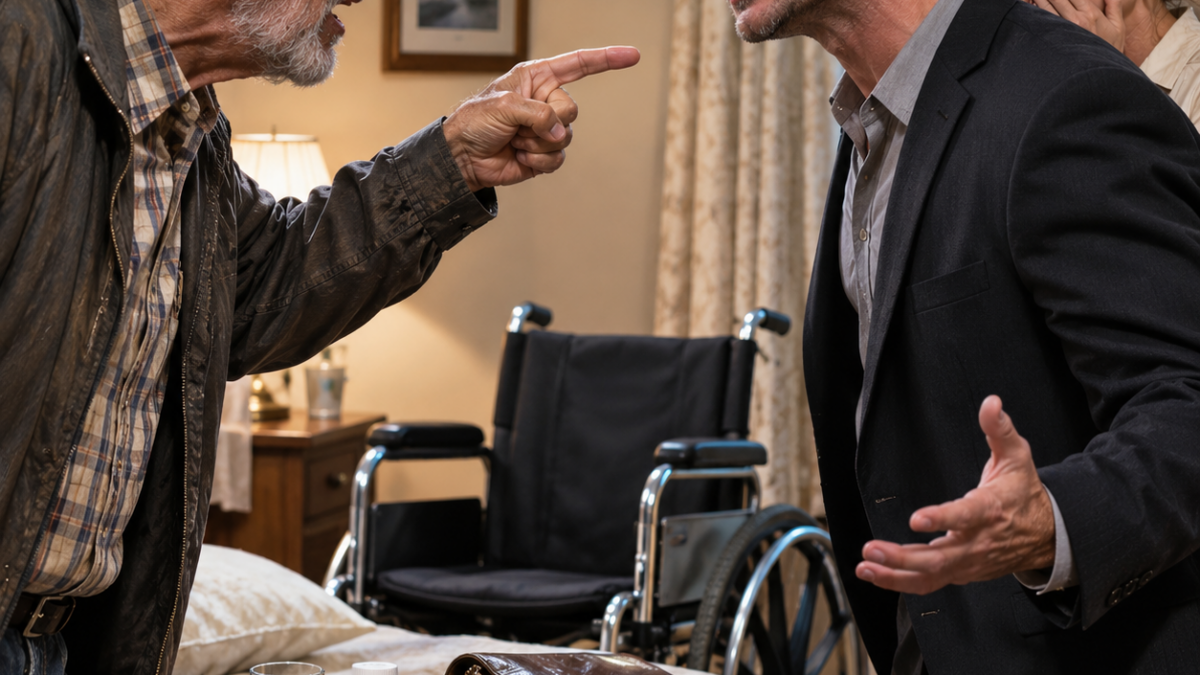
“STOP ACTING CRAZY, DAD! GRANDMA IS EXACTLY WHERE SHE NEEDS TO BE!” my oldest son shouted when I demanded to know why my ninety-two-year-old mother had disappeared overnight, leaving her wheelchair, medication, and purse untouched beside an empty bed.But One Forgotten Camera Exposed His Terrifying Secret.
FULL STORY CONTINUATION
I don’t remember hanging up the phone.
I remember standing in the kitchen with the receiver still in my hand, listening to the dial tone.
I remember the morning light falling across the table.
And I remember noticing George’s coffee cup in the sink.
He had washed it before leaving.
That detail bothered me.
Not because washing a cup was unusual, but because he’d been calm enough to stand there rinsing dishes while I demanded to know where my mother was.
He had treated her disappearance like an inconvenience.
Something he expected me to stop asking about.
I went back to her bedroom.
The silence felt different now.
Earlier, I had been frightened.
Now I was beginning to feel something colder.
I opened her closet.
Her favorite blue dress hung beside two sweaters.
Her winter coat was still on the hook.
Her slippers rested neatly beneath a chair.
I opened the nightstand drawer.
Her rosary lay beside her reading glasses.
A paperback novel she had been reading was turned facedown on a folded handkerchief.
Everything was exactly where she’d left it.
There was no suitcase missing.
No clothing packed.
No sign that she had prepared to visit anyone.
I sat on her bed.
The mattress dipped beneath my weight.
I picked up her pillow and held it against my chest.
It smelled faintly of the inexpensive lavender perfume she’d worn for years.
And suddenly, I remembered being a little boy.
I remembered waking during thunderstorms and running into her bedroom.
I remembered how she always moved over to make room for me.
“Come here, Robert,” she’d whisper. “Nothing’s going to get you while I’m here.”
I was seventy-four years old.
My mother was ninety-two.
And for the first time since childhood, I wanted to crawl into her arms and hear her tell me everything would be all right.
Instead, I sat in her empty room and tried not to imagine what might have happened to her.
I called St. Mary’s Hospital.
The receptionist confirmed that my sister Rose was recovering there.
She couldn’t receive a call at that moment, but she’d been admitted for several weeks.
I thanked the woman and hung up.
Then I called George.
He didn’t answer.
I called again.
Nothing.
I sent him a message.
I know Aunt Rose is in the hospital. Tell me where Grandma is.
He didn’t respond.
For the next several hours, I searched the house.
I checked drawers, paperwork, and recent mail.
I examined every room.
I looked for notes.
Anything.
At noon, I tried George again.
Still nothing.
By evening, I was sitting alone in the living room, staring at my mother’s wheelchair.
The empty chair seemed to accuse me.
I should have protected her.
I should have recognized the warning signs.
I should have stopped George long before things reached this point.
But the truth was that I had spent months pretending not to see what was happening.
And to understand how my family reached that terrible morning, I need to tell you about the last time our home felt like a home.
Two years earlier, we celebrated my mother’s ninetieth birthday.
My wife, Eve, was still alive then.
The house was full of laughter.
I remember waking before sunrise and hearing Eve moving around the kitchen.
When I walked downstairs, she was wearing the pink apron she used only on special occasions.
She had already started baking biscuits.
The smell filled the entire house.
“You’re up early,” I told her.
She turned and smiled.
“Your mother only turns ninety once.”
I kissed her cheek.
“Need help?”
She handed me a bag of potatoes.
“Peel.”
That was Eve.
She never wasted time making speeches when there was work to do.
My mother was sitting near the kitchen table, giving instructions nobody had asked for.
“Don’t overcook the roast, Eve.”
Eve laughed.
“I’ve been cooking for your family for fifty years.”
“And you’ve overcooked it twice.”
They both burst out laughing.
I stood there looking at them.
Two women who had shaped my entire adult life.
My mother had raised me.
Eve had spent fifty-two years building a family beside me.
And for that one morning, everything seemed right.
By eleven, the children began arriving.
George came first with his wife, Sophia, and their children, Beatrice and Benjamin.
Beatrice ran straight toward my mother.
“Happy birthday, Great-Grandma!”
My mother laughed and held out her arms.
Benjamin brought a drawing he’d made at school.
It showed our entire family standing in front of the house, everyone smiling beneath an enormous yellow sun.
My mother studied it like a priceless painting.
“This is the most beautiful thing I’ve ever received.”
Benjamin beamed.
She taped it to the refrigerator.
Then Ethan arrived with his wife, Ellen.
Ethan was quieter than George.
Always had been.
He avoided arguments and rarely challenged anyone.
When he was young, I considered that a blessing.
Later, I would understand that avoiding conflict wasn’t always the same as having good judgment.
Grace came carrying a birthday cake so large she barely fit through the doorway.
Our son John called from overseas.
His face appeared on the phone screen, grainy and distorted, as he sang “Happy Birthday” badly enough to make everyone laugh.
The house was alive.
Eve moved between the kitchen and dining room carrying food.
My mother sat at the head of the table.
George talked loudly about a business opportunity.
Ethan listened.
Grace teased John through the phone.
The grandchildren argued about who would get the biggest slice of cake.
I looked around and thought:
This is what a good life looks like.
We weren’t perfect.
We had disagreements.
Bills.
Health problems.
Worries.
But we were together.
After lunch, George stood and raised his glass.
“To Grandma.”
Everyone quieted.
“The strongest woman I know. Ninety years old, and she still bosses everyone around.”
We laughed.
My mother shook her head.
George smiled.
“Seriously, Grandma, you’ve always been the heart of this family.”
His voice sounded sincere.
“Here’s to many more years.”
We applauded.
My mother wiped her eyes.
Eve squeezed her hand.
But while everyone was clapping, I noticed something strange.
George was looking around the house.
Not at the family photographs.
Not at his grandmother.
At the ceiling.
The windows.
The staircase.
His eyes moved the way they did when he evaluated a property for one of his business schemes.
I dismissed the thought.
He was my son.
Why would he be calculating the value of our home during his grandmother’s birthday?
Later that afternoon, I found Sophia standing alone in the backyard.
She was staring toward the fence, her arms folded tightly.
“Everything okay?” I asked.
She turned.
For a moment, I thought she might cry.
“Robert, can I ask you something?”
“Of course.”
“Have you noticed George changing?”
I frowned.
“What do you mean?”
She looked toward the house.
“He’s angry all the time.”
“He’s under pressure.”
“It’s more than pressure.”
Her voice trembled.
“He talks about money constantly. He borrows from people and won’t tell me where it goes. He comes home furious when things don’t work out.”
I sighed.
“George has always been ambitious.”
She shook her head.
“Ambition doesn’t make someone cruel.”
I stared at her.
She looked frightened.
“Sometimes he talks about your house.”
“What about it?”
“How much it would sell for.”
I laughed nervously.
“He’s always thinking about investments.”
Sophia didn’t smile.
“Robert, please be careful.”
I wish I could go back to that afternoon.
I wish I could stand beside that frightened young woman and say, “Tell me everything.”
I wish I had believed her.
Instead, I told her George was going through a difficult period.
And I went back inside.
Six months later, Sophia left him.
She took Beatrice and Benjamin.
George arrived at my house with bloodshot eyes and wrinkled clothes.
“She left,” he told me.
Eve immediately embraced him.
“Oh, sweetheart.”
George dropped into a chair.
“She thinks I’m a failure.”
Eve stroked his hair.
“You’re not a failure.”
I stood in the doorway.
I wanted to ask what he’d done.
What debts he’d accumulated.
Why Sophia had been so frightened.
But Eve looked at me.
And I stayed silent.
That was one of the great mistakes of my life.
I confused protecting my son with protecting him from accountability.
A year later, Eve became ill.
It began with a persistent cough.
She said it was nothing.
A cold.
A little fatigue.
She’d always been stubborn about doctors.
But the coughing grew worse.
One night, I woke and found her sitting on the edge of the bed, struggling to breathe.
I took her to the hospital.
The doctors diagnosed pneumonia.
They explained that her age and condition made the infection serious.
She was admitted.
I stayed beside her whenever I could.
I read the newspaper aloud.
I held her hand.
I helped her drink water.
I watched her become weaker.
My mother visited every day.
She would sit beside Eve’s bed, hold her hand, and whisper, “You have to get better. This family needs you.”
Grace came immediately.
John arranged to fly home.
Ethan visited after work.
George always had an excuse.
An appointment.
A meeting.
Traffic.
A problem with his car.
“Tomorrow, Dad. I promise.”
But tomorrow kept passing.
And Eve kept waiting.
Every time the hospital door opened, she looked up.
Sometimes she whispered, “Is that George?”
I would shake my head.
She’d smile faintly.
“He must be busy.”
Even when she was dying, she protected him.
One afternoon, she took my hand.
“Robert.”
I leaned closer.
“Yes, sweetheart?”
“Don’t be too hard on George.”
I swallowed.
“Eve—”
“He’s struggling.”
I looked at her pale face.
“He’s a grown man.”
“I know.”
Her fingers tightened around mine.
“But he’s still our boy.”
I didn’t argue.
How could I?
She was exhausted.
She was frightened.
And she still believed there was goodness inside the son who couldn’t make time to visit her.
Eve died on a Thursday.
I was reading the sports section of the newspaper.
She liked hearing my commentary even though she never cared much about sports.
I was halfway through an article when her hand went still in mine.
I looked up.
“Eve?”
She didn’t answer.
I leaned closer.
“Eve, sweetheart?”
Her breathing had stopped.
I called for help.
Nurses came.
Doctors came.
But my wife was gone.
Fifty-two years.
Fifty-two years of marriage.
And suddenly, the woman who had filled every room of my life was no longer there.
I called the children.
George didn’t answer until my fifth attempt.
“Dad, I’m busy.”
“Your mother died.”
Silence.
Then:
“I’m coming.”
He arrived the following day.
At the funeral, he wore a wrinkled black suit.
He hugged me briefly.
“I’m sorry, Dad.”
During the burial, his phone kept ringing.
Twice, I watched him step away to answer.
I stood beside Eve’s grave while my son discussed something on his telephone.
I wanted to scream at him.
But my mother held my arm.
“Not today, Robert,” she whispered.
So I remained silent.
Again.
After the funeral, the house emptied.
Friends returned to their lives.
The children went home.
And I was left with my mother.
We sat in the living room looking at Eve’s photographs.
For a long time, neither of us spoke.
Then my mother reached for my hand.
“Now it’s you and me, Robert.”
I nodded.
“We’ll be all right.”
But I didn’t believe it.
The house seemed too large.
Too quiet.
Every chair reminded me of Eve.
Every cupboard contained something she’d placed there.
I would wake in the night expecting to hear her breathing beside me.
Then remember.
And lie awake until morning.
During those months, George began visiting more often.
At first, I was grateful.
He brought groceries.
He helped with small repairs.
He sat with my mother.
Sometimes he stayed for dinner.
I thought perhaps Eve’s death had changed him.
Perhaps he’d finally understood how much family mattered.
But he wasn’t returning to us out of love.
He was studying us.
And I didn’t understand that until it was almost too late.
Two weeks after the funeral, George arrived with a woman.
“Dad, this is Tiffany.”
She was younger than him, with dyed blonde hair, long red nails, and an expensive-looking handbag.
She smiled when I opened the door.
“Mr. Robert, it’s wonderful to meet you.”
I shook her hand.
“Nice to meet you too.”
She looked past me into the house.
Her eyes moved quickly.
The staircase.
The living room.
The furniture.
Then she smiled again.
“What a beautiful old place.”
I thanked her.
My mother was sitting beside the window.
Tiffany approached her.
“Hello, Grandma!”
She spoke loudly, slowly, the way some people speak to toddlers.
“How are we feeling today?”
My mother looked up.
“I’m feeling ninety-two.”
Tiffany laughed.
But my mother didn’t.
Later, when George and Tiffany left, she called me into her room.
“Robert.”
“Yes, Mom?”
“I don’t like that woman.”
I sighed.
“She’s George’s girlfriend.”
“That doesn’t mean I have to like her.”
I smiled.
My mother didn’t.
“She looks at this house the way a buyer looks at a piece of furniture.”
I felt uncomfortable.
“Mom, you’re imagining things.”
She shook her head.
“That woman didn’t come here for love.”
I wanted to believe she was wrong.
I needed to believe George had found someone who might help him become stable again.
So I dismissed her warning.
Soon, Tiffany was visiting regularly.
She commented on the bathrooms.
The kitchen.
The roof.
The age of the house.
“Have you considered renovating?”
“Have you thought about downsizing?”
“Wouldn’t a smaller place be easier to manage?”
Her questions seemed harmless individually.
But they never stopped.
And George always listened with that familiar calculating expression.
One afternoon, he arrived carrying a briefcase.
“Dad, I need Grandma to sign something.”
I was sorting bills at the kitchen table.
“What is it?”
“Insurance paperwork.”
He opened the case and removed several documents.
“Just routine updates. We need to make sure the house is protected.”
I glanced at the pages.
There was too much fine print.
George pointed to a signature line.
“It’s straightforward.”
I frowned.
“Shouldn’t we have someone explain it?”
He sighed.
“Dad, I know what I’m doing.”
I hesitated.
Then I made the mistake that would haunt me for months.
I called my mother.
She came slowly, using her walker.
George smiled brightly.
“Grandma, just sign here.”
She looked at the papers.
“What am I signing?”
“Insurance.”
She glanced at me.
“Robert?”
I nodded.
“It’s all right, Mom.”
She signed.
Her hand trembled slightly as she wrote her name.
George immediately gathered the documents.
“Perfect.”
He snapped the briefcase shut.
“Thanks, Grandma.”
Then he left.
No coffee.
No conversation.
Just the papers.
My mother remained at the table.
After a while, she looked at me.
“Robert, I signed because you told me to.”
I nodded.
“But I don’t know what I signed.”
Neither did I.
I wish I could tell you I demanded the documents immediately.
That I called an attorney.
That I understood what was happening.
But I didn’t.
Because George was my son.
And I still believed that whatever his faults, he would never deliberately exploit his grandmother.
I was wrong.
A week later, Lucy stopped coming.
Lucy had been my mother’s caregiver for years.
She visited three times a week.
She helped with bathing, medication, and mobility.
More importantly, she treated my mother with warmth and respect.
My mother adored her.
“Lucy talks to me like I’m still a person,” she’d say.
When Lucy failed to arrive one Monday, I called her.
She sounded upset.
“Mr. Robert, your son told me my services were no longer needed.”
I sat down.
“What?”
“George said the family would handle everything.”
“He fired you?”
“He paid what was owed and told me not to return.”
I closed my eyes.
“I’m sorry, Lucy. I didn’t know.”
She paused.
“Mr. Robert, please be careful.”
My heart tightened.
“What do you mean?”
“Your mother seemed frightened the last few times I visited.”
I stared at the wall.
“Frightened of what?”
“I don’t know. But George kept asking about her finances.”
After the call, I confronted him.
He was standing in the kitchen putting groceries away.
“Why did you dismiss Lucy?”
He didn’t turn around.
“Because we’re wasting money.”
“She helps your grandmother.”
“I can help her.”
“You don’t live here.”
He slammed the refrigerator door.
“Dad, you’re seventy-four. You can’t keep doing everything yourself.”
I stared at him.
“I’m perfectly capable of making decisions about this house.”
He smiled.
But there was no warmth in it.
“That’s what everybody says when they’re getting old.”
I felt anger rising.
“Bring Lucy back.”
“We don’t need her.”
“George.”
He stepped closer.
“Why are you fighting me? I’m trying to help.”
I looked at my son.
For the first time, I understood how skillfully he could turn a reasonable concern into an accusation.
If I questioned him, I was ungrateful.
If I disagreed, I was stubborn.
If I asked for evidence, I was confused.
And if I insisted on caring for my mother, he claimed I was putting her at risk.
He wasn’t helping.
He was preparing to take control.
Soon Ethan began appearing more often.
Not to visit my mother.
Not to ask how I was coping with Eve’s death.
He came to speak privately with George.
They stood in the backyard and talked in low voices.
Sometimes I saw George pointing toward the house.
Other times Ethan nodded while staring at the ground.
One afternoon, I stepped outside.
“What are you boys discussing?”
Ethan startled.
George turned calmly.
“Just figuring out how to help you.”
“Help me with what?”
“This place is too big for you and Grandma.”
I crossed my arms.
“It’s our home.”
“Sure. But maintaining it costs money.”
“We manage.”
George exchanged a glance with Ethan.
“Maybe you should think about selling.”
I stared at them.
“Your grandmother has lived here for years.”
“Exactly,” George said. “She’s getting old.”
Ethan nodded.
“There’s nothing wrong with considering alternatives, Dad.”
I looked at my younger son.
Something about his expression troubled me.
He wasn’t speaking with conviction.
He looked like a man repeating words someone else had given him.
I said, “Your grandmother isn’t a piece of furniture we can move because it’s inconvenient.”
George sighed.
“See? This is why we can’t have a reasonable conversation.”
He turned away.
Ethan followed.
I remained in the yard, furious and confused.
I didn’t know they were already discussing paperwork that could strip my mother of control over property she owned.
And I didn’t know how far George intended to go.
My mother began changing.
She grew quieter.
She spent more time in her bedroom.
Sometimes I found her staring out the window with tears in her eyes.
“Mom, what’s wrong?”
“Nothing, my son.”
“Are you in pain?”
She shook her head.
“Just tired.”
But I knew her.
My mother had lived through poverty, illness, the deaths of friends, and the loss of my father.
She wasn’t easily frightened.
Now she seemed afraid whenever George’s car pulled into the driveway.
One evening, while we were eating dinner, she set down her fork.
“Robert.”
“Yes, Mom?”
“Your son talks to me like I’m stupid.”
I stopped eating.
“What did he say?”
“He keeps asking where I keep documents.”
“What documents?”
“Property records. Old inheritance papers. Things that belonged to my parents.”
My stomach tightened.
“Why would he ask?”
She looked at me.
“That’s what I want to know.”
Then she reached across the table and took my hand.
“Promise me something.”
“Anything.”
“Don’t let him take what isn’t his.”
I swallowed.
“Of course not.”
She studied my face.
“Robert, I mean it.”
I squeezed her fingers.
“I promise.”
At the time, I thought I was reassuring her.
Now I understand she was warning me.
And I was still too frightened of confronting my own son to listen properly.
The Sunday dinner was my last attempt to repair the family before everything collapsed.
I decided to cook one of Eve’s favorite meals.
Pot roast.
Mashed potatoes.
Vegetables.
Biscuits.
The kind of meal that once brought everyone around our table.
I invited George, Ethan, their partners, and Father Andrew, our longtime parish priest.
Grace couldn’t attend because of work.
John was overseas.
My mother dressed carefully.
She wore her favorite blue dress and a little perfume.
She looked beautiful.
I told her so.
She smiled sadly.
“Your wife always knew how to make Sundays special.”
I felt my throat tighten.
“She did.”
We sat down around noon.
At first, the conversation was pleasant.
Father Andrew told a funny story.
Ellen laughed.
Tiffany complimented the food.
For a few minutes, I let myself believe the evening might help us find our way back to one another.
Then George put down his fork.
“Dad, we need to discuss Grandma.”
The room became quiet.
I felt my stomach tighten.
“What about her?”
George looked at Ethan.
Ethan nodded.
“We’re worried,” George said.
“About what?”
“You’re seventy-four. Grandma is ninety-two. This house is too much.”
I stared at him.
“She’s receiving care.”
“Not professional care.”
I felt anger rise.
“You fired Lucy.”
George didn’t blink.
“Because we can arrange something better.”
Tiffany leaned forward.
“Mr. Robert, nobody is criticizing you. We just want what’s best for her.”
My mother spoke from the end of the table.
“I want to stay here.”
George turned toward her.
“Grandma, nobody wants to upset you.”
“Then stop making plans without asking me.”
His smile tightened.
“You’re not seeing the whole picture.”
My mother stared at him.
“I’ve lived ninety-two years. Don’t talk to me like a fool.”
I almost smiled.
That was the mother I knew.
But George’s expression darkened.
He turned back toward me.
“We’ve found a wonderful retirement community.”
I set down my fork.
“No.”
“Dad, listen.”
“No.”
“It has nurses, gardens, activities—”
“Your grandmother said she wants to stay home.”
Tiffany sighed.
“You’re being emotional.”
I looked at her.
“This is my mother.”
George leaned forward.
“Grace agrees with us.”
I stared at him.
“She does?”
“Of course.”
I picked up my phone.
“Let’s ask her.”
George’s face tightened.
I called Grace on video.
She answered.
“Dad?”
“Did you tell George you wanted Grandma moved into a care facility?”
Grace looked startled.
“What?”
George leaned toward the phone.
“Grace, we discussed—”
“No, we didn’t.”
The room became silent.
Grace frowned.
“I haven’t spoken to you in two weeks, George.”
I looked at my oldest son.
He stared back.
For several seconds, nobody spoke.
Then he shrugged.
“Maybe there was a misunderstanding.”
I felt something inside me snap.
“A misunderstanding?”
“Dad, calm down.”
“You lied.”
“You’re making a scene.”
I stood so abruptly that my chair scraped against the floor.
“Get out.”
Ethan looked up.
“Dad—”
“All of you.”
Father Andrew rose.
“Robert, perhaps everyone needs a moment—”
“No, Father. I’ve had enough moments.”
I turned toward George.
“You came into my home, dismissed my mother’s caregiver, asked her to sign documents I wasn’t allowed to examine, and now you’re lying about what my daughter said.”
George stood.
His face was hard.
“You’re not thinking clearly.”
I pointed toward the door.
“Get out.”
Tiffany grabbed her handbag.
“Come on, George. There’s no talking to him.”
Ethan and Ellen followed.
Father Andrew left quietly.
George remained until everyone else was near the door.
Then he leaned toward me.
“You’re going to regret being this stubborn.”
I stared at him.
“Are you threatening me?”
He smiled.
“I’m warning you.”
Then he left.
The door closed.
I turned toward the dining room.
My mother was crying.
The table was covered with untouched food.
Eve’s favorite roast had gone cold.
And I understood that I had tried to recreate a family gathering when the family itself had already begun breaking apart.
That night, my mother called me into her bedroom.
She was sitting on the bed with her rosary in her hands.
“Robert.”
I sat beside her.
“Yes, Mom?”
“George told me something.”
My chest tightened.
“What?”
“He said you don’t want me here anymore.”
I stared at her.
“What?”
She began crying.
“He said you’re tired of caring for me. That you want him to find somewhere else for me to live.”
I felt sick.
“Mom, that’s a lie.”
“He showed me papers.”
“What papers?”
She reached into her nightstand and handed me an envelope.
Inside was a brochure for a residential care facility.
There was also a letter stating that a family member had requested placement for her.
I stared at the pages.
My name appeared in the paperwork as though I had approved the arrangement.
I hadn’t.
I looked at my mother.
“Mom, I never requested this.”
Her eyes filled with uncertainty.
“George said you were afraid to tell me.”
I took both her hands.
“Listen to me.”
She looked at me.
“I don’t want you gone.”
Her mouth trembled.
“I know I’m old, Robert.”
“You’re my mother.”
“I know I need help.”
“That doesn’t make you unwanted.”
She began sobbing.
I held her.
For a long time, she cried against my shoulder.
Then she whispered, “I don’t know who to believe anymore.”
Those words devastated me.
George wasn’t simply trying to move her.
He was poisoning her trust in me.
He wanted her to believe I had abandoned her.
And once she believed that, he could present himself as the only person willing to help.
I understood the plan.
But I still didn’t understand how dangerous it was.
I promised her I would prove the truth.
That I would stop George.
That she would remain safe.
She touched my cheek.
“I’m scared, Robert.”
I kissed her forehead.
“So am I, Mom.”
It was the first time I’d admitted it.
Two days later, she vanished.
That was the morning I found her perfectly made bed and empty wheelchair.
And by the time George returned that evening with a rotisserie chicken, I had spent an entire day imagining what might have happened to her.
He entered the kitchen casually.
“Brought dinner, Dad.”
I was sitting in the dark living room.
I hadn’t eaten.
I hadn’t turned on the lights.
I hadn’t stopped thinking about my mother.
“I called the hospital.”
George stopped.
I stood slowly.
“Aunt Rose has been admitted for weeks.”
He placed the food on the table.
“Dad, you’re confused.”
I moved closer.
“Don’t.”
His expression tightened.
“Don’t what?”
“Don’t call me confused.”
He sighed.
“We can talk when you’re calmer.”
I stared at him.
“Where is she?”
“She’s fine.”
“Where?”
“Somewhere safe.”
“George.”
He looked away.
“She needs rest.”
I felt my hands curl into fists.
“She needs her medication. She needs her wheelchair. She needs the son who has cared for her every day.”
George shook his head.
“You aren’t capable of making these decisions anymore.”
The words hit me like a slap.
For a moment, I couldn’t speak.
Then I pointed toward the door.
“Get out.”
He stared.
“What?”
“Get out of my house.”
“Dad—”
“Now.”
His face hardened.
“You’ll regret this.”
I didn’t answer.
He took his jacket and left.
I stood in the living room listening to his car drive away.
Then I sank onto the sofa.
For the first time in my life, I was afraid of my own son.
I didn’t sleep.
At dawn, I began searching for evidence.
My first stop was Ethan’s house.
Ellen opened the door.
She looked surprised to see me.
“Robert?”
“I need to speak with Ethan.”
“He’s inside.”
I walked past her before she could say anything else.
Ethan was sitting in front of the television.
When he saw me, his face turned pale.
“Dad?”
I stood directly in front of him.
“Where is Grandma?”
He looked toward Ellen.
She quietly left the room.
“Dad, I don’t know—”
“Don’t lie.”
His mouth trembled.
“Please.”
I leaned closer.
“Your grandmother is missing. George lied about where she is. And I know you’ve been helping him.”
Ethan stared at the floor.
“Tell me what happened.”
He covered his face.
For several seconds, he said nothing.
Then he whispered, “I helped him take her.”
The room seemed to tilt.
I gripped the back of a chair.
“What?”
Ethan began crying.
“George said it was only temporary.”
I stared at him.
“You helped take a ninety-two-year-old woman out of her home in the middle of the night?”
“He said she needed to sign some papers.”
My stomach turned.
“What papers?”
“I don’t know.”
“Where did you take her?”
Ethan shook his head.
“I swear, Dad. I don’t know where she is now.”
I wanted to grab him.
To shake him.
To demand how he could be so weak.
Instead, I forced myself to speak slowly.
“Who was there?”
“George. Tiffany. Tony.”
“Tony?”
Ethan nodded.
“The caretaker.”
I remembered the large man George had introduced weeks earlier.
The one who stood silently in our living room.
Watching.
Waiting.
“What else?”
Ethan wiped his eyes.
“They talked about a house outside the city.”
“Where?”
“I don’t know.”
I stared at my son.
He was crying like a frightened child.
But his tears couldn’t change what he’d done.
“Your grandmother may be in danger.”
He nodded.
“I’m sorry.”
I felt sick.
“You’ll need to tell the police everything.”
He looked up, terrified.
“Dad—”
“Everything.”
Then I left.
I didn’t hug him.
I didn’t tell him it would be all right.
I couldn’t.
When I returned home, I went directly to the study.
George had installed security cameras the previous year.
“For safety,” he’d said.
I turned on the computer and searched the recordings.
The files from the night my mother disappeared were missing.
Every relevant camera.
Every clip.
Gone.
I stared at the empty folders.
Then I remembered Theodore.
My neighbor across the street had cameras pointing toward the road.
I hurried to his house.
He opened the door.
“Robert?”
“Theodore, please. I need your help.”
He stepped aside.
I explained what had happened.
His face grew serious.
We went into his study.
He opened his camera system.
“What night?”
I told him.
He searched the recordings.
Then the video appeared.
At eleven o’clock, the street was quiet.
Our house stood in darkness.
A black van stopped near the curb.
George climbed out.
Then Tiffany.
Then Tony.
The three of them walked toward my front door.
I leaned closer to the screen.
My heart pounded.
Several minutes passed.
Then they returned.
George and Tony were pushing my mother in a wheelchair.
Her head was bowed.
She wasn’t moving.
I made a sound that frightened even me.
“No.”
Theodore put a hand on my shoulder.
“Robert…”
I stared.
They lifted her into the van.
Tiffany climbed inside.
George shut the door.
Then they drove away.
I couldn’t move.
My son had taken my mother from her home.
At night.
Without telling me.
Without her medication.
Without leaving any way for me to find her.
And he had stood in my kitchen the next morning drinking coffee as though nothing had happened.
I watched the video again.
Then again.
Theodore quietly copied the footage onto a USB drive.
He handed it to me.
“Go to the police.”
I nodded.
But for several seconds, I couldn’t stand.
I kept staring at the frozen image of my mother’s bowed head.
Ninety-two years old.
The woman who had raised me.
The woman who had held me through childhood illnesses and comforted me when Eve died.
And now she was being carried into a van by my own son.
I felt something inside me break.
I called Grace.
She listened as I told her everything.
When I described the video, she began crying.
“I’m coming, Dad.”
Then I called John overseas.
He asked one question.
“Have you called the police?”
“Not yet.”
“Do it now.”
I hung up.
I looked at the USB drive.
Then I dialed the police.
“My mother is missing,” I said.
The dispatcher began asking questions.
I answered.
Then I said something I never imagined saying.
“I believe my son kidnapped her.”
Inspector Monica Hill met me at the station.
She was a serious woman in her fifties with short hair and steady eyes.
She listened carefully.
I showed her the video.
She watched it without interrupting.
When it ended, she turned toward me.
“Mr. Benavides, we’re treating this as a serious matter.”
I nodded.
My hands were trembling.
“She’s ninety-two.”
“I understand.”
“She needs medication.”
“We’ll include that in the alert.”
“She can’t walk far on her own.”
Inspector Hill looked directly at me.
“We’re going to work to find her.”
I wanted to believe her.
But fear had hollowed me out.
Every hour my mother remained missing was another hour I imagined her frightened, thirsty, cold, or injured.
I gave the inspector everything I knew.
George’s number.
Tiffany’s information.
Tony’s description.
Ethan’s admission.
The care facility paperwork.
The forged insurance documents I’d begun questioning.
Everything.
The inspector took notes.
She explained that investigators would work to trace the vehicle and possible locations.
I left the station feeling exhausted.
Not relieved.
Just exhausted.
Because giving the police evidence didn’t bring my mother home.
Not yet.
Grace arrived that evening.
She came through the front door and threw her arms around me.
“Dad.”
I held her tightly.
For a moment, I felt like a little boy again.
“I should have told you,” I whispered.
She pulled back.
“Told me what?”
“Everything. About George. About the papers. About Grandma being frightened.”
Her eyes filled.
“Why didn’t you?”
I looked away.
“Because I didn’t want to believe it.”
She held my hand.
We sat in the living room.
I showed her the footage.
She watched silently.
Then she covered her mouth.
“Oh my God.”
Tears ran down her face.
“That’s Grandma.”
I nodded.
She looked at me.
“How could he?”
I had no answer.
We stayed awake most of the night.
Talking.
Remembering.
Trying to understand when George had become capable of something so cruel.
I told her about Sophia’s warnings.
The debts.
Tiffany.
Lucy being fired.
The documents.
The nursing home brochure.
Grace listened.
Then she said quietly, “Dad, he didn’t change overnight.”
I stared at her.
She was right.
I’d seen warning signs for years.
But I had hidden them beneath excuses.
George was under pressure.
George was ambitious.
George was misunderstood.
George needed another chance.
I had spent so much time trying to understand his behavior that I forgot to question whether it was acceptable.
Now my mother was missing.
And the excuses were over.
The next day, Inspector Hill called.
They had traced a lead connected to Tiffany.
An address outside the city.
Officers were going there.
Grace and I followed the police at a distance.
I sat in the passenger seat gripping the dashboard.
Every minute felt unbearable.
We reached an old house near the outskirts.
The windows were dusty.
The yard was overgrown.
Police entered.
I waited beside the car.
Then Inspector Hill emerged.
Her expression told me everything.
“She’s not here.”
I stared at her.
“What?”
“The house is empty.”
My knees weakened.
I sat on the curb.
Grace sat beside me.
For a moment, I believed I’d lost my mother forever.
I imagined her somewhere in the dark, calling for me.
And I wasn’t there.
Then my phone rang.
Unknown number.
I answered.
“Hello?”
A faint voice whispered, “Robert?”
I froze.
“Mom?”
Silence.
Then:
“My son.”
I began crying.
“Mom!”
Grace grabbed my arm.
“Is it her?”
I nodded, unable to speak.
My mother’s breathing sounded ragged.
“Robert, I got out.”
I stood.
“Where are you?”
“I don’t know.”
“Are you hurt?”
“I’m cold.”
Her voice trembled.
“A woman helped me.”
Inspector Hill came closer.
I signaled frantically.
“It’s my mother.”
She immediately began coordinating with her officers.
I pressed the phone against my ear.
“Mom, listen to me. Stay where you are.”
“I don’t know the address.”
“Can you see anything?”
She paused.
“There’s a little grocery store nearby.”
“What does the sign say?”
She struggled to remember.
“Pete’s Corner.”
Inspector Hill searched the location.
Then she looked at me.
“We have an address.”
My knees almost gave way.
“We found her?”
“We have a location.”
I turned back to the phone.
“Mom, I’m coming.”
She began crying.
“I knew you would.”
Those four words nearly destroyed me.
Because she had believed in me while I was terrified I had failed her.
We reached a small yellow house near the store.
There were flowers in the front yard.
An older woman opened the door.
“Are you Robert?”
“Yes.”
“I’m Linda. Come inside.”
I rushed past her.
My mother was lying on a sofa beneath a knitted blanket.
Her face was pale.
Her lips looked dry.
Her eyes were closed.
“Mom.”
I knelt beside her.
She opened her eyes slowly.
When she saw me, tears rolled down her cheeks.
“Robert.”
I took her hand.
It was cold.
“I’m here.”
She squeezed my fingers.
“I knew you’d find me.”
I couldn’t speak.
I just held her hand and cried.
Paramedics examined her.
She was dehydrated and dangerously chilled.
She needed medical attention.
But she was alive.
My mother was alive.
Grace stood beside me sobbing.
Inspector Hill spoke with Linda.
Then my mother grabbed my sleeve.
“Robert.”
I leaned closer.
“Yes, Mom?”
“The house.”
“What house?”
“Where they kept me.”
Her voice trembled.
“There’s a basement.”
I felt sick.
“They locked me downstairs.”
Inspector Hill moved closer.
“Can you describe it?”
My mother struggled.
“Old house. Covered windows. Not far.”
Linda mentioned an abandoned property nearby.
Inspector Hill immediately sent officers to check.
The paramedics prepared to take my mother to the hospital.
Grace climbed into the ambulance with her.
I wanted to go too.
But my mother held my hand.
“Robert.”
I looked at her.
“Find out what they did.”
My throat tightened.
She squeezed my fingers.
“Don’t let him do this to anyone else.”
I kissed her forehead.
Then I watched the ambulance drive away.
I had found my mother.
Now I needed to face what my sons had done.
The police located the house quickly.
It stood behind an overgrown yard.
Boards covered the windows.
The roof sagged in places.
I stayed outside while officers entered.
I could hear voices.
Footsteps.
A command shouted through the doorway.
Then Inspector Hill came out.
“Mr. Benavides, we’ve found evidence your mother was held here.”
I felt my stomach turn.
She described a hidden basement.
A makeshift confinement area.
Signs that someone had been kept there without proper care.
Then officers brought people out.
Tony appeared first.
He looked frightened.
Behind him came Tiffany.
Then Ethan.
And finally George.
My oldest son.
Handcuffed.
He walked with his head high, his jaw clenched.
For a second, our eyes met.
I searched his face for shame.
For regret.
For anything that suggested he understood what he’d done.
I saw nothing.
Ethan was crying.
“Dad!”
I didn’t move.
“I’m sorry!”
I looked away.
George climbed into the police car without speaking.
And I stood there watching the men who had helped build my family become prisoners of their own decisions.
I had found my mother.
But I had lost something too.
The belief that blood alone made people safe.
At the hospital, my mother was resting beneath a thick blanket.
An IV line ran into her arm.
Grace sat beside her.
“She’s stable,” my daughter whispered.
I took my mother’s hand.
For several minutes, I simply watched her breathe.
I couldn’t stop.
Every rise and fall of her chest felt like a miracle.
When she woke, she looked at me.
“My boy.”
I leaned closer.
“I’m here, Mom.”
She smiled weakly.
“You came.”
I kissed her forehead.
“I’ll always come.”
Her eyes filled.
“I was so scared.”
My throat closed.
I sat beside her.
“Tell me what happened.”
She looked toward the window.
For a long moment, she didn’t speak.
Then she began.
George had taken her from the house late at night.
Ethan helped.
Tony assisted with the transport.
Tiffany accompanied them.
They brought her to the abandoned property.
And they locked her in a basement.
There was little light.
The air was cold.
The floor was damp.
She had no proper bed.
No access to her usual comforts.
George brought food and water, but only in connection with his demands.
“He wanted me to sign papers,” she whispered.
I squeezed her hand.
“What papers?”
“Property.”
My stomach tightened.
“He said if I signed, I could go home.”
I looked at her.
“Did you?”
She shook her head.
“No.”
Tears slid down her cheeks.
“I told him I didn’t understand.”
I stared at her.
She gave a faint smile.
“I pretended to be more confused than I was.”
Despite everything, I almost laughed through my tears.
That was my mother.
Ninety-two years old.
Frightened.
Weak.
But still thinking.
Still resisting.
“He got angry,” she whispered.
“I know.”
“He said I was ruining his life.”
I closed my eyes.
“Mom…”
She squeezed my hand.
“I kept thinking about you.”
I looked at her.
“Every day, I told myself you were searching.”
My chest tightened.
“I was.”
“I knew.”
Her voice broke.
“Even when I couldn’t see the sunlight, I knew my son hadn’t forgotten me.”
I began sobbing.
She lifted one trembling hand and touched my face.
“Robert, don’t cry.”
I shook my head.
“I should have stopped him.”
She stared at me.
“No.”
“Mom—”
“You didn’t put me in that basement.”
I looked down.
“George did.”
Her voice grew stronger.
“And he’s responsible for what he chose.”
I held her hand against my cheek.
For the first time since the nightmare began, I allowed myself to believe her.
The next day, Inspector Hill came to take my mother’s statement.
My mother told her everything.
The nighttime removal.
The confinement.
The threats.
The documents.
The way George withheld comfort while demanding signatures.
The inspector listened carefully.
When my mother finished, she closed her notebook.
“Mrs. Benavides, you’ve been very brave.”
My mother shook her head.
“I was terrified.”
Inspector Hill nodded.
“Bravery doesn’t mean you weren’t afraid.”
My mother smiled faintly.
Then she reached for my hand.
“There’s something George never found.”
I looked at her.
“What?”
“A wooden box.”
She explained that she’d kept it hidden for years.
Inside were family photographs, letters, and a document from her own mother concerning an inheritance.
The document contained provisions intended to protect her decisions from coercion.
George had apparently believed she controlled a substantial fortune.
But he didn’t know the full truth.
My mother looked at me.
“Robert, he wanted me to sign because he thought he could take everything.”
I nodded.
She squeezed my hand.
“But there are protections.”
I stared at her.
She continued.
“And I never signed those new papers.”
I felt tears rising again.
“You saved yourself, Mom.”
She shook her head.
“We saved each other.”
The legal proceedings began soon afterward.
There were charges connected to the unlawful confinement, threats, extortion, and attempted financial fraud.
George, Tiffany, Tony, and Ethan were all investigated for their roles.
I attended the first hearing with Grace and John.
John had flown home immediately after learning what happened.
He stood beside me outside the courthouse.
“Dad, are you ready?”
I looked at him.
“No.”
He squeezed my shoulder.
“Neither am I.”
We entered together.
When George appeared, I felt physically sick.
He wore a wrinkled suit.
His face was unshaven.
But he still carried himself with the same arrogance.
He looked toward me.
I held his gaze.
For years, I’d avoided confronting him.
Not anymore.
The proceedings were painful.
The prosecutor described how my mother had been removed from her home without her consent.
How she had been confined.
How documents had been presented to obtain control over property.
How her age and mobility limitations had been used against her.
Every sentence felt like another wound.
I wanted to leave.
But I stayed.
My mother deserved someone who would stand beside the truth.
Even when the truth implicated my own children.
During a break, I saw Ethan in the hallway.
He was crying.
“Dad.”
I stopped.
He looked up.
“I’m sorry.”
I stared at him.
“Why did you do it?”
He shook his head.
“George said Grandma would be better off somewhere else.”
“And you believed him?”
“He said you couldn’t care for her anymore.”
I felt anger rising.
“Did you ask me?”
Ethan lowered his eyes.
“No.”
“Did you ask Grandma?”
He began crying harder.
“No.”
“Then you chose not to know.”
He looked at me.
“Dad, I never wanted her hurt.”
I swallowed.
“But you helped put her where she could be hurt.”
He covered his face.
“I’m sorry.”
I looked at him for a long time.
Then I said, “Tell your grandmother.”
He nodded.
“And mean it.”
I walked away.
I couldn’t forgive him in that hallway.
I couldn’t make the consequences disappear.
But I hoped, somewhere beneath his weakness and fear, he might still become a better man.
George was different.
When questioned about his actions, he insisted everything had been a misunderstanding.
He claimed he was protecting his grandmother.
He described me as too old to manage her care.
He portrayed himself as the responsible family member.
Then the prosecutor confronted him with the evidence.
The video.
The confinement location.
The financial paperwork.
The witness statements.
And his explanations began to unravel.
At one point, he admitted he needed money.
My heart stopped.
“Money?” I whispered.
He looked toward me.
His face hardened.
“She had things sitting there doing nothing.”
I stared at him.
“She’s your grandmother.”
He shrugged.
“She had assets. I had debts.”
I felt the room spin.
My son had taken a ninety-two-year-old woman from her home because he believed her property could solve his financial problems.
He had frightened her.
Confined her.
Demanded signatures.
And now he spoke about her savings as though they were objects he should have been allowed to claim.
I stared at him.
“Your mother defended you until the day she died.”
His expression flickered.
I continued.
“She waited for you in the hospital.”
He looked away.
“She died believing you were a good man who’d lost his way.”
George said nothing.
“And you didn’t even come when she needed you.”
His jaw tightened.
For one brief moment, I hoped he’d cry.
That he’d admit what he’d done.
That he’d show some sign of regret.
But he only looked at me with resentment.
And I understood that I couldn’t make him feel remorse.
No matter how desperately I wanted to.
Then came another revelation.
My mother had made decisions about her estate long before George’s scheme began.
Through lawful arrangements, she had already directed much of her wealth toward charitable purposes.
Education.
Healthcare.
Support for people who needed assistance.
George had imagined a vast inheritance waiting for him.
But much of what he wanted was no longer available for him to seize.
When the relevant financial records were reviewed, his reaction was immediate.
“That can’t be right.”
He looked furious.
“She had millions.”
I stared at him.
He had risked everything over money he didn’t even understand.
His grandmother’s safety.
His family.
His freedom.
All for an imagined fortune.
He began accusing me of influencing her.
I shook my head.
“I didn’t know about those arrangements.”
He glared.
“Then she lied to me.”
I felt my last trace of patience disappear.
“No, George.”
He stared at me.
“You lied to yourself.”
The courtroom went silent.
“You saw an elderly woman and decided she was weak. You saw property and decided it belonged to you. You saw your father getting older and decided he was too foolish to stop you.”
My voice trembled.
“And you destroyed your family because you wanted something you hadn’t earned.”
He looked away.
For the first time, he had no clever reply.
After the hearing, my mother asked to speak with me privately.
We sat outside on a bench.
The afternoon was cool.
She held my hand.
“Robert, do you know what I thought about while I was locked downstairs?”
I shook my head.
She looked toward the trees.
“I thought about your father.”
My throat tightened.
“I talked to him.”
I smiled sadly.
She continued.
“I told him our grandson had become a man I didn’t recognize.”
Tears filled her eyes.
“But I told him our son was coming for me.”
I looked down.
“Mom…”
“I knew you’d come.”
I squeezed her fingers.
She smiled.
“Do you remember when you were little and afraid of the dark?”
I nodded.
“You’d come into my bedroom during storms.”
I laughed through tears.
“And you’d tell me nothing could hurt me while you were there.”
She touched my cheek.
“Well, when I was in that basement, I remembered those nights.”
My chest tightened.
“I was frightened, Robert. More frightened than I’ve ever been.”
I held her hand.
“But I kept telling myself that my son would come.”
I began crying.
She leaned toward me.
“And you did.”
I pressed my forehead against hers.
For a long time, we sat together.
Two old people.
A ninety-two-year-old mother.
A seventy-four-year-old son.
And for one beautiful moment, neither of us felt old.
We were simply mother and child.
Together.
Safe.
The court eventually imposed sentences reflecting the defendants’ roles.
George received eight years.
Tiffany received five.
Tony received six.
Ethan received a three-year sentence, with potential reduction based on his cooperation and the applicable process.
When I learned the outcome, I didn’t celebrate.
I sat in my kitchen staring at the report.
Grace stood beside me.
“Dad, it’s justice.”
I nodded.
“I know.”
She touched my shoulder.
“Then why are you crying?”
I looked at her.
“Because they’re still my sons.”
She began crying too.
We held each other.
John came into the kitchen and joined us.
For a long time, nobody spoke.
The house that Eve had filled with laughter had become a place where her children were grieving brothers who were still alive.
It was a terrible kind of loss.
There was no funeral.
No grave.
No simple way to explain it.
But something had died.
The family we’d believed we had.
The trust.
The certainty that we could rely on one another.
And I didn’t know whether those things could ever return.
My mother came home after her medical recovery.
Grace had prepared everything.
Fresh sheets.
Flowers.
Clean rooms.
Her favorite chair beside the window.
When we helped her through the front door, she stopped.
She closed her eyes.
Then she smiled.
“It smells like home.”
I felt tears rising.
I helped her into the living room.
She looked around.
Then she sat in her chair.
The same chair where she’d celebrated birthdays.
Watched television with Eve.
Held her great-grandchildren.
And spent countless ordinary afternoons.
“This is where I belong,” she whispered.
I knelt beside her.
“Yes, Mom.”
She touched my face.
“Thank you for bringing me back.”
I shook my head.
“Thank you for holding on.”
She smiled.
“We make a good team.”
I laughed through tears.
“Always have.”
The following months were about healing.
Grace moved closer and helped care for my mother.
John visited regularly.
We arranged appropriate medical support and restored a routine my mother understood and wanted.
Lucy returned to help.
When she walked through the door, my mother began crying.
“Oh, Lucy.”
Lucy hurried over and embraced her.
“I missed you.”
My mother squeezed her hand.
“I missed you too.”
I stood watching them.
And I understood how much damage George had caused simply by removing people my mother trusted.
He hadn’t just threatened her money.
He’d attacked the relationships that made her feel safe.
Now we were rebuilding those relationships.
Carefully.
One day at a time.
Two months after the sentencing, a letter arrived from Ethan.
It came from prison.
I recognized his handwriting immediately.
For several minutes, I held it unopened.
Grace was sitting across from me.
“Are you going to read it?”
I nodded.
I unfolded the paper.
Ethan apologized.
He wrote about his regret.
About being influenced by George.
About allowing fear and greed to overcome his judgment.
He didn’t ask me to erase what he’d done.
He said he understood that his grandmother had every reason never to trust him again.
But he wanted to tell her he was sorry.
And he wanted me to know he was trying to understand why he had been so willing to follow his brother.
I finished reading.
Then I folded the letter.
Grace watched me.
“Are you going to visit?”
I looked toward my mother’s room.
“I don’t know.”
And that was the truth.
I loved Ethan.
But I was afraid that if I forgave too quickly, I would teach him the same lesson I’d taught George for years.
That consequences were temporary.
That someone else would always absorb the damage.
So I waited.
One afternoon, Father Andrew visited.
He brought a Bible and a bottle of wine.
We sat together in the living room.
My mother.
Grace.
John.
The priest.
And me.
He spoke about forgiveness.
About how it doesn’t mean pretending nothing happened.
About how a person can release bitterness without giving someone unrestricted access to their life.
I listened.
When he finished, he turned toward my mother.
“How are you feeling?”
She smiled.
“Free.”
He nodded.
“And you, Robert?”
I looked at my hands.
“I don’t know.”
He waited.
“I don’t know if I can forgive George.”
Father Andrew leaned closer.
“You don’t have to decide today.”
I looked up.
“Or tomorrow.”
I swallowed.
He continued.
“Forgiveness doesn’t erase accountability.”
I nodded slowly.
That was what I needed to hear.
I had spent my life confusing forgiveness with another chance.
Another loan.
Another excuse.
Another opportunity for George to take advantage of us.
Now I understood I could hope he eventually changed without allowing him to harm us again.
And I could love Ethan without removing the responsibility he carried.
It wasn’t easy.
But it was honest.
One evening, my mother asked me to sit outside with her.
The air was cool.
We wrapped ourselves in blankets.
She looked toward the stars.
“Robert.”
“Yes, Mom?”
“Did I ever tell you how I met your father?”
I smiled.
“About a thousand times.”
She laughed.
“Then you’ll hear it again.”
I leaned back.
And she began.
She told me about the carnival.
The music.
The young man who asked her to dance.
The way he stumbled over his own feet.
The way she laughed so hard she nearly refused him.
And how he kept returning until she finally agreed to marry him.
I knew every word.
But I listened as though it were the first time.
Because there had been a moment when I believed I’d never hear her tell that story again.
When she finished, she looked at me.
“I took care of you when you were little.”
I nodded.
“Changed your diapers. Fed you. Held you when you were sick.”
I smiled.
“You did.”
“And now you’ve cared for me.”
My eyes filled.
“Mom—”
She lifted a hand.
“Let me finish.”
I nodded.
“George made terrible choices. Ethan did too. But you found me.”
Her voice trembled.
“You brought me home.”
I took her hand.
“Always.”
She squeezed my fingers.
“And that’s what matters.”
We sat beneath the stars.
And for the first time in a long while, the silence didn’t frighten me.
It felt peaceful.
Eventually, I began visiting Ethan.
The first visit was difficult.
We sat across from each other in the prison visiting room.
He looked thinner.
His eyes were red.
“Dad.”
I nodded.
“Ethan.”
For a long time, neither of us spoke.
Then he began crying.
“I’m sorry.”
I looked at him.
“I know.”
He told me about George’s influence.
About the promises.
About how he’d convinced himself they were helping Grandma because confronting the truth would have required him to defy his older brother.
I listened.
Then I said, “Ethan, you have to stop describing yourself as someone who had no choice.”
He stared at me.
“You did have a choice.”
He lowered his eyes.
“You could have called me.”
He nodded.
“You could have asked Grandma.”
Tears slid down his face.
“You could have refused.”
“I know.”
I leaned forward.
“If you want a different life, you have to understand that.”
He nodded slowly.
Over time, our conversations became more honest.
Not easy.
Not comfortable.
But honest.
He stopped blaming George for every decision.
He began acknowledging his own responsibility.
And eventually, I started believing that the regret he expressed might become something more substantial.
Change.
I didn’t forgive him all at once.
But I allowed the possibility.
I visited George once.
Only once.
Six months after his sentencing.
He sat behind a glass partition.
When I picked up the phone, he looked at me with a cold expression.
“What do you want?”
I swallowed.
“I wanted to see you.”
He laughed bitterly.
“Why?”
I stared at him.
“Because you’re my son.”
His expression didn’t change.
I leaned closer.
“I wanted to know if you understood what you did.”
He looked away.
“I did what I had to do.”
My heart sank.
“George.”
“What?”
“You locked your grandmother in a basement.”
He rolled his eyes.
“Here we go again.”
I felt tears gathering.
“She was ninety-two.”
“I know how old she is.”
“She was frightened.”
“She didn’t have to make things difficult.”
I closed my eyes.
For a moment, I couldn’t breathe.
Then I asked the question I’d carried for months.
“Do you feel sorry?”
He stared at me.
“Sorry my life got ruined?”
I looked down.
He continued.
“Sure.”
“Sorry for what you did to her?”
He said nothing.
I studied his face.
There was no remorse.
No grief.
Only resentment that his plan had failed.
I began crying quietly.
“Your mother loved you so much.”
His jaw tightened.
“Don’t bring Mom into this.”
“She waited for you in the hospital.”
He looked away.
“She defended you until the end.”
He said nothing.
I wiped my face.
“I don’t know how to reach you anymore.”
George leaned back.
“Maybe you never did.”
The words cut deeply.
I looked at him one last time.
Then I placed the phone back on its hook.
I stood.
And walked away.
He didn’t call after me.
I never forgot that.
Life continued.
My mother regained her strength.
She returned to some of her favorite routines.
She helped prepare meals.
She sat in the garden when the weather was pleasant.
She laughed again.
Sometimes she’d tell stories about her childhood.
Other times she’d simply sit beside me watching television.
Those ordinary moments became precious.
I no longer rushed through them.
I no longer treated another cup of tea or another family story as something that would always be available.
I had come too close to losing her.
One afternoon, while we were preparing dinner, she looked at me.
“Robert, do you know what I learned?”
I smiled.
“What, Mom?”
“Family isn’t just blood.”
I stopped chopping vegetables.
She continued.
“Family is who stands beside you when everything falls apart.”
I looked at her.
She nodded toward the living room, where Grace was helping Lucy arrange some things.
“Your daughter came.”
I smiled.
“Yes.”
“John came.”
“Yes.”
“You came.”
My throat tightened.
She took my hand.
“And Ethan is learning.”
I nodded slowly.
She looked toward the window.
“George chose something else.”
I felt pain move through me.
“I know.”
My mother squeezed my fingers.
“We can’t choose for him.”
I looked down.
“No.”
“But we can choose how we live.”
I smiled through tears.
She returned to the vegetables.
“Now finish those potatoes before dinner gets cold.”
I laughed.
That was my mother.
Ninety-two years old.
Still telling me what to do.
And I had never been happier to hear it.
A year later, Ethan received an early supervised release under the applicable terms of his sentence.
He came to the house one Sunday.
I opened the door.
He stood on the porch wearing a plain shirt and dark trousers.
His expression was nervous.
“Dad.”
I looked at him.
“Ethan.”
He swallowed.
“Can I see Grandma?”
I studied his face.
He looked different.
Not because prison had magically transformed him.
But because he no longer carried the same careless expectation that someone would excuse whatever he did.
I stepped aside.
He entered.
My mother was sitting in her chair.
When she saw him, she became very still.
Ethan approached slowly.
Then he knelt before her.
“Grandma.”
She looked at him.
His eyes filled.
“I’m sorry.”
I stood near the doorway.
He continued.
“I helped George take you. I believed what he told me because it was easier than asking questions. I was wrong.”
My mother watched him quietly.
He began crying.
“I know I frightened you.”
She nodded.
“You did.”
“I know I hurt you.”
“Yes.”
He lowered his head.
“I’m sorry.”
For a long moment, nobody moved.
Then my mother reached toward him.
He looked up.
She touched his cheek.
“My boy.”
He began sobbing.
She opened her arms.
And Ethan leaned into them.
I watched my ninety-two-year-old mother hold the grandson who had helped take away her freedom.
I couldn’t imagine the strength it required.
But she didn’t pretend the harm had never happened.
She looked at him.
“I forgive you, Ethan.”
He cried harder.
Then she added, “But don’t forget what you did.”
He nodded.
“Never.”
“Because the memory should help you become someone who would never do it again.”
“I promise.”
She held him.
And I felt the first genuine hope I’d experienced in a long time.
Not that everything would return to the way it had been.
It couldn’t.
But perhaps something honest could grow where the old relationship had broken.
Today, when I look back on those terrible months, I understand something I didn’t understand when I was younger.
The hardest part of being a father isn’t teaching your children how to walk.
It isn’t paying bills or losing sleep when they’re sick.
It isn’t helping them through heartbreak or watching them leave home.
The hardest part is accepting that someday they will make choices you cannot control.
And some of those choices may be terrible.
I loved George.
I still do in the complicated, painful way a father can love a child he no longer recognizes.
But I cannot excuse what he did.
I cannot pretend his grandmother was merely an inconvenience.
I cannot forget that he locked a helpless ninety-two-year-old woman in a basement because he wanted her money.
Nor can I forget that he looked at me afterward and showed no remorse.
I have accepted that George’s path is his own.
I cannot walk it for him.
Ethan’s path has been different.
He carries guilt.
He continues trying to rebuild trust.
He visits.
He helps when asked.
He has learned that being forgiven doesn’t mean everything immediately returns to normal.
Our relationship remains changed.
But there is hope.
Grace is close to us.
John visits regularly.
And my mother is home.
Sometimes I wake before sunrise and walk quietly toward her room.
I pause outside the door.
For one terrible instant, I remember that morning.
The perfectly made bed.
The empty wheelchair.
The missing medication.
George sitting in the kitchen with his coffee.
I feel the old fear rising.
Then I open the door.
And there she is.
Sleeping beneath her favorite blanket.
Her pillow crooked.
Her sheets wrinkled.
Just the way she likes them.
Sometimes she opens one eye.
“Robert?”
I smile.
“Morning, Mom.”
She groans.
“Why are you up so early?”
I laugh.
“Just checking on you.”
She shakes her head.
“At your age, you should know better than to wake an old woman.”
Then she smiles.
And I feel more grateful than words can express.
I don’t have my wife anymore.
I don’t have the family I once believed was unbreakable.
I don’t have the same relationship with my sons.
But I still have my mother.
I still have people who stood beside me when everything fell apart.
And I still have the knowledge that when the worst moment of my life arrived, I finally stopped making excuses and chose to protect someone who couldn’t protect herself.
I wish I’d done it sooner.
I wish I’d listened to Sophia.
To Lucy.
To my mother.
I wish I’d asked more questions about the documents.
I wish I’d stopped George before he had the opportunity to hurt her.
But I cannot go backward.
I can only live differently now.
I can insist on honesty.
I can protect the people who trust me.
I can refuse to let fear of conflict make me silent.
And I can make sure my mother never spends another night wondering whether her son is coming.
One evening, we sat together in the backyard.
The stars were bright.
My mother had wrapped herself in a blanket.
I sat beside her with two cups of tea.
She looked at me.
“Robert.”
“Yes, Mom?”
“Do you remember when you were little and I used to tell you not to be afraid of storms?”
I smiled.
“Of course.”
She reached for my hand.
“Well, my son, I’ve lived through plenty of storms.”
I nodded.
“So have I.”
She squeezed my fingers.
“But we’re still here.”
I looked at her.
Her face was lined with age.
Her hands were thin.
Her voice was quieter than it used to be.
But her eyes still carried the same stubborn strength that had guided me through childhood.
I felt tears gathering.
“Yes, Mom.”
I leaned closer.
“We’re still here.”
She smiled.
Then she rested her head against my shoulder.
And we sat in silence.
A mother and son.
Both old.
Both carrying scars.
But together.
For the first time in a long while, I wasn’t thinking about George’s betrayal or the courtroom or the basement where my mother had been held.
I was thinking about everything she had given me.
The childhood she’d protected.
The lessons she’d taught.
The love she’d shown even when life was hard.
I had spent seventy-four years believing that a mother was someone who protected her children.
I never imagined that one day, protecting mine would mean standing against my own son to save her.
But I did.
And I would do it again.
Because George had looked at my ninety-two-year-old mother and seen an inheritance.
He saw property.
Money.
A problem to be controlled.
I looked at her and saw the woman who had held my hand through every storm of my life—and when she needed someone to hold hers, I finally understood that no amount of money, no family name, and no blood relationship could ever be worth more than bringing her home.








