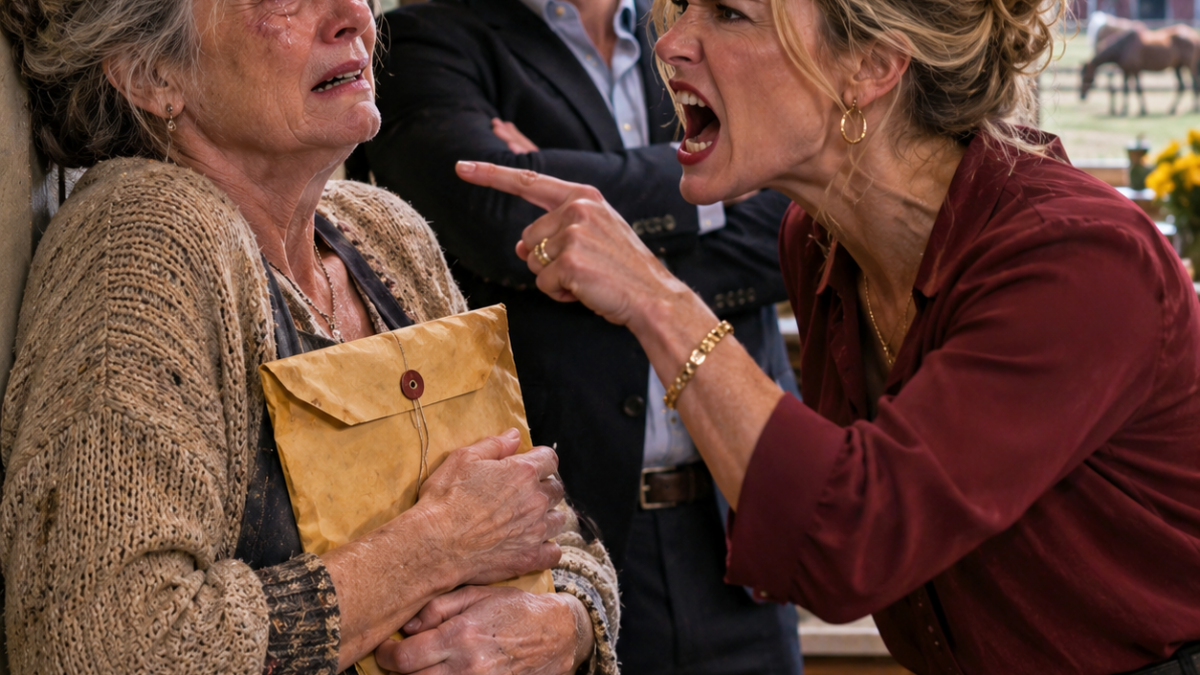
“ SLEEP WITH THE HORSES OR ROT IN A NURSING HOME!” My Daughter Screamed as Her Husband Smirked — Neither of Them Knew I Had Kept One Yellowed Envelope Hidden for 30 Years That Could Take Their Entire Fortune Away.
FULL STORY CONTINUATION
The telephone rang three times.
Then four.
I sat on the edge of the narrow bed, staring at the envelope in my lap while my heart pounded so hard I could feel it in my throat.
For a moment, I almost hung up.
Thirty years.
That was how long I’d kept those papers hidden.
Thirty years of telling myself that some truths were better left buried.
Thirty years of protecting Alexis from a past she hadn’t chosen.
And now, because of what she’d done to me, I was about to open a door I’d spent most of my adult life keeping closed.
“Torres and Associates. Good morning.”
The receptionist’s voice was warm and professional.
I swallowed.
“Good morning. My name is Sophia. I need to speak with Mr. Carlos Torres.”
“May I ask what this concerns?”
I looked down at the name written on the envelope.
Jim Ferrer.
My former husband.
The man who had abandoned our daughter when she was five.
“It’s regarding the Jim Ferrer matter.”
There was a brief silence.
“One moment, please.”
Soft music filled the line.
Downstairs, I could hear Alexis talking to George.
Their voices drifted through the ceiling.
She sounded irritated about something involving the next guests.
George laughed.
I recognized that laugh.
I’d heard it when he made jokes about my clothes.
When he criticized my cooking.
When Alexis complained that I moved too slowly.
When they told me to stop using the main living room because it was now a guest area.
I stared at the envelope.
For years, I’d believed that keeping my daughter’s childhood free from her father’s disgrace was an act of love.
Now I wondered whether I’d confused protection with silence.
The music stopped.
“Sophia?”
A familiar man’s voice came through the receiver.
Older than I remembered.
But unmistakable.
“Mr. Torres.”
“My goodness. It’s been a long time.”
“Yes.”
“Are you all right?”
I tried to answer.
But the moment he asked, my composure almost disappeared.
I pressed my lips together.
“Sophia?”
“I’m not all right.”
His voice changed immediately.
“Tell me what’s happened.”
I looked toward the closed bedroom door.
“My daughter has taken my house.”
A pause.
“What?”
“She and her husband convinced me to transfer the property into their names. They said it was temporary. They used it to finance a business.”
I took a shaky breath.
“Now they’re throwing me out.”
Mr. Torres remained silent.
I continued.
“She told me I could go to a nursing home or sleep with the horses.”
I heard him exhale sharply.
“Where are you now?”
“Still at the property.”
“Are you safe?”
I touched my aching shoulder.
“For the moment.”
“Listen carefully, Sophia. Don’t argue with them any further. Find somewhere safe to stay.”
I looked at the envelope.
“Mr. Torres?”
“Yes?”
“I still have Jim’s documents.”
He didn’t answer immediately.
Then he said, very quietly, “I understand.”
“I need you to do what we discussed all those years ago.”
A long silence followed.
“Are you certain?”
I closed my eyes.
“No.”
My voice cracked.
“I’m not certain about anything anymore.”
He waited.
“But I’m certain I can’t let my daughter take everything I worked for and throw me away like garbage.”
His voice softened.
“Then come to my office tomorrow morning at ten. Bring the envelope. We’ll review everything and decide how to proceed.”
I nodded, forgetting he couldn’t see me.
“Thank you.”
“And Sophia?”
“Yes?”
“Please don’t confront Alexis about those documents yourself.”
I looked toward the door.
“I won’t.”
When the call ended, I remained seated.
The yellowed envelope lay across my knees.
For the first time in decades, the past no longer felt safely buried.
It felt alive.
And it was coming for all of us.
I had raised Alexis alone since she was five years old.
That was the beginning of the story I had told everyone.
But the full truth was uglier.
Jim Ferrer hadn’t simply walked away because he was tired of marriage or frightened of responsibility.
He had been running from a crime.
When we first married, Jim was charming.
He could make strangers feel like friends in minutes.
He loved horses, open fields, and the idea of living somewhere peaceful.
We bought a modest house outside a small Vermont town.
The property included an aging barn, a paddock, and enough land for the horses he dreamed of keeping.
I loved the place.
Not because it was beautiful then.
It wasn’t.
The house needed repairs.
The barn roof leaked.
The fences were old.
But there was something about the mountains beyond our fields that made me feel we could build a life there.
When Alexis was born, I believed we had.
Jim held her in the hospital and cried.
He kissed her tiny forehead.
“She’s perfect, Sophia.”
I remember looking at him and thinking that nothing could ever come between the three of us.
I was wrong about that, too.
Over the years, Jim became increasingly secretive.
He worked for a company that handled substantial financial accounts.
He was ambitious.
Restless.
Always talking about investments and opportunities.
He wanted more than we had.
A better car.
A larger home.
A business of his own.
I told him I was happy.
He never seemed to believe me.
“You’re too easily satisfied,” he used to say.
At the time, I thought he meant we should dream bigger.
Later, I understood that he couldn’t tolerate the idea of living within his means.
When Alexis was five, I found documents hidden in his study.
Bank statements.
Account numbers I didn’t recognize.
Records of transfers that made no sense.
I wasn’t an accountant, but I knew enough to recognize that something was wrong.
I confronted him.
At first, he denied everything.
Then he became angry.
Finally, he broke down.
He had embezzled money from his employer.
A considerable amount.
He’d moved funds through accounts he controlled, hoping to invest the money and eventually replace it before anyone noticed.
But the company had discovered irregularities.
Investigators were asking questions.
Jim was terrified.
“I did it for us,” he told me.
I remember staring at him across the kitchen table.
“For us?”
“I wanted to give you and Alexis a better life.”
“We have a life, Jim.”
“Not the one you deserve.”
I shook my head.
“You stole money.”
He looked away.
“I was going to put it back.”
“Then why didn’t you?”
He didn’t answer.
A few days later, he disappeared.
No proper goodbye.
No explanation to our daughter.
Just debts, unanswered questions, and a house I wasn’t sure I could afford to keep.
I remember Alexis standing in the doorway holding a stuffed rabbit.
“Mommy, when’s Daddy coming home?”
I knelt beside her.
I wanted to tell her the truth.
But what could I say to a five-year-old child?
That her father had stolen from people who trusted him?
That he had run away rather than face the consequences?
That his promises had been built on lies?
So I held her.
And I said, “I don’t know, sweetheart.”
She cried.
I cried with her.
And that night, I made myself a promise.
Whatever Jim had done, Alexis would not grow up believing she was responsible for it.
She would have a home.
An education.
A childhood with horses and Christmas mornings.
She would have at least one parent who stayed.
I didn’t know then how much that promise would cost me.
After Jim left, the bills kept coming.
The mortgage.
The feed for the horses.
Property taxes.
Utilities.
Repairs.
Alexis needed clothes, school supplies, meals, and someone to reassure her when she woke crying for her father.
I worked as a seamstress during the day.
At night, I cleaned offices.
Sometimes I finished work after midnight and came home to prepare breakfast before Alexis woke up.
My hands became rough.
My back began aching years before it should have.
I learned to repair almost anything because hiring someone cost money we didn’t have.
I patched the barn roof.
Replaced broken fence rails.
Sewed curtains.
Painted walls.
Fixed torn coats.
And on the mornings when I was so tired I could barely stand, I reminded myself why I was doing it.
Alexis.
My beautiful little girl.
She loved the horses more than anything.
Especially Star, a young mare Jim had brought home shortly before he disappeared.
Star was nervous and easily startled.
The first night she arrived, Alexis begged to sleep in the barn.
“She’ll be scared, Mommy.”
I tried to explain that the horse would be fine.
Alexis wouldn’t listen.
So I brought blankets into the barn.
We sat together on a pile of clean hay while rain tapped against the roof.
Alexis stroked Star’s muzzle.
I told stories until my daughter fell asleep against my shoulder.
I remember looking at her small face and thinking, This is enough.
Not money.
Not luxury.
Not the life Jim had been so desperate to buy.
Just my daughter sleeping peacefully beside an animal she loved.
For years, that memory sustained me.
When Alexis wanted dance lessons, I took extra sewing jobs.
When she needed a new winter coat, I made one.
When she wanted to attend college, I sold the jewelry my mother had left me.
It hurt to part with those pieces.
Especially a small gold necklace she’d worn for decades.
But Alexis had been accepted into a business administration program in New York City.
She was excited.
Ambitious.
Certain that her future would be bigger than the one I’d lived.
I didn’t want money to stop her.
So I sold the jewelry.
When I handed her the tuition payment, she hugged me tightly.
“Mom, someday I’m going to buy you the most beautiful house you’ve ever seen.”
I laughed.
“I already have a beautiful house.”
She looked around at the peeling paint and worn furniture.
“This place?”
“Yes.”
“Mom, everything’s old.”
I smiled.
“Old doesn’t mean worthless.”
She kissed my cheek.
“Well, someday you’ll have something better anyway.”
I believed her affection was genuine.
I still believe it was, at least then.
But somewhere along the way, the girl who wanted to give me everything became the woman who believed I deserved nothing.
And I spent years refusing to see it.
Alexis met George at college.
He came from a wealthier family.
He dressed beautifully, drove an expensive car, and spoke with the confidence of someone who had rarely been told no.
The first time he visited our home, I noticed how he looked around.
Not with curiosity.
With judgment.
His eyes moved from the older furniture to the repaired kitchen cabinets.
Then toward the paddock.
“Interesting place,” he said.
I smiled.
“Thank you.”
He glanced at the barn.
“Still keeping horses out here?”
“Yes.”
“Must be expensive for such an old property.”
Alexis laughed.
“Mom’s sentimental.”
I looked at her.
She’d spent her childhood begging me not to sell those horses.
Now she sounded embarrassed by them.
I told myself she’d grown up.
People change.
They adopt new interests.
They become more sophisticated.
That didn’t mean she no longer loved me.
But the signs continued.
She began correcting my language in front of George.
Commenting on my clothes.
Encouraging me to replace furniture I couldn’t afford to replace.
When I prepared a homemade dinner, George complimented the food but joked that the kitchen belonged in a museum.
I laughed along because I didn’t want to embarrass Alexis.
When they announced their engagement, I was genuinely happy for her.
I wanted her to have the stability I hadn’t found with Jim.
I used my savings to help pay for the wedding.
It was a lovely ceremony.
Alexis looked radiant.
I cried when she walked down the aisle.
George barely acknowledged my contribution.
He spent most of the reception speaking with his friends.
I told myself that didn’t matter.
It was Alexis’s day.
And when she hugged me afterward, whispering, “Thank you for everything, Mom,” I believed our relationship would remain close.
Instead, her visits became less frequent.
She was always busy.
Always rushing.
Always checking her phone.
I learned to stop asking when she’d come again.
I didn’t want her to think I was demanding.
I had spent my life being careful not to become a burden.
And somehow, that fear made it easier for her to treat me like one.
Two years before the morning she threatened to put me in a nursing home, Jim died in a car accident.
I hadn’t seen him in decades.
We’d exchanged occasional correspondence over the years, mostly through legal channels or brief letters that never repaired the damage he’d caused.
He had never returned to raise Alexis.
He had never been there for school plays, graduations, or the long years when she needed a father.
But he had apparently accumulated money through investments.
And in his will, he left approximately two hundred thousand dollars to our daughter.
When the attorney informed us, Alexis cried.
At first, I thought she was grieving.
Then I saw her expression change.
She began asking questions.
How soon would the money be available?
Were there restrictions?
Could it be invested?
How much would remain after expenses?
George sat beside her, listening closely.
I watched them exchange a glance.
Something about it made me uneasy.
But I pushed the feeling aside.
Alexis had a right to be excited.
Two hundred thousand dollars was a significant amount.
It could change her future.
I hoped she’d use it wisely.
Three months later, she and George arrived at my house with a proposal.
They wanted to build an inn.
Agritourism was becoming increasingly popular in our area.
Visitors wanted rural accommodations, beautiful views, outdoor experiences, and a taste of Vermont farm life.
Our property had land.
Horses.
Scenery.
And enough space for several cabins.
Alexis was enthusiastic.
“Mom, this could be incredible.”
She spread plans across my kitchen table.
Cabins.
Renovations.
A reception area.
Guest facilities.
George explained the financing.
They would use the inheritance as part of the investment, but the bank needed the property involved in the financing arrangement.
They wanted me to sign documents transferring title into their names.
“Temporarily,” Alexis said.
I looked at her.
“Why can’t the property stay in my name?”
She squeezed my hand.
“Because the business financing will be easier this way.”
George smiled.
“Miss Sophia, you’ll benefit from all of this. Imagine not having to clean offices or sew clothes for other people anymore.”
I looked at the plans.
The old barn would be repaired.
The house renovated.
New cabins built near the tree line.
It sounded beautiful.
But something inside me hesitated.
“What happens to me?”
Alexis looked surprised.
“Mom!”
“I’m asking.”
“You’ll live here, obviously.”
“And the horses?”
“We’ll make sure they have enough room.”
George leaned forward.
“We want this to be a family business.”
A family business.
The words were exactly what I wanted to hear.
I imagined Alexis visiting more often.
Perhaps living nearby.
Perhaps building something together.
I imagined guests arriving, children feeding horses, and the house finally becoming the lively place it had been when Alexis was little.
I looked at my daughter.
“Are you sure the transfer is temporary?”
She squeezed my hands.
“Mom, trust me.”
I can still hear those words.
Trust me.
Then she added, “Everything we’re doing is for our future. You’ll never have to worry about anything again.”
I signed.
I wish I could go back to that moment.
Not to change the past by some miracle.
Just to put a hand on my younger self’s shoulder and tell her to stop.
Read every page.
Ask independent questions.
Take the documents to an attorney.
Don’t let love replace understanding.
But I didn’t.
I signed because I trusted the daughter I’d raised.
And those signatures gave Alexis and George control over the property I’d spent thirty years struggling to preserve.
Construction began two months later.
At first, I was excited.
The workers repaired parts of the house, replaced fencing, and built cabins where the land had once been open pasture.
The changes were enormous.
The old property began looking like something from a travel magazine.
There were charming wooden porches.
Neatly landscaped paths.
Comfortable guest rooms.
Warm outdoor lighting.
And beautiful views of the surrounding countryside.
I was proud.
I told myself that Alexis had inherited my stubbornness and her father’s ambition.
Perhaps together, those qualities could produce something wonderful.
But gradually, my role changed.
At first, Alexis asked for small favors.
“Mom, could you help with the laundry?”
“Of course.”
“Could you prepare breakfast for the guests tomorrow?”
“Certainly.”
“Could you clean the cabins before check-in?”
I agreed.
I wanted to help.
The business was new.
Everyone was busy.
I understood that.
But the favors became expectations.
Then demands.
Soon I was waking before sunrise, cooking for strangers, washing linens, cleaning bathrooms, and preparing guest rooms.
Without wages.
Without days off.
Without being asked whether I was physically capable of continuing.
George began calling me “the help” when guests were nearby.
At first, he said it jokingly.
Then the joke became a habit.
Alexis corrected the way I spoke.
The clothes I wore.
The way I arranged flowers.
How long I spent talking to guests.
She complained that I wasn’t sophisticated enough for the business.
One afternoon, I was helping an elderly couple find the walking trail behind the barn.
The woman complimented the property.
“You must have wonderful memories here.”
I smiled.
“Oh, yes. I raised my daughter in this house.”
Alexis appeared behind me.
“Mom, please don’t bother the guests with family history.”
I felt my cheeks burn.
The woman looked uncomfortable.
“I asked her.”
Alexis smiled.
“Of course. But we’re trying to keep the guest experience professional.”
Later, she cornered me in the kitchen.
“Stop telling people you own this place.”
I stared at her.
“I didn’t.”
“You make everything sound like it’s yours.”
I looked around.
“It was my home, Alexis.”
She rolled her eyes.
“Here we go again.”
That was how it began.
Small humiliations.
Dismissive comments.
The constant suggestion that I was old, inconvenient, and incapable of understanding the business.
Then came the day they moved me out of my bedroom.
Alexis appeared at my door carrying a folded blanket.
“Mom, we need this room.”
I looked up from the dress I was repairing.
“What?”
“It’s our best room. Guests love the view.”
I stared at her.
“This has been my bedroom for thirty years.”
“I know.”
“It’s where I slept with your father.”
She sighed.
“Mom, please.”
“It’s where I rocked you when you were a baby.”
“That doesn’t change the business needs.”
I stood.
“Where am I supposed to sleep?”
She gestured toward the back of the house.
“We’ve cleared the storage room.”
I followed her.
The space was small.
Windowless.
Barely large enough for a narrow bed and an old wardrobe.
There was no proper view.
No sunlight.
Just a room that smelled faintly of paint and stored linens.
I stared.
“You’re asking me to live here?”
Alexis folded her arms.
“It’s temporary.”
That word again.
Temporary.
The same word she’d used about the property transfer.
I looked at her.
“For how long?”
She shrugged.
“Until we figure something out.”
I wanted to argue.
I wanted to tell her that I’d spent decades protecting that house.
That I’d slept in the main bedroom through the hardest years of my life.
That I’d buried my face in John’s old pillow after Jim disappeared and wondered whether I could keep going.
But Alexis was looking at her watch.
“We have guests coming, Mom. Can we please not do this now?”
I swallowed the words.
Then I nodded.
“All right.”
That evening, I carried my clothes into the storage room.
I folded them into the small wardrobe.
Placed my old suitcase beneath the bed.
And sat alone in a room without windows.
I told myself I was helping my daughter build her future.
I told myself the sacrifice would be worth it.
I told myself she would eventually appreciate what I’d done.
And for several months, I continued believing those lies because the truth was too painful.
Three months before the confrontation, I found the property documents.
I wasn’t looking for trouble.
I needed an old insurance record.
Alexis and George had reorganized the office, and I thought the paperwork might have been moved into one of the study drawers.
Instead, I found a folder containing the completed property transfer.
I recognized my signature.
The dates.
The names.
Alexis Ferrer.
George.
And the language showing that ownership had been transferred into their names.
Not merely used as temporary security.
Not something that would automatically return to me once financing was complete.
The documents treated the property as theirs.
I sat at the desk and read every page.
Then I read them again.
My hands began trembling.
I wasn’t a lawyer.
But I understood enough.
There was no simple promise that the house would return to my name.
No protection reflecting what Alexis had told me.
No clear reservation of the rights I’d believed I was keeping.
I had trusted my daughter.
And she’d used that trust to acquire legal control over my home.
When I confronted her that evening, she barely looked surprised.
“Mom, we’ve been over this.”
I held up the papers.
“You told me it was temporary.”
She sighed.
“You don’t understand property financing.”
“Then explain it.”
“There’s nothing to explain.”
I pointed to the documents.
“The house is in your names.”
“Yes.”
“Everything?”
“Yes, Mom.”
I stared at her.
“Why didn’t you tell me?”
She laughed.
“We did tell you. You signed.”
I felt my face go hot.
“You said it was only to help with the bank.”
“That’s what it was for.”
“But you never transferred it back.”
She rolled her eyes.
“Mom, you’re old. These things are complicated. We did what was best.”
I stared at her.
“What was best for whom?”
She looked at her phone.
“Don’t start.”
“This house was mine.”
“Was, Mom.”
The single word cut through me.
Was.
As though thirty years of work could be erased by a signature obtained through trust.
As though the years I spent cleaning offices and sewing until midnight meant nothing.
As though the woman who had kept the property through debt, abandonment, and hardship no longer had any claim to it.
I looked at Alexis.
“How could you do this to me?”
She sighed.
“You’re being dramatic.”
Then she walked away.
And I stood alone in the study, holding papers that seemed to prove my own daughter had taken my home.
After that confrontation, everything became worse.
Alexis stopped pretending I had any authority.
She criticized me openly.
George began laughing whenever she called me old-fashioned.
They complained about my cooking, my clothes, my cleaning, and the amount of space I occupied.
Sometimes, guests asked whether I was part of the family.
Alexis answered before I could.
“Oh, that’s Sophia. She helps around the property.”
Not my mother.
Not the woman who raised me here.
Just Sophia.
The woman who helped.
I began feeling invisible in my own life.
Every morning, I woke in that windowless room and listened to the sounds of a business operating on land I’d once owned.
Cabin doors opening.
Cars arriving.
Guests laughing.
The horses moving in the paddock.
I still cared for Star whenever I could.
She was older now.
Her muzzle had begun turning gray.
But she recognized my voice.
Sometimes I stood beside her and cried quietly into her mane.
She didn’t ask why.
She simply remained close.
I think that’s why the ultimatum hurt so much.
Alexis didn’t merely threaten to put me outside.
She chose the horses as part of the insult.
The very animals I’d kept because she loved them.
The paddock where she’d spent the happiest days of her childhood.
The place where I’d stayed awake with her during storms.
She turned those memories into a threat.
Sleep with the horses.
As if I were worth less than the guests paying to stay in the cabins.
As if the home I had built no longer contained a single room I deserved to occupy.
After the call to Mr. Torres, I packed my suitcase.
Only a few clothes.
My toiletries.
A photograph of Alexis as a little girl.
And the yellowed envelope.
I left the rest.
Not because I didn’t care.
Because I couldn’t bear another argument.
When I came downstairs, Alexis and George were in the living room.
She looked at the suitcase.
“Finally.”
George smiled.
“Making the sensible choice, Miss Sophia?”
I stopped.
“I’m staying with a friend.”
Alexis shrugged.
“Fine.”
She seemed almost relieved.
I looked around the room.
The furniture was expensive now.
The walls had been painted.
Everything looked carefully designed for guests.
But I remembered what it had looked like before.
The old sofa where Alexis slept with a fever.
The carpet where she practiced dancing.
The wall where I hung her school drawings.
All gone.
Replaced by a business that had no place for me.
I looked at my daughter.
“Alexis.”
She sighed.
“What now?”
“Are you sure this is what you want?”
She stared at me.
“What?”
“To send me away like this.”
George shifted impatiently.
Alexis folded her arms.
“Mom, stop the drama.”
I looked into her eyes.
“After everything?”
She laughed.
“There it is again.”
“What?”
“Everything you’ve done for me.”
Her face hardened.
“You always bring it up. You always want me to feel guilty.”
I swallowed.
“I wanted you to remember that I love you.”
“Then prove it by leaving me alone.”
The words hurt more than the shove.
I nodded slowly.
“All right.”
She looked surprised by my calm.
I picked up my suitcase.
“But I want you to remember this day.”
George laughed.
“How dramatic.”
I ignored him.
“Because one day, Alexis, you’re going to understand that choices have consequences.”
Her eyes narrowed.
“Are you threatening me?”
“No.”
I looked at her for a long moment.
“I’m telling you that I’m finally going to stop pretending your choices don’t hurt me.”
Then I walked out.
The afternoon air was cold.
The Vermont sky hung low and gray over the fields.
I carried my suitcase down the front steps.
Behind me, the house stood beautiful and unfamiliar.
The cabins Alexis and George had built were scattered along the property.
Everything looked profitable.
Successful.
Polished.
I wondered whether any of the guests knew the older woman cleaning their rooms had once owned the entire place.
Probably not.
To them, I was simply someone working at the inn.
I walked toward the paddock.
Star raised her head when she heard my footsteps.
I stopped beside the fence.
“Hello, old girl.”
She approached slowly.
Her muzzle brushed my hand.
I stroked her mane.
For a moment, I was no longer sixty-two.
I was a young mother standing beside a nervous little horse while her daughter begged me not to leave the barn.
I remembered Alexis curled beneath a blanket.
The sound of rain.
The warmth of her small hand inside mine.
I remembered promising that Star would always have a home.
Now I was leaving the very place I’d fought to preserve.
I rested my forehead against the mare’s.
“I’m sorry.”
She shifted closer.
I smiled through tears.
“You’re the only one here who still seems happy to see me.”
Then I pulled away.
I had to leave before my courage disappeared.
At the end of the dirt road, I called Marcy.
She had been my friend for decades.
We’d met when our daughters were young and remained close through marriage, divorce, illness, and all the ordinary difficulties of getting older.
When she answered, I tried to sound calm.
“Marcy, could I stay with you for a few days?”
She didn’t hesitate.
“Of course.”
“I’ve had a problem with Alexis.”
Her voice changed.
“Where are you?”
“Near the road.”
“Don’t move. I’m coming.”
I closed my eyes.
For the first time that day, someone had responded to my need without making me feel ashamed of having one.
Marcy picked me up fifteen minutes later.
She didn’t ask questions until we reached her house.
Then she made tea, sat across from me, and said, “Tell me.”
I told her everything.
The property transfer.
The unpaid work.
The storage room.
The insults.
The vase.
The shove.
The nursing-home ultimatum.
By the time I finished, her face was rigid with anger.
“Sophia.”
I looked down.
“Why didn’t you tell me it had gotten this bad?”
I couldn’t answer.
She leaned forward.
“Sweetheart.”
“I was embarrassed.”
Her expression softened.
“I thought if I could just keep the peace, Alexis would eventually remember who I was to her.”
Marcy took my hand.
“You shouldn’t have to earn the right to be treated like a human being.”
I began crying.
I had held myself together in front of Alexis.
I’d made the telephone call.
Packed the suitcase.
Walked away.
But in Marcy’s kitchen, surrounded by the gentle ordinary kindness of an old friend, everything I’d been suppressing finally came apart.
“I gave her everything.”
Marcy squeezed my hand.
“I know.”
“I didn’t keep the horses because I could afford them. I kept them because she loved them.”
My voice broke.
“I sold my mother’s jewelry so she could go to college.”
“I remember.”
“I paid for her wedding.”
Marcy’s eyes filled.
“And now she says I’m dead weight.”
I covered my face.
“She looked at me like I was disgusting.”
Marcy moved beside me.
She held me while I cried.
For a long time, neither of us spoke.
Then she said quietly, “Sophia, what Alexis and George have been doing isn’t normal family disagreement.”
I looked at her.
“It’s abuse.”
The word frightened me.
I’d spent months avoiding it.
Abuse.
It sounded too severe.
Too final.
Too ugly to apply to my own daughter.
But what else could I call it?
The humiliation.
The financial manipulation.
The unpaid labor.
The isolation.
The threat of being removed from my home.
The shove against the wall.
I wiped my eyes.
“I know.”
Marcy nodded.
“Then you know you can’t go back to living that way.”
I looked toward my suitcase.
“I don’t intend to.”
That night, I slept in Marcy’s guest room.
Or rather, I lay in the bed and stared at the ceiling.
The house was quiet.
A small lamp glowed beside me.
My suitcase sat near the door.
The yellowed envelope lay on the nightstand.
I kept looking at it.
I remembered the first time I’d received Jim’s letter.
Years after he disappeared, an envelope arrived containing a written confession and supporting documents.
He’d explained more about the money he had taken.
The accounts.
The investments.
The origins of the funds he had moved.
He begged me not to tell Alexis.
He said he was ashamed.
He said he wanted to protect her.
At the time, I hated him.
I hated the cowardice.
The theft.
The way he’d left me to explain his absence to a little girl who had done nothing wrong.
But I also understood one thing.
Alexis was innocent.
Whatever Jim had done, she had not chosen it.
I wanted her to grow up without believing that she carried his shame.
So I kept the documents hidden.
I told myself I would reveal them only if there was a compelling reason.
Now that reason had arrived.
Yet I still felt guilty.
Not because Alexis deserved to keep property obtained through deception.
But because the secret involved her father.
And for all his failings, she had spent much of her life longing for him.
I knew what learning the truth might do to her.
The father who had abandoned her wasn’t merely irresponsible.
He had committed financial wrongdoing.
The inheritance she’d celebrated might have been connected to money he had taken dishonestly.
And the business she had built might now be entangled in that history.
I turned toward the envelope.
Part of me wanted to put it back in the suitcase.
Leave Vermont.
Find a little apartment somewhere.
Live quietly.
Never speak to Alexis again.
But then I imagined the storage room.
The humiliation.
Her hand pushing me against the wall.
Her voice telling me to sleep with the horses.
I thought about the woman I’d become.
The one who endured everything because she believed a mother’s love required endless sacrifice.
And I realized that returning to silence would not protect my daughter.
It would only allow the harm to continue.
I reached for the envelope.
Held it against my chest.
And waited for morning.
At nine-thirty the next morning, I boarded a bus into town.
I wore the blue blouse I’d sewn years earlier.
It was simple, with small pearl buttons and careful stitching along the collar.
Alexis had once told me it looked old-fashioned.
I wore it anyway.
I’d made it with my own hands.
For the first time in months, that seemed like something worth being proud of.
Carlos Torres’s office was in an older brick building near the center of town.
The reception area smelled faintly of coffee and polished wood.
I remembered waiting there decades earlier, when Jim’s disappearance had turned my life into a maze of legal questions.
Back then, I was a frightened young mother.
Now I was a frightened older mother.
The difference was that this time, I had come because I was finally willing to defend myself.
The receptionist greeted me kindly.
“Ms. Sophia?”
I nodded.
“Mr. Torres is expecting you.”
She led me down the hallway.
Carlos stood when I entered.
His hair was completely white now.
His face had deepened with age.
But his eyes were the same.
Kind.
Attentive.
Serious.
“Sophia.”
He came around the desk and shook my hand.
“I’m very sorry about what’s happened.”
I felt my throat tighten.
“Thank you.”
He gestured toward a chair.
“Let’s sit down.”
I placed the envelope on his desk.
For a moment, neither of us touched it.
Then he looked at me.
“Before we discuss Jim, tell me about the property.”
I explained everything.
The inheritance.
The inn proposal.
The promise that the transfer would be temporary.
The paperwork.
The renovations.
The way Alexis and George gradually pushed me aside.
The storage room.
The unpaid work.
And finally, the ultimatum.
Carlos listened without interrupting.
When I finished, his jaw was tight.
“Did your daughter physically push you?”
I nodded.
“She shoved me against the kitchen wall.”
“Are you injured?”
“My shoulder hurts. My back was already bad.”
He looked concerned.
“We should document that. And I don’t want you returning there alone while the situation is hostile.”
I nodded.
He made a note.
Then he opened the envelope.
Inside were copies of Jim’s correspondence, older financial records, and documents connected to the arrangements he’d discussed with Carlos decades earlier.
Carlos retrieved a thick folder from his cabinet.
He placed it beside mine.
“I’ve retained the historical file.”
I looked at him.
“After all this time?”
“Yes.”
He opened it.
There were signed statements.
Witnessed documents.
Records of Jim’s financial dealings.
And a declaration he’d made years before his final will.
Carlos began explaining the legal issues.
Jim had admitted to embezzlement.
The documents raised serious questions about the origins of the assets that later formed his estate.
There were also earlier signed arrangements affecting the intended beneficiaries.
Some provisions appeared inconsistent with the will that left everything to Alexis.
That didn’t mean the entire inheritance automatically belonged to me.
Carlos was careful about that.
The court would have to examine the documents, their validity, the circumstances of Jim’s later will, and the source of the money.
But the evidence gave us grounds to challenge the inheritance arrangements.
And separately, the property transfer to Alexis and George could be contested if we could prove they’d misrepresented its purpose.
I leaned forward.
“Can I get my home back?”
Carlos studied me.
“We have a serious basis to seek that relief.”
I felt tears gather.
“The house?”
“Yes.”
“The land?”
“If the transfer is set aside, the property can return to your ownership.”
I looked down.
“What about the cabins?”
“They’re improvements attached to the property. Their treatment would depend on the ruling and any settlement, but they are part of what we must address.”
I thought about the beautiful little cabins Alexis had built.
The business she’d been so proud of.
For a moment, guilt rose inside me.
“Will I destroy everything she’s built?”
Carlos didn’t answer immediately.
“Sophia, you didn’t create this conflict by asking to have your rights respected.”
I looked at him.
He continued.
“Your daughter and her husband chose how to obtain the property. If the transfer involved misrepresentation, those choices have consequences.”
I swallowed.
“I don’t want revenge.”
“Then let’s pursue the facts and your legal rights. You can decide later whether a settlement is appropriate.”
I nodded.
For the first time, the situation seemed less like an emotional nightmare and more like something that could be addressed through a process.
Documents.
Evidence.
Legal arguments.
A hearing.
I wasn’t asking Alexis to love me.
I was asking the law to recognize that my trust had been used against me.
Carlos spent nearly two hours reviewing the records with me.
He showed me copies of Jim’s statements.
The signatures.
The older documents.
The financial history.
I recognized my former husband’s handwriting immediately.
That surprised me.
Thirty years had passed.
Yet I could still identify the way Jim formed the capital J in his name.
The way he pressed too hard with the pen.
The small uneven loop in the final letter.
I remembered the man he’d been before his deception destroyed our marriage.
Charming.
Restless.
Ambitious.
A father who once held his daughter tenderly and promised her the world.
Then I remembered the man who fled.
Leaving the same daughter to ask why her daddy didn’t want her anymore.
Carlos turned another page.
“These records may become important.”
I nodded.
“Alexis doesn’t know any of this.”
“I understand.”
“She thinks her father simply abandoned us.”
Carlos looked at me.
“And you’ve carried the rest of the story alone.”
I gave a bitter smile.
“That’s what mothers do, isn’t it?”
He didn’t smile.
“Sophia, there’s a difference between protecting a child from information she isn’t ready to understand and carrying someone else’s wrongdoing forever.”
I looked down.
“I thought if she knew, she’d be ashamed.”
“She was five.”
“I know.”
“She wasn’t responsible for her father’s actions.”
“I know.”
He paused.
“And she’s not responsible for the original wrongdoing now. But she is responsible for how she treated you and how she obtained your property.”
I looked up.
The distinction mattered.
I didn’t want Alexis punished for a crime she’d never committed.
But I also didn’t want her using the proceeds of that history to justify taking my home.
Carlos closed the folder.
“We’ll proceed carefully.”
I nodded.
He slid several documents toward me.
We reviewed them.
I asked questions.
I made him explain terms I didn’t understand.
And this time, I did not sign anything simply because someone I trusted told me it was fine.
I read.
I listened.
I asked again.
Only when I understood did I sign.
It was a small act.
But I felt as though I were reclaiming something I’d lost long before Alexis took my bedroom.
The right to make informed decisions about my own life.
Marcy was waiting outside when I left the office.
She’d insisted on meeting me.
I found her near the corner, holding two takeaway coffees.
“How did it go?”
I took the cup she offered.
“Better than I expected.”
She studied my expression.
“Really?”
I nodded.
“Carlos believes we have grounds to challenge the property transfer.”
Her face brightened.
“Oh, Sophia.”
“And Jim’s documents could affect the inheritance.”
She became serious.
“Have you told Alexis?”
“No.”
“Good.”
I looked at her.
“Good?”
“Let the lawyer handle it.”
I managed a faint smile.
“That’s what Carlos said.”
She took my arm.
“Come on. Let’s sit somewhere warm.”
We found a table in a small café.
For several minutes, I stared into my coffee.
Then I whispered, “I’m scared.”
Marcy reached across the table.
“Of course you are.”
“What if Alexis hates me forever?”
She looked at me carefully.
“Sophia, she’s already treating you with cruelty.”
I swallowed.
“I know.”
“You’re hoping that if you surrender enough, she’ll become loving again.”
I looked away.
Marcy continued gently.
“But how much more can you give?”
I couldn’t answer.
“The house?”
I stared at the table.
“Your work?”
My eyes filled.
“Your dignity?”
I closed my eyes.
She squeezed my hand.
“You’ve given all of those things, and she still threatened to make you sleep outside.”
The truth was unbearable.
I had imagined there must be some final sacrifice that would make Alexis appreciate me.
One more favor.
One more apology.
One more humiliation endured without complaint.
But there was no evidence that my sacrifices were changing her.
They were only teaching her that I would continue accepting mistreatment.
I wiped my eyes.
“I’m going through with it.”
Marcy nodded.
“Good.”
I looked toward the window.
“And if I lose my daughter?”
She was silent for a moment.
Then she said, “You may have to grieve the relationship you thought you had. But you don’t have to lose yourself trying to keep it.”
I held those words close.
They would become important in the months ahead.
Four days passed.
Four long days.
I stayed with Marcy, helping her cook and occasionally going for walks.
She tried to keep me occupied.
We watched movies.
Talked about old friends.
Went shopping for groceries.
But every time my phone vibrated, my stomach tightened.
I knew Alexis would eventually receive the legal notice.
I knew she would be furious.
And despite everything, I was frightened of her anger.
That realization disturbed me.
I had once been the person Alexis ran to when she was afraid.
Now I was afraid of her.
On the fifth morning, my phone rang.
Unknown number.
I stared at it.
Then answered.
“Hello?”
“Mom.”
Alexis.
Her voice was low.
Controlled.
Too controlled.
“Alexis.”
“I need you to come to the house.”
I closed my eyes.
“Why?”
“Don’t play games.”
“I’m not.”
“You know exactly why.”
I looked toward Marcy, who was preparing breakfast.
“Did you receive the papers?”
Alexis laughed sharply.
“Those disgusting lies?”
“They’re legal documents.”
“Come here.”
“Alexis, I don’t think—”
“NOW!”
The line went dead.
I stood holding the phone.
Marcy turned.
“Was that her?”
I nodded.
“She received the notice.”
Marcy’s face tightened.
“Don’t go alone.”
I looked down.
Part of me wanted to agree.
Another part felt a terrible need to face Alexis without hiding behind someone else.
But I remembered Carlos’s warning.
The shove.
The threats.
The intensity of Alexis’s anger.
I called his office before making any decision.
He advised me not to enter a hostile situation and to keep the encounter in a public or otherwise safe place.
I told Alexis I would speak with her outside, near the entrance to the property, and that I would not go into the house.
Marcy accompanied me as far as the road and remained nearby.
I was grateful.
Because courage didn’t have to mean pretending I wasn’t frightened.
The dirt road leading toward the inn looked exactly as it had when I left.
The same trees.
The same fences.
The same mountain view.
The cabins were occupied.
Cars stood in the guest parking area.
A cheerful sign near the entrance advertised the inn’s peaceful rural charm.
I almost laughed.
Peaceful.
That was what the visitors were paying for.
They had no idea the woman who’d built her life on that land had been ordered to leave it.
I walked slowly toward the entrance.
Alexis stood on the porch.
George was beside her.
She held several documents in one hand.
Even from a distance, I could see her anger.
When she noticed me, she hurried down the steps.
“How dare you?”
I stopped several feet away.
“Good morning, Alexis.”
“Don’t you dare say good morning to me!”
George approached.
His usual confidence seemed strained.
“Miss Sophia, this is a serious mistake.”
I looked at him.
“I know it’s serious.”
Alexis shook the papers.
“You’re trying to steal my inheritance!”
I stared at her.
“Your inheritance?”
“My father’s money!”
I took a breath.
“Alexis, you need to understand that there are questions about the origin of those funds and about the legal documents involved.”
She laughed.
“Oh, please.”
Her eyes narrowed.
“You’ve always hated that Dad left me something.”
I felt a sharp pain in my chest.
“That’s not true.”
“You couldn’t stand that I finally had money of my own.”
I shook my head.
“I was glad you received something that could help you build a future.”
“Then why are you doing this?”
I looked toward the house.
“Because you took my home.”
She stepped closer.
“I didn’t take anything!”
“You told me the transfer was temporary.”
“You signed the papers!”
“Because I trusted you.”
Her face twisted.
“That’s your problem, Mom. You never understand anything, and then you blame everyone else.”
For a moment, I almost returned to my old habit.
Apologizing.
Explaining.
Trying to make her less angry.
Then I remembered the storage room.
The kitchen wall.
The paddock ultimatum.
I straightened.
“No, Alexis.”
She blinked.
“I signed because you told me one thing while the documents accomplished another.”
George stepped forward.
“You’ll never prove fraud.”
I looked at him.
“Then let the court examine the evidence.”
His expression darkened.
“We have excellent attorneys.”
“Good.”
He frowned.
“Good?”
“Then they’ll be able to review the documents carefully.”
Alexis stared at me.
I could tell she wasn’t accustomed to hearing me speak this way.
Not pleading.
Not explaining myself endlessly.
Not begging for her approval.
She pointed toward the house.
“We built that business!”
“On my land.”
“You gave us the land!”
“Under an understanding you misrepresented.”
George shook his head.
“Miss Sophia, you’re making a terrible mistake.”
I looked at him.
“Perhaps.”
Then I added, “But this time, it’s my decision to make.”
Alexis’s eyes filled with angry tears.
“You’ve always been jealous of me.”
The accusation stunned me.
“Jealous?”
“Yes!”
She gestured toward the cabins.
“I built something you never could.”
I looked around.
The cabins were beautiful.
The landscaping was tasteful.
The business appeared successful.
I had never denied that Alexis possessed talent.
“I’ve told you I’m proud of what you built.”
She laughed bitterly.
“Then why are you trying to take it away?”
I felt my own anger rise.
“Because you used my property to build it, then treated me like a servant in the home I’d kept for thirty years.”
“You’re exaggerating.”
“You moved me into a storage room.”
“We needed the bedroom for guests!”
“You made me clean, cook, and do laundry without pay.”
“You wanted to help!”
“At first.”
I took a breath.
“But when I became exhausted, you called me useless.”
Alexis looked away.
“And when I questioned the property papers, you told me I was too old to understand.”
George crossed his arms.
“Your mother is twisting everything.”
I turned toward him.
“Did you call me ‘the help’ in front of guests?”
He stopped speaking.
“Did you laugh when Alexis insulted my clothes?”
He looked down.
“Did you tell me I was taking up space?”
Silence.
I looked back at Alexis.
“And did you tell me to choose between a nursing home and sleeping with the horses?”
Her face reddened.
“That was said in anger.”
“But you said it.”
She looked away.
I stepped back.
“You shoved me against the kitchen wall.”
Her jaw tightened.
“You were arguing.”
“I was trying to explain that I hadn’t broken a vase.”
She shook her head.
“You always make yourself the victim.”
I felt tears gathering.
But I refused to let them stop me.
“Alexis, I didn’t come here to argue about whether your anger was justified.”
I looked directly at her.
“I came because you demanded to see me.”
She stared.
“And now I’ve told you the truth.”
Her face hardened.
“If you continue this lawsuit, you’re dead to me.”
The words struck so hard that my breath caught.
For a moment, I saw her at five years old, sobbing because her father had disappeared.
I remembered holding her and promising I’d never leave.
Now she was deliberately using abandonment as a weapon.
I swallowed.
“Is that what you want?”
She stared at me.
“Yes.”
I felt tears slide down my cheeks.
“Then I accept that you don’t want a relationship with me right now.”
She looked startled.
Perhaps she’d expected me to beg.
To apologize.
To withdraw the legal action.
But I had finally understood that my daughter’s affection could not be purchased with my surrender.
I took a breath.
“One day, Alexis, I hope you’ll understand what happened here.”
She folded her arms.
“I understand perfectly.”
I shook my head.
“No. You understand that I may recover my property.”
My voice broke.
“But I hope someday you’ll understand what it cost me to realize I had to fight my own daughter to be treated with basic dignity.”
She turned away.
“Go.”
I looked at her for one final moment.
Then I walked back toward the road.
Marcy was waiting near the gate.
When she saw my face, she hurried toward me.
I stepped into her arms.
And all the strength I’d forced myself to maintain disappeared.
I cried beside that gate for a long time.
I cried for the years I’d spent raising Alexis alone.
For the little girl who loved Star.
For the teenager who promised she’d buy me a beautiful house.
For the woman who’d stood on the porch and told me I was dead to her.
And I cried because even after everything, I still loved her.
That was the most difficult truth.
Love doesn’t disappear simply because someone behaves cruelly.
A mother’s memories don’t vanish when her child becomes an adult.
I could still remember the smell of Alexis’s hair when she was a baby.
The weight of her sleeping against my shoulder.
Her laughter.
Her first steps.
Her first day of school.
The prom dress I’d sewn.
The wedding where I’d watched her walk toward George and prayed she would be happy.
All those memories were real.
And now they existed beside the memory of her shoving me against a wall.
I didn’t know how to hold both truths.
Marcy didn’t try to explain them.
She simply held me.
When I finally stopped crying, she handed me a tissue.
“Ready to go home?”
I looked at her.
Home.
For the moment, home was her guest room.
Not the house where I’d raised my daughter.
Not the property I’d spent thirty years protecting.
But someone had opened a door for me without asking what I could provide in return.
I nodded.
“Yes.”
And we left.
The legal process was exhausting.
There were meetings with Carlos.
Document reviews.
Witness statements.
Questions about the property transfer.
Questions about Jim’s earlier financial conduct and the inheritance.
Alexis and George hired attorneys who challenged our claims aggressively.
They argued that I had signed voluntarily.
That I understood the transfer.
That the improvements had substantially increased the property’s value.
That their investment and work had created a legitimate business.
I didn’t deny their work.
The cabins were real.
The renovations were real.
The guests were real.
But the original property had been mine.
And I’d signed because Alexis told me the transfer would be temporary.
Carlos assembled evidence supporting my understanding.
Communications.
Documents.
Witnesses who had heard how the arrangement was described.
The recorded terms and surrounding circumstances.
There were difficult moments when I questioned whether I could continue.
At one meeting, the opposing attorney suggested that I simply regretted transferring the property after seeing the inn become successful.
I stared at him.
“Do you believe I wanted to sleep in a storage room?”
He looked down at his notes.
“Ms. Sophia, I’m asking about your intentions when you signed.”
“My intention was to help my daughter build a business while preserving a home for myself.”
I looked toward Carlos.
“Not to give her permission to make me homeless.”
The questioning continued.
I answered carefully.
I refused to exaggerate.
I refused to claim Alexis had never loved me.
I refused to pretend that her business had no value.
I only insisted on telling the truth.
She had used my trust to obtain control of the property.
Then she’d used that control to push me aside.
The court would decide the legal consequences.
But no one could make me pretend the treatment had been acceptable.
Jim’s documents made the inheritance issue complicated.
The original embezzlement records raised questions about the source of his assets.
The earlier signed instruments complicated the intended distribution.
The later will left everything to Alexis.
Carlos explained that the legal issues were not simple.
There were questions about validity, competing claims, and whether the funds could be traced through years of investments.
Alexis had received the inheritance without knowing about her father’s wrongdoing.
That mattered.
Her ignorance of the original crime was different from her conduct regarding my property.
I was determined to keep those issues separate in my own mind, even when the legal proceedings brought them together.
She hadn’t been responsible for Jim’s embezzlement.
She had been a child when he fled.
She had spent her life without a father.
And she’d inherited money believing it was rightfully hers.
I understood that.
But I also knew the documents were relevant to the financial arrangements that had enabled her and George to take control of my property.
I wanted the court to examine everything.
Not to punish Alexis for being Jim’s daughter.
But to determine who had legitimate rights to the assets and whether the property transfer should stand.
The process took months.
During that time, I did not speak directly with Alexis.
Her silence hurt.
I kept hoping my phone would ring.
That she’d say she’d been angry.
That she hadn’t meant the terrible things she’d said.
That she wanted to talk.
But she didn’t call.
And each passing week forced me to accept that the reconciliation I’d imagined might never come.
Three months after the legal action began, the court reached its decision.
Carlos called me into his office.
I arrived with Marcy.
My hands trembled as I sat down.
He placed the documents in front of me.
“Sophia, the property transfer has been set aside.”
For a moment, I didn’t understand.
I stared at him.
“What?”
“The court found sufficient evidence of fraudulent misrepresentation surrounding the transfer.”
I gripped the arms of my chair.
“The house?”
He nodded.
“Returns to your name.”
“The land?”
“Yes.”
“The cabins?”
“They’re part of the real property improvements, subject to the terms of the judgment.”
I covered my mouth.
For several seconds, I couldn’t speak.
Thirty years.
Thirty years of work.
The house I’d almost lost after Jim disappeared.
The land I’d kept because Alexis loved the horses.
The place where I’d stitched dresses and cleaned until my back ached.
The place I’d been told I no longer belonged.
It was mine again.
Tears ran down my face.
Marcy squeezed my hand.
Carlos waited until I could breathe.
Then he explained the inheritance outcome.
The court had examined Jim’s conflicting documents and the disputed origins of the assets.
The result was a settlement-based resolution rather than a complete transfer of the inheritance to me.
Alexis would retain half of the original inheritance value.
The other half would be paid to me.
Additional compensation was awarded in connection with the wrongful use of the property.
The total amount payable to me would be approximately $120,000.
I stared at him.
A hundred and twenty thousand dollars.
I had spent so many years worrying about grocery bills that the number barely felt real.
Carlos continued.
“Alexis and George are also required to vacate the property within thirty days under the judgment, unless you reach a different agreement.”
I nodded slowly.
“And the inn?”
“You would control the property. The business arrangements would need to be resolved according to the judgment and any further agreement.”
I looked down at my hands.
They were rough.
Scarred from needles and cleaning chemicals.
Hands that had worked for decades.
Now, for the first time in months, I no longer had to wonder whether I would have a place to live.
Carlos smiled gently.
“You’ve regained your home, Sophia.”
I began crying again.
But the tears felt different.
Relief.
Grief.
Exhaustion.
And something I hadn’t felt in a long time.
The knowledge that I was no longer powerless.
I thought victory would make me happy.
Instead, it made me quiet.
That surprised me.
For months, I’d imagined what it would feel like to have the house returned to my name.
I pictured myself standing on the porch.
Walking into my old bedroom.
Opening the windows.
Sitting beside the paddock with Star.
I thought I’d feel triumphant.
But when Carlos handed me the judgment, I saw Alexis’s face.
The fury.
The humiliation.
The words she’d shouted.
You’re dead to me.
Now she and George stood to lose the business they’d spent months building.
The inn might continue.
The cabins would remain.
The land was mine.
But the relationships surrounding it were broken.
I had recovered my property.
Yet I had no idea whether I’d ever recover my daughter.
Back at Marcy’s house, I sat on the porch holding a cup of tea.
She sat beside me.
For a while, neither of us spoke.
Then she asked, “What are you thinking?”
I stared across her garden.
“I won.”
She nodded.
“You did.”
“Why doesn’t it feel better?”
Marcy considered the question.
“Because you didn’t want to fight your daughter.”
I looked at her.
“No.”
“You wanted her to treat you with respect.”
I swallowed.
“Yes.”
“And you wanted your home.”
“Yes.”
She took a sip of tea.
“Those things aren’t the same as wanting to hurt her.”
I stared at the cup.
“She hurt me so badly.”
“I know.”
“She told me to sleep with the horses.”
Marcy nodded.
“That was cruel.”
I looked toward her.
“But she’s still Alexis.”
Her expression softened.
“I know.”
I began crying.
“I don’t want to destroy her.”
Marcy took my hand.
“Then don’t make a decision out of anger.”
I stared at her.
“What do you mean?”
“Ask yourself what you actually want now.”
I looked down.
“I want my home.”
“You have it.”
“I want my dignity.”
“You’re reclaiming it.”
I swallowed.
“And I want my daughter to understand what she did.”
Marcy nodded.
“Then perhaps the next decision is about what kind of opportunity you’re willing to give her to understand.”
I sat quietly.
For the first time, I considered something I hadn’t allowed myself to imagine during the legal fight.
A different kind of resolution.
One that protected my ownership without requiring me to erase every connection with Alexis.
I didn’t know whether it was possible.
But the thought remained with me long after the tea had grown cold.
I spent the next several days thinking about what Marcy had said.
Not because I doubted the court’s decision.
I didn’t.
The house had been taken through misrepresentation, and the ruling had recognized that.
Alexis and George had treated me cruelly.
They had moved me out of my bedroom, used my labor, mocked my age, and threatened to put me somewhere I didn’t want to go.
None of that could be excused by saying they were stressed.
None of it became acceptable because the inn was successful.
But I also knew that if I used every remedy available to me, they could lose the business entirely.
I had the legal right to enforce the judgment.
I had every reason to be angry.
Yet the thought of seeing Alexis completely destroyed brought me no satisfaction.
I kept remembering her as a child.
Not because those memories erased her adult behavior.
But because they reminded me that I still wanted the possibility of a healthier relationship.
I didn’t want to return to the old one.
The relationship in which I gave everything and accepted humiliation.
I wanted something different.
Something built on honesty.
Boundaries.
Mutual respect.
And consequences that were real without being needlessly destructive.
One morning, I called Carlos.
“I’d like to discuss a settlement.”
He paused.
“With Alexis and George?”
“Yes.”
“Are you certain?”
“No,” I admitted. “But I want to consider it.”
He invited me to his office.
We discussed the possibilities carefully.
I made one thing clear.
“The property stays in my name.”
Carlos nodded.
“That should be non-negotiable.”
“I will never sign away my home again.”
“Understood.”
“But if Alexis and George can operate the inn responsibly, perhaps they don’t have to lose it entirely.”
Carlos leaned back.
“What would you want in return?”
I looked down at my notes.
“Fair rent. Written agreements. My right to live on the property. No more treating me like an employee.”
He nodded.
“And?”
I hesitated.
“Family therapy.”
He looked at me.
“That’s a personal condition.”
“I know.”
“Therapy only has value if people participate meaningfully.”
“I understand.”
I took a breath.
“But I want them to make an honest attempt. I don’t want to simply hand them another opportunity to mistreat me.”
Carlos studied me.
Then nodded.
“We can propose terms and see whether they’re willing to accept.”
I looked at him.
“For the first time, I want to make an agreement that protects everyone without requiring me to disappear.”
He smiled faintly.
“Then let’s put it in writing.”
A week later, Alexis and George arrived at Carlos’s office with their attorney.
I came early.
I wanted time to settle my nerves.
Marcy had helped me choose my clothes.
I wore a simple gray dress and a cardigan I’d made myself.
Nothing extravagant.
Nothing meant to impress George.
I was tired of trying to look like someone he might consider worthy of respect.
I was Sophia.
That needed to be enough.
When Alexis entered, my heart tightened.
She looked tired.
There were shadows beneath her eyes.
Her hair was pulled back more carelessly than usual.
She avoided looking at me.
George appeared nervous.
He kept adjusting his cuffs.
Their attorney sat beside them, placing a leather folder on the table.
Carlos began calmly.
“My client has asked us to explore an alternative resolution regarding enforcement of the property judgment.”
Alexis looked up.
Her expression was suspicious.
“What alternative?”
Carlos glanced toward me.
I nodded.
He continued.
“The property will remain in Sophia’s name, as established by the ruling. That condition is not negotiable.”
Alexis’s jaw tightened.
George looked down.
“But Sophia is willing to consider allowing the inn to continue operating under a formal lease.”
Their attorney leaned forward.
“Under what terms?”
Carlos slid a document across the table.
“Three thousand dollars per month, subject to agreed annual adjustments.”
George studied the figure.
I saw him calculate silently.
Then his expression changed.
It was the first time I’d seen anything resembling hope on his face in months.
Carlos continued.
“Sophia would retain the right to occupy a designated private room on the property whenever she chooses. That right would be documented and protected.”
Alexis gave a bitter laugh.
“So we’re supposed to have her living here forever?”
I looked at her.
“The house is mine.”
She crossed her arms.
Carlos spoke calmly.
“The proposed arrangement gives your clients continued access to the commercial operation. It does not remove Sophia’s right to use her own property.”
George glanced toward his attorney.
The man continued reading.
Carlos turned another page.
“Sophia is also prepared to waive enforcement of the additional compensation awarded for the unauthorized use of the property, subject to completion of the agreement.”
Alexis looked genuinely surprised.
For a moment, her expression softened.
Then suspicion returned.
“Why?”
I didn’t answer yet.
Carlos continued.
“There is one additional condition.”
George looked up.
“What?”
“Family therapy. Weekly sessions involving Sophia, Alexis, and George for six months.”
The room fell silent.
Then George laughed sharply.
“Therapy?”
Alexis leaned back.
“You’ve got to be kidding.”
I looked at her.
“No.”
Her eyes narrowed.
“You want to force us to sit in a room while you tell some stranger what terrible people we are.”
I took a breath.
“I want us to learn how to speak honestly.”
She scoffed.
“That’s ridiculous.”
I looked at Carlos.
Then back at her.
“You don’t have to accept.”
Her expression changed.
“But if you don’t, the judgment can be enforced, and you’ll have to make arrangements to leave the property.”
George leaned forward.
“Alexis, let’s hear the full terms.”
She turned on him.
“Don’t tell me what to do!”
He fell silent.
I watched them.
For months, George had encouraged Alexis’s contempt toward me.
Now, faced with losing the business, he seemed suddenly interested in compromise.
I wondered whether that meant he’d changed.
Probably not.
Not yet.
But I wasn’t offering forgiveness without conditions.
I was offering a structured opportunity to behave differently.
Alexis looked at me.
“Why are you doing this?”
I swallowed.
“Because I don’t want to spend the rest of my life hating my daughter.”
Her expression shifted.
I continued.
“But I also won’t spend the rest of my life allowing you to mistreat me.”
Her eyes filled.
She looked away.
For a moment, I saw the frightened girl beneath the angry woman.
Then she said bitterly, “You just want to prove you won.”
I shook my head.
“I already have the ruling, Alexis.”
She looked back.
“I don’t need you to acknowledge that I won a legal case.”
My voice broke.
“I need you to understand why I had to bring one against my own daughter.”
She stared at me.
I continued.
“You told me I could sleep with the horses.”
Tears gathered in my eyes.
“You made me feel less valuable than the furniture in the guest rooms.”
Alexis lowered her gaze.
“And still, I’m sitting here trying to find a way for us not to lose each other completely.”
The room became quiet.
I wiped my eyes.
“That’s why.”
Their attorney requested time to discuss the offer privately.
They left the room.
Carlos looked at me.
“How are you feeling?”
I laughed weakly.
“Terrified.”
He nodded.
“You’ve made a substantial offer.”
“Do you think I’m foolish?”
He considered the question.
“No. But I think you need to remember that generosity doesn’t guarantee reconciliation.”
I looked down.
“I know.”
“If they accept, the contract can protect your property rights. It can’t force genuine affection.”
I nodded.
“I understand.”
He leaned forward.
“And if they violate the terms, you must be prepared to enforce them.”
“I will.”
I meant it.
For the first time, I understood that a boundary without consequences was merely a request.
I had spent decades making requests.
Please respect me.
Please appreciate what I’ve done.
Please don’t speak to me that way.
Please remember that I’m your mother.
I wasn’t going to repeat that pattern.
This agreement would be clear.
Written.
Enforceable.
And my willingness to preserve the business would not mean surrendering my dignity again.
Fifteen minutes later, Alexis and George returned.
Alexis’s eyes were red.
George looked pale.
Their attorney sat.
“My clients accept the proposed terms, subject to final legal review and documentation.”
I exhaled slowly.
Carlos nodded.
“We’ll proceed.”
Alexis didn’t look at me.
She stared at the table.
For a moment, I wanted to reach across and take her hand.
I didn’t.
Not because I wanted to punish her.
Because I finally understood that closeness couldn’t be demanded from either side.
She needed space.
So did I.
We signed the agreement after the final terms were reviewed.
This time, I read every page.
Carlos explained every provision.
I understood exactly what I was agreeing to.
The property would remain mine.
Alexis and George could continue operating the inn as tenants.
They would pay three thousand dollars each month.
I would have a designated private room and the right to occupy it.
The compensation arrangement would be adjusted according to the settlement.
And we would begin family therapy.
When I finished signing, I placed the pen on the table.
Alexis stood immediately.
She hurried toward the door.
George followed.
Then stopped.
“Miss Sophia?”
I looked up.
He seemed uncomfortable.
“I owe you an apology.”
I waited.
He swallowed.
“I was arrogant. I treated you badly. I made jokes I shouldn’t have made.”
I said nothing.
He looked down.
“I encouraged Alexis to see you as a problem.”
My throat tightened.
“I know.”
He nodded.
“I’m sorry.”
I studied him.
It wasn’t enough to repair what he’d done.
But it was the first time he’d acknowledged it without laughing or making excuses.
“George,” I said quietly, “I hope you mean that.”
He nodded.
“Because this is your opportunity to behave differently.”
“I understand.”
I looked at him.
“There won’t be another agreement like this if you use my trust against me again.”
He lowered his eyes.
“Understood.”
Then he left.
I remained seated until the room was empty.
Carlos closed his folder.
“Well, Sophia.”
I looked at him.
“Yes?”
“You have your home.”
Tears gathered.
“And you’ve given your family a chance to build something better.”
I wiped my eyes.
“Now we have to see whether they’re willing to use it.”
I returned to the property on a Thursday afternoon.
Marcy came with me.
The drive seemed strange.
I had traveled that road thousands of times.
Yet I felt like someone visiting a place she’d known only in childhood.
When the house appeared beyond the trees, my chest tightened.
The cabins were beautiful.
I couldn’t deny it.
Alexis had good taste.
She’d always been talented.
Even as a child, she could arrange a room so that everything looked inviting.
The landscaping had matured.
The paths were clean.
The business appeared busy.
But my eyes went immediately toward the paddock.
Star stood near the fence.
I asked Marcy to stop.
Then I climbed out.
The mare raised her head.
For a moment, she stared.
Then she moved toward me.
“Hello, old girl.”
My voice broke.
I reached through the fence and stroked her muzzle.
She pressed against my hand.
I began crying.
“I’m home.”
The words came out as a whisper.
I leaned my forehead against her.
“I’m home, sweetheart.”
Marcy stood beside me.
She didn’t say anything.
She simply rested a hand on my shoulder.
I looked toward the house.
The building was mine again.
Legally.
Completely.
But emotionally, it still held the memory of being told I didn’t belong.
I knew reclaiming it would take more than signing documents.
I would have to learn how to live there without feeling ashamed of occupying space.
That afternoon, I walked into my old bedroom.
The room with the view across the paddock.
My furniture remained.
The bed.
The wardrobe.
The small table beside the window.
For months, I’d been sleeping in a windowless space while guests enjoyed this room.
Now it was available to me again.
I sat on the bed.
The mattress felt familiar.
I looked toward the window.
Beyond it, the fields stretched toward the mountains.
I remembered holding baby Alexis in that room.
Rocking her through sleepless nights.
Telling her stories.
Whispering promises about the life we’d build together.
Then I remembered the day she’d moved me out.
The casual way she’d said the room was needed for guests.
As though the decades I’d lived there had become irrelevant.
I lay back.
And I cried.
Not because I was unhappy.
Because returning home meant confronting everything that had happened there.
When I finally sat up, the afternoon sun was beginning to soften.
I looked around.
The room was mine.
I could open the curtains.
Move the furniture.
Sleep in the bed.
Close the door.
Make decisions without asking my daughter for permission.
I stood and opened the window slightly.
Fresh Vermont air filled the room.
For the first time in months, I felt as though I could breathe inside my own house.
Our first family therapy appointment was scheduled for Monday.
Dr. Laura Scott worked in an old converted house downtown.
Her office was comfortable without being extravagant.
Soft chairs.
Bookshelves.
A small table.
Warm lighting.
I arrived fifteen minutes early.
I wore a light green blouse Alexis had once told me suited me.
I knew it was a small, almost childish attempt at connection.
But I couldn’t help it.
Some part of me still wanted my daughter to look at me with affection.
Alexis and George arrived exactly on time.
She gave me a stiff nod.
George said hello quietly.
We sat on opposite sides of the room.
The distance between us seemed enormous.
Dr. Scott entered carrying a notebook.
She was in her fifties, with gray hair pulled back and bright red glasses.
She greeted each of us warmly.
Then sat.
“Thank you for coming.”
Alexis looked at the floor.
Dr. Scott continued.
“I understand that attending these sessions is part of a legal settlement.”
George nodded.
“Yes.”
“That means we should be realistic. You may not all be equally motivated to be here.”
Alexis gave a small, bitter laugh.
Dr. Scott looked toward her.
“That’s all right. What matters is whether you’re willing to participate respectfully while we’re together.”
My daughter folded her arms.
The therapist explained the rules.
One person speaking at a time.
No insults.
No threats.
No using another person’s disclosures as ammunition later.
The goal wasn’t to force forgiveness or decide who was the better person.
It was to understand the patterns that had brought us there and explore whether healthier relationships were possible.
Then she looked toward me.
“Sophia, what are you hoping to achieve?”
I took a breath.
“I want to be able to live in my home without being treated like a burden.”
My voice trembled.
“I want my daughter to understand how badly she hurt me.”
I looked at Alexis.
“And I want to see whether we can have a relationship that doesn’t require me to surrender everything to keep her happy.”
Dr. Scott nodded.
“Thank you.”
She turned toward Alexis.
“And you?”
My daughter shrugged.
“I’m only here because of the settlement.”
The therapist waited.
Alexis continued.
“My mother has always been dramatic. She makes everything about her sacrifices.”
I felt a sharp pain in my chest.
But I remained silent.
“She never lets me make a decision without making me feel guilty.”
Dr. Scott nodded.
“Thank you for being honest about how you feel.”
Then she looked toward George.
“And what are you hoping for?”
He shifted uncomfortably.
“I want the business to keep running. I want everyone to stop fighting.”
Dr. Scott wrote something down.
“Those are three different starting points.”
She looked around.
“Sophia wants respect and understanding. Alexis feels pressured and resentful. George wants practical stability.”
Then she leaned forward.
“Before we can talk about the future, we need to understand how the relationship reached this point.”
I felt my stomach tighten.
Because I knew what came next.
We would have to talk about the past.
Not the pleasant version.
Not the stories we told guests.
The real one.
The abandonment.
The sacrifices.
The resentment.
The property transfer.
The cruelty.
And the moment my daughter told me to sleep with the horses.
I told my story slowly.
At first, I tried to keep my voice calm.
I explained how Jim left when Alexis was five.
How I’d worked two jobs.
How I’d kept the house and horses.
How I’d paid for her education.
How I’d helped with her wedding.
How I’d signed the property documents because I believed the transfer was temporary.
Then I described the inn.
The work.
The criticism.
The storage room.
The day I discovered the ownership documents.
By the time I reached the ultimatum, my hands were shaking.
“She told me I could go to a nursing home or sleep in the paddock.”
My voice broke.
“She made me feel as though I wasn’t even entitled to a bed in the house I’d worked thirty years to keep.”
I looked at Alexis.
Tears blurred my vision.
“That was the worst part.”
Dr. Scott waited.
I continued.
“Not the money. Not even the papers.”
I pressed a tissue against my eyes.
“It was looking into my daughter’s face and realizing she seemed to feel nothing when she hurt me.”
Alexis shifted sharply.
“That’s not fair.”
Dr. Scott raised a hand.
“You’ll have time to respond.”
My daughter folded her arms.
I looked down.
“I kept thinking that if I worked harder, stayed quieter, or apologized more, she’d remember that she loved me.”
My throat closed.
“But nothing I did was enough.”
The room remained quiet.
Then Dr. Scott turned toward Alexis.
“Now I’d like to hear your experience.”
Alexis took a long breath.
And began telling a story I had never truly listened to before.
“My mother has spent my entire life reminding me what she sacrificed.”
Alexis’s voice was tight with anger.
I opened my mouth.
Then stopped.
Dr. Scott had asked us to listen.
So I listened.
“Every time I wanted something different from what she wanted, I felt guilty.”
Alexis stared at her hands.
“She worked two jobs. She kept the horses. She paid for college. I know all of that.”
Her voice rose.
“How could I not know? It was always there.”
I felt as though she’d struck me.
I had never intended my love to become a burden.
But Alexis continued.
“When I met George, Mom didn’t like him.”
I looked down.
“She never said it directly, but I could feel it.”
George shifted beside her.
“Every decision I made felt like something she had to approve of. Every time I tried to build my own life, I felt like I was abandoning her the way Dad did.”
I stared at her.
That was something I’d never considered.
I’d spent so long protecting Alexis from abandonment that perhaps I’d made her feel responsible for never leaving me.
But then she said something that reminded me why we were there.
“And when we built the inn, she never accepted that it was our business.”
I raised my head.
“The property was mine.”
“See?” Alexis snapped. “That’s exactly what I mean.”
Dr. Scott intervened.
“Let’s separate two issues. Alexis, you may have experienced your mother’s expectations as emotionally burdensome. But that doesn’t establish that the property transfer was honest or that the subsequent mistreatment was acceptable.”
Alexis looked away.
The therapist continued.
“You had the right to become independent. You had the right to marry George, pursue a career, and build a business. You also had a responsibility to be truthful about the legal arrangement and to treat your mother with dignity.”
My daughter wiped her eyes.
“I know.”
I stared at her.
It was the first time I’d heard her acknowledge anything.
Dr. Scott leaned forward.
“Sophia, you may have unintentionally communicated that your sacrifices created an obligation Alexis could never fully repay.”
I looked down.
“Perhaps.”
“That doesn’t excuse what happened.”
I nodded.
“But understanding the emotional pattern may help you avoid repeating it.”
I took a breath.
For the first time, I considered that two things could be true.
My love had been genuine.
And sometimes, my fear of losing Alexis might have made that love feel suffocating.
Her need for independence was genuine.
And she had responded to that need through cruelty and deception.
Understanding her feelings didn’t mean pretending the abuse had been acceptable.
It meant recognizing that if we ever wanted a healthy relationship, both of us would have to change.
Dr. Scott gave us an exercise.
We were to write from each other’s point of view.
I stared at the blank paper.
How could I write as Alexis?
How could I understand the woman who had told me to sleep with the horses?
Then I remembered the frightened little girl who used to cling to me after Jim disappeared.
I picked up my pen.
I grew up knowing my mother loved me.
I paused.
Then continued.
But sometimes her love felt like a debt I could never repay. She worked so hard that I felt guilty whenever I wanted something different. I wanted to grow up and make my own decisions without believing that doing so would hurt her.
My eyes filled.
I kept writing.
I wanted her to be proud of me for who I was, not because I made her sacrifices worthwhile.
When I finished, I felt exhausted.
Dr. Scott asked me to read it aloud.
I did.
My voice broke several times.
When I looked up, Alexis was crying.
Then it was her turn.
She unfolded her paper.
Her hands trembled.
“I worked until my body hurt to give my daughter a future.”
She paused.
“I kept the house because it was the only place she felt safe after her father left.”
Tears slid down her cheeks.
“I wanted her to have opportunities I never had.”
Her voice cracked.
“And when she took my home and told me to sleep outside, I felt as though I no longer mattered.”
She stopped.
For several seconds, she couldn’t continue.
I sat frozen.
Hearing my pain spoken in my daughter’s voice affected me more deeply than I’d expected.
Dr. Scott allowed the silence to remain.
Then she said quietly, “This is what we’re trying to practice. Understanding another person’s experience without requiring them to erase yours.”
Alexis looked toward me.
For the first time in months, her expression held something other than anger.
She looked sad.
Confused.
Almost frightened.
“Mom,” she whispered.
I met her eyes.
“I didn’t know you felt that way.”
I wiped my cheeks.
“I tried to tell you.”
She lowered her head.
“I know.”
It wasn’t an apology.
Not yet.
But it was a beginning.
The weeks that followed were uncomfortable.
Alexis and George continued managing the inn.
They paid the rent on time.
I occupied my own room.
We followed the agreement.
But our relationship remained distant.
Sometimes we passed one another in the hallway and exchanged stiff greetings.
Other times, we avoided each other.
I spent more time with Star.
She had become my quiet refuge.
I brushed her mane.
Walked beside the paddock.
Watched the mountains change color as the days grew longer.
One afternoon, Alexis appeared near the fence.
“Mom?”
I turned.
She stood several feet away.
“Can we talk?”
I hesitated.
Then nodded.
She approached slowly.
For a while, we stood together watching Star graze.
Then Alexis said, “Do you remember when Dad brought her home?”
I smiled sadly.
“Of course.”
“I was six.”
“You insisted on sleeping in the barn.”
A faint smile crossed her face.
“You stayed with me.”
“I remember.”
“You brought blankets and told me stories all night.”
I stroked Star’s mane.
“You were worried she’d be frightened.”
Alexis looked down.
“I remember you being there for me.”
My throat tightened.
She continued.
“I think I spent so many years focusing on what made me angry that I stopped remembering the good things.”
I looked at her.
She wiped her eyes.
“Dr. Scott asked me to write down the things you did that made me feel loved.”
I waited.
“I filled three pages.”
My chest tightened.
“Then she asked me to write down the things that made me feel pressured or resentful.”
“And?”
“Half a page.”
I looked away.
Alexis stepped closer.
“That doesn’t mean those feelings weren’t real.”
“I know.”
“But it made me realize how much of my life I had reduced to resentment.”
For a moment, neither of us spoke.
Then she said quietly, “I was afraid of becoming you.”
I turned.
“What?”
She looked toward the mountains.
“I was afraid I’d spend my entire life sacrificing myself for everyone else.”
Her voice trembled.
“When I looked at you, I saw someone who worked constantly, gave everything away, and never seemed to have anything for herself.”
I swallowed.
“I wanted you to have a better life.”
“I know.”
She looked at me.
“But I was so afraid of becoming that person that I started rejecting everything about you.”
Tears ran down her face.
“And George encouraged it. He kept telling me I needed to stop letting you control me.”
I remained quiet.
She continued.
“It was easier to believe you were the problem than to admit I felt guilty about everything you’d done.”
I looked at her.
“Alexis, I accept that I may have made you feel pressured.”
She nodded.
“But nothing about that justified stealing my home or treating me like an animal.”
Her face crumpled.
“I know.”
I waited.
She covered her mouth.
“I know, Mom.”
Then she began crying.
“That day in the kitchen, when I said you could sleep with the horses…”
She stopped.
I felt my body tighten.
“I saw your face.”
Her voice broke.
“I saw what those words did to you.”
I looked down.
“And for one horrible second, I felt powerful.”
The admission shocked me.
Alexis began sobbing.
“Then I realized what kind of person I was becoming.”
She pressed her hands against her face.
“I became like Dad.”
I felt tears gathering.
“I pushed you away. I used your trust. I abandoned you when you needed me.”
She looked at me.
“And I knew I was hurting you.”
For a moment, the old instinct rose.
I wanted to hug her.
Tell her everything was fine.
Take away her guilt.
But everything wasn’t fine.
And perhaps making her feel better too quickly would prevent her from understanding what she had done.
So I stayed still.
Then I asked quietly, “What do you want from me now?”
She wiped her eyes.
“I don’t know if I deserve to ask for anything.”
I waited.
“But I want the chance to know you as a person.”
Her voice softened.
“Not just as my mother.”
I stared at her.
“As Sophia.”
I looked toward the paddock.
I didn’t know who that woman was anymore.
I’d spent so long being a mother that my own dreams seemed like something belonging to another lifetime.
“I don’t know if I remember how,” I admitted.
Alexis moved closer.
“Then maybe we can learn.”
I didn’t agree to forget the past.
I didn’t promise immediate forgiveness.
I told Alexis that if we were going to rebuild anything, we needed honesty.
No more silent resentment.
No more financial arrangements without independent review.
No more using affection as a way to avoid responsibility.
And no more humiliation.
She agreed.
I asked her to continue individual therapy.
She surprised me.
“I already started.”
I looked at her.
“Really?”
She nodded.
“Twice a week.”
My throat tightened.
“I didn’t know.”
“I wanted to do something for myself, not just because of the settlement.”
Then she asked whether I would consider individual therapy, too.
At first, I felt defensive.
But she was right.
Jim’s abandonment had shaped my life.
My need to be needed had become part of my identity.
I had spent decades confusing exhaustion with worthiness.
Perhaps I needed help understanding that.
So I began my own sessions.
They were difficult.
We talked about Jim.
About the years of loneliness.
About the fear that Alexis would leave me, too.
About how I had built my identity around sacrifice.
One day, Dr. Scott asked me a question I couldn’t answer.
“Who are you when nobody needs you?”
I stared at her.
I had no idea.
I was a mother.
A seamstress.
A cleaner.
A woman who kept a house running.
A person who solved problems.
Someone who endured.
But who was Sophia when there was nothing to endure?
The question frightened me.
Then it began to excite me.
Because for the first time in decades, I had the opportunity to find out.
I enrolled in a painting class.
I’d loved drawing when I was young.
Before Jim.
Before Alexis.
Before working two jobs.
Before every spare dollar and minute belonged to someone else’s needs.
The first day, I felt ridiculous walking into a room full of students carrying paints and brushes.
Some were much younger than me.
But they welcomed me.
I began with simple landscapes.
The mountains.
The trees.
The paddock.
Star standing near the fence.
My first paintings weren’t particularly good.
I didn’t care.
They were mine.
I painted because I wanted to.
Not because someone needed me to.
Not because it would pay a bill.
Not because I was trying to prove I deserved a place in my own family.
One afternoon, Alexis found me painting on the porch.
She stopped.
“Mom?”
I looked up.
“Yes?”
She studied the canvas.
“That’s beautiful.”
I smiled.
“Thank you.”
“Since when do you paint?”
I laughed softly.
“Since before you were born.”
Her eyes widened.
“Really?”
“I stopped when life became busy.”
She looked at the picture again.
“I never knew.”
I set down the brush.
“Neither of us knew very much about who I was outside being your mother.”
She sat beside me.
For a while, we talked about colors.
The weather.
A difficult guest at the inn.
A recipe she wanted to try.
Nothing dramatic.
No accusations.
No rehearsed apologies.
Just conversation.
And for the first time in years, I enjoyed being with my daughter without feeling that I had to earn her approval.
The family therapy continued.
Some sessions were productive.
Others were painful.
There were days when old resentments returned and we argued.
Days when Alexis became defensive.
Days when I slipped into reminding her of everything I’d sacrificed.
Days when George focused too much on the business and too little on the emotional damage.
But we kept attending.
Slowly, the conversations changed.
Alexis became more willing to acknowledge her conduct.
George stopped dismissing my concerns as old-fashioned.
I learned to listen without treating every disagreement as rejection.
And all three of us began recognizing unhealthy patterns before they escalated into cruelty.
At one session, Dr. Scott asked us to write forgiveness letters.
I stared at the blank page.
Forgiveness.
It was a difficult word.
I didn’t know whether I was ready.
But I began writing.
Alexis, I forgive you for making me feel unwanted in my own home.
I stopped.
Tears gathered.
Then I continued.
I forgive you for the words you said in anger, for the humiliation, and for using my love as something you believed would prevent me from defending myself.
I took a breath.
But forgiveness does not mean I will ever surrender my home or dignity again.
When I read the letter aloud, Alexis cried.
Then she read hers.
She spoke about the pressure she’d felt growing up.
The resentment she had allowed to build.
The mistakes she’d made.
And the pain she’d caused.
For once, she didn’t use her feelings as an excuse for her conduct.
She acknowledged both.
We didn’t hug that day.
There was no magical reconciliation.
But something important happened.
We began speaking honestly without trying to defeat one another.
Six months after our first session, the inn was doing well.
Alexis and George paid their rent on time.
They maintained the property.
The cabins were occupied regularly.
Guests enjoyed the countryside and the horses.
I no longer worked as an unpaid servant.
I helped only when I wanted to, under arrangements I understood and accepted.
My time belonged to me.
I painted.
Sewed for pleasure.
Sold embroidered pillows at a craft fair.
Met friends for coffee.
Went to movies.
Took walks.
I was sixty-two, and for the first time in decades, I was discovering what it meant to have a life that didn’t revolve entirely around being useful to someone else.
Then one afternoon, Alexis and George came to see me.
They looked nervous.
I put down my sewing.
“What’s wrong?”
Alexis glanced at George.
“Nothing’s wrong, Mom.”
He nodded.
“We have a business proposal.”
My stomach tightened immediately.
Alexis noticed.
“No, please. It’s not like before.”
I looked at her.
“What kind of proposal?”
She sat across from me.
“The inn is doing well. We’re considering expanding. A few more cabins, maybe a small event space.”
I folded my hands.
“Alexis, I’m not signing over the property.”
She nodded quickly.
“We know.”
George leaned forward.
“We want to propose a formal partnership.”
I stared at him.
Alexis continued.
“You would own forty percent of the operating business. George and I would own sixty.”
I looked between them.
“Why?”
“Because it’s your property,” Alexis said.
I waited.
“And because we want to build something honestly this time.”
She placed the proposal on the table.
I didn’t touch it immediately.
George cleared his throat.
“Miss Sophia, I also want to apologize properly.”
I looked at him.
“I was arrogant.”
His voice was quiet.
“I treated you like you were beneath us. I encouraged Alexis when she was angry instead of helping her handle the situation respectfully.”
He swallowed.
“I was wrong.”
I studied his face.
He seemed sincere.
But I had learned that sincerity alone wasn’t enough.
Actions mattered.
Agreements mattered.
Time mattered.
I picked up the proposal.
“I’ll have Carlos review it.”
Alexis nodded.
“Of course.”
“And I won’t agree to anything I don’t understand.”
“Good,” she said.
The word surprised me.
She smiled faintly.
“That’s how it should have been from the beginning.”
Carlos reviewed the partnership documents carefully.
We discussed the financial risks.
The ownership structure.
Decision-making authority.
The investment I would contribute.
The relationship between my ownership of the land and my proposed interest in the operating business.
I asked questions until I understood.
He considered the terms fair.
The proposed forty-percent interest reflected my contribution and the value I would bring without requiring me to manage daily operations.
I took another week to think.
Then I agreed.
We signed the partnership documents with independent legal advice and clear written protections.
This time, there were no vague promises.
No requests to trust blindly.
No temporary arrangement that secretly transferred ownership.
I understood what I was signing.
Alexis understood that I expected to be treated as a legitimate partner.
And George understood that I would not accept being dismissed.
The partnership wasn’t proof that every wound had healed.
But it was evidence that our behavior had changed.
We were beginning to do things differently.
Nine months after therapy began, Dr. Scott gave us a final writing exercise.
Gratitude letters.
Not apologies.
Not forgiveness statements.
Letters explaining what we had learned from one another.
I struggled with mine for days.
Finally, I wrote:
Alexis, I am grateful that we have found a way to speak honestly.
I am grateful that you are beginning to recognize my right to have a life beyond being your mother.
And I am grateful that when I finally stood up for myself, we eventually found a way to rebuild something healthier rather than returning to the relationship that was hurting us both.
When I read it aloud, my voice shook.
Then Alexis read hers.
Mom, thank you for raising me when you had every reason to feel defeated.
Thank you for keeping our home and the horses, even when doing so cost you more than I understood.
Thank you for showing me that strength doesn’t have to become cruelty.
Her tears fell onto the paper.
And thank you for giving me the opportunity to change, even after I treated you in a way no daughter should treat her mother.
I looked at her.
For a moment, I saw both versions of Alexis.
The child I had raised.
And the adult who had hurt me.
Neither erased the other.
But for the first time, I felt that the adult might genuinely be growing into someone I could trust again.
Not blindly.
Not without boundaries.
But slowly.
Through choices.
Through consistency.
Through the work we were both willing to do.
A year after the day Alexis told me to choose between a nursing home and the paddock, we held a small barbecue at the inn.
Nothing extravagant.
Regular guests.
A few friends.
Marcy.
Carlos.
People who had helped us through the hardest year of our lives.
I was preparing salad in the kitchen when Alexis came in carrying an old box.
“Mom, look what I found.”
I wiped my hands.
“What is it?”
“Photographs.”
She opened the box.
Inside were pictures I’d almost forgotten.
Alexis as a baby.
Alexis riding Star.
Alexis wearing the prom dress I’d sewn.
Alexis at ten years old, covered in flour beside me.
She picked up that picture.
“Do you remember this?”
I laughed.
“Oh, goodness.”
We’d tried to bake her birthday cake.
Something had gone wrong.
Flour covered the counter.
The cake collapsed.
We ended up laughing so hard that neither of us could clean properly.
“It was the best birthday,” Alexis said.
I smiled.
“Even with the terrible cake?”
She shook her head.
“Especially with the terrible cake.”
Her expression softened.
“Because you were happy.”
I looked at her.
She continued.
“Not exhausted. Not rushing to work. Not worrying about whether I had enough.”
Tears filled her eyes.
“You were just laughing with me.”
I looked down at the photograph.
For so much of my life, I’d believed love meant sacrifice.
Working harder.
Giving more.
Enduring pain.
Now I understood that Alexis had also needed something I rarely allowed myself.
A happy mother.
A woman who could laugh without feeling guilty.
A woman with dreams of her own.
A person who didn’t measure her worth by how much she suffered for others.
Alexis touched my hand.
“Are you happy now, Mom?”
I looked around the kitchen.
The house was mine.
The inn was operating under fair agreements.
The horses were safe.
I had savings.
Friends.
My painting.
My own time.
And a daughter who was finally trying to know me as a person.
I considered the question carefully.
“I’m at peace.”
Alexis smiled through tears.
“Is that better than happiness?”
I nodded.
“Happiness comes and goes, sweetheart.”
I squeezed her hand.
“But peace is something you can build a life around.”
Later that evening, after the guests began leaving, Alexis asked me to walk with her.
We went toward the paddock.
The sky glowed orange and pink.
Star approached the fence and nudged my hand.
I smiled.
“Hello, old girl.”
Alexis stood beside me.
For a while, we watched the horses.
Then she spoke.
“Mom?”
“Yes?”
“I’ve been thinking about that day.”
I looked at her.
“What day?”
She swallowed.
“When I told you to go to a nursing home or sleep out here.”
My body tightened.
Even after a year, the memory hurt.
Alexis noticed.
“I’m sorry.”
I nodded.
“I know.”
She looked toward the house.
“I thought I was giving you two choices.”
Her voice trembled.
“But really, I was trying to make you feel powerless.”
I remained silent.
“And you refused.”
I looked at her.
“You didn’t go to the nursing home. You didn’t sleep with the horses.”
She smiled sadly.
“You created another choice.”
I stroked Star’s mane.
“I chose to protect myself.”
Alexis nodded.
“You got your home back.”
“Yes.”
“You made sure I faced what I’d done.”
“Yes.”
“And you still gave me a chance to change.”
I looked at her.
“That was the hardest part.”
Tears gathered in her eyes.
“I know.”
For a moment, she looked like the little girl who had once begged me to stay in the barn with her.
Then she whispered, “George and I are thinking about having a baby.”
I turned sharply.
“Really?”
She nodded.
“We’ve been talking about it.”
Her smile faded.
“I’m terrified.”
I looked at her.
“Of what?”
“Being a terrible mother.”
Her voice broke.
“Making the same mistakes. Loving too much. Loving too little. Hurting my child without realizing it.”
I took her hands.
“Alexis, every parent makes mistakes.”
She looked down.
“I know.”
“But mistakes don’t have to become cruelty.”
She raised her eyes.
“And when you recognize something is wrong, you can choose to change it.”
She began crying.
“I don’t want to become Dad.”
I squeezed her hands.
“Then don’t run from the truth when it becomes uncomfortable.”
She nodded.
“And I don’t want to become the person I was a year ago.”
I looked at her.
“Then keep doing the work.”
She stepped closer.
“I want you to be part of our child’s life someday.”
My throat tightened.
“If that happens, I’d love to.”
“But not as someone who has to do everything.”
She smiled through tears.
“As a grandmother who gets to love the baby and still have her own life.”
I laughed softly.
“That sounds wonderful.”
She embraced me.
I held her.
The paddock was quiet.
Star grazed beside us.
The mountains were darkening beneath the evening sky.
And for the first time in a long while, I hugged my daughter without feeling that I was losing myself.
That night, I opened the journal I’d begun keeping during therapy.
I sat beside my bedroom window.
The same window I’d looked through for decades.
The same room Alexis had once taken from me.
Now it belonged to me again.
Not because someone had given it back as a favor.
Because I had defended my rights.
I picked up my pen.
One year ago, my daughter told me I could go to a nursing home or sleep with the horses.
I paused.
Then continued.
I believed my life was over.
I had lost my home, my dignity, and the relationship I thought I had with my only child.
But the worst thing I had lost was the belief that I mattered outside what I could give to other people.
I looked toward the paddock.
Star stood beneath the moonlight.
I smiled.
Then I wrote:
I learned that love does not require endless sacrifice.
I learned that forgiveness does not mean pretending cruelty never happened.
I learned that justice and mercy can exist together when there is accountability.
And I learned that being a mother is one part of who I am, not the entire definition of my life.
My eyes filled.
I still have difficult days.
Sometimes I remember the way Alexis looked at me in that kitchen, and the hurt returns.
Sometimes I worry that the trust we’ve rebuilt might be damaged again.
But I no longer believe I have to accept mistreatment in order to keep my daughter.
We have boundaries now.
We have honesty.
We have separate lives and a relationship we are learning to choose, rather than one maintained through guilt.
I set down the pen.
Then looked around my room.
My paintings hung on the walls.
My sewing supplies were arranged near the window.
There were books beside the bed.
A small vase of flowers stood on the dresser.
The room reflected the person I was becoming.
Not the woman who slept in a storage closet because she was afraid to upset her daughter.
Not the exhausted mother who believed her only purpose was sacrifice.
Sophia.
A woman with a home.
A history.
Talents.
Dreams.
And a future.
I thought about the yellowed envelope I’d carried to Carlos’s office.
For thirty years, I’d hidden those documents because I believed telling the truth would destroy my daughter.
When I finally used them, I feared I’d lose her forever.
And for a while, it seemed that I had.
But the truth had forced us to confront the relationship we’d allowed to become cruel and dishonest.
It had not healed us by itself.
The court didn’t restore affection.
The settlement didn’t create trust.
The therapy didn’t erase the past.
We had to do that work ourselves.
And we were still doing it.
I closed my journal.
Outside, the horses stood quietly in the moonlight.
I remembered the day Alexis threatened to make me sleep among them.
She had believed she was putting me in my place.
Reducing me to someone without a voice.
Without rights.
Without choices.
But she hadn’t understood that the woman who had survived abandonment, poverty, exhaustion, and thirty years of sacrifice still possessed something valuable.
The ability to say no.
The courage to tell the truth.
And the right to decide how the rest of her life would be lived.
I hadn’t chosen the nursing home.
I hadn’t chosen the paddock.
I had chosen to reclaim my home and protect my dignity.
And when Alexis finally took responsibility for the harm she’d caused, I chose to leave room for the possibility of rebuilding our relationship.
Not because I owed her another sacrifice.
But because we were both willing to try something different.
I turned off the bedside lamp.
The room became quiet.
For the first time in years, I wasn’t afraid of what tomorrow might demand from me.
I had my home.
I had my work.
I had people who respected me.
And I had a daughter who was learning that loving someone did not give her the right to control or diminish them.
Our lives were not perfect.
The scars remained.
But they were no longer the only things we could see.
I settled beneath the blankets and looked toward the moonlit paddock one last time.
A year earlier, those horses had been part of the cruelest threat my daughter had ever made.
Tonight, they were simply part of my beautiful Vermont home.
A home I no longer needed anyone’s permission to occupy.
I smiled in the darkness.
My daughter once told me to choose where I would spend the rest of my life. In the end, I made a choice she never expected: I chose to live it as my own person.








