“SHE’S TOO COLD TO EVER BE A WIFE!” My Sister Mocked My Navy Career at Our Father’s Funeral While Her Fiancé Smirked Beside Her—Until a Rear Admiral Walked Through the Doors With Two Federal Investigators and Said He Was My Husband, Then Asked Julian One Question About His Company…
“SHE’S TOO COLD TO EVER BE A WIFE!” My Sister Mocked My Navy Career at Our Father’s Funeral While Her Fiancé Smirked Beside Her—Until a Rear Admiral Walked Through the Doors With Two Federal Investigators and Said He Was My Husband, Then Asked Julian One Question About His Company…
“THIRTY-EIGHT YEARS OLD, EMMA—NO HUSBAND, NO CHILDREN, JUST THAT COLD NAVY UNIFORM. JULIAN WAS RIGHT TO CHOOSE A REAL WOMAN,” my sister sneered beside our father’s casket while the fiancé she had stolen from me four years earlier smiled over her shoulder. I smoothed the sleeve of my dress-blue uniform and said, “You’re right about one thing, Isabella—I stopped waiting for Julian a long time ago. Meet my husband,” and when Rear Admiral Nathaniel Hale walked through the funeral-home doors with two federal investigators behind him, Isabella’s crystal glass shattered and Julian backed straight into Dad’s mahogany casket. Before that day ended, everyone who had spent years believing Isabella had stolen my perfect life would discover that Julian’s glittering empire was buried beneath millions in fraudulent debt—and that the woman they had mocked as abandoned had quietly built a life none of them could touch.
The smell of night-blooming jasmine reached me before Isabella did.
Synthetic.
Sweet.
Thick enough to sit on the back of my tongue.
Four years had passed, but my body recognized that perfume instantly.
Some memories live in photographs.
Others live in scent.
For me, jasmine would always mean betrayal.
It meant a mahogany office in San Diego.
An engagement ring biting into my palm.
My younger sister wrapped in my naval bridge coat.
And Julian Vance, the man I was supposed to marry, desperately telling me that what I could plainly see was somehow not what it looked like.
Now the same perfume drifted over white lilies arranged around my father’s casket.
Admiral Thomas Morales had died nine days earlier.
Cancer.
Eleven months from diagnosis to death.
He had been seventy-two years old and had spent thirty-six of those years in uniform before moving into maritime consulting.
He had survived hurricanes, bureaucrats, hostile deployments, two heart attacks and raising two daughters who could not have been more different.
Cancer was the thing that finally beat him.
I stood ten feet from his polished mahogany casket in service dress blues.
Commander Emma Morales.
Thirty-eight years old.
Hair pinned.
Shoes polished.
Decorations aligned.
Grief contained because my father had always despised public spectacle.
The reception hall was crowded with retired officers, shipyard executives, government contractors, defense attorneys, neighbors and relatives who hadn’t called Dad in years but had somehow managed to attend the funeral wearing clothes expensive enough to suggest they expected a photographer.
Then Isabella approached.
Black silk.
Scarlet lipstick.
Diamond bracelet.
Jasmine.
In one hand she carried a crystal flute of champagne.
At our father’s funeral.
That was Isabella.
She stopped in front of me and looked slowly from my shoes to the gold insignia on my uniform.
“My God, Emma.”
I said nothing.
She lifted one manicured finger and tapped the edge of my lapel.
“Thirty-eight.”
A few conversations nearby softened.
Isabella noticed.
She always noticed an audience.
“No ring.”
Wrong.
My wedding ring hung beneath my uniform on a thin chain because gloves had irritated my finger that morning.
“No nursery.”
Her mouth curved.
“Still hiding inside Dad’s Navy.”
Ten feet behind her stood Julian.
My former fiancé.
Her husband.
The golden son of Vance Maritime Logistics.
At least that was the version of him most people in the room still believed.
Julian wore a charcoal suit, a vintage watch and the relaxed smile of a man who had spent his entire adult life assuming charm could substitute for solvency.
For the previous hour, he’d been explaining a supposed multimillion-dollar yacht acquisition to a cluster of businessmen.
I knew enough now to understand that most of the yacht wasn’t his.
Neither was the Miami apartment Isabella loved posting online.
Nor, in any meaningful sense, was much of the lifestyle they’d spent four years displaying.
Julian was drowning beneath approximately six million dollars in personal guarantees, hidden liabilities and questionable transactions connected to Vance Maritime.
He simply did not yet know how much federal investigators had already reconstructed.
Isabella leaned closer.
“Julian always said hugging you was like hugging a submerged submarine hull.”
Julian smiled.
The cruelty was familiar.
That surprised me.
Not because it hurt.
Because it didn’t.
Four years earlier those words might have destroyed me.
Now they sounded almost childish.
“Cold,” Isabella continued.
“Rigid.”
She raised her champagne.
“No man wants a woman who loves deployment schedules more than people.”
Julian finally joined in.
“Bella.”
He said her name as though warning her to behave while enjoying every second.
She ignored him.
“You know what your problem has always been, Emma?”
I looked at her.
“You confused being respected with being loved.”
Something inside me became very still.
Then my phone vibrated once inside my breast pocket.
I took it out.
A message from Nathan.
Court orders cleared. Vega and Kline are with me. We’re outside. Your call, my love.
I read it.
Slipped the phone away.
And looked at my sister.
She mistook the movement for discomfort.
Her smile widened.
“You’ll end up dying completely alone.”
I smoothed the cuff of my uniform.
Then smiled.
“Who told you I was alone?”
Her expression shifted.
I turned slightly toward Julian.
“Isabella. Julian.”
I lifted my chin.
“Meet my husband.”
PART2
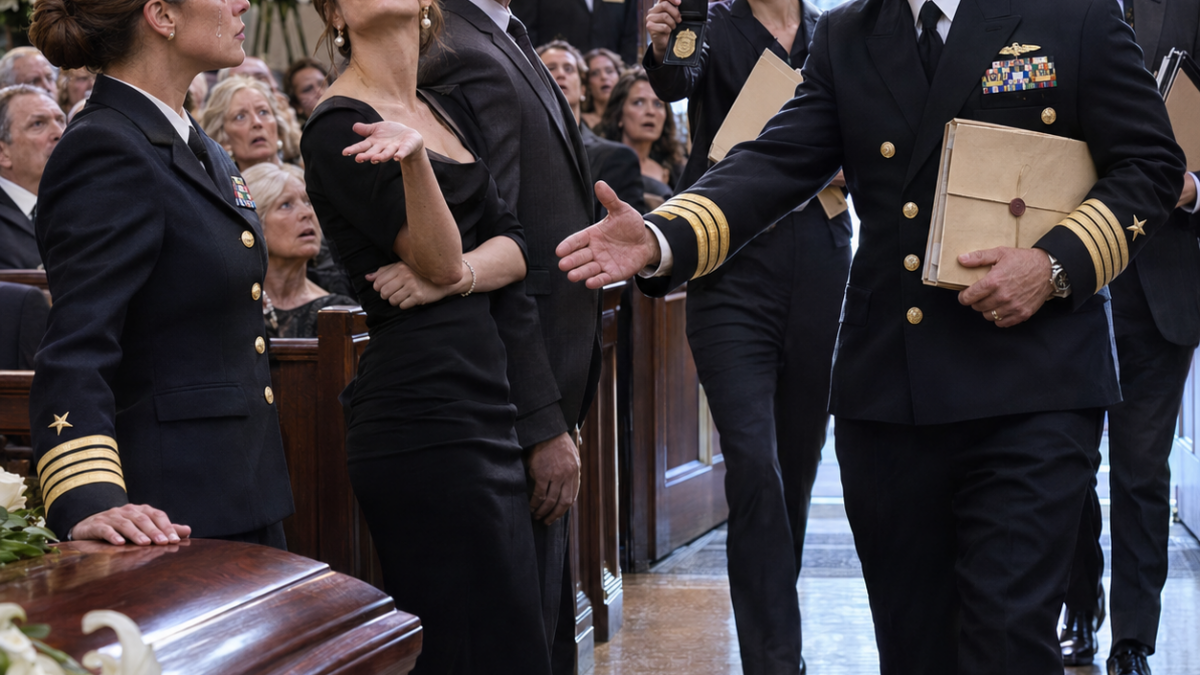
The heavy double doors opened.
Rear Admiral Nathaniel Hale entered first.
He was six feet two, silver beginning at his temples, full dress uniform immaculate.
Behind him walked Special Agent Marisol Vega of NCIS and Treasury investigator David Kline.
Two other federal officers remained near the entrance.
The room went silent.
Not gradually.
Instantly.
Isabella’s fingers opened.
Her champagne glass hit the marble floor.
Crack.
Crystal scattered around her shoes.
Julian stepped backward.
Once.
Twice.
His spine struck Dad’s casket.
The sound was dull but unmistakable.
Every retired officer within twenty feet turned toward him.
Julian immediately stepped away.
“Sorry.”
His voice was barely audible.
Then his eyes locked onto Nathan.
Color drained from his face.
“Sir…”
Nathan looked at me before he looked at anyone else.
He crossed the room.
I met him halfway.
He took my hand.
No theatrical embrace.
No grand announcement.
Just the steady pressure of his fingers around mine.
“You okay?” he whispered.
I looked toward Dad’s casket.
“No.”
Nathan’s expression softened.
“But I’m standing.”
“You always are.”
He raised my hand and kissed my knuckles.
Behind me, someone gasped.
Probably Aunt Teresa.
Nathan finally looked toward Julian.
“Mr. Vance.”
Julian swallowed.
“Admiral Hale.”
His eyes moved toward Vega.
Then Kline.
Then back to Nathan.
“What are you doing here?”
Nathan glanced toward the casket.
“My father-in-law died.”
The phrase landed like artillery.
Isabella’s face changed first.
She looked at Nathan’s wedding ring.
Then at me.
“You’re married?”
“Yes.”
“When?”
“Eleven months ago.”
Her expression became offended.
“You never told me.”
I almost laughed.
Instead I said quietly:
“You slept with my fiancé, married him, and spent four years turning my life into one of your favorite jokes.”
Her lips tightened.
“You stopped qualifying for personal updates.”
A few relatives looked away to hide their expressions.
Julian did not.
He wasn’t looking at Isabella anymore.
He was watching Special Agent Vega.
She stepped forward.
“Mr. Vance.”
Julian straightened instinctively.
“This is neither the place nor the time for a detailed conversation, but there are legal matters requiring your attention after the service.”
His face went gray.
“What kind of legal matters?”
“You may have counsel present.”
That answer traveled through the room faster than gossip.
Several business executives stopped pretending not to listen.
One man who had spent forty minutes laughing at Julian’s yacht stories quietly took two steps away.
Then another.
Power often leaves silently.
Isabella looked at Julian.
“What does she mean?”
He didn’t answer.
“Julian.”
“Later.”
“What legal matters?”
He lowered his voice.
“Not now.”
Wrong answer.
Isabella’s eyes narrowed.
“You told me the refinancing was done.”
Julian’s jaw tightened.
Every banker and corporate attorney within earshot suddenly became very interested.
“Bella.”
“You said the exposure was handled.”
Julian stared at her.
“Stop talking.”
Then another voice came from the entrance.
“What exposure?”
Victor Vance had arrived.
Julian’s father.
Seventy-one.
Silver-haired.
Tailored charcoal suit.
A man who had built Vance Maritime Logistics from a small coastal freight company into what looked, from the outside, like a serious maritime enterprise.
Victor saw Nathan.
Then the investigators.
Then Julian.
His expression changed almost imperceptibly.
But unlike his son, Victor understood danger quickly.
“Julian.”
“Dad.”
Victor approached.
His voice dropped.
“What did you do?”
Julian glanced around.
“Nothing.”
Victor looked at Vega.
“Agent.”
“Mr. Vance.”
“I assume counsel has been contacted.”
“Yes.”
Victor closed his eyes for half a second.
Julian whispered:
“Dad.”
Victor turned.
“You told me the exposure was contained.”
The sentence escaped before he could stop it.
Half the room heard.
Isabella definitely did.
“What exposure?”
Victor’s mouth closed.
She looked at Julian.
“What exposure?”
Nobody answered.
Her voice rose.
“WHAT EXPOSURE?”
Dad’s funeral director appeared at the side of the room looking as though he wanted to disappear into the wall.
I closed my eyes.
And suddenly I heard Dad’s voice from nine days earlier.
Weak.
Amused.
Don’t let Isabella turn my funeral into theater.
Then his second sentence.
If consequences happen to arrive there on their own, that’s different.
I almost smiled.
Instead, I stepped forward.
“Enough.”
My voice wasn’t loud.
It didn’t need to be.
Everyone stopped.
I looked at Victor.
Julian.
Isabella.
Then toward my father’s casket.
“You can tear each other apart later.”
No one spoke.
“My father spent thirty-six years serving his country.”
I swallowed.
“He gets the next hour.”
Vega nodded.
“Of course.”
Nathan squeezed my hand.
And, surprisingly, Isabella lowered her eyes.
The funeral began.
I delivered Dad’s eulogy twenty minutes later.
Standing behind the lectern was harder than any operational briefing I’d ever given.
Briefings require facts.
Funerals require accepting a fact you desperately want to reverse.
I looked toward the flag draped near Dad’s casket.
Then at the audience.
“My father hated long speeches.”
Soft laughter.
“So naturally, he gave them constantly.”
More laughter.
I smiled.
“He taught me knots before multiplication.”
A retired captain nodded.
“He taught me that the ocean punishes arrogance faster than any superior officer can.”
Julian lowered his eyes.
I hadn’t written the line for him.
That made it better.
“He taught me rank is temporary.”
I looked around the room.
“Money is temporary.”
Victor Vance stared at the floor.
“Reputation can be temporary.”
Isabella went still.
“But your word…”
I paused.
“Your word follows people after you leave the room.”
Silence.
“My father believed integrity wasn’t what you said when everyone was watching.”
My voice tightened.
“It was what remained when nobody was.”
Then I looked at Dad.
The man who had taught me to drive.
To sail.
To stand at attention.
To stop apologizing for wanting a career.
“I hope people don’t remember Admiral Thomas Morales because of the stars he wore.”
I swallowed.
“I hope they remember that when he promised to show up…”
My voice broke.
Nathan’s eyes filled.
“He showed up.”
That was the only time I cried during the eulogy.
When I returned to my seat, Nathan stood.
Not because I needed rescue.
Because he knew I wanted his hand.
I took it.
Across the aisle, Isabella watched us.
There was no smirk now.
Only confusion.
Maybe because she had always thought love had to be performed.
Nathan never performed.
He simply stayed.
Four years earlier, I had believed Julian was capable of the same thing.
I had been wrong.
The night I discovered the affair began with Thai food.
I had returned to San Diego after three weeks aboard a military transport vessel conducting tactical readiness evaluations.
I was exhausted.
My shoulders hurt.
Salt had dried into the seams of my fatigues.
But I was happy.
Julian and I were six months from our wedding.
I hadn’t seen him in twenty-three days.
Instead of going home, I stopped at his favorite restaurant and bought dinner.
I remember being excited.
That part embarrasses me now.
Not because loving him was embarrassing.
Because I can still remember how safe I thought I was.
Vance Maritime’s lobby was almost empty when I arrived.
Most employees had gone.
I took the private elevator to the executive floor.
When the doors opened, Leo Vance was standing outside Julian’s office.
Julian’s younger brother looked terrible.
Sweat at his temples.
Hands clenched.
Back pressed against the wall.
“Leo?”
His eyes widened.
“Emma.”
“What happened?”
“Nothing.”
He looked toward Julian’s closed office.
Then back to me.
“Maybe call him.”
I stared.
“I’m twenty feet away.”
“Emma…”
Then I smelled jasmine.
Isabella.
My stomach dropped.
I heard Julian’s voice through the door.
“Let her stay on those floating tin cans, Bella. Emma has the feminine warmth of a steel bulkhead.”
Isabella laughed.
A high, pleased sound.
“Well, some women are meant to command ships.”
A pause.
“And some of us are meant to be worshiped in king-sized beds.”
The takeout bag dug into my fingers.
Leo whispered:
“Please don’t go in.”
I looked at him.
“Why?”
His face answered before his mouth did.
I pushed open the door.
The bag fell.
Dark sauce spilled across an antique Persian rug.
I didn’t look down.
Isabella was stretched across Julian’s leather sofa.
Bare shoulders.
Bare legs.
And wrapped around her body was my ceremonial naval bridge coat.
Midnight wool.
Gold buttons.
MORALES embroidered across the chest.
My coat.
I had worn it through one of the most dangerous deployments of my career.
Now my sister was using it as a blanket after sleeping with my fiancé.
“Oh,” she said.
No shame.
Only irritation.
“Emma.”
Julian jumped up.
His shirt was open.
His face was pale.
“Wait.”
I stared.
“This isn’t what it looks like.”
I looked at him.
Then Isabella.
Then at his unbuttoned shirt.
“You’re both half naked.”
He opened his mouth.
I held up one hand.
He stopped.
Isabella rolled her eyes.
“Please don’t turn this into one of your interrogations.”
I removed my engagement ring.
Platinum.
Large diamond.
A ring Julian chose because subtlety had never interested him.
I placed it on the glass coffee table.
Ping.
One small sound.
Then I turned toward the door.
Leo spoke behind me.
“If you walk out, the defense contract dies.”
I stopped.
Vance Maritime had spent years pursuing a logistics subcontract connected to Navy support operations.
I’d always maintained strict separation.
Julian had repeatedly asked me for introductions.
I repeatedly refused.
I turned.
“That’s not my problem.”
Leo swallowed.
Then said:
“Don’t you want to know who arranged tonight?”
Isabella sat upright.
“Leo.”
Julian snapped:
“Shut up.”
I looked at Leo.
“What does he mean?”
He stared toward the photograph behind Julian’s desk.
Julian and Victor.
Then whispered:
“My father.”
I almost laughed.
“Victor arranged for my sister to sleep with Julian?”
“No.”
Leo rubbed his face.
“But he wanted Julian to end the engagement.”
Isabella stood.
My coat slid from her shoulders.
She caught it.
Then smiled at me.
“Do you really want the humiliating version?”
“I’ve already seen enough.”
“No.”
She pulled my coat tighter.
“You haven’t.”
Julian said:
“Bella.”
She ignored him.
“Victor liked you when you were useful.”
My chest tightened.
“Your name.”
She touched the embroidered MORALES on my coat.
“Your father.”
Then my rank.
“Your access.”
Julian closed his eyes.
I looked at him.
“You asked me to introduce Victor to Admiral Hayes.”
Silence.
“Twice.”
Julian looked away.
“I refused.”
Isabella smiled.
“Exactly.”
Leo continued quietly.
“Dad thought the company could benefit from the relationship.”
I stared at him.
“And when I wouldn’t misuse my position?”
“He decided Julian needed a different future.”
Isabella laughed.
“A more cooperative one.”
I looked at her.
“You?”
She smiled.
“I’m not bound by military ethics.”
That sentence told me more about her than anything else.
Julian stepped toward me.
“Emma, I loved you.”
I looked at him.
“Did you?”
“Yes.”
“Then why is my sister wearing my coat?”
He had no answer.
I walked toward Isabella.
She raised her chin.
I held out my hand.
“My coat.”
“What?”
“Take it off.”
“Emma—”
“My coat.”
Something in my voice finally reached her.
She pulled it from her shoulders.
Then threw it at me.
I caught it.
Folded it.
Placed it over my arm.
And looked at Julian.
“Our engagement is over.”
He stepped forward.
“Don’t make decisions while you’re angry.”
I almost laughed.
“This is the clearest I’ve felt in years.”
I walked out.
Leo followed me to the elevator.
Before the doors closed, he said:
“I’m sorry.”
I looked at him.
“Did you know?”
He didn’t answer.
That was enough.
Dad met me at the airport the next morning.
I hadn’t called him.
Leo had.
Dad stood near baggage claim wearing khakis and an old Navy sweatshirt.
The moment I saw him, everything I’d held together collapsed.
He opened his arms.
I walked into them.
And sobbed.
Not Commander Morales.
Not the officer who had stood watch through storms and casualty alarms.
Just Emma.
His daughter.
“I was so stupid.”
Dad pulled back.
“Never say that.”
“I trusted him.”
“That isn’t stupidity.”
“I should’ve known.”
Dad’s face hardened.
“He should’ve been worthy of being known.”
I stared.
He wiped one tear from my cheek.
“Don’t turn his lack of character into evidence against yours.”
That sentence probably saved me months of self-hatred.
Maybe years.
Julian called.
Isabella called more.
Victor called Dad.
That conversation ended any remaining possibility of civility between the two families.
Victor didn’t apologize for his son’s betrayal.
He asked whether “the unfortunate personal situation” would affect professional relationships.
Dad told him:
“My daughter isn’t a procurement route, Victor.”
Then hung up.
Within six months, Julian married Isabella.
A massive wedding.
Three hundred guests.
Magazine photographs.
A yacht reception.
Someone emailed me pictures.
I deleted them.
I was aboard a ship in the Pacific when they married.
For the first month, I cried more than I’d like to admit.
Then something happened.
Work continued.
The ocean didn’t care that Julian had married my sister.
My sailors still needed decisions.
My command still needed me.
Morning still arrived.
The world didn’t end because the future I’d imagined disappeared.
Slowly, I stopped checking whether Isabella had posted another photograph.
Stopped wondering whether Julian missed me.
Stopped trying to understand why I hadn’t been “enough.”
Then I met Nathaniel Hale.
Nathan was a captain then.
He wasn’t charming like Julian.
Thank God.
He was direct.
Occasionally irritating.
Almost impossible to impress.
We met during a maritime readiness review.
I was briefing a room full of senior officers about maintenance-cycle risk.
Nathan interrupted me.
“I disagree with your projection.”
I looked at his rank.
Then at him.
“With respect, sir, you’re wrong.”
The room went dead.
Nathan asked why.
I showed him.
Numbers.
Maintenance data.
Operational history.
He argued.
I argued back.
Twenty minutes later, he conceded.
After the briefing, I assumed I’d damaged my career.
Instead, he found me near a vending machine.
“Commander Morales.”
“Sir.”
“You were right.”
I stared.
“About?”
“The maintenance model.”
“I know.”
He laughed.
I wasn’t trying to be funny.
That made him laugh harder.
Two weeks later, he asked me for coffee.
Months later, dinner.
He never treated my career as competition.
If I deployed, he understood.
If he disappeared into classified work for weeks, I understood.
We could be independent without using independence as proof that the other person didn’t care.
That was new.
When I finally told him about Julian, he listened.
Then asked:
“Do you still love him?”
I thought about it.
“No.”
Nathan nodded.
“Good.”
I frowned.
“That’s it?”
“No.”
“What else?”
“I was going to ask you to dinner again, and I prefer not competing with ghosts.”
I laughed.
Three years after Julian left me, Nathan proposed.
Not at a restaurant.
Not in front of an audience.
We were standing on a pier after a retirement ceremony.
The sun was going down.
Nathan took a small ring from his pocket.
Simple platinum.
“Emma Morales.”
“That sounds ominous.”
“You terrify half the people I work with.”
“Very romantic.”
“I’m not finished.”
I waited.
“You’re the bravest person I know who still thinks courage means never needing anybody.”
My smile disappeared.
He took my hand.
“I don’t want you smaller.”
My throat tightened.
“I don’t need you less capable.”
He opened the box.
“I just want to be the person you don’t have to be capable around every second.”
I cried.
Then laughed because I was crying.
Then said yes.
We married quietly.
Dad attended.
Nathan’s sister.
Two friends.
No magazine photographs.
No giant guest list.
No business alliances.
No one was networking.
It was the happiest wedding I had ever attended.
Even though it was mine.
I never told Isabella.
Not out of revenge.
She simply wasn’t part of my life anymore.
While Nathan and I built something real, the Vance empire began decomposing.
Slowly.
From inside.
Leo contacted me two years after the affair.
One email.
I need to talk. This isn’t about Julian cheating. The company is in trouble, and I think people are lying to federal clients.
He attached several documents.
Invoices.
Internal spreadsheets.
Payment schedules.
I did not forward them to Nathan.
That distinction matters.
I wasn’t going to use my husband or my own career to settle anything with the Vances.
I consulted counsel.
Leo was directed toward proper reporting channels.
Nathan recused himself from matters intersecting his responsibilities.
Investigators took over.
NCIS.
Financial specialists.
Treasury investigators.
Auditors.
The process moved slowly.
Julian didn’t notice because arrogant people expect danger to knock loudly.
Sometimes it doesn’t.
Sometimes danger arrives as a request for records.
Then a subpoena.
Then another.
Then a bank starts asking questions.
Dad was diagnosed with cancer during the fourth year.
Everything else stopped mattering.
I flew home whenever duty allowed.
Nathan came when he could.
Dad liked him.
Which, for Dad, meant he insulted him slightly less than most people.
One night at the hospital, Dad looked at me.
“You finally picked a man who doesn’t need to beat you at something.”
I smiled.
“Nathan outranks me.”
“Exactly.”
He closed his eyes.
Then opened them again.
“You’re happy?”
“Yes.”
“Good.”
His breathing was weaker by then.
I held his hand.
“I wish I’d told Isabella.”
“About your marriage?”
“Yes.”
Dad shrugged.
“Why?”
“She’s my sister.”
“Biologically.”
I laughed.
“Dad.”
He smiled.
Then became serious.
“Don’t let her turn my funeral into theater.”
“I won’t.”
His mouth twitched.
“And if Julian’s business problems happen to explode that week…”
I stared.
Dad knew a limited amount because investigators had interviewed him regarding old professional contacts.
He whispered:
“That would merely be unfortunate timing.”
I laughed so loudly the nurse came in.
Dad died nine days later.
After the funeral service, the federal matter resumed.
At 4:17 p.m., Special Agent Vega approached Julian outside.
Professional.
Quiet.
His attorney was already available by phone.
She handed him court documents involving preservation orders and restraints on certain assets and accounts tied to the investigation.
No one tackled him.
No handcuffs beside Dad’s grave.
Real consequences are often more humiliating than theatrical ones.
Julian stood in an expensive suit reading legal paperwork while businessmen who’d praised him an hour earlier slowly found reasons to leave.
Isabella saw the first page.
“Six million?”
Julian folded it.
“Give me that.”
She pulled it away.
“What six million dollars?”
“Bella.”
“You told me the refinancing was complete.”
“It is complicated.”
She laughed.
A sharp sound.
“The yacht.”
Julian’s face changed.
“What about it?”
“Is it ours?”
“It’s held through an entity.”
“That isn’t what I asked.”
He lowered his voice.
“It’s leased.”
Isabella stared.
“The Miami apartment?”
“Collateral.”
Her mouth opened.
“The Southampton property?”
Silence.
She took one step backward.
For four years, Isabella had built her identity around winning a life that never actually existed.
She looked at me.
“You knew.”
“I knew investigators believed the finances were far worse than you thought.”
“And you let me stay married to him?”
I stared.
“Isabella.”
She flinched at my tone.
“You slept with my fiancé.”
Her face tightened.
“You married him.”
I continued.
“You spent four years telling everyone you had taken the better life.”
Several relatives were listening.
“At what point was I supposed to become your financial adviser?”
Her eyes filled.
“You could’ve warned me.”
“Would you have believed me?”
Silence.
That was answer enough.
Then Julian exploded.
“You’ve been waiting for this.”
I looked at him.
“For what?”
“To watch me fall.”
“No.”
“You hate me.”
“I hated you for about six months.”
He stared.
“Then I went back to work.”
His face tightened.
“I built a life.”
I looked at Nathan.
“I fell in love.”
Then back at Julian.
“And eventually you became a story I stopped telling.”
That hurt him more than anger would have.
“You think marrying Hale makes you better than me?”
“No.”
I looked at the legal papers in his hands.
“What made me better off was not marrying you.”
One of the relatives behind us coughed to hide a laugh.
Julian’s face reddened.
“You always thought you were superior.”
“No.”
I stepped slightly closer.
“You needed me to think I was inferior.”
Silence.
“You called discipline coldness.”
I glanced toward Isabella.
“You both did.”
Then back to Julian.
“You mocked the part of me you couldn’t control.”
His jaw tightened.
“And when I wouldn’t use my position to help your company, you found someone who would tell you whatever made you feel powerful.”
Julian stared.
I smiled faintly.
“People finally started asking questions, Julian.”
Then I stepped away.
“There is nothing personal about the answers.”
Isabella started crying.
Not the pretty tears she used when she wanted attention.
Real ones.
She looked toward Nathan.
Then me.
“So that’s it?”
“What?”
“You get him.”
She pointed toward Nathan.
“Rank. Respect. Perfect marriage.”
I shook my head.
“You still don’t understand.”
Her face twisted.
“You married a rear admiral.”
“I married Nathan.”
“Same thing.”
“No.”
I looked at Julian.
“You married Julian’s life.”
Her mouth tightened.
“The Vance name.”
She went still.
“The yacht.”
A tear moved down her cheek.
“The parties.”
Another.
“You wanted to win.”
She looked at me.
“And somewhere along the way, Isabella, you forgot to ask whether the prize was worth having.”
She turned toward Julian.
For one second something passed between them.
Recognition.
Not love.
I softened.
“You didn’t steal a great man from me.”
She looked back.
“You exposed a bad one.”
Then I stopped.
Because cruelty after victory would have made me more like the people I’d spent years escaping.
Leo approached me later at the cemetery.
He looked older.
Tired.
Nathan stayed nearby but gave us space.
“Emma.”
“Leo.”
“I’m sorry about your dad.”
“Thank you.”
He shoved his hands into his pockets.
Then said:
“There’s something you still don’t know.”
I almost laughed.
“I’ve had enough revelations today.”
“I know.”
He looked toward Isabella.
“She contacted my father first.”
I stopped.
“What?”
“Before the affair.”
“How long?”
“Months.”
My stomach tightened.
“Why?”
“She wanted Julian.”
“That much is obvious.”
Leo shook his head.
“There was more.”
I waited.
“She believed your father was leaving you most of his maritime investments.”
I stared.
“How would she know that?”
“She told Dad she’d seen estate documents.”
My pulse changed.
“Dad never gave her his estate plan.”
“Maybe she saw something she wasn’t supposed to.”
I thought about Isabella.
Always opening drawers.
Reading mail.
Treating privacy like a challenge.
Leo continued.
“My father was worried losing you meant losing the connection to Admiral Morales.”
Understanding arrived slowly.
Ugly.
“So Isabella offered him another Morales daughter.”
Leo looked ashamed.
“Yes.”
I almost laughed.
“Did Julian know?”
“Some of it.”
“Enough?”
Leo looked toward his brother.
“Enough to choose.”
That was all I needed.
Dad’s estate meeting happened two weeks later.
Isabella arrived with two lawyers.
Her marriage was already collapsing.
Julian had moved into a hotel.
Several accounts remained restricted.
Photos of yachts, Miami and champagne had vanished from Isabella’s social media.
Mara Klein, Dad’s estate attorney, sat at the head of the table.
She explained the estate.
Dad was wealthy.
But not remotely the fantasy Victor and Isabella had apparently created.
A residence.
Investment accounts.
Retirement assets.
A minority interest in a maritime consultancy.
Several trusts.
Charitable gifts.
A veterans’ education fund.
Then Mara reached the family trust.
“Admiral Morales amended this three years ago.”
Isabella leaned forward.
“After Emma turned him against Julian?”
Mara looked at her.
“No.”
Isabella blinked.
“Your father documented concerns regarding creditor exposure and outside commercial interests.”
Her face changed.
Mara continued.
“Your share is held within a protected trust. It provides income, with principal distributions controlled by an independent trustee.”
Isabella stared.
“So I don’t control it?”
“Not completely.”
“Why?”
“Because your father did not want trust assets pledged as collateral for another person’s business obligations.”
Silence.
Isabella’s face went white.
“What does Emma receive?”
Mara looked toward me.
I genuinely didn’t know.
“Commander Morales receives the family residence, certain investment holdings and a larger protected interest.”
Isabella slammed one hand onto the table.
“Of course.”
Mara remained calm.
“Your father left written explanations.”
Isabella laughed bitterly.
“Perfect Emma wins again.”
I looked at her.
“No.”
She stared.
“Dad protected you.”
Her expression hardened.
“By controlling my inheritance?”
“By keeping Julian from taking it.”
Mara nodded.
“Your sister’s characterization is substantially correct.”
Isabella lowered her eyes.
For the first time since the funeral, she seemed to understand something.
Dad hadn’t simply favored one daughter.
He had seen danger Isabella refused to see.
Her voice became very small.
“He knew?”
Mara answered carefully.
“He had concerns.”
Then she handed each of us a letter.
Isabella left before opening hers.
I remained.
Dad’s letter was four pages.
Nathan sat beside me at home while I read it.
Emma,
I watched you confuse endurance with strength for too many years.
My throat tightened.
The Navy taught you how to survive pressure. Sometimes I worry you believe surviving something means you owe it the rest of your life.
I stopped.
Nathan squeezed my hand.
Julian failed you. Isabella failed you. Do not spend the rest of your life allowing their failure to become your identity.
Tears blurred the page.
Then:
Nathan is a good man.
Nathan smiled smugly.
I continued.
Irritatingly good.
His smile disappeared.
I laughed through tears.
“He liked me.”
“Apparently with reservations.”
I kept reading.
He does not dim when you shine. Keep that.
Nathan looked away.
His eyes were wet.
Then came the line that broke me.
You were never cold, Emma.
I covered my mouth.
You simply learned early that some people treat warmth as something they are entitled to consume.
I cried.
Give it where it is protected.
Love, Dad.
Nathan held me.
That night, for the first time since the funeral, I stopped thinking about Julian.
Stopped thinking about Isabella.
Stopped thinking about federal investigations.
I cried because my father was dead.
Nothing more complicated than that.
The Vance investigation lasted another fourteen months.
Financial cases are slow because reality is made from documents, not dramatic speeches.
Investigators examined invoices.
Bank transfers.
Government representations.
Related-party transactions.
Loan files.
Some conduct turned out to be reckless rather than criminal.
Other conduct did not.
Leo cooperated.
Victor fought almost everything.
Julian initially blamed employees.
Then circumstances.
Then his father.
Eventually, faced with the evidence, he entered guilty pleas related to several financial offenses rather than take every allegation to trial.
Vance Maritime entered court-supervised restructuring.
Assets were sold.
Creditors fought over proceeds.
The yacht disappeared.
The Miami apartment went.
The Southampton property was sold.
Victor was removed from operational control and faced separate civil consequences associated with the company’s misconduct.
The empire that had impressed my sister became spreadsheets divided among lawyers.
Nathan and I played no role in deciding guilt or punishment.
That mattered.
I would never turn my uniform into the weapon Victor had always hoped it could become.
Julian destroyed himself without my help.
Isabella filed for divorce before his criminal case ended.
She called me the night before.
I almost didn’t answer.
Then I did.
“Emma.”
Her voice sounded exhausted.
“What do you want?”
Silence.
Then:
“Were you happy at Dad’s funeral?”
I frowned.
“What?”
“When everything fell apart.”
I thought.
“No.”
“Don’t lie.”
“I’m not.”
She laughed bitterly.
“I would’ve been.”
“I know.”
That hurt her.
I heard it.
She began crying.
“I thought I won.”
I sat down.
“Won what?”
“Julian.”
I closed my eyes.
“Isabella.”
“I had the husband.”
“You had a husband.”
“The house.”
“Not really.”
“The yacht.”
“Also not really.”
She almost laughed.
Then cried harder.
“The life.”
I waited.
Finally I asked:
“Was it a good life?”
Long silence.
“No.”
I leaned back.
She whispered:
“He was lying to me before the wedding.”
“Yes.”
“I thought he only lied to you.”
That sentence nearly made me pity her.
Then she asked:
“Why didn’t you warn me?”
I answered gently this time.
“Because you would have assumed every warning was jealousy.”
She cried.
“Yes.”
“I couldn’t save someone who needed my failure to prove her success.”
Silence.
Then Isabella said something I hadn’t expected.
“I hated you.”
“I know.”
“No.”
Her breathing shook.
“I hated that Dad respected you.”
My chest tightened.
“I hated how people looked at you.”
“How?”
“Like you mattered.”
I stared at the wall.
She continued.
“When I walked into a room, people looked at me.”
Her voice broke.
“When you walked into a room, people listened.”
There it was.
The wound underneath everything.
Not Julian.
Not flowers.
Not Dad’s estate.
Isabella had spent her life being admired and envying the people who were respected.
I whispered:
“You could have built your own life.”
“I know.”
“Instead, you tried to take mine.”
She sobbed.
“Yes.”
For the first time in four years, my sister told me the truth without decorating it.
Then she asked:
“Can you forgive me?”
I closed my eyes.
“I don’t know.”
She cried harder.
“But I don’t want to hate you forever.”
Silence.
“That is all I can honestly give you.”
She whispered:
“Okay.”
Two months later, a package arrived.
Inside was my old ceremonial bridge coat.
The one Isabella had worn in Julian’s office.
Dry-cleaned.
Repaired.
Folded perfectly.
A note rested on top.
I had no right to wear this.
I had no right to take something that belonged to you and call it winning.
I’m sorry.
I ran my fingers across the embroidered name.
MORALES.
Nathan found me sitting with the coat.
“That one?”
“Yes.”
He didn’t touch it.
“What are you going to do?”
Four years earlier I might have burned it.
Instead I smiled.
“Keep it.”
Nathan nodded.
“She doesn’t get to ruin my coat.”
He smiled.
“Exactly.”
Isabella and I did not magically become close.
Some damage should not be erased merely because an apology finally arrives.
But we started speaking.
Occasional phone calls.
Dad’s birthday.
Christmas.
Coffee.
She began therapy.
Found a job managing events for a nonprofit organization.
Moved into a modest apartment.
Opened an account in her own name.
For the first time in her adult life, she paid bills with money she had earned.
She stopped using the Vance name professionally.
The first time we met for coffee after the divorce became final, I noticed something.
No jasmine.
She caught me noticing.
“I threw it away.”
“All of it?”
“Every bottle.”
I smiled.
“Probably good for public health.”
She laughed.
A real laugh.
Not the breathless performance she’d used around Julian.
We both noticed.
Neither mentioned it.
Leo moved to Oregon after the Vance restructuring.
His cooperation cost him relationships and professional standing, but he built a quieter life with a regional shipping company.
He mailed me a Christmas card once.
You were right to leave that office. I wish I had been brave enough to tell the truth sooner.
I wrote back only four words.
Be brave from now on.
That was enough.
Nathan eventually retired from active duty.
I stayed.
Two years later, I was promoted to captain.
At my promotion ceremony, Nathan pinned one insignia.
I asked Isabella to pin the other.
She stared at me.
“You’re joking.”
“No.”
“Emma.”
“Yes?”
“Why me?”
I thought about it.
“Because I don’t want the woman you were at Dad’s funeral standing beside me.”
Her face fell.
Then I continued.
“I want the woman you chose to become afterward.”
Her eyes filled.
“I don’t deserve that.”
“Maybe not.”
She almost laughed through tears.
I handed her the insignia.
“But growth isn’t about earning permission to change.”
She cried before the ceremony started.
I pretended not to see.
Someone took a photograph afterward.
Me in uniform.
Captain’s insignia.
Nathan on my right.
Isabella on my left.
When the photograph arrived, I stared at it for a long time.
I remembered Dad’s funeral.
The shattered glass.
Julian backing into the casket.
Isabella staring at Nathan.
Federal investigators near the doors.
For years, I imagined a photograph like this would feel like victory.
It didn’t.
It felt better.
It felt like distance.
The old wound existed.
But I no longer lived inside it.
Julian wrote me once.
Years after his sentencing.
The letter reached me through proper channels.
I almost threw it away.
Curiosity won.
Emma,
I have had years to understand what I destroyed.
I rolled my eyes.
Nathan looked over.
“Good start?”
“Apparently prison encourages dramatic openings.”
I continued.
Julian wrote about Victor.
Debt.
Pressure.
Isabella.
Then finally:
None of those things made the decision for me.
I stopped.
That sentence mattered.
I chose the easiest person to become instead of the decent one.
I kept reading.
I was jealous of you.
That surprised me.
You had a career you earned. Your father’s respect. A sense of purpose. I looked successful, but I knew how much of my life depended on my father’s money and on other people believing I was successful.
I sat quietly.
Then:
When Isabella treated me like a prize, I chose the feeling over the truth.
At the bottom:
I am sorry.
I folded the letter.
Nathan asked:
“Are you answering?”
“No.”
“Why not?”
“Because he finally understands.”
Nathan waited.
“That doesn’t create a responsibility for me.”
He smiled.
“Captain Morales has boundaries.”
“She learned them the expensive way.”
I never saw Julian again.
The last image I had of him in person remained Dad’s funeral.
Gray-faced.
Papers shaking slightly in his hand.
Asking Nathan:
“Sir… what are you doing here?”
People who eventually heard the story loved that moment.
They thought Nathan was my revenge.
He wasn’t.
Nathan was my husband.
They thought the investigation was my revenge.
It wasn’t.
The investigation existed because Julian and his family had made business decisions with consequences.
They thought Dad’s estate plan was revenge against Isabella.
It wasn’t.
It was a father protecting his assets from risks his daughter refused to see.
My revenge—if anyone insists on using that word—was much quieter.
I became happy.
Without Julian.
Without his money.
Without Isabella’s approval.
Without needing anyone who betrayed me to suffer before I could feel whole.
Three years after Dad’s funeral, Nathan and I visited his grave on his birthday.
The Chesapeake wind was sharp.
I placed a Navy challenge coin against the stone.
Nathan frowned.
“Your father would call that wasteful.”
“I know.”
“He’d tell you to pick it up.”
“I know.”
We laughed.
Then I touched Dad’s name.
Admiral Thomas Rafael Morales.
I whispered:
“You were right.”
Nathan stood beside me.
“I wasn’t cold.”
The wind moved through the trees.
I remembered Isabella beside the casket.
No man wants a cold soldier.
I remembered Julian in his office.
Emma has all the warmth of a steel bulkhead.
Both had been wrong.
I had never lacked warmth.
I had simply given too much of it to people who treated access as entitlement.
Nathan took my hand.
We stood there quietly.
No cameras.
No speeches.
No one to impress.
Just love.
The real kind.
Years later, at a Navy charity dinner, a young lieutenant approached me.
“Captain Morales?”
“Yes?”
She looked nervous.
“I heard you speak at the leadership conference.”
“I hope I didn’t put you to sleep.”
“No, ma’am.”
She hesitated.
Then said:
“My fiancé says my deployments prove I don’t care enough about building a family.”
My chest tightened.
She looked down.
“He says maybe I’m too cold.”
For a moment I saw myself four years before the funeral.
Exhausted.
Engaged.
Apologizing for loving the career I’d worked years to earn.
I asked:
“Does he respect what you do?”
She hesitated.
That was enough.
I said:
“Love may ask for compromise.”
She nodded.
“It may ask for difficult conversations.”
Another nod.
“But love should not require contempt.”
Her eyes filled.
I touched her arm.
“Anyone who needs to insult your strength before asking for your softness has not earned access to either.”
She swallowed.
“Thank you, ma’am.”
She left.
Nathan appeared beside me carrying water.
“What did you say to that lieutenant?”
“Nothing.”
“You had your captain face.”
“I do not have a captain face.”
“You absolutely do.”
I laughed.
On the fifth anniversary of Dad’s death, Isabella joined Nathan and me at the cemetery.
That was new.
She brought no flowers.
Dad hated cut flowers.
Instead she carried a small photograph.
Dad with both of us as children.
Emma at twelve.
Isabella at nine.
All three of us sunburned after a sailing trip.
She placed it beside the headstone.
“I was awful to him near the end.”
I looked at her.
“You were angry.”
“I was selfish.”
“Yes.”
She smiled sadly.
“You’ve gotten less diplomatic.”
“Promotion.”
She laughed.
Then became quiet.
“Did he hate me?”
“No.”
“How do you know?”
“Because I asked.”
Her eyes widened.
“When?”
“Hospital.”
She stared.
“What did he say?”
I remembered.
Dad lying beneath a thin blanket.
Breathing slowly.
Me asking whether he wanted me to call Isabella.
His answer:
She’s still my daughter even when she’s being an idiot.
I smiled.
“He said you were still his daughter.”
Isabella started crying.
I let her.
After a while she whispered:
“I wish I’d come sooner.”
“I know.”
“I thought there’d be more time.”
“So did I.”
She reached for my hand.
For a second I hesitated.
Then took hers.
Forgiveness had never arrived as one giant decision.
It came in tiny pieces.
A returned coat.
A coffee.
A truthful apology.
A promotion ceremony.
A hand beside Dad’s grave.
Enough pieces eventually began to resemble something new.
Not the sisterhood we’d had before.
Something more honest.
Nathan and I retired near the Chesapeake several years later.
One evening we sat on the porch while a storm built offshore.
Dark clouds.
Silver water.
Wind moving through the trees.
He handed me coffee.
“You’re thinking about the funeral.”
I looked at him.
“How do you know?”
“You get the same face every time.”
“What face?”
“The one where you’re trying not to laugh about me walking through the doors.”
I smiled.
“You did enter like you were invading a hostile country.”
“I walked normally.”
“You were in full dress uniform with federal investigators behind you.”
“Your father was an admiral.”
“The doors practically exploded.”
“That was the funeral director.”
“You scared Julian into Dad’s casket.”
Nathan tried to remain serious.
Failed.
“That part was mildly satisfying.”
I laughed until coffee spilled onto my hand.
Then leaned against his shoulder.
After a while he asked:
“Do you ever wish none of it happened?”
I knew what he meant.
Julian.
Isabella.
The affair.
I thought for a long time.
“I wish they hadn’t hurt me.”
Nathan waited.
“But I don’t wish I married Julian.”
“That seems healthy.”
I smiled.
“If he had stayed faithful six more months, I probably would have.”
Nathan’s expression changed.
“Unpleasant thought.”
“Exactly.”
I looked at the water.
“I might’ve spent years defending him.”
“Maybe.”
“Explaining him.”
“Probably.”
“Protecting his debt.”
Nathan nodded.
“And doubting myself.”
He took my hand.
“But you didn’t.”
“No.”
The storm moved closer.
I smiled.
“Isabella thought she stole my future.”
Nathan kissed my temple.
“She had poor strategic awareness.”
I laughed.
Sometimes I still think about that first engagement ring.
The one I placed on Julian’s glass table.
Ping.
I used to believe the important moment came four years later.
Dad’s funeral.
Nathan walking through the doors.
Julian’s face turning white.
Isabella dropping her glass.
Federal investigators standing behind him.
Everyone seeing at once that I was not the abandoned, lonely woman my sister had described.
But that wasn’t the moment I won my life back.
The real moment happened inside Julian’s office.
My sister wearing my coat.
My fiancé lying.
My heart breaking.
And my own hand removing the ring.
I did not know what came next.
That mattered.
I had no Nathan yet.
No new marriage.
No guarantee that I’d ever fall in love again.
No knowledge that Julian’s company would collapse.
No proof Isabella would ever regret what she’d done.
I walked away anyway.
That was courage.
Not leaving because you know something better is waiting.
Leaving because something wrong does not become right simply because you’re afraid of being alone.
Four years later, Isabella stood beside Dad’s casket and told an entire room that no man wanted a cold soldier.
She believed my uniform represented everything I’d sacrificed.
No husband.
No children.
No glamorous lifestyle.
What she failed to understand was that the uniform represented everything I had refused to surrender.
My name.
My work.
My ethics.
My independence.
Myself.
Then Nathan walked through the doors.
For one spectacular minute, everybody assumed he was my answer.
He wasn’t.
If Nathan had never appeared, Isabella still would have been wrong.
A woman’s value does not begin when a man chooses her.
It does not end when one leaves.
Nathan did not make me worthy.
He loved me because he already understood I was.
That difference changed everything.
Julian eventually completed his sentence and disappeared from the circles he’d once dominated.
He never rebuilt the Vance empire.
The company survived only in a smaller restructured form under new management with neither Julian nor Victor controlling it.
Victor withdrew from public business life.
Leo remained in Oregon.
Isabella never returned to Julian.
Her divorce was finalized.
She built an ordinary life.
An honest one.
No yachts.
No borrowed mansions.
No staged photographs.
Eventually she became executive director of the nonprofit where she’d started as an event manager.
The first time she told me about the promotion, she sounded almost embarrassed.
“It’s not glamorous.”
I smiled.
“Do you like the work?”
“Yes.”
“Then who cares?”
She laughed.
“I suppose that’s something I should’ve learned twenty years ago.”
“Better late than never.”
Dad’s protected trust remained exactly what he intended.
A safety net.
Not a prize.
Not a weapon.
Isabella stopped asking what I received.
I stopped wondering whether she resented it.
Nathan and I remained married.
He learned how to garden badly.
I learned retirement did not mean creating a color-coded schedule for every hour of the week.
We argued about both.
We were happy.
And me?
I eventually left the Navy as Captain Emma Morales Hale.
I kept Morales professionally.
Nathan never cared.
On the wall of our study hang three things.
My captain’s insignia.
Dad’s photograph.
And the restored midnight-blue bridge coat Isabella once wore in Julian’s office.
I considered hiding the coat.
Instead, I displayed it.
Not because I wanted to remember betrayal.
Because the name across the chest still says:
MORALES.
She never took that from me.
Nobody did.
If I could speak to the woman standing in Julian’s office four years before Dad’s funeral, I’d tell her this:
Don’t wait for him to choose.
Don’t compete with your sister.
Don’t ask what she has that you don’t.
Don’t measure your worth against the man walking away.
Pick up your coat.
Leave the ring.
Walk out.
It will hurt.
For a while, badly.
But pain is not proof you made the wrong decision.
Sometimes pain is simply what freedom costs when you’ve stayed too long.
And someday, you will stand beside your father’s casket while the people who once mocked you discover the truth about the life they thought they stole.
When that day comes, don’t shout.
Don’t humiliate them.
Don’t become cruel just because cruelty is finally available to you.
Stand straight.
Honor your father.
Hold your husband’s hand.
Let the truth do its own work.
Because nothing frightens people who built their lives on illusion more than a woman who no longer needs them to believe anything about her.
Isabella stole my fiancé.
Julian betrayed my trust.
Victor tried to treat my name and uniform like corporate assets.
For years, I thought the satisfying ending would be watching them lose everything.
I was wrong.
The satisfying ending was much quieter.
Julian finally took responsibility for his choices.
Isabella stopped competing long enough to become her own person.
Leo told the truth before cowardice consumed the rest of his life.
My father’s legacy remained protected.
Nathan stayed beside me.
And I stopped carrying the question that had haunted me since the night I opened Julian’s office door:
What was wrong with me?
Nothing.
Nothing had been wrong with me.
I wasn’t too cold.
Too ambitious.
Too independent.
Too devoted to my career.
I had simply loved people who needed me to become smaller before they could feel large.
I don’t anymore.
And that is why, when I remember Isabella’s champagne glass shattering across the funeral-home floor, I don’t remember it as the sound of her losing.
I remember something else.
The quiet metallic sound four years earlier when my engagement ring struck Julian’s glass table.
Ping.
That was the sound that mattered.
That was the moment I stopped asking a dishonest man to choose me.
That was the moment I unknowingly chose the life that came afterward.
And when those funeral-home doors finally opened four years later, revealing Nathan, the investigators and every consequence Julian had convinced himself would never arrive, I understood the truth Dad had tried to teach me all along:
Losing the wrong people is not the same thing as losing your future.
Sometimes it is exactly how you get it back.








