She Was Chained for Four Years, Lost One Puppy in the Rising Flood, and Still Wouldn’t Leave Her Seven Babies Behind—What Happened When I Finally Cut Her Chain Made Me Cry
She Was Chained for Four Years, Lost One Puppy in the Rising Flood, and Still Wouldn’t Leave Her Seven Babies Behind—What Happened When I Finally Cut Her Chain Made Me Cry
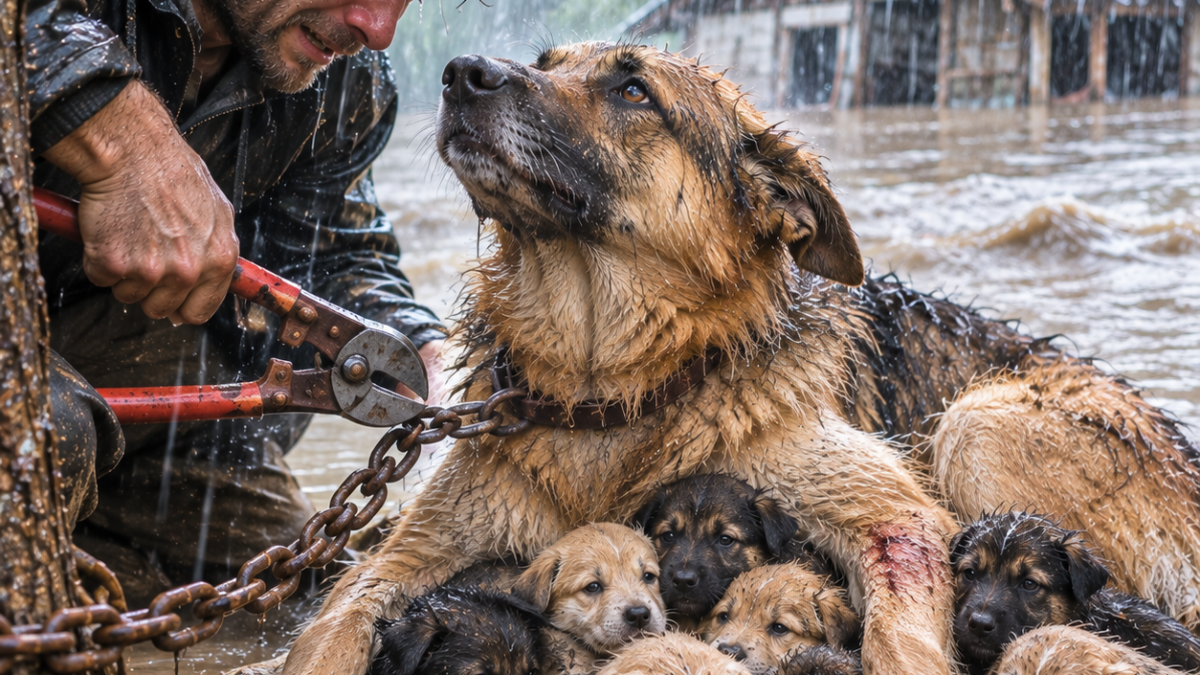
By the time I reached the flooded yard, the Labrador was standing chest-deep in freezing water with a dead puppy still held gently between her teeth and seven living babies trembling on a half-submerged wooden pallet behind her. She had been chained to the same doghouse for nearly four years, and even as the water kept rising, she would not try to save herself because the chain would not let her reach higher ground and she refused to leave her puppies behind. The moment she finally dropped the baby she had already lost and allowed me to touch the chain around her neck, I realized I was not rescuing a helpless dog—I was asking a mother who had every reason to distrust humans to believe that, for once, one of us had come to help.
My name is Rachel Anne Morrison.
I work in animal rescue in Wilmington, North Carolina.
I have seen animals in hurricanes.
Animals abandoned before evacuations.
Dogs tied behind houses while floodwater rose around their chests.
Cats trapped in attics.
Horses standing on small islands of mud while entire fields disappeared beneath brown water.
After enough years, you learn a dangerous skill.
You learn how to keep moving.
You see something that should break you, and instead of breaking, you reach for gloves.
A crate.
A towel.
A catch pole.
Bolt cutters.
You focus on what can still be done.
That does not mean the images disappear.
They simply wait until later.
Bridget was one of the images that waited.
It began on the morning of February 14.
Cold.
Gray.
Rain against my bedroom window before sunrise.
The first thing I saw when I picked up my phone was a message in a local rescue group.
A young girl had posted photographs from a neighborhood in the small town of Millbrook.
The first photo showed a flooded yard.
The second showed a yellow Labrador Retriever standing in water.
The third made me sit upright.
Puppies.
Seven of them.
Tiny.
Wet.
Pressed together on an old wooden pallet that had become the only dry surface in the yard.
The mother was chained to a doghouse.
And in her mouth—
another puppy.
Still.
I stared at the photograph.
Then read the message again.
The girl said she had tried getting closer.
The dog growled.
Not lunged.
Not attacked.
Growled.
The girl had backed away.
Smart.
The water was rising quickly.
Rain was forecast for hours.
The doghouse was almost underwater.
The chain was too short for the mother to reach the steps at the rear of the property.
The puppies were only a few weeks old.
The girl wrote one sentence at the end:
Please, somebody come before the water gets higher.
I was already out of bed.
I called my team.
“Flood rescue.”
“How bad?”
“Mother chained. Seven live puppies. One dead.”
Silence.
Then:
“Location?”
I gave it.
I dressed while talking.
Long waterproof gloves.
Chest waders.
Heavy coat.
Crates.
Warm blankets.
Dry food.
Canned food.
Bolt cutters.
Tow straps.
First-aid supplies.
And one ridiculous thing I kept in my truck because years earlier an older rescuer had taught me that sometimes warmth is the only medicine you can provide immediately—
a thick wool sock filled with rice inside a small plastic container.
Microwave it.
Wrap it.
Instant heat pack.
I threw it into the truck.
The drive to Millbrook was not especially long.
That morning it felt endless.
Rain smeared the windshield.
Water covered sections of road.
I kept seeing that photograph.
Mother standing.
Dead puppy.
Seven behind her.
I later learned she was about four years old.
A Labrador mix.
And, according to people familiar with the property, she had spent essentially those four years chained beneath the same tree in front of the same doghouse.
Four summers.
Four winters.
Same circle.
Same chain.
I kept thinking about that.
She had been physically prevented from leaving for almost her entire life.
Then the first time leaving became a matter of survival—
she still did not leave.
She stayed for the puppies.
When I turned onto the flooded street, people were standing beneath porches watching the water move across lawns.
The girl who had posted waved both arms when she saw my truck.
I parked as close as I could.
Then I saw the yard.
And every photograph had failed to show how bad it really was.
PART2
The water reached almost to the mother dog’s chest.
Cold brown floodwater.
Debris floating.
Pieces of bark.
Leaves.
A plastic bottle.
Her doghouse was nearly submerged.
Only the upper portion of the roof remained clearly visible.
The chain disappeared beneath the surface before rising again to her collar.
The puppies were crowded on the pallet.
Seven little bodies.
Black.
Yellow.
Brown.
One mostly white.
All soaked.
Some crying.
Some frighteningly quiet.
The mother stood between them and everyone else.
She was shivering so hard I could see it from the road.
Yet her legs remained planted.
And the dead puppy was still in her mouth.
Not carried roughly.
Held.
Tenderly.
As if she had not yet accepted that she could put it down.
The girl approached me.
“She won’t let anybody near.”
“You did the right thing backing away.”
“I tried giving her food.”
“Did she eat?”
The girl shook her head.
“She just growled.”
I looked toward the dog.
“That’s okay.”
“She’s not protecting herself.”
“What?”
“She’s protecting them.”
That distinction matters.
Fear aggression and protective behavior can look dangerous when you are staring at teeth.
But context matters.
The dog had already lost one baby.
Humans had failed her for years.
Now strangers were entering the only territory she knew while water threatened the rest of her litter.
Of course she growled.
I would have been more worried if she didn’t.
Two members of my team arrived behind me.
I told them to stay back.
“No crowd.”
One asked:
“You going in alone?”
“At first.”
I took bread.
Not ideal nutrition.
Not the point.
I wanted smell.
Something simple.
I stepped into the water.
Instant cold.
It pushed through my boots before I reached knee depth.
The dog saw me.
Her head lifted.
The dead puppy remained between her jaws.
A low growl started.
I stopped.
“I know.”
She growled.
“You’re a good mother.”
Her eyes fixed on me.
“I see them.”
Another step.
Growl louder.
I stopped again.
“I’m not taking them from you.”
Obviously, she could not understand the sentence.
But tone matters.
Movement matters.
Hands matter.
Pressure matters.
So I made myself small.
Turned slightly sideways.
Avoided staring.
Held the bread low.
“You’ve done your job.”
Rain ran off my hood.
“You kept them alive.”
The dog’s nostrils moved.
Bread.
Hunger.
But her gaze returned immediately to the puppies.
That nearly broke me.
Even starving, she checked them first.
I moved another step.
Water to thighs.
The pallet shifted slightly behind her.
One puppy squealed.
The mother turned instantly.
Touched it with her nose.
Then faced me again.
Growl.
I waited.
Sometimes rescue is action.
Sometimes rescue is standing in cold water doing almost nothing because trust cannot be dragged toward you.
I talked.
“You don’t know me.”
“You shouldn’t trust me.”
“People haven’t given you much reason.”
Her ears moved.
“But I need you to give me five minutes.”
Rain.
Water.
Breathing.
That was the whole world.
Then something changed.
The dog lowered her head.
Not submission.
Exhaustion.
The puppy in her mouth shifted.
She looked down.
For the first time, I saw it clearly.
Tiny body.
No movement.
No breathing.
The mother had likely been carrying it for hours.
She looked at me.
Then slowly opened her mouth.
The puppy slipped into the water.
I felt something inside my chest collapse.
The little body floated beside her leg.
She stared at it.
Then at me.
I wanted to move.
Retrieve it.
Comfort her.
Anything.
I stayed still.
This moment was not mine to control.
She took one step toward the floating puppy.
Stopped.
Then turned toward the living seven.
That decision felt enormous.
Not because she had “chosen life” in some sentimental human way.
Because instinct and exhaustion had finally forced her attention toward the ones still needing her.
I extended the bread.
She sniffed.
Did not take it.
But she did not growl.
One step.
I moved.
No growl.
Another.
Nothing.
I was close enough now to see the collar.
Old.
Worn.
Too tight.
Skin beneath irritated.
I raised my hand slowly.
She watched.
My fingers touched her shoulder.
She flinched.
Did not bite.
I stroked once.
Only once.
“You’re okay.”
Then I touched the chain.
She looked toward her puppies.
I pulled bolt cutters from belt.
The metal jaws opened.
The chain was thick but rusted.
I positioned.
The dog trembled harder.
“Almost.”
I squeezed.
Metal cracked.
One link broke.
For four years, that chain had defined the limit of her world.
The moment it fell into the floodwater, she did not run.
She did not even look toward the road.
She turned immediately to the puppies.
One.
Two.
Three.
She licked each face.
Checked each body.
Freedom had arrived and she used it only to move closer to them.
That was Bridget.
Before she ever had a name.
We started with the strongest puppy.
Small black male.
I lifted him.
The mother followed every movement of my hands.
I wrapped him in towel.
Passed him to teammate waiting on higher ground.
The mother stepped after me until water stopped her near the pallet.
I returned.
Second puppy.
Yellow female.
She snapped weakly at glove.
I laughed despite everything.
“Good.”
Fight was good.
Third.
Brown.
Fourth.
Black-and-white.
Fifth.
Tiny yellow male.
Sixth.
A larger dark female who screamed loudly enough for entire neighborhood.
Also good.
Then seventh.
The weakest.
I knew immediately.
Too quiet.
Cold.
Head limp.
I lifted him.
For half a second, I thought we had lost another.
Then I felt it.
Tiny breath.
Shallow.
Again.
“He’s breathing.”
One teammate rushed forward.
We wrapped him against a warm towel.
The rice sock finally became useful.
He tucked it against the puppy’s side.
Not directly on skin.
Gentle warmth.
I looked at the mother.
She stood alone on the pallet now.
No puppies.
For the first time since I arrived, she seemed uncertain.
Her body leaned toward the truck.
Then toward the place where the dead puppy still floated.
I followed her gaze.
I went back.
Lifted the little body from water.
Wrapped it separately.
The mother watched.
I cannot know what she understood.
But leaving the puppy there felt wrong.
We would not pretend it had never existed simply because we had seven others alive.
Loss deserves acknowledgment too.
We lifted the mother last.
She was lighter than she should have been.
Far lighter.
When I put one arm under her chest, I felt every rib.
Her coat hid how thin she was.
She did not struggle.
She kept twisting her head toward the truck.
Toward the cries.
We carried her.
The moment she heard the puppies louder, her body came alive.
She tried scrambling from our arms.
“Easy.”
We placed her inside beside them.
Chaos.
Seven puppies crying.
Mother sniffing.
Licking.
Counting in the way mothers count—with nose, tongue, touch.
She moved from one to another.
Then another.
When she reached the weak seventh puppy, she stopped.
Licked him.
Again.
Again.
His front leg moved.
The mother lay down.
The puppies immediately pushed toward her belly.
Even the weakest tried.
I closed the truck doors.
Sat behind the wheel.
My clothing dripping.
Hands shaking.
And cried.
Not because everything was safe yet.
It wasn’t.
We still had veterinary care ahead.
Two puppies were dangerously cold.
The mother was malnourished.
Flood exposure.
Parasites likely.
Unknown infection.
One baby dead.
Nothing about this was a clean victory.
I cried because ten minutes earlier she had been chained chest-deep in water.
Now the chain was gone.
Sometimes that is enough for one moment.
The veterinary clinic was ready when we arrived.
Emergency team took puppies first.
Temperature.
Glucose.
Breathing.
Warm oxygen.
Fluids where appropriate.
The weakest puppy needed the most attention.
The veterinarian, an older woman with decades of experience, worked with him long after I expected anyone to say stop.
The mother stayed nearby.
We did not separate more than necessary.
Whenever one puppy cried, her head lifted.
Whenever a technician approached, she watched.
No growling now.
But vigilance remained.
The vet examined her after the puppies were stabilized.
“Four years?”
“That’s what neighbors say.”
She ran fingers over body.
“Underweight.”
“Skin irritation from collar.”
“Parasites almost certainly.”
“Possible early mastitis, but not severe.”
She listened to heart.
“Strong.”
I smiled.
“Of course.”
The vet looked at me.
“You named her?”
“Not yet.”
She glanced toward litter.
“She earned one.”
We left them overnight.
I hated leaving.
Rescuers often do.
You spend hours in urgency, then suddenly professionals take over and you become unnecessary.
That is good.
Still feels strange.
I returned early the next morning.
The clinic was quiet.
One technician met me.
“You should see this.”
She led me back.
The mother lay on thick blankets.
Seven puppies pressed against her.
All nursing.
Including the weak one.
I stood there.
The mother lifted her head.
Looked at me.
No growl.
Her tail moved once.
Tiny.
Against blanket.
That one movement gave me more than any thank-you note ever could.
Not gratitude.
I do not pretend dogs understand rescues the way humans write them.
But recognition?
Maybe.
Safety?
Beginning.
Trust?
A little.
Enough.
We named her Bridget.
The name came from the idea of a bridge.
Not because she needed a poetic identity.
Because every time I looked at her, I saw a body that had literally remained between danger and seven small lives.
She had been their bridge through the flood.
The puppies received temporary names mostly to help medical charts.
I will spare them because rescue workers are notoriously bad at naming litters.
One was named Puddle.
That should tell you enough.
Bridget recovered slowly.
People imagine once an animal is removed from neglect, happiness appears instantly.
It doesn’t.
Freedom is confusing if confinement is the only structure you know.
The first time Bridget entered a larger recovery room, she stayed within roughly the same radius her chain had allowed.
A few feet.
Turn.
A few feet.
Turn.
Invisible circle.
I watched.
Painful.
Her body had learned boundaries even after metal disappeared.
So we did not force.
Food farther out.
Water a little farther.
Bed near.
Then moved.
Day by day.
She expanded.
First ten feet.
Then across room.
Then through doorway.
No chain pulled her back.
Eventually she stopped expecting it.
Touch was similar.
She allowed handling for puppies.
For herself, cautious.
If hand moved above head too quickly, she ducked.
If collar clicked, muscles tightened.
We replaced tight old collar with soft harness.
No neck pressure.
The first time leash attached, she froze.
So we waited.
I sat.
Talked.
She looked.
Eventually one step.
Then another.
Not walk.
Just movement.
That was enough.
The puppies changed faster.
Of course.
Young nervous systems adapt.
Warmth.
Food.
Sleep.
Within days they became ridiculous.
Climbing each other.
Chewing blankets.
Crying because sibling touched them.
Crying because sibling stopped touching them.
One escaped a pen and was discovered asleep inside a laundry basket.
The weakest one gained strength.
Every morning we checked him first.
He became one of the loudest.
Perfect.
Bridget remained serious.
She watched everything.
If a puppy wandered too far, she moved.
If one squealed, she checked.
If stranger entered, she positioned herself between.
No aggression.
Just presence.
Motherhood had become job she refused to delegate.
That made finding placement complicated.
Seven puppies plus mother.
Normally, litters are adopted individually once old enough.
But Bridget had been separated from choice her entire life.
Something in me wanted to preserve what she had fought so hard to keep.
I knew emotion could not dictate placement.
Still.
We looked.
Applications came.
Lots for puppies.
Few for Bridget.
Typical.
Everybody loves babies.
Adult mother remains.
Then one application arrived from an older couple in Fernbrook.
Large house.
Fenced property.
Previous dog experience.
No current pets.
Their note said something unusual:
We understand seven puppies will eventually grow into seven dogs. We are not applying because the story is dramatic. We have the space, time, finances, and desire to keep the family together if your team believes that is best.
I read it twice.
Then called.
They were calm.
Practical.
Asked about feeding.
Vaccines.
Spay/neuter schedule.
Training.
Fencing.
Medical history.
Not:
“Are they famous?”
Good.
We inspected.
Property.
Secure.
Large yard.
Warm indoor area.
No chains.
That detail mattered more to me than I admitted.
Two weeks after rescue, Bridget and all seven puppies went to Fernbrook together.
People later questioned whether that was realistic.
It was unusual.
Absolutely.
But unusual is not impossible when the resources are there.
We built follow-up into the plan.
Veterinary monitoring.
Training support.
Sterilization as age-appropriate.
The couple understood that cute seven-week-old bodies would become full-grown dogs requiring structure and care.
They still said yes.
When we arrived, Bridget stopped at the doorway.
The puppies were already chaos behind me.
She looked inside.
Then back at me.
For one second, floodwater returned in my memory.
Her chest.
Chain.
Dead puppy.
Rain.
I crouched beside.
No grand speech.
Just:
“Go ahead.”
She stepped inside.
One paw.
Then another.
Nothing stopped her.
No chain.
No command.
She sniffed living room.
Kitchen.
Hall.
Turned.
The puppies came tumbling in.
One ran into wall.
Another discovered a rug edge.
One immediately attempted stealing shoelace from new owner.
Normal.
Beautiful.
Bridget stood watching.
Then slowly lowered herself onto floor.
All seven converged.
Warm bodies.
Paws.
Tails.
Mouths.
She closed her eyes.
And something left her.
I could see it.
The constant tension around shoulders.
The readiness.
Gone.
Not completely forever.
Healing does not happen in one scene.
But enough.
She rested.
For perhaps the first time in four years, she rested in a place where she was not tethered, cold or responsible for keeping everyone alive against immediate danger.
That mattered.
I went outside.
Sat in truck.
Reached into pocket.
Found the little plastic box with rice-filled wool sock.
I had packed it from habit.
Never needed it after that first truck ride.
I held it.
Then laughed.
Bridget had spent so long being the heat source herself.
Seven little bodies pressed against her.
Her own body between them and weather.
Now there were heaters.
Blankets.
Walls.
People.
She did not have to be the only warmth anymore.
Follow-up one week later.
Bridget still cautious but improving.
Puppies eating everything.
Including one corner of garden.
The older couple looked exhausted.
Also delighted.
“Are you sure?”
I asked.
The husband laughed.
“No.”
His wife said:
“Absolutely.”
Good answer.
Month one.
Puppies stronger.
Vaccinations.
Training starting.
Bridget began playing.
That surprised me.
First, she watched ball.
No interest.
Then one puppy chased.
Ball bounced near Bridget.
She picked it up.
Dropped.
Puppy grabbed.
Bridget followed.
Ten seconds.
Then twenty.
Soon she ran.
Not fast.
Awkward.
But ran.
I watched video sent by family.
A four-year-old Labrador who had spent life on chain moving freely across grass while seven puppies scattered around her.
I cried.
Again.
This work ruins waterproof mascara.
Month two.
Bridget began sleeping on couch.
The family sent photo.
She was upside down.
Belly exposed.
Four feet in air.
For an animal that spent years alert outside, that posture meant something.
Not proof of complete psychological recovery.
But safety.
Deep enough to sleep vulnerably.
That was the photo I saved.
Not flood.
Not chain.
That one.
People online wanted before-and-after.
I understood.
Still, I became careful.
The flood image is dramatic.
But Bridget deserved not to be permanently introduced by suffering.
So when sharing updates, I used the couch.
The yard.
Puppies.
Her face softened.
Trauma can start story.
It should not be allowed to own title forever.
The girl who posted original message came to visit them.
She had saved them as much as anyone.
Without that post, we might never have known.
She stood in yard.
Bridget approached.
At first cautiously.
Then sniffed her.
The girl cried.
“You remember me?”
Maybe.
Maybe scent.
Maybe not.
Bridget licked her hand.
The girl sat.
One puppy climbed into lap.
Then another.
Chaos.
She laughed.
That was better than crying.
I told her:
“You did exactly right.”
“I didn’t do anything.”
“You noticed.”
“I couldn’t get close.”
“You didn’t need to.”
“You called.”
People underestimate that.
Rescue rarely belongs to one person.
Someone notices.
Someone posts.
Someone drives.
Someone cuts chain.
Someone warms.
Someone treats.
Someone adopts.
A relay.
Bridget lived because multiple people carried one part.
I returned to original property months later with county authorities involved.
The doghouse was gone.
Water receded.
Tree remained.
I saw the place where chain had been attached.
I felt anger.
Four years.
Same spot.
I wanted a grand feeling of closure.
Did not come.
Just sadness.
We documented.
Then left.
I did not bring Bridget.
She had no reason to return.
Animals do not owe us symbolic revisiting.
The dead puppy was cremated respectfully through clinic.
No name.
We did not pretend that one loss disappeared beneath seven survivors.
That little life mattered.
I think rescue stories become dishonest when we erase the one we could not save because the ending feels cleaner.
Bridget saved seven.
Lost one.
Both true.
The grief was not failure.
It was part of what happened.
For a while I wondered whether she searched for that puppy.
At first days, maybe.
She counted frequently.
Moved nose across litter.
Seven.
Again.
Eventually routine stabilized.
I cannot know what she remembered.
I avoid inventing.
But I remember.
That is enough.
The weakest puppy became healthy.
Eventually one of biggest.
Of course.
They always do that sometimes.
The family sent photograph of him chewing a flowerpot.
I laughed.
The puppy that nearly stopped breathing in my hands had become garden criminal.
Excellent.
People wrote to us.
Mothers especially.
“I understand why she wouldn’t leave.”
Some messages became too human, too symbolic.
I appreciated but also corrected when needed.
Bridget did not make moral decision to sacrifice herself in human language.
Maternal behavior.
Attachment.
Stress.
Protection.
Those biological realities do not make it less moving.
Nature is allowed to be profound without becoming metaphor.
Still, Bridget changed me.
Not because she was “better mother than humans.”
I dislike that comparison.
Because she demonstrated something rescue workers know but occasionally forget.
Fear and aggression can hide responsibility.
A growl may mean:
Stay away.
But sometimes also:
I cannot risk you hurting what I protect.
If I had interpreted only teeth, rescue might have escalated badly.
Instead, we slowed.
Respect changed outcome.
That became training example for younger rescuers.
Do not rush a guarding mother.
Reduce pressure.
Read body.
Protect yourself.
Use barriers.
Call veterinary or behavioral help when needed.
Do not romanticize.
A scared mother can bite seriously.
Kindness means safe technique too.
We were fortunate.
Bridget allowed contact.
Another dog might not.
I often think about the instant she released dead puppy.
That moment gets told as if she “understood I was there to save her.”
Maybe not.
Maybe exhaustion.
Maybe jaw fatigue.
Maybe shifting priorities.
I do not claim her inner narrative.
But visually?
It remains one of hardest things I have seen.
Water took small body.
She watched.
Then turned toward seven.
Sometimes survival looks cruel because attention must move forward while grief remains behind.
Humans know that too.
The older couple who adopted them never treated Bridget like fragile relic.
Good.
They trained.
Boundaries.
Routine.
Veterinary care.
Love.
No pity.
Pity can trap animals in past too.
Bridget became dog.
Not victim.
She stole food.
Dug hole.
Rolled in mud.
Ignored recall occasionally.
All wonderful signs of ordinary life.
By summer, she discovered hose water.
Apparently adored it.
A Labrador.
Of course.
The irony of a flood survivor loving sprinklers was not lost on us.
But controlled water was different.
Choice.
She could walk away.
That is why trauma recovery often revolves around agency.
Same sensation can become safe when control changes.
Bridget attacked hose spray.
Puppies joined.
Eight wet idiots.
Family sent video.
I watched five times.
The garden suffered.
Owners complained jokingly.
Good.
Homes should contain mild inconvenience.
That is proof animals belong.
At three months, puppies were bigger.
Still seven.
People asked if family would keep all forever.
They did.
Logistically difficult.
They reorganized property.
Outdoor run connected to house.
Separate feeding areas.
Training rotations.
The couple’s adult children helped.
It became a whole household project.
Again, unusual.
But they had chosen intentionally.
Bridget stayed central.
Not anxiously.
More relaxed.
As puppies matured, she corrected rude behavior.
One stole her chew.
She growled.
Appropriate.
The puppy returned it.
Motherhood evolving.
I visited on a fall morning.
No rain.
Bridget met me at gate.
Tail wagging.
Not one tiny wag.
Full.
I crouched.
She approached.
Pressed head into chest.
There are moments rescue workers try not to over-interpret.
That one I allowed myself.
I hugged her.
Briefly.
She stayed.
Then puppies mobbed me and ruined everything.
Perfect.
The family had removed all chains from property before Bridget arrived.
Even decorative hanging chain near gate.
The wife told me:
“I know she probably wouldn’t care.”
“Maybe not.”
“But I would.”
I understood.
Sometimes we change environment for our own conscience too.
No harm.
Her old collar remained in evidence for a time.
Eventually released.
I did not keep it.
People asked why.
Because not trophy.
A collar that hurt her did not need place on my wall.
I preferred photo of her sleeping upside down.
Memory can choose what it preserves.
The rice sock stayed in truck.
Still does.
I replaced it twice.
It helped other dogs.
One kitten.
An injured raccoon once, indirectly.
Equipment has no symbolism until humans give.
Still, every time I see it, Bridget.
The rescue group built flood-response kits after that incident.
More thermal blankets.
Floating crates.
Extra bolt cutters.
Long leads.
Puppy warming supplies.
Emergency contact lists.
One story should improve systems.
Otherwise it becomes only emotional content.
I wanted more.
Bridget gave reason.
The girl who first posted later volunteered with us.
Part-time at first.
Then regularly.
She learned safe handling.
Transport.
Bottle feeding.
At orientation, I introduced her as:
“The person who saved Bridget.”
She turned red.
“No, I didn’t.”
“Yes.”
She looked at me.
“You did.”
“No.”
I told room:
“She saw something wrong and refused to scroll past.”
That is rescue too.
Maybe first kind.
Years later, I received message from her saying she was studying veterinary technology.
I smiled.
Ripples.
Bridget aged.
Puppies grew.
The couple sent annual photos.
Eight dogs became an absurd family portrait.
Someone always looking wrong direction.
Bridget center.
Calm.
In later photos, muzzle silvered.
Her body fuller.
Healthy.
At seven, mild arthritis.
At eight, more.
No chain-related severe joint damage luckily.
Regular care.
At nine, she preferred porch.
Puppies—now large adult dogs—still gathered near.
Not all literally puppies anymore.
To her, maybe.
To us, always.
One photograph showed all seven lying in yard while Bridget sat on porch step.
I remembered pallet.
Seven wet bodies.
Same mother.
Different world.
That contrast hurt beautifully.
People sometimes say:
“She got happy ending.”
I hesitate.
Life not ending until it ends.
She got years.
Good years.
That is better phrase.
A rescue does not guarantee “happily ever after.”
It creates opportunity for ordinary life.
Vet bills.
Illness.
Aging.
Loss eventually.
But safe.
Loved.
Those are enormous.
The owners grew older too.
They had planned for dogs.
Important.
Their adult children agreed to take responsibility if needed.
Legal arrangements.
Funds.
Veterinary authorizations.
I respected that.
Love includes future planning.
Especially with eight dogs.
Bridget reached eleven.
That surprised everyone.
Given early neglect.
Still.
Strong.
Slower.
She liked sun.
The family added orthopedic bed.
Of course, she preferred rug half time.
Dogs respect budgets poorly.
At twelve, kidney values changed.
Management.
Medication.
Diet.
The seven offspring ranged around eight.
All healthy enough.
Still living together.
I visited.
Bridget recognized maybe.
Tail.
Head in lap.
I cried.
She had long stopped being rescue case in my daily life.
Seeing her old reminded.
One of puppies passed first, unexpectedly from cancer.
That loss hit family.
Bridget searched rooms for several days.
Again, I avoid claiming grief structure.
But behavior changed.
Then settled.
No life escapes loss.
Even saved ones.
That does not negate rescue.
It proves rescue allowed them to love long enough to lose naturally.
Different kind pain.
Worth.
Bridget died at thirteen.
Peacefully.
At home.
Surrounded by remaining dogs and the couple who had given her nearly nine years without a chain.
I received call.
Sat in truck outside rescue office.
Cried.
Not devastation like active case.
A strange gratitude.
She had once stood chest-deep in floodwater at four years old with no future visible.
She got nine more years.
Grass.
Couch.
Hose spray.
Veterinary care.
Seven children grown.
People.
Home.
That was enough.
Her ashes were buried beneath a tree in Fernbrook garden.
Not doghouse.
No chain.
The owners placed simple stone.
BRIDGET
No quote.
Good.
The remaining dogs gradually aged.
Some stayed with couple.
Some eventually moved with adult children as owners themselves slowed.
The family remained connected.
The promise “together” evolved with reality.
That is okay.
Keeping a family safe sometimes means adapting.
No abandonment.
No sudden surrender.
Planned transitions.
Bridget would have approved?
I cannot know.
But I did.
When I speak to rescue groups now, I tell her story carefully.
I do not say:
“She was never a prisoner because motherhood made her free.”
That sounds nice and is false.
She was absolutely a prisoner.
A chain is a chain.
Love does not magically erase confinement.
What mattered was we cut it.
Real problems deserve real intervention, not inspirational language.
I do say this:
She had almost no control.
But within what control remained, she protected.
Then when help arrived, she eventually allowed us to take over.
That is enough courage.
I also do not praise her for refusing to leave puppies in a way that suggests mothers should destroy themselves for children.
Human analogies become dangerous.
She was a dog responding maternally.
We helped because she should not have been forced into that choice.
The correct lesson is not “sacrifice everything.”
It is “do not chain a mother where she cannot save herself.”
Systems matter.
Neglect is not made beautiful by resilience.
Bridget’s strength does not excuse what happened.
She deserved warmth before flood.
Food before pregnancy.
Freedom before emergency.
Her survival was not proof chain “made her strong.”
It was proof neglect failed to erase her capacity to care.
Important difference.
The puppy who died matters here.
I come back.
I do not know gender.
No name.
I sometimes imagine if we had arrived earlier.
Bad road.
Do not.
Alternate timelines poison rescuers.
We came when called.
One did not survive.
Seven did.
We acknowledge.
Keep working.
Burnout in rescue often comes not from suffering itself but from believing every loss proves personal failure.
It doesn’t.
We control little.
We show up.
Use skills.
Improve systems.
Grieve.
Return.
Bridget taught that too.
On difficult flood calls after, I remembered her growl.
Not threatening in memory.
A boundary.
I approach mothers slower.
I tell younger volunteers:
“Do not take growling personally.”
Communication.
Respect.
One volunteer once said:
“But we’re helping.”
I answered:
“They don’t know that yet.”
That might be the essence of rescue.
We know intention.
Animal knows history.
Trust sits between.
We earn.
Bridget gave me touch after minutes.
Some animals take months.
Both valid.
The first touch remains physical memory.
Wet fur.
Cold.
Ribs.
Chain under hand.
Cutters.
Then no tension on neck.
She did not run.
That surprised me then.
Now it doesn’t.
Her world was puppies.
Freedom first used to reach them.
Later, she learned freedom could be for her too.
That took time.
Her first solo pleasure, according to adopter, was sleeping in sun without puppies touching her.
I loved that.
Motherhood important.
Individual dog too.
She became Bridget beyond mother.
She had preferences.
Hose.
Chicken.
Blue blanket.
Back porch.
Avoided vacuum.
Liked one neighbor.
Disliked delivery truck.
Ordinary identity.
That is why rescue aftercare matters.
We save animals for ordinary identity.
Not to preserve them forever as symbols of what they survived.
Years after Bridget, another flood came.
Different county.
We used improved kits.
A chained dog rescued sooner because responders had bolt cutters pre-positioned.
Someone said:
“Bridget kit.”
Unofficial.
I smiled.
That is legacy I value.
Not viral post.
Tool ready.
Minutes matter.
A chain cutter in right truck can matter more than thousand shares.
Though that first share saved Bridget.
Both.
Digital attention and physical action.
Relay.
The young girl’s post was not “just social media.”
It was signal flare.
Important.
People mock posting.
Sometimes posting reaches rescuer.
Use wisely.
I still follow Fernbrook family.
The couple now very old.
Their children send occasional photos of remaining dogs.
Bridget’s line continues? They were spayed/neutered, no breeding. Good.
No puppies beyond.
Legacy not genetics.
Behavior.
Care.
Stories.
One of adult children adopted another rescue years later.
Said Bridget changed family.
There.
Ripple.
I do not believe every rescue must change world.
One safe animal enough.
But sometimes one does change several choices.
Nice.
I have been asked what I felt when Bridget finally let me touch chain.
Fear.
Relief.
Responsibility.
Not magic.
I knew one wrong movement could trigger bite.
My heart pounded.
Professional calm is often fear with procedure around it.
That is okay.
Courage in rescue is not being unafraid.
It is doing appropriate next step despite fear.
That applies to Bridget too.
She allowed.
Maybe because exhausted.
Maybe because bread.
Maybe tone.
Maybe maternal priority.
We will never know.
I am comfortable not knowing.
Mystery does not reduce outcome.
At clinic, when tail moved once, I once described as thank you.
I no longer do.
Not because cynical.
Because animal behavior deserves respect without forced human meaning.
It may have been recognition.
Relaxation.
Social response.
Whatever.
It moved.
I smiled.
Enough.
Humans crave gratitude after rescue.
Better to release need.
Animals owe us nothing.
We help because need exists.
If love comes later, gift.
Bridget did bond.
Beautiful.
Not payment.
This matters because some rescued animals never become cuddly.
Still worth saving.
Trust may look like eating while you’re in room.
No bite.
Sleep.
Distance chosen.
All valid.
Bridget became affectionate eventually.
Lucky.
But worth existed before.
When growling chest-deep.
Especially then.
I still remember her eyes.
Wide.
Exhausted.
Calculating.
Behind them no “sparkle of hope” I can scientifically claim.
That phrase people use.
What I saw was attention.
She watched.
Responded.
Stayed.
That was enough.
The floodwater was filthy.
My boots smelled for days.
One glove ruined.
My phone case never recovered.
Small details.
Real rescues are messy.
Less cinematic.
More laundry.
The truck smelled like wet dog for weeks.
I did not mind.
Mostly.
The dead puppy’s blanket stayed with clinic.
I did not keep.
Again.
Not trophy.
The wooden pallet eventually washed away.
No relic.
Good.
People sometimes want objects because objects feel like proof.
Photos enough.
Memory enough.
Bridget alive was proof then.
The property owner faced investigation related to neglect.
I will not dramatize legal outcome here because what matters in source is rescue, not courtroom.
Accountability matters.
But Bridget’s new life mattered more to me day to day.
I stopped visiting old yard.
No reason.
Rescue workers can become attached to scenes.
Dangerous.
Move toward life.
I visit homes instead.
See animals after.
Important for burnout.
If all you see is worst day, brain believes world only worst days.
You need couch photos.
Garden criminal.
Sun.
Proof work continues beyond trauma.
Bridget gave many.
Her family sent one Christmas card.
Eight dogs wearing red scarves.
Bridget center looking tired of nonsense.
I kept.
It still hangs in office some winters.
Caption:
NO CHAINS. JUST CHAOS.
Perfect.
Better than any inspirational quote.
That is Bridget’s story in five words.
No chains.
Just chaos.
Life.
When I think about February 14 now, I do not first see flood.
I see Fernbrook yard.
Bridget running after hose.
Seven adolescent dogs scattering.
Old couple laughing.
That is deliberate.
Memory can choose final image.
But I never erase beginning.
Because another mother may still be chained somewhere.
Awareness matters.
There will always be another call.
Another flooded yard.
Another frightened animal protecting babies.
Another person who says “she won’t let me near.”
My job is not assume monster.
My job is assess.
Safety.
Patience.
Tools.
Team.
Try.
Sometimes animal lets touch.
Sometimes sedation needed.
Sometimes traps.
Sometimes professionals with specialized equipment.
No single heroic formula.
Bridget was one case.
Beautiful.
Specific.
The broad principle is compassion plus competence.
Either alone can fail.
Compassion without safety can injure.
Competence without compassion can rush.
Together.
I learned from older vet that night.
She stayed beside weak puppies.
No drama.
Adjusted heat.
Checked glucose.
Again.
Again.
Care repetitive.
Like motherhood.
Like rescue.
By sunrise all seven nursing.
That image.
Yes.
Maybe greatest.
No one cheering.
Clinic fluorescent light.
Mother tired.
Puppies.
Life resumed.
If somebody had filmed, would look boring.
That is healing.
Boring.
Steady.
The world loves cliffhanger.
Animals love routine.
We should remember.
Bridget’s adopters gave routine.
Same meals.
Same yard.
Same voices.
No chain.
That repetition rebuilt nervous system.
Not single hug.
She learned door opens.
She can return.
Food appears.
Hands gentle.
Night passes.
Morning safe.
Trust is evidence collected over time.
We tell rescuers:
“Do not demand trust because you have good intentions.”
Good rule.
Bridget taught before phrase.
I imagine first night in Fernbrook.
No rain.
Maybe puppies awake.
Maybe she barely slept.
Then eventually body surrendered.
House warm.
No need stand guard chest-deep.
That first deep sleep might be greatest rescue milestone.
We did not witness.
Fine.
Not everything needs audience.
Some of most important healing happens when no one is watching.
Like strays feeding chained dog in another story? Different source, but principle.
Not mention.
Bridget’s owners once wrote:
She snores now.
I cried at email.
Snoring means deep sleep.
From guard to snore.
That is rehabilitation.
Later she became so comfortable they complained she stole pillow.
Excellent.
One February, years later, rain heavy.
Family sent photo Bridget sleeping while storm outside.
No trembling.
No checking puppies.
Just asleep.
I stared.
That one may beat couch.
Same sound—rain.
Different meaning.
Trauma not erased.
Environment rewritten.
This is what I hope for rescued animals.
Not bravery.
Boredom during weather that once meant danger.
Bridget got that.
I do not know whether she was “grateful all her life.”
The source language says gratitude.
I would phrase differently.
She became attached.
She sought people.
Rested head on owner’s knees.
Trusted.
That is richer than gratitude.
Relationship, not debt.
She owed us nothing.
We owed her care once we intervened.
Then her family chose love.
If I ever write one sentence under her photograph, it would be:
She did not need to be thanked for surviving. She needed someone to cut the chain.
That is it.
Because inspirational stories can sometimes turn concrete problems into metaphors.
Chains are not metaphors when around neck.
Floodwater is real.
Neglect real.
Intervention real.
Cut.
Lift.
Warm.
Treat.
Adopt.
Then maybe philosophy.
Order matters.
The morning I met Bridget, she stood in water because humans had left her no other option.
The morning she died years later, she was lying inside a warm home because humans finally gave her choices.
That is the arc.
Not “hope defeated everything.”
Care changed conditions.
Hope followed.
I find that more powerful.
People sometimes ask why I keep doing rescue.
Because not every story ends like Bridget.
Some are hard.
Some terrible.
But every so often, you get to see direct line from action to life.
Post.
Truck.
Bolt cutters.
Seven breaths.
Years.
That sustains.
I keep responding.
Rain.
Heat.
Middle of night.
Not because heroic.
Because once you know how quickly an animal can go from trapped to safe when someone shows up prepared, it becomes difficult to ignore calls.
I am older now.
Knees hate floodwater.
I train younger people.
Good.
They move faster.
I carry less.
Talk more.
Annoying transition.
Necessary.
When a new rescuer asks biggest lesson, I tell Bridget story.
Then ask:
“What saved them?”
They usually answer:
“You.”
Wrong.
“The mother.”
Closer.
“The girl who posted.”
“Yes.”
“The team.”
“Yes.”
“The vet.”
“Yes.”
“The adopters.”
“Yes.”
Then I say:
“All of them.”
Rescue is chain too.
A good chain.
Links of care.
One breaks, maybe outcome changes.
The irony is not lost on me.
Bridget was trapped by one chain.
Saved by another kind.
Human connection.
Girl to post.
Post to me.
Me to team.
Team to vet.
Vet to home.
That chain did not restrain.
It carried.
Maybe that metaphor I allow.
Still, the most important chain was metal.
And we cut it.
Never forget practical.
I sometimes wonder what happened to that tree.
Does not matter.
Bridget had trees in Fernbrook.
She slept beneath one by choice.
I saw photo.
No tether.
That was enough.
At her memorial stone, one of grown puppies lay beside.
Owner sent.
Same family.
Time.
No flood.
I saved photo.
The puppy that nearly died? Also grown.
Healthy.
Large.
He had white patch.
Owner joked weakest became bossiest.
Of course.
Life likes irony.
I wish the one lost puppy had grown too.
That sentence remains.
No resolution.
Some grief should stay unresolved because love cannot turn every loss into lesson.
We honor.
Bridget did not get eight puppies home.
She got seven.
That is truth.
And seven was extraordinary.
If I could revisit moment in flood, I would whisper same thing.
“You’re a good mother.”
Not because motherhood defines her entire worth.
Because in that moment, it was language she needed from tone.
She was doing impossible work.
I wanted her body to understand I was not enemy.
Then I would cut chain.
Again.
Without hesitation.
That sound—
metal snapping—
still feels like one of best sounds in rescue.
Not applause.
Not crying.
A chain becoming useless.
The water kept rising after we left.
The doghouse eventually disappeared beneath.
If we had waited another few hours?
No.
Do not.
We came.
Timing is not destiny.
It is urgency.
Pay attention.
Act.
The young girl did.
Thank God.
Bridget’s family did.
Again.
Again.
Every day afterward.
That is why story lasted longer than flood.
When I look at her final photos, muzzle gray, eyes soft, I do not see “former chained dog” first.
I see Bridget.
That means rescue succeeded.
Past became context.
Not identity.
That is what I want for every animal we pull from worst day.
Not fame.
Not gratitude.
A name that eventually means more than trauma.
Bridget meant dog who loved sprinklers.
Stole pillows.
Raised seven chaotic children.
Snored.
Leaned into knees.
Sat in sun.
A whole life.
And when people ask what courage looked like that morning, I say it looked different for everyone.
For the girl, courage was getting close enough to see, then backing away when unsafe and asking for help.
For my team, entering cold water.
For the vet, staying all night.
For the older couple, saying yes to eight dogs with open eyes.
For Bridget?
Maybe courage is not the word.
Maybe instinct.
Love.
Persistence.
Whatever it was, she stood.
Chest-deep.
Shivering.
Until we came.
Then, finally, she let someone else carry the weight.
That part matters too.
Strength is not only holding.
Sometimes strength is allowing help.
She allowed one hand.
Then chain.
Then puppies lifted.
Then truck.
Then clinic.
Then home.
A sequence of surrender that did not diminish her.
It saved her.
Humans sometimes need that lesson.
Rescuers especially.
We think we must carry.
No.
Teams.
Ask.
Receive.
Stay alive enough to answer next call.
Bridget again.
The last time I saw her in person, she was old.
She walked slowly toward me.
Sniffed.
I crouched.
She put head on knee.
No dramatic recognition.
I stroked.
We sat.
One grown puppy nearby.
Owners talking.
Sun.
Bridget closed eyes.
That was all.
No flood.
No chain.
No rescue happening.
Exactly how I wanted.
I whispered:
“You did good.”
Then corrected myself internally.
She did not need evaluation.
So I said:
“Hi, Bridget.”
Better.
Just her name.
Present tense.
When she died, I did not say goodbye at flood site.
I never went.
I sat in my truck after call.
Held steering wheel.
Cried.
Then answered another message from shelter.
A dog needed transport.
Life continues.
Not disrespect.
That is rescue.
Carry grief and go.
Bridget’s story does not end with death either.
The young girl rescues now.
The family cared for dogs.
Our flood kits improved.
I teach.
People who heard story donated.
Effects.
No mystical afterlife needed.
Influence enough.
Still, when February rain hits hard, I think of her.
Not standing in water.
Sleeping through storm.
That is the image I choose.
Warm house.
Seven puppies grown.
No reason to stand.
No reason to guard.
No chain tugging neck.
Rain only weather.
That is what safety ultimately is.
Dangerous thing becoming ordinary again.
My name is Rachel Anne Morrison.
I still work rescue.
I still carry bolt cutters.
Gloves.
Crates.
Blankets.
And yes, the ridiculous rice sock.
Because you never know what one call will require.
There will be another frightened mother.
Another person who says she won’t let anyone near.
Another flooded yard.
Another chain.
And when that happens, I will remember Bridget—not as a saint, not as a symbol, not as proof that love conquers everything.
I will remember her as a dog who had been failed for four years and still gave us one narrow opening to help.
She let me take one step.
Then another.
She let me touch.
She let me cut.
And once the metal fell away, she did not run from us.
She ran toward the lives she still had left to protect.
That was enough.
We took it from there.








