“SHE RAN AFTER HIS CAR UNTIL SHE COLLAPSED… THEN CRAWLED BACK TO WAIT FOR HIM.” A Man Abandoned His Gray Dog in the Middle of a Blizzard—Our Security Camera Captured Her Chasing His Taillights Through the Snow, Then Returning to Our Shelter Gate Before Morning… Three Months Later, I Saw Him Sitting in Court, and I Couldn’t Forget the One Thing She Had Never Stopped Doing: Waiting for Him.
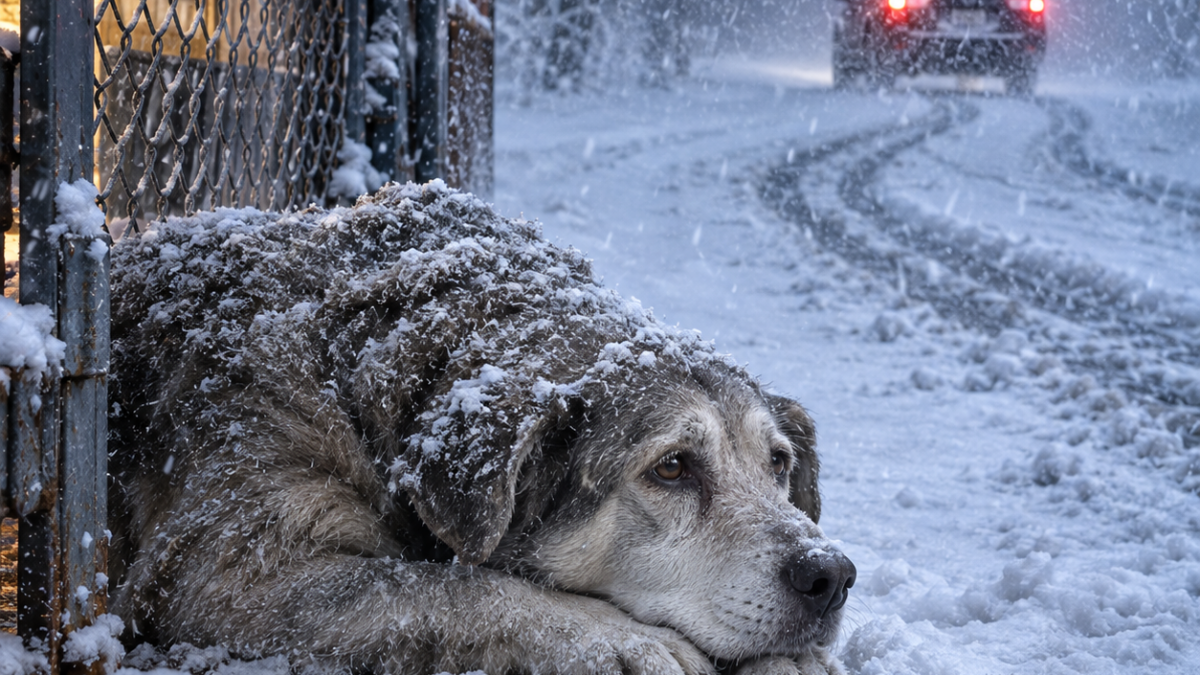
“SHE RAN AFTER HIS CAR UNTIL SHE COLLAPSED… THEN CRAWLED BACK TO WAIT FOR HIM.” A Man Abandoned His Gray Dog in the Middle of a Blizzard—Our Security Camera Captured Her Chasing His Taillights Through the Snow, Then Returning to Our Shelter Gate Before Morning… Three Months Later, I Saw Him Sitting in Court, and I Couldn’t Forget the One Thing She Had Never Stopped Doing: Waiting for Him.
The gray dog had been sitting outside our shelter in a blizzard for hours, staring down the road every time headlights appeared as though she still believed the person who abandoned her would realize his mistake and come back. When we finally checked the overnight security footage, we watched a dark sedan stop at our gate, watched a man open the rear door and shove her into the snow, and then watched the dog run after his taillights until she collapsed—before limping back to our front door and waiting there until morning. Three months later, I sat in a packed courtroom while that same man stared straight ahead with no emotion, and all I could think was that he had thrown away something priceless without ever understanding what she had given him: complete, unquestioning faith.
My name is Catherine Montgomery.
For fourteen years, I have managed Pine Ridge Animal Shelter.
People assume working at a shelter means spending your days surrounded by grateful dogs, purring kittens, happy adoptions, and children choosing puppies with bright red collars.
Sometimes it does.
Those are the days we post online.
The photographs.
The reunions.
The little signs that say ADOPTED.
What people don’t see are the mornings when a cardboard box appears beside the dumpster.
The elderly dog surrendered because someone bought a puppy.
The cat left in an apartment after the tenants moved.
The animals that come through our doors still waiting for the people who no longer want them.
Abandonment has a look.
I can recognize it now.
It is not always panic.
Sometimes it is patience.
That’s worse.
Because panic eventually burns itself out.
Patience means the animal still believes.
Faith was still believing when I found her.
It was 6:24 on a Wednesday morning in January.
The overnight temperature had fallen to eleven degrees.
Wind drove dry snow across the road in silver sheets.
The county had warned people to stay indoors unless travel was absolutely necessary.
I was almost ten minutes late because a plow had blocked the east road.
As I turned into Pine Ridge’s driveway, my headlights swept across something near the front steps.
At first I thought it was a trash bag.
Then it moved.
I braked.
A dog.
She sat directly beside the shelter door.
Gray coat coated with snow.
Head lowered.
One front paw held slightly off the ground.
I stopped the car and opened the door.
The wind hit me instantly.
“Hey!”
The dog lifted her head.
Those eyes.
I remember them more clearly than anything else.
Not wild.
Not aggressive.
Not even relieved.
Searching.
She looked past me.
Toward my car.
Then toward the road.
I crouched.
“Sweetheart?”
She didn’t come.
I took one step.
Her body tensed.
So I stopped.
“Okay.”
Snow had collected along her back.
Her ears.
Her whiskers.
How long had she been there?
I slowly removed my scarf.
Held it toward her.
“I’m Catherine.”
Ridiculous introduction.
But I always talk to frightened animals.
Sometimes because it helps them.
Sometimes because it helps me.
“You’re at Pine Ridge.”
Her nose moved.
“You picked a terrible morning to visit.”
Her tail didn’t move.
Then a set of headlights appeared on the road.
The dog stood so fast she almost fell.
Her ears lifted.
Her entire body leaned forward.
The vehicle approached.
She took three steps toward the driveway.
Then stopped.
A pickup truck passed.
The dog watched it disappear.
And sat down again.
I felt something in my chest shift.
She wasn’t waiting for rescue.
She was waiting for someone specific.
“Who left you here?”
The dog looked at me.
Then toward the road.
I moved closer.
This time she didn’t retreat.
I touched her neck.
No collar.
Her skin was icy.
“Come inside.”
I slid my scarf around her shoulders.
She tried to walk.
Her injured paw folded.
She almost fell.
I caught her.
At first she panicked.
Then something changed.
Her body went limp against me.
Not relaxed.
Surrendered.
As if she had simply run out of strength to decide whether I was safe.
I lifted her.
She was lighter than she should have been.
Much lighter.
I carried her toward the shelter door.
The dog turned her head over my shoulder.
Still looking at the road.
Still waiting.
PART2
Inside, warm air hit us.
The dog began trembling harder.
People sometimes think shivering means an animal is getting colder.
Often the opposite.
Her body finally had enough warmth to react.
I laid blankets on the floor of our intake room.
“Easy.”
She curled immediately.
I brought warm water.
She sniffed.
Didn’t drink.
Food.
Nothing.
That frightened me.
Our senior volunteer, Martha Clark, arrived at 6:40.
Martha was sixty-seven, had volunteered at Pine Ridge longer than some of our employees had been alive, and possessed a special ability to be gentle with animals while terrifying irresponsible humans.
She walked into the room.
Stopped.
“Oh, honey.”
The dog’s eyes opened.
Martha crouched.
“What happened to you?”
“I don’t know.”
“Road?”
“Maybe.”
I pointed toward the injured paw.
“She was outside the front door.”
Martha looked toward me.
“In this?”
“Yes.”
Her face hardened.
“Overnight?”
“I don’t know yet.”
Martha touched the blanket.
“Camera.”
I nodded.
The shelter had two exterior cameras.
One covered the parking lot.
The other faced the front gate and road.
“I’ll check after we get her stable.”
Martha shook her head.
“No.”
“What?”
“You take her to Crosby.”
Dr. Nathan Crosby ran the veterinary clinic five minutes away.
“I’ll check.”
I stared.
“Martha—”
“Go.”
She pointed toward the dog.
“She needs you more than the computer does.”
She was right.
I hated when Martha was right.
Dr. Crosby met us before his clinic technically opened.
I’d worked with him for years.
He was forty-five, patient with animals, impatient with bureaucracy, and incapable of hiding anger when someone had neglected a pet.
He examined the dog while I stood beside the table.
“Female.”
I nodded.
“Probably five to seven.”
“Breed?”
“Mixed.”
He ran a scanner.
“No microchip.”
My heart sank.
He examined her paw.
“Likely soft tissue injury. No obvious fracture, but we’ll image it.”
He looked at her gums.
“Dehydrated.”
Then her temperature.
His face changed.
“How long was she out?”
“I don’t know.”
“Catherine.”
“I found her at 6:24.”
He exhaled.
“She’s hypothermic.”
My stomach tightened.
“How bad?”
“Moderate.”
He looked toward me.
“She is lucky.”
I hated that word.
Lucky.
An animal abandoned in a snowstorm isn’t lucky because she didn’t die.
But I knew what he meant.
“Can she stay?”
“Yes.”
“Anything else?”
Dr. Crosby looked along her body.
“She has pressure sores beginning on one side.”
“What?”
“Not new.”
He moved carefully.
“Older skin irritation. Poor muscle condition.”
I stared.
“You think neglect?”
“I think this didn’t begin last night.”
The dog lifted her head slightly.
Dr. Crosby touched her gently.
“She may have been living badly for a while.”
My anger started there.
Not explosive.
Cold.
Slow.
The kind that gives you energy.
I returned to the shelter around eight.
Martha had coffee waiting.
And a face I recognized.
“What?”
She pointed toward my office.
“You need to see this.”
We sat at the computer.
The security footage displayed the front gate.
Snow streaked diagonally across the image.
Timestamp.
11:47 p.m.
Empty road.
11:53.
Nothing.
12:08.
Headlights.
My body became still.
A dark sedan appeared.
It slowed near our entrance.
Turned.
Stopped just beyond the gate.
Martha didn’t speak.
The driver’s door never opened.
Instead, the rear passenger door swung outward.
For several seconds, nothing happened.
Then a dog appeared.
Gray.
Faith.
She hesitated at the edge.
A person’s arm reached from inside.
Pushed.
Faith landed awkwardly in the snow.
The door shut immediately.
My hand covered my mouth.
The sedan accelerated.
Faith stood.
For one confused second, she watched.
Then ran.
Not toward the shelter.
After the car.
“Oh God.”
Martha whispered it.
Faith ran down the driveway.
Out toward the road.
Her bad paw was fine then.
She ran normally.
Fast.
Desperate.
The sedan’s taillights moved away.
Faith followed.
For several seconds, both disappeared beyond camera range.
I couldn’t breathe.
“Keep going.”
Martha pressed play.
Minutes passed.
12:14.
12:19.
Snow.
12:23.
A shape appeared at the far edge.
Faith.
Returning.
But now she limped.
She came back alone.
Slowly.
Stopping.
Looking behind her.
Walking a little farther.
Stopping again.
At 12:31, headlights appeared.
Faith turned instantly.
Tried to run toward them.
Another car passed.
Not him.
She stood in the road for several seconds after it disappeared.
Then came back.
At 12:37, she reached our gate.
She looked through it.
The shelter was dark.
Closed.
No staff overnight.
She paced.
Then sat.
At 12:51, she lay down.
At 1:16, another car passed.
Faith stood.
Watched.
Lay down again.
At 2:03.
Again.
Every pair of headlights.
Every time.
Hope.
Then disappointment.
Hope.
Then disappointment.
By 3:40, she was no longer standing each time.
Only lifting her head.
At 4:22, she barely moved.
At 5:58, the sky began becoming gray.
At 6:24, my car arrived.
I paused the video.
My hands were shaking.
Martha was crying silently.
Neither of us spoke for a long time.
Then Martha whispered:
“She thought he was coming back.”
I swallowed.
“Yes.”
“She chased him.”
“Yes.”
“She hurt herself chasing him.”
“Yes.”
I stared at the frozen image.
Faith sitting alone in the snow.
And something in me changed.
Pain was there.
But anger pushed through it.
Cold.
Focused.
I reopened the recording.
“Catherine?”
“The plate.”
Martha wiped her face.
“What?”
“The license plate.”
I rewound.
The sedan turned near the gate.
For one moment, the headlights reflected off snow and illuminated the rear.
I paused.
Zoomed.
The image blurred.
I adjusted.
Again.
Characters appeared.
Readable.
Perfectly readable.
My hand shook as I wrote them on paper.
Martha watched.
“What are you doing?”
“Calling Michael.”
Sergeant Michael Covington had handled several animal-cruelty cases with us.
I called the local station.
He answered.
“Covington.”
“Michael, it’s Catherine Montgomery.”
“Morning.”
“No.”
He heard my tone.
“What happened?”
“We had a dog abandoned overnight.”
He sighed.
“Where?”
“Our gate.”
“In this weather?”
“Yes.”
“Do you have video?”
“Yes.”
“Plate?”
I looked at the paper.
“Yes.”
Silence.
“Send it.”
I emailed the footage.
Then waited.
The longest hour of my morning.
I checked Faith twice through Dr. Crosby.
Stable.
Warming.
Sleeping.
At 9:17, my phone rang.
Michael.
“Catherine.”
“Yes?”
“I have the owner.”
I grabbed the paper.
“Who?”
“Vehicle registered to Harold Mitchell.”
I wrote.
“Address?”
He gave it.
North side of town.
Oakwood Drive.
“Is the dog registered?”
“Checking.”
Pause.
“Catherine.”
“Yes?”
“This is good footage.”
“I know.”
“No.”
His voice became firmer.
“I mean legally useful.”
I stared toward my office window.
Snow covered the parking lot.
“I want to file.”
“I was hoping you’d say that.”
“Officially.”
“Good.”
I closed my eyes.
“Michael.”
“Yes?”
“She ran after him.”
He was quiet.
“She thought he was coming back.”
Another pause.
“I’ll take it from here.”
Dr. Crosby called around noon.
“She ate.”
I nearly cried from relief.
“How much?”
“Not enough to impress me.”
“Of course not.”
“But some.”
“Can I see her?”
“Yes.”
At the clinic, Faith lay beneath warming blankets.
She looked better.
Only slightly.
Her eyes were clearer.
I sat beside her.
“Hi.”
Her ears moved.
“Bad news.”
Tail still.
“You have a lot of paperwork coming.”
Nothing.
I touched the blanket.
“We found him.”
Her eyes lifted.
That hurt.
Did she understand?
No.
But hearing a human voice mentioning something with certainty seemed to wake her attention.
I instantly regretted it.
“Sorry.”
I stroked her head.
“You don’t need to worry about him.”
She watched me.
“That’s our job now.”
Her eyes closed.
Why Faith?
People later asked why I gave her that name.
I didn’t name her immediately.
For two days, she was simply gray female stray on the shelter records.
Then, on the third morning, she returned to Pine Ridge after Dr. Crosby cleared her for continued recovery with us.
I prepared a quiet room.
Bed.
Blankets.
Food.
Water.
No kennels beside noisy dogs.
I carried her inside.
Set her down.
She walked slowly.
Still limping.
She sniffed the room.
Then walked toward the door.
Sat.
And waited.
My heart broke.
“Sweetheart.”
Her ears moved.
“He’s not coming.”
She stared at the door.
I sat beside her.
Not touching.
“He doesn’t deserve you waiting.”
Nothing.
I stayed.
Ten minutes.
Twenty.
She remained facing the door.
Then I said:
“You really believe, don’t you?”
Her head turned.
“Even now.”
I thought about the footage.
Faith waiting every time headlights appeared.
Believing someone who had already betrayed her might return.
I whispered:
“Faith.”
Her ears rose.
I tried again.
“Faith.”
This time, she looked at me.
That became her name.
Not because I wanted her to keep believing in Harold.
Because I wanted her faith to find somewhere safer to live.
We learned more about Harold Mitchell.
He was fifty-eight.
Worked irregular construction jobs.
No serious criminal record.
Neighbors remembered seeing Faith in his yard.
One said she had been there at least four years.
Another said the dog spent most of her time outside.
A woman across the street told Sergeant Covington she’d once seen Faith tied to a porch during heavy rain.
Harold claimed she was “fine.”
When police interviewed him, he initially denied knowing the dog.
Then the footage was mentioned.
His story changed.
He said Faith had become “too much work.”
Then said he thought leaving her at a shelter was responsible.
Michael asked why he hadn’t brought her inside during business hours.
Harold said he didn’t want “a scene.”
Why midnight?
Convenient.
Why during a storm?
He had work in the morning.
Why leave no note?
Forgot.
Why push her from the car and immediately drive away?
Silence.
The worst answers are sometimes not dramatic.
Just selfish.
County prosecutor Rebecca Thornton agreed to take the case.
She was known for taking animal-welfare violations seriously.
Not theatrically.
Seriously.
There is a difference.
She reviewed the video.
Dr. Crosby’s medical report.
My statement.
Martha’s statement.
Weather records.
Police interview.
She watched the entire overnight footage.
When Faith ran after the car, Rebecca stopped the recording.
Rewound.
Watched again.
Her jaw tightened.
“He knew she would follow.”
I looked at her.
“What?”
“He didn’t secure her inside the shelter property.”
Rebecca pointed toward the screen.
“He dumps her on a public access road.”
I felt anger return.
“He didn’t even wait until she reached the gate.”
“No.”
She looked through the documents.
“This is one of the clearer cases I’ve handled.”
“What happens?”
“We file the appropriate cruelty and abandonment charges supported by state law and local provisions.”
I nodded.
“Will he go to jail?”
Rebecca looked at me.
“I won’t promise outcomes.”
I appreciated that.
“The court decides punishment.”
She closed the file.
“But we can make sure the evidence is seen.”
That was enough.
For then.
Faith’s recovery took months.
Physically, she improved faster than emotionally.
Her paw healed.
She gained weight.
Her coat began shining.
Dr. Crosby said the muscle loss would take time.
Her bloodwork improved.
But fear is not visible on blood tests.
Faith startled when doors slammed.
If a man raised his voice in the lobby, she retreated to the back of her room.
If someone jingled car keys, her ears rose instantly.
And every time the shelter’s front door opened—
Faith looked.
Every time.
For weeks.
That was the cruelest wound.
She was still checking.
I started spending my lunch break with her.
Not because she needed constant supervision.
Because I needed her to know one person came back predictably.
Every day.
12:30.
I entered.
“Hi, Faith.”
At first, she stayed on her blanket.
Then one afternoon, her tail moved.
A tiny wag.
I smiled.
“Well.”
Faith watched me.
“That’s new.”
Next day, again.
Then stronger.
One week later, she stood when I entered.
I sat on the floor.
Faith approached halfway.
Stopped.
I didn’t reach.
She came another step.
Then another.
Sniffed my sleeve.
Retreated.
Fine.
The next day she came closer.
Healing is often boring.
No dramatic breakthrough.
Just repetition.
One safe moment stacked onto another.
Martha loved Faith.
Faith loved Martha’s pockets.
Martha carried treats.
This relationship was entirely transactional at first.
Martha didn’t care.
“She has good taste.”
“You buy expensive treats.”
“Exactly.”
One morning, Martha entered Faith’s room.
Faith wagged so hard her hips moved.
Martha looked at me.
“Did you see that?”
“Yes.”
“She’s coming back.”
I smiled.
“Yeah.”
That night, alone in my house, I cried.
Because coming back means there was somewhere she had disappeared to.
I lived alone.
Had for years.
That detail becomes important later.
My divorce had been final almost nine years.
No children.
My work was my life.
I told myself that suited me.
Mostly it did.
The shelter needed everything.
Mornings.
Nights.
Weekends.
Emergencies.
There was always an animal to care for.
At home, I enjoyed silence.
At least that’s what I said.
Faith complicated the story.
She made me aware of how quiet my house actually was.
Three weeks into her recovery, we introduced her to a toy.
Simple cloth rope.
She stared at it.
Martha dragged it slowly.
Faith watched.
Then touched it with one paw.
“Good girl.”
Faith backed away.
Next day, again.
A week later, she picked it up.
Martha nearly screamed.
I shushed her.
Faith dropped it.
“Sorry.”
Martha whispered.
Then we both laughed.
The day Faith first played, really played, lasted maybe thirty seconds.
She picked up the rope.
Shook it.
I pulled gently.
She pulled back.
Her tail moved.
Then suddenly she bounced.
One quick hop.
Young.
Happy.
Alive.
I laughed.
Faith froze.
I stopped.
Then she bounced again.
That broke me.
Because the dog on the security footage had run with desperation.
Now she was running because something felt good.
The body can use the same muscles for fear and joy.
What a miracle.
The legal case moved slowly.
Three months.
Continuances.
Evidence exchange.
Pretrial motions.
Harold’s attorney argued that he had brought Faith to a shelter, demonstrating intent to surrender her.
Rebecca argued that leaving an animal outside a closed facility, during a dangerous snowstorm, without ensuring acceptance, constituted abandonment under dangerous conditions.
The weather data mattered.
The footage mattered more.
I hated watching it repeatedly.
But I did.
For preparation.
Every time Faith chased the car, something tightened inside me.
I began knowing the timestamps by heart.
12:08.
Car arrives.
12:09.
Faith abandoned.
12:10.
She runs.
12:23.
Returns limping.
12:37.
Waits at gate.
A life reduced to timestamps.
The trial began in March.
The snow was gone by then.
That felt strange.
The world had moved seasons.
Faith still carried winter inside her.
The courtroom was small.
Nearly every seat filled.
Martha sat in the front row.
Sergeant Covington behind her.
Several shelter volunteers.
People from town.
Some I didn’t recognize.
Animal-abandonment stories travel.
Especially when video exists.
Harold Mitchell sat beside his attorney.
Gray suit.
Expression unreadable.
He looked ordinary.
I remember that.
Cruel acts are often committed by people who look ordinary.
No villain’s face.
No sign.
Just a man.
I testified first.
Rebecca asked me about Pine Ridge.
My role.
The morning.
The weather.
Finding Faith.
I described carrying her inside.
Dr. Crosby’s findings.
Then the video.
The prosecutor played it.
The courtroom lights dimmed.
There was Faith again.
The car.
Door.
Push.
Run.
Nobody moved.
Faith vanished after the sedan.
Then returned.
Limping.
I heard someone behind me crying.
I kept my eyes on the screen.
Headlights.
Faith standing.
Wrong car.
Headlights.
Wrong car.
Again.
Again.
By dawn, barely lifting her head.
Rebecca paused.
“What was the temperature during these hours?”
“Between eleven and fourteen degrees, according to the weather report.”
“Was the shelter open?”
“No.”
“Was anyone staffing the public intake desk?”
“No.”
“Was there any heated outdoor surrender area?”
“No.”
“Any note?”
“No.”
“Food?”
“No.”
“Water?”
“No.”
“Blanket?”
“No.”
“Did the person who left Faith confirm she had entered the building?”
“No.”
“Did he wait?”
I looked at Harold.
“No.”
His attorney asked questions.
Was Pine Ridge an animal shelter?
Yes.
Was the dog left near it?
Yes.
Did Harold perhaps believe someone would arrive soon?
I could not know his beliefs.
Could a citizen reasonably think leaving a dog at a shelter was better than leaving it elsewhere?
Objection.
Rephrased.
I stayed calm.
I wasn’t there to exaggerate.
The evidence didn’t need help.
Then his attorney asked:
“Ms. Montgomery, have you become emotionally attached to this dog?”
I paused.
“Yes.”
Rebecca glanced at me.
The attorney continued.
“Very attached?”
“Yes.”
“So your testimony may be influenced by emotion.”
I looked toward him.
“My feelings don’t change the footage.”
Silence.
“They don’t change the weather.”
He shifted.
“They don’t change Dr. Crosby’s report.”
The judge watched.
“And they don’t change the fact that Faith spent six hours outside a locked shelter in a snowstorm after being pushed from a car.”
No further questions.
Dr. Crosby testified about hypothermia.
Dehydration.
Poor body condition.
The injured paw.
Older signs of neglect.
He was careful.
He did not claim more than he could medically support.
Rebecca asked whether prolonged exposure in those conditions could have become fatal.
“Yes.”
“How long?”
“Impossible to state precisely.”
“Was the dog at risk?”
“Absolutely.”
Harold looked down.
For the first time, I saw his face change.
Not remorse.
Discomfort.
Maybe those are neighbors.
Not the same thing.
Sergeant Covington described identifying the vehicle.
Interviewing Harold.
The changing statements.
Then the interview video was admitted.
Harold saying:
“I figured they’d find her in the morning.”
Michael asking:
“What if no one had?”
Silence.
Harold saying:
“She was a dog.”
The courtroom changed at that sentence.
People moved.
A murmur.
The judge immediately restored order.
I sat still.
A dog.
As though species reduced suffering.
As though loyalty deserved less responsibility because it came on four legs.
Harold eventually testified.
His attorney asked why he surrendered Faith.
He said finances.
She required veterinary care.
She shed too much.
His new rental had restrictions.
He had tried contacting shelters.
He claimed no one responded quickly enough.
Rebecca asked:
“Did you call Pine Ridge?”
“No.”
“Email?”
“No.”
“Visit during operating hours?”
“No.”
“Why not?”
Harold shrugged.
“I was busy.”
“Were you aware of the storm warning?”
“Yes.”
“Were you aware temperatures were expected to fall below fifteen degrees?”
“I don’t remember.”
“You drove through snow to the shelter.”
“Yes.”
“So you were aware it was snowing.”
His attorney objected.
The judge allowed the factual point.
Rebecca continued.
“Why did you place Faith outside the gate rather than return during business hours?”
“I needed her gone.”
The words came out before he could soften them.
Silence.
Rebecca paused.
“Needed her gone.”
Harold looked uncomfortable.
“Yes.”
“Why?”
“She was causing problems.”
“What problems?”
“She cost money.”
There it was.
Not rage.
Not crisis.
Convenience.
Rebecca looked toward the judge.
“No further questions.”
Judge Julian Pearson was a woman in her sixties.
She had listened without visible emotion for most of the case.
When she ruled, the courtroom became completely silent.
She described the evidence.
The abandonment.
Dangerous weather.
Medical condition.
The failure to ensure safe surrender.
The disregard for the animal’s welfare.
Then she looked at Harold.
“Mr. Mitchell, this case is not about whether a person may surrender an animal they can no longer care for.”
Harold looked up.
“Responsible surrender exists.”
She paused.
“What occurred here was not responsible.”
Her voice remained calm.
“You left an animal outside a closed facility in a severe winter storm and drove away before confirming her safety.”
She referenced the footage.
“The court has also watched that animal pursue your vehicle.”
My throat tightened.
Harold looked down.
“You had every opportunity to stop.”
Silence.
“You did not.”
The sentence landed harder than shouting would have.
The court imposed the maximum sentence available under the charged offense structure in this story: twelve months of probation, a five-thousand-dollar fine directed to support Pine Ridge’s animal-care programs, and a lifetime prohibition on possessing animals.
Applause broke out.
The judge immediately ordered quiet.
I did not clap.
Neither did Martha.
We just sat.
Because something about celebrating in that moment felt wrong.
Faith had survived.
That mattered.
But no punishment could make her un-run after that car.
No fine could erase the hours she waited in snow.
Justice cannot go backward.
It can only draw a line forward.
This was wrong.
It happened.
It matters.
It cannot happen again without consequence.
Sometimes that is enough.
Outside the courthouse, reporters asked questions.
I declined most.
One person shouted:
“Do you feel vindicated?”
I stopped.
“No.”
They waited.
“I feel relieved the court recognized the danger Faith was placed in.”
Another reporter asked:
“What do you want Harold Mitchell to understand?”
I thought about it.
Then said:
“That the thing he threw away was not a burden.”
I walked away before they could ask more.
I returned directly to Pine Ridge.
Not home.
Not lunch.
Faith.
She was in her room lying on a blanket.
When I opened the door, she stood.
Tail wagging.
Strong now.
Healthy.
Her ribs no longer visible.
Her coat silver-gray and shining.
I sat on the floor.
Faith came immediately.
Placed her head in my lap.
Exactly like the first morning after Dr. Crosby returned her to us.
I stroked her ears.
“It’s done.”
Faith sighed.
“The court part.”
She looked up.
“You don’t care.”
Tail.
“Good.”
I laughed through tears.
“You shouldn’t.”
Faith rested again.
And something became clear.
For three months, I had told myself I was fighting for her because I managed the shelter.
Because it was my job.
Because someone had to make sure abandonment had consequences.
All true.
Not all.
I loved her.
Somewhere between the snowstorm and the courtroom, Faith had stopped being a case.
She had become mine.
And I had become hers.
That frightened me.
I had signed hundreds of adoption contracts.
Approved placements.
Reviewed homes.
Counseled families.
But I hadn’t adopted personally in years.
My work already consumed me.
My house was small.
I told myself shelter directors should not adopt every dog who broke their hearts.
That is how shelter directors become hoarders.
Martha found me still sitting with Faith forty minutes later.
“You know.”
I looked up.
“What?”
“She knows.”
“Knows what?”
Martha smiled.
“That you’re taking her home.”
I stared.
“I never said that.”
“You don’t have to.”
“Martha.”
She leaned against the door.
“You’ve rejected three adoption inquiries for her.”
“For valid reasons.”
“Two were excellent.”
“They had young children.”
“Faith likes children.”
“She might be overwhelmed.”
Martha raised one eyebrow.
“You also rejected the retired couple.”
“They travel.”
“They own an RV.”
“Exactly.”
“She could travel.”
I glared.
Martha smiled.
“You are the problem.”
I looked down at Faith.
Faith looked up at me.
“Traitor.”
Tail wag.
Martha laughed.
“Fill out the paperwork.”
That evening, I sat at my desk after everyone left.
The adoption form lay in front of me.
I had seen it hundreds of times.
Name of animal.
Faith.
Species.
Dog.
Sex.
Female.
Color.
Gray.
Age.
Estimated six.
Then:
Adopter Name.
My hand hovered.
Catherine Montgomery.
I wrote slowly.
It felt ridiculous to be emotional over paperwork.
But that line meant something.
For years, I had signed shelter forms as director.
Witness.
Approver.
Never this.
Adopter.
Home.
Family.
My hand shook.
Not fear.
Joy.
Faith’s first night in my house was quiet.
Too quiet.
She entered cautiously.
Living room.
Kitchen.
Hallway.
Bedroom.
Back to living room.
Every room inspected.
Every door sniffed.
I sat on the couch.
“Take your time.”
Faith walked toward the front door.
My chest tightened.
She sat.
Looked at it.
Waited.
I wanted to cry.
Instead, I remained calm.
“That’s the door.”
Faith stared.
“People leave through it.”
Her ears moved.
I stood.
Walked beside her.
“And they come back through it.”
I opened the door.
Cold night air.
Faith tensed.
I stepped outside.
Then immediately back in.
Closed it.
“See?”
She looked at me.
I repeated it.
Open.
Out.
Back.
Closed.
Ridiculous exercise.
Faith watched.
Then I sat on the floor.
“You don’t have to wait for anyone who chooses to leave you.”
She walked toward me.
Slowly.
Lay beside my feet.
Her body relaxed.
Then she released a long sigh.
The same kind of sigh I’d heard at the shelter when she finally became warm.
A surrender to safety.
I touched her head.
“You’re already inside.”
Her eyes closed.
“You never have to wait outside again.”
Faith slept on the rug that first night.
Not the expensive dog bed I bought.
Of course.
I woke at 2:00 a.m.
She was standing beside my bed.
Watching me.
“Hi.”
Tail.
“You okay?”
Faith placed one paw on the mattress.
I moved over.
“Fine.”
She climbed up.
Circled three times.
Lay with her back against me.
I hadn’t shared a bed with another living being in years.
Faith snored.
Loudly.
I laughed in the dark.
“Beautiful.”
She snored harder.
I slept better than I had in months.
The next morning, I woke to Faith staring at me.
“What?”
Tail.
“Breakfast?”
Faster.
So began our life.
Faith came to the shelter with me most days.
At first, I worried it might stress her.
Instead, Pine Ridge became a place she understood.
Animals arrived afraid.
Faith noticed.
She changed around them.
Especially dogs.
If a frightened dog refused food, Faith would lie outside the kennel.
Not interact.
Just stay.
If a newly surrendered animal barked frantically at doors, Faith sometimes sat several feet away.
Quiet.
One volunteer said:
“She’s telling them it gets better.”
I laughed.
Then looked at Faith.
Maybe.
There was a small terrier named Pip who arrived after his owner died.
Pip refused to come out of the back corner of his kennel.
Wouldn’t eat if people watched.
Faith sat outside for forty minutes.
No movement.
The next day, again.
Third day, Pip approached the bars.
Faith lay there.
Fourth day, Pip ate while she was nearby.
Martha looked at me.
“Therapy dog.”
“Unlicensed.”
“Details.”
Eventually Pip was adopted.
His new family sent a photograph.
Faith sniffed it.
Then walked away.
Apparently she didn’t need credit.
Every snowstorm changed her.
The first heavy snow after adoption, I opened the back door.
Faith froze.
Not physically.
Emotionally.
Her body stiffened.
She stared at the white yard.
My heart broke.
I crouched.
“You don’t have to.”
She looked at me.
“We can use the front.”
Faith stayed.
Then took one step.
Another.
Her paws touched snow.
She stopped.
I stood beside her.
No leash tension.
No pulling.
Faith looked toward the driveway.
Then back at me.
I threw a tennis ball.
It landed in the snow.
Faith stared as though I’d insulted her.
I laughed.
“Fair.”
Then she walked toward it.
Sniffed.
Picked it up.
Something shifted.
She ran back.
I threw it again.
Faith chased.
For ten minutes.
Snow flew.
Tail high.
Her old trauma still existed.
But now winter also contained play.
That mattered to me more than words can explain.
The five-thousand-dollar court fine came to Pine Ridge.
I didn’t want the money attached to Faith disappearing into the general operating budget.
So we created a winter emergency fund.
Blankets.
Heated pads.
Emergency boarding.
Transportation for owners who couldn’t safely surrender during storms.
Free microchipping weekends.
We called it the Faith Fund.
Martha suggested the name.
I resisted.
Then stopped resisting.
The point wasn’t revenge.
It was prevention.
If one person said, “I can’t care for this dog anymore,” I wanted the answer to be:
Bring her during business hours.
Call us.
We’ll help.
Don’t abandon her.
No shame.
No midnight gate.
No snow.
People donated.
The story had circulated.
Someone sent twenty dollars.
Another five hundred.
Children held a bake sale.
A local hardware store donated insulated dog houses for emergency cases.
One man arrived with a truckload of blankets.
He said his wife had seen the video and couldn’t sleep.
Faith had been abandoned by one person.
Then hundreds of strangers helped build something around what happened.
Cruelty had started the story.
It did not get to decide what came next.
Harold Mitchell completed his probation.
I knew because Michael mentioned it.
I did not follow his life.
Didn’t search social media.
Didn’t ask whether he was sorry.
At first, I thought I wanted remorse.
Then I realized Faith didn’t need it.
Neither did I.
An apology from the person who hurt you can be meaningful.
It can also become another door you sit beside waiting to open.
I was finished waiting.
One day, about a year after the trial, a letter arrived at Pine Ridge.
No return name I recognized.
Inside was a short note.
Ms. Montgomery,
I was wrong.
I shouldn’t have left her that way.
I thought she was just a dog and someone at the shelter would handle it.
I watched the video later. I didn’t realize she ran after me.
I don’t expect forgiveness.
I just wanted you to know.
Harold Mitchell
I read it twice.
Then placed it in my desk.
Martha asked what I would do.
“Nothing.”
“Not answer?”
“No.”
“Why?”
I looked toward Faith sleeping in the office doorway.
“Because she already has her answer.”
Martha smiled.
“What answer?”
I looked at our open shelter door.
“Home.”
Faith changed me too.
I had spent fourteen years caring for hundreds of animals.
That sounds intimate.
It isn’t always.
Shelter work requires emotional distance.
If every case becomes personal, you burn out.
You learn to compartmentalize.
Intake.
Medical.
Behavior.
Placement.
Outcome.
Faith broke through those walls.
She reminded me why I had started.
Not statistics.
Not adoption rates.
Not grant applications.
One animal.
One frightened creature.
One promise.
My house changed.
Dog bed in the living room.
Bowls in the kitchen.
Gray hair everywhere.
Absolutely everywhere.
I bought furniture the same color as Faith to make the shedding less visible.
This is the level of surrender pet ownership creates.
Faith learned my routines.
6:00 alarm.
6:15 coffee.
6:25 stare at Catherine because breakfast has not been served.
6:35 leave.
Faith sat in the passenger seat.
She hated being in the back.
Perhaps because of the car that abandoned her.
I never forced it.
Seat-belt harness.
Front passenger.
Her place.
When we drove, Faith watched the road.
Not anxiously anymore.
Curiously.
The first time we passed the road toward Harold’s neighborhood, I didn’t notice.
Faith did.
She sat upright.
Body tense.
I realized.
My hand moved toward her.
“You okay?”
She stared through the windshield.
I could have turned.
Instead, I slowed.
Faith looked at me.
Then forward.
We continued.
No stop.
No visit.
Nothing theatrical.
That place no longer belonged in our life.
Faith eventually lay down.
Sometimes healing is passing the old road without turning.
Two years after Faith came home, Dr. Crosby estimated she was around eight.
Healthy.
A little arthritis beginning.
Nothing serious.
He looked at her.
Then at me.
“You spoiled her.”
“Medical diagnosis?”
“Severe.”
Faith wagged.
He checked her teeth.
“She looks good.”
That sentence never stopped making me grateful.
Good.
Not frozen.
Not waiting.
Good.
My mother visited that year.
She lived in another state and had heard Faith’s entire story but never met her.
The moment Mom sat on my couch, Faith approached.
Sniffed.
Then placed her head on Mom’s lap.
My mother looked at me.
“Oh.”
I smiled.
“You’re chosen.”
Mom stroked her.
“She does this with everyone?”
“No.”
Faith closed her eyes.
Mom’s expression softened.
“She really waited all night?”
“Yes.”
“For him?”
“Yes.”
My mother looked down.
“Dogs forgive us too easily.”
I thought.
“Maybe.”
Faith sighed.
“Or maybe they just don’t want to spend life carrying what someone else did.”
My mother looked at me.
“That sounds suspiciously personal.”
I smiled.
“Probably.”
Faith grew older.
The years were kind.
That is important.
Trauma stories sometimes end too early.
We focus on the rescue and forget the life afterward.
Faith had years afterward.
Years.
She learned summer.
Thunderstorms.
My couch.
The difference between the refrigerator opening for vegetables and the refrigerator opening for cheese.
She learned Martha’s car.
Dr. Crosby’s clinic.
Children.
Cats.
She never understood cats.
But she respected their authority.
She learned that when I left through the front door, I returned.
That one took time.
The first six months, she’d wait near the door when I was gone.
Our indoor camera showed it.
Not all day.
But enough.
Gradually she stopped.
Started sleeping on the couch.
Then her bed.
Eventually, she didn’t even get up when I took the trash outside.
The first time that happened, I laughed.
Then cried.
Being ignored can be a milestone.
Faith became particularly attached to a shy eleven-year-old volunteer named Sophie.
Sophie had lost her father.
She barely spoke to adults.
Her mother brought her to Pine Ridge because a counselor suggested animal volunteering.
Faith chose her immediately.
Sophie brushed Faith.
Read books beside her.
Sat in silence.
One afternoon, Sophie whispered to me:
“Faith doesn’t make me talk.”
“No.”
“She just stays.”
“Yes.”
Sophie looked at the gray dog.
“That’s nice.”
I nodded.
Faith had learned that presence could be enough.
Perhaps because she once waited all night for someone who never came.
Now she knew how to stay for others.
When Sophie was thirteen, her family adopted an older dog from Pine Ridge.
Not Faith.
Faith was mine.
Sophie chose a ten-year-old hound nobody else had asked about.
Her mother laughed.
“She learned from you.”
I looked at Faith.
“No.”
“From her.”
Faith wagged.
Correct.
On the fifth anniversary of Faith’s rescue, snow fell overnight.
Not a dangerous storm.
Soft.
Quiet.
I woke early.
Faith was gray around the muzzle now.
She stood at the back door.
I opened it.
Snow.
Faith stepped outside.
No hesitation.
She walked into the yard.
Sniffed.
Then sat.
I stood beside her.
For a second, the scene hit me.
Gray dog.
Snow.
Waiting.
My heart clenched.
Then Faith turned toward me.
Barked.
Once.
Demanding.
I stared.
“What?”
She looked toward the ball basket.
I laughed.
“Oh.”
I grabbed the tennis ball.
Threw.
Faith ran.
Not fast anymore.
But happy.
That image replaced another one.
Not erased.
Replaced as the first thing my mind reached for.
Faith in snow.
Running toward joy instead of after someone leaving.
Age arrived slowly.
Stiffness.
Longer naps.
Less interest in shelter chaos.
We reduced her hours.
She stayed home some days.
The first time I left without her, she looked offended.
“You’re retired.”
Faith stared.
“Part-time.”
No forgiveness.
I kissed her head.
When I came back, she was asleep.
She hadn’t waited at the door.
Good.
Then came the lump.
Small.
Near her shoulder.
Dr. Crosby tested it.
Benign.
I nearly collapsed from relief.
He laughed.
“Catherine.”
“What?”
“You’ve seen thousands of lumps.”
“Not on her.”
He smiled.
“I know.”
That was the problem with loving one animal after managing hundreds.
Statistics become useless.
This one.
This one matters differently.
Faith lived to approximately thirteen.
Maybe fourteen.
We never knew her exact birthday.
So we celebrated January 17.
The day I found her.
Her “inside day.”
Every year, Martha brought a dog-safe cake.
I hated the phrase.
Martha loved it.
At Faith’s twelfth celebration with us, Martha said:
“Do you remember the first morning?”
I looked at Faith sleeping beside my chair.
“Yes.”
“You thought she’d die.”
“I didn’t say that.”
“You didn’t have to.”
We watched her breathe.
Martha continued.
“I thought she might too.”
I swallowed.
Then Faith woke.
Looked at us.
Tail moved.
“She’s listening,” Martha said.
Faith yawned.
“She’s bored,” I answered.
The end did not come dramatically.
No cancer.
No accident.
No crisis.
Age.
Her kidneys began failing.
Then her heart weakened.
Dr. Crosby helped us manage.
Medication.
Diet.
Comfort.
I knew the signs.
I had counseled hundreds of adopters through this.
Knowing is useless when the animal is yours.
One evening Faith couldn’t climb onto the couch.
She looked at it.
Then at me.
I sat on the floor.
“Fine.”
She lay beside me.
I realized I had been adapting my life around her for years.
Ramps.
Rugs.
Shorter walks.
Medication alarms.
I would have changed everything.
Everything except the thing time was asking.
Eventually, I would have to let her go.
I hated time for that.
On Faith’s final week, snow appeared in the forecast.
Light snow.
Nothing dangerous.
I cried when I saw it.
Martha understood.
“Maybe that’s right.”
“No.”
I shook my head.
“I don’t want snow.”
Faith had already reclaimed it.
Still, fear is irrational.
The flakes began that afternoon.
Faith lay beside the window.
Watching.
I sat with her.
“Do you remember?”
Her ears moved.
“Probably not.”
She looked at me.
“Good.”
I touched her head.
“You don’t need to remember.”
Her final morning, Faith refused breakfast.
Then water.
She tried standing.
Couldn’t.
I called Dr. Crosby.
My voice broke immediately.
“It’s time.”
Silence.
Then:
“I’ll come.”
He had known too.
Martha came.
Sophie, now in college, drove home after I called her mother.
I almost told them not to come.
Then realized Faith’s life after abandonment had been built from people showing up.
So they showed up.
One after another.
Martha.
Sophie.
Dr. Crosby.
Me.
Faith lay on her favorite blanket in my living room.
Snow moved softly outside.
No storm.
No wind.
No road.
Just quiet snow.
Sophie sat beside Faith and brushed her.
Faith’s tail moved once.
Martha cried without restraint.
“I hate this.”
“Me too.”
Faith looked at us as though we were all being ridiculous.
I lay beside her.
Her breathing was slow.
“Hey.”
Her eyes met mine.
Thirteen years had passed since the shelter door.
Or close to it.
Her eyes had changed.
Cloudier.
Older.
But still hers.
“I need to tell you something.”
Faith breathed.
“You can stop waiting.”
My voice broke.
I had said variations of that sentence for years.
But now it meant something else.
“You don’t have to wait for me.”
Tears fell into her fur.
“You don’t have to stay because I’m not ready.”
Faith’s eyes remained on me.
I kissed her forehead.
“You waited enough.”
I could barely speak.
“You waited outside that door all night.”
Martha covered her face.
“You waited for somebody who didn’t deserve you.”
Faith breathed.
“Then you waited for me every day for years.”
I pressed my forehead against hers.
“You don’t have to wait anymore.”
Dr. Crosby knelt.
I wrapped both arms around Faith.
“I’m here.”
Her body relaxed.
“I’m not going anywhere.”
The medication made her sleepy first.
Faith’s head grew heavier against my arm.
I stroked her face.
Sophie whispered:
“Good girl.”
Martha said:
“We love you.”
I whispered:
“You’re inside.”
Faith’s breathing slowed.
“You’re home.”
One final breath.
Then stillness.
Outside, snow continued falling.
But Faith was warm.
And she was not alone.
I held her for almost an hour.
Nobody hurried me.
Eventually, I noticed something strange.
The front door.
It was closed.
For years, that door had symbolized everything.
Waiting.
Leaving.
Returning.
Faith had spent one terrible night outside a locked door.
Then an entire life inside one.
I looked at it.
And whispered:
“You made it.”
The house was unbearable afterward.
Her bowls.
Bed.
Gray hair still on the couch.
I did not clean immediately.
People have strange opinions about grief.
“Remove reminders.”
“Keep everything.”
There is no correct answer.
I left her bed for three weeks.
Then one morning, I washed the cover.
Folded it.
Donated it to the shelter.
Not because I wanted Faith gone.
Because another frightened dog needed somewhere soft.
That felt right.
Pine Ridge held a small memorial.
I refused anything elaborate.
Faith would have hated attention.
Martha created a framed photograph.
Faith in the shelter lobby.
Healthy.
Gray muzzle.
Tail wagging.
Below it:
FAITH
SHE WAITED ONCE. AFTER THAT, WE MADE SURE SHE NEVER HAD TO WAIT ALONE AGAIN.
The Faith Fund remained.
We expanded it.
Emergency surrender assistance.
Temporary pet boarding for families fleeing crisis.
Winter transport.
Food support.
Veterinary vouchers.
Because sometimes people abandon animals not from cruelty but panic.
I wanted fewer doors closed by desperation.
That became Faith’s legacy.
Not punishment.
Prevention.
Years later, a woman called Pine Ridge during another snowstorm.
She was crying.
She had lost her job.
Facing eviction.
Had a dog.
Couldn’t keep him overnight.
“I don’t want to leave him somewhere.”
Those words stopped me.
“Don’t.”
I asked where she was.
We arranged emergency boarding.
Three weeks later, she found housing that allowed pets.
She came back for her dog.
The reunion was loud.
Messy.
Beautiful.
Afterward, she hugged me.
“Thank you for not judging me.”
I looked toward Faith’s photograph.
“Someone taught us to make another option.”
That is what I wish Harold had done.
Called.
Knocked.
Waited until morning.
Asked.
There were so many alternatives.
He chose the one where Faith paid.
But his choice did not define the rest of her life.
That matters.
Too often we give the worst person in a story too much ownership.
Harold abandoned Faith.
He did not create her goodness.
He did not create her loyalty.
He did not create her capacity to trust again.
He did not own her ending.
We did.
Faith did.
I still have the video.
I rarely watch it.
I don’t need to.
The images are inside me.
Dark sedan.
Door.
Gray dog.
Run.
Snow.
Return.
Wait.
But there is another video now.
One Sophie recorded years later.
Faith in my backyard during snow.
Older.
Running after a tennis ball.
She catches it.
Turns.
Runs toward the camera.
Tail high.
Catherine laughing offscreen.
That’s the one I watch.
Same dog.
Same snow.
Different direction.
People sometimes ask why I named her Faith.
I usually give the simple answer.
Because she kept believing someone would come.
But that’s not the whole answer anymore.
At first, Faith meant waiting.
Later, I learned better.
Faith is not waiting forever for the person who left.
Faith is believing the leaving isn’t the whole story.
Faith is trusting another door might open.
Faith is trying again after the car disappears.
Faith is walking inside.
Sleeping.
Playing.
Loving someone new.
Faith is learning that some people leave—
and others stay.
Harold Mitchell eventually disappeared from my awareness.
I hope he changed.
Not because I need that ending.
Because animals deserve fewer people like the man he was that night.
But whether he changed or not has nothing to do with Faith anymore.
That is freedom too.
The person who hurt you does not need to become good before you are allowed to heal.
One winter, long after Faith died, I arrived at Pine Ridge at 6:25.
Snow covered the parking lot.
For one second, as my headlights swept across the front steps, I saw gray.
My heart stopped.
Then I realized it was a trash bag caught against the railing.
I sat in the car.
Hands on the steering wheel.
Crying.
Not from fresh pain.
Memory.
Fourteen years of shelter work had taught me grief returns without asking permission.
I got out.
Walked toward the door.
Looked at the exact place where Faith had been sitting.
Snow.
Nothing else.
Then I smiled.
Because she wasn’t there.
She was never outside anymore.
Not in my mind.
Not really.
When I think of Faith now, I see the couch.
The passenger seat.
The shelter lobby.
Sophie reading beside her.
Snowballs.
Her head on my lap.
Inside.
Always inside.
Martha retired from volunteering at seventy-eight.
We held a party.
She hated every second.
At the end, she stood beside Faith’s photograph.
“You know,” she said, “that dog changed this place.”
I nodded.
“She changed you.”
“Unfortunately.”
Martha smiled.
“She changed me.”
I looked at her.
“How?”
She shrugged.
“I used to think justice was the satisfying part.”
I understood.
“And now?”
“Home.”
We both looked at Faith.
“Yes.”
“Home is the satisfying part.”
That is the truth.
The courtroom mattered.
Consequences mattered.
The law saying no mattered.
But the most satisfying moment in Faith’s story was not Harold being sentenced.
It was the first night in my house.
Faith walking room to room.
Checking every corner.
Then lying at my feet.
That sigh.
Safe.
Home.
Punishment can stop someone from repeating harm.
Love teaches the harmed creature that the world is bigger than the harm.
Faith needed both.
But if I had to choose which part defines her story—
love.
Every time.
I am older now.
Pine Ridge has changed.
New kennels.
New veterinary room.
New staff.
The front cameras are better.
The gate has an emergency surrender box with heat, water, and direct staff notification.
Nobody should ever have to leave an animal in the snow because the building is closed.
We designed that system because of Faith.
Her worst night became infrastructure for somebody else’s better one.
I like that.
The original paper where I wrote Harold’s license plate is still in my desk.
Faded.
Number on one line.
His name beneath it.
For years, I thought that paper represented determination.
Justice.
Now I think of it differently.
It represents the moment I decided Faith’s pain would not be ignored.
That’s all.
The revenge story ends there.
Everything after became rescue.
When new shelter employees start, I tell Faith’s story during orientation.
Not all of it.
Enough.
I show them the photograph.
I say:
“This dog was abandoned outside our gate in a snowstorm.”
Then I point toward the emergency surrender system.
“That’s why this exists.”
I point toward the winter fund.
“That’s why this exists.”
Then toward our behavior program.
“And she reminded us emotional injuries require treatment too.”
One employee once asked:
“Did she ever stop looking for the owner?”
I thought.
“Yes.”
“When?”
I smiled.
“I don’t know.”
That was the beautiful part.
There wasn’t one moment.
One day, she simply checked the door less.
Then less.
Then one day, someone entered and Faith didn’t lift her head.
She was asleep.
Secure enough to believe whoever mattered would still be there when she woke.
Healing had happened so quietly we almost missed it.
I wish people understood that.
Healing isn’t always dramatic.
Sometimes there is no speech.
No breakthrough.
No perfect day.
Sometimes you simply realize you haven’t checked the door in weeks.
You slept.
You ate.
You laughed.
Snow fell and you played.
The past remained true.
It just stopped standing in every doorway.
Faith’s story began, for me, with waiting.
It ended with belonging.
That is why I still tell it.
Because somewhere, right now, someone feels like Faith did.
Left.
Confused.
Still staring down the road.
Convinced the person who abandoned them is also the only person who can make things right.
Maybe the hardest truth is this:
Sometimes they don’t come back.
Sometimes they shouldn’t.
And that can still become the beginning of something good.
Not because abandonment is a gift.
It isn’t.
Because the abandoned are capable of becoming more than what was done to them.
Faith never got an explanation she could understand.
She never knew why Harold drove away.
Why he didn’t stop when she ran.
Why no one opened the door before dawn.
She did not need those answers to become happy.
That taught me something humans often resist.
Closure isn’t always a conversation.
Sometimes closure is a warm room.
A full bowl.
A hand you trust.
A thousand ordinary mornings after the worst night.
On Faith’s final day, I told her she never had to wait again.
I meant death.
But now I think the promise had been true much earlier.
She stopped waiting the first time she finally understood I would return.
She stopped waiting when Pine Ridge became familiar.
When my house smelled like hers.
When the car ride ended at home.
When snow became play.
When a closed door no longer meant abandonment.
That was freedom.
If I could go back to the night in the security video, I would want to reach through the screen.
I would want to tell Faith:
Don’t run after that car.
Not because your loyalty is foolish.
Because it is precious.
Save it.
There are people ahead who will know what to do with it.
You don’t know Catherine yet.
You don’t know Martha.
Michael.
Dr. Crosby.
Sophie.
You don’t know the warm bed waiting.
The passenger seat.
The backyard.
The shelter animals you will comfort.
The little girl who will read beside you.
You don’t know you’ll grow old.
You don’t know you’ll become gray around the muzzle.
You don’t know how many people will cry when you leave.
You think right now that your whole world is disappearing into those taillights.
It isn’t.
Your whole world is still ahead.
Turn around.
Go back to the door.
Wait just a little longer.
This time, someone is coming.
And she did.
At 6:24 the next morning, my headlights appeared.
Faith stood.
For one terrible second, she probably hoped I was him.
I wasn’t.
Thank God.
Sometimes the person you are waiting for is not the person who is meant to arrive.
I opened the car door.
She looked at me.
I crouched in snow.
Said:
“Sweetheart?”
That was all.
No grand promise.
No idea how much our lives were about to change.
I thought I was opening the shelter.
Instead, I was opening the next chapter of both our lives.
Faith spent years beside me.
Long enough that the night of abandonment became only one story among hundreds.
The first tennis ball.
The first couch nap.
The first snow game.
Sophie.
The Faith Fund.
Birthday cakes.
Dr. Crosby calling her overweight once and Faith refusing to acknowledge him for ten minutes.
Martha sneaking treats.
My mother sharing toast.
The day Faith stole an entire rotisserie chicken from the kitchen counter at age ten.
That dog had no remorse.
Those memories matter too.
Especially those.
Because survivors deserve stories that are not exclusively about survival.
Faith was funny.
Stubborn.
Food obsessed.
Terrible around squirrels.
Afraid of the vacuum.
Loved cheese.
Hated rain.
Snored.
That is who she was.
Not the dog in the snow.
Faith.
When people hear what happened, they often say:
“How could anyone abandon a dog like that?”
I understand.
But I answer differently now.
I say:
“You should have seen who she became afterward.”
Because I don’t want Harold’s decision receiving more attention than Faith’s life.
He drove away.
She ran after him.
That was one minute.
Faith lived years.
Years.
Never let one minute own an entire life.
The last photograph on my desk shows Faith at twelve.
Gray face.
Eyes bright.
Sitting beside me at Pine Ridge.
My arm around her.
Both of us looking toward the camera.
Behind us is the front door.
Open.
I love that detail.
The door is open.
And Faith isn’t looking at it.
She is looking at me.
That is the ending I choose.
Not the sedan disappearing into darkness.
Not Faith collapsing in the road.
Not the courtroom.
Not even Harold’s sentence.
An open door.
A dog who no longer needs to watch it.
A woman beside her.
Home already found.
My name is Catherine Montgomery.
I am still the director of Pine Ridge Animal Shelter.
I still arrive early.
Still complain about budgets.
Still argue with county officials.
Still cry at senior-dog adoptions.
And every winter, when snow begins falling, someone at the shelter tells Faith’s story.
Usually Martha if she’s visiting.
Sometimes me.
Sometimes Sophie, who now volunteers when she is home.
We tell people about the camera.
The car.
The road.
The waiting.
But we always finish the same way.
Not with Harold.
With Faith.
Because Faith taught me something I had spent years misunderstanding.
Faith is not believing the person who left will come back.
Faith is believing their leaving does not mean love is over.
Faith is sitting through one terrible night and still allowing a gentle hand to touch you the next morning.
Faith is trying the door again.
Faith is trusting another car.
Another person.
Another home.
Faith is learning that the worst thing someone did to you does not get to become the final thing anyone remembers about you.
Harold closed one door on a freezing January night.
Faith waited outside it.
Then life opened another.
She walked through.
And this time, she never had to wonder whether she belonged.
Because from the day I signed her adoption papers until the morning I held her through her final breath, Faith was never again an unwanted dog waiting in the snow.
She was family.
She was loved.
She was home.
And if there is one thing I hope she understood before she closed her eyes for the last time, it is this:
The car that left you was never your last chance at love.
The door that stayed closed that night was never the only door in the world.
And sometimes the darkest road does not lead back to the person who abandoned you.
Sometimes it leads somewhere better.
To a warm room.
To a new name.
To years you were never supposed to have.
To people who stay.
To home.
Faith spent one night believing she had lost everything.
She had no way of knowing that by sunrise, the life she deserved was already pulling into the driveway.








