“PLEASE, HURRY! HE’S STILL BREATHING, BUT I DON’T THINK HE HAS MUCH TIME LEFT!”A Beach Cleaner Found a Starving Dog Beside the Garbage at 6:47 A.M.—Then His 8-Year-Old Daughter Made a Promise That Brought Me to Tears
The first thing I heard was crying.
Not barking.
Not whimpering.
Crying.
A grown man was crying on the other end of the phone, trying so hard to speak that his words kept breaking apart.
“Please,” he whispered. “Are you the animal rescue lady?”
“Yes,” I answered. “Tell me what’s happening.”
“There’s a dog.”
I sat straighter.
“Where?”
“Down by the beach. Near the trash containers. I work for coastal sanitation, and I found him while I was cleaning.”
His breath shook.
“He’s barely moving.”
I reached for my keys.
“Is he injured?”
“I don’t know.”
The man swallowed audibly.
“Oh, God. He’s so thin.”
I heard seagulls behind him.
Wind.
The distant crash of waves.
Then his voice again.
“I can see every bone in his body. I tried to give him water, but he couldn’t even lift his head.”
My stomach tightened.
“Is he breathing?”
“Yes.”
A pause.
“Barely.”
I was already moving toward the door.
“Stay with him. Keep your distance if he’s frightened, and don’t force anything into his mouth. I’m coming.”
“Please hurry.”
His voice cracked.
“I think somebody left him here to die.”
I ended the call at 6:47 a.m.
By 6:49, I was in my rescue vehicle.
And during the drive, I kept hearing those last words.
Somebody left him here to die.
I’ve been involved in animal rescue long enough to know that suffering doesn’t always announce itself with dramatic sounds.
Sometimes cruelty is silent.
Sometimes it looks like an empty food bowl.
Sometimes it looks like a locked gate.
And sometimes it looks like a dog lying beside the garbage on a beach while the world wakes up around him.
When I reached the shoreline, the morning sun was beginning to rise over the water.
It should have been beautiful.
The sea was calm.
The sand still held the night’s coolness.
Gulls circled above the trash containers.
And beside them, a man in a faded municipal work shirt was kneeling in the sand.
He looked up when my vehicle stopped.
“You came.”
I hurried toward him.
“Where is he?”
The man moved aside.
Then I saw the dog.
And my heart seemed to stop.
He was lying on his side beside a black garbage bag, his coat dull and dirty, his legs curled beneath a body so painfully thin that I could see the outline of nearly every rib.
His hips protruded.
His stomach was hollow.
His muzzle rested against the sand.
One eye was partly open.
The other seemed too exhausted to follow movement.
For a moment, I couldn’t speak.
I’d seen malnourished animals before.
But there was something devastating about the complete absence of strength in this dog’s body.
He didn’t try to run.
Didn’t bark.
Didn’t even raise his head.
He simply watched me with eyes that seemed to have stopped expecting anything good from the world.
I knelt several feet away.
“Hey, sweetheart.”
His ear moved.
Just slightly.
“I’m here.”
I approached slowly, watching for signs of fear or pain.
The dog remained still.
Then I carefully extended one hand.
And without warning, he snapped.
His teeth caught my hand.
A brief, desperate bite.
I pulled back.
The sanitation worker gasped.
“Oh, my God! Are you okay?”
I looked at the dog.
He wasn’t growling now.
He wasn’t preparing to attack again.
His head had dropped back onto the sand.
The little strength he’d used to defend himself appeared to be gone.
I swallowed hard.
“He’s terrified.”
The man stared.
“He bit you.”
“I know.”
I looked into the dog’s exhausted eyes.
“But look at him.”
The sanitation worker slowly turned.
The dog lay motionless, trembling.
I felt tears sting my eyes.
“He doesn’t know we’re trying to help.”
I reached for my rescue supplies.
And as I prepared to move him safely, I realized something far more frightening than the bite.
The dog was so weak that if we didn’t get him medical attention immediately, there might not be enough time left for him to learn what kindness felt like.
PART2
FULL STORY CONTINUATION
The sanitation worker’s name was Thomas.
I wouldn’t learn that until later.
That morning, he was simply a stranger kneeling in the sand beside a dog he couldn’t bear to leave.
He watched every movement I made.
His hands were trembling.
“Can you save him?” he asked.
I looked down at the animal.
I wanted to say yes.
I wanted to promise him the dog would stand up, eat a meal, and sleep safely in a warm home.
But rescuers learn very quickly that hope and certainty aren’t the same thing.
“I don’t know yet,” I answered.
Thomas’s eyes filled.
I touched his shoulder.
“But I’m going to do everything I can.”
The dog remained curled against the sand.
I spoke softly as I worked.
“Easy, sweetheart. Nobody’s going to hurt you.”
He didn’t appear reassured.
His eyes followed my hands.
Every time I moved closer, the muscles in his face tightened.
I could see the effort it took him simply to remain alert.
It was as if the possibility of being touched frightened him so deeply that he was forcing himself to stay awake despite having almost no strength left.
I examined him as carefully as the situation allowed.
There were no obvious major external injuries.
No uncontrolled bleeding.
No clear sign that he’d been struck by a vehicle.
But his body was dangerously wasted.
The skin hung loosely around his neck.
His breathing was shallow.
And when I gently assessed his position, his legs trembled with weakness.
Thomas crouched nearby.
“Is he old?”
I looked at the dog’s face.
“I don’t think age explains this.”
He swallowed.
“Then what happened to him?”
I studied the sunken sides.
The prominent bones.
The dull coat.
“I suspect severe malnutrition. But he needs a veterinarian immediately.”
Thomas’s face crumpled.
“Somebody didn’t feed him?”
I couldn’t answer that with certainty yet.
But I knew what his body was telling us.
This wasn’t the appearance of an animal that had missed one meal.
Or even several.
It looked like the result of prolonged deprivation.
I took a breath.
“We need to get him to the clinic.”
Thomas nodded quickly.
“Tell me what to do.”
I looked at him.
“Help me keep the area clear. I’ll get the transport bedding.”
He hurried to help.
Together, moving gently and using the rescue equipment, we transferred the dog without forcing him to stand.
He made a faint sound when we lifted him.
Not a full cry.
Just a small, broken breath.
I stopped for a moment.
“It’s okay.”
His eyes found mine.
I swallowed.
“I know you’re scared.”
Then I added something I wasn’t sure I had the right to promise.
“But you’re not staying here.”
Thomas followed us to the rescue vehicle.
The dog lay on a padded surface, still too weak to lift his head.
I checked him again before securing the transport area.
Thomas stood beside the open door.
His eyes were red.
“Will you call me?”
I looked up.
“Of course.”
“Even if…”
He couldn’t finish.
I knew what he meant.
Even if the news was bad.
Even if the veterinarian couldn’t save him.
Even if the little animal who had somehow survived long enough to be found wasn’t strong enough to survive treatment.
I nodded.
“I’ll tell you what happens.”
Thomas looked toward the dog.
For a moment, he seemed to hesitate.
Then he crouched.
He kept enough distance not to frighten him.
“Hey, buddy.”
The dog’s eye moved slightly.
Thomas’s voice broke.
“I know we just met.”
He swallowed.
“But I’m glad I found you.”
I looked away.
He continued.
“Please keep fighting, okay?”
The dog didn’t move.
Thomas wiped his face.
Then stood and stepped back.
I closed the vehicle door carefully.
As I prepared to leave, he raised one hand.
I nodded.
Then drove toward the veterinary clinic.
The beach disappeared behind me.
But the image of Thomas kneeling beside the garbage stayed in my mind.
A grown man with dirty work boots, a municipal uniform, and tears rolling silently down his cheeks.
He had gone to the beach that morning to clean up the things people had thrown away.
Instead, he’d found a living creature someone seemed to have treated as though he belonged among the trash.
And Thomas had refused to walk past him.
The drive to the clinic felt longer than it was.
I kept checking the dog.
Every few minutes, I spoke to him.
“Hang in there.”
Then, “We’re getting closer.”
Then, “You’re doing good, sweetheart.”
I knew my words couldn’t reverse dehydration or starvation.
But silence felt unbearable.
He watched me occasionally.
Not with affection.
Not with trust.
With a wary exhaustion that hurt to see.
I’d spent years helping animals in distress, but there were certain expressions I never grew accustomed to.
The look of a creature that had learned to expect pain.
The way some frightened animals froze when a hand approached.
The way they seemed to believe that stillness might protect them when running was no longer possible.
I kept thinking about the bite.
It had been brief.
My hand would be assessed and treated appropriately.
But the dog’s reaction told me something important.
Even in his weakened condition, the possibility of human contact frightened him enough to use energy he could barely spare.
I wondered what he’d experienced before reaching the beach.
Had he been kept behind a fence?
Confined somewhere without enough food?
Had someone deliberately withheld meals?
Had he been abandoned only after becoming too weak to survive?
I didn’t know.
And I didn’t intend to invent an answer just because the truth looked ugly.
But I knew he had suffered for longer than one morning.
I knew he needed help.
And I knew we couldn’t afford to waste time.
Dr. Morrison met us when we arrived.
She was a veterinarian with thirty years of experience, known for being calm in situations that made younger staff members panic.
I’d worked with her before.
I’d seen her treat frightened dogs, injured cats, animals brought in after accidents, and creatures so neglected that their recovery seemed almost impossible.
But when she saw the dog from the beach, her expression changed.
Not dramatically.
Just enough that I noticed.
She looked at his body.
Then at me.
“How long has he been like this?”
“I don’t know.”
She nodded.
“Let’s get him stabilized and find out what we’re dealing with.”
The veterinary team moved quickly.
They transferred him to an examination area.
Checked his temperature.
Assessed his hydration and circulation.
Collected blood samples.
And began the careful supportive care his condition required.
I stood near the table.
My hand still stung from the bite.
But I hardly noticed.
Dr. Morrison examined the dog’s ribs.
His legs.
His abdomen.
His mouth.
The dull coat around his neck.
Then she looked toward me.
“He’s severely emaciated.”
I swallowed.
“I know.”
She examined him again.
“Do you know who owns him?”
“No.”
“Any identification?”
“Nothing we found at the beach.”
She nodded.
“Let’s concentrate on keeping him stable.”
I looked down at the dog.
His eyes were half closed.
For a moment, I had the terrible thought that he might die before we even learned his name.
I stepped closer.
“Come on, sweetheart.”
Dr. Morrison looked up.
“Talk to him if you want.”
I swallowed.
“He’s frightened of people.”
She nodded.
“Then keep your voice quiet.”
I leaned toward his ear.
“You made it off the beach.”
He didn’t move.
I felt my throat tighten.
“You don’t have to fight the sand or the cold anymore.”
His breathing remained shallow.
“Just stay with us.”
The first test results were concerning.
Not because they revealed one dramatic disease.
Because they showed how depleted his body had become.
Dr. Morrison and her team continued evaluating him.
Bloodwork.
Imaging.
A thorough physical examination.
They looked for evidence of infection, major organ dysfunction, parasitic disease, and other conditions that might explain such severe weight loss.
As the results came back, Dr. Morrison became quieter.
Finally, she brought me into a small consultation room.
I sat across from her.
The clock above the door was moving toward eight.
I hadn’t eaten breakfast.
I couldn’t remember the last time I’d taken a full breath.
Dr. Morrison folded her hands.
“Sofia.”
I looked up.
“What is it?”
She took a breath.
“We haven’t identified an illness that explains his condition.”
I frowned.
“What do you mean?”
“Nothing in the initial workup points to a severe infection, major organ failure, or another disease that would account for the extent of his wasting.”
I stared at her.
“Then why is he so thin?”
Her expression hardened.
“Prolonged starvation.”
The words seemed to take the air out of the room.
I looked down.
She continued.
“His body has been deprived of adequate nutrition for a very long time.”
I swallowed.
“How long?”
“I can’t give you an exact duration based on appearance alone. But this didn’t happen in a day or two.”
I closed my eyes.
The garbage bags.
The protruding ribs.
The hollow stomach.
The dog too weak to stand.
Someone had allowed him to reach that condition.
Dr. Morrison’s voice grew quieter.
“When animals are deprived of food long enough, their bodies begin consuming their own reserves. Fat disappears. Muscle is lost. Eventually, the animal becomes too weak to function normally.”
I looked toward the examination room.
“He couldn’t even lift his head.”
“I know.”
She paused.
Then said, “We’re going to proceed carefully.”
I leaned forward.
“Can he recover?”
Her eyes softened.
“He has a chance.”
I swallowed.
“What do we do?”
“Support his hydration, monitor his bloodwork, and introduce nutrition gradually under supervision. Refeeding a severely starved animal too aggressively can be dangerous.”
I nodded quickly.
“Whatever he needs.”
She looked at me.
“And he needs rest.”
I looked down.
She continued.
“Physical recovery will take time. And from what you’ve described about his fear response, gaining his trust may take even longer.”
I thought about the bite.
The way he’d watched my hand.
The way he’d used the last of his strength to protect himself.
I rubbed my forehead.
“He thinks we’re going to hurt him.”
Dr. Morrison was quiet for a moment.
Then she said, “We don’t know everything that happened to him.”
I nodded.
“But we can control what happens next.”
I looked up.
She held my gaze.
“From now on, every interaction needs to show him that he is safe.”
I returned to the examination room.
The dog was resting on a padded veterinary bed.
A monitored intravenous line supported his treatment.
His body looked painfully small beneath the clinic lighting.
I stood beside him for a long time.
There was so much I wanted to say.
I wanted to apologize for the human beings who had failed him.
I wanted to promise that he’d never be hungry again.
I wanted to tell him he would someday run across a yard with a family who loved him.
But I had no way of knowing whether any of those things would happen.
So I told him the only truth I could offer in that moment.
“You’re still here.”
His ear moved.
I leaned closer.
“Do you hear me?”
The ear moved again.
I felt tears gathering.
“You made it through the night.”
He opened one eye.
I smiled weakly.
“And we’re going to fight for the rest.”
I paused.
Then whispered, “I’m going to call you Leo.”
The name felt right.
A name with strength in it.
A name that belonged to a survivor.
I stroked the edge of his bedding without touching him.
“Leo.”
His ear moved again.
I smiled through my tears.
“There you go.”
Then my phone began ringing.
I looked at the screen.
Unknown number.
The same one that had called at 6:47.
I glanced at the clock.
8:12 a.m.
Not even ninety minutes had passed since Thomas found Leo beside the garbage.
I answered.
“Hello?”
The man’s voice came immediately.
“Is he alive?”
I closed my eyes.
“Yes.”
There was a shaky breath.
“Oh, thank God.”
I looked toward Leo.
“He’s receiving treatment.”
“Is he going to make it?”
“We don’t know yet.”
The line went quiet.
Then Thomas whispered, “Please tell him I’m thinking about him.”
My throat tightened.
“I will.”
And when I ended the call, I realized something.
Leo wasn’t the only one who had been changed by that morning.
A man who’d never seen him before sunrise was already carrying the weight of his suffering home.
And I had a feeling Thomas wouldn’t stop calling until he knew that little dog was safe.
Thomas called again at 10:30 that morning.
I was standing outside the treatment room when my phone vibrated.
His number appeared on the screen.
I answered immediately.
“Thomas?”
He seemed surprised.
“You remember me?”
I glanced toward Leo.
“Of course I do.”
He was quiet for a moment.
Then asked the same question.
“How is he?”
I leaned against the wall.
“He’s stable enough for treatment, but he’s very weak. Dr. Morrison is monitoring him closely.”
Thomas exhaled.
“Has he eaten?”
“Not yet in the way you’re probably imagining. His body needs a carefully controlled nutritional plan.”
He was silent.
Then he whispered, “I almost gave him half my sandwich.”
I closed my eyes.
He continued.
“When I first found him, I thought food was all he needed.”
“You were trying to help.”
“But I didn’t.”
“You called for help. That was exactly what he needed first.”
He took a breath.
“I keep thinking about how he looked at me.”
I turned toward the treatment room.
Leo was lying on his side.
One of the veterinary technicians was checking his line.
“He has a lot of recovering to do,” I said.
Thomas swallowed.
“Do you think anybody loved him before?”
The question surprised me.
I stood quietly for a moment.
“I don’t know.”
“He must have belonged to someone.”
“Maybe.”
His voice broke.
“How do you look at a dog like that every day and not feed him?”
I had no answer.
The cruelty of prolonged neglect was something I could document, report, and try to prevent.
But understanding how a person could watch an animal grow weaker over time and fail to intervene was much harder.
Thomas sighed.
“I’m sorry. I know you’re busy.”
“It’s okay.”
“I shouldn’t keep calling.”
I looked toward Leo.
“You can check in. If I’m unavailable, I’ll call you back when I can.”
“Thank you.”
There was a pause.
Then he added, “My daughter would want me to.”
I smiled faintly.
“You have a daughter?”
“Ella. She’s eight.”
I heard something soften in his voice.
“She loves animals.”
I glanced toward Leo.
“Then she sounds like a good kid.”
Thomas laughed sadly.
“She is.”
Then his voice broke again.
“I don’t know how I’m going to tell her what I found this morning.”
By 2:15 that afternoon, Thomas had called again.
Dr. Morrison had completed more of Leo’s examination, and I was helping organize his care notes.
I answered while standing near the clinic’s back hallway.
“Any news?” Thomas asked.
I could hear the distant sound of equipment through the phone.
He was probably still at work.
“Nothing dramatic,” I said. “But he’s resting. We’re watching him very closely.”
“Is that good?”
“Right now, resting without further decline is something we’re grateful for.”
He exhaled.
“Okay.”
I hesitated.
“Thomas, have you gone home yet?”
“No.”
“You’ve been working since before sunrise.”
“I know.”
I heard him move.
“Every time I pass those garbage containers, I look over there.”
I closed my eyes.
He continued.
“The sand’s been cleaned. The bags have been taken away. There’s nothing left to show he was there.”
His voice shook.
“It’s like he just disappeared.”
I looked toward the treatment room.
“He didn’t disappear.”
Thomas was quiet.
“He’s here. He has people watching over him.”
He let out a shaky breath.
“Good.”
Then he added, “I keep wishing I could have found him sooner.”
That sentence stayed with me.
Because there was nothing crueler than looking at a suffering animal and knowing help had arrived after weeks of harm.
We could measure the dehydration.
Record the muscle loss.
Document the medical findings.
But we couldn’t give Leo back the days he’d spent hungry.
We couldn’t erase the nights when he’d been frightened.
And we couldn’t tell Thomas how much of that suffering might have been prevented if someone had stopped earlier.
I took a breath.
“You found him when you did.”
He said nothing.
“And because you stopped, he’s receiving treatment now.”
Thomas sniffed.
“I suppose.”
“That’s not a small thing.”
He swallowed.
“No.”
I looked toward Leo.
“It’s the reason he has a chance.”
At 5:40 that afternoon, Thomas called again.
By then, I’d begun using Leo’s name consistently.
When I answered, Thomas asked, “How’s the dog?”
I smiled faintly.
“His name is Leo.”
There was silence.
Then Thomas repeated it softly.
“Leo.”
I looked into the treatment room.
“He needed a name.”
Thomas made a quiet sound.
Almost a laugh.
“That’s a good name.”
“I thought so.”
“Does he know it?”
“Not yet.”
Thomas paused.
“Maybe someday.”
I looked at Leo.
“That’s what I’m hoping.”
He asked whether I thought Leo would ever be able to run.
I told him I didn’t know how quickly his strength would return.
He asked whether Leo would be afraid of people forever.
I told him trust often took time.
Then he said something that caught me off guard.
“Ella wants to meet him.”
I leaned against the wall.
“Have you told her?”
“Yes.”
“How did she take it?”
Thomas exhaled.
“Badly.”
My heart tightened.
“She cried?”
“For a while.”
He paused.
“Then she wanted to know what he needed.”
I smiled sadly.
“That sounds like her.”
“She asked whether he had a blanket.”
I looked toward Leo’s padded bed.
“He does.”
“She asked whether anybody was staying with him.”
“I am.”
“She asked whether he’d know people were trying to help.”
I looked down.
That question hurt.
Because I wasn’t sure.
Leo had spent the entire afternoon watching human hands with suspicion.
He remained tense whenever someone approached.
His fear didn’t disappear simply because the treatment was necessary and kind.
But I hoped some part of him was beginning to notice the difference between pain and care.
“Tell her,” I said, “that we’re giving him time.”
Thomas was quiet.
Then he answered, “I will.”
At 10:14 that night, the phone rang again.
I’d already decided to stay at the clinic as part of Leo’s care and monitoring arrangements.
The veterinary staff had prepared a quiet space for him.
His bedding was soft.
His temperature and other vital signs were being checked.
The room was dimmer now, and the busy sounds of daytime appointments had faded.
I sat beside his enclosure, my back against the wall.
Leo was lying awake.
He wasn’t trying to move.
He was simply watching me.
I answered quietly.
“Hello, Thomas.”
His voice came through almost immediately.
“I’m sorry.”
I smiled.
“For what?”
“Calling again.”
“It’s okay.”
He hesitated.
“I told myself I wouldn’t. But I can’t stop thinking about him.”
I looked at Leo.
His eyes followed the sound of my voice.
“How was Ella?”
Thomas sighed.
“She asked about him all evening.”
I listened.
“We were eating dinner, and she wanted to know whether Leo had dinner too.”
My throat tightened.
“She asked whether he was hurting.”
I looked at the thin body on the bedding.
“And what did you tell her?”
“That the veterinarian was helping him.”
I nodded.
“Good.”
Thomas paused.
“Then she asked if dogs can feel lonely.”
I closed my eyes.
For a moment, I couldn’t answer.
The question was so simple.
So painfully innocent.
And it made me think of the beach.
The garbage bags.
The sand.
The dog lying alone while gulls cried overhead.
“I think animals can feel frightened and isolated,” I said quietly.
Thomas’s voice trembled.
“That’s what I told her.”
I reached toward the enclosure, stopping before the door.
Leo watched my hand.
I didn’t try to touch him.
I simply rested my fingers against the outside.
“Tell Ella he’s not alone tonight.”
Thomas was quiet.
Then he whispered, “Are you staying?”
“Yes.”
His breath shook.
“Thank you.”
I looked toward Leo.
“He needs somebody nearby.”
Thomas didn’t answer for several seconds.
Then he said, “You know what’s bothering me most?”
“What?”
“I’ve worked on those beaches for fifteen years.”
I listened.
“I’ve seen lost children. Injured birds. Animals washed ashore after storms. Once we even helped report a stranded young whale.”
His voice grew quieter.
“But I’ve never seen a dog look like that.”
I stared at Leo.
Thomas continued.
“He was lying beside the trash bags as though somebody had decided he belonged with the garbage.”
I felt tears gathering again.
“And I almost kept walking.”
The words hung between us.
I sat straighter.
“What?”
“I saw something near the containers.”
He took a shaky breath.
“From a distance, I thought it was a pile of old clothing.”
I closed my eyes.
“I had a schedule. More bins to empty. A whole stretch of beach to clean.”
He paused.
“I nearly walked past.”
Then his voice broke.
“But something moved.”
I looked toward Leo.
“One little ear.”
Thomas began crying.
“I saw his ear move, Sofia.”
I couldn’t speak.
“If I hadn’t looked again…”
He stopped.
I waited.
Then he whispered, “He’d have been there when the sun got higher.”
I looked toward the sleeping clinic.
The monitored treatment.
The warm bedding.
The staff who had worked through the day.
All of it had begun with one man noticing a small movement beside a garbage container.
I swallowed.
“You looked again, Thomas.”
He sniffed.
“You stopped.”
“Yes.”
“And you called.”
He took a trembling breath.
“Yeah.”
I looked at Leo.
“That matters more than you know.”
After the call, I stayed beside Leo.
The room was quiet except for the soft hum of equipment and the occasional footsteps of veterinary staff.
I could see the outline of his ribs beneath the bedding.
His eyes remained open.
I wondered whether he was watching me because he wanted company or because he was afraid I’d approach.
Maybe both.
I leaned my head against the wall.
“Hey, Leo.”
His ear moved.
“Thomas called again.”
No response.
I smiled faintly.
“That’s the man who found you.”
His eyes followed me.
“He’s a good guy.”
I paused.
“He’s got a little girl named Ella. She wants you to know you’re not alone.”
Leo blinked slowly.
I looked at him.
“She’s eight.”
His ear moved again.
“She asked if you had dinner.”
My voice caught.
I looked down.
“I wish I could tell her how much you’ve eaten in your whole life.”
Then I stopped myself.
I didn’t know.
I knew only what his condition showed.
Long-term deprivation.
Severe weakness.
A body struggling to survive.
I took a breath.
“But from now on, we’re going to make sure your care is consistent.”
Leo stared.
“No surprises. No empty promises.”
I settled back against the wall.
“Just food when it’s safe for you. A warm place to sleep. People who won’t hurt you.”
His eyes began to close.
I smiled.
“And time.”
I watched him.
“All the time you need.”
The first feeding plan was extremely cautious.
Dr. Morrison had explained that a severely starved animal couldn’t simply be given a large bowl of food and expected to recover.
The body had adapted to deprivation.
Reintroducing nutrition too rapidly could create dangerous metabolic problems.
So everything had to be measured.
Monitored.
Adjusted according to Leo’s medical condition.
The staff prepared small amounts of specially selected nutrition according to the veterinarian’s instructions.
I helped where appropriate under their supervision.
But Leo was frightened even by the approach of a bowl.
The first time I brought it near him, his body tightened.
He pulled his muzzle away.
I stopped.
“Okay.”
He watched me.
I waited.
“It’s all right.”
His ears remained low.
I set the food where the staff advised and gave him space.
For several minutes, he didn’t move.
Then he looked toward the bowl.
Back toward me.
And toward the bowl again.
I could almost see the conflict in him.
Hunger.
Fear.
The need for food.
The expectation that reaching for it might somehow bring pain.
I sat still.
I didn’t push.
Didn’t scold.
Didn’t make him feel cornered.
Eventually, he moved his head.
Just a little.
His nose approached the food.
Then withdrew.
I held my breath.
He tried again.
This time, his tongue touched the carefully prepared food.
Once.
Then again.
I felt tears run down my cheeks.
To anyone watching from outside the room, it would have seemed insignificant.
A starving dog tasting food.
Nothing dramatic.
No joyful bark.
No sudden recovery.
But I knew how difficult that movement had been for him.
He’d risked trusting something offered by a human hand.
I whispered, “Good boy.”
Leo stopped.
His eyes turned toward me.
I didn’t move.
Then he returned to the food.
And took another small taste.
I slept very little that first night.
The clinical team continued monitoring Leo, but every time I closed my eyes, I imagined the beach.
I pictured him lying beside the garbage bags.
The gulls moving above him.
The tide coming and going.
And Thomas kneeling nearby, crying because he couldn’t make the dog stand.
At one point, Dr. Morrison came into the room.
She found me sitting against the wall with my knees drawn up.
“Sofia.”
I looked up.
“Hi.”
She glanced at the clock.
“You need some rest.”
I smiled weakly.
“I know.”
She looked toward Leo.
Then sat beside me for a moment.
“He’s being monitored. You don’t need to watch every breath alone.”
I swallowed.
“I know that too.”
She studied my face.
“But?”
I looked toward the dog.
“I keep thinking about what happens if he wakes up frightened and there’s nobody familiar nearby.”
Dr. Morrison was quiet.
Then she said, “He may not understand who you are yet.”
I nodded.
“But familiarity builds through repeated safe experiences.”
I looked toward her.
She smiled gently.
“Let the team carry some of this with you.”
For a moment, I wanted to argue.
Then I looked down at my shaking hands.
I’d spent the entire day operating on urgency.
Driving.
Lifting.
Answering calls.
Watching tests.
Trying to help Leo eat.
Trying not to cry in front of Thomas.
Trying to keep myself together.
Now the adrenaline was gone.
And I was exhausted.
I let out a breath.
“Okay.”
Dr. Morrison rested a hand briefly on my shoulder.
“That’s part of rescue work too, Sofia.”
“What is?”
“Allowing other people to help.”
I looked toward Leo.
Then smiled faintly.
“I suppose he and I both need to learn that.”
The next morning, Leo was still alive.
I know how small that sounds.
But after his first twenty-four hours, it felt enormous.
His medical condition remained serious.
He was far from strong.
His body still needed careful monitoring.
And there was no guarantee that his recovery would be simple.
But he had made it through the night.
When I approached his enclosure, his ear moved at the sound of my voice.
“Good morning, Leo.”
He opened one eye.
I smiled.
“There you are.”
For a moment, I simply stood there.
Then I noticed something.
He wasn’t pressing himself as far away from the entrance as he had the previous day.
He still watched me.
Still held his body tensely.
But he didn’t look quite as overwhelmed by my presence.
I crouched.
“Did you sleep?”
He blinked.
I smiled.
“I’m going to take that as a yes.”
A technician approached with his morning care instructions.
I stepped aside while she assessed him.
The clinic was becoming busy.
Phones rang.
Doors opened.
Other animals arrived.
Life was continuing.
But for me, every part of the morning seemed to revolve around one tiny movement.
A lifted ear.
A steady breath.
A small amount of food accepted.
A moment when Leo looked at someone without immediately pulling away.
Those were our victories.
And I began learning to recognize them.
By the third day, Thomas had called enough times that I recognized the sound of his voice before he said his name.
He was always apologizing.
“Sorry to bother you.”
“Sorry, I know you’re busy.”
“Just one quick question.”
But the questions were never quite quick.
He wanted to know whether Leo was eating.
Whether he’d slept.
Whether he’d moved his head.
Whether the veterinarian thought he was in pain.
And whether he was still frightened.
One evening, Thomas called at 11:30.
I was sitting in the clinic hallway with a cup of tea that had gone cold.
When I answered, I could hear the ocean in the background.
“Thomas?”
He let out a long breath.
“I couldn’t sleep.”
I glanced toward the clock.
“Are you still working?”
“No. I went back to the beach.”
I frowned.
“At this hour?”
“I just wanted to see the place where I found him.”
I sat straighter.
Thomas continued.
“The containers are empty now. Everything’s clean.”
His voice trembled.
“But every time I look at that spot, I see him.”
I closed my eyes.
“The way he was lying there.”
He paused.
“Like he’d given up.”
I felt my throat tighten.
“I know.”
“How do people do things like that?”
I leaned against the wall.
“I don’t have an answer that would make it understandable.”
He was quiet.
Then he whispered, “He looked at me like I was going to hurt him.”
I glanced toward the treatment room.
“He was afraid.”
“I hadn’t even touched him.”
“I know.”
Thomas inhaled shakily.
“I kept thinking, if somebody had cared for him, he wouldn’t have ended up like that.”
I didn’t disagree.
His voice broke.
“He’s just a dog, Sofia.”
I sat still.
Then he corrected himself.
“No.”
I waited.
“That’s what people say, isn’t it? Just a dog.”
He took a breath.
“But he was alive. He could feel hunger. He could feel fear.”
I looked down.
“And somebody let him suffer.”
I thought about Leo lying beneath a warm blanket.
The little movements of his ears.
The way he still flinched when a hand approached.
“Yes,” I whispered.
Thomas went quiet.
Then he said, “Ella asks about him every night.”
I closed my eyes.
“What does she say?”
“Tonight she asked if he knew we loved him.”
My breath caught.
“Thomas…”
He swallowed.
“I didn’t know what to tell her.”
I looked toward Leo.
He was sleeping.
For the moment, he seemed peaceful.
“Tell her we’re showing him.”
Thomas didn’t answer.
I continued.
“Not all at once. But every day.”
His breath shook.
“Okay.”
“Tell her he has food. He has a bed. And nobody here is going to punish him for being frightened.”
Thomas began crying softly.
I stared toward the room.
“And tell her we’re going to keep trying.”
The days began blending together.
Mornings arrived with the sound of the clinic doors opening.
Afternoons passed beneath fluorescent lights while staff reviewed Leo’s bloodwork, hydration, and carefully adjusted feeding plan.
Evenings became quieter.
Nights seemed impossibly long.
I continued my other rescue responsibilities, but I returned to Leo whenever I could.
At first, the changes were almost invisible.
A small movement when he heard my voice.
A slightly longer moment of eye contact.
A little more interest in his food.
Then, one morning, he lifted his head when I entered.
I stopped in the doorway.
“Leo?”
He looked toward me.
His ears moved.
I smiled.
“Hey, sweetheart.”
He held his head up for several seconds.
Then lowered it again.
I stood motionless.
He’d done it.
Not because he was frightened by a sudden movement.
Not because someone had tried to examine him.
He’d heard my voice and lifted his head.
I walked to the nurses’ station.
“Dr. Morrison?”
She looked up.
“What happened?”
“He lifted his head when I came in.”
Her face softened.
“That’s encouraging.”
I couldn’t stop smiling.
“I know it sounds small.”
She shook her head.
“Small changes are how recovery happens.”
I looked back toward the room.
For Leo, lifting his head meant more than I could explain.
On the beach, he’d been too exhausted to do even that.
Now he was beginning to respond to the world around him.
Not confidently.
Not without fear.
But he was responding.
About a week into his treatment, Leo tried to stand.
I was beside his bedding when I noticed him shifting his front paws.
At first, I thought he was adjusting his position.
Then he began pushing against the bed.
His legs trembled.
He raised his chest.
I stared.
“Leo?”
He tried to lift his hindquarters.
For one astonishing moment, his body rose.
Then his legs gave way.
He sank back down.
I felt my heart twist.
“Oh, sweetheart.”
He lay still, breathing harder.
I wanted to gather him into my arms.
To lift him onto his feet.
To tell him he didn’t have to struggle.
But Dr. Morrison had already explained that his muscles needed to rebuild gradually and that any activity had to stay within what was safe for him.
So I didn’t rush him.
I called the veterinary team and stayed nearby as they assessed him and helped him work through gentle, controlled movement.
Leo tried again when he was ready.
His front legs shook.
His back legs trembled.
He rose a little higher.
Then faltered.
I watched his expression.
Fear hadn’t disappeared from his eyes.
But there was something else now.
Determination.
The faintest curiosity about what his body might still be capable of.
The next attempt lasted a little longer.
Then another.
And finally, with the appropriate support and supervision, Leo stood on all four feet.
Unsteady.
Thin.
Barely balanced.
But standing.
I pressed a hand against my mouth.
Dr. Morrison smiled.
“Look at that.”
I could barely speak.
“Leo.”
He turned his head toward me.
“Good boy.”
My voice broke.
“That’s my brave boy.”
His legs trembled.
He carefully returned to the bedding.
I knelt beside him.
He looked exhausted.
But his eyes were open.
And for the first time, I saw something that looked almost like surprise.
As though Leo himself couldn’t quite believe he’d managed to stand.
I laughed through my tears.
“You did it.”
His ear moved.
“You did it, sweetheart.”
I called Thomas that evening.
He answered before the second ring.
“Sofia?”
I smiled.
“He stood up today.”
There was silence.
Then, “What?”
“Leo stood on all four legs.”
Thomas inhaled sharply.
“For how long?”
“Only briefly. He’s still very weak.”
I could hear him breathing.
“But he did it.”
“Oh, my God.”
His voice broke.
“Oh, thank God.”
I smiled through my own tears.
I heard him move the phone away.
Then call into another room.
“Ella!”
A moment later, a child’s voice sounded faintly.
“What, Daddy?”
“Leo stood up!”
There was a gasp.
Then an excited cry.
“He did?”
Thomas laughed.
“He did.”
I heard hurried footsteps.
The phone shifted.
Then a small voice came through.
“Hello?”
I smiled.
“Hi. Is this Ella?”
“Yes.”
Her voice was serious.
“Are you the lady taking care of Leo?”
“I am.”
There was a pause.
“Daddy says he stood.”
“He did.”
Ella was quiet.
Then she asked, “Did it hurt him?”
My heart softened.
“He was very tired afterward, but the veterinary team is helping him recover safely.”
She thought about that.
“Is he going to be able to run?”
I glanced toward the room.
“I hope so. He’s getting stronger a little at a time.”
Ella was silent.
Then she whispered, “Can you tell him I’m proud of him?”
My throat tightened.
“Of course.”
“And tell him not to be scared.”
I closed my eyes.
“I’ll tell him.”
She hesitated.
“Do you think he knows his name?”
I smiled.
“He’s starting to respond when I say it.”
Her voice brightened.
“That’s good.”
Then she became serious again.
“Because I want him to know when people are talking to him.”
I swallowed.
“I think that’s a wonderful idea.”
Thomas took the phone back.
He was crying.
I could hear it.
“Sorry,” he whispered.
I smiled.
“You really have to stop apologizing for caring about him.”
He gave a shaky laugh.
“I’ll try.”
By the end of the second week, Leo could walk short distances.
Slowly.
Carefully.
With close monitoring and plenty of rest.
His body still looked far too thin.
His muscles had a long way to go.
But his strength was returning.
One afternoon, he took several steps across the clinic’s quiet treatment room.
I stood nearby.
He walked toward the water bowl.
Paused.
Looked at me.
Then lowered his head and drank.
I watched him with tears gathering.
Two weeks earlier, Thomas had found him beside the garbage, too weak to lift his head toward water.
Now Leo had crossed a room to drink on his own.
There was no applause.
No crowd.
No celebration.
Just a dog doing something an animal should have been able to do without effort.
And yet it felt extraordinary.
I whispered, “You really are coming back.”
Leo lifted his head.
A droplet of water fell from his muzzle.
He looked toward me.
Then took another step.
I smiled.
“That’s it.”
He moved toward his bedding.
Turned carefully.
And lay down.
I wanted to tell the whole world.
Instead, I called Thomas.
Thomas’s reaction had become part of the rhythm of Leo’s recovery.
At first, every update was filled with fear.
“Is he alive?”
“Is he eating?”
“Will he survive?”
Now his questions were beginning to change.
“Did he walk today?”
“Did he recognize your voice?”
“Did he sleep comfortably?”
And sometimes, quietly, “Is he happy?”
That last question was always the hardest.
Because Leo’s body was healing more quickly than his trust.
He had learned to accept his meals.
He was beginning to recognize my voice.
He could move around more independently.
But if someone approached too quickly, he flinched.
If a hand reached over his head, his body tightened.
If unfamiliar people entered the room, he often retreated toward his bedding.
He wasn’t aggressive.
The defensive bite on the beach hadn’t been an attempt to harm someone for the sake of it.
It had been the reaction of a terrified animal whose trust in human beings appeared deeply damaged.
Even now, Leo didn’t automatically understand that the people approaching him wanted to help.
He expected the worst.
And that expectation wasn’t going to disappear simply because we’d fed him for two weeks.
I began spending more time sitting near him without touching him.
Sometimes I brought a book.
Sometimes I reviewed rescue notes.
Sometimes I sat quietly and watched the daylight move across the floor.
The first few times, Leo remained on his bedding.
His eyes followed every movement I made.
If I shifted my position, his ears went back.
If I reached for my book, he watched my hand.
If I stood, he moved farther away.
I didn’t take it personally.
Fear isn’t an insult.
It’s information.
And Leo’s fear told me he needed the chance to decide when he was ready for contact.
So I gave him that choice.
I kept my voice soft.
Allowed him space.
Avoided sudden approaches.
And let him notice that my presence didn’t always come with an examination, a procedure, or a request.
Sometimes I was simply there.
Reading.
Breathing.
Sharing the room.
One afternoon, I told him about Thomas.
“Your friend called again.”
Leo looked toward me.
“He’s worried about you.”
His ears moved.
“He has a little girl named Ella.”
I smiled.
“She thinks you’re very brave.”
Leo blinked.
I leaned against the wall.
“You don’t know it yet, but you’ve got people rooting for you.”
His head rested against the bedding.
“You’re not alone anymore.”
One evening, I sat reading while Leo rested a few feet away.
The room was quiet.
Dr. Morrison had already completed his latest examination.
The staff had reviewed his feeding plan.
The clinic was beginning to settle for the night.
I turned a page.
Then heard the soft sound of paws against the floor.
I looked up.
Leo was standing.
He was watching me.
I didn’t move.
He took one careful step.
Then another.
I held my breath.
He stopped.
Looked toward the doorway.
Then back at me.
“Hey, sweetheart,” I whispered.
His ears moved.
I lowered my eyes slightly and remained still so he wouldn’t feel crowded.
Leo approached again.
One step.
Then another.
He came close enough that I could see the fine hairs around his muzzle.
For a moment, he stood beside my knee.
I didn’t reach for him.
I didn’t try to make the moment happen faster.
I just waited.
Then Leo lowered his head.
And rested it on my lap.
I stopped breathing.
His body remained still.
His eyes were open.
Then, slowly, they closed.
And he let out a long sigh.
Not a frightened sound.
Not a painful whimper.
A deep, exhausted sigh.
As though something he’d been carrying for a very long time had finally grown light enough to put down.
My eyes filled instantly.
“Leo?”
He didn’t move.
I waited.
Then gently lifted one hand toward his shoulder, giving him time to notice and pull away if he needed to.
He remained relaxed.
I touched his fur.
He didn’t flinch.
I stroked him once.
Slowly.
Then again.
His breathing stayed calm.
I moved my hand gently behind his ear.
And felt the smallest movement against the floor.
His tail.
I stared.
It moved again.
Weakly.
Almost imperceptibly.
But it moved.
For two weeks, I’d wondered whether he would ever feel safe enough to enjoy being touched.
Now he was resting his head on my lap.
His eyes were closed.
And his tail was moving.
I bent my head.
Tears fell onto my jeans.
“Oh, Leo.”
My voice broke.
“Thank you.”
He sighed again.
And stayed there.
I don’t know how long we remained like that.
Ten minutes.
Twenty.
Maybe longer.
I stopped looking at the clock.
My book lay open beside me.
My legs began to ache.
I didn’t care.
I was afraid that if I moved too quickly, the fragile trust between us would disappear.
But eventually, Leo lifted his head.
He looked up at me.
Then returned quietly to his bedding.
He turned in a small circle.
Lay down.
And closed his eyes.
I sat on the floor, staring at him.
Then I reached for my phone.
Thomas answered immediately.
“Sofia?”
I couldn’t speak at first.
He sounded alarmed.
“What’s wrong?”
I shook my head, though he couldn’t see me.
“Nothing.”
My voice trembled.
“Something wonderful happened.”
He was quiet.
Then asked, “Leo?”
I smiled through tears.
“He came to me.”
“What do you mean?”
I looked toward the sleeping dog.
“He walked across the room and put his head in my lap.”
Silence.
“And he let me pet him.”
Thomas made a small sound.
I swallowed.
“His tail wagged.”
For several seconds, I heard nothing.
Then a trembling breath.
“Oh, my God.”
Thomas began crying.
I wiped my face.
“He trusted me, Thomas.”
His voice broke.
“He really did?”
“Yes.”
There was another long silence.
Then he whispered, “Can we come?”
I sat straighter.
“We?”
“Ella and me.”
I looked toward Leo.
He was sleeping peacefully.
Thomas continued.
“She talks about him every day. She wants to see him.”
I took a breath.
We’d discussed the possibility of a carefully supervised visit once Leo was stable enough and comfortable with additional people.
Dr. Morrison would need to approve it.
But for the first time, I felt that the moment might be approaching.
“I’ll speak with Dr. Morrison,” I said.
Thomas waited.
Then I added, “If she agrees, I think we can arrange a short, quiet visit.”
He began crying harder.
“Thank you.”
I looked toward Leo.
“No sudden movements. No crowding him. Ella will need to let him approach at his own pace.”
“Of course.”
I smiled.
“And Thomas?”
“Yes?”
“Tell Ella she can bring something comforting if she’d like.”
I could hear him smile through his tears.
“She already has something.”
I frowned.
“What?”
“A little stuffed bear.”
My throat tightened.
He continued.
“She told me she wanted Leo to have it because it helped her when she was afraid of the dark.”
I closed my eyes.
For a long moment, I couldn’t speak.
Then I whispered, “Bring it.”
Dr. Morrison agreed to the visit the following morning.
But she had conditions.
Leo needed to be comfortable.
Thomas and Ella had to enter quietly.
They couldn’t overwhelm him with attention.
And if he showed signs of fear or fatigue, the visit would end.
I understood.
Thomas understood.
Ella, according to her father, took the rules more seriously than either of us.
When I arrived at the clinic, she was standing beside him near the reception desk.
She was eight years old.
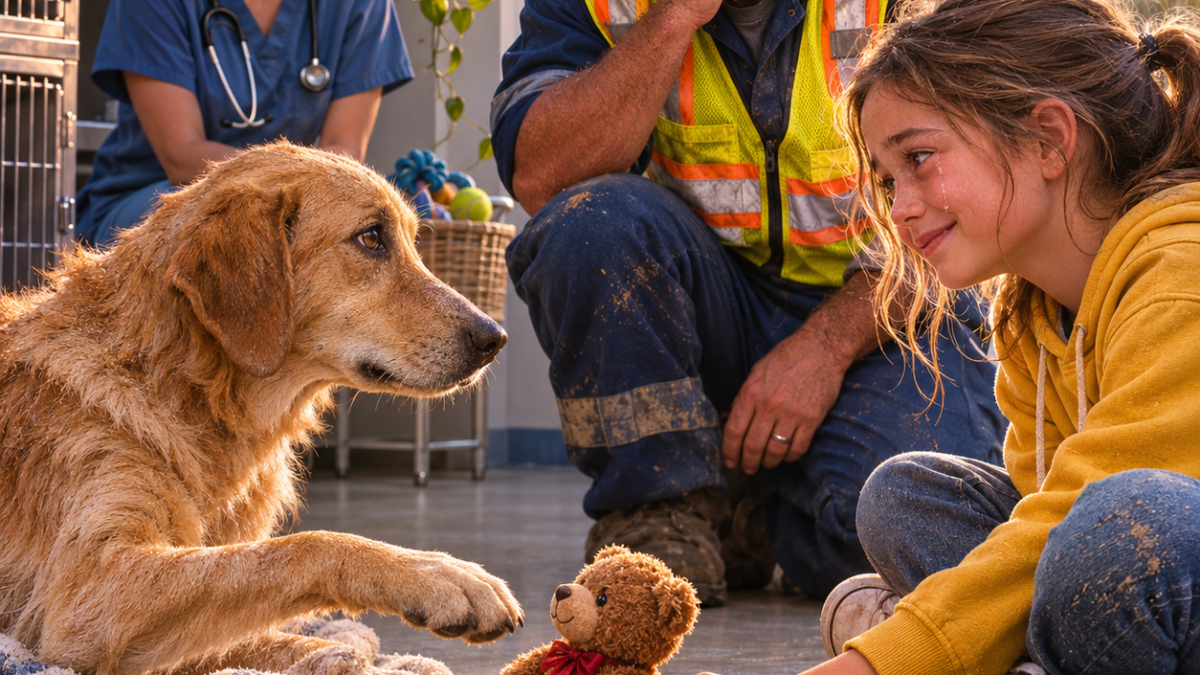
Her hair was pulled into two little pigtails.
She wore pink glasses that kept sliding down her nose.
And she was holding a small stuffed teddy bear with both hands.
The bear was soft and worn, clearly loved for years.
Ella looked up when she saw me.
“Are you Sofia?”
I smiled.
“Yes.”
She stepped closer.
“I’m Ella.”
“I know.”
Her face brightened.
“You do?”
I crouched.
“Your dad has told me a lot about you.”
She looked toward Thomas.
“Did you tell her I was worried about Leo?”
Thomas nodded.
“Every day, sweetheart.”
Ella turned back toward me.
“Is he still scared?”
I thought about the question.
“Sometimes.”
She looked down at her bear.
“Even though you’re nice to him?”
I nodded.
“He’s learning that people can be kind. But learning to feel safe again takes time.”
Ella considered that carefully.
Then she held up the teddy bear.
“This helped me when I was little.”
I smiled.
“Did it?”
She nodded seriously.
“I used to be scared when my room was dark.”
She hugged the bear against her chest.
“My mom said I could hold him until I felt safe.”
I felt something tighten in my throat.
Ella continued.
“So I thought Leo could have him.”
I looked at Thomas.
He was already blinking away tears.
I turned back toward Ella.
“That’s a very kind thing to do.”
She looked down.
“Can I give it to him?”
I smiled gently.
“We’ll see what Leo feels comfortable with.”
She nodded immediately.
“Okay.”
Then she whispered, “I don’t want to scare him.”
We walked toward the quiet room where Leo was resting.
Thomas stayed beside his daughter, holding her hand.
I could see how nervous he was.
The man who had found Leo beside the garbage at 6:47 in the morning was now approaching the same dog more than two weeks later.
But this time, Leo wasn’t lying helpless on the sand.
He had a warm bed.
Regular food.
Medical care.
And enough strength to walk.
I stopped outside the room.
“Remember,” I whispered, “let him decide whether he wants to come closer.”
Ella nodded.
“Like when you meet a shy kid at school.”
I smiled.
“Exactly.”
Thomas gave her hand a gentle squeeze.
Then we entered.
Leo lifted his head.
His eyes moved toward me.
Then toward Thomas.
Then Ella.
His body tightened.
I noticed immediately.
“Easy, Leo.”
He lowered his ears.
For a moment, I wondered whether the visit had come too soon.
Then I sat quietly beside him.
Thomas remained near the doorway.
Ella crouched a comfortable distance away.
She didn’t reach for Leo.
Didn’t rush toward him.
Didn’t squeal.
She simply held the teddy bear in her lap.
“Hi, Leo.”
Her voice was so soft I could barely hear it.
“My name is Ella.”
Leo watched her.
She smiled.
“My daddy found you.”
Thomas swallowed.
Ella continued.
“He told me you were really sick.”
Leo’s ears moved.
“I’ve been thinking about you every day.”
I looked toward Thomas.
Tears were already running down his face.
Ella glanced at the bear.
“I brought you something.”
She carefully placed it on the floor near her, where Leo could investigate it if he chose.
“This is my bear.”
She looked at Leo.
“He helped me when I was scared.”
For several seconds, nobody moved.
Then Ella whispered, “I thought maybe he could help you too.”
I pressed one hand against my mouth.
Leo stared at the little stuffed animal.
Then at Ella.
He shifted his weight.
Took one careful step.
Stopped.
I watched his body language closely.
He was cautious.
But he wasn’t retreating.
Ella remained still.
“It’s okay,” she whispered.
“You don’t have to come if you don’t want to.”
Leo approached the bear.
Sniffed it.
Then lifted his head toward Ella.
She smiled.
“Hi.”
He moved closer.
His nose approached her hand.
She let him sniff.
Then he lifted his muzzle toward her face.
Ella remained calm.
And Leo gave her a small lick on the cheek.
For a moment, she looked stunned.
Then her whole face lit up.
“Daddy.”
Thomas covered his mouth.
“He kissed me.”
I laughed through tears.
“He did.”
Ella slowly turned toward me.
“Does that mean he likes me?”
I looked at Leo.
His body was still relaxed.
His tail moved gently.
I smiled.
“I think he’s comfortable with you.”
Ella looked back at him.
Then whispered, “I’m glad.”
Thomas had been silent through most of the visit.
Now he stepped closer.
His eyes were wet.
Leo noticed him.
For a moment, his ears moved backward.
Thomas stopped immediately.
“Hey, buddy.”
His voice trembled.
“Remember me?”
I looked at Leo.
He studied Thomas.
Then took a cautious step toward him.
Thomas crouched.
He didn’t reach out.
He waited.
Leo approached.
Sniffed his hand.
Then rested his muzzle briefly against it.
Thomas’s face crumpled.
“Oh, Leo.”
He began crying.
For a moment, I thought he might have to step outside.
But he stayed still.
He let Leo decide how much contact he wanted.
And the dog remained beside him.
Thomas looked toward me.
“I found him lying in the trash.”
His voice broke.
“He couldn’t lift his head.”
I nodded.
He looked at the dog.
“And now he’s standing here.”
Tears fell from his chin.
Leo sniffed his hand again.
Thomas laughed through his sobs.
“Look at you.”
He carefully stroked Leo’s neck after the dog remained comfortable with his approach.
“You made it.”
I stood near the wall, unable to speak.
I remembered that first morning.
Thomas kneeling in the sand.
Crying because he thought the dog might die.
Now the same man was kneeling inside a veterinary clinic while Leo stood beside him.
Alive.
Recovering.
And slowly learning not to fear every human touch.
Ella sat near the teddy bear.
Leo returned to her.
Then lowered himself onto the floor at her feet.
She smiled.
“Can he keep it?”
I looked toward the toy.
“Once the clinic confirms it’s safe for him, I think he can.”
Ella nodded.
“Good.”
She gently rested her hand beside him.
Leo’s tail moved.
Thomas looked at me.
And in that moment, I saw something in his face that hadn’t been there on the beach.
Hope.
The adoption conversation began quietly.
There was no dramatic announcement.
No sudden demand.
No emotional speech about destiny.
Just Thomas standing beside me while Ella sat on the floor with Leo.
“Sofia?”
I turned.
“Yes?”
He looked toward his daughter.
“I know he still has a long recovery ahead.”
I nodded.
“He does.”
“And I know taking care of him won’t always be easy.”
I waited.
He swallowed.
“But Ella and I have been talking.”
I looked at him.
“About what?”
He took a breath.
“About bringing him home.”
My heart tightened.
Thomas glanced toward Leo.
“We’ve talked about him every night.”
He smiled faintly.
“Ella says he’s part of our family already.”
I looked toward the little girl.
She was quietly telling Leo about her school.
He lay beside her, listening to the sound of her voice.
Thomas continued.
“I thought she was getting carried away at first.”
He swallowed.
“Then I realized I felt the same way.”
I was quiet.
He looked toward me.
“I found him by accident. But ever since that morning, I can’t stop thinking about what his life could be like if someone gave him a real home.”
His voice trembled.
“Not just food.”
I nodded.
“Not just a roof.”
He looked toward Ella.
“People.”
My throat tightened.
“People who notice when he’s frightened.”
Thomas nodded.
“People who come home.”
He rubbed his face.
“People who won’t give up on him.”
I looked toward Leo.
He had placed his muzzle close to Ella’s teddy bear.
His eyes were half closed.
He looked peaceful.
Not healed completely.
Not free of every fear.
But peaceful.
I took a breath.
“Thomas, I think you and Ella could be wonderful for him.”
His eyes filled.
“Really?”
“Yes.”
I smiled gently.
“But we need to make sure the adoption is appropriate, he’s medically ready, and your family understands what his ongoing care will involve.”
Thomas nodded immediately.
“Whatever it takes.”
I looked at him.
“His digestive system is still recovering. His muscles are rebuilding. And his fear of people may take much longer to improve.”
“I understand.”
“There may be days when he pulls away from you.”
Thomas nodded.
“Okay.”
“Days when a sudden movement frightens him.”
“Okay.”
“Times when he seems to forget that he’s safe.”
Thomas looked toward Leo.
Then back at me.
“Sofia.”
His voice was steady now.
“We can wait.”
I felt tears gathering.
He continued.
“He waited through weeks of hunger and fear. We can give him the time he needs to learn he’s home.”
The weeks that followed were filled with preparation.
Thomas and Ella began visiting the clinic regularly under the care team’s guidance.
Dr. Morrison explained Leo’s nutritional needs.
He still required a carefully managed diet.
His stomach and metabolism needed time to adjust.
His muscles were recovering gradually.
Exercise had to be appropriate to his strength rather than what he seemed eager to attempt on any given day.
Thomas took notes.
Every appointment.
Every instruction.
Every feeding adjustment.
He asked questions about portions, rest, veterinary follow-ups, and signs that Leo might be becoming overwhelmed.
Sometimes I smiled watching him.
The same man who had cried beside a garbage container was now writing down veterinary instructions with the seriousness of someone studying for an exam.
Ella was different.
She didn’t take many notes.
She loved Leo.
Simply.
Patiently.
Without demanding anything in return.
She talked to him softly.
Read aloud while he rested.
Placed his stuffed bear nearby.
And learned to let him come to her when he wanted contact.
One afternoon, Leo moved away from her after a door closed loudly in the hallway.
Ella looked disappointed.
I sat beside her.
“Did I do something wrong?”
I shook my head.
“No.”
She looked toward Leo.
“He went away.”
I nodded.
“Something startled him.”
Ella thought about that.
“Is he mad at me?”
“No, sweetheart.”
I looked toward the dog.
“Sometimes an animal who’s been frightened for a long time needs a little space, even around people he likes.”
Ella was quiet.
Then she nodded.
“Like when I don’t want anybody talking to me after a bad day.”
I smiled.
“That’s a good comparison.”
She looked toward Leo.
“So I should wait?”
“Yes.”
She sat down with her bear.
Then began reading her book aloud.
A few minutes later, Leo returned.
He lay down beside her.
Ella looked toward me.
Her smile was small.
But radiant.
“I waited.”
I nodded.
“You did.”
She returned to her book.
And Leo rested his head near her feet.
One evening, Thomas asked me a question that stayed with me.
“What if he never becomes a normal dog?”
I looked at him.
We were standing outside the clinic while Ella finished saying goodnight to Leo.
“What do you mean by normal?”
Thomas rubbed the back of his neck.
“What if he always gets frightened?”
I thought for a moment.
“Then you’ll learn what helps him feel safe.”
He looked down.
“What if he doesn’t want to play with other dogs?”
“Then he doesn’t need to.”
“What if he never likes being hugged?”
“Then you’ll show him affection in ways he’s comfortable receiving.”
Thomas was quiet.
I continued.
“Leo doesn’t have to become a different dog to deserve a home.”
He looked toward the door.
“Even after everything?”
“Especially after everything.”
His eyes filled.
I took a breath.
“Recovery isn’t about pretending his past never happened. It’s about making sure his future isn’t defined by what someone did to him.”
Thomas swallowed.
Then nodded.
“Okay.”
I smiled.
“And Thomas?”
“Yes?”
“You don’t have to fix every frightened moment.”
He looked at me.
“Sometimes you just need to stay calm, give him space, and let him discover that the people who love him aren’t leaving.”
Thomas looked toward the clinic.
For a long moment, he said nothing.
Then he whispered, “We can do that.”
The day Leo was finally cleared to go home, I cried before Thomas even arrived.
Dr. Morrison had finished his latest examination.
Leo had gained strength.
His nutrition and follow-up plans were in place.
He was eating independently, walking with increasing confidence, and responding positively to the people who had become familiar to him.
There was still healing ahead.
But he no longer required the same level of clinical care.
He was ready for the next part of his recovery.
A home.
I stood beside his bedding that morning, looking at the dog who had arrived from the beach barely able to lift his head.
His coat was cleaner.
His eyes were brighter.
He still had weight to gain, but his body no longer looked quite so painfully fragile.
When I spoke his name, he lifted his head immediately.
“Leo.”
His tail moved.
I knelt.
“Guess what, sweetheart?”
He approached.
I smiled through tears.
“You’re going home.”
He rested his muzzle against my hand.
I stroked him gently.
“Not back to the beach.”
His ears moved.
“Not back to the garbage.”
My voice broke.
“Home.”
Thomas arrived with Ella shortly afterward.
She was practically vibrating with excitement.
But when I reminded her to stay calm around Leo, she took a deep breath and stood very still.
“I’m ready,” she announced.
Thomas smiled.
“So am I.”
He was holding a new leash.
Ella carried a blue collar.
And tucked beneath her arm was the little stuffed bear she’d brought on her first visit.
I looked at the collar.
“What’s that?”
Ella held it up.
“It’s Leo’s.”
I smiled.
“Very nice.”
She nodded proudly.
“I picked blue because it looks good on him.”
Thomas laughed.
“She spent half an hour deciding.”
Ella ignored him.
She looked toward Leo.
“Can we put it on?”
We made sure the collar fit comfortably and the required identification information was attached.
Ella watched every step.
When it was finally in place, she smiled.
“There.”
Leo looked up.
Ella whispered, “Now everybody will know you belong with us.”
My throat tightened.
Thomas looked down.
He was already crying.
I stepped aside for a moment.
Because I knew what that sentence meant.
On the beach, Leo had been lying beside discarded garbage bags.
There had been no one waiting to claim him.
No familiar voice calling his name.
No sign that anyone cared whether he lived or died.
Now an eight-year-old girl was standing in front of him, proud to tell the world he was part of her family.
When it was time to leave, Thomas carefully helped Leo into the vehicle using the safe transport arrangement they’d prepared.
Ella took her place nearby.
She held the stuffed bear close and smiled at him.
Leo looked out through the window.
His eyes found mine.
For a moment, my heart broke.
I’d spent so much time beside him.
So many hours sitting quietly while he learned to trust.
So many mornings wondering whether he would eat.
So many evenings waiting for the smallest movement of his tail.
Now he was leaving.
And even though I knew it was exactly what he needed, saying goodbye hurt.
I stepped closer.
“Hey, Leo.”
He lifted his ears.
I smiled through tears.
“You’re going to have a good life.”
His tail moved.
“Thomas is going to take care of you.”
I looked toward Ella.
“And that little girl is going to love you more than you can imagine.”
Ella grinned.
“I already do!”
I laughed.
“I know you do.”
Thomas looked toward me.
“Thank you, Sofia.”
I shook my head.
“You’re the one who stopped that morning.”
He swallowed.
“You’re the one who saved him.”
I glanced at Dr. Morrison standing near the clinic entrance.
“And a whole team helped him recover.”
Thomas looked toward Leo.
Then smiled faintly.
“I guess we all did.”
I nodded.
“Yes.”
He closed the door carefully.
The engine started.
Leo looked toward me one last time.
I raised my hand.
“Go be happy, sweetheart.”
Then the car pulled away.
I stood outside the clinic until it disappeared around the corner.
And for the first time in weeks, the room where Leo had recovered would be empty.
That evening, I went home to my apartment.
I set my keys on the table.
Took off my shoes.
And sat beside the window.
For a long time, I didn’t turn on the television or open a book.
I kept thinking about the morning Thomas called.
6:47 a.m.
His voice trembling.
The seagulls.
The garbage bags.
The little dog who’d been too weak to lift his head.
Then I remembered the bite.
How frightened Leo had been.
How he’d used the last of his strength to defend himself from the very person trying to rescue him.
I looked down at my hand.
The injury had healed.
But I still remembered the moment.
Then I thought about Leo resting his head on my lap for the first time.
The deep sigh.
The tiny movement of his tail.
The extraordinary feeling of watching an animal decide, after everything he’d endured, to trust someone again.
My phone rang.
Thomas.
I answered immediately.
“Hey.”
His voice sounded different.
Happier.
“Sofia, I have to tell you something.”
I smiled.
“What happened?”
“Leo’s lying beside Ella’s bed.”
I closed my eyes.
He continued.
“Ella didn’t want him to feel alone on his first night.”
My throat tightened.
“So she got down on the floor beside him.”
I laughed softly.
“Of course she did.”
Thomas’s voice grew quieter.
“She fell asleep there.”
I pictured her.
Pink glasses set aside.
Little pigtails loosened.
The teddy bear close by.
Leo resting on his new bed.
Thomas swallowed.
“And Sofia?”
“Yes?”
“Leo put one paw on her hand.”
I went completely still.
“What?”
“He reached over and laid his paw on her hand while she slept.”
Tears filled my eyes.
Thomas was quiet for a moment.
Then said, “It’s like he wanted to make sure she was still there.”
I stared toward the dark window.
Leo had spent so long learning that people might disappear.
That food might disappear.
That safety might disappear.
Now he had a little girl who didn’t want him to spend his first night alone.
I whispered, “Maybe he was checking.”
Thomas sniffed.
“Checking what?”
“That she was real.”
He began crying softly.
I smiled through my tears.
“And that this time, someone would still be there when he woke up.”
A month later, I visited Thomas and Ella.
Their house was small, warm, and full of light.
Children’s toys were scattered across the yard.
A bicycle leaned near the front steps.
And in the sunny grass, on a comfortable dog bed, lay Leo.
For a moment, I stopped walking.
Because I barely recognized him.
He’d gained healthy weight under Dr. Morrison’s continuing guidance.
His coat looked softer.
His ribs no longer stood out so sharply.
His eyes were bright.
And when he heard my voice, he lifted his head immediately.
“Leo?”
He stood.
Then walked toward me.
Not cautiously.
Not fearfully.
His tail was wagging.
I crouched.
“Hey, handsome.”
He approached.
Sniffed my hand.
Then rested his head on my lap.
Exactly as he’d done in the clinic.
Only this time, he wasn’t trembling.
His body was relaxed.
His breathing was calm.
And his tail moved back and forth as I stroked his fur.
I felt tears gathering.
“Look at you.”
He looked up at me.
I smiled.
“You did it.”
Then Ella came running from the house.
“Sofia!”
I laughed.
“Hey, Ella.”
She stopped beside Leo.
“Did you see?”
I nodded.
“He looks wonderful.”
She grinned.
“He can run now!”
My heart softened.
“Can he?”
She nodded enthusiastically.
“We go to the park, and he runs so fast.”
Thomas stepped onto the porch.
“Within the exercise plan,” he added with a smile.
I laughed.
“Good.”
Ella looked toward Leo.
“He still gets scared sometimes.”
I nodded.
“That can happen.”
“But now he knows where his bed is.”
She smiled proudly.
“And if he gets nervous, he comes to us.”
I looked at the dog.
He was standing beside her, leaning gently against her leg.
I swallowed.
“That’s wonderful, Ella.”
She stroked his ears.
“I told you he’d be okay.”
I smiled through tears.
“You certainly hoped he would.”
Ella looked down at Leo.
Then whispered, “I think he knows we love him.”
I couldn’t answer for a moment.
Because watching him stand there beside her, I found it hard to imagine a better ending to the story that had begun on the beach.
Thomas joined me near the porch.
He looked tired.
But this time, he was smiling.
I remembered how he’d sounded during those first late-night phone calls.
“I can’t sleep.”
“I keep seeing his eyes.”
“I can’t stop thinking about him.”
I looked toward him.
“So, Thomas, are you sleeping better now?”
He laughed.
“Not exactly.”
I frowned.
“Why not?”
He pointed toward Leo.
“That dog snores.”
I laughed.
“Really?”
“Like a chainsaw.”
Ella giggled.
“He does!”
Thomas shook his head.
“Some nights, I can hear him from the other end of the house.”
I smiled.
“Sounds terrible.”
“Absolutely terrible.”
He paused.
Then looked toward Leo.
His expression softened.
“But you know something?”
“What?”
“I don’t mind.”
His voice grew quiet.
“When I hear him snoring, I remember that morning on the beach.”
I looked at him.
“I remember thinking he might die before you arrived.”
His eyes filled.
“Now I hear him snoring in the next room.”
He smiled through tears.
“And I know he’s alive.”
I swallowed.
“That’s a pretty good sound.”
Thomas nodded.
“The best.”
Before I left, Thomas walked me to the gate.
Ella was sitting in the grass, telling Leo about her school day.
He lay beside her.
The stuffed bear rested near his front paws.
Thomas stopped.
“Sofia?”
I turned.
“Yeah?”
He looked toward his daughter.
“Can I tell you something?”
“Of course.”
His expression grew serious.
“That morning, when I found him…”
He paused.
“I almost didn’t stop.”
I waited.
“I had a whole section of beach to clean. I was already behind schedule. And when I first saw him near the garbage, I thought he was just another stray I couldn’t help.”
His voice trembled.
“Then his ear moved.”
I looked toward Leo.
Thomas swallowed.
“Just one little movement.”
He wiped his face.
“And I couldn’t walk away.”
For a moment, neither of us spoke.
Then he looked toward Ella.
“Now I can’t imagine our house without him.”
I smiled sadly.
“He’s become part of your family.”
Thomas nodded.
“More than that.”
He looked at me.
“He changed the way I see things.”
I waited.
“I used to think helping meant being able to solve the whole problem yourself.”
His eyes filled.
“But I couldn’t save Leo by myself.”
I nodded.
“I couldn’t treat him. I couldn’t even get him to drink.”
He paused.
“All I could do was stop and call somebody.”
I touched his arm.
“Thomas, that was everything he needed from you in that moment.”
His face crumpled.
I continued.
“You didn’t have to know how to save him.”
I looked toward Leo.
“You just had to notice he needed saving.”
Thomas began crying.
I smiled gently.
“And then you had to refuse to walk away.”
As I drove home that evening, I looked in the rearview mirror.
Thomas stood near the gate.
Ella was beside him.
And Leo stood between them, his tail wagging gently.
For one brief moment, the picture seemed to hold still.
A father.
A daughter.
A dog who’d almost died alone beside the trash.
Now together.
Safe.
Loved.
I thought about how little it had taken for everything to change.
One man noticing an ear move in the sand.
One phone call at 6:47 a.m.
One veterinary team willing to fight for a dog whose condition was terrifying.
One little girl who believed a frightened animal might need her stuffed bear.
And one starving dog who somehow found the courage to trust again.
Leo hadn’t recovered because kindness magically erased what he’d suffered.
His body needed medical treatment.
His strength returned slowly.
His fear required patience.
There were difficult days.
Setbacks.
Moments when he wasn’t ready for someone to come close.
But every day, people showed him that the world could be different.
That food would come again.
That a hand could bring comfort.
That a voice could be gentle.
That a little girl could sit quietly beside him without expecting anything.
And eventually, Leo began to believe it.
I still work in animal rescue.
I still answer emergency calls.
I still encounter animals whose fear or pain is difficult to witness.
Some stories don’t end the way we hope.
Some recoveries take longer than anyone expects.
And some wounds, especially those caused by prolonged neglect, leave traces that never disappear completely.
But whenever I feel overwhelmed, I remember Leo.
The dog whose ribs showed beneath his dirty coat.
The dog who bit me because he was terrified.
The dog who could barely lift his head.
And the dog who, weeks later, walked across a quiet clinic room and rested that same head in my lap.
I remember Thomas crying on the beach.
Then crying again when Leo stood.
Then laughing because the dog he’d once feared would die now snored loudly enough to wake the household.
And I remember Ella.
Eight years old.
Pink glasses.
Two little pigtails.
A worn stuffed bear in her hands.
A child who saw a frightened animal and didn’t ask why he was damaged.
She asked what might make him feel safe.
That question changed everything.
Because Leo didn’t need anyone to pretend his suffering hadn’t happened.
He needed people who would give him a future that looked different from his past.
At 6:47 that morning, Thomas found a dog beside the garbage who was too weak to lift his head and too frightened to trust the hands reaching toward him.
Weeks later, that same dog went home with a little girl who gave him her favorite teddy bear, slept beside his bed, and taught him that love didn’t have to disappear when he closed his eyes.
And when I visited a month later, Leo no longer watched me with the hopeless expression I’d seen on the beach.
He came toward me.
Tail wagging.
Eyes bright.
Then laid his head gently on my lap.
Not because he’d given up.
But because he’d finally learned he could rest.
Leo survived because someone stopped. He healed because people stayed. And he found a home because an eight-year-old girl believed even the most frightened heart deserved to feel safe again.








