“PLEASE, GIRL, DON’T GO BACK! YOUR PUPPIES ARE SAFE NOW!” A Starving German Shepherd With Bleeding Paws Delivered Her Two Freezing Babies to a Navy SEAL, Then Turned Back Into the Deadly Wisconsin Snow — He Followed Her, Never Expecting What Was Waiting Beneath the Trees
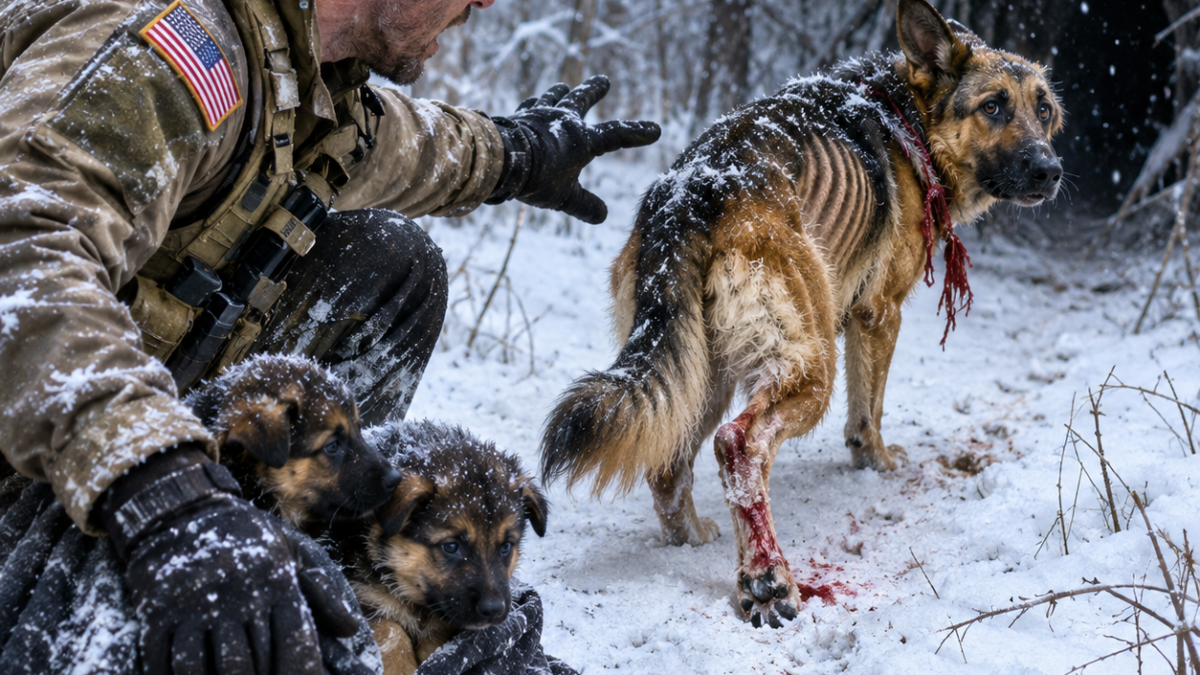
“PLEASE, GIRL, DON’T GO BACK INTO THOSE WOODS! YOU’LL FREEZE TO DEATH!” former Navy SEAL Luke Harris shouted as a starving German Shepherd placed her second half-frozen puppy at his boots, then turned toward the dark Wisconsin forest instead of climbing into his warm truck. Her ribs showed beneath her soaked black-and-tan fur, blood stained the snow beneath one injured paw, and a frayed piece of red yarn hung around her neck—but despite barely having the strength to stand, she refused to abandon whatever was waiting for her among the trees.
Luke had spent years blaming himself for missing his mother’s final days, and after losing the military working dog that once trusted him with its life, he’d sworn never to love another creature he might fail to save; yet now two tiny puppies were struggling to breathe beneath his coat, and their exhausted mother was staring at him with an expression he couldn’t bear to ignore.
Three days later, the same German Shepherd appeared outside Luke’s cabin carrying another piece of red yarn, leading him toward a freezing cabin, a dying seventy-nine-year-old Army nurse, and a collection of letters his mother had written before her death—letters containing a truth Luke had spent years running from, and a final lesson about love that would change four lives forever.
The mother dog didn’t bark.
That was the first thing Luke Harris noticed.
She simply stood in the middle of County Road 7, snow falling across her shoulders, a tiny puppy dangling gently from her jaws.
Luke pressed the brake.
His old black pickup slid several feet before the tires found traction.
The heater rattled.
The windshield wipers scraped across the glass.
And for one terrible moment, Luke thought he was looking at a dead puppy.
Then one little paw moved.
Barely.
A trembling twitch against the mother’s chest.
Luke’s hand tightened around the steering wheel.
“Jesus.”
He opened the driver’s door.
The winter air hit him like a wall.
Snow blew across the empty road.
Pine trees rose on either side, their branches bowed beneath the weight of the storm.
The German Shepherd watched him.
Her ears stood upright, but their tips trembled.
Her coat was wet.
Her hips looked painfully sharp.
And the little creature in her mouth was so small that Luke could have held it in one hand.
He took a slow step toward her.
“Easy, sweetheart.”
The mother stiffened.
Luke stopped.
“I’m not going to hurt you.”
For several seconds, neither moved.
Then the dog advanced.
One step.
Another.
A third.
She lowered her head.
And placed the puppy directly in front of Luke’s boots.
He crouched immediately.
The puppy was black and tan, perhaps six or seven weeks old.
His muzzle was cold.
His paws barely moved.
Luke slipped two fingers gently against the tiny rib cage.
There.
A heartbeat.
Weak.
But unmistakable.
He closed his eyes for half a second.
“Okay, little man.”
His voice shook.
“I’ve got you.”
He lifted the puppy and carried him toward the truck.
The mother followed until Luke reached the open passenger door.
Then she stopped.
Luke placed the puppy on the seat, wrapped him in his heavy coat, and turned back.
“Come on, girl.”
He held out his hand.
“There’s room for you too.”
She didn’t move.
Instead, she looked toward the forest.
Then back at him.
Luke frowned.
“What is it?”
The dog suddenly turned.
And disappeared between the pines.
“Hey!”
Luke took two steps after her.
Then stopped.
The puppy was in his truck.
Freezing.
Barely breathing.
He couldn’t leave him alone.
So he climbed into the cab, turned the heater higher, and cupped his hands around the little body.
The puppy made a sound.
So faint Luke almost missed it.
A thin whimper.
The sound of something that hadn’t given up yet.
Luke swallowed.
“That’s right.”
He rubbed the puppy gently through the coat.
“Stay with me.”
He waited.
Five minutes.
Then seven.
Snow accumulated on the windshield.
The road remained empty.
Luke kept looking toward the trees.
He told himself the mother had abandoned the pup because she was frightened.
Perhaps she’d been starving for days.
Perhaps she was injured.
Perhaps she had no idea how to survive the storm.
Then he saw movement.
A dark shape emerged between the pines.
The mother.
She was carrying another puppy.
Smaller than the first.
Darker along the back.
Its head hung limp.
Luke was out of the truck before she reached the road.
“No, no, no.”
He knelt.
The mother approached slowly.
Her legs shook.
For a moment, Luke thought she would collapse.
Instead, she lowered her head.
Placed the second puppy beside him.
Then pushed the tiny body forward with her nose.
Luke lifted it.
It felt frighteningly cold.
He pressed it against his chest.
“Come on, buddy.”
No movement.
“Please.”
Then a tiny breath brushed against his fingers.
Luke nearly cried.
He carried the second puppy into the truck and placed him beside his brother.
Then turned toward their mother.
“Now you.”
He opened the door wider.
“All three of you. Come on.”
The German Shepherd stepped closer.
For one beautiful second, Luke believed she would climb inside.
Her eyes moved toward the puppies.
Her nose lifted.
She sniffed the air.
Her whole body seemed to lean toward the warmth.
Then she looked over her shoulder.
Toward the forest.
Again.
Luke felt frustration rising.
“What is back there?”
He stepped forward.
The dog gave a low growl.
He stopped immediately.
She wasn’t baring her teeth.
She wasn’t lunging.
She was simply refusing.
A boundary.
A warning.
And perhaps a plea he couldn’t understand.
Luke lowered his hand.
“All right.”
His throat tightened.
“I won’t force you.”
The mother stared at him.
Snow gathered on her ears.
A frayed red thread fluttered against her neck.
Luke noticed the yarn then.
A loose knot.
Deep crimson.
Something about it stirred an old memory.
A kitchen table.
His mother’s hands.
A ball of red wool.
But before he could understand why, the dog turned.
She looked back once.
Then disappeared into the woods.
Luke stood in the snow.
Two puppies were waiting in his truck.
Their mother was vanishing into a storm that could kill her before sunset.
And every instinct in his body screamed at him to follow.
But the smaller puppy gave a faint, desperate cry.
Luke turned.
He knew he couldn’t save everyone by standing in the road.
He hurried back to the truck.
Closed the door.
Gathered the puppies beneath his coat.
Then whispered, “I’m sorry, girl.”
His voice broke.
“I have to get these two warm first.”
He started driving.
But as the forest disappeared in his rearview mirror, he couldn’t stop seeing the mother dog’s exhausted eyes.
She hadn’t looked relieved when he took her babies.
She’d looked as though she was asking him to finish something.
And Luke Harris, a man who had survived combat and spent years refusing to let anyone close enough to need him, felt a fear he knew far too well.
He was afraid he’d just left somebody behind.
PART2
The road to Ironwood Falls disappeared beneath drifting snow.
Luke drove carefully.
The smaller puppy lay tucked against his right side, wrapped in the coat he’d taken off moments earlier.
The larger puppy was moving a little now.
He made weak, irritated noises whenever his brother pressed too close.
Luke would have laughed under different circumstances.
Instead, he kept glancing down, watching their breathing.
“Stay with me.”
He tightened his grip on the steering wheel.
“Both of you.”
The heater worked harder than the old truck seemed capable of handling.
Warm air blew across the windshield.
The puppies remained frighteningly cold.
Luke knew enough about hypothermia to understand that bringing a body from freezing conditions into warmth wasn’t the same as making it safe.
These little animals needed professional help.
Quickly.
He pressed the accelerator gently.
The truck moved through the storm.
And Luke began remembering another winter.
Another desperate journey.
Another life he hadn’t been able to save.
Luke Harris was forty-five years old.
A former Navy SEAL.
Broad-shouldered, physically strong, with dark brown hair graying at the temples and a closely trimmed beard.
He had the weathered face of a man who’d spent too many years outdoors and too many nights sleeping badly.
People in Ironwood Falls considered him dependable.
If a neighbor’s fence collapsed, Luke repaired it.
If a tree blocked a driveway, he brought his chainsaw.
If somebody’s truck wouldn’t start, he appeared with jumper cables.
He never asked for payment.
Rarely stayed for coffee.
And almost always left before anybody could ask how he was doing.
He lived alone in a small cabin outside town.
The rooms were clean.
Organized.
Quiet.
Painfully quiet.
Luke liked telling people he preferred it that way.
There was nobody to disappoint.
Nobody to lose.
Nobody waiting for promises he might not be able to keep.
At least, that was what he told himself.
Years earlier, he’d served alongside military working dogs in dangerous places.
He’d learned to trust animals that couldn’t speak but could recognize danger before a man understood what was happening.
He remembered their intelligence.
Their discipline.
Their loyalty.
And the terrible helplessness of watching one of those partners die despite everything he’d done to save it.
The loss had stayed with him.
Not because dogs mattered more than people.
Because trust was trust.
And when an animal placed its life in your hands, you felt the weight of that responsibility long after the animal was gone.
Luke had promised himself he wouldn’t bring another dog home.
No more food bowls.
No more excited footsteps.
No more familiar breathing beside the bed.
No more love with four legs that might disappear.
It was easier to live without something than to risk losing it again.
Or so he believed.
The person he’d lost most painfully was his mother.
Eleanor Harris.
She’d died before Luke returned from his final deployment.
He hadn’t been beside her.
Hadn’t held her hand.
Hadn’t heard her last words.
By the time he came home, other people had already arranged the funeral and tried to explain what happened.
Everyone spoke gently.
Everyone told him she was proud of him.
Everyone insisted she’d understood why he couldn’t return.
But the words never reached the part of him that hurt.
He remembered the empty chair at her kitchen table.
The mug she used every morning.
The blue cardigan hanging beside the door.
And the unfinished red scarf she’d been knitting.
Before Luke left, she’d held up the growing length of wool and laughed.
“A man who runs toward trouble still needs something warm when he comes home.”
He’d kissed the top of her head.
“Finish it before I get back.”
She smiled.
“I’ll try.”
Luke had promised he’d return before winter settled in.
He didn’t.
And for years afterward, he carried that broken promise as though it were proof that he had failed the one person who always waited for him.
His mother used to say that a house without something to care for became a cave.
Luke remembered that sentence often.
Usually when he entered his empty cabin.
Usually when he caught himself speaking aloud simply to break the silence.
That winter morning, he’d been driving into town to buy coffee, kerosene, nails, and a replacement hinge.
His handwritten shopping list lay folded in the console.
At the bottom, almost by accident, he’d written:
Dog food.
Then he’d crossed it out so violently the pen nearly tore the paper.
He hadn’t owned a dog in years.
He didn’t intend to.
Yet perhaps some part of him had been remembering what his life once felt like when another creature depended on him.
Now two puppies were trembling beneath his coat.
And their mother was somewhere in the forest.
The Pine Ridge Animal Clinic stood near the edge of town.
A squat brick building.
Green metal roof.
Wooden sign shaped like a paw print.
Yellow light in the windows.
Luke pulled into the parking lot.
Stopped crookedly near the entrance.
Then gathered the puppies in his arms.
He pushed through the door.
A little bell rang overhead.
The waiting room smelled of disinfectant, damp coats, and dog biscuits.
Behind the counter stood Dr. Karen Wells.
Fifty years old.
Tall and lean.
Copper-brown hair streaked with gray and secured in a practical knot.
She wore square glasses, green scrubs, and a cream cardigan.
Her expression was serious.
But when she saw the bundle in Luke’s arms, her face changed instantly.
“Exam room.”
She stepped around the counter.
“Now.”
Luke followed.
Karen spread warmed towels across the examination table.
“Set them down.”
Luke hesitated.
He’d carried the puppies against his chest for nearly half an hour.
Handing them over felt strangely difficult.
Karen noticed.
“Luke.”
He looked at her.
“I need to examine them.”
He nodded.
Then carefully placed the puppies on the towels.
The larger one immediately attempted to crawl toward him.
A tiny paw reached across the metal table.
Luke swallowed.
Karen looked down.
“Well, somebody’s still got opinions.”
The puppy made a weak complaining sound.
The smaller one barely moved.
Karen’s expression became more serious.
She examined both animals.
Checked their temperature.
Hydration.
Gums.
Breathing.
Weight.
Then looked toward Luke.
“Both male.”
He nodded.
“German Shepherds. Six or seven weeks old.”
“Will they make it?”
Karen didn’t answer immediately.
That frightened him.
She touched the smaller puppy’s chest.
Then said, “They’re hypothermic and underfed.”
Luke stared.
“The smaller one is in worse condition.”
He swallowed.
“But he’s breathing.”
Karen nodded.
“And we’re going to work with that.”
She began controlled warming and supportive care.
A veterinary technician joined her.
They worked carefully, adjusting the treatment to the puppies’ condition.
Luke stood near the wall.
His hands remained empty at his sides.
He hated feeling useless.
He’d been trained to respond to emergencies.
To make decisions.
To carry people through dangerous situations.
Now his entire world seemed focused on two tiny bodies on a table.
And there was very little he could do except wait.
The smaller puppy twitched.
Luke took a step forward.
Karen looked up.
“Easy.”
He stopped.
She gently supported the puppy.
Then checked his breathing again.
After a moment, she nodded.
“Still with us.”
Luke exhaled.
He hadn’t realized he’d been holding his breath.
Karen glanced toward him.
“You look worse than he does.”
He gave a short, humorless laugh.
“Thanks.”
She almost smiled.
Then continued working.
Finally, she asked how he’d found them.
Luke told her.
The snowy road.
The mother dog.
The first puppy.
Her disappearance.
The second puppy.
And the way she refused to enter the truck.
Karen listened without interrupting.
When he finished, she looked toward the window.
“Interesting.”
Luke stared.
“Interesting?”
He sounded angry.
“She walked into the woods in the middle of a blizzard.”
Karen nodded.
“I heard you.”
“She was starving.”
“Yes.”
“And she wouldn’t let me help her.”
Karen looked at him.
“Luke, a mother dog doesn’t carry her puppies into a road because everything is going well.”
He fell silent.
She continued.
“Something was wrong.”
He stared toward the puppies.
“Injured?”
“Possibly.”
“Lost?”
“Maybe.”
Karen considered.
“Or she may have had somewhere she needed to return.”
Luke’s eyes narrowed.
“What does that mean?”
Karen shook her head.
“I don’t know yet.”
Then she added, “But I wouldn’t assume she abandoned them.”
The larger puppy began trying to chew the corner of his towel.
Karen sighed.
“Oh, you’re going to be trouble.”
Luke looked down.
Despite himself, the corner of his mouth moved.
The puppy sneezed.
Then attempted to bite his own paw.
Luke almost laughed.
The smaller one remained quiet.
He shifted slightly toward Luke’s hand when Luke leaned closer.
His nose pressed against Luke’s wrist.
For a second, Luke froze.
The tiny animal was seeking warmth.
Trusting him.
Without knowing who he was.
Or what kind of man he used to be.
Luke allowed his hand to remain.
The puppy settled against it.
Karen watched.
Then quietly returned to her work.
After several hours, both puppies were more stable.
Karen explained the feeding instructions and ongoing care they would require.
They weren’t out of danger.
But they had a chance.
She offered to keep them at the clinic while they recovered.
Luke looked toward the two little animals.
Then said too quickly, “I’m not adopting them.”
Karen raised one eyebrow.
“I didn’t say you were.”
He folded his arms.
“I can take them for one night.”
She nodded.
“One night.”
“After that, you find somebody.”
“All right.”
“Somebody with a fenced yard.”
“Of course.”
“And patience.”
Karen looked at the larger puppy, who was now wrestling a corner of his towel.
“Plenty of that.”
Luke nodded firmly.
“One night.”
Karen didn’t argue.
She simply handed him the feeding instructions.
Then said, “A surprising number of families begin with one night.”
By evening, Luke drove home with a box lined in warm towels, carefully prepared puppy supplies, and instructions written in Karen’s practical handwriting.
He carried the box into his cabin.
Set it in a safe, warm area near the wood stove.
Then stood looking at it.
For years, the cabin had been silent.
Now the larger puppy was complaining.
The smaller one was making faint little noises.
Luke set down the supplies.
Took off his wet boots.
And crouched.
“All right.”
He stared at them.
“I don’t know what your mother was thinking.”
The larger puppy tried climbing over his brother.
Luke gently moved him back.
“But apparently she thinks I can handle you.”
He looked around the cabin.
The clean floors.
The neatly arranged furniture.
The empty space beside the stove.
Then he sighed.
“She may have made a terrible mistake.”
That night, Luke fed the puppies according to Karen’s instructions.
The larger one fought every attempt to hold him still.
He tried biting the feeding equipment.
Then the towel.
Then Luke’s sleeve.
The smaller puppy required more patience.
Luke spoke quietly while feeding him.
Sometimes the little animal turned away.
Sometimes he seemed too tired.
Luke slowed down and followed the veterinarian’s guidance.
Eventually, both settled.
Luke sat on the floor beside the box.
His back rested against the sofa.
The wood stove crackled.
Outside, snow struck the windows.
He listened to the puppies breathing.
And remembered the sound of a military working dog sleeping beside him years earlier.
His chest tightened.
He told himself he was only keeping the puppies alive.
Nothing more.
But when the smaller puppy stirred and made a frightened sound, Luke reached into the box.
The tiny body pressed against his hand.
And Luke stayed there until the puppy fell asleep again.
Meanwhile, across Ironwood Falls, another woman was beginning to worry.
Helen Brooks was seventy-two.
She owned Brooks Secondhand and Sundries, a narrow shop near the center of town.
For twenty-three years, she’d sold old books, repaired lamps, mismatched dishes, forgotten Christmas decorations, and small household things people didn’t want to throw away.
She had a reputation for rescuing objects that looked beyond repair.
And people who felt much the same way.
She was short and slightly stooped, with white hair pinned in a loose bun, round glasses, warm brown skin, and gray eyes that missed very little.
That morning, when she unlocked the shop, a brown paper bag had been waiting on the doorstep.
Snow covered the top.
Helen brought it inside.
Opened it.
And stopped breathing.
Inside was a ball of old red yarn.
The deep crimson shade she remembered from Eleanor Harris’s unfinished scarf.
Beneath it lay a folded note.
The handwriting was unsteady.
“If the dog brings her pups to town, don’t make her stay.”
Helen read the sentence twice.
Then sank into the chair behind her counter.
Because she recognized something about the handwriting.
And she knew only one woman in Ironwood Falls who would leave a message like that.
Ruth Miller.
Ruth was seventy-nine years old.
A retired Army nurse.
She lived alone near Loon Ridge Road.
She had spent her life taking care of soldiers, children, injured farm animals, and neighbors who needed help but were too proud to ask.
She had been Eleanor Harris’s close friend.
And for months, she had barely been seen in town.
Helen had called.
Sometimes Ruth answered.
Sometimes she didn’t.
Whenever Helen offered to visit, Ruth insisted she was fine.
That was Ruth.
Stubborn.
Independent.
Fiercely private.
A woman who would rather drag a sack of firewood across her porch than admit she needed somebody to carry it.
Helen looked toward the note.
Then at the yarn.
A cold feeling settled in her stomach.
Something was wrong on Loon Ridge Road.
And Ruth was trying to tell her without admitting it directly.
That Wednesday, Helen carried the bag to the church basement.
Six women sat around a long table, knitting and drinking coffee.
Among them was Martha Lane.
Eighty-one.
A retired third-grade teacher.
Small and sharp-eyed, with a long silver braid pinned around her head and a habit of saying exactly what she thought.
Helen placed the note before her.
“Martha, look at this.”
Martha adjusted her glasses.
Read it.
Then frowned.
“That looks like Ruth’s handwriting.”
Helen nodded.
“I thought so.”
Martha looked toward the yarn.
Then slowly lifted the red ball.
For a moment, her expression softened.
“Eleanor’s color.”
Helen nodded again.
The two women sat quietly.
Then Martha said, “We need to find out what’s happening.”
By the third night, the puppies had begun changing Luke’s cabin.
There were towels everywhere.
A water bowl near the stove.
Puppy supplies on the kitchen counter.
A small basket of toys Karen had insisted he take.
And two creatures who seemed determined to make him forget what a peaceful house sounded like.
The larger puppy had developed a habit of waking whenever Luke sat down.
The smaller one preferred to curl against something warm.
Luke told himself he wasn’t attached.
He repeated it while preparing formula.
While changing bedding.
While carrying the box from one warm room to another.
While staying awake long after midnight to make sure both puppies were breathing comfortably.
He was not attached.
Absolutely not.
Then, just before dawn, the larger puppy began barking.
A tiny, high-pitched sound.
Luke sat upright.
“What?”
The puppy barked again.
His brother lifted his head.
Both were staring toward the front door.
Luke went still.
He heard something.
Not a knock.
Not a human voice.
A faint scratching sound.
He stood.
Crossed the room.
And looked through the window.
Then his heart stopped.
The German Shepherd mother was standing on his porch.
Snow covered her back.
Her brown eyes were fixed on the puppies.
And in her mouth was a short piece of red yarn.
Luke opened the door slowly.
Cold air rushed into the cabin.
“Hey, girl.”
His voice softened immediately.
“You found us.”
The mother didn’t enter.
She stepped forward.
Lowered her head.
And placed the yarn on the threshold.
Luke looked down.
A short, frayed piece.
The same deep red color as the thread around her neck.
Then she looked past him.
Toward the puppies.
The larger one began whimpering.
The smaller puppy tried climbing out of the box.
Luke turned toward them.
Then back at the mother.
“Come inside.”
He stepped away from the doorway.
“Please.”
For one moment, she moved closer.
Her nose lifted.
She smelled her puppies.
The warmth.
The food.
The safe shelter.
Then she stopped.
Her eyes moved toward the forest.
Again.
Luke felt his throat tighten.
“What is it?”
The dog stared at him.
Then took one step backward.
And another.
She turned toward the trees.
Looked back.
Waited.
Luke stood motionless.
For three nights, he’d been asking himself why she refused to stay.
Now he began wondering whether he’d been asking the wrong question.
Perhaps she wasn’t trying to leave her puppies behind.
Perhaps she was trying to show him where she needed to go.
He stepped onto the porch.
The cold bit into his bare feet.
“Wait.”
The dog paused.
Luke looked toward the puppies.
Then the yarn.
Then the dark forest.
He took a breath.
“All right, girl.”
His voice trembled.
“I’ll follow.”
The mother watched him.
For a moment, her ears lifted.
Then she turned.
And disappeared between the trees.
Luke stood in the doorway.
The red yarn lay at his feet.
Behind him, two puppies began crying for their mother.
And somewhere in the darkness, a third life might be running out of time.
Luke didn’t go after her immediately.
Every instinct told him to put on his boots, grab a flashlight, and follow the tracks before the snow buried them.
But the puppies were still recovering.
The smaller one especially.
Charlie—though Luke hadn’t named him yet—needed regular feeding and careful monitoring.
Leaving two vulnerable animals unattended for hours would have been reckless.
He stood over their box, frustrated.
The larger puppy looked up at him.
Then sneezed.
Luke sighed.
“You two picked a hell of a time to need a babysitter.”
The puppy tried to chew his finger.
For the first time that morning, Luke laughed.
A brief sound.
Surprised.
Then he reached for the phone.
Dr. Karen Wells answered after the fourth ring.
“Pine Ridge Animal Clinic.”
“Karen.”
“Luke?”
“The mother came back.”
Silence.
Then she asked, “Is she there now?”
“No.”
Luke looked toward the door.
“She left another piece of red yarn.”
Karen hesitated.
“Another?”
“There’s thread around her neck. She brought me a separate piece last night.”
He heard paper rustling.
Then she asked, “Did you follow her?”
“Not yet.”
“Good.”
Luke frowned.
“Good?”
“Those puppies still need care. Bring them in before you start searching through the woods.”
He looked toward the box.
“I was thinking the same thing.”
Karen seemed surprised.
“Well.”
“What?”
“Nothing. You’re learning.”
Luke almost smiled.
Later that morning, he delivered the puppies to the clinic.
The larger one protested the entire trip.
The smaller puppy lay quietly against his brother.
Luke carried them inside.
Karen examined them and checked their progress.
The larger pup was improving.
His body temperature had stabilized.
He was beginning to show a healthy appetite.
And he seemed determined to argue with every towel Karen placed around him.
The smaller puppy remained more delicate.
But there were encouraging signs.
He was warmer.
More responsive.
And when Luke leaned close, the little animal lifted his head toward the familiar scent.
Luke’s throat tightened.
Karen noticed.
“Getting attached?”
He looked away.
“No.”
She raised one eyebrow.
“Of course not.”
Before Luke left, Karen asked whether he’d seen anything that might identify the mother.
He described the red yarn.
The location on County Road 7.
Her condition.
The way she returned repeatedly to the forest.
Karen listened.
Then said, “Luke, if she belongs to somebody living out there, that person might need help too.”
He nodded.
That was exactly what had been troubling him.
A dog carrying puppies through deep snow was extraordinary enough.
A mother dog deliberately returning to the same stretch of forest after leaving them with a stranger suggested that something remained unresolved.
He couldn’t prove she was seeking human help.
But the possibility was too important to ignore.
Luke packed carefully.
Flashlight.
First-aid kit.
Emergency blanket.
Water.
Food.
Spare gloves.
Rope.
A portable radio.
And a map of the back roads north of town.
He put on his brown winter coat over his faded green-gray-brown Navy working uniform.
The uniform had once made him feel prepared for almost anything.
Now he was chasing a starving dog into the woods without knowing what he would find.
He hated the uncertainty.
But he’d learned something during his years of service.
Sometimes refusing to move because you don’t know the whole situation is a decision too.
And sometimes it is the wrong one.
The place where the mother dog first appeared looked different in daylight.
Snow covered most of Luke’s tire tracks.
The road seemed narrower.
The woods darker.
He parked safely off the roadway and stepped outside.
The wind had weakened.
Snow still fell, but the flakes were smaller.
Luke crouched near the ditch.
There.
Paw prints.
Partly filled with fresh snow.
One set led toward the road.
Another returned to the forest.
He studied the marks.
Then began following them.
The trail led through a gap in an old fence.
Past a sagging wire gate.
And into a stand of pines where the snow was deep enough to slow every step.
Luke moved carefully.
The mother dog had passed through more than once.
There were places where her paws had slipped.
Places where she’d paused.
Places where the snow showed a shallow impression suggesting she’d lowered her body to rest.
He thought about the puppies.
One in her mouth.
The other waiting somewhere in the cold.
She’d carried the first to the road.
Returned.
Carried the second.
Then returned to the woods again.
Every journey must have cost her strength she couldn’t afford to lose.
Luke looked toward the trees.
“Where were you going, girl?”
The forest gave no answer.
After nearly half a mile, he reached an abandoned rail line.
The tracks were rusted.
Half-buried beneath snow.
An old farm shed stood nearby.
Its boards were gray.
One door hung crookedly from a damaged hinge.
The roof bowed beneath the weight of ice.
Luke approached carefully.
Inside, the air smelled of damp wood and old hay.
He swept his flashlight across the floor.
Then stopped.
Black-and-tan fur clung to a splintered board.
A piece of burlap had been flattened into a rough nest.
There were paw prints.
A torn blanket.
An overturned can.
And several tiny scraps of red yarn caught on exposed nails.
His heart began pounding.
The mother had been here.
With her puppies.
But this didn’t look like a place she could survive for long.
The shelter was barely standing.
Cold air came through the gaps.
Snow had drifted inside.
Luke crouched beside the torn blanket.
For a moment, he imagined the dog curled around her puppies.
Using her body to keep them warm.
Hungry.
Exhausted.
Waiting for a chance to find help.
He closed his eyes.
Then whispered, “You did everything you could.”
Near the back wall, he found a pair of women’s gloves.
Brown wool.
Worn thin at the fingertips.
One button missing.
Beside them lay an orange prescription bottle.
Empty.
The label was damaged.
Most of the name had been scratched away.
But one word remained visible.
Ruth.
Luke frowned.
He knew someone named Ruth.
Ruth Miller.
An elderly woman who’d been close to his mother.
He hadn’t spoken with her in years.
After Eleanor died, Ruth had tried calling him.
He remembered that.
She’d left messages.
Sent a card.
Asked him to visit.
Luke had never answered properly.
At the time, he told himself he couldn’t bear talking about his mother.
Now he was looking at a prescription bottle in a freezing shed, wondering whether avoiding Ruth had been another way of leaving someone alone.
He continued searching.
Behind a cracked feed bin was a folded scrap of paper.
A few words were written in trembling handwriting.
Loon Ridge Road.
Luke stared.
Ruth lived near Loon Ridge.
He remembered driving past her cabin years earlier.
A small wooden house beneath tall trees.
A garden.
An old mailbox.
He turned the paper over.
Nothing.
Then the flashlight illuminated marks on the wall.
At first, he thought they were scratches.
Then he moved closer.
Letters.
Carved into the wood.
Uneven.
Hurried.
Tell Luke the scarf was never finished.
For several seconds, he couldn’t move.
The flashlight trembled in his hand.
He read the sentence again.
Then again.
His mother’s scarf.
The red yarn.
The unfinished gift.
He reached toward the words.
Touched the rough grooves with two fingers.
And suddenly he was no longer a forty-five-year-old veteran standing in an abandoned shed.
He was a younger man in his mother’s kitchen.
Eleanor sat near the window.
Her blue cardigan hung loosely around her shoulders.
The red yarn lay across her lap.
She looked up.
Smiled.
Then said, “You know, Luke, somebody should teach you that coming home isn’t a weakness.”
He remembered laughing.
Promising he’d return.
And leaving.
He pressed his hand against the wall.
His throat closed.
“Mom.”
The word barely escaped.
A sound came from outside.
Luke turned.
At the edge of the trees stood the mother German Shepherd.
Snow dusted her coat.
Her eyes remained fixed on him.
For a moment, he couldn’t breathe.
Then he stepped toward her.
“Ruth?”
The dog’s ears lifted.
Luke pointed toward the woods.
“Is she out there?”
Of course the dog couldn’t answer his question.
But she turned.
Walked several yards.
Then looked back.
Luke followed.
Not recklessly.
He kept his bearings.
Checked the terrain.
And watched the light.
The mother dog moved ahead at a distance, occasionally disappearing between the trunks.
Then she would reappear.
Always looking back.
Always waiting long enough for him to keep following.
Luke wasn’t certain whether she understood what he was doing.
But he understood something about her now.
She wasn’t wandering aimlessly.
She was moving between places she knew.
And the trail was leading him toward Loon Ridge Road.
By late afternoon, the snow began falling harder.
Luke realized he couldn’t safely continue much farther without risking becoming lost after dark.
He marked the route.
Checked his position.
Then reluctantly turned toward his truck.
The mother dog remained between the trees.
Luke stopped.
Looked back.
And whispered, “Tomorrow.”
His voice tightened.
“I’ll come back tomorrow.”
He hoped it would be soon enough.
In town, Helen Brooks had reached a similar conclusion.
The note.
The red yarn.
Ruth’s absence.
The stories about a German Shepherd seen near County Road 7.
Everything pointed toward Loon Ridge.
Helen called several neighbors.
Nobody had seen Ruth recently.
One person recalled that her truck hadn’t moved for weeks.
Another said there had been no smoke from the chimney the last time he passed.
Helen’s stomach tightened.
She called Dr. Karen Wells.
Karen listened.
Then asked one question.
“Does Ruth have a German Shepherd?”
Helen closed her eyes.
“Yes.”
A pause.
“Her name is Maggie.”
Karen went silent.
Then asked, “Is she black and tan?”
“Yes.”
“About five years old?”
“I think so.”
Karen took a breath.
“Helen, I think we need to check on Ruth immediately.”
Luke received the call while preparing another feeding for the puppies.
When Karen told him what Helen had discovered, he went still.
“Maggie.”
He looked toward the window.
The mother finally had a name.
Not just a starving dog.
Not simply an animal moving through the forest.
Maggie.
Somebody’s companion.
Somebody’s family.
And that somebody might be alone in a freezing cabin.
Luke set down the bottle.
“I found a prescription container with Ruth’s name.”
Karen’s voice sharpened.
“Where?”
“An abandoned shed near the old rail line.”
He swallowed.
“And a note with Loon Ridge Road on it.”
Karen was silent for a moment.
Then said, “Luke, you need to tell Deputy Price everything you’ve found.”
He nodded.
“I will.”
Deputy Allen Price had served the area for twenty-eight years.
Broad-shouldered.
Balding.
Gray mustache.
A calm voice.
He knew the roads.
The farms.
The families.
And the older residents who sometimes refused help until circumstances became dangerous.
When Luke explained the situation, Allen didn’t dismiss it.
He arranged for a welfare check and help navigating the road.
The weather and darkness limited what they could safely do that evening.
But they began coordinating.
Luke spent the night staring at the clock.
Every hour seemed too long.
He remembered Eleanor’s empty chair.
How he’d arrived too late.
How Ruth had been one of the people who tried to comfort him afterward.
And he couldn’t bear the thought of another woman sitting alone in a cold house while he waited somewhere warm.
At first light, Luke returned to Loon Ridge Road.
The snow had stopped.
The sky was pale.
The pines stood motionless.
Karen had arranged continued care for the puppies.
Allen knew where Luke was going.
And this time, he had a clear destination.
The small cabin appeared beyond a narrow curve.
Its roof was covered in snow.
A blue tarp hung loosely over the woodpile.
One window had been patched with cardboard.
And the chimney showed no smoke.
Luke felt his chest tighten.
No smoke.
In this weather.
He stopped the truck.
Stepped outside.
And heard a faint sound.
A low bark.
Then movement near the porch.
Maggie emerged from behind the cabin.
Her tail remained low.
Her fur was rough.
But when she saw Luke, she approached.
Not close enough to let him touch her.
Only close enough to be certain he’d noticed.
Then she turned toward the front door.
Pressed one paw against it.
And looked back.
Luke swallowed.
“All right, girl.”
He approached.
The door wasn’t fully closed.
He knocked.
“Ruth Miller?”
Nothing.
He tried again.
“Ruth? It’s Luke Harris.”
Silence.
Then, from somewhere inside, came a voice.
Thin.
Dry.
Impatient.
“If you’re selling something, I already bought too much life.”
Luke stopped.
For one second, he nearly laughed.
Then he pushed the door open.
And found a woman who had spent her entire life caring for others slowly freezing in her own home.
Ruth sat in a worn armchair beneath two quilts.
Her iron-gray hair had been cut unevenly.
Her cheeks were pale.
Her hands trembled.
The stove had gone cold.
Beside her stood a metal cane.
A stack of old medical books.
An empty water glass.
And several prescription bottles.
Maggie hurried toward her.
Placed her head on Ruth’s knee.
And closed her eyes.
Ruth lowered one trembling hand onto the dog’s ears.
“There you are.”
Her voice broke.
“Maggie.”
Luke stood motionless.
The room was so cold he could see his breath.
He looked toward the wood box.
Nearly empty.
Then toward Ruth.
“You need medical help.”
She lifted her chin.
“I was a nurse before you were a bad idea in boots.”
Under different circumstances, Luke would have laughed.
Instead, his eyes filled.
Because even now, weak and shivering, Ruth sounded like the formidable woman who used to argue with Eleanor across the kitchen table.
He crouched beside her.
“Ruth.”
She looked at him.
For a long moment, her expression didn’t change.
Then her eyes softened.
“Luke Harris.”
He nodded.
She studied his face.
And whispered, “Your mother would’ve been glad you came.”
Luke had to look away.
Ruth told him what happened.
First came the illness.
Fever.
Weakness.
Exhaustion.
Then the generator failed.
She tried to keep the wood stove burning.
But the firewood ran low.
She became too weak to drive.
Too weak to carry more wood.
Too stubborn to admit she needed help until it was almost too late.
Maggie had given birth during the storm.
Two puppies.
Both small.
Both vulnerable.
For two days, the cabin held only cold, hunger, and four living creatures struggling to stay warm.
Ruth shared what little food she could.
Maggie refused to eat until her puppies had fed.
The weather worsened.
The stove grew cold.
And Maggie began pacing toward the door.
Ruth tried to stop her.
But the dog had made a decision.
“She took the first one before dawn,” Ruth whispered.
Luke closed his eyes.
Maggie rested beside the chair.
“Carried him out through the snow.”
Ruth swallowed.
“She came back without him.”
Luke stared.
“I thought she’d failed.”
Her eyes filled.
“Then she took the second.”
For a moment, neither spoke.
Ruth stroked Maggie’s neck.
“I begged her not to go.”
A tear rolled down her cheek.
“She was already starving.”
Her voice broke.
“But she wouldn’t stop.”
Luke looked down at the dog.
The red thread.
The exhausted eyes.
The body that had kept returning to the same freezing cabin.
Maggie had not been choosing between her puppies and Ruth.
She’d been trying to save both.
“She went toward the road,” Ruth continued.
“I knew what she was doing.”
Luke looked toward her.
“She was looking for someone.”
Ruth nodded.
“Someone who would stop.”
For several seconds, he couldn’t speak.
Then he remembered the mother dog placing the first puppy at his boots.
Backing away.
Returning with the second.
Refusing the warm truck.
Her eyes shifting toward the forest.
Again and again.
He had thought she was abandoning her babies.
Instead, she’d been asking a stranger to protect them while she returned to the woman who had nothing left.
Luke lowered his head.
Then whispered, “She found me.”
Ruth smiled faintly.
“Yes.”
A pause.
“And you stopped.”
Luke began checking what he could do immediately and coordinated medical help.
He restarted the stove using available safe fuel.
Brought Ruth warm water.
Helped her remain comfortable while waiting for assistance.
And kept Maggie nearby.
Ruth watched him moving around the cabin.
Her expression softened.
“You fuss like Eleanor.”
Luke froze.
For a moment, his hand remained on the wood box.
Then he turned.
“Don’t.”
Ruth looked at him.
“Don’t what?”
“Talk about her like that.”
Her face became serious.
Luke swallowed.
“I wasn’t there.”
The words came out before he could stop them.
Ruth stared.
Then spoke quietly.
“No.”
Luke looked down.
“You weren’t.”
The honesty hurt.
More than a gentle excuse would have.
Then Ruth continued.
“But that wasn’t the whole story.”
He frowned.
“What?”
She reached toward Maggie’s red thread.
“There are things your mother wanted you to know.”
Luke stopped moving.
Ruth’s voice weakened.
“Letters.”
His throat tightened.
“What letters?”
Ruth looked toward the window.
“Helen has them.”
Luke stared.
Then whispered, “Why?”
Ruth took a shaky breath.
“Because Eleanor knew you might not be ready.”
For a moment, the cabin seemed to become very still.
Then she added something that entered Luke’s heart like a blade.
“Your mother didn’t spend her final days blaming you for being gone, Luke. She spent them hoping that someday you’d stop blaming yourself.”
Luke stepped backward.
He couldn’t speak.
Ruth watched him.
Then gently touched Maggie’s head.
“There’s a scarf too.”
Luke closed his eyes.
The red yarn.
The unfinished gift.
The words carved inside the shed.
Tell Luke the scarf was never finished.
He lowered himself into a chair.
And for the first time in years, the man who had survived battlefields without breaking began crying in front of someone who remembered his mother.
Luke didn’t try to hide the tears.
That surprised him.
For years, he’d learned how to stop grief before it reached his face.
He would tighten his jaw.
Look away.
Find something practical to do.
Repair a hinge.
Split wood.
Check the truck.
Anything except sit with the unbearable fact that his mother had died while he was somewhere else.
But now Ruth Miller was watching him from a freezing armchair, and Maggie was resting her head against the old woman’s knee, and there was nowhere Luke could go that wouldn’t mean walking away again.
So he stayed.
And cried.
Ruth didn’t tell him to be strong.
Didn’t say Eleanor was in a better place.
Didn’t offer a neat explanation for the loss.
She simply waited.
Then, when his breathing steadied, she said, “Your mother loved you.”
Luke pressed his palms against his eyes.
“I know.”
“Do you?”
He looked up.
Ruth’s expression was gentle.
“Because you talk about her death as though the only thing that mattered was the day you weren’t there.”
He swallowed.
Ruth continued.
“What about all the days you were?”
Luke stared.
She looked toward the little stove.
“The mornings you carried her groceries.”
A pause.
“The nights you called.”
“The repairs you made when you came home.”
“Every birthday you remembered.”
Her eyes filled.
“Eleanor had a whole life with you, Luke.”
He looked down.
“And you keep reducing it to one goodbye you missed.”
For a moment, he couldn’t breathe.
Then Ruth whispered, “That’s not fair to either of you.”
Help arrived before the afternoon was over.
Ruth was assessed and transported for further medical care, with the arrangements adjusted to the difficult winter conditions.
Luke made sure the cabin was secured and that Maggie could remain with her person wherever it was safe and appropriate.
The old dog followed every movement.
Whenever Ruth coughed, Maggie lifted her head.
Whenever someone approached the chair, she watched.
She was no longer growling at Luke.
But she wasn’t leaving Ruth.
Not even when Luke held out food.
Not even when he opened the truck door.
Her responsibility was clear.
And this time, Luke understood it.
He didn’t ask her to abandon the old woman.
He simply helped them travel together.
At Pine Ridge Animal Clinic, Karen met the group with blankets and assistance.
Ruth was guided toward the appropriate human medical care through the arrangements already made, while Karen checked Maggie and the recovering puppies.
Maggie was dangerously thin.
Her paws were irritated from repeated trips through the snow.
She needed nourishment, rest, and monitoring.
But she was stronger than Luke had feared.
Karen examined her gently.
Then looked toward him.
“She was fortunate.”
Luke stared at the dog.
“Was she?”
Karen nodded.
“She found somebody who helped her.”
Luke shook his head.
“She found somebody who took her puppies.”
Karen considered him.
Then said quietly, “And came back when she needed help for Ruth.”
He looked toward her.
Karen continued.
“She kept trying until someone understood.”
Luke lowered his eyes.
For a moment, he couldn’t speak.
Helen Brooks arrived soon afterward.
She came through the clinic door carrying an enormous bag of knitted blankets, food supplies, and enough determination to make the receptionist stand up straighter.
“Where is Ruth?”
Karen pointed her toward the latest information on Ruth’s care.
Helen nodded.
Then spotted Maggie.
Her expression crumpled.
“Oh, sweetheart.”
She approached carefully.
Maggie sniffed her fingers.
Then allowed Helen to touch her head.
The older woman began crying.
“You beautiful, stubborn girl.”
Luke looked away.
Helen wiped her face.
Then turned toward him.
“Ruth told me you found her.”
He nodded.
She reached for his hand.
“Thank you.”
Luke swallowed.
“I should’ve gone sooner.”
Helen’s expression changed.
“Luke.”
He looked up.
She squeezed his hand.
“You went.”
He stared.
“And sometimes,” she added, “that’s the part that matters.”
The next morning, Luke drove into town alone.
Buddy and Charlie were temporarily staying at the clinic.
Maggie remained under Karen’s care while arrangements were coordinated around Ruth.
For the first time since the puppies appeared, Luke’s truck was quiet.
Painfully quiet.
He found himself glancing toward the passenger seat.
Expecting to see a small muzzle.
A twitching paw.
A pair of dark eyes.
Nothing.
Only a folded towel.
He smiled sadly.
Then realized the truth.
He missed them.
Already.
He’d spent years avoiding anything that might need him.
Now two little animals had occupied his cabin for a few nights, and their absence made the entire truck feel empty.
Helen was waiting at Brooks Secondhand and Sundries.
She wore a purple cardigan.
Her white hair was pinned badly.
Her glasses hung from a chain around her neck.
When Luke entered, the bell rang.
She looked up.
“Morning.”
He nodded.
“Helen.”
She studied him.
Then said, “You look like you haven’t slept in a week.”
“Feels about right.”
She smiled faintly.
“Ruth said you were coming.”
Luke looked toward her.
“She told me about the letters.”
Helen’s expression softened.
“Yes.”
For a moment, neither spoke.
Then she turned the sign on the shop door.
CLOSED.
Luke frowned.
“It’s the middle of the morning.”
Helen walked toward the back room.
“And I am seventy-two years old. I can close my own shop.”
Despite himself, Luke almost smiled.
She looked over her shoulder.
“Come on.”
They crossed a narrow alley and entered the old church through a side door.
The basement was warm.
It smelled of coffee, old hymnals, furniture polish, and the faint sweetness of something baking upstairs.
Martha Lane sat at a long folding table.
A ball of red yarn rested in her lap.
She looked at Luke over her spectacles.
Then said, “You have Eleanor’s expression.”
Luke stopped.
“What expression?”
Martha adjusted her glasses.
“The one she wore whenever she was pretending not to care.”
Helen sighed.
“Martha.”
“What?”
The older woman shrugged.
“I’m old. Not decorative.”
Luke looked down.
For the first time that morning, a small laugh escaped him.
Martha’s eyes softened.
“There.”
She nodded.
“That’s better.”
Helen approached a wooden cabinet near the back wall.
She took out a key.
Unlocked the door.
Then reached inside.
When she turned, she was holding a tarnished silver tin.
No larger than a shoebox.
The lid was dented.
A short piece of red yarn had been tied around it.
Luke froze.
He recognized the knot.
Not because it was unusual.
Because his mother used to tie gifts that way.
Two simple loops.
One small twist.
She said ribbons were too expensive to waste when yarn worked perfectly well.
He remembered watching her wrap birthday presents at the kitchen table.
Now that familiar knot was resting on a box he hadn’t known existed.
Helen placed the tin before him.
“Ruth brought this to me six years ago.”
Luke stared.
“Six years?”
Helen nodded.
“She said Eleanor wanted you to have it.”
He looked up.
“Then why didn’t you give it to me?”
Helen’s eyes filled.
“We tried reaching you.”
Luke said nothing.
She continued.
“Ruth called.”
A pause.
“I wrote.”
“Your mother’s friends asked whether you’d come by.”
Luke looked down.
He remembered the messages.
The letters.
The invitations.
He’d ignored most of them.
Not because he didn’t love those people.
Because every conversation reminded him of Eleanor’s absence.
And he couldn’t bear hearing how much she had missed him.
Helen took a breath.
“Eventually, Ruth said you’d come when you were ready.”
Luke stared toward the tin.
“I wasn’t.”
“No,” Helen whispered.
“You weren’t.”
He sat down.
Slowly.
As though his knees had become unreliable.
Helen moved the tin toward him.
Luke touched the lid.
Then opened it.
Inside were several folded letters.
Each addressed to him.
Eleanor’s handwriting.
Rounded.
Careful.
Familiar.
Beneath them lay a length of unfinished red knitting.
Soft.
Uneven near one end.
He stared.
The scarf.
The one his mother had promised to finish before winter.
The one he’d imagined her working on while he was away.
The one he never received.
He touched the wool with two fingers.
And suddenly remembered her hands.
The small callus near her thumb.
The way she held her knitting needles.
The quiet clicking sound they made in the evenings.
He hadn’t thought about that sound in years.
Now it returned so clearly that he almost turned his head, expecting to hear her sitting beside him.
“Luke?”
Helen’s voice was gentle.
He couldn’t answer.
She stepped back.
Giving him room.
Martha remained quiet.
For once.
Luke picked up the first letter.
His hands shook.
He unfolded the page.
And began reading.
My dear Luke,
The maple outside the kitchen dropped its leaves early this year. I suspect it knows something about winter that the weather people don’t.
Luke smiled through tears.
That sounded like Eleanor.
Always finding personality in trees.
Clouds.
Old kitchen appliances.
The house itself.
He continued.
Helen burned another apple pie and announced that she had invented rustic baking. Ruth told her rustic was not a polite word for charcoal. I laughed so hard I dropped three stitches.
Luke covered his mouth.
A broken laugh escaped him.
Martha smiled faintly.
Then he continued reading.
I worked on your scarf this afternoon. It’s getting longer. I wish you were here to complain that red isn’t a proper color for a serious man.
His eyes filled.
You always knew how to run toward danger, my son. I used to be proud of that. I still am.
He stopped.
His breathing changed.
Then he read the next lines.
But I hope one day you learn that staying can be brave too.
A home is not a trap, Luke.
Sometimes it is only a place waiting to forgive you for leaving.
He lowered the paper.
For a moment, he couldn’t see.
The room became blurry.
The shelves.
The table.
Helen.
Martha.
The red yarn.
Everything seemed to move behind a curtain of tears.
Luke covered his face.
A sound escaped him.
Deep.
Broken.
The kind of sob he’d spent years forcing himself not to make.
He wanted to apologize.
To Eleanor.
For not being there.
For ignoring her friends.
For running from every reminder of her love.
For allowing one final absence to erase the hundreds of times she’d told him she was proud.
But the woman he wanted to apologize to was gone.
And the only thing left was her handwriting.
Helen placed a cup of coffee beside him.
She didn’t touch his shoulder.
Didn’t tell him to stop crying.
She simply sat nearby.
Martha folded her hands.
For a long time, the only sound was Luke struggling to breathe.
Then he picked up the second letter.
And kept reading.
Eleanor wrote about ordinary things.
A broken fence near the church.
A little boy who helped carry groceries.
Ruth’s stubbornness.
Helen’s habit of feeding every stray animal in town.
She wrote about missing Luke.
But never as an accusation.
She said she understood his work mattered.
She told him she admired his courage.
Then she added that courage had many forms.
Sometimes it means moving toward danger.
Sometimes it means staying beside someone who’s frightened.
And sometimes it means allowing people to love you when you cannot do anything impressive for them in return.
Luke stared at the words.
For years, he’d understood love as responsibility.
Protection.
Strength.
Doing the difficult thing.
Saving someone else.
But he had never learned what to do when he was the one who needed comfort.
He thought needing people made him weak.
Eleanor had understood something he hadn’t.
Sometimes accepting love is the hardest kind of courage.
The third letter was shorter.
Her handwriting grew less steady.
Luke noticed immediately.
He remembered her illness.
How she’d minimized it during their conversations.
How she’d insisted she was managing.
He’d believed her.
Or wanted to.
Now he could see her weakness reflected in the uneven letters.
He swallowed.
Then read.
My darling boy,
If I cannot finish your scarf, don’t let that be another thing you carry as a failure.
Luke froze.
He stared at the sentence.
There will always be something unfinished. A conversation. A visit. A little task we meant to do tomorrow.
That doesn’t make the love unfinished.
His breathing became uneven.
You have given me more joy than you know.
You don’t owe me a perfect goodbye.
You only owe yourself the chance to keep living afterward.
Luke pressed the page against his chest.
And cried until Helen quietly pulled a chair beside him.
When he finally looked up, the room had changed.
Not physically.
The table was still there.
The shelves.
The old church basement.
Martha’s knitting basket.
But the air felt different.
For years, every memory of Eleanor had carried an accusation.
You weren’t there.
Now he’d heard her voice again.
And there was no accusation.
Only love.
Ordinary.
Practical.
Stubborn.
The same love she’d given him all his life.
Helen opened the tin again.
She lifted the unfinished scarf.
“Ruth kept it for years.”
Luke touched the wool.
Helen continued.
“She brought it to me when her hands became too stiff to finish.”
Martha looked toward the loose stitches.
“Your mother had already done most of the difficult part.”
Luke almost smiled.
Martha lifted the red yarn.
“We thought perhaps the knitting circle could finish the rest.”
He looked up.
“For me?”
Helen nodded.
“If you’d like.”
Luke stared at the scarf.
For a moment, he imagined the women knitting over Eleanor’s work.
Different hands.
Different stitches.
A gift continuing beyond the person who began it.
He swallowed.
Then whispered, “Please.”
Helen’s eyes filled.
Martha nodded firmly.
“Good.”
She reached for the knitting needles.
“Now get out of the way. Some of us have work to do.”
Luke laughed.
A real laugh this time.
It surprised all three of them.
Then he looked toward the unfinished scarf.
And understood that perhaps the gift had never been only about keeping him warm.
Perhaps Eleanor had left him something that other people could help finish.
Something that would require him to let them.
A few days later, Luke returned to the clinic.
Buddy and Charlie were recovering well.
The larger puppy had become a menace to every towel in the building.
The smaller one had begun following Karen’s movements with cautious interest.
Maggie was stronger too.
Her coat was cleaner.
Her eyes brighter.
The irritated areas on her paws were healing.
But when Luke entered the room, she looked past him.
Toward the doorway.
Toward the place where Ruth would normally appear.
Luke crouched beside her.
“Hey, girl.”
She sniffed his hand.
Then gently touched his fingers with her nose.
For a moment, he thought she might stay beside him.
Instead, she turned toward the room where Ruth was resting during a supervised visit.
Luke watched her.
Then smiled sadly.
“Of course.”
He stood.
“You’ve got somebody waiting.”
Ruth’s recovery was slow.
She needed rest.
Medical follow-up.
Help with daily tasks.
And, most difficult of all, she needed to accept assistance from people who cared about her.
Helen arranged for her to stay in town while she regained strength.
Ruth complained.
About the softness of the bed.
The soup.
The curtains.
The number of pillows.
The fact that Helen insisted on checking whether she’d eaten lunch.
Helen ignored most of it.
Maggie didn’t.
Every morning, the dog nudged Ruth’s hand until she sat up.
Every afternoon, Maggie stood near the door as though reminding her that the world still existed beyond the blankets.
Ruth would grumble.
“You bossy old creature.”
Then stroke Maggie’s head.
And smile.
Luke began visiting regularly.
Sometimes he brought groceries.
Sometimes firewood.
Sometimes he simply sat with Ruth and listened to stories about Eleanor.
He learned things he hadn’t known.
How his mother once walked across town during a blizzard to help a frightened neighbor.
How she knitted scarves for people who had nobody to give them Christmas presents.
How she sat beside Ruth after Ruth’s husband died.
How she sometimes worried about Luke without ever regretting that he’d chosen a life of service.
For years, he’d imagined Eleanor’s final months as a series of lonely days spent waiting for him.
Now he learned that she had been surrounded by people who loved her.
He hadn’t been there.
That remained true.
But she hadn’t been abandoned.
And the difference mattered.
One afternoon, Ruth showed him an old photograph.
Eleanor stood beside her outside the church.
A young German Shepherd sat near Ruth’s boots.
The dog’s black-and-tan coat gleamed.
A red thread circled her neck.
Luke frowned.
“Who’s that?”
Ruth smiled.
“A dog your mother helped save.”
He looked closer.
Eleanor held a ball of red yarn.
Her face was bright with laughter.
Luke swallowed.
“Mom never told me about her.”
Ruth nodded.
“She probably meant to.”
Then she put the photograph away.
“There are things we don’t get around to telling people.”
Luke stared toward the window.
The words felt familiar.
Too familiar.
He thought about the letters.
The unfinished scarf.
The many ordinary moments he’d once taken for granted.
And he began understanding that an incomplete conversation didn’t necessarily mean an incomplete love.
As the weeks passed, Buddy and Charlie became stronger.
Luke brought them home.
This time, he stopped pretending the arrangement was temporary.
He bought proper bedding.
Food bowls.
Chew toys.
Leashes.
A secure area for them to play.
He consulted Karen about their vaccinations, training, and developmental needs.
Then he made a small change to the list hanging beside his kitchen door.
Where he’d once crossed out dog food, he wrote it again.
This time, he underlined it.
The larger puppy developed a habit of grabbing anything within reach.
Bootlaces.
Socks.
Dish towels.
The end of the rug.
Once, Luke caught him dragging an entire roll of paper towels across the kitchen.
The puppy stood proudly in the center of the mess.
Tail wagging.
Luke stared.
Then said, “You’re unbelievable.”
The puppy sneezed.
Luke laughed.
And named him Buddy.
The smaller puppy was different.
He watched before moving.
Approached new objects carefully.
Startled at sudden noises.
Sometimes hid beneath the coffee table when wind rattled the chimney.
Luke never dragged him out.
He simply sat nearby.
Waited.
Spoke quietly.
Until the little dog decided it was safe to approach.
One evening, the puppy crawled from beneath the table and rested his chin on Luke’s boot.
Luke looked down.
Then whispered, “Charlie.”
The puppy blinked.
Luke smiled.
“Yeah.”
He gently rubbed the small ears.
“Charlie suits you.”
Buddy and Charlie.
Two names.
Two lives.
Two little creatures who had entered Luke’s world because a mother refused to stop trying to save them.
He hadn’t planned to love them.
But love didn’t seem particularly interested in his plans.
When Luke returned to the church basement with the puppies, Helen and Martha were working on the scarf.
The knitting circle laughed when Buddy immediately seized a loose ball of yarn.
He backed across the room, dragging it behind him.
Charlie followed.
Then became tangled in Helen’s knitting basket.
Only his ears and little face remained visible above the wool.
Martha burst out laughing.
Helen laughed too.
Luke crouched.
Lifted Charlie gently.
Then rescued the yarn from Buddy.
“Absolutely no respect.”
Buddy wagged his tail.
Charlie pressed his nose into Luke’s wrist.
The women laughed harder.
And Luke realized something extraordinary.
He was laughing with them.
Without remembering to stop.
Without wondering whether he deserved to feel happy.
For the first time since his mother died, a room full of people who had known her didn’t make him want to escape.
It made him want to stay.
By the time Ruth was strong enough to return to Loon Ridge Road, the worst of winter had passed.
Snow still covered the fields.
But the days were growing longer.
The sky remained pale after five.
Water dripped from the roof in the afternoons.
And the pines no longer looked quite so merciless.
Luke had been visiting Ruth’s cabin while she recovered.
He replaced the damaged window.
Repaired the stove pipe.
Stacked fresh firewood beneath a new tarp.
Checked the door.
Fixed the sagging porch step.
And made certain there was a dependable plan for help if Ruth became ill again.
He didn’t announce most of the work.
He simply did it.
When Ruth returned, she stood in the doorway with Maggie beside her.
Her cane rested against the wall.
She looked toward the window.
Then the stove.
Then the woodpile.
Her expression tightened.
“Luke Harris.”
He looked up.
“Yes, ma’am?”
“Did you repair my entire house while I was gone?”
He considered.
“Not the entire house.”
Ruth narrowed her eyes.
“What didn’t you fix?”
Luke looked toward the roof.
“Still needs some work in spring.”
For a moment, she stared.
Then laughed.
A tired, wonderful laugh.
She reached for his hand.
“You have your mother’s helpful hands.”
Luke smiled.
Ruth squeezed his fingers.
“And your father’s impossible habit of refusing to admit you care.”
He laughed softly.
For the first time, hearing his mother’s name in that cabin didn’t feel like a wound opening.
It felt like a familiar face entering the room.
Buddy and Charlie came out of the truck carefully.
They were bigger now.
Healthier.
More energetic.
Buddy charged toward Maggie with his entire body wagging.
Charlie followed more slowly.
For a moment, Maggie stood motionless.
Then she lowered her head.
Sniffed Buddy.
Then Charlie.
Her tail began moving.
She licked each puppy’s face.
Buddy immediately attempted to climb onto her shoulders.
Charlie pressed against her chest.
Maggie settled carefully onto the ground.
Both puppies crowded around her.
Luke watched from beside the gate.
His hands remained in his coat pockets.
For a moment, his throat tightened.
He remembered the tiny bodies in the snow.
One at his boots.
Then the other.
The way Maggie refused the truck.
How he’d wondered whether she understood what she was doing.
Now he watched her greeting the lives she’d entrusted to him.
And knew that whatever had driven her decision, her devotion had never ended.
After a while, Buddy wandered toward Luke.
Charlie followed.
Maggie remained beside Ruth.
Luke crouched.
Both puppies pushed against him.
He laughed.
Then looked toward their mother.
“Come on, girl.”
He gestured gently.
“There’s room.”
Maggie lifted her head.
For a moment, she watched him.
Then she stood.
Walked toward Ruth.
And pressed against the old woman’s leg.
Luke stopped.
Ruth lowered her hand onto the dog’s neck.
For several seconds, nobody spoke.
Then Ruth smiled sadly.
“She loves those boys.”
Luke nodded.
“I know.”
“But she stays with me.”
He swallowed.
“Yes.”
Ruth looked toward him.
“Does that hurt?”
Luke considered.
Then answered honestly.
“A little.”
Ruth’s eyes softened.
He looked toward Buddy and Charlie.
Then toward Maggie.
“But I think I understand.”
For years, Luke had believed that loving someone meant keeping them close.
Protecting them.
Refusing to let them go.
Making sure nothing happened that he couldn’t control.
Then he’d lost people despite everything he did.
His military working dog.
His mother.
Friends who never returned.
He’d begun treating distance as safety.
If he didn’t love anyone new, he couldn’t lose them.
If he didn’t stay close, nobody could ask him to promise something he might fail to deliver.
But Maggie had shown him another possibility.
She loved her puppies.
She’d carried them into the snow.
Placed them with a stranger.
Then returned to Ruth.
Not because her love was divided badly.
Because she recognized that two different lives needed two different kinds of care.
And trusting someone else to help did not make her less of a mother.
Luke lowered his eyes.
Buddy was chewing his shoelace.
Charlie rested against his leg.
He smiled.
Then looked toward Maggie.
“All right, girl.”
His voice softened.
“You stay with Ruth.”
Maggie’s ears lifted.
He nodded.
“I’ll take care of the boys.”
Ruth looked away.
Her eyes were wet.
For a moment, Luke thought she might say something.
Instead, she whispered, “Eleanor would’ve liked that.”
Luke swallowed.
Then nodded.
“I think so too.”
Spring arrived slowly in Ironwood Falls.
Not with a sudden burst of flowers.
But with melting snowbanks.
Muddy roads.
Dripping roofs.
And birds beginning to test their voices in the bare branches.
Luke’s cabin changed with the season.
The floor was never completely clean.
There were muddy paw prints near the back door.
A water bowl beside the kitchen cabinet.
Chew toys beneath the sofa.
And two growing German Shepherds who seemed determined to investigate every corner of his life.
Buddy developed long legs and an enormous appetite.
His black saddle became more defined.
His chest broadened.
His paws looked too large for the rest of him.
He moved through the world as though every closed door were a personal insult.
Charlie remained gentler.
More cautious.
He watched Luke closely.
Listened before moving.
And seemed able to detect small sounds Buddy ignored.
They were brothers.
But they couldn’t have been more different.
Luke began training them.
Short sessions.
Clear commands.
Patience.
Rewards.
Consistency.
He taught them to sit.
Wait.
Come when called.
Walk calmly on a leash.
And remain near him when distractions appeared.
Buddy learned quickly when he wanted to.
Then forgot everything the moment he saw an exciting leaf.
Charlie took longer to trust unfamiliar situations.
But once he understood what Luke wanted, he remembered.
Luke sometimes laughed at how much the dogs resembled two different parts of himself.
Buddy was the part that rushed toward danger.
Charlie was the part that listened before moving.
And both needed something he’d struggled to practice.
Gentleness.
One morning, Buddy knocked over a water bucket.
Charlie startled.
The bucket struck the floor.
Water spread across the kitchen.
Buddy scrambled backward.
Caught a shoelace.
And slid into a stack of firewood.
The wood collapsed.
The noise was tremendous.
Luke spun around.
“HEY!”
Both puppies froze.
Buddy dropped his ears.
Charlie hurried beneath the table.
Silence filled the room.
Luke stood motionless.
His heart was pounding.
Then he saw their faces.
The fear.
The uncertainty.
The way Charlie pressed himself into the corner.
For a moment, Luke remembered another version of himself.
A young soldier.
Taught to respond quickly.
Speak firmly.
Control dangerous situations.
Those habits had served him in places where mistakes could kill people.
But these weren’t soldiers.
They were puppies.
And they were frightened because he’d shouted.
Luke took a breath.
Then slowly crouched.
“Hey.”
His voice softened.
“Come here.”
Buddy approached first.
Tail low.
Luke rubbed his ears.
“That was too loud.”
The puppy pressed against his knee.
Luke looked toward Charlie.
“I’m sorry, little man.”
He waited.
Charlie remained beneath the table.
Luke didn’t reach for him.
Didn’t force him out.
He simply sat on the floor.
After several minutes, Charlie crawled forward.
One paw.
Then another.
Until his nose touched Luke’s hand.
Luke swallowed.
He gently stroked the puppy’s head.
And whispered, “We’ll try again.”
That small moment stayed with him.
Gentleness wasn’t something he could learn once and possess forever.
It was a choice.
One he had to make repeatedly.
Especially when tired.
Frustrated.
Frightened.
Or reminded of things he wanted to forget.
Meanwhile, Ruth recovered at her cabin.
Helen visited frequently.
Martha came with food and complaints.
Dr. Karen monitored Maggie’s health.
And Luke brought the puppies out whenever weather and schedules allowed.
Ruth pretended the visits were inconvenient.
She complained about Buddy stealing her gloves.
Charlie sleeping against her boots.
Maggie knocking over her cane when she grew too excited.
But every time Luke arrived, Ruth’s face brightened.
And every time he left, she stood on the porch watching until his truck disappeared.
Luke began understanding why Eleanor had loved her.
Ruth’s words could be sharp.
But beneath them was a devotion that never asked for attention.
One afternoon, Helen arrived at Luke’s cabin driving faster than usual.
The sky was covered in thick spring fog.
The woods looked pale and indistinct.
Luke had just finished a training session with Buddy when he heard the truck.
Helen stepped out.
Her hair was slipping from its pins.
Her glasses were fogged.
And her hands were shaking.
“Luke!”
He immediately moved toward her.
“What happened?”
She swallowed.
“Nora Whitman is missing.”
Nora was eighty-two.
One of the oldest and most beloved residents of Ironwood Falls.
For forty years, she had taught piano from the front room of her yellow house near the church.
She had snowy white curls, gentle blue eyes, and a habit of rewarding every improved musical scale with a piece of butterscotch candy.
Children loved her.
Former students visited whenever they returned to town.
But since her husband Samuel died, Nora’s memory had become less reliable.
Some days, she remembered every student she’d ever taught.
Other days, she forgot what month it was.
And sometimes, she believed Samuel was still alive.
Waiting for her.
At the old railway station.
Wearing his brown hat.
Holding two tickets to Chicago.
That morning, Nora had slipped out of the assisted-living residence near the church.
A staff member noticed the back door wasn’t properly secured.
By the time everyone realized she was missing, heavy fog had settled over the streets.
Helen had helped search the immediate area.
Then someone remembered what Nora said the previous evening.
She needed to meet Sam at the station.
Helen looked at Luke.
“The old rail line.”
His stomach tightened.
“The one near Mill Marsh?”
She nodded.
“That’s what I’m afraid of.”
Luke looked toward the fog.
The abandoned mill.
The marsh.
The unstable ground.
The old railway shelter.
He knew the area.
And he knew how quickly a frightened older adult could become injured or disoriented.
He took a breath.
“Has Deputy Price been notified?”
Helen nodded.
“He’s organizing the search.”
“Good.”
Luke turned toward his truck.
“Let’s go.”
He gathered the dogs’ leashes.
A blanket.
Water.
A flashlight.
And the scent article Helen had brought with her.
A lavender handkerchief Nora often kept tucked inside her cardigan sleeve.
Luke understood that Buddy and Charlie weren’t certified search-and-rescue dogs.
They were still young.
Training at home wasn’t the same as professional tracking.
But their senses might still help under careful supervision, and Luke wouldn’t allow them to become another pair of lives in danger.
He secured them in the truck.
Then drove toward town.
Deputy Allen Price stood near the church with several volunteers.
The fog had thickened.
Buildings appeared and disappeared in the gray air.
A few people were searching along the sidewalks.
Others checked yards and nearby streets.
Allen looked relieved when Luke arrived.
“Good to see you.”
Luke nodded.
“What do we know?”
Allen explained the last confirmed sighting.
The possible route.
The conditions near Mill Marsh.
Then he looked toward Buddy and Charlie.
“Think they can help?”
Luke considered.
“They can try, but they aren’t professional tracking dogs.”
Allen nodded.
“Understood.”
Luke looked toward the fog.
“Let’s keep the search organized.”
Buddy sniffed the handkerchief.
His body changed.
The restless puppy became focused.
His ears lifted.
His nose worked rapidly.
Charlie watched.
Then moved closer.
For a moment, Luke felt a strange surge of hope.
He clipped the leashes securely.
Then gave a quiet instruction.
“Easy.”
Buddy moved forward.
Luke followed.
Charlie remained near his side.
The search took them toward the old railway path.
The ground was wet.
Spring water filled the ditches.
The abandoned mill appeared through the fog like a ruined ship.
Luke kept his pace controlled.
The dogs moved carefully.
Buddy stopped near a broken fence.
He sniffed a piece of fabric caught on a splintered board.
Luke crouched.
A pale thread.
Possibly from Nora’s cardigan.
He marked the location and notified the others.
Then continued.
Beyond the fence stood the old railway platform.
The boards were weathered.
Parts of the structure had collapsed.
The marsh spread behind it.
Luke felt his chest tighten.
If Nora had wandered into the wet ground, she might be cold, injured, or unable to find her way back.
He called her name.
“Nora!”
Nothing.
He tried again.
“Nora Whitman!”
Only dripping water answered.
Buddy continued searching.
Then Charlie stopped.
His ears lifted.
His whole body became still.
Luke looked down.
“What is it?”
Charlie turned toward the station house.
A sagging wooden shelter near the old platform.
The door hung crooked.
One window was broken.
Luke listened.
At first, he heard nothing.
Then—
Tap.
A pause.
Tap.
Tap.
A faint rhythm.
He held his breath.
Another sound.
Tap.
Tap.
Tap.
He looked toward Charlie.
The dog gave a soft whine.
Luke’s heart began pounding.
“Show me.”
Charlie moved toward the station house.
Buddy followed, his nose working rapidly.
At the doorway, both dogs stopped.
Luke called again.
“Nora?”
A weak voice answered from inside.
“Samuel?”
Luke froze.
Then carefully opened the door.
Nora sat on the floor beneath the old ticket window.
Her gray cardigan was damp.
One shoe was missing.
Her white curls clung to her forehead.
Her hands were trembling.
She held one hand against a jammed interior door.
Her wedding ring had been tapping against the wood.
The same small rhythm Charlie had heard.
Luke crouched.
“Nora.”
She stared at him.
Her eyes were frightened.
Then hopeful.
“Sam?”
Luke felt his throat tighten.
He knew how much she missed her husband.
He also knew that arguing about the past wouldn’t help her feel safe.
He lowered his voice.
“It’s Luke Harris.”
She blinked.
He smiled gently.
“Helen sent us.”
Nora looked confused.
Luke continued.
“She was worried you’d miss breakfast.”
For a moment, Nora stared.
Then her eyes filled.
“Helen?”
He nodded.
“She’s waiting for you.”
Charlie moved closer.
Very slowly.
He settled beside Nora’s knee.
She looked down.
Then touched his head.
“Oh.”
Her voice softened.
“A dog.”
Luke smiled.
“Yes, ma’am.”
Buddy remained near the doorway.
Watchful.
Nora stroked Charlie’s ears.
Then whispered, “This one listens.”
Luke felt something catch in his chest.
He nodded.
“He does.”
A pause.
“Better than most people.”
Luke notified Deputy Price.
The volunteers were guided toward the station house.
Appropriate medical assistance was arranged.
While they waited, Luke stayed close.
Nora was frightened and cold.
But she was alive.
He offered comfort without trying to rush her.
Charlie remained beside her.
Buddy watched the doorway.
And Luke found himself remembering the day Maggie appeared on County Road 7.
The two puppies.
The snow.
The helpless feeling of realizing another life depended on what he did next.
He had been terrified of becoming responsible for them.
Now one of those puppies was comforting a frightened woman.
And the other was standing guard.
Helen arrived breathless.
Mud covered her boots.
Her hair had come completely loose.
When she saw Nora, she began crying.
“Oh, you impossible woman!”
Nora looked up.
“Helen?”
Helen crouched.
Wrapped her arms around her friend.
Then held her carefully.
“You frightened us half to death.”
Nora began crying too.
“I was waiting for Sam.”
Helen closed her eyes.
“I know.”
For a moment, neither spoke.
Then Helen whispered, “Come home with us.”
Nora leaned against her.
And Luke looked away.
Because the scene reminded him too much of his mother.
Not the death.
The love.
The way Eleanor always came when someone was frightened.
The way she understood that sometimes people didn’t need a lecture.
They needed somebody to find them.
Later, after Nora had been safely brought for medical assessment, people began calling Luke a hero.
Deputy Price shook his hand.
Volunteers thanked him.
Helen hugged him so tightly he nearly lost his balance.
Luke accepted their gratitude awkwardly.
Then stepped outside.
The fog was thinning.
Buddy stood beside him.
Charlie rested against his boot.
Across the road, Ruth had arrived with Maggie.
The mother German Shepherd sat quietly beside the elderly nurse.
The red thread still hung loosely around her neck.
Luke looked at her.
Then toward the two young dogs.
He smiled.
Deputy Price approached again.
“Those boys did a good job.”
Luke nodded.
“They did.”
Allen looked toward him.
“So did you.”
Luke shook his head.
Then glanced at Maggie.
“She started it.”
Allen frowned.
“What?”
Luke’s eyes filled.
He looked toward the dog who’d carried two freezing puppies onto a winter road.
Then toward the young animals who had helped bring Nora home.
And whispered, “It started with a mother who wouldn’t give up.”
Several weeks later, the people of Ironwood Falls gathered inside the old church.
Not for a parade.
Not for medals.
Not for a ceremony designed to turn a quiet act of kindness into a public spectacle.
They came with coffee.
Homemade pie.
Casseroles.
Flowers.
Children.
Dogs.
And the simple desire to celebrate the fact that several lives had been saved because someone refused to look away.
The winter snow had almost disappeared.
Thin sunlight entered through the stained-glass windows.
The wooden floor glowed with soft colors.
Luke stood near the back wall with Buddy and Charlie at his boots.
Buddy watched the plates of pie with extraordinary concentration.
Charlie sat quietly beside Luke’s leg.
Both dogs were growing fast.
They were no longer the freezing bundles he’d carried into the clinic.
Their coats shone.
Their eyes were bright.
Their bodies were strong.
And their lives had become inseparable from his.
Near the front of the church, Ruth sat beside Maggie.
The elderly nurse wore a dark green shawl.
Her cheeks had regained some color.
She still walked with a cane.
Still complained about people fussing over her.
And still pretended she wasn’t grateful whenever Helen appeared with another meal.
Maggie lay beside her chair.
Her black-and-tan coat had grown fuller.
The sharp outline of her ribs had softened.
Her eyes no longer carried the same terrible exhaustion Luke remembered from the winter road.
When Buddy and Charlie noticed her, their tails began thumping.
Maggie lifted her head.
Watched them.
Then settled again.
Calm.
Certain.
She knew they were safe.
And that seemed to be enough.
Helen stood near a table at the front of the room.
On the table rested the tarnished silver tin.
Beside it lay a folded red scarf.
Luke stopped breathing.
The scarf.
His mother’s unfinished gift.
The knitting circle had completed it.
Not perfectly.
Some stitches were tighter than others.
One section leaned slightly.
Martha had insisted they leave it that way.
“Mercy shouldn’t look machine-made,” she’d declared.
“Let the scarf tell the truth.”
Now Helen lifted the red wool.
The room grew quiet.
“Luke,” she said.
He looked up.
“Would you come here?”
For a moment, he wanted to refuse.
He’d never liked standing before crowds.
He preferred fixing things quietly.
Leaving before the gratitude began.
But Buddy pressed against his leg.
Charlie looked up.
And somewhere near the front, Maggie gave a soft breath.
Luke took a step.
Then another.
Until he stood before Helen.
She held the scarf carefully.
“Your mother began this.”
Luke’s throat tightened.
Helen looked toward Ruth.
Then Martha.
“And the rest of us helped finish it.”
For several seconds, nobody spoke.
Helen continued.
“Eleanor spent her life caring for people who didn’t know how to ask.”
Her voice trembled.
“She’d bring bread to a lonely neighbor.”
A pause.
“Sit beside someone who was ill.”
“Help a frightened animal.”
“Or show up with a scarf because she thought someone might be cold.”
Luke lowered his head.
Helen smiled through tears.
“She didn’t think these were extraordinary things.”
Her voice softened.
“She thought this was simply what people were supposed to do for one another.”
Then she extended the scarf.
“It’s yours, Luke.”
He reached for it.
The red wool touched his hands.
Soft.
Warm.
Familiar.
For a moment, the church disappeared.
He could almost see Eleanor in the kitchen.
Her chestnut hair streaked with silver.
Her blue cardigan.
Her knitting needles moving.
The little smile she wore whenever he pretended not to need a hug.
He remembered the empty chair after her funeral.
The unfinished scarf.
The terrible guilt.
For years, those had been the memories he allowed himself to keep.
Now he remembered something else.
Her hands.
The way she rested them against his cheeks when he came home.
The way she laughed.
The way she touched his shoulder when he was worried.
The way she always seemed to know when he needed her without demanding that he explain.
Luke pressed the scarf against his face.
And began crying.
Ruth slowly stood.
Maggie rose beside her.
The old woman approached with careful steps.
Luke lowered the scarf.
Ruth smiled.
“I’ve got something else.”
She opened the silver tin.
Then removed an old photograph.
The corners were curled.
The colors faded.
Luke took it.
His mother stood outside the church beside a younger Ruth.
Eleanor held a ball of red yarn.
Ruth was standing with a German Shepherd.
A young female.
Black and tan.
Bright eyes.
And a red thread tied loosely around her neck.
Luke stared.
Then looked toward Maggie.
Then back at the photograph.
“Ruth?”
Her eyes filled.
“Your mother found that dog half-frozen behind the church after a terrible storm.”
Luke swallowed.
“She stayed with her for three nights.”
Ruth nodded.
“Fed her carefully. Helped her get warm. Wouldn’t leave her alone.”
Luke looked toward the picture.
“Then what happened?”
Ruth smiled sadly.
“When Eleanor became ill, I took the dog into my home.”
A pause.
“She grew old with me.”
Luke stared toward Maggie.
Ruth continued.
“And that dog became Maggie’s grandmother.”
For a moment, the room seemed to stop breathing.
Luke looked at the photograph.
Then at Maggie.
Then Buddy.
Then Charlie.
He tried to understand the impossible tenderness of it.
Years earlier, his mother had helped save a freezing German Shepherd.
Ruth had cared for the animal and her descendants.
And now Maggie, from that same family line, had carried two helpless puppies through a winter storm and placed them at Luke’s feet.
He knew the dog hadn’t recognized him through some inherited memory.
That wasn’t what mattered.
Maggie had found him because he stopped.
Because he opened the door.
Because he saw two lives in danger and chose to help.
But the kindness that made the encounter possible had begun long before he understood it.
His mother had once helped an animal nobody else could save.
That animal’s descendants had become part of Ruth’s life.
And Maggie had returned that love through a desperate act that connected Ruth and Luke when both needed someone.
The circle wasn’t magic.
It was something quieter.
A chain of ordinary acts of care.
Each one making the next possible.
Luke knelt.
Buddy pressed against his shoulder.
Charlie leaned into his side.
Maggie approached.
For the first time, she crossed the distance between herself and Luke without hesitation.
He remained still.
She sniffed the red scarf.
Then gently touched his wrist with her nose.
Luke closed his eyes.
For a moment, he imagined Eleanor’s hand resting there.
He knew it was Maggie.
A tired, devoted dog who had survived an impossible winter.
But the gesture carried a tenderness he hadn’t allowed himself to feel in years.
He lowered his forehead.
And whispered, “Thank you, girl.”
Maggie remained beside him.
Just long enough.
Then returned to Ruth.
Ruth wiped her eyes.
Helen did too.
Martha turned away and pretended to adjust her glasses.
Buddy attempted to investigate the cake table.
Charlie followed.
Someone laughed.
Then the whole room seemed to breathe again.
Afterward, the church filled with conversation.
Children gathered around the puppies.
Nora Whitman sat beside Helen, holding a cup of tea.
Her memory was still uncertain.
Some moments were clear.
Others weren’t.
But when Charlie approached, she smiled immediately.
“That one listens.”
Luke knelt beside her.
“Yes, ma’am.”
She stroked Charlie’s ears.
“He found me.”
Luke’s throat tightened.
He smiled.
“He helped.”
Nora looked up.
Then said, “Sometimes that’s enough.”
Luke nodded.
“Yes.”
His voice softened.
“Sometimes it is.”
Near the door, Helen had placed a wooden donation box.
Beside it was a handwritten sign.
BRING WHAT YOU CANNOT CARRY ALONE.
People had begun leaving small objects inside.
A photograph of a loved one.
An unsent letter.
A wedding program.
A child’s mitten.
Things that carried memories too heavy to hold privately.
Luke stood beside the box.
For a long moment, he considered what he might leave.
Then he reached into his coat.
Took out the shopping list from that first winter morning.
The paper was creased.
Soft at the edges.
At the bottom was the word he’d crossed out.
Dog food.
He stared at it.
Then smiled.
He took out a pen.
Wrote beneath it:
Buddy and Charlie.
And folded the list.
He didn’t put it into the box.
Some things weren’t burdens anymore.
Some things belonged at home.
That evening, Luke helped Ruth into his truck for the drive back toward Loon Ridge Road.
Maggie climbed in beside her.
Buddy and Charlie settled in the rear.
Helen stood on the church steps waving.
Martha shouted something about making sure the dogs didn’t eat the scarf.
Luke laughed.
He looked toward Ruth.
“Ready?”
She adjusted her shawl.
“I’m seventy-nine, Luke. I’ve been ready since before you learned to drive.”
He grinned.
Then started the engine.
They drove through the quiet roads of Ironwood Falls.
The last patches of snow glowed beside the fields.
The pines stood dark against the evening sky.
For a while, nobody spoke.
Then Ruth looked toward Luke.
“Your mother would be proud.”
He swallowed.
A year earlier, those words would have hurt.
He would have looked away.
Changed the subject.
Found something practical to do.
Now he let them settle.
“Thank you,” he whispered.
Ruth smiled.
Maggie rested her head against the old woman’s knee.
Behind them, Buddy and Charlie slept.
And Luke realized that for the first time in years, he wasn’t frightened by the thought of going home.
He dropped Ruth and Maggie at the cabin.
Helped carry her things inside.
Checked the stove.
Made sure the wood box was full.
Then knelt beside Maggie.
“Take care of her.”
The German Shepherd looked at him.
Her brown eyes were steady.
Luke smiled.
“I know you will.”
Ruth stood in the doorway.
“Luke.”
He turned.
“Yes?”
“Don’t disappear again.”
For a moment, he couldn’t answer.
Then he nodded.
“I won’t.”
She smiled.
“Good.”
When Luke returned to his cabin, Buddy charged through the door and immediately stole a sock.
Charlie settled near the stove.
Luke placed the finished red scarf over the back of his mother’s old chair.
The chair he’d brought home after Eleanor died.
The chair that had once made the room feel unbearable.
He stood looking at it.
For years, it represented everything he’d lost.
Now the red wool lay across it.
Some stitches Eleanor had made.
Some Ruth had preserved.
Others Helen, Martha, and their friends had added.
One gift.
Many hands.
A love that had continued even when the person who began it was gone.
Luke sat down.
Buddy approached carrying the stolen sock.
Charlie rested his chin on Luke’s knee.
For a moment, Luke stared at the fire.
Then whispered, “Mom, I think I’m finally home.”
The cabin remained quiet for a few seconds.
Then Buddy sneezed.
Charlie barked.
The stolen sock dropped into Luke’s lap.
And the old silence disappeared beneath the ridiculous sounds of two young dogs who had decided that his life belonged to them now.
Luke began laughing.
Not a polite laugh.
Not a brief sound he immediately swallowed.
A deep, warm laugh that filled the room.
He reached for both dogs.
Held them close.
And didn’t apologize for the tears that followed.
The next morning, Luke woke to sunlight.
The storm was gone.
The snow had retreated from the road.
And outside his window, the forest looked less like a place that swallowed people and more like somewhere the world was beginning again.
He fed Buddy and Charlie.
Filled their water bowls.
Then picked up the red scarf.
Wrapped it around his neck.
And stepped onto the porch.
The air was cold.
But not cruel.
He looked toward the road where Maggie had appeared months earlier.
A starving mother.
A freezing puppy.
Then another.
A desperate decision made in the snow.
He remembered believing she was abandoning her young.
Now he understood how wrong he’d been.
Maggie hadn’t given up.
She’d trusted someone else to help her save what she loved.
And in doing so, she’d brought Luke back to a part of himself he thought was gone forever.
He looked down.
Buddy was already trying to pull a stick twice his size through the doorway.
Charlie stood beside him, watching as though wondering why his brother insisted on making everything difficult.
Luke smiled.
“Come on, boys.”
He stepped into the yard.
They followed.
And for the first time in years, he didn’t feel as though every happy moment was something he’d eventually be punished for losing.
Love still carried risk.
He knew that.
There would be illness.
Old age.
Goodbyes.
Days when nothing could be fixed.
But Eleanor had been right.
A house wasn’t a trap.
And staying wasn’t weakness.
Sometimes staying was the bravest thing a person could do.
A starving German Shepherd carried two freezing puppies onto a Wisconsin road and trusted a stranger with their lives. Luke Harris thought he’d rescued them, but when Maggie refused to remain in his warm truck, she led him to the elderly Army nurse who needed her, the unfinished red scarf his late mother had left behind, and the family history that finally helped him face his grief.
He saved Buddy and Charlie. Maggie helped save Ruth. Together, the two growing dogs helped find a missing elderly woman in the fog. And when Luke learned that Maggie descended from a dog his own mother had rescued years earlier, he understood that one act of kindness can continue touching lives long after the person who began it is gone.
But the greatest thing Maggie gave him wasn’t a mystery to solve.
Or a heroic rescue.
It was the courage to love again.
For years, Luke believed he’d failed his mother because he wasn’t present when she died.
He remembered the goodbye he missed more clearly than all the years of love she had given him.
He had treated grief like a debt he could never repay.
Then a German Shepherd mother placed two tiny lives at his feet.
And asked him, in the only way she could, to care for someone even when he couldn’t control what happened next.
That simple trust changed him.
He learned that love isn’t always keeping everyone close.
Sometimes it’s carrying someone to safety.
Sometimes it’s asking for help.
Sometimes it’s returning to the person who still needs you.
And sometimes it’s opening the door of a house you’ve kept empty because you’re afraid of how much happiness might hurt when it leaves.
Buddy and Charlie never knew that their mother had given Luke a reason to return to the world.
They only knew his voice.
His hands.
The warm stove.
The food bowls.
And the comfort of curling against him at night.
Maggie never knew the full history connecting Eleanor, Ruth, and the young man she’d found on County Road 7.
She only knew that her puppies were cold.
Ruth was alone.
And someone needed to stop.
But perhaps that is why the story matters.
Kindness doesn’t always understand what it will become.
It simply begins.
With a dog refusing to surrender.
A man stopping his truck.
An old woman keeping a promise.
A group of friends finishing a scarf.
And two little animals growing into the kind of companions who help a lonely heart remember how to stay.
Luke Harris believed he was too late to save the person he loved most. But on a freezing winter road, a desperate German Shepherd mother trusted him with everything she had—and led him back to the one truth he’d forgotten: his mother’s love had never been unfinished, even when her scarf was.
That evening, Buddy slept against one of his boots.
Charlie curled beside the chair.
The finished red scarf rested across Luke’s shoulders.
And in the home that had been silent for so many years, a man who once believed he had nothing left to love whispered goodnight to two sleeping dogs.
For the first time, there was no guilt in his voice.
Only gratitude.
Because the mother German Shepherd hadn’t merely brought Luke two puppies to save. She had brought him a reason to come home—and the courage to stay.








