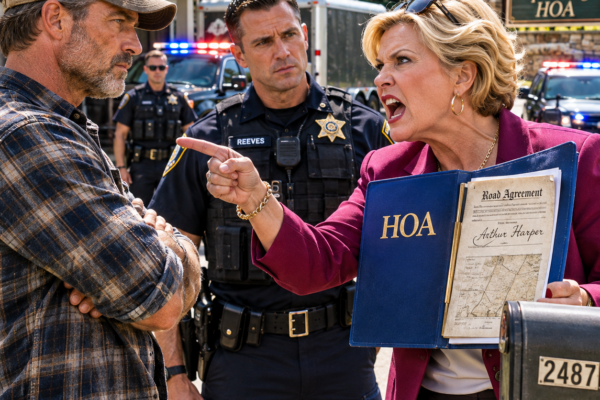
“GET OFF MY PROPERTY, YOU BROKE OLD RANCHER!” HOA Karen Sent 14 Armed Guards to Seize My Ranch—Then She Saw the Sheriff’s Badge Under My Jacket
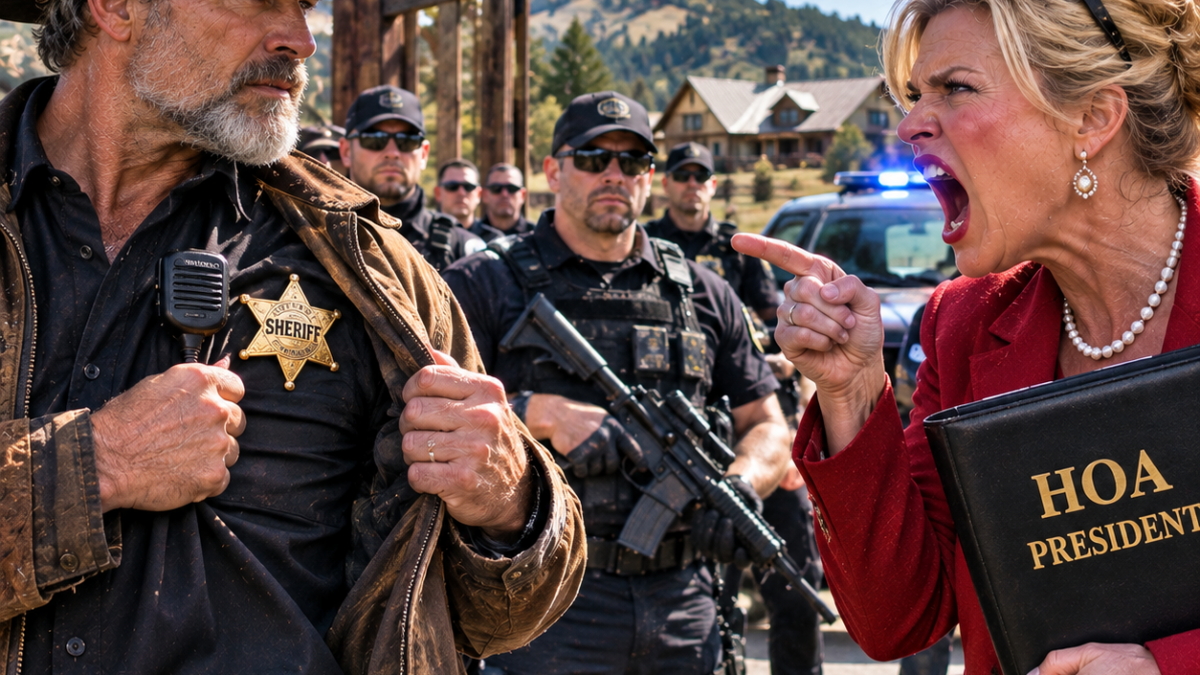
“GET OFF MY PROPERTY, YOU BROKE OLD RANCHER!” HOA Karen Sent 14 Armed Guards to Seize My Ranch—Then She Saw the Sheriff’s Badge Under My Jacket
“YOU HAVE TEN MINUTES TO GET OFF THIS RANCH, NOLAN—AND IF YOU DON’T LEAVE, MY FOURTEEN SECURITY GUARDS WILL DRAG YOU OUT LIKE THE TRESPASSER YOU ARE!” HOA President Valerie Whitcomb screamed as seven black SUVs surrounded my barn before sunrise, her men cut through my gate chains, and a private security supervisor shoved a document bearing a forged county seal into my face.
She believed I was nothing more than a fifty-eight-year-old rancher who couldn’t afford to fight her $86,400 in fabricated HOA fines, and she had no idea that I was also the elected county sheriff, that my family had owned Mercer Ridge Ranch long before Silver Crest Estates existed, or that her supposed emergency possession order was about to expose a much larger conspiracy involving stolen county credentials, $38,500 in HOA funds, and a secret real estate company waiting to profit from my family’s land.
But when the patrol trucks appeared over the ridge and Undersheriff Tessa Caldwell stepped out, looked straight past Valerie, and addressed me as “Sheriff,” the woman who had threatened to throw me out of my own home watched in horror as I opened my badge case—and the leather folder she had brought to force my signature onto a quitclaim deed became the evidence that would bring her entire scheme crashing down.
At 5:40 on a Thursday morning, I was walking the eastern fence line of Mercer Ridge Ranch with a thermos of coffee in one hand and a pair of fencing pliers in the other.
The sky was still dark.
Mist hung low over the pasture.
Dew covered the grass.
Somewhere near the barn, one of my horses snorted impatiently, probably wondering why breakfast hadn’t arrived.
It should have been an ordinary morning.
I’ve had thousands of ordinary mornings on that ranch.
I know the sound of the old gate when the wind catches it.
I know which fence posts lean slightly after a hard winter.
I know where the ground stays soft after rain and where the cattle like to gather when the afternoon sun gets too hot.
Most people see a ranch and think about land.
I see my father.
My grandfather.
The barn doors I helped hang when I was fourteen.
The creek where I learned to fish.
The pasture where my mother taught me to ride.
And the old white farmhouse my wife, Hannah, filled with laughter before cancer took her six years ago.
Mercer Ridge wasn’t a weekend investment.
It wasn’t a parcel on somebody’s development map.
It was home.
And that morning, I was supposed to be repairing a section of fencing near the lower pasture.
Instead, I heard engines.
At first, I thought it was Everett Sloan coming over early.
Everett owned the ranch east of mine.
He had a habit of appearing before sunrise with some ridiculous question about cattle prices or a broken tractor.
But Everett drove one battered blue pickup.
What I heard sounded like a convoy.
I stopped.
Listened.
Then turned toward the long dirt road leading to my front gate.
Headlights appeared between the trees.
One vehicle.
Then another.
Then another.
Seven black SUVs rolled toward the house in a tight procession.
I lowered my thermos.
“What in God’s name?”
The first SUV didn’t stop at the gate.
Neither did the others.
They drove straight through.
And that was when I noticed the chain.
My heavy steel gate chain had been cut.
The broken ends hung from the post.
The padlock lay in the dirt.
I stood motionless for a second.
Then watched fourteen men climb out of the vehicles.
Dark uniforms.
Heavy boots.
Body armor marked SECURITY.
Several carried firearms in holsters.
Two moved toward my horse barn.
Four headed for the equipment shed.
Others began unloading barricades, caution tape, and a metal sign.
One of the men hammered the sign into the ground beside my driveway.
PROPERTY UNDER SILVER CREST CONTROL.
I stared at it.
Then at my broken gate.
Something cold settled in my stomach.
Not fear.
Recognition.
Because I’d been receiving threats from Silver Crest Estates for almost a year.
And I knew exactly who had sent these men.
I walked toward the nearest guard.
“Morning.”
He turned.
I pointed toward the gate.
“Who authorized you to cut my chain?”
He looked me up and down.
Work boots.
Faded jeans.
Canvas jacket.
An old baseball cap.
I suppose I looked exactly like what I was.
A rancher who’d gotten out of bed early.
The guard didn’t know about the badge beneath my jacket.
And I wasn’t interested in using it unless I had to.
He stepped toward me.
“Sir, you need to leave this property.”
I stared.
“Excuse me?”
“You’ve been ordered to vacate.”
I looked past him toward the barn.
Two of his men were stringing yellow tape across the doors.
Another was examining the lock on my equipment shed.
I raised my voice just enough to be heard.
“Everybody stop what you’re doing.”
The men continued working.
The guard moved closer.
“My name is Wade Prescott.”
“Field supervisor.”
“We’re here to execute an emergency possession order.”
I looked at him.
“From what court?”
He hesitated.
Then reached into a folder.
He handed me several pages.
The top sheet displayed a bold heading.
EMERGENCY POSSESSION ORDER.
Underneath it was a county seal.
A case number.
A signature.
A legal description of Mercer Ridge Ranch.
And language claiming Silver Crest Estates had been granted immediate temporary possession of the property.
I studied the page.
Then looked at Wade.
“Where did you get this?”
“From our client.”
“Who issued it?”
“County authorities.”
“Which judge?”
He frowned.
“Sir, that’s not my responsibility.”
I looked toward the broken gate.
“Actually, Mr. Prescott, verifying your authority before destroying somebody’s property is very much your responsibility.”
His jaw tightened.
“I’m not here to argue.”
“Neither am I.”
I handed back the papers.
“I’m telling you that order is not valid.”
Wade smiled without humor.
“And I’m telling you to vacate.”
Behind him, another SUV appeared.
White.
Expensive.
Perfectly clean.
It drove through my damaged gate and stopped near the barn.
The driver’s door opened.
And Valerie Whitcomb stepped onto my ranch wearing a cream-colored designer coat and the triumphant smile of a woman who believed she’d finally won.
PART2
“Good morning, Nolan.”
Valerie spoke as if she’d arrived for a neighborhood landscaping inspection.
Not an armed occupation of private property.
I watched her walk toward me.
“Valerie.”
She smiled.
“I see you’ve met our security team.”
“I’ve met the man who claims he has authority to cut my gate.”
She glanced toward Wade.
Then back at me.
“Everything has been handled legally.”
I pointed toward the damaged chain.
“Then you won’t mind showing me the court order.”
Wade lifted the folder.
Valerie raised one hand.
“That isn’t necessary.”
I stared.
“You brought fourteen armed private security contractors onto my ranch, damaged my gate, and told me to leave my home.”
“It’s necessary.”
Her expression tightened.
“Nolan, you’re making this difficult.”
I nearly laughed.
“I’m making it difficult?”
She sighed.
“Silver Crest has been patient with you.”
I looked around.
My horses were moving nervously inside the barn.
Two strangers stood blocking the entrance.
One of the guards had positioned his SUV across the equipment access road.
“You call this patience?”
Valerie folded her arms.
“You’ve refused every reasonable opportunity to cooperate.”
I knew what she meant.
For almost a year, she’d been trying to buy part of Mercer Ridge.
Not the whole ranch, initially.
Just a corridor through the western pasture.
A wide strip of land connecting Silver Crest’s proposed expansion to the county highway.
I’d refused.
Then she offered to buy the entire property.
I’d refused that too.
Then the letters started.
Violation notices.
Special assessments.
Claims about fencing standards.
Alleged architectural restrictions.
Warnings that the HOA might place liens against my land.
Every notice had the same problem.
My ranch wasn’t part of her HOA.
Never had been.
My family owned the property decades before Silver Crest Estates was established.
There was no recorded covenant placing Mercer Ridge under the association’s authority.
No valid annexation.
No agreement.
No deed transferring jurisdiction.
I had the records.
So did Valerie.
But she kept sending letters as if repeating a lie often enough would eventually make it true.
And now she’d brought fourteen men to enforce it.
Valerie stepped closer.
“You have ten minutes to collect personal belongings.”
I looked at her.
“Then what?”
“Then security will escort you from the property.”
“And my livestock?”
“The association will arrange appropriate management.”
“My equipment?”
“That will be inventoried.”
“My house?”
“Temporarily under association control.”
I stared.
She smiled.
“Until your financial obligations have been resolved.”
I felt my pulse slow.
That’s something people misunderstand about anger.
Real anger doesn’t always make you shout.
Sometimes it makes the world become terribly clear.
I looked directly at Valerie.
“Call your attorney.”
She laughed.
“Nolan, I brought fourteen guards.”
“I don’t need a lawyer standing here to explain what happens next.”
I glanced toward the counterfeit seal.
Then back at her.
“That’s exactly why you need one.”
My father used to say that land doesn’t make you rich unless you understand what it cost the people who came before you.
His name was Samuel Mercer.
He was seventy-nine when he died.
A hard man in some ways.
Quiet.
Disciplined.
More comfortable repairing a tractor than expressing affection.
But he loved this ranch.
He knew every acre.
Every fence line.
Every place where water gathered after a storm.
My grandfather bought the original property after returning from military service.
He didn’t inherit wealth.
He worked.
Saved.
Borrowed.
Repaired machinery for other ranchers.
Raised cattle.
Built fences.
And slowly acquired enough land to create something his family could keep.
My father grew up there.
Then I did.
When I was twelve, he taught me to set fence posts.
When I was fourteen, he made me help replace the barn roof.
When I was sixteen, he showed me the deed records and survey maps.
I remember sitting at the kitchen table while he unfolded a large plat.
“See this line?”
I nodded.
“That’s our western boundary.”
He pointed again.
“And this one?”
“The creek?”
“That’s right.”
He looked at me.
“Nolan, someday somebody will come along who wants this land for something else.”
I smiled.
“Like what?”
He shrugged.
“Road.”
“Subdivision.”
“Shopping center.”
“Who knows?”
Then his face grew serious.
“When that happens, you remember something.”
“What?”
“A man can offer to buy your property.”
“He can negotiate.”
“He can walk away.”
“But he doesn’t get to simply decide it’s his.”
I laughed.
“Dad, everybody knows that.”
He looked at me for a long time.
Then said:
“You’d be surprised.”
Standing in my driveway decades later, surrounded by fourteen armed guards, I finally understood exactly what he’d meant.
Valerie believed the ranch was standing between her and the most profitable development project Silver Crest Estates had ever pursued.
The proposed Silver Crest Equestrian Reserve.
Luxury homes.
A private clubhouse.
Artificial lake.
Landscaped riding trails.
A marketing brochure showing smiling families on horseback beneath golden sunsets.
It looked beautiful.
It also depended on a transportation corridor across my western pasture.
Without that corridor, the development’s access plans became substantially more difficult and expensive.
Valerie had been told this by the developers.
And she decided the solution was me.
Not negotiating fairly.
Not redesigning the project.
Not exploring alternatives.
Me.
The stubborn rancher who wouldn’t sell.
The first offer arrived eleven months earlier.
A certified letter.
An attached map.
An amount of money that was substantial but nowhere near what the land’s strategic value appeared to be.
I declined.
Then came a second offer.
A little higher.
A little more aggressive.
I declined again.
A week later, Valerie appeared on my porch.
She wore sunglasses and carried a leather portfolio.
“Nolan.”
“Valerie.”
“Have you reconsidered?”
“No.”
She smiled.
“Surely there’s a number.”
I looked toward the western pasture.
“My family has owned this land for generations.”
“Everything has a price.”
“Not everything.”
She laughed.
“That’s sentimental.”
“Maybe.”
“You’re being unreasonable.”
I looked at her.
“You asked.”
“I answered.”
She removed her sunglasses.
“You understand this development would benefit the entire community?”
“Then find a route that doesn’t cross my land.”
Her smile disappeared.
“It’s not that simple.”
“Then your problem isn’t my refusal.”
I paused.
“It’s your plan.”
She stared at me.
Then said something I remembered every time another HOA letter arrived.
“You’ll regret making this difficult.”
I watched her leave.
At the time, I thought she meant litigation.
I didn’t imagine she’d eventually cut my gate chain before sunrise.
The first violation notice came three days after that conversation.
UNAUTHORIZED AGRICULTURAL FENCING.
I read it twice.
Then laughed.
The fence was older than Silver Crest Estates.
Older than Valerie’s house.
Possibly older than Valerie herself.
The second notice concerned the color of my barn.
The third claimed that my livestock violated neighborhood appearance standards.
The fourth alleged that commercial machinery was visible from a residential road.
Then came assessments.
Late charges.
Administrative penalties.
Attorney fees.
Numbers that grew every time I refused to sign.
Eventually, Valerie claimed I owed $86,400.
Eighty-six thousand four hundred dollars.
For violating HOA restrictions that had never applied to my land.
I contacted Grant Harlow, the association’s attorney.
He was cautious.
Professional.
And, in my experience, far less impressed by Valerie than she believed.
Grant requested the documents.
I provided the recorded deed, boundary survey, and subdivision declarations.
A week later, he wrote back.
The association’s claims required additional legal support.
He did not endorse the assertion that Mercer Ridge was automatically subject to Silver Crest’s covenants.
I thought that would end it.
It didn’t.
Valerie stopped copying Grant on certain correspondence.
Then new notices began arriving under her own signature.
They looked increasingly official.
County-style headings.
Legal references.
Threats of possession.
Language about emergency enforcement authority.
My attorney advised me to preserve everything.
I did.
At the time, I still believed Valerie was trying to frighten me into selling.
I hadn’t yet understood that she was building a paper trail to justify taking the land by force.
At 5:53 that morning, I watched one of Wade Prescott’s guards bring bolt cutters toward an interior fence.
The fence separated my main pasture from the barn enclosure.
I stepped forward.
“Stop.”
The guard looked at me.
I pointed toward the cutters.
“Do not touch that chain.”
Wade approached.
“Sir, you’re interfering with authorized security operations.”
I looked at him.
“Show me the valid court order.”
He gestured toward his folder.
“I already have.”
“No.”
“You showed me a document claiming to be one.”
His jaw tightened.
“Mr. Mercer, I suggest you cooperate.”
I looked toward the guard with the bolt cutters.
He was waiting.
Wade turned toward him.
“Proceed.”
The cutter closed.
Metal snapped.
The sound carried across the morning air.
I felt something in my chest settle.
I reached into my pocket.
Took out my phone.
And sent a short message.
Code 6. Mercer Ridge.
Then I put the phone away.
Wade noticed.
“Who did you contact?”
I looked at him.
“Someone who can verify your paperwork.”
He laughed.
“Good luck.”
I said nothing.
Because a few miles away, Undersheriff Tessa Caldwell was about to discover that fourteen strangers had entered the county sheriff’s private property with a document bearing the seal of the very county he served.
Tessa and I had worked together for eleven years.
She was younger than me.
Forty-two.
Sharp.
Disciplined.
Unimpressed by bluster.
And perhaps the most dependable law-enforcement officer I’d ever known.
When my wife Hannah died, Tessa was the person who handled the department’s responsibilities while I took leave.
She didn’t give speeches about grief.
She brought groceries.
Checked on the ranch.
Made sure I wasn’t using work as an excuse to avoid coming home.
When I returned, she told me something I’ve never forgotten.
“Nolan, being sheriff doesn’t mean you have to carry everything by yourself.”
I smiled at the time.
“That’s an unusual thing for an undersheriff to say.”
She shrugged.
“Somebody has to remind you.”
Our relationship was built on trust.
So when her phone displayed my emergency message that morning, she understood immediately.
Something was wrong at Mercer Ridge.
Not a routine trespass complaint.
Not a broken fence.
Something requiring an urgent response.
She coordinated patrol units and headed toward my property.
But I didn’t know that yet.
I was standing beside my barn watching Valerie Whitcomb explain to her security supervisor how quickly I needed to disappear.
“Mr. Mercer,” Valerie said, “your time is running out.”
I looked at my watch.
“Is it?”
She smiled.
“You have less than five minutes.”
I nodded toward the paperwork.
“Still refusing to let me inspect the original?”
“Everything is properly filed.”
“Where?”
“The county.”
“Which office?”
She sighed.
“Nolan, you’re trying to delay the inevitable.”
I looked at her.
“I’m asking a simple question.”
She leaned closer.
“You ranch people always think owning dirt makes you powerful.”
I felt an almost irresistible urge to laugh.
Instead, I answered:
“Owning it usually helps.”
Her face reddened.
“Security!”
Wade turned.
Valerie pointed toward me.
“Remove him.”
Two guards approached.
I remained still.
One stepped close.
“Sir, you need to come with us.”
I looked at him.
“Don’t put your hands on me.”
He reached toward my shoulder.
I stepped back.
He followed.
Then placed one hand firmly against my jacket.
I looked straight into his eyes.
“Remove your hand.”
He hesitated.
Wade called:
“Escort him.”
The guard gripped my arm.
I felt the pressure.
I looked down.
Then back at him.
“You have now crossed a different line.”
The young man’s expression flickered.
He wasn’t much older than twenty-five.
I could see uncertainty.
But he tightened his grip.
I did not strike him.
Did not reach for a weapon.
Did not try to turn the situation into a fight.
I simply repeated:
“Let go.”
He finally released me.
Wade stepped forward.
“What happens now, old man?”
I looked toward the road.
Then answered:
“Now we find out whether the documents you were given are real.”
A truck horn sounded beyond the fence.
Everett Sloan had arrived.
My neighbor.
Seventy years old.
Gray beard.
Broad shoulders.
A man who knew exactly how much trouble could fit into one morning.
He pulled his blue pickup onto his own side of the boundary and stopped.
Then climbed out holding his phone.
He looked at the SUVs.
The guards.
The caution tape.
The damaged gate.
Then at me.
“Nolan!”
I raised one hand.
“Morning, Everett.”
He stared.
“What the hell’s going on?”
Valerie turned.
“Security, remove that man.”
Everett looked at her.
Then down at his boots.
Then toward the survey marker beside his truck.
He smiled.
“Ma’am, I’m standing on my own ranch.”
Valerie’s face tightened.
“You’re interfering.”
“I’m filming.”
She pointed.
“You don’t have permission.”
Everett laughed.
“Your permission doesn’t extend across my fence either.”
I almost smiled.
Everett lifted his phone.
The recording continued.
That video would later become one of the first independent pieces of evidence establishing the order of events.
Seven SUVs entering through a damaged gate.
Guards blocking the barn.
The HOA signs.
Valerie giving instructions.
And me standing on my own land asking for the legal authority that nobody seemed willing to provide.
But at that moment, Everett was simply doing what good neighbors do.
He showed up.
And refused to look away.
Grant Harlow arrived shortly afterward.
His sedan pulled through the gate.
He climbed out carrying a leather folder.
The moment he saw the security convoy, he stopped.
His expression changed.
He looked toward Valerie.
Then toward the damaged chain.
Then at the men posted around the barn.
“Valerie.”
She turned.
“Grant.”
He approached quickly.
“What is this?”
“Enforcement.”
“Under what authority?”
She smiled.
“The emergency possession order.”
Grant stared.
“What order?”
Valerie’s smile weakened.
“The county order.”
Grant turned toward Wade.
“May I see it?”
Wade handed him the folder.
Grant read the first page.
Then the second.
Then turned the document toward the morning light.
He studied the county seal.
The signature.
The case number.
His expression went pale.
“Valerie.”
“What?”
“Where did you get this?”
She crossed her arms.
“It’s valid.”
“That wasn’t my question.”
The silence between them became uncomfortable.
Grant looked at me.
Then back at the document.
“Who prepared this?”
Valerie stepped closer.
“We can discuss that privately.”
Grant didn’t move.
“Did you obtain this through a court?”
She stared.
He repeated:
“Valerie.”
Her face hardened.
“You’re my attorney.”
Grant answered carefully.
“I represent the association within the scope of my engagement.”
“Then support me.”
“I cannot verify this document.”
She looked furious.
“That’s your problem?”
Grant lowered his voice.
“No.”
“My problem is that you’ve brought armed contractors onto a ranch without showing me a valid court order.”
I watched Valerie’s face.
For the first time that morning, her confidence flickered.
Not much.
But enough.
Grant looked toward the guards.
Then toward the gate.
“Stop this operation.”
Valerie stared.
“What?”
“Until the document is verified.”
She laughed angrily.
“We are already here.”
“That’s precisely the problem.”
She leaned toward him.
“I’ve handled the county.”
Grant went completely still.
I heard it.
Every word.
I’ve handled the county.
That sentence changed everything.
Because now the question wasn’t simply whether Valerie had invented a false property claim.
The question was whether someone inside county government had helped her manufacture evidence of authority.
A low sound reached us from the road.
Sirens.
At first distant.
Then clearer.
Everett lowered his phone slightly.
“Sounds like company.”
Valerie looked toward the ridge.
Then smiled.
A full, triumphant smile.
“Finally.”
She turned toward me.
“Now the sheriff will deal with you.”
I looked at her.
“That might be difficult.”
She frowned.
“What?”
Three patrol vehicles appeared beyond the rise.
They approached slowly along the ranch road.
Behind them came Tessa Caldwell’s SUV.
The first unit stopped near the gate.
Two deputies stepped out.
Then Tessa emerged.
She surveyed the scene.
The guards.
The broken chains.
The blocked access road.
The armed private contractors.
Then she walked directly past Valerie.
Valerie stepped forward.
“Officer!”
Tessa didn’t stop.
“That man is trespassing on HOA property!”
Tessa kept walking.
Valerie raised her voice.
“I demand that you remove him immediately!”
The undersheriff reached me.
Stopped.
Looked at my arm where the guard had grabbed it.
Then at my face.
“Sheriff.”
One word.
That was all.
The entire ranch seemed to go silent.
Wade turned.
The guard who had grabbed my arm stared at me.
Grant closed his eyes.
Everett lowered his phone for just a moment.
And Valerie Whitcomb looked as if somebody had pulled the ground out from beneath her feet.
“Sheriff?” she repeated.
Tessa nodded toward me.
“Yes, ma’am.”
I opened my jacket.
Removed my leather badge case.
And held it where everyone could see.
COUNTY SHERIFF — NOLAN MERCER.
Valerie’s mouth opened.
Nothing came out.
Wade stared at the badge.
Then at the paperwork in his hand.
I looked directly at him.
“Mr. Prescott.”
He swallowed.
“Yes?”
“Now would be a good time to stop calling that document a court order.”
I hadn’t hidden my job.
Not really.
I was the elected sheriff.
My photograph appeared on the department website.
I’d attended public meetings.
Spoken at schools.
Given interviews.
But when I came home to the ranch, I came home as Nolan.
I didn’t wear the badge around the cattle.
Didn’t drive my patrol vehicle unless duty required it.
Didn’t introduce myself to neighbors by rank.
Most people around the county knew who I was.
Valerie apparently hadn’t bothered to check.
She saw a rancher.
An older man.
Someone who wore faded jeans and worked before sunrise.
And she decided I was powerless.
Now she stared at the badge.
Her face had lost its color.
Then she forced a smile.
“Sheriff Mercer.”
I said nothing.
She laughed nervously.
“Well, this is quite a surprise.”
Tessa looked toward the broken gate.
“Is it?”
Valerie ignored her.
“Nolan, surely we can resolve this misunderstanding.”
I stared.
“Which misunderstanding?”
“The property enforcement.”
I pointed toward the gate.
“Cutting my chain?”
She swallowed.
“The guards were acting under instructions.”
“Your instructions?”
A pause.
Valerie looked toward Wade.
He looked back.
I continued.
“Posting HOA possession signs on private property?”
She said nothing.
“Blocking my vehicles?”
Silence.
“Damaging interior locks?”
Her smile disappeared.
Then I looked at the guard who had grabbed me.
“And physically restraining the landowner?”
Valerie’s eyes moved toward him.
He stared at the ground.
I turned toward Tessa.
“You have the scene.”
She nodded.
“Understood.”
Then I said something Valerie hadn’t expected.
“Because this involves my own property, I am not directing the criminal investigation.”
Tessa looked at me.
I continued.
“Secure the scene.”
“Preserve the evidence.”
“Document the damage.”
“Verify the documents.”
“And coordinate independent investigative oversight.”
She nodded.
“Yes, Sheriff.”
I stepped back.
Then looked toward Valerie.
“You accused me of abusing authority before you even knew I had any.”
Her lips trembled.
I continued.
“So we’ll make sure this case is handled by people who don’t need to take my word for anything.”
That was the moment I saw real fear enter her eyes.
Because she understood something.
My badge wasn’t the evidence against her.
The broken chains were.
The forged papers.
The security contracts.
The recordings.
The orders she’d given.
And the people standing around us who had heard every word.
Tessa took control.
She instructed the guards to keep their hands away from their weapons and remain at designated positions while officers verified identification and assessed the situation.
Everyone was told not to disturb the scene.
The deputies photographed the gate.
The severed chain.
The damaged locks.
The HOA signs.
The blocked road.
The vehicles.
The documents.
They took individual witness statements.
Obtained information about body cameras.
Identified the private security firm.
And began checking the purported order through county records.
Wade’s confidence disappeared.
He handed over his identification.
Then the company’s contract.
Then the original email from Valerie.
Tessa read it.
Her expression tightened.
The email stated that county authorities had approved immediate possession of Mercer Ridge.
It claimed the sheriff’s office was aware of the operation.
It instructed the guards to secure the property before seven that morning.
Tessa looked at Wade.
“Did you speak to anyone at the sheriff’s office?”
He swallowed.
“No.”
“Did you verify the court order with the issuing court?”
Silence.
Then:
“No.”
She looked at him.
“Then why did you cut the gate?”
He stared toward Valerie.
“Because she told us everything had been cleared.”
Tessa nodded.
“That’s what we’re going to document.”
Wade looked sick.
I didn’t feel sorry for him yet.
Not after watching his people cut my locks and put their hands on me.
But I understood the difference between someone knowingly participating in a scheme and someone who had been deceived into it.
That distinction would matter.
And unlike Valerie, I had no interest in punishing people merely because they stood in the wrong place at the wrong time.
At 7:18, Tessa received the first confirmation from county records.
No emergency possession order existed under the case number printed on Valerie’s document.
No matching judicial order had been issued.
No valid court record authorized Silver Crest Estates to occupy Mercer Ridge.
The signature was not supported by the court’s records.
The seal appeared authentic at first glance.
But the document itself had no legal foundation.
Tessa approached me.
“Sheriff.”
I turned.
She kept her voice low.
“We’ve confirmed the order doesn’t exist.”
I looked toward Valerie.
She stood beside her Range Rover speaking angrily into her phone.
Grant Harlow was a few feet away.
He looked exhausted.
I turned back to Tessa.
“Preserve the document.”
“Already done.”
“Coordinate with the county clerk and independent investigators.”
She nodded.
“Underway.”
Then she paused.
“There’s something else.”
I looked at her.
“What?”
“The county records team found unusual activity associated with the Mercer Ridge property file.”
My stomach tightened.
“What kind?”
“A document was uploaded using an administrative account.”
“Then deleted.”
“When?”
“Three days ago.”
I stared.
Tessa continued.
“Just after two in the morning.”
For a moment, neither of us spoke.
Then I asked:
“Whose credentials?”
“An employee’s.”
“Any indication the employee personally did it?”
“Not yet.”
I nodded.
“Then don’t assume.”
Tessa gave a small smile.
“I wasn’t going to.”
I looked toward the ranch road.
Valerie’s white SUV.
The seven black vehicles.
The fourteen guards.
And the paper she’d carried into my driveway.
This was no longer merely a private trespass dispute.
Someone had used access to a government record system to make a fraudulent document look legitimate.
That required a much broader investigation.
And Valerie had brought the evidence directly to us.
The next call came from Bethany Rourke.
She was Silver Crest’s treasurer.
A careful woman in her late forties who had served on the HOA board for three years.
I’d met her once at a public hearing.
She was polite.
Quiet.
The kind of person who asked for invoices instead of accepting verbal assurances.
That morning, when she learned what Valerie had done, she began reviewing the association’s accounts.
And she found a payment.
Thirty-eight thousand five hundred dollars.
Approved under a vague budget description.
SPECIAL PROPERTY RECOVERY SECURITY.
The transaction had not received the board approval normally required for an expense of that size.
There were no meeting minutes authorizing it.
No legal opinion supporting the expenditure.
No approved resolution to seize Mercer Ridge.
Just Valerie’s signature.
Bethany called Grant.
Then Tessa.
Then, through proper channels, she provided copies of the financial records.
I heard about it later that morning.
I stood beside the barn listening while Tessa summarized the discovery.
“Thirty-eight thousand five hundred?”
“Yes.”
“HOA funds?”
“Yes.”
“For the guards?”
“That’s what the payment appears to relate to.”
I looked toward Wade Prescott.
Then toward Valerie.
She had taken money paid by ordinary homeowners for community services and used it to finance a private operation against my ranch.
The more I learned, the less this looked like a woman making one reckless mistake.
It looked planned.
Budgeted.
Coordinated.
And deliberately concealed.
I took a breath.
“Make sure the financial evidence goes to the independent team.”
Tessa nodded.
“It will.”
Then she looked at me.
“Nolan.”
“Yeah?”
“Are you okay?”
I looked toward the house.
The barn.
The broken gate.
The home my father built.
Then answered:
“Ask me after everybody leaves.”
She nodded.
And walked back toward the investigators.
Grant Harlow asked to speak with Tessa.
He looked deeply troubled.
His leather folder was tucked under one arm.
His tie had loosened.
He said he’d been contacted by Valerie two weeks earlier.
She wanted him to draft a deed or easement agreement that would pressure me into surrendering the access corridor.
Grant had refused the request as presented.
He had warned her that Silver Crest did not have authority to seize land outside its covenants.
She’d become angry.
Then told him:
“Fine.”
“I’ll find someone who understands how business gets done.”
He hadn’t known what she intended.
He hadn’t drafted the fake order.
Hadn’t approved the security operation.
And hadn’t authorized the use of county seals.
He said he wanted those facts documented.
Tessa listened.
Asked questions.
Recorded his statement.
Then asked whether he knew the name Westbrier Holdings.
Grant frowned.
“No.”
“Should I?”
Tessa didn’t answer immediately.
Then showed him the entity name appearing in material associated with the proposed land transfer.
Grant stared.
“That’s not the HOA.”
“No.”
“Who owns it?”
“That’s being investigated.”
Grant’s face tightened.
He looked toward Valerie.
Then whispered:
“Dear God.”
The quitclaim deed surfaced as investigators reviewed the documents Valerie had voluntarily produced and later obtained additional materials through appropriate legal procedures.
It wasn’t a routine HOA notice.
It wasn’t a legitimate possession order.
It was a prepared instrument designed to transfer a wide corridor of Mercer Ridge Ranch to Westbrier Holdings.
The legal description followed the proposed development access route.
The beneficiary wasn’t Silver Crest Estates.
It was a separate limited liability company.
A company that had only recently been formed.
I stared at the document when the investigators later showed me the relevant portions during my witness interview.
For years, my father had told me to protect the deed records.
To understand the boundaries.
To remember what ownership meant.
Now I was looking at a paper intended to make those protections disappear with one signature.
Mine.
The signature line remained blank.
But everything else was ready.
The notary section.
The legal description.
The conveyance language.
The recipient.
And a proposed transfer covering land I had repeatedly refused to sell.
I took a slow breath.
Then asked:
“Was she planning to have me sign this today?”
The investigator looked at his notes.
“That’s what we’re examining.”
I nodded.
He continued.
“There are statements indicating the guards were instructed to keep you from leaving until documents were executed.”
I stared.
“And if I refused?”
He didn’t answer immediately.
Then:
“Some of the instructions refer to removing you from the premises.”
I looked down.
That was when the morning became frightening in a way it hadn’t been while it was happening.
At 5:40, I’d been angry.
Alert.
Focused.
I knew I had a phone.
A badge.
A department nearby.
I believed help would arrive.
But now I understood what Valerie had intended.
She didn’t merely want to embarrass me.
She wanted fourteen armed men surrounding my property before sunrise.
She wanted access blocked.
My equipment secured.
My movements controlled.
Then she wanted to present a deed.
And make refusal feel impossible.
That wasn’t a negotiation.
It was coercion dressed up as paperwork.
The security camera footage made the sequence clearer.
I had installed cameras around the barn after equipment thefts in the area several years earlier.
They recorded continuously.
Valerie apparently hadn’t considered them.
One camera captured her white SUV approaching the gate.
Another showed Wade standing near the chain.
The audio was clear enough to distinguish voices.
Wade asked whether he had authorization to cut the lock.
Valerie answered:
“Do it.”
Two words.
Simple.
Direct.
A third camera showed guards placing the HOA signs and blocking the road.
Another captured the moment one guard restrained me.
The footage was preserved and provided to investigators.
Then came an even more damaging recording.
A guard’s body camera captured Valerie speaking before she approached the farmhouse.
Her voice was cold.
Controlled.
She said:
“He signs before seven, or he leaves with nothing.”
I heard those words during the independent investigation.
For a long moment, I sat without speaking.
Then asked the investigator to play them again.
He did.
He signs before seven, or he leaves with nothing.
I closed my eyes.
The voice was unmistakable.
Valerie.
Not confused.
Not improvising.
Not reacting emotionally to an argument.
Giving instructions.
Before the operation had even begun.
I thought of my father.
My grandfather.
The barn.
The pasture.
The years of work that built Mercer Ridge.
And I realized that Valerie had reduced all of it to a deadline.
Before seven.
One signature.
Or nothing.
By late morning, the financial investigation uncovered why Valerie had become so desperate.
Westbrier Holdings was connected to people involved in the Silver Crest Equestrian Reserve development.
Its ownership structure also led back to Valerie herself.
She held a financial interest in the company that stood to receive the ranch corridor.
The development deal included a substantial consulting arrangement tied to securing access.
But that wasn’t all.
Further review showed that Westbrier’s plan contemplated selling or licensing the corridor rights back to the HOA or related project interests at a significantly inflated price.
Valerie expected to profit from acquiring the land.
Then profit again from controlling the access rights.
All while using HOA funds to finance the operation.
I sat in the interview room listening as the independent investigators explained what the records supported.
At first, I couldn’t believe the audacity.
Then I remembered her face when she stepped out of the white SUV.
The smile.
The certainty.
The way she looked at my ranch as though it were already hers.
It made sense.
She wasn’t merely offended that I’d refused to cooperate.
She had money riding on my surrender.
And the longer I refused, the more desperate she became.
The development project couldn’t proceed on her preferred schedule without the access corridor.
The private company couldn’t profit as planned.
Her consulting arrangement was at risk.
So she escalated.
Letters.
Fines.
Threats.
False claims of authority.
And finally fourteen armed guards.
All to obtain a signature from a man she’d never bothered to investigate.
During the scene investigation, Valerie repeatedly accused me of abusing my position.
She told anyone who would listen that I was using the sheriff’s office to settle a personal grudge.
I understood how serious such an allegation could be.
That’s why I had stepped away from directing the investigation.
Tessa coordinated the immediate safety response and evidence preservation.
Independent personnel handled the criminal case and arrest decisions.
I provided witness statements like everyone else.
My property records.
My correspondence.
My camera footage.
My account of the physical contact.
I did not personally decide what charges to pursue.
Did not order the arrest.
And did not put handcuffs on Valerie for the satisfaction of doing it myself.
That would have given her exactly the argument she wanted.
Instead, the evidence spoke.
The fake order.
The county record anomaly.
The HOA payment.
The security contracts.
The recordings.
The deed.
The financial interest in Westbrier.
The statements from guards who said they had been misled.
The case no longer depended on whether anyone liked me.
Or trusted my office.
Or respected my badge.
It depended on what Valerie had done.
And what the records proved.
Wade Prescott was the first guard to cooperate fully.
He asked for his own attorney.
Then gave investigators the complete security contract.
The emails.
The deployment instructions.
The purported possession order.
The text messages.
The bonus arrangements.
And the names of every employee present.
He admitted that his company should have independently verified the order.
That cutting the gate without confirmation was a serious failure.
That some of the conduct could not be justified merely because a client claimed legal authority.
Other guards gave statements.
One described a meeting three days earlier when Valerie walked the perimeter and pointed out where vehicles should be positioned.
Another recalled being told to prevent my truck from leaving.
A third said Valerie had promised extra money if the property was secured before seven.
The youngest guard admitted he’d considered refusing the assignment.
He had been uncomfortable with the instructions.
But the supervisor assured him the county had authorized everything.
I listened to those accounts later.
And I kept thinking about how close the morning had come to turning violent.
Fourteen armed men.
A landowner refusing to leave.
An invalid document.
A supervisor under pressure.
A client demanding results.
One frightened guard.
One misunderstood movement.
One hand reaching for the wrong thing.
That was all it might have taken.
The thought made my stomach turn.
Valerie hadn’t just threatened property rights.
She had created a situation where people could have died.
For a road corridor.
And money.
At the scene, Valerie tried to leave when she realized the evidence was accumulating.
She moved toward her SUV.
Tessa instructed her to remain available while the immediate investigation continued, subject to the lawful authority officers had established.
Valerie protested.
Threatened lawsuits.
Claimed she knew county officials.
Demanded that somebody call the commissioner.
She was told the documents and evidence were being verified.
Then investigators discovered additional materials that supported seeking further legal authority to search and seize records.
The process continued under proper procedures.
By the time the independent team had established the relevant grounds, Valerie’s composure was gone.
She stood near her vehicle.
Her expensive coat dusty.
Her hair disheveled.
The pearl earrings still in place.
But the smile had disappeared.
When the arrest was made, it wasn’t by me.
An investigator approached.
Explained the legal basis.
And took her into custody.
Valerie turned toward me.
“You did this.”
I looked at her.
“No.”
She stared.
I continued.
“You brought the guards.”
“You cut the chains.”
“You brought the documents.”
“And you decided that my refusal to sell meant you could take what belonged to me.”
Her mouth trembled.
“You’ll regret this.”
I looked toward the ranch.
Then back.
“That’s what you said the first time I refused your offer.”
She said nothing.
The investigator guided her toward the patrol vehicle.
The handcuffs clicked.
Fourteen guards watched.
So did Everett.
Grant.
The deputies.
And the two HOA board members who had arrived after Bethany learned what happened.
Valerie looked around one last time.
Searching for somebody to defend her.
Nobody did.
Then the vehicle door closed.
And the woman who had arrived before sunrise expecting to drive me off my ranch left it in custody.
I wish I could say I felt wonderful.
Triumphant.
Vindicated.
Like the hero in a movie.
I didn’t.
I felt tired.
Deeply tired.
The kind of exhaustion that settles into your bones after danger has passed and your body finally admits what happened.
I stood near the broken gate.
Looked at the severed chain.
The damaged lock.
The tire tracks.
The signs still planted in my driveway.
And thought about Hannah.
My wife.
She’d died six years earlier.
A long battle with cancer.
Painful treatments.
Hospital visits.
Months when every good day felt precious.
Then a final night when I held her hand and knew there was nothing more I could do.
After she died, I had thrown myself into work.
Sheriff’s duties.
Ranch chores.
Anything that kept me moving.
Anything that prevented me from sitting alone in our house listening to the silence.
Hannah always loved the ranch more than I did.
Not because I didn’t love it.
Because she saw things I sometimes missed.
She loved the wildflowers near the creek.
The smell of the barn after fresh hay arrived.
The way the mountains turned purple at sunset.
She used to stand on the porch with a cup of coffee and say:
“Nolan, I don’t care how much money somebody offers.”
“This is where I want to grow old.”
I would smile.
“Then we’d better keep fixing the roof.”
She’d laugh.
And we would stand there until the sun disappeared.
Now I looked toward the porch.
Empty.
And for the first time that morning, my eyes filled.
Not because Valerie had nearly taken the ranch.
Because I suddenly understood how much more than land she had threatened.
She had threatened the last home Hannah and I shared.
The place where my father’s hands remained visible in every repair.
The place where my grandfather’s work had become my responsibility.
I leaned against the gatepost.
Closed my eyes.
Then whispered:
“It’s still ours, Hannah.”
The wind moved across the pasture.
I took a breath.
And for a moment, I let myself cry.
Everett found me there.
He approached quietly.
Didn’t speak at first.
Then stood beside me.
“Hell of a morning.”
I laughed weakly.
“That’s one way to put it.”
He looked toward the damaged gate.
“Want help fixing that?”
I nodded.
“Eventually.”
He looked at me.
Then toward the farmhouse.
“Your dad would’ve been proud.”
I swallowed.
“Maybe.”
Everett shook his head.
“No.”
“He would’ve.”
I looked at him.
He smiled faintly.
“Samuel Mercer never liked people who confused money with ownership.”
I laughed.
“That’s true.”
Everett continued.
“And he would’ve had something to say about those security guards.”
I looked toward the road.
“Probably something I couldn’t repeat in court.”
Everett burst out laughing.
I laughed too.
Then he placed one hand on my shoulder.
“Come on.”
“Let’s get your horses fed.”
And that was how the worst morning of my life began to feel normal again.
Not with applause.
Not with a victory speech.
With a neighbor helping me feed horses.
The investigation expanded.
Over the following weeks, investigators identified three other landowners who had received similar threats from Silver Crest.
Not identical incidents.
No fourteen-vehicle convoys.
No armed occupations.
But the pattern was familiar.
A property outside the HOA boundaries.
A notice claiming association authority.
Fabricated or unsupported fines.
Pressure to sign an easement or sell land.
Then a purchase offer significantly below the owner’s expectations.
One of those landowners was Carol Ashby.
Seventy-six years old.
Widow.
Lived on a small parcel along the northern edge of Silver Crest.
Her husband had died eight years earlier.
She maintained the property herself as best she could.
A little garden.
A small house.
Two apple trees.
A porch where she sat every morning watching birds.
She told investigators that Valerie had sent three letters threatening foreclosure.
Carol had become frightened.
She didn’t understand how an HOA could claim authority over her land.
She assumed there must be something she’d missed.
Then a purchase offer arrived.
A low one.
But it promised to make the fines disappear.
Carol nearly signed.
Only a conversation with a neighbor persuaded her to consult an attorney.
That attorney reviewed her deed.
Confirmed the HOA’s claims lacked the asserted legal foundation.
And told her not to sign away anything.
Carol kept her property.
But the pressure had taken a toll.
She told investigators:
“I spent three weeks thinking I was going to lose my house.”
Her voice broke.
“My husband and I paid that mortgage off twenty years ago.”
She wiped her eyes.
“I thought we’d done everything right.”
When I heard her story, I felt sick.
Because Valerie hadn’t merely tried to take land from an older widow.
She’d used fear.
Confusion.
And the possibility of homelessness.
To make an honest woman question whether the home she’d spent decades paying for still belonged to her.
Another victim was Harold Denny.
Retired schoolteacher.
Sixty-nine.
Lived just outside the eastern development boundary.
He had paid nearly four thousand dollars in disputed fines before realizing something was wrong.
Harold was the kind of man who believed official-looking letters should be taken seriously.
He taught history for thirty-five years.
Raised three children.
Paid his taxes.
Maintained his home.
Then Silver Crest started sending notices.
Landscaping violations.
Fence issues.
Administrative charges.
He paid the first one.
Then the second.
Then the third.
Until a friend asked why he was paying an association he didn’t belong to.
Harold called an attorney.
The attorney checked the records.
The supposed HOA authority wasn’t there.
He stopped paying.
Valerie escalated.
Then, after the Mercer Ridge investigation became public, Harold came forward.
His payments became part of the financial review.
He eventually obtained repayment through the appropriate resolution.
But when I met him months later, he told me something that stayed with me.
“Sheriff.”
“Harold.”
“I taught children all my life to question unsupported claims.”
I nodded.
He looked down.
“Then I got scared and stopped following my own advice.”
I put one hand on his shoulder.
“Fear doesn’t make you foolish.”
He smiled sadly.
“No?”
“No.”
“It makes you human.”
He looked at me.
Then nodded.
“Thank you.”
Bethany Rourke led the HOA’s financial audit.
She worked with independent accountants and legal counsel.
The association reviewed contracts approved during Valerie’s presidency.
Security payments.
Consulting arrangements.
Professional fees.
Development-related transfers.
The process uncovered serious governance failures.
Valerie had operated with far less oversight than homeowners believed.
Some contracts were improperly approved.
Some financial records lacked supporting documentation.
Certain transactions were connected to her personal development interests.
The $38,500 security payment became a central example.
Ordinary homeowners had paid dues expecting maintenance, administration, and community services.
Instead, their money had been used to fund a private operation against land the association did not own.
Bethany called an emergency board meeting.
The room filled.
Homeowners demanded answers.
Some were furious.
Others embarrassed.
Several said they’d trusted Valerie because she seemed so confident.
A woman near the front stood.
“I don’t understand.”
Bethany looked toward her.
“What part?”
“How could she spend that kind of money without the board voting?”
Bethany took a breath.
“Because our internal controls were inadequate.”
The room fell silent.
She continued.
“And because we allowed too much authority to concentrate in one person.”
A man raised his hand.
“Can we recover the money?”
“That’s part of the legal and financial process.”
Another asked:
“What about the development?”
Bethany looked toward the documents.
“The association is reviewing every claimed obligation and will not proceed on the basis of the disputed ranch corridor.”
Then someone asked the question that mattered most.
“How do we make sure this never happens again?”
Bethany paused.
Then answered:
“By changing more than the president.”
She held up the proposed governance reforms.
“Independent reviews.”
“Written authorization procedures.”
“Conflict-of-interest disclosures.”
“Transparent financial reporting.”
“Actual verification before enforcement.”
“And no claim of authority over property outside the association without proper legal support.”
The room remained quiet.
Then people began nodding.
For the first time in years, Silver Crest residents were talking about governance instead of obedience.
That was progress.
The Equestrian Reserve project stalled.
Then the developer withdrew from the Westbrier arrangement.
Without the promised corridor, the access plan couldn’t proceed as designed.
The financial assumptions collapsed.
The secret consulting arrangement came under scrutiny.
The company that had expected to profit from taking my land now faced questions about what it knew and when.
Valerie’s elaborate plans began falling apart.
But the most important consequence wasn’t financial.
It was exposure.
She had spent years telling people the HOA could decide what happened to their property.
Now homeowners were reading the actual covenants.
The deeds.
The recorded plats.
The board minutes.
The statutes and legal opinions relevant to their own circumstances.
They were learning that a person with a title still had limits.
And that a confident declaration wasn’t a substitute for lawful authority.
I found that deeply satisfying.
More satisfying than the arrest itself.
Because a bad leader can be replaced.
But unless people change the system that enabled her, another bad leader can eventually take her place.
Wade Prescott returned to my ranch three weeks after the incident.
Alone.
No black SUV.
No body armor.
No fourteen-man team.
Just an ordinary pickup.
He stopped outside the gate.
Didn’t drive in.
That detail mattered.
He waited until I approached.
Then stepped out.
“Mr. Mercer.”
I looked at him.
“Wade.”
He held a new heavy-duty gate lock.
“I brought this.”
I glanced at it.
“Why?”
He swallowed.
“Because we destroyed yours.”
I stared.
He continued.
“My company should’ve verified the documents before accepting that assignment.”
“Yes.”
“We shouldn’t have cut your chain.”
“No.”
“And nobody should’ve put hands on you.”
I held his gaze.
“No.”
Wade looked down.
For a moment, he seemed much older than the man who had stood in my driveway ordering me off my property.
“I believed her,” he said.
I nodded.
“You did.”
He swallowed.
“That’s not an excuse.”
“No.”
He looked up.
“But I want you to know we’re changing our procedures.”
I studied him.
“Good.”
“Court verification.”
“Legal review.”
“Written approval before any enforcement assignment involving possession of property.”
I nodded.
“That should’ve existed already.”
“Yes, sir.”
He extended the lock.
I took it.
Then said:
“Wade.”
He looked at me.
“Next time, verify before you cut somebody’s chain.”
His eyes filled slightly.
He nodded.
“I will.”
I believed he meant it.
That didn’t erase his responsibility.
But it was a beginning.
And sometimes a beginning is all you get.
The county record investigation also produced reforms.
The fraudulent document had been briefly uploaded using administrative credentials.
Investigators examined access logs, device records, and the circumstances surrounding the compromised account.
The precise responsibility was determined through evidence rather than assumptions about the employee whose credentials had been used.
Access controls were strengthened.
Verification procedures revised.
Additional protections added for sensitive document activity.
The county reviewed how outside parties could confirm the authenticity of judicial and property-related records.
That mattered.
Because Valerie’s scheme depended on people accepting a document simply because it looked official.
The font was right.
The seal convincing.
The terminology familiar.
The case number formatted correctly.
But the authority didn’t exist.
And a seal is only meaningful when the underlying record is genuine.
It seemed like an obvious lesson.
Until I remembered how many people had almost lost property because somebody printed convincing paperwork.
The criminal case continued through the courts.
Forgery-related allegations.
Fraud.
Coercive conduct.
Unauthorized expenditures.
Trespass and property damage.
The specific charges and outcomes were determined through the applicable legal process.
Valerie had counsel.
The evidence was tested.
Witnesses gave statements.
Records were examined.
And the case did not depend on my personal anger.
I was glad about that.
Because the more I learned, the more furious I became.
Especially when investigators explained the broader pattern.
Three other property owners.
The false fines.
The coercive offers.
The private financial interests.
The attempt to use HOA money to acquire land for personal profit.
The discovery that Valerie expected to benefit twice from the same corridor—first through the proposed transfer, then through selling the rights back at an inflated price—made the financial motive unmistakable.
But I also remembered something Hannah used to tell me.
“Nolan, being right doesn’t give you permission to become cruel.”
She said it when I was younger.
More impatient.
More likely to let anger make decisions for me.
I’d argue.
She’d smile.
Then repeat:
“You can hold somebody accountable without enjoying their suffering.”
I thought about that often while the case proceeded.
I wanted Valerie held responsible.
I wanted the affected landowners protected.
I wanted the financial losses addressed.
And I wanted the county record system strengthened.
But I did not need to humiliate her beyond what the truth itself established.
The facts were enough.
One evening, Tessa sat across from me in my office.
A file lay between us.
The Mercer Ridge investigation had reached its later stages.
The ranch was no longer under immediate threat.
The false HOA claims had been withdrawn.
The new board had acknowledged the property boundaries.
The development corridor was no longer being pursued through Westbrier’s scheme.
Tessa looked at me.
“You’ve been quiet.”
I smiled faintly.
“Unusual?”
“Very.”
I laughed.
She leaned back.
“What’s bothering you?”
I looked at the file.
Then toward the window.
“Fourteen armed guards.”
She nodded.
“I know.”
“Seven SUVs.”
“Yes.”
“A fake court order.”
“Yes.”
“Eighty-six thousand four hundred dollars in invented fines.”
She waited.
I looked at her.
“Do you know what I keep thinking about?”
“What?”
“How close it came to becoming something worse.”
Tessa was quiet.
I continued.
“One of those guards could’ve panicked.”
“I could’ve reached for my badge at the wrong moment.”
“Somebody could’ve mistaken a movement.”
“Everett could’ve gotten too close.”
I swallowed.
“All because Valerie thought she could force somebody to sign away land.”
Tessa nodded slowly.
“That’s why you stayed calm.”
I looked at her.
“I wasn’t calm because I wasn’t angry.”
“I know.”
“I was calm because I was terrified of what would happen if everybody started acting on anger.”
She smiled faintly.
“That’s part of why you’re sheriff.”
I looked down.
Then laughed softly.
“Hannah would’ve said I was finally learning.”
Tessa’s expression softened.
“She would’ve been proud.”
I closed my eyes.
“Yeah.”
“I hope so.”
Months later, I repaired the old entrance sign.
It had hung at the gate for decades.
Weathered wood.
White lettering.
My father’s handwriting used as the original guide.
MERCER RIDGE RANCH — PRIVATE PROPERTY.
The guards had knocked it loose during their arrival.
It wasn’t badly damaged.
A few scratches.
One cracked support.
I could have replaced it.
Bought something elegant.
Metal letters.
Fresh paint.
A sign worthy of the glossy ranch advertisements Valerie had been carrying.
But I didn’t want a new sign.
I wanted the one my father made.
So I repaired the support.
Sanded the damaged edge.
Repainted the lettering.
Then mounted it back in place.
Everett came over while I was finishing.
He leaned against his truck.
Watched.
Then smiled.
“Looks good.”
I stepped back.
“Yeah.”
He pointed toward the new lock.
“Think anybody’s going to try this again?”
I looked at the chain.
Then at the gate.
“Not with fake paperwork, I hope.”
Everett laughed.
“And probably not with fourteen guards.”
I smiled.
“Fourteen was plenty.”
He shook his head.
“Never seen anything like that.”
“Neither have I.”
He looked toward the sign.
Then said:
“Your dad would like that you kept it.”
I nodded.
“He hated replacing things that could be repaired.”
Everett smiled.
“Smart man.”
I looked toward the pasture.
“Yeah.”
“He was.”
That autumn, the ranch returned to its familiar rhythm.
Fences.
Cattle.
Horse feed.
Equipment repairs.
Early mornings.
Long evenings.
The seasons changing over the hills.
I still worked as sheriff.
Still attended meetings.
Still answered calls.
Still made decisions that sometimes kept me awake at night.
But when I drove through my gate, I felt the same quiet relief I’d felt since I was a boy.
Home.
One Sunday afternoon, I found an old photograph in the barn office.
My father standing beside the original gate.
He was younger than I remembered.
Dark hair.
Strong hands.
A hammer in one hand.
My grandfather stood beside him.
And there, in the corner of the picture, was me.
Maybe nine years old.
Grinning.
Holding a piece of chain twice as long as my arms.
I stared.
Then laughed softly.
I had forgotten that day.
But the photograph brought it back.
My father teaching me to fit the chain around the gatepost.
My grandfather telling me to stop playing with the lock.
The three of us working under the summer sun.
I carried the photograph into the house.
Placed it on the mantel beside Hannah’s picture.
Then stood looking at both.
My father.
My grandfather.
My wife.
All gone.
But the place they loved remained.
And somehow, that made the house feel less empty.
The HOA eventually sent a formal letter withdrawing its baseless claims against Mercer Ridge.
It acknowledged that the ranch was outside the association’s recorded jurisdiction.
That the purported fines were invalid.
That no lawful basis existed for the attempted possession.
The boundary maps were corrected and distributed.
The association adopted new procedures requiring independent review before asserting property rights over neighboring land.
I received the letter in the mail.
Read it.
Then placed it in the property records binder.
No celebration.
No framed trophy.
Just another document where it belonged.
Because the truth had always been there.
In the deed.
The plat.
The recorded boundaries.
The history.
The letter didn’t create my ownership.
It acknowledged what had never changed.
A few weeks later, Carol Ashby invited me for coffee.
I accepted.
Her little house sat near the northern edge of Silver Crest.
A narrow driveway.
White porch.
Two apple trees.
She opened the door wearing a blue cardigan.
“Sheriff.”
I smiled.
“Nolan.”
She laughed.
“Come in, Nolan.”
Her kitchen smelled of cinnamon.
A pie cooled on the counter.
We sat beside the window.
She poured coffee.
Then looked toward a stack of papers.
“The lawyers have finished.”
I nodded.
“Good.”
“My property is safe.”
“I’m glad.”
She stared at her hands.
Then whispered:
“I almost signed.”
I didn’t answer.
She continued.
“I was so frightened.”
“I thought maybe they really could take the house.”
Her eyes filled.
“My husband worked thirty years to pay it off.”
She looked toward a photograph on the wall.
A man in overalls.
Smiling beside an apple tree.
“His name was Robert.”
I nodded.
“He planted those trees.”
She pointed toward the window.
“I couldn’t bear losing them.”
My throat tightened.
Carol wiped her eyes.
Then looked at me.
“Thank you for standing up to her.”
I shook my head.
“Carol, you saved your property when you decided to ask questions.”
She smiled sadly.
“Maybe.”
I leaned forward.
“And you should never have been put in that position.”
She nodded.
Then placed a slice of pie in front of me.
“Eat.”
I laughed.
“Yes, ma’am.”
She smiled.
“Robert always said people think better after pie.”
I looked at the plate.
Then at the apple trees outside.
“Smart man.”
Carol laughed.
And for the first time that afternoon, the fear in her face disappeared.
That night, I sat on the porch at Mercer Ridge.
The air was cool.
The mountains dark against the sky.
A few stars appeared above the barn.
I held Hannah’s favorite coffee mug.
Green ceramic.
One small chip near the handle.
She’d bought it at a roadside market on our tenth wedding anniversary.
She used to sit beside me on the porch and complain that I spent too much time worrying about things I couldn’t control.
I would tell her somebody had to worry.
She’d smile.
Then say:
“Then worry about the things you can help.”
I thought about Valerie.
Her money.
Her ambition.
Her certainty that fourteen armed men could make an invalid document real.
I thought about Wade.
The new gate lock.
The apology.
The procedures his company should have had before the incident.
I thought about Bethany.
The financial audit.
The homeowners finally demanding transparency.
I thought about Carol and Harold.
People who had almost lost money or land because they were frightened by official-looking letters.
Then I looked toward the entrance.
The old sign.
The repaired gate.
The new chain.
Everything back where it belonged.
Hannah would have liked that.
Not because I’d won.
Because the ranch was still here.
And because I hadn’t allowed Valerie’s cruelty to turn me into someone I didn’t recognize.
I took another sip of coffee.
Then whispered:
“You were right, Hannah.”
The wind moved gently through the trees.
I smiled.
“You usually were.”
People around the county still tell the story.
Sometimes they exaggerate.
They say Valerie brought twenty guards.
Or thirty.
They say she arrived with bulldozers.
They claim I pulled my badge and arrested her before breakfast.
They tell it like a movie.
And I understand why.
Fourteen armed private security guards arriving at a ranch before sunrise.
A woman with a fake court order.
An old rancher who turns out to be the county sheriff.
It sounds too dramatic to be ordinary life.
But the parts that matter most aren’t the parts people repeat.
What matters is that a group of men entered private land without properly verifying their authority.
That an HOA president used money belonging to homeowners to pursue a personal financial scheme.
That government records were misused to make a false document appear official.
That other property owners were threatened and frightened.
And that the evidence was preserved carefully enough for the truth to survive the legal process.
The badge reveal was memorable.
I won’t pretend otherwise.
The look on Valerie’s face will probably stay with me forever.
But the badge wasn’t what saved Mercer Ridge.
My family owned the land before I was born.
The deed was recorded.
The boundary was established.
The HOA had no lawful claim to it.
Those facts were true when Valerie arrived.
They were true when Wade cut the chain.
They were true when the guards surrounded my barn.
And they remained true after the patrol vehicles appeared over the ridge.
The badge made Valerie realize she’d chosen the wrong person to intimidate.
The records proved she had chosen the wrong land to steal.
One final conversation stayed with me.
It happened months after the arrest, when Tessa and I were reviewing the remaining administrative matters tied to the case.
The file sat between us.
The office was quiet.
Outside, afternoon sunlight fell across the courthouse lawn.
Tessa closed a folder.
“Well.”
I looked up.
“What?”
“Valerie finally got one thing right.”
Tessa raised an eyebrow.
“That would be a first.”
I smiled.
“She told me that morning that something had stopped mattering.”
Tessa frowned.
“What?”
I looked toward the hills visible beyond the town.
Then answered:
“Her HOA title.”
Tessa laughed softly.
I shook my head.
“No.”
“Think about it.”
“She believed being president meant she could take anything she wanted.”
“Control the board.”
“Spend the money.”
“Forge authority.”
“Send guards.”
“Force signatures.”
I paused.
“But the moment the evidence was examined, the title didn’t protect her.”
Tessa nodded.
“No.”
“It didn’t.”
I looked at the file.
Then closed it.
“That’s how it should work.”
The next morning, I woke before sunrise.
Like always.
Pulled on my jeans.
My old work boots.
My canvas jacket.
Made coffee.
Then walked outside.
The air was cold.
The pasture quiet.
The sky just beginning to brighten over the eastern hills.
I passed the barn.
Checked the horses.
Then followed the fence line toward the main gate.
Everything was where it belonged.
The chain.
The lock.
The sign.
The boundary markers.
No SUVs.
No armed men.
No fake possession notices.
Just Mercer Ridge Ranch.
I stopped near the gate.
Rested one hand against the wooden post my father had helped set decades earlier.
Then looked across the land.
The creek.
The fields.
The barn.
The house where Hannah and I spent our best years.
I thought about my grandfather, who worked to buy it.
My father, who taught me to protect it.
And my wife, who taught me that protecting something doesn’t mean becoming cruel to everybody who threatens it.
The sun rose slowly.
A breeze moved through the grass.
I took a drink of coffee.
Then smiled.
For the first time in a long while, I didn’t feel angry.
I felt grateful.
The ranch was still ours.
The truth had survived.
And the people who had tried to seize it were finally being held accountable through the very legal system they thought they could imitate with a forged seal.
Valerie Whitcomb brought fourteen guards because she believed force could replace ownership.
She brought fake paperwork because she believed appearance could replace authority.
She brought a quitclaim deed because she believed fear could replace consent.
And she brought her HOA title because she believed nobody would dare question her.
But she had forgotten something my father taught me when I was sixteen years old.
A boundary doesn’t move because somebody powerful wishes it would.
A deed doesn’t become worthless because somebody prints a threatening letter.
And a home doesn’t stop belonging to the family that owns it because a woman in an expensive coat arrives before sunrise demanding the keys.
I finished my coffee.
Turned toward the barn.
And went back to work.
Because that was what my father had done.
What my grandfather had done.
And what I intended to keep doing for as long as I could.
Valerie came to Mercer Ridge with fourteen armed guards, $38,500 in stolen HOA funds, and a forged county order because she thought she could take my family’s land before breakfast—but by the time the sun rose, she had lost the only authority she ever truly possessed: the power to make frightened people believe her lies.