PART2:“YOU’RE TOO OLD TO NEED THIS ROAD—SELL ME THE LAND!” A Rich Farmer Locked an 84-Year-Old Widow Out for 20 Years—Then Lost 300 Acres of His Own
PART2
The first thing the road killed was the cabin business.
Not all at once.
That would have been easier to explain.
Bookings simply became less reliable.
A couple from Melbourne arrived after dark and spent forty-five minutes at a locked gate with no mobile signal.
Another family found the second padlock changed and turned around.
A plumber scheduled to repair a cabin hot-water system could not get through and charged Evelyn for the wasted trip.
Then online reviews started.
Most were kind.
One was devastatingly funny:
Lovely cabin, beautiful creek, shame about the hostage situation at the entrance.
Evelyn pretended to laugh.
But she printed it.
Kept it.
By 2018, she stopped accepting new reservations.
When David asked why, she said:
“I’m too old to be changing sheets.”
That was partly true.
Louise and I could have managed most cleaning.
The real reason was simpler.
Evelyn could not promise guests they would be allowed to reach the property they had paid to visit.
She kept every booking ledger.
Every cancellation.
Every refund.
Every complaint.
At the time, none of us realized those records would matter.
The road itself became another weapon.
Graham graded it occasionally.
That sounds helpful.
Sometimes it was.
Other times he would leave loose material piled through the center just before rain.
After a wet week, the road turned into brown porridge.
Graham called it drainage improvement.
Curiously, drainage on his pasture side always seemed excellent.
My own worst mistake happened during my second winter.
I came to the middle gate with a trunk full of groceries.
New padlock.
Wrong key.
No phone reception.
I knew there was a gap near a fallen fence post.
The paddock looked firm.
I thought:
I can get around.
Forty yards later, my car sank to the axles.
Mud.
Rain.
Cold.
I walked the rest of the way to Evelyn’s house.
She looked at me soaked through.
“You look stupid.”
“Thank you.”
“Did you bog the car?”
“Yes.”
“Very stupid.”
Then she called Graham because there was nobody else with machinery nearby.
One of his young farm workers came with a tractor.
Friendly kid.
Maybe twenty-four.
Name was Liam Carver.
He pulled my car out.
Would not accept money.
Barely spoke.
A week later, Graham sent Evelyn a letter.
UNAUTHORIZED TRESPASS AND PASTURE DAMAGE
Attached:
Photograph of my bogged car.
Tire tracks.
Demand that all workers remain on the registered right-of-way.
I sat at Evelyn’s kitchen table holding the letter.
“He sent his own tractor to pull me out.”
Evelyn shrugged.
“Apparently the rescue did not include forgiveness.”
That was Graham’s method.
He was not openly cruel every day.
That made him harder to explain.
Sometimes I met him on the road and he was pleasant.
Once, after Evelyn fell in the bathroom, he stopped his ute and asked genuinely how she was recovering.
Two weeks later, a front-end loader was parked across the road.
No operator.
No way around.
When I called Graham, he said a hydraulic line had failed.
Part would arrive later.
We called police.
By the time an officer arrived, the loader had moved.
Graham met the officer.
Polite.
Confused.
Helpful.
“Mechanical breakdown.”
The officer told us:
“Civil matter.”
That phrase became almost a joke.
Gate locked?
Civil matter.
Machinery blocking access?
Civil matter.
Road dispute?
Civil matter.
The paperwork said Evelyn had a right-of-way.
Reality required somebody to enforce it.
David knew some of this.
Only some.
Evelyn made sure of that.
I heard her on Sunday calls.
“Oh, Graham’s put another gate up.”
Pause.
“No, sweetheart, nothing serious.”
Pause.
“No, I’m fine.”
Then immediately:
“How’s the weather in London?”
David would ask questions.
She redirected.
At first I thought it was pride.
Later I understood.
Evelyn had already lost Harold.
She did not want to become the mother whose life became another problem her son had to solve from ten thousand miles away.
She wanted David to call because he loved her.
Not because he was managing a crisis.
So she minimized.
Louise did too.
So did I.
Until Tuesday.
The Tuesday that changed everything.
Evelyn had macular degeneration.
Every four weeks, I drove her to a specialist for injections into her eyes.
If you have never watched somebody receive those injections, be grateful.
The doctors were excellent.
The treatment helped preserve her vision.
But afterward Evelyn’s eyes watered.
Her sight blurred.
Light hurt.
The trip home was long.
Usually, once we turned onto the dirt road, she would lean back and say:
“Nearly home.”
That Tuesday, around two in the afternoon, we passed the first gate.
Open.
Second gate.
Open.
Then came the narrow cutting.
A section where road passed between a bank and a fence.
No room to go around.
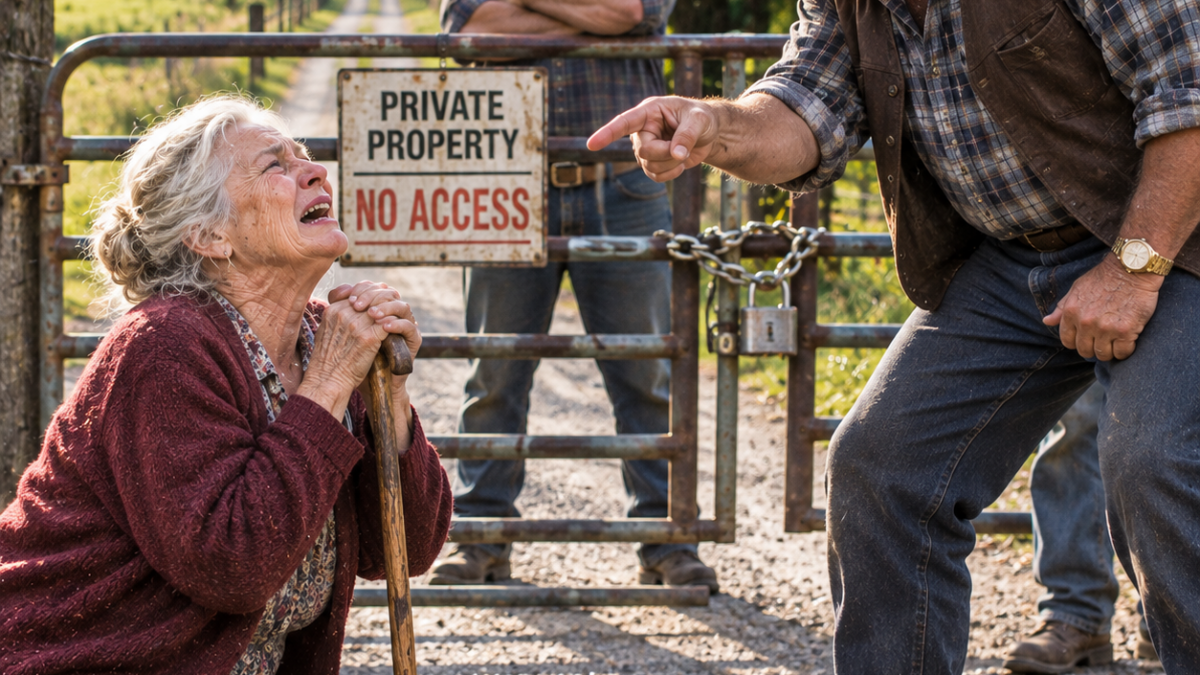
A grader was parked sideways across it.
Blade down.
Graham stood nearby speaking to another man.
I stopped.
Evelyn lifted her head.
“Why are we stopping?”
“Machinery.”
She sighed.
I got out.
“Graham.”
He looked over.
“Rachel.”
“We need through.”
“Working on a drain.”
“How long?”
“Couple hours, maybe.”
I looked at the grader.
“Can you move it five minutes?”
He shook his head.
“Not that simple.”
“It has wheels.”
He did not appreciate that.
“We hit rock.”
“Move forward fifteen feet.”
“Blade needs adjustment.”
“Then lift it.”
“Waiting for a man.”
I glanced at Evelyn.
She had one hand covering her eyes.
“She’s just had injections.”
Graham looked toward the car.
Then back.
“I’m sorry.”
“Then move the machine.”
“Can’t.”
“You can.”
“No.”
Something about how calm he was bothered me.
Not angry.
Not apologetic.
Certain.
Like our inconvenience was a natural consequence of his ownership.
I took out my phone.
Started recording.
I had never filmed him before.
For years we avoided escalating.
That ended.
I filmed the grader.
Road.
Cutting.
Graham.
Timestamp.
He looked at the phone.
“Go ahead.”
Then got into his ute.
Drove away across the paddock.
For the first thirty minutes, Evelyn stayed quiet.
Then she asked:
“Any movement?”
“No.”
Another fifteen minutes.
She shifted.
“Rachel?”
“Yes?”
“I need the bathroom.”
My stomach dropped.
“We can drive back to the highway.”
“That’s forty minutes.”
“Maybe the clinic—”
“No.”
She sounded tired.
“My house is there.”
Less than a kilometer beyond the grader.
Her bathroom.
Her property.
Her road right.
But a machine sat between her and all three.
I called Graham.
No answer.
Again.
No answer.
I texted.
EVELYN NEEDS ACCESS HOME. MOVE THE GRADER NOW.
Read receipt.
No reply.
I called police.
Explained.
An officer would attend.
No ETA.
Evelyn waited another twenty minutes.
Then opened the passenger door.
“What are you doing?”
“Walking.”
“No.”
“Rachel.”
“Your eyes—”
“I know where my house is.”
“The ground’s wet.”
“I am not sitting here wetting myself in my own driveway.”
Technically, it was Graham’s road.
But I understood what she meant.
I tried to argue.
Lost.
I parked.
Helped her through the fence.
The ground along the paddock edge was soft.
Evelyn used a cane.
One hand held my arm.
Her eyes were still blurry.
Every few steps, the cane sank.
“You okay?”
“Keep moving.”
We went slowly.
Painfully slowly.
Gum leaves stuck to her shoes.
Her breathing became rough.
We crossed back near her fence line.
House visible now.
Maybe three hundred yards.
Then two hundred.
Then a hundred.
She stopped.
I knew.
Before she said anything.
Her face changed.
“No.”
She whispered it.
Not to me.
To her body.
To the road.
To Graham.
To nobody.
She had not made it.
I said:
“It’s okay.”
She shook her head.
“No.”
“It’s okay.”
“Don’t.”
Her voice cracked.
I looked away.
Gave her whatever privacy a field can give an eighty-four-year-old woman who has been forced to walk home half-blind because somebody wanted control over a road.
We reached the house.
I got her inside.
She refused help.
“Put towels in the bathroom.”
I did.
“Leave me.”
“Evelyn—”
“Please.”
I left.
Closed the door.
Stood in the kitchen.
Then I heard her cry.
Nine years.
I had seen her after falls.
After surgeries.
After Harold’s anniversary.
After doctors told her vision would never improve beyond a certain point.
I had never heard her cry.
That sound made the decision for me.
At 5:30, the grader was gone.
I drove back down.
Filmed the empty cutting.
No broken hydraulic line.
No immovable disaster.
Just road.
That evening I called Louise.
She listened silently.
Then said:
“I have something.”
“What?”
“A notebook.”
“What notebook?”
“I’ve been writing down the gates.”
“How long?”
“2016.”
I drove to her house.
She brought out a cheap spiral notebook.
Dates.
Times.
Gate locked.
Key failed.
Delivery delayed.
Machinery blocked road.
Police called.
Road cleared before arrival.
She had photographs.
Screenshots.
Names.
Her father had been a bus driver.
“He wrote everything down,” she said.
“So I started doing it too.”
I stared at nine years of obstruction in blue and black ink.
Then thought about Evelyn’s hall cupboard.
The biscuit tin.
Dozens of Graham’s letters.
Her replies.
Booking records.
Refunds.
Police incident numbers.
I went home.
Opened the video.
Then did the one thing Evelyn had repeatedly asked us not to do.
I sent it to David.
Message:
I’m sorry. She told us not to worry you. You need to see this.
I attached the video.
Photographs.
Then typed everything I remembered.
At 4:17 the next morning, my phone rang.
David.
London.
His voice was calm.
“Rachel.”
“I’m sorry.”
“What time did the grader arrive?”
Not:
What did that bastard do?
Not:
Is Mum okay?
He had clearly already spoken to her.
He asked:
“What time did you start recording?”
“2:07.”
“What time was the road clear?”
“About 5:30.”
“Do you still have the original video file?”
“Yes.”
“Do not edit it.”
“Okay.”
“Louise’s notebook?”
“Yes.”
“I need scans.”
“Okay.”
“Every photograph.”
“Yes.”
“Every letter Graham sent Mum.”
“There are dozens.”
“All of them.”
“The cabin bookings.”
“Yes.”
“Refunds.”
“Yes.”
“Cancellations.”
“Yes.”
“Police stations you contacted.”
“I can list them.”
“Please.”
Then he paused.
“Rachel.”
“Yes?”
“Thank you.”
I expected anger.
He sounded cold.
Controlled.
That scared me more.
I had always thought of David as Evelyn’s son.
The man who sent money.
Asked whether the gutters had been cleaned.
Called on Sundays.
I once asked Evelyn what he did.
“Something with contracts.”
That morning, curiosity got me.
I searched his name.
Then sat staring at my laptop.
Senior partner.
Major London commercial litigation firm.
International disputes.
Financial cases.
Infrastructure.
Contract claims.
Articles in business newspapers.
Photograph of David in a dark suit outside a courthouse.
Apparently “something with contracts” meant enormous companies paid him enormous amounts of money to fight other enormous companies over enormous amounts of paper.
He could not personally act as Evelyn’s Australian lawyer.
He said that immediately.
Different jurisdiction.
Different admission.
Different rules.
What he could do was understand evidence.
He hired a property law firm in the city.
They retained a barrister specializing in land disputes.
Then David flew home.
Less than two weeks later, he sat at Evelyn’s kitchen table.
Biscuit tin in front of him.
Louise’s notebook beside it.
Colored tabs.
Laptop.
Scanner.
Three legal pads.
Evelyn stood in the doorway.
David looked up.
“Mum.”
She said:
“You’ll be wanting tea, then.”
That was as close as she came to admitting she should have told him.
David stared.
Then laughed.
Then cried.
Not dramatically.
Just one hand over his face for a second.
Evelyn crossed the room.
Put her hand on his shoulder.
“You had your own life.”
David looked at her.
“You’re my mother.”
“I know.”
“You should have called.”
“I did.”
“Once a week.”
“I mean about this.”
She looked toward the biscuit tin.
“I handled it.”
“For twenty years?”
“Apparently not very well.”
He closed his eyes.
“Mum.”
She squeezed his shoulder.
“I’m still here.”
That line broke him.
He hugged her.
I looked away.
Then David went to work.
He did not call Graham.
Did not threaten.
Did not knock on his door.
He built a chronology.
First purchase offer.
Second offer.
Initial complaints.
First gate.
Second gate.
Lock changes.
Guest delays.
Cabin cancellations.
Road grading.
Machinery incidents.
Police calls.
My trespass mistake.
Every key.
Every letter.
Every photograph.
At one point he held up Graham’s 2005 letter.
Read aloud:
I am well aware of your right-of-way, however I hope you will eventually see sense regarding the future disposition of your block.
David stared at his mother.
“He wrote this?”
“Yes.”
“And then spent twenty years disputing the right?”
“Yes.”
David smiled without humor.
“That was generous of him.”
“Generous?”
“He put knowledge in writing.”
That became a theme.
Graham’s greatest enemy was not David.
It was Graham fifteen years earlier.
The local solicitors sent a formal letter.
Graham retained his own lawyers.
Their argument was not absurd.
That matters.
They said the right-of-way allowed reasonable domestic access.
They disputed whether holiday-cabin guests fell fully within historic usage.
They argued gates were necessary for cattle management and biosecurity.
They said road maintenance required temporary closures.
They cited my trespass into the paddock.
Included photographs.
Graham argued Evelyn’s workers and guests created problems beyond the original intended use.
Our barrister, Oliver Kane, read the response.
Then said:
“Good.”
I stared.
“Good?”
“Yes.”
“Why?”
“Bad arguments are easy.”
He tapped the letter.
“Reasonable arguments force us to prove the actual facts.”
I disliked lawyers almost as much as I liked Rina? Wrong story. Keep consistent. Oliver smiled.
“Don’t worry.”
“I’m not.”
“You look worried.”
“I look tired.”
“That too.”
Because obstructions continued even after lawyers became involved, Evelyn’s solicitors sought interim relief.
The court issued an order.
Graham could not block the right-of-way.
Any gate had to remain operable with a working key or equivalent access.
No intentional obstruction.
Suddenly the mechanical problems disappeared.
Locks stopped rusting.
Keys stopped failing.
Hydraulic lines became extraordinarily healthy.
The gates stayed open.
Louise drove through one morning and called me.
“You know what’s incredible?”
“What?”
“Court orders improve farm machinery.”
I laughed for five minutes.
Evelyn did not.
She simply said:
“Should have done it years ago.”
The final hearing took several days.
No jury.
No shouting lawyers pacing before dramatic witnesses.
Mostly documents.
Folders.
Maps.
Questions.
Old letters.
The courtroom was smaller than I imagined.
Graham sat with his lawyers.
He looked older.
Still broad-shouldered.
Still wealthy-looking.
But the certainty was gone.
The first major issue was the right-of-way itself.
Title language.
Historic usage.
Visitors.
Service providers.
Cabin guests.
Evidence showed the cabins operated before Graham purchased the neighboring farm.
Guest access had existed for years.
The right was not something Evelyn secretly expanded after he arrived.
Then came Graham’s purchase contract from 2004.
Attached title search.
Right-of-way clearly listed.
Every page initialed.
Including that one.
David sat behind the lawyers.
When the document appeared, he did not smile.
Later I asked why.
He said:
“Never celebrate before judgment.”
Commercial litigator.
Then came the 2005 letter.
I am well aware of your right-of-way.
Graham’s barrister tried to distinguish legal acknowledgment from disagreement over scope.
Fair enough.
But the letter made it nearly impossible to claim he had been unaware of Evelyn’s rights.
Louise testified.
Notebook.
Dates.
Lock changes.
She was nervous.
I had never seen Louise nervous.
Before entering court she whispered:
“What if I say something stupid?”
David answered:
“Tell the truth.”
“What if truth sounds stupid?”
“Then let it.”
She did.
Opposing counsel challenged her record-keeping.
“Did Mrs. Hart ask you to maintain this notebook?”
“No.”
“So it was your personal project?”
“Yes.”
“You disliked Mr. Rusk?”
“Eventually.”
A few people smiled.
“You began recording incidents because you expected litigation?”
“No.”
“Why, then?”
“My father drove buses.”
The barrister paused.
Louise continued.
“He wrote everything down.”
“Fuel.”
“Routes.”
“Breakdowns.”
“Late passengers.”
“I picked up the habit.”
The notebook was not perfect.
Some entries lacked photographs.
Some times were approximate.
But it matched enough letters, police calls, delivery records, and messages to become powerful corroboration.
Then I testified.
My paddock incident came up.
Graham’s barrister showed the photograph.
My car buried in mud.
“Is that your vehicle?”
“Yes.”
“You knowingly left the right-of-way?”
“Yes.”
“Entered Mr. Rusk’s paddock?”
“Yes.”
“Without permission?”
“Yes.”
“Caused damage?”
“Tire tracks.”
“So you admit trespassing?”
“Yes.”
He seemed almost disappointed by the speed of the answer.
“Would you do it again?”
“No.”
The judge wrote something down.
I have no idea what.
Then the barrister asked:
“And why did you leave the road?”
“Locked gate.”
“Could you have waited?”
“Yes.”
“Could you have called?”
“No signal.”
“But you chose to drive into the paddock.”
“Yes.”
I looked at Graham.
“I made the wrong choice.”
That was it.
No excuse.
My mistake did not erase Evelyn’s right.
That mattered.
Then came the grader incident.
My video.
Timestamp.
Road.
Machine.
Graham standing beside it.
My request.
His refusal.
Evelyn sitting in the car.
Later footage showing the road clear.
Graham’s explanation remained:
Unexpected rock.
Blade problem.
Needed technician.
Could not safely move.
Then David’s team found Liam Carver.
The young farm worker who had pulled my car from the mud years earlier.
He no longer worked for Graham.
They found his name in employment records.
Contacted him.
He still had old work texts backed up on his phone.
One message from the week of the grader incident came from Graham.
No rush getting grader out of cutting Tuesday. Afternoon’s fine.
Everything changed when that appeared.
Liam testified.
He was still angry with Graham over unpaid overtime after leaving.
Opposing counsel made sure the judge knew.
“You have a grievance against Mr. Rusk?”
“Yes.”
“You dislike him?”
“Yes.”
“You believe he owes you money?”
“He did. It was settled.”
“You were angry when the Hart solicitors contacted you?”
“Yes.”
“Then why should the court rely on your interpretation?”
Liam shrugged.
“Don’t rely on my feelings.”
He pointed toward the evidence.
“Read the text.”
That was the best answer anybody gave.
He explained the grader could have been moved within minutes.
Not repaired.
Moved.
The blade could have been lifted.
Machine repositioned.
Road cleared temporarily.
Graham knew Evelyn returned from the eye clinic around that time because her schedule had been discussed previously in correspondence about road works.
That part was contested.
But the video, text, work records, and timeline existed.
The judge did not need to read Graham’s mind.
He only needed to decide whether the obstruction was reasonable.
Then Evelyn testified.
Eighty-four.
Small.
White hair.
Dark blue cardigan.
She carried a cane.
David wanted her to rest.
She refused.
The barrister asked:
“Mrs. Hart, why did you refuse to sell your property in 2004?”
Evelyn looked confused.
“Because I didn’t want to.”
Somebody behind me coughed to hide a laugh.
“Was the price the primary reason?”
“No.”
“Why?”
“It was my home.”
Simple.
“Did you intend to sell later?”
“No.”
“Did Mr. Rusk ask what you planned to do with the property at your age?”
“Yes.”
“How did you understand that?”
Evelyn thought.
“As him asking when I intended to become inconveniently dead.”
The judge looked down.
Even Graham’s lawyer paused.
Evelyn continued.
“I may have misunderstood.”
Nobody believed she had.
She was asked why she did not sue earlier.
That was harder.
“Court costs money.”
“Did your son offer assistance?”
“He would have.”
“Why did you not tell him everything?”
She looked toward David.
“I didn’t raise him so he could spend his life solving mine.”
David stared at the floor.
Then came the grader day.
Evelyn’s voice changed.
Not crying.
Flatter.
“I had injections.”
“My vision was poor.”
“I needed to use the toilet.”
“We waited.”
“Rachel tried.”
“Then I walked.”
She stopped.
The barrister waited.
Evelyn looked annoyed.
“Must I say the rest?”
“Only if you can.”
She lifted her chin.
“I wet myself.”
Silence.
“About a hundred meters from my house.”
She looked toward Graham.
“I had lived there more than forty years.”
Her voice finally trembled.
“And I could see my own bathroom.”
That was the moment I saw Graham look away.
Not when damages were discussed.
Not when his letter appeared.
Then.
Evelyn continued.
“I was embarrassed.”
“Angry?”
“Yes.”
“At Mr. Rusk?”
“At myself.”
That hurt more.
“Why yourself?”
“For letting it go on so long.”
David closed his eyes.
The judge called a short break.
Outside, Evelyn immediately asked for tea.
As if testimony about twenty years of harassment were simply another annoying appointment.
David stood beside her.
“Mum.”
“What?”
“Nothing.”
“Then stop looking at me.”
He laughed.
She drank tea.
The cabins became central to damages.
This was where paperwork nobody had cared about became money.
Booking ledgers.
Tax records.
Refunds.
Cancellations.
Maintenance costs.
Reviews.
Emails from guests.
We could not claim every lost booking forever.
The lawyers isolated periods the court could fairly consider.
They distinguished operating expenses.
Seasonality.
Evelyn’s age.
The fact she might have reduced the business eventually anyway.
That made the claim stronger.
It was not fantasy revenue.
It was documented loss.
One review appeared in evidence:
Lovely cabin, shame about the hostage situation.
The judge actually looked over his glasses.
Graham looked furious.
I almost felt sorry for him.
Almost.
The police history mattered too.
Not because officers had found crimes.
They had not.
But the call records showed a repeated pattern.
Obstruction reported.
Officer dispatched.
Road clear by arrival.
Graham cooperative.
Civil dispute.
Again.
Again.
Again.
No single incident proved everything.
Together they formed a rhythm.
Then Graham testified.
That surprised me.
His lawyers could have advised against it.
Maybe he insisted.
He was not monstrous on the stand.
That also mattered.
He talked about biosecurity.
Cattle.
The road running through a working farm.
Guests speeding.
Gates left open.
Trespass.
Maintenance expense.
Dust.
Liability.
Some complaints were legitimate.
The problem was that legitimate concerns did not give him authority to extinguish Evelyn’s right.
The barrister asked:
“You offered to purchase Mrs. Hart’s land?”
“Yes.”
“More than once?”
“Yes.”
“After she refused, did you believe the property would eventually become part of your farm?”
Graham paused.
“I hoped.”
“Why?”
“It made agricultural sense.”
“Did her sixty acres interrupt your holding?”
“Yes.”
“Did you ever tell her she was too old to maintain it?”
“I don’t remember those words.”
“Did you ask what she intended to do with the property at her age?”
“Possibly.”
Then the 2005 letter.
I hope you will see sense about the future of the block.
Graham’s face tightened.
The barrister asked:
“What future did you mean?”
“Sale.”
“To you?”
“Potentially.”
“And if she did not sell?”
“It was her choice.”
“Was it?”
Silence.
That question lingered.
The final judgment did not arrive that week.
Courts are cruel that way.
You pour twenty years into several days.
Then wait.
Months.
Late 2025, the decision came.
David called me.
“Rachel.”
“What?”
“We have judgment.”
My stomach tightened.
“And?”
“We won.”
Not his case.
His mother’s.
But I understood.
The judge found repeated deliberate interference with the registered right-of-way.
A permanent order protected Evelyn’s access.
Gates could not be used to deny passage.
Working keys or unrestricted equivalent access had to be maintained.
No obstruction with machinery except genuine, reasonably necessary operational events handled so as to minimize interference.
The cabins were recognized within the historic access usage.
Graham could manage legitimate farm safety.
He could not use farm management as a pretext to isolate Evelyn.
Damages:
A little more than $120,000.
Proven business losses.
Certain expenses.
Interest.
Then costs.
That was worse for Graham.
Early in the litigation, Evelyn’s solicitors had made a formal settlement offer.
Graham rejected it.
The eventual judgment made that decision expensive.
Most of Evelyn’s legal costs were ordered against him.
Enhanced rates applied for part of the proceeding because of the settlement position.
Nearly $300,000.
Combined with damages:
More than $400,000.
His own legal bill came on top.
Nobody knew exactly how much.
David did not celebrate.
Neither did Evelyn.
She read the judgment summary.
Then asked:
“So the gates stay open?”
“Yes.”
“That’s all I wanted.”
David laughed.
“Mum, we just spent—”
“I know.”
She looked at him.
“Tea?”
Of course.
Graham did not pay immediately.
There was talk of appeal.
Then no appeal.
Enforcement began.
Slow.
Administrative.
Letters.
Deadlines.
Financial disclosures.
David covered continuing legal expenses so Evelyn never had to choose between enforcement and groceries.
That was when we learned Graham’s farm was less secure than it appeared.
Eleven hundred acres does not mean eleven hundred acres owned free and clear.
Dry years.
Machinery finance.
Operating loans.
Land improvements.
Bank debt.
He had assets.
He also had obligations.
The judgment arrived at the worst possible time.
Commodity prices.
Input costs.
Refinancing pressure.
Bank negotiations.
For months, rumors traveled around the district.
Graham selling?
Graham appealing?
Bank taking land?
Nobody knew.
Then survey markers appeared.
Real-estate agents came.
By the second half of 2026, roughly three hundred acres were sold.
Not the entire farm.
Enough.
The sale included the strip containing the road.
That part felt almost impossible.
For twenty-two years, Graham had guarded that road like control over it would eventually deliver Evelyn’s sixty acres into his hands.
Instead he lost the road.
And five times the acreage he had tried to acquire from her.
I did not feel triumphant when I heard.
Maybe a little.
I am human.
But mostly I thought about how unnecessary all of it had been.
Graham could have maintained gates.
Provided working keys.
Scheduled road work.
Asked cabin guests to follow rules.
Negotiated maintenance contributions.
Even litigated the scope honestly if he truly believed Evelyn exceeded her rights.
He did not have to spend two decades turning access into pressure.
Three hundred acres is a hell of a lot of land to lose over a road you did not need to own completely.
The new owners were a couple named Ben and Alice Morley.
Sheep farmers.
Before settlement, Ben called Evelyn.
Not David.
Not the lawyers.
Evelyn.
“Mrs. Hart?”
“Yes?”
“We’re buying the western block from Rusk.”
“So I’m told.”
“The middle gate is awkward.”
Evelyn went quiet.
I was sitting across from her.
I saw her face change.
Ben continued quickly:
“We’re thinking a stock grid instead.”
Pause.
“No lock.”
Another pause.
“Would that cause you any trouble?”
Evelyn stared at me.
Then smiled.
“No.”
“No?”
“No.”
“Good.”
“We’ll still need a gate beside it for stock movement occasionally.”
“That’s fine.”
“You’ll have a key.”
Evelyn laughed.
Ben stopped.
“Something funny?”
“No.”
She wiped her eyes.
“I’m sorry.”
“What?”
“Nothing.”
Then:
“A working key sounds lovely.”
The stock grid went in three weeks later.
I drove over it slowly the first morning.
Metal bars hummed beneath the tires.
No stop.
No key.
No padlock.
No phone call.
No grader.
Just road.
The bolt cutters stayed beneath my seat.
Habit.
I kept forgetting to remove them.
Louise saw them once.
“You know those are useless now?”
“Yes.”
“Why keep them?”
“Emotional support.”
She laughed.
Evelyn’s cabins never fully reopened.
By then she truly was too old to manage a holiday business.
David asked whether she wanted someone else to operate them.
“No.”
“Sell them separately?”
“No.”
“What do you want?”
“To look at them.”
So they stayed.
One became a place for David when he visited.
The other stored furniture and boxes.
Sometimes families from the new sheep farm used the creek path with permission.
Life became quiet.
Exactly what Evelyn had wanted twenty years earlier.
Graham still owned the remaining farm.
We saw him occasionally.
No dramatic final confrontation.
I think people expect one.
They want the widow standing at the boundary shouting:
“How does it feel?”
Evelyn would never.
The first time Graham drove past after the land sale, he slowed.
Evelyn was near her mailbox.
I was with her.
He lowered his window.
“Evelyn.”
“Graham.”
Long pause.
“I’m selling the western paddocks.”
“I heard.”
“New owners seem decent.”
“Yes.”
Another pause.
Then Graham said:
“I never intended things to go this far.”
Evelyn looked at him.
That sentence bothered me.
Not because it was false.
Because it was probably true.
People rarely intend twenty years at the beginning.
They intend one gate.
One delay.
One pressure tactic.
One letter.
One more lock.
One more inconvenience.
Then pride starts defending yesterday’s mistake.
Evelyn answered:
“You could have stopped any year.”
Graham looked away.
“Yes.”
That was all.
He drove on.
I expected Evelyn to say something afterward.
She did not.
We walked back to the house.
Finally I asked:
“Do you forgive him?”
She looked offended.
“That’s private.”
“Sorry.”
Ten steps later:
“Probably.”
I stared.
She shrugged.
“I’m eighty-four.”
“So?”
“I don’t have enough years left to spend them all hating Graham Rusk.”
That was Evelyn.
Then:
“I still think he’s an idiot.”
Also Evelyn.
David visited more often after the case.
Guilt.
He never said it.
I could see it.
One evening we sat on the veranda.
Evelyn had gone to bed.
David held a beer.
“I should have known.”
“No.”
“She told me about gates.”
“She told all of us they were nothing.”
“I’m her son.”
“You live in London.”
“That sounds like an excuse.”
“It sounds like geography.”
He looked toward the dark road.
“I solve problems for strangers every day.”
“Companies call.”
“I read documents.”
“I find pressure points.”
“My mother was being trapped behind a gate and I thought she needed somebody to fix her Wi-Fi.”
I said:
“She wanted you to be her son.”
He looked at me.
“What?”
“Not her lawyer.”
Silence.
“She hid it because she didn’t want every Sunday call to become litigation.”
“That doesn’t make it okay.”
“No.”
“But it explains it.”
David stared at the bottle.
“I was furious with her.”
“I know.”
“Then she made tea.”
“I know.”
“She thinks tea is conflict resolution.”
“It often works.”
He laughed.
Then:
“Thank you for sending the video.”
“I broke my promise.”
“You kept the important one.”
“What promise?”
“To look after her.”
I had no answer.
The notebook went into the biscuit tin eventually.
Louise insisted.
“Historical archive.”
David wanted to scan everything.
Evelyn let him.
Then took the originals back.
“My letters.”
“Mum, they need proper storage.”
“They have proper storage.”
She held up the biscuit tin.
David stared.
It had faded flowers on the lid.
Probably older than he was.
“No solicitor in London uses a biscuit tin.”
“That is why they charge too much.”
I almost fell off the chair laughing.
The road case changed small things.
Deliveries returned.
The pump serviceman stopped asking whether the gate would be open.
The pharmacy driver drove to the house again.
Emergency services updated access notes.
Louise stopped calling ahead before every visit.
I did too.
That took longer than expected.
Years of interference train the body.
Even after the interim order, I approached the middle gate expecting trouble.
Hand reaching toward the center console.
Eyes looking for a padlock.
When the stock grid replaced it, I still slowed automatically for months.
Then one day I did not.
I simply drove.
That was when I understood how much Graham had changed our routines.
Harassment does not need to be dramatic to occupy your life.
It can be tiny.
A key.
A lock.
A phone call.
A delivery.
A question:
Will I get home today?
People imagine property disputes as lines on maps.
Sometimes they are.
Sometimes they are about whether an old woman can reach a toilet after medical treatment.
That was the part no title document could capture.
The right-of-way language was clinical.
Ingress and egress.
What did ingress mean on that Tuesday?
It meant dignity.
It meant an eighty-four-year-old woman should not have been forced across wet ground while half-blind.
What did egress mean?
Doctor appointments.
Groceries.
Ambulance access.
Her son visiting.
Guests reaching the cabins.
Life moving in both directions.
Graham looked at the same road and saw ownership.
His ground.
His gates.
His cattle.
His maintenance burden.
Those things were not imaginary.
But property rights can overlap.
That was what he refused to accept.
His road.
Her right.
Both true.
The legal system did not need to declare him owner of nothing.
It simply told him ownership did not mean everything.
That may have been the hardest lesson for him.
Evelyn already understood.
She owned sixty acres.
The road crossed somebody else’s land.
She never pretended otherwise.
She accepted gates.
Accepted cattle.
Accepted reasonable care.
Accepted that guests needed to slow down.
Even offered money for grading.
She wanted coexistence.
Graham wanted eventual consolidation.
Once she refused to sell, every inconvenience became pressure.
He might never have sat at his desk and written:
I will force this widow out.
Life rarely produces villains with written plans.
Instead:
Change the lock.
Delay the key.
Park machinery.
Make bookings difficult.
Raise costs.
Question age.
Make staying annoying.
Make selling feel easier.
That is why the biscuit tin mattered.
One letter is a disagreement.
Twenty years of letters reveal direction.
Louise’s notebook mattered for the same reason.
One locked gate could be a mistake.
Repeated lock changes at inconvenient times become a pattern.
One machine failure is life.
A text saying No rush getting grader out Tuesday changes the context.
Evidence does not always discover a dramatic secret.
Sometimes it simply proves repetition.
David understood that instantly.
His profession trained him for it.
He once said:
“People think litigation is about arguing.”
“What is it?”
“Organizing.”
“Really?”
“Mostly.”
“That’s disappointing.”
He smiled.
“The person with the better story often loses to the person with the better chronology.”
That was our case.
Graham had a story.
Farm security.
Biosecurity.
Road maintenance.
Cabin traffic.
Trespass.
All partly true.
We had chronology.
Offer to buy.
Refusal.
Complaints.
Gate.
Second gate.
Lock changes.
Cabin losses.
Police calls.
Letters acknowledging the easement.
Grader.
Text.
Once arranged in order, the same facts looked different.
That is why David wanted dates before opinions.
When he first called from London, I wanted to tell him Graham was a bastard.
He wanted the timestamp.
At first I thought he was cold.
Later I understood.
Anger could wait.
Evidence had to be preserved.
That lesson stayed with me.
The judgment became local gossip.
Some people sympathized with Graham.
“He had to manage his farm.”
True.
“She ran commercial cabins over his road.”
Also true.
“Four hundred thousand plus legal fees is enormous.”
Absolutely.
Then somebody would say:
“He initialed the right-of-way when he bought the farm.”
Conversation usually stopped there.
Not because initialing a title page makes every later dispute illegitimate.
Because it destroyed the story that Evelyn’s right surprised him.
He knew what he purchased.
The land came burdened by her passage.
Like a fence.
A creek.
A power easement.
A neighbor.
You do not get to erase inconvenient features because you later wish your title were cleaner.
The sale of three hundred acres became the irony everyone repeated.
He tried to get her sixty and lost three hundred.
Catchy.
Maybe too neat.
Reality was more complicated.
The judgment did not single-handedly confiscate three hundred acres.
Graham already had bank debt.
Dry seasons.
Machinery costs.
Operating pressure.
The damages and legal costs became another large obligation at a bad time.
He chose or was forced by finances to sell acreage to stabilize the rest.
That distinction matters.
Justice should not need exaggeration.
The proven truth was enough.
His campaign to pressure an old widow over her sixty acres contributed to a chain of consequences that ended with him selling roughly three hundred acres of his own.
Including the road.
That is irony without embellishment.
David appreciated precision.
When a local person said:
“Your mum took his farm,” David corrected:
“No.”
“He sold part of his farm to meet debts.”
Less satisfying.
More true.
Evelyn said:
“Stop ruining good gossip.”
David stared at her.
“You’re impossible.”
“Genetic.”
The damages helped replace some cabin income Evelyn had lost.
David insisted on setting the money aside carefully.
Evelyn wanted a new refrigerator.
“You can afford one without the judgment money.”
“I know.”
“Then why are you telling me?”
“Because I won.”
“You did not win a refrigerator.”
“I absolutely did.”
She bought one.
Stainless steel.
Too large for the kitchen opening.
Installer had to remove a door.
David stared at it.
“This is what justice looks like?”
Evelyn opened the freezer.
“Very cold.”
She deserved it.
The rest was invested conservatively.
Some covered property maintenance.
Cabin roofs.
Creek fencing.
Medical expenses.
Not revenge money.
Restoration.
One thing Evelyn refused to do was sell.
David asked gently after the case:
“Would you ever consider moving closer to town?”
“No.”
“Not because of Graham.”
“No.”
“Because of your eyes?”
“No.”
“Mum.”
“I’ll know when.”
“When what?”
“When I want to leave.”
He nodded.
That mattered.
For twenty years, Graham had asked what she planned to do with the property at her age.
David was careful not to become another man making decisions because she was old.
He arranged support.
Not removal.
More hours from us.
Emergency call system.
Better lighting.
Handrails.
Regular garden maintenance.
Freedom with scaffolding.
Not freedom taken away.
Evelyn noticed.
One morning she told me:
“David has finally learned to nag politely.”
“Progress.”
“He gets it from me.”
“Obviously.”
The new sheep owners were different.
Ben and Alice respected the right-of-way from day one.
Mostly because they had competent solicitors.
Before purchasing, their lawyer highlighted it.
Ben laughed when he told me.
“First thing she said was, ‘You do understand Mrs. Hart has permanent access?’”
“What did you say?”
“Apparently the correct answer was yes.”
“Very advanced.”
He grinned.
The stock grid changed everything psychologically.
Cattle or sheep could remain contained.
Vehicles passed without stopping.
A side gate handled livestock movements.
Evelyn still had keys.
They worked.
Nobody cared because we rarely needed them.
Occasionally sheep wandered near the road.
Those became our new delays.
I would stop.
Wait.
A sheep would stare at me as though I were the inconvenience.
Then move.
First time it happened, I sat laughing alone in the car.
Four years of bolt cutters beneath the seat.
Twenty years of padlocks.
Hundreds of letters.
Two court hearings.
More than $400,000.
Three hundred acres sold.
And now my biggest access problem was a confused sheep.
I called Louise.
“You’ll never guess.”
“Locked gate?”
“Sheep.”
“Did you call police?”
“Civil matter.”
She laughed until she cried.
We never removed the bolt cutters.
I kept forgetting.
Truthfully?
I think I liked them.
Not because I planned to cut anything.
They reminded me of who we had been before court.
People adapting.
Preparing.
Carrying tools we hoped not to use because formal rights felt too slow to protect daily life.
Afterward, the bolt cutters became unnecessary.
That is what good enforcement should do.
Make self-help unnecessary.
People should not need tools under car seats to exercise rights already written in deeds.
That lesson applies far beyond farm roads.
A right only works when the system protecting it works fast enough to matter.
Evelyn had technically been right since 2004.
That did not stop her losing bookings.
Waiting at gates.
Missing deliveries.
Walking home after eye injections.
Being legally correct and practically protected are different things.
The interim order mattered because it turned paper into behavior.
Suddenly:
Gate open.
Keys work.
Machinery moves.
Amazing.
The final judgment made that permanent.
Not dramatic.
Effective.
That is why Evelyn cared more about the order than the money.
“So the gates stay open?”
That was her first question.
Not:
How much did I win?
Not:
What happens to Graham?
Access.
That was always the case.
David sometimes wished she felt more victorious.
I think.
He had spent enormous energy.
Time.
Money.
Professional attention.
Her response was:
Tea.
Then crossword.
At first it frustrated him.
Later he understood.
Evelyn never wanted a battle.
Winning did not become her identity.
She wanted her old life back.
That is healthier than many litigants manage.
She did not spend mornings checking whether Graham suffered.
Did not drive past his land sale signs for pleasure.
Did not attend auctions.
Did not post about him.
She returned to her house.
Her doctor.
Her creek.
Her crossword.
That was justice.
Ordinary life resumed.
The Tuesday eye appointments continued.
The first one after the stock grid opened made me nervous.
More than Evelyn.
I picked her up.
She wore sunglasses.
“Ready?”
“I’ve been ready since six.”
“It’s eight.”
“You’re late.”
“I am two minutes early.”
“Not by old-person time.”
We drove to the specialist.
Injections.
Blurred vision.
Long return trip.
When we turned off the bitumen, I felt my hands tighten on the steering wheel.
Old habit.
First gate area.
Open.
Middle section.
Stock grid.
No machinery.
No Graham.
We crossed.
Evelyn leaned back.
“Nearly home.”
Same words she always used.
Except this time nothing interrupted them.
I drove all the way to her back door.
Parked.
Helped her out.
She stood.
Looked toward the road.
Then toward me.
“What?”
“Nothing.”
“You’re making a face.”
“What face?”
“That sentimental one.”
“I don’t have one.”
“You do.”
She went inside.
I carried her bag.
She used her own bathroom.
No field.
No tears.
A human being should not be grateful for that.
Yet I was.
Later that afternoon, she sat at the kitchen table with a crossword.
I unpacked groceries.
Changed her sheets.
Booked her next eye appointment.
Tuesday.
Again.
On the windowsill sat the biscuit tin.
Now filled with photocopies because David had taken the originals temporarily for archiving and then, under protest, returned them.
Louise’s notebook sat inside.
I opened the hall cupboard.
Saw the tin.
Then saw the bolt cutters when I returned to my car.
Still under the passenger seat.
I shook my head.
One day.
I would remove them one day.
Maybe.
The road stretched ahead.
Dirt.
Gravel.
Three kilometers.
Nothing special.
Ben’s sheep grazed beyond the fence.
The stock grid hummed beneath my tires.
No lock.
No waiting.
No phone signal still, but that had somehow become charming again instead of threatening.
When I first started working for Evelyn, I thought the road dispute was about a difficult neighbor.
Then I thought it was about property law.
Then business losses.
Then dignity.
By the end, I realized it was about something more basic.
A person can own the land beneath a road without owning another person’s right to pass.
Graham never accepted that emotionally.
The law had been written before he bought his farm.
He initialed it.
But he looked at eleven hundred acres and Evelyn’s sixty-acre corner and kept thinking:
This would make more sense if it were mine.
Maybe it would have.
From a map.
From a farming perspective.
From an efficiency standpoint.
But Evelyn’s life was not an inefficiency.
Her house was not a missing puzzle piece.
Her age was not a countdown to Graham’s convenience.
That was the part he never understood until consequences arrived.
He kept asking:
What are you going to do with this place at your age?
The answer turned out to be:
Live there.
For more than twenty more years.
Long enough to outlast his patience.
Long enough to take him to court.
Long enough to watch him sell the road he had guarded.
Long enough to drive over a stock grid installed by neighbors who simply asked what would work.
Evelyn did not beat Graham because she was richer.
She was not.
Not because she had more land.
She did not.
Not because she was more powerful.
For most of the fight, she was an elderly widow with two caregivers and a biscuit tin.
She won because the right existed.
Because people kept the paperwork.
Because Louise wrote dates in a notebook.
Because booking ledgers survived.
Because I finally recorded the grader.
Because Liam kept an old text.
Because Graham initialed his purchase papers.
Because David understood that twenty years of small incidents became powerful when put in order.
And because eventually Evelyn stopped treating endurance as the only respectable response.
That last part matters.
She sometimes called herself stubborn.
People praised her independence.
Both were true.
But independence can become a trap too.
She had spent years refusing to burden David.
In doing so, she let Graham burden her instead.
That was one of the conversations David eventually had with her.
I overheard part.
“Mum.”
“What?”
“You do not protect me by hiding things that hurt you.”
“You live far away.”
“I own telephones.”
“You work.”
“I have colleagues.”
“You have children.”
“So do you.”
Pause.
Then Evelyn:
“You were very busy.”
David:
“I would have preferred being busy helping you.”
Long silence.
Finally:
“I know.”
That may have been harder for her than court.
Accepting help.
Not surrender.
Help.
She got better at it.
Barely.
One winter, a storm washed part of the creek bank near the old cabin.
Evelyn called David herself.
He answered:
“What’s wrong?”
“Nothing dramatic.”
His voice changed immediately.
“Mum.”
“The creek ate some dirt.”
“Rachel?”
“Here.”
“Louise?”
“Tomorrow.”
“Send photographs.”
Evelyn sighed.
“Bossy.”
“Genetic.”
Progress.
The legal costs became a cautionary story in the district.
People said:
“Imagine losing three hundred acres over a gate.”
Again, oversimplified.
But useful.
Gates are small until they become symbols.
Graham could have installed them legally.
Stock management justified gates.
The easement did not mean Evelyn could demand no gates.
It meant she had to be able to pass.
Working key.
Reasonable access.
Simple.
His problem was not that he built a gate.
It was that he used uncertainty about the gate as leverage.
Different lock.
Delayed key.
Temporary obstruction.
Each individually explainable.
Together deliberate.
That difference is what evidence revealed.
I think about that whenever somebody says:
“It was only…”
Only a padlock.
Only a few days.
Only one machine.
Only one delayed delivery.
Only a guest.
Only an old woman.
Small things accumulate.
So do records.
Graham spent years believing each incident was too minor to justify serious action.
He was mostly right.
Individually.
Collectively, they cost him a fortune.
That is how patterns work.
They hide inside reasonable explanations until someone stops looking at episodes and starts looking at sequence.
David did that.
Colored tabs.
Years.
Themes.
Green for gates.
Blue for letters.
Yellow for business losses.
Red for police.
Purple for machinery.
I teased him.
“Commercial litigation is scrapbooking for angry rich people.”
He stared.
Then laughed.
“I’m stealing that.”
Probably did.
At the end of the case, he left the colored tabs in the biscuit tin.
Evelyn used some for recipes.
Nothing is sacred to mothers.
The new owners invited Evelyn to their farm Christmas barbecue the next year.
She went.
At eighty-five.
Wore a blue dress.
Ben introduced her to people as:
“Our neighbor who came with the road.”
Evelyn answered:
“No, the road came with me.”
Correct.
Graham did not attend.
Different social circle by then.
His remaining operation continued.
I hope it survived.
People are sometimes disappointed when I say that.
They expect me to wish total ruin.
I do not.
Three hundred acres was enough.
More than enough.
The judgment was enough.
The road protection was enough.
Justice does not become better because suffering continues after the lesson is learned.
Did Graham learn?
I do not know.
Maybe.
His roadside conversation suggested some understanding.
Maybe losing land made him bitter.
Maybe not.
His internal ending is his business.
Our ending was open road.
That was enough for me.
Years later, somebody asked Evelyn whether she regretted not selling in 2004.
She looked genuinely confused.
“Why would I?”
“You could have avoided all that.”
She looked toward the creek.
“Then I wouldn’t have my house.”
Simple.
People often measure decisions by difficulty afterward.
Evelyn measured by what mattered.
She wanted the property.
So keeping it was not a failure because somebody made keeping it hard.
That is a lesson I carry.
Bullies often try to make your choice expensive enough that surrender looks rational.
Then, if you surrender, they say:
See?
You didn’t really need it.
Evelyn needed no justification beyond:
It is mine.
I want to stay.
That was legally and morally enough.
Her age did not weaken that.
If anything, the twenty years she had already invested made Graham’s assumptions uglier.
At sixty-two:
What will you do with it at your age?
At eighty-four:
Still there.
At eighty-five:
Still there.
At eighty-six:
Still solving crosswords.
Age did not become permission.
One of the last times I drove her to the specialist before reducing my working days, we crossed the stock grid.
A flock blocked the road.
Maybe twenty sheep.
I stopped.
Evelyn lifted her sunglasses.
“Why?”
“Sheep.”
She looked through the windshield.
One stood directly in front of us chewing.
“Can’t you honk?”
“I could.”
“Then?”
“They’ll move.”
We waited.
Thirty seconds.
One minute.
The sheep slowly drifted aside.
Evelyn smiled.
“Much better.”
“Than Graham?”
“The sheep have manners.”
I laughed.
We continued.
At the back door, she said:
“Rachel?”
“Yes?”
“Take the bolt cutters out of the car.”
I stared.
“How do you know?”
“Louise told me.”
“Traitor.”
“You’ve carried them four years.”
“Insurance.”
“No.”
She looked toward the road.
“You don’t need them.”
I opened the passenger door.
Pulled them out.
Heavy.
Red handles scratched.
Never used.
I brought them inside.
“Where?”
Evelyn pointed toward the shed.
“Hang them up.”
I did.
That felt stranger than expected.
For four years they had been an object of imagined control.
If the lock changed.
If we had an emergency.
If nobody came.
I could cut something.
Maybe.
Probably not legally.
But I could.
Hanging them in the shed meant trusting the road again.
That mattered.
The next morning I drove in without them.
Nothing happened.
Of course.
Sometimes healing is painfully undramatic.
Years after the grader incident, I can still hear Evelyn crying in that bathroom.
That is the part that never becomes funny.
The land sale?
Irony.
The costs?
Justice.
The stock grid?
Relief.
But that afternoon was humiliation.
An old woman who had done nothing wrong forced to feel ashamed of her own body because another man believed his ownership of the ground beneath a road gave him the right to decide when she reached home.
That is why I sent the video.
Not because I suddenly became brave.
Because shame had moved to the wrong person.
Evelyn felt ashamed.
Graham did not.
I wanted that corrected.
Court did not erase what happened.
But it moved responsibility back where it belonged.
Evelyn had not failed.
She had not been weak.
She had not been foolish.
She had not become “too old” to deserve access.
A deliberate obstruction had put her there.
The judgment said so in formal language.
Sometimes formal language matters emotionally.
David gave her a framed copy of one paragraph.
She refused to hang it.
“People will think I’m strange.”
“You are strange.”
“Take it to London.”
He did.
Apparently it hangs in his office.
Senior partner.
Big litigation firm.
One paragraph about an Australian farm road on the wall.
I like that.
Maybe when corporations fight over billions, he looks at it and remembers the case that mattered most had a biscuit tin.
I still work occasional days for Evelyn.
Less now.
Louise too.
David arranged additional support.
Evelyn is older.
Slower.
Still there.
The cabins weather.
Creek runs.
Sheep move through the neighboring fields.
Ben keeps the road graded properly.
If he needs to close it for genuine work, he calls.
“Rachel, we’re doing gravel Thursday from nine to eleven. Can you get through before?”
Imagine.
A phone call.
Communication.
Two hours.
No court.
No barricade disguised as surprise.
No power play.
That is how easy it always could have been.
Sometimes the most enraging part of a twenty-year conflict is discovering coexistence required almost nothing except respect.
Ben has land too.
Stock too.
Machinery.
Biosecurity concerns.
He manages all of them without turning Evelyn into an enemy.
That proves Graham’s situation was never impossible.
His choices made it impossible.
Ownership did not force him.
Farming did not force him.
The road did not force him.
Pride did.
Control did.
The belief that if he applied enough inconvenience, eventually Evelyn would decide his preferred outcome was easier.
He was almost right.
The cabins closed.
Her visitors decreased.
Service providers hesitated.
She became more isolated.
If the grader incident had not happened, perhaps the pressure would have continued quietly until she died or moved.
That thought bothers me.
Sometimes a situation changes not because the final act is uniquely worse, but because it is finally humiliating enough to break the silence.
Evelyn’s walk home did that.
I wish it had not required that.
But it did.
The next time I hear someone say:
“It’s not worth making a fuss.”
I think of her.
Maybe the issue truly is too small.
Maybe not.
The right question is:
Is this one inconvenience?
Or is this the latest piece of a pattern?
Patterns deserve attention.
Documents deserve preservation.
And people who keep saying:
“It’s nothing”
sometimes need someone who loves them enough to say:
“No. It isn’t.”
That was what I finally did to Evelyn.
She was angry with me for sending David the video.
For almost two days.
Then David arrived.
Then tea.
Then colored tabs.
By the end she admitted:
“You were probably right.”
I said:
“Can I record that?”
“Get out.”
Victory.
Today, the road belongs to different people.
Evelyn’s right remains.
That is the beautiful thing about a properly recorded easement.
Owners change.
Right remains.
Graham learned that when he purchased.
Then spent twenty years fighting it.
Ben learned it before purchase.
Accepted it.
Life became easy.
Same legal words.
Different attitude.
That may be the entire story.
The law did not change.
The person respecting it did.
I drove in this morning with groceries.
Crossed the stock grid.
Three sheep stood near the road.
One moved eventually.
I parked beside the back door.
Evelyn sat at the table with a crossword.
“You’re late.”
“Three sheep.”
“Excuses.”
I unpacked milk.
Bread.
Tea.
Medication.
Changed her sheets.
Called the eye clinic.
Her next appointment is Tuesday.
Of course.
When I finished, I looked through the kitchen window.
The dirt road curved past the gums toward the neighboring farm.
Nothing blocked it.
No loader.
No grader.
No padlock.
No man deciding whether an eighty-four-year-old widow had enough reason to go home.
Just road.
For years, I thought the bolt cutters under my seat made me feel prepared.
They never solved anything.
Paper did.
A biscuit tin did.
A notebook did.
A video did.
An old purchase contract did.
A worker’s forgotten text did.
An eighty-four-year-old woman telling the truth in a small courtroom did.
The strongest thing we ever did was not cut the gate.
It was prove it never had the right to keep us out.
Graham Rusk spent more than twenty years trying to make Evelyn’s sixty acres inconvenient enough that she would finally surrender them.
He changed locks.
Blocked roads.
Undermined her cabins.
Tested her patience.
Questioned her age.
And convinced himself that because he owned eleven hundred acres, the little sixty-acre corner inside his map would eventually have to become his too.
Instead, Evelyn stayed.
The court protected her road.
The judgment followed him into his finances.
And by the end of 2026, the man who had once tried to pressure an old widow into giving up sixty acres had sold roughly three hundred acres of his own.
Including the road.
People call that karma.
Maybe.
I prefer something less mystical.
Consequences.
For twenty years, Graham kept trying to move a woman whose legal right had already been written down.
In the end, that paperwork proved harder to move than any gate, grader, tractor, or eleven-hundred-acre farmer.
And these days, when I drive toward Evelyn’s house, the only thing that ever blocks the road is a sheep.
I can live with that.








