PART2:“YOU’RE JUST A USELESS CRIPPLE NOW!” My Fiancée Humiliated Me in My Wheelchair Before 200 Millionaire Guests—She Had No Idea I Was About to Take Back My Billion-Dollar Empire
Three months earlier, I would have trusted Marcus Hale with my life.
That wasn’t an exaggeration.
We’d known each other for almost seventeen years.
Long before the billion-dollar valuations.
Long before the magazine covers.
Long before people began sending invitations to charity galas simply because they wanted to be photographed standing beside me.
Marcus and I met when I was twenty-five.
I had just left a comfortable engineering position to build a software platform for coordinating freight shipments between regional warehouses and small manufacturers.
The idea wasn’t glamorous.
Most of my college friends thought it was boring.
Warehouse schedules.
Transportation capacity.
Inventory forecasting.
Route optimization.
The kind of systems customers barely notice until something fails.
But I’d grown up watching my father work as a logistics supervisor, and I understood how much money businesses lost because their information couldn’t move as efficiently as their products.
I had twelve thousand dollars in savings.
A secondhand laptop.
A used pickup.
And an office above a warehouse that smelled permanently of diesel fuel.
Marcus arrived as a contract operations manager.
He wore a wrinkled shirt and carried a notebook filled with questions.
During our first meeting, he studied my projections and said, “Your software might work.”
I smiled.
“That’s encouraging.”
“But your operating plan is terrible.”
I laughed.
“Less encouraging.”
He pointed toward a spreadsheet.
“You’re assuming customers will behave rationally.”
“Isn’t that the idea?”
“No. That’s the fantasy.”
He grinned.
“You need someone who understands what happens when trucks break down, warehouse managers quit, and customers forget what they agreed to yesterday.”
I considered him.
“Are you applying for a job?”
“Depends. Can you afford me?”
“Not really.”
He laughed.
“Perfect. Sounds like a startup.”
I hired him.
For the next five years, we worked almost constantly.
We slept in the office during major implementations.
Argued over pricing.
Lost customers.
Won them back.
Made mistakes.
Learned from them.
And gradually built a business that could stand on its own.
Marcus was excellent at managing people.
He could walk into a chaotic warehouse and identify the problem within minutes.
I focused on technology, contracts, and long-term strategy.
We complemented each other.
When the company landed its first major national contract, Marcus and I celebrated with hamburgers from a diner across the street.
No champagne.
No photographers.
Just two exhausted young men staring at a signed agreement that meant we’d finally be able to pay everyone on time.
He raised his soda.
“To making it.”
I tapped my glass against his.
“To surviving long enough to try.”
We laughed.
I trusted him then.
And for many years afterward, he gave me little reason not to.
Vance Global expanded.
We acquired smaller technology firms.
Built new logistics facilities.
Invested in industrial properties.
Eventually, we formed a holding company to coordinate several business divisions.
Our growth attracted private investors and major lenders.
The company developed a board with independent directors and formal governance procedures.
I retained majority voting control through my ownership interests and properly established shareholder arrangements.
Marcus became chief operating officer.
He received significant compensation and equity incentives.
I believed he’d earned them.
But the larger we became, the more our friendship changed.
At first, the changes were subtle.
Marcus started speaking about the company as though he’d built it alone.
He resented interviews that focused on me.
He complained about my public profile.
Once, after a business magazine described me as the driving force behind Vance Global’s expansion, he walked into my office and threw the magazine onto my desk.
“Interesting article.”
I looked up.
“What’s wrong?”
“Apparently I don’t exist.”
I frowned.
“Marcus, you were interviewed.”
“They used two sentences.”
“That’s the editor’s decision.”
He folded his arms.
“Easy for you to say.”
I leaned back.
“You’re the COO. Everybody who matters knows what you’ve contributed.”
He looked away.
“That’s not the same thing.”
I should have taken the conversation more seriously.
Instead, I treated it as ordinary frustration.
People who build something together don’t always feel equally recognized.
I understood that.
So I made a point of acknowledging Marcus more often.
At board meetings.
During investor presentations.
At company events.
I increased his responsibilities and supported a generous long-term incentive package.
I believed recognizing his work would strengthen our partnership.
For a while, it seemed to.
Then I met Victoria Ashford.
She entered my life at a foundation fundraiser in Manhattan.
Victoria was thirty-five.
Elegant.
Beautiful.
Confident.
She worked in luxury brand consulting and came from a family that had once been prominent in East Coast society.
The Ashfords possessed famous names, impressive acquaintances, and far less money than their public image suggested.
I didn’t know that when we met.
Victoria approached me beside a display of photographs from a children’s hospital project.
She wore a black silk gown and carried a glass of champagne.
“Alexander Vance.”
I smiled.
“That’s me.”
She tilted her head.
“I thought you’d be taller.”
I laughed.
“Disappointing start.”
“Not necessarily.”
She smiled.
“I’ve heard you’re impossible to impress.”
“Depends on the subject.”
She gestured toward the photographs.
“Then perhaps we should start with something worthwhile.”
We talked for almost an hour.
She knew about the foundation’s work.
Asked thoughtful questions.
And seemed genuinely interested in the people the hospital project would help.
At least, that’s what I believed.
I had dated before.
Some relationships were serious.
Others weren’t.
But Victoria felt different.
She was comfortable in rooms filled with wealthy, influential people.
She understood the expectations that came with running a large company.
She didn’t seem intimidated by my schedule.
And she possessed the effortless social confidence I’d never fully developed.
Six months later, we were inseparable.
She attended business dinners.
Traveled with me.
Met my employees.
Visited Vance Estate.
And gradually became part of my daily life.
When I proposed in Switzerland, she cried.
Real tears, I thought.
She threw her arms around me.
Said yes before I finished asking.
And called her mother from the hotel terrace.
I remember hearing Celeste scream with excitement.
At the time, I thought she was celebrating her daughter’s happiness.
Later, I began to wonder whether she was celebrating the ring.
Or the estate.
Or the money.
Victoria loved the life surrounding Vance Global.
The private aircraft.
The foundation galas.
The hotels.
The jewelry.
The summer house.
The way people changed their behavior when she entered a room holding my arm.
I told myself there was nothing wrong with enjoying beautiful things.
I enjoyed them too.
I’d worked hard.
I’d taken risks.
I’d built a successful business.
But as our wedding approached, Victoria’s attention seemed to shift away from our relationship and toward the privileges she expected to gain from it.
She wanted changes at Vance Estate.
New furniture.
New art.
A redesigned ballroom.
She complained that the household staff wore uniforms that looked too ordinary.
Once, she asked me to dismiss an elderly gardener because he moved too slowly.
His name was Arthur.
He’d worked for my parents before he came to me.
He was seventy-two and knew every tree on the property.
I told her no.
She stared at me.
“Alexander, people notice these things.”
“What things?”
“Standards.”
“Arthur’s an excellent gardener.”
“He’s old.”
“So?”
She sighed.
“You don’t understand.”
I looked at her.
“Then explain it.”
She waved a hand.
“Never mind.”
I thought we’d simply disagreed about household management.
I didn’t yet understand that Victoria believed people were valuable only as long as they enhanced her image.
Maya had been working at the estate for several months by then.
She was quiet.
Professional.
Dependable.
I knew little about her personal life.
She wasn’t the sort of employee who approached the owner with stories or requests.
She did her work.
Spoke politely.
And occasionally asked whether I needed anything when I stayed late in the library.
One evening, I returned home after an exhausting board meeting.
Victoria had gone to dinner with friends.
The house was nearly empty.
I stood in the library reviewing a set of financial reports.
Maya appeared at the door.
“Mr. Vance?”
I looked up.
“Yes?”
“Would you like some tea?”
I smiled.
“That would be wonderful.”
She returned a few minutes later with a tray.
Then noticed several pages scattered across the desk.
“Long day?”
I laughed.
“Something like that.”
She placed the tea beside me.
“My grandmother used to say that people make the worst decisions when they’re too tired to remember what matters.”
I looked at her.
“Your grandmother sounds wise.”
Maya smiled.
“She was.”
Then she left.
I remembered the remark.
Not because it was dramatic.
Because she’d noticed I was exhausted without treating my wealth as proof I couldn’t be.
Over the following months, small warning signs appeared.
Victoria became increasingly interested in my will.
My trusts.
My succession arrangements.
The voting structure of Vance Global.
At first, the questions sounded natural.
We were getting married.
It was reasonable to discuss finances.
I intended to have an appropriate prenuptial agreement and clear estate planning.
But Victoria resisted the idea of independent legal review.
“Alexander, don’t you trust me?”
“Of course I do.”
“Then why all the paperwork?”
“Because we both deserve to understand our rights.”
She sighed.
“You’re making marriage sound like a merger.”
I smiled.
“Well, we’re not merging companies.”
She didn’t laugh.
Later, she began suggesting that Marcus should have more authority over Vance Global.
I found that strange.
She’d never shown much interest in our operational structure before.
But now she mentioned it repeatedly.
“Marcus understands the business better than anybody.”
“He’s excellent at his job.”
“Then why do you still handle so many decisions yourself?”
I looked at her.
“Because I’m responsible for the company.”
She shrugged.
“That sounds exhausting.”
Sometimes it was.
But there was something in the way she said it.
As though my responsibilities were an inconvenience.
As though my control of the company prevented other people from doing what they wanted.
Then Marcus started making similar suggestions.
We needed faster decision-making.
More delegated authority.
A broader executive succession plan.
A restructuring of certain voting agreements.
Some of those ideas were legitimate topics for a growing business.
But the timing bothered me.
Victoria and Marcus weren’t supposed to be coordinating corporate governance proposals.
Yet they seemed to be using almost identical language.
I asked Marcus about it one afternoon.
“Have you been discussing Vance Global’s succession structure with Victoria?”
He looked up sharply.
“Why?”
“Because she’s suddenly very interested in it.”
He laughed.
“She’s probably worried about how much you work.”
“That’s not an answer.”
He shrugged.
“We’ve talked occasionally.”
“About what?”
“Nothing significant.”
I studied him.
“Marcus, she’s not an executive or a board member.”
“I know.”
“Then keep confidential governance matters inside the company.”
His expression hardened.
“You’re getting paranoid.”
I looked at him.
“That’s an unusual response to a straightforward request.”
He forced a smile.
“Sorry. Long week.”
I let the conversation end.
But I didn’t forget it.
Six weeks later, my car crashed on a wet road outside the city.
And when I woke in the hospital, the first person I saw wasn’t Victoria.
It was my attorney.
Daniel Whitmore.
He stood beside the window holding a folder.
His face was pale.
And before he asked how I felt, he told me something that would change the rest of my life.
“Alexander, somebody tried to exercise authority over your company while you were unconscious.”
I stared at him.
“What?”
He moved closer.
“And I don’t think the crash is the only thing we need to investigate.”
The last thing I remembered before the crash was the sound of tires losing traction.
Rain hammered the windshield.
The road curved sharply along a wooded hillside.
I had left a dinner with investors earlier than expected because I wasn’t feeling well.
My driver had taken the evening off, so I’d driven myself.
It wasn’t unusual.
Despite the wealth, I still enjoyed driving.
It was one of the few times I could be alone without somebody asking for a decision.
As I entered the curve, the car began to slide.
I corrected the steering.
The tires caught briefly.
Then the rear of the vehicle swung toward the guardrail.
I remember the headlights reflecting off wet metal.
The impact.
The sound of glass.
And a terrible crushing pressure across my chest.
Then nothing.
I woke in a private hospital room two days later.
My ribs hurt.
My left shoulder was heavily bruised.
There were cuts along my forehead.
A monitor beeped beside the bed.
For a few moments, I couldn’t remember where I was.
Then I saw Daniel Whitmore standing near the window.
He looked as though he’d barely slept.
“Daniel?”
He turned immediately.
“Alexander.”
I tried to sit up.
Pain shot through my ribs.
“Easy.”
He stepped toward the bed.
“Don’t move too quickly.”
I looked around.
“Where’s Victoria?”
His expression changed.
“She was here earlier.”
“Marcus?”
“He visited yesterday.”
I closed my eyes.
“The car…”
“You’re lucky to be alive.”
I swallowed.
“How bad?”
“The physicians can explain your injuries better than I can.”
I looked down at my legs.
They were beneath a blanket.
I moved my toes.
Then my feet.
Relief flooded through me.
“Thank God.”
Daniel nodded.
“The initial spinal assessment has not shown the catastrophic injury people are already talking about.”
I frowned.
“What people?”
He hesitated.
“Alexander, rumors about your condition have been circulating.”
I stared at him.
“What rumors?”
“That your spine was severed. That you’re permanently paralyzed.”
I looked down at my feet again.
“But I can move.”
“I know.”
“Who said that?”
“We don’t know where it originated.”
He opened the folder.
Then explained what happened during the two days I’d been unconscious.
Marcus had called an emergency executive meeting.
He told senior management that my injuries might leave me unable to perform my duties.
He asked for temporary authority over several transactions.
He also requested changes to the company’s internal approval procedures.
Some of those requests could have been ordinary emergency measures.
A company couldn’t simply stop operating because its founder was hospitalized.
I understood that.
But Daniel had noticed something troubling.
Several proposals were unrelated to immediate operational needs.
One would have expanded Marcus’s discretion over a major asset sale.
Another involved changes to the control of sensitive subsidiary accounts.
A third attempted to create a mechanism for transferring voting authority if I were deemed medically incapable.
I stared at the documents.
“Did the board approve them?”
“Not all of them. The independent directors requested further information.”
I exhaled.
“Good.”
Daniel looked at me.
“There’s more.”
He handed me another page.
It was a draft authorization.
My name appeared at the bottom.
So did a signature.
I stared at it.
“What’s this?”
“An instrument purporting to authorize certain voting and transaction actions on your behalf.”
I examined the signature.
It resembled mine.
But I hadn’t signed it.
Not that document.
Not in that form.
I looked up.
“Where did this come from?”
“Through the transaction team. We have the copy, but we’re still establishing its origin.”
I felt my heartbeat accelerate.
“Daniel, somebody’s trying to use my name.”
“That’s one possibility we’re examining.”
I stared at him.
“And Marcus brought it to the company?”
“The records suggest it came through a chain of people reporting to him.”
I lowered my eyes.
The man I’d trusted for seventeen years.
The man who knew my business better than anyone except me.
The man who’d helped build Vance Global.
I felt something cold settle in my chest.
“Are you saying Marcus is stealing from me?”
Daniel didn’t answer immediately.
“I’m saying we have enough irregularities to preserve evidence, suspend questionable transactions, and conduct an independent review. We need facts before accusations.”
I nodded slowly.
He was right.
I had spent my entire career making decisions based on evidence.
I wasn’t going to abandon that discipline because somebody I loved might have betrayed me.
Then I remembered Victoria.
“Does she know?”
Daniel hesitated.
“She has been communicating with Marcus.”
My stomach tightened.
“About the company?”
“According to the information we’ve received, yes.”
I stared at him.
He continued.
“Alexander, I also need you to know that Victoria has asked questions about whether your medical condition could affect your legal capacity and control arrangements.”
I looked toward the door.
“While I was unconscious?”
“Yes.”
For several seconds, I couldn’t speak.
Then I laughed.
It was a terrible sound.
Bitter.
Disbelieving.
“Two days.”
Daniel watched me.
“Alexander?”
“That’s how long it took?”
He said nothing.
“Two days after the crash, and they’re already discussing how to take control of the company.”
He leaned forward.
“We don’t know precisely what either of them intended. But there are enough concerns that we need to move carefully.”
I closed my eyes.
A part of me wanted to call Marcus immediately.
Demand answers.
Accuse him of betrayal.
Another part wanted to call Victoria and ask whether she still loved me.
But something stopped me.
I’d seen people react badly to fear before.
During acquisitions.
Lawsuits.
Financial emergencies.
A suspicious action didn’t always mean a conspiracy.
Yet the documents were too specific.
The timing too convenient.
The communications too closely coordinated.
I opened my eyes.
“Who knows I can move my legs?”
“Your physicians. Relevant medical personnel. Me. And your security director knows your actual condition through the arrangements you’ve authorized.”
I nodded.
“Keep my medical information confidential.”
Daniel studied me.
“Alexander, privacy is your right. But don’t let this become a false medical representation to investors, insurers, or a court.”
“I won’t.”
He waited.
I looked toward the ceiling.
“I need time to understand what they’re doing.”
“Then we’ll use lawful methods to preserve evidence and protect the company.”
I took a slow breath.
“All right.”
That was the beginning.
Not of some elaborate plan to deceive the courts or claim a disability I didn’t have.
I never filed a false medical statement.
Never sought disability benefits.
Never asked a physician to falsify records.
Never instructed company directors to rely on a false diagnosis.
But I allowed the rumors within my personal social circle to continue while my attorneys and the independent board members investigated the documents.
I knew the distinction wouldn’t erase every ethical question about my decision.
And it certainly wouldn’t make the deception harmless.
But at the time, I believed that confronting Victoria and Marcus before securing the relevant records would give them an opportunity to destroy or explain away evidence.
So I kept quiet.
My physician, Dr. Helena Price, was less enthusiastic.
She was a respected specialist in rehabilitation medicine who had treated patients with serious spinal injuries for years.
When she learned that Victoria believed I was paralyzed, she looked at me with unmistakable disapproval.
“Alexander, your medical privacy is one thing. Deliberately allowing people to believe you’re permanently unable to walk is another.”
I nodded.
“I understand.”
“Do you?”
I looked away.
She continued.
“Real patients live with disabilities every day. Their lives don’t exist to provide a test of somebody else’s loyalty.”
Her words stung.
Because she was right.
I had survived a real crash.
Suffered real injuries.
Required real rehabilitation.
But I hadn’t suffered the catastrophic spinal injury Victoria believed I had.
And I needed to be careful not to turn that reality into a cruel experiment.
I looked at Dr. Price.
“I’m trying to protect my company.”
“Then let your attorneys do that.”
“They are.”
She folded her arms.
“And when this is over, you need to consider what your silence has cost.”
I nodded.
“I will.”
She remained my physician.
My medical records stayed accurate.
My treatment continued.
And in private, I began recovering my strength.
The crash had injured my shoulder, bruised my ribs, and left me weak after days in bed.
Standing wasn’t instantly effortless.
Walking hurt at first.
I needed rehabilitation.
I needed time.
But my legs worked.
My spine hadn’t been severed.
And the long-term prognosis was far better than the story circulating around Vance Estate.
The rumors, meanwhile, spread with remarkable speed.
People began sending messages about my courage.
My tragedy.
My supposedly ruined future.
Some were sincere.
Others were uncomfortable.
A few sounded almost pleased.
Victoria’s messages were the strangest.
For the first several days, she appeared concerned.
She visited the hospital.
Held my hand.
Told reporters she was praying for my recovery.
But when the cameras were gone, she seemed impatient.
She asked how soon I would return to the estate.
Whether I’d be able to attend public events.
Whether my condition would affect the wedding.
I remember one conversation vividly.
She stood beside my hospital bed wearing an expensive cream coat.
“Alexander, we need to talk about the ceremony.”
I looked at her.
“Right now?”
She sighed.
“The invitations are already out.”
“I’m recovering from a car accident.”
“I know, darling.”
She touched the blanket.
“But the venue and the photographers need answers.”
I stared at her.
“Answers about what?”
“How we’ll handle your entrance.”
I blinked.
“My entrance?”
She looked uncomfortable.
“With the wheelchair.”
For a moment, I thought I’d misunderstood.
“You mean how I’ll get to the ceremony?”
“Yes.”
“We can make the venue accessible.”
She sighed.
“That isn’t exactly what I mean.”
I looked at her.
“Then explain.”
She glanced toward the door.
“Some of the photographs might need to be arranged differently.”
I stared.
“Victoria, are you worried about how my wheelchair will look in wedding photographs?”
She flushed.
“Don’t make it sound so ugly.”
I felt a cold sensation in my stomach.
“How should I make it sound?”
She stepped back.
“You’re being difficult.”
Then she left.
That night, I lay awake for hours.
I kept remembering the woman who had cried when I proposed.
The way she’d held my face.
The promises she’d made.
The future we’d discussed.
And the way she’d looked at my wheelchair as though it were a stain on a wedding photograph.
I wanted to believe she was frightened.
People react badly to medical crises.
Some don’t know what to say.
Others focus on practical details because they’re overwhelmed.
I considered all of that.
Then I remembered the timing of her questions about my voting authority.
And I stopped making excuses.
Two weeks later, I returned to Vance Estate.
The house had never seemed so enormous.
Long marble corridors.
Tall windows.
A staircase that curved toward the second floor.
A ballroom capable of entertaining hundreds.
Rooms I rarely used.
Art I’d collected because I liked it, not because I wanted to impress anyone.
And an entire household staff trained to make my life comfortable.
Victoria arranged a formal homecoming.
She called it a celebration of resilience.
I asked her to keep it small.
She ignored me.
By the time I arrived, reporters were waiting outside the gates.
Guests had been invited.
A photographer stood beside the entrance.
Victoria wore a pale blue dress and carried a bouquet of flowers.
She leaned toward my wheelchair and kissed my cheek for the cameras.
“My brave Alexander.”
I smiled politely.
Then she whispered, “Please don’t look miserable. People are watching.”
I looked at her.
“What?”
She straightened.
“Smile.”
I did.
Not because I was happy.
Because I wanted to see what would happen when the cameras left.
It didn’t take long.
Once inside, Victoria handed responsibility for my care to the household staff.
She complained about the wheelchair making marks on the floor.
Asked whether it could be kept away from the formal dining room.
And told the event coordinator to position me where guests could see me without having to move around me.
I listened.
Said little.
And watched.
Maya was assigned to assist with some of my daily needs at the estate.
At first, she seemed nervous.
Not because she was uncomfortable with the wheelchair.
Because Victoria constantly corrected her.
“Don’t leave the blanket crooked.”
“Don’t move him too close to the table.”
“Make sure he doesn’t look untidy.”
“Keep the medical supplies out of sight.”
Maya followed the reasonable instructions.
But she also asked me what I wanted.
That difference mattered.
One afternoon, I was sitting in the library when she brought tea.
Victoria had just left after complaining that I was spending too much time alone.
Maya placed the tray beside me.
“Would you prefer the window open?”
I looked up.
“Yes, please.”
She opened it.
A cool breeze entered.
For a moment, we listened to the trees outside.
Then I asked, “Does the wheelchair bother you?”
She turned.
“Sir?”
“The chair. Does it make people uncomfortable?”
She looked confused.
“Why would it?”
I smiled sadly.
“Apparently it affects the room’s aesthetic.”
Maya’s expression changed.
Then she said, “A room’s appearance isn’t more important than the person sitting in it.”
I looked at her.
She seemed embarrassed by her own boldness.
“I’m sorry, Mr. Vance. I shouldn’t have—”
“No.”
I shook my head.
“Don’t apologize.”
She lowered her eyes.
I continued.
“Thank you for saying that.”
She gave me a small smile.
Then returned to work.
I watched her leave.
And thought about how extraordinary it felt to hear a perfectly ordinary statement of human decency.
By then, Daniel Whitmore and my head of security, Samuel Reed, had begun examining what happened while I was hospitalized.
Samuel had worked for me for eleven years.
A former federal investigator, he was disciplined, careful, and not easily impressed by wealth.
He disliked speculation.
And he disliked people who assumed money could replace procedure.
When I asked whether he believed Marcus had engineered the car crash, he shook his head.
“We don’t have evidence supporting that.”
I studied him.
“None?”
“The crash investigation identifies road conditions and loss of control as the apparent cause. We have no reliable evidence of tampering or another person’s involvement.”
I nodded.
“Good.”
Samuel looked at me.
“You seem relieved.”
“I am.”
He raised an eyebrow.
“Because?”
“Because I don’t want to invent crimes just because I’m angry.”
Samuel nodded once.
“Then let’s focus on what the evidence actually shows.”
And what it showed was serious enough.
During my hospitalization, Marcus had directed communications through outside advisers who were not approved to act for the company in the capacities they claimed.
Certain files had been accessed outside normal procedures.
A draft transaction had been circulated with an authorization that appeared to bear my signature.
There were unexplained communications between Marcus and people associated with the Ashford family.
And a proposed asset sale had been advanced without the approvals normally required.
The independent directors were concerned.
So was Daniel.
We preserved the relevant corporate records through authorized channels.
Access logs.
Board materials.
Electronic communications held on company systems under applicable policies.
Original documents.
Transaction drafts.
Approval histories.
Nothing obtained by hacking private accounts.
Nothing stolen from someone’s home.
Nothing dependent on an illegal recording.
Just business records the company had a lawful right to review.
Then Samuel identified an unusual meeting.
Marcus had met with an investment group connected to Celeste Ashford.
The meeting itself wasn’t necessarily improper.
Companies meet with investors constantly.
But this group had expressed interest in purchasing several valuable Vance Global subsidiaries at a price substantially below the independent valuation available to the board.
And the proposed structure included management incentives that might have benefited Marcus personally.
I sat in my study staring at the summary.
“How long has this been going on?”
Daniel answered.
“We’re still establishing the timeline.”
I looked toward the window.
“Does Victoria know?”
Samuel remained quiet.
Then handed me a copy of a communication recovered from an authorized corporate archive.
It referred to Victoria as a contact who could help manage “the founder situation” while the proposed transaction advanced.
My stomach turned.
The founder situation.
That was me.
Not Alexander.
Not the man who had built the company.
Not the person whose life had almost ended on a wet road.
A situation.
A problem.
An obstacle.
I read the message again.
Then looked at Daniel.
“What exactly do they think they’re going to accomplish?”
He answered carefully.
“The current documents suggest they hope to expand Marcus’s authority, create pressure for a change in leadership, and advance transactions that would not necessarily be approved under ordinary scrutiny.”
I leaned back.
“And Victoria?”
“Her precise role is still being examined.”
I looked toward the door.
Somewhere in the house, Victoria was discussing flowers for the homecoming gala.
I could hear her laughter faintly through the corridor.
I closed the folder.
“Then we keep examining.”
Samuel nodded.
“And we make sure nobody can act on those documents in the meantime.”
That was the important part.
I still held the controlling voting interest in Vance Global.
My ownership didn’t disappear because I was using a wheelchair.
The company’s governing documents didn’t automatically transfer my shares to Marcus because I was injured.
And a temporary inability to attend meetings in person wouldn’t by itself eliminate my legal rights.
Daniel worked with independent directors to ensure that valid authority, actual signatures, and required approvals were verified before major actions proceeded.
Questionable transactions were paused.
Relevant records were preserved.
And a special committee began reviewing the governance concerns.
Marcus wasn’t informed of every step immediately.
The investigation had to be conducted properly.
But his ability to finalize the suspicious transactions was constrained.
He continued appearing confident.
He still visited the estate.
Still spoke to me like a concerned friend.
Still patted my shoulder and told me to focus on recovery.
One afternoon, he sat across from me in the library.
“You should think about stepping back permanently, Alex.”
I looked at him.
“From the company?”
He nodded.
“You’ve earned a rest.”
I watched his face.
“That’s generous of you.”
He smiled.
“Somebody has to look after you.”
I looked toward the fireplace.
“And who would run Vance Global?”
“Well, the board would decide the right structure.”
“Would they?”
Marcus leaned forward.
“Alex, I know this is hard.”
I turned toward him.
“What’s hard?”
“Accepting that life has changed.”
I stared at him.
He continued.
“You’re not going to be able to do everything you used to.”
I looked down at the wheelchair.
Then back at my oldest friend.
“Are you saying I can’t run a company because I can’t walk?”
He looked uncomfortable.
“No, of course not.”
“Then what are you saying?”
He sighed.
“That the company needs certainty.”
I nodded slowly.
“Certainty.”
“Exactly.”
I thought about the questionable authorization.
The proposed sale.
The communications with the Ashford investment group.
Then I looked at Marcus.
“You’re right about one thing.”
He smiled.
“What’s that?”
“Vance Global needs certainty.”
He looked relieved.
“Good.”
I continued.
“And I intend to make sure it gets some.”
For a second, his smile faltered.
Then he leaned back.
“That’s the spirit, Alex.”
When he left, I looked at Samuel, who had been waiting outside the library.
“Did you hear enough?”
Samuel nodded.
“Enough to know he wants you to step away. Not enough to establish criminal conduct by itself.”
I smiled faintly.
“Always careful.”
“That’s what you pay me for.”
I laughed.
Then asked him to contact Daniel.
The homecoming gala was scheduled for Saturday.
Victoria had invited two hundred guests.
She believed the evening would establish her position as the future Mrs. Vance and publicly demonstrate Marcus’s growing influence over the company.
I had considered canceling it.
But the special committee still needed to complete its review.
And I wanted to see whether Victoria would continue treating my supposed disability as a business opportunity.
I didn’t ask anyone to insult me.
Didn’t arrange a public humiliation.
Didn’t tell Maya to perform kindness for the cameras.
I simply allowed the party to go ahead while the company completed its lawful investigation.
I believed I knew what Victoria valued.
Saturday night would remove any remaining doubt.
The morning of the gala, Maya found me in the library.
She stood near the door holding a fresh blanket.
“Mr. Vance?”
I looked up.
“Yes?”
“Mrs. Ashford has requested that you wear the gray one tonight.”
I glanced at the blanket.
“Why?”
Maya hesitated.
“She said the navy one doesn’t coordinate with the decorations.”
For a moment, I simply stared.
Then I laughed.
Not because the request was funny.
Because it was so perfectly Victoria.
My supposed permanent paralysis was acceptable only if it matched the ballroom.
“Gray it is, then.”
Maya looked uncomfortable.
“Would you prefer the navy?”
I considered her.
“Which do you think looks better?”
She smiled slightly.
“I think you should wear whichever one makes you comfortable.”
I nodded.
“That’s a sensible answer.”
She approached and placed the blanket on the armchair beside me.
Then noticed the untouched breakfast tray.
“Have you eaten?”
“Not much.”
“May I bring something else?”
I shook my head.
“I’m not hungry.”
She studied me.
“Are you feeling unwell?”
I looked at her.
“Just thinking.”
She nodded.
Then turned to leave.
“Maya?”
She stopped.
“Yes, sir?”
I hesitated.
There were things I wanted to tell her.
About Victoria.
About Marcus.
About the investigation.
And about the fact that I could walk.
But Maya wasn’t part of the corporate inquiry.
She didn’t need to carry secrets that could complicate her employment or place her in an uncomfortable position.
So I asked a different question.
“Why did you stay here?”
She looked confused.
“Sir?”
“Victoria can be difficult with the staff. I’ve noticed. Why haven’t you left?”
Maya glanced toward the hallway.
Then answered honestly.
“I need the work.”
I nodded.
She continued.
“My younger brother is finishing nursing school. I’ve been helping with his tuition.”
I looked at her.
“I didn’t know that.”
She smiled faintly.
“Most people don’t ask.”
The words landed harder than she intended.
I had owned this estate for years.
Employed dozens of people.
Signed payroll reports.
Approved benefits.
But I knew very little about the lives of the people who made my home function.
Maya continued.
“And the other staff members are good people. Arthur has been very kind to me.”
I smiled.
“He is.”
She looked toward the window.
“Besides, I don’t believe one difficult person should decide where everyone else belongs.”
I studied her.
“That’s a strong opinion.”
She shrugged.
“My grandmother taught me that dignity isn’t something wealthy people hand out.”
I thought about the woman who raised her.
“She sounds like someone I’d have liked.”
Maya smiled.
“I think she would have liked you too.”
Then she left.
I sat alone for a long time.
I had been evaluating the people around me based on what happened after the crash.
Who called.
Who visited.
Who asked about the company.
Who avoided me.
But Maya had given me something more valuable than a flattering answer.
She’d reminded me that she had a life beyond my estate.
A family.
Responsibilities.
Ambitions.
She wasn’t a symbol of kindness created to make me feel better.
She was a person.
And whatever happened that evening, I wanted to make sure my company and household treated her that way.
At four o’clock, Daniel arrived.
Samuel came with him.
We met in my private study.
The doors were closed.
Daniel placed a thick folder on the desk.
“The special committee has completed its preliminary review.”
I felt my pulse quicken.
“And?”
He opened the folder.
“The board has sufficient grounds to suspend Marcus’s executive authority pending further proceedings.”
I looked at him.
“Based on what?”
Daniel walked me through the findings.
The attempted authorization.
The questionable transaction.
The conflicts that had not been properly disclosed.
The communications concerning a proposed change in leadership.
And evidence that Marcus had advanced discussions with investors without the required corporate approvals.
It was not a trial.
The committee wasn’t declaring him criminally guilty.
But it had documented serious governance violations and conduct inconsistent with his duties to the company.
The independent directors had received the findings.
The appropriate corporate actions were being prepared under the governing documents.
Some measures could take effect immediately.
Others required notice, votes, or additional formal steps.
I listened carefully.
Then asked about the proposed asset sale.
“Can it go through?”
“Not without approvals it doesn’t have,” Daniel answered. “We’ve confirmed the relevant restrictions and notified the appropriate parties.”
I exhaled.
“And my voting control?”
“Intact.”
I looked down.
For months, I’d imagined the company slipping away while I lay helpless in a hospital bed.
Now I could see that the system we’d built had safeguards.
Not perfect safeguards.
But real ones.
The independent directors had asked questions.
Legal counsel had challenged questionable documents.
And my ownership rights had not vanished because somebody told a frightening story about my medical condition.
“What about the signature?”
Daniel’s expression grew serious.
“The disputed authorization has been referred for further examination. We have evidence it was not executed through the normal process, but questions remain about who prepared it and who knew what.”
I nodded.
I wanted answers.
But I wasn’t going to turn suspicion into certainty before the evidence justified it.
Then I asked about Victoria.
Samuel opened a second folder.
“She has been involved in communications with people connected to the proposed investment group.”
I stared at him.
“How involved?”
“Enough to establish that she knew of the proposed transaction and had discussed your removal from operational control. The evidence doesn’t show that she possessed any independent right to your shares or assets.”
I looked toward the ballroom.
Somewhere downstairs, she was preparing to welcome hundreds of guests into my home.
“And the engagement?”
Daniel looked at me.
“That’s your decision.”
I closed my eyes.
For a moment, I saw her in Switzerland.
Standing beside a mountain lake.
Crying when I opened the ring box.
Telling me she loved me.
I wanted to believe that woman had been real.
Perhaps part of her had been.
Perhaps she’d loved me as long as I provided the life she wanted.
But love that disappears when somebody becomes ill isn’t the partnership I’d agreed to.
I looked at Daniel.
“The engagement is over.”
He nodded.
“Then we’ll handle the legal and property matters appropriately.”
I thought about the diamond.
The ring Victoria wore.
The extravagant wedding plans.
The future we’d discussed.
Then I said, “I want no public spectacle over the jewelry tonight. We can address ownership of the ring and any other gifts through counsel.”
Daniel smiled faintly.
“That would be wise.”
Samuel checked his watch.
“The guests will begin arriving soon.”
I looked toward the door.
“Then let’s finish the preparations.”
Daniel hesitated.
“Alexander, you don’t have to attend this event.”
I knew.
The ballroom could be closed.
The guests sent home.
Marcus suspended without me ever facing him.
Victoria informed privately that the engagement had ended.
There was no legal reason to stage a confrontation.
But the party had already been arranged.
And I wanted to address the people who had been told I was no longer capable of leading.
Not to humiliate Victoria.
To correct the story being used to justify my removal.
“I’ll attend,” I said. “But only to make a limited announcement after the formal corporate steps are confirmed.”
Daniel nodded.
“And no accusations of criminal guilt.”
“Agreed.”
Samuel looked at me.
“Do you intend to stand?”
I glanced toward the wheelchair.
Then toward the cane my physician had approved for occasional support during recovery.
“Yes. If I feel steady enough.”
He nodded.
“Then we’ll make sure the route is clear.”
I took a slow breath.
There was something deeply strange about preparing to stand at my own party as though it were a corporate announcement.
But I had spent weeks watching people treat my wheelchair as proof that my life was over.
I needed that story corrected.
And I needed it corrected without suggesting that people who genuinely used wheelchairs were less capable than I was.
The important thing wasn’t that I could stand.
It was that Victoria had already decided I was worthless when she believed I couldn’t.
That difference mattered.
And I intended to make it unmistakable.
At seven o’clock, the ballroom glittered.
Chandeliers filled the room with warm light.
A string quartet played near the terrace.
Waiters carried silver trays of champagne.
Business leaders mingled with wealthy acquaintances, relatives, and people who had never met me but enjoyed being invited to my parties.
Victoria moved through the crowd in a silver gown.
The diamond on her hand caught the light with every gesture.
She looked magnificent.
I felt nothing.
That frightened me a little.
A few months earlier, seeing her in that dress would have made my heart race.
Now I saw only a woman who had spent the afternoon instructing the staff how to make my wheelchair less visible in photographs.
Marcus arrived shortly after seven.
He wore a black tuxedo.
He greeted guests with the confidence of a man preparing to inherit something.
Richard appeared beside him.
The two spoke quietly.
Then looked toward me.
I pretended not to notice.
At seven-thirty, Victoria approached.
“Alexander, darling.”
I looked up.
“Victoria.”
She glanced toward the blanket.
“Good. You’re wearing the gray one.”
I smiled faintly.
“Wouldn’t want to ruin the decorations.”
She missed the sarcasm.
“Exactly.”
Then she looked around the room.
“Everybody’s here.”
I nodded.
“You’ve done quite a job.”
She smiled proudly.
“Of course.”
She rested one hand on my shoulder.
For a moment, I remembered the woman who had promised to love me.
Then she leaned closer.
“Try not to look too tired when Marcus speaks.”
I looked at her.
“Marcus is speaking?”
“Just a few words about the company’s future.”
I felt my pulse quicken.
“Interesting.”
She smiled.
“People need reassurance.”
“About what?”
She hesitated.
“Continuity.”
I nodded.
“Of course.”
Then she squeezed my shoulder.
“Just let him handle it, darling.”
She walked away.
I watched her join Marcus near the stage.
They exchanged a brief look.
Something passed between them.
Confidence.
Expectation.
Perhaps relief.
They believed the evening was under control.
Then Victoria called for attention.
The quartet stopped.
Guests turned.
She stepped toward the microphone.
“Good evening, everyone.”
Applause filled the ballroom.
She smiled.
“Thank you for joining us to welcome Alexander home after such a terrible accident.”
More applause.
I remained still.
Victoria continued.
“As you know, the road ahead may be difficult.”
She glanced at me.
“Very difficult.”
Several guests nodded sympathetically.
Then she smiled.
“But Alexander is surrounded by people who care about him.”
I looked toward Marcus.
He lifted his champagne glass.
Victoria continued.
“And people who understand that sometimes life requires us to make difficult adjustments.”
I felt my jaw tighten.
She was talking about me as though I wasn’t there.
As though the man who owned the house and founded the company had become a problem to be managed.
Then she began improvising.
Perhaps she’d had too much champagne.
Perhaps she believed everybody in the room already agreed with her.
Or perhaps cruelty had become so ordinary to her that she no longer recognized it.
She looked toward my wheelchair.
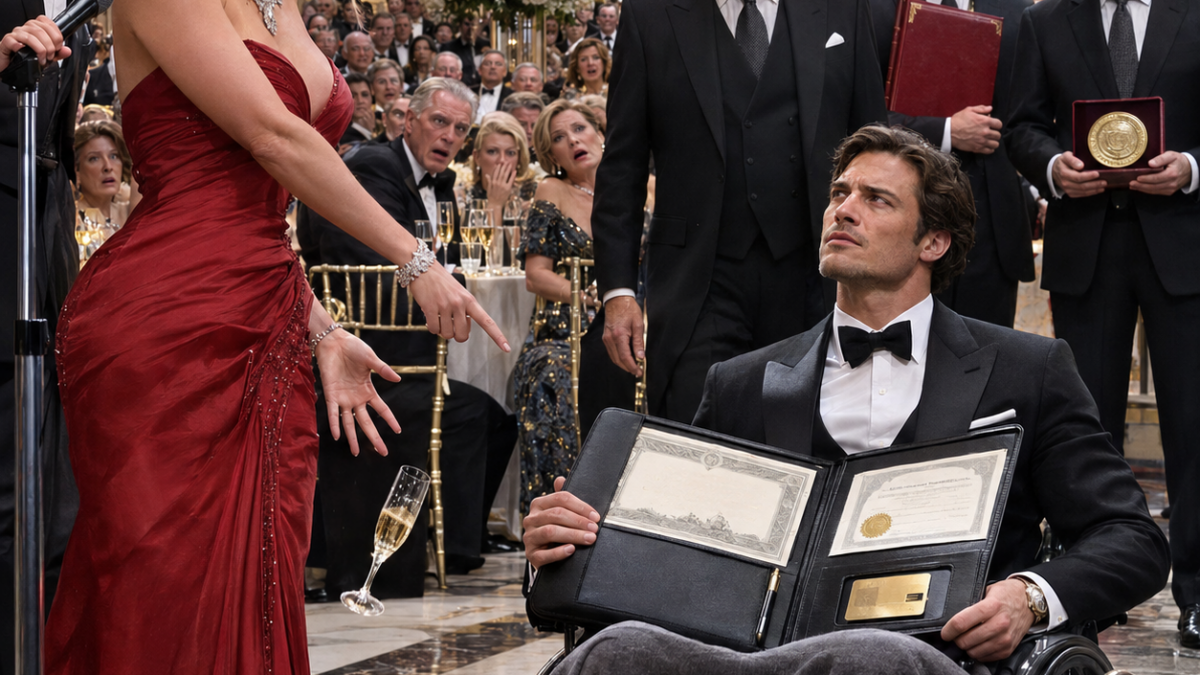
“Oh, Alexander. You poor thing.”
A few guests laughed awkwardly.
She smiled wider.
“Just look at you. The great Alexander Vance, who used to command boardrooms around the world.”
She paused.
“Now he needs somebody to tuck in his blanket.”
Another uncomfortable laugh.
I remained silent.
Victoria came closer.
She touched the edge of the blanket with one manicured finger.
“I was supposed to marry a powerful man.”
The room grew quieter.
She leaned toward me.
“Not a burden.”
I stared at her.
“Victoria.”
She laughed.
“Oh, don’t be so sensitive.”
Then she said it.
The sentence I would remember long after the financial investigation ended.
“Look at you now. You’re just a useless cripple.”
The room froze.
For one brief second, I thought someone would object.
Marcus.
Richard.
One of the directors.
A friend.
Anybody.
Instead, I saw people looking away.
A few laughed nervously.
Others pretended to examine their drinks.
Richard turned toward the bar.
Marcus lowered his head.
And I saw his smile.
Victoria looked satisfied.
She had said aloud what she’d been thinking for weeks.
Then Maya stepped forward.
She knelt beside me.
Adjusted the blanket.
And whispered the words that finally made me understand the difference between loyalty and dependence.
“You are still a king to me.”
I looked at her.
Then at Victoria’s diamond.
And smiled.
Because the last doubt I had about my fiancée had just disappeared.
But the people in that room were about to learn that the greatest mistake they’d made wasn’t underestimating my legs.
It was underestimating my judgment.
Victoria noticed my smile.
Her eyes narrowed.
“What’s so funny?”
I looked up.
“Nothing, Victoria.”
She folded her arms.
“Then stop staring at me like that.”
I placed one hand on the wheelchair’s armrest.
“I was just thinking.”
“About what?”
“Promises.”
She laughed.
“Don’t get sentimental, Alexander.”
I looked toward Marcus.
He was still standing beside Richard.
Then I turned back to Victoria.
“Do you remember what you told me when I proposed?”
Her expression changed.
“Alexander, this isn’t the time.”
“You said you’d stand beside me for better or worse.”
She rolled her eyes.
“Oh, for heaven’s sake.”
I nodded.
“Yes. I suppose that’s an inconvenient memory.”
A few guests shifted.
Victoria glanced toward the microphone.
Then smiled brightly.
“Let’s not ruin the evening with a marital discussion.”
“We’re not married.”
Her smile tightened.
“Not yet.”
I looked at the diamond.
“No.”
She leaned closer.
“What?”
I took a slow breath.
“We’re not getting married.”
For a moment, she stared.
Then laughed.
“Don’t be ridiculous.”
I didn’t answer.
She looked toward Marcus.
“Alexander’s emotional. It’s been a difficult few months.”
Marcus stepped forward.
“Alex, maybe we should get you somewhere quiet.”
I looked at him.
“Why?”
He smiled.
“You seem overwhelmed.”
I glanced around the room.
Two hundred guests.
Crystal chandeliers.
A stage prepared for speeches.
And a man who had spent weeks advancing questionable transactions while telling everybody I was no longer capable of managing my own affairs.
I looked directly at Marcus.
“I’m perfectly capable of finishing a conversation.”
His smile faded.
Then Daniel Whitmore entered the ballroom.
He had been waiting in the adjoining room with Samuel and two independent directors.
They didn’t storm in.
Didn’t shout.
Didn’t seize anybody.
They simply walked toward the front of the room.
Marcus noticed them.
His expression changed.
“Daniel?”
Daniel stopped beside him.
“Marcus, we need to speak with you.”
Marcus frowned.
“Now?”
“Yes.”
Victoria stepped forward.
“What’s going on?”
I looked at her.
“Some company matters.”
She laughed nervously.
“Alexander, don’t be absurd. This is a party.”
I nodded.
“I know.”
Then I placed my hands on the wheelchair’s armrests.
And began to stand.
A gasp moved through the room.
Not loud.
Not theatrical.
Just a sudden collective intake of breath.
My legs trembled.
My ribs still hurt when I shifted my weight.
I took my time.
Samuel stood nearby in case I needed support, but he didn’t touch me.
I rose carefully.
Then straightened.
The room became silent.
Victoria stared.
Her mouth opened.
Marcus stopped moving.
Richard’s champagne glass hovered halfway to his lips.
For several seconds, nobody spoke.
Then Victoria whispered, “Alexander?”
I looked at her.
“Yes.”
She stared at my legs.
Then at the wheelchair.
Then back at me.
“You can walk?”
I nodded.
“Yes.”
Her expression changed from disbelief to fury.
“You lied to me?”
I looked at her.
“I allowed you to believe an inaccurate rumor about the severity of my injuries. My medical records have always reflected my actual condition.”
She stepped backward.
“You let me think you were paralyzed?”
“Yes.”
Her voice rose.
“WHY?”
I held her gaze.
“Because I was trying to understand who was attempting to use my hospitalization to take control of my company.”
Marcus went pale.
Victoria stared at him.
Then back at me.
“You set us up!”
I shook my head.
“No. I didn’t make you insult me. I didn’t make Marcus circulate unauthorized documents. And I didn’t make either of you discuss the sale of company assets without the required approvals.”
The room remained silent.
I continued.
“But I was wrong to allow the false belief about my condition to continue. My actions have consequences too, and I intend to take responsibility for them.”
Victoria’s face reddened.
“You’re unbelievable!”
I looked at her.
“Perhaps.”
Then I turned toward the guests.
“Before this becomes any more of a spectacle, I want to clarify something.”
I spoke calmly.
“My use of a wheelchair was not evidence that I lacked the ability to lead Vance Global. Many people with permanent disabilities lead companies, families, and communities with extraordinary skill. What you’ve witnessed tonight is not proof that walking makes someone worthy.”
I glanced toward Maya.
“It’s proof that a person’s character is revealed by how they treat somebody they believe is vulnerable.”
Several guests lowered their eyes.
I continued.
“The company has been conducting a confidential review of certain proposed transactions and governance irregularities arising during my hospitalization. The appropriate directors and counsel have been handling that work.”
Marcus stepped forward.
“Alex, we should discuss this privately.”
I turned toward him.
“That is exactly what Daniel is asking you to do.”
Daniel remained composed.
“Marcus, the board has approved your immediate suspension from executive duties pending further proceedings. You’ll receive the formal notice and information concerning your rights and obligations.”
Marcus stared.
“What?”
Daniel continued.
“Your company access will be restricted according to the approved process. The independent review will continue.”
Marcus looked at me.
“Alex, you can’t do this.”
I shook my head.
“This isn’t a personal order issued at a party. The authorized board has taken action under the company’s governing documents.”
He stared.
Then laughed bitterly.
“So that’s it? Seventeen years?”
I felt something painful move through my chest.
“Seventeen years,” I repeated.
He looked at the floor.
I continued quietly.
“I gave you every opportunity to explain the proposed transactions.”
His face hardened.
“You don’t understand what it takes to keep that company running.”
I stared at him.
“I built it with you.”
“Exactly!”
His voice rose.
“I built it too!”
The room went still.
Marcus stepped closer.
“Do you know what it’s like standing behind you for seventeen years while everybody treats you like some kind of genius?”
I didn’t answer.
He continued.
“I made that company work. I dealt with the problems. I managed the people. I fixed the messes you created.”
I felt my throat tighten.
“Marcus, I know how much you contributed.”
He laughed.
“No, you don’t.”
I looked at him.
“Then why didn’t you tell me that instead of trying to change control arrangements while I was hospitalized?”
He opened his mouth.
Then closed it.
I continued.
“You had compensation. Equity incentives. A senior leadership position. A voice in every major operating decision.”
He looked away.
“If you wanted a different role or ownership arrangement, we could have discussed it.”
Marcus stared at the floor.
“But you didn’t ask.”
His jaw tightened.
“You always had the final say.”
I nodded.
“Because I held the controlling ownership and responsibility. That wasn’t a secret.”
He said nothing.
Daniel stepped forward.
“Marcus, this conversation needs to continue through the proper channels.”
Marcus looked toward Victoria.
She was staring at him.
For the first time that evening, neither of them seemed certain what the other would do.
Then Marcus turned and walked toward the exit with Daniel and the appropriate representatives.
He didn’t shout again.
Didn’t confess to crimes.
Didn’t beg forgiveness.
He simply left the ballroom.
And I stood watching the man I’d once considered my brother disappear through the doors.
That hurt more than I’d expected.
Then Victoria stepped toward me.
“Alexander.”
I turned.
Her voice had become soft.
Familiar.
The voice she’d used when she wanted something.
“Darling, we need to talk.”
I stared at her.
“Do we?”
She reached for my hand.
I stepped back.
Her expression changed.
“You’re misunderstanding everything.”
I looked at her.
“Then explain.”
She swallowed.
“Marcus told us the company needed stability.”
I nodded.
“And you believed that required humiliating me?”
She looked around.
“Not here.”
“You chose this room.”
Her eyes filled.
I watched carefully.
Months earlier, tears from Victoria would have made me forget almost anything.
I had loved her.
Wanted to protect her.
Wanted to believe the best about her.
Now I couldn’t tell whether she was frightened, remorseful, or simply furious that her plans had failed.
Perhaps she was all three.
But I no longer needed to solve that question.
“Alexander, I was scared.”
I nodded.
“The accident frightened everybody.”
“I thought you were never going to recover.”
I looked at her.
“Would that have made me less worthy of your respect?”
She didn’t answer.
I continued.
“Suppose I really had lost the ability to walk.”
Her eyes moved toward the wheelchair.
“Would you have wanted to marry me?”
She began crying.
“Don’t ask me that.”
“Why not?”
“Because it’s cruel.”
I felt something break inside me.
“Victoria, you called me useless in front of two hundred people.”
She covered her mouth.
I continued quietly.
“All I asked was whether you meant it.”
She began sobbing.
I didn’t move toward her.
I didn’t comfort her.
Not because I wanted her to suffer.
Because for the first time, I understood that comforting her would require ignoring the pain she’d deliberately caused.
“The engagement is over,” I said.
She shook her head.
“No.”
I looked at her.
“Yes.”
“Alexander, please.”
“I’ll have counsel address our legal and financial arrangements. You can take the personal belongings that are yours. We’ll arrange the rest respectfully.”
She looked down at the ring.
Then back at me.
“Are you taking this too?”
I glanced at the diamond.
The same ring I’d bought in Geneva.
The symbol of a promise neither of us would keep.
“The legal ownership of the ring can be resolved properly. I’m not going to argue with you about jewelry in front of these people.”
She stared.
Then whispered, “You’re destroying my life.”
I felt sadness wash over me.
“Victoria, I was in a car accident. I thought I might die. And while I was recovering, you began treating my condition as an inconvenience and discussing how to remove me from the future we’d planned.”
Her face crumpled.
“You don’t understand.”
I shook my head.
“I understand enough.”
She looked around the room.
At her mother.
At the guests.
At the champagne.
The decorations.
The beautiful ballroom she’d designed for a celebration of my recovery.
Then she turned and walked away.
Celeste followed.
For several minutes, nobody moved.
I stood beside the wheelchair, suddenly exhausted.
The adrenaline that had carried me through the confrontation began fading.
My shoulder ached.
My ribs hurt.
I wanted nothing more than to sit down.
Then I heard a quiet voice beside me.
“Mr. Vance?”
I turned.
Maya.
She held the back of the wheelchair steady.
“Would you like to sit?”
I looked at her.
She wasn’t smiling triumphantly.
Wasn’t astonished that I could stand.
Wasn’t asking why I’d allowed everyone to believe I couldn’t walk.
She was simply offering help because I looked tired.
I nodded.
“Yes, Maya. Thank you.”
I sat carefully.
She adjusted the blanket over my knees.
Then stepped back.
For a moment, I couldn’t speak.
Finally, I said, “I’m sorry.”
She looked confused.
“For what, sir?”
“For letting you believe something that wasn’t true about my injuries.”
Maya studied me.
Then looked toward the ballroom doors.
“Why did you do it?”
I considered lying.
Or giving her some polished explanation about corporate governance.
Instead, I told her the truth.
“I was afraid people I trusted were trying to take advantage of the accident. I thought keeping quiet would help me understand what was happening.”
She nodded slowly.
“And did it?”
I looked around the ballroom.
The guests.
The empty stage.
The chandeliers.
The people who had laughed when Victoria humiliated me.
“Yes.”
Maya was silent.
Then she said, “I hope it was worth what it cost you.”
I stared at her.
She wasn’t being cruel.
She was being honest.
And I suddenly understood why her kindness had mattered so much.
She didn’t tell me what I wanted to hear.
She treated me like a person.
One who could be hurt.
One who could be wrong.
One who still deserved dignity.
I nodded.
“So do I.”
Then I asked Samuel to arrange a quiet end to the evening.
The guests were thanked for coming.
Transportation was made available for anyone who needed it.
The staff handled the departure professionally.
There were no further speeches.
No triumphant music.
No public announcement that I’d won a billion-dollar battle.
Because I hadn’t won anything that night.
I’d stopped a dangerous situation from getting worse.
And I’d lost the woman I intended to marry and the friend I’d trusted for seventeen years.
The actual victory, if there was one, would depend on what happened next.
The following Monday, Vance Global held a formal board meeting.
Not in my ballroom.
Not at the estate.
In the company’s headquarters, where major decisions belonged.
The independent directors reviewed the special committee’s findings.
Counsel explained the relevant governance provisions.
The company’s finance team provided updated information about the transactions that had been under review.
Marcus had an opportunity to respond through the appropriate procedures.
The board considered the evidence.
Then finalized its decision to remove him from his executive position.
Certain matters concerning the disputed authorization and possible misrepresentations were referred for further legal review.
The proposed asset sale did not proceed.
The company also strengthened approval controls governing major transactions, executive conflicts, and access to sensitive corporate records.
I participated in the processes for which I was properly authorized.
My ownership interest remained intact.
The company continued operating.
Our employees kept receiving their salaries.
Customers kept receiving services.
And the businesses we’d built were not sold at a discount simply because a few people believed my supposed medical condition had created an opportunity.
There was no magical transfer of billions into somebody else’s account.
No instant legal victory.
No single judge declaring that every person who had betrayed me was guilty of fraud.
The consequences developed through documented procedures.
Some were corporate.
Some financial.
Some personal.
And some required more investigation than I initially expected.
As the review continued, further evidence established that Marcus had failed to disclose material conflicts surrounding the proposed transaction and had improperly advanced arrangements that could have benefited him.
The final resolution of his employment and financial interests followed the company’s governing agreements and applicable legal processes.
The disputed signature became a separate matter.
Its origin required careful examination.
I wanted whoever created or knowingly used an unauthorized document held accountable.
But I refused to accuse anyone of forging it without sufficient evidence.
That decision surprised some of my advisers.
They expected me to be furious.
I was.
But anger didn’t justify inventing facts.
I’d spent seventeen years believing Marcus was my friend.
If he had acted dishonestly, I wanted the evidence to establish exactly what he’d done.
Not merely what I feared he might have done.
Over time, the investigations resolved the outstanding corporate issues.
The company recovered or protected assets affected by the improper proposals.
The governance failures were addressed.
And the people whose conduct violated their duties faced consequences through the relevant proceedings and agreements.
Victoria’s involvement was handled separately.
She had no ownership rights in Vance Global simply because we had been engaged.
The wedding had never taken place.
The legal arrangements we had been preparing for marriage were never completed.
Her communications concerning the proposed transaction were examined where relevant.
But the collapse of our engagement didn’t entitle me to punish her through the company.
I made sure of that.
Whatever Victoria had done to me personally, Vance Global wasn’t my instrument for revenge.
It was a business employing thousands of people.
Those employees deserved leadership focused on their livelihoods, not the founder’s broken heart.
The engagement-ring dispute was settled through counsel.
So were the questions about gifts and belongings.
Victoria moved out of the estate.
I didn’t see her again for several months.
Occasionally, a photograph appeared online.
A charity event.
A restaurant opening.
A vacation.
She looked beautiful.
Smiling.
Perfectly dressed.
The woman I’d once believed would be beside me for the rest of my life.
At first, those photographs hurt.
Then they became ordinary.
A reminder of someone I’d known.
Someone I’d loved.
Someone I’d misunderstood.
And eventually, someone I no longer needed to think about.
Richard remained a more complicated problem.
He was my uncle.
My father’s younger brother.
A man who had known me since childhood.
He’d attended family birthdays.
Sat beside me at funerals.
Told stories about my parents.
And accepted years of professional compensation from businesses I controlled.
At the gala, he had looked away while Victoria humiliated me.
That hurt more than anything he might have said.
We met privately several weeks later.
He arrived at my study wearing a dark suit.
His expression was cautious.
“Alexander.”
“Uncle Richard.”
He sat across from me.
For a while, neither of us spoke.
Then he sighed.
“I suppose you’re disappointed in me.”
I looked at him.
“Yes.”
He lowered his eyes.
“I didn’t know what to do.”
I stared.
“When Victoria insulted me?”
He nodded.
“Everybody was watching.”
I leaned back.
“Then you had a perfect opportunity to show them what kind of man you are.”
He looked wounded.
“That’s unfair.”
I felt anger rise.
Then forced myself to speak calmly.
“Richard, she was humiliating me because she believed I was permanently disabled.”
He looked away.
“And you didn’t say a word.”
He rubbed his forehead.
“I didn’t want to create a scene.”
I shook my head.
“You didn’t want to risk being on the wrong side of the people you thought might soon control the company.”
His eyes lifted.
He didn’t answer.
I watched him.
Then asked, “Did you know about the proposed transaction?”
He hesitated.
“I knew Marcus was discussing options.”
“What options?”
“Leadership changes. Possible asset sales.”
“Did you know those discussions hadn’t received proper approval?”
He looked toward the window.
“I didn’t understand all the details.”
I studied him.
For once, I wasn’t interested in protecting his feelings.
“Richard, you’ve been a director and adviser long enough to know that you don’t support major changes without understanding the details.”
He sighed.
“Alexander…”
I raised one hand.
“No.”
He stopped.
I continued.
“I won’t accuse you of anything the evidence doesn’t support. But I also won’t pretend your judgment has been sound.”
He looked down.
The subsequent governance review addressed his board and consulting roles.
He did not remain in positions where his conflicts or judgment could continue undermining confidence in the company.
The personal relationship was harder.
I didn’t stop being his nephew.
But I stopped pretending that family history automatically guaranteed trust.
Some relationships survive betrayal.
Others change permanently.
Ours changed.
I saw him occasionally at family events after that.
We were polite.
Sometimes even warm.
But I no longer relied on him the way I once had.
And I accepted that the relationship might never return to what it had been.
That wasn’t revenge.
It was a boundary.
The hardest conversation, strangely enough, was with Maya.
Three weeks after the gala, I asked her to meet me in the library.
She arrived wearing her work uniform.
Her expression was nervous.
“Mr. Vance?”
“Come in.”
She stepped inside.
I gestured toward a chair.
“Please sit.”
She hesitated.
“Is something wrong?”
“No.”
I smiled.
“I wanted to thank you.”
She looked confused.
“For what?”
“For the way you treated me after the accident.”
She lowered her eyes.
“I was just doing my job.”
I shook my head.
“No. You were doing more than that.”
She looked uncomfortable.
I continued carefully.
“When Victoria insulted me, you were the only person who came over and helped.”
She folded her hands.
“Nobody deserves to be treated that way.”
I nodded.
“You’re right.”
There was a pause.
Then I said, “I also owe you an apology.”
Maya looked up.
“I’ve already apologized for allowing the misunderstanding about my condition to continue. But I want to acknowledge something else.”
She waited.
“I let you perform care tasks while you believed I was permanently unable to walk, even when my actual condition was different.”
Her expression grew thoughtful.
I continued.
“Some assistance was genuinely necessary because of my injuries. But you deserved accurate information about the tasks you were being asked to perform, consistent with my right to medical privacy.”
She nodded slowly.
“Thank you for saying that.”
I took a breath.
“I’ve instructed the household management team to review how staff were treated while Victoria was directing the estate. Not to blame anyone for following reasonable instructions, but to make sure the workplace is respectful and fair.”
Maya looked relieved.
“That would be good.”
I smiled.
“There’s something else. I understand you’re helping your brother through nursing school.”
Her expression changed.
“Yes.”
“How’s he doing?”
She smiled.
“Very well. He graduates next spring.”
“That’s wonderful.”
She nodded.
“He’s worked hard.”
I considered my next words carefully.
I didn’t want Maya to think she was being rewarded for praising me.
Or that she owed me affection because I was wealthy.
So I explained that the estate was establishing a transparent employee education benefit available under defined criteria to eligible staff and their families.
The program would be administered through human resources rather than personal favors.
Maya could apply if she wished.
She stared at me.
“Mr. Vance…”
I raised a hand.
“You don’t have to thank me for special treatment. This isn’t about the gala. We should have had a program like this years ago.”
Her eyes filled.
She smiled.
“I think it would mean a lot to people.”
I nodded.
“That’s what I hope.”
Then I asked whether she wanted to continue working at the estate.
She looked surprised.
“Of course.”
I smiled.
“Good. But if you ever want a different role or more responsibility, please speak with the household manager. You shouldn’t have to stay in one position simply because it’s what you started doing.”
She nodded.
“Thank you.”
As she stood to leave, I remembered her grandmother’s words.
“Dignity isn’t something wealthy people hand out,” I said.
Maya smiled.
“No, sir.”
I looked at her.
“She was right.”
Maya gave me a small nod.
Then walked out.
I sat alone for a long time.
For years, I’d believed wealth allowed me to protect the people around me.
Sometimes it did.
I could fund scholarships.
Create jobs.
Pay for medical treatment.
Support charities.
Help employees through difficult circumstances.
But money couldn’t make people love me.
Couldn’t make Marcus loyal.
Couldn’t make Victoria compassionate.
And couldn’t guarantee that the people attending my parties would stand beside me when I became vulnerable.
Those things belonged to character.
Not bank accounts.
My recovery continued.
Dr. Price kept me on a structured rehabilitation plan.
I followed it.
Not perfectly.
There were days when I was impatient.
Days when my shoulder ached.
Days when I wanted to skip exercises and return to the office.
Dr. Price refused to be impressed by my schedule.
“Alexander, your company will survive an hour without you.”
I laughed.
“That’s debatable.”
She raised an eyebrow.
“Would you like me to call the board and confirm?”
I shook my head.
“No, doctor.”
She smiled.
“Then finish your exercises.”
I did.
Over time, walking became easier.
The pain improved.
My strength returned.
The wheelchair was no longer necessary for routine mobility.
But I never forgot how differently people had treated me when they believed it would be permanent.
That experience changed the way I looked at our buildings.
Our workplaces.
Our hiring practices.
Our accessibility policies.
I had always assumed that providing ramps and elevators meant we’d handled accessibility properly.
Then I remembered Victoria asking that my wheelchair be positioned out of photographs.
Marcus speaking about disability as though it automatically meant incapacity.
The guests who looked away.
And Maya, who simply asked whether I was comfortable.
I began asking different questions.
Were our workplaces genuinely accessible?
Could employees request accommodations without feeling embarrassed?
Were we evaluating leadership ability based on performance or assumptions about physical condition?
Did our buildings make people feel welcome?
Were our policies clear?
I didn’t pretend one experience had made me an expert.
Instead, I asked people with relevant lived experience and professional knowledge to help the company improve.
We reviewed our practices.
Identified shortcomings.
Allocated resources.
And made changes that were useful regardless of whether the founder ever needed a wheelchair again.
It felt like a more meaningful response than giving a speech about resilience.
Several months later, I received a letter from Marcus.
It arrived through counsel.
I read it alone in the library.
He acknowledged serious mistakes.
Said he had allowed resentment to influence his decisions.
Wrote that he believed he deserved a larger share of recognition for Vance Global’s success.
And admitted that his actions had damaged the company and our friendship.
He didn’t ask to return.
Didn’t demand forgiveness.
He simply said he was sorry.
I sat staring at the final page.
For seventeen years, Marcus had been part of my life.
I remembered the warehouse office.
The late nights.
The diner.
The first major contract.
The day he told me our projections were unrealistic.
The friend who had once been willing to work beside me when neither of us knew whether the company would survive.
I missed that man.
Even though I couldn’t trust the person he’d become.
I wrote back through the appropriate channel.
I acknowledged the apology.
Made clear that the legal and financial matters would be handled independently.
And wished him well in whatever life he built next.
I didn’t offer friendship.
Not yet.
Perhaps never.
Forgiveness, I was learning, didn’t require restoring access to the things someone had misused.
One evening, almost a year after the crash, I hosted a small dinner at Vance Estate.
Not two hundred guests.
Not a ballroom filled with socialites.
Just eight people.
Daniel Whitmore and his wife.
Samuel Reed.
Two longtime friends who had visited me in the hospital without asking about the company.
Dr. Price.
Arthur, who had retired from full-time gardening but still came by occasionally.
And Maya, who attended as an invited guest rather than a household employee.
We ate in the smaller dining room overlooking the garden.
No champagne tower.
No photographers.
No speeches about wealth.
Just dinner.
Conversation.
Laughter.
At one point, Daniel raised his glass.
“To good company.”
We all joined him.
I looked around the table.
These were not the people Victoria would have invited to impress a magazine editor.
They didn’t all have impressive titles.
They didn’t all belong to the same social circles.
Some were wealthy.
Some weren’t.
But every person at that table had treated me with decency when it mattered.
After dinner, Maya walked beside me toward the terrace.
The evening was cool.
Lights glowed along the garden paths.
She stopped near the doorway.
“Mr. Vance?”
I smiled.
“Alexander. You’re not on duty tonight.”
She laughed.
“All right. Alexander.”
I looked at her.
“What is it?”
She hesitated.
“Can I ask you something?”
“Of course.”
“Are you happy?”
The question surprised me.
I looked toward the garden.
For years, I’d measured happiness in achievements.
Revenue.
Growth.
Contracts.
Investments.
Public recognition.
Then Victoria entered my life, and I began measuring it in the possibility of marriage.
A shared future.
A family.
Someone who would love me when the office lights went dark.
Now I stood beneath the evening sky with neither the fiancée nor the best friend I’d expected to have beside me.
And yet…
I thought about the dinner.
The laughter.
The people who’d come simply because they wanted to spend time together.
The company we’d protected.
The employees whose jobs remained secure.
The mistakes I’d admitted.
The changes I’d made.
I took a slow breath.
“I think I’m getting there.”
Maya smiled.
“Good.”
We stood quietly for a moment.
Then she said, “My grandmother would’ve liked that answer.”
I laughed.
“I think I would’ve liked her.”
Maya smiled.
“She would’ve told you to stop worrying so much about being important.”
I looked at her.
“Would she?”
“Absolutely.”
“And what would she tell me to do instead?”
Maya looked toward the table where our guests were still laughing.
“Be a good man.”
I considered that.
Then nodded.
“Sounds like a better goal.”
She smiled.
Then went inside.
I remained on the terrace.
A breeze moved through the trees.
The house behind me glowed with warm light.
For a moment, I remembered the gala.
Victoria in her silver gown.
Marcus hiding a smile.
Richard looking away.
The crowd laughing.
And Maya kneeling beside my wheelchair to restore a fallen blanket.
I’d spent months believing the greatest moment of my life would be standing up in that ballroom and watching Victoria realize she couldn’t control me.
But that wasn’t the moment I remembered most.
I remembered Maya’s hand carefully smoothing the blanket.
Her quiet voice.
The simple certainty that I deserved kindness even if I never walked again.
I thought about the diamond ring.
The billions of dollars.
The company I’d worked so hard to build.
All the things people believed made Alexander Vance powerful.
Then I thought about the words Victoria had spoken.
You’re useless now.
She had believed my value ended where my physical ability changed.
Marcus had believed my injury created an opportunity to seize authority.
Richard had believed loyalty depended on who was likely to win.
But Maya had looked at the same wheelchair and seen a human being.
Nothing more complicated than that.
Nothing more valuable.
I walked back inside.
The library door stood open.
On the desk lay a photograph from Vance Global’s early years.
Marcus and me outside the warehouse.
Young.
Exhausted.
Smiling.
I picked it up.
For a moment, sadness returned.
Then I placed the photograph back on the shelf.
I didn’t need to destroy every memory of the friendship to acknowledge how it ended.
I turned off the library light.
Down the hallway, I heard my guests laughing.
And I realized something that would have sounded ridiculous to the man I was before the crash.
I had nearly lost my life.
Almost lost control of my company.
Lost my fiancée.
Lost my closest friend.
And discovered that much of the social world I’d spent years building was held together by money rather than affection.
Yet the accident had also given me something I hadn’t possessed before.
Clarity.
Not about who was richest.
Or most powerful.
Or most impressive.
About who remained kind when they believed I had nothing left to offer.
Victoria had thought the wheelchair reduced me to a burden.
Marcus had seen it as the opening move in a business opportunity.
My uncle had chosen silence.
And a housemaid who owed me nothing had quietly reminded me that dignity wasn’t measured in money, titles, mobility, or other people’s approval.
I stood in the doorway of the dining room and looked at the people waiting for me.
Then I smiled.
Not the controlled smile I’d worn during the gala.
Not the smile of a man hiding evidence.
A real smile.
Because the empire was still standing.
And for the first time in years, I knew the difference between people who admired what I owned and people who cared about who I was.
Victoria thought my wheelchair had turned a billionaire into a worthless man, and she laughed because she believed the empire was already hers—but the night she mocked my disability, she didn’t destroy my dignity or seize my fortune; she merely proved that the one person in the room who understood my true worth was the woman who knelt beside me when everyone else chose to look away.








