PART2:“YOU’RE HIS AUNT—FIGURE IT OUT!” My Sister Left Her 7-Month-Old Baby on My Porch in 11-Degree Weather—Then My Camera Exposed Who Helped Her Plan It
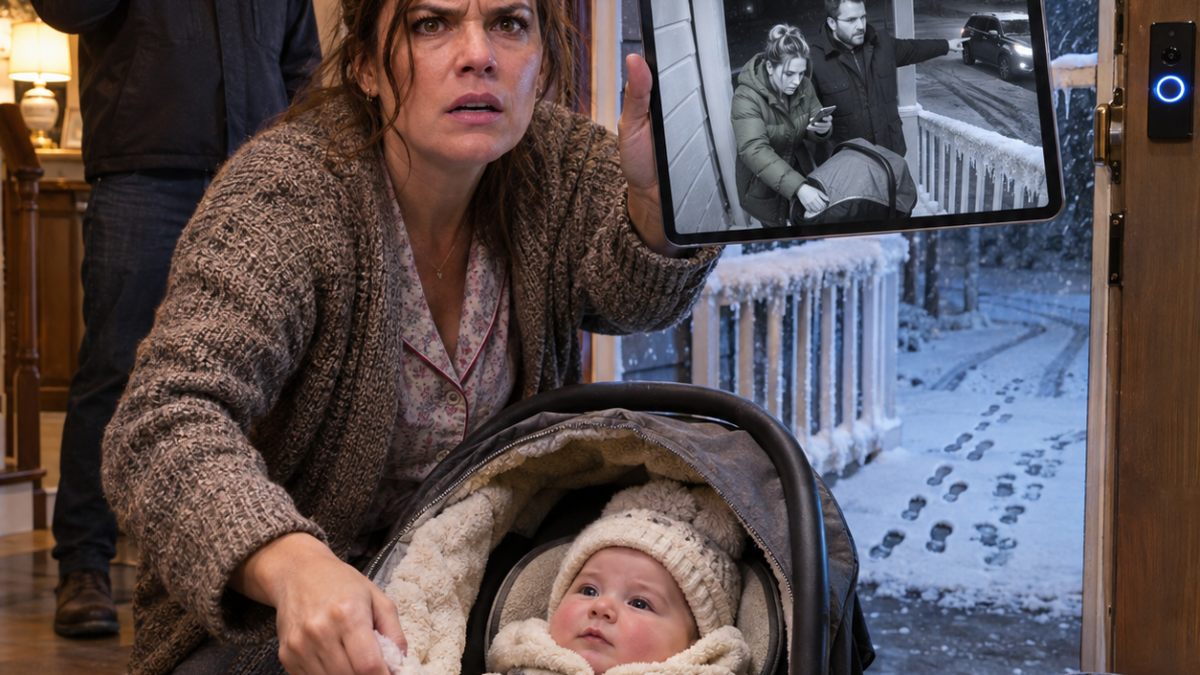
PART2
Paramedic Kelly Marsh arrived first.
She knelt beside us.
“Jamie?”
“Yes.”
“I’m Kelly. Let me take him.”
I handed Luca over.
That was harder than it should have been.
His little fingers had been curled against my skin.
Kelly wrapped him in warmed blankets.
Another medic checked temperature.
Pulse.
Oxygen.
Respirations.
The numbers made both of them move faster.
Not frantic.
Focused.
Officer Ruben Gaither arrived next.
Late forties.
Heavy winter coat.
Salt on his boots.
He looked at the carrier still sitting near the doorway.
Then the note.
Then Luca.
“Dispatch said abandonment?”
“Yes.”
“Mother?”
“My sister.”
“Any custody agreement where you were supposed to have the baby?”
“No.”
“Any text saying you agreed?”
“No.”
“Any standing arrangement?”
“No.”
He looked at me.
“You certain?”
“I’m an insurance fraud investigator.”
That almost made him smile.
“I document everything.”
I handed him my phone.
Messages with Elise.
Thursday, 8:14 p.m.
ELISE: Cancel Denver. I need you this weekend.
ME: No.
ELISE: Seriously?
ME: Lauren’s wedding is Saturday. You’ve known for eleven months.
ELISE: I don’t have anyone else.
ME: Ask Davin.
Three dots.
Then:
ELISE: Absolutely not.
ME: Then hire someone.
ELISE: You’re family.
ME: That doesn’t make me automatic childcare.
ELISE: Wow.
ME: I’m leaving for the airport at 6:20 Saturday morning. Do not bring Luca here.
No ambiguity.
Gaither read it twice.
“Can you send this to me?”
“Yes.”
“Camera?”
I pointed toward the television.
I cast the footage.
He watched silently.
Silver Nissan.
Carrier.
Doorbell.
Elise leaving.
The muscle beside his jaw jumped.
“She didn’t wait.”
“No.”
“She didn’t call?”
“No.”
“Text?”
“No.”
“What if you’d left early?”
“I keep asking myself that.”
The answer made neither of us feel better.
The ambulance transported Luca to Blank Children’s Hospital.
I wanted to go.
Gaither asked if I could stay ten minutes longer for the report.
I agreed.
That was when Elise finally responded.
I had texted:
Luca was left on my porch in sub-zero weather. Police and EMS are here. Respond immediately.
Delivered.
Read.
Then:
He isn’t my baby. And if you want to keep your family alive, take him and run before they get there.
I stared.
Officer Gaither read over my shoulder.
“What does that mean?”
“I have no idea.”
“Is she denying maternity?”
“She gave birth to him.”
“Could she mean something else?”
“I don’t know.”
Another text appeared.
Do NOT call Davin.
Then nothing.
Gaither’s expression changed.
“Who’s Davin?”
“Luca’s father.”
“On birth certificate?”
“Yes.”
“Custody?”
“Temporary order. Elise has primary placement right now.”
“Why temporary?”
I hesitated.
That was family territory.
And I had spent years being trained to protect family territory.
Then I looked toward the driveway where the ambulance had just carried my nephew away.
“Because Elise filed allegations against him.”
“What kind?”
“She said he was controlling. Unstable. Threatening.”
“You believe that?”
“I believed my sister.”
That answer sounded different out loud.
Gaither said nothing.
He replayed the footage.
Again.
Then leaned closer.
“Your camera records sound?”
“Yes.”
“I can hear wind.”
He backed up.
Turned volume higher.
At first, nothing useful.
Wind.
Crunching snow.
The doorbell click.
Then Elise’s boots moving away.
Car door open.
A faint electronic voice.
Gaither stopped.
“Wait.”
He replayed.
I heard Elise.
Barely.
“…did it.”
Another voice came through her car speakers.
Female.
Muffled.
Gaither increased volume.
The camera system stored a higher-quality audio stream than the television playback initially used.
He exported the clip to my tablet.
Enhanced it.
Not magically.
Just gain, noise reduction, repeat.
And then I heard my mother.
Clear enough that every hair on my arms rose.
MOM: She’ll cancel the flight.
Elise:
She better.
Mom:
She always caves once the baby’s already there.
Elise laughed.
My own sister laughed while her seven-month-old sat behind her in freezing wind.
Then another line.
Elise:
If she calls the cops, I’m screwed.
Mom:
She won’t. Tell her you thought you had an arrangement.
Elise:
Davin’s hearing is in April. If he gets this, I’m done.
Mom:
Then don’t give him anything. Delete everything before Davin finds out.
The car door slammed.
Engine rose.
Recording ended.
Officer Gaither looked at me.
My hands had started shaking.
Not from cold.
“She knew.”
He did not ask who.
We both knew.
My mother had not merely excused Elise afterward.
She had helped plan it.
The woman who called herself Luca’s grandmother had helped arrange for him to be left outside because she believed I would rescue him quietly and protect Elise’s custody case.
Gaither said:
“Jamie.”
I looked at him.
“You need to understand something.”
“What?”
“This stopped being a misunderstanding before your sister ever pulled into the driveway.”
I nodded.
My phone rang.
Mom.
I answered.
Speaker.
“Ila Given?”
Gaither mouthed.
I nodded.
Mom’s voice came fast.
“Is he breathing?”
No hello.
No:
Is Luca okay?
Just:
Is he breathing?
“Yes.”
She exhaled.
“Good.”
Then her voice lowered.
“Listen to me. Do not let them file a report.”
Gaither’s eyebrows rose.
I said:
“There’s already a report.”
“Then fix it.”
“What?”
“Tell them you misunderstood.”
I looked at Gaither.
He was writing.
Mom continued.
“Tell them you and Elise arranged the weekend.”
“We didn’t.”
“Jamie.”
“No.”
“You don’t understand what this can do to her custody case.”
“What this can do?”
“Yes.”
“Mom, Luca was hypothermic.”
“He’s fine.”
“You don’t know that.”
“You said he’s breathing.”
My stomach turned.
“Breathing is not the definition of fine.”
“Don’t be dramatic.”
I almost laughed.
Dramatic.
The word families use when reality becomes inconvenient.
Mom said:
“If Davin gets this report, he will weaponize it.”
“Maybe he should know what happened to his son.”
“Absolutely not.”
“Why?”
“Because he has been trying to take that baby from Elise since the day he was born.”
“Why?”
“You know why.”
“No.”
I realized I didn’t.
Not really.
I had heard Elise’s version.
Davin was controlling.
Davin asked too many questions.
Davin wanted receipts.
Davin complained about missed pediatric appointments.
Davin insisted on scheduled calls.
Davin had once shown up unexpectedly because Elise did not answer for six hours.
I had accepted all of it as evidence of obsession.
What if it had been evidence of concern?
Gaither quietly asked:
“Is the father adjudicated?”
Mom heard.
“Who is that?”
“Officer Gaither.”
She inhaled sharply.
“You have police in your house?”
“Yes.”
“Jamie.”
Then the tone I had obeyed since childhood.
“Listen to me carefully.”
I did not speak.
“You are going to tell that officer there was an arrangement.”
“No.”
“You are going to take care of Luca until Sunday.”
“No.”
“Elise needs this weekend.”
“Luca needed his mother.”
Silence.
Then:
“You don’t have children.”
There it was.
“You have no idea what motherhood does to a person.”
“Apparently it makes some people leave infants outside.”
“Do not talk about your sister like that.”
Gaither looked away.
Probably to hide his reaction.
Mom continued.
“Your sister has been through hell.”
“So has Luca.”
“Family protects family.”
I stared at the note on my counter.
FIGURE IT OUT.
“For thirty-two years, ‘family protects family’ has meant I protect Elise from consequences.”
“That is not fair.”
“It is exactly fair.”
“She needs help.”
“Then she needs actual help.”
“Not police.”
“Maybe both.”
Mom’s voice turned vicious.
“If you contact Davin, I will never forgive you.”
The old Jamie would have panicked.
Disowned.
Bad daughter.
Cold sister.
Selfish.
The words had controlled me for decades.
That morning they sounded small.
I said:
“Okay.”
She stopped.
“What?”
“You don’t have to forgive me.”
Then I hung up.
My hand shook afterward.
Gaither said:
“You all right?”
“No.”
“Good answer.”
I laughed once.
It came out wrong.
He asked:
“Do you have Davin’s number?”
“Yes.”
I found it.
Had not called him voluntarily in over a year.
He answered first ring.
“Jamie?”
His voice was immediately alert.
“Is Luca okay?”
That told me something.
Not:
Why are you calling?
Where is Elise?
Is there a problem?
His first question:
Is Luca okay?
I said:
“He’s at Blank Children’s.”
Silence.
“What happened?”
“Elise left him on my porch this morning.”
Nothing.
Then:
“In this weather?”
“Yes.”
“How long?”
“About eight minutes before I opened the door.”
He inhaled.
“Is he alive?”
“Yes.”
“Can I see him?”
“There’s an officer here.”
“Put him on.”
I handed Gaither the phone.
The conversation lasted four minutes.
Gaither verified identity.
Temporary custody order.
Father’s legal status.
Davin said he could be at my house in twenty-five minutes.
He arrived in seventeen.
He wore jeans over pajama bottoms.
Work boots unlaced.
Winter jacket half zipped.
He had apparently dressed while driving from his apartment.
He came through the door.
Saw the empty infant carrier.
Stopped.
Then looked at me.
“Where’s Elise?”
“I don’t know.”
“Did she hurt him?”
“I don’t know.”
His eyes went red.
Gaither stepped in.
“Mr. Mims, we’re going to need to go over some things.”
Davin nodded.
Then he did something that destroyed another piece of the story I had believed.
He handed Gaither a folder from his truck.
Organized.
Tabbed.
Pediatric records.
Screenshots.
Custody filings.
Photographs.
Missed appointment notices.
A CPS intake number from four months earlier.
I stared.
“What is that?”
Davin looked at me.
“The reason your sister hates me.”
I opened the first section.
At five months old, Luca had missed two pediatric follow-ups.
At four months, Davin had photographed a severe diaper rash after a visitation exchange.
At three months, he had documented that Elise sent only two ounces of formula for a six-hour visit.
There were text messages.
DAVIN: When did he last eat?
ELISE: Stop interrogating me.
DAVIN: I need to know because he’s crying and the bottle is empty.
ELISE: Figure it out. You wanted to be a dad.
That phrase.
Figure it out.
Same as my note.
I kept reading.
Another:
DAVIN: Pediatrician says he missed Tuesday.
ELISE: I was busy.
DAVIN: He needs the vaccines.
ELISE: Stop controlling me.
Another:
DAVIN: You left him with your friend Kara overnight?
ELISE: Mind your business.
DAVIN: He is my business.
My stomach tightened.
I looked at Davin.
“Why didn’t you tell me?”
He laughed bitterly.
“Would you have believed me?”
I could not answer.
He nodded.
“Exactly.”
Officer Gaither asked:
“CPS outcome?”
“Unsubstantiated.”
“Why?”
“Elise told them I was weaponizing parenting disputes.”
He swallowed.
“Your mother backed her.”
Of course she did.
Davin continued.
“I filed for modification.”
“Hearing in April?”
“Yes.”
My mother’s exact fear.
This incident could change everything.
Gaither asked:
“Did you know Elise was leaving town?”
“No.”
“Where would you expect her to go?”
“She’s been seeing a guy named Brandon Kell.”
“Elise said they broke up.”
“They didn’t.”
“How do you know?”
Davin looked embarrassed.
“Instagram.”
Even in crisis, humanity survives.
Gaither asked for details.
Brandon lived in Kansas City.
Worked event promotions.
This weekend there was a three-day concert event there.
Elise had posted months earlier about wanting to attend.
Now the babysitting demand made sense.
Not emergency.
Not work.
A party.
She wanted three child-free days.
I refused.
So she placed Luca outside and assumed guilt would finish what her argument could not.
At the hospital, Luca’s core temperature had been low but responded to treatment.
No frostbite.
No lasting injury expected.
Those words nearly made my knees fail.
No lasting injury expected.
Expected.
Not guaranteed.
A paramedic later told me another fifteen or twenty minutes could have changed the situation substantially.
I stopped thinking about the missed flight after that.
Lauren called while I sat in the hospital waiting room.
“You should be boarding.”
“I’m not coming.”
“What happened?”
I told her.
She went silent.
Then:
“Jamie.”
“Yeah?”
“You stay there.”
“I’m sorry.”
“Do not apologize.”
“You don’t understand, I’m maid of honor.”
“I have four other women wearing the same color.”
I laughed through tears.
She said:
“There is only one Luca.”
That ended the flight question.
Davin arrived at the hospital after police cleared him to go.
Because Elise still had primary placement under the temporary order, hospital staff had to verify what legal authority he had.
Then child protective services arrived.
Emergency procedures began.
I watched Davin sit beside Luca’s crib.
He did not pick him up until the nurse said he could.
Then he held his son.
No dramatic speech.
Just:
“Hey, buddy.”
His face collapsed.
“I got you.”
I left the room.
Some moments do not belong to witnesses.
Police located Elise shortly before noon.
She had not reached Kansas City.
Her vehicle was stopped near the Missouri border after a statewide attempt-to-locate had been entered.
Brandon was in the passenger seat.
She initially told officers there had been an agreed childcare handoff.
That story lasted until Gaither mentioned the messages.
Then she said I had “always watched Luca.”
False.
I had babysat maybe six times.
All arranged.
Then she said she believed I was awake because my lights were on.
My lights were automatic timers.
Then she said she had waited in the driveway.
Camera showed forty seconds.
Then:
“I rang the bell.”
As if doorbells constitute custody agreements.
The threat text created another problem.
If you want to keep your family alive, take him and run before they get there.
Police took it seriously.
So did I.
What threat?
Who were they?
Was Brandon involved in something dangerous?
Was Elise being threatened?
For several hours, I wondered whether the entire abandonment story was hiding a genuine danger.
Then detectives obtained more of Elise’s messages.
With her consent initially limited and later through legal process.
The dark truth was not a criminal gang.
In some ways, it was uglier because it was more ordinary.
The threat was fabricated.
A panic tactic.
A message designed to scare me into taking Luca and refusing to contact authorities.
She had searched online two nights earlier:
Can aunt keep child without custody order
abandonment child Iowa consequences
what happens if babysitter calls police
emergency custody father neglect claim
And one search that made me sit down:
how to make someone afraid to call police without explicit threat
Brandon later told investigators Elise had been rehearsing explanations during the drive.
He claimed he did not know she planned to leave Luca outside.
He thought she had arranged care with me.
Camera audio partly supported that because Brandon never appeared at the house.
But phone messages between Elise and Mom were worse.
Mom:
Jamie will say no until she sees him.
Elise:
What if she’s already gone?
Mom:
Her flight isn’t until 8:10. She leaves around 6. You have time.
My mother knew my flight schedule.
Elise:
If she reports it Davin gets everything he wants.
Mom:
Then remind her what family means.
Elise:
She’s been acting superior since the Army.
Mom:
You know how to handle her.
Then:
Once she takes the carrier inside, it’s babysitting.
I read that sentence five times.
That was the plan.
Not:
Jamie will agree.
Not:
Jamie will answer the door.
Not:
Jamie will hold Luca.
Once I physically rescued an infant from freezing weather, they planned to reinterpret my rescue as consent.
My mother had spent decades teaching Elise that boundaries only existed until you created a situation where someone else felt too guilty to enforce them.
This was simply the most dangerous version.
And it got worse.
The phone extraction showed prior messages about Luca.
Mom regularly covered for Elise.
Missed pediatric appointment?
Mom told her to say Davin had rescheduled it.
Elise overslept during a custody exchange?
Mom suggested claiming a car problem.
Elise left Luca overnight with a friend without notifying Davin?
Mom said:
He doesn’t need to know everything.
Whenever Davin raised concerns, Mom helped Elise frame them as harassment.
He was not perfect.
The records showed angry messages from him too.
One night he called Elise irresponsible.
Another time he threatened to seek full custody during an argument.
But the overall picture did not resemble the dangerous, obsessive man I had been taught to avoid.
It looked like a father who had become increasingly alarmed and increasingly angry because nobody listened.
That realization hurt.
I had participated.
Not actively.
But enough.
At a family dinner five months earlier, Davin had approached me privately.
“Jamie, I need you to check on Luca more.”
I had stiffened.
“Why?”
“Elise is overwhelmed.”
“She says you’re trying to control her.”
“I’m trying to make sure he’s okay.”
I said:
“You need to work this out in court.”
Then walked away.
Technically reasonable.
Emotionally convenient.
He had been asking for help.
I chose neutrality.
Neutrality is comfortable until you discover who paid for it.
Emergency family court happened Monday.
I attended because I had video evidence and firsthand knowledge.
Davin’s attorney requested immediate temporary placement.
Elise’s attorney argued the porch incident was an isolated lapse during postpartum stress and a family childcare misunderstanding.
Then Gaither’s report came in.
Camera footage.
My texts expressly telling Elise not to bring Luca.
The note.
Audio call with Mom.
The threat message.
Pediatric history.
Prior communications.
The judge asked Elise one question.
“Did your sister agree to care for the child that weekend?”
Elise cried.
“I thought she would.”
“That was not my question.”
“No.”
“Did you verify she was inside the residence before leaving?”
“No.”
“Did you wait for the door to open?”
“No.”
“Did you call her?”
“No.”
“Text her that the child was outside?”
“No.”
“Temperature?”
Elise whispered:
“I don’t know.”
The prosecutor’s report listed eleven degrees.
The judge looked at her.
“You left a seven-month-old infant outside in eleven-degree weather without confirming any responsible adult had custody of him?”
Elise said:
“I panicked.”
The judge answered:
“You did not panic for one moment.”
He looked at the video timeline.
“You planned transportation, arrived at a specific time, placed the child on the porch, left a written note, and departed.”
That sentence mattered.
Panic was no longer available as camouflage.
Emergency placement went to Davin.
Elise received supervised contact pending further evaluation and proceedings.
I expected to feel victorious.
I did not.
My sister had just lost the right to take her son home alone.
There is no healthy person who enjoys that.
But I looked at Davin holding Luca outside the courtroom.
And I felt relief.
That was different.
Mom called me that night.
I did not answer.
She sent:
I hope you’re proud of yourself.
Then:
You destroyed your sister’s life.
Then:
You handed that baby to a man who hates his mother.
I replied once.
Elise left Luca outdoors in eleven-degree weather. I reported what happened. Those are two different actions.
Mom:
You could have protected her.
Me:
I protected Luca.
No more response.
For three weeks, Mom told relatives I had betrayed the family.
Aunt Linda called.
Cousin Rebecca.
My grandmother.
Everybody received some version:
Jamie overreacted.
Elise thought Jamie was home.
Luca was outside “for just a minute.”
Police exaggerated.
Davin had manipulated me.
Army service had made me cold.
That last one almost made me laugh.
Then Gaither asked whether I would authorize release of a still image from my camera if required for the case.
I said yes.
I did not post anything online.
Did not fight family gossip.
Did not publish texts.
The legal process did enough.
Eventually, relatives stopped calling after they learned the footage existed.
People become less enthusiastic about family loyalty when there is a timestamp.
Elise’s criminal case did not end with some dramatic twenty-year sentence.
Real life was more complicated.
She faced serious child-endangerment and related allegations, but the final resolution reflected several factors: Luca recovered, she had no prior criminal history, she underwent psychological evaluation, and she eventually accepted responsibility.
There was probation.
Mandatory parenting intervention.
Mental-health treatment.
Restrictions around unsupervised care.
Court oversight.
The family case lasted longer.
Davin became primary custodial parent.
Elise received supervised visitation first.
Then gradually expanded contact only after sustained compliance.
I am not giving exact legal labels because those changed through negotiations and orders.
The important part was simple.
Luca stopped being an object adults passed around to solve their own problems.
For the first several months, Davin brought him to my house every other Sunday.
Not because a court told him.
Because he wanted Luca to know me.
The first visit felt strange.
I had spent years thinking Davin was dangerous.
Now he was sitting at my table feeding mashed banana to his son while asking whether my coffee maker was broken.
“It makes coffee.”
“This is brown water.”
“You’re welcome to leave.”
He laughed.
We eventually talked about the past.
I said:
“I owe you an apology.”
“For?”
“Believing everything.”
He shrugged.
“You believed your sister.”
“I did.”
“Most people do.”
“That doesn’t make it okay.”
“No.”
He stirred his coffee.
“It makes it predictable.”
I asked:
“Why didn’t you push harder with me?”
“I did once.”
“I shut you down.”
“Yes.”
I looked away.
He said:
“Jamie.”
“What?”
“You called 911.”
I looked back.
“That mattered more.”
That was generous.
I did not let myself use it as an excuse.
Mom refused to speak to me for four months.
Then she appeared at my house.
No warning.
Of course.
I opened the door but did not invite her in.
She looked older.
“I want to see you.”
“You are seeing me.”
“Jamie.”
“What?”
“I’m your mother.”
“Yes.”
“Can I come inside?”
“No.”
Her face hardened.
Then softened.
“I made mistakes.”
Plural.
Vague.
I waited.
“I should not have told Elise to leave the baby there.”
Better.
“And?”
She frowned.
“And what?”
“You knew I had refused.”
“Yes.”
“You knew the weather.”
“I didn’t know it was eleven degrees.”
“You knew it was below freezing.”
She said nothing.
“You told her once I brought him inside, it counted as babysitting.”
Mom looked at the porch.
“Yes.”
“Why?”
“Because you always help.”
“That’s not consent.”
“I know that now.”
“No.”
I shook my head.
“You knew then.”
Her eyes filled.
“Jamie, your sister was falling apart.”
“So you made me responsible.”
“I didn’t know what else to do.”
“Call Davin.”
“She hates him.”
“Hire childcare.”
“She couldn’t afford the weekend if she paid a sitter.”
There it was.
The weekend.
Not survival.
Not work.
A party.
“You risked Luca’s life so Elise could afford entertainment.”
Mom flinched.
“That isn’t fair.”
“It’s extremely fair.”
She began crying.
The old reflex arrived.
Bring her inside.
Make tea.
Tell her it was okay.
I did nothing.
People can cry without being rescued from what they are crying about.
Mom wiped her face.
“I’ve lost Elise.”
“No.”
“She barely talks to me.”
“That may be part of her treatment.”
“She blames me.”
“You helped her.”
“I was trying to help.”
“You were trying to prevent consequences.”
“That is not the same thing.”
Mom stared.
That sentence landed.
I continued.
“You taught Elise that every mistake could be cleaned up by somebody who loved her.”
“I taught her family sticks together.”
“No.”
“You taught her family hides evidence.”
“That’s cruel.”
“It’s recorded.”
Her face collapsed.
There are arguments families can maintain forever.
Then there are recordings.
Mom whispered:
“What do you want from me?”
“Nothing.”
“That’s not true.”
“It is.”
“You want me punished.”
“No.”
“I want you to stop asking me to carry you.”
She did not understand.
So I explained.
“I carried Elise’s consequences.”
“I carried your fear of losing Elise.”
“I carried everybody’s version of family.”
“I’m done.”
Mom looked at me.
“You’ll end up alone.”
That used to scare me.
I smiled sadly.
“Maybe.”
Then:
“But I won’t end up responsible for another adult leaving a baby in the snow.”
I closed the door.
I cried afterward.
Boundaries are not painless just because they are correct.
Lauren sent me wedding photographs from Denver.
Beautiful.
She had placed a framed picture of me on the bridesmaids’ table as a joke.
Caption:
MAID OF HONOR — DEPLOYED ELSEWHERE
I laughed.
Then cried again.
Her marriage survived without me standing beside her.
Luca might not have survived if I had left ten minutes earlier.
I stopped regretting the flight.
The darkest discovery came almost two months later.
Not because of another crime.
Because of something from my own camera archive.
Gaither called.
“Jamie, do you keep thirty days of footage?”
“Ninety.”
“Can you check December seventeenth around 9 p.m.?”
“Why?”
“Your sister’s phone messages reference your house.”
I searched.
Found it.
Elise’s Nissan.
She had come by when I was at work.
Mom’s car arrived five minutes later.
Neither rang the bell.
They stood on my porch.
Talking.
Why my porch?
The camera audio was excellent that night.
No wind.
Mom said:
“She’s never going to say yes ahead of time.”
Elise:
“I know.”
Mom:
“Then stop asking.”
Elise:
“What if she flips out?”
Mom:
“She won’t let anything happen to Luca.”
Elise:
“That’s the whole point.”
Mom laughed softly.
Then:
“You leave him, ring once, drive away. By the time she gets angry, she’ll already have him inside.”
Elise:
“And Denver?”
Mom:
“She’ll miss the flight.”
There it was.
Two weeks before it happened.
A rehearsal.
On my porch.
They had stood outside my home planning how to use my conscience against me.
Then Mom said something that permanently changed how I understood my childhood.
“You have to stop giving Jamie choices. She always chooses herself when you give her time to think.”
Elise laughed.
“I know.”
I paused the video.
Stared at my mother’s face.
She always chooses herself.
That was what they called boundaries.
Choosing myself.
Every time I refused money.
Every time I would not lie.
Every time I kept my plans.
Every time I said I mattered too.
In my family, self-respect had been translated into selfishness so consistently that I had begun doing it for them.
That recording was the darker truth.
The porch abandonment was not a desperate impulsive act.
It was not even the first time they had considered it.
My mother and sister had deliberately planned a situation where they believed my decency could be turned into forced consent.
That changed my relationship with both of them more than the courtroom did.
I sent the clip to Gaither.
Then my attorney.
Then my therapist.
Yes.
Therapist.
Turns out five years in the Army can teach you to enter a hostile room and still fail to teach you why your mother’s disappointment makes you feel twelve.
Dr. Meredith Cole asked me:
“What did you hear in that sentence?”
“Which one?”
“Jamie always chooses herself.”
I laughed.
“An accusation.”
“Why?”
“Because that’s how she meant it.”
“What if we changed the language?”
“To what?”
“Jamie considers herself when making decisions.”
I stared.
She continued.
“Is that wrong?”
“No.”
“Jamie does not automatically erase her own commitments when her sister creates a problem.”
“No.”
“Jamie believes consent matters.”
“No.”
“Jamie expects adults to arrange childcare before leaving a child.”
I smiled despite myself.
“When you say it that way, it sounds ridiculous.”
“That is often what happens when you translate guilt into facts.”
I wrote that down.
Translate guilt into facts.
That became useful.
Mom says I abandoned family.
Fact:
I reported an abandoned infant.
Elise says I stole her son.
Fact:
A judge changed custody after reviewing evidence.
Relatives say I missed Lauren’s wedding because of family drama.
Fact:
I stayed because my nephew was hospitalized.
Elise says Davin manipulated everyone.
Fact:
He had documented concerns before the incident.
I say I should have known earlier.
Fact:
I acted when I had reliable evidence.
Facts do not solve emotion.
They keep emotion from rewriting history.
Luca turned one in July.
Davin held a small birthday party.
Backyard.
Plastic pool.
Cupcakes.
No elaborate theme.
Elise attended for one supervised hour.
A family-services worker stayed nearby.
I had not seen her since the courthouse.
She looked thinner.
Tired.
No makeup.
She walked toward me.
Stopped several feet away.
“Hi.”
“Hi.”
Silence.
Then:
“I’m sorry.”
I said nothing.
She swallowed.
“I don’t mean just the porch.”
Still nothing.
“I’m sorry for making you responsible for me.”
That surprised me.
She continued.
“Mom did it.”
“I did it.”
“You let us.”
“That last part isn’t your fault.”
I looked at her.
“No.”
“It was mine eventually.”
She nodded.
“I hated you.”
“For calling 911?”
“For always acting like you had your life together.”
“I didn’t.”
“I know that now.”
She laughed weakly.
“You just didn’t make everybody else fix it.”
That sentence hurt in a different way.
She sat on the deck step.
I sat two chairs away.
She said:
“I really thought you’d bring him inside and scream at me on Monday.”
“You knew I said no.”
“Yes.”
“You knew I might have left early.”
She looked down.
“I checked your flight.”
“That’s not what I asked.”
“No.”
She wiped her eyes.
“I thought you’d still be there.”
“Thought.”
“Yes.”
“You gambled Luca against a flight schedule.”
She cried.
I let her.
Then she said:
“I know.”
For once, I believed she did.
I asked:
“What was the threat text?”
She closed her eyes.
“Stupid.”
“Why send it?”
“I panicked when you said police were there.”
“So you invented danger.”
“Yes.”
“Why say he wasn’t your baby?”
“I don’t know.”
“That’s not good enough.”
She thought.
Then:
“I wanted to make it sound like something bigger.”
“Bigger than abandoning your own child?”
Her face crumpled.
“Yes.”
There was the ugliest truth.
Reality was already terrible.
She needed a larger story because a larger story gave her an excuse.
Threats.
Danger.
Mystery.
Anything except:
I left him there because I wanted to go have fun and believed Jamie would clean it up.
Ordinary selfishness can be harder to confess than dramatic desperation.
Elise looked toward Luca.
He was smashing frosting into his hair.
“I love him.”
I said:
“I believe you.”
She looked startled.
“You do?”
“Yes.”
Then:
“Love didn’t make you safe.”
She cried again.
That sentence became important for both of us.
Love is not evidence of competence.
Parents can love children and still need supervision.
Siblings can love each other and still require distance.
Mothers can love daughters and still train them into unhealthy roles.
Love does not erase behavior.
Elise kept working her plan.
Therapy.
Parenting classes.
Employment.
Sobriety monitoring even though substance abuse had not been the central issue.
Consistency.
No missed visits.
No blaming Davin during handoffs.
No using Mom as intermediary.
Over time, her contact with Luca expanded.
Davin did not sabotage it.
That impressed me.
He could have.
He had reasons to be furious.
Instead he said:
“If she becomes safe, Luca deserves both parents.”
That is what actual child-centered thinking sounds like.
Not:
I deserve.
Not:
She deserves.
Luca deserves.
Mom took longer.
She refused therapy for almost a year.
Then something happened I did not expect.
Elise reduced contact with her.
Not because I asked.
Because her therapist apparently helped her understand that Mom’s constant rescue had been part of what kept her helpless.
Mom called me furious.
“Your sister says I enable her.”
“You do.”
“I supported her.”
“You did both.”
“She says I’m not allowed at unsupervised visits.”
“That’s between her and the professionals.”
“She’s becoming cold like you.”
I laughed.
Could not help it.
“What?”
“Mom.”
“What?”
“You spent my whole life calling me cold whenever I had a boundary.”
“That is not true.”
“Camera footage says otherwise.”
She hung up.
A year after the porch incident, Mom entered therapy.
Not because I convinced her.
Because everybody else stopped adapting to her refusal.
That is sometimes how change begins.
Not with insight.
With loss of control.
She apologized to me eventually.
A real apology.
No but.
No childhood story.
No tears used as leverage.
She said:
“I taught Elise that love meant rescue.”
I waited.
“I taught you that strength meant you should need less.”
That one hit.
She continued.
“So whenever Elise needed something, I looked at you and thought, Jamie can handle it.”
I cried.
Not because it excused anything.
Because it explained something I had never been able to name.
Strong children often become family infrastructure.
Everybody assumes they can carry one more thing.
The reliable daughter.
The organized sister.
The one with savings.
The one without children.
The military one.
Jamie can handle it.
Eventually nobody asks whether Jamie should have to.
Mom said:
“I’m sorry I made your competence a reason to take from you.”
That was the apology I needed.
I did not forgive everything that day.
Forgiveness is not a receipt someone receives once they say the correct sentence.
But something loosened.
Luca is three now.
Healthy.
Loud.
Obsessed with trucks.
No memory of the porch.
Thank God.
Davin remains primary parent.
Elise has substantial scheduled parenting time now.
Unsupervised.
Earned slowly.
She has not missed an exchange in over a year.
She works at a dental office.
Keeps a paper calendar because, according to her, phone reminders make it too easy to swipe away responsibility.
That sounds like something a therapist told her.
Fine by me.
Our relationship is not what it was.
It is better in some ways.
Less intimate.
More honest.
She asks before asking.
That sounds small.
It is not.
“Jamie, are you free Saturday?”
Instead of:
“I need you Saturday.”
If I say no?
She says:
“Okay.”
The first time she did that, I nearly asked whether she was ill.
Mom no longer calls me first when Elise has a problem.
She calls Elise.
Or lets Elise solve it.
Also revolutionary.
I never became close friends with Davin.
We are family in the practical sense.
Birthday texts.
Luca updates.
Occasional coffee.
He remarried last year.
His wife, Hannah, is kind.
Elise struggled with it.
Handled it.
That mattered.
At the wedding, Luca carried the rings in a tiny suit.
Elise attended the ceremony because Davin invited her.
I watched her clap when they kissed.
Growth can look incredibly ordinary.
Sometimes that is the most impressive kind.
Lauren and I recreated the maid-of-honor photo she missed at her actual wedding.
The next summer, we went to Denver.
She put me in the same color dress.
Handed me dead flowers from a grocery store.
Made her husband take pictures.
Caption:
ONE YEAR LATE. STILL HIGH MAINTENANCE.
I framed it.
Beside it sits another photograph.
Luca at three.
Standing on my porch.
Same welcome mat.
Summer.
Bare feet.
Holding a popsicle.
People ask why I keep that photo.
Because I needed the porch to become ordinary again.
For months after the incident, every doorbell before sunrise made my heart race.
Every silver Nissan made my stomach drop.
Trauma does not care that the danger ended.
It learns locations.
Sounds.
Temperatures.
So I gave the porch new memories.
Birthday bubbles.
Halloween candy.
Packages.
Luca eating popsicles.
Mom sitting there once while we talked.
No one abandoned.
No one freezing.
No one forced.
Just a porch.
Officer Gaither retired recently.
I sent him a card.
Inside:
Thank you for listening to the audio twice.
He called.
Said:
“Most important evidence is usually the part somebody almost skips.”
I understood that better than most.
In insurance fraud, everyone wants the dramatic clue.
Fake crash.
Staged theft.
Burned car.
Often the truth sits in smaller things.
A timestamp.
A reflection.
A mileage reading.
A phone pairing automatically with a vehicle someone claims they never drove.
Our family was the same.
The dramatic event was Luca on the porch.
But the deeper truth lived in the quiet sentence captured by my camera weeks earlier.
Jamie always chooses herself when you give her time to think.
I hated that sentence once.
Now I almost treasure it.
Not the cruelty.
The information.
It showed me exactly how my family had interpreted every boundary I ever set.
So I changed the sentence.
Jamie chooses herself too.
Not instead of everyone.
Too.
I can love Luca and still board a plane when his mother has proper childcare.
I can love Elise and still call police when she endangers her son.
I can love Mom and refuse to lie for her.
I can care about Davin without pretending I never misjudged him.
I can be strong without volunteering to be everybody’s emergency exit.
The Army taught me panic was undisciplined energy.
My family taught me guilt can be undisciplined love.
Both need direction.
That morning, Elise expected guilt to direct me.
She left Luca on my porch because she believed the sight of him would override every no I had already spoken.
For most of my life, she would have been right.
I would have brought him inside.
Canceled Denver.
Sent furious texts.
Then spent the weekend feeding him while Mom told me I was a wonderful sister.
On Sunday, Elise would return.
Maybe apologize.
Maybe bring coffee.
And we would never mention how she got what she wanted.
Then next time, the boundary would move again.
That is how family dysfunction grows.
Not always through one enormous act.
Through successful small violations.
Until somebody finally goes too far.
Elise went too far at 5:41 a.m.
The temperature made hiding impossible.
The camera made rewriting impossible.
Luca’s condition made minimizing impossible.
And for once, I did not make myself useful enough to erase what happened.
I called 911.
That call changed everything.
People sometimes ask whether I regret giving police the footage.
No.
Do I regret the consequences for Elise?
Some of them hurt.
Watching your sister lose custody hurts even when the judge is right.
Watching your mother cry because her grandchild cannot stay overnight hurts even when the restriction exists for a reason.
Watching Davin discover how many concerns were dismissed hurts.
But regret is not the same as wishing I had lied.
I do not wish I had lied.
The lie would have protected adults.
The truth protected Luca.
That distinction became my compass.
Years later, when Luca asks about the Army, he likes the handcuff stories.
I do not tell him much.
He says:
“Aunt Jamie catches bad guys.”
I say:
“Sometimes.”
He once pointed at Elise.
“Did you ever catch Mommy?”
The room went silent.
Elise looked at me.
Then answered herself.
“Aunt Jamie helped me stop doing something really bad.”
Luca frowned.
“What?”
“You’ll learn when you’re older.”
He accepted that.
Then asked for crackers.
After he left, I told Elise:
“That was good.”
She nodded.
“I’m done making you carry my truth.”
There are sentences worth waiting years to hear.
That was one.
Mom and I will never return to blind closeness.
We have something better.
She knocks.
She asks.
She accepts no.
Last Christmas, she asked:
“Would you like me to host?”
I said:
“No.”
Old Mom would have demanded why.
New Mom said:
“Okay. Your house?”
“Yes.”
“What should I bring?”
“Pie.”
“What kind?”
“Apple.”
“No pecan?”
“Apple.”
Long pause.
Then:
“Apple it is.”
I almost cried over pie.
Healing is embarrassing.
Christmas at my house was loud.
Davin brought Luca for the afternoon.
Elise came later.
Mom brought apple pie.
Lauren mailed ridiculous matching ornaments.
No one discussed court.
No one discussed the porch.
At one point, Luca ran outside without shoes.
Every adult yelled simultaneously.
We dragged him back in laughing.
Mom wrapped him in a blanket.
Then stopped.
Looked at me.
For one second, both of us remembered.
She kissed his hair.
“I’m sorry.”
Not to me.
To him.
He was too young to understand.
“That’s okay, Grandma.”
She cried.
He asked for pie.
Children move forward faster than adults.
Maybe because they do not confuse suffering with loyalty.
The neon-yellow note still exists.
Evidence bag.
Returned to me after the case closed.
I keep it in a locked file.
YOU’RE HIS AUNT. FIGURE IT OUT. BACK SUNDAY.
Sometimes I consider throwing it away.
I have not.
Not because I enjoy the pain.
Because the note represents the last time my sister told me my relationship to her created an obligation I had never accepted.
She was right about one thing.
I am Luca’s aunt.
So I figured it out.
I figured out that being his aunt did not mean hiding what his mother did.
It meant keeping him alive.
It meant telling the truth.
It meant calling his father.
It meant refusing to let adults turn him into leverage.
It meant giving Elise the opportunity to become safer instead of giving her another successful escape from consequences.
And I figured out something about myself too.
For years, everyone in my family called me strong because strength was convenient for them.
Strong Jamie could lend money.
Strong Jamie could forgive.
Strong Jamie could babysit.
Strong Jamie could keep secrets.
Strong Jamie could absorb one more crisis.
That morning, I finally understood strength differently.
Strength was not carrying everything.
Strength was knowing what belonged in my arms and what needed to be handed to people whose job it was to deal with it.
Luca belonged in my arms until the paramedics arrived.
The evidence belonged with Officer Gaither.
The custody question belonged with the court.
Elise’s recovery belonged to Elise.
Mom’s guilt belonged to Mom.
My life belonged to me.
That is what I figured out.
And that is why, when people tell me I destroyed my sister by calling 911, I do not argue anymore.
I simply tell them the truth.
At 5:41 on a sub-zero morning, my sister placed her seven-month-old baby on frozen concrete and drove away because she believed I would protect her from the consequences.
At 5:49, I made a different choice.
I protected the baby instead.








