PART2:“YOU’RE DE@D, FRANK—THE CABIN IS ALREADY SOLD!” HOA Karen Sold My Lake Home for $285,000 While I Was Still Living There—She Never Expected the Buyer to Find Me on My Dock
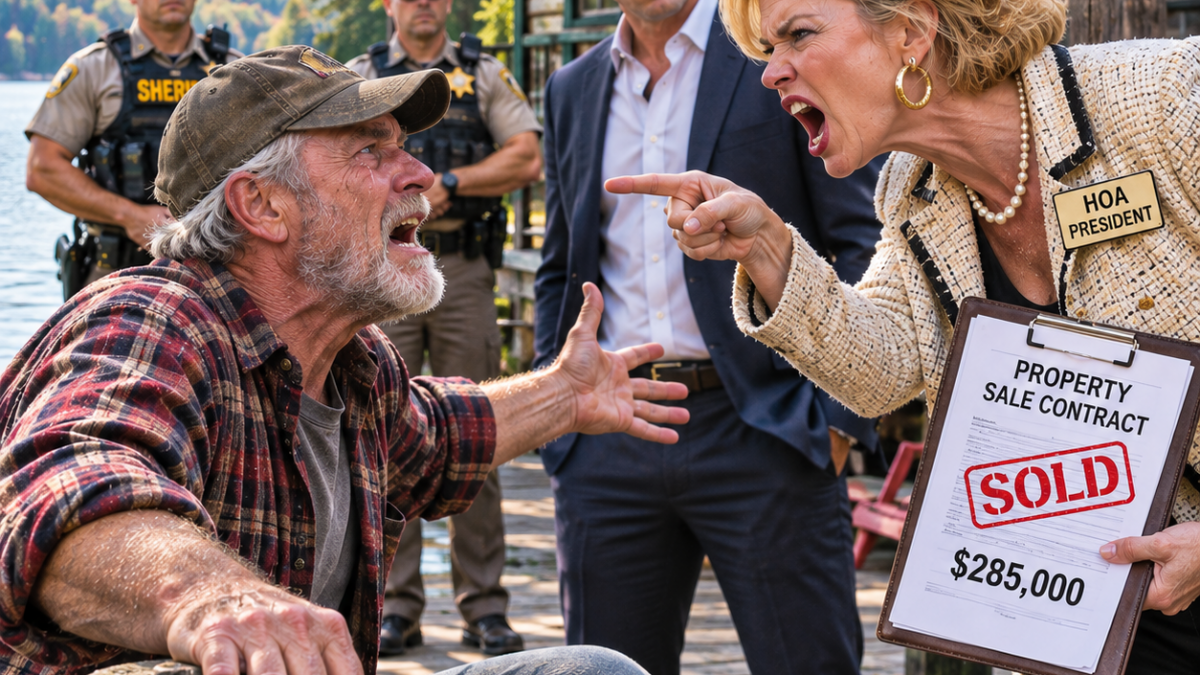
PART2
I left the screws in my cart.
Drove home.
A young man stood beside my porch carrying a camera.
He looked twenty-five.
Maybe thirty.
More embarrassed than dangerous.
“Can I help you?”
“You’re Frank?”
“Yes.”
He glanced at the cabin.
“I was told the owner was away.”
“Who told you?”
“Linda Shaw.”
My stomach tightened.
“What are you doing here?”
“Property photographs.”
“For what?”
He hesitated.
“The listing.”
I stared at him.
“There is no listing.”
He looked at his phone.
“This address?”
He showed me.
Mine.
Under access instructions someone had typed:
OWNER AWAY. REAR KEY AVAILABLE.
I felt cold.
“What rear key?”
He pointed toward the back.
I didn’t move.
“Did you enter?”
“No.”
“Why not?”
“She said she’d meet me.”
His camera bag was still closed.
The porch camera later confirmed he’d arrived only minutes earlier.
I believed him.
“Send me that work order.”
He hesitated.
“This is weird.”
“You think?”
I pulled out my driver’s license.
Then unlocked my own front door.
He looked from the license to the cabin.
“I’m sorry.”
“I know.”
He emailed the work order.
Then left.
I walked around back.
Beneath the steps had been a small metal key box.
Ruth had put it there years ago.
The spare key inside had blue tape wrapped around the head because her eyesight had been getting worse.
Blue meant back door.
Red meant shed.
She could identify them without glasses.
The box was empty.
I knew one person besides Bill who knew about that key.
Linda.
The previous winter, while I was visiting my daughter, a pipe froze beneath the kitchen sink.
Linda had helped let the plumber inside.
I had thanked her.
Then I made the stupid mistake of leaving the key where it had always been.
I called her.
“Linda.”
“Frank.”
“Where’s my spare key?”
Silence.
“What spare key?”
“The blue one.”
“I don’t know what you mean.”
“Then why does a photographer have instructions saying there’s a rear key?”
“He mixed up the assignment.”
“He has my address.”
“Because your driveway is easier to locate.”
“For another property?”
“Yes.”
“And the listing?”
“There is no listing.”
“Linda.”
Her voice sharpened.
“Nobody is stealing your cabin, Frank.”
“I didn’t say stealing.”
Another pause.
“Return my key. Stay off my property.”
“You’re overreacting.”
“Return the key.”
I hung up.
Then emailed the same thing.
Written words.
Date.
Time.
Specific request.
Her reply arrived that night.
There is no listing for your property. This was a scheduling mistake.
I saved it.
The next morning, I changed both locks.
The back door had swollen around the old mechanism, so I spent half the morning kneeling on a kitchen floor my knees hated.
By noon, there were two new locks.
The metal box beneath the steps was gone.
I told myself that fixed it.
It didn’t.
Two days later, Susan Walker came through my front gate.
Susan lived three houses up.
Mid-fifties.
Quiet.
Recently elected HOA treasurer.
She carried a thin envelope.
“I was told to leave this in your mailbox.”
“By Linda?”
Susan nodded.
“But I wanted to give it to you.”
Inside was a property-status form.
Three boxes.
Vacant.
Rented.
Owner occupied.
I looked at her.
“I’m standing here.”
“I know.”
Below the boxes was a line for the name and phone number of the person responsible for the property.
“Why does the HOA need this?”
“Linda says we’re updating records.”
I checked:
OWNER OCCUPIED.
Then wrote:
FRANK MILLER.
My phone number.
Signed it.
Before handing it over, I took a photograph.
Susan watched.
“Something happen?”
I showed her the photographer’s order.
She read it twice.
Then looked toward the cabin.
“Did you change the locks?”
“Yesterday.”
She nodded.
“Good.”
It was one word.
But the way she said it made me look at her.
“What aren’t you telling me?”
She hesitated.
“Linda handles too much herself.”
“That isn’t an answer.”
“I’ve been asking for bank statements.”
My stomach tightened.
“Why?”
“I’m treasurer. I should have them.”
“And?”
“She keeps delaying.”
“Money missing?”
Susan shook her head immediately.
“I did not say that.”
I respected her more for it.
She continued.
“I don’t know. That’s why I need records.”
Before leaving, she asked me to send her the photograph of the form.
“Why?”
“Proof I returned it completed.”
I emailed it.
That afternoon, I drove to the county office.
Explained that someone might be advertising my property.
The clerk helped me pull the latest recorded deed.
My name.
Still there.
FRANK MILLER.
I bought a certified copy.
Drove home.
And made my first serious mistake.
I relaxed.
The deed said I owned the cabin.
Linda denied there was a listing.
Locks were changed.
Surely she’d been testing how far she could push and realized she’d been caught.
For four days, nothing happened.
I repaired a loose board on the dock.
Found the red fishing float my grandson left beneath Ruth’s bench.
Called my daughter.
“Told you that HOA woman was trouble,” she said.
“It’s handled.”
Those two words embarrassed me later.
It’s handled.
Friday afternoon, Bill came walking across my yard carrying his phone.
“Frank.”
“What?”
“You need to see this.”
My cabin was on a real-estate website.
Picture after picture.
Front porch.
Kitchen.
Bedroom.
Living room.
Dock.
Across the bottom:
SOLD.
I stared at the screen.
My first feeling wasn’t anger.
It was cold.
Like seeing your own face in an obituary.
I swiped through the photos.
Then stopped.
One picture showed the kitchen table.
A package sat unopened on top.
Replacement faucet parts.
I remembered that package.
It had arrived before Linda asked me to sign the entry form.
Which meant the interior photographs had been taken before she ever pretended she needed permission to measure the shoreline.
I enlarged another picture.
My green coat hung beside the door.
My reading glasses lay on the table.
There was food in the pantry.
This wasn’t an empty cabin.
Someone had entered a lived-in home and photographed it while I was away.
Bill said, “Call her.”
I almost did.
Instead, I photographed every page still open on his phone.
The listing disappeared when I searched from mine.
Bill’s cached version still showed it.
Price:
$285,000.
Contact:
Linda Shaw.
I called the sheriff’s office.
“My house appears to have been sold without me.”
That sounded ridiculous even while saying it.
The dispatcher asked whether someone was currently trying to enter.
“No.”
She gave me a report number.
I wrote it on the back of the printout.
Then I called the number connected to the buyer inquiry.
Voicemail.
I left one sentence.
“My name is Frank Miller. I own the cabin at this address. It is not for sale.”
I barely slept.
Saturday morning, I needed something physical.
Something simple.
So I took sandpaper to the dock.
Ruth’s bench had weathered.
I wanted to reseal it.
That was where Paul Bennett found me.
I heard footsteps behind me.
“Excuse me?”
I turned.
A man around sixty stood on the dock.
Neat jeans.
Brown jacket.
Brass key in one hand.
Folder in the other.
He looked more confused than angry.
“Can I help you?”
He glanced toward the cabin.
“Are you family?”
“I’m Frank Miller.”
The color in his face changed.
“The owner’s Frank Miller.”
“Yes.”
He swallowed.
“I was told Frank Miller died.”
I stopped sanding.
“By who?”
“Linda Shaw.”
I put down the sandpaper.
“What’s your name?”
“Paul Bennett.”
He opened the folder.
“We closed yesterday.”
The first page showed a photograph of my cabin.
SALE COMPLETE.
Below it was a printed message from Linda:
The owner passed away. I’m handling everything for the family.
Paul looked at me.
Then the message.
Then my truck parked beside the cabin.
“Please tell me you’re his brother.”
“I don’t have a brother.”
I pulled out my driver’s license.
His hand shook as he read it.
The brass key clicked against the metal folder clip.
I looked at it.
Blue tape around the head.
Ruth’s key.
The one missing from under my steps.
I sat down.
Paul sat too.
I brushed sawdust from the bench first.
Habit.
Ruth would have complained.
“My wife’s at the rental house packing.”
I looked at him.
“You paid?”
“All of it.”
“How much?”
“Two hundred eighty-five thousand.”
The lake went quiet in my head.
“Who got it?”
“The closing.”
“Who handled the closing?”
“Linda arranged it.”
“Your attorney?”
He looked embarrassed.
“We didn’t use one.”
“Why?”
“She said everything had already been prepared.”
I almost asked how a grown man could send $285,000 without meeting the owner.
Then I looked at his face.
He was another victim.
Different side of the same lie.
There was no value in humiliating him.
“Show me everything.”
He did.
Sales agreement.
Receipt.
Deed.
A document claiming Linda had authority to act for me.
I took him into the cabin.
He stopped in the kitchen.
My coffee mug sat beside the sink.
Crossword open on the table.
Reading glasses beside it.
A loaf of bread.
Toolbox.
Nothing looked abandoned.
Paul whispered:
“She told us the family left everything.”
“How many times were you here?”
“Twice.”
“When?”
He gave me the dates.
Both days I had been at the hospital for knee tests.
Linda knew those dates because I had asked the HOA road crew to keep my driveway accessible for the rides taking me there.
Paul stared at me.
“She knew when you’d be gone.”
“Yes.”
He placed the deed on the table.
Address matched.
Property description matched.
Buyer’s name:
Paul Bennett.
Seller:
Frank Miller.
But I had never signed it.
Linda had signed her name beneath language claiming she had the authority to act for me.
Paul pointed.
“She said it remained valid after you died.”
I looked at him.
“Even if I had authorized her, you think death gives someone more authority?”
His face tightened.
“I didn’t think.”
“No.”
I softened my voice.
“Neither of us did enough thinking soon enough.”
Then his phone rang.
His wife.
He answered.
“Ann, don’t load anything.”
Pause.
“No. Something’s wrong.”
He looked at me.
“Don’t send Linda another dollar.”
I leaned closer.
“Another?”
He covered the phone.
“She wanted a dock-access payment Monday.”
“The dock comes with the cabin.”
Paul shut his eyes.
“Of course it does.”
After he ended the call, he showed me Linda’s last email.
Attached:
The document supposedly authorizing her to act for me.
My name at the bottom.
Signature.
Witness:
Susan Walker.
My chest tightened.
Susan had watched me write OWNER OCCUPIED only days earlier.
Then Paul’s phone buzzed.
New message from Linda.
He read it.
His face changed.
“What?”
He handed it to me.
If Frank’s brother is at the property, do not let him delay possession. Removal crew is scheduled for Monday morning.
“Frank’s brother?”
Paul whispered, “She thinks you’re pretending.”
Below it was a work order.
Furniture removal.
Tools.
Beds.
Kitchen table.
Dock items.
Then:
WOODEN BENCH — HEAVY — BRING TWO MEN.
I stared at those words.
Ruth’s bench.
Linda had watched Ruth sit there.
She knew exactly what it was.
To her, it had become debris.
Something to clear so Paul could move into the property she had stolen from me.
“Send me everything.”
Paul nodded.
Before responding to Linda, I stopped him.
“Save first.”
“What?”
“Every email. Every attachment. Every message.”
He understood.
We saved them.
Printed them.
Then I called the removal company.
A man named Rick answered over the sound of equipment.
I gave my address.
“Yes, sir. Monday at eight.”
“I’m the owner.”
Pause.
“The job says estate removal.”
“I’m alive.”
Longer pause.
“I live there.”
The machinery went quiet behind him.
“Well.”
“That’s different.”
I sent Rick a photograph of my license with sensitive numbers covered and the certified deed I’d bought that week.
Ten minutes later he called back.
“We’re putting the job on hold.”
“Keep everything Linda sent you.”
“I keep every job record.”
“Good.”
“Especially jobs like this.”
That was the first time all morning I took a complete breath.
Ruth’s bench was safe Monday.
Paul’s money wasn’t.
His payment receipt showed the funds had gone into an account under the HOA’s name.
$285,000.
Paul called his bank.
Explained he believed the payment had been induced by fraud.
The representative said they would attempt recovery.
Attempt.
That word sat in the kitchen with us.
No guarantee.
At noon, Deputy Harris arrived.
Broad man.
Reading glasses tucked into his shirt pocket.
He listened to Paul.
Then me.
Then looked through the documents.
“I need to separate what we can prove from what people are telling us.”
I liked him immediately.
“No promises?”
“No promises.”
He pointed at Paul’s phone.
“We can see Linda told you Mr. Miller was dead.”
Paul nodded.
“We can see Mr. Miller is alive.”
I raised my coffee mug.
“Strong evidence.”
Harris almost smiled.
“We can see the payment receipt.”
“Yes.”
“We cannot yet see where the money ultimately went.”
He looked at me.
“And we don’t yet know what documents have been filed with the county.”
I handed him the report number from Friday.
“This started before Paul arrived.”
Harris reviewed it.
Then stepped onto my porch and called Linda.
I could hear only his side.
“Yes, ma’am.”
Pause.
“No, I checked his identification.”
Long pause.
“No. He says he has no brother.”
Another pause.
“Send me every document you relied upon.”
When he returned, I asked:
“What did she say?”
“Family misunderstanding.”
“I have no family involved in this property.”
He wrote that down.
Paul’s wife arrived soon after.
Ann Bennett.
She carried an empty grocery box because they had expected to begin moving.
She set it inside the door.
Looked at me.
Then at Paul.
Then around the cabin.
“I am so sorry.”
Paul started explaining all at once.
She touched his arm.
“Start with what we need to do today.”
That steadied everyone.
Their rental ended in a week.
They thought this was their home.
I could not invite them to stay in mine.
It was the very thing I was fighting to keep.
But Bill had an apartment over his garage.
His daughter used it during summer visits.
No one was coming for a month.
I called.
“Bill, I need a favor.”
After hearing two sentences:
“Tell them they can use it.”
Ann cried when I told her.
Paul stared at the floor.
They had arrived that morning believing I was the obstacle to their new life.
By afternoon, we were protecting one another’s paperwork.
After they left, I called Susan.
“Your name is on something.”
“What?”
“Come over.”
She arrived twenty minutes later.
I laid the authorization paper on the table.
Pointed at the witness signature.
Her face went white.
“That’s my name.”
“Did you sign it?”
“No.”
“Look carefully.”
She sat.
Opened her phone.
Pulled up the photo I had sent her of the owner-status form.
At the bottom, Susan had signed to confirm she received it.
Her signature had a distinctive long tail on the final letter.
The line crossed into a printed box.
We compared it with the witness signature.
Same tail.
Same tiny piece of printed box beside it.
Susan whispered:
“Oh my God.”
I took my reading glasses.
The signatures were not simply similar.
The witness signature appeared to include part of the original form.
As though somebody had digitally copied the entire image and placed it onto a different page.
“Linda asked for the original form when I got back.”
“You gave it to her?”
“Yes.”
Susan covered her mouth.
“That’s why I wanted your photograph.”
I sent both images to Harris.
No accusation.
No statement that we knew who created it.
Just:
Please compare these signatures and the printed marks around them.
Susan opened another email.
From Linda.
Subject:
SHORELINE AGREEMENT COMPLETED.
The message said the cabin owner had approved a private sale.
It said the HOA would receive compensation for arranging the sale and settling shoreline-access rights.
Attached was a supposed board approval from a Wednesday meeting.
Susan stared.
“We didn’t meet Wednesday.”
“Could the others have met without you?”
“Yes.”
“Does this say you were there?”
“Yes.”
Her name appeared beside three board members.
UNANIMOUS APPROVAL.
Susan leaned back.
“I never voted for this.”
“Forward it.”
She looked at me.
“Frank.”
“I know.”
“If she finds out—”
“She already used your name on paperwork.”
Susan stared at the false witness page.
Then forwarded the email.
That choice cost her something.
I could see it.
She belonged to that board.
Those people were neighbors.
Linda had power.
Susan was deciding which mattered more.
Truth won.
Barely.
Before leaving she said:
“I still need those bank statements.”
Sunday morning, I lost my temper.
Not in person.
Online.
The neighborhood had a private message board.
I wrote:
My cabin has been sold without my permission. Linda Shaw told a buyer I was dead.
Accurate.
Then I added:
Anyone who helped her should start packing.
That was stupid.
It felt satisfying for five minutes.
Linda deleted my post.
Then uploaded only the final sentence.
Her caption:
Frank Miller is threatening board members during a private family dispute.
My phone exploded.
“Frank, are you okay?”
“Is this true?”
“Did you threaten Linda?”
One neighbor asked whether I was confused because of my age.
That one hurt.
For an hour, I typed angry replies.
Then stopped.
Linda had successfully moved me away from evidence and into a public argument about my temper.
I saved the full post.
Sent it to Deputy Harris myself.
Then wrote a correction:
I should not have written the remark about anyone packing. I am not threatening anyone. I am disputing an unauthorized sale of my home.
I hated writing it.
Which meant it probably needed writing.
From that point onward, I stayed off the neighborhood board.
Linda could perform online alone.
I had records to gather.
Paul arrived with a thick paper folder held together by a rubber band.
“We printed everything.”
Ann came with him.
We spread the emails across my kitchen table.
The story appeared chronologically.
Paul had answered an advertisement seeking buyers for quiet lake property.
Linda contacted him.
Called it a private sale for a family wanting discretion.
Then came pressure.
Another buyer is ready.
Family wants this completed quickly.
No need to spend money on an outside lawyer.
Paul rubbed his face.
“I look like an idiot.”
“You look like somebody who trusted the person presenting herself as the authority.”
“That’s generous.”
“No.”
I pointed at the pages.
“It’s accurate.”
The supposed closing company had an impressive logo.
Blue house.
Circle.
Professional email footer.
But the phone number went to voicemail that never named a business.
Paul had never visited a closing office.
Linda met him at the clubhouse.
Handed him documents.
Told him the “closing company” had reviewed everything.
The final papers arrived by email.
No independent attorney.
No title agent he met.
No seller.
No family.
Just Linda.
I built another timeline.
Photographer work order.
Linda’s entry form.
My refusal.
My email telling her to stay off the property.
Her written denial that the listing existed.
Susan’s owner-occupied form.
Then Linda telling Paul I was dead.
Ann read the dates.
Stopped.
“Wait.”
“What?”
She pointed.
“Susan saw you Thursday?”
“Yes.”
“She gave Linda the form Thursday?”
“Yes.”
“And Linda told Paul you had died Friday morning?”
Silence.
There it was.
Linda could not later say she relied on old information.
She had received written confirmation I was alive and living there.
Then told the buyer I was dead.
One day apart.
I circled both dates.
Monday morning, Paul and I reached the county office when it opened.
I carried the certified deed I’d purchased days earlier.
I expected the clerk to pull the same record.
She stared at the screen.
Then frowned.
“There’s a newer filing.”
My stomach dropped.
She printed it.
Recorded Friday afternoon.
Buyer:
Paul Bennett.
New owner.
My cabin.
Linda had submitted the false authority paper with Susan’s copied signature.
Paul backed away from the counter.
“I don’t want his house.”
The clerk looked sympathetic.
“Can you undo it?” he asked.
“We record documents.”
“What does that mean?”
“We don’t determine whether the underlying signatures are valid.”
She gave us information for disputed filings.
Recommended a property attorney.
I bought copies.
My hands were steady until I tried to slide them into the folder.
Five days earlier, county records said I owned my cabin.
Now the public record said Paul did.
The truth had not changed.
The paper had.
That frightened me more than I expected.
Then Susan called.
“Frank.”
“What?”
“We got into the bank records.”
Paul stood close.
“The money came in Friday morning.”
“I know.”
“Most of it went out Friday afternoon.”
“How much?”
“Two hundred forty thousand.”
Paul went pale.
“To who?”
Susan hesitated.
“The transfer description says proceeds owed to seller.”
“What seller?”
She read the account label.
FRANK MILLER.
For one second, I felt sick.
If somebody looked only at the paperwork, they might believe I received $240,000 and was now pretending the sale never happened.
“Does the bank record show who owns the receiving account?”
“No.”
“Just the description?”
“And last four account digits.”
I leaned against the courthouse wall.
“Send the full page to Harris.”
Paul stared.
“Can she make them believe you got paid?”
“She can say anything.”
I looked at the false deed in his hand.
“That doesn’t make it true.”
I wished I felt as confident as I sounded.
We found Beth Turner that afternoon.
Property attorney.
Second-floor office above a hardware store.
Narrow stairs.
My knee complained with every step.
Beth read my folder.
Then Paul’s.
“I can represent Frank.”
Paul nodded.
“You need your own advice.”
“I understand.”
“I’m not going to fight Frank for the house.”
“That helps.”
She looked at him.
“But legally, your name is on a deed. We need the record corrected properly.”
Then she turned to me.
“You never signed this?”
“No.”
“You never authorized Linda to sell?”
“No.”
“You never agreed orally?”
“No.”
“You received money?”
“No.”
Beth tapped the supposed authority document.
“This is meant to give her power to act for you.”
“I gathered that.”
“It doesn’t become valid because somebody types your name on it.”
Then she found something better.
“Linda told Paul you were dead.”
“Yes.”
“She also claimed this authorization let her continue acting for you after death?”
Paul nodded.
Beth leaned back.
“That story has problems.”
“Meaning?”
“Even a legitimate agency relationship normally doesn’t become more powerful when the principal dies.”
I nodded.
“She lied twice.”
“Maybe more.”
Beth remained cautious.
“We prove what we can.”
She explained the first goal.
Temporary court order.
Stop possession.
Stop removal of property.
Stop any further transaction involving the cabin while ownership was litigated.
“How much?”
She gave me the retainer.
Three thousand dollars.
My truck-replacement account.
I stared at the number.
The truck had started blowing blue smoke on cold mornings.
I had planned to replace it before winter.
Instead, I wrote a check to prove I owned a home I had already paid for twenty-six years earlier.
Beth watched me fold the receipt.
“Keep that.”
“I keep everything.”
“For once, Frank, that may save you.”
That night, I studied the signatures.
Susan’s wasn’t the only one.
Mine appeared on the false authorization.
I compared it with the owner-occupied form.
On the real form, my signature rose sharply at the end because my pen caught the edge of Susan’s clipboard.
There was also a tiny ink dot beneath the M where I tested the pen.
The false signature had the same rise.
Same dot.
I held the pages against the kitchen window.
Almost perfect alignment.
The signatures appeared to come from the same source.
I wanted to call Linda.
Ask whether she thought I was stupid.
Instead, I sent Beth and Harris the clean image files.
One sentence:
Please compare these.
Then I sat in Ruth’s old chair.
That was when the irony hit me.
Linda had sent Susan to confirm whether I lived at the cabin.
I wrote:
OWNER OCCUPIED.
Signed my name.
Susan signed confirming she received it.
And those signatures appeared to have been taken from the very form proving I was alive and used to manufacture paperwork pretending I had sold my home.
The document created to confirm my occupancy may have been used to erase me.
I didn’t sleep much.
Paul and Ann returned the next morning.
Ann placed an envelope on the table.
Money.
I pushed it back.
“No.”
“You’re paying legal fees because we’re part of this.”
“You paid $285,000.”
“It may come back.”
“May.”
She looked down.
“You need it.”
“So do you.”
They had temporary housing costs.
Attorney fees.
No house.
No access to most of their savings.
I was not taking their grocery money to feel morally balanced.
“Help me with the timeline.”
Paul put the envelope away.
That was more valuable.
He signed a statement confirming:
He never met me before finding me on the dock.
Linda told him I was dead.
Linda said she represented my family.
He had never spoken to an heir.
He never wanted possession once he learned the truth.
Ann verified the communications she witnessed.
For the first time, the problem stopped feeling like Frank versus Paul.
We were two sides of Linda’s same transaction.
Wednesday, Linda sent a neighborhood email.
She blamed me.
Unexpected legal costs have arisen because a property owner changed his mind after a private agreement.
Then:
A special assessment may be required.
That got attention.
Residents who didn’t care about my deed suddenly cared about their wallets.
Bill brought me a printed copy.
“Now folks are asking questions.”
“Good.”
“You going door to door?”
“I want to.”
“But?”
“Beth will kill me.”
I sent her the email.
Asked whether we could distribute our timeline.
She helped remove Paul’s private banking information and anything that could interfere with investigation.
Two pages.
Simple.
No accusations beyond what documents showed.
I had not sold.
I had not received payment.
Linda denied there was a listing.
Susan confirmed I was living there.
The next morning Linda told Paul I was dead.
I emailed the timeline to the board.
Susan replied within an hour.
Emergency meeting Thursday.
Linda opposed it.
The other board members outvoted her.
That was the first sign the room might finally stop belonging to her.
Thursday morning, Beth called.
“Judge signed the temporary order.”
I sat down.
“What does it do?”
“Prevents Linda and the HOA from taking possession, removing your belongings or entering further transactions involving the cabin while the dispute is pending.”
“Does it clear the deed?”
“No.”
“Return Paul’s money?”
“No.”
I closed my eyes.
“But nobody can remove my things?”
“Correct.”
I printed the order.
Placed one copy in my front window.
Then walked to the dock.
Ruth’s bench still had one rough section from Saturday.
I sanded it.
Slowly.
The removal order had said:
HEAVY. BRING TWO MEN.
I ran my palm across the smooth wood.
Ruth had sat there.
Paul had sat there.
Soon my grandson would.
For ten minutes, I worked on something I understood.
Then I went to the clubhouse.
People stood along the walls.
More residents than I’d seen at any meeting in years.
Linda stood at the front.
Dark jacket.
Pearl earrings.
Papers in neat stacks.
Susan sat at the opposite end with bank records.
Tom, another board member, sat between them.
Paul and Ann were near the front beside Bill.
I took an aisle seat.
Folder on my knees.
Linda opened.
“This situation has been badly misunderstood.”
Nobody responded.
She continued.
“My intention was to create a shoreline improvement that would raise property values for every homeowner.”
She displayed the drawing.
Bigger dock.
Shelter.
Trailer parking.
My shed absent.
Path through my yard.
My dock marked common.
Tom asked:
“Did Frank authorize use of his land?”
Linda said:
“There were discussions.”
I raised my hand.
Tom called on me.
“She asked me to sign an open-ended entry form.”
I held up my copy.
“I refused.”
Linda tried to interrupt.
Tom raised one hand.
“We’ll come back to that.”
He turned to Susan.
“Money.”
Susan read the transaction.
$285,000 incoming from Paul.
$240,000 transferred out.
$45,000 remaining in the association account.
“The bank has been notified the transaction is disputed.”
Paul stood.
“That is our retirement money.”
Linda turned toward him.
“You received a property at a fair value.”
Paul held up her printed message.
“I bought it because you told me Frank was dead.”
For the first time, Linda’s expression broke.
Small.
But visible.
She recovered.
“I relied on information available to me.”
I stood.
“Then explain this.”
The owner-occupied form.
Susan said:
“I watched Frank complete it.”
“What date?”
She gave it.
I read Linda’s message telling Paul I was dead.
The next morning.
Silence.
Linda reached for water.
Didn’t drink.
Then said:
“Frank had already agreed to let me handle the property.”
Different story.
Tom asked:
“Where is that agreement?”
Linda produced the authorization.
Susan placed her original form beside it.
Pointed at the copied printed line beside her signature.
I showed the matching ink dot beneath mine.
Papers moved through the rows.
Nobody shouted.
That was worse for Linda.
Everyone was reading.
Thinking.
Comparing.
She said:
“Digital signatures are routinely transferred to final documents.”
Susan stared at her.
“Not when the people never agreed to the document.”
The ceiling fan clicked.
Click.
Click.
Click.
Tom asked:
“Where did the $240,000 go?”
Linda folded her hands.
“To the seller.”
“Frank says he didn’t receive it.”
“There are settlement issues.”
“Where is the money?”
She pulled another stack of papers.
“I have a solution.”
She slid a new agreement toward me.
Page one:
I approved the sale.
Page two:
I would receive $240,000.
HOA kept $45,000.
Page three:
I granted shoreline access.
Signature line.
Mine.
Blank.
I stared.
Then looked at Linda.
“You told everyone I already agreed.”
“This resolves the dispute.”
“You said I already received the money.”
“It can be released upon execution.”
Paul stood.
“Released?”
Linda froze.
Paul stepped closer.
“You can release it?”
Tom pushed his chair backward.
Susan looked at Linda.
“You told the board it had already been paid to Frank.”
Linda said:
“It is being held safely.”
Paul put his payment receipt beside her agreement.
“By who?”
“That is part of settlement.”
“No.”
His voice trembled.
“That is my wife’s and my money.”
Linda looked around.
Nobody rescued her.
Finally:
“It is in a separate account under my control.”
Susan slowly turned the bank statement around.
“Then why does this describe it as paid to Frank?”
“It was intended for him.”
“You told us he had it.”
Linda’s voice rose.
“I was trying to complete a transaction that benefited this community!”
There it was.
Not denial.
Justification.
I looked at the shoreline plan.
My shed erased.
Path across my yard.
Ruth’s dock labeled shared.
I finally understood.
Linda hadn’t stumbled into selling my cabin.
She needed my land for the project.
She believed that if she offered enough money—or simply completed the transaction first—I would eventually accept it.
My refusal wasn’t a right to her.
It was an obstacle.
“Why did you tell Paul I was dead?”
She looked down.
Paul answered for her.
“Because I wanted to speak to him.”
Linda’s eyes lifted.
Paul continued.
“You needed a reason why I couldn’t.”
Linda whispered:
“I was under pressure.”
Nobody spoke.
“The shoreline project was months behind.”
She looked toward the residents.
“People wanted improvements.”
A woman shouted:
“Not like this.”
Linda flinched.
She continued:
“I thought Frank would accept once he saw the price.”
I slid the agreement back.
“I’m not selling.”
Tom looked at Linda.
“Turn over the checkbook.”
Her face hardened.
“You cannot remove me without following the bylaws.”
“You’re right.”
Tom nodded.
“So we will.”
He looked at Susan.
“Vote to suspend Linda’s financial access immediately and refer the records to investigators.”
Susan:
“Yes.”
The third board member:
“Yes.”
Linda sat perfectly still.
Tom extended his hand.
“Checkbook.”
She placed it on the table.
Her fingers stayed on it for several seconds.
Then released.
No handcuffs.
No cheering.
No dramatic arrest.
Linda collected her purse.
And the shoreline drawing.
Then walked out.
For the first time in years, nobody waited for her permission to keep talking.
Susan handed me the unsigned settlement.
“She left it.”
I held it by the corner.
One page claimed I had already sold.
Another asked me to make that claim true.
Beth loved that.
Not emotionally.
Lawyers have a frightening way of loving contradictions.
She placed it into the evidence file.
The bank restricted the HOA account.
Investigators took steps to prevent movement of the disputed $240,000.
Paul still didn’t have his money.
But now we knew it existed.
That mattered.
Deputy Harris brought me in for a formal statement.
We walked through everything.
Entry form.
Photographer.
Missing key.
Linda’s written denial.
Listing.
Paul.
False authority paper.
Bank transfer.
New settlement.
He asked:
“Why did you keep the photographer work order?”
“Because it was strange.”
“Why keep Linda’s denial email?”
“Because it was stranger.”
He smiled slightly.
“Good.”
The supposed closing company unraveled too.
Investigators found there had been no independent closing office.
Linda controlled the email used to send the papers.
The blue-house logo was decoration.
Professional-looking paperwork creating the appearance that another institution had reviewed the deal.
It hadn’t.
Paul had purchased a home through a process Linda designed, using authority Linda supplied, based on a death Linda invented.
The entire structure led back to one person.
Clearing the deed took weeks.
Paul cooperated completely.
Beth insisted on a court order.
Not just Paul signing something back.
She wanted the public title record clean.
Something my children could rely upon years later without wondering whether some old fraudulent deed might surface again.
The hearing took place on a rainy morning.
I wore the suit I kept for funerals and weddings.
Paul sat across the aisle with his own lawyer.
He gave me a small nod.
Linda sat farther forward beside counsel.
Her lawyer argued that the unsigned settlement showed she had attempted to resolve an unfortunate misunderstanding.
Beth stood.
She did not raise her voice.
“Your Honor, the chronology matters.”
Then she walked through it.
Frank refused broad access.
Linda arranged interior photographs anyway.
Frank confronted her.
Linda denied in writing that any listing existed.
Susan then confirmed Frank was alive and owner-occupying the cabin.
The following morning, Linda told Paul the owner had died.
Linda later claimed money had already been paid to Frank.
Then offered to release that same money if Frank signed a new agreement.
Beth stopped.
The judge looked at me.
“Mr. Miller, did you sign the authorization allowing Linda Shaw to sell your property?”
“No, Your Honor.”
“Did you authorize her verbally?”
“No.”
“Did you receive any portion of the $285,000?”
“No.”
“Do you wish to approve the sale now?”
I looked at Paul.
He gave me a tiny nod.
Then at Ruth’s cabin in my mind.
The dock.
Bench.
Garden.
Twenty-six years.
“No, Your Honor.”
Pause.
“I want to keep my home.”
The judge ruled the authorization invalid.
The deed based upon it invalid.
The county was ordered to correct the record.
My cabin was mine.
It had always been mine.
But hearing a judge say it made something in my chest finally loosen.
Outside the courthouse, Paul shook my hand.
“I’m glad.”
His money was still trapped.
But he meant it.
Weeks later, Ann called.
Her voice broke before she finished the sentence.
“The money is back.”
I sat down.
“All of it?”
“Two hundred eighty-five.”
The $45,000 returned from the HOA account.
The $240,000 from the separate account Linda controlled.
No bonus.
No miracle settlement.
Their own money.
Back where it belonged.
Paul took the phone.
“We can breathe.”
I walked outside.
Sat on the porch.
No paperwork in my hands.
For the first time in months.
Just lake water.
Wind.
And Ruth’s empty chair beside the door.
“I think we’re okay,” I said aloud.
Maybe to her.
Maybe to myself.
The HOA removed Linda through its formal process.
Susan and Tom had the finances independently reviewed.
The shoreline expansion was canceled.
A correction letter went to every homeowner:
Frank Miller had never agreed to sell.
Frank Miller had never received the purchase money.
Frank Miller had not “changed his mind.”
The transaction had been unauthorized.
I saved that letter too.
Of course I did.
Some neighbors apologized.
Others simply began waving again when I drove past.
I didn’t demand public confessions.
I understood how it happened.
Linda had a title.
President.
She spoke confidently.
She controlled official-looking paperwork.
People assume authority and truth are related.
Sometimes they are.
Sometimes they aren’t.
Paul learned that lesson for $285,000.
I learned it for $3,000 in legal fees and several months of sleep.
The HOA learned it by nearly becoming part of a fraudulent property transaction.
The new board changed procedures.
No single person could move large funds.
Board votes required documented records.
Real-estate matters required independent review.
Bank statements went to more than one officer.
Not revolutionary reforms.
Obvious ones.
The kind people only appreciate after discovering what happens without them.
The criminal case lasted longer.
Linda eventually pleaded guilty to charges involving fraud and forged documents.
Her attorney spoke about years of volunteer service.
About stress.
About her belief that the shoreline project would benefit everyone.
The judge asked one question.
“Did Ms. Shaw ever obtain Mr. Miller’s permission to sell his home?”
Her lawyer answered:
“No.”
That ended the debate.
Linda received a two-year prison sentence.
There were also repayment obligations for documented losses caused by her conduct, apart from the purchase funds already returned.
My legal expenses.
Paul and Ann’s temporary housing expenses.
Other direct costs.
I did not seek some enormous emotional-damages jackpot.
I wanted my title clean.
My costs covered.
Paul’s money returned.
And Linda unable to repeat what she had done.
Before sentencing ended, Linda was allowed to speak.
She stood.
Said:
“I’m sorry the situation went as far as it did.”
That was not the apology I expected.
Not:
I’m sorry I told Paul you were dead.
Not:
I’m sorry I forged documents.
Not:
I’m sorry I used Susan’s name.
Not:
I’m sorry I took a key from beneath your steps.
Not:
I’m sorry I tried to erase Ruth’s home because it interfered with my development plan.
For weeks, that bothered me.
Then one afternoon I realized I didn’t need her to say the truth.
The record already said it.
That was enough.
By late summer, Paul and Ann found another lake place.
Smaller.
Farther south.
Narrow porch.
Crooked dock.
Exactly the kind of place I suspected Paul would have rejected before meeting me.
This time, they hired their own attorney.
Real closing office.
Independent title search.
Met the seller.
Paul called after closing.
“I shook his hand twice.”
I laughed.
“Just to make sure he was alive?”
“Exactly.”
It was the first time I heard him joke about the whole nightmare.
A few weekends later, they came to my cabin.
Sandwiches.
Tin of cookies.
Paul reached into his jacket.
Blue-taped brass key.
“I think this belongs here.”
I stared.
The tape was worn.
Right where Ruth’s thumb used to rub it.
It no longer opened either door.
I turned it over.
Then put it in the kitchen drawer beside her old seed notes.
The key Linda stole eventually came home.
That mattered more than it should have.
My grandson was on the dock learning to cast.
Badly.
His whole arm went with the rod every time.
Paul helped untangle the line.
Ann sat on Ruth’s bench.
The one Linda’s removal order described as:
HEAVY — BRING TWO MEN.
I had finally sealed it.
Smooth wood.
Fresh finish.
I stood beside Paul.
Looked back at the cabin.
Shed still there.
Yard still grass.
No trailer parking beside my kitchen.
No public path through Ruth’s flower bed.
No giant common dock swallowing mine.
Paul said:
“Still sorry about that first morning.”
“For what?”
“I walked onto your dock thinking you were trespassing.”
“You knocked before using the key.”
He smiled.
“Seemed polite.”
“It was.”
We sat.
My grandson dropped the red float into the lake.
It landed six feet from the dock.
“Good cast,” Paul lied.
I looked at him.
He shrugged.
“Kid needs confidence.”
For the rest of the afternoon, nobody asked me for a deed.
Nobody asked whether I belonged.
Nobody told me what my property ought to become.
That felt strange at first.
Then peaceful.
People often ask what part made me angriest.
Linda saying I was dead?
Yes.
Selling my home?
Obviously.
Taking Ruth’s key?
That hurt.
Putting Ruth’s bench on a removal list?
I still think about it.
But the thing that stayed with me wasn’t one dramatic act.
It was the assumption underneath everything.
Linda believed my refusal was temporary.
That was the entire crime before the paperwork.
I said no to the broad entry form.
She treated no as delay.
I said the dock was mine.
She treated ownership as negotiation.
I challenged the shoreline drawing.
She assumed enough money would eventually change my answer.
When money did not have my permission, she created paperwork that did.
When I remained alive, she told Paul I was dead.
In Linda’s mind, the project mattered so much that reality became negotiable.
That is the kind of authority people should fear.
Not loud authority.
Not strict authority.
Authority that stops recognizing the word no.
I had made mistakes too.
Leaving the spare key beneath the steps.
Trusting Linda after she had already shown interest in my land.
Assuming the county record alone would protect me.
Posting the angry message.
But mistakes are different from surrender.
The most useful thing I did was boring.
Copies.
Dates.
Emails.
Photographs.
Clean originals.
Timeline.
No dramatic confrontation saved the cabin.
A folder did.
Beth once held my file and said:
“This thing is heavier than some lawsuits.”
I smiled.
“I spent thirty-eight years repairing school buses.”
“What does that have to do with it?”
“If a mechanic doesn’t write down what he replaced, the next mechanic wastes six hours discovering it again.”
She laughed.
“Then you were training for litigation your whole life.”
Maybe.
Susan eventually became HOA president.
She didn’t want the job.
That was partly why everybody trusted her.
At her first meeting she said:
“If anybody hears me say ‘trust me, I’m president,’ remind me of Linda.”
Someone shouted:
“We will.”
The whole room laughed.
She published monthly bank summaries.
Board votes.
Contracts.
Boring things.
Exactly how community governance should feel.
Boring.
Linda had turned everything into drama because drama helped her remain central.
Susan made herself almost unnecessary.
Road maintained.
Insurance paid.
Common dock repaired.
People left alone.
I liked that.
One spring afternoon, Susan walked to my fence.
She stayed outside.
That detail made me smile.
“Frank?”
“Yes?”
“The board wants to ask you something.”
“Ask.”
“Common dock repairs.”
“Okay.”
“Contractor may need temporary access near your fence.”
I looked at her.
She smiled.
“I have a date, name and exact work area.”
She handed me a one-page form.
Specific contractor.
Tuesday.
Eight until noon.
No general entry.
No indefinite access.
I read it.
Signed.
Susan laughed.
“Was that so hard?”
“No.”
“Linda would hate this.”
“I hope prison gives her hobbies.”
Susan tried not to laugh.
Failed.
The contractor came Tuesday.
Finished by eleven.
Nobody photographed my kitchen.
Nobody sold my house.
Remarkable what happens when people ask permission honestly.
I still sand Ruth’s bench every year.
It doesn’t need it every year.
I know.
The ritual matters.
Sometimes I sit where she sat.
Coffee.
Morning sun.
Red fishing float beneath the boards.
The blue-taped key is now inside a small wooden box.
My grandson asked about it once.
“What’s that?”
“Old key.”
“To what?”
“This cabin.”
“But it doesn’t work.”
“No.”
“Why keep it?”
I looked toward the lake.
“Because your grandmother marked it.”
He shrugged.
Kids have the healthy ability to accept sentimental adults without understanding them.
“Can I fish?”
“Go.”
He ran.
I turned the key over in my hand.
Linda had once used that little piece of metal because she believed access was ownership.
It wasn’t.
A key lets you through a door.
It does not make the room yours.
That is another lesson people forget.
Possession is not ownership.
Access is not authority.
Confidence is not truth.
Paper is not valid simply because it looks official.
And somebody saying you’re dead doesn’t make you disappear.
Bill still tells the story differently.
According to Bill, he solved everything because he found the online listing.
“Without me,” he says, “you’d be living in my garage.”
“You offered the garage to Paul.”
“Exactly. Hero.”
I let him have it.
He was the one who called when the photographer appeared.
He was the one who saved the cached listing.
He gave Paul and Ann temporary housing.
Heroes often look like nosy neighbors with spare apartments.
I’m comfortable with that.
Paul and I became friends.
Not close enough to call every week.
Close enough to exchange Christmas cards.
Close enough that when his dock needed new boards, he called me before a contractor.
“I’m a retired bus mechanic.”
“You own tools.”
“Fair.”
I drove down.
His new place was nice.
Not perfect.
Better that way.
Ann brought lemonade.
We replaced three boards.
Halfway through, Paul said:
“You know what I still can’t understand?”
“What?”
“Why she thought you’d eventually sign.”
I tightened a screw.
“She thought everybody had a price.”
“Do you?”
“Of course.”
He looked surprised.
I laughed.
“Everybody has things they would sell.”
“But not that cabin.”
“No.”
“Why?”
I looked at the lake.
“Because Ruth is dead.”
He waited.
“When somebody’s gone, you discover objects aren’t only objects anymore.”
The bench.
Key.
Garden.
Cabin.
Porch.
“They become places where memories know where to find you.”
Paul nodded.
He understood.
He had nearly lost his retirement money chasing a home he thought would become that place for Ann and him.
Eventually, he found one honestly.
A year after sentencing, I received a letter from Linda.
I almost threw it away.
Prison return address.
My name handwritten.
I opened it.
She wrote three pages.
Most were about herself.
She had been arrogant.
She felt abandoned by people she had served.
She said the shoreline project became an obsession.
She said she convinced herself I would accept the sale because $240,000 was “fair.”
That sentence angered me again.
Fair according to whom?
Then near the bottom:
I should have accepted your first no.
I stopped.
Read it twice.
That was the closest thing to an apology that mattered.
Not because it repaired anything.
Because it finally named the first boundary she crossed.
Not the forged deed.
Before that.
The word no.
I folded the letter.
Put it in the cabin file.
Of course I did.
I didn’t respond.
I didn’t need to.
The cabin file now fills an entire drawer.
Tax bills.
Roof receipt.
Spring shoreline drawing.
Photographer work order.
Linda’s denial email.
Owner-occupied form.
False authorization.
Paul’s messages.
Removal order.
Bank records.
Court orders.
Corrected deed.
HOA correction letter.
Linda’s prison letter.
Some people would burn it all.
I won’t.
Not because I enjoy remembering.
Because memory becomes less reliable with age.
Paper doesn’t.
One day my daughter will inherit this cabin.
I want her to know exactly what happened.
More importantly, I want her to know exactly what she owns.
I turned sixty-nine this year.
My knees are worse.
Truck still runs.
Blue smoke on cold mornings.
I never bought the replacement.
Three thousand dollars went to Beth instead.
Worth it.
The truck complains every winter, but it starts.
I tell it:
“Linda cost you your retirement.”
Bill says I talk to machinery too much.
I spent thirty-eight years talking to school buses.
Old habits stay.
One morning, Susan called.
“Frank.”
“What did I violate?”
She laughed.
“Nothing.”
“Then why are you calling?”
“We’re updating property records.”
Silence.
She immediately realized.
“Oh no.”
I laughed so hard I had to sit down.
Susan said:
“I swear this one is legitimate.”
“No broad entry forms?”
“No.”
“No selling me?”
“No.”
“No death certificate?”
“Frank.”
“I’m checking.”
She was laughing too.
“That wasn’t funny three years ago.”
“No.”
“It is now.”
That surprised me.
The story had become something I could laugh about.
Not all of it.
But enough.
Healing sometimes announces itself that way.
The thing that once made your hands shake eventually becomes a joke you tell people who know the ending.
I still remember Paul standing on the dock.
Brass key.
Folder.
Question:
“Why is a dead man’s truck parked beside my new home?”
He didn’t actually say it that cleanly.
Memory turns moments into sentences.
But that was the feeling.
Two men.
One house.
Two sets of papers.
Both convinced the other represented disaster.
Linda needed us to remain enemies.
If Paul had demanded possession, things would have been harder.
If I had blamed him for being fooled, harder.
Instead, he showed me his documents.
I showed him mine.
That decision defeated most of Linda’s power before any judge became involved.
She relied on isolation.
Buyer against owner.
Board against resident.
Neighbors against troublemaker.
Once we compared information, her story could not survive.
That may be the most important part.
Manipulation depends on people not talking.
At the next annual HOA meeting, Susan asked me to speak.
I refused.
“Why?”
“I’ve done enough meetings.”
“Five minutes.”
“No.”
“Three.”
“Two.”
She smiled.
“Deal.”
I stood at the front.
Same room where Linda had tried to force the sale.
Different president.
Different atmosphere.
I said:
“I have one suggestion.”
People waited.
“If somebody tells you they have authority over your property, ask them to show you.”
A few people nodded.
“If they tell you another person agreed to something, ask that person.”
More nods.
“And if an HOA president says somebody died…”
Laughter.
“Maybe verify before selling the house.”
The room laughed harder.
Susan covered her face.
I sat down.
Two minutes exactly.
The shoreline project never returned.
There was no need.
The common dock was repaired within its existing footprint.
A small picnic area went on land the HOA actually owned.
Trailer parking stayed where it had always been.
My shed remained.
I repainted it gray.
Purely because I wanted to.
Paul joked:
“Get HOA approval?”
“Get off my dock.”
He laughed.
Ruth’s garden came back too.
For a while, after she died, I stopped planting.
The following summer I grew tomatoes.
Then beans.
Then marigolds because Ruth liked them and I did not.
Turns out marigolds are difficult to resent.
During Linda’s mess, I nearly let everything die.
Too much paperwork.
Too much court.
Too much anger.
After the corrected deed was recorded, I planted twice as much.
Not symbolically.
I simply had time again.
That is what people don’t understand about conflict.
It steals ordinary time.
You think legal trouble costs money.
It does.
It also costs Tuesday afternoons.
Sleep.
Conversations.
Gardens.
Fishing.
The price of peace is often measured by how many normal things you get back.
Paul once asked whether I would ever sell.
“Yes.”
He looked shocked.
“When?”
“When I’m too old to maintain it and my daughter doesn’t want it.”
“So Linda could have bought it?”
“No.”
“Why?”
“Because asking whether something might someday be for sale is different from deciding the owner has already agreed.”
He nodded.
“Fair.”
I added:
“And she tried to erase Ruth’s bench.”
“Right.”
“That alone added ten years.”
Paul laughed.
Sometimes reporters make stories like mine sound like one brilliant trap.
It wasn’t.
There was no trap.
I didn’t outsmart Linda with one hidden document.
There were twenty small things.
The photographer kept his work order.
I saved Linda’s denial.
Susan photographed the occupancy form.
Bill saved the listing.
Paul kept every email.
Rick kept the removal order.
The bank kept transfer records.
Harris kept clean reports.
Beth arranged dates in order.
The court compared claims.
Each thing alone was ordinary.
Together, they became the truth.
That is why I tell people:
Don’t rely on the dramatic piece of evidence you hope exists.
Keep the boring pieces.
Truth often arrives as a stack.
The corrected deed hangs nowhere.
It’s in the safe.
I don’t need it framed.
What I framed instead was a photograph Ruth took the first year we owned the cabin.
Me standing on the unfinished dock.
Younger.
Hair darker.
Tool belt crooked.
Behind the camera, Ruth’s shadow falls across one corner.
She used to complain I never smiled in photographs.
In this one, I am.
Under the frame I placed the blue-taped key.
Not mounted permanently.
Just resting inside the shadow box.
The key doesn’t open anything now.
But every time I see it, I remember the strangest lesson Linda taught me:
Someone can hold the key to your house and still have no right to enter your life.
Three summers after everything ended, my grandson finally learned to cast properly.
No whole arm.
Just wrist.
The float sailed twenty yards.
He shouted:
“Grandpa!”
“I saw.”
Paul happened to be visiting.
He clapped.
Ann sat on Ruth’s bench.
Bill stood behind us with beer.
Susan walked along the common dock east of my fence.
Nobody crossed without asking.
The lake was calm.
My grandson reeled in nothing.
Perfect fishing day.
I sat beside Paul.
He looked toward the cabin.
“Hard to believe I thought that was mine.”
I smiled.
“You had paperwork.”
“Bad paperwork.”
“Still paperwork.”
He looked at me.
“You ever hate me for it?”
“No.”
“Not even that morning?”
“I disliked the folder.”
Paul laughed.
“Fair.”
I pointed toward the key box.
“You knocked.”
He nodded.
“Always knock.”
That afternoon, I realized there was one place on Ruth’s bench where the sealant had worn thin.
I ran my hand over it.
Rough.
Paul noticed.
“You’re going to sand that, aren’t you?”
“Yes.”
“Today?”
“Yes.”
“Frank, it is perfectly fine.”
I looked at him.
“That is how HOA presidents happen.”
He stared.
Then laughed so hard Ann asked what was wrong.
Nothing.
Everything.
Life.
I don’t know what Linda will do when she finishes her sentence.
Maybe move.
Maybe rebuild.
Maybe become bitter.
Maybe finally understand that believing something benefits a community does not give you permission to take one person’s home.
That part no longer belongs to me.
For a long time, I wanted her to understand.
Needed it.
Then the court cleared my deed.
Paul got his money.
The board corrected the record.
The neighborhood changed.
Ruth’s key came home.
And I realized her understanding had become irrelevant.
Accountability does not require the wrongdoer to achieve enlightenment.
Sometimes it only requires the rest of us to stop letting their version of the story control ours.
People ask me if I trust the HOA now.
I trust Susan.
I trust Tom.
I trust procedures better than personalities.
That’s the real answer.
Good people still need checks.
Linda may have started as a good volunteer.
I don’t know.
Years of authority without oversight made it easy for her to stop hearing no.
The new system does not depend on Susan remaining perfect.
That is what a good system should do.
Bank access requires more than one person.
Votes are recorded.
Contracts reviewed.
Large transactions disclosed.
If Susan loses her mind tomorrow and decides my dock belongs to the HOA, she has to convince other people before moving one dollar or signing one paper.
She knows this.
She helped design it.
That is healthy authority.
On Ruth’s birthday every year, I take coffee to the bench.
One cup.
Not two anymore.
I talk to her.
I know that sounds ridiculous.
I spent thirty-eight years fixing machines.
I am not mystical.
Still, I talk.
The year after the case ended, I said:
“You should’ve seen it, Ruth.”
Lake quiet.
“She stole your key.”
Nothing.
“Tried to sell the cabin.”
A duck landed near the dock.
“Some man named Paul almost owned your kitchen.”
I smiled.
“He’s nice.”
Wind moved through the reeds.
“And the bench?”
I touched it.
“Still here.”
That was all.
Sometimes victory is just having the same bench beneath your hand one more morning.
Last fall, I replaced one board.
The wood beneath had begun rotting.
I hesitated before removing it because Ruth had sat above that exact section.
Then I realized preserving something does not mean refusing to repair it.
I installed new cedar.
Sanded it.
Sealed it.
Paul helped hold one end.
My grandson drove one screw.
Crooked.
I left it.
Ruth would have hated that.
I tell myself she would have tolerated it for the boy.
Maybe.
My daughter eventually asked a serious question.
“What happens to the cabin when you’re gone?”
We were sitting at the kitchen table.
The same place where I first compared Susan’s signatures.
I looked at her.
“You inherit it.”
“And HOA?”
“Same road obligations.”
“Dock?”
“Yours.”
“Could this happen again?”
I pulled out the updated title file.
Corrected deed.
Court order.
Survey.
Insurance.
HOA documents.
Everything labeled.
“No.”
She looked at the thickness.
“Dad.”
“What?”
“This is insane.”
“Your mother married a mechanic.”
“You were never this organized before.”
“Trauma improves filing systems.”
She laughed.
Then hugged me.
She asked about the blue key.
I told her.
Ruth marking it.
Frozen pipe.
Linda knowing the box.
Paul returning it.
My daughter touched the tape.
“Mom did this?”
“Yes.”
Her eyes filled.
Then she put the key back.
That is when I realized another reason I kept it.
The key had started as a practical thing.
Then became evidence.
Then became stolen property.
Then became proof of deception.
Then came home.
Now it was a memory my daughter could hold.
Objects change meaning without changing shape.
Maybe homes do too.
The cabin had once been a weekend getaway.
Then Ruth’s refuge.
Then my grief.
Then Linda’s target.
Then evidence.
Now it was home again.
The new board installed a plaque beside the clubhouse notice board.
Not about Linda.
Thank God.
It reads:
BOARD ACTIONS AFFECTING PRIVATE PROPERTY REQUIRE DOCUMENTED OWNER CONSENT AND INDEPENDENT REVIEW.
Boring.
Ugly.
Perfect.
I stop and read it whenever I attend a meeting.
Susan once asked:
“Do you enjoy that too much?”
“Yes.”
“Thought so.”
Paul told me their lawyer made them use title insurance at their new place.
“Best money I ever spent.”
I laughed.
“You used to think lawyers slowed things down.”
“Linda said that.”
“Linda also said I was dead.”
“Fair point.”
He has become almost evangelical about real-estate closings.
If somebody mentions buying a house, Paul asks:
“Did you meet the seller?”
“Who checked title?”
“Who holds escrow?”
“Do you have your own lawyer?”
Ann tells him to stop frightening people.
I tell her let him work.
Paul paid tuition.
He deserves the lecture hall.
When I think about the first moment everything could have changed, it wasn’t the fake deed.
It was that green clipboard.
Linda at my mailbox.
Broad permission form.
All she needed to do was say:
“Frank, we want to explore expanding the common dock. Would you consider selling a narrow strip?”
I probably would have said no.
Maybe offered another solution.
Maybe allowed a survey.
Maybe worked something out.
Instead, she believed asking honestly risked hearing no.
So she tried to create access first.
Everything after that grew from the same decision.
Avoid consent.
That is what turned a neighborhood disagreement into fraud.
I tell younger people something now.
If somebody pressures you to sign quickly, slow down.
If somebody says outside advice is unnecessary, get outside advice.
If somebody claims to speak for the owner, speak to the owner.
If somebody says the owner is dead, verify.
Especially that one.
Paul laughs every time I say it.
A while ago, a man at the marina recognized me.
“You’re the dead cabin guy.”
I stared.
“The what?”
“The guy whose HOA sold his house and said he was dead.”
I sighed.
“That title is going to follow me forever.”
He laughed.
“Great story.”
“It was less entertaining live.”
He apologized.
Then asked:
“What stopped her?”
I thought.
“Eventually?”
“Yes.”
“Other people looking at the same papers.”
He seemed disappointed.
“That’s it?”
“That’s usually it.”
Truth becomes harder to manipulate when more than one person can see the whole page.
Bill says I should write everything down.
I tell him I did.
He means a book.
No.
I prefer the cabin file.
Anybody who needs to know can read it.
Everybody else gets the short version:
An HOA president wanted my shoreline.
I said no.
She sold my cabin anyway.
The buyer found me alive.
We compared papers.
The papers beat her.
That is enough.
Today, I am sitting on Ruth’s bench.
Yes, I sanded it again.
The lake is almost still.
My grandson left another red float underneath.
The cabin door is open.
From here I can see the kitchen table.
No forged agreement.
No bank statement.
No temporary order.
Just a bowl of peaches and yesterday’s newspaper.
Paul and Ann are coming this afternoon.
Susan may stop by.
Bill will probably appear uninvited.
Normal people.
Normal afternoon.
I once underestimated normal.
After Linda, I value it more.
The cabin never changed ownership.
The county record did temporarily.
The paperwork said Paul owned it.
Reality said I did.
A judge eventually forced the paper to catch up with the truth.
That lesson stays with me.
We think records create reality.
Sometimes they only describe it.
When somebody corrupts the record, you need patience and evidence to put the description back where it belongs.
Linda thought selling my home would make her shoreline plan inevitable.
Instead, it destroyed the project.
Destroyed her authority.
Destroyed the trust her board had placed in her.
And exposed exactly how dangerous a title can become when one person believes nobody will question what sits beneath it.
Paul once asked me:
“If I hadn’t found you that morning, what would’ve happened?”
I thought about it.
Removal crew Monday.
Furniture gone.
Bench gone.
He and Ann moving in.
Me arriving.
Police called.
Two people waving competing deeds.
Maybe months before we understood each other.
“I don’t know.”
He looked toward the lake.
“Good thing I knocked.”
“Yes.”
Sometimes the difference between catastrophe and evidence is one person knocking instead of assuming.
Ruth used to say lake water made people honest.
“You sit long enough,” she’d tell me, “you eventually run out of things to pretend about.”
I thought that was sentimental nonsense.
Now I’m sixty-nine.
I sit here a lot.
She may have been right.
So here’s the honest version.
Linda frightened me.
There were days I thought I could lose the cabin.
Days I imagined the public record becoming too complicated to fix.
Days I wondered if some judge would believe the woman with official titles over an old mechanic saying he’d never signed.
I was scared.
Not heroic.
Paul was scared too.
Susan was scared to cross Linda.
Ann was scared their retirement money was gone.
Being frightened did not make any of us weak.
It made the paperwork more important.
I used to think standing up for yourself meant having the right words.
Some brilliant sentence.
Some courtroom moment.
Now I think it means something duller.
Answer the next email.
Keep the next receipt.
Show up to the next hearing.
Correct your own mistake when anger makes you stupid.
Ask for help.
Let other people see the evidence.
Then do it again tomorrow.
That is how I kept my home.
Not with one speech.
With persistence.
The bench is warm beneath me.
I look back at the cabin.
Ruth and I bought it when I was forty-one.
We thought we’d have forever.
We got twenty-three years together there before she died.
That’s not forever.
But it was enough to make every board and nail mean something.
Linda looked at the property and saw square footage.
Shoreline.
Parking.
Improvement.
$285,000.
I looked at it and saw Ruth laughing because I dropped a screwdriver into the lake.
Our daughter sleeping on the sofa after thunderstorms.
My grandson catching his first bluegill.
Coffee.
Funerals.
Birthdays.
Ordinary mornings.
There is no line on a deed for that.
Still belongs to me.
And maybe that was Linda’s biggest mistake.
She thought ownership was the only reason I would refuse.
Ownership was simply the law’s language for something more personal.
Home.
She could forge a signature.
Fake a meeting.
Move money.
File a false deed.
But she could not create my consent.
That remained mine.
The whole time.
If you had told me at sixty-seven that I would someday have to prove I was alive to stop an HOA president from selling my house, I would have laughed.
Now I keep my driver’s license close.
Old joke.
Mostly.
Bill gave me a birthday card last year.
Front:
CONGRATULATIONS ON ANOTHER YEAR OF NOT BEING DE@D.
Inside:
PLEASE INFORM THE HOA.
I laughed for five minutes.
Then put the card in the cabin folder.
Of course.
At the most recent HOA meeting, Susan proposed resurfacing part of the private road.
She presented three bids.
Residents asked questions.
She answered.
Vote taken.
Recorded.
Meeting ended.
Nobody sold anybody’s house.
Progress.
As we walked out, Susan said:
“Boring enough for you?”
“Perfect.”
Paul and Ann arrived after lunch today.
He brought cookies.
Ann brought potato salad.
Paul walked onto the dock.
Tapped Ruth’s bench.
“Need sanding?”
“Get out.”
He laughed.
My grandson arrived with his fishing pole.
Soon all four of us were sitting there.
Paul looked toward the cabin.
“You know, Frank.”
“What?”
“I think Linda accidentally introduced us.”
“That does not mean we thank her.”
“Agreed.”
Ann laughed.
The red float moved.
My grandson grabbed the rod.
Nothing.
He reeled in an empty hook.
“Again,” I told him.
He cast.
Better this time.
I thought about that word.
Again.
That is what life does after somebody tries to take something from you.
Again.
Breakfast.
Again.
Work.
Again.
Fishing.
Again.
Sand the bench.
Again.
Pay the dues.
Again.
Trust people carefully.
Again.
You do not return to the exact person you were before.
You continue anyway.
The blue key is inside now.
The false deed is corrected.
Paul’s money is safe.
Linda is serving the consequences of choices she made.
The HOA has new controls.
The shoreline plan is gone.
My shed still leans slightly.
My dock still leans too.
I could fix both.
I probably won’t.
Ruth liked them that way.
At least that’s what I tell myself.
People call stories like this revenge stories.
I don’t.
I did not destroy Linda.
I did not take her house.
I did not steal $285,000 from her.
I did not need to.
She created documents.
Messages.
Transactions.
Contradictions.
All we did was preserve them long enough for other people to see.
Justice was not me winning against her.
Justice was the record becoming true again.
My name on my deed.
Paul’s money in Paul’s account.
Susan’s real signature meaning only what she actually signed.
The HOA funds controlled by the HOA.
Linda’s actions attributed to Linda.
Nothing more dramatic than that.
Nothing more important either.
I finish this where the whole thing truly changed.
On Ruth’s bench.
Sandpaper beside me.
Lake in front.
That Saturday morning, Paul came down the dock holding my dead wife’s blue-taped spare key.
He thought I was dead.
I thought he might be trying to steal my house.
We could have started with anger.
Instead, I asked his name.
He showed me his papers.
I showed him mine.
That simple exchange destroyed the lie.
Linda Shaw believed she could sell my lake cabin because she controlled the HOA, the key, the listing, the paperwork and the money—but she never controlled the one thing every legitimate sale requires: the owner’s consent.
She told Paul I was dead so he would stop asking to speak with me.
But I was alive.
I was sitting on the dock.
Sanding Ruth’s bench.
And once the buyer finally met the man who supposedly no longer existed, every lie Linda had built began collapsing under the weight of two people simply comparing what they had been told.
Years later, the blue key is back in my drawer.
The cabin still belongs to me.
And when I sit beside the lake now, nobody asks me to prove I belong here.
They already know.
I never needed Linda to admit the cabin was mine; I needed the deed, the money, the signatures and the truth to end up where they belonged—and eventually, they did.








