PART2:“YOU’RE A PATHETIC, LYING SPINSTER!” My Family Humiliated Me at My Sister’s Wedding—Then My Husband Walked In and Everything They Believed About Me Collapsed
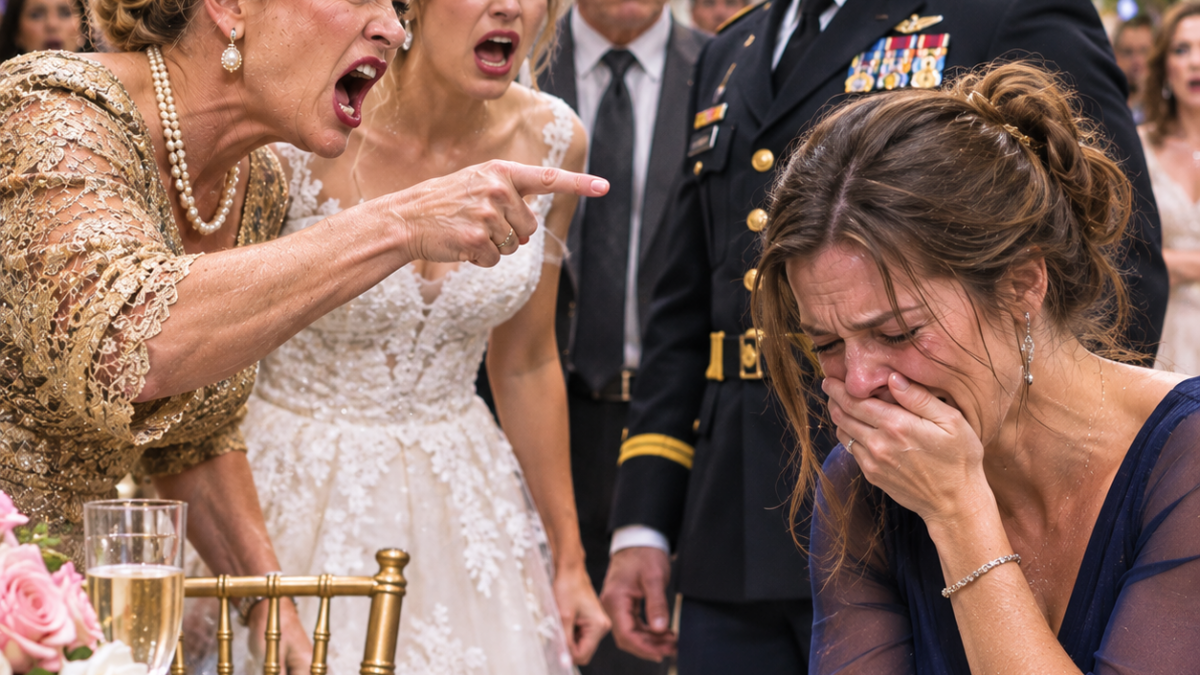
PART2
My father saw the movement.
“Oh, what now?” he sneered. “Calling one of your imaginary government colleagues?”
Several people laughed again.
I unlocked the screen.
Nathan’s name sat at the top of my messages.
Landed. Twenty-five minutes out. I’m sorry.
He had arrived from Tokyo earlier than expected.
I pressed call.
He answered immediately.
“Meredith?”
“Where are you?”
“In the car.”
I looked down at my ruined dress.
“Come in through the main ballroom entrance.”
There was a pause.
“Are you okay?”
“No.”
His voice changed.
“What happened?”
“Come upstairs.”
“I’m coming.”
I ended the call.
My father laughed.
“That’s it?”
“That’s it.”
Mother stared at me.
“You need to leave.”
“I will.”
“Now.”
“In about twenty minutes.”
Allison stood from the head table.
Her new husband, Preston Vale, looked increasingly uncomfortable beside her.
Preston came from another Boston family with old money and newer banking problems.
He was polished, educated, and generally less cruel than Allison.
That was not a high bar.
He approached me cautiously.
“Meredith, let us get you another dress.”
“No.”
“We can have someone bring something upstairs.”
“I’m leaving.”
“Please don’t make tonight worse.”
I looked at him.
“Preston, your wife arranged for a waiter to throw wine on me.”
His expression changed.
Allison snapped:
“That is insane.”
I turned toward the waiter.
He had disappeared.
Of course he had.
Preston looked at Allison.
“Did you?”
“No.”
Too fast.
Mother intervened.
“This has gone far enough.”
She looked at me.
“You have always done this.”
“Done what?”
“Made every family occasion about your resentment.”
I laughed softly.
“My dress is dripping Bordeaux onto the floor.”
“You provoke people.”
There it was.
The Campbell family constitution.
If Meredith was hurt, Meredith had caused it.
A memory came back.
I was twelve.
Allison had cut the strings on my violin before a school concert.
Mother said:
“She wouldn’t tease you if you weren’t so serious.”
Sixteen.
Allison told my boyfriend I had been cheating.
When he dumped me, Dad said:
“Maybe she was trying to protect him.”
Twenty-one.
I won a statewide university debate competition.
Nobody came.
Allison had a ballet recital.
Mother told me:
“Your sister needs us more.”
Thirty-two.
Wine-soaked.
Publicly insulted.
Still somehow guilty.
That was when I stopped feeling embarrassed.
Embarrassment requires believing the crowd has authority over your worth.
They did not.
I walked to an empty table.
Pulled out a chair.
Sat down.
Father stared.
“What the hell are you doing?”
“Waiting for my husband.”
Silence.
It lasted perhaps three seconds.
Then Allison laughed.
Not chuckled.
Laughed.
“Oh, Meredith.”
Mother closed her eyes.
Father looked almost pitying.
“This is exactly what I mean.”
I folded the wine-stained handkerchief.
“What?”
“The lies.”
I looked at him.
“You think I invented a husband?”
“You have never brought a man home.”
“I stopped bringing anyone into this family years ago.”
“You told us nothing about getting married.”
“Yes.”
Mother’s expression hardened.
“You would not get married without me.”
I almost smiled.
“I absolutely would.”
Allison stepped closer.
“What’s his name?”
“Nathan.”
She laughed again.
“Nathan what?”
“Reed.”
That laughter stopped.
Not completely at first.
Then Preston Vale went pale.
He stared at me.
“What did you say?”
I looked at him.
“Nathan Reed.”
Allison frowned.
“So?”
Preston turned toward her.
“So?”
His voice was barely audible.
“Do you know who Nathan Reed is?”
Allison rolled her eyes.
“Some finance guy.”
Preston looked at me.
“Executive chairman of Aethelgard Capital?”
I said nothing.
My father’s expression shifted.
Only slightly.
Aethelgard was a name he knew.
Everybody in his business circle knew it.
A private investment firm with enormous institutional mandates.
Pension funds.
Sovereign capital.
Infrastructure.
Technology.
Distressed credit.
Aethelgard did not appear on television much.
It did not need to.
My father had spent the previous eighteen months trying to get his logistics company in front of one of its infrastructure funds.
Three requests.
Two introductions.
One proposal.
No meeting.
He stared.
“Meredith.”
I met his eyes.
“What?”
“You work for Aethelgard?”
I had told him years earlier that I worked in institutional strategy and public-market policy.
He had translated that into:
Government desk job.
I stopped correcting him.
“Yes.”
“What do you do there?”
I wiped another streak of wine from my wrist.
“Chief Strategy Officer.”
Nobody laughed.
Preston whispered:
“Jesus Christ.”
Allison looked between us.
“No.”
I shrugged.
“Yes.”
Father shook his head.
“That’s impossible.”
There was the familiar answer.
Not congratulations.
Not surprise.
Impossible.
Because success belonging to me violated the family narrative.
“You’re thirty-two.”
“I’m aware.”
“You don’t become chief strategy officer at—”
“I joined Aethelgard at twenty-six.”
He stopped.
Mother stared at me.
“You told us you worked in policy.”
“I do.”
“That is deliberately misleading.”
“No, Mother. You never asked another question.”
“You let us think—”
“I let you think whatever made you comfortable.”
My father stepped closer.
“And Nathan Reed?”
I looked toward the ballroom doors.
“He’ll be here shortly.”
Preston had stopped looking at me.
He was looking at his father, Harrison Vale, seated at the head table.
Harrison chaired Granite Harbor Bank.
He had been boasting all weekend that Granite Harbor was in conversations with Aethelgard regarding a strategic capital partnership.
I knew that because I had seen the conflict disclosure.
The matter was on Aethelgard’s investment committee agenda.
I had formally recused myself because my sister was marrying Harrison Vale’s son.
That was how governance worked.
My family did not know any of that.
Harrison stood.
He crossed the room.
“Meredith?”
“Mr. Vale.”
His face held the careful neutrality of an experienced banker.
“You are Meredith Gallagher?”
“Professionally, yes.”
Mother interrupted.
“Gallagher is her maiden name.”
I looked at her.
“My legal name is Meredith Reed.”
Harrison’s face changed.
My father’s glass slipped from his fingers.
It hit the carpet without breaking.
Then the brass-studded ballroom doors opened.
Four members of Nathan’s security team entered first.
Not because he traveled like royalty.
Because his public profile and the scale of deals he handled made executive protection standard during certain international trips.
The men checked the room.
Then Nathan walked in.
Charcoal suit.
No tie.
Travel fatigue around his eyes.
He scanned the ballroom.
Found me.
And stopped.
I watched his face change when he saw the dress.
He crossed the room without looking at anyone else.
People moved out of his way.
Nathan stopped in front of me.
“Meredith.”
I stood.
His hand came up slowly.
He touched the wine-darkened silk at my shoulder.
“Are you hurt?”
“No.”
“Did somebody touch you?”
“No.”
“Who did this?”
I looked toward Allison.
Nathan followed my gaze.
My sister’s face was white.
Then he looked at my father.
Nathan knew Charles Campbell’s name.
He had read his company proposal.
He had never met him.
My father had been trying to change that for eighteen months.
Nathan turned back to me.
“What do you need?”
Not:
What should I do to them?
Not:
Who should I destroy?
What do you need?
That was one reason I loved him.
“I want to leave.”
“Okay.”
He removed his jacket and put it around my shoulders.
Then kissed my forehead.
“I’m sorry I’m late, Mrs. Reed.”
Somebody in the ballroom audibly gasped.
My mother dropped into the nearest chair.
My father’s knees buckled enough that Preston caught his elbow.
Allison stared as though the laws of physics had changed.
Nathan finally looked toward them.
“Which one is Allison?”
My sister swallowed.
“I am.”
He nodded.
“Congratulations on your marriage.”
The politeness was almost brutal.
Allison opened her mouth.
Nothing came.
My father recovered enough to step forward.
“Mr. Reed.”
Nathan looked at him.
“Charles Campbell.”
The fact that Nathan knew his name seemed to revive him.
“Yes. Yes, exactly.”
He extended a hand.
Nathan looked at it.
Then at the wine on my dress.
Father slowly lowered it.
“Obviously there has been some misunderstanding.”
I laughed.
Nathan looked at me.
“What happened?”
Before I could answer, my father spoke.
“Family tension.”
Nathan’s expression cooled.
“I asked my wife.”
Those three words changed the room more than his arrival.
My wife.
Not the pathetic older daughter.
Not the spinster.
Not the failed Campbell.
His wife.
I said:
“Allison arranged for wine to be thrown on me.”
“I did not!”
Preston turned toward her.
“Allison.”
“She’s lying.”
I pointed toward the ceiling.
“This ballroom has cameras.”
Preston looked up.
So did Allison.
That was enough.
Nathan asked:
“And your father?”
“He used the microphone to call me a pathetic, lying spinster and told me I was cut off from the family.”
Nathan was quiet.
My father’s face reddened.
“I was angry.”
Nathan nodded once.
“Then perhaps we should all be grateful you made your position clear.”
Father tried to laugh.
“Families say things.”
“Mine doesn’t.”
That was it.
No threat.
No dramatic promise.
Nathan offered me his arm.
I took it.
Then Harrison Vale stepped forward.
“Mr. Reed.”
Nathan paused.
Harrison looked deeply uncomfortable.
“I realize this is an extraordinary moment, but given our ongoing discussions—”
Nathan’s eyes narrowed slightly.
“The Granite Harbor process?”
“Yes.”
My father looked between them.
Allison looked at Preston.
Harrison continued:
“I want to assure you that tonight has nothing to do with the bank.”
Nathan answered:
“I would hope not.”
“It doesn’t reflect our governance.”
“I would hope that even more.”
Harrison swallowed.
“Of course.”
Nathan’s tone remained professional.
“The investment committee will continue its independent review. Meredith remains recused because of the family connection.”
My father stared.
“She’s on the committee?”
I answered:
“Usually.”
The color left his face again.
Nathan continued:
“Nothing that happens tonight will substitute for due diligence.”
Harrison nodded.
That mattered.
Because Nathan was not going to destroy a bank because my father insulted me.
Power used emotionally becomes abuse too.
I would not escape one controlling family by building another.
We walked toward the exit.
Then my mother called:
“Meredith.”
I stopped.
Not because she deserved it.
Because for thirty-two years some part of me always stopped when my mother used my name.
She stood.
Her mascara had begun to run.
“You really married him?”
“Yes.”
“When?”
“Three years ago.”
Her face crumpled.
“Three years?”
“Yes.”
“You didn’t tell us.”
“No.”
“Why?”
That question almost made me angry.
Instead, I said:
“Look at my dress.”
She looked.
“Look at Dad.”
She did.
“Look at Allison.”
My sister’s arms were folded defensively across her wedding gown.
Then I said:
“That’s why.”
Mother whispered:
“We would have come.”
“No.”
“What?”
“You would have taken over.”
“That isn’t fair.”
“You would have criticized the flowers, compared my dress to Allison’s, interrogated Nathan about his family, turned the ceremony into a networking opportunity, and spent the entire weekend explaining why Allison’s eventual wedding would be more elegant.”
Mother flinched.
I had never spoken to her that directly.
“I wanted one day in my life that belonged to me.”
Her eyes filled.
“So I got married without you.”
Then I left.
Nathan and I did not go home.
We went upstairs.
The hotel had a private suite reserved for us because Nathan had planned to surprise me by arriving before the reception ended.
A stylist from the hotel brought a robe.
I changed.
When I stepped out of the bathroom, Nathan was sitting by the window.
Boston lights below us.
My ruined dress lay in the bathtub because we had nowhere else to put it.
He looked at me.
“Tell me everything.”
So I did.
Not only the wine.
Everything.
My father missing my debate championship.
Mother editing me out of family photographs because Allison “looked better alone.”
Allison dating a boy I liked just because she knew.
Christmas seating arrangements.
Birthday dinners forgotten.
The constant jokes about my career.
The comments about being unmarried.
The way my parents interpreted every boundary as jealousy.
Nathan listened.
He did not interrupt.
When I finished, he asked:
“Why did you go tonight?”
I stared at the floor.
“Because she’s my sister.”
“That isn’t an answer.”
I looked at him.
Maybe it was not.
So I tried again.
“Because some part of me still thought if I behaved perfectly enough, eventually they would notice.”
Nathan’s face softened.
“They noticed tonight.”
I laughed bitterly.
“Only because you walked in.”
“No.”
He moved closer.
“They noticed because for the first time you stopped cooperating with the version of you they needed.”
That stayed with me.
My phone began vibrating.
Mother.
Father.
Allison.
Preston.
Cousin.
Aunt.
Unknown number.
I turned it off.
Nathan asked:
“Do you want me to cancel anything?”
I knew what he meant.
Business.
Aethelgard.
Campbell Atlantic Logistics.
Granite Harbor.
I shook my head.
“No.”
“Okay.”
“I don’t want anyone thinking I used you to punish them.”
“You didn’t.”
“And I don’t want you doing it for me.”
“I won’t.”
He took my hand.
“But I will not socialize with people who publicly humiliate my wife.”
“That seems reasonable.”
“And if your father calls me asking for a business meeting tomorrow?”
I almost smiled.
“He will.”
“What should I say?”
“The truth.”
Nathan nodded.
“He can submit through normal channels.”
“Exactly.”
My father called at 6:12 the next morning.
Nathan’s phone.
Not mine.
Of course.
Nathan showed me the screen.
Charles Campbell.
I laughed.
“Called it.”
“Want me to answer?”
“Yes.”
Nathan put the call on speaker.
“Charles.”
“Mr. Reed. Nathan. Good morning.”
My father sounded as though the previous night had never happened.
“I wanted to apologize for the unfortunate confusion.”
Nathan looked at me.
I mouthed:
Confusion?
He almost smiled.
Father continued.
“Our family dynamic can be complicated.”
Nathan said:
“So I observed.”
“I hope you understand nothing said last night reflects my respect for Meredith.”
I had to cover my mouth.
Nathan’s voice remained flat.
“You called her a pathetic liar in front of several hundred people.”
Silence.
“I was emotional.”
“So was she.”
Another silence.
Then father moved to the real reason for the call.
“I believe Campbell Atlantic has submitted a proposal to Aethelgard’s infrastructure platform.”
“Yes.”
“I had hoped perhaps we could discuss it personally.”
“No.”
The answer was immediate.
Father seemed unprepared.
“I don’t mean today.”
“I understand.”
“Next week?”
“No.”
“Nathan—”
“Charles, your proposal will receive the same review it would have received before last night.”
“That’s all I’m asking.”
“Then there is nothing to discuss.”
My father tried another direction.
“Meredith could perhaps provide some context.”
“No.”
“She knows our company.”
“Which is why she disclosed the relationship and recused herself.”
Silence.
My father had spent years calling my career a government desk job.
Now he discovered I had voluntarily removed myself from a process that could affect his company.
Nathan said:
“She will continue to have no role in that decision.”
My father’s disappointment was almost audible.
“Of course.”
“Anything else?”
“Could I speak with my daughter?”
Nathan looked at me.
I shook my head.
“She isn’t available.”
He ended the call.
I stared at the dark phone.
“You enjoyed that.”
“A little.”
“Terrible governance.”
“Personal pleasure. Professional neutrality.”
“Better.”
Three hours later Mother arrived at the hotel.
She somehow persuaded the front desk to call the room.
I almost refused.
Then I said yes.
Nathan stayed in the adjoining study.
Not hiding.
Giving me space.
Mother entered carrying my ruined dress in a garment box.
Apparently the hotel staff had transferred it after I left the ballroom.
She set it down.
“I had it cleaned.”
“It’s silk. That stain isn’t coming out completely.”
“I know.”
She sat.
For a moment, she looked older than I remembered.
Not elegant.
Not controlled.
Just tired.
“Your father barely slept.”
“That sounds difficult.”
“Meredith.”
“What do you want me to say?”
“He is devastated.”
“Because he insulted me?”
“Because he didn’t know.”
There it was.
I stared at her.
“You think the problem is that he humiliated the wife of Nathan Reed.”
“No.”
“Yes.”
Mother looked away.
I continued.
“If Nathan had been an accountant from Worcester, would Dad be devastated?”
Her mouth tightened.
“That’s unfair.”
“Would he?”
Silence.
“Would you have come here this morning?”
“Of course.”
“Would you?”
She closed her eyes.
That hurt.
For both of us.
Finally:
“Maybe not this quickly.”
I nodded.
“Thank you.”
“For what?”
“For telling the truth.”
She started crying.
“I was not a terrible mother.”
I said nothing.
“I loved you.”
“I know.”
Her head lifted.
“You know?”
“Yes.”
That seemed to make it worse.
“You can love someone and still hurt them.”
She wiped her eyes.
“I didn’t know you felt this excluded.”
“You knew.”
“No.”
“You knew enough to laugh last night.”
Her face collapsed.
That was the moment.
Not Nathan arriving.
Not Father going pale.
That.
My mother remembering herself laughing while wine ran down my face.
“I’m ashamed of that.”
“You should be.”
She flinched.
I had never allowed myself to say sentences like that.
She whispered:
“I thought you were going to attack Allison.”
“I was standing still.”
“I know.”
“You always assume I’m the danger.”
Mother said nothing.
I continued.
“When Allison hurts me, she’s sensitive.”
Silence.
“When Dad insults me, he’s stressed.”
Silence.
“When you exclude me, you’re avoiding conflict.”
Silence.
“When I finally react, I’m jealous.”
Her shoulders shook.
“I don’t know how we got here.”
“I do.”
She looked at me.
“One excuse at a time.”
Mother left two hours later.
I did not hug her.
I did not tell her everything was fine.
But I let her say she was sorry.
That was more than I had expected.
Allison’s wedding reception lasted another forty minutes after Nathan and I left.
I learned that later from Preston.
The atmosphere never recovered.
Guests whispered.
Videos circulated privately.
The waiter who spilled the wine was questioned by hotel management.
Security footage showed something important.
Before approaching me, he had spoken with Allison near a service corridor.
She had handed him cash.
The footage had no audio.
But it showed the exchange.
It showed her point toward me.
It showed him look.
Then the tray.
The hotel did not accuse her of assault.
Neither did I.
We dealt in facts.
When confronted by Preston, Allison admitted she had paid the waiter two hundred dollars to “accidentally splash” wine on me.
Not twelve glasses.
Just enough to embarrass me.
The waiter overdid it.
That was her defense.
She had wanted humiliation.
Just less humiliation.
Preston called me four days later.
“Can we talk?”
I nearly said no.
But he sounded different.
We met at a café in Back Bay.
He looked exhausted.
No wedding glow.
No honeymoon tan.
“You canceled the honeymoon?”
He nodded.
“Allison and I are staying separately.”
I was surprised.
“I’m sorry.”
“Are you?”
“Yes.”
I meant it.
Marriage collapsing four days after a wedding was not something I wanted for anyone.
Even Allison.
Preston stirred coffee he never drank.
“I didn’t know.”
“About the wine?”
“About a lot of things.”
He looked embarrassed.
“Allison told me you hated her.”
I almost laughed.
“She told me you had spent years inventing achievements because you couldn’t stand that she was more successful.”
“Of course.”
“She said you refused to bring a date because you wanted people asking about you.”
I stared.
“Preston, I’m married.”
“I know that now.”
He rubbed his forehead.
“There’s more.”
I waited.
“Her bridesmaids knew about the wine.”
My stomach tightened.
“How many?”
“Three.”
“Did they know she was paying the waiter?”
“They thought it would be a small spill.”
I looked away.
It should not have mattered.
But humiliation becomes different when you learn it was rehearsed.
Preston said:
“She called it a lesson.”
I looked back.
“For what?”
“Apparently you refused to give her ten thousand dollars toward the wedding.”
There it was.
Six months earlier, Allison had asked.
Not borrowed.
Asked.
She said the floral installation she wanted cost more than expected.
I declined.
I had already given her a six-thousand-dollar wedding gift.
She called me selfish.
Then stopped speaking to me for three weeks.
“She did all that over ten thousand dollars?”
Preston looked miserable.
“Partly.”
“What else?”
“You didn’t tell her you were married.”
I laughed.
“How was that her business?”
“She took it as proof you were hiding something to make her wedding look less important.”
That was Allison.
Even my secret marriage somehow became about her.
Preston said:
“I don’t know who I married.”
I almost corrected him.
Then stopped.
Not my job.
He asked:
“Did Nathan have anything to do with Granite Harbor’s deal?”
Here it came.
“No.”
“He said you’re recused.”
“I am.”
“Completely?”
“Yes.”
“Can you influence him privately?”
I stared.
Preston immediately looked ashamed.
“Sorry.”
“That answer is why I’m recused.”
He nodded.
“I’m sorry.”
“What happens to your bank is between your bank and Aethelgard’s committee.”
He looked relieved and frightened at the same time.
“Thank you.”
“Don’t thank me.”
“For not retaliating.”
“I’m not twelve.”
The irony was obvious.
My family had spent decades treating me like the emotionally unstable one.
Yet when given actual power, the first thing everyone expected was revenge.
Maybe because that was what they would have done.
Aethelgard’s review of Granite Harbor continued.
I had no part in it.
Nathan did not vote either after the wedding incident.
He voluntarily stepped back from the final committee decision because his wife’s sister was now married into the Vale family.
That surprised some board members.
Nathan told me:
“I don’t want them wondering whether approval is a favor or rejection is punishment.”
That was the difference between power and impulse.
The investment did not proceed.
Not because Allison humiliated me.
Six weeks of due diligence identified credit concentration and liquidity risks Aethelgard’s committee did not like.
Granite Harbor found another, smaller capital solution months later.
Preston’s family survived.
Their pride took a larger hit than their balance sheet.
My father’s Campbell Atlantic proposal also failed.
Again, not because of me.
The investment team concluded projected returns did not justify leverage and pension exposure.
My father refused to believe that.
He called me after receiving the rejection.
“You did this.”
I was in my office.
Floor-to-ceiling glass.
Manhattan below.
“Dad, I was recused.”
“You expect me to believe you had no influence?”
“Yes.”
“You humiliated me.”
I almost laughed.
“You called me a pathetic liar in front of two hundred people.”
“Three hundred.”
“What?”
“Three hundred guests.”
Even then.
Correcting numbers.
I said:
“Thank you for the clarification.”
He exhaled sharply.
“I built that company for forty years.”
“And?”
“You could have helped.”
That was the moment I understood something fundamental.
He was not angry that I had harmed him.
He was angry that I had not rescued him.
Those were different accusations.
“Dad, you spent my entire adult life mocking my career.”
“I didn’t know what your career was.”
“You never asked.”
“You hid it.”
“I stopped volunteering information after you made it clear nothing I did mattered.”
“Family helps family.”
I leaned back.
“Interesting.”
“What?”
“Was I family at Allison’s wedding?”
Silence.
“Was I family when you put me at Table Nineteen by the kitchen?”
“It was a seating issue.”
“Was I family when you told three hundred people I was pathetic?”
“I apologized.”
“No.”
“What?”
“You haven’t.”
Silence again.
He had not noticed.
My mother had apologized.
My father had explained.
Defended.
Minimized.
Networked.
He had never said the words.
I told him:
“Your company was reviewed on its merits.”
“You could change the decision.”
“No.”
“You mean you won’t.”
“No, Dad.”
I looked through the glass toward the city.
“I mean I won’t.”
He hung up.
Two months passed without contact.
Then I received a letter.
Handwritten.
From him.
My father had terrible handwriting.
I almost did not recognize it.
He wrote:
Meredith, I have spent most of my life believing providing materially for my family meant I had fulfilled my obligations to them. I paid tuition. I paid mortgages. I paid for holidays. I mistook money for attention.
I stopped reading.
That was more self-awareness than I had ever heard from him.
I favored Allison because she made needing me obvious. You became independent early, and instead of being proud, I punished you for not requiring me.
I cried at that sentence.
Not because it fixed anything.
Because it named something.
I had always wondered why success made my father colder.
Maybe independence felt like rejection to a man who only understood love through usefulness.
He continued:
What I said at the wedding was cruel. I did not say it because I believed it. I said it because you embarrassed me by refusing to perform the role I expected from you. That is worse. I am sorry.
I folded the letter.
Put it down.
Walked away.
Returned an hour later.
Read the final paragraph.
I do not expect forgiveness. Your mother says I have always treated apologies like negotiations. I am trying not to do that now.
Mother was right.
I kept the letter.
I did not call for three weeks.
Then I did.
Our first conversation lasted eight minutes.
We discussed weather.
Nothing else.
People want reconciliation to be one huge scene.
It usually is not.
Sometimes it is eight minutes about rain.
Then twelve minutes the following week.
Then coffee in a neutral place.
Then a boundary crossed.
Then another month apart.
Healing is less photogenic than revenge.
My relationship with Allison was harder.
She did not apologize immediately.
She blamed stress.
Alcohol.
Wedding pressure.
Mother.
Dad.
The bridesmaids.
The waiter.
Eventually Nathan.
That one impressed me.
“If he hadn’t walked in like some billionaire movie villain, nobody would have made such a big deal about the wine.”
I stared at her across my mother’s living room six months later.
“You paid a waiter to humiliate me.”
“It was supposed to be one glass.”
“That is not a defense.”
“You threatened me.”
“After the wine.”
“You said it would be the least of my problems.”
“Because I was done.”
She folded her arms.
“You enjoyed what happened.”
“What happened?”
“Everyone finding out who you were.”
I thought about it.
“Yes.”
Her face hardened.
At least I was honest.
“For about five minutes, yes.”
She looked stunned.
“I enjoyed watching Dad realize he had no idea who I was.”
I continued.
“I enjoyed watching you realize your pathetic spinster sister had a husband you considered important.”
Her eyes watered.
“See?”
“But then it stopped being enjoyable.”
She looked confused.
“Why?”
“Because I realized Nathan’s status was the only reason any of you believed I mattered.”
Silence.
“That felt worse.”
Allison looked down.
I continued.
“I didn’t want Dad to respect me because my husband was powerful.”
“You’re powerful too.”
“That would have been nice to hear fifteen years ago.”
She began crying.
For once, I let her.
I did not rush to comfort her.
After several minutes she whispered:
“I hated you.”
I had expected denial.
Not that.
“Why?”
“You left.”
“What?”
“You left us.”
“I went to college.”
“No.”
She wiped her face.
“You stopped needing anybody.”
I stared.
“You’d come home and you were different. You didn’t fight with Dad. You didn’t ask Mom to come to your events. You stopped competing.”
“I was exhausted.”
“I thought you thought you were better than us.”
That surprised me.
“You had everything.”
She laughed bitterly.
“No.”
She looked at me.
“I had everything they gave me because I did exactly what they wanted.”
That was the first time I saw Allison as something besides the favored child.
Favoritism has a cost on both sides.
I had been rejected.
She had been trained.
Ballet.
Schools.
Friends.
Marriage.
Everything optimized for Campbell approval.
That did not excuse cruelty.
But explanation matters if reconciliation is ever possible.
She said:
“When you married Nathan without telling anybody, I thought you were proving you didn’t need us.”
“I was protecting the wedding.”
“I know that now.”
“Do you?”
She nodded.
Then:
“I’m sorry about the wine.”
Specific.
Good.
“I’m sorry I paid him.”
Better.
“I wanted everyone to laugh at you.”
There it was.
I felt my chest tighten.
She continued.
“I wanted one night where nobody could compare me to you.”
I stared.
“Nobody compared us.”
“You didn’t hear what Preston’s father said at dinner the night before.”
“What?”
“He found out somebody from Aethelgard might come. He said women like you were the future of finance.”
My mouth opened.
“He knew my name?”
“No. He was talking about Aethelgard executives.”
She laughed through tears.
“I spent my whole life being the impressive daughter. Then I kept hearing people talk about women with real careers and global jobs and…”
“And?”
“I knew you had always been smarter than me.”
That might have been the saddest thing Allison ever said.
Not because I believed it.
Because she had spent her life understanding love as ranking.
Someone must be ahead.
Someone behind.
If I succeeded, she lost.
If she shone, I disappeared.
Our parents built that scoreboard.
We kept playing long after we were adults.
“I never wanted your place,” I said.
She cried harder.
“I know.”
Preston and Allison stayed married.
Barely.
They spent a year in counseling.
He required her to tell him the full truth about the wine incident and several other things she had lied about during their relationship.
They moved out of the Beacon Hill townhouse her parents had chosen and bought a smaller place in Brookline.
Mother complained.
Allison ignored her.
That was progress.
A year later, Allison called me.
“Can you come over?”
“Why?”
“I need help.”
The old version of me would have immediately gone.
The new one asked:
“With what?”
She laughed.
“Therapy is ruining you.”
“Improving me.”
She wanted career advice.
Not money.
Not contacts.
Advice.
She had spent years sitting on charity boards because Mother told her that was what women in their circle did.
She wanted to work.
Actually work.
She had studied art history.
Loved museum administration.
Was terrified everyone would think she was starting too late.
She was thirty.
I said:
“You mocked me for having a boring job.”
“I know.”
“Now you want one?”
She smiled.
“Desperately.”
I helped her revise a résumé.
Not get a job.
There is a difference.
She applied.
Got rejected twice.
Mother wanted me to call people.
I refused.
Allison agreed.
Third application, a small historical foundation hired her as a development coordinator.
The salary was less than the monthly floral budget from her wedding.
She loved it.
That pleased me more than I expected.
My father sold part of Campbell Atlantic two years later.
Not because Aethelgard rejected him.
Because leverage remained too high and the market changed.
He stayed chairman.
Smaller company.
Healthier balance sheet.
For the first time in my life, he occasionally called me to ask what I thought.
Not:
Fix this.
Not:
Introduce me.
What do you think?
Sometimes I answered.
Sometimes I said:
“I can’t discuss that because of work.”
He learned to accept it.
Mother had the hardest transformation.
Her identity was family presentation.
Perfect photos.
Perfect weddings.
Perfect address.
Perfect daughters.
The video of the wine incident escaped eventually.
Of course it did.
Someone posted a short clip online.
It spread among Boston social circles.
Mother was mortified.
Not initially because I had been humiliated.
Because people saw her laughing.
Several charity acquaintances distanced themselves.
One woman apparently asked:
“Victoria, why were you laughing at your daughter?”
Mother told me later she had no answer.
That question did what years of my explanations could not.
Publicly seeing herself.
She started therapy.
At sixty-one.
She hated it.
Then became evangelical about it.
I asked her to stop recommending therapists to everybody.
She did not.
Two years after Allison’s wedding, Mother asked if I would come for Christmas.
I said:
“Who is sitting where?”
She laughed nervously.
“Anywhere you want.”
“No.”
“What?”
“I don’t want special treatment because you’re afraid.”
She went quiet.
Then:
“Family table.”
That mattered.
Nathan came with me.
No security inside.
No grand entrance.
He wore a sweater my mother called “surprisingly normal.”
He said:
“Thank you, Victoria.”
She turned red.
Father did not talk business once.
I noticed.
After dinner, Allison brought out an old box of family photographs.
There were gaps.
Years I barely appeared.
Mother touched one empty page.
“I did that.”
I looked.
“Did what?”
“When you stopped coming to family pictures.”
“I wasn’t invited to some.”
“I know.”
She swallowed.
“I told myself you were difficult to schedule.”
I said nothing.
She had begun learning the difference between explanation and confession.
“I was punishing you.”
“For?”
“Not needing me.”
There it was again.
My parents had both experienced my independence as rejection.
Then punished me until I became more independent.
Families can build self-fulfilling prophecies beautifully.
Mother handed me a photograph.
Me at seventeen.
Debate trophy.
Alone.
I remembered taking it myself using a timer.
She whispered:
“I should have been there.”
“Yes.”
Nothing more was needed.
Nathan and I never made our marriage public in some grand announcement.
We became less secret.
There is a difference.
My professional biography eventually listed:
Meredith Gallagher Reed
No explanation.
No society profile.
No feature about the mysterious financier’s wife.
At work, I remained Meredith.
I did not want my marriage to become my credential.
Nathan understood.
One journalist once asked him during an interview:
“Your wife is also one of Aethelgard’s most senior executives. Is that difficult?”
Nathan answered:
“Only when I make the mistake of arguing with her about strategy at breakfast.”
Then he explained our governance disclosures and reporting structure.
I loved him for both parts.
Three years after Allison’s wedding, I finally did something about the dress.
I had stored it in tissue paper.
Platinum silk.
Dark Bordeaux stains across the shoulder and bodice that no cleaner had completely removed.
Nathan found me looking at it.
“Why do you still have that?”
“I don’t know.”
“Want to burn it?”
I laughed.
“Everyone keeps offering.”
“What do you want?”
I thought.
Then I called the designer who had made it.
Her name was Isabelle Tran.
I asked whether the fabric could be reused.
She examined it.
“Not as a dress.”
“What could it become?”
She smiled.
“Something smaller.”
Three months later, she returned a framed textile piece.
The clean platinum silk formed the background.
The wine-stained sections had been cut into deep red shapes resembling branches.
Not hiding the stain.
Using it.
At the bottom, stitched almost invisibly:
9:17 PM
Nathan stared.
“That’s brutal.”
“I love it.”
We hung it in my home office.
Not as a trophy over my family.
As a reminder.
At 9:16, I still wanted their approval.
At 9:17, I began living without it.
The financial press eventually learned Nathan and I had been married for years.
Nobody cared as much as my family once imagined they would.
That was funny.
The world rarely cares about our secrets as much as families do.
My career continued.
Some years successful.
Some difficult.
Aethelgard lost deals.
Won others.
Markets moved.
I made decisions I regretted.
Got others right.
Nothing resembled the mythology my father had built after learning my title.
I was not the Ghost of Wall Street.
That nickname appeared in one ridiculous magazine profile after someone leaked it.
I hated it.
I was an executive with spreadsheets, meetings, jet lag, and a disturbing dependence on black coffee.
Nathan teased me by having a mug made:
GHOST OF WALL STREET
I threw it away.
He bought another.
Marriage.
My father eventually stopped introducing me as:
“My daughter who works in finance.”
He started saying:
“My daughter Meredith.”
That was enough.
One evening, five years after the wedding, the four of us sat in my parents’ dining room.
Mother.
Father.
Allison.
Me.
Nathan and Preston were in the living room discussing baseball.
Allison suddenly said:
“Do you ever think about that night?”
My mother groaned.
“Please.”
Father looked at his plate.
I answered:
“Yes.”
Allison asked:
“Do you hate me for it?”
I considered.
“No.”
She looked relieved too quickly.
“I hated you for a while.”
Fairer.
Her smile vanished.
“I don’t anymore.”
Mother whispered:
“Meredith—”
“It’s okay.”
I looked at Allison.
“What you did was cruel.”
“I know.”
“And it changed how I see you permanently.”
She nodded.
“But permanently doesn’t mean only badly.”
Her eyes filled.
“I know who you are now.”
She laughed softly.
“That sounds ominous.”
“It should.”
We smiled.
Father remained quiet.
Then he said:
“I still hear myself on that microphone.”
I looked at him.
“So do I.”
“I wish I could take it back.”
“I know.”
He stared at his hands.
“Sometimes sorry doesn’t feel big enough.”
“It isn’t.”
He looked up.
I continued.
“But it’s what exists.”
That was another lesson.
People become obsessed with making apologies equal damage.
They cannot.
Words cannot return childhood.
Cannot unstain silk.
Cannot remove a video from somebody’s phone.
Cannot unsay:
Pathetic.
Lying.
Spinster.
Sorry is smaller than harm.
But it can still be honest.
And honest things accumulate too.
Just like cruel ones.
My father missed my debate championship.
Years later he attended a speech I gave at Harvard Kennedy School.
Sat in the second row.
Did not bring business cards.
Mother once removed me from family pictures.
Now she asks before posting anything with my face.
Allison paid someone to humiliate me.
Years later, when a colleague publicly embarrassed her at work, she called me and said:
“I finally understood what I did to you.”
Not perfect.
Real.
The man everyone remembers from that wedding is Nathan.
The doors.
The security.
The silence.
The famous financier walking across the ballroom.
I understand why.
It makes a good story.
But Nathan was not the person who saved me that night.
I was.
He arrived after the important decision.
Before those doors opened, I had already wiped my face.
Already looked at Allison.
Already listened to my father call me pathetic.
Already heard Mother choose reputation over me.
Already made the call.
Already decided I was leaving.
If Nathan’s plane had remained delayed in Tokyo, I still would have left.
Maybe in a taxi.
Maybe barefoot if the wine ruined my shoes too.
But I would have gone.
That matters.
Because for years people told the story as:
They mocked Meredith until they discovered who her husband was.
That was not the lesson.
The lesson was:
They mocked Meredith because they never bothered discovering who Meredith was.
Nathan’s arrival only exposed the size of their ignorance.
He did not make me valuable.
My title did not make me valuable.
Aethelgard did not.
Money did not.
What changed that night was that I stopped allowing people who refused to know me to define me.
The first phone call was not a command for revenge.
It was:
Come get me.
Sometimes that is the most powerful call you can make.
Years later, Allison asked whether she could have the old invitation sample I had kept accidentally in my clutch.
I had not known it was there until the next morning.
Burgundy cardstock.
Gold lettering.
Allison Campbell & Preston Vale request the pleasure…
There was a tiny Bordeaux stain on one corner.
“Why do you want it?”
She smiled.
“To remind myself not to become that woman again.”
I handed it over.
She framed it inside her office.
On the back, she wrote something I did not see until years later.
The worst thing I did on my happiest day.
I cried when I read it.
Not because I had forgotten.
Because neither had she.
Remembering correctly is part of accountability.
My mother kept no wedding photographs showing the wine incident.
But she did something stranger.
She printed one photograph taken about thirty minutes before.
Me alone at Table Nineteen.
The kitchen doors behind me.
Everyone else seated closer to the family.
She placed it in her study.
I asked why.
She said:
“So I remember what exclusion looks like when it’s dressed up nicely.”
That sounded like therapy language.
I told her.
She agreed.
My father never framed anything.
Men like him are less symbolic.
He simply stopped making jokes at my expense.
That may sound small.
It was enormous.
He also stopped joking at other people’s expense when they could not answer back.
Sometimes change arrives in what someone no longer does.
Nathan and I renewed our vows privately on our tenth anniversary.
Not because the first marriage needed replacing.
Because we liked Italy.
Same hillside.
Same two witnesses, though both had aged.
I wore ivory.
No platinum silk.
Nathan asked:
“Want to invite your family this time?”
I thought.
“Yes.”
So we did.
My parents came.
Allison and Preston came.
No one controlled the flowers.
No one altered the seating.
No speeches except ours.
Mother cried through the ceremony.
Father cried harder.
Allison stood beside me before we walked outside.
“You sure you want me here?”
I looked at her.
“Yes.”
She nodded.
“Okay.”
Then she reached into her purse.
Pulled out a folded white linen handkerchief.
My breath caught.
It looked almost identical to the one I had used at her wedding.
She handed it to me.
“In case of wine.”
I stared at her.
Then laughed.
So hard I had to sit down.
She laughed too.
That was the moment I knew forgiveness had become something real enough to live beside.
Not forgetting.
Never forgetting.
Not pretending the first wedding had been harmless.
Not restoring the relationship to what it was.
There was nothing worth restoring.
We built something different.
Adult.
Limited.
Honest.
At dinner that night, my father raised a glass.
I tensed automatically.
He noticed.
His eyes softened.
“No speeches.”
Everyone laughed.
He simply said:
“To Meredith and Nathan.”
Then sat down.
No comparison.
No Allison.
No family legacy.
No joke.
Just our names.
I looked at Nathan.
He squeezed my hand.
That was enough.
If you had told me on the night of Allison’s wedding that one day I would sit at another table with the same people and feel safe, I would not have believed you.
But safety did not come because they became perfect.
It came because I stopped making access to me unconditional.
If my father insulted me, I left.
If my mother manipulated, I ended the conversation.
If Allison competed, I refused the game.
Boundaries gave their apologies somewhere real to land.
Without consequences, sorry becomes decoration.
With changed behavior, it becomes evidence.
That word again.
Evidence.
I built a career around evidence.
Markets.
Risk.
Probabilities.
I spent years thinking family existed outside that logic.
Maybe not.
Love is emotional.
Trust is evidentiary.
You know someone has changed because they repeatedly behave differently when there is no audience.
My father apologized when Nathan was not there.
Mother changed seating when nobody famous would notice.
Allison stopped competing even when she thought I was winning.
That mattered more than the scene at the Fairmont.
Still, I will never forget the doors.
Not because Nathan looked powerful.
Because of what happened to my father’s face.
Recognition.
For thirty-two years, he believed he knew exactly who I was.
Less ambitious than Allison.
Less charming.
Less successful.
Alone.
Bitter.
A woman who had failed to build the life he respected.
Then one man walked through a doorway and forced him to confront how little he had ever asked.
That was the humiliation he actually suffered.
Not losing the Aethelgard proposal.
Not guests whispering.
Not videos circulating.
He learned that his own daughter had built an entire life—career, marriage, friendships, authority, love—and had stopped telling him because his response had become irrelevant.
Parents fear estrangement.
They should fear irrelevance more.
Estrangement still contains emotion.
Irrelevance means the child stopped expecting anything.
I had.
That night brought some expectation back.
Slowly.
Painfully.
But only after they earned it.
The wine-stained textile still hangs in my office.
Visitors occasionally ask about it.
I usually say:
“Old dress.”
Nathan always smiles when he hears that.
Once, a young analyst asked:
“Why keep something ruined?”
I looked at the red branches stitched into platinum silk.
“It isn’t ruined.”
She tilted her head.
“It changed function.”
That answer came to me only as I said it.
Maybe that was true of me too.
For years my family thought the daughter they wanted had been ruined.
Too independent.
Too private.
Too serious.
Too unwilling to perform.
Maybe I simply changed function.
I stopped existing to make the Campbell family portrait symmetrical.
I became my own person.
Wife.
Executive.
Sister on different terms.
Daughter with boundaries.
Friend.
Woman.
None ranked against Allison.
None required permission.
The last time I visited the Fairmont Copley Plaza, I was there for a conference.
Seven years had passed.
I walked past the ballroom.
The doors were open.
Another wedding was being prepared.
White flowers.
Gold chairs.
Waiters setting crystal glasses.
For a second I could smell Bordeaux that was not there.
My body remembered before my mind did.
I stopped.
A young hotel employee asked:
“Ma’am, are you okay?”
I smiled.
“Yes.”
And I was.
No racing heart.
No anger.
Just memory.
I looked toward the far corner.
Table Nineteen had been approximately there.
Kitchen doors.
Darkest part of the room.
I imagined my younger self sitting alone.
Platinum silk.
Straight spine.
Pretending exclusion did not hurt.
I wanted to walk over and tell her:
You do not have to earn your seat at their table.
You already built your own.
Instead, I continued down the hallway.
Nathan was waiting outside.
No security this time.
No dramatic entrance.
Just my husband holding two coffees.
He handed me one.
“You disappeared.”
“Memory.”
“Bad one?”
“Old one.”
He nodded.
We walked toward the elevators.
Then I started laughing.
“What?”
I looked at him.
“Do you remember Dad’s face when you said ‘Mrs. Reed’?”
Nathan tried to remain dignified.
Failed.
“Yes.”
“He almost fell over.”
“He did fall into Preston.”
We laughed in the hotel corridor like teenagers.
That part was still funny.
Healing does not require surrendering every satisfying memory.
You are allowed a few.
But if you asked me now what my favorite moment was, I would not choose Nathan walking in.
I would choose the moment before.
Standing in that ballroom.
Wine running down my arms.
My father pointing toward the exit.
Mother laughing.
Allison watching.
Everyone waiting for me to cry.
And me realizing:
I can leave.
That thought was quieter than breaking crystal.
Quieter than applause.
Quieter than the band stopping.
But it changed everything.
Because my family had spent thirty-two years teaching me that being excluded from them was punishment.
That night I understood it could also be freedom.
Nathan opened the ballroom doors twenty minutes later.
But I had already opened the important one myself.








