PART2:“YOU’RE A BURDEN, MOM—THIS HOUSE IS TOO MUCH FOR YOU.” My Son Left for a Luxury European Vacation Expecting to Inherit My $875,000 Home—He Came Back to Find His Key No Longer Worked
PART2
A week later, Brandon asked whether I had updated my will.
We were eating pot roast.
Walter’s recipe.
Brandon said it casually.
Too casually.
“Mom, you’ve got everything organized legally, right?”
I looked at him.
“Define everything.”
“Estate stuff.”
Kendra lifted her wine.
“House. Accounts. Insurance.”
I smiled.
“You two planning my funeral?”
Kendra laughed.
“No.”
Brandon did not.
“I’m serious.”
“So am I.”
He put down his fork.
“You’re sixty-eight.”
“I’m aware.”
“Dad’s gone.”
That sentence still hurt.
“And?”
“And we need to be realistic.”
“About?”
“The future.”
I leaned back.
“Whose?”
He frowned.
“Mom.”
“Your future or mine?”
Kendra quickly stepped in.
“Nobody is trying to upset you.”
That sentence always arrives before someone says something upsetting.
Brandon rubbed his hands together.
“This house is worth almost nine hundred thousand dollars now.”
I stared at him.
“How do you know?”
He hesitated.
“Zillow.”
Kendra corrected him.
“Actually, a realtor friend estimated eight seventy-five.”
Something inside me went still.
“A realtor friend?”
Brandon said:
“It was casual.”
“You gave somebody my address?”
“Mom.”
“To value my house?”
He exhaled.
“We’re trying to plan.”
“For what?”
Silence.
I looked from him to Kendra.
“For what?”
Kendra answered.
“If you moved somewhere safer, this property could be sold or retained as an investment.”
I almost laughed.
“Retained by whom?”
Brandon looked annoyed.
“Eventually it comes to me anyway.”
There it was.
Not:
If you choose.
Not:
If that’s what your will says.
Eventually it comes to me anyway.
I set down my fork.
“Does it?”
He stared.
“I’m your only child.”
“Yes.”
“Who else would inherit it?”
“I’m not dead.”
“No one said you were.”
“You are discussing my house like I’m absent.”
“Because every time we bring this up, you get emotional.”
I felt Walter everywhere.
The cabinet he built.
The chair he repaired.
The mark on the floor where Brandon dropped a hammer at fourteen.
And my son called my attachment emotional.
Kendra slid a brochure across the table.
HARBOR RIDGE SENIOR LIVING.
“Just look.”
I did.
One-bedroom apartment.
Meals.
Transportation.
Exercise classes.
Emergency call system.
Four thousand eight hundred dollars a month.
I looked up.
“Who pays this?”
Brandon answered:
“You have Social Security.”
I laughed.
“And?”
“You could use proceeds from the house.”
“Ah.”
Kendra smiled carefully.
“It would simplify things.”
“For whom?”
“Everyone.”
I folded the brochure.
Then Brandon said it.
The sentence that changed everything.
“Mom, you’re becoming a burden.”
Silence.
His face changed immediately.
Not regret.
Calculation.
He knew it had gone too far but wanted the point to remain.
Kendra whispered:
“Brandon.”
He continued anyway.
“I’m not trying to hurt you.”
“You just called me a burden.”
“I mean the responsibility.”
“What responsibility?”
“Checking on you.”
“You come twice a month.”
“Because we have lives.”
“I never asked you to come.”
“That’s the problem.”
I stared.
“What?”
“You don’t realize how much help you need.”
My hands started shaking beneath the table.
Not because I believed him.
Because some part of me still wanted my son to take it back.
He did not.
Kendra said:
“What Brandon means is that we can’t keep worrying whether you’re falling down the stairs or maintaining this huge place.”
I looked around my dining room.
Three bedrooms upstairs.
One downstairs.
A garden.
Garage.
Nothing palatial.
“You’re worried.”
“Yes.”
“Yet you’re leaving for Europe for two weeks.”
Silence.
Their trip.
Paris.
Florence.
Lake Como.
A vacation they had been planning for a year.
Brandon frowned.
“That has nothing to do with this.”
“It tells me how urgent my safety is.”
His face reddened.
Kendra reached across the table.
“Evelyn.”
I pulled my hand away.
She stopped.
“We love you.”
That sentence hurt more than the burden comment.
Because I believed they believed it.
People can love you and still become entitled to you.
That night, after they left, I sat in Walter’s chair.
I cried.
Not because I feared retirement living.
Not because I feared selling.
Because I finally understood my son had begun thinking of my life as a waiting room for his inheritance.
I did not sleep.
At three in the morning, I walked through the house.
Brandon’s old bedroom.
The pencil marks on the closet frame measuring his height.
Age 7.
Age 9.
Age 12.
Walter had written each date.
At sixteen Brandon had complained:
“Dad, stop doing that.”
Walter said:
“One day you’ll want proof you were short.”
Brandon laughed.
I touched the highest mark.
Six feet.
Then I walked into my bedroom.
Opened the fireproof safe.
My will.
Deed.
Bank records.
Insurance.
I had been organized for years.
Walter insisted.
My estate plan left the house to Brandon.
Most assets too.
I sat on the floor reading the documents.
Then I asked myself one question.
If Brandon knew with absolute certainty he would never receive this house, would he still be concerned about whether I could manage the stairs?
I did not know.
That frightened me more than knowing would have.
The next morning, I called my attorney.
Her name was Patricia Wynn.
She had handled Walter’s estate.
“Evelyn?”
“I want to change my will.”
“Okay.”
“And maybe sell my house.”
Silence.
“That’s a larger sentence.”
“I know.”
“Why?”
I told her.
Not every cruel detail.
Enough.
Patricia listened.
Then:
“First, are you being pressured?”
“Yes.”
“By the buyer?”
“No.”
“By family?”
“They want me to sell.”
“And give them proceeds?”
“They haven’t said that.”
“Yet.”
I laughed despite myself.
Patricia continued.
“Second, are you competent?”
“I hope so.”
“I’m serious.”
“Yes.”
“Good. Then nobody gets a vote.”
That sentence felt revolutionary.
Nobody gets a vote.
Not Brandon.
Not Kendra.
Not even Walter’s memory.
It was my house.
For the next ten days, I did something I had not done in years.
I made decisions without telling my son.
Patricia referred me to a realtor named Joanne Keller.
Joanne arrived expecting grief.
Instead, she got a spreadsheet.
Recent roof replacement.
HVAC service.
Property taxes.
Renovations.
Utility averages.
Walter would have been proud.
She walked through every room.
Finally:
“This house will sell fast.”
“How fast?”
“At the right price? Days.”
“What’s the right price?”
She looked around.
“Eight sixty to eight eighty.”
I smiled.
“Kendra’s friend said eight seventy-five.”
Joanne raised an eyebrow.
“You already had it valued?”
“Not voluntarily.”
I told her.
Joanne looked furious on my behalf.
I did not need that.
“I’m not trying to punish him.”
She nodded.
“What are you trying to do?”
I looked toward Walter’s garden.
“Stop waiting for permission to live.”
We listed privately first.
Coming-soon network.
No sign in yard.
I did not want neighbors calling Brandon.
Within forty-eight hours, we had three serious buyers.
One couple offered $875,000.
Cash-heavy.
Thirty-day close.
No sale contingency.
I accepted.
Exactly the number Brandon expected to inherit.
That felt almost too poetic.
Still, I hesitated before signing.
Joanne noticed.
“You can walk away.”
“I know.”
“Do you want to?”
I stared at the signature line.
“I’ve lived here thirty-two years.”
“Yes.”
“My husband died here.”
She waited.
“Not in the house.”
I smiled sadly.
“But everywhere.”
“I understand.”
“I thought selling meant losing him.”
Joanne’s voice softened.
“Do you?”
I looked around.
“No.”
That was the answer.
Walter was not drywall.
Not a roof.
Not granite counters.
He was the reason I knew how to survive a frightening mortgage.
The reason I knew how to laugh at bad timing.
The reason I knew a house was something we built a life inside, not the life itself.
I signed.
Closing was scheduled while Brandon and Kendra were in Europe.
I did not plan that deliberately.
At first.
Then their travel dates made it convenient.
I decided not to correct the convenience.
Before they left, Brandon came by.
He hugged me.
“We’ll talk about Harbor Ridge when we get back.”
I smiled.
“No rush.”
He looked relieved.
“Good.”
Kendra kissed my cheek.
“Try not to do too much while we’re gone.”
“I’ll try.”
Brandon picked up his suitcase.
“Oh, and don’t hire anybody for big repairs without calling me.”
“Why?”
“I don’t want you getting taken advantage of.”
I almost laughed.
“Okay.”
He had no idea I was selling the entire property.
The buyers were David and Melissa Grant.
Mid-forties.
Two children.
Their daughter walked into Brandon’s old bedroom and immediately said:
“This one.”
I stood in the hallway while she turned in circles.
Melissa looked embarrassed.
“Sorry.”
“No.”
I smiled.
“He picked that one too.”
“Your son?”
“Yes.”
“How old?”
“Forty-two.”
She laughed.
“Mine’s eleven.”
“Same confidence level.”
That afternoon, I packed Walter’s things.
That was the hardest day.
His winter coat.
Twenty-seven years of tax records he had no reason to keep.
Tools.
Fishing gear.
A box labeled:
CORDS THAT MIGHT MATTER SOMEDAY.
I laughed until I cried.
Every husband owns that box.
I kept his wedding ring.
Watch.
Photographs.
Favorite mug.
One jacket.
His handwritten recipe cards.
I donated clothing.
Gave tools to our church repair ministry.
His armchair went with me.
Not because it was valuable.
Because the fabric still held the shape of him in my memory.
I did not move into Harbor Ridge.
I rented a two-bedroom townhouse near the river.
One floor.
Small patio.
Enough room for guests.
No enormous yard.
No stairs except two steps at the entrance.
Rent was reasonable.
I had not committed permanently.
That mattered.
I wanted to discover what I liked before somebody else decided what was best for me.
At closing, Patricia sat beside me.
The buyers signed.
I signed.
Funds transferred.
After fees and adjustments, hundreds of thousands landed in accounts Brandon could not access and did not know existed.
Patricia helped revise my estate plan.
Brandon remained a beneficiary.
But not sole beneficiary.
Some went into a charitable fund supporting hospice care in Walter’s name.
Some to Brandon.
Some reserved for my own lifetime care.
That part felt obvious once someone said it aloud.
My money should first fund my life.
Apparently I needed legal counsel to remember that.
The night before Brandon returned from Europe, I slept in my townhouse.
Walter’s chair stood beside the window.
I made tea.
Then looked around.
Quiet.
Different.
Mine.
I cried.
But it was not regret.
Grief can travel with relief.
The next afternoon, Joanne called.
“The Grants changed the locks.”
“Good.”
“Your son returns today?”
“Yes.”
“You sure you want to watch?”
“No.”
“Then why are you?”
I smiled.
“Because I spent three weeks imagining his reaction.”
“That doesn’t sound healthy.”
“It probably isn’t.”
She laughed.
I rented a moving truck because I still had two storage runs to make.
Then parked across the street.
Brandon’s taxi arrived at 4:18.
He got out.
Suitcase.
Shopping bags.
Kendra.
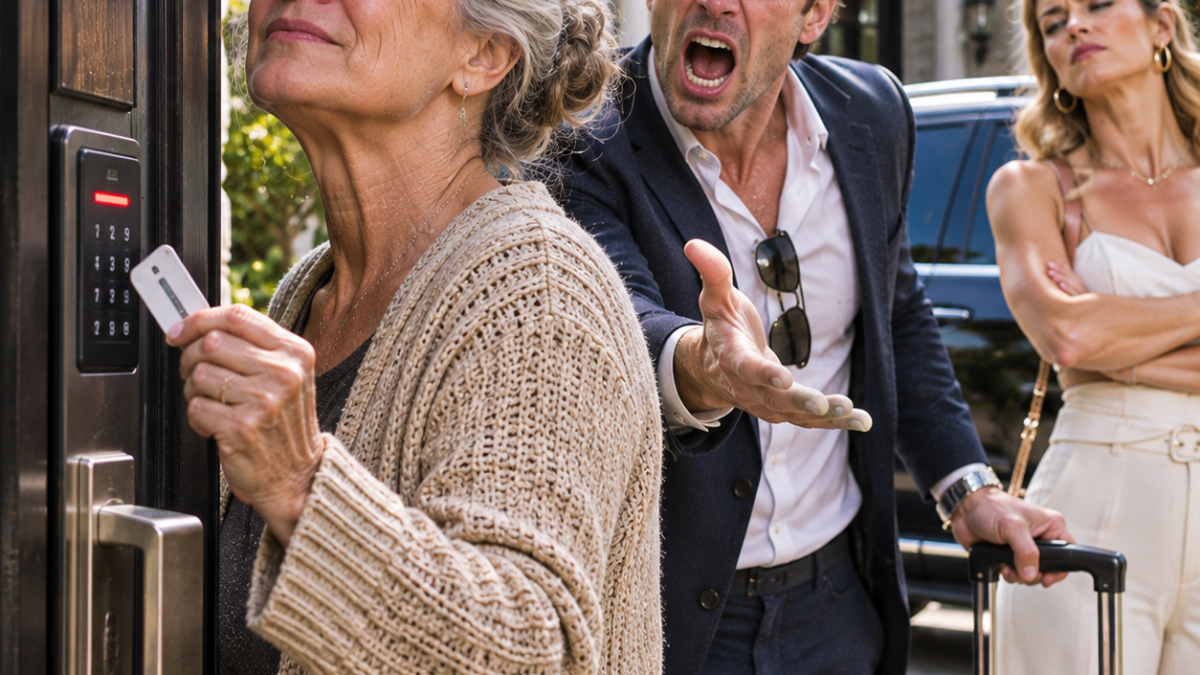
Then the key.
Once.
Twice.
Again.
“What the hell?”
I watched.
Kendra looked through the front window.
“Did your mother change the locks?”
Brandon took out his phone.
Called me.
My phone buzzed.
I let it ring twice.
Then answered.
“Hi, sweetheart.”
“Mom.”
His voice was sharp.
“What happened to the locks?”
I looked at him through the windshield.
“The owners changed them.”
Silence.
“What?”
“The new owners.”
He stared at the house.
“What new owners?”
“The people who bought it.”
His face emptied.
“Bought what?”
I almost admired the question.
“The house, Brandon.”
Kendra grabbed his arm.
“What is she saying?”
He ignored her.
“You sold the house?”
“Yes.”
“Without telling me?”
“Yes.”
“Why?”
I looked at the house.
“You said it was too much for me.”
“That is not what I meant.”
“You said I was becoming a burden.”
“Mom.”
“So I simplified my life.”
“You SOLD my childhood home?”
There it was.
My.
I said:
“No.”
His voice rose.
“What do you mean no?”
“I sold my house.”
He saw the truck.
Then he saw me.
His head turned slowly.
Across the street.
Our eyes met through the windshield.
“Are you sitting over there?”
“Yes.”
He hung up.
Stormed across the road.
Kendra followed.
Brandon yanked open the passenger door.
“What the hell have you done?”
I looked at him.
“Sold my house.”
“You can’t just do that.”
“I did.”
“You didn’t even tell me.”
“I noticed.”
“Mom!”
Kendra reached us.
Her face was pale.
“Where is the money?”
That was faster than I expected.
Brandon turned.
“Kendra.”
“What?”
She looked at me.
“I’m asking because we need to make sure she wasn’t taken advantage of.”
I smiled.
“Of course.”
“Were you?”
“No.”
“How much did you sell for?”
“Eight hundred seventy-five thousand.”
Both of them went silent.
Exactly their estimate.
Brandon stepped back.
“You got full value?”
“Yes.”
His face changed.
For one second, relief.
Then realization.
“What did you do with the money?”
I looked at him.
“Why?”
“Because I’m your son.”
“That doesn’t make you my banker.”
“Mom.”
“I have an attorney.”
Kendra crossed her arms.
“We were supposed to help you manage all this.”
“No.”
“You said you would think about Harbor Ridge.”
“I did.”
“And?”
“I decided against it.”
Brandon stared.
“Where are you living?”
“Townhouse near River Road.”
“Renting?”
“Yes.”
“Why would you sell a paid-off house and start paying rent?”
“Because I wanted to.”
“That makes no financial sense.”
“Patricia disagrees.”
His face changed.
“Patricia?”
“Wynn.”
“Dad’s estate attorney?”
“Yes.”
“You talked to a lawyer?”
“Yes.”
“About me?”
“No.”
I smiled.
“About myself.”
He paced beside the truck.
“You should have discussed this with us.”
I said nothing.
“Mom.”
“Why?”
“We’re family.”
“So?”
His face hardened.
“You know what this house meant to me.”
“Yes.”
“Then how could you sell it without even giving me the option to buy it?”
“Could you?”
Silence.
“What?”
“Buy it.”
He looked at Kendra.
Then at me.
“That’s not the point.”
“It seems relevant.”
“We could have worked something out.”
“With what money?”
His face reddened.
Kendra said:
“We could have refinanced.”
I stared.
“My house?”
“No, I mean—”
“To help Brandon buy something he expected me to give him eventually?”
She stopped.
That sentence exposed everything.
Brandon looked furious.
“I never said you had to give me the house.”
“You said it would eventually come to you.”
“Because I’m your son.”
“There it is again.”
“What?”
“The idea that being my son gives you ownership before I’m dead.”
His face collapsed slightly.
“I don’t think that.”
“You valued the house.”
He said nothing.
“You sent me retirement brochures.”
Nothing.
“You discussed selling it.”
Nothing.
“You called me a burden.”
His eyes lowered.
“I was frustrated.”
“And I listened.”
He looked up.
“That isn’t fair.”
I laughed softly.
“No.”
“It isn’t.”
Kendra said:
“Evelyn, this is incredibly impulsive.”
“I planned it with a realtor, attorney, title company, buyers, movers, and financial adviser.”
She went quiet.
“That is the opposite of impulsive.”
Brandon stepped closer.
“Are you trying to punish me?”
That question mattered.
“No.”
“You expect me to believe this timing is accidental?”
“No.”
His face hardened.
“So it is punishment.”
“I said no.”
“Then what is it?”
I looked at my son.
“The first major decision I’ve made in years without asking whether you’d approve.”
He stared.
“That’s all?”
“No.”
I looked toward the house.
“It is also the first decision I’ve made since your father died that feels completely mine.”
That silenced him.
For a moment.
Then the front door opened.
Melissa Grant stepped outside.
The new owner.
She looked nervous.
“Everything okay?”
I smiled.
“Yes.”
Brandon looked at her.
“You bought this house?”
She glanced at me.
“Yes.”
“My mother didn’t tell us.”
Melissa looked uncomfortable.
“I’m sorry.”
I said:
“You don’t need to apologize.”
Brandon looked toward the doorway.
Behind Melissa, her daughter appeared.
Standing barefoot in what had once been Brandon’s home.
He stared.
That was when it finally became real.
He was not locked out of his mother’s house.
He was standing outside someone else’s.
He turned toward me.
“Can I at least go inside?”
Melissa looked at me.
I shook my head slightly.
Not because I wanted to hurt him.
Because I had already handed over possession.
“It’s their home now.”
Brandon’s eyes filled.
“I grew up there.”
“I know.”
“All my stuff—”
“I boxed everything that was still yours.”
“Where?”
“Storage unit.”
He laughed bitterly.
“You put my childhood in storage.”
“No.”
I looked at him.
“Your childhood happened.”
He stared.
“A house is not the only proof.”
He walked away.
Kendra followed.
They loaded their luggage back into the taxi.
Before getting in, Brandon turned.
“I hope this was worth it.”
That hurt.
Not as much as I expected.
I answered:
“I hope so too.”
For three days, he did not call.
Then a text.
We need to talk about what you’ve done financially.
I stared at it.
No:
Are you okay?
No:
I’m sorry.
No:
Where are you living?
What you’ve done financially.
I forwarded it to Patricia.
She replied:
You do not need permission to ignore this tonight.
So I did.
A week later, Brandon appeared at my townhouse.
He had discovered the address through a mutual family friend.
I opened the door.
He stared behind me.
Small living room.
Walter’s chair.
Bookshelf.
Fresh flowers.
“You live here?”
“Yes.”
“It’s tiny.”
“It’s two bedrooms.”
“Compared to the house.”
“I don’t live there anymore.”
He stepped inside.
Not invited exactly.
Old habit.
I noticed.
“Sit.”
He did.
I made tea.
He refused.
Then:
“I’m worried about you.”
I almost laughed.
“Still?”
“Mom, stop.”
“I’m listening.”
“What if the money runs out?”
“It won’t.”
“How do you know?”
“I have a financial adviser.”
“Who?”
“Why?”
“Because I should know who is managing your money.”
“No.”
His jaw tightened.
“I’m your only child.”
“You keep saying that as if it’s a job title.”
He stared.
“I’m supposed to look after you.”
“Then ask what I need.”
“I am.”
“No.”
I leaned forward.
“You are asking how much I have.”
“That’s part of taking care of you.”
“Why?”
“So nobody takes advantage.”
I smiled sadly.
“Brandon, the only people who have treated my assets like they already belonged to someone else are you and Kendra.”
His face reddened.
“That is unfair.”
“Is it?”
“We were trying to plan.”
“For after I die.”
He looked away.
“No.”
“Then tell me the plan.”
Silence.
“Brandon.”
He rubbed his hands over his face.
“Fine.”
He stood.
“We thought if you moved into Harbor Ridge, we could rent the house.”
I stared.
“Rent it?”
“Yes.”
“Without selling?”
“Yes.”
“Who would manage it?”
“We would.”
“Who would receive the rent?”
“You.”
Too quick.
“How much?”
“What?”
“How much would I receive?”
He frowned.
“Whatever was left after expenses.”
“What expenses?”
“Maintenance. Taxes. Management.”
“Your management?”
“That’s normal.”
I almost admired how completely he had normalized it.
“So you planned to become paid managers of my property.”
His face tightened.
“We’d be doing work.”
“And eventually?”
“What?”
“Eventually the house came to you.”
He said nothing.
There.
Not cruelty.
A plan.
A financial structure built around my aging.
I sat back.
“Did Kendra’s realtor friend help develop this?”
His eyes shifted.
That was enough.
“How long?”
“Mom.”
“How long have you been discussing my house?”
“Not like that.”
“How long?”
He whispered:
“About a year.”
My chest tightened.
A year.
While bringing soup.
Checking smoke detectors.
Carrying groceries.
Maybe some of that care was genuine.
That almost made it worse.
People are rarely pure villains.
They can love you while also building plans that benefit from your decline.
I asked:
“Was Harbor Ridge your idea?”
“Kendra found it.”
“And the realtor?”
“Her friend.”
“You already had rental estimates?”
Silence.
“Brandon.”
“Yes.”
I closed my eyes.
“Leave.”
He stared.
“Mom.”
“Please leave.”
“I’m trying to be honest.”
“And I appreciate that.”
I looked at him.
“But I need space.”
He stood slowly.
At the door, he said:
“I did not want you dead.”
I almost broke.
“I know.”
He turned.
“Then why are you acting like I did?”
“I’m not.”
I swallowed.
“I’m acting like you started living inside my future before I was finished with my present.”
He left.
That night, I cried harder than the night Walter died.
Grief behaves strangely.
Walter’s death had been loss.
Brandon was still alive.
Still my son.
But something I believed about us had died.
Two weeks later, Kendra called.
“Evelyn, can we meet?”
I almost said no.
Then yes.
Coffee shop.
Public.
She arrived in a cream coat.
No designer bags.
No performance.
She sat.
“I owe you an apology.”
I said nothing.
“I pushed.”
“Yes.”
“I convinced Brandon the house was becoming a problem.”
“Yes.”
“I talked about it as an asset.”
“Yes.”
Her eyes filled.
“I work in financial planning.”
I knew.
“Everything becomes an asset eventually.”
“That sounds dangerous.”
She laughed sadly.
“It can be.”
I waited.
“My parents had nothing.”
That surprised me.
She continued.
“When my father died, my mother lost the house because he had borrowed against it without telling her.”
I listened.
“I grew up believing security meant planning early.”
“That does not excuse planning my life without me.”
“I know.”
She wiped her eyes.
“I looked at your house and saw security for Brandon.”
“And yourself.”
“Yes.”
Good.
Honesty.
“We have debt.”
I looked up.
“What debt?”
“More than Brandon knows.”
My stomach tightened.
“How much?”
She hesitated.
“About ninety thousand.”
“What?”
“Credit cards. Personal loan. Some travel.”
Europe.
The bags.
The restaurants.
I stared.
“Does Brandon know?”
“Not all.”
“Then why are you telling me?”
“Because he thinks you selling the house destroyed our future.”
I felt cold.
“And?”
“That is not true.”
She looked down.
“Our choices did.”
That was the first thing either of them said that sounded like accountability.
Kendra continued.
“I kept thinking if the house eventually came to us, we would reset.”
There it was.
Inheritance as financial rescue.
Not greed exactly.
Desperation dressed as inevitability.
I asked:
“Did Brandon know that was your plan?”
“He knew we had debt.”
“How much?”
“Maybe half.”
“Does he know about the rest now?”
“Yes.”
“How?”
“I told him after he came here.”
I sat back.
“And?”
“He’s furious.”
“At you?”
“At first.”
She smiled bitterly.
“Then at himself.”
That surprised me.
I said:
“I’m not paying it.”
“I know.”
“I’m serious.”
“We are not asking.”
“Good.”
She nodded.
“I wanted to apologize.”
“For what specifically?”
She looked at me.
“For turning your age into a financial opportunity.”
That sentence hurt.
Because it was accurate.
I nodded slowly.
“Thank you.”
She looked hopeful.
“Do you forgive me?”
“No.”
Her face fell.
“Not yet.”
I continued.
“But I believe you understand what you did.”
She nodded.
“That is a start.”
Kendra left.
A month passed.
Brandon stopped calling.
Then my birthday arrived.
Sixty-nine.
I expected a text.
Instead, he came to church.
Sat in the back.
After service, he waited.
No gift.
No flowers.
He said:
“Can we walk?”
We walked through the church garden.
Walter’s memorial plaque was there beneath a maple tree.
Brandon stopped in front of it.
“Dad would be ashamed of me.”
I looked at the plaque.
“Maybe.”
He looked at me.
“That’s all?”
“I don’t speak for dead people.”
He laughed once.
Then started crying.
My forty-two-year-old son cried beside his father’s name.
“I called you a burden.”
“Yes.”
“I keep hearing it.”
“So do I.”
“I didn’t mean you.”
“What did you mean?”
“The fear.”
I waited.
“What fear?”
“That you’d get older.”
“That’s happening.”
“I know.”
“That you’d need me.”
“Maybe someday.”
“And I didn’t think I could handle it.”
There it was.
Not greed.
Not entirely.
Fear.
“I’m already behind at work.”
“Kendra and I are in debt.”
“We’ve talked about having a baby and can’t imagine affording one.”
“And every time I came to the house, I saw something else coming.”
“Roof.”
“Taxes.”
“Repairs.”
“Your age.”
His voice broke.
“I started seeing you as one more future problem.”
That hurt more than the inheritance.
He continued:
“And instead of telling you I was scared, I turned you into the problem.”
I looked away.
“I am sorry.”
I believed him.
That did not erase it.
He wiped his face.
“I also thought the house would eventually fix everything.”
“I know.”
“Kendra told you?”
“Yes.”
“I knew about some of the debt.”
“Not all.”
“No.”
He shook his head.
“We were living like people we weren’t.”
Europe.
Clothes.
Restaurants.
“Why?”
“I don’t know.”
“Brandon.”
He laughed sadly.
“Maybe because Kendra’s friends all look successful.”
“Maybe because I wanted to look like Dad had done better for me than he actually could.”
That surprised me.
“What does that mean?”
He looked at Walter’s plaque.
“Dad worked his whole life.”
“Yes.”
“He gave me college.”
“Yes.”
“Helped with the wedding.”
“Yes.”
“But I watched friends inherit businesses.”
“Property.”
“Money.”
“I thought eventually the house was my version.”
I felt something inside me loosen.
Not because I liked the answer.
Because finally it was honest.
He looked at me.
“I made Dad’s house into something he owed me.”
I said nothing.
“He didn’t.”
“No.”
“You don’t.”
“No.”
Brandon nodded.
“I know that now.”
We stood quietly.
Then I said:
“I did leave you something.”
His eyes lifted.
“What?”
“Your boxes.”
He laughed through tears.
“That’s terrible.”
“I know.”
“Where are they?”
“Storage.”
“How many?”
“Eleven.”
“What is in eleven boxes?”
“Baseball cards, trophies, terrible school artwork, your old stereo.”
He groaned.
“You kept the stereo?”
“Your father said someday it would be vintage.”
“It was junk then.”
“It remains junk.”
We laughed.
That was the first normal laugh between us in months.
Repair did not happen that day.
It started.
Slowly.
I did not give Brandon financial access.
Did not add him to accounts.
Did not restore the old will.
Instead, I changed the way we related.
If I needed help, I asked.
If I did not, he did not invent needs.
He stopped dropping by to “check” things.
He called because he wanted dinner.
Kendra and Brandon sold her luxury SUV.
Canceled two credit cards.
Worked with a debt counselor.
Their European vacation photographs stayed online for a while.
Then disappeared.
I never asked why.
Kendra took extra consulting work.
Brandon gave up a golf membership.
Ordinary consequences.
No bailout.
One Sunday they invited me to their apartment.
Kendra served pasta.
Not expensive.
Good.
Brandon said:
“We made a budget.”
I raised an eyebrow.
Kendra laughed.
“We are not showing it to you.”
“Thank God.”
“We just wanted you to know.”
“Why?”
Brandon smiled.
“Because apparently adults manage their own finances.”
“Revolutionary.”
He laughed.
The townhouse changed my life more than I expected.
Without the big property, I traveled.
Not Europe at first.
Richmond.
Charleston.
Then Savannah with my book club.
At seventy, I took a train to New York with my friend Margaret.
We saw two Broadway shows.
Ate cheesecake at eleven at night.
Walked until my feet hurt.
I sent Brandon one photograph.
He replied:
Careful. Elderly people can fall.
I stared at the phone.
Then laughed so loudly Margaret almost dropped her coffee.
I wrote:
Burden currently unavailable. Try again Monday.
He responded with six laughing emojis.
Humor returned.
That mattered.
I eventually bought another home.
Not $875,000.
A small single-story cottage near the river.
Two bedrooms.
Garden.
No mortgage.
I paid cash from part of the sale proceeds.
Enough remained invested for retirement.
I hired a fiduciary adviser.
Patricia reviewed everything.
Brandon knew none of the account balances.
He did not ask.
When I showed him the cottage, he stood on the front porch.
“This feels like you.”
“What does that mean?”
“Smaller.”
I glared.
He laughed.
“Not you.”
“The pressure.”
That was actually true.
Inside, Walter’s chair fit beside the window.
His mug went into the cabinet.
His photograph sat on the mantel.
My life had moved.
My marriage had come with me.
Not physically.
In memory.
I planted roses.
The first year they barely bloomed.
The second year they exploded.
Kendra came over one afternoon.
She stood in the garden.
“Walter’s roses?”
“New ones.”
She looked surprised.
“I thought you transplanted them.”
“No.”
“Why not?”
I touched a leaf.
“Those belonged to that garden.”
She nodded.
“That makes sense.”
Maybe it did.
Or maybe I had finally learned not everything had to be preserved to remain meaningful.
Three years after the sale, David and Melissa Grant invited me back to the old house.
Their daughter was graduating high school.
Melissa had become a friend.
Strange.
She called:
“Come see what we did to the kitchen.”
I hesitated.
Then went.
Brandon came too.
First time he had been inside since the sale.
He stood in the foyer.
Different paint.
Different furniture.
Family photographs that did not belong to us.
Melissa hugged me.
Her daughter came down the stairs.
Tall now.
She said:
“Mrs. Carter!”
I smiled.
“My son used to sleep in your room.”
She looked at Brandon.
“You’re Brandon?”
He laughed.
“Apparently.”
She said:
“I found something.”
She returned with a small wooden board.
The closet trim.
The height marks.
They had renovated and saved it.
Walter’s handwriting.
Brandon — 7.
9.
12.
16.
Brandon stopped breathing.
Melissa said:
“We thought you might want it.”
He touched his father’s writing.
Then started crying.
I did too.
For years I had thought selling the house meant erasing history.
There it was.
Four feet of painted wood.
Enough.
Brandon took it home.
Later, he mounted it in his hallway.
Not because he inherited the house.
Because he inherited something more useful.
Memory.
Five years after everything happened, Brandon and Kendra had a daughter.
They named her Grace.
When I held her for the first time, Brandon watched me like he was seventeen again.
Terrified.
“Support her head.”
I stared.
“Brandon.”
“Sorry.”
“I raised you.”
“Debatable.”
I laughed.
Kendra was exhausted.
Beautiful.
I looked at my granddaughter.
Then at them.
Something in me softened completely.
Not because a baby fixed the past.
Babies should never have that job.
Because seeing Brandon as a father showed me he finally understood what fear can do to love.
The first time Grace had a fever, he called me at two in the morning.
“Do we go to the ER?”
“What’s the temperature?”
He told me.
“Call the pediatrician’s line.”
“Are you sure?”
“Yes.”
“Mom.”
“What?”
“I’m scared.”
There it was.
The sentence he should have said years earlier.
I smiled.
“I know.”
No blame.
No control.
Just fear named honestly.
That was growth.
When Grace turned two, Brandon asked:
“Have you changed your will again?”
I stared.
His face went pale.
“That sounded terrible.”
“Yes.”
“I meant—”
“I know.”
He laughed nervously.
“I wanted to ask whether you’ve made plans for healthcare.”
“That sounds better.”
“Because Kendra and I want to know what you actually want.”
I studied him.
Not:
Where is the money?
What do you want?
I answered.
Advanced directive.
Medical power of attorney.
Patricia had everything.
I had named Brandon as backup healthcare agent after my friend Margaret.
Not financial agent.
Healthcare.
He accepted that.
No complaint.
Then:
“What about the cottage?”
I raised an eyebrow.
He smiled.
“Forget I asked.”
“No.”
He froze.
“What?”
“You can ask.”
I poured coffee.
“You just don’t get to assume.”
He nodded.
“Fair.”
My updated estate plan left the cottage partly to Brandon and partly to Walter’s hospice fund.
Other assets were divided among Brandon, Grace’s education trust, charitable gifts, and my own final-care reserve.
When I eventually told Brandon the general structure, he said:
“You don’t need to tell me numbers.”
That made me prouder than any apology.
I did not sell the $875,000 house to teach my son a lesson.
That is how people later told the story.
Mother sells son’s inheritance while he vacations in Europe.
Good headline.
Not quite true.
The house was never Brandon’s inheritance.
It was my property.
My home.
My money.
Inheritance only begins after death.
I was alive.
That was the lesson.
For too many years, I behaved like motherhood required pre-spending my own future in my son’s favor.
Save this for Brandon.
Keep that for Brandon.
Don’t travel too much.
Don’t spend too much.
Don’t sell.
Don’t move.
Preserve.
Leave something behind.
Walter never asked me to live that way.
I had invented the obligation myself.
One afternoon, years later, I found the old champagne glasses.
The ones Walter and I used after paying off the mortgage.
I poured sparkling cider into one.
Sat on my porch.
And remembered him saying:
“It’s ours now, sweetheart.”
For years, I thought the important word was ours.
Then I understood something else.
After Walter died, it became mine.
Not Brandon’s.
Mine.
Walter had spent thirty-two years building a home with me because he wanted us to live.
Not because he wanted me to guard an asset until our son could inherit it.
I raised my glass.
“Sorry I took so long.”
No answer.
That was okay.
I knew what he would have said.
Probably something stupid about expensive vacations.
I finally took one.
Italy.
Seventy-three years old.
Florence.
Rome.
Tuscany.
Yes.
The same places Brandon and Kendra visited during the sale.
My friend Margaret came.
I bought a leather handbag in Florence.
Not designer.
Still expensive enough that Walter would have complained.
I drank wine overlooking vineyards.
Walked through museums.
Sent Brandon a picture.
He replied:
You sold my inheritance for that wine, didn’t you?
I stared at the message.
Then another arrived.
Kidding. Spend every dime. Just save enough for the flight home. Love you.
I cried.
Margaret asked:
“Bad news?”
“No.”
I smiled.
“Very good news.”
The final part of the story happened after I returned.
Brandon picked me up from the airport.
He carried my suitcase.
“Heavy.”
“Souvenirs.”
“Kendra said you bought a bag.”
“Maybe.”
He put the suitcase into his trunk.
Then leaned against the car.
“Mom.”
“Yes?”
“I’ve wanted to say something for years.”
I waited.
“When I came home from Europe and that key didn’t work…”
He smiled sadly.
“I thought you had stolen something from me.”
I said nothing.
“The house.”
“I know.”
“I was furious because I genuinely believed I had lost my future.”
He looked down.
“That is embarrassing.”
“Honest.”
“I spent months learning that what I thought was my future was actually your present.”
My throat tightened.
He continued.
“You had every right to use it.”
“Yes.”
“And I’m glad you sold it.”
That surprised me.
“Really?”
“No.”
I laughed.
He laughed too.
Then:
“I’m glad you stopped living for the version of me who expected it.”
That was better.
He hugged me.
I held my son.
Forty-seven now.
Still my boy in some hidden corner of my heart.
Still the child whose height Walter measured against a closet frame.
Still the man who once called me a burden.
Both true.
People want family stories to end with punishment.
Son cut out of will.
Mother disappears.
Greedy daughter-in-law humiliated.
No contact forever.
Sometimes that is necessary.
It was not what I wanted.
I wanted my son back.
Not the son who expected the house.
The son who could sit at my table without calculating what happened after I died.
It took years.
Boundaries.
Distance.
Embarrassment.
Debt counseling.
Apologies.
A new baby.
A lot of difficult conversations.
But he came back.
Different.
So did I.
I was no longer the mother who apologized to prevent conflict.
I could say no.
No explanation.
No panic.
No guilt.
That was freedom.
The key Brandon tried on the old front door still exists.
He kept it.
When I asked why, he said:
“Reminder.”
“Of what?”
He smiled.
“That some doors stop opening when you start treating what’s behind them like it already belongs to you.”
Pretty good.
Walter would have liked that.
I keep another key now.
Small brass one.
My cottage.
No one else has a copy except my neighbor for emergencies.
Not Brandon.
Not because I do not trust him.
Because he knocks.
That is enough.
Sometimes he jokes:
“When do I get a key?”
I tell him:
“When I die.”
He says:
“That is exactly the wrong lesson.”
Then we laugh.
The story began with him standing outside a house worth $875,000, twisting a useless key while I watched from across the street.
At the time, I thought the satisfying part was knowing he could not get in.
I was wrong.
The satisfying part came years later when I realized he no longer needed to.
He had his own home.
His own family.
His own financial problems and his own solutions.
I had mine.
Love became love again once inheritance stopped sitting between us like a third person.
The house belonged to another family.
Walter remained mine in every way that mattered.
Brandon remained my son.
And I remained alive.
That last part turned out to be the most important.
Because being old does not mean your life becomes inventory.
Your house is not automatically somebody else’s inheritance.
Your savings are not money you are obligated to preserve for adult children.
Your time is not a waiting room.
Your choices do not require permission simply because someone younger claims to know what is best.
I learned that at sixty-eight.
Later than I wish.
Early enough to use it.
And if Walter were sitting beside me now, I know exactly what he would say.
He would look at the cottage.
The garden.
The travel photographs.
The ridiculous handbag from Florence.
Then he would smile and say:
“Sweetheart, you finally took the expensive vacation.”
And this time, I would answer:
“Yes.”
Then I would raise my glass.
“And I paid for it with my own damn house.”








