PART2:“YOUR USELESS DAUGHTER DESERVED THAT SLAP!” My Husband Knocked Out My Tooth While His Mother Laughed—They Had No Idea Who My Mother Really Was
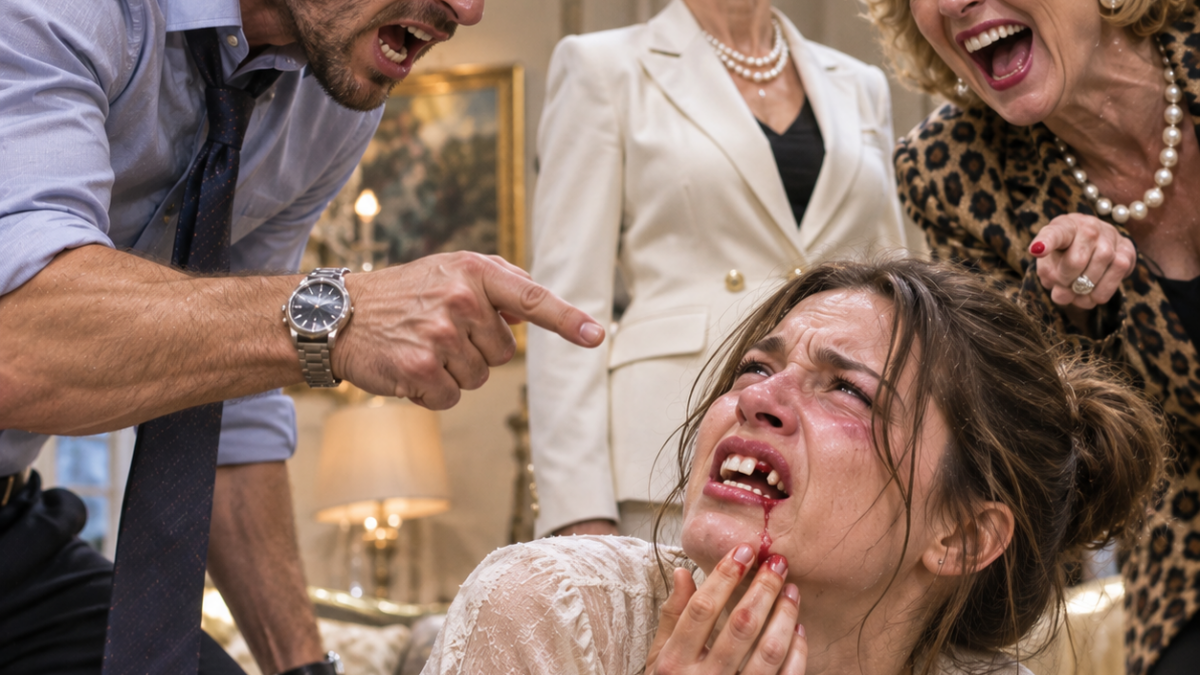
For eight years, Evan Caldwell had known exactly how to make an apology sound like a threat.
He never began with anger.
Not after the worst moments.
Afterward, he became gentle.
Quiet.
Almost tender.
He would call me sweetheart.
Tell me he was sorry.
Explain that work had been stressful.
That his mother had upset him.
That I should have known better than to argue when he was tired.
Then he’d remind me that we were married.
That husbands and wives were supposed to protect each other.
That involving outsiders would only make a private problem worse.
I’d heard every variation of that speech.
Standing in our bedroom.
Sitting inside my car.
Crying in the laundry room.
Once, on the floor beside a shattered coffee mug he’d thrown hard enough to leave a dent in the wall.
But this time, there was blood on my shirt.
A piece of my tooth on the kitchen floor.
And my mother was driving toward Chesapeake.
“Rachel,” Evan called through the door. “I know you’re upset.”
I held the phone against my chest.
“Please go away.”
“Come on. Don’t do this.”
The key turned slightly.
I stared at the lock.
“Don’t open the door.”
He exhaled sharply.
“Sweetheart, I’m trying to help you.”
I pressed my back against the bathtub.
My mother had told me to contact emergency services.
I’d been hesitating.
The fear wasn’t rational.
Or perhaps it was rational in the way fear becomes rational when somebody has spent years teaching you the consequences of disobedience.
If I called the police, Evan would be furious.
Diane would blame me.
His family would say I’d ruined his career.
People would know.
The neighbors.
Our friends.
My coworkers.
Every person who thought we were a happy couple living in a beautiful house near the water.
And somewhere beneath all that fear was the terrible thought that perhaps I could still fix the evening by apologizing.
Even though I hadn’t done anything wrong.
Even though he had broken my tooth.
Even though I was the one bleeding.
Then Mom’s voice returned.
“Rachel?”
I lifted the phone.
“Yes.”
“Are you still behind the locked door?”
“Yes.”
“Call 911 now. Tell them you’re injured and your husband is attempting to enter the room.”
I swallowed.
“Mom, what if he gets arrested?”
There was a pause.
Then she said, “That decision belongs to the police and the law. Your job is to get safe.”
I stared at the lock.
“He’s going to hate me.”
My mother took a slow breath.
“Rachel, someone who loves you does not get to break your tooth and then demand that you protect him from the consequences.”
The words hurt.
Because they were true.
And because part of me had known they were true for years.
I ended the call and dialed 911.
The dispatcher answered.
I gave my name, the address on Heritage Way, and the essential facts.
My husband had struck me.
My tooth was broken.
I was bleeding.
I was locked inside the downstairs bathroom.
He was trying to open the door.
The dispatcher asked whether I needed medical assistance.
“Yes.”
“Are you able to remain in the bathroom safely?”
“I think so.”
“Stay on the line. Officers and medical personnel are being sent.”
Evan heard me.
The change in his voice was immediate.
“Rachel, what are you doing?”
I didn’t answer him.
“Are you seriously calling the police?”
I pressed the phone to my ear.
The dispatcher asked me to describe what was happening.
“He’s outside the door.”
Then Evan slammed his palm against the wood.
“Hang up!”
I flinched.
“Rachel, you are not doing this to me!”
Diane’s voice joined his.
“What did she do?”
“She’s calling the police!”
Diane gasped.
Then her voice became sharp enough to cut through the door.
“RACHEL! YOU WILL HANG UP THAT PHONE!”
I covered my mouth with my free hand.
“Ma’am?” the dispatcher said. “Can you still hear me?”
“Yes.”
“Keep the door locked if you can. Don’t open it to anyone until officers identify themselves and it’s safe.”
Outside, Diane continued shouting.
“Do you have any idea what an arrest would do to Evan’s career?”
I closed my eyes.
A tear rolled down my cheek.
The same question she’d asked whenever Evan crossed another boundary.
What about his career?
What about his reputation?
What about his future?
Never once had she asked what his behavior was doing to mine.
Evan stopped pounding.
For a moment, there was silence.
Then I heard the key turning again.
I stared at the knob.
It began to move.
“He’s unlocking it,” I whispered.
The dispatcher remained calm.
“Tell me what you see. Do not confront him.”
The latch clicked.
I pulled my knees toward my chest.
Then the door opened a few inches.
Evan’s face appeared in the narrow gap.
He looked down at me.
The blood.
The swelling.
The phone.
And for the first time since the kitchen, I saw fear in his expression.
Not fear for me.
Fear of what I’d told someone.
He pushed the door farther open.
“Rachel, give me the phone.”
I shook my head.
“No.”
His jaw tightened.
“Don’t make this worse.”
The dispatcher heard him.
“Sir, emergency services have been contacted. Please step away from the injured person.”
Evan froze.
His eyes moved toward the phone.
“Is that the police?”
I didn’t answer.
Diane appeared behind him.
“Oh, for God’s sake.”
She looked down at me.
“Look at you. Sitting on the floor like some abused little housewife.”
I stared at her.
My mouth throbbed.
My face felt enormous.
For one terrible moment, I wondered whether I was seeing myself through their eyes.
Pathetic.
Weak.
A burden.
Then I remembered what my mother had told me.
Your job is to get safe.
I looked at Evan.
“Please leave me alone.”
He stepped closer.
“Rachel, we need to talk before anybody arrives.”
I shook my head.
“I’m not talking to you.”
His expression hardened.
Diane touched his arm.
“Come away, darling.”
He didn’t move.
“Rachel, you’re destroying our marriage.”
I looked up at him.
Something inside me went very still.
“No, Evan.”
My voice was quiet.
“You did that when you hit me.”
For a moment, nobody spoke.
Then the dispatcher asked whether he was still near me.
I answered.
“Yes.”
Evan stared at the phone.
Then looked toward the hallway.
I could almost see him calculating.
How much time remained.
What the officers might see.
Whether he could persuade me to change my story.
Diane leaned toward him.
“Don’t say another word.”
Then she looked down at me.
“You’re going to regret this.”
I heard the dispatcher.
“Rachel, are you still there?”
“Yes.”
“Help is on the way.”
Evan backed out of the bathroom.
Diane followed him.
The door remained open.
I didn’t get up.
I was afraid to move.
I stayed beside the bathtub, phone pressed to my ear, listening to the distant voices in the kitchen.
Then Evan called out something that made my entire body go cold.
“Mom, where’s the towel?”
Diane answered.
“Why?”
“There’s blood on the floor.”
I closed my eyes.
They weren’t preparing to help me.
They were preparing the house for the police.
And suddenly I understood how badly they wanted the evidence to disappear.
I whispered into the phone.
“They’re cleaning the kitchen.”
The dispatcher asked me to repeat it.
I did.
Then I looked at the photographs my mother had told me to take.
My swollen lip.
The blood on my shirt.
The broken edge of my tooth.
A red mark along my cheek.
I uploaded the images to a private account Evan couldn’t access.
My hands shook.
But I finished.
Then I leaned against the bathtub and waited.
Outside, a drawer slammed.
Water ran.
Diane complained about the stain on the floor.
Evan muttered something I couldn’t hear.
Then, in the distance, a siren.
One.
Then another.
For the first time that evening, the sound didn’t frighten me.
It made me breathe.
The first officer arrived before my mother did.
I heard a firm knock at the front door.
Then a man’s voice.
“Chesapeake Police Department.”
Evan answered almost immediately.
His voice had changed again.
He sounded calm.
Concerned.
Exactly like the man our neighbors believed him to be.
“Officers, thank God you’re here. My wife’s having some kind of emotional episode.”
I closed my eyes.
Even then.
Even with an emergency call recorded and a broken tooth in my mouth, he was trying to make me sound unstable.
“Where is your wife?” an officer asked.
“She’s in the downstairs bathroom.”
“Is she injured?”
“She fell against the counter.”
I felt my stomach turn.
A fall.
That was the story he’d chosen.
Not ten minutes earlier, he’d screamed that I made him hit me.
Now he’d decided I had fallen.
The officer’s voice grew firmer.
“Sir, please step aside.”
There were footsteps in the hallway.
A moment later, a woman appeared in the bathroom doorway wearing a police uniform.
She was in her thirties, with dark hair pulled into a tight bun and a calm expression.
“Rachel?”
I nodded.
“I’m Officer Angela Brooks. Are you safe to speak with me?”
I tried to answer.
Then started crying.
Not softly.
Not gracefully.
Everything I’d been holding inside seemed to come apart at once.
Officer Brooks crouched a short distance from me.
“You’re okay. I’m here to listen.”
I shook my head.
“He hit me.”
“Can you tell me what happened?”
I looked toward the hallway.
She noticed.
“We can speak separately from him.”
I swallowed.
Blood still stained my lips.
I told her about the document.
The argument.
My refusal.
Evan’s backhand.
The kitchen counter.
My tooth hitting the floor.
Then Diane calling my mother.
I explained that Evan had followed me to the bathroom and tried to enter while I spoke with the dispatcher.
Officer Brooks listened.
She didn’t interrupt to tell me I should have left years ago.
Didn’t ask why I stayed.
Didn’t demand that I explain why I’d loved him.
She asked practical questions.
Where had Evan struck me?
Had I lost consciousness?
Was I dizzy?
Was the bleeding continuing?
Had he threatened me afterward?
Was there a history of physical intimidation?
Some questions were difficult.
Especially the last one.
Because answering honestly meant admitting that tonight hadn’t come out of nowhere.
“He never knocked out a tooth before,” I whispered.
Officer Brooks nodded.
“Has he hurt you in other ways?”
I stared at the floor.
I remembered the bruises on my wrists.
The coffee mug that shattered near my face.
The night he blocked the bedroom door while I begged him to let me leave.
The time he shoved me against a closet because I questioned a credit-card charge.
I had spent years separating those incidents into categories.
Anger.
Stress.
Bad temper.
Marriage problems.
Anything except abuse.
Now, sitting on a bathroom floor with an officer looking at my swollen face, the categories collapsed.
“Yes,” I whispered.
Officer Brooks waited.
I told her.
Not everything at once.
Just what I could remember clearly.
She took notes.
Then asked whether I had photographs or messages documenting earlier incidents.
I nodded.
“Some.”
“Keep them. We can discuss how to preserve those records.”
A paramedic appeared behind her.
“Rachel, I’m Marcus. We’re going to check your injuries.”
He asked permission before examining my mouth.
That small courtesy nearly made me cry again.
For years, Evan had grabbed my wrists, taken my phone, blocked doorways, and acted as though my body belonged to him whenever he was angry.
Now a stranger was asking permission before touching my face.
Marcus looked at the damaged tooth.
Then at my cheek.
“Do you have pain in your jaw?”
“Yes.”
“Any difficulty breathing or swallowing?”
“No.”
“Any dizziness?”
“A little.”
He advised that I needed evaluation for the facial injury and dental damage.
A hospital could assess possible concussion symptoms and other trauma.
I nodded.
I didn’t want to move.
But I knew I needed treatment.
Officer Brooks helped me stand.
When I stepped into the hallway, I saw Evan near the kitchen entrance speaking with another officer.
Diane stood beside him.
She looked furious.
The moment she saw me, she began shouting.
“There she is! Ask her why she was screaming at my son!”
Officer Brooks stepped slightly between us.
“Ma’am, please give us space.”
Diane ignored her.
“She’s been unstable all evening!”
I felt my throat tighten.
Then Evan saw my face.
His expression changed.
For a fraction of a second, he looked horrified.
I wondered whether he’d finally noticed how badly he’d hurt me.
Then he spoke.
“Rachel, tell them it was an accident.”
The room went still.
The officer beside him looked up.
“Evan,” Diane hissed.
But he’d already said it.
I stared at my husband.
Eight years of marriage.
Eight years of apologies.
Eight years of worrying what people would think if I told the truth.
And now he was asking me to lie while blood still stained my shirt.
I shook my head.
“No.”
His eyes hardened.
“Rachel, don’t do this.”
Officer Brooks spoke.
“Sir, you need to stop addressing her.”
Evan pointed toward me.
“She’s my wife!”
“That doesn’t change my instruction.”
Diane moved forward.
“You people have no idea what kind of woman she is.”
Officer Brooks turned.
“Ma’am, we’re investigating an allegation of assault. I need you to stop interfering.”
Diane looked stunned.
She wasn’t accustomed to people refusing to treat her outrage as authority.
She drew herself up.
“My son is a respected professional.”
The other officer answered.
“Then he can give us his account.”
I almost laughed.
Even now, Diane believed a respectable job was proof that someone couldn’t be violent at home.
As if a good salary erased bruises.
As if business cards meant more than broken teeth.
I looked toward the kitchen floor.
Someone had wiped away much of the blood.
But the small piece of my tooth was still near the edge of the island.
I pointed.
“That’s it.”
Officer Brooks followed my gesture.
“The tooth?”
I nodded.
A scene photograph was taken, and the fragment was handled in accordance with the responders’ instructions so I could take it for dental evaluation if appropriate.
My gaze moved toward the trash can.
A blood-stained paper towel lay near the top.
Then toward the damp patch on the tile.
Diane noticed where I was looking.
Her expression changed.
Officer Brooks noticed too.
Questions followed.
What had been cleaned?
Who cleaned it?
Why?
Diane immediately announced that she had merely been keeping the kitchen sanitary.
Maybe that was how she wanted to describe it.
But the fact remained that she’d focused on wiping blood off the floor while I was locked in the bathroom with a broken tooth.
I didn’t need to argue about what that meant.
The officer documented what was there.
Then Marcus guided me toward the front door.
Outside, the evening air was cool.
I hadn’t realized how hot the house had become until I stepped onto the porch.
A neighbor stood across the street pretending to examine her mailbox.
Another watched from behind a curtain.
I felt humiliation rise in my chest.
Then I remembered the sound of the tooth hitting the tile.
The pain.
The blood.
The way Diane laughed.
And I realized that I had nothing to be ashamed of.
I hadn’t caused this.
I was the one seeking help.
As I approached the ambulance, I heard Evan raise his voice.
“Am I being arrested?”
I stopped.
Officer Brooks looked toward the other officer.
The investigation was still underway.
They’d taken our accounts.
Photographed the scene.
Observed my injuries.
And documented the emergency call.
The decisions about arrest and charges belonged to the officers applying the law.
I couldn’t control that.
For the first time in years, I didn’t try to.
I climbed into the ambulance.
Marcus helped me sit.
He checked my vital signs.
Then asked whether I had someone safe who could meet me at the hospital.
“My mother.”
“Is she nearby?”
I looked toward the road.
“She’s coming from Virginia Beach.”
He nodded.
“We’ll make sure you have the information you need to contact her.”
My phone buzzed.
A message from Mom.
I’m on my way. Tell me where they’re taking you when you know.
I read it three times.
Then typed the name of the hospital Marcus gave me.
Her response came almost immediately.
I love you. You’re not going back there tonight.
I stared at the words.
For eight years, Evan had told me what would happen if I left him.
I’d have no money.
No home.
No one who understood me.
My mother would be disappointed.
People would judge me.
I’d lose everything.
But on that evening, sitting in the back of an ambulance with blood on my shirt, I knew one thing with absolute certainty.
There was somewhere I could go.
And somebody was coming.
The ride to the hospital felt unreal.
Streetlights passed through the ambulance windows.
The paramedic asked questions.
I answered.
My cheek throbbed.
My jaw hurt.
Every breath of cool air across my broken tooth sent a sharp pain through my mouth.
But the physical pain was easier to understand than everything else.
At least I knew where it came from.
The emotional pain was different.
I remembered Evan proposing to me on a beach near Virginia Beach.
He’d been nervous.
His hands shook when he opened the ring box.
He told me I was the most important person in his life.
And I believed him.
I remembered our first apartment.
The nights we ate cheap takeout on the floor because we couldn’t afford a dining table.
The laughter.
The plans.
The way he used to kiss my forehead before leaving for work.
I didn’t understand when that man had become the person who struck me hard enough to break a tooth.
Maybe the change had been gradual.
Maybe I’d been explaining away warning signs for years.
Maybe I’d loved the idea of who he could be more than I acknowledged who he had become.
At the hospital, the medical staff evaluated me carefully.
They examined my mouth and jaw.
Checked for concerning signs associated with head injury.
Documented the visible trauma.
Arranged appropriate dental follow-up.
The broken tooth would require further treatment.
The bruising would take time to heal.
I was given information about warning signs that would require urgent reassessment and how to obtain follow-up care.
A nurse named Caroline helped me change into a clean hospital gown.
She placed my bloodstained shirt in a bag so it could be retained if needed.
Then she looked at me.
“Do you feel safe going home?”
I shook my head.
“No.”
She nodded.
“Do you have somewhere else to stay?”
“My mother.”
“Good.”
She paused.
“Would you like to speak with a social worker or domestic-violence advocate about your options?”
I hesitated.
Then nodded.
“Yes.”
It was one of the hardest answers I’d given all night.
Because saying yes meant acknowledging that I needed help beyond a repaired tooth.
It meant looking directly at the marriage I’d spent eight years trying to save.
And admitting that my mother’s arrival, however comforting, wouldn’t make everything disappear.
There would be decisions.
Legal questions.
Financial arrangements.
A safe place to stay.
Possibly a protective order.
Maybe a divorce.
I felt overwhelmed.
But Caroline didn’t ask me to decide everything at once.
She simply began helping me understand what resources were available.
A little before nine, my phone rang.
Mom.
I answered immediately.
“Mom?”
“I’m at the hospital.”
I sat up.
My heart began pounding.
She had arrived.
For a moment, I couldn’t speak.
Then I heard footsteps outside the room.
A nurse asked someone to wait.
And my mother appeared in the doorway.
Evelyn Mercer.
Sixty-nine years old.
Silver hair pulled into a low bun.
Dark jeans.
A navy-blue jacket.
Comfortable boots.
No dramatic uniform.
No weapon.
No team of armed men behind her.
Just my mother.
But there was something about the way she stood.
Straight-backed.
Still.
Completely focused.
The same presence I’d known since childhood.
She looked at my face.
And the expression in her eyes changed.
Not into rage.
Not into the theatrical fury Diane would have understood.
Into something much more painful.
Grief.
“Rachel.”
That was all she said.
I tried to smile.
The movement hurt my mouth.
“Hi, Mom.”
She crossed the room.
Then stopped beside the bed.
For a moment, she didn’t touch me.
She looked at my cheek.
My swollen lip.
The damaged tooth.
The hospital bracelet around my wrist.
Then she asked softly, “May I hug you?”
I nodded.
And when her arms closed around me, I finally let myself cry without trying to hide the sound.
I cried against her shoulder.
Like a child.
Like a grown woman.
Like someone who had been holding her breath for eight years and had finally discovered there was air outside the house.
Mom held me.
She didn’t tell me to calm down.
Didn’t demand that I stop crying.
Didn’t ask how I could have let this happen.
She simply stayed.
When I could breathe again, she stepped back.
Her eyes were wet.
That frightened me more than anger would have.
Growing up, I’d rarely seen my mother cry.
She wasn’t cold.
She was loving.
Funny.
Patient.
But life had trained her to remain calm when everybody else was panicking.
Seeing tears in her eyes made the reality of what happened feel enormous.
“I’m sorry,” I whispered.
She frowned.
“For what?”
“For not telling you sooner.”
Her expression changed.
“Rachel.”
I looked down.
“I knew you’d worry.”
She took my hand carefully.
“Sweetheart, I am your mother. Worrying about you is part of loving you.”
I started crying again.
She squeezed my fingers.
“You don’t owe me an apology for being hurt.”
I swallowed.
“I should’ve left.”
“Maybe there were times you wanted to. Maybe there were reasons you felt you couldn’t. We’ll talk about those things when you’re ready.”
She looked toward the hospital door.
“But tonight, you got help. That’s what matters right now.”
I stared at her.
She had spent years commanding people in difficult situations.
Yet she wasn’t commanding me to feel a certain way.
She wasn’t demanding that I make an immediate decision about my marriage.
She was giving me room to breathe.
And somehow, that made me feel safer than anything else.
A moment later, she asked the nurse whether she could speak with the medical team about my treatment, with my permission.
I agreed.
She listened carefully.
Asked questions about the injury and follow-up care.
Made notes.
Then thanked everyone who had helped me.
I watched her.
It was such an ordinary thing.
A mother helping her daughter understand hospital instructions.
But I knew Diane would have interpreted it differently.
She would have expected shouting.
Threats.
A dramatic confrontation with Evan.
Instead, my mother was doing what she’d always done best.
Gathering information.
Assessing the situation.
Making sure the next step was safe.
The social worker arrived.
Mom asked whether I wanted her to stay.
I did.
We discussed safety planning, emergency contacts, access to my belongings, legal resources, and support available to people experiencing domestic violence.
I answered questions.
Sometimes with difficulty.
Sometimes through tears.
Mom didn’t interrupt.
When I struggled, she waited.
When I needed a break, she asked for one.
And when the conversation turned to the possibility of obtaining a protective order, she looked at me.
“Rachel, you get to make decisions about your future. But we are going to make sure you understand your options.”
I nodded.
I had almost forgotten what it felt like to make decisions without first imagining how Evan would react.
Afterward, Mom sat beside my bed.
Her phone lay face down on the table.
She hadn’t checked it once.
I looked at her.
“Mom?”
“Yes?”
“Are you angry?”
She considered the question.
“Very.”
I swallowed.
“At me?”
Her expression changed immediately.
“No.”
“Then at Evan?”
She nodded.
“And at anyone who watched you get hurt and decided protecting his reputation mattered more than protecting you.”
I thought of Diane.
Her laughter.
Her polished kitchen.
Her concern about the blood on the floor.
I closed my eyes.
Mom continued.
“But anger isn’t a plan.”
I looked at her.
She gave me a small, sad smile.
“That’s something I learned a long time ago.”
I knew what she meant.
My mother had spent more than twenty years working in Naval Special Warfare.
She’d retired as a Master Chief after a career that involved demanding operations, leadership responsibilities, and years of service that most people outside the military would never fully understand.
But she never treated that history as a license to intimidate people.
To me, she’d always been Mom.
The woman who made pancakes on Sundays.
Who insisted I wear a coat when it was cold.
Who grew hydrangeas in her yard.
Who cried when I graduated from college.
Who drove an old pickup because she liked it, not because she couldn’t afford anything else.
Evan and Diane saw those ordinary things and assumed she was powerless.
They thought the quiet voice meant weakness.
The gardening meant idleness.
The age meant helplessness.
They had no idea how many difficult situations she’d handled without raising her voice.
And they were about to discover something else.
My mother didn’t need to threaten anybody to make consequences real.
She knew how to work through institutions, preserve evidence, and insist that people follow the law.
Which was far more effective than the revenge fantasy Evan had been expecting.
I asked her whether she’d spoken to the police.
“Only to ask how to provide information and where you could follow up.”
I nodded.
“Did they arrest Evan?”
Mom looked at me carefully.
“The officers have been handling the incident. We’ll get accurate information from them rather than guessing.”
I stared at the blanket.
Part of me wanted him arrested immediately.
Another part felt sick at the thought.
Mom noticed.
“It’s possible to be frightened of him and still have complicated feelings about what happens next.”
I looked up.
She continued.
“You don’t have to pretend this is easy.”
That was when I realized how different she was from Diane.
Diane demanded loyalty to Evan.
Whatever he did.
Whatever I suffered.
Whatever the consequences.
My mother wasn’t asking me to prove loyalty by hiding the truth.
She was helping me face it.
Later that evening, after the medical staff finished their immediate assessment, a police officer came to speak with me.
Officer Brooks.
She looked tired.
But kind.
She confirmed that the incident was being investigated and explained the steps I could expect concerning the report, evidence, and any charging decisions.
I provided the photographs I’d taken.
The messages.
The account of earlier incidents.
The information about Diane’s phone call.
I also explained the financial argument that had preceded the assault.
Officer Brooks asked whether I wanted to clarify anything in my statement.
I did.
I wanted the record to show that I’d said no to a financial document.
That I hadn’t struck Evan.
That he’d hit me with his hand.
That I’d collided with the counter.
And that I’d heard my tooth hit the floor.
Then I described what happened afterward.
The bathroom.
The attempted entry.
The threats.
The cleaning of the kitchen.
Diane’s insistence that I was ruining her son’s career.
When I finished, Officer Brooks nodded.
“Thank you for being clear.”
I looked toward Mom.
She sat silently beside me.
For the first time in my life, I understood why people who work in crisis situations value calmness so much.
Mom didn’t interrupt the officer.
Didn’t attempt to answer for me.
Didn’t claim that her military rank entitled her to special treatment.
She simply made sure I had the time and space to speak for myself.
After Officer Brooks left, I leaned back against the pillows.
“I’m exhausted.”
Mom stood.
“Then rest.”
“Will you stay?”
She looked at me.
“Of course.”
I closed my eyes.
And for the first time in weeks, I fell asleep without listening for the sound of Evan’s footsteps.
I woke just after midnight.
The room was dim.
A monitor hummed nearby.
My jaw ached, and my mouth felt swollen.
For one disorienting second, I thought I was back inside the Caldwell house.
Then I saw my mother sitting in the chair beside the window.
She was reading a small paperback.
Her glasses rested low on her nose.
The scene was so ordinary that I almost cried.
“Mom?”
She looked up immediately.
“Hey, sweetheart.”
“What time is it?”
“Little after midnight.”
“Have you been sitting there the whole time?”
She closed the book.
“Pretty much.”
“You must be exhausted.”
“I’ve been more tired.”
I managed a painful smile.
“That’s such a Navy answer.”
She smiled back.
“Some habits stick.”
Then she set the book aside.
“How’s your pain?”
I told her.
She helped me contact the nurse.
Afterward, I lay back.
For a while, neither of us spoke.
Then I asked the question that had been haunting me.
“Mom, why didn’t I leave sooner?”
She didn’t answer immediately.
I looked toward the ceiling.
“I knew things were wrong.”
She listened.
“I knew he was controlling. I knew he scared me sometimes.”
My voice cracked.
“But I kept telling myself it wasn’t bad enough.”
Mom reached for my hand.
“Rachel, people often make decisions based on the information, resources, fears, and hopes they have at the time.”
I swallowed.
“I thought I could help him.”
She nodded.
“I know.”
“He used to be different.”
“Maybe he was.”
I looked at her.
“Do you believe that?”
She considered the question.
“I believe you loved him. I believe there were good memories. And I believe those memories made it harder to recognize how much things had changed.”
I stared at her.
She continued.
“That doesn’t make what he did acceptable.”
I closed my eyes.
“I feel stupid.”
“You’re not stupid.”
I shook my head.
“Eight years, Mom.”
She squeezed my hand.
“Eight years of marriage doesn’t disappear in one night. Neither does the hope that someone will become the person you remember.”
I started crying again.
This time, quietly.
Mom handed me a tissue.
Then she said something I would remember long after my mouth healed.
“The important thing isn’t why you didn’t leave yesterday. It’s what helps you stay safe tomorrow.”
I looked at her.
She smiled gently.
“And tomorrow, we’re going to start with breakfast.”
It was such a small sentence.
Such an ordinary promise.
But it felt enormous.
Because Evan had made every decision about our future sound like a threat.
My mother made tomorrow sound possible.
The next morning, I was discharged with medical instructions and follow-up appointments.
Mom helped me gather my things.
We left through a quiet entrance.
She drove.
Her old pickup smelled like coffee, clean upholstery, and the faint scent of the peppermint candies she kept in the console.
I had ridden in that truck hundreds of times.
To school.
To college visits.
To the airport.
To family gatherings.
But never like this.
I sat beside her with a small bag of medication instructions and dental paperwork.
Every bump in the road made my mouth throb.
Mom drove carefully.
After a while, I asked, “Where are we going?”
“Home.”
I looked at her.
“Virginia Beach?”
“Yes.”
I stared through the windshield.
“What about my things?”
“We’ll make a plan.”
“My clothes are there.”
“We’ll get what you need.”
“My documents.”
“We’ll handle those too.”
I swallowed.
“Evan won’t let me take anything.”
Mom glanced toward me.
“Rachel, he doesn’t get to decide everything anymore.”
I looked down.
She continued.
“We’ll speak with the appropriate people, make sure you understand your legal options, and arrange any necessary retrieval safely. You’re not going back into that house alone.”
I nodded.
The words made sense.
But I felt a strange emptiness.
For eight years, I’d lived in the Caldwell home.
My books were there.
My wedding photographs.
My favorite coffee mug.
The small wooden jewelry box Dad had made before he died.
Clothes.
Documents.
Christmas decorations.
Pieces of a life I’d believed would last forever.
Leaving without them made everything feel unfinished.
Mom seemed to understand.
“We don’t have to solve every problem today.”
I looked at her.
“What do we solve?”
She smiled.
“First, we make sure you eat something you can tolerate. Then we call the dentist. After that, we’ll decide what needs attention next.”
I leaned back.
For the first time, I allowed myself to believe that somebody else could help carry the weight.
We arrived at her house late that morning.
The hydrangeas were blooming along the front walkway.
Blue and lavender flowers nodded in the breeze.
A small American flag hung beside the porch.
The house looked exactly as it had during my last visit.
White siding.
Dark shutters.
A weathered wooden bench near the front door.
Nothing dramatic.
Nothing intimidating.
Just home.
Mom carried my bag inside.
I stood in the doorway for a moment.
The familiar smell of lemon cleaner and fresh coffee reached me.
And something inside my chest loosened.
I was back in the house where I’d grown up.
The house where Dad had taught me to ride a bicycle.
Where Mom had waited after school when I came home crying over a failed exam.
Where we celebrated birthdays with homemade cake.
Where the worst thing I’d ever worried about as a teenager was whether I would pass a chemistry test.
I walked into the kitchen.
The yellow curtains were still there.
So was the wooden table with a scratch along one edge.
Mom placed my bag on a chair.
“Sit.”
I obeyed.
She opened the refrigerator.
“Yogurt? Applesauce? Something soft?”
I almost laughed.
“You’re treating me like I’m six.”
She looked over her shoulder.
“You’re my daughter. I’m allowed.”
For the first time since Evan struck me, I smiled without forcing it.
The movement hurt.
But it was worth it.
We spent the afternoon making practical arrangements.
Mom helped me organize the medical paperwork.
I scheduled the recommended dental evaluation.
We contacted the people involved in my safety planning.
I began identifying accounts and passwords I needed to secure.
Not every task was dramatic.
Some were painfully ordinary.
Changing a password.
Finding a document.
Canceling a shared delivery.
Updating an emergency contact.
But each small action gave me a little more control over my life.
That evening, my phone displayed seventeen missed calls from Evan.
I stared at the screen.
Mom was making tea.
She saw my expression.
“Is it him?”
I nodded.
She set down the kettle.
“Do you want to listen to the messages?”
I didn’t know.
Part of me was curious.
Part of me was terrified.
The domestic-violence advocate I’d spoken with had recommended preserving unwanted communications rather than deleting them, and documenting any threats.
So I saved the messages.
Then, with Mom beside me, listened to the first voicemail.
Evan sounded frantic.
“Rachel, please call me. This has gone way too far.”
The second message was angry.
“You’ve embarrassed me in front of everyone.”
The third was apologetic.
“I love you. I’m sorry. I didn’t mean for you to get hurt.”
The fourth blamed his mother.
“Diane made everything worse.”
The fifth blamed me.
“You know how to push my buttons.”
The sixth sounded almost tender.
“Come home, sweetheart. We can fix this.”
I stopped listening.
My hands were shaking.
Mom looked at me.
“Do you want a break?”
I nodded.
She turned off the playback.
I stared at the phone.
“That’s how he always does it.”
Mom waited.
“He apologizes. Then he blames someone. Then he says he loves me.”
My voice cracked.
“And somehow I end up apologizing.”
Mom looked at me sadly.
“Not this time.”
I closed my eyes.
“No.”
Then I looked at the saved messages.
“Not this time.”
The next afternoon, Diane called.
I let it go to voicemail.
Her message began without a greeting.
“Rachel, I hope you’re satisfied.”
I stared at the phone.
She continued.
“My son has been humiliated. People are asking questions. Do you understand what you’ve done to this family?”
I almost laughed.
There it was again.
What I’d done.
Not what Evan had done.
Not the injury.
Not the ambulance.
Not the police.
Me.
She continued.
“Your mother should be ashamed of herself for encouraging this nonsense.”
I stopped the message.
My mother stood near the window.
She looked at me.
“Don’t answer if you don’t want to.”
I shook my head.
“I don’t.”
“Then don’t.”
I saved the voicemail.
And for the first time in eight years, I didn’t spend the next hour preparing an apology for Diane.
The following week, I met with a family-law attorney.
Her name was Caroline Bennett.
She was in her late forties, direct, thoughtful, and careful not to promise outcomes she couldn’t guarantee.
Mom accompanied me to the office, then asked whether I wanted to speak privately.
I did.
Caroline listened while I described the marriage.
The financial control.
The threats.
The earlier incidents.
The assault.
The emergency call.
The medical treatment.
She asked questions about property, income, accounts, and safety.
Then explained the available legal processes.
Divorce.
Potential protective measures.
Property and financial issues.
The importance of preserving evidence.
The need to avoid direct confrontation if I believed Evan might become violent.
I listened.
At one point, I started crying.
Caroline offered a tissue.
Then waited.
When I could speak again, I asked, “What if he tells everyone I’m lying?”
She looked at me.
“He may dispute your account. That’s why we document what can be documented and proceed through the appropriate process.”
I swallowed.
“What if his mother supports him?”
“She can give her account. Other witnesses and evidence can also be considered.”
“What if he says I provoked him?”
Caroline’s expression remained steady.
“Having an argument doesn’t give a spouse permission to assault the other person.”
I stared at her.
The sentence was so simple.
So obvious.
And yet I needed to hear it from somebody outside my family.
Because for years, Evan had convinced me that his anger was something I caused.
That if I used the right words, he wouldn’t shout.
If I kept the house perfect, he wouldn’t criticize.
If I avoided sensitive subjects, he wouldn’t grab my arm.
If I just tried hard enough, the marriage would be peaceful.
Now I was beginning to understand something.
I could control my own conduct.
I couldn’t control his decision to hurt me.
And I didn’t have to take responsibility for that decision.
Caroline explained the next steps.
We discussed what records were needed.
How communication could occur through counsel.
How to approach retrieving belongings.
And how to address the financial document that had sparked the argument.
That document mattered.
It wasn’t the reason Evan had chosen violence.
Nothing justified that.
But it explained the immediate conflict and why he’d been pressuring me.
For months, Evan had struggled with financial problems related to his contracting business.
I’d known some of them.
Others he’d hidden.
He had taken on expensive equipment financing.
Extended credit with suppliers.
And repeatedly assured Diane that everything was under control.
But the business was under pressure.
The document he’d demanded that I sign would have allowed access to funds that belonged to me separately.
Money my mother had established for my future before Evan and I married.
I’d refused because I didn’t understand the full obligations or want those funds exposed without independent advice.
Evan called that betrayal.
Diane called it selfishness.
I called it protecting something that was mine.
And for the first time, I had an attorney helping me make sure that boundary remained clear.
When the meeting ended, Mom was waiting in the lobby.
She stood as I approached.
“How did it go?”
I took a breath.
“I’m filing for divorce.”
She looked at me carefully.
“Is that what you want?”
I nodded.
“Yes.”
She opened her arms.
I stepped into them.
And for the first time, saying the words didn’t feel like failure.
It felt like the beginning of something honest.
News traveled quickly.
Chesapeake wasn’t a tiny town, but the circles Evan and Diane moved in were smaller than they liked to admit.
People noticed when police cars appeared outside a familiar house.
They noticed when an ambulance left.
And they noticed when a man who had always presented himself as the perfect husband suddenly stopped bringing his wife to community events.
I didn’t tell everyone what happened.
I wasn’t interested in turning my marriage into entertainment.
But I stopped lying for Evan.
When people asked why I was staying with my mother, I gave a simple answer.
“He’s hurt me, and I’m taking steps to stay safe.”
Some people were shocked.
Others became uncomfortable.
A few tried to change the subject.
One woman said, “But Evan always seemed so nice.”
I looked at her.
“He often was nice in public.”
She didn’t know what to say.
I didn’t blame her for being surprised.
I had spent years helping maintain that image.
At holiday parties, I smiled beside Evan.
At business dinners, I laughed at his jokes.
When people complimented our marriage, I thanked them.
And when he grabbed my wrist beneath the table, I pretended nothing was happening.
I had become so skilled at hiding the truth that sometimes I believed my own performance.
Now I was learning how to live without it.
Two weeks after the assault, I returned to the dentist for the next stage of treatment.
The injury required more than a quick cosmetic repair.
There were examinations.
Imaging.
Treatment planning.
Pain management.
And discussions about restoring the damaged tooth.
I sat in the dental chair feeling strangely embarrassed.
The dentist, Dr. Hannah Lewis, was patient.
She explained the findings and the available treatment options.
She didn’t ask intrusive questions.
She didn’t make me repeat the story unnecessarily.
When she finished, she asked whether I had any concerns.
I stared at my reflection in the small mirror.
The swelling had improved.
The bruising was fading.
But the tooth looked different.
I swallowed.
“Will I look normal again?”
Her expression softened.
“We’ll work toward restoring your tooth and function as well as possible. I’ll explain what each treatment can accomplish and any limitations.”
I nodded.
Then whispered, “Thank you.”
Outside, Mom was waiting in her truck.
She looked up when I opened the door.
“How’d it go?”
I told her.
She listened.
Then handed me a bottle of water.
“Ready to go home?”
I nodded.
That phrase had become something I looked forward to.
Go home.
Not to Evan.
Not to Diane.
Not to the house where I had learned to measure every word.
To the little place with blue hydrangeas and a wooden bench by the front door.
Mom drove.
We stopped for soft food I could eat comfortably.
Then went home.
That evening, I found her in the backyard trimming the hydrangeas.
She wore faded jeans and an old Navy sweatshirt.
Her silver hair was tied back.
A small radio played quietly beside the garden bench.
I stood watching her for a moment.
Then asked, “Mom?”
She looked up.
“What’s on your mind?”
“Did you ever get scared when you were in the Navy?”
She set down the pruning shears.
“Of course.”
I smiled faintly.
“I thought you were going to say no.”
She laughed.
“Only foolish people pretend they’ve never been afraid.”
I sat on the bench.
“What did you do?”
She considered the question.
“Depended on the situation. But I learned that fear can tell you something important. You just can’t let it make every decision for you.”
I looked down.
“I’m afraid of what Evan will do next.”
Mom nodded.
“That makes sense.”
“I’m afraid he’ll show up.”
“Then we take that concern seriously and follow the safety plan.”
“I’m afraid people won’t believe me.”
“Some may not.”
I looked at her.
She continued.
“But our goal isn’t convincing every person who hears a rumor. It’s protecting you and making sure the people handling the legal matters have the evidence they need.”
I stared at her hands.
Those hands had worked through decades of military service.
Fixed engines.
Carried heavy equipment.
Held me when I was a child.
Now they were gently cutting dead flowers from a hydrangea bush.
“Mom, why didn’t you tell Evan more about your career?”
She raised an eyebrow.
“He never asked.”
I almost laughed.
“That’s true.”
She smiled.
“Besides, I wasn’t interested in proving anything to him.”
I looked toward the house.
“He always called you an old pensioner.”
“Well, I am retired.”
“Mom.”
She chuckled.
“And I receive a pension.”
I shook my head.
“You know what he meant.”
Her expression grew serious.
“Yes.”
I waited.
She set the shears aside.
“Rachel, some people think strength is being able to frighten everyone in the room.”
I nodded.
“Evan does.”
“Real strength is often knowing what you could do and choosing what you should do instead.”
I looked at her.
She continued.
“When I got that phone call, I was angry enough that I wanted to drive straight to that house and drag you out myself.”
My eyes filled.
“But you called 911 instead.”
“I told you to call. You made the call.”
I swallowed.
She reached for my hand.
“And that was a stronger decision than anything I could have done by showing up to fight your husband.”
I started crying.
Mom moved beside me.
For a while, we sat together beneath the evening sky.
The hydrangeas moved in the breeze.
A bird landed on the fence.
And I thought about the difference between the two people who had shaped my life most deeply.
Evan believed strength meant control.
Mom believed strength meant responsibility.
I wished I’d understood that difference sooner.
The legal case moved slowly.
Officer Brooks remained one of the contacts associated with the investigation.
I provided additional records when requested.
The medical documentation.
Dental records.
Photographs.
Saved messages.
The emergency-call information.
Statements about earlier incidents.
The officers had also documented what they observed at Diane’s home.
The broken tooth.
The blood.
The accounts.
The cleaning of the kitchen.
Not every question had an easy answer.
Evan disputed parts of what happened.
Diane supported his version.
Their attorney challenged certain allegations.
The proceedings required evidence and proper consideration.
I understood that.
I wanted the case handled fairly.
I just no longer believed fairness required me to remain silent.
Meanwhile, my divorce attorney helped me address financial issues and communication boundaries.
Evan began sending messages through counsel.
Some contained settlement proposals.
Others focused on property.
Occasionally, he asked to speak to me directly.
I declined.
Not because I wanted to punish him.
Because direct conversations had become unsafe and emotionally destabilizing.
Caroline explained the proper channels for negotiation.
We used them.
I gathered my financial records.
Identified separate accounts.
Reviewed marital assets and debts.
And made plans for retrieving personal belongings.
That last task frightened me more than I expected.
The thought of returning to Diane’s house made my stomach tighten.
I imagined the kitchen.
The island.
The tile floor.
The bathroom door.
Evan standing over me.
Diane laughing.
I didn’t want to see any of it again.
Mom noticed my anxiety the morning we discussed the retrieval.
“You don’t have to go alone.”
I nodded.
“We’re arranging appropriate assistance.”
“Good.”
She looked at me.
“And if you decide you can’t do it that day, tell the people helping you. You don’t need to force yourself to prove anything.”
I swallowed.
“I just want Dad’s jewelry box.”
Mom smiled sadly.
“I know.”
My father had made it for my sixteenth birthday.
Small oak box.
Brass hinges.
A little carved flower on the lid.
Inside were earrings, necklaces, and a few keepsakes.
Nothing worth much money.
But it was one of the few things Dad had made with his own hands that I still used every day.
I couldn’t bear the thought of leaving it behind.
We arranged a supervised retrieval through the appropriate process, with the necessary permission and coordination.
I went with a trusted support person.
The visit was limited.
Practical.
Focused on collecting agreed personal belongings.
I didn’t go there to confront Evan.
I didn’t go there to argue with Diane.
And I didn’t go there hoping someone would finally apologize.
When we arrived, the house looked exactly the same.
The neatly trimmed hedges.
The white columns.
The expensive stone walkway.
The front door with its polished brass handle.
I stood beside the car.
My breathing grew shallow.
For a moment, I couldn’t move.
Then I remembered the first time Evan brought me there.
We’d been dating for six months.
Diane had served dinner on expensive china.
She’d called me a sweet girl.
Asked about my job.
Complimented my dress.
I had believed she liked me.
Now the same front door seemed like the entrance to a place where I’d spent years losing pieces of myself.
I took a breath.
Then walked forward.
Inside, I collected what I was entitled to retrieve under the arrangement.
Clothes.
Documents.
Personal items.
My father’s jewelry box.
A few photographs.
Books.
Small things that mattered because they were mine.
I avoided the kitchen as much as possible.
But eventually, I passed the doorway.
The quartz island stood beneath the pendant lights.
The tile floor gleamed.
There was no blood.
No tooth fragment.
No visible sign of what had happened.
I stopped.
For a moment, I was back there.
The impact.
The pain.
Evan’s voice.
Diane demanding that someone collect her useless daughter.
My hands began shaking.
The person assisting me noticed.
“Rachel, do you need a moment?”
I nodded.
I looked toward the downstairs bathroom.
The door was closed.
The brass handle reflected the light.
Then I looked away.
I didn’t need to prove I could stand there without feeling anything.
I gathered my remaining belongings.
And left.
Outside, the air felt cool.
I stood beside the car holding Dad’s jewelry box.
Then I looked back at the house one final time.
For years, I’d believed leaving it would mean losing everything.
But now I was standing outside with my own belongings, my own decisions, and somewhere safe to go.
I had lost the marriage.
I hadn’t lost myself.
That was the difference.
When I returned to Mom’s house, she was waiting on the porch.
I held up the jewelry box.
“Got it.”
She smiled.
“Your dad would be glad.”
I nodded.
Then walked inside.
And for the first time, the Caldwell house felt like a place I’d visited rather than a place I still belonged.
Three months after the assault, Evan asked for a meeting through our attorneys.
He said he wanted to apologize.
Caroline explained that I didn’t have to agree.
I sat in her office holding the request.
For years, Evan’s apologies had been the doorway back into the same cycle.
Anger.
Fear.
Promises.
Flowers.
A few quiet weeks.
Then another explosion.
I looked at Caroline.
“What do you think?”
She folded her hands.
“I think you should ask yourself what purpose the meeting would serve and whether it would be safe and useful for you.”
I considered that.
What did I want from Evan?
An apology?
I’d heard dozens.
An explanation?
He’d given me many.
Closure?
I wasn’t sure another conversation could provide it.
I looked down at the paper.
Then shook my head.
“No.”
Caroline nodded.
“I’ll communicate that.”
I exhaled.
It was such a simple thing.
One word.
The same word that had started the argument in Diane’s kitchen.
No.
But this time, I said it without Evan standing over me.
Without Diane accusing me of selfishness.
Without worrying that I would be punished for having a boundary.
And nobody tried to take the decision away from me.
That afternoon, I drove to the waterfront.
The Chesapeake Bay stretched beneath a pale blue sky.
I parked near a quiet walkway and sat on a bench overlooking the water.
For a long time, I listened to the waves.
I thought about the woman I’d been eight years earlier.
A young wife.
Hopeful.
Certain love could solve almost anything.
I didn’t hate her for believing that.
I wished somebody had told her that love wasn’t supposed to require fear.
I wished she’d understood that a person could be charming and still be dangerous.
That an apology didn’t erase a pattern.
That a beautiful house could contain an unhappy life.
But I couldn’t go back and warn her.
All I could do was protect the woman I had become.
And perhaps, someday, share enough of my experience to help someone else recognize the signs earlier.
The criminal proceedings eventually reached their resolution.
The court considered the evidence, the injury, and the applicable law.
Evan faced legal consequences for the assault, including court-imposed conditions and obligations arising from the case.
The final disposition also established boundaries intended to prevent further harmful contact.
I won’t pretend the process was easy.
There were documents.
Hearings.
Questions.
Dates that made my stomach tighten.
Mom accompanied me when I wanted her there.
Caroline helped with the family-law matters.
The victim-support professionals explained what to expect.
And I learned that justice rarely arrives as one dramatic moment.
More often, it arrives through a sequence of smaller ones.
A report being taken seriously.
Evidence being preserved.
A witness speaking honestly.
A court hearing both sides.
An order being entered.
A boundary becoming enforceable.
And a person who once felt powerless beginning to make decisions without fear.
Diane’s role in the incident was also examined through the evidence available.
I couldn’t control what she believed about her son.
I couldn’t force her to admit she’d been cruel.
But I no longer had to accept her version of events.
She’d called me useless.
Blamed me for being hurt.
And laughed at the idea that my mother could protect me.
Now the record showed that I had been injured, sought emergency assistance, and taken lawful steps to protect myself.
Diane could dislike those facts.
She couldn’t change them by shouting.
The divorce proceedings continued separately.
We addressed property, debts, and the financial issues that had contributed to the conflict.
I had independent legal advice.
I reviewed the documents carefully.
I didn’t sign anything because Evan demanded it.
And the separate funds I’d refused to put at risk were addressed according to their legal ownership rather than his anger.
By the time the divorce became final, the relationship had been over in my heart for months.
Still, when I received the final documents, I cried.
Not because I wanted Evan back.
Because I’d once loved him.
Because I’d believed in our future.
Because there were years of memories I couldn’t simply throw away.
I cried for the happiness we’d had in the beginning.
And for all the time I’d spent hoping it would return.
Then I wiped my face.
Closed the folder.
And went downstairs.
Mom was making dinner.
She looked up.
“Everything okay?”
I held the papers.
“It’s final.”
She turned off the stove.
For a moment, she simply looked at me.
Then she opened her arms.
I stepped into them.
No speech.
No celebration.
Just a long hug.
Afterward, she asked, “Hungry?”
I laughed through my tears.
“Starving.”
“Good. I made enough for both of us.”
That was my mother.
She could face a crisis with the calm of a seasoned military leader.
But once the immediate danger had passed, she returned to the ordinary things that make life worth living.
Food.
A safe home.
A clean bed.
Someone to talk to.
Someone who would listen.
I began rebuilding my life in Virginia Beach.
At first, I stayed with Mom.
Then I found a small apartment nearby.
Nothing extravagant.
One bedroom.
A bright kitchen.
A balcony with room for two chairs.
I bought a secondhand dining table and painted it white.
Hung my favorite photographs.
Put Dad’s jewelry box on the dresser.
And chose curtains without asking anyone’s permission.
That last part made me laugh.
For eight years, even something as simple as buying curtains had required navigating Evan’s moods.
Now I stood in a store comparing colors because I wanted to.
I chose pale blue.
They reminded me of the hydrangeas outside Mom’s house.
I started working again with greater independence.
I reconnected with friends I hadn’t seen in years.
Some had drifted away because Evan disliked them.
Others had stopped calling after I repeatedly canceled plans.
I sent messages.
Apologized where I needed to.
Explained what I felt comfortable explaining.
And discovered that more people were willing to welcome me back than I’d expected.
One friend, Melanie, cried when we met for coffee.
“Rachel, I thought you didn’t want to see me anymore.”
I looked down.
“Evan always said you were a bad influence.”
She stared at me.
Then shook her head.
“I knew something wasn’t right.”
I felt tears rising.
“Why didn’t you say anything?”
“I tried once.”
I looked at her.
She continued.
“You told me I was misunderstanding your marriage.”
I remembered that conversation.
I’d been furious with her.
Not because she was wrong.
Because she’d come too close to a truth I wasn’t ready to face.
“I’m sorry,” I whispered.
Melanie reached across the table.
“I’m just glad you’re here.”
We sat talking for three hours.
And afterward, I realized how much of my life had been narrowed by Evan’s control.
Not all at once.
Not through one dramatic command.
But through small decisions.
One canceled dinner.
One friendship he criticized.
One family visit that became too inconvenient.
One argument that made me decide staying home was easier than going out.
Eventually, I’d stopped noticing how small my world had become.
Now it was expanding again.
Slowly.
Carefully.
But unmistakably.
My tooth was restored through the course of dental treatment.
The pain improved.
The bruises faded.
My jaw gradually felt normal again.
The first time I looked in the mirror and smiled without seeing the damaged tooth, I cried.
Not because the new appearance erased what happened.
It didn’t.
But because I’d begun to recognize myself again.
I didn’t look like the frightened woman on the bathroom floor.
I looked like Rachel.
A woman with a future.
One afternoon, Mom came to my apartment carrying a small cardboard box.
“What’s this?”
She set it on the table.
“Something I found while cleaning the attic.”
Inside were photographs from my childhood.
Me riding a bicycle.
Me in a school play.
Me holding a science-fair ribbon.
Me at my college graduation.
Then one photograph made me stop.
I was about seven years old, standing beside Mom in her Navy uniform.
Her hair was darker then.
Her posture exactly the same.
She had one arm around my shoulders.
I was grinning at the camera, showing a gap where I’d lost a baby tooth.
I stared at the picture.
Then laughed.
Mom looked over.
“What?”
“Look at my teeth.”
She smiled.
“You were very proud of that missing tooth.”
I held up the photograph.
“Mom, do you remember what you said when I was little and worried about getting hurt?”
She thought for a moment.
“Probably something about wearing a helmet.”
I laughed.
“Besides that.”
She sat beside me.
“I don’t know, sweetheart.”
I looked at the photograph.
“You told me brave people aren’t the ones who never get scared.”
Mom smiled softly.
“That sounds like me.”
“You said brave people are the ones who ask for help when they need it.”
She nodded.
“I still believe that.”
I looked at her.
“Me too.”
Then I placed the photograph on the bookshelf.
Not because I wanted to remember the violence.
Because I wanted to remember the woman who helped me survive it.
Nearly a year after that night in Chesapeake, I attended a community event supporting survivors of domestic violence.
I wasn’t there as a speaker.
I wasn’t ready to tell my story publicly.
I was there as a volunteer.
Helping arrange chairs.
Handing out information.
Making sure people knew where to find appropriate services.
At one point, a young woman approached the table.
She looked nervous.
She kept glancing toward the exit.
“Excuse me,” she whispered.
I smiled.
“Can I help you?”
She held a brochure.
“Does someone have to be physically injured to ask for help?”
I felt my chest tighten.
For a moment, I saw myself.
Years earlier.
Standing beside a broken coffee mug.
Telling myself Evan had never actually hit me.
I looked at the young woman.
“No. You don’t have to wait for an injury to ask about your safety or your options.”
Her eyes filled with tears.
I handed her the contact information for the advocates at the event.
Then asked whether she’d like me to help her find someone to speak with privately.
She nodded.
And as I walked beside her toward the support desk, I realized something important.
I couldn’t change what happened to me.
I couldn’t make Evan become the husband I’d once believed he was.
I couldn’t erase Diane’s laughter.
But I could refuse to let their cruelty be the final meaning of my story.
I could build something after it.
A life.
A sense of safety.
Friendships.
Work.
A future.
And perhaps, in small ways, help someone else realize that asking for assistance wasn’t a failure.
That evening, I drove to Mom’s house.
The hydrangeas were blooming again.
She sat on the porch wearing an old Navy sweatshirt and reading a book.
When she saw me, she smiled.
“Hey, sweetheart.”
“Hey, Mom.”
I sat beside her.
We watched the evening light settle over the garden.
After a while, I asked, “Do you ever think about that night?”
She closed her book.
“Yes.”
“Are you still angry?”
She looked toward the flowers.
“Sometimes.”
I nodded.
“Me too.”
She reached for my hand.
Then I asked the question I’d wanted to ask for months.
“When Diane called and said those awful things, what were you thinking?”
Mom was quiet.
Finally, she answered.
“I was thinking that my daughter was hurt and needed help.”
I looked at her.
“That’s all?”
She smiled sadly.
“That was enough.”
I felt tears rise.
“Did you want to go after Evan?”
She considered the question.
“I wanted you safe. Everything else came second.”
I squeezed her hand.
For years, Evan had told me that power meant being feared.
He thought a raised voice made him strong.
Diane thought money and social standing gave her the right to humiliate people.
They both looked at my mother and saw a retired widow with silver hair and an aging pickup.
They laughed because they believed she couldn’t do anything to protect me.
But two hours after that terrible phone call, she had arrived at the hospital.
Not with threats.
Not with violence.
Not with a dramatic promise to destroy anybody.
She arrived with steady hands, an open heart, and the discipline to help me through the hardest night of my life.
She helped me preserve the truth.
Get medical care.
Understand my options.
Find a safe place to stay.
And rebuild my life without surrendering my dignity.
That was the part Evan and Diane never understood.
My mother’s strength had never depended on whether they recognized her military rank.
Her greatest power wasn’t the title Master Chief.
It was knowing how to remain calm when people she loved were in danger.
And teaching me that I could do the same.
The evening grew cooler.
Mom went inside to make tea.
I remained on the porch for a few moments.
The air smelled of hydrangeas and salt from the nearby coast.
Somewhere down the street, a child laughed.
A car passed.
A dog barked.
Ordinary sounds.
Peaceful sounds.
I touched the edge of my restored front tooth with my tongue.
Then looked toward the doorway where Mom had disappeared.
I thought about that broken little shard lying on Diane’s kitchen floor.
The moment I’d believed my world was ending.
I hadn’t known then that the marriage was already over.
Or that the call I was afraid to make would become the beginning of my freedom.
I only knew I was hurt.
Frightened.
And alone behind a locked bathroom door.
But I wasn’t alone anymore.
And I never needed Evan’s permission to be safe.
Mom returned carrying two mugs.
She handed one to me.
“Everything okay?”
I looked at the garden.
The house.
The woman who had driven through the night to reach me.
Then I smiled.
“Yes, Mom.”
I took a slow breath.
“For the first time in a long time, I think it really is.”
Evan thought breaking my tooth would teach me never to say no again, and Diane thought calling my mother would shame me into submission—but the woman they mocked as a frail old pensioner didn’t come to destroy their family; she came to help me save my own life, and that was the one thing neither of them had the power to stop.








