PART2:“YOUR TRUCK IS TRASH—AND SO ARE RENTERS LIKE YOU!” HOA Karen Had My Pickup Towed on Christmas Eve—She Had No Idea I Was About to Own the Building Her Husband’s Company Rented
PART2
Christmas morning arrived quietly.
No truck.
No visitors.
No revenge plan.
I ate leftover chili at my kitchen table and read the Silver Pines governing documents.
Every page.
Most people imagine wealthy real-estate investors spend Christmas drinking expensive whiskey beside fireplaces.
I spent mine reading HOA parking regulations.
My name is Callum Mercer.
I was thirty-nine that winter.
For most of my adult life, I had worked in property.
Not glamorous property.
I didn’t flip luxury penthouses.
I didn’t build resorts.
I bought things other people had stopped believing in.
My first purchase had been a condemned duplex twelve years earlier.
The roof leaked.
Half the wiring was unsafe.
The plumbing looked like it had been assembled by three different people who hated each other.
I repaired most of it myself.
I rented one unit to a nurse raising two boys.
The other went to an older mechanic.
I made enough to buy another property.
Then another.
Eventually I created Northgate Land Partners.
The company grew slowly.
Warehouses.
Small apartment buildings.
Old strip malls.
Mixed-use properties.
Places with good foundations and neglected potential.
I never became famous.
That suited me.
I didn’t need magazine articles.
I needed properties whose numbers made sense.
By thirty-nine, Northgate was worth far more than anyone looking at my faded pickup would have guessed.
That was deliberate.
I liked ordinary clothes.
Ordinary food.
Ordinary trucks.
The small gray rental in Silver Pines wasn’t an act either.
I had leased it because I wanted to understand the neighborhood before closing the commercial acquisition.
You can study demographics.
Traffic counts.
Lease rates.
Tax records.
Crime reports.
But if you want to know a place, live there.
Shovel the sidewalk.
Walk to the mailbox.
Listen to neighbors complain.
See what happens when somebody parks where they shouldn’t.
I had moved into Silver Pines in November.
At first, I liked it.
The development was beautiful.
Pine trees.
Wide sidewalks.
Quiet streets.
Families walking dogs.
Children riding bicycles.
The kind of neighborhood people bought into because they wanted predictability.
Then I started noticing the sameness.
Every mailbox the same forest green.
Every porch light the same approved white.
Every fence the same height.
Every lawn trimmed almost identically.
That wasn’t necessarily bad.
Some people enjoy consistency.
What bothered me was the nervousness.
Residents checked their trash cans after pickup.
People whispered before criticizing the board.
One older woman apologized to me because leaves from her maple tree had blown onto my lawn.
I told her leaves were not a criminal offense.
She looked toward Vivienne Cross’s house before laughing.
That should have told me something.
The day after Christmas, I drove a rental sedan to the HOA office.
The office opened at nine.
I arrived at 8:55.
Vivienne was already inside.
She saw me through the glass.
She did not unlock the door.
Instead, she continued drinking coffee.
At exactly nine, the lock clicked.
I walked in.
“Good morning.”
She pointed toward a folding chair.
“Sit. I’ll be with you shortly.”
There was nobody else in the office.
I sat.
Vivienne opened mail.
Answered a phone call.
Rearranged folders.
Watered a fern.
Made another call.
Checked her phone.
Forty minutes passed.
Then fifty.
At fifty-two minutes, she finally looked up.
“Mr. Mercer.”
I approached her desk.
She slid a paper toward me.
“To release your vehicle, you’ll need to settle the outstanding charges.”
I read the invoice.
Tow fee.
HOA violation.
Administrative processing.
Storage.
Total: $1,986.
I pointed to one line.
“Where is the administrative fee authorized?”
Vivienne leaned back.
“You don’t need to understand the bylaws.”
“Who does?”
“Homeowners.”
“So renters don’t need to understand rules being used to fine them?”
“If you want to continue living here, I suggest you stop arguing over every detail.”
“I asked one question.”
“People who cooperate don’t have problems in Silver Pines.”
“And people who don’t?”
Her expression became pleasant.
“Your landlord can be notified.”
I understood.
I could have told her who I was.
I could have opened my phone and shown her Northgate’s assets.
I could have explained that my net worth made the house across the street from hers look modest.
What would that prove?
That she treated wealthy people differently?
I wanted to know how she treated someone she believed had no power.
So I took out my card.
Paid the $1,986.
Signed.
Vivienne stamped the release.
She looked almost disappointed that I hadn’t argued.
I folded the receipt.
“Thank you.”
She frowned.
“For what?”
“For showing me how this place works.”
I walked out.
At the impound yard, I found a fresh scrape on my rear bumper.
I photographed it.
Then I went home.
Over the next several days, I requested records.
Meeting minutes.
Budgets.
Enforcement policies.
Fine schedules.
Some requests were ignored.
Others were answered slowly.
I talked to neighbors.
Nothing formal.
Just conversation.
An elderly man named Harold walked his beagle every morning.
One day he pointed toward my truck.
“Heard Vivienne got you.”
“Apparently.”
“Don’t feel special.”
“What happened to you?”
“Trash can stayed out six hours too long.”
“How much?”
“Two hundred dollars.”
I stared at him.
He shrugged.
“Cheaper than fighting.”
That phrase bothered me.
Cheaper than fighting.
A retired teacher named Margaret lived two doors away.
She had been fined for leaving a garden hose visible.
A young family received three landscaping violations after the father questioned a budget increase.
Another homeowner kept a boat in his driveway all summer without receiving a single notice.
Why?
His wife served on the architectural committee.
I began comparing stories with meeting minutes.
The pattern wasn’t obvious enough to prove anything.
But it existed.
Certain households seemed nearly immune.
Others collected fines like parking tickets in Manhattan.
Then I found an old note in the board records.
The HOA had been fighting for years with the owner of Silver Pines Commercial Holdings.
Parking.
Signs.
Delivery traffic.
Exterior maintenance.
The same property I was buying.
I smiled when I read that.
The seller, an elderly developer named Howard Bell, had complained about Vivienne during our negotiations.
“Woman thinks she owns half the county,” he had told me.
At the time, I assumed he was exaggerating.
Now I understood.
On January 2, I found a pale green envelope taped to my door.
HOLIDAY DECORATION VIOLATION.
My wreath exceeded the approved diameter by two inches.
I measured it.
Photographed it.
Saved the notice.
January 5.
Another envelope.
EXTERIOR LIGHTING VIOLATION.
My porch bulb was warm white.
Silver Pines required soft white.
I photographed the packaging.
Saved the notice.
January 8.
VEHICLE APPEARANCE VIOLATION.
Snow had remained on my truck windshield for several hours after snowfall ended.
The letter called it an “unmaintained vehicle appearance.”
I actually laughed at that one.
Then I paid the fines.
Every one.
By check.
Paper trail.
Dates.
Copies.
Receipts.
I did not want Vivienne saying I had ignored obligations.
On January 10, the HOA sent a community email.
Most of it was routine.
Snow clearing.
Recycling.
Mailbox maintenance.
Then one paragraph stood out.
Certain residents appear to believe financial resources place them above Silver Pines standards. No person, regardless of perceived status, will receive preferential treatment.
I read it twice.
I had never told anyone in Silver Pines about my business.
Vivienne had noticed something.
Maybe my attorney’s letterhead.
Maybe my records requests.
Maybe the rental sedan.
Whatever it was, she had realized I wasn’t reacting like the renters she usually intimidated.
She didn’t know why.
That uncertainty made her more aggressive.
The next morning, I drove downtown.
My attorney, Marlo Bennett, had the purchase agreement spread across a conference table.
Eighty-seven pages.
Marlo was fifty-one, sharp-eyed, direct, and allergic to stupidity.
She had represented me for almost a decade.
“You’re still buying it?”
“Yes.”
“Even after discovering the HOA situation?”
“Yes.”
She watched me.
“You’re not buying it because of Vivienne Cross?”
“I’ve been negotiating since April.”
“I know. I need to hear you say it.”
“I would close this deal if Vivienne Cross moved to Alaska tomorrow.”
Marlo nodded.
“Good.”
We reviewed the property.
Six storefronts.
Three leased.
Four-bay garage.
Warehouse.
Three-story office building.
Cross Insurance occupied the entire second floor.
“Elias Cross has fourteen months left,” Marlo said. “His rate is below market.”
“How far below?”
“About twenty-seven percent.”
“Why?”
“Howard liked him.”
“Renewal options?”
“None automatic.”
She showed me the restructuring provision.
Any new owner had to honor the existing lease.
No arbitrary eviction.
No retaliatory termination.
At renewal, however, rent could be adjusted to market rates.
Building standards could be updated.
Terms could be renegotiated.
Fair.
Normal.
Legal.
“Does Elias know who is buying?” I asked.
“No. Notices identify Northgate.”
“Keep it that way until closing.”
Marlo studied me.
“Why?”
I thought about Vivienne’s smile in the snow.
“I want to see how people behave when they think no one important is watching.”
January 15 arrived gray and cold.
At 10:14 a.m., the money transferred.
The county recorded the deed.
Northgate Land Partners officially owned Silver Pines Commercial Holdings.
Howard Bell shook my hand.
“Congratulations.”
“Thank you.”
Then he smiled.
“And good luck with that HOA.”
I laughed.
“I think I understand what you meant now.”
At two that afternoon, every commercial tenant received the same notice.
Ownership Transfer.
Existing leases remained valid.
Management contact information changed.
Representatives would schedule tenant meetings.
Elias Cross called.
A receptionist transferred him to me.
“This is Elias Cross with Cross Insurance. I received the ownership notice.”
“Good afternoon, Mr. Cross.”
“I wanted to make sure my lease is secure.”
“It is.”
Relief entered his voice.
“Good.”
“I would like to meet to discuss the building.”
“Tomorrow?”
“Ten works.”
“Perfect.”
He hung up.
He never asked my name.
The next morning, I waited in a conference room on the first floor.
At ten exactly, Elias walked in carrying a leather portfolio.
He was tall.
Quiet-looking.
Professional.
He began:
“Good morning, I’m—”
Then he stopped.
He recognized me.
We had seen each other across Juniper Lane.
Once or twice collecting mail.
And on Christmas Eve, when he had apparently watched my truck being towed.
His face changed.
“You’re…”
“Callum Mercer.”
He stared.
I extended my hand.
“Your new landlord.”
Elias shook it automatically.
He looked as though somebody had changed the language of the room while he wasn’t paying attention.
We sat.
I discussed the property.
Parking.
Boiler.
Electrical system.
Deferred maintenance.
Windows.
Signage.
I never mentioned Vivienne.
Not once.
That seemed to make him more uncomfortable.
Twenty minutes later, we finished.
I stood.
“Anything else?”
He hesitated.
“No.”
“Then have a good day.”
He left.
Five minutes later, somewhere in his car, Elias called his wife.
I know because Vivienne arrived at the commercial property that afternoon.
No red coat.
No black gloves.
Gray coat.
Bare hands.
I was inspecting a loading dock with a contractor when I saw her.
I thanked the contractor and approached.
“Mrs. Cross.”
“You bought this place.”
“Yes.”
“My husband’s building.”
“The entire commercial property.”
She stared at me.
“Did you do this because of me?”
“No.”
She visibly relaxed.
Then I continued.
“I started negotiating in April.”
Her shoulders lowered.
“But the way you handled my truck did make me pay closer attention to Silver Pines.”
The relief disappeared.
“What does that mean?”
“It means exactly what I said.”
“What are you planning to do to Elias?”
“Nothing.”
“You own his office.”
“I own the building.”
“What are you going to do?”
“Honor his lease.”
“And when it expires?”
“Discuss renewal like I would with any tenant.”
Vivienne studied my face.
“You expect me to believe this isn’t revenge?”
“I don’t care what you believe.”
That sentence hit her harder than anger would have.
Her voice tightened.
“You could destroy his business.”
“I could also burn down my own warehouse. Neither would be intelligent.”
“Don’t joke.”
“I’m not.”
I stepped closer.
“Your husband did nothing to my truck.”
Vivienne blinked.
“Why would I punish him for something you did?”
For the first time since meeting her, she had no answer.
Then she turned and left.
I thought maybe that conversation would cool things down.
Instead, Vivienne escalated.
Green envelopes arrived constantly.
Trash can visibility.
Window-covering violation.
Doormat color.
Snow removal.
Decorative object.
She scheduled an inspection of the rental.
She called my landlord, an eighty-year-old widow living in Florida, and told her I had become a neighborhood liability.
My landlord called me.
“Callum, is something wrong?”
“No, Mrs. Foster.”
“Vivienne says you’re breaking rules.”
“I’m documenting everything.”
“Do I need to evict you?”
“No.”
“Good. I don’t want to.”
“Then don’t.”
She laughed.
“I like you. You fix things without calling me.”
That evening, I called Marlo.
“I want everything.”
“What?”
“Every HOA record residents are legally entitled to request.”
Marlo paused.
“Violation logs?”
“Yes.”
“Fine records?”
“Yes.”
“Meeting votes?”
“Yes.”
“Enforcement correspondence?”
“Yes.”
“You realize this is going to create work.”
“I pay you.”
“That is the correct answer.”
Records came slowly.
Boxes.
PDFs.
Spreadsheets.
Meeting minutes.
Letters.
Marlo and a paralegal spent eleven days reviewing them.
Then she called.
“You need to see this.”
I drove downtown.
She had several spreadsheets printed.
“Same twelve households,” she said.
“What about them?”
“They account for almost seventy percent of fines over four years.”
I looked at the names.
Margaret.
Harold.
Several people I recognized.
Marlo placed meeting minutes beside the list.
“Every one of these households had a documented public disagreement with Vivienne before their enforcement activity increased.”
I sat back.
“Can we prove retaliation?”
“No.”
“Why not?”
“Correlation isn’t enough. She’ll say violations were observed. Some were approved by the board. Selective enforcement cases are fact-specific.”
I nodded.
Marlo removed her glasses.
“You seem disappointed.”
“I’m not.”
“Most clients would be.”
“I don’t need a shortcut.”
“What do you need?”
“Something residents can read without needing to trust me.”
That was the difference.
Vivienne liked control through fear.
I trusted records.
Paper has no ego.
Paper does not shout.
Paper doesn’t care whether the person reading it is rich or poor.
It simply sits there.
And if enough facts line up, people eventually see the pattern.
Meanwhile, Elias Cross had a problem.
His insurance company was expanding.
He wanted a business loan.
The bank required long-term occupancy certainty.
His existing lease had fourteen months remaining.
The bank wanted five years.
So Elias needed a renewal.
And I was the person authorized to give it.
I scheduled a meeting.
Elias arrived looking tired.
I placed two options on the table.
“The first is a new five-year lease.”
He opened it.
“Rent is higher.”
“Market rate.”
He nodded.
“It is.”
“In return, Northgate replaces the windows, boiler, and outdated electrical service on your floor.”
He turned pages.
“And the second option?”
“You complete the existing lease and relocate when it ends.”
“No penalty?”
“No.”
“No forced move?”
“No.”
“No threat?”
“No.”
Elias looked at me.
“What do you want?”
“A decision.”
“No, Callum. What do you really want?”
I leaned back.
“For you to read the agreement.”
He stared.
“My wife is trying to drive you out of Silver Pines.”
“I noticed.”
“And you’re offering me a fair lease.”
“Yes.”
“Why?”
“Because you’re my tenant.”
His expression changed.
“You don’t want to use me against her?”
“No.”
He looked down.
Then he said:
“You should know she’s been calling people.”
“Who?”
“The bank. County permit offices. She’s been trying to find problems with your properties.”
I folded my hands.
“Thank you for telling me.”
“She won’t stop.”
“I know.”
“You don’t seem worried.”
“I’ve spent my career buying properties with problems. Vivienne is not the worst building issue I’ve encountered.”
Elias almost smiled.
Then his face became serious.
“You don’t understand her.”
“Maybe.”
He looked toward the window.
“She needs to win.”
I considered that.
“So do a lot of people.”
“She needs it differently.”
Elias took the documents.
“I’ll review these.”
“Take your time.”
As he stood, he paused.
“You really aren’t going to punish my company?”
“No.”
“Even if she keeps doing this?”
“No.”
He shook his head.
“I don’t know if that makes you decent or terrifying.”
“Probably neither.”
Vivienne, meanwhile, was researching me.
I learned that later.
She spent several evenings searching public business filings.
Deeds.
Articles.
Tax records.
Northgate transactions.
What she found apparently confused her.
Twelve years earlier, I had been working construction and investing whatever I could save.
One duplex became two.
Two became five.
Then mixed-use properties.
Then commercial buildings.
I bought slowly.
I sold rarely.
Northgate’s assets had grown into something Vivienne had never imagined while watching my pickup leave on a tow truck.
She had judged me by a canvas jacket and faded paint.
That mistake frightened her more than it embarrassed her.
A week later, I ran into her at a hardware store.
I was buying pipe fittings.
She appeared beside my cart.
No folder.
No violation notice.
“Why do you live in that house?”
I looked at her.
“Because I rented it.”
“You could buy Juniper Lane.”
“Probably.”
“Then why rent?”
I placed the fittings into my cart.
“Because I was considering a major investment beside Silver Pines.”
“So you were spying on us?”
“No.”
“Studying us?”
“Studying the market.”
Her jaw tightened.
“I was part of some experiment.”
“No.”
I looked directly at her.
“You just made me pay attention faster.”
She stared.
I expected anger.
Instead, she laughed once.
Not happily.
Not cruelly.
Almost helplessly.
We walked toward the parking lot.
Something about the neutral territory changed her.
No HOA office.
No desk.
No clipboard.
No board.
She leaned against her car.
“My father lost our house when I was twelve.”
I stopped.
Vivienne looked toward the parking lot instead of me.
“He ignored letters. Bills. Late notices. My mother kept telling him something was wrong. He kept saying he had it under control.”
I said nothing.
“One morning, people came to change the locks.”
Her voice became quieter.
“I carried my clothes out in garbage bags while neighbors watched.”
That explained something.
Not everything.
But something.
“I promised myself I would never live like that.”
“No surprises?”
She nodded.
“No chaos. Everything controlled.”
“And when somebody doesn’t fit?”
“They create instability.”
I looked at her.
“Or they’re just different.”
She crossed her arms.
“Someone has to keep standards.”
“Standards and control aren’t the same.”
“To you.”
“To anyone.”
She looked irritated.
Then I asked:
“Are you happy, Vivienne?”
Her face changed immediately.
“What?”
“Are you happy?”
“That has nothing to do with this.”
“Probably not.”
“You don’t know anything about my life.”
“You’re right.”
I opened my truck door.
“But you seem to spend a lot of energy controlling everybody else’s.”
Her eyes flashed.
“You think because you have money you understand people?”
“No.”
“Then don’t analyze me.”
“I wasn’t.”
“You asked whether I’m happy.”
“Yes.”
“Why?”
“Because you never look happy when you win.”
She stared at me.
I got into the truck.
That night, Elias came home early.
The argument between them was loud enough that I learned pieces later from both sides.
Elias was furious that Vivienne had contacted his bank.
“You called my lender?”
“I was protecting us.”
“From what?”
“Callum.”
“He offered me a five-year lease.”
Vivienne stared.
“What?”
“Fair market rent. Building improvements.”
“He’s manipulating you.”
“No.”
“Yes.”
“No, Vivienne. He isn’t.”
“You’re taking his side?”
“I’m taking my company’s side.”
“I am your wife.”
“And you are making my business look connected to your personal feud.”
She flinched.
“He bought the building.”
“In April he started buying it.”
“He could ruin us.”
“He could. He hasn’t.”
“That doesn’t mean he won’t.”
Elias apparently stared at her for a long time.
Then he said something that stayed with her.
“The only person turning this into revenge is you.”
Their marriage had already been failing.
Callum Mercer did not cause that.
For months, Elias had been sleeping in the spare bedroom.
They shared bills.
Schedules.
A house.
Almost nothing intimate.
Elias buried himself in work.
Vivienne buried herself in the HOA.
There, people listened.
There, she mattered.
There, she had rules.
She could create order.
She could send notices.
She could make people comply.
That night, Elias went upstairs alone.
Vivienne sat at the kitchen table until one in the morning.
Three days later, she texted me.
Would you meet for coffee?
I agreed.
We met in a small café outside town.
Vivienne wrapped both hands around her cup.
“What if I apologize?”
I waited.
“For the truck.”
I waited.
“For the fines.”
Still I waited.
“For all of it.”
“Then I’d accept.”
Her eyebrows rose.
“That’s it?”
“That’s generally how apologies work.”
“You don’t want revenge?”
I smiled slightly.
“I already got what I wanted.”
Her cup stopped halfway to her mouth.
“What did you do?”
“Nothing.”
“That isn’t an answer.”
“I wanted you to realize you couldn’t treat people the way you treated me without consequences.”
“That’s revenge?”
“To me, yes.”
“You could raise Elias’s rent until he leaves.”
“I could charge market rent.”
“You could refuse his renewal.”
“I could.”
“You could make our lives miserable.”
“I could make a lot of people miserable.”
“Then why don’t you?”
“Because power isn’t valuable if the only thing you can think to do with it is hurt somebody.”
Vivienne looked down.
I let the silence stay.
Then her phone buzzed.
She read the screen.
The blood drained from her face.
“What happened?”
She turned the phone toward me.
BOARD MEETING — EMERGENCY REVIEW
A group of residents had filed a petition.
Formal review of the president’s conduct.
Possible removal.
Vivienne stared at the screen.
“Who did this?”
I read the email.
“I don’t know.”
She whispered:
“The people who used to support me.”
The meeting was held Tuesday night.
More than eighty residents attended.
I did not go inside.
I wasn’t a homeowner.
I had no vote.
Marlo came because some records we had obtained might become relevant.
We stood outside the clubhouse.
“You don’t want to speak?” she asked.
“No.”
“You have more documentation than half the people in there.”
“It’s their neighborhood.”
Through the windows, we could see residents standing along the walls.
The complaints began.
Margaret spoke about a four-hundred-dollar fine over a garden hose.
A young father described being fined while a board member’s neighbor kept an RV in the driveway for months.
A veteran said he had been threatened with a lien after criticizing the budget.
Others described notices without photographs.
Uneven enforcement.
Threats.
Rules interpreted differently depending on who was involved.
Then a retired accountant presented numbers.
The same twelve households had paid most of the association’s fines.
Every household had previously disagreed publicly with Vivienne.
Inside, Vivienne stood.
I could see her through the glass.
Her hands gripped the table.
“Everything I did was to protect this community.”
A woman rose from the third row.
Vivienne’s longtime friend.
I couldn’t hear every word through the wall.
But I heard enough.
“You protected your power.”
The room became still.
Then:
“We let you because we were afraid to be next.”
Vivienne sat.
Two hours later, the vote happened.
She was suspended pending an independent review.
Only one board member abstained.
Everyone else supported it.
Residents began leaving.
Nobody celebrated.
That surprised me.
People looked relieved.
Some ashamed.
Some sad.
Vivienne came out last.
Snow was falling.
She had pulled her gray coat tightly around herself.
She saw me by the fence.
Her eyes were red.
“Are you satisfied?”
“No.”
She stared.
“No?”
“No.”
“You got what you wanted.”
“I wanted fair treatment.”
“You wanted me destroyed.”
“No.”
Her voice cracked.
“Then what do you want from me?”
I considered the question.
“I want you to learn how to live without controlling everybody around you.”
Tears came suddenly.
Vivienne turned away.
I did not follow.
I didn’t hug her.
I didn’t tell her everything would be fine.
Some moments belong to the person experiencing them.
Marlo watched her walk down the road.
“You’re strange, Mercer.”
“So you’ve told me.”
The next morning, a cardboard box sat outside my front door.
No note.
Inside was cash.
I counted it.
$1,986.
Exactly what I had paid after the Christmas Eve tow.
I knew who left it.
I said nothing.
Winter became spring.
The independent HOA review continued.
It confirmed much of what residents had suspected.
Documentation was inconsistent.
Enforcement procedures varied.
Several fines lacked sufficient supporting records.
The board adopted new policies.
Photographs required.
Dates required.
Second board signature required.
Appeal procedures improved.
Some residents received refunds.
Vivienne resigned before the final report was released.
Elias signed the five-year lease.
His rent increased to market rate.
Northgate replaced windows.
Installed a new boiler.
Updated electrical infrastructure.
Everything happened exactly as promised.
And six months later, Elias moved out of the house across from mine.
He and Vivienne separated.
Again, I had nothing to do with the underlying failure of their marriage.
Elias later told me they had been emotionally separated long before I arrived.
My conflict with Vivienne merely forced them to stop pretending.
A year passed.
Christmas Eve returned.
Silver Pines looked different.
Not neglected.
Not ugly.
Different.
Some houses had white lights.
Some blue.
One family had red-and-green lights around every window.
A giant inflatable snowman leaned sideways on a lawn.
Nobody received a violation notice.
I stood outside the gray house hanging a wreath.
Two inches larger than the old approved diameter.
My blue pickup sat in the driveway.
Nobody touched it.
Footsteps crunched through the snow.
I looked down from the ladder.
Vivienne stood at the edge of my lawn.
Simple knit cap.
Blue scarf.
No clipboard.
She held two cups.
“Hot cider.”
I climbed down.
“Trying to bribe me?”
“Maybe.”
She gave me one.
Then she looked toward the truck.
“Do you remember last Christmas?”
“I remember.”
“I was awful.”
I said nothing.
“No, Callum. I mean it.”
She stared at the pickup.
“I used rules to make people afraid of me.”
I took a sip of cider.
“I thought fear meant respect.”
“That’s common.”
“I thought if everything stayed exactly where I put it, nothing could be taken away.”
Her voice softened.
“But everything was already falling apart.”
She looked toward the house where she had lived with Elias.
“Our marriage. Me. All of it.”
“How are you doing?”
“Better.”
“And Elias?”
“We’re finalizing the divorce in January.”
“I’m sorry.”
“Don’t be.”
She looked at me.
“It’s the kindest thing we’ve done for each other in years.”
Then she hesitated.
“Do you hate me?”
“No.”
“Did you ever?”
“No.”
“I tried pretty hard.”
“That’s true.”
She almost smiled.
“Have you forgiven me?”
“Yes.”
The answer surprised her.
“You don’t need more time?”
“I’ve had a year.”
She looked down at her cider.
Then back at me.
“Would you have dinner with me?”
“Tonight?”
“Christmas dinner.”
I raised an eyebrow.
“No HOA business?”
“No HOA.”
“No fines?”
“No fines.”
“No approved wreath dimensions?”
She laughed.
“Absolutely no approved wreath dimensions.”
I smiled.
“Okay.”
Vivienne started toward the sidewalk.
Then I remembered something.
“Wait.”
I reached into my coat.
A brass key rested in my palm.
She stared.
“What’s that?”
“An apartment.”
Her eyebrows rose.
Northgate had renovated unused space on the third floor of the office building.
Two modest apartments.
One was rented to a paramedic.
The other was vacant.
I knew Vivienne had been searching for housing after the divorce.
“It isn’t free.”
She looked at me.
“It isn’t charity.”
“What is it?”
“Standard lease. Standard deposit. Fair rent.”
She picked up the key.
“You want me living in a building you own?”
“I want you to have an option.”
“Why?”
“Because you need somewhere to live.”
“You’re helping me.”
“I’m offering you a lease.”
“That’s helping.”
“Then don’t tell anyone. I have a reputation.”
She laughed.
Then her eyes filled.
“And if I say no?”
“I rent it to someone else and wish you Merry Christmas.”
Vivienne closed her fingers around the key.
“Do you know what I hated most about you?”
“Should I be worried?”
“You were never afraid of me.”
I thought about that.
“I never wanted what you thought you had.”
“Power?”
“Control.”
She stepped closer.
“And now?”
“Now I’m curious.”
“About?”
“The person who was hiding behind all those violation notices.”
Vivienne smiled.
Not the tight smile from Christmas Eve.
Not the smile she wore after towing my truck.
A real one.
What happened after that was slow.
No dramatic romance.
No instant transformation.
We had dinner.
Then coffee.
Then another dinner.
We argued.
She still liked things organized.
I still left tools in my truck.
She hated country music.
I insisted that was a character flaw.
She told me pickup trucks were not personality traits.
I told her that depended on the pickup.
By February, she rented the apartment.
Same lease as everyone else.
Same deposit.
Same rules.
No discounts.
She insisted on that.
The new HOA board eventually asked whether she would volunteer as a mediator.
At first, I thought that was a terrible idea.
Then I watched her do it.
Two neighbors fought over a fence.
Vivienne sat with them.
No threats.
No fines.
She listened.
They compromised.
Another family complained about a barking dog.
Vivienne helped them arrange reasonable hours and training.
The woman who once created disputes became surprisingly good at resolving them.
Maybe because she understood what bad conflict looked like.
Elias did well too.
Two years into his new lease, Cross Insurance outgrew the building.
He found larger space across town.
He asked whether I would release him early.
I did.
No penalty.
He had been an excellent tenant.
I even wrote him a reference.
Vivienne heard about it.
“You really never wanted to hurt him.”
“No.”
“I thought you were lying.”
“I know.”
“Why didn’t you defend yourself harder?”
“Would it have mattered?”
She considered that.
“No.”
“Exactly.”
Two Christmases after the tow, snow fell again over Juniper Lane.
By then, I had purchased the gray house from Mrs. Foster.
She was delighted to sell.
My old blue pickup still sat in the driveway.
The rear bumper still carried the faint scrape from the impound lot.
I could have repaired it.
I never did.
Some scars are useful.
The front door opened.
Vivienne stepped outside.
She wore the same red coat she had worn the night my truck was taken.
But now a small sprig of holly was pinned near the collar.
She walked toward the driveway.
Stared at the pickup.
Then looked at me.
“You know what tonight is?”
“Christmas Eve?”
She rolled her eyes.
“You know what I mean.”
“I remember.”
“Two years ago tonight, I had this thing towed.”
“That happened.”
She studied it.
“I’m thinking of calling another tow truck.”
I raised an eyebrow.
“Dangerous statement.”
She burst out laughing.
“To take it to the car wash.”
I looked at the dirty panels.
“It’s fine.”
“It is filthy.”
“It’s a truck.”
“It has mud all the way up the doors.”
“That’s how people know it works.”
She shook her head.
“Some things never change.”
“Thankfully.”
We stood there beneath Christmas lights.
Blue.
Red.
Green.
White.
One house even had purple.
Nobody cared.
Children ran through the snow.
A dog barked.
A trash can remained visible at the curb because somebody had forgotten it.
Nothing collapsed.
Property values did not disappear.
Civilization survived.
Vivienne looked down the street.
“I really thought order meant everything had to match.”
“Matching is easy.”
“And people aren’t.”
“No.”
She leaned against me.
“I’m glad.”
I looked toward the truck.
Two years earlier, Vivienne Cross had stood in almost the exact same place believing power meant she could make a man bow his head because his name wasn’t on a deed in Silver Pines.
She had my pickup towed on Christmas Eve.
She made me wait fifty-two minutes just because she could.
She charged me $1,986.
She fined my wreath.
My porch light.
Snow on my windshield.
She threatened my lease.
She treated renters as temporary people whose dignity mattered less because they didn’t own the house beneath them.
And I could have destroyed her.
Once I owned Elias’s building, I could have made his business miserable while staying close enough to the edge of legality to call it business.
I could have flaunted my money.
I could have humiliated her publicly.
I could have attended the HOA meeting and stood in front of eighty residents telling everyone exactly what she had done.
I could have enjoyed every second of her downfall.
Instead, I did something Vivienne had never expected.
I followed the rules.
I kept records.
I honored contracts.
I paid what I owed.
I challenged what deserved challenging.
And I let the truth arrive at its own speed.
That was what finally broke the system Vivienne had created.
Not money.
Not threats.
Not revenge.
Records.
Witnesses.
Residents who stopped being afraid.
And a woman who finally had to face the difference between respect and fear.
Months after we started seeing each other, Vivienne asked me a question while we were sitting beside the window in her apartment.
“What would you have done if the HOA board hadn’t removed me?”
“Kept documenting.”
“And if I kept fining you?”
“Kept challenging it properly.”
“What if I had gotten Mrs. Foster to evict you?”
“I would have moved.”
She stared.
“That’s it?”
“What did you expect?”
“You wouldn’t have bought her house just to defeat me?”
“No.”
“You could have.”
“Of course.”
“Then why wouldn’t you?”
I looked at her.
“Because if I had to buy a house just to win an argument with you, you would already own too much space in my head.”
She became quiet.
That answer mattered to her.
I think because Vivienne had spent years allowing fear to occupy every room in her life.
Fear of losing her home.
Fear of losing status.
Fear of disorder.
Fear of appearing weak.
Fear that if one person ignored her rules, the entire world might start slipping away again.
She had responded by tightening her grip.
Then tightening it more.
Until she eventually squeezed away the things she actually cared about.
Her marriage.
Her friendships.
Her reputation.
Her peace.
Control had promised safety.
It delivered isolation.
The HOA review became part of Silver Pines history.
New presidents came and went.
Fines became rare.
Rules remained.
The neighborhood didn’t become lawless.
People still maintained yards.
Parking rules still existed.
Noise limits still mattered.
Common property still needed management.
The difference was simple.
Rules became tools again.
Not weapons.
One Christmas, Margaret—the retired teacher who had once been fined for her garden hose—walked over while Vivienne and I were hanging lights.
She handed Vivienne a box.
“I thought you might want these.”
Inside were photocopies of old violation notices.
Vivienne’s signature appeared on nearly every one.
She looked uncomfortable.
“Why are you giving me these?”
Margaret smiled.
“Because I kept them for years because I was angry.”
Vivienne lowered her eyes.
“I’m sorry.”
“I know.”
“No. I really am.”
Margaret nodded.
“That’s why I don’t need them anymore.”
She walked away.
Vivienne stood holding the papers.
Then she cried.
Quietly.
I put my arm around her.
She didn’t need advice.
Some apologies don’t erase what happened.
They simply make it possible for the person who caused harm to stop hiding from it.
A few weeks later, Vivienne burned the copies in a fire pit behind my house.
Not the originals.
Those belonged in records.
Only her copies.
She watched the signatures curl into ash.
“I used to think my name at the bottom made me powerful.”
“What do you think now?”
She looked at me.
“It made me responsible.”
That was the lesson.
The same lesson I had learned through real estate.
Ownership isn’t domination.
It is responsibility.
Authority isn’t permission to humiliate.
It is obligation.
Rules aren’t supposed to remind weaker people that stronger people can hurt them.
They’re supposed to create predictable boundaries so everyone knows where they stand.
Vivienne Cross had forgotten that.
Silver Pines had allowed her to forget it.
And I had arrived at exactly the wrong time for her and exactly the right time for everybody else.
Years later, the old blue pickup finally died.
Not dramatically.
No catastrophic engine explosion.
One morning it simply refused to start.
The mechanic gave me the news.
“Callum, you’ve gotten your money’s worth.”
“I can fix it.”
“You could.”
“How much?”
He told me.
I whistled.
“Or,” he continued, “you could accept that fourteen years became eighteen years and let the poor thing retire.”
Vivienne was delighted.
She had hated that truck almost as much after falling in love with me as she had before.
For completely different reasons.
She wanted me to buy something safer.
I eventually agreed.
But I kept the old rear license plate.
And the scratched bumper section.
Vivienne rolled her eyes when I hung the plate in my garage.
“Sentimental.”
“Historic.”
“It is a license plate.”
“It changed my life.”
“No. I changed your life.”
“That too.”
She smiled.
We never forgot the first Christmas.
Neither did Silver Pines.
Every year, someone made a joke about oversized wreaths.
One neighbor deliberately hung a wreath so large it nearly covered his front window.
Another parked an antique pickup in his driveway during the Christmas parade.
The HOA president at the time laughed.
Vivienne laughed too.
That mattered.
Because the real victory was never that Vivienne lost her presidency.
It was that she no longer needed it.
She became softer without becoming weak.
More patient without becoming passive.
She still had opinions.
Plenty of them.
She still loved order.
She still reorganized my kitchen drawers when she thought I wasn’t looking.
And she still complained when my truck left mud on the driveway.
But now she asked.
She listened.
She apologized.
She laughed at herself.
Years after the conflict, she told me:
“You know what scares me most when I think about who I was?”
“What?”
“That I genuinely thought I was helping.”
I nodded.
“That’s why power needs limits.”
She looked at me.
“And people need someone willing to say no.”
“Sometimes.”
She smiled.
“You were very annoying about it.”
“So were you.”
“More.”
“Much more.”
She slapped my arm.
I laughed.
Sometimes people ask whether I planned everything.
Whether renting the gray house was some brilliant strategy.
Whether I intentionally let Vivienne tow the truck because I knew I would later own her husband’s building.
No.
Life is rarely that neat.
I rented the house because I was studying an investment.
I kept my business private because I value privacy.
I drove an old truck because I liked it.
Vivienne made assumptions.
Then she acted on them.
That was her mistake.
The most dangerous people aren’t always the ones with the least information.
Sometimes they are the people most confident they already know enough.
Vivienne looked at my canvas jacket and saw a poor renter.
She looked at my old truck and saw someone without influence.
She looked at silence and assumed weakness.
She looked at compliance and assumed surrender.
She was wrong about every one.
But the biggest mistake was believing that authority gave her the right to make another person feel small.
That was the part Silver Pines never forgot.
One Christmas Eve, many years after the tow, Vivienne and I stood outside our house.
Yes.
Our house.
She had eventually moved out of the apartment.
Not because I offered her free housing.
I never did.
She paid every month she lived there.
When we decided to live together, she moved into the gray house on Juniper Lane.
The same house she once threatened to have me removed from.
Life has a sense of humor.
Snow fell softly.
Children ran between houses.
Christmas lights covered Silver Pines in every color imaginable.
A teenager had parked an old pickup near the curb.
Rust around the wheel wells.
Ladder rack on top.
Mud on the doors.
Vivienne noticed it.
I watched her face.
She looked at me.
I raised an eyebrow.
“What?”
“Nothing.”
“You’re thinking something.”
“I’m not.”
“Vivienne.”
She sighed.
“That truck is terrible.”
I laughed.
She pointed at me.
“But I am not calling anyone.”
“Growth.”
“Shut up.”
We stood there smiling.
Then she looked down Juniper Lane.
“Do you ever wonder what would have happened if I had just knocked on your door that first week and asked you to move the truck somewhere else?”
“Probably nothing.”
“No tow.”
“No fines.”
“No investigation.”
“No emergency meeting.”
“Elias’s building would still have been mine.”
She laughed.
“That part would have terrified me eventually.”
“Probably.”
“And you still would have lived across the street.”
“For a while.”
She took my hand.
“I’m glad I was wrong.”
“That’s an unusual thing to say.”
“I’m serious.”
She looked at me.
“I spent my whole life thinking being wrong meant losing.”
“And now?”
“Sometimes being wrong is the only way you learn something you desperately needed to know.”
Snow landed on her red coat.
The same red coat.
She had kept it.
For years she refused to wear it on Christmas Eve because it reminded her of the tow.
Eventually she stopped hiding from the memory.
Now she wore it because it was warm.
That seemed fitting.
The past no longer controlled her.
Neither did the HOA.
Neither did fear.
I squeezed her hand.
Behind us, my newer pickup sat in the driveway.
Clean enough.
Not too clean.
No tow truck in sight.
And somewhere in my garage, the old scratched license plate still hung on the wall.
A reminder of the night a woman who believed she controlled an entire neighborhood looked at a quiet renter and asked:
“What exactly do you think you can do about it?”
The answer turned out to be simpler than either of us understood that night.
I didn’t need to destroy her.
I didn’t need to humiliate her.
I didn’t need to threaten her husband.
I didn’t need to break rules.
I didn’t even need to raise my voice.
I only needed to refuse to become the small man she had already decided I was.
Vivienne once used an HOA to have my truck dragged away on Christmas Eve because she believed authority meant she could make people bow their heads.
I watched the truck disappear.
I paid the money.
I saved the paperwork.
And when the truth finally caught up with her, I didn’t shove her while she was falling.
I offered her something she had rarely given anyone else.
A fair choice.
That was the part she remembered most.
Not the commercial property.
Not her husband’s lease.
Not the board vote.
The choice.
Years later, she told me that was the first moment she understood the difference between control and strength.
Control says:
Do what I say because I can hurt you.
Strength says:
I could hurt you, but I don’t need to.
And that difference changed both of us.
Silver Pines still has rules today.
It should.
Communities need rules.
But every fine requires evidence.
Every homeowner has a real appeal process.
No president can issue major enforcement actions alone.
Renters receive the same basic dignity as owners.
And Christmas lights?
Those are nobody’s business anymore.
Some are white.
Some blue.
Some red.
Some look absolutely ridiculous.
Every December, Vivienne and I walk through the neighborhood and judge them privately.
Because she has changed.
But she hasn’t become a saint.
Neither have I.
We simply learned how to disagree without turning rules into weapons.
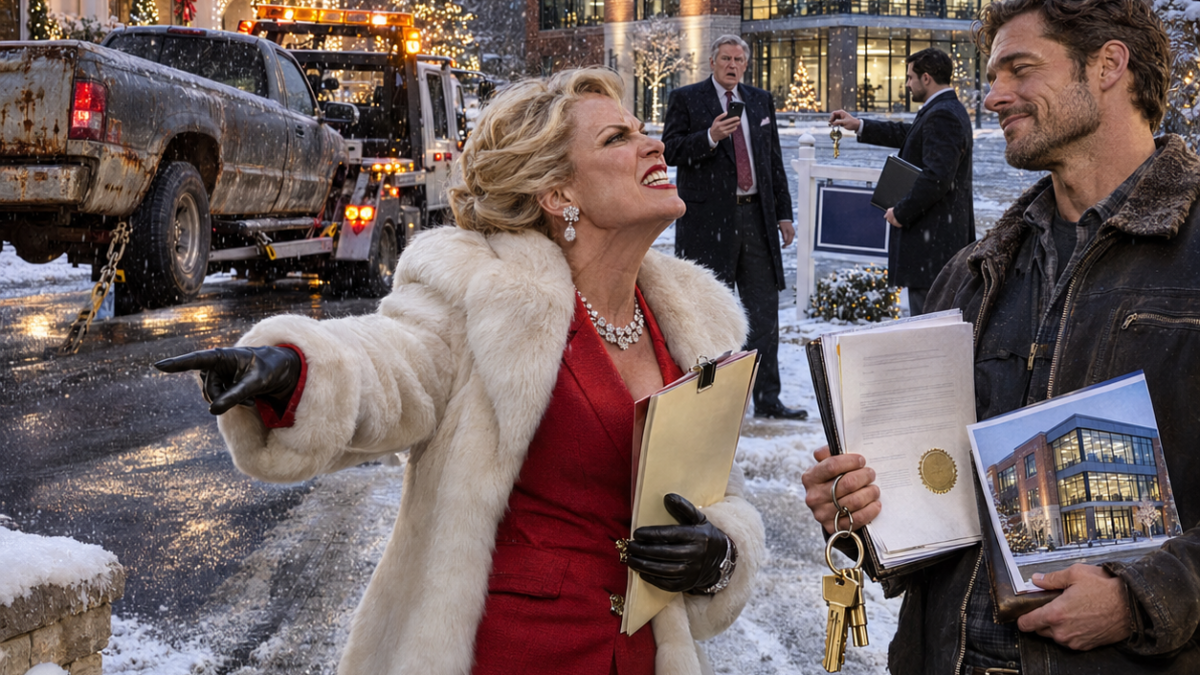
And every Christmas Eve, when snow begins falling over Juniper Lane, I remember those amber tow-truck lights reflecting off the hood of my old blue pickup.
I remember Vivienne standing in her red coat.
I remember the neighbors watching silently.
I remember her saying renters come and go.
She was partly right.
Renters do come and go.
Titles come and go too.
HOA presidents.
Landlords.
Business owners.
Board members.
Even marriages.
What remains is how you treated people when you believed you had the power to make their lives harder.
Vivienne learned that lesson painfully.
I learned another one.
Sometimes the strongest response to humiliation isn’t immediate retaliation.
Sometimes it’s documentation.
Patience.
Boundaries.
And refusing to let somebody else’s cruelty decide who you become.
That Christmas Eve, Vivienne thought she had taken something from me.
My truck.
My dignity.
My place in the neighborhood.
Instead, she accidentally gave me the clearest view I had ever had of Silver Pines.
And three weeks later, when her husband walked into my conference room and realized the quiet renter across the street now owned the building containing his business, I finally understood why I hadn’t needed to shout.
The paperwork had already said everything.








