PART2:“YOUR MARINE BROTHER LOST HIS HOUSE. GET OVER IT!” HOA Karen Sold His Home While He Was Deployed—She Never Expected Me to Find Out Who Bought It
PART2
I didn’t sleep that night.
I tried.
I really did.
Around midnight, I turned off the lights, stretched out on my couch, and stared at the ceiling.
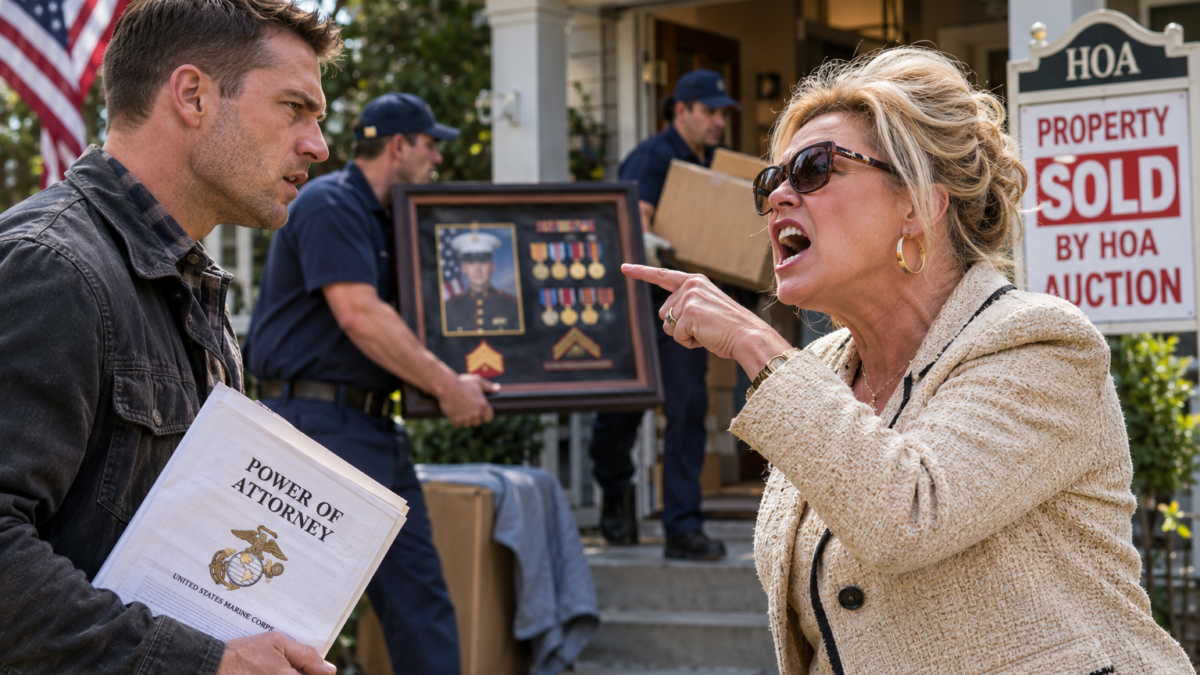
But every time I closed my eyes, I saw Aaron’s shadow box being carried through his front door.
I remembered helping him hang it.
He’d stood a few feet back while I adjusted the frame.
“Little crooked,” he’d said.
I’d stepped off the chair.
“Looks straight to me.”
“That’s because you have terrible eyesight.”
I’d laughed and moved it another quarter inch.
“There. Happy?”
Aaron had studied it.
Then smiled.
“Perfect.”
That stupid little memory hurt more than I could explain.
Those medals weren’t decorations.
They represented years of service, sacrifice, deployments, and people who had depended on him.
And Gwen had watched someone carry them away as though they were unwanted junk.
I sat up.
Turned on my laptop.
And opened the folder Aaron had given me before leaving.
The file was labeled:
DEPLOYMENT PREPARATION — LOGAN ACCESS
There were account details, copies of documents, contact information, and a spreadsheet tracking the obligations attached to his house.
Aaron had been meticulous.
Mortgage payments: current.
Utilities: active.
Home-security monitoring: paid.
Lawn maintenance: scheduled every two weeks.
HOA assessment payments: automatic.
I checked the bank statements.
No missed mortgage payments.
No unpaid regular HOA dues.
No sign that Aaron had abandoned his responsibilities.
I leaned back.
“What the hell did you do, Gwen?”
Then I opened the HOA’s online records.
And discovered the violations.
The first was dated in March.
Unkempt lawn — $150.
I frowned.
Aaron had hired Evergreen Landscaping to maintain the yard.
I opened the company records.
Six invoices.
Six documented visits.
Photographs attached to two of the reports.
The grass had been cut.
The landscaping had been maintained.
I saved everything.
The second violation concerned an unauthorized security system.
Another $150.
I stared at the description.
Aaron used a standard residential camera system.
The same basic setup I’d seen on several homes in the neighborhood.
There was no obvious reason it should have been treated as an extraordinary violation.
The third notice concerned extended vacancy.
No approved extended-absence registration.
That one made me stop.
Aaron had completed the form before deploying.
I remembered because he’d asked me to help scan it.
I searched the files.
There it was.
Signed.
Dated.
Submitted two weeks before his departure.
And stamped received by the HOA office.
I stared at the confirmation.
My hands began trembling.
They had the form.
They knew he was leaving.
They knew why.
Yet they fined him for failing to submit it.
I went through the violation history again.
Each $150 fine had been followed by administrative charges.
Then late fees.
Then additional assessments.
The balance had grown until the association claimed it had grounds to pursue foreclosure.
I had seen bad paperwork before.
I had dealt with unreasonable fees.
But this was something else.
Every accusation depended on ignoring records the HOA should already have possessed.
And somehow, the mistakes all worked in the same direction.
They created debt against a house whose owner couldn’t easily come home and defend himself.
I checked the clock.
2:41 a.m.
My coffee had gone cold.
I kept working.
Then I opened the county’s property records.
I searched Aaron’s address.
The transfer was still pending.
I leaned closer.
There was an auction record.
A proposed purchaser.
And a name that made my stomach drop.
Ryan Radcliffe.
I read it twice.
Then a third time.
Radcliffe.
I opened the HOA website.
Gwen’s profile was still there.
She’d served as president of Oakwood Ridge since 2018.
The biography described her commitment to neighborhood standards and property values.
There was also a paragraph about her family.
She mentioned her nephew.
A local entrepreneur named Ryan Radcliffe.
I sat motionless.
The woman who had approved the fines and pushed the foreclosure was related to the man buying the house.
Aaron’s house.
I looked at the screen.
Then at the documents spread across my table.
The false lawn violation.
The security-system complaint.
The ignored deployment form.
The compounded fees.
The foreclosure.
And Gwen’s nephew waiting to take ownership.
I felt cold all over.
This wasn’t an unfortunate coincidence.
At the very least, it was a serious conflict of interest.
And the pattern suggested something much worse.
I whispered, “You planned this.”
Then I thought about the other houses in Oakwood Ridge.
Retirees.
Military families.
Single parents.
People who traveled for work.
People who might not understand complicated HOA procedures.
How many others had been treated this way?
I opened a notebook.
And started writing names.
Lawyers.
Veterans’ organizations.
Housing advocates.
Local reporters.
State officials.
Anyone who might know how to stop a foreclosure against a deployed service member.
I wasn’t a Marine like Aaron.
I didn’t know how to fight the kind of battles he had been trained for.
But I understood computers.
Records.
Documentation.
And something Aaron had taught me years earlier.
When someone tries to intimidate you into surrendering, the first thing you do is find out what they’re hiding.
By sunrise, I had a plan.
And Gwen Radcliffe had become the most important project of my life.
The first six law offices I called didn’t give me much hope.
One receptionist said the attorney didn’t handle HOA disputes.
Another told me the firm required a consultation fee I couldn’t afford.
A third lawyer listened for several minutes, then said homeowner associations were notoriously difficult to challenge.
“You’re dealing with recorded covenants, assessments, foreclosure procedures, and property law,” he explained.
“I have records proving the fines are wrong.”
“That may help, but litigation could be expensive.”
“He’s serving overseas.”
“I understand.”
“No, I don’t think you do.”
I regretted snapping at him.
But I was exhausted.
Angry.
And terrified that every hour brought Ryan Radcliffe closer to owning Aaron’s house.
The next attorney quoted a retainer so large I nearly laughed.
Another said the foreclosure might already be impossible to reverse.
By the sixth call, I was sitting in my truck outside a grocery store with my forehead against the steering wheel.
I wanted to call Aaron.
I wanted to hear him say, “Relax, Logan. We’ll figure it out.”
But he was overseas.
His communications were limited.
And even if I reached him, what would I say?
Hey, remember the house you trusted me to protect? The HOA sold it to the president’s nephew while you were deployed.
I couldn’t bear the thought.
I wanted to have something better to tell him.
A plan.
A lawyer.
A reason to believe we could save his home.
So I made one more call.
The number came from a veterans’ legal support discussion.
The recommendation mentioned an attorney named Dale Whitaker.
He was described as experienced, stubborn, and nearly impossible to intimidate.
Exactly what I needed.
A woman answered.
“Whitaker Law Office.”
I explained my situation.
There was a pause.
Then she asked, “Your brother is on active-duty orders?”
“Yes.”
“And the HOA foreclosed without going through a court?”
“That’s what the records show.”
Another pause.
“Can you come today?”
I nearly dropped the phone.
“Yes.”
“Then come now.”
Dale Whitaker’s office was in a converted house on a quiet street.
The building looked as though it had survived three different decades without deciding which one it preferred.
Inside, books lined the walls.
Legal pads covered a desk.
A faded American flag hung near the window.
And a coffee mug carried the words:
SUE FIRST, SETTLE NEVER.
An older man with a gray beard and steel-rimmed glasses looked up when I entered.
“You’re Logan Price?”
“Yes, sir.”
“Your brother’s a Marine?”
“Yes.”
“Sit down.”
I sat.
He held out his hand.
“Documents.”
I placed the folder on his desk.
He opened it.
Read.
Turned a page.
Read again.
I watched his expression change.
At first, he looked mildly irritated.
Then interested.
Then angry.
He held up the extended-absence form.
“They received this?”
“Two weeks before Aaron deployed.”
“And they still fined him for failing to submit it?”
“Yes.”
He examined the landscaping invoices.
“These dates match the alleged lawn violations.”
“Exactly.”
He reviewed the security-system complaint.
Then the foreclosure paperwork.
Finally, I handed him the county record.
“Look at the buyer.”
Dale read the name.
“Ryan Radcliffe.”
I nodded.
“The HOA president’s nephew.”
He leaned back.
For a long moment, he said nothing.
Then he removed his glasses.
“Well.”
I waited.
He looked at me.
“Your brother has a very serious problem.”
My stomach dropped.
Then Dale continued.
“But the association may have a much bigger one.”
I leaned forward.
“Can you help?”
He picked up the deployment orders.
“Do you know about the Servicemembers Civil Relief Act?”
“I’ve heard of it.”
He nodded.
“It provides protections to qualifying active-duty service members. Among other things, it restricts certain foreclosure actions without court approval.”
I stared at him.
“Are you saying they couldn’t do this?”
“I’m saying we need to examine the dates, documents, and procedure carefully. If the association attempted a covered foreclosure without the required court order, we may have a powerful argument.”
I felt hope rise for the first time.
Dale pointed toward the county record.
“And this related-party purchase makes the entire situation even more troubling.”
I swallowed.
“Can we stop the transfer?”
“We can ask the court for emergency relief.”
I leaned closer.
“How soon?”
He was already reaching for a legal pad.
“Let’s get started.”
For the next two hours, Dale worked like a man who had been waiting years for exactly this kind of fight.
He asked precise questions.
When did Aaron deploy?
When was the first violation recorded?
Who received the notices?
Was I listed as his authorized representative?
What did the HOA know about his absence?
Had the association obtained any court order?
Who conducted the auction?
How was the winning bidder selected?
I answered everything I could.
He made copies.
Organized evidence.
Prepared a request for emergency relief to prevent the transfer from being completed while the dispute was reviewed.
I watched him work.
The difference between Dale and the attorneys who had dismissed me was striking.
He didn’t promise an easy victory.
He didn’t pretend the law was simple.
But he took the documents seriously.
And he treated my brother’s house as something worth defending.
By the afternoon, we had filed the emergency papers.
I stepped outside the courthouse and looked at the sky.
It was the first time in two days I’d noticed the weather.
Dale came out behind me.
“We’ve made our position clear.”
I turned.
“Does that mean the house is safe?”
“Not yet.”
My stomach tightened.
“But we’ve taken the first step.”
I nodded.
He looked at me carefully.
“Logan, from this point forward, don’t let anger make your decisions for you.”
I laughed bitterly.
“That’s going to be difficult.”
“I know.”
He put a hand on my shoulder.
“Keep your evidence. Keep your records. And don’t give Gwen an excuse to make this about your behavior instead of hers.”
I took a breath.
“Okay.”
Then I asked, “Can I tell her?”
Dale studied me.
“Tell her what?”
“That we’re challenging the foreclosure.”
He considered it.
“Stick to the facts. Don’t threaten her.”
I nodded.
“Understood.”
But as I walked toward my truck, I already knew I needed to see Gwen again.
Not because I expected her to apologize.
Because I wanted to look her in the eye and make sure she understood that Aaron wasn’t defenseless.
The Oakwood Ridge HOA office looked almost charming from the street.
Brick walls.
Flower boxes.
A decorative lantern.
A neatly painted sign.
It resembled the kind of building where friendly volunteers might organize neighborhood barbecues.
I knew better now.
I walked through the front door carrying the legal papers.
A young receptionist looked up.
“Can I help you?”
“I’m here to see Gwen Radcliffe.”
“Do you have an appointment?”
“No.”
She hesitated.
Before she could respond, Gwen’s office door opened.
Gwen stood inside holding a porcelain coffee cup.
She saw me.
Then smiled.
“Mr. Price.”
I approached.
“Mrs. Radcliffe.”
She leaned against the doorway.
“Have you come to apologize for yesterday’s scene?”
I stared at her.
“No.”
Her smile tightened.
“Then what can I do for you?”
I placed a copy of the filed emergency papers on her desk.
“You can read that.”
She set down her coffee.
Opened the folder.
And skimmed the first page.
For a moment, her expression changed.
Then she laughed.
“An emergency injunction?”
I nodded.
“My attorney is challenging the foreclosure and asking the court to stop the transfer.”
She closed the folder.
“How adorable.”
I felt my jaw tighten.
“Excuse me?”
“You really think filing some papers changes what happened?”
I stared at her.
“My brother is a deployed Marine.”
“And?”
“The association received his absence notification.”
She waved a hand.
“Our administrative staff process hundreds of documents.”
“You charged him for not filing a form he filed.”
“That is your interpretation.”
I leaned forward.
“I have the stamped copy.”
Her eyes narrowed.
“Mr. Price, you seem to be under the impression that neighborhood rules are optional if you dislike them.”
I shook my head.
“No. I understand rules.”
She smiled.
“Good.”
“I also understand evidence.”
Her expression hardened.
I continued.
“I have the landscaping invoices. I have the mortgage records. I have the security-system documentation. And I have the county record showing your nephew is the buyer.”
For the first time, her smile disappeared completely.
“Ryan is a private citizen.”
“He’s your nephew.”
“That doesn’t prohibit him from purchasing property.”
“Maybe not. But it’s one more thing a court should examine.”
She leaned closer.
“You have no idea how many people have tried to challenge this association.”
I stared at her.
“And?”
“They lost.”
Something about the way she said it bothered me.
Not the confidence.
The familiarity.
As though she wasn’t talking about one unfortunate dispute.
As though she had already watched other homeowners fight and fail.
She continued.
“We’ve been enforcing these rules for years. You won’t be the first person to complain.”
I felt the hairs rise on the back of my neck.
“How many houses have you taken?”
She straightened.
“That’s an inappropriate question.”
“How many?”
“Get out of my office.”
I looked at the folder.
Then back at her.
“You should find your own lawyer, Gwen.”
Her face flushed.
“Are you threatening me?”
“No.”
I turned toward the door.
“I’m telling you what’s coming.”
I left before my anger could take over.
Outside, the air felt cold.
I stood beside my truck and replayed her words.
We’ve been enforcing these rules for years.
Other people tried.
They lost.
I opened my notebook.
And added a new line.
Find previous HOA foreclosures.
That evening, I did something I never imagined doing.
I made the story public.
I had always been a private person.
I didn’t enjoy posting about my life.
I didn’t want strangers arguing over my brother’s deployment.
And I certainly didn’t want Aaron’s personal information exposed unnecessarily.
So I spoke with Dale about what records could be shared responsibly.
Then I prepared a post.
I explained that my brother was an active-duty Marine deployed overseas.
That his HOA had pursued foreclosure based on disputed fines.
That the property had been auctioned while he was away.
And that the winning bidder was related to the HOA president.
I attached carefully selected records supporting those claims, without publishing sensitive account information or military details that could compromise Aaron’s privacy.
Then I wrote:
My brother has served his country, paid his mortgage, maintained his home, and trusted me to protect it while he is deployed. Now the HOA has tried to take that home from him. We have filed for emergency court relief. If you know of other families who have experienced similar foreclosure practices, please speak up.
I stared at the screen.
My finger hovered over the button.
What if nobody cared?
What if Gwen’s supporters attacked us?
What if I made everything worse?
Then I remembered the moving truck.
And Aaron’s medals.
I clicked Post.
The response began almost immediately.
First came a few comments.
Then shares.
Then messages from people I didn’t know.
Some offered encouragement.
Others asked questions about the legal process.
Veterans’ organizations began circulating the story.
People who lived in HOA communities described similar disputes.
Several homeowners warned that associations could be extremely difficult to challenge when their rules were used aggressively.
Then something happened I hadn’t expected.
A woman from Oakwood Ridge sent me a private message.
My parents lost their home after disputed HOA fines. Please contact me.
I stared at it.
Then another message arrived.
A single mother described being fined repeatedly for minor outdoor equipment violations.
She said the debt had grown rapidly.
Eventually, she’d lost her property.
I opened the county records.
The dates and addresses gave me something concrete to investigate.
And in some transactions, the purchasers had connections to people associated with Gwen.
I sat back.
My stomach tightened.
Aaron might not have been the first.
The next morning, I called Dale.
“You need to see this.”
He listened as I described the messages.
Then he said, “Send me everything.”
I did.
A few hours later, he called back.
“Logan, don’t contact these people with promises. We need verified records and careful statements.”
“I know.”
“But this could become bigger than your brother’s case.”
I looked toward Aaron’s photograph on my desk.
“I think it already has.”
By the end of the week, the story had reached local news.
A television reporter called.
She wanted to interview me outside Aaron’s house.
I was nervous.
I wasn’t trained to speak in front of cameras.
My work involved repairing equipment, solving problems, and getting through the day without attracting attention.
But Dale told me to stick to what I knew.
So I did.
The reporter stood near the curb.
Behind us, Aaron’s house looked strangely empty.
The driveway was clear.
The lawn was freshly cut.
The flagpole remained.
I stared at it while she prepared her questions.
Then she looked into the camera.
“An active-duty Marine serving overseas is at the center of a controversial foreclosure involving his homeowners association.”
She turned toward me.
“Logan, what happened?”
I took a breath.
“My brother left this house in order.”
I pointed toward it.
“His mortgage was paid. His lawn was maintained. He filed the paperwork notifying the HOA about his deployment.”
The reporter nodded.
“And yet the association sold the property?”
“That’s what the records show.”
“What concerns you most?”
I looked toward the front door.
I remembered Aaron carrying boxes through it.
I remembered him laughing when we struggled with the couch.
I remembered helping him hang his medals.
Then I looked back at the reporter.
“That someone thought they could take advantage of the fact that he wasn’t here to defend himself.”
My voice grew stronger.
“My brother is serving overseas. He shouldn’t have to worry about whether the people running his neighborhood are going to take his home while he’s gone.”
The reporter asked about the buyer.
I explained the documented family relationship and why we believed the transaction deserved scrutiny.
Then she asked one final question.
“What are you hoping happens?”
I looked directly at the camera.
“I want my brother’s house restored. I want the process investigated. And if other families were harmed, I want them to have a chance to be heard.”
The segment aired that evening.
By morning, more people were contacting us.
The publicity spread faster than I could follow.
Veterans’ legal organizations reached out.
Housing advocates offered guidance.
A retired Marine colonel shared the story online.
Local officials began asking questions.
A Washington state senator who had served in the Navy called for the allegations to be reviewed.
A federal agency sent inquiries concerning the treatment of a service member’s property.
And reporters began investigating Oakwood Ridge’s foreclosure history.
I should have felt relieved.
Instead, I felt overwhelmed.
My phone rarely stopped ringing.
Some people wanted interviews.
Others wanted to tell me their own stories.
A few accused me of exaggerating or trying to destroy the HOA.
I tried to answer carefully.
I didn’t want attention for myself.
I wanted Aaron’s house protected.
But each new document raised more questions.
The association’s records suggested that other homeowners had faced large accumulated fines over relatively minor alleged violations.
Some had disputed the charges.
Some had paid fees that apparently weren’t properly credited.
And some properties had been transferred to buyers with connections to people in Gwen’s circle.
Dale warned me not to declare every transaction fraudulent before the facts were established.
He was right.
But the pattern was impossible to ignore.
The more we looked, the harder it became to believe Aaron’s case was simply an administrative mistake.
Then Aaron finally called.
His voice came through unevenly.
“Logan?”
I closed my eyes.
“Hey, brother.”
For a moment, I couldn’t speak.
He sounded tired.
Far away.
But alive.
“Mom said something happened with the house.”
I looked down.
“Yeah.”
“What happened?”
I swallowed.
“The HOA tried to foreclose on it.”
Silence.
Then:
“You’re kidding.”
“I wish.”
“Logan.”
“I’ve got an attorney. We’ve filed papers. We’re fighting it.”
He didn’t answer immediately.
Then he said, “The house is gone?”
I felt my chest tighten.
“The transfer is being challenged.”
“That’s not what I asked.”
I closed my eyes.
“The HOA auctioned it.”
He was quiet for so long I wondered whether the connection had failed.
Then he whispered, “I did everything right.”
I stared at the floor.
“I know.”
“I paid everything.”
“I know.”
“I sent the form.”
“I have it.”
Another silence.
Then Aaron asked, “Did they take my things?”
My throat closed.
“Some of them.”
He exhaled slowly.
I could picture him sitting somewhere overseas, trying to absorb the fact that strangers had entered his home and removed his belongings while he was away.
Finally, he asked, “The medals?”
I shut my eyes.
“We’re working on getting everything back.”
He didn’t speak.
“Aaron.”
“Yeah?”
“I’m sorry.”
His voice changed.
“Why are you apologizing?”
“You trusted me.”
“I still do.”
I began crying.
He continued.
“You’re there. I’m not.”
I pressed a hand over my face.
“Logan, listen to me.”
“Okay.”
“Don’t do anything stupid.”
I laughed through tears.
“Too late. I’m fighting an HOA president.”
He gave a short laugh.
Then grew serious.
“Take care of Mom.”
“I will.”
“And don’t let them intimidate you.”
I looked toward the legal folders covering my table.
“Not a chance.”
The call ended.
I sat motionless.
Then I picked up Aaron’s deployment folder again.
My brother had trusted me.
And I intended to deserve that trust.
The courthouse looked different on the morning of the hearing.
I arrived in my old Toyota Tacoma, expecting a small group of people waiting near the entrance.
Instead, I found a crowd.
Veterans.
Neighbors.
Reporters.
Families carrying signs.
Some people held American flags.
Others carried handmade placards supporting Aaron.
I saw a banner stretched across the courthouse gate.
STAND WITH SERGEANT PRICE.
I stopped walking.
For a moment, I couldn’t move.
A man wearing a Marine Corps veteran cap approached.
“You’re Logan?”
I nodded.
He held out his hand.
“Thank you for standing up for your brother.”
I swallowed.
“I’m just trying to get his house back.”
The man shook his head.
“That’s enough.”
I looked around.
People had come because they believed the issue mattered beyond one property.
The law was supposed to protect people.
Military service members.
Homeowners.
Families.
And if an association could ignore those protections, punish someone for serving overseas, and transfer a house to a relative of its president, then every homeowner had reason to be concerned.
Dale appeared beside me.
He looked at the crowd.
Then at me.
“Well, you’ve certainly attracted some attention.”
I laughed nervously.
“Sorry.”
He adjusted his tie.
“Don’t apologize. Just remember that the judge decides cases on evidence, not applause.”
I nodded.
He placed a hand on my shoulder.
“We’ve got the evidence.”
Then we walked inside.
The courtroom was packed.
Reporters lined the benches.
Neighbors from Oakwood Ridge sat near veterans and military families.
Some homeowners who had contacted us were present.
I saw people who had lost property.
People who believed they’d been treated unfairly.
And people who simply wanted to know whether an HOA president could really do what Gwen had done.
Then I spotted someone in uniform.
Aaron’s commanding officer.
He’d arranged to attend.
I felt my throat tighten.
He nodded toward me.
I nodded back.
Across the room, Gwen entered with her attorney and two board members.
She wore a tailored suit and oversized sunglasses.
Her expression was controlled.
But she wasn’t smiling.
She glanced toward the crowd.
Then toward me.
For a moment, our eyes met.
I remembered her standing on Aaron’s porch, telling me the law was the law.
Now she was sitting in a courtroom where she couldn’t simply declare herself the authority.
The judge entered.
Everyone stood.
Judge Claudia Henley took her seat and looked over the room.
She had a reputation for being direct and impatient with unsupported arguments.
I hoped that reputation was deserved.
The hearing began.
Dale rose.
“Your Honor, I represent Logan Price under power of attorney for his brother, Sergeant Aaron Price, a United States Marine currently serving on active duty overseas.”
The judge nodded.
Dale continued.
He explained Aaron’s deployment.
The mortgage payments.
The landscaping agreement.
The submitted absence form.
The fines.
The auction.
The pending transfer.
And the relationship between Gwen and the buyer.
He presented the records methodically.
Not shouting.
Not exaggerating.
Simply connecting documents.
Then he addressed the federal protections applicable to certain foreclosures involving active-duty service members.
He argued that the association’s foreclosure had proceeded without the required court authorization.
The judge looked toward Gwen’s attorney.
“Counsel, was a court order obtained before the association attempted the foreclosure?”
The lawyer hesitated.
“Your Honor, the association proceeded under its governing documents and state-law authority.”
The judge repeated the question.
“Was there a court order?”
Silence.
Then:
“No, Your Honor.”
I felt my pulse pounding in my ears.
Judge Henley looked down at the records.
Dale continued.
He explained why the law’s protections mattered.
A service member deployed overseas should not be placed at a disadvantage simply because military duties prevent them from responding to ordinary property disputes.
He then presented Aaron’s notice of extended absence.
The form bore the association’s receipt stamp.
The judge examined it.
“Your client received this?”
Gwen’s attorney shifted.
“The document appears to have been processed by administrative staff.”
The judge looked toward Gwen.
“Ms. Radcliffe, were you aware that Sergeant Price was deployed?”
Gwen stood slowly.
“We were aware he was absent.”
“That isn’t what I asked.”
Her face tightened.
“Yes, we knew.”
I gripped the edge of the table.
The judge looked at the form again.
“And yet the association assessed fines for failing to submit notice of extended absence.”
Gwen swallowed.
“Our office receives a large volume of paperwork.”
The judge stared at her.
“That doesn’t explain charging someone for failing to submit a document your office received.”
Gwen said nothing.
Dale then presented the landscaping records.
Invoices.
Dates.
Photographs.
The judge compared them with the violation notices.
The defense attorney argued that contractors’ visits didn’t necessarily prove every condition complied with HOA standards.
Dale acknowledged the distinction but pointed out that the association had offered little reliable support for several alleged violations.
Then came the auction record.
Ryan Radcliffe.
Gwen’s nephew.
The judge looked toward her.
“Is the successful bidder related to you?”
Gwen hesitated.
“Yes.”
“How?”
“He’s my nephew.”
The courtroom murmured.
The judge raised a hand.
Silence returned.
“Was that relationship disclosed and appropriately addressed during the transaction?”
Gwen looked toward her lawyer.
He began answering.
But the judge interrupted.
“I want the documentation.”
Dale provided what we had.
The judge reviewed it.
Then she leaned back.
For several seconds, the courtroom was completely silent.
Finally, she spoke.
“The plaintiff has presented substantial grounds for emergency relief.”
My heart began pounding.
She continued.
“The attempted foreclosure and transfer raise serious questions concerning compliance with applicable service-member protections, notice requirements, and the association’s own procedures.”
Gwen sat rigidly.
The judge ordered the transfer halted and directed further review of the foreclosure’s validity.
Then, after considering the records and the procedural defects before the court, she ruled that the association’s attempted sale could not stand.
The foreclosure was invalidated.
The transfer was vacated.
Aaron’s ownership was preserved.
For a moment, I couldn’t understand what I’d heard.
Then Dale leaned toward me.
“Logan.”
I looked at him.
“We got the house back.”
My eyes filled instantly.
Around us, people reacted.
Someone gasped.
A few people began applauding before the judge called for order.
I sat motionless.
I saw Aaron’s front door.
His fireplace.
The shadow box.
The flagpole.
And I realized that when he came home, the house he’d worked so hard to buy would still be his.
I covered my face.
And cried.
The judge wasn’t finished.
She addressed the association’s conduct and the related-party transaction.
The matter, she explained, warranted additional review by appropriate authorities.
Records concerning other foreclosures could be examined.
Potential wrongdoing would be evaluated through the proper legal processes.
Gwen’s expression had changed completely.
She no longer looked like a woman who controlled a neighborhood.
She looked like someone who had finally discovered that her clipboard was not stronger than the law.
I watched her.
And remembered what she’d told me in her office.
We’ve done this before.
I wondered whether she regretted those words now.
The hearing concluded.
Dale gathered his papers.
Then he looked at me.
“Your brother’s house is safe from this attempted transfer.”
I nodded.
My voice wouldn’t work.
He smiled faintly.
“You can call him.”
I took out my phone.
Then hesitated.
Aaron was still overseas.
He might not be able to answer.
But I typed a message anyway.
We won. The house is yours. I’ll explain everything when you can call.
I stared at it.
Then sent it.
It was the best message I’d ever written.
Outside the courthouse, reporters crowded around us.
Microphones appeared.
Cameras clicked.
People called my name.
I wasn’t prepared.
Dale answered the legal questions.
He explained the significance of the ruling and the remaining investigations.
Then a reporter turned toward me.
“Logan, how do you feel?”
I looked around.
Veterans stood beside neighbors.
People who had never met Aaron were holding signs with his name.
And somewhere overseas, my brother was still doing his job.
I swallowed.
“Relieved.”
The reporter waited.
I continued.
“But this isn’t just about Aaron anymore.”
I looked toward the courthouse.
“We found other homeowners who may have been treated unfairly. They deserve to have their cases examined too.”
Another reporter asked whether I wanted Gwen punished.
I thought about her standing on my brother’s porch.
The way she’d laughed.
The satisfaction in her voice.
Then I said, “I want the truth established, and I want the people responsible held accountable.”
Dale nodded beside me.
I added, “Nobody should lose their home because someone in authority thinks they won’t be able to fight back.”
Then I stepped away.
I had said enough.
The next morning, Gwen resigned as HOA president.
The announcement described personal reasons.
I read it twice.
Then set my phone aside.
I didn’t feel like celebrating.
I wanted the investigations to continue.
And they did.
Authorities began reviewing the association’s foreclosure practices.
Past transactions.
Fee records.
Auction procedures.
Related-party purchases.
And the roles played by Gwen and other people involved in the administration.
The more records investigators examined, the more troubling questions emerged.
A retired couple had lost their home after disputed HOA charges despite possessing proof of payments.
A single mother had faced escalating penalties following minor outdoor-equipment complaints.
Other homeowners described notices they believed were improper or fees that grew beyond anything they could reasonably pay.
Some properties had subsequently been purchased by people with connections to Gwen.
The situation was no longer a single foreclosure dispute.
It was an investigation into whether the association’s authority had been used systematically to benefit insiders.
I thought about the people who had contacted me.
Some were embarrassed.
Others angry.
A few had given up trying to recover their property because they believed no one would listen.
I understood that feeling now.
The helplessness.
The exhaustion.
The way an official letter could make an ordinary person feel powerless.
I wanted them to know that documentation mattered.
That questions mattered.
And that Gwen’s confidence wasn’t proof she had been acting lawfully.
The HOA board began falling apart.
Some members resigned.
Others retained attorneys.
Records were requested.
Financial arrangements came under scrutiny.
Gwen’s personal financial dealings were examined in connection with the disputed transactions.
Civil claims followed.
The association that once seemed capable of intimidating anyone into silence was suddenly being required to explain itself.
I watched everything unfold from my kitchen table.
The same table where I’d spent that first sleepless night.
Back then, I’d been one exhausted younger brother staring at a folder of documents.
Now lawyers, investigators, public officials, and homeowners were examining the same pattern.
It felt almost unreal.
But every time the coverage became overwhelming, I reminded myself what mattered most.
Aaron was coming home eventually.
And I wanted his house ready.
The damage to his belongings couldn’t be ignored.
Some furniture had been removed.
Other items were scratched or broken.
The house needed cleaning.
Repairs.
Replacement appliances.
And a careful inventory of anything that had gone missing.
Legal proceedings resulted in compensation for the unlawful foreclosure and related losses.
The total damages award was $275,000, including specified property losses, legal costs, and compensation tied to the harm caused.
It was a significant amount.
But I didn’t think of it as a prize.
I thought about the hours I’d spent sorting through the wreckage of Aaron’s home.
The fear I’d carried while trying to stop the transfer.
And the fact that my brother had been thousands of miles away, unable to protect the place he’d bought.
Money couldn’t erase that.
But it could help repair the damage.
We began rebuilding.
The movers returned with a different purpose.
This time, they carried things into the house.
A replacement couch.
Appliances.
Furniture.
Boxes of belongings that had been recovered.
I stood in the living room directing where things belonged.
“That goes upstairs.”
“The table belongs by the window.”
“Careful with that frame.”
When the military shadow box was returned, I carried it myself.
I stood before the fireplace.
The wall looked strangely bare.
I remembered hanging the box with Aaron years earlier.
I took out a level.
Adjusted the frame.
Checked it again.
Then stepped back.
Straight.
Exactly where it belonged.
I looked at the medals.
And whispered, “You’re coming home, brother.”
Oakwood Ridge held a meeting to elect new leadership.
For years, Gwen had dominated the association.
People were afraid to challenge her.
Some residents felt there was little point attending meetings because the decisions seemed to have been made before anyone spoke.
Now the meeting room was full.
Homeowners wanted answers.
They wanted records.
They wanted limits on how fines could escalate.
They wanted meaningful review before anyone could face the loss of a home.
And they wanted new leadership.
Keith Barlow, a retired Army master sergeant, was nominated.
He lived in Oakwood Ridge.
He had previously been fined over the placement of a military flag.
He understood the frustration of dealing with an association that sometimes seemed more interested in control than fairness.
He was elected unanimously.
I attended the meeting.
Afterward, Keith approached me.
“Logan.”
I shook his hand.
“Congratulations.”
He smiled.
“Don’t congratulate me yet. We’ve got a lot of work.”
I laughed.
“That sounds familiar.”
His expression grew serious.
“What happened to Aaron cannot happen again.”
I nodded.
“Agreed.”
The new board began reviewing the association’s procedures.
They adopted stricter safeguards around foreclosure actions, including requirements for legal review and appropriate court authorization where necessary.
Protections for active-duty military homeowners were emphasized.
Clearer recordkeeping and notice procedures were introduced.
Residents pushed for more transparency about conflicts of interest.
It wasn’t a magical solution.
Rules only matter if the people responsible follow them.
But for the first time, the HOA was being rebuilt around the idea that its authority existed to serve homeowners—not exploit them.
Keith handed me a copy of the new resolution.
I read it carefully.
Then folded it.
“I know exactly who needs this.”
I mailed the resolution to Aaron.
Inside the envelope, I included a letter.
I told him about the court hearing.
About Dale.
About the neighbors who came forward.
About the investigations.
About Keith’s election.
And about the changes to the HOA’s procedures.
Then I wrote something personal.
I know you told me not to lose the house. I came closer than I ever wanted to admit. But it’s yours, Aaron. The deed is yours, the rooms are ready, and the flagpole is still standing. Come home when you can.
I paused.
Then added:
I couldn’t protect you from everything that happened. But I kept my promise that I wouldn’t stop fighting.
I sealed the envelope.
And for the first time in months, I slept through the night.
The investigation into Gwen’s conduct continued.
The details emerged gradually.
Some former homeowners pursued claims to challenge the transactions that had cost them their property.
Others sought compensation.
The association itself faced difficult questions about the responsibility of board members who had approved or failed to challenge improper actions.
There were no simple answers for every family.
Some had already moved away.
Some were dealing with years of financial consequences.
Others had lost treasured belongings that couldn’t be replaced.
I learned quickly that justice isn’t always as neat as one dramatic courtroom ruling.
Sometimes it involves months of paperwork.
Disputed records.
Hearings.
Appeals.
And people telling painful stories over and over.
But there was progress.
Gwen no longer controlled the association.
Her transactions were under scrutiny.
And homeowners who once believed they had no voice were being heard.
I thought about the night I found Ryan Radcliffe’s name in the county records.
How frightened I’d been.
How alone I’d felt.
And how certain Gwen seemed that nothing could stop her.
Now, when I drove through Oakwood Ridge, I saw people talking openly about the association.
Attending meetings.
Asking questions.
Reviewing documents.
It wasn’t the kind of neighborhood transformation you see in a movie.
There were still disagreements.
Still rules.
Still people who complained about lawns and fences.
But the fear had changed.
And that mattered.
Nine months after Aaron deployed, I received the call I’d been waiting for.
He was coming home.
I was sitting in his living room when my phone rang.
His name appeared on the screen.
I answered immediately.
“Hey, stranger.”
He laughed.
“Still keeping the place standing?”
I smiled.
“Mostly.”
“Mostly?”
“You know how old houses are.”
“Logan.”
“Yeah?”
“I’m coming home.”
I stood up.
“When?”
He told me.
I stared toward the fireplace.
At the shadow box.
At the couch.
At the familiar rooms.
And I felt tears gathering.
“That’s good, brother.”
He was quiet for a moment.
Then asked, “Is it really okay?”
I knew what he meant.
Not the court case.
Not the HOA.
The house.
The place he had been afraid he’d lost.
I looked around.
“Yeah.”
My voice broke.
“It’s ready.”
I had planned to pick him up at Seattle-Tacoma International Airport.
But Aaron insisted he wanted a quiet ride home.
After months overseas, he didn’t want a crowd at the airport.
He wanted a shower.
A meal.
And his own bed.
I understood.
So I arranged for a car to bring him to Oakwood Ridge.
Then I contacted a few neighbors.
I wanted them to know when he was arriving.
Just in case they wanted to welcome him.
The response was overwhelming.
Keith offered to help.
Several veterans volunteered.
Neighbors began making signs.
A family asked whether they could hang a banner across the porch.
I hesitated.
Aaron wasn’t someone who liked being the center of attention.
But I remembered everything he’d been through.
And I wanted the first thing he saw when he returned to his street to be proof that the neighborhood was no longer the place that had tried to take his home.
So I agreed.
On the day Aaron arrived, the sky was clear.
I woke before sunrise.
I walked through his house one last time.
The kitchen was clean.
The refrigerator was stocked.
Fresh towels hung in the bathroom.
The bedrooms were ready.
His favorite coffee was waiting near the machine.
I checked the living room.
The couch stood where it belonged.
His photographs were arranged.
The shadow box hung above the fireplace.
I adjusted it slightly.
Then laughed at myself.
It was already straight.
I stepped outside.
The American flag moved gently in the morning breeze.
The lawn was freshly cut.
Flowers had been planted near the walkway.
Everything looked familiar.
Everything looked like home.
By late morning, neighbors began gathering.
A white banner stretched across the porch.
WELCOME HOME, SERGEANT PRICE.
Children held signs.
Veterans stood near the curb.
People who had followed the case came to show support.
I stood in the driveway.
Nervous.
Excited.
And suddenly afraid I’d start crying before Aaron even arrived.
Keith came over.
“You doing all right?”
I nodded.
“Yeah.”
He smiled.
“You don’t look convinced.”
I laughed.
“Just thinking about the last time I stood here with a crowd.”
Keith’s expression softened.
“This time is different.”
I looked toward the road.
“Yeah.”
I took a breath.
“This time it is.”
When the car turned onto the street, people began moving toward the sidewalk.
I stood still.
I saw the vehicle approach slowly.
Then stop in front of the house.
For a moment, the door remained closed.
Then Aaron stepped out.
He wore travel clothes and carried a duffel bag over one shoulder.
He looked tired.
Older than when he’d left.
His posture was still unmistakably military.
But when he saw the crowd, he stopped.
His eyes moved across the signs.
The banner.
The neighbors.
The veterans.
Then toward the house.
I watched his face change.
At first, confusion.
Then disbelief.
Then something that looked like relief so intense it hurt.
He lowered his duffel.
“Logan?”
I smiled.
“Hey, brother.”
He looked toward the porch.
“That’s my house.”
I nodded.
“Sure is.”
He stared.
“The whole thing?”
I laughed through tears.
“Every room.”
His eyes filled.
“You got it back.”
I stepped closer.
“Yeah.”
He looked at me.
“You really got it back.”
I nodded.
Then he dropped his bag.
And pulled me into the tightest hug of my life.
I wrapped my arms around him.
For a moment, neither of us spoke.
Then Aaron whispered, “Thank you.”
My throat closed.
I shook my head against his shoulder.
“You’re my brother.”
He held me tighter.
“I know.”
I swallowed.
“You trusted me.”
He pulled back and looked into my eyes.
“Still do.”
That was when I finally broke.
I began crying.
Months of fear.
Anger.
Exhaustion.
The courtroom.
The paperwork.
The moving truck.
The nights I wondered whether I’d failed him.
It all came out.
Aaron hugged me again.
And for the first time since that awful morning, I allowed myself to believe the fight was truly over for us.
Inside, Aaron walked slowly from room to room.
He touched the back of the couch.
Looked at the photographs.
Opened a kitchen cabinet.
Smiled at the familiar coffee mugs.
It was the kind of tour a person takes when they fear the home they remember might exist only in their imagination.
I stayed a few steps behind him.
I wanted to give him space.
He stopped in front of the fireplace.
His eyes went to the shadow box.
For a long moment, he didn’t move.
Then he approached it.
Touched the frame.
And looked at me.
“You saved these.”
I nodded.
“Got them back.”
He swallowed.
“Thank you.”
I smiled weakly.
“Had to put them back where they belonged.”
He looked at the medals.
Then toward the window.
“Everything looks the same.”
I nodded.
“We tried.”
He shook his head.
“I don’t mean that.”
I waited.
He looked back at me.
“I thought I’d come home to nothing.”
My chest tightened.
He continued.
“I knew you were fighting. I saw the messages. But I couldn’t be here.”
I nodded.
“I know.”
He looked down.
“That was the worst part.”
I waited.
“Knowing someone was taking my home and there was nothing I could do.”
I felt tears gathering again.
Aaron looked toward the front door.
“You did what I couldn’t.”
I shook my head.
“You would have done the same.”
He smiled faintly.
“Probably.”
Then he held out his hand.
I took it.
He pulled me into another embrace.
And I knew the house wasn’t simply a financial asset to him.
It was proof that something permanent still waited for him after months away.
A place to return.
A place to rest.
A place to belong.
On the kitchen counter, I’d placed a framed copy of the new HOA resolution.
Aaron noticed it.
“What’s that?”
I smiled.
“Read it.”
He picked it up.
His eyes moved down the page.
He frowned.
Then read it again.
“Is this because of what happened?”
I nodded.
“The association has new leadership. They adopted stronger procedures to protect service members and other homeowners.”
He stared at the document.
Then at me.
“You changed the rules?”
I smiled.
“Some of them.”
Aaron shook his head slowly.
“Logan…”
I shrugged.
“Turns out a lot of people were tired of Gwen.”
He laughed.
Then grew serious.
“You didn’t just get my house back.”
I looked at him.
He held up the framed resolution.
“You made sure the next guy has a better chance.”
I swallowed.
“That was the idea.”
Aaron nodded.
Then placed the frame carefully on the counter.
For a moment, we stood in silence.
Outside, neighbors were still talking.
Children laughed.
Someone was folding the welcome-home banner.
The street looked ordinary again.
But it wasn’t quite the same neighborhood.
And neither were we.
That evening, Aaron and I sat on his back porch.
The welcome-home gathering had ended.
The neighbors had gone home.
The house was quiet.
I brought out two cups of coffee.
Aaron looked at mine.
“Still drinking that terrible stuff?”
I laughed.
“You still complaining about free coffee?”
He smiled.
“Some things never change.”
We sat for a while without speaking.
Then he looked toward the backyard.
“Did you ever think we’d end up fighting an HOA over my house?”
I shook my head.
“Not in a million years.”
He smiled.
“Mom said you became famous.”
I groaned.
“Don’t start.”
He laughed.
“Saw you on television.”
“Yeah?”
“You looked terrified.”
“I was.”
He nodded.
“Still did it.”
I looked down.
“For you.”
He was quiet.
Then he said, “I know.”
We sat listening to the evening breeze.
After a while, Aaron asked about Gwen.
I told him what I knew.
Her resignation.
The investigations.
The questions surrounding past foreclosures.
The related-party transactions.
The civil claims.
I explained that some matters remained unresolved and would take time.
Aaron listened.
Then he shook his head.
“All that power over people’s homes.”
I nodded.
“And she used it like that.”
I looked toward the fence.
“She thought no one would challenge her.”
Aaron stared at me.
“Guess she was wrong.”
I smiled.
“Yeah.”
He leaned back.
“Good.”
In the weeks after Aaron returned, life began settling into something recognizable.
He resumed ordinary routines.
Grocery shopping.
Laundry.
Maintaining the yard.
Drinking coffee at his kitchen table.
He spent time with neighbors who had supported us.
He thanked the veterans who had attended the hearing.
He met Keith and discussed the association’s new procedures.
And gradually, the house became his again in a deeper sense than any court order could provide.
Not merely a property whose title was restored.
A home he could live in without constantly thinking about what had happened there.
That took time.
There were moments when he opened a cupboard and noticed an item had been moved.
Times when he looked toward the driveway and remembered the truck.
Times when a letter from the HOA arrived and he paused before opening it.
I understood.
The legal fight had ended in our favor.
But the experience had changed the way he saw the place.
Trust doesn’t always return as quickly as ownership.
We talked about that.
Sometimes over dinner.
Sometimes while working in the yard.
Sometimes without saying much at all.
Aaron never pretended the experience was harmless.
And I didn’t ask him to.
But slowly, the memories of coming home began replacing the memories of the foreclosure.
The welcome-home banner.
The neighbors.
The smell of fresh coffee.
His medals above the mantel.
And the knowledge that someone had stood beside him when he couldn’t be there himself.
One afternoon, I stopped by to help Aaron repair a loose board on the back fence.
We worked for about an hour.
The weather was mild.
Music played quietly from the kitchen.
It felt almost exactly like the days before his deployment.
When we finished, Aaron stepped back.
“Looks good.”
I smiled.
“That’s because I did most of the work.”
He laughed.
“You held the boards.”
“Critical contribution.”
He shook his head.
Then looked toward the house.
For a moment, his expression grew serious.
“Logan?”
“Yeah?”
“I never asked you something.”
I set down the hammer.
“What?”
“Were you scared?”
I stared at him.
“Of Gwen?”
“Of losing the house.”
I looked toward the porch.
Then nodded.
“Every day.”
Aaron was quiet.
“I thought I failed you.”
He frowned.
“Logan—”
“I promised I’d protect the place. Then I got that call from Mom and found strangers carrying your things out.”
My throat tightened.
“I kept thinking I should’ve checked the HOA records sooner. I should’ve noticed the notices. I should’ve known something was happening.”
Aaron stepped closer.
“Stop.”
I looked at him.
“You didn’t cause this.”
I swallowed.
“Still.”
He shook his head.
“You had everything in order because I trusted you to handle the things I couldn’t. The HOA ignored the records. That’s on them.”
I looked down.
He continued.
“You found the problem. You fought it. You got my house back.”
I nodded slowly.
Then Aaron placed a hand on my shoulder.
“You didn’t fail me, Logan.”
My eyes filled.
“You were the reason I had a home to come back to.”
I couldn’t answer.
He squeezed my shoulder.
Then picked up the hammer.
“Now stop getting emotional and help me clean this mess up.”
I laughed through tears.
“Yes, Sergeant.”
He grinned.
“That’s better.”
I think about Gwen Radcliffe sometimes.
Not because I miss fighting her.
Believe me, I don’t.
I think about how easily authority can become dangerous when nobody questions it.
A neighborhood association is supposed to help a community manage shared responsibilities.
Maintain common areas.
Establish reasonable standards.
Resolve disputes.
Protect homeowners’ interests.
But authority without accountability can become something very different.
Gwen had treated the rules as though they belonged to her.
She expected people to accept notices without asking questions.
Pay fines without examining records.
And surrender their property because challenging the association seemed too difficult or expensive.
My brother’s deployment gave her an opportunity she believed would be easy to exploit.
He was far away.
The house was vacant.
Not because he had abandoned it.
Because he was serving overseas.
And she believed there was nobody close enough to stop her.
She overlooked one thing.
Aaron had left someone responsible for his affairs.
He had trusted me.
And once I found the records, I wasn’t going to stop until someone with real authority examined what had happened.
I also think about the other homeowners.
The retired couple.
The single mother.
The families whose stories began surfacing after we made Aaron’s case public.
I don’t know whether every one of them will recover everything they lost.
I hope so.
But I know that their experiences deserve careful investigation.
Some people spend their entire lives paying for a home.
They save.
Work.
Sacrifice.
Raise children.
Build memories.
Then one day, an unexpected financial or administrative dispute threatens everything.
For someone with money and connections, hiring lawyers may be possible.
For someone living on retirement income or supporting children alone, it can feel impossible.
That difference in resources is exactly why the law must be applied fairly.
And why records, notice requirements, judicial review, and safeguards matter.
They aren’t just technicalities.
They exist because a home is often the most valuable thing a family owns.
And sometimes the most meaningful.
The last time I visited Aaron, we stood together in his driveway.
It was early evening.
The light fell across the front of the house.
His American flag moved gently above the lawn.
I looked toward the porch.
For a moment, I saw Gwen standing there with her clipboard.
The movers.
The truck.
The shadow box.
I remembered how helpless I’d felt.
Then Aaron opened the front door and called, “You coming in or what?”
I smiled.
“Yeah.”
I walked up the steps.
The same steps I’d run across that awful morning.
But this time, nobody tried to stop me.
Nobody told me the house belonged to someone else.
Nobody stood there pretending a stack of HOA notices was more important than the truth.
I stepped inside.
Aaron was in the kitchen preparing coffee.
He looked up.
“Still take it black?”
“Still make it terrible?”
He grinned.
“Absolutely.”
I laughed.
Then I looked around.
The house was warm.
Lived in.
Familiar.
Safe.
And I realized that was the thing I’d been fighting for all along.
Not revenge.
Not attention.
Not the satisfaction of humiliating Gwen.
I wanted my brother to walk through his own front door.
Take off his boots.
Set down his keys.
And know that the place he’d worked for was still there.
I wanted him to come home.
There are people who hear our story and focus on the courtroom.
The judge.
The legal arguments.
The association president being forced to answer questions she couldn’t dismiss.
Other people focus on the investigation.
The suspicious property transfers.
The related buyers.
The homeowners who began speaking up.
Those things matter.
They should matter.
But when I remember the whole experience, I keep returning to one small moment.
Aaron standing in his driveway on the day he came home.
His duffel bag hanging from one shoulder.
His face filled with disbelief.
And the way he whispered:
“You got it back.”
That was the moment everything became real.
For months, I’d been living inside a fight.
Documents.
Phone calls.
Court filings.
Public attention.
Legal uncertainty.
Even after the ruling, I was focused on repairs, compensation, and making sure the house was ready.
I hadn’t allowed myself to stop and understand what we’d accomplished.
Then Aaron stepped out of that car.
He looked at his home.
And I saw what the fight had meant to him.
A place to return.
A place where his memories belonged.
A place he’d bought with years of work.
A home he thought he might never see again.
And I knew that every sleepless night had been worth it.
I still keep a copy of the original foreclosure paperwork in a folder at home.
Not because I enjoy looking at it.
I don’t.
I keep it because it reminds me how easily an official document can be used to frighten someone who doesn’t know how to challenge it.
Beside it, I keep the stamped extended-absence form.
The landscaping invoices.
The legal filings.
And the court’s ruling.
Together, they tell a story.
Not of a perfect system.
But of a system that can sometimes be made to correct itself when people refuse to accept unsupported claims.
They remind me of Dale Whitaker.
The attorney who took us seriously when others turned us away.
The neighbors who came forward.
The veterans who showed up.
The people who shared documents.
The officials who examined the case.
And the homeowners who found the courage to tell their own stories.
I didn’t win that fight alone.
I may have made the first phone calls.
But the truth needed witnesses.
Evidence.
Professionals willing to work.
And people who believed the rules should apply to those in power too.
Sometimes Aaron jokes that I should run for HOA president.
I tell him I’d rather repair a thousand broken printers.
He laughs.
Then says, “You’d be good at it.”
I shake my head.
“No, thanks.”
I don’t want Gwen’s old job.
I don’t want control over my neighbors.
I don’t want to spend my evenings arguing about fences or lawn decorations.
What I want is much simpler.
I want homeowners to know their rights.
I want associations to maintain accurate records.
I want people in positions of authority to disclose conflicts of interest.
I want families to receive proper notice and fair review before anyone threatens their home.
And I want service members who deploy overseas to know their property won’t be treated as an easy target simply because they’re away.
That shouldn’t be a revolutionary idea.
It should be ordinary.
Just as ordinary as a man coming home from deployment and opening his own front door.
Months after Aaron returned, I found an old photograph on my phone.
It showed the two of us on the day he moved into Oakwood Ridge.
He was standing on the porch with a cardboard box under one arm.
I was beside him holding a toolbox.
Both of us were smiling.
The house behind us looked empty.
There were no curtains.
No flowers.
No flagpole yet.
Just two brothers helping turn a building into a home.
I sent him the picture.
A few minutes later, he replied.
You looked younger.
I laughed.
So did you.
Then another message arrived.
Thanks again, brother.
I stared at it.
And typed back:
Always.
Because that’s what I’d promised him long before Gwen Radcliffe ever appeared.
And that’s what I’d do again.
The morning my mother called to say Aaron’s house had been sold, I thought our family had already lost.
I thought the HOA had too much power.
That the auction was final.
That the paperwork would be impossible to challenge.
That I was just an ordinary man with no way to fight an organization determined to take what belonged to my brother.
But Gwen had confused confidence with authority.
She had confused silence with surrender.
And she had confused a deployed Marine’s absence with helplessness.
She thought Aaron wouldn’t be able to return in time.
She thought I would get angry, shout for a while, then disappear.
She thought the foreclosure paperwork would be enough to stop anyone from asking questions.
She never expected me to examine the fines.
She never expected me to find the stamped deployment notice.
She never expected me to look up the winning bidder.
And she certainly never expected the story of one Marine’s house to bring scrutiny to years of HOA conduct.
But none of that would have mattered if we’d simply accepted her word.
The evidence had been there.
The records existed.
The questions needed asking.
And once we asked them, Gwen’s version of events began falling apart.
Last Sunday, I drove over to Aaron’s house for dinner.
His driveway was clear.
The lawn looked good.
The flagpole stood beside the walkway.
I parked in the same place I’d parked the morning of the foreclosure.
Then I sat in my truck for a moment.
I remembered the panic.
The movers.
Gwen’s sunglasses.
The police officer telling me it was a civil matter.
And the terrible feeling that I’d already failed my brother.
Then I looked toward the porch.
Aaron was standing there.
Wearing an old T-shirt.
Holding a spatula.
Grinning.
“You planning to sit in your truck all night?”
I laughed.
“Depends. Is dinner any good?”
He shrugged.
“Better than your cooking.”
I got out.
Walked up the driveway.
And followed him inside.
The house smelled of grilled food and coffee.
His medals hung above the mantel.
The framed HOA resolution stood on a shelf near the kitchen.
And somewhere in the backyard, the evening breeze moved through the trees.
It was ordinary.
Completely ordinary.
That was what made it beautiful.
Aaron was home.
His belongings were his.
His name remained on the deed.
And the people who tried to take those things had finally faced scrutiny beyond the authority they’d claimed for themselves.
I sat at his kitchen table while he finished dinner.
Then I looked around and thought about the promise he’d asked me to make before deployment.
Don’t lose the house.
I smiled.
Because after everything we’d endured, I finally knew I’d kept it.
Gwen Radcliffe thought she could steal a Marine’s home because he was thousands of miles away and unable to defend it. What she never understood was that my brother hadn’t left his house unprotected—he’d left it in the hands of someone who loved him enough to fight until he had a home to come back to.








