PART2:“YOUR GRANDFATHER WAS A BROKE OLD FOOL!” HOA Karen Demolished My Family’s 40-Year-Old Bridge and Threw a Victory Party—She Had No Idea What Would Happen When 63 Families Tried to Get Home
Russell Haynes answered at 12:43 a.m.
“Colton?”
His voice was thick with sleep.
“Russ, it’s gone.”
Silence.
Then the sound of movement.
“What is?”
“The bridge.”
He was fully awake now.
“Tell me exactly what happened.”
I looked through my kitchen window toward the creek.
“Diane hired a demolition crew. Two flatbeds, an excavator, cutting equipment. They destroyed the entire structure while I was away.”
“Do you have proof?”
I swallowed.
“Four cameras. Multiple angles. The equipment, the contractors, Diane giving instructions. Everything.”
Russ exhaled slowly.
“Don’t disturb the scene any further. Preserve the recordings and the original files.”
“I already backed them up.”
“Good. And Colton?”
“Yes?”
“Did you authorize any demolition?”
I stared into the darkness.
“No.”
“Did you sign the easement?”
“No.”
“Did the HOA provide a court order?”
“No.”
Russ was quiet.
Then he said, “We’re going to need the deeds, survey, communications, contractor information, and a proper damage assessment.”
“I’ve got most of it.”
“Then we’ll start there.”
I closed my eyes.
“Russ, she destroyed the only convenient crossing those families use to reach the highway.”
He didn’t answer immediately.
When he did, his voice had changed.
“How many households?”
“Eighty.”
A pause.
“Is there another road?”
“An old county-road loop through Leander. Rough, narrow, close to an hour when conditions are good. Large vehicles can’t reliably use it.”
Russ swore softly.
“That raises serious access and emergency-response concerns.”
I leaned against the kitchen counter.
“She knows all those families use the bridge.”
“Then we need to determine who else approved the work and whether anyone evaluated the consequences.”
I looked down at the concrete fragment in my hand.
The broken date.
The piece of my grandfather’s life she’d left in the creek.
“Russ?”
“Yes?”
“I want her held accountable.”
“You have every right to pursue that.”
I swallowed.
“Not just for the money.”
“I know.”
“No,” I whispered. “I don’t think you do.”
For a moment, I couldn’t speak.
Then I continued.
“My grandfather spent months building that bridge so people could get where they needed to go. She turned it into scrap because I wouldn’t give her something that wasn’t hers.”
Russ listened.
Then said something I would remember through every hearing, every sleepless night, and every confrontation that followed.
“Colton, the strongest thing you can do for your grandfather now is let the evidence tell the truth.”
I looked toward the creek.
Then nodded.
“Okay.”
For the first time that night, I opened a fresh notebook.
On the first page, I wrote three words.
BRIGGS BRIDGE — DEMOLITION.
Beneath them, I wrote the date.
And then I began documenting everything.
By two in the morning, I’d downloaded the footage from all four trail cameras.
I had installed them three weeks earlier after someone began slipping anonymous threats into my mailbox.
The cameras were battery-powered, weatherproof, and positioned to cover the crossing and its approaches from different angles.
Each uploaded recordings to secure storage.
I hadn’t installed them because I expected someone to demolish the bridge.
I’d installed them because I no longer trusted Diane Prescott to respect a fence, a property line, or a written refusal.
Now those little cameras were the only reason I could reconstruct what had happened while I was six hundred miles away.
The first recording showed Diane’s Escalade arriving at 8:16 a.m.
The second showed the contractor’s excavator moving into position.
The third captured a foreman inspecting the bridge and speaking to Diane.
I couldn’t make out every word of their conversation, but the equipment, their movements, and the sequence of work were unmistakable.
Diane stood on the gravel shoulder with her arms folded.
She watched as the excavator bucket slammed into the wooden deck.
The first impact split three planks.
The second dislodged a section of railing.
Dust rose around the machine.
The foreman paused.
Diane stepped closer.
She pointed toward the structure.
Then toward the creek.
The demolition resumed.
I watched the footage twice.
The second time was worse.
I noticed details I’d missed while standing at the gas station outside Fort Stockton.
One worker appeared to hesitate before cutting the steel.
Another walked along the approach with what looked like a rolled plan.
There were no visible signs warning drivers that their regular crossing would be removed.
No temporary bridge.
No completed alternate access route.
Just men with cutting equipment and a woman who apparently believed a property dispute could be resolved by breaking the disputed property into pieces.
At 11:42 a.m., a steel beam fell into the creek.
At 11:58, the last usable portion of the deck collapsed.
By noon, the bridge was gone.
Diane remained until the contractor began loading equipment.
Then she climbed into her Escalade and drove away.
I paused the final recording.
The screen showed an empty gap.
For forty years, a bridge had occupied that space.
Now there was nothing but broken material and water.
I sat back.
I wasn’t naive about the structure.
It had been aging.
I’d already prepared drawings for reinforcement and replacement of deteriorating components.
The projected work would have cost roughly forty thousand dollars.
New steel connections.
Fresh timber decking.
Modern guardrails.
Additional inspections and load assessments.
I wanted to preserve Grandpa’s bridge while making sure it remained safe.
Diane had claimed to be concerned about safety.
But she’d chosen destruction over engineering review, maintenance planning, or securing alternative access.
The contradiction was impossible to ignore.
I closed the video.
Then opened the folder containing the first letter she’d sent me.
It was dated March 7.
Almost three months before the demolition.
Reading it again, I could see how carefully the entire conflict had escalated.
Diane’s letter was printed on thick cream-colored stationery.
At the top was the Ridgewood Estates crest, a stylized oak tree surrounded by gold lettering.
Beneath it were the words:
BOARD OF DIRECTORS — OFFICE OF THE PRESIDENT.
The letter requested that I sign a permanent easement granting the association unrestricted use of the Briggs Bridge.
It described the crossing as a community transportation asset.
It claimed the HOA needed certainty regarding future access.
And it proposed no meaningful contribution toward the cost of maintaining or replacing a bridge located entirely on my land.
I read the document at the kitchen table.
Then called Larry Caldwell.
Larry was eighty-one and had lived in Ridgewood Estates long enough to remember when the houses were new.
He’d known my grandfather.
Sometimes he came across the bridge in his old pickup just to sit on my porch and complain about the price of cattle feed.
He answered on the third ring.
“Colton?”
“Larry, did the HOA discuss asking me for a permanent easement?”
A pause.
“That woman finally sent the letter?”
“Yes.”
He sighed.
“I warned the board this was going to happen.”
“What did they say?”
“Diane says you’re standing in the way of community improvements.”
I looked at the letter.
“What improvements?”
“That’s what I asked.”
“And?”
Larry gave a dry laugh.
“She told me I wasn’t thinking strategically.”
I closed my eyes.
The phrase sounded exactly like Diane.
“Larry, Grandpa let people use the bridge because he wanted to be a good neighbor.”
“I know.”
“I’m not planning to close it.”
“I know that too.”
I looked toward the window.
“But I can’t sign away unrestricted control of a structure I’m responsible for maintaining.”
Larry was quiet.
Then he said, “Your grandfather wouldn’t have signed it either.”
That mattered.
More than I wanted to admit.
I thanked him and hung up.
Then I wrote Diane a measured response.
I explained that the bridge was private property.
That the historical arrangement had been permissive.
That I was willing to discuss a formal maintenance agreement with defined responsibilities, reasonable use limits, insurance provisions, and engineering requirements.
But I would not grant unrestricted perpetual access on the terms she’d proposed.
Three days later, she came to my house.
It was almost four in the afternoon when her Escalade turned into my driveway.
I was replacing a torn screen on the porch.
Diane stepped out wearing a navy dress, tan heels, and sunglasses that probably cost more than my first month’s mortgage payment.
She carried a leather folder.
“Colton.”
She said my name like we’d been friends for twenty years.
“Mrs. Prescott.”
She smiled.
“I got your letter.”
“I assumed you would.”
She walked up the steps without waiting to be invited.
“There’s been a misunderstanding.”
I set down my screwdriver.
“About what?”
She opened her folder.
“The bridge belongs to the community in every practical sense.”
I stared.
“It’s located on my property.”
“Yes, but families have been using it for decades.”
“Because my grandfather allowed them to.”
She smiled patiently.
“Colton, you seem like an intelligent man.”
I knew what was coming.
“Thank you.”
“Surely you understand that long-standing community use creates obligations.”
“Sometimes it can create legal questions,” I replied. “That’s why I had the records reviewed before responding.”
Her smile faltered.
I continued:
“The county plat identifies my parcel. The deed includes the crossing. I haven’t found a recorded easement granting the HOA the rights you’re requesting.”
She closed the folder.
“Are you threatening to stop our residents from getting home?”
“No.”
“Then sign.”
I looked at her.
“Those aren’t the only two choices.”
Her expression hardened.
“What do you mean?”
“We can negotiate a proper agreement.”
She crossed her arms.
“An agreement that pays you?”
“An agreement that allocates responsibilities and protects everyone.”
Diane laughed.
“You want to profit from families who need to get to work?”
I felt my jaw tighten.
“I’m offering to continue access while discussing maintenance and safety.”
She leaned closer.
“Your grandfather never charged anyone.”
“He also didn’t surrender ownership.”
The smile vanished completely.
For a moment, she looked at me with open contempt.
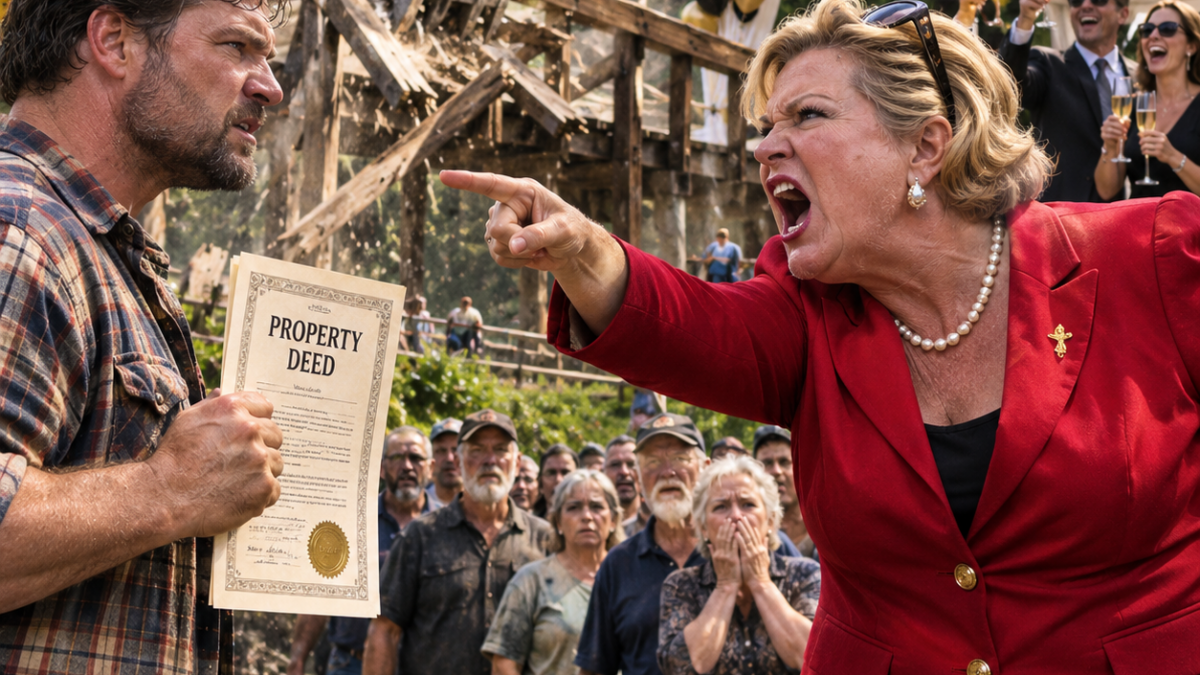
“Your grandfather was a sentimental fool.”
I stopped breathing.
Diane continued:
“He built a pile of aging scrap metal and convinced everybody it was a gift.”
I slowly put down the screwdriver.
“Don’t talk about my grandfather like that.”
She tilted her head.
“Or what?”
I looked directly at her.
“You’re standing on his property.”
Her eyes narrowed.
Then she said quietly:
“You’re making a mistake, Colton.”
I didn’t move.
“Is that a threat?”
“It’s advice.”
She slid the folder beneath her arm.
“The association has resources. Attorneys. Contractors. Influence.”
I stared.
“And I have a deed.”
Diane’s face flushed.
She turned sharply.
Walked down the porch steps.
Then stopped beside her Escalade.
“People who stand in the way of progress usually regret it.”
I watched her climb inside.
Her tires threw gravel against my fence as she drove away.
That evening, I walked down to the bridge.
Ran my hand along the old railing.
And thought about how easily a woman who had never helped maintain the structure could speak as though its history belonged to her.
I didn’t know she’d eventually destroy it.
But I knew she wouldn’t accept my refusal.
The harassment began six days later.
The first complaint alleged that I had an unpermitted structure on my property.
A county inspector arrived in a white truck.
His name was Daniel Foster.
He was courteous, thorough, and clearly accustomed to people being angry before he stepped out of his vehicle.
I showed him the records I had.
He inspected the relevant structures and explained what additional information, if any, the county needed.
He found no basis for the sweeping allegations in the complaint.
“Looks like somebody’s upset with you,” he said before leaving.
I smiled without humor.
“That’s one possibility.”
Four days later, another complaint arrived.
Illegal dumping near the creek.
I had to take time away from work to meet the inspector again.
There was no illegal dump.
Just old farm equipment properly stored near the workshop and a few branches I’d stacked for removal.
The following week, another complaint claimed I was operating an unlicensed commercial construction business from the ranch.
My engineering office was in Round Rock.
I wasn’t running a commercial yard from the property.
By then, Daniel recognized my truck before I came out of the house.
He stepped from his vehicle and sighed.
“Mr. Briggs.”
“Daniel.”
He looked toward the porch.
“Another complaint.”
I folded my arms.
“Let me guess. I’ve started an underground airport?”
He laughed.
“Not quite.”
We completed the inspection.
Again, the particular allegation wasn’t supported.
Afterward, Daniel stood beside his truck.
“Have you considered keeping a record of all these complaints?”
I nodded.
“Already started.”
“Good.”
He lowered his voice.
“I can’t tell you who submitted anonymous complaints, and I wouldn’t assume they’re all from the same person without evidence.”
“I understand.”
“But document everything.”
I watched him drive away.
Then returned to my kitchen.
Opened the folder.
And added another dated entry.
By the end of that month, the folder had grown thick enough that I needed a second one.
The anonymous letters were worse than the inspections.
Government inspectors had procedures to follow. They asked questions, examined evidence, and wrote reports.
The people sending letters to my mailbox apparently believed accusations became facts if they printed them in large enough letters.
The first arrived without a return address.
STOP EXTORTING OUR NEIGHBORHOOD.
I read it twice.
Then looked toward the bridge.
People had been crossing for years without paying me a toll.
I hadn’t asked them to begin.
I’d offered to share future maintenance expenses because the structure required ongoing engineering work.
Somehow, Diane had transformed that into extortion.
The second letter arrived two days later.
YOUR GRANDFATHER WOULD BE ASHAMED OF YOU.
That one hurt.
I stood beside the mailbox holding the paper for several minutes.
Grandpa had been the person who taught me to weld.
He showed me how to measure twice before cutting steel, how to recognize a loose connection, and how to admit when I’d made a mistake.
He’d also taught me that generosity and surrender weren’t the same thing.
Once, when I was fourteen, a rancher borrowed one of Grandpa’s trailers and returned it with a damaged axle.
The man apologized and offered to pay for repairs.
Grandpa accepted.
Later, I asked why he’d taken the money.
“Thought you always helped people, Grandpa.”
He looked up from the repair.
“I do.”
“Then why make him pay?”
Grandpa smiled.
“Because helping somebody doesn’t mean pretending the damage didn’t happen.”
He handed me a wrench.
“When people take responsibility, you can trust them enough to help again.”
I thought about that while looking at the letter.
Grandpa would have wanted the bridge maintained properly.
He would not have wanted me to sign away control of it to a woman who refused to acknowledge that maintenance cost money.
I folded the letter.
Placed it in the evidence folder.
And tried to continue my day.
The third letter arrived on Friday.
WE’VE CONTACTED THE SHERIFF ABOUT YOU. BE CAREFUL.
I photographed it.
Recorded the time.
Then called Russ.
He asked whether there had been any direct threats, physical trespassing, or damage.
I told him what I knew.
He advised preserving everything and reporting any immediate safety concern.
Then he asked something that made me pause.
“Colton, are you certain Diane sent these?”
“No.”
“Then don’t tell people she did.”
I looked at the letters.
“She benefits from them.”
“That may be true. It isn’t the same as proving she wrote them.”
I took a breath.
He was right.
I hated that he was right, because I wanted an easy answer.
But if I was going to demand that Diane respect evidence, I had to apply the same standard to myself.
So I kept documenting.
And waited.
Larry Caldwell brought me the next piece of the story.
He arrived on a Saturday afternoon carrying two bottles of iced tea and a look of disgust.
“Colton, that woman has lost her mind.”
I opened the screen door.
“Which woman?”
Larry stared.
I smiled.
“Just checking.”
He followed me onto the porch.
We sat overlooking the pasture while a pair of goats argued beside the fence.
Larry took a long drink.
“Diane’s been holding neighborhood meetings.”
I nodded.
“I figured.”
“She’s telling everybody you’re planning to close the crossing.”
I stared at him.
“I specifically said I wasn’t.”
“I know.”
He shook his head.
“She told the Hendersons they’d have to pay tolls to visit their grandchildren.”
My jaw tightened.
Dale and Margaret Henderson were among the oldest residents in Ridgewood Estates.
Dale was eighty-three and used a cane because of a bad hip.
Margaret had chronic respiratory problems and sometimes needed supplemental oxygen.
They’d known Grandpa.
He used to bring Margaret peaches from the orchard when the weather was good.
“What else?” I asked.
Larry looked toward the creek.
“She’s telling people you want to charge the HOA hundreds of thousands of dollars.”
I laughed bitterly.
“I suggested sharing a forty-thousand-dollar maintenance project.”
Larry nodded.
“She doesn’t mention that part.”
I sat back.
“Has anyone asked her to show them my letter?”
He looked at me.
“Diane says she can’t release private negotiations.”
“Convenient.”
“Very.”
For a while, we sat quietly.
Then Larry said:
“You know what scares me?”
I looked toward him.
“That she’s got half the neighborhood thinking you’re the enemy.”
I swallowed.
“I haven’t changed anything.”
“Doesn’t matter.”
He looked tired.
“People are worried about getting to work. Taking their kids to school. Getting emergency vehicles into the subdivision.”
I nodded.
Those concerns were real.
And they made Diane’s manipulation more effective.
She wasn’t convincing people to hate me simply because I owned a bridge.
She was persuading them that their daily security was threatened, then telling them I was responsible for the threat.
I looked toward Larry.
“Have they asked why someone who owns the road would want to keep it safe?”
He shook his head.
“Not enough of them.”
The following week, I drove into town for supplies.
At the gas station, a woman I’d seen cross my bridge dozens of times stepped out of her car.
I raised a hand.
She looked away.
Then hurried inside.
I stood beside my truck feeling foolish.
I told myself not to care.
She didn’t know me.
I didn’t know her.
Maybe she was having a difficult morning.
But it happened again at the feed store.
And again when a neighbor I’d once helped replace a broken gate drove past without returning my wave.
People were beginning to treat me like someone who had harmed them.
I hadn’t even changed their access.
For a moment, I considered writing an angry letter to every homeowner.
Explaining that Diane was lying.
Demanding apologies.
Telling them exactly what I thought of their president.
Instead, I sat at my kitchen table and drafted a factual explanation.
It included the history of the bridge.
The lack of a recorded HOA easement.
My maintenance proposal.
And the conditions under which I’d be willing to negotiate a fair agreement.
Russ reviewed it.
We sent it to the HOA board through the appropriate channels.
A week passed.
Nobody answered.
Then Diane sent another letter.
It said the board considered my response unacceptable and would pursue all available options.
I looked at those words.
All available options.
The phrase was deliberately vague.
It could mean another meeting.
A lawyer’s letter.
A civil claim.
Or something worse.
That evening, I drove to Round Rock and purchased four trail cameras.
I didn’t know whether they’d ever record anything important.
But I knew I wanted a reliable account of what happened around the bridge.
I mounted them discreetly on my property, covering the approaches and structure without intruding into neighbors’ private living spaces.
Then I tested their uploads.
Each camera recorded movement.
Each preserved the footage.
I kept the timestamps synchronized.
Grandpa had taught me that engineering begins with knowing what actually happened.
I wasn’t going to rely on rumors if the situation escalated.
My work assignment in El Paso arrived on a Wednesday.
A routine inspection.
Four days away.
A bridge rehabilitation project that required me on-site to evaluate load-bearing components and document conditions.
I almost declined.
Something about leaving the ranch unsettled me.
But I had professional obligations.
I couldn’t cancel every job because Diane sent threatening letters.
Before leaving, I walked down to Grandpa’s bridge.
The creek was running low.
Sunlight reflected off the steel beams.
I checked the visible connections and examined sections of the deck.
The structure needed work.
I knew that.
I’d planned it carefully.
Then I stood beside the south abutment and placed my palm against the concrete.
“Hang in there, old man,” I whispered.
I wasn’t sure whether I meant the bridge or Grandpa.
Probably both.
I left before dawn.
Six hours later, after traveling west and stopping outside Fort Stockton, my phone vibrated.
A trail-camera alert.
I opened it while parked safely at a gas station.
The screen showed two flatbed trucks at the bridge.
An excavator.
Several workers.
And a pearl-white Cadillac Escalade.
My stomach dropped.
I enlarged the image.
Diane stood beside the bridge wearing a white linen blazer.
She was speaking to the foreman.
He pointed toward the deck.
She nodded.
Then the excavator moved forward.
I called the contractor’s number displayed on one of the vehicles, which I’d managed to read from the footage.
No answer.
I called Diane.
She declined the call.
I contacted the sheriff’s office and explained that work appeared to be occurring on my private bridge without authorization.
The dispatcher took the information.
I sent the available footage and property details through the appropriate reporting channel.
Then I called Russ.
He answered immediately.
“Colton?”
“She’s doing it.”
“Doing what?”
“Demolishing the bridge.”
Silence.
Then:
“Are you sure?”
I looked at the screen.
The excavator bucket crashed into the wooden decking.
Three boards shattered.
Dust rose.
“I’m watching it.”
Russ’s voice sharpened.
“Where are you?”
“Fort Stockton.”
“Don’t drive while watching the video. Stay where you are and make sure the footage is preserved.”
I swallowed.
“Russ, she’s destroying it.”
“I know.”
“No, you don’t understand—”
“Colton.”
His voice became firm.
“Listen to me. You cannot stop an excavator from six hundred miles away. What you can do is alert the authorities, identify the contractor, and document exactly what’s happening.”
I stared at the screen.
Another beam shifted.
A section of railing collapsed.
My hands began shaking.
For a moment, I could barely breathe.
Then Russ said:
“I’m contacting local counsel and the relevant offices. You keep the recordings secure.”
I swallowed.
“Okay.”
“And Colton?”
“Yes?”
“Drive carefully when you come back.”
I looked at the video.
The bridge my grandfather had built was coming apart piece by piece.
I wanted to scream.
Instead, I saved another recording.
Then another.
I watched until there was no bridge left to destroy.
It took me almost twenty minutes to move from the gas-station parking space.
I sat staring through the windshield at the Texas landscape.
A truck pulled into the next parking space.
Someone laughed near the convenience-store entrance.
A woman carried a bag of groceries toward her car.
The world continued as though nothing important had happened.
But I had just watched forty years of my family’s history fall into a creek.
I remembered Grandpa welding the railing.
My grandmother bringing him sandwiches.
The day he taught me to check timber for soft spots.
The first time he let me drive his pickup across the bridge.
I was thirteen.
My hands shook on the steering wheel.
“Easy, Colton.”
He sat beside me.
“Keep her straight.”
I laughed nervously.
“What if I hit the railing?”
He grinned.
“Then you’ll help me fix it.”
I remembered reaching the other side.
Grandpa had clapped me on the shoulder.
“See? You can do hard things if you don’t panic halfway through.”
I looked at the trail-camera image.
The excavator was loading broken steel.
Diane was watching.
And somewhere inside my grief, Grandpa’s voice returned.
Don’t panic halfway through.
I put the phone down.
Started the truck.
And headed east.
The bridge was gone.
But the evidence wasn’t.
And Diane had no idea how much of it she’d left behind.
On Friday afternoon, Larry Caldwell drove up my driveway with a bright, glossy flyer in his hand.
He stepped onto the porch without saying hello.
I knew immediately that something had happened.
“What is it?”
Larry held out the paper.
Across the top, in enormous red letters, were the words:
RIDGEWOOD ESTATES — FREE AT LAST!
Beneath them was a photograph of a barbecue.
Smiling families.
Picnic tables.
Red, white, and blue balloons.
Then the announcement:
BRIDGE REMOVAL CELEBRATION
SATURDAY — BRUSHY CREEK PARK
FOOD, MUSIC, FAMILY, COMMUNITY!
At the bottom was a message from Diane.
After years of unreasonable interference, Ridgewood Estates has reclaimed its freedom from one property owner’s attempts to control our community.
I stared.
Larry watched my face.
“Colton?”
I read the flyer again.
Then a third time.
She had destroyed my grandfather’s bridge.
Now she was throwing a party.
Not a private dinner.
Not a board meeting.
A public celebration.
She was inviting families to eat barbecue and applaud the demolition of property she’d never owned.
I looked up.
“Does everybody know the bridge is gone?”
Larry gave a bitter laugh.
“She says there’s going to be a new access arrangement.”
My stomach tightened.
“What arrangement?”
“That’s what several people asked.”
“And?”
He looked toward the creek.
“She told them the board was handling it.”
I closed my eyes.
The board wasn’t handling it.
No replacement crossing had been constructed.
No temporary structure had been installed.
No engineered plan for a new bridge had been presented to me or, as far as I knew, the county.
The old road now ended at the creek.
Ridgewood Estates still had a difficult secondary route through the county-road network, but the crossing everyone used for their daily commute was gone.
Some residents might not even know the alternate route.
Others would discover too late that it was unsuitable for the vehicles they normally used.
I looked toward Larry.
“Are they really going to drive to the park and then try coming back across the creek?”
He nodded slowly.
“Most people don’t understand how completely the crossing was removed.”
I felt my face grow hot.
“Someone needs to tell them.”
Larry sighed.
“I’ve tried.”
I looked at the flyer.
He continued:
“Diane says you’re spreading scare tactics.”
I stared.
“Scare tactics?”
“She told people your engineering expertise is being used to frighten the neighborhood into paying for a new bridge.”
I shook my head.
“Larry, the old bridge is lying in the creek.”
“I know.”
“There is no crossing.”
“I know that too.”
He looked exhausted.
“That’s why I’m here.”
I took a breath.
Then called Russ.
I explained the party and the risk of residents relying on a route that no longer existed.
He asked whether we’d notified the relevant local authorities.
I told him what I’d already reported.
He advised that we provide the updated safety information, preserve the flyer, and avoid any attempt to physically control the crowd or interfere with emergency personnel.
We contacted the county and emergency-response offices with the available facts.
The authorities could determine what warnings or measures were appropriate.
I couldn’t force sixty-three families to believe me.
But I could make sure the people responsible for public safety knew what had happened.
Saturday arrived hot and bright.
The kind of Central Texas afternoon when sunlight bounces off white gravel and the air feels heavy before noon.
I didn’t attend the party.
I couldn’t bear the thought of standing beneath balloons while people applauded what had happened to my grandfather’s bridge.
But Larry went.
He told me afterward that the pavilion at Brushy Creek Park looked as though somebody had organized a Fourth of July fundraiser.
A catering truck served brisket and smoked sausage.
There were coolers of drinks.
A disc jockey played country music.
Children raced between picnic tables.
Residents wore bright shirts and sunglasses.
Some had attached little flags to their vehicles.
Two large banners hung beneath the pavilion roof.
One said:
OUR COMMUNITY. OUR ROAD. OUR FUTURE.
The other was worse.
NO MORE BRIGGS BRIDGE TOLL.
I had never charged a toll.
Not one dollar.
Not my grandfather.
Not me.
Yet Diane had repeated the accusation so often that people were celebrating the removal of a fee that had never existed.
Larry said he stood near the back of the crowd watching families eat lunch.
Some were genuinely happy.
Others looked uncertain.
A few asked him whether the county had approved the new access route.
He told them he hadn’t seen one.
Diane’s supporters dismissed him.
One man laughed.
“Larry, the bridge is gone. It’s over.”
Larry looked at him.
“Have you figured out how you’re getting home?”
The man shrugged.
“Same way I came.”
Larry didn’t laugh.
He just shook his head.
At one o’clock, Diane took the microphone.
She wore a coral dress and white wedge heels.
Gold bracelets gleamed against her wrist.
Her hair had been freshly styled.
Larry told me she looked like someone about to receive an award.
“My friends,” she began, smiling broadly, “for too long, our beautiful community has been held hostage by unreasonable demands.”
Several people applauded.
Diane raised her chin.
“One man believed he could control the movements of eighty families simply because his grandfather built an aging bridge decades ago.”
More applause.
She continued:
“We refused to let that man dictate our future.”
Someone cheered.
A few others joined in.
Diane smiled.
“And today, Ridgewood Estates celebrates its independence.”
She raised a glass.
“To our community!”
The crowd answered.
“To our community!”
Some people genuinely believed they’d won.
Others applauded because everyone around them was applauding.
And some, Larry later admitted, were probably just enjoying the free food.
But the photographs taken that afternoon would become part of the public argument about what Diane knew, what she’d told the residents, and how thoroughly she’d misunderstood the consequences of her decision.
After the speech, people danced.
Children played.
The caterer packed leftover food.
And Diane posed for photographs beneath a banner celebrating the destruction of a structure she had not owned.
At about three thirty, the party began breaking up.
Families loaded coolers into vehicles.
Parents called for their children.
Folding chairs disappeared into trunks.
The first cars pulled out of the park.
A silver minivan led the way.
Behind it came a pickup.
Then another SUV.
Then a line of vehicles carrying families who expected to be home in a few minutes.
They were about to discover the difference between demolishing a bridge and creating another way across a creek.
Steve Callaway was driving the silver minivan.
He’d lived in Ridgewood Estates for nine years.
His wife, Amanda, sat beside him.
Their two children were in the back.
The youngest had fallen asleep at the party.
The older one was complaining about wanting another piece of cake.
Steve turned down the familiar access road.
He’d driven it hundreds of times.
The road descended gently toward the creek.
Normally, the old bridge appeared just beyond a bend lined with cedar trees.
This time, when Steve rounded the corner, he slammed on the brakes.
The minivan stopped.
Amanda grabbed the dashboard.
“What happened?”
Steve stared through the windshield.
The road ended at a drop.
Beyond it, the creek moved between limestone banks.
On the far side, the road continued toward the subdivision.
But the bridge connecting them was gone.
Steve opened the door.
Stepped onto the gravel.
Walked toward the edge.
And stared.
Broken steel projected from the water.
Concrete rubble lay against the bank.
Timber fragments had collected downstream.
He looked back toward the minivan.
Then toward the far side of the creek.
Amanda opened her door.
“Steve?”
He didn’t answer.
Behind them, another car approached.
Then another.
Someone honked.
Steve turned toward the growing line.
His face had gone pale.
“The bridge,” he whispered.
Amanda stared at him.
“What?”
He pointed.
“The damn bridge is gone.”
Within minutes, the road filled with vehicles.
Ten.
Twenty.
Thirty.
Some still carried balloons from the celebration.
Others had the FREE AT LAST signs Diane’s volunteers had handed out.
Drivers stepped out.
Walked toward the creek.
Then stopped.
Nobody wanted to believe what they were seeing.
One man claimed it had to be a temporary closure.
Another insisted the contractor must have installed a crossing farther downstream.
A woman began calling the HOA emergency number.
Children asked why they weren’t going home.
Then an older man shouted:
“Does anybody know how we’re supposed to get across?”
Silence.
Nobody had an answer.
By the time Diane arrived, vehicles stretched back along the access road.
She stepped out of her Escalade still wearing the coral dress.
Her sunglasses rested on top of her head.
The white wedge heels sank into the loose gravel.
She looked irritated.
Not frightened yet.
I know because Larry was standing nearby.
He’d arrived after hearing the road was blocked and was helping explain the alternate route to confused neighbors.
Diane walked toward the creek.
Stopped.
And stared.
For several seconds, she said nothing.
Then Steve Callaway approached.
“Diane.”
She turned.
“Steve, I’m aware there’s an inconvenience.”
He stared.
“An inconvenience?”
She looked toward the gap.
“The contractors should have coordinated the transition.”
Steve gave a disbelieving laugh.
“Transition to what?”
Diane’s expression tightened.
He pointed toward the creek.
“There’s no bridge.”
“I can see that.”
“Then how do we get home?”
She crossed her arms.
“The association is working on solutions.”
Steve looked at her.
“Now?”
Several people gathered closer.
A woman named Helen Barker stepped forward.
“My daughter needs medication that’s at home.”
Diane looked uncomfortable.
“Then perhaps someone can bring it to her.”
Helen stared.
“Across the creek?”
Diane said nothing.
Another resident raised his voice.
“My mother is eighty-six. She can’t sit in this heat all afternoon.”
Then someone called:
“What about the Hendersons?”
Dale and Margaret Henderson were standing beside their car.
Dale leaned heavily on his cane.
Margaret had an oxygen supply with her.
Both looked exhausted.
They’d attended the party because Diane had personally invited them.
Now they were stranded on the wrong side of a crossing they had relied on for years.
Larry hurried toward them.
“Margaret, are you okay?”
She nodded, but her breathing was labored.
“I’m tired, Larry.”
Dale looked toward the creek.
“Earl would never have let this happen.”
Larry swallowed.
“I know.”
Margaret glanced toward the broken steel.
Then whispered:
“Why would anybody celebrate destroying something everyone needed?”
Nobody answered.
At 4:07 p.m., the first 911 call was placed.
The caller reported that families were unable to reach the subdivision by their usual route because the bridge had been demolished.
Additional calls followed as people became concerned about children, elderly residents, medical needs, and the rapidly growing traffic backup.
The Williamson County Sheriff’s Office dispatched deputies.
Emergency-response personnel were contacted to assess the access problem and assist people who needed immediate help.
I was at my farmhouse when I heard the first sirens.
The sound came from the highway side.
Then stopped near the creek.
I walked onto the porch.
Through the trees, I could see vehicles lined up along the road.
Balloons moved in the breeze.
A few people were standing near the water.
I felt no satisfaction.
Not yet.
All I could think about was Grandpa.
He had built that bridge because he wanted people to get home safely.
Now children were sitting in hot cars while older residents struggled on the roadside.
Diane had caused the situation.
But the families suffering from it weren’t all responsible for her decision.
Some had applauded.
Some had believed her lies.
Some had never been told the truth.
None deserved to be placed in danger.
I grabbed my phone and called the emergency-response contact.
I explained that I owned the private property on my side of the creek and that responders could coordinate with me regarding any necessary safe access.
Then I walked down toward the crossing.
Not to interfere.
Not to lecture the crowd.
To help where I could.
Deputy Travis Webb arrived with another officer.
He examined the scene.
The missing bridge.
The line of vehicles.
The old road.
The creek conditions.
Then he began asking questions.
A volunteer fire unit and medical personnel arrived to help assess residents’ immediate needs.
A swift-water team evaluated whether any controlled crossing operation could be conducted safely.
People with medical concerns were prioritized.
Other residents were directed toward the longer alternate road rather than encouraged to attempt dangerous crossings.
The Hendersons received assistance.
Margaret was evaluated by medical personnel.
Dale was helped into a safer, shaded waiting area.
Meanwhile, deputies worked to prevent traffic from backing onto the county highway.
It was a logistical mess.
A preventable one.
And everyone could see why.
Deputy Webb eventually approached Diane.
“Ma’am, are you the HOA president?”
She lifted her chin.
“Yes. Diane Prescott.”
“Who authorized the bridge removal?”
“The association.”
“Who specifically approved the work?”
She hesitated.
“The board supported addressing the structure.”
He made a note.
“Do you have the authorization documents?”
She looked annoyed.
“I can provide them.”
“Please do.”
Then he asked:
“Who owns the bridge?”
Diane waved toward the creek.
“It serves the subdivision.”
The deputy looked at her.
“That wasn’t the question.”
Her expression hardened.
He continued:
“According to the property information we’ve received, the bridge was situated on private land associated with the Briggs property.”
Diane went still.
Deputy Webb glanced toward me.
Then back at her.
“Mr. Briggs has reported that the demolition occurred without his permission.”
She stared.
“There must be a mistake.”
He looked toward the wreckage.
“That’s what the investigation will determine.”
Diane’s face changed.
For the first time, she appeared to understand that calling something an HOA improvement didn’t automatically make it lawful.
And behind her, sixty-three families were discovering how expensive that misunderstanding could become.
Diane’s first instinct was to blame the contractor.
“I specifically told them to handle this properly,” she insisted.
Deputy Webb looked toward the empty crossing.
“What did you instruct them to do?”
She hesitated.
“Remove the unsafe structure.”
“Did you arrange a replacement before authorizing removal?”
“The board was discussing options.”
“Was there an approved emergency-access plan?”
Diane’s jaw tightened.
“I don’t have all the documents with me.”
The deputy wrote something down.
Then asked whether she had received confirmation that the bridge was association property.
She shifted her weight.
“It’s been used by residents for more than twenty years.”
“That doesn’t answer who owned it.”
Several neighbors were close enough to hear.
For weeks, Diane had spoken with absolute certainty about the bridge.
She called it community property.
An unauthorized toll station.
A symbol of one man’s selfishness.
Now a deputy was asking her to identify a single document proving she possessed the authority she’d claimed.
And she couldn’t.
Larry later told me that the expression on Steve Callaway’s face changed at that exact moment.
Until then, Steve had been angry about the inconvenience.
He thought Diane had mishandled an HOA project.
Now he was beginning to wonder whether the project itself had ever been authorized.
He stepped forward.
“Diane, did you check the deed?”
She glared at him.
“Steve, this isn’t the time.”
“Did you?”
“I’m handling it.”
He pointed toward his minivan.
“My kids have been sitting here for over an hour.”
“Then take the detour.”
Steve stared.
“What detour?”
“The northern route.”
He gave a bitter laugh.
“You mean the old ranch road that floods every time it rains?”
Diane said nothing.
Steve looked at the crowd.
Then back at her.
“Why didn’t you tell us before the party?”
That question spread through the stranded residents faster than any announcement Diane had made from the microphone.
Why hadn’t she warned them?
Why wasn’t another crossing ready?
Why had the HOA spent money on a celebration before arranging access?
Why had she claimed the bridge belonged to the association when the recorded property documents apparently said otherwise?
A woman holding a deflated balloon asked whether her family would be reimbursed for the extra fuel and travel time.
Another demanded to see the demolition contract.
An elderly resident wanted to know who would pay if an ambulance couldn’t reach him promptly.
Diane tried to quiet them.
“Please, everybody. We need to remain calm.”
But the authority in her voice had disappeared.
For the first time, the people around her weren’t waiting for instructions.
They were waiting for answers.
The emergency operation continued into the evening.
Personnel assessed the safest options for people with immediate needs.
Some residents were transported by established alternate roads.
Others received assistance from emergency crews, including controlled crossings where conditions and equipment allowed.
No responsible rescuer treated the fast-moving creek as something ordinary motorists could cross.
The water had risen after recent rain.
Fragments of the demolished bridge created additional hazards.
And the broken steel made the former crossing especially dangerous.
Margaret Henderson was one of the people I worried about most.
When the medical team checked her, she was exhausted and frightened.
Dale stood beside her holding his cane.
I approached only after the responders indicated it was appropriate.
“Mr. Henderson?”
Dale turned.
For a moment, he looked surprised.
Then his face softened.
“Colton.”
I swallowed.
“Are you both okay?”
He looked toward Margaret.
“We’ve had better afternoons.”
She gave me a tired smile.
I crouched beside her.
“I’m sorry you’re going through this.”
Margaret reached for my hand.
“Oh, sweetheart.”
Her eyes filled.
“This isn’t your doing.”
I looked toward the broken bridge.
She squeezed my fingers.
“Your grandfather used to bring me peaches.”
I smiled sadly.
“I remember.”
“He was a good man.”
My throat tightened.
“Yes, ma’am.”
She looked toward the far bank.
“Some people seem to have forgotten that.”
For several seconds, none of us spoke.
Then Dale asked:
“Can you rebuild it?”
I looked at him.
The question struck harder than I expected.
He wasn’t asking whether I could win a lawsuit.
Or punish Diane.
Or force the HOA to apologize.
He wanted to know whether the crossing could exist again.
I looked toward the wreckage.
“I believe so.”
Margaret nodded.
Then whispered:
“Earl would have liked that.”
My eyes filled.
I stood before they could see me cry.
And promised myself that whatever happened to Diane, I would not let her destruction become the final chapter of Grandpa’s bridge.
By sunset, the celebration was over in every possible sense.
The remaining balloons hung limp from vehicles.
The caterer’s leftover food had gone cold in the trunks.
Children slept in car seats.
Parents calculated alternate routes.
Some families remained angry at me because Diane had spent weeks telling them I was responsible for the loss of access.
Others were beginning to understand what had happened.
I didn’t try to convince everyone.
The sheriff’s office had the camera footage.
The county had the property records.
Russ had the correspondence.
The facts would take time to establish.
But they weren’t going anywhere.
Deputy Webb eventually approached me near the farmhouse side of the crossing.
“Mr. Briggs?”
“Yes.”
“Thank you for cooperating with the access arrangements.”
I nodded.
“Are the Hendersons okay?”
“They’ve been assisted. The medical team is monitoring the situation.”
I exhaled.
He looked toward the creek.
“We’ll need additional information from you about the demolition.”
“I have it.”
He nodded.
“Your recordings will be important.”
I swallowed.
“Do you know who hired the contractor?”
“That’s part of what we’re investigating.”
I looked toward Diane’s Escalade.
She stood beside it speaking urgently into her phone.
For a moment, she glanced toward me.
Our eyes met.
She looked away first.
That small movement meant more to me than any insult she’d ever thrown.
For months, Diane had acted as though she could summon officials to punish me whenever I refused her demands.
Now she was the one answering questions.
The difference was that I’d spent those months preserving documents.
She’d spent them inventing a version of events in which her confidence was a substitute for permission.
The practical consequences became clear on Monday morning.
The familiar three-minute crossing was gone.
The alternate route added roughly forty-seven minutes to many trips under favorable conditions.
In poor weather, it was worse.
The route included narrow roads, rough surfaces, and a low-water crossing that could become impassable after heavy rain.
Large school buses and certain commercial vehicles couldn’t reliably use all of it.
The district had to adjust transportation arrangements.
Parents drove children to new pickup points.
Employees began leaving home long before sunrise.
Delivery companies revised schedules.
And emergency services had to review their plans for reaching the subdivision.
One resident, a nurse named Amanda Callaway, called the HOA office after missing part of a shift because of the detour.
She asked for a clear schedule for restoring access.
The office couldn’t give one.
Another resident called because her father required regular dialysis appointments.
An elderly couple wanted to know whether ambulance crews had an alternative route suitable for the necessary equipment.
The HOA board had no prepared answers.
Every question led back to the decision to destroy the bridge before securing replacement access.
Diane had called the demolition liberation.
The residents were beginning to call it what it was.
A disaster.
Within the first week, Ridgewood Estates began filling with anger.
Garbage collection became more difficult because the hauling contractor couldn’t use the regular route.
Some deliveries were delayed.
Residents shared photographs of damaged vehicles and long detours.
People argued over who should pay for additional transportation costs.
The HOA’s online message board, normally filled with complaints about lawn irrigation and holiday decorations, became a nonstop discussion of the bridge.
Larry printed several threads and brought them to my house.
I read them at the kitchen table.
One homeowner wrote:
We attended the celebration because we were told the road problem had been resolved.
Another wrote:
Who authorized demolition before the replacement was ready?
A third asked:
Did anyone on the board verify the bridge was association property?
Then came a message from Steve Callaway.
My children spent an afternoon stranded near a dangerous creek after a party celebrating the destruction of the bridge we all used. I want the board minutes, the contractor agreement, and every dollar spent on this project.
I looked up.
Larry nodded.
“People are asking questions now.”
I set the papers down.
“Why didn’t they ask before?”
He sighed.
“Because Diane gave them answers before they knew what the questions were.”
I stared.
Larry continued:
“She told them you were threatening their homes. She said the bridge was ours. She promised she had everything under control.”
His eyes filled.
“Most people wanted to believe her because the alternative was admitting nobody had checked.”
I nodded slowly.
It was an uncomfortable truth.
People sometimes prefer a confident lie to an uncertain fact.
Especially when the lie promises to make their lives easier.
But the creek didn’t care what Diane had promised.
Neither did the missing bridge.
Real estate agents began telling homeowners that the access disruption could affect sales.
A buyer who’d been considering a house near the subdivision entrance delayed his decision.
Another asked for assurances that emergency vehicles could reach the property.
A local appraiser was retained to study the potential effects on market value.
Early assessments raised serious concerns, with some owners reporting possible losses approaching thirty percent under the prolonged-access scenario.
Those estimates weren’t final valuations of every home.
But they were enough to alarm residents who had spent years paying mortgages and maintaining their properties.
A man named Curtis Bell called Larry after learning that a prospective buyer had withdrawn from negotiations.
“My house was supposed to be my retirement,” he said.
Larry told me about the conversation.
Curtis had worked in a machine shop for thirty-four years.
He planned to sell his home and move closer to his grandchildren.
Now he was worried that any buyer would see the access problem and walk away.
I listened quietly.
Then asked Larry for Curtis’s number.
I called him that evening.
He sounded suspicious when I introduced myself.
“Colton Briggs?”
“Yes, sir.”
“The bridge owner?”
“Yes.”
A long silence.
Then:
“Why are you calling me?”
“I heard you’re having trouble with your property sale.”
He laughed bitterly.
“That’s putting it mildly.”
I swallowed.
“I’m sorry.”
He went quiet.
Then said:
“I heard you wanted the HOA to pay you a fortune to use the bridge.”
I closed my eyes.
“No, sir.”
I explained the history.
The original developer’s arrangement.
My maintenance proposal.
The lack of a recorded permanent easement.
The demolition.
The damage.
Curtis listened.
When I finished, he asked:
“You were going to repair it yourself?”
“I’d prepared plans and expected to cover the initial work. I wanted a fair arrangement for continued shared use and maintenance.”
He was quiet.
Then whispered:
“That’s not what Diane told us.”
“I know.”
Another silence.
Then he asked:
“Do you think you can rebuild it?”
I looked toward the creek.
“Yes.”
“How long?”
“I can’t promise a date until the engineering, permissions, funding, and construction arrangements are settled.”
He sighed.
“That’s more honest than anything I’ve heard from our HOA in months.”
I smiled sadly.
“I’m trying.”
Before hanging up, Curtis said something that stayed with me.
“Mr. Briggs, I owe you an apology.”
I closed my eyes.
“For what?”
“I cheered at that party.”
For several seconds, I couldn’t speak.
Then he whispered:
“I didn’t understand what we were celebrating.”
The HOA’s first emergency meeting was chaos.
Larry attended and later described it to me.
Diane sat at the head of the table wearing a black blouse and pearl earrings.
She had prepared a statement blaming the demolition contractor for delays in arranging replacement access.
But before she could finish, residents demanded the underlying documents.
Helen Parker, the association treasurer, asked for the invoices.
Diane said the accounting was being compiled.
Another board member asked whether a formal vote had authorized complete removal of the bridge.
Diane claimed the work fell within an earlier general safety directive.
The secretary reviewed the minutes.
The directive concerned obtaining an engineering evaluation and developing access options.
It did not expressly authorize destroying a structure on private land.
Helen looked toward Diane.
“Did you obtain a written property authorization?”
Diane’s expression hardened.
“I was acting to protect the community.”
Helen repeated the question.
“Did you obtain one?”
Diane didn’t answer.
A resident stood.
“Then who gave the contractor permission?”
Diane slammed her folder shut.
“This is becoming a witch hunt.”
From the back of the room, Steve Callaway spoke.
“No, Diane.”
His voice was steady.
“This is what happens when eighty families discover the person making decisions for them never checked whether she had the authority.”
The room became quiet.
Then someone began applauding.
Others joined in.
For six years, Diane had dominated meetings by controlling the conversation.
Now the conversation had changed.
And there was nothing she could do to make the destroyed bridge reappear.
Russ and I filed the civil claim after the demolition evidence had been organized and the damage independently assessed.
My original estimate was approximately eighty-five thousand dollars.
That included substantial work required to remove damaged material and replace the destroyed structure, although the eventual cost of a modernized bridge would depend on the final design.
A licensed appraiser and engineering review placed the loss associated with the original structure at approximately ninety-two thousand dollars.
Russ explained that the numbers served different purposes and that recoverable damages would depend on evidence, legal standards, and the remedies available.
I understood.
What I didn’t understand was why Diane believed she could avoid responsibility simply by saying she’d acted as HOA president.
She hadn’t owned the bridge.
She hadn’t received my permission.
She’d been told in writing that the structure was on my land.
And the work she’d authorized had destroyed it.
The sheriff’s investigation also continued.
Deputy Webb obtained statements from the contractor and witnesses.
The trail-camera recordings showed the sequence of demolition.
The county property records confirmed the location of the bridge.
The correspondence showed Diane had been informed of my ownership position and had demanded that I grant the HOA rights it did not already possess.
As investigators gathered information, they also examined what Diane had told the contractor about authorization.
One of the most important documents was the work order.
It described the bridge as an obsolete community structure being removed under HOA authority.
Attached was a simplified site drawing.
It identified the surrounding subdivision road.
But it did not accurately establish that the HOA owned the bridge.
When Russ showed me the document, I stared at it.
“Who prepared this?”
“The contractor says the association supplied the project description.”
“Did they ask for proof of ownership?”
Russ looked toward the page.
“That’s one of the questions being examined.”
I felt my jaw tighten.
The people operating the excavator hadn’t necessarily known they were destroying a private bridge without permission.
They might have relied on representations made by the person hiring them.
That didn’t remove every responsibility from the contractor.
But it meant the legal issues were more complicated than the simple picture I’d seen on the camera.
I didn’t want innocent workers punished because Diane had misrepresented her authority.
I wanted each person held responsible for what they actually knew and did.
Grandpa had taught me that too.
Accountability wasn’t the same as blaming everyone standing nearby.
The records eventually showed that Diane had pushed the project forward despite warnings.
A contractor’s representative had asked for confirmation of the bridge’s ownership before finalizing the work.
The association had discussed obtaining a title review.
But the demolition proceeded without the necessary property authorization.
The board minutes were equally revealing.
An earlier meeting had approved studying the condition of the crossing and negotiating access arrangements.
There had been no clear vote authorizing immediate demolition of privately owned property.
Diane had treated a broad instruction to explore safety options as permission to destroy the bridge.
When she was questioned, she claimed the structure was dangerous.
I didn’t deny that the bridge needed repair.
I’d been the one preparing the repair plans.
But a need for maintenance was not permission for a private association to bring excavators onto somebody else’s land.
And removing a crossing used by eighty households without a safe replacement was hardly a responsible solution to a safety concern.
The county records and trail-camera footage made that painfully obvious.
By the time the case moved forward, Diane’s attorneys were no longer arguing that the bridge had never existed on my property.
They were arguing about what she had believed and whether her actions were authorized.
That was a significant change.
Months earlier, she’d told me ownership was a technicality.
Now it was at the center of every question she faced.
Forty-two Ridgewood Estates households organized a separate civil action seeking relief for losses and disruption they attributed to the demolition.
They retained a law firm in Austin.
The residents alleged that Diane’s actions had caused substantial financial harm, including additional travel costs, loss of access, and diminished property values.
The claimed amount exceeded four million dollars across the participating households.
That number wasn’t a judgment.
It was the amount being sought.
And the homeowners would still have to establish their claims and prove what losses could legally be recovered.
Their attorneys also examined whether Diane could be held personally responsible for actions taken outside her proper authority.
The HOA’s liability insurer reviewed the circumstances, including the demolition authorization, ownership records, and the relevant policy provisions.
Coverage became disputed.
Diane had expected the association and its insurance to protect her from the consequences of acting as president.
Now she faced the possibility that some of her conduct might fall outside the protection she’d assumed she had.
Larry called me after learning about the insurance dispute.
“Colton, she’s furious.”
I looked toward the pasture.
“I’m sure.”
“She says everybody’s abandoning her.”
I swallowed.
“Did she say anything about rebuilding the bridge?”
Larry was quiet.
“No.”
I closed my eyes.
That was what hurt most.
She was worried about her position.
Her reputation.
Her money.
Her legal defense.
I understood that those were serious matters.
But even now, she didn’t seem to be thinking first about the families whose lives she’d disrupted.
Or the property she’d destroyed.
Or the old man whose work she’d mocked.
I looked toward the creek.
Then said:
“Larry, I don’t need her to suffer.”
He was silent.
“I need her to accept what she did.”
Four months after the demolition, the criminal case reached trial.
I arrived at the courthouse early.
Russ had prepared me for what to expect.
The criminal proceedings were separate from my civil claim, and the prosecution had to prove the elements of the charges under the applicable legal standard.
I wasn’t there to give a speech about family history.
I was there to testify about ownership, authorization, the condition of the bridge, and what I knew firsthand.
Diane entered wearing a navy blazer and little jewelry.
Her hair was pulled back.
She carried herself differently.
No oversized sunglasses.
No bright lipstick.
No theatrical smile.
For the first time, she looked like a person who understood that confidence couldn’t decide the outcome.
Her attorney sat beside her.
A man with silver hair and a careful voice.
He presented her as a community leader who had made a difficult decision in good faith.
He spoke about safety concerns.
Aging infrastructure.
The needs of residents.
He argued that Diane had believed she possessed the authority to authorize the demolition.
Then the prosecution began presenting the evidence.
The property records came first.
The survey.
The deed.
The documents showing the bridge’s location.
Then my correspondence refusing the requested easement.
Then Diane’s replies.
The prosecutor showed that she had been told the bridge was private property and that I had not authorized demolition.
He also presented evidence about the contractor’s instructions and the lack of an adequate replacement-access plan.
Finally, the courtroom lights dimmed.
The trail-camera footage appeared on the screen.
My grandfather’s bridge.
Whole.
Quiet.
The crossing I’d walked across since childhood.
Then the vehicles arrived.
The excavator moved into place.
The first bucket struck the deck.
Wood shattered.
Steel bent.
The screen showed the bridge disappearing piece by piece.
I watched Diane sitting at the defense table.
She didn’t look toward me.
Her eyes remained fixed on the screen.
The prosecutor paused the video at the moment she stood beside the foreman.
Then resumed.
The last major steel member fell.
The creek swallowed the wreckage.
The recording ended.
For several seconds, nobody spoke.
I looked down.
My hands were shaking.
I’d watched the footage dozens of times.
But seeing it projected across a courtroom made the loss feel new again.
The bridge wasn’t merely a number in a damages report.
It had been a physical place.
A crossing.
A connection.
A piece of history people could touch.
And the woman accused of authorizing its destruction had once laughed at the idea that it mattered.
When I testified, the prosecutor asked me to describe the bridge.
I explained its dimensions, design, age, and condition.
I discussed the maintenance work I’d planned.
The property records.
The informal history of access.
Then he asked:
“Did you grant Diane Prescott permission to demolish the bridge?”
“No.”
“Did you grant the HOA that permission?”
“No.”
“Did you agree to the permanent easement Ms. Prescott requested?”
“No.”
“Why not?”
I took a breath.
“Because it would have transferred significant control over a structure on my property without adequately defining maintenance, liability, or limits on its use.”
He nodded.
“Did you offer an alternative?”
“Yes.”
“What was it?”
“A negotiated agreement for continued access and shared maintenance responsibilities.”
The prosecutor showed the letter.
I confirmed it was mine.
Then he asked:
“Did you ever tell the residents of Ridgewood Estates that they could no longer use the bridge?”
“No.”
“Did you ever charge a toll?”
“No.”
“Did you threaten to demolish it yourself?”
“No.”
The prosecutor paused.
Then asked:
“What did you find when you returned from El Paso?”
I swallowed.
For a moment, the courtroom blurred.
I could see the headlights illuminating the empty gap.
The broken concrete.
The twisted steel.
The creek.
I cleared my throat.
“There was no bridge.”
Silence.
Then I added:
“My grandfather’s thumbprint was in one of those concrete footings.”
The prosecutor looked toward me.
“Why is that important?”
I took a breath.
“Because it reminded me that he built the structure with his own hands. It wasn’t junk to us.”
My voice broke.
“It was part of our family.”
I heard somebody in the gallery moving.
I kept my eyes forward.
The prosecutor thanked me.
Then the defense attorney began asking questions.
He was polite.
Careful.
And determined to establish that the bridge had been aging.
He asked whether I had identified deteriorated timber.
“Yes.”
Whether I’d recommended repairs.
“Yes.”
Whether I’d estimated substantial maintenance costs.
“Yes.”
He paused.
“Mr. Briggs, isn’t it true that you understood the bridge could eventually become unsafe?”
“Any bridge can become unsafe without appropriate maintenance and inspection.”
He nodded.
“So you agree there were safety concerns.”
“I agree the structure required maintenance and engineering review.”
He moved closer.
“And you planned to spend forty thousand dollars addressing those concerns.”
“Yes.”
He glanced toward the jury.
“Wouldn’t demolition eliminate the risk of the old bridge failing under traffic?”
I looked at him.
“Demolishing a crossing without establishing another usable access route creates different risks.”
He hesitated.
I continued:
“As an engineer, I would evaluate the structure, define safe operating conditions, and develop a repair or replacement plan before interrupting a critical access route.”
The attorney nodded slowly.
“That’s your professional opinion?”
“Yes.”
He looked at his notes.
Then asked:
“But you don’t deny the bridge needed work?”
“No.”
I leaned slightly toward the microphone.
“I’m the person who prepared the work.”
He stopped.
For a moment, the room was quiet.
Then he thanked me.
I returned to my seat.
Russ gave me the smallest nod.
I’d answered the questions.
Nothing more.
But the distinction was clear.
Aging infrastructure required responsible action.
It didn’t turn someone else’s property into something the HOA could destroy at will.
Diane later testified.
Her voice was softer than I’d ever heard it.
She described herself as a woman who loved her neighborhood.
She said residents had been worried about access.
That the bridge was aging.
That she believed removing it was necessary to protect the community from uncertainty.
For a few minutes, she sounded almost reasonable.
Then the prosecutor began questioning her.
“Mrs. Prescott, did Mr. Briggs tell you the bridge was on his property?”
She hesitated.
“He claimed it was.”
“Did he provide written documentation supporting that claim?”
“Yes.”
“Did you obtain a county title review establishing that the HOA owned the bridge?”
Silence.
“Mrs. Prescott?”
“No.”
“Did you receive Mr. Briggs’s permission to demolish it?”
“No.”
“Did the HOA board specifically authorize destruction of the bridge before arranging replacement access?”
Diane looked toward her attorney.
He remained still.
Finally, she answered:
“We had discussed safety improvements.”
“That wasn’t my question.”
She swallowed.
“No. Not in those words.”
The prosecutor paused.
Then showed her the party flyer.
FREE AT LAST.
He asked whether she had approved it.
“Yes.”
“Did you know the bridge had been completely removed before the celebration?”
“Yes.”
“Did you tell the guests that their usual crossing was no longer available?”
She looked down.
“I assumed everyone understood.”
The prosecutor waited.
Then asked:
“Did you arrange for those families to use another suitable crossing when they left the park?”
Diane’s voice became barely audible.
“No.”
For the first time, her explanations had nowhere left to go.
The jury had seen the property records.
The letters.
The work order.
The demolition.
And the celebration.
Her own answers connected them.
She had been warned.
She had chosen to proceed.
And the consequences had reached far beyond the structure she’d wanted removed.
The jury deliberated for three hours.
I spent most of that time sitting in a quiet corner of the courthouse with Russ.
There was coffee on the table between us.
Neither of us drank much.
I kept thinking about the original bridge.
Not the demolished one.
The whole one.
The way morning sunlight fell across the timber.
The sound of Grandpa’s boots when he walked ahead of me.
The day he made me carry a heavy toolbox because he’d decided I was old enough to learn that fixing things required effort.
I thought about Diane’s party.
The children stranded near the creek.
Margaret Henderson holding her oxygen line.
Curtis Bell worrying about the value of his retirement home.
A single act of arrogance had spread into dozens of other people’s lives.
Russ noticed me staring at my hands.
“You okay?”
I looked up.
“Ask me after the verdict.”
He nodded.
For a while, we sat quietly.
Then I said:
“Grandpa always told me that doing the right thing doesn’t guarantee somebody else will.”
Russ smiled faintly.
“Sounds like a smart man.”
“He was.”
I looked toward the hallway.
“I used to think that was just something he said when people disappointed him.”
“And now?”
I swallowed.
“Now I think he was telling me not to let somebody else’s behavior become an excuse for mine.”
Russ leaned back.
“That sounds like good advice.”
I nodded.
Then the courtroom officer appeared.
The jury had reached a verdict.
Diane stood when the judge entered.
Her hands were clasped so tightly that her knuckles had turned pale.
She stared straight ahead.
The foreperson answered the court’s questions.
Then the verdicts were read.
Guilty on the criminal-mischief charge relating to the destruction of my bridge.
Guilty on the separate misdemeanor count arising from the dangerous consequences of the unauthorized access disruption.
For a moment, I couldn’t move.
I’d spent months reviewing evidence.
Discussing legal procedures.
Answering questions.
Trying not to imagine outcomes.
Now the jury had spoken.
Diane swayed slightly.
Her attorney touched her arm.
She sat down.
I looked toward Russ.
He nodded.
But he didn’t smile.
Neither did I.
The courtroom wasn’t a football stadium.
Nobody cheered.
The decision carried serious consequences for a real person, even one whose actions had caused enormous harm.
I thought about the woman who had stood on my porch in expensive sunglasses and called my grandfather a fool.
Then I looked at the woman sitting at the defense table.
Her shoulders had collapsed.
Her eyes remained fixed on the floor.
For six years, Diane had been accustomed to making decisions other people were afraid to challenge.
Now twelve jurors had evaluated her conduct and reached a conclusion she couldn’t dismiss with a clipboard or a threat.
I felt relief.
And grief.
And something I couldn’t quite name.
The bridge was still gone.
The verdict didn’t put Grandpa’s steel back across the creek.
But it meant his property hadn’t been destroyed without accountability.
That mattered.
At sentencing, the court imposed two years of probation, community-service requirements, court costs, and restitution of eighty-five thousand dollars associated with the bridge damage, with the obligations subject to the applicable orders and enforcement process.
Diane listened in silence.
Her attorney spoke about her prior community involvement and the consequences she’d already faced.
The court considered the circumstances.
But the judge also addressed the seriousness of authorizing destruction of property she didn’t own.
Diane had not been required to agree with me.
She had not been required to like my grandfather’s bridge.
She could have sought legal advice, pursued negotiations, asked for a court ruling, or worked with the residents to develop another route.
Instead, she’d chosen to destroy the crossing.
The judgment reflected that choice.
Afterward, she passed within a few feet of me in the courthouse corridor.
Her lawyer was beside her.
For a moment, she stopped.
“Colton.”
I looked at her.
She appeared older than she had four months earlier.
Her hair was still carefully styled.
Her clothes were expensive.
But the familiar certainty was gone.
I waited.
She swallowed.
“I never meant for the residents to get stranded.”
I studied her face.
“Then why didn’t you arrange another crossing before tearing down the first one?”
She looked away.
For several seconds, she said nothing.
Then she whispered:
“I thought it would force the issue.”
My chest tightened.
There it was.
Not a safety plan.
Not an engineering decision.
A pressure tactic.
She had destroyed my bridge because she thought doing so would make me surrender.
I took a breath.
“You used eighty families to try to win an argument with one man.”
Her eyes filled.
She shook her head.
“I didn’t think—”
“No.”
My voice was quiet.
“You didn’t.”
For a moment, I could see the anger returning to her face.
The instinct to defend herself.
To explain why I had provoked her.
To insist that everything would have been fine if I’d just signed the easement.
But she didn’t say any of it.
Instead, she looked down.
Then walked away.
I stood there until she disappeared around the corner.
Russ approached.
“Ready?”
I looked toward the courthouse doors.
“Yes.”
Then I walked into the sunlight.
The HOA held a special meeting the following week.
For once, I wasn’t the subject of the meeting’s accusations.
Diane was.
Larry called me beforehand.
“You ought to come.”
I shook my head.
“Why?”
“So you can see what happens.”
I thought about it.
Then said:
“Larry, they need to decide what kind of association they want without me standing in the middle.”
He was quiet.
Finally, he nodded.
“Fair enough.”
The meeting was crowded.
Residents filled the clubhouse.
Some stood along the walls.
Others waited outside.
The agenda concerned replacing the current board and electing new directors.
Diane had already lost much of her support.
The verdict had made continued excuses difficult.
But the HOA’s members also had practical decisions to make.
How would they restore reliable access?
How would they address the growing legal expenses?
Who had authorized the demolition expenditures?
What internal controls would prevent a future president from making similarly reckless decisions?
And who would finally approach me with a reasonable proposal?
When the vote was counted, seventy-one ballots supported replacing the board.
Four opposed.
The four had remained loyal to Diane.
The rest had apparently decided they were finished paying for her certainty.
Larry called me afterward.
“Seventy-one to four.”
I looked up from my kitchen table.
“Really?”
“Really.”
I was quiet.
Then asked:
“Who’s the new president?”
“Tom Waverly.”
I knew Tom.
He was a retired schoolteacher who had lived in Ridgewood Estates for almost fifteen years.
He wore old boots, drove a modest pickup, and rarely spoke at meetings unless he had something worth saying.
I smiled.
“Tom seems sensible.”
Larry laughed.
“That’s what we’re hoping for.”
Then his voice softened.
“Colton?”
“Yes?”
“The first thing Tom said after the vote was that the new board needed to stop treating the Briggs family like an enemy.”
I felt my throat tighten.
For months, I’d listened to people repeat Diane’s accusations.
I’d watched them celebrate the demolition.
I’d heard myself described as selfish, dangerous, and greedy.
Now the new board president was saying publicly what should have been obvious from the beginning.
My grandfather’s family wasn’t the enemy.
We were neighbors.
I looked toward the creek.
Then said:
“Tell Tom my door’s open.”
Tom came to the ranch two days later.
He brought Larry and Helen Parker, the new board treasurer.
I met them on the porch.
Tom shook my hand.
“Colton.”
“Tom.”
He looked toward the creek.
Then back at me.
“First thing I want to say is that I’m sorry.”
I nodded.
He continued:
“The association should have handled your grandfather’s bridge with respect.”
My throat tightened.
“Thank you.”
“And we should never have allowed the access dispute to become what it did.”
Helen stepped forward.
“The financial records are being reviewed. We also need to address the unresolved lawsuits and restoration costs.”
I nodded.
Tom took off his hat.
“Most importantly, we need a safe way home.”
I looked toward the broken crossing.
“Yes.”
He swallowed.
“We can’t ask you to pretend nothing happened.”
“No.”
“And we can’t expect you to rebuild the bridge while carrying all the responsibility yourself.”
I studied his face.
For the first time since the conflict began, an HOA representative was acknowledging that using something came with obligations.
Tom continued:
“We’d like to discuss a formal agreement.”
I looked toward Larry.
He gave a small nod.
Then I turned back to Tom.
“Come inside.”
We sat at the same kitchen table where I’d read Diane’s first letter.
I made coffee.
Helen spread out a folder.
Tom opened a notebook.
And for the next three hours, we discussed the problem the way it should have been discussed from the beginning.
Engineering.
Property rights.
Maintenance.
Insurance.
Vehicle loads.
Emergency access.
Long-term costs.
The old bridge had been narrow.
Its structure had been built for the needs of a rural ranch in 1981.
The subdivision had increased traffic over the years.
Families drove heavier vehicles now.
Service trucks crossed more frequently.
Emergency equipment needed reliable access.
Simply copying the original bridge wouldn’t solve every modern problem.
I showed them the drawings I’d prepared before the demolition.
Then a preliminary concept for a stronger replacement.
Tom leaned forward.
“Could it carry a full-size fire apparatus?”
“With an appropriate final design, approvals, and verified loading requirements, yes.”
Helen looked toward the cost estimate.
“Would it require a completely new foundation?”
“Some of the original foundation has been destroyed. We’d need geotechnical and structural assessment before deciding the final configuration.”
Tom nodded.
“Can we do it?”
I looked toward the window.
The creek moved quietly beneath the place where Grandpa’s bridge had stood.
“Yes.”
Then I added:
“But we’re going to do it properly.”
Tom looked at me.
“That’s why we’re here.”
For the first time in months, I believed an HOA president might actually mean what he said.
Russ prepared the agreement with the new board’s attorney.
We did not rely on a handshake alone.
Grandpa’s arrangement had worked because people once honored the understanding.
But I’d learned what could happen when a later generation decided that an informal courtesy entitled it to permanent control.
The agreement established clear recognition of my family’s ownership of the bridge and the underlying private property.
It provided defined access rights for the association, subject to lawful limitations and operational requirements.
It included a formal maintenance contribution of twenty-four hundred dollars annually, with provisions addressing inspections, shared responsibilities, and future adjustments.
And it established protections against unauthorized interference with the structure.
Any future board would have to respect the recorded arrangement and pursue disputes through proper procedures rather than taking unilateral physical action.
The agreement was reviewed, approved, and recorded where appropriate.
When Tom signed it, he looked toward me.
“Your grandfather helped this neighborhood long before most of us lived here.”
I nodded.
Tom continued:
“We should’ve started by thanking your family.”
For a moment, I couldn’t speak.
Then I said:
“He wouldn’t have wanted people thanking him forever.”
Tom smiled.
“What would he have wanted?”
I looked down at the signed document.
“People keeping their word.”
Tom extended his hand.
I shook it.
And just like that, a dispute that had once seemed impossible to resolve became a set of obligations people could understand, document, and honor.
It didn’t erase what Diane had done.
But it created a way forward.
And that was what I’d wanted since the first day.
Construction began in September.
The first morning, I arrived at the creek before sunrise.
A thin layer of mist hovered above the water.
The limestone banks were damp.
The air smelled of cedar and wet earth.
For months, I’d walked down to that crossing and seen nothing but the remains of Grandpa’s work.
Twisted steel.
Broken timber.
Fragments of concrete.
Now trucks were arriving.
A crew unloaded equipment.
Survey stakes marked the new alignment.
Engineering drawings lay inside a weatherproof case on the hood of my pickup.
Two of the men had spent more than fifteen years working on highway bridges in Central Texas.
They knew how much responsibility was involved in building something people trusted with their lives.
That mattered to me.
I didn’t want a decorative replacement.
I wanted a structure designed, approved, and built for the traffic it would carry.
Before work began, I gathered the crew near the south bank.
We reviewed the plan.
Safety procedures.
Environmental requirements.
The work sequence.
Inspection points.
Then I looked toward the creek.
For a moment, my throat tightened.
One of the senior workers, a man named Ben Alvarez, noticed.
“You okay, Colton?”
I nodded.
“Yeah.”
He looked toward the old foundation.
“This was your grandfather’s place?”
“Yes.”
Ben studied the remaining concrete.
Then said:
“Let’s build him something good.”
I swallowed.
“That sounds right.”
We began.
The first days involved clearing the demolition debris and preparing the site.
Damaged steel had to be removed carefully.
The remaining concrete was assessed.
Suitable replacement foundations were constructed according to the approved design.
Every stage required attention.
Measurements.
Inspections.
Corrections.
I was grateful for the work.
After months of legal arguments, construction gave me something solid to do with my hands.
A drawing could become a structure.
A problem could be measured.
A correction could be checked.
And gradually, the empty space above the creek began to look less permanent.
One afternoon, while reviewing the remaining demolition debris, Ben called me over.
“Colton.”
I turned.
He was standing near a broken section of the old south abutment.
“Come look at this.”
I approached.
He pointed toward the concrete.
At first, I saw only a damaged surface covered with dirt.
Then I recognized the shallow impression.
Grandpa’s thumbprint.
Not the entire original footing.
Not a perfect untouched piece.
But enough of the impression remained to identify the mark I’d known since childhood.
My heart began pounding.
“Where did you find it?”
Ben nodded toward the debris collection.
“It was protected by another chunk of concrete. We set it aside when we saw the old date marks.”
I knelt.
Ran my fingers gently around the impression.
The concrete was rough.
Cool.
Weathered by decades beside the creek.
But the mark was still there.
I remembered Grandpa pressing his thumb into the wet mixture.
He’d told me about it so many times that I felt as though I’d witnessed the moment myself.
I sat back.
For a second, I couldn’t speak.
Ben crouched beside me.
“Is that what I think it is?”
I nodded.
“My grandfather.”
He looked at the mark.
Then toward the planned new abutment.
“Can we preserve it?”
I swallowed.
“We can document it and make a cast. The original fragment can be protected separately.”
Ben smiled.
“Then that’s what we ought to do.”
I stared at the concrete.
Months earlier, I’d stood beside the wreckage believing every physical trace of that day in 1981 had been destroyed.
Now I was holding a surviving piece of it.
Not everything lost could be restored.
But something had endured.
I lifted the fragment carefully.
And for the first time since the demolition, I felt a kind of happiness that had nothing to do with Diane’s punishment.
It came from knowing Grandpa’s mark could remain part of the story.
The new bridge took shape over the following weeks.
The foundation work was completed.
The new steel members were delivered.
A crane lifted the beams into position under the crew’s supervision.
I watched as they settled onto their supports.
The first time the main span connected the two banks, everyone stopped for a moment.
Nobody applauded.
There was still substantial work to do.
But the gap was no longer empty.
I stood near the crane and remembered the first time I’d seen the bridge destroyed.
That terrible camera footage.
The falling beams.
The broken deck.
The moment Diane had driven away.
Now steel stretched across the water again.
New.
Stronger.
Engineered for the demands of the crossing.
I took a photograph.
Then sent it to Larry.
He replied almost immediately.
Earl would be smiling.
I stared at the words.
Then looked toward the creek.
I hoped Larry was right.
I spent many evenings helping fit the white-oak decking.
The work was different from the welding and heavy construction performed by the specialized crews.
It was slower.
More personal.
Each board had to be measured, prepared, and installed according to the design.
I liked the repetition.
The smell of wood.
The sound of tools.
The satisfaction of seeing a clean line form along the span.
Sometimes I’d work until sunset.
Then stop and look across the creek.
On the far side, Ridgewood Estates residents occasionally stood watching.
Some waved.
Some didn’t.
A few had apologized.
Others remained embarrassed.
I didn’t demand that every neighbor acknowledge what had happened.
The bridge would have to serve people with different opinions.
That was the nature of shared infrastructure.
It didn’t ask whether somebody had cheered at Diane’s party before allowing them to cross.
It simply had to be safe.
One evening, Steve Callaway came down the road with his daughter, Emily.
She was nine.
She stood beside him holding a small paper bag.
I walked toward them.
“Evening.”
Steve nodded.
“Colton.”
Emily looked at the bridge.
“Are you almost done?”
I smiled.
“Getting closer.”
She considered the steel beams.
“Is this one stronger than the old one?”
“Yes.”
“How much stronger?”
I laughed.
“That’s a good engineering question.”
Steve smiled faintly.
I explained in simple terms that the new structure was being designed for heavier loads, modern safety requirements, and more reliable emergency access.
Emily listened carefully.
Then looked toward her father.
“Can I be the first kid to ride my bike across?”
Steve laughed.
“We’ll have to see.”
I smiled.
“Once it’s open and safe, you’re welcome to ride across.”
She grinned.
Then held out the paper bag.
“My mom made cookies.”
I stared.
“For me?”
Emily nodded.
“She said you work late.”
I took the bag.
My throat tightened.
“Tell her thank you.”
Steve stepped closer.
For a moment, he looked uncomfortable.
Then he said:
“Colton, I wanted to apologize.”
I nodded.
He looked toward the crossing.
“I went to that party.”
“I know.”
“I believed Diane.”
I waited.
He swallowed.
“She told us you were going to cut everybody off unless we paid you.”
I looked down.
Steve continued:
“I never asked you about it.”
For several seconds, neither of us spoke.
Then he said:
“My kids were scared that afternoon. Amanda was scared. And I was furious when I realized how easily I’d believed the whole thing.”
I looked toward Emily.
She was studying the new guardrail.
I took a breath.
“Steve, you don’t have to spend the rest of your life apologizing.”
He looked up.
“But I do need to say it.”
I nodded.
“All right.”
He extended his hand.
“I’m sorry.”
I shook it.
Then said:
“Thank you.”
He glanced toward the bridge.
“Your grandfather built something good.”
I smiled sadly.
“He did.”
Steve’s expression softened.
“Looks like you’re doing the same.”
After they left, I sat on the edge of the work platform and ate one of Amanda’s cookies.
It tasted like chocolate and brown sugar.
An ordinary cookie.
But after months of suspicion, threats, and legal battles, it felt like a sign that the valley might finally become a neighborhood again.
Diane put her house on the market two weeks after sentencing.
I heard the news from Larry.
He arrived one morning carrying coffee and a newspaper.
“She’s leaving.”
I looked up from the bridge plans.
“Who?”
He raised an eyebrow.
I sighed.
“Diane.”
He nodded.
“House is listed.”
I considered that.
For years, she’d treated Ridgewood Estates like her personal kingdom.
Now the residents who once competed for invitations to her parties barely wanted to speak with her.
The civil litigation had placed additional financial pressure on her.
Her position as president was gone.
Her public reputation had suffered.
And her former allies had begun distancing themselves.
Eventually, the house sold for substantially less than she’d paid, with reports indicating a loss approaching forty percent.
I didn’t celebrate.
The financial consequences were severe.
But they were not something I’d invented to punish her.
She’d made decisions that exposed herself and others to enormous risk.
The legal, financial, and personal consequences followed.
One Tuesday morning, a moving truck arrived at her house.
Larry told me Diane supervised the loading herself.
Then she climbed into the Escalade.
The same pearl-white vehicle she’d driven to my porch when she demanded I surrender the bridge.
She left through the long alternate route.
The new bridge wasn’t ready for traffic yet.
Larry said nobody organized a farewell party.
Nobody hung banners.
Nobody delivered speeches.
She drove away quietly.
I stood beside the new deck that afternoon thinking about the difference between how she’d entered the neighborhood and how she’d left it.
Diane had wanted people to admire her authority.
She’d spent years cultivating the appearance of power.
But she’d confused fear with respect.
When the consequences arrived, the people she’d once controlled were no longer willing to defend her.
I didn’t wish her further suffering.
I hoped she learned something.
More importantly, I hoped the residents did.
Because another board president would eventually take office.
Another disagreement would arise.
And the only lasting protection against repeating the same disaster would be a community willing to question authority before obeying it.
By late October, the structure was nearly complete.
The final deck work was finished.
Guardrails were installed.
Drainage and approach improvements were checked.
Reflective markers were added for nighttime visibility.
The bridge underwent required inspections and load verification before it could be opened to regular traffic.
I attended every inspection I could.
Not because I distrusted the crew.
Because I knew exactly how much the crossing mattered.
One afternoon, Tom Waverly arrived while I was reviewing an inspection report.
He stepped out of his pickup.
Looked at the bridge.
Then smiled.
“Colton.”
“Tom.”
He stood beside me.
For a moment, neither of us spoke.
Then he asked:
“How’s she doing?”
I laughed.
“Like a bridge.”
He grinned.
“That’s encouraging.”
I handed him the report.
He studied the summary.
Then looked toward the far bank.
“Hard to believe there’s going to be a road here again.”
I nodded.
He removed his hat.
“People are nervous.”
“About what?”
“The opening.”
I frowned.
“Why?”
Tom looked toward me.
“Because a lot of them feel ashamed.”
I was quiet.
He continued:
“They remember the party.”
I looked toward the creek.
“So do I.”
Tom nodded.
“They’re not sure whether you’ll want them there.”
I thought about that.
The balloons.
The cheers.
The banner calling Grandpa’s bridge a toll.
For a moment, anger returned.
Then I looked at the new steel.
The fresh deck.
The crossing Grandpa had wanted people to use.
I took a breath.
“Tom, this bridge isn’t going to be a monument to what Diane did.”
He listened.
“It’s going to be a bridge.”
His expression softened.
“A way for people to get home.”
I nodded.
“Exactly.”
Tom smiled.
“Then would you be willing to attend a small opening ceremony?”
I hesitated.
“I don’t want another big production.”
He laughed.
“Neither do I.”
“Nothing like Diane’s party.”
“Absolutely not.”
I looked toward the bridge.
Then said:
“All right.”
Tom extended his hand.
I shook it.
And we agreed that the opening would be simple.
No fireworks.
No elaborate speeches.
No grand claims about freedom from imaginary enemies.
Just neighbors.
A completed bridge.
And a chance to acknowledge the person whose work had connected the community long before most of its residents arrived.
We opened the new bridge on the first Saturday in November.
The morning was cool.
A welcome change after months of Central Texas heat.
The live oaks were still green, but the pecan trees had turned gold.
A pale blue sky stretched over the valley.
And for the first time since May, the creek had a bridge above it again.
I arrived before anyone else.
The final inspections had been completed.
The required approvals were in place.
The crossing was ready.
I walked slowly onto the fresh white-oak deck.
My boots made a soft, solid sound.
Nothing like the splintering crack I’d heard through my phone on the day Diane destroyed the original bridge.
I stopped halfway across.
Looked down.
The creek moved quietly beneath me.
Sunlight reflected against the new steel members.
The water was low enough that I could see limestone along the bottom.
For a moment, I closed my eyes.
I remembered Grandpa walking beside me on the old bridge.
“Listen to her, Colton.”
I’d laughed.
“Listen to what?”
“The bridge.”
I was ten years old.
I thought he was joking.
He placed one hand against the railing.
“Every structure tells you something if you pay attention.”
I looked down.
“What does this one say?”
Grandpa smiled.
“That she’s holding steady.”
I opened my eyes.
Placed my hand against the new guardrail.
It was cool.
Smooth.
Solid.
And for the first time in months, I could stand above the creek without seeing the moment the old bridge fell.
The residents began arriving shortly after nine.
Not sixty-three cars with balloons.
Not a caravan honking in celebration.
Just neighbors.
Some walked from Ridgewood Estates.
Others came from the county-road side.
A few brought folding chairs.
Children stood beside their parents.
Dogs sniffed along the grass.
Someone carried a thermos of coffee.
Another had brought a tray of homemade biscuits.
There was no disc jockey.
No catering truck.
No enormous banner declaring victory over anybody.
But there was a small hand-painted sign stretched between two cedar posts.
It read:
BRIGGS BRIDGE
BUILT BY FAMILY — RESPECTED BY COMMUNITY
I stopped when I saw it.
For several seconds, I couldn’t speak.
Tom Waverly approached.
“Do you like it?”
I swallowed.
“Who made it?”
“Some of the neighborhood kids helped.”
I looked toward the sign again.
The letters weren’t perfectly straight.
A little blue paint had run beneath the word community.
One corner was slightly crooked.
It was beautiful.
I nodded.
“Yes.”
My voice broke.
“I like it.”
Tom smiled.
Then stepped aside.
Larry Caldwell was walking toward us.
He wore polished boots, a clean shirt, and the old brown hat he’d worn to Grandpa’s funeral.
He moved slowly.
At eighty-one, his knees weren’t what they used to be.
But he walked with purpose.
When he reached the south end of the bridge, he stopped.
Looked across.
Then looked at me.
“Mind if I go first?”
My throat tightened.
“Be my guest.”
Larry stepped onto the deck.
One foot.
Then the other.
He took his time.
His hand rested against the guardrail.
For a moment, I could see Grandpa in the movement.
The same careful steps.
The same habit of testing a railing with his palm.
Larry reached the center.
Stopped.
Looked down at the creek.
Then continued.
When he reached the far side, he turned.
Raised one hand.
And nodded.
That was all.
No speech.
No applause from him.
Just a quiet acknowledgment.
From Larry Caldwell, a nod was worth more than a hundred compliments.
I wiped my eyes before anyone noticed.
Dale and Margaret Henderson crossed next.
Dale used his cane.
Margaret held his arm.
They walked slowly, accompanied by family members who stayed close without rushing them.
Near the center, Margaret stopped.
She looked down at the water.
Then toward me.
“Colton.”
I approached.
“Yes, ma’am?”
She rested a hand against the railing.
“This feels different.”
I nodded.
“It’s a much stronger structure.”
She smiled.
“That’s not what I mean.”
I looked at her.
Her eyes filled.
“When we were stranded that afternoon, I thought about how your grandfather would have hated seeing everybody frightened.”
My throat tightened.
She continued:
“He spent so much time helping people across this creek.”
I nodded.
“Yes, ma’am.”
She looked toward the opposite bank.
“Now you’ve done the same.”
For a moment, I couldn’t speak.
Then I shook my head.
“I had a lot of help.”
Margaret smiled.
“Your grandfather did too.”
I looked at her.
She continued:
“Your grandmother brought him food every day while he worked. Neighbors lent equipment. People helped move materials. Earl was proud of that bridge, but he never pretended he built it without anyone else.”
I laughed through tears.
“That sounds like him.”
She squeezed my hand.
“He would’ve loved this one.”
I looked toward the steel.
The oak deck.
The new railings.
Then whispered:
“I hope so.”
Margaret smiled.
“I know so.”
She and Dale continued across.
I watched until they reached the other side.
Then I looked toward the people waiting behind them.
Families.
Children.
Neighbors.
The same community Diane had tried to turn against me.
A community that had also suffered because of her decision.
I felt something loosen inside my chest.
Not all the anger.
Not all the grief.
But enough that I could finally imagine this place being peaceful again.
When the bridge was opened for ordinary use, Emily Callaway was among the first children to ride across on a bicycle.
She wore a blue helmet.
Her father walked nearby.
She looked toward me.
“Ready?”
I laughed.
“Ready.”
She pedaled forward.
Her tires made a soft, rhythmic sound across the deck.
Thump.
Thump.
Thump.
She crossed to the other side.
Turned around.
Then rode back.
When she reached me, she stopped.
Grinned.
And said:
“It’s way better than the old one.”
I laughed.
“Don’t let my grandfather hear you say that.”
She looked confused.
Then smiled.
“Would he be mad?”
I thought about Grandpa’s stubborn pride.
His rough hands.
His old pickup.
The way he used to inspect his own welds as though he expected someone to find fault.
Then I shook my head.
“No.”
My voice softened.
“He’d probably ask you why.”
Emily considered that.
Then said:
“Because this one feels really safe.”
I swallowed.
Grandpa would have liked that answer.
More than anything.
Tom eventually gathered everyone near the south end.
He wore a simple button-down shirt and held a small stack of notes.
When he stepped forward, conversations quieted.
“I don’t intend to keep everybody standing here long,” he began.
A few people laughed.
He looked toward me.
Then toward the bridge.
“There’s something our community needs to acknowledge.”
The crowd became still.
Tom took a breath.
“This crossing existed because Earl Briggs built it.”
He paused.
“For decades, the Briggs family allowed neighbors to use it while maintaining a structure the community depended upon.”
My eyes filled.
Tom continued:
“We failed to respect that generosity when our association allowed a property dispute to become an act of destruction.”
Nobody spoke.
He looked toward the residents.
“That failure caused real harm.”
His voice remained steady.
“To Colton.”
“To his family’s history.”
“And to the residents who lost their ordinary access to schools, work, medical services, and their homes.”
I glanced toward Steve Callaway.
He stood beside Amanda and their children.
His expression was serious.
Tom continued:
“Today isn’t about pretending that didn’t happen.”
He looked toward the bridge.
“It’s about choosing to do better.”
Then he turned toward me.
“Colton, on behalf of the new board, thank you for working with us to restore this crossing.”
My throat tightened.
Tom smiled gently.
“And thank you for insisting that respect for property rights and responsibility to neighbors can exist together.”
There was applause.
Not the loud, self-congratulatory cheering I’d heard in the videos from Diane’s barbecue.
Something quieter.
More sincere.
I looked toward the bridge.
Then toward the faces in front of me.
And nodded.
That was all I could manage.
After the gathering began to disperse, Tom approached carrying a flat rectangular package wrapped in brown paper.
“Colton, one more thing.”
I frowned.
“What’s that?”
“A gift.”
I laughed.
“Tom, you didn’t have to—”
“I know.”
He smiled.
“Open it.”
I peeled away the paper.
Inside was a framed black-and-white photograph.
For several seconds, I didn’t understand what I was seeing.
Then my knees nearly gave way.
Grandpa.
He was standing on the original bridge.
Young.
Strong.
One boot resting on the lower railing.
A cigarette in his hand.
His face turned slightly toward the sun.
He looked about forty.
I had never seen this photograph before.
I stared at it.
“Where did you find this?”
Tom’s expression softened.
“An old neighborhood newsletter from 1985.”
I looked down.
Grandpa’s hair was dark.
His shoulders broad.
The bridge behind him looked new.
At the bottom of the frame was a small inscription.
EARL BRIGGS — 1985
THE MAN WHO CONNECTED US
My eyes filled.
For a moment, I couldn’t speak.
Larry moved beside me.
“That’s your grandfather, all right.”
I nodded.
My throat felt too tight for words.
He smiled.
“Look at that stubborn face.”
A laugh escaped me.
Then I began crying.
Not the angry tears I’d cried beside the demolished footing.
Not the exhausted tears I’d cried after the trial.
These were different.
They came from seeing Grandpa standing proudly on the thing he’d built.
From realizing that someone in the neighborhood had preserved his photograph for forty years.
From learning that despite everything Diane had said, not everybody had forgotten what he gave them.
I pressed the frame carefully against my chest.
“Thank you.”
My voice broke.
“Thank you all.”
Tom rested a hand on my shoulder.
“Your grandfather helped us get home, Colton.”
He looked toward the new bridge.
“It’s time we remembered that.”
That evening, after everyone had gone, I returned to the crossing alone.
The last sunlight touched the cedar ridge.
A breeze moved through the trees.
The creek was running low and clear.
I carried the framed photograph beneath one arm.
In my other hand was the small case containing the preserved fragment of Grandpa’s original concrete footing.
I stopped at the south abutment.
During construction, we’d created a permanent memorial detail near the foundation without compromising the structure.
It contained two impressions.
The first was a cast of Grandpa’s thumbprint from the original bridge.
The second was mine.
I’d pressed my thumb into a prepared concrete memorial section while the material was still workable, remembering exactly what he’d done in 1981.
Two marks.
Forty years apart.
Same family.
Same creek.
Different bridge.
I knelt beside them.
For a moment, I saw my grandfather as clearly as if he were standing next to me.
His work boots.
His faded shirt.
The old cap he wore whenever the sun got too strong.
I remembered him telling me to measure twice.
To inspect what I couldn’t see easily.
To admit mistakes.
To keep my word.
And never to confuse kindness with weakness.
I ran my fingers along the protected memorial surface.
“It’s done, Grandpa.”
My voice was barely above a whisper.
I looked across the bridge.
The steel shone silver-gray in the fading light.
The oak decking was pale and smooth.
Reflectors marked the approaches.
Everything looked unfamiliar and deeply familiar at the same time.
I swallowed.
“I wish you could see it.”
A breeze moved across the creek.
I closed my eyes.
Then smiled through tears.
“Although you’d probably tell me I used too much steel.”
I laughed softly.
I could almost hear him answering.
Only if you did, boy.
I sometimes think about what happened to Diane Prescott.
She entered Ridgewood Estates wanting authority.
Then confused it with ownership.
She wanted to control my property because it stood between her ambitions and the way she imagined her neighborhood should operate.
She threatened me.
Slandered me.
Demanded that I surrender an important property right.
And when I refused, she authorized the destruction of something she didn’t own.
For one afternoon, she believed she’d won.
She threw a party.
Raised a glass.
Accepted congratulations.
And watched people cheer for what she had done.
Then her neighbors tried to go home.
That was when her victory collapsed.
Not because I had planned to strand them.
Not because I’d set a trap.
Not because I wanted elderly residents frightened or children stuck near a dangerous creek.
Her own decision had destroyed the crossing.
The consequences followed.
The police investigation.
The court proceedings.
The restitution.
The lawsuits.
The loss of her position.
The collapse of the reputation she’d spent years building.
Diane had mistaken being feared for being respected.
And when the truth became impossible to deny, the people around her stopped confusing the two.
But I don’t think of her as the most important person in this story.
I think of Grandpa.
A man who never held public office.
Never ran an HOA.
Never gave speeches about his authority.
He bought forty-five acres of Texas land and built something useful.
Then he let people use it because he understood that a bridge doesn’t serve much purpose if nobody is allowed to cross.
For forty years, families traveled over his work.
Children went to school.
Parents went to jobs.
Ambulances reached homes.
Neighbors carried groceries.
People came and went without giving much thought to the steel beneath their tires.
That was what Grandpa wanted.
Not applause.
Not a monument.
Just a crossing that held steady when people needed it.
And now, after everything that happened, the bridge was there again.
Stronger.
Safer.
Supported by a written agreement that recognized what the Briggs family owned and what the community needed.
As darkness settled over the valley, the first evening headlights appeared on the county-road side.
A pickup approached slowly.
Its driver paused near the bridge.
Then rolled forward.
The tires crossed the oak decking.
A familiar double thump echoed over the water.
I closed my eyes.
For a moment, I was thirteen again.
Sitting beside Grandpa in his old truck.
My hands gripping the steering wheel.
His voice steady beside me.
Keep her straight, Colton.
I opened my eyes.
The pickup reached the other side.
Its taillights disappeared among the trees.
Somewhere in Ridgewood Estates, a family was arriving home.
No detour.
No uncertainty.
No stranded children.
No elderly neighbors waiting for help beside the creek.
Just a simple journey across a bridge.
I looked down at the two thumbprints.
Then toward Grandpa’s photograph.
And finally understood what I’d been fighting for.
It wasn’t eighty-five thousand dollars.
It wasn’t the satisfaction of watching Diane lose her presidency.
It wasn’t even proving that the bridge stood on my land.
It was the right to honor what my grandfather had built without allowing somebody else’s arrogance to erase it.
It was the responsibility to make sure the next generation inherited something better than broken steel and bitter memories.
And it was the belief that a man’s generosity shouldn’t become an invitation for others to take what belongs to him.
I lifted the photograph.
Looked at Grandpa’s face one final time.
Then walked back toward the farmhouse.
Behind me, the bridge stood quietly above the creek.
The same crossing.
A different structure.
A new beginning.
And beneath the fading Texas sky, two thumbprints remained side by side.
One from a grandfather who built a bridge because his neighbors needed a way home.
The other from a grandson who built it again because someone tried to take that gift away.
Diane Prescott destroyed the bridge because she believed it was the source of my power. She never understood that my grandfather’s greatest legacy wasn’t the steel, timber, or concrete—it was the conviction that doing something good for your neighbors should never require surrendering your dignity or your rights.
She threw a party to celebrate what she’d destroyed. I rebuilt what she couldn’t understand. And when the first family crossed the new bridge and disappeared safely toward home, I finally knew that Grandpa’s work had survived her after all.








