PART2:“YOUR FARM, YOUR METER, YOUR $9,000 BILL!” HOA Karen Laughed at My Repair Estimate—Then the Meter Started Running Backward
PART2
I slept maybe two hours.
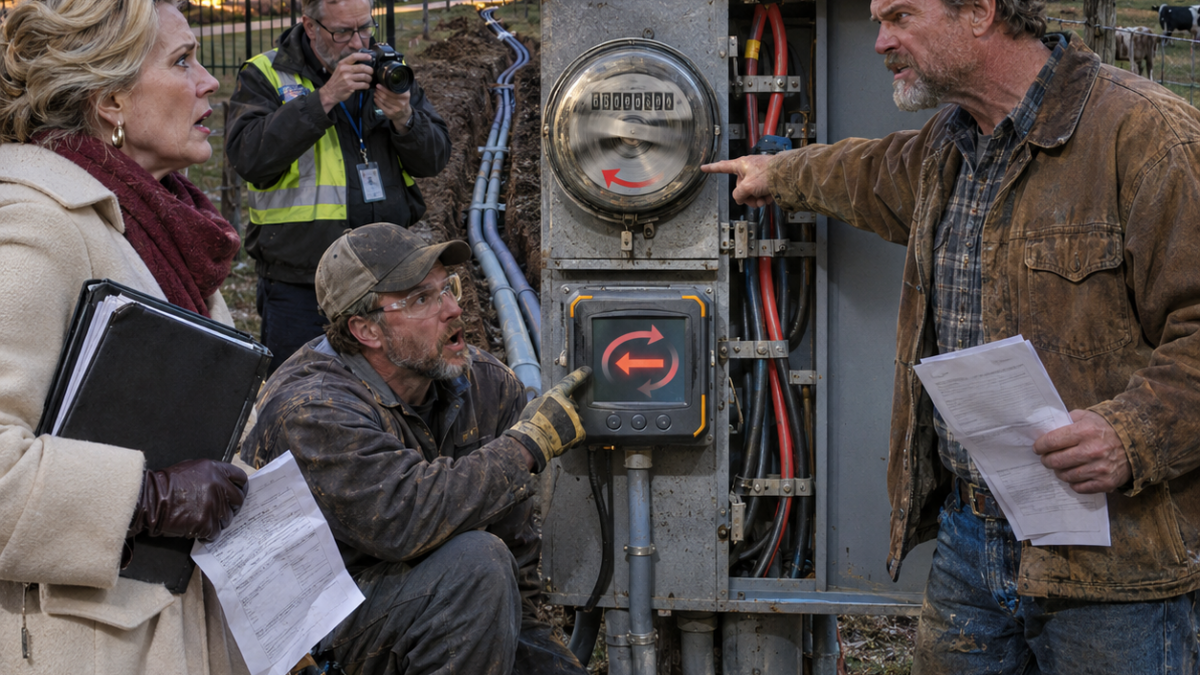
At six the next morning, I was back beside the post with my notebook.
Meter reading.
Weather.
Temperature.
Well-pump cycle.
Cold-storage load.
Greenhouse fans.
Grow lights.
Everything.
At six that evening, I did it again.
Then every morning and evening after that.
The first day almost made sense.
The meter rose slightly.
The second day, it ended lower than it started.
The third day, the reading dropped by more than my entire farm usually consumed in a week.
Nothing on my side had changed.
The well pump still ran.
The greenhouse lights still came on at five.
The cold room stayed at thirty-six degrees.
I called Gus.
Read him the numbers.
He was quiet for several seconds.
“A meter doesn’t make electricity.”
“I know.”
“It measures flow.”
“I know.”
“If the reading is moving backward while your load stays steady, something is pushing current the opposite direction.”
“From where?”
“Possibilities.”
He listed them.
A wiring fault.
Improper bypass.
Another power source tied onto the same circuit.
“Generator?”
“No.”
“Solar?”
“No.”
“Battery bank?”
“No.”
Another pause.
“Then I don’t think it’s coming from the farm.”
That weekend, I tried to prove him wrong.
Not because I distrusted Gus.
Because if I was going to accuse another system of affecting mine, I wanted every reasonable explanation on my property eliminated first.
I shut off circuits one by one.
Equipment shed.
Greenhouse.
Well house.
Cold storage.
I crawled under the barn floor with a flashlight between my teeth.
Found a mouse nest.
Found an old cracked junction box that had nothing to do with anything.
Found enough dirt to question every life decision I had made.
I did not find another power source.
Sunday evening, I stood at the fence looking toward Cedar Hollow.
Neat roofs.
Landscaped common areas.
Streetlights.
The HOA pond fountain turning in the distance.
And then I remembered an envelope.
Months earlier, Marlene had mailed something titled:
UTILITY ACCESS ADDENDUM
It asked me to give the association broad permission to enter Reeves Farm to inspect, maintain, or modify utility equipment.
The language had bothered me.
I called the clubhouse.
Marlene herself answered.
She told me it was administrative housekeeping.
“Nothing you need to worry about.”
I had never signed it.
I found the addendum in a kitchen drawer.
Read it again.
It did not look harmless anymore.
That evening, I called Marlene.
She answered on the second ring.
Before I said hello, she asked:
“Have you fixed the meter yet?”
I stopped.
That was an odd question from somebody who had formally declared it my private problem.
“No.”
Silence.
Long enough that I checked whether the call had dropped.
Then her voice returned.
Lower.
“Then don’t touch it.”
I looked toward the fence.
“Why?”
Click.
She hung up.
I called back.
No answer.
The meter glowed faintly in the darkness.
Its numbers continued falling.
People do not usually protect equipment they know nothing about.
And Marlene had just gone from your meter, your problem to do not touch it without me telling her what the meter was doing.
That mattered.
Three weeks after her refusal, the power-company statement arrived.
For four years, growing-season bills had averaged a little over nine hundred dollars a month.
This bill:
$4.12.
I thought I was reading it wrong.
Four dollars.
Twelve cents.
I compared it with the previous month.
Then the year before.
Then the meter log.
I added the statement to my blue folder.
The next morning, my phone rang at 6:14.
Marlene.
No greeting.
“You need to shut it down.”
I sat up in bed.
“Shut what down?”
“Whatever you’re running.”
“What are you talking about?”
Her breathing sounded tight.
“Turn it off right now.”
“What?”
Silence.
Then, nearly a whisper:
“How did you connect that meter to the neighborhood line?”
I looked toward the bedroom window.
The gray post sat beyond the yard in the pale morning light.
“I didn’t.”
The call ended.
I stayed seated on the edge of the bed for several minutes.
Marlene had just supplied a fact I had never given her.
She knew the farm meter was connected to the neighborhood line.
A week later, an email came from the HOA board account.
Formal.
Cold.
It ordered me to cease all interference with association electrical systems.
I was prohibited from opening, inspecting, testing, tracing, or approaching utility cabinets outside my lot boundaries.
I read the message twice.
I had never opened an HOA cabinet.
Never touched association wiring.
Never stepped into the corridor.
The email accused me of doing things I had not done in order to stop me from doing things I had not even thought of doing yet.
So I replied.
Calmly.
I confirmed that I had not interfered with association equipment.
I requested the specific bylaw provision giving the board authority to prohibit inspection of wiring physically connected to my service.
I requested a map identifying ownership of every relevant line.
And I attached the document Marlene had signed three weeks earlier.
HOA DENIES RESPONSIBILITY.
If the system was mine, why was I forbidden from inspecting it?
If it was theirs, why was I expected to pay nine thousand dollars?
Two days.
Four days.
No answer.
On the fifth morning, Marlene’s white SUV came down my gravel drive.
She got out before I reached the porch.
No smile.
No greeting.
“What’s the current meter reading?”
I leaned against the tailgate of my truck.
“Why?”
“Because irregular readings could affect the community.”
“Three weeks ago, the community had nothing to do with my meter.”
“This is a safety concern now.”
“What changed?”
She looked toward the fence.
“The board has an obligation to understand what’s happening.”
I almost laughed.
Not because anything was funny.
Because the language had completely reversed.
Your farm. Your meter. Your bill.
Had become:
We need to understand.
The community is affected.
The board has an obligation.
The meter had not changed ownership.
Only Marlene’s interest had.
“I’ll provide information through written correspondence.”
She looked at me.
“Excuse me?”
“The way the board chose to communicate with me.”
“This is urgent.”
“Then put the question in writing.”
Her jaw tightened.
“Calder—”
“Anything else?”
She stared at me for a long time.
Then returned to her SUV.
Gravel sprayed harder than necessary when she left.
That evening, I bought a fireproof document box.
And an external hard drive.
The blue folder had become too small.
I printed every email.
Every response.
Gus’s estimate.
Marlene’s denial.
The unsigned access addendum.
Power bills.
Meter logs.
I downloaded four years of electrical consumption history.
I began recording the meter every morning and evening.
Date visible in the video.
Time.
Reading.
Weather.
Load.
I photographed every wire I could legally see from my property.
Not because I wanted revenge.
Because stories were changing.
And when stories change, records matter.
Ten days later, I followed the conduit farther along the fence.
It dipped underground.
Reappeared beyond the line.
Then entered a small metal cabinet half-hidden behind blackberry vines.
Dull green.
Padlocked.
Rust on the hinges.
I wiped dirt from the front.
A faded label emerged.
HOA UTILITY CONTROL — PRIVATE ACCESS
The next morning, I called someone who had never done business in Cedar Hollow.
Drake Holloway.
Licensed electrical engineer.
Two counties away.
Industrial-failure investigations.
Insurance cases.
No HOA relationship.
No reason to care who won.
He arrived before noon.
Listened to the entire story.
Asked almost no questions until I finished.
Then he opened the farm-side meter housing.
Used a thermal camera.
Reviewed county utility schematics across the hood of my truck.
Tested conductors.
Compared field conditions with old drawings.
At four, he called me over.
“Here.”
He pointed toward the back of the meter base.
A second set of conductors disappeared into the conduit.
“This isn’t only your service.”
“What is it?”
“A branch circuit.”
“To where?”
He traced the old schematic.
“The subdivision.”
I looked at him.
“You’re saying neighborhood power comes through my meter?”
“I’m saying part of a shared load appears physically tied in behind it.”
“How long?”
“Can’t tell yet.”
“Where does it go?”
“Common area, probably.”
He studied the print.
“Pump house. Maybe lighting.”
My stomach tightened.
“For four years?”
“Possibly longer.”
Then Drake gave me the part that bothered him most.
“If you had simply paid the nine thousand dollars and replaced the meter without separating this branch, the new meter would have worked correctly.”
“That’s bad?”
“It would have accurately measured everything flowing through it.”
He looked at me.
“Including power used by whatever this branch serves.”
“So I’d still be paying.”
“Yes.”
“And a brand-new meter would make the billing look legitimate.”
“Yes.”
I stared toward the utility corridor.
“Who installed it?”
“Too early.”
He shook his head.
“Don’t jump.”
The conduit was old.
Connections weathered.
At least six or seven years.
Maybe more.
I had owned Reeves Farm four years.
Which meant the shared tie existed before me.
That night, I pulled out my purchase documents.
Walt Brennan had owned the farm for decades.
The HOA expansion had incorporated agricultural parcels before the sale.
Maybe the wiring dated to that period.
The next morning, I submitted a records request to the board.
Every contract.
Invoice.
Maintenance report.
Engineering document.
Utility plan.
Work order.
Anything involving the corridor.
The board delayed.
I sent a second request.
This time Nolan Mercer, a real estate attorney I had consulted briefly over a drainage dispute, helped me word it.
On the ninth business day, an envelope arrived.
Mostly boring.
Streetlight repairs.
Pump-service invoices.
Landscaping.
Then:
BRIGHT LINE ELECTRICAL SERVICES
Maintenance agreement.
Corridor infrastructure.
Clubhouse service.
Streetlights.
Pond pump.
Transformer pads.
I read the equipment schedule on the final page.
Last line:
AGRICULTURAL METER — TEMPORARY SHARED CONNECTION
I stopped.
Read it again.
The contract had been approved for the HOA.
Signature:
Marlene Voss.
I placed the contract beside her denial.
My meter.
Their connection.
Her signature.
I requested a meeting.
Marlene agreed.
At the clubhouse, I placed the Bright Line contract on her desk.
Open to the last line.
Then the photograph of the green cabinet.
She glanced at both.
“That contract is old.”
“I know.”
“Expired.”
“I know.”
“It has no relevance to current maintenance.”
“It proves the association knew my meter was connected to shared infrastructure.”
She straightened.
“I’ll need these documents turned over.”
“No.”
Her expression changed.
“Association records cannot be removed without authorization.”
“You mailed them to me.”
“That doesn’t give you the right to distribute—”
“I’m not surrendering my copies.”
“The board may fine you for interfering with association property.”
“I haven’t.”
“We can suspend your amenity access.”
“I don’t use the clubhouse.”
“Road-gate privileges.”
“My farm access is deeded.”
She spoke faster.
Lawsuit.
Violation.
Interference.
Confidentiality.
Everything except the question.
I waited.
When she finally stopped, I said:
“You’re trying to scare me before I ask the most important thing.”
Her hands went still.
“What thing?”
“Why did you refuse nine thousand dollars?”
She did not answer.
“If this was completely my equipment, why did you know whether I repaired it?”
Silence.
“Why did you tell me not to touch it?”
Nothing.
“Why did you call me at 6:14 in the morning asking how I connected to the neighborhood line?”
Her mouth opened.
Closed.
“Why does a contract you approved list my meter as shared infrastructure?”
“Liability is complicated.”
“That’s not an answer.”
“The system evolved over time.”
“Not an answer.”
“Calder, you don’t understand association utility planning.”
“Then explain it.”
She stood.
Walked to the window.
Back to me.
For the first time since I had met her, Marlene Voss had nothing prepared.
I gathered my papers.
Left.
That afternoon, Drake called an old Bright Line technician.
A man he had known through an insurance case.
The technician remembered Cedar Hollow.
More importantly, he had kept a copy of an old report.
Four pages.
Dry engineering language.
Temporary connection used during common-area construction.
Billing risk.
Safety risk.
Recommended separation.
Last page.
Bold sentence:
SHARED CONNECTION SHOULD BE REMOVED BEFORE NEXT PROPERTY TRANSFER.
Recipient:
Cedar Hollow HOA.
Acknowledgment recorded.
Date:
Eleven months before I purchased Reeves Farm.
I sat at the kitchen table staring at the date.
Eleven months.
The board had been warned before I signed a mortgage.
Before I received keys.
Before my name appeared on the utility account.
They knew a common-area circuit was connected behind the agricultural meter.
They knew the arrangement created billing risk for the next owner.
They knew the connection should be removed.
And they let the sale happen anyway.
I remembered standing beside Walt Brennan the day I bought the farm.
I asked him about utilities.
He pointed toward the fence.
“The association handles the shared stuff out there.”
He had not sounded worried.
Why would he?
The HOA’s disclosure packet said nothing about the tap.
My title report said nothing.
Closing documents said nothing.
For four years, I had been receiving bills through a meter measuring something that might not entirely belong to me.
The nine-thousand-dollar repair was no longer the issue.
The risk was bigger.
What if the power company audited the irregular readings?
What if someone accused me of tampering?
My name was on the account.
What if the shared circuit caused a fire?
What if my insurer discovered undisclosed infrastructure?
What if the backward meter made it look as though I was feeding unauthorized power into the system?
I called Nolan.
He cleared his conference table.
I brought everything.
Estimate.
Denial.
Addendum.
Bright Line contract.
Old report.
Power bill.
Meter logs.
Drake’s notes.
Nolan read for nearly an hour.
Then leaned back.
“I’m not going to tell you the HOA broke the law.”
“I didn’t ask you to.”
“Good.”
He tapped the old engineering report.
“But this is what bothers me.”
“The tap?”
“The timing.”
He pointed at the date.
“They were told before your purchase.”
“Yes.”
“They acknowledged the warning.”
“Yes.”
“No disclosure?”
“Nothing.”
“No separation?”
“No.”
“No dedicated account?”
“No.”
He leaned forward.
“Do not touch that connection.”
“I wasn’t planning to.”
“Don’t pull the old meter.”
“Okay.”
“Don’t open the cabinet.”
“Okay.”
“Don’t cut a wire even if you know exactly which one is wrong.”
“Why?”
“Because the moment you alter the system, every argument becomes about what you changed.”
That made sense.
“We need independent documentation.”
He recommended Keystone Inspection Group.
State-certified.
Different region.
No local contracts.
I hired them.
Gave the HOA written notice.
Date.
Time.
Scope.
No response.
Keystone arrived on a gray Thursday.
Two trucks.
Camera operator.
Lead inspector Russell Graves.
They spent hours testing the farm side.
Then mapped conductors along the corridor.
By late afternoon, Russell confirmed Drake’s finding.
Neighborhood common-area infrastructure physically tied into my service.
For years.
But the backward meter still did not make sense.
Russell stood beside the post studying readings.
“The shared load explains excessive forward consumption.”
“But not reverse.”
“No.”
“So something is generating power.”
“Somewhere.”
“Not here.”
“Not from anything we’ve found.”
They needed access to the green cabinet.
Nolan had already notified the HOA.
A sheriff’s deputy stood nearby at his request.
Not to intimidate anybody.
To keep a neutral witness at the site because ownership of the cabinet was undisputedly HOA-controlled.
6:15 p.m.
Camera rolling.
Russell cut the rusted padlock.
Placed one gloved hand on the latch.
Opened the door halfway.
Every porch light in Cedar Hollow went dark.
Streetlights failed one after another.
The clubhouse sign disappeared.
The pond fountain stopped.
A dog began barking.
Russell froze.
I turned toward the farm.
My greenhouse was still lit.
Yard light on.
Cold storage humming.
The neighborhood was dark.
Reeves Farm was not.
Nobody spoke.
The deputy looked from the subdivision to my buildings.
Russell slowly closed the cabinet without touching anything inside.
The camera kept recording.
My phone started vibrating.
Neighbors.
Unknown numbers.
Voicemails.
“Is your power on?”
“What happened?”
“Did you do something?”
I did not answer.
Because I knew how it looked.
The man fighting the HOA touched a cabinet.
Neighborhood goes dark.
Farm stays lit.
By morning, someone would turn that coincidence into a story.
Power returned shortly before midnight.
At nine the next morning, Marlene called an emergency board meeting.
I attended.
Drake came too.
Marlene stood at the front.
Pale.
Rigid.
She opened with an accusation.
“The outage was caused by electrical interference originating from Reeves Farm.”
I looked at her.
“What caused it?”
“Your equipment.”
“Which equipment?”
“The farm system.”
“What fault?”
She turned toward the other directors.
Nobody answered.
“Power-company report?”
None.
“Inspection report?”
Nothing.
“Data?”
Silence.
Drake spoke.
“Let us inspect the cabinet with board members present.”
The treasurer, Paul Whitaker, looked toward Marlene.
She said nothing.
Paul nodded.
That afternoon, about twenty residents gathered near the corridor.
Drake opened the cabinet.
Removed an interior panel.
Inside sat an automatic transfer switch.
He explained it simply.
Under normal configuration, part of the common-area load could be fed through the shared tie behind my meter.
But the system also had the ability to transfer power between sources.
“When conditions change,” Drake said, “this switch can reverse flow through the connection.”
I pointed toward the meter.
“That explains the backward count?”
“Part of it.”
He clamped a meter onto one conductor.
Checked again.
Then frowned.
“For power to move backward toward the farm, there has to be another source.”
“Where?”
“Not Reeves Farm.”
He followed a heavy cable out of the cabinet.
Toward association property behind the maintenance building.
Behind a fence and row of young cypress trees sat solar panels.
And a large battery enclosure.
Several residents looked at one another.
Paul whispered:
“When did we install that?”
Marlene stepped forward.
“It’s a backup system.”
Nobody had asked her.
“Minor infrastructure upgrade. Clubhouse and pond emergency service.”
Drake did not argue.
He connected a laptop to the transfer-switch controller.
Pulled the event log.
Configuration changes appeared.
Manual overrides.
Schedule changes.
Load limits.
Every entry contained an administrator account.
Drake rotated the screen.
MVOSS_ADMIN
Marlene’s face lost color.
Two days later, she sent notice of a special membership meeting.
The language was unmistakable.
Disruptive resident activity.
Unauthorized contractor access.
Interference with community infrastructure.
Neighborhood power outage.
Nothing about the Bright Line contract.
Nothing about the pre-sale warning.
Nothing about the shared tap.
Nothing about the administrator log.
She intended to define the story before I could.
The clubhouse was packed.
Marlene sat at the center table.
Prepared remarks aligned in front of her.
I sat in the second row.
She spoke for fifteen minutes.
She accused me of escalating a maintenance issue.
Hiring outside contractors.
Creating safety risks.
Interfering with systems.
Potentially causing the outage.
I did not interrupt.
When I was given the floor, I carried one banker’s box to the front.
Set it on the table.
Then removed documents one by one.
Gus’s $9,000 estimate.
Marlene’s signed denial.
The unsigned access addendum.
My four years of bills.
Six weeks of meter logs.
Dated videos.
Bright Line contract.
Green-cabinet photographs.
Old engineering report.
Keystone inspection findings.
I did not make a speech first.
I made one request.
“Every question I ask tonight, I want answered in writing and entered into the minutes.”
Marlene’s eyes narrowed.
I began.
“If my meter was entirely private, why was it listed in an HOA electrical contract as a temporary shared connection?”
She objected to the document’s age.
No answer.
“If the association had no responsibility, why was the board warned eleven months before my purchase that the shared connection should be removed?”
“Under review.”
No answer.
“If I caused the outage, where is the electrical report proving it?”
“Investigation pending.”
No answer.
“Who authorized the transfer-switch configuration?”
“Technical issue.”
No answer.
Then a woman near the front raised her hand.
Evelyn Hart.
Sixty-one.
Retired county auditor.
Former board member.
Rarely spoke.
She stood.
“I have a simpler question.”
Marlene turned toward her.
“If his meter is entirely his responsibility, why does HOA-controlled equipment determine where electricity flows through it?”
Nobody spoke.
Evelyn continued.
“Either the HOA has no role in that meter.”
She held up Marlene’s denial.
“Or the HOA has equipment controlling that meter.”
She pointed toward Drake’s photographs.
“You cannot tell him both stories depending on which one costs less.”
That changed the room.
Residents leaned forward.
Paul opened his laptop.
At Evelyn’s request, Drake had already sent directors the complete transfer-switch log.
Paul connected the computer to the clubhouse projector.
The log filled the screen behind Marlene.
Three years of manual changes.
Schedules.
Limits.
Overrides.
Configurations shifting energy through the shared connection during high-rate periods.
Administrator:
MVOSS_ADMIN
Again.
Again.
Again.
Paul read the username aloud.
“Marlene.”
The room went silent.
Marlene stood suddenly.
Gathered her papers.
Walked toward the side exit.
Pulled the handle.
It did not open.
She pulled again.
A few people turned.
The clubhouse manager spoke from the back.
“Side doors are check-in controlled during a special membership session.”
Nobody had locked Marlene inside.
The association’s own quorum procedure required attendees to use the main door.
Evelyn looked toward her.
“Please sit down.”
Marlene stared at the door.
Then at the room.
“The meeting isn’t finished.”
For six years, Marlene had used procedure as authority.
That night, procedure applied to her too.
Before adjournment, residents voted overwhelmingly to hire an independent electrical consultant selected jointly by Evelyn and Paul.
No Marlene appointment.
No local vendor.
Harlon Pruitt was a state-licensed engineer with utility-infrastructure experience.
He spent three weeks investigating.
His final report went to every household.
The conclusions were plain.
My meter had genuinely failed.
The shared connection worsened the failure.
The tap predated my ownership.
The HOA knew.
The old report proved it.
The association’s common-area system had used the farm service for years.
Separating it correctly would require:
New conduit.
Dedicated transformer.
Dedicated association utility account.
Control-system changes.
Cost:
Nearly sixty thousand dollars.
That was the real number.
Not nine thousand.
The HOA had postponed the separation year after year.
Why?
Because as long as part of the common-area load ran through the agricultural meter, the association’s own account stayed lower.
The cost went somewhere else.
Reeves Farm.
Whoever owned it.
Before me, Walt.
Then me.
Harlon also examined the solar-and-battery system.
During certain configurations, the backup system had been programmed to feed energy across the shared tie during expensive peak-rate periods.
That explained the reverse flow.
When my old meter began malfunctioning, it sometimes interpreted the unusual bidirectional flow incorrectly.
That caused the wildly low readings.
The four-dollar bill was not a gift.
It was an alarm.
And Marlene understood that.
An almost-zero farm bill could attract the power company.
A utility investigation would trace the wiring.
The shared connection would be discovered.
The hidden cost shift would become visible.
That was why she called me at 6:14.
That was why she wanted everything shut down.
That was why she told me not to touch the meter after laughing at the repair.
At the follow-up membership meeting, I was asked if I wanted to speak.
I stood.
Looked around the room.
“I’m not angry because a meter needed repair.”
Nobody moved.
“Farmers pay for repairs constantly.”
I pointed toward the blue folder on the table.
“I’m angry because the people responsible for this system knew part of their electrical cost was landing on a meter in someone else’s name.”
Then:
“They knew before I bought the property.”
I looked at Marlene.
“And when the problem finally became visible, the first answer I received was, ‘Your farm, your meter, your bill.’”
Silence.
Marlene sat at the far end of the table now.
No longer center.
She eventually stood.
“Our budget has been extremely tight for years.”
A few older residents nodded.
That was true.
“I kept dues stable.”
Also true.
“The infrastructure upgrade would have forced an assessment.”
Probably true.
“I believed delaying it was better for the community.”
There it was.
Not denial.
Justification.
She looked at me.
“I was trying to protect hundreds of homeowners from expenses they could not afford.”
I answered quietly.
“So you moved the expense to one homeowner who didn’t know he was paying it.”
Her face tightened.
No answer.
That sentence ended the argument more effectively than anger could have.
The next month became paperwork.
Real boring paperwork.
But that is where justice usually lives.
Engineering proposals.
Utility coordination.
New transformer design.
Insurance review.
Cost allocation.
Billing analysis.
The HOA agreed to pay for every component tied to shared infrastructure.
My failing meter was replaced.
The unauthorized shared tap was removed.
The common area received a dedicated transformer.
Separate utility account.
Separate control equipment.
The association sent me a signed responsibility map defining exactly where HOA infrastructure ended and Reeves Farm began.
No ambiguity.
No future argument.
Harlon then compared four years of my historical bills against estimated farm consumption.
He used equipment ratings.
Usage logs.
Seasonal loads.
Pump cycles.
Cold-storage consumption.
Greenhouse operating hours.
Utility rate history.
He was conservative.
He refused to guess where data did not support a number.
The final overbilling estimate:
More than thirty-eight thousand dollars.
The HOA board voted to reimburse it.
Plus investigation costs.
Engineering.
Keystone inspection.
The portion of the original meter repair attributable to the shared junction.
One October morning, the utility crew finished the final connection.
I walked down to the gray post.
The new meter was clean.
Silent.
Boring.
Numbers moving forward.
Slowly.
Well pump kicked on.
Rate increased.
Pump shut off.
Rate slowed.
Exactly what a meter was supposed to do.
I had spent months staring at that post.
That morning, I stood there smiling because nothing interesting was happening.
My phone chimed.
Bank notification.
Deposit from Cedar Hollow Homeowners Association.
$47,300.
I read it twice.
Then opened the attached letter.
Refunded excess electrical charges.
Investigation costs.
Inspection reimbursement.
Shared-infrastructure repair allocation.
Every amount listed.
No vague settlement.
No mystery.
Paper.
Exactly what I had wanted from the beginning.
At the November membership meeting, residents adopted new utility controls.
Two officers required for major utility contracts.
Full-board approval for backup-system configuration.
Quarterly review of shared infrastructure.
No single administrator account.
Marlene sat through most of the meeting.
Then a motion was introduced to remove her as president.
Before voting began, she stood.
“I resign.”
No speech.
No accusations.
No dramatic exit.
She handed the secretary a short letter.
Afterward, she stopped beside me near the door.
Without the president’s chair in front of her, she looked smaller.
Tired.
“I thought if I put it off long enough, the problem would disappear.”
I zipped my jacket.
“It didn’t disappear.”
She looked at me.
“It just went looking for the right person to carry it.”
For a moment, she held my eyes.
Then nodded.
She did not apologize.
I did not ask her to.
I had not spent months documenting wiring because I wanted Marlene humiliated.
I wanted the truth recorded where the next president could not pretend it had never happened.
She walked into the parking lot.
Streetlights hummed overhead.
The same lights that, for years, had quietly drawn part of their power through my account.
Evelyn stood beside the door watching her leave.
Then turned to me.
“The corrected minutes will be signed by every officer.”
“Thank you.”
“And mailed.”
“Thank you.”
“And emailed.”
I smiled.
“You really were an auditor.”
“Unfortunately.”
Life on Reeves Farm returned to its old rhythm.
Well pump.
Cold storage.
Greenhouse fans.
Harvest trucks.
Repairs.
Invoices.
Dirt.
Rain.
Normal problems.
But I never again trusted a single meter because someone else said it was correct.
With part of the reimbursement, I upgraded the farm electrical system.
Revenue-grade submetering.
Circuit monitoring.
Alerts.
Battery storage.
Control panel inside the equipment shed.
Only my key.
Every watt entering Reeves Farm was measured.
Every major load tracked.
If something changed unexpectedly, my phone knew before I did.
In early December, an email arrived.
From Evelyn Hart.
New HOA president.
The board was reviewing utility connections on other agricultural parcels.
They wanted to use my new system as a reference.
Not copy it blindly.
Study it.
Build clear boundaries.
She thanked me for the documentation I had kept.
I read the email at the kitchen table.
The blue folder sat beside me.
Bent at the corners now.
Inside:
The original nine-thousand-dollar estimate.
Marlene’s denial.
The four-dollar bill.
The old addendum.
Bright Line contract.
Engineering report.
Everything.
I did not answer immediately.
I put on my boots.
Walked to the east field.
The sun was setting.
Copper light stretched over frozen rows.
Behind me, the greenhouse glowed.
Near the fence, the new meter blinked.
Forward.
Steady.
Boring.
Exactly right.
For months, people had treated the story as if it were about electricity.
It wasn’t.
Not really.
Electricity was only how the truth traveled.
The real problem was responsibility.
Marlene had inherited a bad infrastructure decision.
Instead of fixing it, she delayed.
Then delayed again.
Each delay made the eventual repair more expensive.
The more expensive it became, the easier it was to justify another delay.
Eventually, the only way to keep dues low was to let someone else carry part of the cost without knowing.
First Walt Brennan.
Then me.
That is how bad decisions become systems.
Nobody wakes up one morning and announces:
Let’s quietly make a farmer pay for the neighborhood’s power.
It starts smaller.
Temporary connection.
Short-term workaround.
Budget problem.
Next year.
Then another year.
Someone retires.
A file gets forgotten.
A new board inherits it.
The temporary solution becomes normal.
Then somebody like Marlene discovers the truth.
And instead of saying:
“We need to fix this.”
She says:
“We cannot afford to fix this.”
Then:
“Maybe we can delay.”
Then:
“Maybe nobody will notice.”
Then I arrived with a nine-thousand-dollar estimate.
That should have been the moment the problem ended.
The board could have said:
Calder, we found a shared connection.
We need engineers.
We need to separate the system.
We need to determine what belongs to whom.
It would have been expensive.
Residents would have been unhappy.
I probably would have been unhappy too.
But there would have been no war.
No special meeting.
No lawyers.
No independent investigation.
No public embarrassment.
No forty-seven-thousand-dollar reimbursement.
Instead, Marlene laughed.
Your farm. Your meter. Your bill.
She believed the easiest solution was to hand the risk to the person with the least information.
That sentence cost the association far more than sixty thousand dollars.
Not just money.
Trust.
The first winter after the repair, the HOA held a meeting about infrastructure reserves.
Evelyn presented a five-year plan.
Transformers.
Road drainage.
Pond pumps.
Streetlights.
Nothing exciting.
Nobody clapped.
That was exactly how it should have been.
One homeowner complained that dues might rise twenty-three dollars a month.
Another complained about the reserve target.
A third asked whether the board could delay transformer replacement.
Evelyn answered:
“We can delay it.”
Then she looked toward me.
“But we should understand what delay costs.”
A few people laughed.
I didn’t.
Because that was the lesson.
Delay is not free.
It simply hides the invoice.
Sometimes it lands in the future.
Sometimes on the next board.
Sometimes on a farmer who never agreed to pay it.
The board approved the reserve plan.
Not unanimously.
But openly.
That mattered.
A few weeks later, Walt Brennan visited.
I had not seen him since buying the farm.
He was eighty-one now.
Moved slower.
Still wore the same battered cap.
I showed him the new meter.
He stared at it.
“So that old thing really was feeding their stuff?”
“Part of it.”
He shook his head.
“I told you the HOA handled that corridor.”
“I remember.”
“They told me the same.”
“When?”
“Years ago.”
He looked toward the green cabinet.
“Temporary pump hookup during construction.”
My stomach tightened.
“You knew there was a temporary connection?”
“Knew there had been one.”
“You thought it was removed?”
“Absolutely.”
He looked embarrassed.
“I would’ve told you.”
“I know.”
“They sent a crew once.”
“When?”
“Years before the sale.”
“Bright Line?”
“That sounds right.”
He rubbed his chin.
“Thought they separated it.”
That added another piece.
The association had allowed even the prior owner to believe the temporary tie had been corrected.
Walt looked at me.
“You think I should’ve checked?”
“No.”
“Maybe.”
“You relied on the people responsible for it.”
He nodded slowly.
“Bad habit.”
“Apparently.”
We stood beside the fence.
Then Walt smiled.
“You got forty-seven grand out of them?”
“I got money back that I already paid.”
“That sounds less fun.”
“It is.”
He laughed.
“Still buying lunch.”
“Fine.”
The following spring, Evelyn asked whether I would serve on the infrastructure committee.
I said no.
She asked again.
Still no.
“I farm.”
“You also read contracts.”
“I learned against my will.”
“We could use you.”
“You could use an engineer.”
“We hired one.”
“Then you’re already improving.”
She eventually convinced me to attend two meetings as an owner representative.
Two became six.
Not because I enjoyed them.
Because I understood how easily invisible systems get ignored.
One meeting focused on another agricultural parcel.
Old irrigation pump.
Shared drainage controller.
Nothing improper.
But the board had never documented responsibility clearly.
We fixed the map.
Recorded it.
Sent copies to everyone affected.
No fight.
Another involved a streetlight transformer sitting partly inside a homeowner’s easement.
Again:
Survey.
Agreement.
Signature.
Paper.
No drama.
The more we reviewed, the more I understood that Marlene’s worst mistake was not a single lie.
It was treating clarity as optional.
When responsibility stays vague, the person with more authority usually wins the first argument.
The person with better records wins the last.
Two years after the meter dispute, the original green utility cabinet was removed.
I watched the crew lift it away.
The faded label was barely readable.
HOA UTILITY CONTROL — PRIVATE ACCESS
Evelyn asked whether I wanted it.
“What would I do with it?”
“Hang it in the barn.”
“No.”
“Reminder?”
“I have a forty-seven-thousand-dollar bank statement.”
She laughed.
The crew hauled it off.
In its place sat two clearly marked systems.
Association infrastructure on one side.
Farm service on the other.
Separate conduit.
Separate accounts.
No mystery.
No shared switch.
No hidden tie.
A six-year-old could understand the layout.
That might have been the most satisfying part.
Not complicated justice.
Simple engineering.
Winter came again.
The farm entered its quieter season.
Greenhouse work continued.
Cold storage emptied.
The east field rested.
One December morning, I walked past the meter at six.
The reading had increased exactly as expected overnight.
I almost kept walking.
Then I stopped.
Habit.
I looked at it.
Remembered the first night I watched numbers go backward.
Remembered Marlene’s call.
How did you connect that meter to the neighborhood line?
At the time, I thought that question exposed her.
Later, I understood it exposed something larger.
Fear.
She was not afraid I had stolen power.
She was afraid I had discovered who had been using mine.
That distinction mattered.
For years, I had been taught that people reveal themselves through what they accuse others of doing.
Not always.
But sometimes.
Marlene’s first instinct was to accuse me of connecting to the neighborhood line because she already knew the neighborhood line was connected to me.
The truth was hidden inside the accusation.
That stayed with me.
Another thing stayed with me too.
I could have paid the nine thousand dollars.
There were nights I wished I had.
Especially when legal invoices arrived.
When inspections interrupted harvest work.
When neighbors called.
When the power went out and the whole subdivision looked toward my lit greenhouse.
Paying would have been easier.
At first.
That is the trap.
Easy solutions are often only cheap because someone else carries the future cost.
Had I paid and replaced the meter without examining the junction, the shared tie would have remained.
My bills would have continued including neighborhood usage.
The new meter would have been accurate.
That accuracy could have made the arrangement look legitimate for years.
I might never have known.
Maybe until another outage.
A fire.
A utility audit.
A sale.
And then somebody would have opened the old files and asked:
Why did Calder Reeves accept responsibility for this system?
There might have been no good answer.
The signed HOA denial could even have been used against me.
That thought made me more grateful for one small thing.
Gus underlining four words.
SHARED LINE CONNECTION INVOLVED.
A good professional does not have to solve the entire case.
Sometimes he only has to notice what does not belong.
Gus came by the farm during the third winter.
I showed him the upgraded monitoring panel.
He whistled.
“This is overkill.”
“You caused this.”
“I wrote an estimate.”
“You underlined something.”
“I underline a lot.”
“You ruined my trust in electricity.”
“That sounds like a personal issue.”
I handed him coffee.
We walked to the meter.
He listened.
Nothing.
“No buzz.”
“Nope.”
“Forward?”
“Always.”
“Boring.”
“Best nine thousand dollars I never spent.”
He laughed.
Then looked toward Cedar Hollow.
“People know what happened?”
“Enough.”
“Still hate you?”
“Some probably.”
“Good.”
“Why is that good?”
“Means you’re farming correctly.”
That was Gus.
Years passed.
The story faded inside Cedar Hollow.
New families moved in.
Some knew almost nothing about Marlene.
Evelyn eventually stepped down as president after three terms.
Paul took over.
Utility reports remained part of every annual budget packet.
Most residents probably skipped them.
That was fine.
The important thing was that they existed.
The system no longer depended on one person remembering the truth.
The truth was built into the paperwork.
That was what I wanted.
When I finally paid off the farm mortgage, I opened the fireproof document box.
The blue folder was still inside.
I placed the paid-off note beside it.
Two piles.
One represented the land I chose to buy.
The other represented obligations somebody tried to make mine without telling me.
The difference was consent.
That word had become important to me.
Not only in property.
Not only utilities.
Responsibility should follow knowledge and agreement.
You can inherit a problem.
You can choose to help solve someone else’s problem.
But people should not quietly place their obligations behind your meter and wait for you to discover them.
That night, I walked outside.
No moon.
Cold.
Greenhouse glowing.
The new battery system inside the equipment shed hummed quietly.
I had installed it after the dispute so the farm could ride through short outages independently.
Unlike the old HOA system, mine had one source.
One meter.
One owner.
One account.
One set of keys.
The monitor on my phone showed every major circuit.
Well.
Cold storage.
Greenhouse.
Workshop.
Nothing else.
No streetlights.
No pond.
No clubhouse.
Only Reeves Farm.
I stood near the fence and looked toward Cedar Hollow.
Their streetlights glowed.
Their pond fountain ran.
Clubhouse windows bright.
All of it on their own account.
I smiled.
Not because their bills were higher.
Because mine were finally mine.
That was all I had wanted when I carried Gus’s estimate into Marlene’s office.
I had not asked the HOA to pay my farm expenses.
I had asked them to identify the shared connection.
If she had simply said:
“You’re right. We need to investigate.”
Everything would have been different.
Instead, she believed a strong answer was better than an accurate one.
Your problem.
Those two words created every problem that followed.
The last time I saw Marlene was almost five years after her resignation.
Hardware store.
Electrical aisle.
Of all places.
She looked older.
So did I.
She noticed the wire connectors in my hand.
“Still fixing things?”
“Always.”
A small smile.
Then awkward silence.
I expected us to walk away.
Instead she said:
“I heard the farm is doing well.”
“It is.”
“I’m glad.”
“Thank you.”
She looked toward the shelves.
“I was angry with you for a long time.”
I did not ask why.
She answered anyway.
“Because everyone blamed me.”
“Some of it belonged to you.”
“I know.”
That surprised me.
She continued.
“But not all of it.”
“No.”
That was true too.
The temporary connection existed before her presidency.
Earlier boards postponed the upgrade.
Management companies failed to resolve it.
Contractors documented it.
No one followed through.
Marlene inherited a bad system.
Her responsibility came from what she did after learning about it.
She had choices.
Tell owners.
Fix it.
Budget for it.
Instead, she hid it.
“That’s the part I understand now,” she said.
“What?”
“That I kept telling myself I didn’t create the problem.”
She looked at me.
“So I didn’t have to own it.”
I thought about that.
“Didn’t work.”
“No.”
A pause.
“I’m sorry.”
Simple.
No qualifiers.
I nodded.
“Thank you.”
That was enough.
We walked in opposite directions.
I bought the connectors.
Drove home.
Never saw her again.
The following morning, the sun rose over Reeves Farm the way it always had.
Gold across greenhouse glass.
Light down the tomato rows.
Well pump cycling.
Cold storage humming.
I walked the fence with coffee.
Passed the new meter.
Almost did not look.
Then habit won.
Numbers moving forward.
Slowly.
Correctly.
I pulled out my notebook.
The old one.
The first page still held the original reading.
6:37 a.m.
Buzzing meter.
Unexplained jump.
I had kept logging for years even after the system was fixed.
Not because I feared the HOA.
Because measurement had become part of how I protected the farm.
I wrote the new reading.
Closed the notebook.
For a moment, I thought about throwing the old blue folder away.
I didn’t.
Not because I wanted to remember Marlene.
Because I wanted to remember the sequence.
Problem.
Question.
Refusal.
Evidence.
More questions.
Independent verification.
Truth.
Correction.
That order mattered.
The story people told later was simpler.
HOA Karen refused nine thousand dollars.
Farmer catches HOA stealing electricity.
Gets forty-seven thousand back.
President resigns.
That version was satisfying.
It was also incomplete.
The truth was slower.
Messier.
The HOA did not wake up one morning and invent a scheme to rob me.
A temporary infrastructure shortcut became permanent.
Officials deferred an expensive repair.
The next owner was not informed.
Leadership changed.
Documentation sat in files.
Then one president learned enough to understand the risk and made a choice.
Hide it.
That choice turned negligence into something worse.
And when the meter failed, it started telling the truth in the strangest way possible.
Backward.
I looked at the post.
The old meter was gone.
But I could still remember those numbers sliding downward under the flashlight.
At the time, they made no sense.
Now they did.
The meter had not created the problem.
It had exposed it.
Sometimes broken things do that.
A failed system reveals every shortcut hidden inside it.
A cracked pipe reveals bad plumbing.
A blown breaker reveals overloaded wiring.
A backward meter revealed years of avoided responsibility.
And once I saw that, I stopped being angry at the machine.
The machine was the only thing in the story that had never lied to me.
It simply counted what flowed through it.
Badly, eventually.
But honestly enough to make somebody panic.
The sun climbed higher.
Greenhouse fans started their morning cycle.
The meter sped up slightly.
Exactly as it should.
Then slowed.
I finished my coffee.
Walked toward the east field.
Behind me, Cedar Hollow’s streetlights clicked off automatically with the daylight.
Their electricity.
Their account.
Their responsibility.
Ahead of me waited thirty-eight acres that answered only to me.
My well.
My greenhouse.
My cold room.
My machines.
My meter.
My bill.
For the first time, those words meant exactly what Marlene had claimed they meant months earlier.
The difference was that now they were true.








