PART2:“YOUR DEAD HUSBAND IS GONE, MA! THROW HIS JUNK AWAY!” My Daughter-in-Law Dumped My 45-Year-Old Wedding Gift in the Trash — But When I Checked the $1,850 Charge on My Bank Statement, I Discovered Her Biggest Mistake
PART2
Carly stared at me as though I’d suddenly begun speaking another language.
Then she laughed.
Not a nervous laugh.
Not a laugh of surprise.
A sharp, dismissive sound.
“Oh, Ma. Come on.”
I didn’t move.
She reached for her glass of water.
“You’re upset. I understand that. But you don’t need to be dramatic.”
I looked at her.
“Did you hear what I said?”
She sighed.
“Of course I heard you.”
“Then understand me.”
I pointed toward the dishes.
“You threw away something that belonged to me.”
She opened her mouth.
I continued.
“You used my credit card without permission.”
Her expression tightened.
“And for eight months, you’ve treated this house like yours while asking me to live like a guest.”
Carly set down her glass.
Her voice sharpened.
“Scott would never agree to us leaving.”
I took a slow breath.
“Scott doesn’t own this house.”
She stared.
I continued.
“I do.”
For a brief moment, neither of us spoke.
Then Carly gave me the same cold smile I’d seen a hundred times before.
“We’ll see what your son has to say about that.”
She turned and walked out of the kitchen.
I remained beside the sink.
My hands were shaking.
I looked toward the white dishes.
Then at the trash can.
I knew Carly believed I’d calm down.
That after a few hours, I’d begin feeling guilty.
That I’d remember the baby upstairs and decide to swallow everything again.
And until that morning, she would have been right.
But something had changed.
I’d finally understood that every time I remained silent to keep my family comfortable, I made myself more uncomfortable inside the only home I had.
And I was finished disappearing.
My name is Ellena Johnson.
I’m sixty-eight years old.
A retired accountant.
A widow.
A mother.
And a grandmother to the most beautiful little girl I’ve ever held in my arms.
My husband’s name was Robert.
He died seven years before the morning Carly threw our wedding dishes into the garbage.
We were married for forty-five years.
Forty-five years of ordinary life.
Bills.
Birthdays.
Arguments.
Holidays.
Sickness.
Laughter.
And a love that didn’t look especially glamorous from the outside but made even the hardest days worth coming home for.
Robert wasn’t rich.
Neither was I.
He worked hard.
I spent forty years as an accountant for a midsized company.
We saved.
We planned.
We repaired things instead of throwing them away.
We never bought anything expensive without talking about it first.
And together, we paid for the house where I still live.
Every room holds something of us.
The kitchen window overlooks the garden Robert planted.
The living room contains the sofa where he fell asleep watching the evening news.
The bedroom upstairs was where we whispered about retirement, dreamed about traveling, and worried over our son’s future.
My sewing room was where I spent quiet afternoons after retiring.
And the dining room held the mahogany sideboard my grandmother left me.
None of those things would make a decorator particularly excited.
But they mattered to me.
They were the physical evidence of a life I’d built.
A life I hadn’t expected to defend against the people I loved.
When Robert died, the silence nearly destroyed me.
People talk about grief as though it is one emotion.
Sadness.
Loss.
Heartbreak.
But grief is also habit.
It’s making two cups of coffee before remembering only one person will drink them.
It’s reaching across the bed in the middle of the night and finding cold sheets.
It’s hearing a funny story and turning to tell someone who isn’t there.
It’s standing in the grocery store staring at a product your husband always bought because you don’t know whether you should keep buying it.
For months after Robert’s funeral, I couldn’t sleep properly.
I’d wake at three in the morning and listen to the house.
The refrigerator humming.
The heating system clicking.
Rain against the windows.
And I’d think about how much noise one person makes simply by being alive.
Robert used to clear his throat before speaking.
He whistled while watering the garden.
He’d call upstairs when coffee was ready.
He always dropped his keys into the same little ceramic bowl near the door.
After he died, those sounds disappeared.
The house remained.
But the rhythm of my life had changed.
I began spending more time in my sewing room.
Not because I needed money.
My pension and savings were sufficient.
I simply needed something to do with my hands.
I’d sew tablecloths.
Repair old clothes.
Embroider napkins.
Sometimes I worked on projects for neighbors.
Other times I made things nobody had asked for.
The gentle hum of my mother’s old Singer sewing machine made the afternoons feel less empty.
And when the loneliness became especially heavy, I’d take out our cobalt blue wedding dishes.
Make myself a simple supper.
Set one place.
And remember all the evenings Robert had sat across from me.
That was why I kept them.
Not because I couldn’t accept his death.
Because I didn’t want his life to become something I was expected to throw away.
Eight months before the confrontation in my kitchen, Scott called.
He was thirty-two.
My only son.
A civil engineer like he’d always wanted to be.
He’d been married to Carly for three years.
And she was six months pregnant with their first child.
I was sitting near the kitchen window when my phone rang.
“Mom?”
I smiled.
“Hello, sweetheart.”
His voice sounded wrong.
Exhausted.
Tense.
“Mom, I need to tell you something.”
I sat straighter.
“What happened?”
A pause.
Then he whispered, “I lost my job.”
My stomach tightened.
“Scott…”
“The construction company went under.”
He took a shaky breath.
“They’re laying everybody off.”
I closed my eyes.
He continued.
“We’re already behind on rent.”
I looked toward the garden.
“Does Carly know?”
“Yeah.”
His voice broke.
“Mom, she’s scared.”
I swallowed.
“She shouldn’t be worrying this much during the pregnancy.”
“I know.”
There was a long silence.
Then he said, “I hate asking this.”
I waited.
“Could we stay with you for a little while?”
My heart tightened.
“Of course.”
He exhaled.
“Mom, we don’t need much. Just two months. Maybe three.”
I smiled sadly.
“Scott, you don’t have to explain.”
He began crying.
“I feel like I’ve failed.”
“Oh, sweetheart.”
I closed my eyes.
“Losing a job doesn’t mean you’ve failed.”
He sniffed.
“I’ve got a wife and a baby coming.”
“And a mother who has a home with room for you.”
His voice cracked.
“Really?”
“Really.”
I looked around the quiet kitchen.
“Come home.”
I was excited when they arrived.
That’s the part that hurts to remember.
I wasn’t reluctant.
I wasn’t worried about sharing my house.
I’d spent seven years living alone.
The thought of having family nearby made me happy.
I cleaned the guest bedroom.
Changed the sheets.
Bought fresh towels.
Prepared space in the closet.
I even painted one wall with little clouds and stars for my granddaughter.
I bought a few baby clothes.
Small pink blankets.
Tiny socks.
A set of soft washcloths.
I couldn’t stop smiling while arranging everything.
I imagined Scott coming downstairs for coffee.
Carly sitting at the table.
A baby’s laughter filling the hallway.
For the first time since Robert died, I looked forward to hearing footsteps in the house.
They arrived on a Sunday afternoon.
Scott brought in suitcases.
Carly carried a designer handbag and wore an expensive coat.
Her perfume reached me before she did.
She hugged me.
“Oh, Ma, you’re saving us.”
I smiled.
“That’s what family is for.”
Scott kissed my cheek.
“We’ll be out of your hair as soon as I find work.”
I laughed.
“Don’t worry about that.”
He carried the boxes upstairs.
Carly looked around the house.
Then smiled.
“It’ll be nice having more space.”
I nodded.
“Make yourselves comfortable.”
I didn’t know those three words would become the beginning of my losing almost every comfortable place I had.
The first few days were pleasant.
Scott went out looking for work.
Carly rested.
I cooked.
We ate together.
Sometimes we watched television in the evening.
I enjoyed seeing my son’s shoes near the door again.
Hearing him come downstairs in the morning.
Watching Carly rest her hand on her stomach when the baby moved.
I asked whether they needed anything.
They thanked me.
I believed them.
Then, one Tuesday, I returned from the grocery store and found my curtains gone.
The soft beige curtains Robert and I had chosen years earlier had been replaced with dark gray panels.
I stood in the living room holding two grocery bags.
For a moment, I wondered whether I’d entered the wrong house.
Carly appeared from the kitchen.
“Oh, Ma! You’re home.”
I stared at the window.
“What happened to the curtains?”
She smiled.
“I changed them.”
I looked at her.
“Why?”
“The old ones were faded.”
My hands tightened around the bags.
“Robert and I chose those together.”
She tilted her head.
“I’m sure they were lovely at the time.”
I swallowed.
She continued.
“But this looks much more modern.”
I stared at the gray fabric.
The room seemed darker.
Colder.
I wanted to tell her to put my curtains back.
But then she touched her stomach.
“The baby needs a fresh environment.”
I looked at her.
My granddaughter.
My first granddaughter.
I was so excited to meet her.
And I didn’t want to be the difficult mother-in-law who argued with a pregnant woman over curtains.
So I nodded.
“All right.”
Carly smiled.
And the next week, she moved the sofa.
It was the same sofa Robert and I had bought when Scott was a teenager.
Brown upholstery.
Wide cushions.
A slightly worn armrest.
Nothing special.
But it was comfortable.
Robert had fallen asleep there after countless long shifts.
Scott had watched cartoons curled against my side.
And during my husband’s final months, we’d spent more time on that sofa than anywhere else.
One afternoon, I came downstairs and found it pushed against the opposite wall.
Carly was standing in the middle of the room.
“Look, Ma!”
I stared.
“What happened?”
“I rearranged everything.”
She smiled proudly.
“The light comes in so much better.”
I looked toward the empty space where the sofa had always stood.
“But…”
She tilted her head.
“Don’t you like it?”
I hesitated.
Then forced a smile.
“It’s different.”
She laughed.
“Exactly. Different is good.”
I nodded.
Then went upstairs.
That evening, I sat on my bed staring at my husband’s photograph.
I knew it was only furniture.
I knew houses change.
But there was something painful about returning home and discovering that another person had begun making decisions about your belongings without even asking.
I told myself it was temporary.
Two months.
Maybe three.
Then Scott would find work.
They would move.
And my house would return to normal.
I didn’t know that every time I stayed silent, Carly interpreted it as permission to take more.
By the fourth month, she no longer asked about anything.
I returned from the farmers market one Saturday carrying fresh vegetables.
The front door was open.
A man I didn’t recognize was carrying my mahogany bookshelf toward the hallway.
I stopped.
“Excuse me!”
He turned.
“Yes, ma’am?”
“Where are you taking that?”
He looked confused.
“Basement.”
I stared.
“Why?”
Carly appeared behind him.
“Oh, Ma. Perfect timing.”
I placed the bags on the floor.
“What is happening?”
She held a tape measure.
“We’re making room for the baby.”
I looked toward the living room.
My grandmother’s sideboard had been moved.
The family photographs were stacked in a cardboard box.
The bookshelf stood near the stairs.
I felt dizzy.
“Carly, those things belong to me.”
She sighed.
“I know.”
“Then why are they being moved?”
“Because we need space.”
She gestured toward the room.
“Playpen over there. Rocking chair here. Maybe a storage cabinet against that wall.”
I looked at the furniture.
“Those pieces can’t go into the basement.”
She frowned.
“Why not?”
“It’s damp.”
She shrugged.
“We can cover them.”
I felt my chest tighten.
“That sideboard belonged to my grandmother.”
Carly’s expression became impatient.
“Ma, we’re having a baby.”
“I know.”
“Then you understand that the baby’s needs come first.”
I looked at her.
She continued.
“You don’t want your granddaughter growing up in a house full of old furniture, do you?”
My throat tightened.
“No.”
She smiled.
“Good.”
Then she turned toward the worker.
“Take the bookshelf down first.”
And I stood there holding grocery bags while pieces of my family’s history disappeared down the basement stairs.
That night, I cried.
Quietly.
In the room that was still my bedroom.
I didn’t want Scott to hear.
I didn’t want Carly to accuse me of making a pregnant woman feel guilty.
I sat on the edge of my bed and looked at the photograph beside the lamp.
Robert and me on our wedding day.
Forty-five years earlier.
His arm around my waist.
My veil blowing slightly in the wind.
Both of us young.
Hopeful.
Certain we could face anything if we stayed together.
I touched the glass.
“Robert, what am I doing?”
My voice trembled.
“I don’t know how to say no.”
I imagined his answer.
He’d always been gentle.
But when something mattered, he could be firm.
I could almost hear him telling me that kindness and surrender were not the same thing.
I wiped my face.
Then put the photograph back.
Tomorrow, I told myself.
Tomorrow, I’d speak to Scott.
But tomorrow came.
He was exhausted.
Worried about work.
And I looked at my son’s tired face and decided he had enough problems.
So I stayed quiet again.
By the fifth month, Carly’s mother began visiting.
Her name was Evelyn.
She arrived one afternoon with a suitcase and enormous sunglasses.
I was preparing dinner when I heard voices in the hallway.
Carly came into the kitchen.
“Ma, this is my mother.”
I turned.
Evelyn smiled briefly.
“Hello.”
I wiped my hands.
“Welcome.”
She looked around.
Then at the kitchen cabinets.
“Oh, this house has potential.”
I didn’t know what to say.
Carly laughed.
“I know, right?”
Evelyn stayed for several days.
Then another week.
Then a second.
She occupied the living room.
Changed television channels.
Criticized my cooking.
Left dishes in the sink.
And repeatedly told Carly how much more comfortable the house could be if I changed things.
One evening, I was washing dishes when I heard them talking.
Their voices came from the living room.
“Why doesn’t Ellena give you the master bedroom?” Evelyn asked.
I stopped moving.
Carly sighed.
“I’ve thought about that.”
Evelyn continued.
“You have a baby coming. You need space.”
I stared at the soapy water.
Carly said, “Ma says the room has memories because she shared it with Robert.”
Evelyn laughed.
“Oh, honey. Her husband’s been gone for years.”
My hands tightened around a cup.
“She doesn’t need a room that large for herself.”
Carly was silent.
Then Evelyn said something I’ve never forgotten.
“When people offer their home to family, they should offer it completely.”
I closed my eyes.
The kitchen felt suddenly smaller.
My house.
My bedroom.
My memories.
Being discussed like resources that belonged to everyone except me.
I wanted to walk into the living room.
Tell them they were wrong.
Tell them my kindness didn’t mean they could decide how much of my life I was allowed to keep.
But I didn’t.
I stood at the sink.
Washed their dishes.
And swallowed my tears.
By the sixth month, Scott had found part-time work.
I was relieved.
It wasn’t much.
But it was a beginning.
One evening, we sat at the kitchen table.
I served chicken and potatoes.
Then asked gently, “Have you found any apartments you like?”
Scott looked up.
His expression changed.
“Mom, we haven’t really started looking.”
I paused.
“Oh.”
He put down his fork.
“It’s just that rent is still expensive.”
Carly touched her stomach.
“And the baby could come any day.”
I nodded.
Scott continued.
“Could we stay a little longer?”
My heart sank.
I looked toward the living room.
The new curtains.
The rearranged furniture.
The empty space where my grandmother’s sideboard had stood.
Then I looked at my son.
He seemed frightened.
Ashamed.
And I remembered the little boy who used to run toward me when he was hurt.
I swallowed.
“Of course, sweetheart.”
He smiled with relief.
Carly reached for my hand.
“Oh, Ma, you’re wonderful.”
I smiled.
But that night, I sat alone in my room wondering how a temporary arrangement of two months had become six without anybody discussing how it affected me.
Camille was born on a Tuesday morning.
I remember the phone call.
Scott’s voice shaking.
“Mom, we’re at the hospital.”
I stood so quickly my chair scraped against the floor.
“Is Carly okay?”
“Yes. They’re taking care of her.”
I grabbed my purse.
“I’ll be there.”
The hospital waiting room smelled of coffee and disinfectant.
I sat for hours.
Praying.
Remembering when Scott was born.
Remembering Robert holding our son for the first time.
The way my husband’s face crumpled with happiness.
After eight long hours, Scott appeared.
His eyes were shining.
“Mom.”
I stood.
He smiled.
“She’s here.”
My hands flew to my mouth.
“The baby?”
He nodded.
“A little girl.”
I began crying.
He hugged me.
“She’s beautiful.”
When they finally allowed me to see her, I thought my heart would burst.
Camille was wrapped in a pink blanket.
Her face was tiny.
Her hands curled near her cheeks.
Scott placed her carefully in my arms.
I looked down.
“Hello, my darling.”
A tear fell onto my blouse.
“I’m your grandma.”
Camille moved slightly.
I smiled through tears.
And for a brief, beautiful moment, I forgot every uncomfortable thing that had happened during the previous six months.
I had a granddaughter.
Robert would have been so proud.
I looked toward the ceiling.
Then whispered, “Honey, I wish you could see her.”
They came home three days later.
I had prepared everything.
Clean blankets.
Diapers.
Clothes.
A small wooden crib.
Supplies Carly had requested.
I was exhausted from preparations but happy.
I wanted to help.
I wanted Carly to recover peacefully.
I wanted Scott to enjoy becoming a father.
And I wanted Camille to feel safe and loved.
For a few days, the house was full of the strange, tender confusion that comes with a newborn.
Soft cries.
Midnight footsteps.
Warming bottles.
Tired faces.
Whispered conversations.
I helped where I could.
Then Carly began talking about the bedroom.
“Ma, we need more space.”
I was making breakfast.
I looked up.
“For what, dear?”
She adjusted Camille in her arms.
“Our room.”
I nodded.
“What about it?”
“It’s too small.”
I stared.
She continued.
“We need the master bedroom.”
My hand tightened around the spoon.
“My bedroom?”
She nodded.
“The crib, changing table, rocker, and all the baby’s things won’t fit comfortably in ours.”
I swallowed.
“But Carly, that room is where Robert and I—”
She interrupted.
“Ma, please don’t start.”
My heart tightened.
She looked down at Camille.
“Think about your granddaughter.”
I stared at the baby.
Then back at Carly.
“I’m thinking about her.”
“Then you understand.”
I took a breath.
“Could we find another arrangement?”
Carly’s face hardened.
“What’s more important? Your memories or Camille’s comfort?”
I felt the familiar trap closing.
If I said no, I was selfish.
If I asked for time, I was making things difficult.
If I protected something that belonged to me, I was denying my granddaughter what she needed.
I looked down.
“Let me think.”
Carly sighed.
“Fine. But we really can’t keep living like this.”
Five days later, my bedroom was no longer mine.
I had gone to the bank.
When I returned, the hallway was full of boxes.
My clothes.
My books.
My photographs.
My sewing basket.
All stacked outside the smaller guest room.
I hurried upstairs.
“What happened?”
Scott stood near the doorway.
He looked uncomfortable.
“Mom…”
I stared past him.
The master bedroom had been rearranged.
My bed pushed aside.
A crib placed near the wall.
A changing table installed.
A rocking chair beside the window.
A mini refrigerator near the dresser.
Carly stood in the middle of it all.
She smiled.
“Surprise.”
I couldn’t speak.
Scott looked down.
“We thought it’d be easier to move everything while you were out.”
I stared at him.
“You moved my things?”
He nodded.
“Yeah.”
“Without asking?”
His expression tightened.
“Mom, we talked about this.”
I swallowed.
“I said I needed time.”
Carly sighed.
“Ma, the baby needed the room.”
I looked at the bed.
The place where Robert and I had slept for decades.
Where we’d whispered about our son.
Where I’d held my husband during the final weeks of his life.
Now another family occupied it.
I felt as though I had been removed from my own marriage.
I looked toward Scott.
“Son, that was my bedroom.”
His face softened briefly.
Then Carly spoke.
“Scott, Camille’s getting fussy.”
He looked toward her.
Then back at me.
“Mom, please don’t make this harder.”
I stared.
For a moment, I wanted to scream.
Instead, I nodded.
Then carried my belongings into the small room.
And closed the door.
That evening, I sat on the edge of the narrow bed.
The room smelled of fresh paint and cardboard.
My husband’s photograph stood on a small bedside table.
I looked at it.
Then at the unfamiliar walls.
I had owned that house for decades.
Paid the mortgage.
Paid the taxes.
Paid the utilities.
Maintained the garden.
Repaired the roof.
Replaced the heating system.
And now I was sleeping in the smallest bedroom because my daughter-in-law had decided her needs mattered more.
I began crying.
Not loudly.
I didn’t want to wake Camille.
That was the cruelest part.
Even in my own heartbreak, I was trying not to inconvenience anyone.
By the seventh month, Carly wanted my sewing room.
“Camille will need a playroom soon.”
I stared.
“She’s only a few weeks old.”
Carly smiled.
“It’s never too early to prepare.”
I looked toward the doorway.
The little room where my Singer machine stood.
Where I’d spent countless peaceful afternoons after Robert died.
My fabric shelves.
My patterns.
My embroidery supplies.
It was the last room that felt entirely mine.
I took a breath.
“Could we wait?”
Carly frowned.
“Ma, why do you resist every improvement?”
I stared.
“I’m not resisting.”
“Then what’s the problem?”
I looked toward my sewing machine.
“It matters to me.”
She sighed.
“Your sewing can wait.”
I swallowed.
“You don’t even use it for work anymore.”
For a moment, I couldn’t answer.
Then I looked down.
“All right.”
I packed my machine.
My fabrics.
My scissors.
My patterns.
And carried everything into the basement.
Beside my grandmother’s furniture.
Beside the old curtains.
Beside the photographs that had been removed from the living room.
As I placed the last box on the concrete floor, I realized something terrible.
My family hadn’t simply moved into my house.
They had gradually moved me out of my own life.
The expenses grew.
Electricity.
Water.
Groceries.
Baby supplies.
Household products.
Internet.
Repairs.
Every month, the bills were higher.
Scott contributed what he could.
But his income was limited.
Carly rarely offered to pay anything.
I kept telling myself that this was what families did.
They helped.
They sacrificed.
They made room.
But I began noticing something else.
Carly ordered expensive products.
New makeup.
Designer shoes.
Decorations.
Clothes.
She bought things casually while explaining that she and Scott couldn’t afford to live independently.
One evening, I found a shopping bag from an expensive store in the hallway.
I asked where it came from.
Carly smiled.
“Just a little treat.”
I nodded.
I didn’t want to criticize her spending.
But later, when I paid the electricity bill, I wondered how someone who couldn’t afford rent could afford so many treats.
I should have looked at my bank statements more carefully.
I was an accountant.
I knew better.
But I trusted them.
They were family.
And that trust made me careless.
Then came the Tuesday morning.
Seven o’clock.
My slippers squeaking against the kitchen tile.
The smell of old coffee.
The quiet house.
I had been looking forward to my morning ritual.
A cup of slow-drip coffee.
The sunrise beyond the kitchen window.
A few minutes of peace before Carly woke and began telling me what needed changing next.
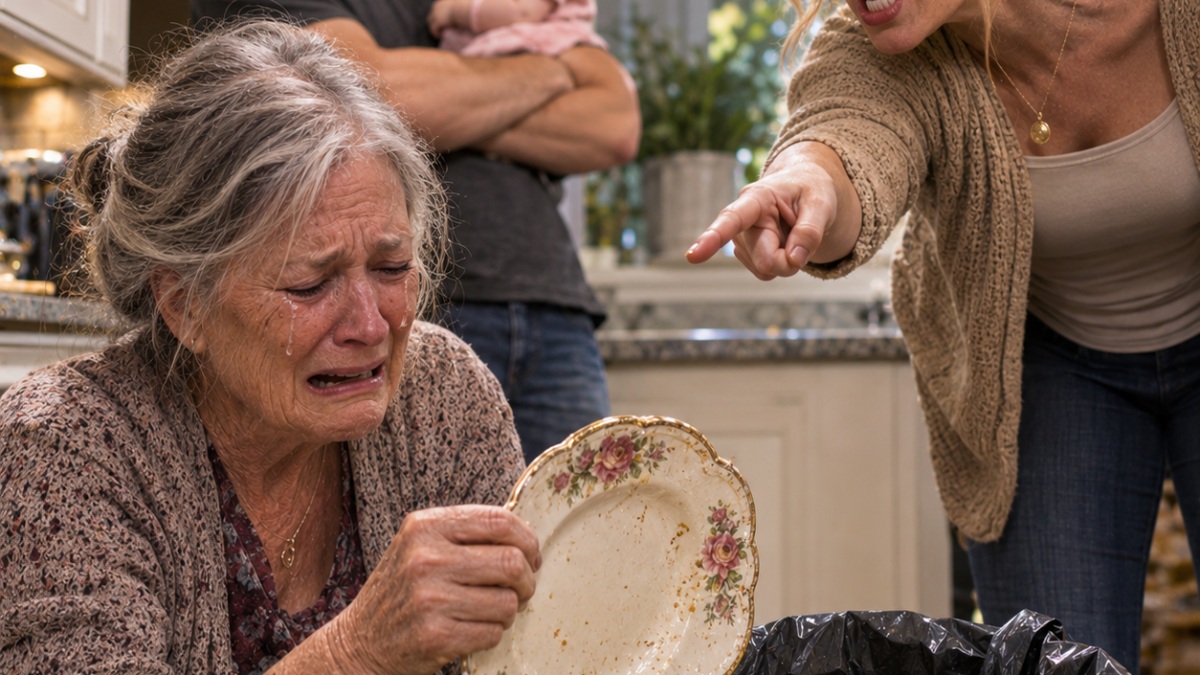
Instead, I opened the kitchen door and saw cobalt blue porcelain sticking out of the trash can.
My wedding dishes.
The ones Robert had given me.
The ones we’d used for forty-five years.
Thrown away.
Not boxed.
Not offered to me.
Not placed somewhere safe.
Thrown into garbage.
With eggshells.
Coffee grounds.
Used napkins.
I remember kneeling.
Pulling out the plates.
One by one.
My hands shaking.
My chest hurting.
And Carly standing above me, annoyed that I was making a fuss.
That was the morning I finally realized how far I’d allowed things to go.
And it was the morning my life began changing.
After Carly stormed out of the kitchen, I rescued every piece I could.
Eight plates.
Six bowls.
Four cups.
The large serving dish.
The little creamer.
The chipped plate Robert had dropped years earlier.
Some pieces were dirty.
A few were damaged.
But most could be cleaned.
I washed them carefully.
Dried them with a soft towel.
Then placed them in a clean box.
When I finished, I sat at the kitchen table.
For a long time, I stared at the box.
I felt exhausted.
As though I’d spent the morning carrying something far heavier than porcelain.
Then I remembered my work.
Forty years as an accountant.
Forty years of examining numbers.
Finding discrepancies.
Understanding what figures revealed when people stopped paying attention.
I looked toward the hallway.
My old bedroom.
The room where my desk and important papers were stored before Carly moved in.
A sudden thought came to me.
Where is my credit card?
I stood.
Went upstairs.
And began searching.
My credit card wasn’t in the drawer where I’d left it.
At first, I thought I’d misplaced it.
I checked my purse.
My wallet.
The small lockbox in my current room.
Nothing.
Then I remembered Carly showing me the new dishes.
An $1,850 set.
The kind of purchase she couldn’t possibly justify while telling me they had no money.
I went downstairs.
Opened my computer.
Signed into my bank account.
And began reviewing transactions.
The first unfamiliar charge was from Macy’s.
$1,850.
My breath caught.
I clicked on it.
Checked the date.
Checked the card.
Then looked toward the kitchen cabinet.
The white dishes.
I felt cold.
I scrolled farther.
Clothing purchases.
Cosmetics.
Shoes.
Home decorations.
Several transactions I had never authorized.
Together, they totaled approximately $3,400, including the expensive dinnerware.
I sat perfectly still.
My hands were trembling.
I wanted to believe there was an explanation.
Maybe I’d forgotten something.
Maybe Scott had used the card with my permission.
Maybe there was an accounting error.
But I knew those were desperate excuses.
I remembered the card in my desk.
The room Carly now occupied.
The purchases.
The timing.
And suddenly, every expensive shopping bag I’d seen began making sense.
I pressed a hand against my mouth.
“My God.”
Then I whispered the words I’d been afraid to think.
“She took my money.”
I checked everything.
Dates.
Merchants.
Amounts.
The transactions didn’t belong to me.
I had never bought expensive makeup.
Never purchased designer shoes.
Never ordered luxury housewares.
The records were there.
Clear.
Specific.
I printed them.
Then placed them beside the receipt for the new dishes.
The same dishes Carly had purchased to replace my wedding set.
With my card.
Without my knowledge.
I stared at the papers.
For months, I’d been paying their bills because I believed they had nowhere else to turn.
I’d surrendered my rooms because I believed Camille needed them.
I’d swallowed insults because I didn’t want to upset my son.
And while I was doing all of that, Carly had apparently been using my account as though it belonged to her.
I felt anger rise.
Hot.
Unfamiliar.
Almost frightening.
Then something else.
Clarity.
I wasn’t simply being disrespected.
My generosity was being exploited.
And I needed to stop it.
That night, I couldn’t sleep.
I sat in the little bedroom Carly had assigned me, surrounded by boxes that had never been unpacked.
My clean wedding dishes rested beside the dresser.
The gold edges caught the light from my bedside lamp.
I stared at them for a long time.
Then opened the drawer where I kept my important documents.
Inside was a green folder.
The deed to the house.
Property tax records.
Insurance information.
Bank statements.
Documents I’d kept carefully organized since my working years.
I placed everything on the bed.
Then began reviewing the last eight months.
Not guessing.
Not relying on memory.
Adding numbers.
Checking dates.
Separating ordinary household expenses from costs that had increased after Scott and Carly moved in.
It was worse than I’d expected.
Utilities had risen significantly.
Groceries cost more.
Carly had ordered expensive products while contributing little toward them.
Scott had made occasional payments, but nowhere near enough to cover what the household was consuming.
I stared at the totals.
For eight months, I had treated my home like a free refuge for people who were supposed to be getting back on their feet.
Instead, they had become increasingly comfortable letting me pay while they made plans without me.
I took off my glasses.
Rubbed my eyes.
And looked toward Robert’s photograph.
“Honey, I think I made a terrible mistake.”
Then I opened the next bank statement.
And found another charge.
By three in the morning, my kitchen table was covered with papers.
I had marked every transaction that needed explanation.
Highlighted every suspicious purchase.
Written down every increased household expense.
I wasn’t planning to demand repayment for every grocery I’d bought.
I’d offered to help my family.
That had been my choice.
But helping someone didn’t give them permission to take money without asking.
And I wanted to understand the full financial impact before deciding what to do.
When I finished, I looked at the deed.
My name.
Ellena Johnson.
There it was.
The house belonged to me.
Not Scott.
Not Carly.
Not Evelyn.
Me.
For months, Carly had acted as though she controlled every room.
But the legal documents told a different story.
I had surrendered space voluntarily.
And I could insist on getting it back through the appropriate process.
I looked at the clock.
Four thirty.
The bank would open in a few hours.
I picked up my phone.
Then stopped.
I knew exactly whom I needed to call.
My niece Valerie was a lawyer.
She was the daughter of my younger sister, who’d died ten years earlier.
After my sister’s death, Valerie and I had become close.
I’d helped with some of her educational expenses when she was studying law.
Not because she asked.
Because I knew how hard she’d worked.
She was intelligent.
Practical.
The kind of woman who could examine a problem without becoming distracted by how emotional everyone else was.
I called her early the following morning.
“Aunt Ellena?”
Her voice sounded surprised.
“Sweetheart, I need your help.”
A pause.
“What’s wrong?”
I looked toward the kitchen.
“I think somebody has been using my credit card without permission.”
Her tone changed immediately.
“Are you safe?”
“Yes.”
“Have you contacted the bank?”
“I’m going to.”
She took a breath.
“Tell me what’s happened.”
I told her about the dishes.
The bedroom.
The expenses.
The charges.
The eight months of living arrangements.
She listened.
Then said, “Aunt Ellena, I want you to preserve the records and speak to the bank promptly.”
I swallowed.
“Could you come over?”
“Of course.”
I closed my eyes.
“Thank you.”
She paused.
“And Aunt Ellena?”
“Yes?”
“Please don’t sign anything or confront anyone about the financial records until we’ve reviewed what you’ve got.”
I nodded.
“All right.”
When the call ended, I felt something I hadn’t felt in months.
Relief.
Not because the problem was solved.
Because I finally had someone willing to listen before deciding I was being dramatic.
Before Valerie arrived, I called the bank.
I reported the card missing.
Explained that I had discovered transactions I hadn’t authorized.
Asked for the card to be blocked and replaced.
Requested the proper dispute process.
The representative listened carefully.
She asked questions.
I answered honestly.
Then I followed the instructions for protecting my account.
I changed passwords.
Reviewed alerts.
Checked whether any other account information had been compromised.
By the time I finished, my hands were shaking.
I had spent forty years helping other people keep accurate financial records.
Yet I’d allowed my own accounts to go unexamined because I didn’t want to believe my family could misuse them.
That realization hurt.
But I wasn’t going to let embarrassment stop me from correcting it.
Valerie arrived the next morning carrying a briefcase.
She hugged me.
Then looked at my face.
“Aunt Ellena, you look exhausted.”
I forced a smile.
“I haven’t slept much.”
She squeezed my hand.
“Let’s sit.”
We spread the documents across the kitchen table.
Bank statements.
Receipts.
A copy of the house deed.
Notes about household expenses.
Photographs of the replaced dishes.
Valerie reviewed everything carefully.
Then looked up.
“These charges need to be investigated.”
I nodded.
“She used my card.”
“We need to document what you know and follow the bank’s process.”
I swallowed.
“Could Carly get into serious trouble?”
Valerie’s expression softened.
“Unauthorized card use can have serious legal consequences. But the facts need to be established, and the right steps depend on the applicable law.”
I looked down.
“I don’t want to destroy her life.”
Valerie reached for my hand.
“Aunt Ellena, protecting yourself doesn’t mean you’re responsible for the choices somebody else made.”
Tears filled my eyes.
She continued.
“And we need to address the living situation separately.”
I looked up.
“Can I make them leave?”
She considered the question.
“You own the house, but they’ve been living here for months. We need to follow the lawful notice and possession process. You shouldn’t simply lock them out or remove their belongings.”
I nodded.
“I don’t want a fight.”
“Then let’s prepare properly.”
For the next several hours, we discussed how to document the situation, give appropriate notice, and pursue further legal steps if necessary.
Valerie prepared a written notice consistent with the process she recommended after reviewing the circumstances.
She also explained the difference between expenses I’d voluntarily paid and unauthorized purchases that might give rise to a repayment claim.
When we finished, she looked at me.
“Are you sure this is what you want?”
I looked toward the kitchen cupboard.
The new white dishes.
Then at the box containing my wedding set.
“Yes.”
My voice trembled.
“I want my house back.”
Valerie stayed for coffee.
For a while, we didn’t talk about legal documents.
We talked about her mother.
My sister.
The woman I’d lost ten years earlier.
Valerie told me she still remembered the way her mother used to laugh when somebody told a terrible joke.
I smiled.
“She laughed harder at bad jokes than good ones.”
Valerie laughed through tears.
“She did.”
Then she looked toward the kitchen.
“Your house feels different.”
I swallowed.
“I know.”
She studied me.
“You used to be so happy here.”
My eyes filled.
I looked toward the garden.
“After Robert died, I was lonely.”
Valerie nodded.
“So when Scott called, I thought having everyone here would make me feel less alone.”
I paused.
“I didn’t understand that you can be surrounded by people and still feel terribly lonely.”
She reached for my hand.
I continued.
“Sometimes I hear them laughing downstairs, and I’m afraid to come out of my room because Carly might complain.”
Valerie’s eyes filled.
I looked down.
“I own this house, sweetheart.”
My voice broke.
“And I feel like I’m trespassing.”
She squeezed my fingers.
“Then it’s time to change that.”
That afternoon, Carly went to visit Evelyn with Camille.
Scott returned from work earlier than usual.
I was upstairs putting away documents when I heard voices in the garden.
At first, I paid no attention.
Then Carly said something that made me stop.
“Six more months.”
I stood near the window.
Scott answered.
“I don’t know, Carly. Mom seems unhappy.”
Carly laughed.
“Your mother is always unhappy about something.”
I felt my stomach tighten.
Scott continued.
“We told her we’d stay only a couple of months.”
“And now we’re saving money.”
I heard the rustle of leaves.
Carly continued.
“Why pay somebody else rent when we can stay here?”
I pressed one hand against the windowsill.
Scott sounded uncertain.
“I don’t want to take advantage of her.”
Carly gave a sharp laugh.
“She’s your mother. She likes having us here.”
I closed my eyes.
Then she said, “Besides, once we’ve saved another twenty thousand dollars, we can put down a deposit on our own place.”
Scott was quiet.
Carly continued.
“Camille is the reason she won’t complain too much.”
My stomach turned.
There it was.
My granddaughter.
The little girl I loved more than I could explain.
Being discussed as a way to keep me quiet.
Then Carly said something even worse.
“She hasn’t even noticed most of the money I used from her card.”
I stopped breathing.
Scott didn’t answer immediately.
Then he said, “Carly, what money?”
She laughed nervously.
“Oh, don’t start.”
His voice changed.
“Did you use Mom’s card?”
There was a silence.
Then Carly said, “It’s not like she needs every dollar.”
My eyes filled.
I stepped away from the window.
I couldn’t listen anymore.
It was one thing to suspect.
Another to hear someone dismiss my money as though taking it were harmless.
And even though Scott sounded troubled, I wondered why he hadn’t noticed the signs before.
Why he’d allowed the rearrangements.
The bedroom.
The sewing room.
The bills.
The way Carly spoke to me.
I looked toward the documents on my bed.
Then took a breath.
The time for silence was over.
“Scott. Carly.”
They looked up when I stepped into the garden.
My son frowned.
“Mom?”
I stood beside the doorway.
“I need both of you in the living room.”
Carly shifted Camille against her shoulder.
“What for?”
I looked at her.
“Now.”
Something in my voice made them stop.
Scott approached.
“Mom, are you okay?”
I looked toward him.
“No, sweetheart.”
His expression changed.
“I haven’t been okay for months.”
He stared.
Then followed me inside.
I placed the papers on the coffee table.
Scott sat on the sofa.
Carly remained standing, holding Camille.
I looked at them.
For a moment, I saw my family as I’d imagined it eight months earlier.
My son.
His wife.
My beautiful granddaughter.
I remembered how happy I’d been when they arrived.
How carefully I’d prepared the guest room.
How I’d painted the clouds and stars.
How I’d believed the house would feel warm again.
Then I looked at the documents.
And felt my heart harden just enough to keep speaking.
“Eight months ago, you asked to stay here temporarily.”
Scott nodded.
“I know.”
“I said yes because you needed help.”
He looked down.
“I know, Mom.”
I turned toward Carly.
“Since then, my furniture has been moved without permission.”
She sighed.
“My bedroom was taken.”
Carly shifted.
“My sewing room was emptied.”
She rolled her eyes.
“And my wedding dishes were thrown in the garbage.”
Scott looked sharply toward her.
“Wait. What?”
I took a breath.
“There’s more.”
I placed the bank statements in front of them.
“Someone used my credit card without authorization.”
Carly went pale.
Scott stared at the papers.
I pointed toward the first charge.
“One thousand eight hundred fifty dollars at Macy’s.”
He looked up.
“For what?”
I pointed toward the kitchen.
“The white dishes.”
For a moment, my son simply stared.
Then he turned toward his wife.
“Carly?”
She swallowed.
“Scott, it’s complicated.”
He looked back at the statement.
Then at the next page.
“And these?”
I answered.
“Clothes. Makeup. Shoes. Decorations.”
My voice trembled.
“Approximately thirty-four hundred dollars in transactions I didn’t authorize.”
Scott stared at Carly.
“Did you use Mom’s card?”
She looked away.
“Carly.”
Her eyes filled.
“I was going to explain.”
I felt my stomach turn.
Scott stood.
“You took her card?”
She snapped, “We needed things!”
His expression changed.
“Then why didn’t you ask?”
Carly looked toward me.
“Because Ma gets emotional about everything!”
I stared.
Scott lowered the papers.
Then looked directly at her.
“These are purchases you made without her permission.”
Carly’s face reddened.
“She has plenty of money!”
The words hung in the air.
I felt a strange calm settle over me.
For eight months, I’d been wondering whether she understood what she was doing.
Now I knew.
She believed my money was available because she wanted it.
And she believed my feelings didn’t matter because I was old.
I placed the house deed on the table.
Scott looked confused.
“Mom?”
I took a breath.
“This house belongs to me.”
He nodded.
“I know.”
I looked toward Carly.
“I worked forty years to pay for it.”
She remained silent.
“Your father helped build this life with me.”
Scott looked down.
I continued.
“When I offered you a temporary place to stay, I was offering shelter.”
My voice strengthened.
“I was not giving you ownership.”
Carly shifted.
“I never said you were.”
I looked at her.
“You acted as though you had the right to decide which rooms I could occupy.”
She opened her mouth.
I continued.
“You moved my things while I was away.”
She looked toward Scott.
“You threw away my wedding dishes.”
Her eyes narrowed.
“And you used my money without asking.”
The room was quiet.
Camille made a little sound against her mother’s shoulder.
I looked toward the baby.
My heart tightened.
Then I faced Scott.
“I love you.”
His eyes filled.
“You know I do.”
He nodded.
“But I can’t keep living like this.”
His face changed.
“Mom…”
I placed the written notice on the coffee table.
“You need to make arrangements to move out.”
He stared.
Carly stepped forward.
“What?”
I took a breath.
“Valerie has advised me about the legal process.”
I looked at Scott.
“I’m giving you formal notice, and I expect you to follow the requirements and arrange another place to live.”
For a long moment, nobody spoke.
Then Carly began laughing.
A sharp, disbelieving laugh.
“You’re kidding.”
I shook my head.
“No.”
She looked toward Scott.
“Tell her she’s kidding.”
My son didn’t answer.
Carly’s smile disappeared.
Then she shouted, “You can’t throw us out! WE HAVE A BABY!”
I felt tears fill my eyes.
“I know.”
She stepped closer.
“Your own granddaughter!”
I swallowed.
“Camille is not responsible for this.”
Carly looked furious.
I continued.
“And I will always love her.”
My voice broke.
“But loving my granddaughter doesn’t mean I have to surrender my home and finances to her parents.”
Scott picked up the notice.
His hands shook.
“Mom, please.”
I looked at him.
He swallowed.
“I know we’ve made mistakes.”
I shook my head.
“This isn’t one mistake.”
His eyes filled.
“It’s eight months.”
He looked down.
I continued.
“Eight months of being made to feel unwanted in the home I paid for.”
My voice broke.
“Eight months of swallowing my feelings because I was afraid you’d stop bringing Camille to see me.”
Scott covered his mouth.
I felt tears rolling down my face.
“I gave up my bedroom.”
His expression crumpled.
“My sewing room.”
He nodded slowly.
“My furniture.”
He looked toward the floor.
“And then I found the dishes your father gave me lying in the garbage.”
Scott began crying.
I looked at him.
“Son, I didn’t need you to choose between me and your wife.”
He raised his eyes.
“I needed you to notice that your mother was hurting.”
He covered his face.
For a long time, he didn’t speak.
Then he whispered, “I’m sorry.”
I nodded.
“I know you are.”
But I didn’t take back the notice.
Carly stood beside the sofa with Camille in her arms.
Her expression shifted between anger and panic.
“Ma, I apologized for the dishes.”
I looked toward her.
“No, Carly.”
She frowned.
“You said they were old and I was dramatic.”
She looked away.
“That’s not an apology.”
Her eyes filled.
I continued.
“And even if you apologized sincerely, it wouldn’t change what happened with my credit card.”
She began crying.
“I just wanted Camille to have a nice home.”
I looked toward the baby.
Then back at her.
“She had one.”
My voice trembled.
“She had a loving grandmother with a safe house and a family willing to help.”
Carly stared.
I continued.
“You didn’t have to erase everything that belonged to me to make this house comfortable for her.”
For a moment, she said nothing.
Then she whispered, “I didn’t think you cared that much.”
I looked at her.
“You never asked.”
I turned toward the stairs.
I was exhausted.
My hands were trembling.
I needed a moment alone.
Then Carly said something that stopped me.
“Your mother is impossible, Scott.”
I paused.
She continued.
“Everything has to be about her dead husband and her precious old junk.”
I gripped the banister.
Scott spoke sharply.
“Carly, stop.”
But she was angry now.
And frightened.
And when people feel cornered, sometimes they reach for the cruelest words they can find.
She raised her voice.
“Maybe Robert died because he couldn’t stand living with her anymore!”
The house went silent.
I stood frozen.
For a moment, I couldn’t understand what she’d said.
Then the meaning reached me.
My husband.
The man who had loved me for forty-five years.
The man whose hand I’d held during his final illness.
The man whose absence still hurt every morning.
Carly had used his death as a weapon.
I turned slowly.
“What did you say?”
Her face changed.
Scott stared at his wife.
“Carly…”
I took one step down.
Then another.
“Say it again.”
She swallowed.
“Ma, I was angry.”
I looked at her.
“Do you really believe my husband died because he couldn’t stand being married to me?”
She looked away.
Scott stepped forward.
“Mom, she didn’t mean it.”
I turned toward him.
“Don’t.”
My voice was sharp enough to make him stop.
I felt tears spilling down my cheeks.
“For eight months, you’ve told me Carly doesn’t mean the things she says.”
He stared.
I continued.
“She didn’t mean to hurt me when she moved the furniture.”
My voice shook.
“She didn’t mean to upset me when she took my bedroom.”
I looked toward Carly.
“She didn’t mean anything when she threw away your father’s wedding gift.”
I wiped my face.
“And now she’s telling me that the man who loved me most in this world died because I made his life unbearable.”
Scott’s face crumpled.
I looked directly at him.
“When do her words become her responsibility?”
He began crying.
And Carly finally fell silent.
For a long moment, nobody moved.
Camille began fussing.
Carly adjusted her against her shoulder.
I looked toward my granddaughter.
The baby hadn’t done anything wrong.
She didn’t understand why the adults were shouting.
She only knew the room had become frightening.
I took a breath.
Then spoke more quietly.
“This conversation needs to stop until everyone can speak calmly.”
Scott nodded.
I continued.
“The notice stands.”
Carly looked up.
“And the unauthorized charges need to be addressed.”
She swallowed.
“I’m not going to threaten you while you’re holding a baby.”
My voice strengthened.
“But I’m also not going to pretend nothing happened.”
Scott wiped his eyes.
“Mom, can we work out repayment?”
I nodded.
“With proper documentation.”
He swallowed.
“And the house?”
I looked at him.
“You need your own place.”
His eyes filled.
I continued.
“You’re thirty-two years old. You have a wife and a child.”
He nodded.
“Your father and I gave you a home while you were growing up.”
My voice softened.
“And I opened that home to you when you needed help.”
Tears rolled down my face.
“But now you need to build a household you can support without treating mine as something you own.”
Scott lowered his head.
For a moment, he looked like the little boy who used to come to me when he’d broken something.
Only this time, what had been broken wasn’t a plate.
It was trust.
The next day, Scott asked to speak with me alone.
Carly was upstairs with Camille.
We sat at the kitchen table.
He looked exhausted.
“Mom, I didn’t know about the card.”
I watched him carefully.
“I heard part of your conversation in the garden.”
His face changed.
He looked down.
“I knew Carly was spending too much.”
I waited.
“But I didn’t realize she was using your card.”
I nodded slowly.
He continued.
“And I knew you weren’t happy here.”
My throat tightened.
He covered his face.
“I just didn’t want another problem.”
I looked toward him.
“Scott, avoiding a problem doesn’t make it disappear.”
He nodded.
“I know.”
I swallowed.
“You saw the furniture moving.”
His eyes filled.
“You saw me leave my bedroom.”
He nodded.
“You saw my sewing room become storage for baby equipment.”
He looked down.
I continued.
“And every time I tried to tell you how I felt, you said Carly only wanted what was best for Camille.”
He began crying.
I reached toward his hand.
Then stopped.
I needed him to hear me before I comforted him.
“Your daughter deserves a good life.”
His voice broke.
“I know.”
“So do I.”
He looked up.
I held his gaze.
“I’m still a person, Scott.”
A tear rolled down his cheek.
“I know, Mom.”
I swallowed.
“Then I need you to start treating me like one.”
He agreed to repay the unauthorized charges.
We documented the arrangement properly with Valerie’s guidance.
He and Carly also agreed to leave within a mutually arranged period consistent with the applicable requirements and advice we’d received.
They had to find somewhere to live.
They had to budget.
They had to face the expenses I’d been quietly absorbing.
And they had to understand that my forgiveness couldn’t be purchased by a few tears.
It would depend on changed behavior.
The days that followed were uncomfortable.
Scott searched for apartments.
Carly packed.
Camille cried at night.
The house felt tense.
Sometimes I heard Carly whispering angrily upstairs.
Other times, she avoided me completely.
I didn’t enjoy any of it.
I’d imagined having my family nearby would make me happy.
Now I was watching them prepare to leave.
And part of me felt as though I’d failed.
But then I’d look toward the box containing my wedding dishes.
And remember.
I hadn’t asked for perfection.
I’d asked for respect.
I hadn’t demanded that Carly love my decorating choices.
I’d asked her not to destroy my belongings.
I hadn’t refused to help my son.
I’d helped him for eight months.
Now I was asking him to take responsibility for his own household.
Those weren’t unreasonable things.
I repeated that to myself whenever guilt became heavy.
One evening, Mrs. Rodriguez knocked on my door.
She’d been my neighbor for decades.
A warm, practical woman who knew most of the history of our street.
She brought a box of donuts.
“Ellena?”
I opened the door.
She looked at me.
“Honey, you look tired.”
I laughed weakly.
“That’s becoming my permanent condition.”
She stepped inside.
We sat in the kitchen.
I told her what had happened.
The bank statements.
The argument.
The notice.
Carly’s words about Robert.
Mrs. Rodriguez listened without interrupting.
Then she reached across the table.
“Your husband adored you.”
My eyes filled.
She continued.
“I remember him planting those roses.”
I smiled through tears.
She laughed softly.
“He spent half a Saturday arguing with the soil because he said the roots deserved better.”
I covered my mouth.
I could almost hear Robert complaining in the garden.
Mrs. Rodriguez squeezed my fingers.
“Don’t let somebody else’s cruelty change what you know about your marriage.”
I began crying.
She moved beside me.
And held me.
For the first time in months, I allowed myself to be comforted without apologizing for it.
A few days before the move, Carly knocked on my door.
I was sitting in my small bedroom folding clothes.
“Ma?”
I looked up.
She stood holding an envelope.
Her face was pale.
“Can I come in?”
I hesitated.
Then nodded.
She entered.
For a moment, she looked around the room.
The narrow bed.
The boxes.
My husband’s photograph.
The wedding dishes resting in their clean container.
Her eyes lingered on them.
Then she held out the envelope.
“I wrote you something.”
I looked at it.
“What is it?”
“An apology.”
I took the envelope.
My hands remained steady.
“Thank you.”
She swallowed.
“I know words aren’t enough.”
I nodded.
“They aren’t.”
Her eyes filled.
For a moment, she seemed to expect me to soften.
To hug her.
To tell her everything was forgiven.
But I wasn’t ready.
Carly looked toward the photograph of Robert.
Then whispered, “I shouldn’t have said that about him.”
My throat tightened.
“No.”
She began crying.
“I was angry.”
I looked at her.
“You were cruel.”
She nodded.
“I know.”
I took a breath.
“Carly, you don’t have to like my furniture.”
She looked up.
“You don’t have to enjoy my cooking.”
I continued.
“You don’t even have to agree with every decision I make.”
My voice softened.
“But you do have to understand that somebody else’s age, grief, or generosity doesn’t give you permission to treat them as though they don’t matter.”
She wiped her eyes.
I looked toward the envelope.
“I hope you learn that.”
She nodded.
“I want to.”
For a moment, neither of us spoke.
Then Carly whispered, “Do you hate me?”
I considered the question.
“No.”
Her expression changed.
I continued.
“But I don’t trust you.”
She looked down.
“And I can’t pretend trust will return just because you’re sorry today.”
Tears rolled down her cheeks.
I swallowed.
“Maybe in time, things can improve.”
She nodded.
“But that will depend on what you do.”
She wiped her face.
Then quietly left the room.
I remained sitting on the bed.
Holding the letter.
For a long time, I didn’t open it.
Moving day arrived.
Scott had rented a truck.
A friend helped carry boxes.
Carly was quiet.
Camille slept in her stroller for much of the afternoon.
I watched the house slowly empty.
The modern decorations disappeared.
The extra furniture.
The baby equipment.
The shopping bags.
The things that had crowded the hallways.
By four o’clock, most of their belongings were loaded.
Scott came into the kitchen.
He placed a set of keys on the table.
“Mom.”
I looked up.
“We’re ready.”
My throat tightened.
“All right.”
He looked exhausted.
They’d found a modest apartment.
Smaller than my house.
With two bedrooms.
A kitchen.
A little living room.
It wasn’t luxurious.
But it was theirs to manage.
Scott had made arrangements to work additional hours while rebuilding their finances.
Carly would need to contribute when she could.
They were going to learn what it meant to budget without having my savings available to absorb every expense.
Scott looked toward the keys.
“These are all the copies.”
I nodded.
“Thank you.”
For a moment, he didn’t move.
Then he whispered, “Mom, I love you.”
My eyes filled.
“I love you, too.”
He stepped forward as though to hug me.
I hesitated.
Not because I’d stopped loving him.
Because I was still hurt.
Scott noticed.
His face fell.
“Mom…”
I swallowed.
“I need some space, sweetheart.”
He nodded slowly.
“I understand.”
I looked at him.
“I hope you do.”
His eyes filled.
Then he turned and walked toward the door.
I watched him go.
And felt a piece of my heart go with him.
Carly was already in the truck with Camille.
Before Scott climbed into the driver’s seat, he looked back toward the house.
For a moment, I saw the little boy who used to play in the garden.
The boy Robert had taught to ride a bicycle.
The boy I’d held when he was sick.
I wanted to run toward him.
Tell him he could stay.
That we’d work everything out.
That I didn’t care about the money or the dishes or the bedroom.
But I did care.
And pretending otherwise would only bring us back to the same place.
So I remained in the doorway.
Scott raised one hand.
I raised mine.
Then the truck pulled away.
I watched until it disappeared around the corner.
And the house became quiet.
I stood in the kitchen for a long time.
Nobody was telling me to turn down the television.
Nobody was asking me to change what I cooked.
Nobody was moving my belongings.
Nobody was complaining that my sewing machine made too much noise.
I walked through the rooms.
Slowly.
The living room.
The dining room.
The sewing room.
The master bedroom.
Everywhere I looked, there were signs of the previous eight months.
Marks on walls.
Small scratches in furniture.
Empty spaces.
But the house was mine again.
I went downstairs to the basement.
My grandmother’s sideboard stood beneath a protective cover.
The old curtains were folded in a box.
My wedding photographs rested against the bookshelf.
The Singer sewing machine stood in a corner.
I touched its wooden case.
Then whispered, “We’re going upstairs.”
For the first time in months, I smiled without forcing it.
That night, I slept in my own bedroom.
I had moved the remaining baby equipment out and made the bed with fresh sheets.
The room looked different.
There were marks on the wall where Carly had hung decorations.
The furniture wasn’t arranged the way Robert and I had left it.
And a few things were missing.
But the bed was mine.
The window was mine.
The space was mine.
I lay down and stared at the ceiling.
It was the same ceiling I’d looked at beside Robert for decades.
The same room where we’d laughed after Scott took his first steps.
Where we’d talked about retirement.
Where I’d held my husband’s hand during sleepless nights.
I turned toward his photograph.
For a moment, I almost expected to hear him breathing beside me.
I began crying.
But the tears felt different.
They weren’t the helpless tears I’d shed while hiding in the guest room.
They were tears of exhaustion.
Relief.
Grief.
And a strange, fragile happiness.
“Robert,” I whispered, “I did it.”
I touched the photograph.
“I got our home back.”
Then I closed my eyes.
And slept.
The next morning, birds woke me.
Not loud music.
Not Carly’s footsteps.
Not somebody calling from downstairs for me to bring a bottle or change the temperature.
Birds.
I lay still for several minutes.
Listening.
The morning light touched the curtains.
A breeze moved through the garden.
The house was quiet.
And for the first time in eight months, quiet didn’t feel like something I needed to fear.
I got out of bed.
Put on my old robe.
The soft blue one Carly had once called embarrassing.
Then went downstairs.
I opened the kitchen cupboard.
Removed the expensive white dishes.
Packed them carefully.
And set them aside with the remaining belongings to be returned as appropriate.
Then I opened the box containing my cobalt blue wedding set.
I took out one plate.
The chipped one.
The one Robert had dropped all those years earlier.
I washed it again.
Dried it.
And placed it in the cupboard.
The blue porcelain glowed beneath the morning light.
I stood looking at it.
Then laughed softly.
“Welcome home, sweetheart.”
Mrs. Rodriguez helped me restore the house.
We began with the living room.
She brought her son to help carry the heavy furniture up from the basement.
My grandmother’s sideboard returned to the dining room.
The mahogany bookshelf went back beside the window.
The wedding photographs returned to their places.
The beige curtains were cleaned and rehung.
When we finished, Mrs. Rodriguez stood beside me.
“Well?”
I looked around.
For a moment, I couldn’t speak.
The room wasn’t perfect.
Some pieces had been scratched.
The curtains looked older than I remembered.
But it felt familiar.
Warm.
Lived in.
Mine.
I touched the bookshelf.
Then whispered, “Robert would’ve liked this.”
Mrs. Rodriguez smiled.
“He always did.”
I began crying.
She hugged me.
And for a little while, we simply stood there in the living room, surrounded by the ordinary things that had become precious because I’d nearly lost the right to keep them.
Next came my sewing room.
I unpacked the Singer machine.
Wiped away the dust.
Checked that it was working.
Organized my scissors.
Sorted my thread.
Folded the fabrics.
Then placed a small vase of flowers beside the window.
When I finally sat down in front of the machine, I hesitated.
It had been months.
I wondered whether I’d forgotten the pleasure of creating something with my hands.
Then I pressed the pedal.
The machine began humming.
A familiar sound.
Steady.
Comforting.
I fed a strip of fabric beneath the needle.
The stitches formed a neat line.
And suddenly, I was crying.
Not because anything was wrong.
Because I hadn’t realized how much I missed that sound.
The hum of my mother’s old machine.
The sunlight on the table.
The quiet pleasure of choosing a pattern.
For eight months, those things had been treated as unimportant.
Now they felt like pieces of myself returning.
I began seeing a therapist.
Her name was Dr. Laura Hills.
At first, I felt foolish.
I was sixty-eight.
I’d spent forty years working.
Raised a son.
Survived losing my husband.
Managed a household.
Surely I should have known how to handle a difficult daughter-in-law.
But I had spent months crying in secret.
My blood pressure had increased.
My sleep had deteriorated.
And I had become frightened of making ordinary decisions inside my own home.
I needed help understanding why I’d allowed things to continue so long.
During our first appointment, Dr. Hills listened while I explained everything.
The phone call.
The move.
The curtains.
The furniture.
The bedroom.
The sewing room.
The dishes.
The unauthorized purchases.
The confrontation.
The move.
When I finished, I felt exhausted.
She waited.
Then asked, “Ellena, what were you most afraid would happen if you said no?”
I stared at her.
For a moment, I couldn’t answer.
Then the truth came out.
“I thought I’d lose my son.”
My eyes filled.
“And my granddaughter.”
Dr. Hills nodded.
I continued.
“After Robert died, I was so lonely.”
My voice broke.
“When Scott asked to move in, I thought I was getting my family back.”
Tears rolled down my cheeks.
“So every time Carly wanted something, I told myself it was worth it.”
I swallowed.
“I thought if I kept giving, they’d stay.”
The therapist was quiet.
Then she asked gently, “Did giving them more make you feel more loved?”
I looked down.
“No.”
The word came out barely above a whisper.
She waited.
I began crying.
“Every time I gave something up, I felt less important.”
That was the moment I understood how much I’d lost before the dishes ever reached the garbage.
Therapy wasn’t easy.
Some sessions left me feeling relieved.
Others exhausted.
I had to examine habits I’d developed over decades.
The way I apologized before expressing a preference.
The way I said yes when I wanted to say no.
The way I felt responsible for everybody else’s feelings.
I learned that generosity becomes unhealthy when it’s driven entirely by fear.
I learned that asking for respect wasn’t the same as demanding control.
And I learned that I could love Scott without giving him unlimited access to my money or home.
One afternoon, I told Dr. Hills something I’d been afraid to admit.
“Sometimes I miss having them here.”
She nodded.
“Of course.”
I looked down.
“Even Carly.”
The words surprised me.
She waited.
I continued.
“I miss the sound of the baby.”
My throat tightened.
“The little clothes in the laundry.”
I wiped my eyes.
“The way Scott used to come downstairs for coffee.”
Dr. Hills spoke gently.
“Missing those moments doesn’t mean your decision was wrong.”
I looked toward her.
She continued.
“You can grieve an arrangement that wasn’t healthy for you.”
I sat quietly.
Then nodded.
For the first time, I understood that feeling sad about their departure didn’t mean I needed to invite them back.
I could miss them.
And still protect my peace.
One afternoon, Mrs. Rodriguez arrived holding a small cardboard box.
She stood on the porch with an expression I recognized.
The expression of someone who had a surprise and was hoping I wouldn’t object.
“Ellena?”
I smiled.
“What have you done?”
She laughed.
“Nothing terrible.”
Then the box moved.
I stared.
“What’s in there?”
She lifted the lid.
Two enormous green eyes looked up at me.
A tiny gray kitten.
Black stripes along her back.
Ears too large for her little head.
She made a faint sound.
My heart melted.
“Oh, sweetheart.”
Mrs. Rodriguez smiled.
“She turned up near my yard. I had her checked and made sure no one was looking for her.”
I reached toward the kitten.
She sniffed my fingers.
Then began purring.
I laughed through tears.
Mrs. Rodriguez watched me.
“I thought she might enjoy living with you, if you’re ready.”
I hesitated.
A pet was a responsibility.
Not simply a cure for loneliness.
But I’d been thinking about having an animal companion.
I had time.
Space.
And the resources to provide proper care.
I looked down at the little gray kitten.
She pressed her head against my hand.
I smiled.
“Hello, baby.”
Her tail moved.
I laughed.
“I suppose you’ll need a name.”
Mrs. Rodriguez leaned closer.
“Have you thought of one?”
I looked toward the window.
The afternoon light was soft.
Then I looked at the kitten again.
“Luna.”
She purred.
I smiled.
“Your name is Luna.”
And just like that, the house gained a new little heartbeat.
Luna changed the sound of my days.
She chased dust motes in the sunlight.
Investigated every corner.
Curled beside me while I sewed.
Followed me into the kitchen.
And claimed the sofa as though she’d paid the mortgage herself.
Some mornings, I woke to find her sleeping near my pillow.
Other times, she sat on the windowsill watching birds.
I talked to her constantly.
“Luna, do you think this fabric matches?”
She blinked.
“I’ll take that as a yes.”
When I made coffee, she’d follow me downstairs.
When I watered the garden, she’d watch safely from the window.
And when the house became quiet in the evening, she’d curl into my lap and purr.
She didn’t replace Robert.
Nothing could.
She didn’t replace Scott or Camille.
But she gave me companionship without asking me to become smaller.
I could sit in my own chair.
Use my own dishes.
Choose my own curtains.
And Luna seemed perfectly content with all of it.
I began laughing more.
Smiling more.
Sleeping better.
For the first time in a long while, I was no longer measuring every day by whether Scott called.
I was living my own life again.
The first repayment arrived as agreed.
Two hundred dollars.
A brief note from Scott.
First payment, Mom. I won’t miss another. I love you.
I sat at the kitchen table holding the envelope.
For a long time, I didn’t move.
It wasn’t that I desperately needed the two hundred dollars.
I was financially stable.
What mattered was that Scott had followed through.
He’d made a promise.
And kept it.
The following month, another payment arrived.
Then another.
Every payment was recorded.
Every payment was acknowledged.
I didn’t invite him over simply because he’d sent money.
Repayment was about correcting the financial harm.
Trust would take something more.
But I was glad he was trying.
Months passed.
I returned to church regularly.
Visited friends.
Worked in my sewing room.
Tended the garden.
And slowly rebuilt the peaceful routines I’d lost.
Sometimes the memories still hurt.
I’d open a drawer and discover something Carly had moved.
Or see a mark on the wall where the crib had stood.
Or remember a particularly cruel sentence.
But those moments became less frequent.
I began to see the house as my home again instead of a collection of places where I’d been made to feel unwelcome.
I also stopped blaming myself for every part of what happened.
I’d been too accommodating.
That was true.
I needed stronger boundaries.
Also true.
But my generosity hadn’t given Carly permission to misuse my card.
My silence hadn’t made her insults acceptable.
My love for my granddaughter hadn’t obligated me to surrender my bedroom.
The responsibility for those choices belonged to the people who made them.
Understanding that helped me heal.
One Thursday in October, the doorbell rang.
I was watering plants near the front porch.
Luna, who was watching through the window, immediately disappeared into the hallway.
I smiled.
“Brave little girl.”
Then I opened the door.
Scott stood outside.
For a moment, I almost didn’t recognize him.
He looked thinner.
Tired.
His clothes were simpler.
But there was something different in his face.
A steadiness.
An awareness I hadn’t seen before.
“Hi, Mom.”
My throat tightened.
“Scott.”
He held an envelope.
“Could we talk?”
I hesitated.
Our relationship had been limited mostly to necessary communication and repayment arrangements.
I hadn’t been ready for casual visits.
But something about his expression made me willing to listen.
“Five minutes,” I said.
He nodded.
“Thank you.”
I stepped aside.
Scott entered the living room.
He looked around.
The beige curtains.
The mahogany bookshelf.
The wedding photographs.
My grandmother’s sideboard.
Then he looked toward me.
“You put everything back.”
I nodded.
“Yes.”
He swallowed.
“It looks like home.”
For a moment, I couldn’t speak.
Then I sat in my favorite chair.
Scott took the sofa.
He placed the envelope on the coffee table.
“Mom, this is the rest of the money.”
I stared.
“What?”
“The remaining balance.”
He pushed the envelope closer.
I opened it.
Counted the bills.
One thousand six hundred dollars.
I looked up.
“Scott, where did you get this?”
He took a breath.
“I sold my car.”
I stared.
“Your car?”
He nodded.
“We’ve been using a less expensive one. It made sense.”
I looked down at the money.
He continued.
“I wanted to finish paying you back.”
My eyes filled.
“You didn’t have to pay the whole balance at once.”
“I know.”
He swallowed.
“But I wanted to.”
For a moment, neither of us spoke.
Then he said something that surprised me.
“I don’t want to ask you for anything while I still owe you for something we took.”
I looked toward him.
His eyes filled.
“Mom, I’ve been thinking about everything.”
I waited.
He continued.
“Not just the money.”
His voice broke.
“The way I let you live in that little room.”
I felt tears gather.
“The way I never asked whether you were comfortable.”
He looked down.
“The way I kept saying Carly was doing everything for Camille.”
I nodded.
He rubbed his face.
“I was ashamed of losing my job.”
His voice trembled.
“I felt like a failure.”
I waited.
“And instead of dealing with that, I let you carry the responsibility.”
His eyes filled.
“Then I let Carly take over your home because I didn’t want to argue.”
I looked at him.
He continued.
“Mom, I wasn’t protecting my family.”
A tear rolled down his cheek.
“I was avoiding responsibility.”
For the first time, my son wasn’t blaming everything on Carly.
He was recognizing his own part.
And that mattered more than the envelope on the table.
Scott told me about their apartment.
Small.
Two bedrooms.
A kitchen with very little counter space.
No garden.
No extra rooms.
Their monthly bills had forced them to make difficult decisions.
Carly had found work at a clothing store.
Scott was doing engineering work during the day and additional construction-related work at night.
They were tired.
Budgeting carefully.
Learning to live within what they earned.
I listened.
Part of me hurt for them.
But another part knew those responsibilities belonged to them.
Scott continued.
“Carly’s been seeing a therapist.”
I looked up.
He nodded.
“She knows she has things she needs to work through.”
I remained quiet.
“She talks a lot about her mother.”
He swallowed.
“How Evelyn taught her that if somebody offered help, you should take everything you could get.”
I looked down.
“She says she was wrong.”
I waited.
Scott continued.
“She told me that living here felt like winning something.”
His face tightened.
“She didn’t understand that she was taking away the place where you felt safe.”
I swallowed.
He looked toward the old dishes visible behind the glass cabinet.
“She understands more now.”
I took a breath.
“I hope so.”
Scott nodded.
Then he asked quietly, “Could I visit sometimes?”
My heart tightened.
He continued quickly.
“Not to ask for anything.”
He looked toward me.
“Just coffee.”
His eyes filled.
“Maybe once a month.”
For a moment, I couldn’t answer.
I thought about the boy I’d raised.
The man who’d allowed me to become a stranger in my own house.
The months of loneliness.
The trust we’d lost.
Then I looked at the envelope.
He’d repaid the money.
He’d acknowledged his mistakes.
He was taking responsibility for his own household.
And he was asking instead of assuming.
I felt something soften inside me.
“Once a month,” I said.
His eyes widened.
“Really?”
I nodded.
“Sundays at eleven.”
He smiled through tears.
“I’ll bring donuts.”
I laughed softly.
“And I’ll make the coffee.”
He stood.
For a moment, he hesitated.
Then asked, “Can I hug you?”
My eyes filled.
I nodded.
He came toward me.
And I held my son.
The same son I’d held when he was a baby.
The boy I’d comforted after nightmares.
The young man whose graduation had filled me with pride.
He buried his face against my shoulder.
“I’m sorry, Mom.”
I closed my eyes.
“I know, sweetheart.”
His arms tightened.
“I love you.”
I smiled through tears.
“I love you, too.”
Then I pulled back.
“But we’re doing things differently now.”
He nodded.
“With boundaries.”
I smiled.
“With boundaries.”
The visits began slowly.
One Sunday a month.
Coffee.
Donuts.
An hour of conversation.
Sometimes we talked about his work.
Sometimes about Camille.
Sometimes the weather.
Scott never asked for money.
Never suggested moving back in.
Never treated my home as though it belonged to him.
He knocked.
Waited.
Asked before making decisions.
And gradually, I began looking forward to those visits.
At first, Luna hid whenever he arrived.
Then she began watching him from the hallway.
Eventually, she approached.
Sniffed his hand.
And decided he was acceptable.
One afternoon, she jumped onto his lap.
Scott laughed.
“Mom, I think she likes me.”
I smiled.
“She has excellent judgment.”
He looked toward me.
“Does she?”
I raised an eyebrow.
“Most of the time.”
We both laughed.
It was the first time we’d laughed together that easily in years.
And something about it made my heart ache with gratitude.
Almost two years passed.
Scott’s life became more stable.
He found better-paying work and no longer needed the additional night shifts.
Carly continued working.
Eventually, she received a promotion.
Their finances improved.
Camille grew.
Learned to walk.
Then run.
Then speak in the delightful, breathless way toddlers do when they have more thoughts than words.
Scott brought photographs.
He told me about her first steps.
Her favorite toys.
The way she laughed when he made silly faces.
Sometimes I cried after he left.
Because I’d missed so much.
Milestones I couldn’t get back.
Moments I had imagined sharing when I first welcomed them into my house.
But I reminded myself why the distance had been necessary.
I had needed safety.
Peace.
Time to heal.
And Scott and Carly had needed to learn how to build a family without depending on my surrender.
Both things could be true.
One Sunday, Scott arrived at eleven.
Right on time.
He carried donuts from the local bakery.
Luna followed him into the kitchen as though she’d been waiting for him.
We drank coffee.
Talked about his new job.
Then he grew quiet.
I noticed immediately.
“What’s wrong?”
He looked toward his hands.
“Mom, I want to ask you something.”
I waited.
He took a breath.
“Camille’s turning three.”
I smiled.
“I know.”
“We’re having a small birthday party in the park.”
My heart tightened.
He continued.
“Carly would like you to come.”
For a moment, I didn’t speak.
Scott watched me carefully.
Then added, “You can say no.”
I looked toward him.
He continued.
“We’ll understand.”
My eyes filled.
Two years earlier, he’d assumed I would provide whatever he needed.
Now he was giving me a choice.
And allowing me to make it.
I looked toward the window.
The garden Robert had planted was blooming.
Luna sat near my feet.
I took a slow breath.
“I’d like to see Camille.”
Scott’s face softened.
“But I need to speak with Carly beforehand.”
He nodded.
“Of course.”
“And I won’t stay all day.”
He smiled.
“That’s fine.”
I looked at him.
“Two hours.”
He nodded again.
“Whatever you’re comfortable with.”
I swallowed.
“This doesn’t mean everything returns to the way it was.”
His eyes filled.
“I know.”
I continued.
“It means I’m willing to see whether we can build something healthier.”
He reached across the table.
“Thank you, Mom.”
I took his hand.
For a moment, I saw the little boy who used to run through the garden.
Then I saw the man sitting in front of me.
Older.
Wiser.
Finally learning that loving someone includes respecting their right to say no.
I squeezed his fingers.
“You’re welcome, sweetheart.”
After he left, I went to the kitchen cupboard.
On the highest shelf was the box containing my wedding dishes.
I’d kept them carefully for almost two years.
Some pieces I’d used again.
Others had needed repair.
A few months earlier, I had taken them to a ceramic restoration artist who practiced a form of kintsugi, the Japanese technique of highlighting cracks and repairs rather than hiding them.
The restored pieces weren’t intended for ordinary food use unless specifically made food-safe.
But they were beautiful objects to display.
The artist had repaired the cracks with shimmering gold-colored lines.
The broken places had become part of the design.
When I first saw the finished dishes, I began crying.
Because they looked different.
Not new.
Not untouched.
But beautiful.
I lifted the chipped plate from its protective wrapping.
The one Robert had dropped so many years earlier.
The chip was now marked by a narrow gold line.
Like a tiny river crossing the porcelain.
I held it gently.
And remembered my husband’s voice.
Ellena, sweetheart, I’m so sorry.
Then my own younger voice.
Good things don’t have to be perfect.
I smiled through tears.
For forty-five years, that little chip had reminded me of a mistake we’d laughed about together.
Now the gold line reminded me of something else.
That broken things sometimes survive.
Not because the damage never happened.
But because someone cares enough to repair them properly.
I placed the blue plate in the display cabinet.
Sunlight touched the gold.
Luna jumped onto the chair beside me.
I smiled.
“Look at that, sweetheart.”
She blinked.
I laughed.
“Much prettier than those white dishes, don’t you think?”
Luna began purring.
I took that as agreement.
Then I sat beside the kitchen window with my coffee.
The garden was full of sunlight.
Roses bloomed near the fence.
The flowers Robert and I had planted were still growing.
Some plants had died over the years.
Others had been replaced.
A few survived every season, blooming stubbornly even after difficult winters.
I looked toward them.
And thought about my own life.
I was seventy now.
My hair had turned white.
My face held more lines.
My hands were older.
But I was still here.
Still sewing.
Still gardening.
Still laughing with Mrs. Rodriguez.
Still learning.
Still capable of being happy.
And most importantly, still allowed to make decisions about my own life.
Sometimes, when I remember that Tuesday morning, I can still feel the cold kitchen tile beneath my knees.
I can still smell the coffee grounds in the trash.
Still see the cobalt blue porcelain beneath the eggshells.
Still hear Carly saying my husband was dead and my memories were old.
For a long time, those words hurt so much that remembering them made me cry.
Now they remind me of something different.
The moment I stopped confusing sacrifice with love.
The moment I understood that helping family should never require giving up my dignity.
And the moment I finally began protecting the home Robert and I had built.
It wasn’t easy.
I didn’t feel brave.
I felt frightened.
Heartbroken.
Guilty.
I worried about my son.
My granddaughter.
The possibility that they’d never speak to me again.
But I acted anyway.
With advice.
With documentation.
With appropriate legal steps.
And with the support of someone who cared about my well-being.
I didn’t need to become cruel to stop accepting cruelty.
I only needed to stop pretending that everything was fine.
I still love Scott.
I always will.
I hope his marriage continues becoming healthier.
I hope Carly remembers what she learned.
I hope Camille grows up knowing that family means kindness, responsibility, and respect.
And I hope one day my granddaughter will sit beside me in the garden while I tell her stories about her grandfather.
About how he planted the roses.
About how he laughed when he dropped a wedding plate.
About how he always made coffee too strong.
About how he held my hand through forty-five years of life.
I want Camille to know her family’s history.
Not because I expect her to live in the past.
But because the past is part of the love that brought her into the world.
And nobody should ever teach a child that old memories become worthless simply because they’re old.
Tonight, Luna is curled beside me on the sofa.
The house is quiet.
My sewing machine is ready for tomorrow.
The kitchen smells faintly of cinnamon and coffee.
The beige curtains move gently in the breeze.
My grandmother’s sideboard stands in the dining room.
And my cobalt blue wedding dishes rest safely behind the cabinet glass, their golden repairs catching the light.
I look toward Robert’s photograph.
He’s smiling.
The same familiar smile he wore on our wedding day.
I touch the frame.
“Well, honey,” I whisper.
“We’ve been through quite a lot.”
For a moment, I can almost hear his laugh.
I smile through tears.
“But the house is still standing.”
Luna lifts her head.
I stroke her ears.
“And so am I.”
Two years ago, I thought I was losing everything.
My home.
My peace.
My memories.
My relationship with my son.
I thought saying no would make me a bad mother.
I thought protecting my bedroom would make me a selfish grandmother.
And I thought that if I stopped giving, the people I loved would stop loving me.
But I was wrong.
The people who truly want a relationship with you can learn to respect your boundaries.
And when they can’t, you still have the right to protect yourself.
Scott and I are rebuilding our relationship.
Slowly.
Carefully.
One conversation at a time.
Carly and I have not returned to the relationship we had before.
Trust doesn’t work that way.
But there is a possibility of something more respectful in the future.
And Camille will always have a grandmother who loves her.
A grandmother who hopes to teach her that kindness is powerful.
But that kindness should never require a person to disappear.
I am Ellena Johnson.
Seventy years old.
Retired accountant.
Widow.
Mother.
Grandmother.
Owner of my home.
And, finally, owner of my peace.
I walk into my kitchen whenever I want.
I cook with as much garlic as I please.
I sew until I feel like stopping.
I choose my curtains.
I decide what belongs in my cupboards.
And when I want to sit beside the window with a cup of coffee and remember the man I loved for forty-five years, nobody tells me those memories are too old to matter.
I look toward the blue wedding plate.
Its gold line shines in the afternoon light.
Then I think about the woman who knelt beside the garbage can two years earlier, trembling as she pulled her history from beneath somebody else’s trash.
I wish I could tell her something.
That she wasn’t weak because she’d been too generous.
That she wasn’t selfish for wanting her home back.
And that she didn’t need to wait until every treasured possession had been discarded before deciding she deserved respect.
I would tell her that she had forty years of hard work behind her.
A lifetime of love.
And every right to protect what she’d built.
Then I would help her stand.
Take the plate from her trembling hands.
And lead her back to the kitchen table.
Because the house was hers all along.
She simply needed to believe she was allowed to live in it.
The afternoon light begins fading.
Luna stretches beside me.
I put down my coffee.
Walk toward the display cabinet.
And look at my wedding dishes one last time.
Forty-five years of memories.
A few chips.
A few cracks.
Lines of gold.
Still beautiful.
Still valuable.
Still mine.
I smile.
“Good night, Robert.”
Then I turn off the kitchen light.
And walk upstairs to my own bedroom.
My daughter-in-law thought she’d thrown away nothing more than an outdated set of dishes. She didn’t realize she’d thrown away the last piece of my patience—and that the woman she’d spent eight months pushing into smaller rooms was the same woman who owned every inch of the house. I couldn’t undo what she’d done to my memories, but I could protect the life I still had. And when I finally said, “Enough,” I didn’t lose my family forever. I gave us the chance to learn that love without respect isn’t love worth sacrificing yourself for.








