PART2:“YOUR BARN IS HOA CHRISTMAS PARKING NOW—STOP BEING SELFISH!” HOA Karen Cut My Lock and Parked 28 Cars Inside—Then the Sheriff Saw the Signature She Forged
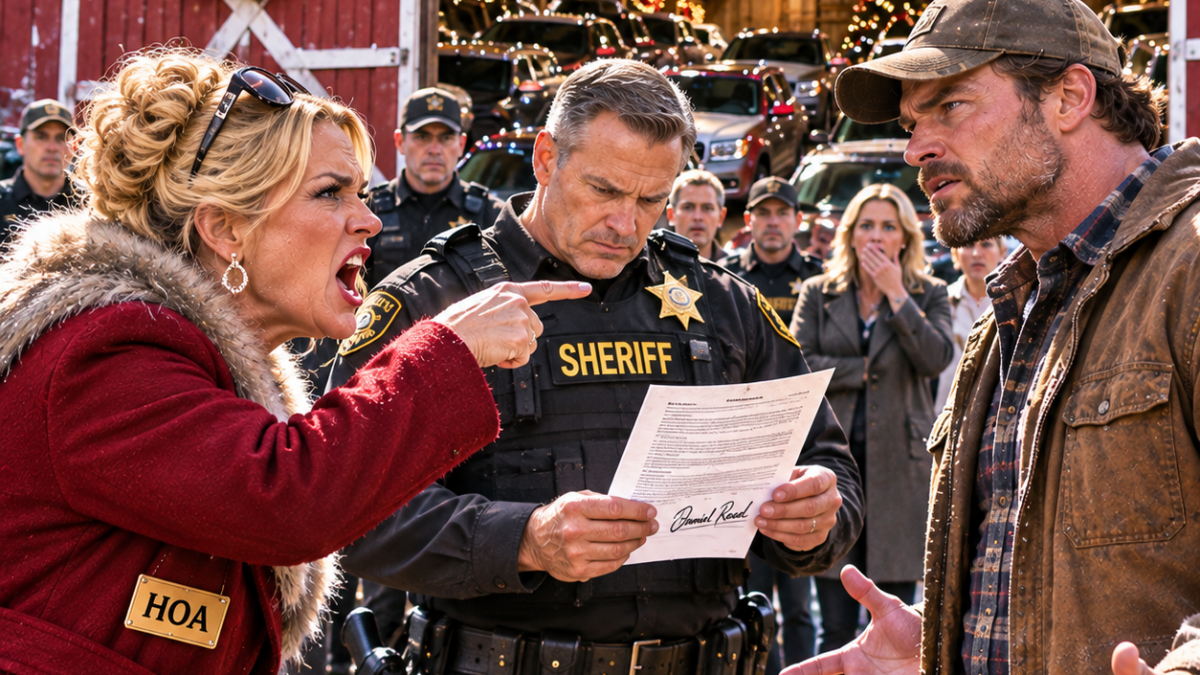
PART2
A young valet in a red jacket jogged toward me holding a clipboard.
He looked maybe twenty.
College kid earning holiday money.
Not the person I was angry with.
“Good evening, sir. Are you here for the gala?”
I pointed toward the barn.
“Who told you to park cars here?”
He hesitated.
Then pointed through the trees toward the Asheford Ridge clubhouse.
“Mrs. Winthrop.”
Of course.
The clubhouse glowed gold against the snow.
Music carried faintly across the property.
I looked back at the cars.
Then took out my phone.
“Did you cut my chain?”
His face changed.
“I didn’t personally.”
“Who did?”
“I don’t know.”
That answer was not convincing, but he looked scared rather than arrogant.
I said:
“Do not move anything yet.”
Then I started recording.
Every vehicle.
Every plate.
Every valet tag.
Every tire rut.
The cut chain.
The moved tractor.
The signs.
The LED markers.
The parking map on the valet stand.
This had not happened because twenty-eight guests became confused.
Someone planned it.
Then I opened the barn security app.
My camera recorded continuously to cloud storage.
I rewound.
5:42 p.m.
Two valet attendants arrived with Marcy Ellington, Asheford Ridge’s event coordinator.
Marcy made a call.
Minutes later, Celeste appeared.
There she was.
White winter coat.
Hair perfect.
Pointing at my gate.
One valet gestured toward the chain.
Celeste made a short cutting motion with her hand.
A man produced bolt cutters.
The chain snapped.
I watched twice.
Then saved the clip.
Cloud backup.
Second backup.
Engineering habit.
Never trust one copy.
Then I walked toward the clubhouse.
The Asheford Ridge Christmas Gala was apparently the social event of the year.
String quartet.
White event tent.
Garlands around columns.
Champagne.
Caterers.
Men in tuxedos.
Women in evening gowns.
A Christmas tree taller than my barn.
I found Celeste near the entrance directing staff as if she were running the White House Christmas reception.
“Celeste.”
She turned.
Her expression changed when she saw me.
Not guilty.
Annoyed.
Like a caterer had brought the wrong napkins.
I held up my phone.
“Did you put twenty-eight cars in my barn?”
She took a sip of champagne.
“We needed overflow parking.”
“You cut my lock.”
“It’s temporary.”
“Who gave you permission?”
She sighed.
“The board approved temporary holiday access.”
I actually laughed.
“Your board could vote unanimously to put a helicopter pad in my hayfield.”
“It would still be my hayfield.”
Her eyes narrowed.
“Trevor, don’t be difficult.”
“My tractor was moved.”
“It was necessary.”
“My chain was cut.”
“We’ll replace it.”
“My barn is full of cars.”
“For one evening.”
That phrase.
One evening.
As though time converted trespass into permission.
I told her:
“Remove every car.”
She looked toward the clubhouse.
“Now?”
“Now.”
“Our guests are eating.”
“Not my problem.”
“You expect twenty-eight families to walk out into a snowstorm in formal clothes because you’re having a territorial tantrum?”
I stared at her.
“My property is not a tantrum.”
She lowered her voice.
“This gala has sponsors.”
“Community leaders.”
“VIP guests.”
“We cannot humiliate people because you suddenly decided to be possessive about an empty barn.”
Empty.
I said:
“You have twenty minutes.”
Her mouth tightened.
“Or what?”
“Twenty minutes.”
She smiled.
Slowly.
Coldly.
“If you cause a scene tonight, Trevor, everyone in Asheford Ridge will remember you as the man who ruined Christmas.”
That sentence showed me her entire plan.
Not law.
Not permission.
Shame.
She believed Christmas Eve protected her.
She believed I would see children, decorations, wealthy guests, champagne, and social pressure and decide defending my property made me the villain.
I said:
“Nineteen minutes.”
Then walked away.
Back at the farm, I documented everything again.
At exactly twenty minutes, not one car moved.
Instead, two HOA maintenance workers arrived.
They hammered another sign into the snow.
AUTHORIZED HOA PARKING
I took a photograph.
Then called the county sheriff’s non-emergency number.
“My name is Trevor Langston.”
“I need to report trespassing and property damage.”
The dispatcher asked:
“Is anyone in danger?”
“No.”
“Any confrontation?”
“No.”
“Any weapons involved?”
“No.”
“How many trespassers?”
I looked at the barn.
“Technically, twenty-eight vehicles.”
Pause.
“Say that again?”
I explained.
A few minutes later, Deputy Aaron Pritchard called.
I knew Aaron casually.
Forty-six.
Calm.
Been with the department for years.
He listened without interrupting.
Then asked:
“Anyone physically inside your property right now?”
I walked through the barn.
No guests.
Valets outside.
“No.”
“Do not damage the cars.”
“I won’t.”
“Do not move them yourself.”
“Wasn’t planning to.”
“No threats.”
“None.”
“Preserve everything.”
“Already doing that.”
He paused.
“Of course you are.”
Then:
“I’m on my way.”
That was when I closed the gate.
Not to hold people hostage.
Not to demand money.
To stop the valet company from moving vehicles and destroying evidence before law enforcement arrived.
I swung both steel gates shut.
Threaded a spare chain.
Locked it.
Click.
The valet stared.
“You can’t lock their cars in.”
I pointed at my severed chain.
“You couldn’t cut my lock to put them in.”
I wrote my phone number on a piece of cardboard.
PRIVATE PROPERTY
ACCESS TEMPORARILY SUSPENDED
CONTACT OWNER
Ten minutes later, I saw Celeste coming through the snow.
Fast.
Her heels kept sinking.
Fur wrap slipping.
Champagne confidence gone.
“Open this gate!”
“No.”
“You cannot imprison people’s vehicles.”
“No people are inside.”
“You’re holding private property hostage.”
“I’m preserving a trespass scene until the deputy arrives.”
Her face changed slightly.
“Deputy?”
“I already called.”
For three seconds, she said nothing.
Then recovered.
“The HOA has legal access.”
“Show me.”
She pulled out her phone.
Opened a PDF.
Held it toward me.
“Temporary Parking Agreement.”
I read.
Property owner:
Trevor Langston.
Parcel number correct.
Address correct.
Dates covering the Christmas gala.
Permission granted for up to thirty-five vehicles.
Then I saw the signature.
My name.
Not my handwriting.
I looked at Celeste.
“What is this?”
“Your agreement.”
“I never signed it.”
She smiled.
“You probably forgot.”
I almost admired the audacity.
“Send it to me.”
“No.”
“Why?”
“This is HOA documentation.”
“You just said I signed it.”
She started pulling the phone away.
I lifted mine and photographed the screen.
Clear enough to capture the page.
Her expression changed.
“This is no longer parking.”
“What are you talking about?”
“Someone put my name on a document I never signed.”
She laughed.
“You are being ridiculous.”
“No.”
“I’m becoming interested.”
That worried her.
She turned and marched back toward the clubhouse.
Within fifteen minutes, gala guests started arriving at my gate.
Word had spread that their cars were locked inside.
Celeste came with them.
She announced loudly:
“Trevor Langston has seized your vehicles.”
Smart framing.
I refused to argue.
A man in a tuxedo demanded:
“Is my Mercedes in there?”
“What plate?”
He gave it.
“Yes.”
“Why can’t I get it?”
“Because a valet parked it on private land without my permission.”
“I was told this was HOA parking.”
“I understand.”
That shifted something.
Another woman said:
“The invitation said VIP parking was included.”
“Do you have the invitation?”
She opened her phone.
There it was.
VIP VALET PARKING PROVIDED.
I asked:
“Does it identify where?”
She scrolled.
Attached map.
My barn outlined in red.
LOT C.
I photographed it.
Celeste saw.
“Stop collecting private communications.”
I looked at her.
“They’re showing me invitations that sent vehicles onto my land.”
“That map is HOA property.”
A man behind her laughed.
“No, Celeste.”
“It’s in my email.”
The cracks were beginning.
Then red and blue lights appeared at the end of the road.
Aaron arrived.
Celeste reached his patrol car before the door fully opened.
“Deputy, thank God.”
She pointed toward me.
“That man has stolen twenty-eight cars.”
Aaron closed the door.
Looked at her.
Then the gate.
Then the barn.
“How did the cars get onto his property?”
Celeste launched into the temporary agreement.
Board authority.
Owner consent.
Holiday access.
I waited.
When she finished, Aaron walked over.
“Trevor.”
“Aaron.”
“You have your deed?”
“Of course.”
I handed him a folder.
Deed.
Survey.
County parcel map.
Title information.
My land existed decades before Asheford Ridge.
The HOA boundary ended outside my fence.
Aaron studied it.
Then:
“Camera footage?”
I played it.
Celeste arriving.
Pointing.
Bolt cutters.
Chain falling.
Aaron watched without expression.
Then looked at Celeste.
“Did Mr. Langston give you permission to cut the lock?”
“We had a signed agreement.”
“That wasn’t my question.”
Her voice tightened.
“The lock obstructed authorized access.”
Aaron held out his hand.
“Show me the agreement.”
She hesitated.
Then gave him the phone.
He read.
Turned toward me.
“Your signature?”
“No.”
Celeste said:
“He may not remember.”
Aaron looked at her.
I took out my driver’s license.
Then a recently signed insurance contract from the folder.
My actual signature.
Long T.
Sharp descending L.
The PDF signature looked different.
Then something else caught my eye.
Upper corner.
County Event Services logo.
Stamped line:
OWNER CONSENT VERIFIED
“Who verified it?”
I asked.
Celeste said:
“The county.”
Aaron radioed dispatch.
He gave the reference number printed on the form.
We waited.
Snow kept falling.
People whispered.
Dispatch came back.
No matching owner-consent record.
Celeste immediately said:
“Clerical error.”
Then:
“Marcy handled the paperwork.”
Marcy Ellington stood twenty yards away.
She heard her name.
She looked terrified.
Aaron waved her over.
Celeste spoke first.
“Marcy coordinated the parking.”
Marcy stared at her.
Something hardened in her face.
“I coordinated what you told me to coordinate.”
Celeste’s eyes flashed.
“Marcy.”
Aaron lifted one hand.
“Let her answer.”
It was the first time that evening somebody publicly stopped Celeste from controlling another person’s sentence.
Marcy unlocked her phone.
Email from Celeste.
Three days earlier.
Print parking maps.
Confirm valet staff.
Prepare signage.
Use Langston barn as Lot C.
Aaron asked:
“Did you obtain Mr. Langston’s signature?”
“No.”
“Ever speak to him?”
“No.”
“Ever meet him?”
“Not until tonight.”
Celeste said:
“She’s confused.”
Marcy looked directly at her.
“No.”
“I’m not.”
The crowd went very quiet.
Aaron did not cut my lock.
That mattered.
He explained:
“This is private property.”
“I do not have legal grounds to order Mr. Langston to open unrestricted access to the HOA.”
Celeste exploded.
“Twenty-eight residents are being deprived of their property!”
Aaron said:
“Mr. Langston has already told me he intends to return every vehicle.”
I nodded.
“One at a time.”
Celeste turned.
“What?”
“No fee.”
“No penalty.”
“No documents held hostage.”
“Each owner identifies the car and signs a short statement confirming the valet put it here and that they did not personally receive permission from me.”
Her face went white.
“No one signs anything.”
I looked at the guests.
“That is your choice.”
Aaron said:
“The statements appear reasonable for documenting the incident.”
Celeste snapped:
“You’re helping him extort residents.”
“No money is being requested.”
That killed that argument immediately.
I grabbed a notepad.
Listed all twenty-eight vehicles.
Make.
Color.
Plate.
Owner as identified.
The first was Gerald Huxley.
Retired dentist.
He showed me his license.
Read the statement.
Signed.
“I honestly believed the HOA owned this barn.”
“I understand.”
I opened the gate.
Gerald drove out.
Gate closed.
Locked.
Car two.
Diane Mercer.
Real estate broker.
She showed me the gala invitation.
Signed.
Drove out.
Car three.
Russell Boyd.
Contractor.
He had the parking email.
Signed.
Drove out.
By car six, people understood this was not revenge.
By car nine, several guests were angry at Celeste.
By car twelve, the story had changed entirely.
Every person leaving my property was becoming a witness.
That terrified her.
She stood beside the gate saying:
“You are not required to cooperate.”
A woman answered:
“I just want my car.”
Celeste said:
“This statement could be used against the HOA.”
The woman looked at her.
“Why would telling the truth hurt the HOA?”
Excellent question.
Celeste did not answer.
Then Warren Keating walked forward.
Fifty-seven.
HOA vice president.
Quiet all evening.
He asked:
“Celeste, when did the board vote on using Trevor’s barn?”
She turned.
“Executive approval.”
“I’m vice president.”
He waited.
“I never saw it.”
Celeste said:
“The president has emergency event authority.”
“Cutting private locks?”
“That’s not what I said.”
“Forging owner permission?”
Her face changed.
Warren looked at me.
“Did you sign anything?”
“No.”
He turned back.
“This is not what I approved.”
The fight was no longer Trevor versus HOA.
It became HOA versus Celeste.
Car fourteen left.
Then fifteen.
At sixteen, an owner found damage.
Silver Audi.
Flat rear tire.
He started shouting.
Then I showed him where the car had been parked.
Equipment lane.
Scrap metal.
Bolts.
Farm hardware.
Not a finished parking lot.
I said:
“This area was never intended for passenger vehicles.”
His anger shifted.
“Who told them to park here?”
The valet pointed toward the HOA team.
Another SUV had a scrape down one side from being squeezed near the barn frame.
Now insurance entered the story.
Property damage to me.
Vehicle damage to guests.
Valet liability.
HOA liability.
Potential event insurance issues.
Celeste called a tow company.
Twenty minutes later, a truck arrived.
Driver stepped out.
Big guy.
Gray beard.
She pointed at my chain.
“Cut that.”
He looked at me.
“You own the property?”
“Yes.”
I handed him the deed copy.
Aaron stood nearby.
The driver read enough.
Handed it back.
“No.”
Celeste said:
“I’ll pay double.”
“No.”
“Triple.”
The driver shook his head.
“I’m not cutting a lock on private property while a deputy is standing beside me.”
He climbed back into his truck.
Drove away.
Celeste turned toward an HOA maintenance worker.
“Get bolt cutters.”
Aaron stepped between them.
“Nobody is cutting any more locks tonight.”
Her face changed.
For the first time, she seemed to understand something fundamental.
Aaron had not come to rescue her.
He was documenting her.
Around car seventeen, Marcy found another email.
Subject:
LANGSTON LOT
She read.
Then covered her mouth.
“What?”
Warren asked.
She showed him.
One sentence:
If he complains, tell him the county approved it because he won’t make a scene on Christmas.
Warren read it twice.
Then gave the phone to Aaron.
I stared at Celeste.
That sentence confirmed what I had already suspected.
Christmas had been part of the plan.
Not merely the date.
The pressure mechanism.
She knew I had not agreed.
She expected embarrassment to keep me quiet.
Aaron radioed dispatch again.
The county event permit.
This time they found the actual gala application.
It existed.
But the permit number on Celeste’s “consent form” belonged to an older HOA summer event.
Wrong date.
Wrong event.
Wrong reference.
The Christmas gala application itself had a problem.
Parking.
The clubhouse lot had lost spaces because Celeste had installed a covered dining pavilion and outdoor stage.
County reviewers required enough parking, a fire lane, emergency access, and traffic control for the expected attendance.
The original plan came up short.
Instead of reducing guests or renting an off-site commercial lot with shuttle service, someone amended the application.
New overflow parking.
LOT C.
My barn.
To accept private land in the parking plan, the county required owner consent.
That explained the signature.
I looked at Aaron.
“So whoever submitted that form didn’t just lie to me.”
He chose his words carefully.
“It appears someone submitted documentation bearing your name into an official county process.”
Celeste said:
“This is being blown completely out of proportion.”
I turned toward her.
“You cut my chain.”
“I told you I’ll replace it.”
“You used my land.”
“One night.”
“You put my name on a document.”
She said nothing.
I stepped closer.
Not threatening.
Just close enough that she could not pretend not to hear me.
“You signed my name.”
Her face changed.
No answer.
Then she tried anger.
“You have hated this HOA from day one.”
“No.”
“You’ve looked for every excuse to embarrass us.”
“If you had called me three weeks ago and said you needed five parking spaces for elderly guests, I probably would have said yes.”
She blinked.
“If you had offered to rent part of the field and provided insurance, maybe we could have discussed it.”
I pointed toward the barn.
“But you needed twenty-eight spaces.”
“You didn’t ask.”
“You cut the lock.”
“Moved my equipment.”
“Used my name.”
“And counted on Christmas to keep me silent.”
She looked away.
At 9:40, another county vehicle arrived.
Fire Marshal Heather Lomax.
Forty-eight.
Calm.
Clipboard.
The type of person who could shut down a room without raising her voice.
She reviewed the permit.
The consent form.
My deed.
Then asked:
“Mr. Langston, did you sign this December fourteenth?”
“No.”
“Where were you December fourteenth?”
“Montana.”
“Equipment auction.”
“Hotel receipt and credit-card record.”
Celeste interrupted.
“Electronic signatures can be made anywhere.”
Heather looked at me.
“Did you electronically sign it?”
“No.”
She opened the county file on her tablet.
No verified signing platform.
No audit trail.
No authentication record.
Just an image of a signature embedded in the PDF.
I leaned closer.
Then recognized it.
“Oh.”
Heather looked at me.
“What?”
“That’s from one of my letters.”
I opened my email.
Months earlier, I had mailed and emailed the HOA a signed response stating:
I am not a member of your HOA.
The signature at the bottom had the same unusual angle.
Same long tail.
Same spacing.
Side by side?
Nearly identical.
My stomach turned.
Someone had likely copied the signature image.
Heather straightened.
She looked toward the clubhouse.
Then toward the traffic lanes.
“I’m suspending this event pending compliance review.”
Celeste stared.
“What?”
“The approved parking plan includes Lot C.”
“That lot is unavailable.”
“Vehicles have been moved into unapproved locations.”
“I need to inspect emergency access.”
“It’s Christmas Eve.”
Heather looked at her.
“Fire does not care.”
That ended the discussion.
She walked the site.
The problem became obvious.
With my barn unavailable, valet staff had improvised.
Cars stacked near service areas.
A catering truck narrowed a fire lane.
The emergency route near the clubhouse had become too tight.
The guest count was near permit capacity.
The event could not continue safely under the approved plan.
Heather told staff to stop admitting guests.
Then she ordered an orderly wind-down.
No dramatic sirens.
No tables overturned.
The quartet stopped.
Bartenders capped bottles.
Caterers covered food.
People gathered coats.
The gala ended slowly.
Quietly.
Humiliatingly.
Celeste found me at my gate.
“You did this.”
I looked at her.
“No.”
“You shut down my Christmas gala.”
“I closed my own gate.”
She stared at me.
There was nothing else to say.
I went back to the list.
Car eighteen.
Nineteen.
Twenty.
Twenty-one.
The crowd changed.
Earlier, people asked why I was holding their cars.
Now they asked why the HOA parked them on private land.
One man showed me the written instructions.
Another said:
“I specifically asked the valet whether this was HOA property.”
“What did he say?”
“Yes.”
Marcy heard.
Her face fell.
She had been carrying out instructions she believed were legitimate.
Heather ordered all parking emails, maps, and approval records preserved and delivered for review.
Aaron collected names.
Contacts.
Statements.
Celeste tried to leave.
Warren stopped her.
“Did you know Trevor hadn’t signed?”
She answered:
“There was miscommunication.”
“That’s not what I asked.”
No answer.
Marcy stepped forward.
“I asked her.”
Everyone looked.
“When?”
“Three days ago.”
She opened the text.
Did Langston actually agree to the parking?
Celeste’s reply:
It’s handled.
Two words.
That was all.
Aaron photographed the screen.
By then, Celeste looked exhausted.
I almost felt sorry for her.
Almost.
Then I looked at the severed chain.
Not yet.
At eleven, seven cars remained.
Warren was on the phone with the HOA property-management company.
As vice president, he requested access to the internal event files.
Minutes later, his email started filling.
One attachment:
LANGSTON PARKING PLAN
Created nearly three weeks before Christmas.
He opened the chain.
The motive became clearer.
Three weeks earlier, Marcy had warned that adding the pavilion reduced the clubhouse parking supply by at least twenty-four spaces.
She offered options.
Commercial overflow lot in town.
Shuttle buses.
Fewer tickets.
Ride-share encouragement.
Celeste rejected each.
Commercial lot cost too much.
Shuttles looked cheap.
Reducing tickets meant refunding sponsors and VIP guests.
Then one email:
Langston has more space than he needs.
I read it once.
Then again.
That sentence hit harder than the fake form.
More space than he needs.
That was Celeste’s philosophy in six words.
If I had something she believed I did not deserve, my ownership became less important than her need.
Another email.
Marcy:
Do we have Trevor’s approval?
Celeste:
He is not part of the community. We do not need to involve him unless necessary.
Days later, the owner-consent form appeared.
No email from me.
No call.
No contract.
No payment.
No negotiation.
Only my copied signature.
Warren asked Celeste directly:
“Who created the consent?”
“My attorney will address that.”
“The HOA attorney represents the association.”
He stepped closer.
“Not you personally.”
Her face went pale.
She refused to answer.
Warren called the other board members.
Emergency meeting by phone.
While they talked, Aaron and I inspected the barn.
Cut chain.
Damaged lock.
Bent gate post.
Deep tire ruts.
Scraped barn door.
Pallets moved.
Tractor repositioned.
Hay compressed beneath tires.
I documented everything.
No exaggeration.
No claiming fifty thousand dollars when damage was five.
Truth was enough.
At 11:41, Warren’s phone buzzed.
Board vote.
PRESIDENTIAL AUTHORITY SUSPENDED PENDING INVESTIGATION.
Celeste read the email.
Her shoulders dropped.
Clubhouse access deactivated.
Event authority revoked.
Independent counsel to be retained.
Less than six hours earlier, she had been directing caterers, valets, musicians, and residents.
Now no one needed to take her orders.
Four cars remained.
Then three.
Two.
Finally one.
A white Cadillac.
Celeste’s.
11:54 p.m.
I looked across the gate.
“Looks like yours.”
“Open it.”
I held out the same statement every other owner had signed.
She stared.
“You cannot be serious.”
“No fee.”
“No penalty.”
“Just verify the car is yours, valet placed it here, and I never personally authorized the parking.”
“You want me to confess.”
“I want the same statement I got from everyone else.”
She called me petty.
Vindictive.
Obsessed.
I waited.
She threatened to sue.
“Your right.”
Aaron remained nearby.
Did not intervene because I was willing to release the car and asking for no money.
Warren finally said:
“Celeste.”
She looked at him.
“Stop.”
“The board has the emails.”
“The county has the form.”
“Twenty-seven people already signed.”
“This is over.”
Her eyes filled with furious tears.
Then she took the pen.
Signed hard enough to nearly tear the paper.
I checked her identification.
Unlocked the gate.
She climbed into the Cadillac.
Before driving away, she lowered the window.
“You ruined my Christmas.”
I looked toward the dark clubhouse.
Then at the cut chain lying in the snow.
“You cut my lock, forged my permission, and parked twenty-eight cars in my barn.”
I paused.
“Christmas had nothing to do with it.”
She rolled up the window.
The Cadillac drove away.
11:57 p.m.
Three minutes before Christmas.
I closed the gate.
Locked it.
Then stood alone in the snow.
For the first time all night, there were no cars on the other side.
I should have felt victorious.
Mostly I felt tired.
I went inside.
Made coffee.
At midnight, church bells sounded faintly from town.
Merry Christmas.
I slept five hours.
Christmas morning, I found an email from Warren.
Subject:
YOU NEED TO SEE THIS.
Attached invoice from the valet company.
Near the bottom:
PRIVATE LOT AUTHORIZATION PROVIDED BY HOA PRESIDENT CELESTE WINTHROP.
Personally vouched for.
In writing.
That eliminated another escape route.
She could no longer convincingly say Marcy misunderstood.
Or valet staff acted independently.
Or county staff made a mistake.
She represented to a vendor that authorization existed.
I forwarded it to Aaron.
Then called my sister.
She said:
“Merry Christmas.”
I said:
“You’re not going to believe my night.”
She answered:
“I saw Facebook.”
Of course.
Someone had posted video.
Not mine.
A guest.
Clip of Celeste yelling at the gate.
Comments were already multiplying.
I stayed off social media.
Best decision of the week.
The next few weeks moved slowly.
Real consequences almost always do.
County investigators reviewed the owner-consent form.
I gave them:
My deed.
Survey.
Security footage.
Cut-chain photographs.
The forged document.
My genuine signature examples.
Emails.
Parking maps.
Twenty-seven owner statements plus Celeste’s.
Valet invoice.
Event records.
Hotel receipt showing I was in Montana on the date shown on the form.
Marcy cooperated.
Warren cooperated.
The valet company cooperated.
Nobody needed to invent anything.
The paperwork was bad enough.
The HOA hired independent counsel.
That investigation asked a separate question:
How did one president obtain enough operational control to create parking plans, represent property permission, approve vendor arrangements, and communicate with county officials without meaningful board oversight?
Warren stood at the next community meeting.
He did not pretend he had been heroic.
That impressed me.
He said:
“We failed.”
The room became quiet.
He continued:
“The board relied too heavily on one person.”
“We assumed approvals existed because Celeste said they existed.”
“We did not independently verify the private-property arrangement.”
“That was irresponsible.”
A resident shouted:
“You’re vice president!”
“Yes.”
Warren nodded.
“That is why I am saying we failed.”
No defensive speech.
No blaming Marcy.
Accountability.
Rare thing.
Marcy spoke too.
Her voice shook.
“I should have insisted on seeing Mr. Langston’s consent.”
Celeste’s friends tried to interrupt.
Warren stopped them.
“Let her finish.”
Marcy continued.
“I asked.”
“I accepted ‘it’s handled’ because I wanted to keep my job.”
“I’m sorry.”
I believed her.
Not because she was innocent of every mistake.
Because she was finally honest.
The board voted to remove Celeste from the presidency.
She resigned from the board entirely soon afterward.
The HOA agreed to pay all verified damage to my property.
Gate post.
Chain.
Padlock.
Barn repair.
Gravel restoration.
Equipment movement inspection.
No lottery-sized settlement.
Actual damage.
That was all I wanted.
My attorney, Rachel Stone, handled the civil side.
She warned me:
“Do not turn this into a crusade.”
“I’m not.”
“You’ve been interviewed by three reporters.”
“I said no.”
“Good.”
“Do not speculate about criminal charges.”
“I won’t.”
“Do not say forged in public as an established legal finding before investigation resolves.”
“Can I say I didn’t sign it?”
“Yes.”
“Because that’s true.”
Exactly.
That discipline mattered.
The county investigation into the document continued.
Slowly.
Deliberately.
The person who physically created the PDF became part of the inquiry.
Digital records.
Metadata.
Source files.
Email chains.
Nothing was decided because a crowd on Facebook wanted an arrest.
I appreciated that.
Justice should survive examination.
The HOA sent every resident a formal notice.
It contained a revised community map.
Asheford Ridge boundary in one color.
Langston Farm outlined separately in thick black.
It stated:
Langston Farm, including the barn, private access road, agricultural structures, and surrounding acreage, is privately owned and is not HOA common property.
Then:
No HOA officer, vendor, resident, employee, or event contractor is authorized to use Langston Farm without express permission from the owner.
I framed that one.
Not because it was beautiful.
Because Celeste had sent me letters for years pretending my property was subject to HOA aesthetics.
Now the HOA itself had written the sentence I had been sending her all along.
I am not part of your HOA.
Rachel laughed when she saw the frame.
“You’re petty.”
“I’m documenting history.”
“Same thing with better paper.”
The county fire marshal issued its own findings regarding the gala.
The event plan had materially depended on private parking represented as authorized.
Once that parking disappeared, emergency access deteriorated.
Heather’s suspension had been based on safety conditions she personally observed.
Not revenge.
Not favoritism.
That mattered.
Some residents initially blamed me for ending Christmas dinner early.
Then insurance claims arrived from damaged vehicles.
The Audi tire.
SUV scrape.
Another car with underbody damage from farm hardware.
The valet company’s insurer asked why passenger vehicles had been placed in an active agricultural work area.
Excellent question.
The answer always returned to the same place.
Because Celeste needed parking.
Over the next months, I learned something about communities.
Most people do not support abuse of power.
They support convenience.
As long as somebody else handles everything, they do not inspect how it gets handled.
Celeste had been useful.
Organized.
Fast.
Decisive.
If landscaping needed replacement, she replaced it.
If contractors were slow, she pressured them.
If residents complained, she answered.
People rewarded results.
Then stopped checking methods.
Until the methods landed twenty-eight cars in somebody else’s barn.
The new board changed procedures.
Written proof of property authorization for any event using non-HOA land.
Dual approval for significant vendor changes.
Independent verification of permits.
No president acting alone where board approval was required.
Clear document retention.
Conflict review.
Boring things.
I loved every one.
One resident complained:
“This bureaucracy is ridiculous.”
Warren answered:
“You know what was more ridiculous?”
“Standing in snow at eleven p.m. because your Cadillac was parked in Trevor’s barn.”
Nobody argued.
I upgraded my own security.
Not to make the farm a fortress.
New cameras.
Keypad gate.
Motion lights near the barn.
Reinforced chain.
Simple steel sign:
LANGSTON FARM
PRIVATE PROPERTY
NO HOA ACCESS
Rachel said:
“Very restrained.”
“I considered something longer.”
“What?”
“Not enough steel.”
She laughed.
I kept it simple.
Then life started returning.
Hay deliveries.
Equipment work.
Winter maintenance.
Silence.
For months, every time headlights slowed near my gate after dark, I looked outside.
That annoyed me.
Celeste had not physically hurt me.
Still, she had changed my relationship with the property.
Before Christmas, an unfamiliar vehicle meant neighbor.
Delivery.
Lost driver.
After Christmas, I wondered:
Who authorized this?
Is someone coming through the gate?
That was the damage no invoice captured.
Violation changes how safe home feels.
Even when the violation looks ridiculous from outside.
Twenty-eight cars.
Rich people.
Christmas decorations.
Funny story.
Except someone cut my lock while I was gone.
Someone moved my equipment.
Someone put my name on a document.
Someone counted on my silence.
The humor came later.
A year later, Asheford Ridge held the Christmas gala again.
Smaller.
Much smaller.
The covered pavilion was gone.
Guest list reduced.
Every car parked on HOA property.
Additional guests used a commercial lot in town.
A shuttle ran every twenty minutes.
Exactly one of the options Marcy had proposed the year before.
Cost more.
Worked perfectly.
No forged signatures required.
I stood in my barn doorway that evening.
Hands in my coat.
Snow falling lightly.
Christmas music drifted through trees.
For once, it did not bother me.
Warren came by earlier in the day.
He brought a bottle of bourbon.
“For making it through a full year without us trespassing.”
“Strong achievement.”
“We’re proud.”
He hesitated.
Then:
“Trevor.”
“Yes?”
“I owe you an apology beyond the board statement.”
“You already apologized.”
“No.”
He looked toward the clubhouse.
“I knew Celeste pushed boundaries.”
“I didn’t know about your barn.”
“But I knew she treated your property like it was eventually going to become ours.”
“I didn’t challenge it because she was effective.”
“That made me part of the problem.”
I respected that.
“You didn’t cut my chain.”
“No.”
“But I helped create a board where she thought she could.”
I held out my hand.
He shook it.
“Do better.”
“We are.”
That was enough.
Celeste moved away from Asheford Ridge after the legal and board fallout became impossible to ignore.
Not immediately.
There was no cinematic midnight escape.
She stayed for months.
Attended through counsel where required.
Continued disputing portions of the allegations.
The document investigation followed its own legal path.
I never turned it into entertainment.
Some parts became public.
Others did not.
What mattered to me was simpler.
The HOA acknowledged my boundary.
Paid for the physical damage.
Stopped entering.
Stopped sending violation letters about my tractor.
Stopped pretending my access road belonged on their event maps.
I got exactly what I had wanted before Celeste turned everything into a Christmas crisis.
To be left alone.
Funny how expensive that simple right became.
Marcy kept her job with the event-management company after cooperating.
She eventually left the HOA contract voluntarily.
About nine months later, she stopped at the farm.
I was fixing a hydraulic hose.
She stood outside the gate until I waved her in.
Important detail.
She waited.
“Trevor?”
“Marcy.”
“I brought something.”
She handed me an envelope.
Inside:
A new padlock.
Heavy steel.
I looked at her.
She smiled nervously.
“I know the HOA paid for one.”
“But…”
“I felt like I should.”
I almost refused.
Then accepted.
“Thank you.”
She looked toward the barn.
“I still think about that night.”
“So do I.”
“I should have pushed harder.”
“You asked Celeste if I had agreed.”
“I accepted two words.”
“It’s handled.”
“Yes.”
I nodded.
“That’s how systems fail.”
She looked surprised.
“What?”
“People ask the right question.”
“Then accept the wrong answer because checking is inconvenient.”
She swallowed.
“I’m sorry.”
“I know.”
She left.
The padlock stayed in my desk for years.
Not because I needed it.
Because apology had weight too.
A local reporter eventually wrote a piece about the incident.
Not sensational.
Headline:
CHRISTMAS PARKING DISPUTE LEADS HOA TO OVERHAUL PRIVATE-PROPERTY CONTROLS
Boring headline.
Good reporting.
The article explained the farm predated Asheford Ridge.
The HOA was never entitled to impose its covenants on me.
The Christmas parking plan had included my barn without valid owner authorization.
The board later changed policies.
Perfect.
Internet versions were less accurate.
One claimed I deliberately waited until guests were drunk and then demanded $1,000 per car.
False.
Another said I towed all twenty-eight cars into a field.
False.
One had me release cattle around the Mercedes.
Tempting.
Still false.
The funniest said Celeste had to sleep in her Cadillac until Christmas morning.
She drove away at 11:57.
Facts apparently are insufficiently dramatic for social media.
But the real story was better because I did almost nothing dramatic.
I said no.
Then preserved the no.
That is harder than it sounds when the person violating your boundary has an institution behind her.
Celeste wore the title.
HOA President.
She had stationery.
Logos.
Board emails.
County forms.
Staff.
Vendors.
A clubhouse full of people who assumed she had permission because she behaved like someone with permission.
I had:
A deed.
A survey.
A camera.
A broken chain.
And the truth.
The strongest piece of evidence was not even the video.
It was the twenty-eight cars.
Their presence proved scale.
Twenty-eight independent owners.
Twenty-eight sets of parking instructions.
Twenty-eight opportunities to ask:
Who told you this was legal?
Every vehicle became a witness.
That is why I never damaged them.
Apart from the fact that damaging innocent people’s property would have been wrong, it would have destroyed the clarity of the case.
Celeste wanted me angry.
If I had smashed something, threatened someone, blocked people indefinitely, or demanded money, the story could have become:
Unstable farmer retaliates against residents.
Instead:
Twenty-eight people were misled into parking on private land.
That was much harder to spin.
Deputy Pritchard told me that later.
We were drinking coffee at a diner.
He said:
“The best thing you did was make it boring.”
I laughed.
“Locking twenty-eight cars in a barn is boring?”
“You created a process.”
“One out.”
“Sign.”
“Gate closed.”
“Next.”
“You gave people their property.”
“You gave me time to document.”
“Celeste had nowhere to hide.”
I asked:
“What if you had ordered me to open the whole gate?”
“I might have if there were a safety emergency.”
“There wasn’t.”
“Once I saw the cut chain and disputed consent?”
He shook his head.
“I wasn’t going to create more access rights than the law gave them.”
Good deputy.
Heather Lomax became something of a legend in Asheford Ridge.
Residents invited her to the next year’s safety planning meeting.
She made them review fire lanes before talking about centerpieces.
Warren told me Celeste would have hated it.
I said:
“Then it’s probably useful.”
Heather later told me:
“Your parking dispute exposed something bigger.”
“What?”
“Everyone assumed the event permit was a rubber stamp.”
“It isn’t.”
“Parking is safety.”
“Emergency lanes are safety.”
“Capacity is safety.”
“Private-land consent is not decorative paperwork.”
Exactly.
Celeste treated the signature as a box she needed checked.
She forgot a signature represents a person agreeing.
When the agreement is absent, the ink does not create it.
That was the part that bothered me most.
The chain cost sixty dollars.
Gate post cost more.
Gravel could be repaired.
But the copied signature?
That was someone attempting to manufacture my consent.
I had always thought forgery sounded like an abstract financial crime.
Checks.
Contracts.
Money.
Then I saw my name at the bottom of that parking form.
There is something deeply personal about seeing your own signature used to make you agree to something you refused.
It feels like someone borrowed your voice.
That made the eventual legal process important to me even when it was slow.
I wanted the county to determine what happened properly.
Not because I needed Celeste publicly destroyed.
Because official systems had accepted a document speaking in my name.
Those systems needed to know I had never spoken.
The investigation eventually established enough evidence for authorities and the association to take formal action related to the falsified consent and associated submissions.
The precise legal resolution was less cinematic than people online wanted.
Lawyers.
Negotiations.
Document authentication.
Responsibility allocated among individuals.
No Christmas Eve handcuffs beside the Cadillac.
Good.
Arrest spectacle would not have improved my gate.
The association’s independent counsel produced a lengthy internal report.
Warren offered me a copy of the relevant sections.
The central finding was simple.
Celeste had exceeded her authority.
No board resolution gave her the right to use my land.
The HOA’s governing documents did not extend to Langston Farm.
The parking arrangement lacked valid owner consent.
Internal controls failed because staff and board members relied on representations without verifying them.
The board adopted reforms.
Celeste was gone.
My farm remained mine.
Justice can be boring too.
I learned to appreciate that.
The next Christmas, at 5:42 p.m.—almost exactly the time Celeste had ordered my chain cut the previous year—I checked the camera.
Snow.
Empty barn entrance.
Gate closed.
No valet lights.
No red signs.
No Cadillacs.
Just snow.
I made coffee.
Walked outside.
Music floated from the clubhouse.
A shuttle bus passed on the main road.
Stayed on their road.
Beautiful sight.
I stood there and remembered the sentence Celeste had written:
Langston has more space than he needs.
That sentence remained the whole story to me.
Not the forgery.
Not the gala.
Not the fire marshal.
Not twenty-eight cars.
The assumption underneath it.
She looked at seventeen acres and saw unused capacity.
I looked at seventeen acres and saw home.
She saw my barn empty for one evening and concluded emptiness was permission.
She saw my access road and concluded proximity was ownership.
She saw my refusal to join Asheford Ridge and concluded I was not part of the community, therefore my rights mattered less.
That is how entitlement works.
It does not always say:
I am stealing this.
It says:
He doesn’t need it.
She isn’t using it.
It’s only temporary.
It benefits more people.
We’ll replace what we damage.
He’ll get over it.
He won’t make a scene.
Every sentence exists to avoid the one question that matters:
Did he say yes?
I didn’t.
That should have ended it.
One spring afternoon, a new family moved into Asheford Ridge.
The husband walked over.
Name was Michael Avery.
He stood outside my gate.
Waited.
I came out.
“Can I help you?”
“Hi.”
“We’re the new house on Hawthorne.”
“Welcome.”
“My son’s turning twelve.”
“He wants a farm-themed birthday.”
I almost laughed.
Michael continued:
“I was wondering whether you ever rent the barn.”
“No.”
“Okay.”
He nodded immediately.
Then:
“Do you know anywhere nearby that does?”
That was it.
No pressure.
No argument.
No:
You have more space than you need.
Just no.
Accepted.
I gave him the number for a horse farm ten miles away.
His son had the party there.
Michael brought me cake afterward.
Simple.
That interaction gave me more hope for humanity than any board reform.
Ask.
Receive answer.
Respect answer.
Civilization.
A few years later, I sold three acres at the eastern edge of my property.
People were shocked.
“You fought the HOA over one foot of access and then sold land?”
Yes.
Because I chose to.
Buyer was a young couple who wanted a small house and workshop.
We negotiated.
Surveyed.
Signed.
Paid.
Recorded.
No one cut anything.
Consent changes everything.
Celeste’s former supporters occasionally used the sale as proof I had been unreasonable.
Warren told me.
I laughed.
“They still don’t get it.”
“What?”
“It was never about never letting anyone use anything.”
“It was about who decides.”
Exactly.
Ownership is not a vow never to share.
It is the right to decide how sharing happens.
My parents understood that.
Dad loaned tools constantly.
Allowed neighbors to cross the field during emergencies.
Let kids sled on one hill.
But ask first.
Always.
Not because he was controlling.
Because respect is the foundation that makes generosity sustainable.
If people can take whenever they want, generosity becomes obligation.
Then eventually resentment.
I kept the farm open to neighbors in reasonable ways.
That surprised some people.
Asheford Ridge kids helped stack hay once for a school service project.
I let the HOA use the edge of one field during an emergency water-main repair because their contractor asked.
Written agreement.
Insurance.
Two-day access.
They repaired the ruts afterward.
Warren joked:
“Look at us using your land without forgery.”
“Progress.”
He laughed.
The relationship between the farm and Asheford Ridge became normal.
Not friendly with everyone.
Normal.
They had rules.
I had land.
Occasionally our interests overlapped.
We discussed.
Sometimes agreed.
Sometimes did not.
No war.
That was all I had wanted.
Celeste’s name gradually disappeared from meetings.
New residents barely knew the story.
Older residents remembered.
Every Christmas, somebody joked:
“Did we count parking spaces?”
Warren would answer:
“Twice.”
Marcy once sent him a Christmas card.
Inside:
LOT C: NEVER AGAIN.
He framed it in the HOA office.
I approved.
Years later, Deputy Aaron Pritchard retired.
At his retirement reception, he saw me.
“Twenty-eight.”
I laughed.
“You remember?”
“How could I forget?”
He introduced me to his wife.
“This is the guy with the Christmas cars.”
Apparently that was my civic identity now.
Aaron said:
“You know what I thought when I arrived?”
“What?”
“That I was about to spend Christmas Eve mediating some rich-neighborhood nonsense.”
“You were.”
“Yes.”
“But then I saw the signature.”
His expression changed.
“That was when I knew.”
“Know what?”
“This wasn’t misunderstanding.”
“Somebody had decided documentation was something they could manufacture.”
He paused.
“People who do that usually believe they’ll never have to explain it.”
He was right.
Celeste had not prepared for questions.
She prepared for appearance.
The PDF looked official.
County logo.
Parcel number.
Signature.
Verification stamp.
Enough for busy people to assume someone else checked.
That is another lesson I never forgot.
Documents can look official and still be wrong.
Ask where they came from.
Ask who signed.
Ask who verified.
Ask whether the authority exists.
A logo does not create truth.
Neither does a title.
Neither does confidence.
My niece once asked:
“Uncle Trevor, why didn’t you just call the police when you first saw the cars?”
“I did.”
“No.”
“Before talking to Celeste.”
I thought.
“Because I wanted to give her a chance to correct it.”
“Why?”
“Because sometimes people make dumb decisions.”
“And they can fix them before it becomes something bigger.”
“Did she?”
“No.”
“What if she had?”
Interesting question.
If Celeste had come down after my first demand and said:
“Trevor, I screwed up.”
“I thought we could use the barn.”
“We shouldn’t have cut the lock.”
“We’re moving every car.”
Would I have called Aaron?
Maybe still for the damage.
Maybe not for a full dispute.
If she had offered to pay for repairs and apologized?
The night might have ended quietly.
The forged form complicates that hypothetical, of course.
But the point remains.
People rarely get destroyed by one mistake.
They get destroyed by defending the mistake after they know it is wrong.
Celeste had exit ramps all night.
Move the cars.
Admit she lacked permission.
Stop blaming Marcy.
Stop insisting the signature was mine.
Stop trying to cut the new lock.
Tell the board the truth.
Every time, she chose escalation.
That is why the consequences escalated too.
The farm changed over the years.
I eventually replaced part of the barn roof.
Installed better doors.
Regraded the equipment lane.
The scratch where the SUV hit the barn frame disappeared under new paint.
The bent gate post was replaced.
Snow and summers erased the tire ruts.
Physical evidence faded.
One thing remained.
The camera.
Newer model now.
Still above the barn.
Every December 24th, the app sends me a storage-renewal notification for some ridiculous reason.
I always laugh.
Technology has timing.
I also kept Celeste’s signed vehicle statement.
The last one.
White Cadillac.
At the bottom:
I confirm that my vehicle was placed on Langston Farm by the Asheford Ridge Christmas Gala valet service and that I personally did not receive authorization from Trevor Langston to use the property.
Then her signature.
Her real signature.
There is symmetry there.
The night began with my signature used without consent.
It ended with hers acknowledging the truth.
I never displayed it.
Never posted it.
Kept it in the same fireproof cabinet as my deed.
Evidence belongs where evidence belongs.
Not every victory needs social media.
A documentary producer contacted me once.
Wanted to recreate the night.
Actors.
Drone shots.
Dramatic lock close-up.
He asked:
“What did you say when you locked the gate?”
I thought.
“Probably nothing.”
He looked disappointed.
“No line?”
“No.”
“Something like, ‘Now we’ll see who owns this land’?”
“No.”
He laughed.
“We may need to dramatize slightly.”
I declined.
Reality had enough.
Twenty-eight cars in a private barn.
Fake parking agreement.
Fire marshal ending a luxury gala.
HOA president’s own Cadillac being the last car.
If that needs improving, maybe storytelling is the problem.
The part I would emphasize, if anyone asked me now, was quieter.
When Gerald Huxley signed the first statement.
Retired dentist.
Tuxedo.
Confused.
He said:
“I genuinely thought the HOA owned this.”
I believed him.
That was when I realized Celeste had not only taken something from me.
She had lied to her own people.
She had put them in legal and physical risk without their knowledge.
Imagine discovering your car was parked inside a working barn with uneven ground, farm equipment, scrap metal, and no owner permission because someone wanted your gala experience to feel seamless.
That was the arrogance.
The guests were not villains.
Most were victims of bad information too.
That is why I released every car safely.
The target of anger matters.
If you punish everyone around a powerful person for what the powerful person did, you become another version of the same problem.
That realization probably saved me a lot of legal trouble.
And some shame.
People still ask:
“Would you lock the gate again?”
Yes.
Under the same circumstances?
Absolutely.
I had called law enforcement.
Confirmed no person was trapped.
Did not damage vehicles.
Offered release.
Asked no money.
Documented everything.
The lock preserved the scene long enough for facts to catch up with Celeste’s narrative.
Would I keep them overnight?
No.
Would I demand payment?
No.
Would I tow without lawful process?
No.
The point was never revenge.
The point was stopping unauthorized use.
Once each owner identified the vehicle and documented what happened, the car left.
The process was the power.
Not captivity.
That distinction is why Celeste’s accusation of extortion failed before it started.
She wanted me to behave badly enough to make her behavior irrelevant.
I refused.
That is probably the most useful thing age taught me.
You do not have to match somebody else’s chaos.
Sometimes calm is the most aggressive thing in the room.
The year after Warren stepped down as vice president, Asheford Ridge elected a woman named Patricia Gomez.
Former CPA.
Terrifyingly organized.
At her first meeting, she introduced a property-access checklist.
Nobody could use outside property for an HOA event without:
Recorded owner contact.
Written consent.
Proof of insurance.
Board verification.
Permit cross-check.
Final pre-event confirmation.
A resident complained it was excessive.
Patricia looked at him.
“Twenty-eight.”
Everyone laughed.
Policy passed unanimously.
I liked Patricia.
She never sent me a letter about my tractor.
At one point the HOA offered to buy a permanent easement over a tiny part of my western access road for emergency snow-plow turnaround.
This time, they asked.
I reviewed.
Negotiated.
Required limits.
No general HOA traffic.
Emergency and maintenance turnaround only.
Compensation.
Insurance.
Recorded.
Signed.
Perfectly boring.
I agreed.
Warren came by after recording.
“Celeste would have a heart attack.”
“Why?”
“You voluntarily gave an HOA an easement.”
“No.”
“I sold a defined easement under terms.”
He smiled.
“Exactly.”
Consent.
Again.
Asheford Ridge did not need to be my enemy.
It simply needed to stay inside its authority.
That Christmas gala became almost folklore.
One year, somebody made an ornament shaped like a padlock.
Another made one shaped like a white Cadillac.
I pretended to hate them.
I have both.
The white Cadillac hangs near the back of my tree every year.
My sister says that means I am not over it.
I say it means I appreciate craftsmanship.
She calls me a liar.
Fair.
Celeste never returned to the neighborhood after moving away.
I heard conflicting things.
Some said she relocated to Arizona.
Others said Colorado Springs.
I never checked.
I did not need updates.
There is a strange temptation after conflict to monitor the person who caused it.
Did they suffer?
Are they unhappy?
Did karma continue?
That keeps them living in your head.
I already gave Celeste enough square footage on Christmas Eve.
She gets none now.
What mattered was what remained.
My barn.
My gate.
My road.
My farm.
And a neighborhood that finally understood the black line on the county map was not a suggestion.
On the fifth anniversary of the incident, I found the original severed chain.
I had stored it in the machine shed.
Rusty.
Heavy.
I held it for a while.
Then threw it into scrap recycling.
No ceremony.
No plaque.
The chain had done its job.
So had the story.
You do not need to keep broken things forever just because they once proved somebody hurt you.
The deed was enough.
The boundary was enough.
My memory was enough.
That night snow fell again.
Same soft Montana? No—Colorado snow over the foothills.
The farm looked nearly identical to the night of the gala.
White fence lines.
Red barn.
Warm light through windows.
Asheford Ridge glittering beyond trees.
I walked to the gate.
Closed both halves.
Used the newer lock Marcy had given me.
Click.
I stood there.
No anger.
No anxiety.
Just habit.
Then headlights approached from the neighborhood side.
A shuttle bus.
Christmas gala.
It slowed near the intersection.
Turned away from my road.
Continued toward the commercial parking lot they had rented.
I smiled.
That was the ending.
Not Celeste losing the presidency.
Not the county investigation.
Not the forged signature.
Not the fire marshal shutting the gala.
The ending was a bus driver seeing the map, recognizing the boundary, and turning where he was supposed to turn.
Rules respected so quietly nobody noticed.
That is what property rights are supposed to look like most days.
Boring.
Invisible.
Uncontroversial.
The dramatic stories happen when someone decides another person’s boundary is inconvenient.
Celeste looked at my barn and said:
Langston has more space than he needs.
She was wrong in a deeper way than she understood.
Nobody else gets to determine how much of your own property, time, money, privacy, or life you “need” before they can take the rest.
Maybe I needed every square foot.
Maybe I needed none of it that night.
It did not matter.
She needed permission.
She never asked.
Everything that followed—the cut chain, twenty-eight cars, deputy, forged form, fire marshal, canceled gala, angry board, investigation, suspension, resignation—came from avoiding one simple sentence:
Trevor, may we use your barn?
Maybe I would have said no.
Maybe I would have said yes under conditions.
We will never know.
That choice was mine.
And that was the one thing Celeste could not tolerate.
She thought authority meant never hearing no.
In the end, twenty-eight cars taught her otherwise.
The last one left at 11:57 p.m.
Three minutes before Christmas.
The next year there were zero.
And every Christmas since, when I close my gate and hear that quiet metal click, I remember the lesson Celeste paid so much to learn:
Someone else’s property does not become yours because you have a better use for it.
A board resolution cannot manufacture consent.
A fake signature cannot turn trespass into permission.
And sometimes the most powerful thing an ordinary man can do when somebody crosses a clearly marked line is simply close the gate—and let the truth catch up.








