PART2:“YOU HAVE 48 HOURS TO GET OFF MY ISLAND!” HOA Karen Sent a Demolition Barge to My Cabin—She Never Imagined Her Own $8 Million Empire Was About to Be Taken Away
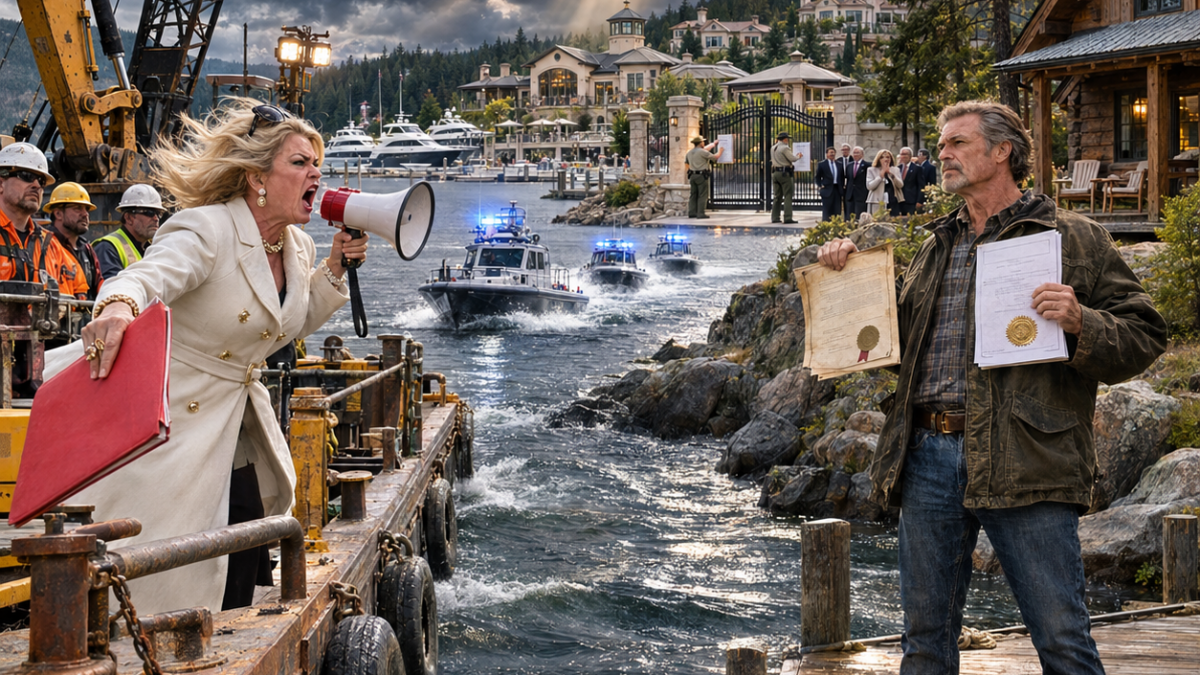
I stepped onto the porch.
“Blythe, what the hell are you talking about?”
Her smile widened.
“Watch your language, Mr. Allison. We have community standards.”
“This isn’t your community.”
She laughed.
“Oh, but that’s where you’re mistaken.”
She motioned toward my cabin with one perfectly manicured hand.
“This island is part of our expanded shoreline protection zone. Your little shack is interfering with an important community project.”
“My little shack?”
“Don’t be sensitive. It’s hardly a luxury residence.”
I felt my jaw tighten.
That cabin had taken me years to restore.
I’d replaced rotten floorboards, reinforced the foundation, repaired the roof, and installed every electrical fixture myself.
It wasn’t fancy.
It was mine.
“Blythe, I’ve never joined your HOA.”
“That doesn’t matter.”
“I’ve never signed your covenants.”
“That doesn’t matter either.”
“And I have a recorded deed proving this island belongs to me.”
Her smile disappeared.
“Mr. Allison, I am not going to stand here discussing paperwork with a man who repairs boat motors for a living.”
There it was.
The contempt.
The certainty that her money, her position, and her expensive attorney made her superior to anybody who worked with his hands.
She lifted the megaphone again.
“YOU HAVE FORTY-EIGHT HOURS! EVERYTHING LEFT ON THAT PROPERTY AFTER THE DEADLINE WILL BE REMOVED AT YOUR EXPENSE!”
I looked at the worker sitting behind the boat’s windshield.
Then back at her.
“Are you threatening to destroy my home?”
“I’m informing you of the consequences of noncompliance.”
“You don’t have the authority.”
Her eyes hardened.
“You really should learn how the world works, Wade.”
For a moment, the only sound was water brushing against the dock pilings.
Then she leaned forward.
“Seventy-four families have invested millions in this community. Do you seriously believe one stubborn mechanic gets to stand in their way?”
I didn’t answer immediately.
Instead, I walked back toward the door and examined the notice more closely.
Official-looking letterhead.
Embossed pine-tree logo.
A signature.
And something else.
Near the bottom, partly obscured by the association seal, was a faint blue stamp.
DOCUMENT REVIEW — CRESTWATER COMMUNITY BANK.
I blinked.
Crestwater Community Bank?
I’d never opened an account there.
Never applied for a loan.
Never used my island as collateral.
Why would a bank have anything to do with an HOA eviction notice?
I took out my phone and photographed the paper.
Blythe noticed.
“Take all the pictures you want,” she called. “They won’t change the deadline.”
I turned toward her.
“One question.”
She sighed theatrically.
“What now?”
“Why does your bank need my cabin?”
Her expression changed.
It lasted barely a second.
But I saw it.
The smile vanished, and something sharp moved behind her eyes.
“What did you say?”
I held up the notice.
“There’s a bank stamp on this.”
“Administrative documentation.”
“Documentation for what?”
“That is association business.”
“Then why is it nailed to my door?”
She grabbed the railing of the boat.
“You’re wasting your forty-eight hours, Mr. Allison.”
The speedboat’s engine roared.
As it pulled away, Blythe raised the megaphone one final time.
“BY SUNDAY MORNING, THAT ISLAND WILL FINALLY SERVE THE PEOPLE WHO PAID FOR IT!”
I stood on the dock watching her disappear into the fog.
Then I looked back at my cabin.
The red paper moved slightly in the morning breeze.
For the first time in eleven years, someone had threatened to take my home.
And what frightened me most wasn’t the eviction notice.
It was the fact that Blythe Renshaw had been completely certain I wouldn’t be able to stop her.
PART2
I didn’t pull the notice off the door immediately.
That was the first decision I made, and it might have been the smartest one.
Instead, I photographed the nail heads, the angle of the paper, the footprints along the dock, and the scratches the worker’s hammer had left in the wood.
I wrote down the time.
I recorded the registration number of Blythe’s boat.
Then I carefully removed the notice and slipped it into a clear plastic sleeve where it couldn’t be torn or stained.
I knew almost nothing about fighting an HOA in court.
But I understood evidence.
When somebody brings me an engine that suddenly stopped running, I don’t start replacing parts at random.
I inspect what happened.
I document what I find.
I identify the cause before touching anything.
Blythe had just created a problem.
And I intended to take it apart the same way.
At 7:18 that morning, my phone rang.
The caller identified himself as a dispatcher from a moving company in the next county.
“Mr. Allison? We’re calling to confirm access arrangements for Sunday morning.”
“What arrangements?”
There was a pause.
“Removal of residential contents from the island property.”
I looked out through my kitchen window.
“Who hired you?”
“Silver Pine Shores Homeowners Association.”
“To remove what?”
“Furniture, personal belongings, household equipment. Two box trucks are scheduled to receive the contents at the marina.”
“Did anyone tell you I’m still living here?”
Another pause.
“We were informed possession has already transferred to the association.”
I felt something cold settle into my stomach.
“Who told you that?”
“The association president.”
I took down the company’s name, asked for written confirmation of the booking, and ended the call.
Twenty minutes later, I contacted a marine construction company whose workboat I’d seen near the eastern shore.
Their operations manager confirmed that an equipment barge had been reserved for Sunday.
A barge equipped with a hydraulic lifting rig.
And a demolition crew.
Not a survey team.
Not an inspector.
A demolition crew.
Blythe had already scheduled the destruction of my cabin.
I asked whether the company had verified who owned the island.
The manager explained that their customer had assured them the association controlled the site.
“Sir,” he said cautiously, “we were told the previous occupant had been ordered to vacate.”
“Previous occupant?”
I looked around at the room where I’d eaten breakfast for eleven years.
“My coffee is still on the table.”
The manager went quiet.
I told him I had a recorded deed, that the property was disputed, and that nobody had permission to step onto my land.
He promised to pass the information along.
But I knew a promise from a contractor wasn’t enough.
By 9:00 a.m., I understood something important.
Blythe hadn’t given me forty-eight hours to decide whether to leave.
She had already arranged everything that would happen when those forty-eight hours expired.
The countdown wasn’t a warning.
It was part of her plan.
And somebody had spent a considerable amount of money making sure that plan moved forward.
I started with the marina.
For more than a decade, I’d bought fuel, groceries, and repair supplies from a family-owned operation on the eastern shore.
The owner was a man named Pete, who had known me since before I’d finished rebuilding the cabin.
When I pulled my skiff alongside the fuel dock, he didn’t greet me with his usual joke about old motors.
He looked worried.
“Wade, we need to talk.”
He handed me a printed email.
It came from Silver Pine Shores.
The subject line read:
URGENT COMMUNITY SAFETY ADVISORY.
The message described my island as structurally unsafe and warned local vendors against providing services to the property during an active shoreline clearance operation.
I read it twice.
“You know this is nonsense.”
Pete rubbed his forehead.
“I do.”
“Then why are you showing it to me?”
“Because Silver Pine Shores has the largest commercial fuel account we service. Their marina buys more from us in a month than most customers buy in a year.”
I stared at him.
“She’s threatening your business?”
“Not directly. But the email makes it pretty clear they expect cooperation.”
Pete looked genuinely ashamed.
“I can’t afford to lose seventy-four households over a dispute I don’t understand.”
I wanted to be angry.
Part of me was.
But I’d known Pete too long to pretend his business didn’t matter.
I bought every spare gallon of fuel I could safely transport, along with groceries and a few supplies.
Then I headed to town.
By late morning, I was standing at the county records office with a folder beneath my arm.
I requested certified copies of my deed, the original survey, and every recorded document connected to the island.
The deed showed exactly what I’d always known.
11.6 acres.
Private ownership.
Separate from the Silver Pine Shores subdivision.
There was no recorded transfer of the island to the HOA.
No foreclosure.
No sale.
No court order granting anybody possession of my cabin.
But while reviewing the county reference file, I noticed a document I’d never seen before.
It was a glossy map titled:
SILVER PINE EMERGENCY SHORELINE MANAGEMENT PLAN.
My island was shaded orange.
Across the middle of it were the words:
EVACUATION SUPPORT ZONE.
I pointed to the map.
“Who filed this?”
The clerk checked the record.
“Silver Pine Shores Homeowners Association.”
“When?”
“Recently. It’s a supplemental filing.”
“Does this mean they own my island?”
She shook her head.
“No. Recording a map doesn’t establish ownership.”
That should have reassured me.
It didn’t.
Because somebody had gone to the trouble of placing my property inside an official-looking plan that made the HOA’s claim appear legitimate.
And they’d done it before I ever received the red notice.
I called Blythe from the parking lot.
She answered on the third ring.
“Mr. Allison. Have you decided to cooperate?”
“I’ve seen your map.”
“What map?”
“The one where you’ve colored my island orange.”
“That’s an approved emergency management plan.”
“Approved by whom?”
“The association board.”
“You can’t turn my property into HOA land by voting on it.”
“We’re not claiming ownership in the simplistic sense you’re describing.”
I went still.
That was different.
Six hours earlier, she’d publicly declared the island community property.
Now she was changing the argument.
“What sense are you describing, Blythe?”
“Emergency use rights. Shoreline safety. Evacuation access. These are complicated matters, Wade.”
“Then send me the document that gives you those rights.”
“I don’t have time to educate you.”
She hung up.
I stood beside my truck staring at the phone.
She was no longer arguing only that the HOA owned the island.
She was claiming the HOA possessed some legal right to use it.
That was a different problem.
And for the first time that day, I wondered whether an old document existed that I hadn’t known about.
I needed somebody who understood land records better than I did.
That afternoon, I went to see Owen Hartley.
Owen was fifty-seven, an independent land surveyor with the kind of reputation that made developers nervous.
He didn’t care how much money you had.
He cared where the boundary line actually ran.
His office smelled of coffee, old paper, and printer ink.
He spread my deed across a drafting table, checked the recorded survey, and examined the county map.
“Your ownership is clear,” he said.
I finally exhaled.
“Good.”
“Don’t celebrate yet.”
His finger stopped near the bottom of the deed.
There was a reference to a shoreline access agreement dated 1984.
“Do you have this attachment?”
I shook my head.
Owen frowned.
“Then we need to find it.”
“Why?”
“Because this reference may describe an existing right of access.”
“On my island?”
“Possibly.”
“Blythe doesn’t own anything there.”
“Ownership and access rights aren’t always the same thing.”
I hated that answer.
Not because Owen was wrong.
Because he was too careful to tell me what I wanted to hear.
He promised to search the older county archives and compare whatever he found against the original subdivision records.
As I headed toward the door, he called after me.
“Wade?”
“Yeah?”
“Don’t tell anybody there are absolutely no access rights until we’ve seen that agreement.”
I nodded.
At that moment, I had no idea how important those words would become.
By the time I reached the island, the sun was sinking behind the western trees.
I tied up the skiff and noticed something new.
A small security camera had been mounted to a mooring piling just offshore.
Its lens was pointed directly at my front door.
A patrol boat sat nearby.
I waved the operator over.
“Who installed that camera?”
The man identified himself as an HOA security guard.
“It’s for monitoring the clearance operation.”
“On my property?”
“Sir, I’m just following instructions.”
“Whose instructions?”
“Mrs. Renshaw’s.”
“Tell her I demand that it be removed.”
He shifted uncomfortably.
“You’ll have to contact the office.”
I recorded the camera, the boat, and the conversation.
Then I returned to my cabin.
For a long time, I sat at the kitchen table looking at everything I’d built.
The pine shelves.
The repaired fireplace.
The old oak table I’d found at an estate sale and refinished by hand.
A photograph of the cabin on the day I bought the island was hanging beside the window.
Back then, the roof had leaked, the dock had been half submerged, and weeds had grown through the porch steps.
I’d looked at that neglected place and seen a future.
Blythe looked at the same place and saw an obstacle.
I opened my laptop.
A new email was waiting.
No sender name.
No explanation.
Just one sentence.
Ask Blythe why the bank needs your cabin empty by Monday.
I read it several times.
Then I looked toward the front door, where the red notice had been nailed that morning.
There was that bank again.
And suddenly, I knew I wasn’t fighting a simple property dispute.
Something was happening behind the scenes.
Something involving money.
And whatever it was, Blythe needed my cabin empty before Monday morning.
By 7:30 that evening, I was sitting in my truck outside the Silver Pine Shores clubhouse.
I’d never attended an HOA meeting in my life.
Didn’t have any reason to.
The subdivision occupied the western shore of Crestwater Lake, where expensive houses lined landscaped roads and nearly every driveway held a vehicle worth more than my annual income.
The clubhouse sat on a manicured slope overlooking the community marina.
It had floor-to-ceiling windows, decorative stone pillars, and a sign boasting about private waterfront living.
Blythe had called an emergency meeting.
The parking lot was nearly full.
I knew showing up would probably make things worse.
But I also knew she was telling seventy-four households a story about me, and I wanted to hear that story before deciding how to answer it.
Inside, almost every chair was occupied.
Blythe stood at a podium beneath a massive screen.
Her white jacket had been replaced by a dark tailored suit.
She looked polished, composed, and entirely pleased with herself.
On the screen behind her was an aerial photograph of my cabin.
Across the image, somebody had placed three red warnings.
UNAPPROVED STRUCTURE.
EVACUATION ROUTE OBSTRUCTION.
COMMUNITY FINANCIAL RISK.
I stopped near the back wall.
Blythe was explaining that the association faced serious insurance and financing concerns because of a privately occupied structure inside what she called an essential emergency management area.
“Every homeowner in this room has invested in the safety and stability of Silver Pine Shores,” she announced.
Several residents nodded.
“Unfortunately, one individual has refused to cooperate with reasonable measures necessary to protect that investment.”
A woman near the front raised her hand.
“Is this why our insurance costs are going up?”
Blythe gave a sympathetic smile.
“Insurance carriers examine a wide range of factors, including our ability to maintain emergency access.”
She hadn’t answered the question.
But she’d made the woman afraid.
A man asked whether the dispute could affect property values.
Blythe said unresolved safety concerns could create uncertainty for lenders.
Again, no direct answer.
Just another fear.
I recognized what she was doing.
She was turning my cabin into an explanation for problems those homeowners were already worried about.
Their dues had apparently increased three years in a row.
Insurance premiums were rising.
They had recently paid a special assessment for marina repairs.
Now Blythe was offering them someone to blame.
Me.
She clicked to another slide.
My dock appeared on the screen.
“This structure occupies space needed for our shoreline management project.”
I raised my hand.
She ignored me.
I stepped into the center aisle.
“Which recorded document says you have the authority to evict me?”
The room went quiet.
Blythe stopped speaking.
Then her expression hardened.
“Mr. Allison, this is a private association meeting.”
“I understand. But you’re discussing my home.”
“You are not a member.”
“Exactly. So why are you claiming the authority to remove me?”
A few residents turned toward me.
I held up my folder.
“Here is my recorded deed. Here is the county survey. The island is private property, and nobody has shown me a document giving the HOA possession of it.”
Blythe tightened her grip on the podium.
“Security.”
I continued before anyone reached me.
“If there’s a valid agreement, I’ll look at it. But I want the actual recorded document, not a map your board created.”
“Mr. Allison, you are disrupting an emergency financial meeting.”
“Financial?”
The word came out before I could stop it.
I looked around the room.
“I thought this was about safety.”
Blythe’s face changed.
Only slightly.
But several homeowners noticed.
“This association’s financial security is part of community safety,” she said.
Two security guards approached.
I didn’t resist.
As they escorted me toward the exit, I heard Blythe announce the next agenda item.
A supplemental authorization.
Four hundred and ten thousand dollars.
For a shoreline safety project.
I stopped walking.
“$410,000?” I repeated.
One of the guards gently pushed me toward the door.
Blythe pretended not to hear.
Then a gray-haired man rose from the third row.
“Excuse me, Madam President.”
I later learned his name was Gordon Fisk.
He was a retired homeowner who had lived in Silver Pine Shores for years.
“We just paid a special assessment for the marina docks,” Gordon said. “Why do we need another four hundred and ten thousand dollars?”
Blythe smiled at him.
“Those expenses are handled through separate budget categories.”
“Can we see the breakdown?”
“The board has reviewed the necessary documentation.”
“That isn’t what I asked.”
I watched Blythe’s smile become very thin.
She turned toward a woman sitting beside the front table.
“Laurel, would you please confirm that the expenses have been properly classified?”
The woman looked down.
She appeared to be in her midforties, with dark hair pulled back and a stack of folders arranged neatly in front of her.
Several seconds passed.
Blythe waited.
“Laurel?”
The woman swallowed.
“Yes,” she said quietly. “They’ve been classified according to the reports submitted.”
There was something strange about the answer.
Not that the expenses had been verified.
Only that they’d been classified according to reports.
Blythe hurried on.
I was led outside.
Twenty minutes later, I was unlocking my truck when a voice spoke behind me.
“Mr. Allison?”
I turned.
It was Laurel.
Up close, she looked exhausted.
“You’re the treasurer?” I asked.
She nodded.
“Laurel Dunn.”
I waited.
She glanced toward the clubhouse doors.
“I can’t stay long.”
“Then tell me what you came to say.”
She hesitated.
“I don’t think getting you off that island is the real objective.”
I felt my pulse quicken.
“What is?”
She shook her head.
“Please don’t ask me that here.”
“Did Blythe lie about the money?”
Laurel’s eyes filled with something I couldn’t quite identify.
Fear, mostly.
But shame too.
“I’ve signed reports,” she whispered. “A lot of them.”
“Reports you knew were false?”
“I thought I was protecting the association. I thought we were correcting temporary problems.”
She rubbed her hands together.
“Now I’m not sure what I’ve been helping protect.”
I took a small step toward her.
“Laurel, if somebody’s committing fraud—”
“Don’t use that word.”
Her voice was suddenly urgent.
“Not until you have a lawyer. And please don’t use my name.”
She turned and hurried toward the clubhouse.
I stood there staring after her.
The first anonymous message had told me to ask about the bank.
Now the association treasurer was warning me that the eviction wasn’t the real goal.
Two people were afraid of something.
And both seemed to believe my cabin was connected to it.
By midnight, the HOA had emailed every household a newsletter naming me as the person obstructing a vital safety project.
The following morning, printed complaints appeared on the marina bulletin board.
Some accused me of putting families at risk.
Others demanded that I stop being selfish.
One message described me as a greedy outsider.
That word bothered me more than I expected.
Outsider.
I’d lived on Crestwater Lake eleven years.
I’d repaired engines for many of those homeowners.
I’d helped tow broken-down boats out of shallow water.
Once, during a thunderstorm, I’d brought a stranded family back to shore when their outboard quit.
But suddenly I was an outsider because Blythe had told them I was.
I could have packed up.
I could have moved my tools into storage and waited for a court to decide what happened next.
But that would have meant accepting her version of events.
And I wasn’t ready to do that.
Saturday morning, I got a call from a marine contractor who owed me a favor.
I’d rebuilt one of his workboat engines the previous winter.
He’d heard about the island dispute.
“Wade, I don’t know what you’re caught up in,” he said, “but you might want to look at this.”
He sent me a copy of a project cost estimate connected to the HOA’s $410,000 authorization.
I opened it on my phone.
Then I sat down.
The paperwork didn’t describe the demolition of an unsafe cabin.
It didn’t mention removing debris from an evacuation route.
Instead, one of the major expenses was labeled:
ACCESS FACILITY PREPARATION — CREDIT INSPECTION SUPPORT.
I read the phrase again.
Credit inspection.
Why would a community emergency project need to prepare an island for a credit inspection?
And why would it require my cabin to be empty?
I called a property attorney named Miriam Vale.
A friend had recommended her years earlier after a waterfront boundary dispute.
She was forty-one and had spent most of her career dealing with property rights, easements, and complicated lakeshore development agreements.
When I explained the situation, she told me to bring every document I had.
By early afternoon, I was sitting across from her in an office overlooking the county courthouse.
She studied the red notice.
Turned it over.
Examined the blue bank stamp.
Then looked up at me.
“Who served this?”
“A worker hired by the HOA.”
“Was a court officer involved?”
“No.”
“Is there any court case authorizing your eviction?”
“Not that I’m aware of.”
She set the notice on the desk.
“Wade, this is not a judicial eviction order.”
I stared at her.
“So it’s worthless?”
“As an order allowing them to remove you from your home, yes. But don’t mistake that for the situation being harmless.”
She leaned forward.
“Someone has already hired contractors. If they believe the association controls the property, they could begin destroying things before we get a hearing.”
“Then what do we do?”
“We stop the demolition first. Everything else comes second.”
She opened a legal pad.
“We need emergency relief from the court. And we need to document every threat, every contract, and every attempt to enter your property.”
I handed her Owen’s notes about the 1984 shoreline agreement.
She read them carefully.
“This needs investigating.”
“I know.”
“Even if the agreement grants emergency access, that doesn’t automatically grant possession of your cabin.”
“Can Blythe use it to get me out?”
“That depends on what it actually says and where the rights apply. We don’t guess. We get the original.”
For the next hour, we worked through the evidence.
The eviction notice.
The HOA map.
The camera.
The moving company’s booking.
The demolition barge.
The threats to local businesses.
The $410,000 project estimate.
And the anonymous email about Monday’s bank inspection.
Miriam stopped when she saw the last item.
“Do you know who sent this?”
“No.”
“Don’t try to identify them by doing anything improper. Preserve the message and its original details.”
She wrote something down.
“Whatever is happening, the bank may be more important than the HOA wants you to believe.”
Before I left, she gave me strict instructions.
No threats.
No trespassing.
No secret recordings where they were prohibited.
No destroying equipment.
No trying to obtain records I wasn’t legally entitled to see.
“Clean evidence,” she said. “That’s how we protect you.”
I nodded.
Then I went straight to the demolition company’s yard.
The operations manager met me outside a large metal building near the river.
I showed him my deed.
Explained the dispute.
And formally notified the company that I did not consent to any entry, removal, or demolition.
He looked uncomfortable.
“We were assured the association had the right to clear the site.”
“By Blythe?”
“Yes.”
“Can you send me a copy of the work authorization?”
“I can confirm the scope and the dates.”
An hour later, his email arrived.
I was sitting in my truck when I opened it.
The contract had been signed three days before the red notice appeared on my door.
Three days.
I stared at the date.
Blythe had hired a demolition company before she’d supposedly given me forty-eight hours to leave.
She hadn’t intended the notice to give me an opportunity to respond.
She’d already decided what would happen.
I forwarded everything to Miriam.
Then I returned to the island and began documenting the cabin as though I might never see it intact again.
I filmed the roof.
Every window.
The foundation.
The porch.
The fireplace.
The tools in my workshop.
I photographed receipts for equipment and improvements.
I recorded serial numbers.
I backed up the files to multiple drives.
Standing in the living room with my phone, I suddenly remembered the first night I’d slept there.
The cabin had been freezing.
Rain had come through the roof.
I’d eaten canned soup while sitting on an overturned bucket because I didn’t own a chair.
I had been happier that night than I’d been in years.
Now a woman in a white jacket wanted to tear that room apart because it was interfering with a financing arrangement.
I lowered the phone.
For the first time, the fear hit me hard.
What if the judge didn’t act quickly enough?
What if the barge arrived before I could stop it?
What if everything I’d built was destroyed while lawyers argued over paper?
That evening, Miriam called.
She had prepared the emergency filing.
“We’re asking the court to preserve the property until the underlying rights can be determined.”
“Will it work?”
“We have strong evidence of an immediate threat. But I won’t promise you an outcome before the judge rules.”
I respected her for that.
Blythe made promises constantly.
Miriam dealt in facts.
On Saturday, the judge granted temporary protection against demolition, removal, and interference with my property pending further proceedings.
When Miriam called with the news, I sat down on the porch steps and closed my eyes.
For a moment, I could breathe again.
The order didn’t settle who possessed what rights under the old agreement.
It didn’t resolve the HOA’s financial dealings.
But it meant Blythe couldn’t lawfully send her demolition crew onto the island and destroy my cabin.
At least, not while that order remained in effect.
That should have been the end of the immediate crisis.
Instead, it was when the real fight began.
Because Blythe had just lost something she desperately needed.
Time.
The first sign of trouble came from Laurel.
She sent a short message warning that the board was trying to accelerate a credit transaction.
No explanation.
Just the warning.
I called Miriam.
She instructed me to forward the message without changing anything.
Then she asked whether I’d heard back from Crestwater Community Bank.
I hadn’t.
I’d left a message with its risk management department after finding the blue stamp.
Now I sent a second email.
This time, I attached the deed, the notice, and the temporary court order.
In the subject line, I wrote:
URGENT — PROPERTY RIGHTS DISPUTE INVOLVING BANK REVIEW DOCUMENT.
Twenty minutes later, my phone rang.
“Mr. Allison?”
“Speaking.”
“My name is Russell Daker. I’m the director of risk management at Crestwater Community Bank.”
His tone was controlled, but there was an unmistakable urgency beneath it.
“I’ve reviewed the documents you sent.”
“Good. Can you tell me why your bank’s stamp is on an HOA eviction notice?”
There was a brief silence.
“Before we discuss that, I need to confirm something.”
“Go ahead.”
“Is it your position that Silver Pine Shores does not own or control the island identified in its inspection materials?”
My hand tightened around the phone.
“What inspection materials?”
Another pause.
“Mr. Allison, does your property include a pine cabin on an approximately eleven-acre island near the center of Crestwater Lake?”
“Yes.”
“Have you entered into any agreement allowing the association to represent that cabin as a facility it manages?”
“No.”
“Have you signed any financing documents connected to the association?”
“Absolutely not.”
I heard papers moving.
Russell spoke more slowly.
“Then we may have a serious problem.”
“What kind of problem?”
“One that requires your attorney.”
He asked me to come to the bank with Miriam and the certified survey.
The meeting took place in a glass-walled conference room on the second floor.
Russell was forty-nine, with neatly combed hair and the careful manner of someone accustomed to identifying problems before they became disasters.
A thick binder lay open in front of him.
Miriam placed her folder on the table.
Russell began with a warning.
He couldn’t disclose unrelated confidential banking records merely because we asked.
But he could address the bank’s understanding of the property directly involved in our dispute.
Then he turned the binder toward us.
On the page was a photograph of my cabin.
My porch.
My roof.
My dock.
Printed inside a bank credit file.
I felt something twist in my chest.
“Why do you have pictures of my house?”
Russell folded his hands.
“Silver Pine Shores has applied for a $3.4 million refinancing loan.”
I looked at Miriam.
She stayed silent.
Russell continued.
“The proposed collateral package includes certain association revenues and facilities, along with an island location described as an emergency access facility.”
He pointed to the photograph.
“This location.”
I stared at the page.
“That’s my home.”
“According to the file submitted to our lending department, the association holds rights allowing it to manage that facility.”
“Manage it?”
Russell nodded.
I almost laughed.
Not because anything was funny.
Because the claim was so absurd.
I’d paid for the island.
I’d paid the property taxes.
I’d rebuilt the cabin.
I’d maintained the dock.
And a woman who had never asked my permission had put my home inside a multimillion-dollar loan application.
“Did the bank verify those rights?” Miriam asked.
“The credit review was still underway. Final approval and funding had not occurred.”
He turned another page.
“A site inspection was scheduled for early next week.”
I remembered the anonymous email.
Ask Blythe why the bank needs your cabin empty by Monday.
“Was Blythe supposed to be there?” I asked.
Russell nodded.
“She was listed as the association representative.”
“And was my cabin supposed to be empty?”
“The submitted materials describe the location as a controlled emergency facility.”
I looked down at the photograph.
A controlled facility.
Not somebody’s home.
Not a privately owned cabin.
A facility.
Suddenly everything made sense.
The red notice.
The fake eviction deadline.
The moving trucks.
The demolition barge.
The HOA’s emergency management map.
Blythe needed the island to look like property the association controlled when the bank’s appraiser arrived.
If my boat was gone, my furniture was gone, and nobody was standing on the porch objecting, she could try to reinforce the false impression already created by the paperwork.
She wasn’t simply trying to take my cabin because she disliked me.
She was trying to make my property appear available for a $3.4 million financial transaction.
I turned toward Russell.
“The bank stamp. How did it end up on the eviction notice?”
He examined the red paper.
Then opened a different section of the binder.
The review mark matched one used on the bank’s underwriting materials.
Russell’s expression darkened.
“It appears someone reused a reviewed document or template.”
“Did your bank authorize it?”
“No.”
“Did you approve an eviction?”
“Absolutely not.”
He spoke more firmly.
“The bank has not authorized the association to use our review mark as evidence of enforcement authority.”
Miriam made a note.
Russell closed the binder.
“Until the association produces satisfactory legal documentation of its rights, the credit process will be suspended.”
I stared at him.
“Suspended?”
“Yes.”
“The loan?”
“Yes.”
“For how long?”
“Until the documentation and collateral concerns are resolved.”
For the first time since Friday morning, I felt the balance of power shift.
Blythe had needed the bank.
And the bank had just stopped moving.
I didn’t celebrate.
Not yet.
Because if Blythe was desperate enough to threaten my home over that loan, I suspected she was desperate for a reason.
We hadn’t gone far from the bank when my phone rang.
Blythe.
I showed Miriam the screen.
“Answer it,” she said. “Stay calm.”
I put the call on speaker.
“Wade!”
Her voice was warm.
Too warm.
“I hope you’re having a pleasant weekend.”
“What do you want, Blythe?”
“I understand there have been some unfortunate misunderstandings.”
I glanced at Miriam.
She raised one eyebrow.
“Misunderstandings?”
“Yes. And I think two reasonable adults can find a solution without involving everyone else.”
“You sent a demolition crew to my home.”
“Those arrangements were made in anticipation of a legal transition.”
“There is no legal transition.”
She sighed.
“Must you be so difficult?”
“What are you offering?”
Her voice brightened.
“Eighty-five thousand dollars.”
I said nothing.
“In exchange, you would allow the association temporary use of the cabin for three months and withdraw your legal objections.”
“Eighty-five thousand.”
“That’s a generous amount for a modest property like yours.”
“My property isn’t for sale.”
“This isn’t a purchase. It’s a temporary arrangement.”
“Put the entire proposal in writing.”
Silence.
Then her voice turned sharp.
“Don’t play games with me, Wade.”
“I’m not.”
“You have no idea how many people you’re hurting.”
“Then send the offer to my attorney.”
She hung up.
Miriam slowly shook her head.
“She wants your signature.”
“Why?”
“Because an agreement signed after the fact might help her defend the property representations she’s already made.”
I stared at the phone.
“So she’s trying to buy proof that she had permission?”
“Potentially. We need to see the actual terms before drawing conclusions.”
I leaned back in the passenger seat.
Eighty-five thousand dollars.
For three months.
That’s more money than some people make in a year.
Blythe had been willing to spend it just to get me out of the way.
Whatever she was protecting had to be worth far more.
And I was about to learn just how much.
That night, rain swept across Crestwater Lake.
It came in hard from the north, rattling the cabin windows and slapping against the porch roof.
I’d lived through plenty of storms on the island.
Usually, I enjoyed them.
There was something comforting about sitting beside the fireplace while the weather raged outside, knowing the roof was solid because I’d repaired it myself.
But that night, every gust of wind reminded me how close I’d come to losing the place.
Miriam had sent over the portions of the credit documents we were entitled to review.
I spread them across the kitchen table.
Three figures kept appearing.
$8 million.
$3.4 million.
$410,000.
The HOA reported assets worth approximately $8 million.
It was trying to obtain a $3.4 million refinancing loan.
And the board had approved $410,000 for the so-called shoreline safety project tied to my island.
I knew enough about business to understand that large borrowing wasn’t automatically suspicious.
Companies and associations refinance legitimate obligations all the time.
But why was Blythe so desperate to borrow against a property she didn’t own?
Why had she hired a demolition crew before issuing the eviction notice?
Why had the treasurer warned me that moving me off the island wasn’t the real objective?
And why did a community supposedly sitting on millions in assets need to rush the transaction before anyone examined its records?
At 9:47 p.m., Laurel called.
Her name appeared on my screen.
I answered immediately.
“Laurel?”
For several seconds, I heard only breathing.
Then she spoke.
“The bank stopped the loan.”
“Yes.”
“Did you tell them about the island?”
“Of course I did.”
She made a sound somewhere between a sigh and a sob.
“Oh, God.”
“What’s happening?”
“I can’t explain everything over the phone.”
“Then meet with Miriam.”
Another long silence.
“If that loan doesn’t close, there’s a payment coming due.”
“What payment?”
“An old obligation. One the board hasn’t properly explained.”
“How much?”
“I don’t know what I can safely tell you.”
“Laurel, people are threatening to destroy my home.”
“I know.”
Her voice broke.
“I know, Wade. And I’m sorry.”
“Then help me understand.”
She lowered her voice.
“Blythe has been moving money between accounts for a long time. She said it was temporary. She said the next financing arrangement would make everything right.”
I sat perfectly still.
“How much money?”
She didn’t answer.
“Laurel?”
“Please don’t tell her I called.”
The line went dead.
I remained at the table, staring at the phone.
Outside, thunder rolled over the lake.
I finally understood the possibility we were facing.
The HOA’s financial reports might not reflect the money actually available.
Blythe could be relying on a new loan to conceal earlier financial problems.
And my cabin had become part of the collateral story she needed to tell the bank.
If that was true, then preserving my property wouldn’t be enough.
Even if Blythe gave up on evicting me, the association’s money could still be at risk.
I called Miriam and told her everything Laurel had said.
She listened without interrupting.
Then she asked whether Laurel would be willing to speak with her directly.
“I don’t know.”
“Don’t pressure her. Tell her she needs independent legal advice before making decisions about records she signed.”
“Do you think she’s involved?”
“I think she’s a treasurer who may have approved transactions she doesn’t fully understand. That’s serious. But we can’t determine her responsibility from one frightened phone call.”
I looked at the pile of papers.
“What happens if Blythe starts transferring money before the court can review it?”
“That depends on what evidence we can establish.”
“Can the bank stop her?”
“The bank has suspended the new credit transaction. That doesn’t automatically freeze the association’s existing accounts.”
I rubbed my face.
“So she could still move the four hundred and ten thousand?”
“Possibly.”
“And if it goes to a contractor who never does the work?”
“Recovering it could become much more difficult.”
The rain grew louder.
Miriam’s voice stayed measured.
“We need the homeowners.”
“The homeowners hate me.”
“Some of them do. But they’re the people whose money we’re talking about. They have interests and legal rights independent of yours.”
I thought about Gordon Fisk.
The man who had stood up in the clubhouse and asked why another $410,000 was necessary.
“Gordon might listen.”
“Then start there. Don’t accuse anyone of crimes. Show him the questions the documents raise and encourage him to examine the association’s records through proper channels.”
I hung up.
For the first time, I realized that defeating Blythe might require helping people who believed I was their enemy.
And that was a harder decision than protecting my own home.
The next morning, I found that Blythe had already begun another campaign.
A new association bulletin blamed me for the delayed refinancing.
According to her statement, my refusal to cooperate was placing seventy-four families at risk of unexpected financial assessments.
She didn’t mention the disputed collateral documents.
She didn’t mention the bank’s concerns.
She didn’t mention that she’d tried to use my private cabin as an association asset.
Instead, she wrote as though I were deliberately harming the community.
By the time I arrived at the marina, several residents were waiting near the fuel dock.
A man in a blue jacket approached as I tied up.
“Are you Wade Allison?”
“Yes.”
“Then you’ve got some explaining to do.”
I looked at the three other people behind him.
“About what?”
“Why you’re holding up the association’s financing.”
I stepped onto the dock.
“Did Blythe tell you why the bank suspended it?”
“Because you’re refusing to cooperate.”
“That’s what she said?”
“Yes.”
I nodded slowly.
“Then ask her this.”
The man folded his arms.
“Ask her what?”
“Why does an HOA with eight million dollars in reported assets need to use my privately owned island to secure a loan?”
He blinked.
“What?”
“My island appears in the bank’s financing package as a facility the association controls.”
One of the women frowned.
“That can’t be right.”
“Then ask Blythe to show you the recorded document proving she controls it.”
The man opened his mouth.
Closed it.
I continued.
“I don’t want your homes. I don’t want your dues. I don’t want your community to suffer. I just don’t want somebody demolishing my house to make a bank application look better.”
The woman glanced at her husband.
“What bank application?”
“That’s a question your board should answer.”
Nobody said anything for a moment.
Then I picked up the fuel nozzle.
“I’ve got work to do.”
Two of them walked away without another word.
The man in the blue jacket stayed.
His anger had been replaced by uncertainty.
“Are you saying we’ve been lied to?”
“I’m saying you should see the documents before deciding who to believe.”
He looked toward the expensive houses across the lake.
Then left.
It wasn’t a victory.
But it was the first time I’d seen one of Blythe’s supporters question her story.
And that mattered.
Later that morning, Miriam called.
“There’s a settlement offer.”
I sat down on the porch.
“From Blythe?”
“Through the HOA’s attorney.”
“How much?”
“Two hundred and fifty thousand dollars.”
I stared at the water.
A quarter of a million dollars.
For a man who made his living repairing engines, that wasn’t a small number.
It was enough to pay off debts, buy new workshop equipment, and build a financial cushion I’d never had.
“What do they want?”
“Several things.”
Miriam’s tone changed.
“The association will withdraw its demand that you vacate. It will acknowledge your continued occupancy. In exchange, you agree to permit certain existing island-use representations to remain in the financing file.”
I looked toward the cabin.
“Meaning?”
“Meaning they want you to accept language that may support their earlier claims about the property.”
“What else?”
“A confidentiality provision covering information about the financing arrangements.”
I didn’t answer immediately.
“Can they still use my property as collateral?”
“The proposed wording is ambiguous enough that I would not recommend signing it without substantial changes.”
I stared at the worn boards beneath my feet.
“Two hundred and fifty thousand,” I repeated.
“Yes.”
“Just to stop asking questions.”
“I can’t tell you their motivation. I can tell you what the contract would require you to give up.”
I felt the temptation.
I really did.
For eleven years I’d worried about equipment failures, medical bills, seasonal work, and whether I could afford major repairs to the cabin.
A quarter of a million dollars could erase a lot of those worries.
But I kept imagining the bank’s photograph of my front porch.
A photograph used to represent something that wasn’t true.
And I remembered Laurel’s frightened voice.
An old payment coming due.
Money moving between accounts.
Seventy-four households who had trusted their board.
I asked Miriam to send me the complete offer.
I read it that evening.
Every page.
Every clause.
Every condition.
By the time I reached the confidentiality provision, I knew my answer.
The money wasn’t free.
It came with a signature that could be used to justify disputed rights and a promise not to discuss financial information connected to the transaction.
I called Miriam the next morning.
“No.”
“You’re certain?”
“Yes.”
“We could negotiate.”
“Not on those terms.”
“Understood.”
I paused.
“Miriam?”
“Yes?”
“If I sign something that lets them keep pretending they control my island, doesn’t that make me part of the problem?”
“It could expose you to risks, and it could complicate the case.”
I looked out over the lake.
“Then I don’t want their money.”
Blythe was furious.
By breakfast, she’d told the neighborhood I had rejected a quarter-million-dollar offer because I wanted more.
She left out the conditions.
She left out the financing language.
She left out the confidentiality provision.
In her story, I was a greedy mechanic holding the community hostage for a bigger payout.
Angry messages began appearing again.
Someone taped a printed photograph of my cabin to the marina bulletin board and wrote:
HOW MUCH IS ENOUGH, WADE?
I stared at it for a long time.
Then I took a picture and walked away.
That afternoon, two workers stepped onto the edge of my dock from an HOA contractor’s boat.
One carried a clipboard.
The other was examining a mooring attachment.
I came out of the cabin with my phone recording.
“Can I help you?”
The man with the clipboard looked startled.
“We’re conducting an equipment inspection.”
“On whose authority?”
“Silver Pine Shores.”
“Are you aware there’s a court order restricting access to this property?”
He glanced at his coworker.
“We were told it didn’t apply to routine inspection work.”
“Who told you that?”
“Mrs. Renshaw’s office.”
I kept recording.
“I’m asking you to leave. My attorney will contact your company.”
The workers returned to their boat.
I sent the footage to Miriam.
Her response was brief.
Received. Preserve the original recording. Do not confront anyone further.
It occurred to me that Blythe wasn’t merely challenging the court’s authority.
She was testing how far she could go without consequences.
And if I reacted badly, she could use that reaction against me.
I refused to give her the satisfaction.
Instead, I found Gordon Fisk’s number.
He answered cautiously.
“Mr. Allison?”
“Gordon, it’s Wade.”
A pause.
“What can I do for you?”
“I’d like to talk about the $410,000 project.”
He sighed.
“Look, I’m not interested in getting dragged into a lawsuit.”
“Neither was I.”
That earned a faint chuckle.
I continued.
“I’m not asking you to take my side.”
“Then what are you asking?”
“Ask your board for the records supporting that spending authorization. Ask to see the financing resolution and the association’s actual reserve balances.”
He was silent for several seconds.
“Why?”
“Because if everything is legitimate, the records should help explain it.”
“And if they won’t show us?”
“Then you’ll have to decide what that means.”
Gordon finally spoke.
“You’re not the first person who’s questioned the numbers.”
My pulse quickened.
“Who else?”
“Several of us have been asking why the reserve fund never seems to improve, even after the dues increases.”
“Has Blythe answered?”
“She says the money is being invested in safety and infrastructure.”
“Have you seen completion reports?”
“No.”
“Then maybe it’s time.”
He exhaled.
“I’ll talk to some neighbors.”
For the first time since the red notice appeared, I wasn’t standing entirely alone.
Three days after Blythe ordered me out of my cabin, Gordon and several other homeowners submitted a formal written request to inspect association financial records.
They asked for the reserve account statements, major contractor agreements, the loan authorization, and documentation supporting the shoreline safety expenses.
Their request wasn’t unusual.
Homeowners have a legitimate interest in knowing how their association’s funds are handled, subject to the governing documents and applicable law.
But Blythe treated it like an act of treason.
Her written response accused the residents of interfering with confidential commercial arrangements.
She refused to provide the requested records.
She claimed the board had already exercised appropriate oversight.
And she warned that continued obstruction could jeopardize the community’s financial position.
Gordon forwarded the letter to Miriam.
When I read it, I shook my head.
“She’s telling the homeowners they can’t inspect the records because doing so might hurt the homeowners.”
Miriam gave a tired smile.
“That’s one way of describing it.”
“Is that legal?”
“Whether she can withhold particular documents depends on the governing law and the nature of the records. But a blanket refusal raises serious questions.”
“Can we force an inspection?”
“The homeowners may have legal remedies. We’ll evaluate those with their counsel.”
I looked at Gordon’s letter.
For years, Blythe had apparently convinced people that asking questions was disloyal.
Now a group of homeowners was beginning to challenge that idea.
And Laurel was watching.
The treasurer called me that evening.
“I need to meet Miriam.”
“All right.”
“Somewhere away from Silver Pine Shores.”
I gave her Miriam’s office number.
The meeting took place the following afternoon at a small diner two towns away.
I arrived early.
Miriam was already seated near the back.
Laurel came in carrying a plain canvas bag.
She looked as though she hadn’t slept in days.
Before we discussed anything, Miriam asked whether Laurel had spoken to her own attorney.
Laurel nodded.
“I have. He knows I’m here.”
“Good. I want you to understand that I represent Wade and certain homeowners in this dispute. I don’t represent you personally.”
“I understand.”
“And you should not provide anything you aren’t legally permitted to disclose. We also need to preserve the original records.”
Laurel set the bag on the seat beside her.
“I brought copies of reconciliation reports I was authorized to access as treasurer.”
Her hands trembled.
“I don’t know where to start.”
Miriam spoke gently.
“Start with what you personally know.”
Laurel opened the first folder.
“Two years ago, we expanded the community marina.”
I remembered the project.
For months, contractors had worked along the western shore, installing new dock sections and reinforcing portions of the seawall.
“The expansion went over budget,” Laurel continued.
“By how much?” I asked.
“More than the original contingency could cover. I don’t want to give you a figure I haven’t verified.”
“Did homeowners know?”
“Not the full extent.”
She looked down at the papers.
“Blythe said disclosing the problem immediately would damage property values and create panic.”
Miriam remained silent.
Laurel continued.
“She told the board we could temporarily reclassify certain expenses while additional financing was arranged.”
“Reclassify them as what?” Miriam asked.
“Shoreline protection. Emergency maintenance. Safety improvements.”
She slid a reconciliation across the table.
“Some of those expenses were legitimate. There really were repairs. But other payments didn’t match the work I could verify.”
I scanned the page.
There were dozens of entries.
Contractor payments.
Project codes.
Transfer dates.
Invoice references.
One company name appeared repeatedly.
NORTH CHANNEL SAFETY SOLUTIONS.
I looked up.
“Wait.”
Laurel stopped speaking.
I pointed to the name.
“That’s the company that hired the demolition barge.”
Her face went pale.
“What?”
I pulled out the email I’d received from the marine contractor.
The company name matched.
North Channel Safety Solutions had been contracted to clear my cabin.
And according to Laurel’s reconciliation, it had been receiving HOA money for months.
Miriam leaned closer.
“Do you know who controls North Channel?”
Laurel shook her head.
“Blythe said they specialized in marine infrastructure.”
“Have you visited their offices?”
“No.”
“Seen their crews perform the work?”
“Sometimes there were contractors at the marina. But I couldn’t connect every payment to a specific completed project.”
I stared at the columns.
“How much money are we talking about?”
Laurel swallowed.
“Over the eighteen-month period I reviewed, approximately $1.86 million went through the shoreline safety project accounts into contractor payments that need reconciliation.”
I almost dropped the paper.
“One point eight six million?”
“Yes.”
“To North Channel?”
“North Channel received a substantial portion. The total includes the related project accounts and contracts. We need an independent audit to establish exactly which amounts were legitimate.”
Miriam nodded.
“That’s an important distinction.”
Laurel covered her face with her hands.
“I signed payment reports.”
Neither of us spoke.
She lowered her hands.
“Blythe told me the work had been completed or properly authorized. Sometimes I questioned missing documents. She said engineering reports were delayed or that the contractor would deliver them later.”
“Did you verify the work?” Miriam asked.
“Not consistently.”
Her eyes filled with tears.
“I should have.”
I felt anger rising.
Not just at Blythe.
At the system that had allowed so much money to move without clear documentation.
But Miriam remained calm.
“Laurel, these records need to be preserved exactly as they are. Don’t change, remove, or delete anything. Let your attorney guide you through your obligations.”
Laurel nodded.
“I know.”
“Has Blythe been informed you’re reviewing these transactions?”
“She knows I’ve been asking questions.”
“What has she said?”
“That I’m making a difficult situation worse.”
I looked at Laurel.
“Did she threaten you?”
“Not directly.”
She hesitated.
“But she reminded me that my signature is on the reports.”
There it was.
Blythe didn’t need to scream at everyone.
Sometimes all she needed was to remind them what could happen if they stopped cooperating.
Laurel reached back into her bag.
“There’s something else.”
She produced a timeline of transfers between accounts.
The pattern began with the marina expansion overruns.
Money was moved into different maintenance categories.
Additional payments followed.
Then more transfers.
The association’s public financial summaries continued describing healthy reserves, but Laurel’s internal reconciliation showed growing discrepancies.
“The refinancing was supposed to fix it,” she whispered.
Miriam studied the documents.
“The $3.4 million loan?”
Laurel nodded.
“Blythe said it would restructure the existing obligations and give us enough cash to restore the reserves.”
“And the island?”
“I didn’t know she was using Wade’s island in the application until the bank started asking for site documents.”
I stared at her.
“Did you know about the eviction?”
“Not until she announced it.”
“Did you approve it?”
“No.”
Miriam asked whether the full board had reviewed the collateral package.
Laurel shook her head.
“Some directors relied on Blythe’s summary. I can’t say what each of them understood.”
She looked at me.
“Wade, I know I’ve made mistakes.”
I didn’t answer.
She went on.
“But when I saw you standing in that clubhouse with your deed, I realized she might be using the same method on your property that she’d used on the financial reports.”
“What method?”
“Making the paperwork sound more certain than the facts actually were.”
I leaned back.
That sentence stayed with me.
It described the entire dispute.
Blythe had taken limited information, wrapped it in official language, and presented it as settled truth.
She did it with the island.
She did it with the financial reports.
And she did it with the homeowners who trusted her.
Miriam gathered the copies.
“We need to verify all of this through proper records. There may be legitimate explanations for some payments. But the missing documentation and the related contractor interests deserve independent scrutiny.”
I nodded.
“What about North Channel?”
“We’ll start with public business records.”
That evening, Miriam and I began comparing the names connected to North Channel Safety Solutions against available public filings.
The company promoted itself as a specialist in shoreline infrastructure, breakwaters, reinforced docks, and emergency marine access.
Its website was polished.
Its photographs showed expensive equipment and beautiful waterfront construction.
But public filings revealed connections that made me uneasy.
A managing partner of North Channel had shared business ventures with Blythe Renshaw over the previous decade.
One involved property development.
Another involved a charter boat operation.
Neither fact, by itself, proved wrongdoing.
People in small business communities often knew one another.
But when a contractor repeatedly received payments from an association led by someone with a prior business relationship to its management, the transactions deserved careful examination.
Especially when documentation for some of those payments appeared to be missing.
We built a spreadsheet.
Invoice date.
Payment date.
Project description.
Contractor.
Amount.
Reported completion date.
Available supporting records.
I knew engines, not accounting.
But I knew what a completed repair job looked like.
When I rebuilt an outboard motor, there was a work order.
There were parts receipts.
There were photographs if the damage was serious.
There was a customer who could see the repaired engine running.
A payment didn’t magically prove I’d done the work.
Yet several large HOA payments appeared to have been made without corresponding completion reports.
Some invoices covered what looked like overlapping work under different project labels.
Other payments had been made weeks before the reported work began.
Again, advance payments weren’t automatically improper.
But they needed to match the contracts and supporting documentation.
The more we compared, the more unanswered questions appeared.
Miriam printed the spreadsheet and laid it beside Laurel’s reconciliation.
“See this?”
She pointed to two entries.
Same general work description.
Different project number.
Different invoice date.
No clear explanation for the overlap.
I frowned.
“Could be two separate jobs.”
“Exactly. We need to determine whether they were. We can’t assume duplication solely from the description.”
I looked at the growing stack of papers.
“How do we get the answers?”
“An independent examination of the books.”
“And Blythe won’t allow one.”
“Then the homeowners may need a court to order it.”
I sat back.
“How long?”
“That depends on the relief requested and the evidence supporting it.”
I thought about the $410,000 authorization.
“By then, the money could be gone.”
Miriam didn’t disagree.
And that silence frightened me more than anything she might have said.
Because Blythe still controlled the existing association accounts.
The bank had stopped the new loan.
The court had protected my cabin.
But neither action necessarily prevented the HOA from spending the money it already held.
If the $410,000 payment went out while everyone argued, recovering it could be difficult.
I said what I’d been thinking for hours.
“We need to protect the homeowners’ money.”
Miriam nodded slowly.
“That may be the next step.”
When I first contacted Gordon Fisk, he had been skeptical.
He’d spent years paying HOA dues, attending occasional meetings, and trusting that somebody else understood the financial statements.
Now he was sitting in Miriam’s office with four other homeowners, asking questions he’d probably never imagined needing to ask.
One woman brought three years of association budgets.
Another had copies of special assessment notices.
Gordon had gathered newsletters promising that the community’s reserves remained strong.
We laid everything out.
No dramatic accusations.
No claims that anybody had definitely stolen money.
Just documents, dates, and discrepancies.
Gordon examined the $410,000 authorization.
“I voted against this.”
A woman beside him nodded.
“So did I.”
“Did the board explain what it was for?” Miriam asked.
“Shoreline safety.”
“Did they identify Wade’s island?”
“Only as an emergency access location.”
I pointed to the contractor’s work estimate.
“Does this sound like an evacuation project to you?”
Gordon read the credit inspection language.
His face tightened.
“Why would homeowners pay four hundred and ten thousand dollars to prepare somebody else’s cabin for a bank inspection?”
Nobody answered.
The question was too obvious.
And too uncomfortable.
A woman named Ellen spoke quietly.
“We’ve been paying extra assessments because they kept telling us the community needed stronger reserves.”
She looked down.
“My husband and I are retired. We budget carefully. Last year’s assessment meant postponing work on our own roof.”
Gordon nodded.
“My property taxes have gone up. Insurance has gone up. HOA dues have gone up. And every time we ask why, Blythe says she’s protecting our investments.”
He looked at me.
“Wade, I owe you an apology.”
“You don’t owe me anything.”
“Yes, I do. I believed her when she said you were trying to extort the association.”
I shook my head.
“I just want the truth.”
“So do I.”
Miriam explained that the homeowners’ financial claims were separate from my property dispute.
I could ask a court to protect my land.
But association members had their own rights and interests concerning the management of community assets.
Their participation mattered.
The group agreed to pursue legal action seeking access to records and protection against potentially improper transfers.
Miriam coordinated with their counsel.
Laurel, after consulting her independent attorney, agreed to testify about records she’d personally handled.
For the first time, the case had two clear fronts.
My cabin.
And the association’s money.
Blythe learned about the homeowners’ involvement faster than I expected.
By late afternoon, Laurel received a message demanding that she surrender her office computer.
Her access to the HOA accounting system had been revoked.
The message instructed her to return association property immediately and stop communicating about internal financial matters.
She forwarded it to her attorney.
Then to Miriam through an appropriate legal channel.
I read the message and felt my stomach tighten.
“Can she do that?”
“An organization can have legitimate reasons to control its systems and property,” Miriam said. “But we need to preserve relevant records, and the timing here raises concerns.”
“Could they delete everything?”
“I can’t say what they intend. That’s why we need independent preservation measures.”
She added the developments to the emergency petition.
The homeowners asked the court to examine the financial controls and prevent disputed transactions from proceeding without adequate oversight.
They also sought protection for the association’s books and electronic records.
I remember watching Miriam arrange the evidence into separate binders.
There was something almost comforting about the order.
Every issue had its own place.
Land rights.
Eviction.
Bank documents.
Contractor agreements.
Reserve accounts.
Blythe had spent days creating confusion.
Miriam was removing that confusion one document at a time.
Sunday evening, Owen Hartley called.
I’d nearly forgotten about the old 1984 shoreline agreement.
He sounded exhausted.
“Wade, I found it.”
I stood up.
“The original?”
“Certified copy from the archived recording.”
“Well?”
He hesitated.
“You’re not going to like all of it.”
My chest tightened.
“What does it say?”
“The old island owner granted a limited shoreline access right to residents of the original lakeside development.”
I said nothing.
Owen continued.
“It’s a twelve-foot strip along the southern edge. Designated as an emergency boat landing.”
I looked toward the dark southern shoreline.
“Does it belong to the HOA?”
“Not in the ownership sense. But the agreement appears to create a recorded access right benefiting the shoreline residents.”
“Can they use it?”
“For the purpose stated in the agreement, subject to its exact terms.”
“And my cabin?”
“We need a precise comparison survey before I answer that.”
I sat down.
For days I’d been saying the HOA had no rights anywhere on my island.
Now Owen was telling me that a legitimate right might exist.
A narrow one.
But real.
I felt a flash of anger.
Then embarrassment.
I’d been so certain.
I’d told Blythe.
I’d told the homeowners.
I’d even told the bank that the association had no rights on my property.
Maybe I hadn’t understood the full history.
“Owen, are you sure?”
“I’m looking at the recorded document.”
I rubbed my forehead.
“Bring it to Miriam.”
“First thing.”
“No. Tonight, if you can.”
He paused.
“All right.”
We met at Miriam’s conference room after midnight.
Owen placed the old agreement on the table.
The paper copy showed the signatures of the island’s former owner and the original developer of the lakeside community.
The agreement dated to 1984.
It identified a twelve-foot strip along the southern shoreline as an emergency boat landing.
There was no statement granting ownership of the island.
No language giving the association general control over the cabin.
No authorization to use the property as a financial asset.
But the emergency landing right was there.
Recorded.
And Owen had found no evidence that it had been terminated.
I read it three times.
Then I leaned back.
“I was wrong.”
Miriam looked up.
“About what?”
“I kept saying they had no rights on the island at all.”
She nodded.
“You didn’t know about this agreement.”
“But I said it anyway.”
Owen folded his hands.
“That’s why we look for the original records.”
I stared at the document.
Blythe was going to use it.
I knew that before anyone said a word.
She’d hold it up and claim it proved everything she’d been saying.
And some homeowners would believe her.
I looked at Miriam.
“Does this hurt us?”
“It changes part of the analysis. It does not prove the association owns the island or has authority to evict you.”
“Could a judge decide otherwise?”
“The judge will interpret the agreement and the evidence. But a limited access right is very different from possession of the whole property.”
I lowered my eyes to the yellowed page.
“Then we acknowledge it.”
Owen looked at me.
“What?”
“The emergency landing. If it’s valid, we honor it.”
Miriam watched me carefully.
“Wade, we need to establish its exact boundaries first.”
“Of course.”
I tapped the agreement.
“But I’m not going to pretend it doesn’t exist because Blythe is using it against me.”
“Good,” Owen said quietly.
I continued.
“If those residents have the right to land a rescue boat on twelve feet of shoreline, they can land a rescue boat there. I’ll never interfere with that.”
“And the cabin?” Miriam asked.
“The cabin stays.”
Owen gave a slight smile.
“Now that’s something I can survey.”
I didn’t know it then.
But admitting that I had been wrong about one part of the dispute would become one of the strongest moments in our case.
Because Blythe was about to do the exact opposite.
She was going to take a small legitimate right and stretch it until it became something it never was.
And the documents would show exactly how far she’d gone.
By 7:15 Monday morning, every homeowner in Silver Pine Shores had received another message from Blythe.
The subject line was practically a victory announcement.
OFFICIAL DOCUMENT CONFIRMS HOA RIGHTS OVER DISPUTED ISLAND.
Attached was the 1984 shoreline agreement.
I had to give her credit for one thing.
She worked fast.
The message accused me of misleading the community about the association’s legal rights.
It described the document as proof that Silver Pine Shores had possessed authority over my island for decades.
And it demanded that I immediately abandon my lawsuit.
For a few hours, it worked.
Gordon called me before breakfast.
“Wade, what’s going on?”
“Owen found the agreement.”
“So Blythe is telling the truth?”
“About a twelve-foot emergency landing? Yes.”
There was silence.
“Then why did you tell us she had no rights?”
“Because I didn’t know about the agreement.”
“That’s not good, Wade.”
“I know.”
He sighed.
“I’ve got neighbors calling me. They think we backed the wrong person.”
I looked down at the document on my kitchen table.
“Gordon, did you read what the agreement actually says?”
“Some of it.”
“Read all of it. It grants limited emergency landing access along one section of shoreline. It doesn’t transfer ownership. It doesn’t give Blythe my house.”
“Are you sure?”
“That’s what the document says. Owen is going to survey the exact location.”
He was quiet again.
Finally, he said, “You’re admitting she has a right to use part of the island?”
“Yes.”
“Even after everything she’s done?”
“If the right exists, it exists. I don’t get to erase it because I dislike her.”
Gordon exhaled.
“That’s more than Blythe has admitted about anything.”
I almost smiled.
“Then help the other homeowners understand the difference.”
After the call, I stepped onto the porch.
The lake was calm.
Sunlight glittered across the water.
For the first time since the dispute began, I looked toward the southern shoreline instead of the marina.
The island curved gently there, with a narrow stretch of open ground between the pines and the water.
I’d never built anything significant along that section.
Occasionally, I’d seen fishermen shelter there during sudden weather changes.
It was entirely possible that the emergency landing had existed long before I bought the place.
And that was fine.
I hadn’t moved to the island to deny somebody help during an emergency.
I had moved there to live peacefully on land I legally owned.
There was a difference.
Owen arrived midmorning with his survey equipment.
He spent hours working along the southern shore, comparing old measurements against the recorded documents and modern boundary references.
I helped carry equipment and clear small branches where he needed an unobstructed line of sight.
Neither of us spoke much.
The work required concentration.
Near noon, Owen called me over.
He had marked the easement boundaries.
“Here.”
I followed his pointing hand.
The designated strip lay along the southern edge.
It didn’t reach the cabin.
It didn’t touch the foundation.
And it didn’t include my private dock.
Owen showed me the measurements.
“The emergency landing exists,” he said. “But the cabin is well outside it.”
I felt relief wash through me.
“So Blythe can’t claim the cabin blocks it.”
“Not based on this survey.”
He retrieved another sheet.
It was the shoreline management map submitted by the HOA.
We laid the two maps side by side on the dock.
I stared.
On Owen’s survey, the emergency access right was a narrow strip.
On Blythe’s map, the claimed management zone spread across a huge portion of the island.
It swallowed the southern grounds.
It extended toward the dock.
And it included the cabin.
I looked from one map to the other.
“That’s not even close.”
“No,” Owen said.
“Could it be a drafting mistake?”
“Someone would need to explain why the claimed area is so much larger than the recorded right.”
He tapped the HOA map.
“This doesn’t accurately represent the twelve-foot easement.”
I felt my pulse quicken.
“And this is the map used in the bank’s collateral package.”
“According to the documents you’ve shown me, yes.”
I took photographs.
Then I sent them to Miriam.
She called immediately.
“Can Owen prepare a signed survey statement?”
“He’s already working on it.”
“Good. We need the court to understand the distinction clearly.”
I looked at the two drawings.
“Will this be enough?”
“It’s significant evidence. But we’re presenting the entire record, not relying on one document.”
She paused.
“Has Blythe contacted you?”
“Not since her newsletter.”
“Don’t respond to her publicly. We’ll address the survey in court.”
I agreed.
But Blythe wasn’t finished.
That afternoon, her attorney submitted another document.
A board resolution.
According to the resolution, the association had expanded its emergency landing arrangement into a broader lake safety operation zone.
The wording was formal.
It referred to evacuation readiness, community risk management, and the protection of waterfront infrastructure.
At first glance, it looked impressive.
Then I reached the signature page.
The resolution had been approved by the HOA board.
Not by me.
Not by any previous owner of the island.
And there was no recorded amendment signed by the landowner expanding the original easement.
I read it aloud to Owen.
He shook his head.
“They can’t simply redraw the easement by passing their own resolution.”
“That’s what I thought.”
“A resolution may express what the board wants. It doesn’t, by itself, establish additional property rights against someone else’s land.”
I laughed bitterly.
“So she voted herself half my island.”
“That’s how the document appears to treat it.”
I looked at the cabin.
“She really believes her board can do anything.”
Owen folded the old map.
“Then the court needs to see what it actually can do.”
That evening, Miriam arranged the documents in a sequence so simple that even someone unfamiliar with land law could understand it.
First, the recorded 1984 agreement.
Then Owen’s comparison survey.
Then the HOA’s expanded map.
Finally, Blythe’s board resolution.
A narrow historical access right.
An accurate modern survey.
A much larger claimed management zone.
And a resolution attempting to justify that expansion without the landowner’s consent.
The difference was impossible to ignore.
Miriam prepared a statement for the court.
Then she asked me something unexpected.
“Would you be willing to formally recognize the lawful emergency landing?”
“Of course.”
“Even if doing so disappoints the homeowners who believe you should fight the entire agreement?”
I nodded.
“They have the right to use it for genuine emergencies. I’m not fighting that.”
She watched me for a moment.
“That distinction may matter more than you realize.”
I leaned back.
“Because I’m admitting I was wrong?”
“Because you’re showing the court that your objective is to protect your actual property rights, not to deny somebody else’s.”
I thought about Blythe screaming through her megaphone.
She had never admitted one mistake.
Not about the eviction.
Not about the bank stamp.
Not about the map.
Not about the money.
Every time evidence challenged her, she changed the story.
I had no intention of doing the same.
At 8:36 that night, my phone buzzed.
A text message from Blythe.
You can keep your cabin, Wade. But if you take my association away from me, every homeowner will suffer.
I read it twice.
Then I showed Miriam.
She told me to preserve it.
I typed one short reply.
The association belongs to its homeowners, Blythe. Not to you.
I set the phone down.
My cabin was still standing.
The court hearing was the next morning.
And for the first time, I wasn’t afraid of what Blythe would say.
I was interested in what she could prove.
The courthouse was crowded on Monday morning.
I arrived with Miriam shortly before nine.
Gordon was already there with several homeowners.
Some residents I’d seen at the marina stood near the entrance.
Others sat quietly on the benches, clutching folders of association statements.
Nobody was smiling.
It was clear that the dispute had moved far beyond one cabin.
People wanted answers about their money.
Their dues.
Their community.
And the woman who had controlled those things for nine years.
Blythe entered shortly afterward.
She wore a navy suit and carried a leather handbag that probably cost more than my outboard motor.
Her attorney walked beside her.
Several remaining board members followed.
She didn’t look at me.
Not initially.
Then she passed our table and slowed.
“Enjoying your little performance, Wade?”
I looked up.
“Morning, Blythe.”
She leaned closer.
“You’ve convinced a handful of bitter homeowners to attack their own association.”
“I didn’t make the financial records.”
Her expression tightened.
“You have absolutely no idea what you’ve started.”
I met her eyes.
“Then explain it to the judge.”
Her attorney touched her arm.
She pulled away and continued toward the defense table.
I watched her sit down.
For nine years, she’d apparently walked into association meetings knowing nobody could seriously challenge her authority.
This room was different.
The judge wasn’t one of her homeowners.
The court wasn’t her clubhouse.
And the documents were not going to change simply because she raised her voice.
Judge Adeline Cross took the bench.
She was sixty, with gray-streaked hair and an expression that suggested she had very little patience for theatrics.
She surveyed the crowded courtroom.
Then she spoke.
“This matter involves competing claims concerning real property and an emergency request for protection of association assets. I expect counsel to distinguish established facts from allegations.”
Miriam nodded.
Blythe’s attorney stood.
He began with the shoreline agreement.
He argued that Silver Pine Shores possessed recorded emergency access rights to the island.
He characterized my cabin as an obstruction to essential community safety preparations.
He described the red notice as an administrative communication rather than an attempt to seize private property.
Then he argued that the court should not entertain my objections to internal HOA matters because I wasn’t an association member.
I listened carefully.
Some of his statements were technically true.
I wasn’t a member.
The 1984 agreement existed.
The residents did have limited emergency access rights.
But those facts didn’t establish everything Blythe claimed.
And Miriam was ready.
She stood when the judge invited her response.
“Your Honor, Mr. Allison’s right to seek protection of his cabin does not depend on membership in the defendant association.”
She spoke calmly.
“He is the recorded owner of the property threatened with entry, removal, and demolition.”
She placed the deed before the court.
“The association’s own notice demanded that he surrender possession within forty-eight hours. Contractors had already been engaged to remove his belongings and demolish the structure.”
She presented the demolition contract.
The judge examined its date.
“Counsel, am I reading this correctly? The demolition arrangements were made before the notice was served?”
“Yes, Your Honor.”
The judge looked toward Blythe’s attorney.
“Do you dispute the date?”
He cleared his throat.
“No, Your Honor. The association anticipated the need for enforcement.”
“Enforcement of what order?”
A pause.
“The association’s administrative determination.”
Judge Cross looked over her glasses.
“That was not my question.”
The courtroom went quiet.
Blythe shifted in her seat.
Miriam continued.
“The association members bringing the financial claims have separate interests in the management and protection of association assets. Their standing does not depend on Mr. Allison being a member.”
She turned toward the screen.
“Now, regarding the recorded shoreline agreement.”
Owen’s survey appeared.
The twelve-foot emergency landing was clearly marked.
Miriam didn’t deny it.
She acknowledged its existence and purpose.
Then she displayed the HOA’s map.
The enlarged orange zone filled much of the island.
A low murmur moved through the courtroom.
Miriam pointed to the two boundaries.
“The association’s map claims rights over a substantially larger area than the original recorded agreement describes.”
She displayed the cabin location.
“Mr. Allison’s cabin does not obstruct the documented emergency landing.”
Owen then explained his survey work and the location of the recorded easement.
The judge asked him several technical questions.
He answered precisely.
No embellishment.
No accusations.
Just measurements, documents, and boundaries.
When Blythe’s attorney questioned him, he acknowledged that the historical access right was valid to the extent reflected in the recorded agreement.
Then he explained that the HOA’s broader map did not match those recorded boundaries.
I watched Judge Cross take notes.
For the first time, I saw Blythe stare at the documents instead of the people presenting them.
Miriam moved to the board resolution.
“Your Honor, the association later adopted an internal resolution claiming a substantially expanded management zone.”
The judge examined it.
“Did the landowner consent to this expansion?”
“No.”
“Was there a recorded amendment executed by the landowner?”
“None has been produced.”
Blythe’s attorney stood.
“The board has broad authority to address emergency safety concerns.”
Judge Cross looked at him.
“Broad authority over association affairs does not automatically establish property rights over land owned by someone outside the association.”
He sat down.
I looked toward the windows.
Beyond them, the morning sun was shining.
My cabin was nearly a mile from the nearest HOA house.
And after days of being told it was community property, a court was finally examining what the documents actually said.
The hearing turned to the bank.
Russell Daker had provided a formal declaration addressing the credit application and the disputed property information.
Miriam presented the relevant portions.
The declaration confirmed that the proposed financing package had described the association’s rights to my island more broadly than the original records supported.
It also confirmed that the bank had not approved an eviction and that its document review stamp was not authorization for any enforcement action.
Blythe’s attorney tried to characterize the stamp as a clerical mistake.
Miriam didn’t argue that a single stamp proved a conspiracy.
Instead, she laid out the sequence.
The expanded HOA map.
The loan application.
The bank’s planned inspection.
The eviction notice bearing the review stamp.
The moving company reservation.
The demolition contract signed before the eviction deadline was announced.
The project estimate referencing credit inspection preparation.
And the settlement proposal that would have preserved disputed island-use representations in the loan file.
One by one, the documents appeared on the screen.
Miriam turned toward the judge.
“Taken individually, certain actions might have innocent explanations. Taken together, they justify serious concern about the association’s efforts to portray control over property it does not own.”
Judge Cross looked at Blythe.
“Mrs. Renshaw, did you personally authorize the notice demanding that Mr. Allison vacate?”
Blythe stood.
“Yes, Your Honor. I believed it was necessary to protect our community.”
“Did you authorize the contractor arrangements?”
“Through the appropriate association process.”
“Did you have a court order permitting demolition?”
Blythe hesitated.
“We relied on our emergency management authority.”
“Did you have a court order?”
“No.”
“Did Mr. Allison consent to surrendering his cabin?”
“No, but—”
“Thank you.”
Blythe sat down.
Her face had reddened.
I expected her to look frightened.
Instead, she looked furious.
As though the judge were being unreasonable by asking questions nobody at Silver Pine Shores had dared ask her.
Then the hearing moved to the money.
And everything changed.
Laurel took the stand.
She looked pale but composed.
Her attorney sat nearby.
When asked about the financial records, she spoke carefully.
She described the marina expansion overruns.
The reclassification of certain expenses.
The payment reports she’d approved.
The missing completion documents.
And the discrepancy between the amounts represented in public reserve summaries and the transactions she had been able to reconcile.
Miriam didn’t ask her to speculate about whether Blythe had stolen money.
She asked what Laurel had seen.
What she’d signed.
What she’d questioned.
And what records were missing.
Laurel admitted that she’d failed to verify some supporting documents before approving reports.
The admission visibly pained her.
But she made it.
Blythe stared at her with an expression of pure disbelief.
As though she couldn’t comprehend that someone who had once followed her instructions was now answering questions under oath.
Miriam displayed the spreadsheet of payments requiring review.
Approximately $1.86 million in shoreline-related project transactions over eighteen months.
Some supported by completed work.
Others lacking clear completion documentation.
Several with potentially overlapping descriptions.
Connections between North Channel Safety Solutions and prior business ventures involving Blythe also appeared in the record.
The judge examined the schedule.
“Are all these payments alleged to be improper?”
Miriam shook her head.
“No, Your Honor. We are not making that assertion. We are asking for independent examination because the current records do not adequately establish the validity of every transaction.”
The judge nodded.
That distinction mattered.
Then Miriam presented the approved $410,000 payment.
It was still pending.
The supporting documentation was incomplete.
And the payment was connected to a contractor involved in the disputed island project.
Judge Cross leaned forward.
“Does the association have evidence establishing the work for which this payment is due?”
Blythe’s attorney began describing the contractual obligations.
The judge interrupted.
“I am asking about the supporting work and completion records.”
He looked through his files.
After several moments, he acknowledged that not all requested documents were available at the hearing.
Blythe suddenly stood.
“Your Honor, if I may—”
Her attorney reached toward her.
She ignored him.
“I have managed this community successfully for nine years.”
Judge Cross watched her.
Blythe continued.
“We have maintained roads, improved docks, negotiated insurance, and protected millions of dollars in property values. These accusations are being driven by a man who isn’t even a member of our association.”
I felt my jaw tighten.
She pointed toward me.
“He has turned a routine safety matter into a personal vendetta!”
“Mrs. Renshaw,” the judge said.
Blythe kept going.
“Our residents elected me because they trust my judgment!”
“Mrs. Renshaw.”
“And now he wants to destroy everything we’ve built!”
The judge’s voice became firm.
“Sit down.”
The courtroom went silent.
Blythe froze.
Then she sat.
Judge Cross looked toward both tables.
“The issue before the court is not whether Mrs. Renshaw believes she has done good work in the past.”
She glanced at the financial documents.
“The issue is whether the association’s assets are adequately protected while serious discrepancies and disputed transactions are examined.”
She turned toward Blythe’s attorney.
“What independent safeguards are currently in place to prevent further disputed transfers?”
He began describing existing board procedures.
The judge asked whether those procedures required independent approval outside the board for the transactions at issue.
He acknowledged that they generally did not.
“Is there an independent reconciliation of the disputed accounts?”
“Not presently.”
“Are the missing completion reports available?”
“Not all of them.”
“Is the association prepared to voluntarily suspend the questioned payments pending review?”
He looked toward Blythe.
She gave a small, almost imperceptible shake of her head.
The attorney cleared his throat.
“The association maintains that its contractual obligations must be honored.”
Judge Cross folded her hands.
For several seconds, nobody spoke.
Then she delivered the ruling that ended Blythe’s control.
The court would maintain protection against unauthorized entry or demolition affecting my cabin while the property-rights issues proceeded.
But given the documented financial concerns, the proposed transfer, and the association members’ request for relief, Judge Cross found sufficient grounds for temporary independent oversight of the HOA’s finances.
She appointed Franklin Sutter, a court-certified financial professional, as temporary receiver of Silver Pine Shores.
I didn’t move.
At first, I wasn’t certain I’d heard correctly.
Then the judge explained the consequences.
The receiver would assume control over association accounts and financial operations within the scope of the order.
Essential community services would continue.
Routine expenses could still be paid under proper supervision.
But Blythe and the existing board would no longer independently direct the disputed association funds.
The court had not determined that every questioned payment was fraudulent.
It had not permanently confiscated anyone’s property.
It had not dissolved the HOA.
The order was protective and temporary, pending further examination.
But its immediate effect was unmistakable.
Blythe could no longer treat approximately $8 million in reported association assets as though they were hers to command.
Judge Cross looked down at the final section.
“Relevant board officers are directed to surrender financial records, contracts, account access credentials, and related materials to the receiver as specified in the order within forty-eight hours.”
Forty-eight hours.
I felt the words settle over the courtroom.
Friday morning, Blythe had given me forty-eight hours to abandon my home.
Now the court had given her forty-eight hours to surrender financial control.
I turned toward her.
She was motionless.
Her face had drained of color.
She stared straight ahead, as though she were trying to understand how something she’d considered impossible had just happened in front of seventy-four families.
Franklin Sutter rose from his seat.
He was fifty-five, quietly dressed, and carried a thin folder.
He approached Blythe’s table.
“Mrs. Renshaw, I’ll need the first set of records and account information under the court’s order.”
Blythe looked up at him.
Her lips parted.
“This association is mine.”
Franklin’s expression remained neutral.
“No, Mrs. Renshaw.”
He placed his folder on the table.
“It belongs to its members.”
I didn’t cheer.
I didn’t laugh.
I didn’t say a word.
I just sat there as the woman who had threatened to destroy my cabin realized she could no longer sign a single association payment without someone else examining it.
And for the first time since Friday morning, her silence was louder than her megaphone had ever been.
I expected the courthouse to erupt when the hearing ended.
It didn’t.
People seemed too stunned.
Some homeowners stood whispering in small groups.
Others remained seated, staring at the empty judge’s bench.
Gordon approached me near the hallway.
His eyes were wet.
“Wade.”
I turned.
For a moment, he couldn’t speak.
Then he extended his hand.
“Thank you.”
I shook it.
“Don’t thank me yet. There’s still a lot to sort out.”
“I know.”
He glanced toward the courtroom.
“But you gave us a reason to start looking.”
Behind him, Ellen stood holding her purse tightly against her chest.
She was the woman who had told us she and her husband postponed roof repairs because of an HOA assessment.
“I feel foolish,” she said.
“Why?”
“Because every time we asked where the money went, Blythe made us feel like bad neighbors.”
I shook my head.
“Asking what happened to your money doesn’t make you a bad neighbor.”
Ellen nodded.
“I wish we’d understood that sooner.”
Across the hallway, Blythe emerged with her attorney.
For a moment, nobody moved.
Then she saw me.
Her expression hardened.
“You must be proud of yourself.”
I met her eyes.
“I’m relieved my cabin is protected.”
She gave a bitter laugh.
“You’ve humiliated an entire community.”
Gordon stepped forward.
“No, Blythe.”
She turned sharply.
He continued.
“The community is still here. The houses are still here. We’re going to find out what happened to our money.”
Her face tightened.
“You have no idea how complicated those accounts are.”
“Then the receiver can explain them.”
She looked as though he had slapped her.
“I protected this neighborhood for nine years.”
Gordon’s voice stayed steady.
“Then you should have no objection to someone checking the records.”
Blythe stared at him.
She had no answer.
Her attorney guided her toward the exit.
I watched them leave.
There was no dramatic arrest.
No handcuffs.
No crowd screaming for revenge.
But I could see that something much more important had happened.
Her authority had finally become subject to independent scrutiny.
For someone who built her identity around never being questioned, that was devastating.
Franklin began work almost immediately.
Under the court’s order, he notified the banks and relevant contractors that association payments would require appropriate authorization through his office.
The community’s essential operations were not shut down.
The marina continued functioning.
Utilities remained connected.
Maintenance crews kept doing their jobs.
Routine obligations were reviewed and paid.
The homeowners didn’t lose their properties.
The association didn’t disappear.
In many ways, life at Silver Pine Shores continued almost exactly as before.
Except one person no longer controlled every important decision.
And the $410,000 payment to North Channel Safety Solutions was about to face its first genuine independent review.
Franklin found the transfer scheduled for that Wednesday.
He examined the contract file.
Then he requested the supporting documents showing what work had been performed and what payment milestones had been satisfied.
Several items were missing.
He suspended the transfer pending verification.
North Channel’s attorney immediately protested.
The company claimed that the association could be in breach of contract if the payment was withheld.
Franklin didn’t accuse the contractor of wrongdoing.
He simply asked for the documentation required to establish the payment obligation.
The invoices.
The work records.
The completion reports.
Any applicable approvals.
Until those materials could be reviewed, the transfer would not proceed.
When Miriam called to explain, I was working on an old outboard motor in my island workshop.
I wiped my hands on a rag.
“So the money’s still there?”
“The payment has been suspended pending review.”
I looked down at the engine.
“Good.”
“You realize this doesn’t mean the contractor won’t eventually be paid if the obligation is valid.”
“I know.”
“That’s important.”
I nodded.
“If they did the work, they deserve payment. If they didn’t, the homeowners deserve an explanation.”
There was a pause.
Then Miriam said, “Exactly.”
I hung up.
That was the difference between the result I wanted and the revenge Blythe probably expected.
I didn’t want to ruin legitimate businesses.
I didn’t want to bankrupt seventy-four households.
I didn’t even want Blythe punished for things she hadn’t done.
I wanted the documents examined, the lawful bills paid, the unsupported transactions investigated, and my property left alone.
That didn’t seem unreasonable.
But it had taken a courtroom to make it possible.
Blythe tried to regain control of the story.
She sent an emotional letter to the homeowners accusing unnamed critics of betrayal.
She described herself as a victim of political maneuvering.
She claimed the receiver’s appointment showed disrespect for the years she’d devoted to the neighborhood.
Several residents shared the letter with me.
I read it once.
Then I put it aside.
There was nothing in it that changed the evidence.
Franklin, meanwhile, issued a factual notice to the membership.
He explained that the receivership was temporary.
That the association remained operational.
That financial records and major contracts would be examined.
And that the court’s purpose was to protect association assets while unresolved questions were addressed.
No insults.
No emotional accusations.
No scapegoats.
Just information.
For people who had spent years hearing every financial question framed as a threat to the community, the difference was striking.
Gordon told me attendance at homeowner meetings increased almost immediately.
Residents who had never asked questions began requesting understandable financial summaries.
Others wanted to know how large contracts were selected.
Some asked whether the board had properly reviewed conflicts of interest.
For the first time, people were discussing their association as something they collectively owned.
Not something Blythe personally controlled.
A few days later, the demolition company contacted me.
The scheduled work had been canceled.
The equipment barge would not return to the island for clearance operations.
The moving company confirmed that its booking had also been terminated.
When I received those emails, I walked outside and stood near the spot where the red notice had first been nailed.
The hammer marks were still visible in the door.
Four small indentations.
I’d left them there.
Not because I wanted to remember Blythe.
Because I wanted to remember how quickly someone could threaten something you’d spent years building.
I ran my fingers over the marks.
Then I went back inside.
There was still one important issue to settle.
The emergency landing.
I told Miriam I wanted it documented properly.
Not hidden.
Not disputed for the sake of winning.
Defined.
Owen prepared a precise survey identifying the recorded twelve-foot strip.
Miriam drafted an agreement recognizing lawful emergency access while making clear that the access right did not extend to possession or control of my cabin, dock, or the rest of the island.
It also did not allow the association to represent those other areas as its collateral.
I reviewed the wording carefully.
Then I signed the appropriate documents.
I wasn’t being generous.
I was honoring a legitimate obligation.
If someone was stranded on the lake during a storm, I wanted them to have a safe place to land.
If a rescue boat needed that shoreline, I wanted it available.
But nobody was going to use an emergency landing agreement as an excuse to take my home.
Not again.
The receivership uncovered more questions.
Franklin’s preliminary review identified additional transactions requiring examination.
Some documents were incomplete.
Some expense classifications needed reconciliation.
Certain contractor relationships required closer scrutiny.
Relevant information was referred through appropriate legal channels for further review.
I wasn’t present for every accounting meeting, and I didn’t pretend to understand every finding.
There were issues involving contractual obligations, project overruns, reserves, accounting treatment, and possible conflicts of interest.
Some expenses could be explained.
Others remained disputed.
The process would take time.
There might be civil claims.
There might be efforts to recover improperly paid funds if wrongdoing was established.
There might be further investigations.
But the court had not simply declared Blythe guilty of stealing $1.86 million, and I wasn’t going to spread that claim.
The evidence supported a serious need for independent review.
That was enough to justify protecting the funds while the truth was determined.
What mattered immediately was that nobody could continue moving the disputed money without oversight.
Then Franklin found something that made me angry all over again.
It wasn’t hidden in a bank account.
It wasn’t a secret message.
It was an old engineering report.
Three years earlier, Silver Pine Shores had commissioned a technical review of its lake emergency access facilities.
The engineers examined several options for improving evacuation readiness and emergency boat landings.
One recommendation was straightforward.
Upgrade the existing landing inside the subdivision.
The work would have been less complicated than creating a new facility on my island.
It would have avoided the need to claim additional rights over privately owned property.
And according to the report, it was a practical option for the community’s emergency access needs.
Blythe had received the report.
Then it had been set aside.
I sat in Miriam’s office reading the findings.
“She already had another solution.”
Miriam nodded.
“The report identified one.”
“A solution that didn’t involve my cabin.”
“Correct.”
I looked up.
“Then why did she choose my island?”
Miriam turned to the financing documents.
“The proposed new facility on the island was part of the association’s collateral representations. The existing alternative wouldn’t have created the same new asset claim.”
I stared at the engineering report.
For days, Blythe had accused me of endangering families.
She’d told residents that my cabin threatened emergency access.
She’d threatened the marina’s business relationships.
She’d turned my neighbors against me.
And all along, there had been a reasonable alternative inside the subdivision.
An alternative that didn’t require anybody to leave their home.
I shook my head.
“She wasn’t trying to solve the safety problem.”
“The evidence certainly raises that question.”
I looked toward the window.
“She needed the financial transaction.”
Miriam didn’t answer immediately.
Then she said, “The court will determine what can ultimately be proven about her intent. But the documentary record makes the island’s role in the financing very difficult to ignore.”
I understood her caution.
And I respected it.
But sitting there with the report in my hands, I finally saw how much damage Blythe’s need for control had caused.
She’d frightened homeowners about their financial future.
She’d turned a legitimate emergency access right into a broad property claim.
She’d tried to make my cabin disappear before a bank inspection.
And she’d treated questions from her own treasurer as a personal betrayal.
All because she wanted to make decisions without anyone challenging her.
That was the part I couldn’t forget.
The money mattered.
The law mattered.
But the willingness to destroy somebody else’s home rather than admit uncertainty revealed something about Blythe that no spreadsheet could fully describe.
She believed her authority was more important than the truth.
And for nine years, too many people had allowed her to believe it.
The deadline for surrendering the HOA records arrived.
Franklin went to the association office to collect the remaining materials and credentials required by the order.
I wasn’t there.
Gordon later described what happened after speaking with people involved in the handover.
Blythe sat behind the president’s desk.
The office still displayed her framed awards and photographs from community events.
For years, she’d hosted meetings there, signed contracts there, and decided which requests deserved attention.
Now the desk was covered with folders she was required to surrender.
Franklin arrived with the court order.
He didn’t raise his voice.
He didn’t insult her.
He simply requested the remaining records, account access information, and keys.
Blythe prolonged the process.
She questioned whether certain folders were included.
She wanted additional time to organize files.
She argued about administrative details.
Franklin referred her to the order and waited.
Eventually, she stopped arguing.
She removed a ring of keys from her drawer.
Placed it on the desk.
Signed the transfer documentation.
And stood.
For nine years, she’d walked into that office as the person everyone feared disappointing.
That afternoon, she walked out without the authority to approve the next association payment.
There was no cheering crowd.
No speech.
No public humiliation staged for cameras.
Only a ring of keys left on a polished wooden desk.
When Gordon told me, I didn’t feel the satisfaction I’d expected.
I felt something quieter.
Relief.
Blythe had wanted to prove that power meant never being questioned.
The court had reminded her that authority carries obligations.
And those obligations don’t disappear because someone believes she’s too important to be held accountable.
A week after the hearing, I made my usual supply run across Crestwater Lake.
The morning was cold and bright.
I stopped at the commercial marina for fuel.
Pete came out from behind the counter when he saw me.
“Wade.”
“Morning.”
He looked uncomfortable.
“I’ve been meaning to call.”
“About what?”
He rubbed his hands together.
“That warning the HOA sent. The one about refusing service to the island.”
I nodded.
“I remember.”
“I’m sorry.”
I watched him for a moment.
He continued.
“I should’ve asked more questions before letting it affect how we handled your account.”
I could see he meant it.
I leaned against the counter.
“You were worried about losing business.”
“That’s true. But I still could’ve handled it better.”
I nodded.
“Fair enough.”
He exhaled.
“So we’re good?”
I smiled faintly.
“Depends. You still charging me too much for fuel?”
He laughed.
It was the first normal conversation I’d had at that marina in days.
I loaded my supplies.
Then I headed back toward the island.
The lake was beautiful.
Sunlight moved across the water.
The pine trees stood dark against a pale sky.
And my cabin appeared gradually as I approached the dock.
Same roof.
Same porch.
Same weathered siding.
Same place I’d bought eleven years earlier when almost nobody saw value in it.
I tied up the skiff and carried the groceries toward the house.
An envelope had been placed securely near the door.
It bore the receiver’s letterhead.
I opened it at the kitchen table.
Inside was formal confirmation that the association’s plans to enter, clear, or remove my cabin had been canceled.
The notice also acknowledged the defined emergency landing arrangement and the limits of the association’s lawful access.
I read it twice.
Then I placed it beside my original deed.
For a long time, I sat without moving.
The cabin was quiet.
A breeze stirred the curtains.
Somewhere outside, a bird called from the pines.
I looked around the room.
The shelves I’d built.
The floor I’d repaired.
The fireplace I’d cleaned out with my own hands.
Every mark in the wood seemed to carry a memory.
I’d never believed that owning something honestly meant nobody could challenge it.
I’d dealt with property taxes, permits, surveys, contractors, and maintenance like everyone else.
I knew ownership came with responsibilities.
But I’d also believed that if I followed the law, kept my records, and respected other people’s rights, my home would be reasonably secure.
Blythe had shaken that belief.
She’d shown me how quickly a determined person could turn official-looking paperwork into a weapon.
How easily fear could spread through a community.
And how dangerous it could become when people trusted authority more than evidence.
But the experience had taught me something else.
Documents could also protect the truth.
So could ordinary people who were willing to ask difficult questions.
Owen had insisted on finding the old agreement, even when he knew I wouldn’t like what it said.
Miriam had refused to promise victories she couldn’t guarantee.
Laurel had eventually chosen to speak honestly about reports she’d signed, despite the risks to herself.
Gordon and the other homeowners had stopped accepting polished explanations and demanded to see the records.
Russell had treated the disputed loan file as a serious problem rather than ignoring it.
And the court had distinguished between protecting my home and protecting the association’s money.
Nobody had needed a secret connection.
Nobody had needed to threaten violence.
Nobody had needed to invent a dramatic piece of evidence.
The facts had been enough to stop the immediate harm.
I thought about the mistake I’d made when I insisted the HOA had no rights anywhere on the island.
The 1984 agreement proved otherwise.
I could have tried to hide it.
I could have argued that it didn’t count.
I could have behaved exactly as Blythe had behaved whenever evidence challenged her.
Instead, I’d admitted the truth.
And the truth hadn’t cost me my cabin.
It had made my position clearer.
The residents had a right to use a narrow strip of shoreline for emergencies.
I had a right to the rest of my private property.
Those two facts could exist together.
The conflict had become destructive because Blythe refused to recognize where her authority ended.
I carried the receiver’s letter to the window.
Across the water, the Silver Pine Shores marina was operating normally.
Boats moved between the docks.
The houses still stood above the shoreline.
Families were still living their lives.
Nothing about protecting my cabin required destroying their neighborhood.
Nothing about examining their financial records required bankrupting them.
Blythe had repeatedly warned that removing her from control would ruin the community.
But the community was still there.
The only thing missing was her ability to command it without independent oversight.
I set the letter down.
Then I went outside and sat on the porch steps.
The old hammer marks were still visible beside the door.
I remembered standing there on Friday morning in bare feet, looking at the blood-red notice and listening to Blythe laugh through a megaphone.
I remembered her calling my cabin worthless.
I remembered her telling me that a man who repaired boat motors for a living couldn’t possibly understand the rules governing people like her.
And I remembered the exact words she’d spoken as her speedboat pulled away.
“You have forty-eight hours, Mr. Allison.”
She’d sounded so certain.
So pleased with herself.
Like the future was already settled because she’d said it out loud.
I looked toward the southern shoreline.
The emergency landing was still there.
If a rescue boat needed it, the people aboard would be welcome to use it for its lawful purpose.
That had never been the problem.
The problem was a woman who thought one limited right gave her control over everything around it.
I stayed on the porch until the sun began dropping behind the western trees.
Then I went inside.
I made coffee.
Opened the workshop ledger.
And looked through the engine repair jobs scheduled for the following week.
There was an outboard that needed a new fuel pump.
A fishing boat with an electrical problem.
And an older motor that had been sitting in my shop for nearly two months because its owner couldn’t afford the repairs all at once.
Ordinary work.
The kind of work Blythe had mocked.
I smiled.
Because I still had the freedom to do it.
The financial investigation at Silver Pine Shores would continue.
The homeowners would still have decisions to make.
Any proven wrongdoing would have to be addressed through the proper legal process.
And the association would need to rebuild financial accountability and public trust.
But my fight to stop the destruction of the cabin had achieved what mattered most.
The demolition was canceled.
The court had intervened to protect the disputed assets.
And Blythe no longer controlled the association’s money.
She had tried to convince seventy-four households that I was the threat to their community.
In the end, the documents showed that the real risk came from an administration nobody was allowed to question.
She had tried to make my home disappear before anyone looked closely at the bank file.
Instead, the file exposed why she needed my home gone.
She had tried to turn a twelve-foot emergency landing into authority over an entire island.
Instead, a survey established the boundary she couldn’t cross.
She had tried to use the association’s money and contractors to force me into submission.
Instead, the court placed that money under independent supervision.
And through it all, I learned that the strongest response to someone abusing authority isn’t always to shout louder.
Sometimes it’s to preserve the document they want you to destroy.
To ask the question they refuse to answer.
To acknowledge the facts that don’t favor you.
And to keep searching until the whole truth becomes visible.
That Friday morning, Blythe Renshaw arrived on my dock believing she could erase eleven years of my life with a red sheet of paper and a forty-eight-hour deadline.
Three days later, she stood in a courtroom while a judge took control of the financial empire she’d spent nine years treating as her own.
I still remember the way she gripped the edge of that table.
The way her expression changed when the receiver asked for the records.
The way she whispered that the association belonged to her.
And Franklin’s quiet answer.
“No, Mrs. Renshaw. It belongs to its members.”
I never needed to destroy Blythe Renshaw.
I only needed to make certain she couldn’t destroy my home.
She gave me forty-eight hours to surrender my cabin.
The judge gave her forty-eight hours to surrender control of an $8 million HOA.
And when that deadline expired, I was still standing on my own porch, looking out over the same beautiful lake.
The cabin was still mine.
The association was still its members’.
But Blythe Renshaw’s power to threaten either of us was gone.








