PART2:“YOU HAVE 10 MINUTES TO LEAVE—FEDERAL MARSHALS ARE TAKING YOUR HOMES!” HOA Karen Hired Fake Officers to Evict Nine Veterans—Then the Real Marshals Arrived
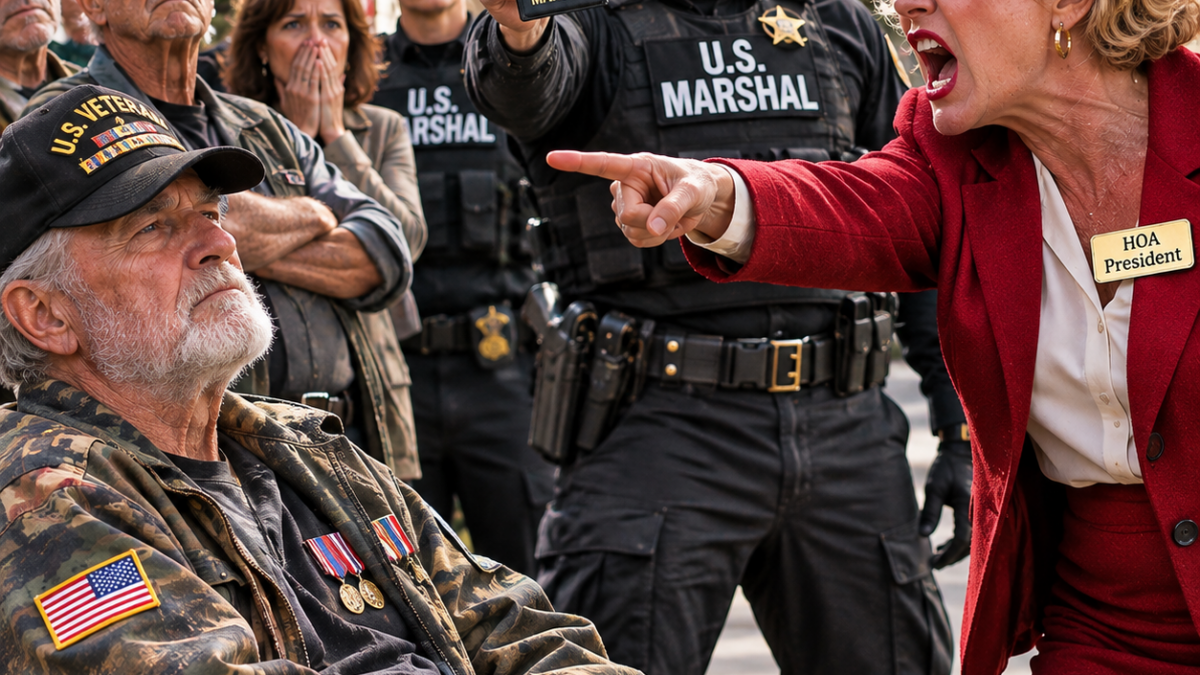
PART2
The next evening, Veronica unveiled her plan to nearly eighty homeowners in the Raven Creek clubhouse.
We attended.
Not because any of us belonged to the HOA.
Because when someone publicly announces plans for your home, listening matters.
A slideshow glowed behind Veronica.
Luxury cabins.
A spa.
Private lodge.
Landscaped trails.
Mountain views.
Then:
RAVEN CREEK RESERVE
PROJECT VALUE: $6.2 MILLION
On slide four, a satellite image appeared.
Our property was outlined in red.
PARCEL PENDING CLEARANCE
Walter stood beside me.
He was seventy-seven.
Old Army.
Walked with a cane but hated when anyone held doors for him.
“Clearance,” he murmured.
“They make us sound like brush.”
When Veronica opened questions, I raised my hand.
Two private security guards stepped into the aisle.
Blocked me.
“Residents first,” Veronica said.
“We’re the residents of the land you’re presenting.”
“You’re not members.”
“No.”
I looked at the screen.
“That’s the point.”
She ignored me.
Then described Haven Ridge as:
“An obsolete cluster of aging structures negatively affecting surrounding property values.”
Run-down shacks.
That was how she put it five minutes later.
One homeowner laughed.
A few looked uncomfortable.
Most stared at the slides.
People will believe almost anything when it appears beside an architect’s rendering of a spa.
Walter raised his voice.
Quietly.
“Mrs. Tredwell?”
She looked toward him.
“Would you show us the certificate of title for Haven Ridge?”
Her expression hardened.
“Your military service does not give you the right to stand in the way of progress.”
The room went silent.
Patrick’s hands curled.
I touched his arm.
Dale held his phone at waist level.
Recording.
Walter nodded once.
Then:
“I didn’t ask whether my service gave me anything.”
He looked at the screen.
“I asked whether you own the land.”
Veronica gripped the podium.
“Our attorneys have resolved the title issue.”
“Then show the deed.”
No answer.
I walked toward the front table.
Set down a certified copy of the Haven Ridge deed.
Veronica brushed it aside without reading it.
That small movement bothered me more than any insult.
She did not want competing evidence.
Cynthia Ray, a sixty-year-old board member who had served nearly a decade, stood.
“I would like the purchase agreement and the board minutes authorizing this transaction made available to homeowners.”
Hazel answered immediately.
“Commercially confidential.”
Cynthia looked toward Veronica.
“Was there a vote?”
“The board authorized negotiations.”
“That is not what I asked.”
Veronica ended questions.
Sunday morning, every Haven Ridge cottage received HOA violations.
Fines.
Warnings.
Claims that road access could be suspended.
I called the sheriff.
A deputy came out.
Read everything.
Then said:
“An HOA notice is not a court order.”
“Can they remove us?”
“Not because they printed paper.”
“What about the ownership claim?”
“That needs to be settled through deeds, surveys, and court if necessary.”
Judith stood beside me.
“What if they block access?”
“Call us.”
Then the deputy added:
“But document everything.”
That became our rule.
Document everything.
Sunday evening, my phone rang.
Unknown number.
A man introduced himself as an officer with the U.S. Marshals Service.
“An enforcement team has been assigned to Haven Ridge.”
“What district?”
Silence.
“Badge number?”
More silence.
“Supervisor?”
Nothing.
“Case number?”
The line disconnected.
I stared at the phone.
Then called the publicly listed Denver number for the United States Marshals Service.
Not any number on Veronica’s paperwork.
The duty officer listened.
“Sir, I cannot validate anything based on what you’ve described.”
“Would your office execute an HOA eviction?”
“No.”
“Would a federal officer refuse to provide a verifiable case number?”
Another pause.
“Send us everything.”
Monday morning, Floyd, Judith, and I drove to the county records office.
A clerk named Elaine helped us.
Two hours.
Twenty years of filings.
We confirmed three facts.
One:
Haven Ridge belonged to the Veterans Housing Trust.
Recorded.
Unbroken title.
Two:
All nine occupancy rights were legally recorded.
Three:
Raven Creek Estates held one narrow easement across a portion of our service road.
That was it.
No management rights.
No sale rights.
No ownership.
Floyd placed Veronica’s map beside the original survey.
The differences were immediate.
A minor service easement had become a major access route.
Boundary lines had shifted.
Our entire parcel had been absorbed into the resort plan.
Judith began reviewing recent filings.
Then stopped.
Her face drained.
“Leland.”
She turned a page toward me.
A consent to transfer.
Trust records custodian:
Judith Calder
Signature.
Judith stared.
“I never signed this.”
Elaine looked at her.
“You’re certain?”
“I have signed thousands of records.”
Her voice went hard.
“I did not sign away nine homes.”
We asked the clerk to preserve every related filing.
The county had already flagged the HOA’s recent notice of interest for additional verification.
Supporting records did not match historical documents.
Veronica’s seven-day deadline suddenly made sense.
She needed us gone before anyone completed verification.
An empty property could be presented as surrendered.
A property with nine residents waving recorded rights was harder to sell.
I called Denver property attorney Hannah Houser.
She listened.
Then:
“Do not sign anything.”
“We aren’t.”
“Do not leave voluntarily without talking to me.”
“We won’t.”
“I’m filing to block transfer.”
Across town, Veronica received a call from developer Malcolm Keating.
We learned this later.
His company had agreed to acquire the resort site for $6.2 million.
But only with clear title.
Vacant property.
No unresolved residents.
His inspectors were coming within days.
Veronica assured him:
“No problems.”
Then called Hazel.
“The nine residents have to be gone before inspection.”
Monday night, Stella’s cameras caught a black panel van stopping near our gate.
Headlights off.
Two men stepped out.
Dark jackets.
Bright yellow letters.
FEDERAL MARSHAL
One taped a document to our gate.
The deadline had changed.
No longer Friday.
Tuesday.
8:00 a.m.
At eight sharp, they returned.
The taller man introduced himself as Curtis Fenn.
He demanded keys.
Transfer forms.
Immediate cooperation.
I asked:
“Which federal court issued the order?”
He waved a folder.
“Do not obstruct.”
“Let me read it.”
“No.”
“Badge number?”
His jaw tightened.
“Failure to cooperate can result in arrest.”
Patrick stepped off his porch.
Fists clenched.
I raised one hand.
“Patrick.”
He stopped.
We all understood the danger.
If these men were fake, punching one helped Veronica.
If they were somehow real, punching one was worse.
Judith approached.
“Show me the judge’s signature.”
Curtis flashed the papers for half a second.
Then closed the folder.
Stella’s cameras captured every word.
Dale recorded from his porch.
Curtis finally pointed toward us.
“Next time we bring the full team.”
They left.
I called the real Marshals Service again.
Sent the footage.
Vehicle plate.
Documents.
Witness statements.
An hour later, the duty officer called back.
“This has been referred.”
“To who?”
“I can’t discuss investigative details.”
That afternoon, Veronica called.
“Next time they won’t ask.”
I remained silent.
She continued.
“You people are making this much harder than it has to be.”
I answered:
“Then you better make sure those men are who you claim they are.”
She hung up.
Two hours later, my phone rang again.
This time:
Federal Bureau of Investigation.
The woman identified herself as Special Agent Eloise Carver.
I did not continue the conversation until I called the FBI field office through its public line and confirmed her identity.
Then we spoke.
“Preserve everything.”
“We are.”
“Keep cameras operating.”
“Yes.”
“Do not confront anyone.”
“Understood.”
“If these people return, stay inside unless instructed otherwise by verified law enforcement.”
For the first time in days, I felt something close to relief.
Not because the problem was solved.
Because somebody real was listening.
Wednesday morning, an HOA-hired construction crew arrived.
Orange barricades.
They blocked the service road where the HOA easement crossed our property.
Sign:
ROAD CLOSED FOR CONSTRUCTION
No construction equipment ever appeared.
The grocery van turned away.
Then propane.
Cold weather was moving in.
Abram checked the generators.
“Four days comfortable.”
“And after?”
“Depends how cold.”
Walter used medical equipment at night.
Two cottages relied heavily on propane heating.
Patrick wanted to throw the barricades into the ditch.
“No,” I said.
“They’re blocking legal access.”
“I know.”
“So we move them.”
“No.”
“Why?”
“Because Veronica wants photographs of angry veterans destroying HOA property.”
He glared.
“So we freeze politely?”
“No.”
“Hannah files emergency relief.”
Maren pulled the original right-of-way documents.
Our attorney moved.
By afternoon, the court had the motion.
Then nine envelopes arrived.
Each contained:
A relocation payment.
A release.
A promise never to bring any claim involving Haven Ridge.
The amount barely covered moving costs.
We gathered in my kitchen.
Nine adults around a table meant for four.
Walter held his check.
“I’m tired.”
Nobody spoke.
“I don’t want to spend whatever years I have left in court.”
Patrick snapped:
“So leave?”
Walter’s face changed.
“Careful.”
“Patrick,” I said.
He ignored me.
“We fought harder than this overseas.”
Walter looked at him.
“I am not twenty-five anymore.”
Silence.
“I served twenty-two years.”
His voice remained low.
“I don’t need you measuring my courage because I don’t want to lose heat in January.”
Patrick looked away.
I let the room cool.
Then:
“Nobody is obligated to stay.”
Everyone looked at me.
“I mean that.”
I pointed toward the releases.
“This choice belongs to each person.”
Judith nodded.
“But.”
I looked around.
“Nobody signs before counsel reviews it.”
That was something we could agree on.
All nine envelopes remained unsigned.
That night Stella received an email from a Raven Creek homeowner.
Attached:
HOA expense report.
She searched.
Landscaping.
Legal.
Festival.
Then:
SECURITY SERVICES — $185,000
Vendor created six weeks earlier.
She checked state business records.
Managing member:
Curtis Fenn.
The fake marshal was being paid by the HOA.
Before Stella could reach us, someone slipped an envelope under Judith’s cottage door.
Inside:
A relocation consent.
All nine cottages.
Transfer authorized.
Judith’s signature.
The next morning, we gathered again.
This time anger came faster.
Walter saw the signature.
“Judith.”
She stared.
“I didn’t sign that.”
“It’s your signature.”
“I know what my signature looks like.”
Patrick hit the table.
“Then explain it.”
Judith’s hands shook.
“Two months ago, someone from the HOA came by.”
Everyone quieted.
“He said there was a routine road maintenance confirmation.”
“What did you sign?”
“One page.”
“Did you keep a copy?”
She looked toward her cottage.
“Yes.”
Thank God for Judith Calder.
She returned with the original.
Road drainage acknowledgment.
Her signature at the bottom.
Nothing about transfer.
Hannah arrived before noon with an FBI document examiner.
They compared the pages.
Signature identical.
Not similar.
Identical.
Placement artifacts.
Formatting differences.
The signature appeared to have been digitally transferred from the legitimate maintenance form onto the false consent.
Judith sat down.
Covered her face.
“I handed it to them.”
“No,” I said.
She looked up.
“You signed a road form.”
“They used it.”
“That is not consent.”
Walter stepped closer.
“Judith.”
She looked at him.
“I’m sorry.”
His voice cracked.
“I shouldn’t have doubted you.”
Patrick stared at the floor.
Then muttered:
“Me too.”
Judith looked around the room.
“That’s what she wanted.”
I nodded.
Nine people who trusted one another for years.
Split them.
Make the fight internal.
Then nobody needs fake marshals.
That afternoon, Cynthia Ray requested a private meeting.
She arrived at Hannah’s temporary office looking exhausted.
“I checked the board records.”
She placed a folder down.
“There was never a valid vote to purchase Haven Ridge.”
We already suspected it.
Now we had a director saying it.
“Veronica?”
“Veronica, Hazel, and Bridget handled everything.”
Cynthia had found altered summaries.
Emails.
Draft minutes.
Then one message.
From Veronica to Hazel and Bridget.
THE VETERANS MUST BE GONE BEFORE THE BUYER CHECKS THE ORIGINAL TITLE.
Nobody spoke.
Cynthia placed another printout on the table.
Instructions to Curtis.
Uniforms.
Badges.
Vehicles.
Federal appearance.
A staged eviction.
My stomach turned.
“You knew?”
“Not until yesterday.”
“Why come forward?”
She looked at me.
“Because this isn’t an HOA dispute anymore.”
She looked at Judith.
“It’s fraud.”
Cynthia became a cooperating witness.
Agent Carver received everything.
The investigation accelerated.
Federal agents confirmed none of Curtis’s six men had ever served with the Marshals Service.
Bank subpoenas showed Hazel moving association funds through categories labeled:
Security.
Legal consulting.
Project preparation.
Money flowed into Curtis’s newly formed company.
Other funds moved through entities tied to Hazel and Veronica.
The resort project was not only about taking Haven Ridge.
It was being used to hide financial misconduct inside the HOA.
Then agents interviewed Malcolm Keating.
The developer.
He turned over everything.
Veronica had supplied:
A title packet.
Board resolution.
Resident consent.
Assurance of voluntary surrender.
All false or altered.
His company had nearly purchased land the HOA did not own.
That gave federal investigators motive.
Fraud.
Forged documents.
Fake federal officers.
Misappropriated HOA funds.
The case was no longer a neighborhood argument.
Thursday afternoon, a federal magistrate signed warrants.
That same day, our attorney obtained emergency court relief restoring our service-road access.
The barricades came down.
Propane arrived.
Groceries arrived.
Walter’s medical equipment remained safe.
At sunset, two women came to my cottage.
Special Agent Carver.
Deputy U.S. Marshal Tessa Rourke.
Tessa was forty-one.
Calm.
Direct.
She sat at my kitchen table.
“The fake enforcement team is scheduled to arrive before dawn.”
“How do you know?”
“We know.”
She did not elaborate.
“You stay inside.”
“Yes.”
“Doors locked.”
“Yes.”
“No confrontation.”
“Yes.”
“Cameras keep recording.”
“Yes.”
She looked at the others.
“Your job is not to catch anyone.”
Then at me.
“Your job is protecting these people.”
I nodded.
“One request.”
“What?”
“Nobody loses a home while this case works through court.”
“That decision ultimately belongs to the court and the trust structure.”
She paused.
“But the disputed transfer is being frozen, and no lawful eviction is occurring tomorrow.”
That was enough.
Across Raven Creek, Veronica was preparing.
Curtis called her at 7:00 p.m.
Six men ready.
Jackets pressed.
Fake badges polished.
Dashboard lights installed.
Veronica poured champagne.
According to later testimony, she said:
“By sunrise, not one veteran will be left.”
At Haven Ridge, nobody slept much.
Walter sat alone with an old photograph.
I found him around ten.
Nine veterans on opening day.
Ribbon.
Borrowed scissors.
Younger faces.
He turned the photograph over.
“I never thought I’d be afraid of men wearing a government uniform.”
I sat.
“I served that government twenty-two years.”
“I know.”
“I was proud of it.”
“I know.”
His eyes lifted.
“We shouldn’t have to be scared in our own homes.”
“We won’t surrender our homes to people pretending to represent the country we served.”
Walter nodded.
Across the clearing:
Judith built a tabbed binder of deeds and occupancy rights.
Floyd marked surveys.
Stella verified offsite camera backups.
Dale tested exterior lights.
Abram filled generators.
Maren checked everyone’s medication supply.
Patrick walked the road three times.
At midnight, the clubhouse across the wall still glowed.
Veronica met with Curtis.
Hazel confirmed final payments.
Bridget prepared nine transfer forms.
One for each cottage.
Curtis’s youngest guard asked:
“What if the real cops come?”
Veronica laughed.
“The HOA has attorneys.”
That answer would become important later.
Authority was so natural to her that she could not imagine consequences reaching past it.
4:30 a.m.
Fake convoy departed.
4:41.
Veronica left in her SUV.
4:47.
The pounding started.
Now, standing inside my cottage, I watched Curtis hold a fake federal order against the glass.
“Five minutes!”
Across the clearing, another man shouted at Judith.
Another hit Patrick’s door.
Floyd’s porch camera captured a fake badge held inches from the lens.
Veronica recorded from the gate.
“I warned them.”
Then Dale called me.
Not my cell.
The internal cottage line.
“Leland.”
“What?”
“Road.”
I looked.
Headlights.
Several vehicles.
No sirens.
No flashing lights.
Slow.
Steady.
They separated at preplanned positions.
Blocked both directions.
Doors opened.
Men and women stepped out wearing real tactical vests.
U.S. MARSHAL
Not costume lettering.
Agency identification.
Disciplined movement.
Deputy U.S. Marshal Tessa Rourke walked into the clearing.
“CURTIS FENN!”
Everything stopped.
“Federal law enforcement. Keep your hands visible.”
Curtis spun.
“We’re federal marshals executing an eviction!”
Tessa continued walking.
“No, you are not.”
He raised his folder.
“I have an order.”
“Put it down.”
“This is federal—”
“Put it down.”
Something in her voice changed him.
The folder fell.
She displayed credentials.
“Curtis Fenn, you are the subject of a federal arrest warrant relating to impersonation of a federal officer and associated offenses.”
His face went white.
One of his men stepped backward.
A deputy shouted:
“DON’T.”
He froze.
Within two minutes, all six were detained.
No shots.
No fight.
No heroic tackle.
Real authority needed none of that.
Veronica came through the gate.
“What is happening?”
Tessa turned.
“I’m Veronica Tredwell.”
“We know.”
“I am president of the Raven Creek Estates Homeowners Association.”
“We know.”
“These men are contractors.”
Curtis looked at her.
That was the moment I saw panic.
Veronica continued.
“If they misrepresented themselves, then I was deceived.”
Special Agent Carver stepped forward.
“No, Ms. Tredwell.”
Veronica stopped.
Carver held a folder.
“We have your payment contracts.”
Silence.
“Text messages.”
Nothing.
“Emails instructing Mr. Fenn to stage a federal-looking enforcement action.”
Veronica’s mouth opened.
Then:
“Those messages are being taken out of context.”
Carver read from the warrant.
Conspiracy.
Fraud-related allegations.
Impersonation-related conduct.
Financial offenses under investigation.
A deputy approached.
Veronica looked toward me.
For one strange second, I think she expected me to help.
Maybe because I was the person she had been fighting all week.
Maybe because even then, she could not understand that none of this had ever been about defeating her.
I opened my door.
Stepped onto my porch.
Tessa allowed it.
Veronica stared.
I asked:
“Where’s your federal authority now, Veronica?”
Not shouted.
Didn’t need to be.
She looked away.
The handcuffs closed.
Across town, Hazel and Bridget were arrested under related warrants.
Agents entered HOA offices with search authority.
Records were seized.
Computers.
Financial statements.
Contracts.
Bank documents.
The deeper audit came later.
And what investigators found made Haven Ridge only one part of a larger scheme.
Veronica and Hazel had been using the resort expansion to justify suspicious transfers from association reserves.
Security services.
Consulting.
Project preparation.
Money routed through intermediary businesses tied to people close to them.
The fake eviction served two purposes.
Empty Haven Ridge before the buyer checked title.
And create the appearance that the resort transaction was progressing far enough to hide missing money.
By sunrise, the fake marshals were in federal vehicles.
Veronica walked past the red sign she had planted.
PROPERTY UNDER HOA ENFORCEMENT
Nobody cheered.
That mattered to me.
Patrick did not shout.
Walter did not smile.
Judith stood beside me.
All nine of us watched quietly.
Tessa approached.
“Mr. Vickers.”
“Yes?”
“Your homes are not being seized today.”
I looked at the eight people around me.
Walter was crying.
Barely.
Just tears running down a face that had spent most of a week refusing to show fear.
Judith took his hand.
Patrick looked toward the trees.
Stella finally lowered the tablet showing camera feeds.
Abram said:
“I’m going back to bed.”
We laughed.
Not because anything was funny.
Because for the first time in seven days, our bodies understood that we were allowed to.
The arrests hit Raven Creek like an earthquake.
Homeowners who had applauded Veronica learned their dues had funded men pretending to be federal officers.
Cynthia called an emergency meeting.
Independent audit.
New election.
Removal of leadership.
The directors uninvolved in the scheme cooperated.
Within weeks, Raven Creek had a new board.
Its first actions were simple.
Withdraw every Haven Ridge fine.
Cancel every false notice.
Issue a formal written apology.
Guarantee the service road would remain open according to the valid easement.
Support removal of fraudulent county filings.
The court barred reliance on the suspected forged transfer records.
The county corrected its records after legal review.
Haven Ridge remained where it had always been.
Ours to occupy under the trust.
The criminal case moved slowly.
As real cases do.
Indictments.
Discovery.
Motions.
Hearings.
Cynthia testified.
Malcolm testified.
Judith testified about the stolen signature.
Dale’s video played.
Stella’s footage showed Curtis demanding keys.
The fake order appeared on a courtroom screen.
UNITED STATES DISTRICT COURT OF RAVEN CREEK
Even some jurors looked stunned.
Tessa testified about legitimate Marshals Service procedure.
No HOA can appoint federal marshals.
No private contractor can manufacture federal authority with clothing and paperwork.
Investigators traced HOA funds.
Prosecutors separated each defendant’s conduct.
Veronica faced the most serious consequences as an organizer.
Hazel and Bridget faced charges tied to financial transactions and documents according to what prosecutors could prove.
Curtis and his men faced consequences for impersonation-related conduct and their participation in the staged operation.
The sentences were not identical.
They should not have been.
Justice is not multiplying the same punishment by the number of people involved.
It is matching consequences to proven conduct.
Recoverable assets were directed toward restitution where legally appropriate.
The association recovered money.
Owners recovered part of what had been lost.
Then came the civil side.
The nine of us filed claims against the responsible people and entities.
I hated every deposition.
Walter hated them more.
Patrick enjoyed his too much.
Judith brought color-coded binders.
Of course.
Eventually, settlement covered legal fees.
Improper fines.
Access disruption.
Documented expenses.
Other provable harm.
No one became rich.
Good.
We already had what mattered.
The cottages.
Then Malcolm Keating asked to meet us.
The resort developer.
I expected an apology.
He brought something else.
His company was abandoning the Raven Creek Reserve project on Haven Ridge permanently.
Fine.
Then:
“We’d like to fund infrastructure improvements.”
My first answer:
“No.”
Malcolm blinked.
“We were nearly part of taking your land.”
“You were deceived.”
“We still missed warning signs.”
“Probably.”
“We can replace the water lines.”
“No.”
“Generator system.”
“No.”
“Paved access.”
“No.”
Walter was sitting beside me.
He touched my arm.
“Leland.”
I looked at him.
“Let him finish.”
Malcolm proposed the improvements only with approval of the Veterans Housing Trust and no ownership interest in return.
No branding.
No resort rights.
No easement expansion.
Just restoration.
I still disliked it.
Walter understood.
After Malcolm left, he said:
“You want to punish everybody forever.”
“No.”
“Yes.”
I looked at him.
“That developer almost bought our homes.”
“Because Veronica lied.”
“They should have checked harder.”
“They know.”
He leaned closer.
“Real victory isn’t making everybody pay forever.”
I said nothing.
“It’s making sure no one can ever do it again.”
That sentence stayed with me.
The trust reviewed Malcolm’s proposal.
Lawyers reviewed it.
Independent engineers.
No hidden rights.
No strange clauses.
We accepted.
Water lines replaced.
Generator system modernized.
Access road properly paved.
Not luxury.
Safety.
Reliability.
Then Raven Creek homeowners made a proposal of their own.
An old guardhouse near the shared boundary had been unused for years.
Convert it into a community center.
Adults from both properties.
Veteran services.
Meeting space.
Public records for shared infrastructure.
Transparent management agreement.
At first Patrick hated the idea.
“After everything?”
Cynthia answered him.
“That is exactly why.”
The agreement went through months of review.
Public votes.
Signed documents.
Recorded rights.
Every boring thing Veronica had tried to avoid.
The center opened the following autumn.
No grand resort.
No spa cabins.
No $6.2 million luxury expansion.
A renovated building with accessible bathrooms, a kitchen, a meeting room, and a small workshop.
Better.
On opening day, all nine of us gathered at the Haven Ridge gate.
The old sign read:
PRIVATE VETERANS PROPERTY
Weathered wood.
Patrick had carved a new one.
We took the old board down.
Raised the new one.
Polished pine.
The lettering read:
HAVEN RIDGE
NINE VETERANS. NINE HOMES. ONE UNBREAKABLE PROMISE.
Patrick drove the final nail.
Walter complained it was crooked.
Patrick told him his eyesight was crooked.
Judith threatened both of them.
I stood back.
Nine cottages among the pines.
Every roof still there.
Every resident still home.
Cynthia asked me to say something.
I refused.
Then everyone stared until I changed my mind.
“We didn’t serve because we wanted power.”
I looked toward Raven Creek.
“We served because authority is supposed to mean something.”
Then toward Haven Ridge.
“A badge doesn’t create authority because someone puts it on a jacket.”
“A title doesn’t create ownership because someone prints it on letterhead.”
“And fear doesn’t turn a lie into law.”
Nobody applauded immediately.
Walter did first.
Then everyone else.
Afterward, I went back to cottage number four.
Made coffee.
Sat on my porch.
Quiet.
That was all I had wanted.
But the story did not end the day Veronica was arrested.
It would have been easier if it had.
Arrest is dramatic.
Rebuilding trust is not.
For months, some Raven Creek homeowners avoided Haven Ridge.
Embarrassment.
They had sat in the clubhouse while Veronica called us shacks.
Some had nodded.
Some had voted for project assessments.
A few had repeated rumors that we were squatters.
Now they had to drive past us.
Cynthia came first.
One Saturday morning with a box of pastries.
“I don’t know what the etiquette is after your HOA tries to steal somebody’s neighborhood.”
“Coffee helps.”
She laughed.
I let her in.
Then others.
A retired teacher.
A young couple.
A father with two teenagers.
Some apologized.
Some admitted they had not asked questions because property values sounded good.
One man said:
“I thought the board had checked everything.”
Floyd answered:
“That’s how bad surveys become good enough.”
Over time, the wall between properties felt less like a frontier.
It remained a boundary.
Important difference.
Haven Ridge did not join Raven Creek.
We never wanted to.
They did not gain authority over us.
We did not want authority over them.
Shared road.
Community center.
Specific agreements.
Clear lines.
That was enough.
Judith became almost obsessive about document security after the forged transfer.
Not that she wasn’t already.
She installed a scanner.
Encrypted backups.
Offsite storage.
Nobody was permitted to sign anything on a porch again.
Patrick teased her:
“What if it’s a birthday card?”
“Counsel review.”
“What if it’s a pizza receipt?”
“Read every page.”
Walter said:
“She’s going to make us notarize Christmas cards.”
Judith pointed at him.
“You were the one who accused me.”
Walter immediately shut up.
That joke took a long time before it became funny.
For weeks, Judith had carried the pain of seeing her own signature used to betray people she loved.
It took longer for her to forgive herself than for anyone else to forgive her.
One evening, I found her shredding duplicate documents.
She stopped.
“I should have read that maintenance form more carefully.”
“It was legitimate.”
“I still signed it.”
“You signed what was in front of you.”
“They used the signature.”
“Yes.”
“If I hadn’t—”
“Stop.”
She looked at me.
“That logic belongs to the people who forged it.”
Silence.
“You don’t take responsibility away from them by giving it to yourself.”
She sat down.
Then cried.
Judith Calder almost never cried.
I stayed until she stopped.
Patrick’s guilt worked differently.
He had almost attacked Curtis.
If I had not stopped him, the entire scene might have changed.
He knew that.
Months later, he said:
“I thought restraint was cowardice.”
“No.”
“I know.”
“You always knew.”
He shook his head.
“Not when I’m angry.”
That was true.
He began volunteering at the community center.
Conflict de-escalation sessions for younger veterans.
Nobody found that more ironic than Patrick.
Walter’s fear lingered longest.
Any hard knock at his door startled him.
He hated that.
Twenty-two years of military service.
Then a fake marshal in a cheap jacket changed what knocking sounded like.
Tessa visited Haven Ridge six months after the arrests.
Not official.
She brought a framed letter from the Marshals Service district leadership recognizing the residents’ cooperation.
Walter asked her:
“Does it stop feeling wrong?”
“What?”
“Seeing your agency name on a jacket.”
Tessa understood.
She sat with him.
“What those men wore wasn’t our authority.”
“I know that here.”
He tapped his head.
“Not always here.”
Chest.
Tessa nodded.
“Authority is supposed to be verifiable.”
She gave him the public district number again.
“If anyone ever claims to be one of us, you can call.”
Walter put the number beside his phone.
After that, the knocks bothered him less.
Veronica’s trial became news.
Local first.
Then regional.
Headlines loved:
HOA PRESIDENT ACCUSED IN FAKE MARSHAL EVICTION
I hated the attention.
Reporters came to Haven Ridge.
I gave one interview.
One.
They kept asking:
“How does it feel to win?”
I answered:
“We kept our homes.”
They wanted anger.
I gave records.
They wanted to know whether I hated Veronica.
I said:
“I don’t know her well enough to hate her.”
They wanted revenge.
I talked about property rights.
Boring interviews do not get repeated much.
That was fine.
During the criminal proceedings, defense attorneys challenged parts of the government’s case.
As they should.
Some allegations were stronger than others.
Evidence was tested.
Documents authenticated.
Witnesses cross-examined.
Not every suspicious transaction became a conviction.
Not every rumor became a fact.
That mattered to me.
Because Veronica’s entire scheme had depended on convincing people that official-looking claims were enough.
If we answered that abuse by abandoning standards ourselves, what had we learned?
The strongest evidence remained straightforward.
The land did not belong to the HOA.
Our occupancy rights were recorded.
Judith’s consent document had been manipulated.
Curtis’s company had been paid from association funds.
Messages connected Veronica to plans for the staged enforcement.
Cynthia documented the absence of valid board approval.
Malcolm proved his company had been given representations that did not match the actual title.
The fake federal operation happened on camera.
Those facts did not need exaggeration.
Neither did the financial misconduct that auditors could actually trace.
When the legal cases ended, Veronica received the heaviest sentence among the principal organizers based on the conduct proven against her.
Hazel and Bridget faced serious consequences consistent with their documented roles.
Curtis and the men who participated in the impersonation operation were convicted on charges tied to what each had done.
No one at Haven Ridge celebrated sentencing day.
Walter said:
“Prison isn’t a party.”
He was right.
Consequences were necessary.
Joy was not.
The closest I came to satisfaction happened months later.
County records office.
Elaine, the same clerk who helped us in the beginning, called.
“Mr. Vickers?”
“Yes?”
“I thought you’d want to know.”
“What?”
“The fraudulent notice has been formally removed.”
I drove into town.
She showed me.
Clean chain of title.
Veterans Housing Trust.
Occupancy rights.
Easement.
Nothing else.
No fake consent.
No redevelopment claim.
I stared at the page.
That felt like victory.
Not handcuffs.
A correct public record.
The truth restored where lies had been filed.
Years passed.
Haven Ridge changed slowly.
Walter’s health declined.
Abram replaced the generator controls twice.
Maren expanded the garden and continued calling tomatoes “community morale infrastructure.”
Stella upgraded cameras but removed one aimed too closely toward Raven Creek after neighbors complained.
“Reasonable,” she admitted.
Patrick finally stopped checking the road every evening.
Dale married.
We gained a tenth regular face when his wife spent more time at Haven Ridge than he did.
The occupancy structure stayed nine cottages.
But family has never respected paperwork as neatly as property does.
Walter died four years after the eviction attempt.
Peacefully.
Cottage seven.
Morning.
Photograph of the original Haven Ridge opening still beside his bed.
His funeral filled the community center.
Raven Creek homeowners came.
Tessa came.
Cynthia.
Elaine from county records.
Even Malcolm.
Patrick spoke.
That surprised everyone.
He said:
“Walter taught me that refusing to fight can require more courage than throwing the first punch.”
Nobody looked at Patrick.
We all knew.
Afterward, Judith placed Walter’s old photograph in the center hallway.
Nine veterans.
Younger.
Ribbon.
Borrowed scissors.
Underneath:
THE FIRST DAY HOME
No mention of Veronica.
No fake marshals.
That mattered.
We refused to let the worst week become Haven Ridge’s identity.
The community center grew.
Veterans’ legal clinics.
Benefits counseling.
Financial literacy workshops.
Property-record seminars.
Floyd led those until his eyesight worsened.
He began every session with the same line:
“Never trust a map just because somebody used a color printer.”
People laughed.
Then he showed them exactly how Veronica’s altered map had absorbed our parcel.
The lesson was simple.
Documents carry authority only if they are authentic.
Uniforms carry authority only if the people wearing them truly hold it.
Titles carry authority only within lawful boundaries.
Those ideas sound obvious until someone confident enough tells you otherwise.
Raven Creek Estates changed too.
Its new governance rules required:
Independent review of major property transactions.
Multiple signatures for large payments.
Conflict disclosures.
Owner access to contracts.
No unilateral enforcement outside association boundaries.
Annual reserve audits.
The reforms were not glamorous.
That was why I liked them.
Systems rarely fail because there were no dramatic speeches.
They fail because ordinary controls are missing.
Veronica had operated inside those gaps.
The new board closed them.
Cynthia served one term as president.
Then refused another.
“Power should feel temporary,” she told me.
Good answer.
One December, years after everything, the Raven Creek board invited Haven Ridge to its holiday dinner.
Patrick said no.
Then yes.
Then no again.
Judith told him to stop performing.
We went.
The clubhouse looked almost exactly as it had the night Veronica presented the resort.
Same fireplace.
Same mountain view.
Different board.
On one wall was a framed copy of the new shared-boundary agreement.
Public.
Readable.
Cynthia stood beside me.
“You know what I remember most?”
“What?”
“You putting the deed on the front table.”
I smiled.
“Veronica never looked at it.”
“That’s what I mean.”
She looked toward the document display.
“She had already decided what the truth was.”
That sentence stayed with me.
The most dangerous people I met in the Army were not always dishonest.
Sometimes they were simply certain before evidence arrived.
Veronica had not begun by hiring fake officers.
She began by believing her plan mattered more than inconvenient facts.
Eighteen acres near a luxury development.
Nine modest cottages.
A project worth millions.
She probably told herself:
Surely this land should be part of the resort.
Then:
Surely there must be a legal mechanism.
Then:
The paperwork can be fixed.
Then:
The residents will leave if pressured.
Then:
The uniforms only need to look federal.
One compromise made the next easier.
Until six men were pounding on veterans’ doors before dawn pretending to represent the United States government.
That progression mattered more to me than calling her evil.
Evil is easy to dismiss as something other people do.
Rationalization is more dangerous because everyone recognizes it.
The new Raven Creek board eventually sold the old resort planning documents to a recycling company.
Cynthia asked whether we wanted copies.
“No.”
Patrick did.
“Why?”
“Firewood.”
“They’re paper.”
“Exactly.”
Judith threatened him with legal violence.
We laughed.
The $6.2 million resort never happened.
Instead, the land Raven Creek actually owned was developed conservatively years later.
Walking trails.
A small shared pavilion.
No expansion into Haven Ridge.
Before beginning, the board sent us boundary surveys.
Asked for review.
Floyd nearly cried.
“Look.”
He showed me.
“They used the correct line.”
“You’ve become sentimental.”
“Shut up.”
The shared road remained.
Paved.
Maintained under a clear agreement.
Raven Creek paid its part.
The Veterans Housing Trust paid ours.
No barricades.
No threats.
One winter, a tree fell across it.
HOA maintenance called us before sending a crew.
Permission to enter the Haven Ridge segment?
Judith answered.
“Yes.”
Then hung up.
Stared at the phone.
“What?”
“They asked.”
That was all.
Two words.
They asked.
Such a small thing.
The entire original conflict could have changed if Veronica had done that.
She could have come to Haven Ridge with Malcolm’s proposal.
Explained the resort.
Asked whether the trust wanted to sell.
We probably would have said no.
Then everyone would have gone home.
No fake documents.
No blocked fuel.
No forged signature.
No arrests.
A lawful no is still an answer.
Some people cannot tolerate that.
That was Veronica’s real failure.
Not ambition.
Not wealth.
Not wanting a resort.
She could not accept that nine people whose cottages looked insignificant to her had the right to say no.
Walter once said:
“Home is the one place where no should mean something.”
I think about that often.
My cottage was simple.
Two bedrooms.
Wood stove.
Old couch.
Army photographs in a box I rarely opened.
Market value far below any Raven Creek mansion.
But property rights do not increase with granite countertops.
Dignity does not scale with square footage.
That is what the resort renderings failed to show.
A spa cabin worth $800,000 is not morally superior to a wooden cottage where a seventy-seven-year-old veteran keeps his medication and old photographs.
Veronica saw development value.
We saw home.
That difference drove everything.
By my seventieth birthday, only five of the original nine still lived full time at Haven Ridge.
Death.
Health.
Family moves.
Life.
The trust filled vacancies carefully.
Always veterans.
Always recorded rights.
New residents received orientation.
Judith, older but still terrifying, explained the documents.
Then Stella showed the security system.
Patrick told the fake marshal story with increasingly ridiculous details.
I corrected him every time.
“Curtis did not have an eye patch.”
“He should have.”
“He didn’t.”
“Story works better.”
“Truth works fine.”
That became our argument.
The new residents usually thought the story was legend until Stella showed them the archived footage.
4:47 a.m.
Fake jackets.
Veronica’s SUV.
Then the real convoy.
Every time I watched it, the same detail struck me.
The impostors were loud.
Real marshals were calm.
Fake authority performs.
Real authority rarely needs to.
One Christmas morning, Tessa returned.
Retired by then.
She stood at the gate looking at the polished sign.
NINE VETERANS. NINE HOMES. ONE UNBREAKABLE PROMISE.
“Still nine homes.”
“Always.”
“Still trouble?”
“Mostly Patrick.”
From the community center porch:
“I HEARD THAT.”
Tessa laughed.
We drank coffee.
She told the newer residents about verification.
If somebody claims federal authority, ask for identity.
Call the public agency number.
Do not rely on contact information the person provides.
Do not physically resist.
Document.
That practical advice mattered.
The internet version of our story became more dramatic over time.
People said nine veterans “ambushed” fake marshals.
We didn’t.
People said we surrounded Veronica.
We didn’t.
People said there were guns drawn everywhere.
There weren’t.
The truth was stronger.
Nine people stayed behind locked doors.
Cameras recorded.
Investigators did their job.
Real marshals arrested impostors.
Paperwork beat fabricated paperwork.
Restraint beat provocation.
That version might be less cinematic.
It is also the reason nobody died.
I told Tessa that.
She nodded.
“The hardest thing we asked you to do was nothing.”
“Yes.”
“You did it.”
“I hated every second.”
“I know.”
At sunset, she left.
I walked the property.
Old habit.
Water lines.
Fence posts.
Drainage.
Forty years after the Army taught me to inspect logistics before problems found you, I was still doing it.
I stopped at the place where Veronica’s red sign had stood.
No marker remained.
Grass.
Pine needles.
Snow.
I could have erected some memorial.
HERE STOOD THE SIGN OF A VERY BAD IDEA.
Patrick would have loved that.
I never did.
Not every wound deserves a monument.
Some deserve healthy tissue.
Haven Ridge became known for other things.
Summer barbecues.
Legal clinics.
Walter Memorial Workshop.
Judith’s terrible tomatoes.
A winter coat drive.
The story of the fake marshals remained part of us.
Not all of us.
That mattered.
Many years later, a young veteran named Marcus moved into Walter’s cottage.
Thirty-two.
Afghanistan.
Quiet.
The first night, he sat on the porch staring toward Raven Creek.
I joined him.
“Heard what happened here.”
“Which thing?”
“The eviction.”
“There was no eviction.”
“You know what I mean.”
I did.
He looked at the cottage.
“Why didn’t you guys leave for a few days?”
I thought about it.
“We could have.”
“Wouldn’t that have been safer?”
“Maybe.”
“Then why stay?”
I looked toward the trees.
“Because we had verified documents saying we belonged.”
He waited.
“And because leaving was exactly what the fraud needed.”
I explained the buyer.
Vacant-property requirement.
Voluntary surrender appearance.
He nodded.
“So staying was evidence.”
“Yes.”
That was the best description anyone had ever given it.
Our presence was evidence.
Nine occupied cottages contradicted Veronica’s story.
Nine residents asking for title contradicted the resort packet.
Nine locked doors contradicted voluntary surrender.
Sometimes simply remaining where you have a lawful right to be becomes an act of truth.
Marcus smiled.
“I like that.”
“Don’t get dramatic.”
“Too late.”
Winter returned.
Haven Ridge disappeared beneath snow.
Raven Creek’s lights glowed through trees.
The shared road remained open.
No barricades.
One evening I received a letter.
No return address at first.
Then I recognized the name inside.
Veronica Tredwell.
Years had passed.
I almost did not read it.
Then did.
Short.
No demand.
No excuse.
She wrote:
Mr. Vickers,
I used to believe the worst thing that could happen to Raven Creek was losing the resort deal. I understand now that the worst thing was what I was willing to become to keep it.
I told myself you were standing in the way of progress because that made it easier to forget you were people in your homes.
I have no right to ask forgiveness from you or the others. I am writing only because I want to say plainly that what I did was wrong.
Veronica
I read it twice.
Then showed Judith.
“What do you think?”
She adjusted her glasses.
“Good grammar.”
“Judith.”
“What?”
“Forgiveness.”
She looked toward me.
“Do you forgive her?”
“I asked you.”
“You’re avoiding.”
“Yes.”
Judith folded the letter.
“I don’t know whether forgiveness requires an announcement.”
That sounded right.
I put the letter in our records.
Not displayed.
Not destroyed.
Just preserved.
Evidence of something else.
Accountability arriving late.
The final original resident to leave Haven Ridge before me was Judith.
Health.
Her niece wanted her closer to Denver.
We packed fireproof boxes.
Too many.
At the door, Judith looked around.
“Think they’ll keep the records properly?”
“Yes.”
“Are you lying?”
“Yes.”
She smiled.
Then handed me a small binder.
“What’s this?”
“The original maintenance form.”
The one whose signature had been stolen.
I stared.
“Why keep it?”
“Because that page nearly cost us everything.”
“No.”
She shook her head.
“The forgery nearly cost us everything.”
She tapped the real form.
“This page proves the difference.”
I placed it in the trust archive.
Original.
Authentic.
Boring.
Powerful.
Years after the arrests, I finally understood that every turning point in the story involved someone asking to see the original.
Floyd comparing surveys.
Judith producing her maintenance form.
The county clerk checking title.
Cynthia opening board records.
Malcolm turning over due diligence requests.
Federal investigators obtaining bank documents.
Tessa arriving with actual warrants.
Veronica’s power depended on copies, summaries, representations, appearances.
Truth kept returning to originals.
That became Haven Ridge’s culture.
Read the original.
Check the boundary.
Verify the badge.
Call the public number.
Ask who voted.
Ask who signed.
Ask where the money went.
Authority should survive questions.
If it cannot, it is probably not authority worth obeying.
Eventually, I became the oldest resident.
I hated that.
Patrick reminded me daily.
“You used to call Walter old.”
“I did not.”
“You thought it.”
“Different.”
At seventy-nine, I still walked before sunrise.
Slower.
Cane some mornings.
The road was paved now.
Water system modern.
Generators reliable.
The old community center lights came on automatically.
One December morning, snow covered everything.
I stopped at the gate.
The polished Haven Ridge sign had weathered.
The words remained.
NINE VETERANS. NINE HOMES. ONE UNBREAKABLE PROMISE.
I ran my glove across the wood.
When we carved that line, I thought the promise meant:
No one takes these cottages.
I was wrong.
Homes eventually change occupants.
People die.
Move.
Need care.
Nothing human is unbreakable in that sense.
The promise was larger.
No one loses a home here because someone more powerful thinks their wants matter more than another person’s rights.
That could continue.
Long after us.
The first sunlight reached Raven Creek’s stone walls.
A car approached.
HOA maintenance.
Driver stopped at the boundary.
Rolled down his window.
“Morning, Mr. Vickers.”
“Morning.”
“We need access to the shared culvert.”
“Work order?”
He held it up.
Trust office had already approved.
I checked anyway.
“Go ahead.”
“Thanks.”
He drove through.
Asked.
Verified.
Approved.
No drama.
That was the future we fought for.
Not endless revenge.
Normal procedure.
The most satisfying justice in the world is sometimes a boring morning where everyone follows the rules.
I continued my walk.
Past Walter’s cottage.
Judith’s old garden.
Generator shed.
Community center.
Nine rooftops.
All still homes.
I remembered 4:47 a.m.
Curtis hitting my door.
Veronica smiling from her SUV.
The fake seal.
Then the real convoy.
People often told me the best part must have been watching the handcuffs close around Veronica’s wrists.
It wasn’t.
The best part happened later.
Tessa looked at all nine of us and said:
Your homes are not being seized today.
That sentence meant the fraud had failed.
The fake authority had failed.
Fear had failed.
The documents we preserved had held.
The people who trusted one another despite a forged signature had held.
Our restraint had held.
Home had held.
I reached my porch.
Turned back toward the gate.
Snow fell softly through the pines.
No red enforcement sign.
No fake badges.
No resort rendering.
Only the polished Haven Ridge board and the road beyond it.
Years earlier, Veronica Tredwell believed six uniforms could frighten nine veterans into surrendering what the law already said was theirs.
She forgot something those of us who had spent years in uniform understood better than most.
A uniform is not authority.
A title is not authority.
A threat is not authority.
Authority comes from law, evidence, responsibility, and limits.
The morning the real marshals arrived, everybody in that clearing finally saw the difference.
And once the difference became visible, no amount of money, paperwork, or arrogance could hide it again.








