PART2:“YOU DON’T PAY HOA DUES—SO YOU DON’T GET TO USE THIS ROAD!” HOA Karen Padlocked My Gate on Christmas Eve—She Never Checked Who Actually Owned the Road
PART2
My name is Caleb Mercer.
I was forty-one years old when I bought the Cedar House at the far end of Alder Creek.
I worked as a freelance structural engineer.
Most of my professional life involved examining things people believed were solid and finding the small hidden point where stress was quietly accumulating.
Foundations.
Load-bearing walls.
Retaining systems.
Roof structures.
Bridges.
I had always liked that kind of work because buildings were honest.
Concrete did not care about status.
Steel did not care who chaired a committee.
Wood did not become stronger because somebody shouted at it.
A structure either carried the load or it did not.
I had no idea when I bought three quiet acres at the end of Juniper Lane that I was about to apply the same thinking to an HOA president.
The Cedar House had belonged to Walter Haynes for thirty-six years.
Walter was seventy-eight when he sold it to me.
A widower.
Retired machinist.
Thin, sharp-eyed, stubborn as old oak.
The house stood among tall pines above a narrow gravel road that ran from the county right-of-way past the final Alder Creek cul-de-sac and directly to the property.
At closing, Walter handed me the keys.
Then he held onto my hand longer than expected.
“The road’s yours, son.”
I smiled.
“So the documents say.”
Walter didn’t smile.
“I mean it. Don’t let anybody tell you different.”
At the time, I assumed he was sentimental.
Maybe he had fought with neighbors over snow removal or parking.
I thanked him.
Moved in.
Forgot the warning.
For exactly one week.
Then a cream-colored envelope appeared in my mailbox.
ALDER CREEK HOMEOWNERS ASSOCIATION
Embossed seal.
Welcome packet.
Fee schedule.
Twelve-page rulebook.
Monthly dues: $220.
I read the first page twice.
My purchase documents contained no HOA membership agreement.
No dues obligation.
No covenant binding my parcel.
Nothing.
Two days later, Vivienne Cross knocked on my door.
She was forty-five.
Tall.
Dark hair.
Camel coat.
Pearl earrings.
Perfect posture.
The kind of smile that looked professionally maintained.
“Mr. Mercer.”
“Yes?”
“Vivienne Cross. Alder Creek HOA president.”
She extended one hand.
I shook it.
“We’re thrilled someone finally bought Walter’s property.”
“Thank you.”
“I wanted to make sure you understand how things operate here.”
She didn’t ask to come inside.
She simply began listing rules.
Monthly dues.
Architectural approval.
Gate regulations.
Driveway standards.
Fence colors.
Holiday lighting.
Cool white bulbs only.
No animated displays.
No music.
No unapproved yard structures.
No visible commercial equipment.
No changes to exterior finishes without approval.
She spoke slowly.
Almost kindly.
The way someone explains rules to a child expected to misbehave.
When she finished, I asked:
“Did I sign an HOA agreement?”
Vivienne paused.
Only for a few seconds.
But I noticed.
“You don’t need to.”
“Why?”
“You live here.”
“I live beside Alder Creek.”
“You live within the neighborhood.”
“My deed doesn’t say that.”
Her smile thinned.
“The association boundaries include this area.”
“Can I see the recorded covenants?”
“The welcome packet contains the rules.”
“I’m asking for the recorded legal documents.”
Her eyes cooled.
“Most new owners don’t begin their relationship with the community by demanding legal paperwork.”
“I’m not beginning a relationship. I’m asking whether I owe your organization money.”
“You use the neighborhood.”
“I drive past it.”
“You benefit from our standards.”
“That doesn’t create membership.”
Vivienne stared at me.
Then she took a small step closer.
“Most people want to belong, Mr. Mercer.”
“I’m sure.”
“People who begin by refusing cooperation often discover Alder Creek isn’t a comfortable place for them.”
There was no anger in her voice.
That made the sentence worse.
It was delivered like a weather forecast.
I rested one hand on the doorframe.
“I’m not trying to create trouble.”
“Good.”
“I’m also not signing anything until I see proof that my parcel is part of your association.”
Vivienne smiled again.
“Merry Christmas, Mr. Mercer.”
She turned and walked toward her SUV.
That evening, my laptop chimed.
An email from Alder Creek.
The subject:
FINAL NOTICE — HOA COMPLIANCE REQUIRED
There had been no first notice.
No second.
Final.
I read the message twice.
Then I created a folder on my computer.
ALDER CREEK HOA
I saved the email.
That was the beginning.
By the second week of December, the violations started arriving.
My Christmas lights were warm white instead of cool white.
They allegedly created a “visual disturbance.”
The closest house was four hundred feet away behind pine trees.
Two days later:
My cedar wreath was too large.
Wrong ribbon.
Then:
My pickup was visible from a common area.
The common area was nowhere near my driveway.
Then:
My firewood stack created a pest hazard.
Then:
My cedar gate needed repainting in one of three approved earth tones.
That one made me stare.
Walter had built the gate himself.
The boards were weathered but beautiful.
Red cedar.
Hand-cut braces.
Iron hinges.
No paint.
I scanned every notice.
Photographed every claimed violation.
Timestamped everything.
I responded once.
A simple email:
Please provide the recorded document establishing Alder Creek HOA authority over my parcel.
No response.
Instead, Vivienne began walking to the bottom of my gravel road every evening.
Clipboard in hand.
Sometimes she photographed the gate.
Sometimes the lights.
Sometimes my truck.
I installed a camera under the porch roof.
Then another on the gate post.
Not because I expected anything dramatic.
Because I liked records.
On December 17, Vivienne returned carrying a leather folder.
I was checking tire pressure on my truck.
She laid the folder on the hood.
“Let’s stop wasting everyone’s time.”
Inside was an HOA membership agreement already filled out with my name.
My address.
My parcel information.
A yellow tab marked the signature line.
“Sign this,” she said, “pay the back dues, and we can all enjoy Christmas.”
I picked it up.
Read page one.
Then two.
Vivienne sighed.
“You don’t have to read every word.”
“I generally read things before signing them.”
“It’s standard.”
I kept reading.
Page nine stopped me.
The clause said the member granted Alder Creek Homeowners Association perpetual authority over access routes serving the member’s property for purposes of maintenance, regulation, and community infrastructure.
I read it again.
Vivienne tapped one finger against the truck.
“Well?”
I closed the packet.
“No.”
Her face hardened.
“Why?”
“Because I’m not giving your association perpetual authority over my road.”
“It’s standard infrastructure language.”
“Then why wasn’t it in the welcome packet?”
“Because this is the membership agreement.”
“I’m not joining.”
“You don’t actually have that choice.”
“Then why do you need my signature?”
That landed.
Vivienne pulled the folder toward herself.
“Do you really want to turn this into a war?”
“No.”
“It certainly looks that way.”
“I want to live on my land.”
“You’ll regret making this difficult.”
She took the folder and left.
That sentence stayed with me.
So did page nine.
Not dues.
Not Christmas lights.
Access routes.
That night, at 10:07, my phone buzzed.
Motion alert.
Gate camera.
Vivienne’s white SUV sat at the bottom of my road.
Headlights off.
She stepped out.
Walked toward the gate.
At first, I thought she was inspecting the wreath.
Then she pulled something from her coat.
A yellow tape measure.
She hooked it to the gatepost.
Walked backward toward Juniper Lane.
Measured the distance.
Then repeated it from another angle.
I watched the video three times.
She wasn’t measuring decorations.
She was measuring my road.
At six the next morning, I drove to the county recorder’s office.
I asked for everything connected to my parcel.
Deeds.
Surveys.
Easements.
Plats.
Subdivision records.
Anything going back before Alder Creek existed.
A clerk named Doris brought me boxes and old microfilm.
I stayed all day.
By late afternoon, Walter’s warning finally made sense.
The Cedar House predated Alder Creek by almost forty years.
The gravel road predated it too.
When the surrounding farmland was developed in the 1990s, the developer built Juniper Lane around Walter’s existing property.
But he never purchased Walter’s three acres.
Never purchased the road.
Never incorporated either into the subdivision.
The recorded HOA covenants stopped precisely at my boundary.
Then I found the old plat.
A narrow strip ran from the county right-of-way to Walter’s property.
Next to it:
PRIVATE EASEMENT — EXCLUSIVE ACCESS
Exclusive.
Not common.
Not HOA-maintained.
Not association property.
Mine.
I photographed everything.
Then another thought came.
Vivienne knew.
Or at minimum, she had reason to know.
Why else would she be measuring the road at night?
Why would page nine focus on access authority?
I called Marlo Bennett.
Marlo was a real-estate attorney in her fifties with silver hair, sharp eyes, and very little patience for theatrical nonsense.
Her office sat above a hardware store downtown.
Old radiators clanked while she read my documents.
Forty minutes.
No conversation.
Finally, she removed her glasses.
“Your land isn’t in the HOA.”
“That’s what I thought.”
“Your road isn’t theirs either.”
“Can they charge dues?”
“Not based on anything you’ve shown me.”
“Can they regulate my gate?”
“No.”
“Can they prevent me from using the road?”
“Absolutely not.”
“Then why is she pushing this?”
Marlo leaned back.
“Because she thinks you’ll be afraid.”
“That simple?”
“You would be shocked how much invalid paperwork succeeds because the person receiving it assumes the sender must know what they’re doing.”
“What do I do?”
“Nothing stupid.”
“I wasn’t planning to.”
“I say that to every client.”
She counted on her fingers.
“No threats.”
“Fine.”
“No shouting.”
“Fine.”
“If somebody puts a lock on something, don’t destroy it until we have documented what happened.”
I frowned.
“You think she might?”
“I think somebody who measures another person’s gate at ten o’clock at night is thinking about access.”
She pointed toward my camera photographs.
“Keep recording.”
That afternoon, I added the hidden camera in the pine.
Then Christmas Eve came.
I cooked stew.
Lit the wood stove.
Hung Walter’s oversized cedar wreath on the gate.
Warm white lights glowed around the porch.
The same lights Vivienne hated.
At 11:18, an automated text arrived.
YOUR GATE ACCESS HAS BEEN SUSPENDED.
I stared at the message.
Twenty-nine minutes later, I heard the metal snap.
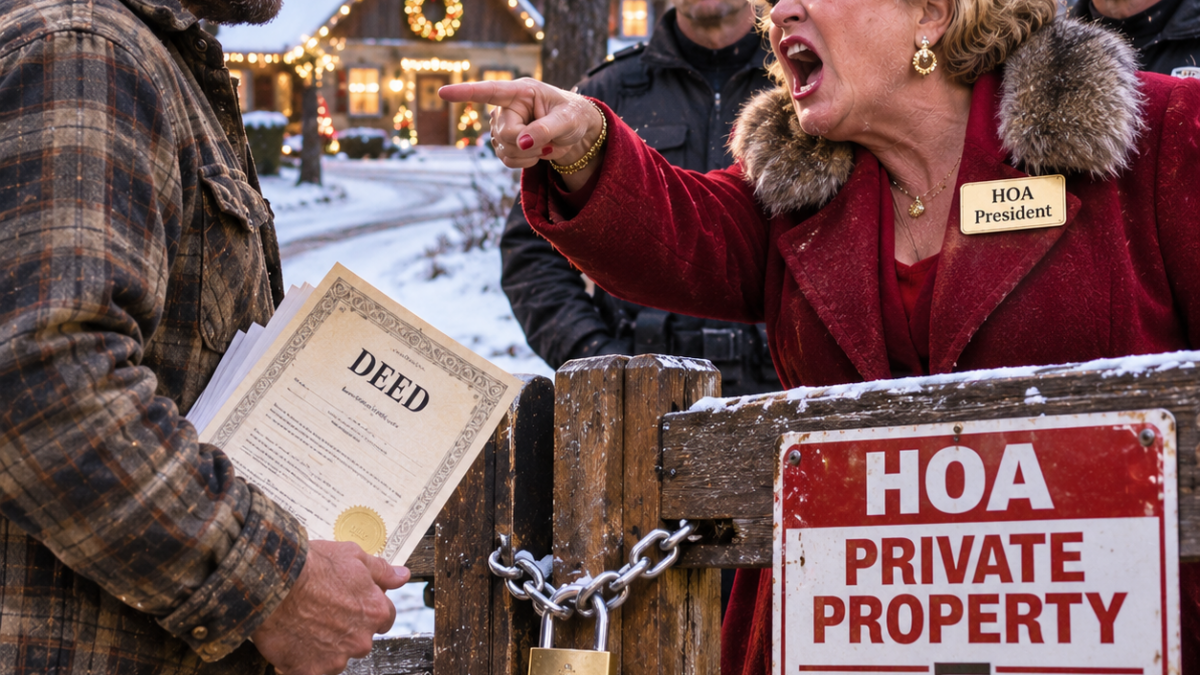
And now Deputy Dana Whitaker stood beside her patrol car under falling snow while Vivienne Cross accused me of trespassing on my own road.
Vivienne reached the deputy first.
“That’s him.”
Deputy Whitaker looked through the gate at me.
I stayed silent.
Vivienne continued.
“He refuses to comply with Alder Creek regulations. He is not in good standing. He is currently attempting unauthorized use of association property.”
Whitaker turned toward me.
“Sir?”
I took a manila folder from inside my coat.
“My deed. Recorded survey. Easement. Plat.”
Vivienne gave a short laugh.
“He always carries paperwork.”
Whitaker looked at her.
“That’s not illegal.”
She took my folder.
Then asked Vivienne for her documents.
Vivienne went to her SUV and returned carrying a thick binder.
Tabs.
Bylaws.
Rules.
HOA member list.
Fine schedule.
Maps.
She handed it over like she had just placed a royal flush on the table.
Whitaker set both collections on her hood.
She read.
Snow collected around us.
Vivienne lasted maybe four minutes.
“Officer, this man lives inside our subdivision.”
Whitaker didn’t look up.
“Ma’am, let me finish.”
“Our association has controlled access for years.”
“Please.”
“He doesn’t pay dues.”
Whitaker finally raised her eyes.
“That still doesn’t answer who owns the road.”
Silence.
She looked at me.
I turned to the survey page.
Pointed toward the narrow strip.
Whitaker followed it with her flashlight.
County boundary.
Survey monument.
Private access.
Recorded easement.
Then she compared it to the HOA map.
Her expression changed.
“Mrs. Cross.”
“Yes?”
“Do you have a recorded document showing the HOA owns this section?”
Vivienne’s answer came quickly.
“That survey is old.”
I looked at her.
“Do you have a newer recorded one?”
She looked down.
No answer.
Whitaker waited.
Vivienne eventually said:
“The association has historically exercised authority over the corridor.”
“That’s not what I asked.”
Vivienne’s jaw tightened.
Whitaker closed the folders.
“I’m not a judge. I’m not adjudicating a title dispute on Christmas morning.”
Vivienne nodded as though that supported her.
Then Whitaker continued.
“But the recorded material presented to me appears to identify Mr. Mercer’s access as private. I see no basis tonight for treating him as a trespasser on that access.”
Vivienne stiffened.
“The association disagrees.”
“You can pursue that disagreement through counsel.”
Whitaker pointed toward the gate.
“Until then, do not interfere with his entry.”
Vivienne said nothing.
“Where is the key?”
Silence.
“Mrs. Cross?”
Vivienne reached into her coat.
Pulled out a brass key.
She dropped it into Whitaker’s hand rather than mine.
Whitaker unlocked the gate.
Removed Vivienne’s padlock.
Then peeled off the laminated HOA PRIVATE PROPERTY sign.
She handed me both.
“Keep these.”
“Evidence?”
She almost smiled.
“Could be.”
Vivienne turned toward her SUV.
At the driver’s door she looked back.
“This isn’t over.”
I nodded.
“I know.”
The road became quiet after she left.
I retrieved Walter’s cut lock from the snow.
Put it in my pocket.
Walked uphill.
Christmas morning had technically begun.
I should have felt victorious.
I didn’t.
Because I had seen Vivienne’s face when Deputy Whitaker read the survey.
She hadn’t looked defeated.
She had looked like someone revising a plan.
On December 26, certified mail arrived.
The Alder Creek HOA was suing me.
Back dues.
Attorney fees.
Damages.
Unauthorized use of community infrastructure.
Marlo read the complaint.
Then laughed once.
“They’re suing you for driving on your own road.”
“That seems to be the theme.”
She flipped pages.
“Good.”
I stared at her.
“Good?”
“They committed their position to writing.”
That was Marlo.
Never angry when she could be productive.
She filed our response.
Then requested records.
Association articles.
Covenants.
Amendments.
Boundary descriptions.
Road agreements.
Minutes.
Internal maps.
Authority for access regulation.
Four days later, she called.
“I found something.”
The HOA had created an amended neighborhood map three years earlier.
Not a county plat.
Not a recorded subdivision change.
An internal map.
Approved by board vote.
Someone had taken the original Alder Creek boundary and redrawn it.
The new line curved around my road.
My house.
My three acres.
And a wooded strip behind me.
I stared at the copy.
“They just added the property?”
“With a marker, apparently.”
“Can they do that?”
“No.”
“So this entire lawsuit is based on an HOA map?”
“Partly.”
Marlo tapped the original recorded plat.
“A board vote cannot annex private property into an HOA.”
“Why would they draw the line there?”
Marlo looked at me.
“Good question.”
She demanded every record related to the change.
The association lawyer asked for extensions.
Thirty days.
Then sixty.
Then stopped returning calls.
Meanwhile, Vivienne worked the neighborhood.
At the New Year’s potluck, she told residents I was freeloading.
Using their roads.
Their lighting.
Their mailbox area.
Their neighborhood reputation.
Paying nothing.
She said I had called police on her Christmas Eve.
She did not mention cutting my lock.
By early January, people stopped waving.
At the mailbox kiosk, conversations ended when I approached.
Hank Pruitt, who had been friendly since I moved in, suddenly became fascinated by his gas pump when he saw me.
Somebody slipped an HOA dues schedule beneath my windshield wiper.
The total I supposedly owed was circled in red.
I threw it away.
Said nothing.
Silence frustrated Vivienne.
But silence gave me time.
At night, I searched public records.
Association tax filings.
Vendor disclosures.
Planning agendas.
Corporate registrations.
I didn’t know what I was looking for.
Then one number caught my attention.
More than $340,000 in two years.
Paid by a sixty-two-home HOA.
To one vendor.
Ridgeline Land Management.
The services were vague.
Property management.
Landscape consulting.
Infrastructure planning.
Alder Creek’s streets were plowed by the county.
Residents maintained their own lots.
Three hundred forty thousand dollars seemed like a lot of infrastructure planning for a neighborhood with no visible infrastructure project.
I searched the state business registry.
Ridgeline had been formed four years earlier.
Its official address was a rented mailbox.
Then I found the managing member.
Garrett Cross.
Vivienne’s brother.
I called Marlo at seven the next morning.
By nine, we had county planning records spread across her desk.
Family business wasn’t automatically wrongdoing.
Marlo emphasized that.
The issue was disclosure.
The board records showed no meaningful disclosure of the relationship.
Then she found a pending development request.
Ridgeline wanted to develop forty wooded acres behind Alder Creek.
Twelve luxury lots.
High-end ridge homes.
The parcel sat above my property.
To develop it, they needed a road.
The preliminary access plan contained a red line.
From Juniper Lane.
Up my gravel road.
Through my gate.
Across my property.
Into the ridge.
I stared.
“I’m the access.”
Marlo nodded.
I looked at the terrain map.
As an engineer, I understood immediately.
Creek to one side.
Steep grade to the other.
My road was the practical route.
Without access across my land, the ridge project became dramatically more difficult.
Maybe financially impossible.
“With the road,” I said, “those lots could be worth millions.”
“Yes.”
“Without it?”
Marlo shrugged.
“Maybe not enough.”
Then page nine returned to me.
The membership agreement.
Perpetual HOA authority over all access routes.
“If I had signed that…”
Marlo looked at me.
“You would have handed Alder Creek contractual control over your access.”
“And Alder Creek was paying Vivienne’s brother.”
“Yes.”
“So they could use my road for the ridge project.”
“They might have tried.”
“And when I refused…”
I stopped.
The wreath.
The lights.
The woodpile.
The fines.
The gate.
The lock.
The lawsuit.
Marlo finished the thought.
“She made staying unpleasant.”
I looked at the development map.
“It was never about $220 a month.”
“Probably not.”
“It was about getting me to sign or leave.”
Marlo leaned back.
“Possibly. But possibility is not proof.”
We needed intent.
Vivienne gave it to us herself.
Tuesday night.
9:40 p.m.
Motion alert.
Two vehicles stopped near my gate.
Vivienne’s SUV.
Black pickup with a Ridgeline logo.
A man got into her passenger seat.
The windows fogged.
They were eight feet from my gate camera.
I turned up the audio.
Engine noise.
Heater.
Wind.
Then fragments.
“Garrett…”
“…investors…”
“…spring…”
“…road…”
“…easement…”
I put on headphones.
A man’s voice:
“Garrett’s impatient. Investors want an answer by spring.”
Vivienne:
“Then we keep pushing.”
The man said something unclear.
Vivienne again:
“Fines. Lawsuit. Whatever it takes.”
Pause.
Then the sentence.
Soft.
Calm.
Almost amused.
“Once he leaves, the road is ours.”
I sat motionless.
Played it again.
And again.
And again.
Then copied it.
One copy into my safe.
One onto a drive.
Next morning, Marlo listened.
Twice.
Then removed the headphones.
“Caleb.”
“What?”
“We’re past an ordinary HOA dispute.”
Vivienne somehow discovered that we were investigating Ridgeline.
Her response was immediate.
Every outdoor item on my property received an order for removal.
Firewood.
Patio chairs.
Canoe.
Birdbath.
Then an “association compliance inspector” arrived.
He photographed my house.
Then a private security vehicle parked near the road.
Day and night.
Next came an accusation that the property appeared abandoned.
Vivienne suggested Alder Creek might petition the county to declare the parcel a nuisance.
That one made me angry.
I sat in my kitchen with the letter in my hands.
For months I had stayed calm.
But seeing the words abandoned property after being watched almost continuously made something hot move through me.
I wanted to walk downhill.
Knock on Vivienne’s door.
Ask whether she had finally lost her mind.
Instead, I scanned the notice.
Saved it.
Sent it to Marlo.
The security guard at the bottom of my road was a young man named Tyler.
Probably twenty-three.
He looked miserable.
One morning I brought him coffee.
He stared at the cup.
“Seriously?”
“You’ve been sitting here four hours.”
“I’m supposed to monitor the property.”
“I know.”
He accepted it.
“Thank you.”
“You’re welcome.”
“I don’t really know what this is about.”
“I assumed.”
He looked toward my gate.
“She says you’re trying to steal association land.”
I smiled.
“That’s one version.”
Tyler looked embarrassed.
“Man, I’m just working.”
“I know.”
Vivienne wanted enemies.
I refused to give her one.
Marlo, meanwhile, found something far more damaging than another violation.
The lawsuit included an exhibit titled:
ROAD MAINTENANCE AND ACCESS AGREEMENT
Walter Haynes’s name appeared on it.
A signature.
Notary seal.
Language supposedly granting Alder Creek authority over the road.
Marlo searched county records.
Nothing.
No recording number.
No filing date.
No deed book.
Then she checked the notary.
The commission had expired two years before the date on the document.
I called Walter in Arizona.
His daughter answered.
Then passed him the phone.
“Caleb?”
“Walter, I need to ask you about a document.”
I read the title.
Then the date.
Silence.
“Walter?”
Then he laughed.
Not happily.
“That woman.”
“What?”
“Pearl earrings?”
“Yes.”
“Nice coat?”
“Yes.”
“She came to my house three years ago.”
“What did she want?”
“The road.”
My grip tightened around the phone.
“She said it was only maintenance paperwork. Said the HOA needed formal authority to keep access safe.”
“Did you sign anything?”
“Hell no.”
I closed my eyes.
Walter continued.
“I told her to get off my porch.”
“Your signature is on the document.”
“It isn’t my signature.”
Within days, Walter signed a sworn statement.
Properly notarized.
Current commission.
He denied signing the road agreement.
Marlo called me after receiving it.
“Her lawsuit just developed a serious problem.”
“I want the neighbors to see everything.”
“You could wait for court.”
“They already think I’m trying to steal their road.”
“You want a public meeting.”
“Yes.”
Alder Creek’s annual meeting was coming.
The bylaws allowed a property owner directly affected by association enforcement to request time to address the issue.
Marlo filed the request.
The association secretary, Gloria Pike, approved it before Vivienne could stop her.
Meeting night arrived bitterly cold.
The clubhouse was packed.
Vivienne sat at the head table.
Camel coat draped behind her chair.
Pearls.
Leather folder.
Slides ready.
She looked completely in control.
Then I walked in with Marlo.
She carried the document box.
The room went quiet.
Vivienne smiled.
“Mr. Mercer. I wasn’t aware nonmembers were attending.”
Gloria cleared her throat.
“He’s on the agenda.”
Vivienne looked at her.
“What?”
“The bylaws permit affected owners to answer enforcement actions.”
Vivienne’s smile remained.
Her fingers tightened around her pen.
When my name was called, I walked to the front.
I did not make a speech.
I plugged in my laptop.
First video.
Christmas Eve.
11:47.
My gate.
My wreath.
Vivienne walking toward the cedar boards.
Bolt cutters.
Walter’s padlock.
Snap.
Sixty people watched her cut it.
Watched her throw it into the snow.
Watched her install the new lock.
Watched her tape the sign across my gate.
Nobody spoke.
Then the phone audio.
Vivienne’s voice:
“You’re not an HOA member, Mr. Mercer. So you have no right to use this road.”
A woman in the second row turned toward Vivienne.
Someone else whispered:
“She said he cut the lock.”
Another voice:
“She told us he threatened her.”
I clicked again.
Second video.
Two vehicles.
Vivienne’s SUV.
Ridgeline truck.
Rough audio.
Marlo had cleaned it enough to make the relevant section understandable.
“Garrett’s impatient.”
“Investors want an answer by spring.”
“Then we keep pushing.”
“Fines. Lawsuit. Whatever it takes.”
Then:
“Once he leaves, the road is ours.”
The room changed.
You could feel it.
People stopped looking at me.
They looked at Vivienne.
Her face went pale.
“That recording is illegal.”
Marlo stood.
“We can address admissibility in the appropriate venue. Tonight, residents can decide whether they recognize the conversation.”
Vivienne pointed toward us.
“You’re manipulating edited audio.”
Marlo didn’t argue.
She opened the document box.
One page at a time.
County deed.
Recorded subdivision plat.
Survey.
Private exclusive access easement.
The original boundary stopped before my property.
Then the internal HOA map.
The one that had quietly swallowed my three acres.
Marlo placed both maps side by side.
People leaned forward.
Ruth Delaney, a retired nurse and longtime board member, stood.
“When was that map changed?”
Vivienne answered quickly.
“The board approved updates three years ago.”
“Why?”
“Boundary clarification.”
Ruth looked at Marlo.
“Can a board clarify private land into the HOA?”
Marlo replied:
“Not through an internal map.”
Murmurs spread.
Next document.
The Road Maintenance and Access Agreement.
Walter’s supposed signature.
Expired notary commission.
Then Walter’s sworn statement denying the signature.
Someone said:
“Oh my God.”
Vivienne stood.
“That man is elderly.”
I felt my jaw tighten.
“You mean Walter?”
“He may not remember what he signed.”
I looked directly at her.
“He remembered you.”
Vivienne stopped.
I continued.
“Pearl earrings. Nice coat. Tried to get him to sign away control of the road.”
Her face changed.
For the first time, real fear.
Marlo continued.
Payment records.
$340,000 to Ridgeline Land Management.
State business filing.
Managing member:
Garrett Cross.
Ruth stood again.
“Vivienne.”
Vivienne looked at her.
“Why didn’t you tell us Ridgeline belongs to your brother?”
“He is one of several affiliated managers.”
“That isn’t what this says.”
“Ridgeline submitted the best proposals.”
“Were other bids obtained?”
Vivienne hesitated.
Another homeowner shouted:
“What infrastructure did we pay three hundred forty thousand dollars for?”
A man in the back:
“My dues went to her brother?”
Vivienne raised both hands.
“Everyone needs to calm down.”
Marlo placed the last document under the camera.
County planning application.
Forty-acre ridge development.
Twelve luxury lots.
Proposed access route highlighted red.
Straight through my road.
My property.
My gate.
Silence.
Ruth stared at the screen.
Then at Vivienne.
“Your brother’s development needs Caleb’s road.”
Vivienne shook her head.
“This is preliminary planning.”
“Does it need his road?”
“There are options.”
I spoke.
“As a structural engineer, I reviewed the terrain. The alternatives involve steep grades, drainage issues, and creek constraints.”
Vivienne glared.
“You are not the project engineer.”
“No.”
I looked at the screen.
“But I know what a contour line is.”
A few nervous laughs.
Vivienne struck the table.
“This entire presentation is designed to destroy me.”
I finally looked directly at her.
“No.”
The room quieted.
“You spent months telling these people I was trying to steal from them.”
She said nothing.
“You fined me for a wreath.”
Silence.
“Lights.”
Silence.
“Firewood.”
Silence.
“You tried to make me sign an agreement granting your HOA perpetual authority over my road.”
Vivienne’s breathing quickened.
“When I refused, you locked my gate.”
“That is not—”
“Then you called police and reported me as a trespasser.”
“That was based on—”
“You sued me for using my own road.”
“Because our attorney believed—”
“And your brother’s development plan uses the exact same road.”
People began talking again.
Vivienne raised her voice.
“EVERYTHING I DID WAS TO PROTECT ALDER CREEK!”
For the first time all evening, I felt angry enough that I had to deliberately slow my breathing.
Then I answered.
“No.”
She stared at me.
“You were protecting a deal.”
Nobody moved.
Vivienne looked smaller somehow.
Not physically.
But the certainty around her had cracked.
She tried again.
“The recording is out of context.”
No one answered.
“The map was intended to simplify planning.”
No one answered.
“My brother’s company performed legitimate work.”
Ruth asked:
“Then why didn’t you disclose the relationship?”
Vivienne looked around.
No answer.
Gloria Pike opened the bylaws.
Her hands shook.
“Any member in good standing may request an immediate vote regarding board conduct.”
Ruth raised her hand.
“I request a vote.”
Another hand rose.
Then another.
Vivienne’s voice sharpened.
“You cannot conduct a removal vote without proper notice.”
Marlo quietly said:
“Read your own emergency provisions.”
Gloria did.
The bylaws permitted temporary removal from officer duties pending review where allegations involved financial conflicts, unauthorized enforcement, or conduct creating significant legal exposure.
Ruth requested Vivienne’s immediate resignation.
The vote began.
Hands rose.
One row.
Then another.
Then another.
When it ended:
51 to 4.
Vivienne Cross was removed as HOA president effective immediately.
The membership ordered an independent financial audit.
Every violation against me was withdrawn.
The board directed its attorney to dismiss the lawsuit.
The membership formally recognized that my three acres and my road were outside Alder Creek.
Vivienne sat perfectly still.
Then she gathered her papers.
Aligned the edges.
Closed the leather folder.
Put on her coat.
Buttoned every button carefully.
She walked down the center aisle.
Nobody stopped her.
At the door, she paused beside me.
“You win today.”
I looked up.
“I wasn’t trying to beat you.”
Her eyes narrowed.
“Don’t pretend you didn’t enjoy this.”
“I didn’t.”
“You humiliated me in front of everyone.”
“I showed them what happened.”
“You could have handled this privately.”
“I tried.”
She looked away.
Then back.
“What did you want?”
“The same thing I told you the first day.”
“What?”
“To live on my land.”
She stared at me for several seconds.
Then opened the door.
Cold air swept inside.
Vivienne walked into the night.
The meeting ended slowly.
People lingered.
Some approached me.
Others avoided eye contact.
Hank Pruitt stood near the coffee urn.
He looked like he wanted to speak but couldn’t.
I packed my laptop.
Marlo lifted one side of the document box.
I took the other.
Outside, she looked at me.
“You all right?”
“Yes.”
“You don’t sound convinced.”
“I thought I’d feel better.”
“You protected your property.”
“I know.”
“She tried to take control of your road.”
“I know.”
“Then what’s bothering you?”
I looked toward the clubhouse.
“Sixty people lived under this for years.”
Marlo nodded.
“That happens.”
“Why?”
“Because challenging authority is expensive.”
“Even bad authority.”
“Especially bad authority. Good authority tolerates questions.”
Three weeks later, a plain white envelope arrived.
No embossed seal.
No cream paper.
No threatening title.
Inside was a letter signed by every remaining board member.
All claims withdrawn.
All fines canceled.
Lawsuit dismissed with prejudice.
The HOA acknowledged in writing that my parcel was not part of Alder Creek.
My road remained private.
I folded the letter.
Put it in the same folder as the first HOA notice.
Then I went outside to repair Walter’s gate.
Vivienne’s tape had left adhesive marks.
The latch was bent.
One hinge had cracked.
I removed the damaged hardware.
Straightened the latch.
Installed new hinge pins.
Sanded the cedar.
Rubbed clear oil into the wood.
The red grain came alive again.
I did not paint it beige.
Or taupe.
Or approved earth tone number three.
Not out of spite.
Because it was my gate.
When I finished, I went inside.
Retrieved the cedar wreath.
The oversized one.
Wrong ribbon.
I hung it on the gate.
Then stepped back.
No SUV.
No clipboard.
No security patrol.
No violation notice.
Just falling snow.
Hank came to see me the following weekend.
He stood on the porch holding his cap.
“I owe you an apology.”
“You don’t owe me anything.”
“I believed her.”
“A lot of people did.”
“I stopped waving.”
“I noticed.”
His face reddened.
“I thought you were trying to avoid paying dues while using our stuff.”
“I understand.”
“No. You don’t.”
He looked toward the road.
“I never checked.”
“That’s different from knowing something was false.”
“Still.”
He swallowed.
“I’m sorry.”
I shook his hand.
Ruth arrived the next day with banana bread.
She placed it in my hands.
“Peace offering.”
“You weren’t at war with me.”
“I sat on that board nine years.”
“You didn’t know about the road.”
“I should have asked.”
“Then ask next time.”
She smiled sadly.
“We all will.”
One by one, neighbors visited.
Some apologized.
Some simply introduced themselves properly for the first time.
I didn’t make them beg.
I didn’t need that.
They had been given a story.
Most believed it because the person telling it had a title and a binder.
Titles make people sound official.
Official doesn’t always mean right.
In late spring, Marlo called.
The independent audit was complete.
Ridgeline had received association contracts without adequate disclosure or competitive bidding.
The board referred the findings to the appropriate county authorities for review.
Ridgeline lost every HOA contract.
Its ridge-development application was withdrawn.
Vivienne was permanently barred from serving on the Alder Creek board under the association’s new governance rules.
And the county issued a formal clarification confirming the private access attached to the Cedar House.
“The road is yours,” Marlo said.
I smiled.
“Walter already told me.”
“Now the county told you too.”
“That cost considerably more.”
She laughed.
“Legal certainty rarely comes cheap.”
Summer passed.
Then autumn.
Then December.
One year after the padlock.
Alder Creek looked different.
The new board abolished the ridiculous holiday-lighting restrictions.
Red lights.
Blue.
Green.
Warm white.
Cool white.
Blinking reindeer.
Animated snowflakes.
One house had a ten-foot inflatable Santa that looked drunk every time the wind blew.
Nobody received a fine.
The clubhouse had a handmade wreath on the door.
A card beneath it read:
WELCOME, NEIGHBORS.
That Christmas Eve, I walked down my gravel road.
The cedar gate stood beneath a string of warm white lights.
My forbidden lights.
The wreath hung at the center.
I installed a new brass padlock.
Heavy.
Simple.
Mine.
I closed the gate.
Slid the shackle through.
Turned the key.
Click.
The sound traveled through the snow.
For one second, I was back at 11:47 the year before.
Vivienne.
Bolt cutters.
HOA sign.
“You have no right to use this road.”
I rested my gloved hand on the cedar.
Then I understood something.
I wasn’t locking the gate to keep Alder Creek out.
Anyone who needed me could call.
Neighbors were welcome.
Ruth had coffee with me sometimes.
Hank helped clear fallen branches after storms.
The gate wasn’t about exclusion.
It was about choice.
My choice.
That was what Vivienne had tried to take.
Not wood.
Not gravel.
Not even a road.
Choice.
The right to decide what happened on land I owned.
People talk about property disputes as though they are always about money.
Sometimes they are.
The ridge development certainly involved money.
But what kept me awake during those weeks wasn’t the potential value of my three acres.
It was the idea that someone could create enough paperwork, enough pressure, enough fear, and enough repetition that eventually a lie might start behaving like the truth.
Vivienne called my private road HOA infrastructure often enough that neighbors believed it.
She redrew a map.
Sent fines.
Produced an agreement.
Called police.
Filed a lawsuit.
If I had panicked, maybe I would have signed page nine.
If I had become exhausted, maybe I would have sold.
If Walter had sold to somebody who didn’t read deeds, maybe Ridgeline would eventually have treated the road like theirs.
That was the frightening part.
Not how powerful Vivienne was.
How close she came to succeeding simply because most people didn’t look.
I looked.
That was all.
I asked for documents.
I read them.
I saved notices.
I installed cameras.
I let her talk.
Vivienne built most of the case herself.
Months after everything ended, I found Walter’s cut lock in a drawer.
I turned it over in my hand.
Steel body.
Broken shackle.
Small scratches from years of use.
I called him.
“How’s Arizona?”
“Too hot.”
“You moved there.”
“Big mistake.”
I laughed.
“I fixed your gate.”
“My gate?”
“My gate now.”
“Good answer.”
I told him the HOA situation was over.
He was quiet.
Then:
“Told you the road was yours.”
“You could have explained more.”
“You’re an engineer. I figured you’d eventually read something.”
“That was your strategy?”
“Worked, didn’t it?”
I laughed.
Then Walter became serious.
“Caleb.”
“Yeah?”
“Don’t hate those people.”
“I don’t.”
“Even that woman.”
I paused.
“That’s harder.”
“Doesn’t mean you trust her.”
“I know.”
“Just don’t let somebody else’s bad behavior rent space in your head for free.”
That sounded like Walter.
Blunt.
Practical.
Annoyingly correct.
I never saw Vivienne often after that.
She still owned her house in Alder Creek for a while.
When we crossed paths, she usually looked away.
Once, months after the audit, I saw her at the grocery store.
We reached the same checkout line.
She stood behind me.
No pearls.
No camel coat.
No HOA binder.
Just a woman holding groceries.
I considered saying nothing.
Then I stepped aside.
“You can go ahead.”
She looked startled.
“I’m not asking for a favor.”
“You have three things. I have a cart.”
She hesitated.
Then moved forward.
While the cashier scanned her groceries, she looked at me.
“Why didn’t you sue me personally?”
The question surprised me.
“I considered my options with counsel.”
“That isn’t an answer.”
“I got what I needed.”
“You could have tried to ruin me.”
“Would that have given me more land?”
“No.”
“More road?”
“No.”
“Then why?”
She looked down.
“You really weren’t trying to destroy me.”
“No.”
She paid.
Picked up the bag.
Then turned.
“I did know the road wasn’t ours.”
There it was.
No attorney.
No meeting.
No microphone.
Just the truth beside a grocery checkout.
I said nothing.
Vivienne continued.
“Not at first.”
I waited.
“When Walter refused to sign, I knew there was a problem.”
“And you kept going.”
“Yes.”
“Why?”
Her jaw tightened.
“Garrett had investors.”
“That isn’t why.”
She looked at me.
I had seen that expression before.
The polished surface trying to remain intact.
She finally said:
“Because I had already told everyone the plan would work.”
I understood immediately.
Pride.
Not money alone.
Not her brother alone.
She had built an image of herself as the person who always knew what she was doing.
Admitting the road wasn’t hers meant admitting she had promised something she couldn’t deliver.
“So you tried to make reality match what you had already told people.”
She gave a bitter smile.
“You make it sound simple.”
“It was simple.”
“It didn’t feel simple.”
“Most bad decisions don’t.”
She looked toward the automatic doors.
“I am sorry about Christmas Eve.”
I studied her.
“For the lock?”
“For treating you like you didn’t belong on your own property.”
That was different.
I nodded.
“Thank you.”
“You forgive me?”
“I don’t know.”
She flinched.
I continued.
“But I’m not carrying it around every day.”
She nodded slowly.
“That’s probably more than I deserve.”
I disagreed with that.
People often say that when they really mean they’re afraid forgiveness will erase accountability.
It doesn’t.
I could accept an apology without rewriting history.
Vivienne left.
I never needed another conversation.
Alder Creek changed after her presidency.
The new board posted financial records.
Competitive bids became mandatory over certain amounts.
Conflicts of interest had to be disclosed.
Homeowners could attend more meetings.
Fine appeals were formalized.
Most importantly, people started asking questions.
Sometimes annoyingly many.
Ruth called me once laughing.
“You created monsters.”
“What happened?”
“Three homeowners want to see six bids for repainting the clubhouse.”
“Good.”
“We only need two.”
“Then explain why.”
She groaned.
“You really are an engineer.”
“Transparency is inconvenient.”
“So is democracy.”
“Exactly.”
The ridge behind my house remained woods.
Ridgeline’s development proposal died after access disappeared.
Garrett Cross eventually sold his interest in the tract.
A conservation-minded buyer purchased part of it.
Another section remained undeveloped.
The pines stayed.
Deer still crossed behind my house.
Winter still bent the branches low.
I sometimes thought about what could have been there.
Twelve luxury homes.
Construction trucks.
Utility trenches.
A widened road through my property.
Traffic past my porch.
None of those things were inherently evil.
Development happens.
People need places to live.
The issue was never whether someone could build on the ridge.
The issue was whether my land could be quietly converted into somebody else’s access because a powerful person decided asking permission was inconvenient.
That line mattered.
One December evening, Hank stood beside me at the gate.
He looked at the brass padlock.
“You know, everybody thought you hated the neighborhood.”
“I noticed.”
“Now people think you saved it.”
“I didn’t.”
He laughed.
“You exposed three hundred forty thousand dollars going to the president’s brother.”
“The audit exposed it.”
“You recorded her.”
“She chose the parking spot.”
“You’re impossible.”
“So I’m told.”
Hank looked toward Juniper Lane.
Children were riding sleds.
Christmas lights glowed in every color.
“Place is better now.”
“I think so.”
“You know the weird thing?”
“What?”
“We still have rules.”
“Of course.”
“We still pay dues.”
“Probably necessary.”
“We still tell people when their fence is falling down.”
“That also seems reasonable.”
He shook his head.
“Vivienne always acted like without her controlling every tiny thing, everything would collapse.”
I looked at the neighborhood.
Nothing had collapsed.
If anything, it looked more alive.
“That’s the difference between structure and control.”
Hank raised an eyebrow.
“Engineer speech?”
“Probably.”
“Explain.”
“A good structure distributes load. A bad one concentrates everything in one place.”
He stared.
Then laughed.
“You waited a year to use that metaphor, didn’t you?”
“Maybe.”
The truth was, Vivienne had concentrated everything around herself.
Complaints.
Enforcement.
Vendor decisions.
Maps.
Access.
Authority.
She had convinced people that Alder Creek worked because she was in control.
Then one person refused to hand her a road.
The whole structure cracked.
Not because I was powerful.
Because it had been badly built.
I sometimes wonder what would have happened if I had reacted differently on Christmas Eve.
Suppose I had cut her lock.
Suppose I had shoved the gate open.
Suppose I had screamed at her.
Suppose I had threatened her.
Vivienne would have had photographs.
A police report.
Maybe video of an angry man damaging a lock.
The story would have changed.
Instead of discussing ownership, everyone would have discussed my behavior.
That was exactly the fight she wanted.
Marlo understood before I did.
“Stand still and let the camera watch.”
It was some of the best advice I ever received.
Years later, the cedar gate still stands.
I replace the oil every spring.
Tighten the hardware.
Clear snow around the posts.
Walter’s wreath eventually fell apart.
I made another.
Slightly larger.
Warm white lights still hang there every December.
Nobody measures them.
Nobody sends letters.
The old brass lock is gone.
I replaced it twice.
But Walter’s cut padlock remains in my desk.
Not because I enjoy remembering Vivienne.
Because it reminds me of something bigger.
Authority can look incredibly convincing when it arrives on embossed paper.
It can wear a camel coat.
Carry a leather folder.
Quote bylaws.
Use legal words.
Hire security.
Call police.
File lawsuits.
Draw maps.
And still be wrong.
The only thing separating confidence from truth is evidence.
On the second Christmas after the dispute, Ruth invited me to the Alder Creek holiday party.
I almost declined.
Then Hank showed up at my door.
“You’re coming.”
“That sounds less like an invitation.”
“It is.”
“I’m not a member.”
“That’s why we need you.”
“Why?”
“So you can eat food without paying dues.”
I laughed.
I went.
The clubhouse looked completely different from the night of the vote.
Colored lights.
Children running around.
Music.
Ruth stood near the coffee table.
Gloria had retired as secretary but still attended everything.
Someone had put an absurd blinking reindeer beside the entrance.
Hank pointed at it.
“Violation.”
“Absolutely.”
“We should fine somebody.”
“Four hundred dollars.”
“Minimum.”
Ruth overheard us.
“Both of you behave.”
For the first time, Alder Creek felt like a neighborhood instead of an organization.
Near the end of the evening, Ruth tapped a glass.
Everyone quieted.
She thanked volunteers.
Announced the budget.
Mentioned snow removal.
Then she looked toward me.
“And since Caleb is here, I want to say something.”
I immediately regretted attending.
Ruth continued.
“A year ago, many of us believed something because the person saying it sounded official.”
The room became quiet.
“We stopped asking questions.”
Several people looked down.
“We won’t do that again.”
She raised her glass.
“To good neighbors.”
People echoed it.
I didn’t say anything.
I didn’t need to.
When I walked home, snow had started.
I reached my gate.
Unlocked it.
Then stopped.
For one second, I saw that old laminated sign again.
HOA PRIVATE PROPERTY
I remembered Vivienne’s voice.
“You’re not an HOA member, so you have no right to use this road.”
She had believed exclusion made her powerful.
In the end, the opposite happened.
Her attempt to exclude one person forced an entire neighborhood to examine who actually held authority.
The answer was never me.
I owned my road.
That was all.
I didn’t own Alder Creek.
I didn’t control its board.
I didn’t decide how sixty-two families lived.
I didn’t want to.
That was the lesson Vivienne never understood until it was too late.
Owning your property does not mean owning your neighbor.
Leading an association does not mean owning its members.
Having rules does not mean having unlimited authority.
And being the loudest person in the room does not move a property line one inch.
Christmas Eve comes every year.
Sometimes I still walk to the gate around midnight.
Not because I expect anyone.
Not because I’m watching for Vivienne.
I simply like the quiet.
Snow on cedar.
Pines moving in the wind.
Warm lights behind me.
Juniper Lane glowing below.
On one of those nights, I reached the gate and noticed something hanging beside the latch.
A small envelope.
No return address.
Inside was an old photograph.
Walter Haynes standing beside the gate when it was new.
Younger.
Thicker hair.
One hand resting on the cedar.
On the back, someone had written:
Built 1989. Private road. Walter said nobody gets to tell him how to paint it.
I laughed out loud.
Later I discovered Ruth had found the photo in old association archives.
I framed it.
It hangs in my hallway now.
Walter beside his gate.
Me beside the same gate decades later.
Different owners.
Same road.
Same lesson.
People ask why I didn’t sell after all the trouble.
My answer is simple.
Because I liked the house.
I liked the pines.
I liked the silence.
And because leaving would have meant Vivienne’s strategy worked.
Not her development plan.
That failed anyway.
I mean something more personal.
She had tried to make staying painful enough that I would surrender a choice that belonged to me.
I refused.
That refusal did not require rage.
It required patience.
Documents.
Cameras.
An attorney who read everything.
And one old man in Arizona who remembered exactly what he had refused to sign.
So when people tell the story now, they usually make it sound more dramatic.
They say:
HOA Karen locked an engineer out of his own house on Christmas Eve and accidentally exposed a multimillion-dollar land scheme.
That is technically true.
But it misses the point.
The most important moment was not the meeting.
Not the vote.
Not the audit.
Not even the recording.
It was the moment Vivienne snapped her lock onto my gate and looked at me as if the matter were finished.
She believed power meant making the decision for someone else.
She believed I would either obey or leave.
I did neither.
I stood there.
Recorded the time.
Called my attorney.
And waited for the paperwork to catch up with the truth.
One year later, I locked that same gate myself.
Same metallic click.
Completely different meaning.
Vivienne had used a lock to tell me I had no choice.
I used mine to remind myself that I did.
That road was mine.
That house was mine.
That decision was mine.
And no amount of HOA letterhead could change it.








