PART2:“YOU DON’T OWN THIS RANCH ANYMORE!” HOA Karen Sold My Montana Land on Christmas Eve—She Never Knew What My Uncle Locked in the Safe
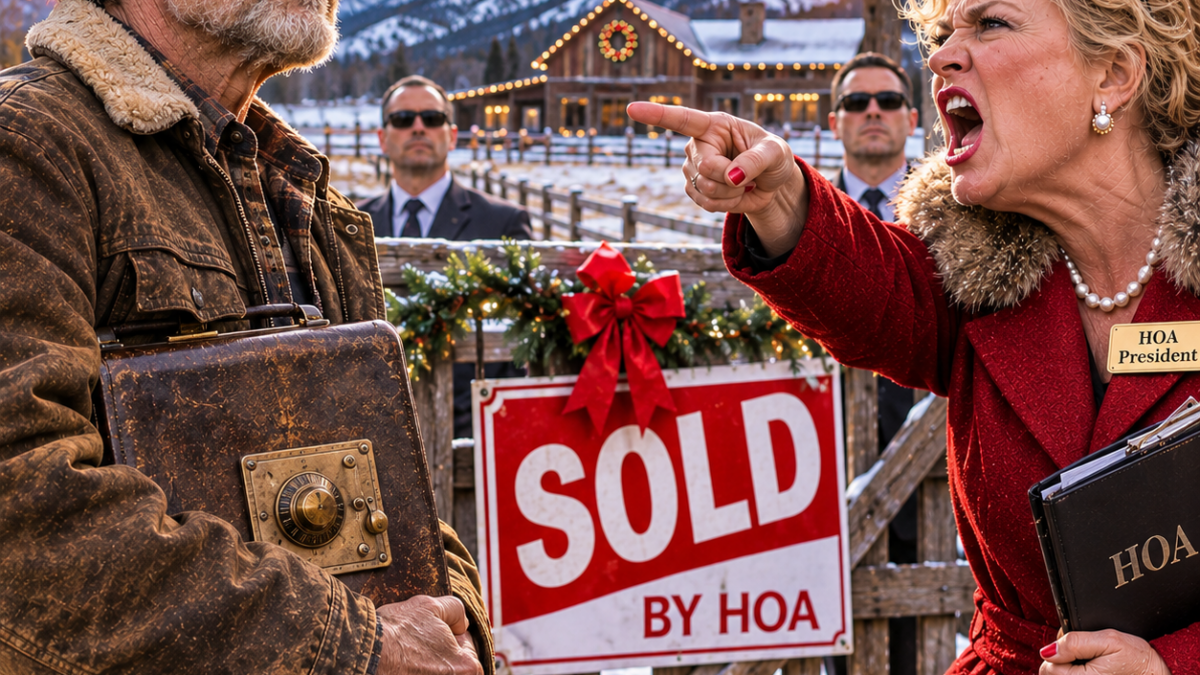
PART2
December twentieth.
Five days before Christmas.
Snow had been falling since noon when I drove home from the feed store with forty pounds of oats rattling around in the bed of my truck.
The sky over the Montana hills had turned the pale, flat gray that usually meant snow would keep coming after dark.
The cottonwoods along the creek were bare.
White gathered along the rails of my split-rail fence.
A few crooked strings of red and green Christmas lights hung from my porch because Walt had never taught me how to decorate properly and I had never cared enough to learn.
Mercer Ranch sat eleven miles outside Harland Creek.
Nothing about it belonged in a luxury real-estate brochure.
Log house.
Tin roof dulled by weather.
Red barn leaning slightly east after forty Montana winters.
Three-stall stable.
Two horses.
A dirt road that became mud every spring and hard ruts every winter.
Fence posts repaired so many times that half of them carried some memory of the man who taught me to set them.
To Karen, those things made the ranch ugly.
To me, they made it home.
I turned off the highway and felt what I always felt when my tires reached my own road.
My shoulders loosened.
Then my headlights caught something white beside the gate.
At first I thought somebody had posted another HOA notice.
Then I got closer.
The sign was too large.
Too professional.
Two steel legs driven into frozen ground.
Bold black letters across the top.
PROPERTY SOLD.
Underneath:
SUMMIT PEAK REALTY.
Phone number.
I stopped the truck.
For several seconds I did nothing.
Then I got out.
Snow came over the tops of my boots.
A man in a camel-colored overcoat stood near the gate with a clipboard.
His polished shoes were already soaked.
He looked like somebody who had learned Montana from a website.
“Evening,” he said.
I read the sign again.
He smiled professionally.
“Blake Ror. Summit Peak Realty.”
I looked at him.
He looked toward the ranch house.
“You the new tenant?”
I thought I had misheard him.
“The what?”
His smile weakened.
“Caretaker, maybe? I was told someone might remain on-site temporarily through the winter.”
“Who told you this property was for sale?”
That finally removed the smile.
He flipped through his clipboard.
“Well… everything appears to be in order.”
“Show me.”
He handed me several pages.
Listing agreement.
Purchase terms.
Seller authorization.
Closing date.
December twenty-fourth.
I read the legal description.
Correct.
Acreage.
Correct.
Parcel number.
Correct.
Boundary references.
Correct.
Then I reached the line marked SELLER.
Karen Whitlock.
I read it twice.
Blake shifted beside me.
“Problem?”
Before I answered, headlights swept across the snow.
Black SUV.
I knew who it was before the driver’s door opened.
Karen stepped out in a long red coat with a fur collar.
Her blonde hair somehow looked untouched by the weather.
She carried leather gloves in one hand.
She approached us with the calm expression of someone arriving at a ceremony arranged in her honor.
“Gideon.”
“Karen.”
She glanced at the SOLD sign.
Then at me.
“You should prepare yourself.”
“For what?”
“For reality.”
I raised Blake’s paperwork.
“This?”
Her smile widened.
“This ranch doesn’t belong to you anymore.”
Blake looked from her to me.
I handed the papers back to him.
Karen folded her gloved hands.
“You’ve been warned for months.”
“Warned about what?”
“Enforcement.”
“By whom?”
“Elk Ridge.”
“I’m not part of Elk Ridge.”
“You live inside the community.”
“No.”
Her jaw tightened.
“You live surrounded by it.”
“That doesn’t make my ranch part of your HOA.”
Karen breathed out through her nose.
She had been doing that around me for six years.
It was the sound she made whenever reality refused to cooperate.
“Gideon, we have been through this repeatedly.”
“Yes.”
“And you were wrong repeatedly.”
Her eyes sharpened.
“I am trying to spare you embarrassment.”
“You’re doing a poor job.”
Blake looked at the snow.
Smart man.
Karen pointed toward my barn.
“Look around you.”
I did.
“What?”
“That.”
“What about it?”
“Your barn.”
“Still standing.”
“Your fencing.”
“Still works.”
“Your unpaved drive.”
“Gets me home.”
“Livestock visible from premium residences.”
“They’re horses, Karen.”
“Your chicken coop.”
I almost laughed.
“You came here in a snowstorm to discuss chickens?”
“This is exactly why nobody can reason with you.”
“No.”
I nodded toward the sign.
“This is why.”
Her expression changed.
Only for a second.
But I saw it.
Money.
Something bigger than HOA irritation sat behind the entire performance.
Karen stepped closer.
“This valley has changed.”
“I noticed.”
“Property values have tripled.”
“Good for your homeowners.”
“Families are paying over a million dollars for homes here.”
“Good for them.”
“And right in the middle of one of the most desirable private communities in Montana sits an old agricultural property that looks like it stopped developing thirty years ago.”
I stared at her.
“My uncle bought this ranch thirty-nine years ago.”
“Yes.”
“You say that as though age makes it sacred.”
“To me, it does.”
“To the market, it makes it underutilized.”
There it was.
Not ugly.
Not noncompliant.
Underutilized.
That was the language of people who looked at land and saw nothing except what they could build after removing whoever already lived there.
Karen continued.
“A development group has taken serious interest.”
“What development group?”
“You don’t need to concern yourself with that.”
“I’m standing beside a sign saying you sold my ranch.”
Her smile returned.
“You’ll be compensated.”
“For something I never agreed to sell?”
“Gideon, stop pretending you have leverage.”
She walked closer.
“The project will transform this valley.”
“Into what?”
“A luxury winter destination.”
I said nothing.
She began listing it as though she had memorized the investor presentation.
“Private cabins.”
“A grand lodge.”
“Fine dining.”
“An ice rink.”
“Sleigh routes.”
“A Christmas village.”
“Guests from all over the country.”
She lifted one hand toward my fields.
“This could become the jewel of the state.”
I looked at my house.
“Where do I go?”
“You’ll be compensated according to the transaction.”
“What transaction?”
“The sale.”
“I did not sell.”
Karen’s eyes hardened.
Then she stepped close enough that I could smell her perfume over the cold.
“No,” she said softly. “I’m simply finishing something you can no longer afford to stop.”
That sentence stayed with me.
Not because it scared me.
Because it told me how certain she was.
Karen walked back to her SUV.
Blake remained behind.
He looked at me differently now.
Less like a caretaker.
More like a man wondering whether his commission had just become evidence.
“I was told everything was authorized,” he said.
“I believe you.”
He swallowed.
“Do you want copies?”
“Yes.”
He handed them over.
Then left.
I stood beside the SOLD sign until both vehicles disappeared.
I wanted to tear it out.
I could almost feel the steel legs coming loose in my hands.
Instead, I left it exactly where it was.
I drove to the barn.
Fed the horses.
Broke ice from the trough.
Put away the oats.
Then I went inside.
Walt had taught me a simple rule.
When somebody says your fence is in the wrong place, don’t scream.
Get the survey.
My uncle Walt bought Mercer Ranch in 1987.
Back then there was no Elk Ridge.
No stone entrance monument.
No decorative landscaping.
No million-dollar second homes.
No HOA president driving around with a violation notebook on the passenger seat.
The valley was hayfields.
Gravel.
Cattle.
Creek water.
Walt took me in after my parents died.
I was young enough that grief was not something I understood.
It was simply the atmosphere around me.
People spoke softly.
Adults looked at me differently.
Everybody kept asking whether I was all right.
I wasn’t.
Walt never asked.
He gave me work.
At first I hated him for that.
Then I understood.
He was giving me things I could finish.
Feed this horse.
Carry those boards.
Hold this level.
Drive that post.
When the world feels destroyed, finishing small things matters.
The ranch became the first place where I stopped waiting for everything I loved to disappear.
Walt taught me how to judge weather from cloud edges.
How to know when hay had cured enough to bale.
How to repair wire without tearing your hands apart.
How to read a horse’s mood before climbing into the saddle.
How to fix before replacing.
And above all:
“Read anything with your name at the bottom.”
He told me that so many times I could still hear his voice.
At twelve, I thought he was talking about feed-store receipts.
He was teaching me about power.
When Walt died, he left Mercer Ranch to me.
Free and clear.
Recorded with the county.
Taxes current.
No mortgage.
And no HOA.
That was deliberate.
Elk Ridge did not form until 2009.
Twenty-two years after Walt bought the ranch.
When the subdivision was established, developers needed access through the narrow canyon.
Walt cooperated.
But he did not surrender his land.
His attorney made certain the records reflected that distinction.
Mercer Ranch remained independent.
Karen knew.
That matters.
She was not confused.
She had read the documents.
She simply believed she could eventually overpower them.
Before Karen became president, Elk Ridge HOA had been boring.
That was a compliment.
Two meetings each year.
Snow removal.
Shared landscaping.
Maybe some argument about lighting.
Then Karen Whitlock took over.
Forty-nine years old.
Real-estate license.
Political instincts.
A smile polished enough to make bullying sound administrative.
Within two years, Elk Ridge had committees watching other committees.
Approved paint colors.
Eleven shades.
All beige, gray, or some variation pretending not to be beige or gray.
Fence-height restrictions.
Mailbox standards.
Parking restrictions.
Contractor schedules.
Approved planting lists.
Holiday-display rules.
One retired couple received a fine because their grandson left a portable basketball hoop outside.
Another family got three warnings over a wind chime.
Karen called it preserving property values.
People at the Harland Creek diner had other names for it.
But Mercer Ranch drove her crazy because none of those rules reached me.
The first time she came to my porch, she carried a thick binder.
“Gideon.”
“Karen.”
“We’re regularizing the properties in the immediate area.”
“Congratulations.”
She smiled patiently.
“I’d like you to sign these.”
“What are they?”
“HOA membership documents.”
“No.”
She blinked.
“You haven’t read them.”
“Don’t need to.”
“It would benefit you.”
“No.”
“You use our roads.”
“One of your roads crosses my land.”
Her smile tightened.
“We all have to live together.”
“We’re already doing that.”
I closed the door.
A few months later, she returned carrying a petition and a new map.
Her map drew the Elk Ridge boundary in a wide circle that swallowed Mercer Ranch.
I studied it.
Then looked at her.
“No.”
“You’re being difficult.”
“I’m being accurate.”
That became the entire relationship.
Accuracy bothered Karen.
The letters began afterward.
Cream paper.
Elk Ridge seal.
Formal type.
First fine:
Fifty dollars.
Unpainted gate.
Second:
One hundred dollars.
Hay trailer visible from the road.
Third:
Two hundred fifty dollars.
UNAPPROVED AGRICULTURAL STRUCTURE.
My chicken coop.
I ignored them.
Then new rules appeared.
No livestock visible from common areas.
No unpaved driveways longer than one hundred feet.
No exterior utility lighting beyond a porch lamp.
No agricultural fencing inconsistent with “community aesthetics.”
It became almost impressive.
Every rule sounded as though Karen had stood at my property line and written down whatever irritated her.
At one packed HOA meeting the previous spring, she finally announced publicly:
“Every property in this area answers to the association.”
I had been standing near the back.
Hat in my hands.
The room went quiet.
I said:
“Not mine.”
Nothing else.
Karen’s face turned nearly as red as her coat.
But everybody knew I had documentation.
Or they should have.
That night, after finding the SOLD sign, I went into the back bedroom.
Beneath the bed sat Walt’s old steel lockbox.
Dented corner.
Scratched black paint.
Latch polished smooth from decades of hands.
I carried it into the kitchen.
Set it under the yellow light.
Opened it.
One by one, I laid out the papers.
Recorded deed.
County seal.
Boundary survey.
Thirty-nine years of property-tax records.
All paid.
Hand-drawn map in Walt’s pencil.
The signed exemption confirming Mercer Ranch stood outside Elk Ridge authority.
Letters from Walt’s attorney.
Then I opened the kitchen drawer where I had been tossing HOA mail.
Nineteen envelopes.
I arranged them by date.
August.
September.
October.
November.
December.
The accusations grew more aggressive every month.
Covenant violations.
Commercial activity because I sold hay to a neighbor.
Failure to maintain fencing.
Visual nuisance.
Administrative penalties.
Then retroactive HOA dues supposedly calculated all the way back to 2009.
Total claimed debt:
More than forty thousand dollars.
Every letter depended on the same lie.
That Mercer Ranch belonged to Elk Ridge.
It never had.
Then I noticed something.
Several notices had been mailed to an old post-office box I had closed years before.
Karen knew my physical address.
She had been to my porch.
If she wanted me to receive legal notice, why use an obsolete mailbox?
Because perhaps she didn’t want me to receive it.
Perhaps she wanted a record showing she had mailed it.
A paper trail.
I checked the clock.
After nine.
Then called a number I had not dialed in nearly three years.
Marlo Pierce.
Marlo was fifty-six.
Attorney.
Office above the hardware store.
Old friend of Walt’s.
He handled Walt’s estate and the transfer of Mercer Ranch into my name.
If anybody understood those old documents, it was him.
He answered after several rings.
“Gideon?”
“Sorry about the hour.”
“What happened?”
I told him everything.
The sign.
Blake.
Karen.
Seller authorization.
Closing date.
Nineteen letters.
He listened without interrupting.
When I finished, the line stayed quiet.
“How long has the sign been there?”
“Don’t know.”
“Did you touch it?”
“No.”
“Good.”
“Why?”
“Because if they’re actually trying to transfer ownership, this is no longer a dispute with a homeowners association.”
I looked through the window.
The sign stood faintly visible near the gate.
“What is it?”
“Potential fraud.”
The word settled differently than every HOA threat before it.
“What should I do?”
“Nothing.”
I frowned.
“Nothing?”
“Don’t call Karen.”
“Don’t call the broker.”
“Don’t remove the sign.”
“Why?”
Marlo let out a breath.
“People who believe they’ve already won become careless.”
Pause.
“Let them keep being careless.”
I looked at Walt’s deed.
“All right.”
That was the beginning.
Not revenge.
Documentation.
At seven the next morning, I sat inside Marlo’s office.
Cracked leather chair.
Old radiator knocking against the wall.
Coffee strong enough to remove paint.
He searched county records.
Parcel filings.
Recorded instruments.
Recent changes.
Then his hand stopped.
He leaned closer to the monitor.
Scrolled back.
Read something twice.
Removed his glasses.
“Gideon.”
His voice made my stomach tighten.
“What?”
“Three weeks ago, somebody recorded a durable power of attorney against Mercer Ranch.”
I stared at him.
“What power of attorney?”
He turned the monitor.
My name appeared at the top.
Karen Whitlock’s name beneath it.
The document supposedly granted her full authority to act for me regarding the sale, transfer, conveyance, and disposition of Mercer Ranch.
Notary stamp.
County nearly two hundred miles away.
Then the signature.
My name.
Almost.
Whoever did it had copied the shape.
But the capital G curled wrong.
Walt taught me how to sign my name when I was a teenager.
I had formed that G the same way for decades.
“That isn’t my signature.”
“I know.”
“How?”
Marlo looked at me.
“Because I would remember if you gave Karen Whitlock the authority to sell your ranch.”
Fair.
He tapped the screen.
“They’ve created something smarter than a fake deed.”
“What do you mean?”
“They’re not saying the HOA owns your land.”
He leaned back.
“They’re making it appear you voluntarily appointed Karen as your legal agent.”
“So Blake sees this…”
“And believes she can sign for you.”
“The buyer?”
“Same.”
I looked again at the signature.
For the first time, real anger arrived.
Cold.
Not explosive.
Not useful to anybody except me.
Marlo watched me.
“Don’t do something stupid.”
“I won’t.”
“Good.”
I stood.
“I want to know who is buying.”
Northstar Development Group.
Denver.
Major resort projects across the Rockies.
They already had promotional material for the Montana development.
NORTHSTAR CHRISTMAS ESTATE.
Two hundred luxury cabins.
Grand lodge.
Private holiday village.
Ice rink.
Sleigh routes.
High-end restaurants.
Estimated final project value:
More than $180 million.
Then I saw the rendering.
My valley.
My ridge.
The bend in the creek.
The cottonwoods where Walt taught me to fish.
But my ranch was gone.
Barn gone.
Stable gone.
House gone.
Where my porch stood, architects had drawn a timber lodge glowing gold through enormous windows.
Someone in Denver had erased my home before anybody told me I was selling it.
I stared at that rendering longer than I want to admit.
That image hurt more than Karen’s fines.
More than the SOLD sign.
The sign was a threat.
The rendering was a future where I had already been removed.
Marlo discovered that Karen had scheduled a private Northstar presentation at the Elk Ridge clubhouse on December twenty-second.
I parked a quarter mile away.
Walked through snow.
The clubhouse glowed against the hillside.
Twelve-foot Christmas tree behind the front windows.
Champagne.
Music.
People in expensive winter clothes.
I stood beneath a spruce near the back patio.
A sliding door had been left open a few inches to release heat.
Karen’s voice carried perfectly.
“The landowner has agreed to sell.”
I closed my eyes.
“Everything is in order.”
Another voice answered.
Male.
Controlled.
Preston Hail.
Northstar’s vice president of acquisitions.
“And Mr. Mercer has signed?”
Karen did not hesitate.
“I hold full authority to represent him.”
No uncertainty.
No qualification.
No misunderstanding.
She knew exactly what she was doing.
I stayed just long enough to hear that.
Then turned around.
Walked back to my truck.
Sat inside with the engine running and heater roaring.
Called Marlo.
“I need everything ready.”
“For the lawsuit?”
I looked back toward the clubhouse lights.
“No.”
Silence.
“Then what?”
“For the closing.”
Another silence.
Then Marlo understood.
“I’ll start tonight.”
Christmas Eve was not an accidental closing date.
Karen had chosen it carefully.
County offices closing early.
Lawyers leaving town.
Judges difficult to reach.
Banks operating limited hours.
If the transaction completed and money moved, unwinding everything would become slower and harder.
Maybe months.
Maybe longer.
Karen believed I was isolated.
She wasn’t entirely wrong.
No wife.
No children.
No big family sitting around my Christmas table.
Walt gone.
The ranch was what remained.
But Karen had confused absence of family with absence of help.
Marlo had been Walt’s friend before he was my attorney.
And the more Karen underestimated that old man above the hardware store, the better our chances became.
The following morning, a courier arrived.
Large Elk Ridge envelope.
Inside:
FINAL NOTICE OF ENFORCEMENT.
Forty-eight hours to vacate.
Failure supposedly meant court action.
Suspension of access rights.
Claims of interference with a property transaction.
Enforcement of every covenant Karen had invented.
I stood on my porch and read it twice.
Then called Marlo.
“She sent me forty-eight hours to vacate.”
He laughed once.
“She really thinks she’s won.”
“Apparently.”
“People in town say she’s already looking at condos in Scottsdale.”
I looked at the notice.
“Good.”
“Good?”
“Confidence makes people careless.”
Marlo chuckled.
“I’ve taught you too much.”
That night Karen hosted the Elk Ridge Christmas party.
I did not attend.
Frank Delaney told me later what happened.
The clubhouse was packed.
Stone fireplace.
Christmas tree.
Candles.
Karen stood beneath the tree wearing her red coat like a cape and tapped a spoon against her wineglass.
“Friends, I have an early Christmas present.”
People quieted.
“Tomorrow, the last uncontrolled piece of land in this valley finally belongs to us.”
Some applauded.
Others exchanged glances.
Frank, a retired teacher who had lived there fifteen years, raised his hand.
“Karen, does Gideon actually know about this?”
Her smile did not move.
“Of course.”
“I know that man.”
Frank frowned.
“I can’t imagine him selling.”
Ruth Ellison spoke beside him.
“That ranch was never part of the association.”
Karen’s smile tightened.
“Gideon is a reasonable man.”
Then she said:
“And a reasonable man knows when he’s beaten.”
Eleven miles away, I was walking my north fence beneath a hard clear sky.
Stars.
Snow.
Cold air sharp enough to hurt my lungs.
I touched posts Walt and I had set when I was fifteen.
The crooked one he insisted was straight.
The section rebuilt after an elk broke through.
The field where we baled hay until my shoulders felt ruined.
Northstar’s rendering said the land was worth millions as a resort.
That wasn’t its value to me.
Its value was that after my parents died, this was where Walt taught me how to become somebody who could stand on his own.
I looked toward the house.
Small windows.
Crooked lights.
No crowd inside.
No children.
No huge Christmas dinner.
Just home.
“They don’t want land,” I said into the cold.
My breath rose like smoke.
“They want to erase me from the only place I’ve ever belonged.”
Then I walked back inside.
The safe in my bedroom closet was bolted to the floor.
Walt made me memorize the combination at twelve.
I opened it.
Original deed sat on top.
Then something underneath caught my attention.
A long yellowed envelope.
Brittle tape.
Walt’s handwriting.
ORIGINAL SURVEY — 1987.
I called Marlo.
He arrived within an hour.
We opened that envelope at my kitchen table almost like two men opening a letter from the dead.
Heavy linen paper.
Licensed surveyor stamp.
Hand-drawn bearings.
Distances.
Boundary lines.
Marlo placed coffee mugs on the corners.
Studied it almost twenty minutes.
Then his face changed.
“Gideon.”
“What?”
He traced a red line.
“This is your eastern boundary.”
Then another dotted line.
“And this is where Elk Ridge’s original plat begins.”
I leaned closer.
There was a gap.
Clear.
Undeniable.
“Your ranch is entirely outside the HOA.”
“I know.”
“No.”
He looked at me.
“I mean entirely.”
“Not a corner.”
“Not a disputed strip.”
“Nothing.”
He tapped the survey.
“This survey destroys every jurisdictional claim Karen has made for six years.”
But Marlo wasn’t finished.
He pulled the Northstar planning map from his folder.
Placed it over Walt’s survey.
Matched the creek.
The ridge.
Then pointed toward the road.
Elk Ridge had only one practical access route through the narrow canyon.
Every homeowner used it.
Northstar planned to widen it to four lanes.
That road crossed Mercer Ranch for almost half a mile.
Walt had granted the easement in 2009.
But there were conditions.
Marlo found the original letter.
Read aloud.
“Residential access only.”
Then:
“No commercial expansion without written consent of the landowner.”
He continued.
Then stopped.
“What?”
He read the final clause.
“If the association asserts ownership or control over Mercer Ranch, the owner may revoke the easement upon written notice.”
We looked at each other.
Marlo leaned back.
“Without that road, Northstar cannot get the county access approvals their development plan depends on.”
“No road.”
“No permits.”
“No permits…”
“No resort.”
I sat very still.
Then understood.
Karen was not simply trying to sell my ranch.
She was selling the road.
That was why Northstar’s project needed Mercer Ranch so desperately.
That was why a few hundred acres of old agricultural ground suddenly mattered to a $180 million resort.
My property controlled access.
My signature would never authorize commercial widening.
So Karen needed a way to manufacture one.
Then Marlo found one final document.
A consulting agreement.
Northstar Development Group.
Red Pine Advisory LLC.
Registered to Karen Whitlock.
Purpose:
ACCESS FACILITATION SERVICES.
The fee was enormous.
On top of whatever real-estate commission she expected.
I stared at it.
“So this was never about property values.”
“No.”
“Never the barn.”
“No.”
“The chicken coop.”
“No.”
“The paint colors.”
Marlo almost smiled.
“Definitely not the paint colors.”
I looked at both maps.
“She couldn’t control this land.”
Marlo nodded.
“So she decided to cash in on it.”
He stacked everything in front of us.
Survey.
Easement.
HOA declaration.
Deed.
Forged power of attorney.
Consulting agreement.
County records.
Then he placed one hand on the file.
“Gideon.”
“What?”
“If you walk into that closing with this…”
I waited.
“…you can bring the entire deal down in front of every person involved.”
Snow tapped lightly against my kitchen window.
I shook my head.
“No.”
Marlo frowned.
“No?”
“I don’t want to bring anything down.”
“What do you call what we’re doing?”
“I want the truth on the record.”
For several seconds he stared at me.
Then smiled.
“That may actually be worse for Karen.”
Christmas Eve.
Heavy gray sky.
Snow falling again.
Marlo and I spent most of the morning at the county recorder’s office while a skeleton holiday staff produced certified copies.
My original deed recording.
The recent power of attorney.
HOA founding filings.
Easement.
Deputy recorder statement.
Marlo had already sent a formal demand to Harland Creek Title asking them to re-examine chain of title before issuing any policy.
By three o’clock, everything was ready.
Marlo closed the accordion folder.
Then handed me the leather briefcase.
“Go home.”
I looked at him.
“Why?”
“Let her see you.”
I understood.
Karen needed to believe she had won right up until the moment she learned otherwise.
At my gate, the black SUV was waiting.
Karen had added a red rider to the SOLD sign.
CLOSING TODAY.
She stood beside it.
Same red coat.
Same confident smile.
“You’re late.”
I stepped from my truck.
She gestured toward the sign.
“The ranch has been sold.”
I said nothing.
“Are you finally understanding?”
Nothing.
“You could have made this easier.”
I looked toward my house.
Karen folded her arms.
“You’re not going to say anything?”
I looked at her once.
Then climbed back into the truck.
Karen laughed.
I heard it through the closed door.
She watched me turn around and drive away.
She believed I was abandoning my ranch.
She never asked where I was going.
Harland Creek Title & Escrow occupied a brick building downtown.
Four o’clock closing.
Walnut-paneled conference room.
Leather chairs.
Brass chandelier.
Pine garland in the windows.
Snow drifting across an almost empty street.
Preston Hail sat with a fountain pen ready.
Laura Brandt beside him.
Two junior attorneys with laptops.
Blake Ror straightening his tie.
Dana Kesler at the center.
Gray hair.
Reading glasses.
More than four thousand closings in thirty years.
At 4:05, Karen arrived.
Snow on her red coat.
She stood at the head of the table.
Smiled.
“Well.”
Everyone looked up.
“Today we finish this.”
Then:
“Merry Christmas.”
Laura Brandt did not smile.
“Before we begin, where is Mr. Mercer?”
Karen waved one hand.
“He isn’t coming.”
“Given the power of attorney, I would still prefer the landowner be reachable.”
“I saw him less than an hour ago.”
“What did he say?”
Karen smiled.
“Nothing.”
“He looked at the sign, got back in his truck, and left.”
She sat down.
“The man is done.”
Signing began.
Preston signed.
Karen signed the deed of conveyance as my supposed attorney-in-fact.
Pages moved.
Pens scratched.
The junior attorneys exchanged documents.
Then the million-dollar wire authorization appeared.
Blake reached for a cookie.
Dana raised one hand.
“I’m sorry.”
Everyone stopped.
“I need you to pause.”
Karen’s pen hovered above the page.
“Is there a problem?”
Dana looked at her screen.
“This office received a formal request this morning to re-examine chain of title.”
Karen’s smile thinned.
“From whom?”
Dana lifted her eyes.
“An attorney representing Gideon Mercer.”
Color left Karen’s face.
That was when the conference-room door opened.
I walked in.
Canvas coat dusted with snow.
Hat wet around the brim.
Walt’s leather briefcase in my right hand.
Marlo behind me carrying the accordion file.
I did not greet Karen.
Did not stare.
Did not smile.
There was one empty chair at the far end.
The chair reserved for the landowner.
I sat.
Placed the briefcase on the table.
Two quiet clicks.
Opened it.
Then slid the original deed toward Dana.
No speech.
No accusation.
Paper.
She put on her reading glasses.
Checked the embossed seal.
Grantor signature.
Recording number.
Book and page.
Legal description.
Notary.
Then she checked the certified copies Marlo brought.
Nobody spoke.
Finally, Dana set down her glasses.
“Everything matches.”
Karen straightened.
Dana continued.
“This deed is authentic.”
“And it is the controlling recorded instrument.”
Karen recovered quickly.
“That’s very nice.”
Everybody looked at her.
“But nobody disputes that Mr. Mercer’s name was once on the deed.”
I turned toward her.
“Once?”
She met my eyes.
“You granted me full power of attorney.”
“Recorded.”
“Notarized.”
“Legal.”
I said quietly:
“No.”
The room went completely still.
“It isn’t.”
Marlo opened the accordion folder.
Then began dealing documents across the table like cards.
Original 1987 survey.
Elk Ridge founding declaration.
Clause excluding Mercer Ranch.
2009 easement.
Commercial restrictions.
Certified statement from the recorder.
Finally, my sworn affidavit.
Attached receipts.
Livestock-auction records.
Proof that on the date the supposed power of attorney had been signed before a notary two hundred miles away, I had been in Billings selling cattle.
In front of dozens of witnesses.
Laura Brandt pulled the affidavit toward her.
Read it twice.
Then the easement.
Then the power of attorney.
Her expression became very still.
Karen’s voice rose.
“I am the president of this homeowners association.”
I looked at her.
“The HOA president isn’t the owner of my land.”
Nobody moved.
Preston slowly turned his chair toward Karen.
“You told us Mr. Mercer had agreed to sell.”
She said nothing.
“You told us you had valid authority.”
Silence.
He pointed at the signature.
“Did you?”
Karen looked down.
At the wrong G.
Her mouth opened.
Nothing came out.
Dana removed her glasses.
Folded them.
Placed them on the deed.
Then spoke clearly enough that nobody could later claim confusion.
“Based on the documents presented, Harland Creek Title cannot insure this title.”
Karen jerked toward her.
“What?”
“There is a material dispute regarding seller authority and credible evidence the recorded power of attorney may be fraudulent.”
“No.”
Dana continued.
“This closing cannot proceed.”
She pulled the wire authorization from the stack.
Turned it face down.
That small movement changed everything.
A million dollars stopped moving.
Laura began collecting Northstar’s documents.
Preston capped his fountain pen.
But I wasn’t finished.
“I’m not asking only that the sale stop.”
Dana looked at me.
“I want the record to reflect formally that a potentially fraudulent instrument was filed against Mercer Ranch.”
Karen’s face went pale.
“And I want every transaction relying on that document investigated.”
“Not corrected quietly.”
“Not forgotten after Christmas.”
“Investigated.”
Laura Brandt looked at Preston.
Then Dana.
“My client joins that request.”
Karen stared at her.
Laura’s voice became colder.
“Northstar relied on the document.”
“We want to know who created it.”
Karen broke.
She stood so quickly her chair struck the wall.
Her red coat slid from her shoulders.
“What do you want?”
Her voice cracked.
I stayed seated.
“Gideon.”
Her hands trembled.
“Money?”
I said nothing.
“Is that what this is?”
“Name a number.”
Nobody interrupted her.
“Tell me what you want.”
I looked at her.
“The truth.”
Her face twisted.
Not with shame.
With rage.
Because the room no longer obeyed her.
Preston stood.
Went into the hallway.
Made a call.
Returned minutes later.
“Northstar is withdrawing.”
Karen shook her head.
“No.”
“The purchase agreement is terminated.”
“No.”
“The Red Pine Advisory consulting agreement is terminated.”
That was the blow she could not hide.
Her eyes widened.
Preston continued.
“We will cooperate fully with the title investigation.”
Karen stepped toward him.
“Preston, listen—”
He moved away.
Laura handed Karen a letter.
“Further communication through counsel.”
By five o’clock, the $180 million resort project was collapsing.
By eight, the county had formally flagged the power of attorney.
Recorder Hollis Grady treated questionable instruments in his records as a personal insult.
The notary problem made matters worse.
The stamp appearing on the power of attorney belonged to a notary whose commission had been surrendered eight months earlier.
Christmas Eve phones started ringing across Elk Ridge.
By nine, Frank Delaney and Ruth Ellison had called an emergency board meeting.
Same clubhouse.
Same twelve-foot tree.
Same room where Karen had toasted her victory less than twenty-four hours earlier.
Only now nobody was holding champagne.
When I arrived, the Christmas lights were still glowing.
Candles half burned.
Karen sat behind the board table.
Pale.
People were already shouting questions.
Frank stood.
“Why did you tell us Mercer Ranch belonged to the association?”
A woman near the center called:
“Did you have any authority to sell it?”
Ruth asked:
“Were HOA funds used?”
Another homeowner:
“Are we legally exposed?”
Karen tried to answer.
Stopped.
Started again.
Stopped.
Then the clubhouse door opened.
Cold air came in with me.
The room quieted.
I walked to the front.
Removed my hat.
Opened Walt’s briefcase.
Laid out the documents.
Not every legal detail.
Enough.
I spoke the way Walt used to explain fence lines.
Plain.
“My uncle bought Mercer Ranch in 1987.”
“Elk Ridge formed in 2009.”
“The ranch sits entirely outside the HOA boundary.”
“The association has never had legal authority to impose dues, fines, covenants, or sale rights on my property.”
I pointed at the easement.
“The road most of you use crosses Mercer Ranch.”
People shifted in their seats.
“That road exists under recorded conditions.”
“Those conditions belong to the deed and easement.”
“Not Karen.”
“Not the board.”
“And nobody can sell my ranch without my valid consent.”
I looked across the room.
“That’s all.”
“The papers say what they say.”
Silence.
Then Wes Holloway, a contractor who lived near the back of the subdivision, stood slowly.
“So what happens now?”
He looked toward the easement.
Then at me.
“Are you going to sue all of us?”
Everybody understood the question behind the question.
Walt’s easement allowed revocation if Elk Ridge asserted ownership or control over Mercer Ranch.
I could have terrified them.
Could have made seventy families wonder whether they would still have a road after Christmas.
Could have let them experience the helplessness Karen had tried to force on me.
Instead:
“No.”
The room shifted.
“I don’t want anything from any of you.”
Karen looked up.
“I want this association to follow the law.”
That was it.
I had no interest in punishing homeowners whose worst mistake had been trusting the wrong president.
The problem was Karen.
Not everybody.
Before midnight, the board voted.
Karen Whitlock resigned as president.
Effective immediately.
Entered into the minutes.
Every fine ever issued against Mercer Ranch:
Rescinded.
Every assessment:
Rescinded.
Every notice:
Rescinded.
The board formally confirmed in writing that Mercer Ranch had never been part of Elk Ridge.
Karen gathered her coat.
At the door, she stopped beside me.
Her eyes were red.
I didn’t smile.
Didn’t mock her.
Didn’t call her a thief.
I said quietly:
“You thought power meant you got to own everything.”
She stared.
“But paper decides who owns land.”
“Not titles.”
“Not committees.”
“Paper.”
Karen walked into the snow without another word.
Christmas morning arrived clear and silent.
The storm had passed.
A foot of fresh snow covered the fields.
The sky looked painfully blue.
Smoke rose straight from my chimney.
I stepped onto the porch with coffee.
Down at the gate, the sign remained.
PROPERTY SOLD.
CLOSING TODAY.
I finished my coffee.
Got a crowbar and wrench.
Walked through the squeaking snow.
Removed the red rider.
Worked the steel legs out of the frozen ground.
Carried the sign behind the barn.
There was an old burn barrel.
I broke the board apart.
Dropped the pieces inside.
Struck a match.
PROPERTY SOLD curled black in the flames.
Then disappeared.
I did not do it angrily.
There was almost no anger left.
I did it because it was over.
Some lies should not remain standing after the truth has been recorded.
My phone rang.
Marlo.
Christmas morning.
I could hear children laughing somewhere behind him.
Fire.
Family noise.
“Merry Christmas.”
“Merry Christmas.”
“I thought you’d want to hear this.”
I waited.
“Northstar’s lawyer sent a letter overnight.”
“What does it say?”
“They’re out.”
“Of Mercer Ranch?”
“All of it.”
I looked across the valley.
“The entire project?”
“The entire project.”
“Why?”
“Without the access arrangement they expected, their development plan no longer works.”
Then:
“And after what happened with the title documents, they want nothing to do with Karen.”
I nodded.
“And Karen?”
Marlo went quiet.
“The county attorney opened a file last night.”
“For?”
“That’s all I’m saying on Christmas.”
Fair enough.
“The law will handle what the law handles.”
I thanked him.
Hung up.
Then stood in the snow for another minute.
Strangely, I did not care much what happened to Karen after that.
Not because what she did was small.
It wasn’t.
But her future belonged to investigators.
Attorneys.
Courts.
Not me.
All I had wanted was my ranch.
Quiet.
Horses.
Fences.
Seasons.
That had always been enough.
So I spent Christmas morning fixing my gate.
One hinge had groaned for three winters.
I replaced it.
Reset a post rotted at the base.
Then went into the barn.
The night before closing, after Marlo left, I had been unable to sleep.
So I carved something.
Heavy pine plank.
Sanded smooth.
Weather sealed.
Letters burned deep into the wood.
I carried it to the gate.
Hung it on two short chains.
Stepped back.
It did not say:
FOR SALE.
It did not say:
SOLD.
It said:
MERCER RANCH
EST. 1987
The board moved once in the wind.
Then settled.
My name.
My gate.
My land.
Some victories make people shout.
Mine made me quiet.
Because I had not won anything.
Not really.
I had simply prevented somebody from taking what had always been mine.
I walked back toward the house.
The fire in the stone hearth burned steady.
Coffee smelled better than it had all week.
Walt’s survey went safely back into the steel box.
The original deed into its sleeve.
No big Christmas dinner waited.
No crowd of relatives.
No presents beneath a giant tree.
For years, people occasionally looked at my life and assumed the quiet meant something was missing.
Karen probably thought the same.
One rancher.
No wife.
No children.
No political influence.
No fortune compared with a $180 million developer.
Easy target.
Alone.
Weak.
She was wrong.
Solitude is not helplessness.
Quiet is not surrender.
And a man who doesn’t shout can still keep records.
I carried my coffee to the front window.
Snow began falling again.
Light.
Slow.
It settled across the barn roof.
The fence rails.
The fields.
The new sign at the gate.
I watched for a long time.
Then, for the first time in days, I smiled.
“I didn’t buy back my ranch.”
Nobody was there to hear me.
Didn’t matter.
I looked toward Walt’s fields.
At the home Karen had tried to erase from a developer’s map.
Then I said:
“I just walked into that closing room and reminded them it was never theirs.”








