PART2:“YOU DON’T GET NINE VOTES—YOU GET NINE FORECLOSURES!” HOA Karen Thought My Husband’s LLC Was Trying to Seize Her Board—Then a Judge Found She Never Had the 19 Votes She Needed
PART2
Over the next year, small things started going wrong.
Nothing dramatic enough to make us panic.
That was part of the problem.
A tenant’s bicycle on a balcony.
Fine.
A grill on a patio.
Warning.
An overnight guest using visitor parking.
Fee.
Lease-registration forms suddenly requiring extra documentation.
New board approvals slowing repair work.
Two units sitting empty longer than normal because prospective renters got tired of waiting for association registration.
Our manager challenged some fines and paid others.
Her reports remained calm.
Assessment dispute.
Violation challenged.
Board review pending.
I called her once.
“Is something going on?”
“They’re on a compliance kick.”
“Karen?”
“The whole board.”
“Are they targeting rentals?”
“Every HOA gets like this eventually.”
“Should Frank go to a meeting?”
“No.”
She answered too quickly.
Then laughed.
“Honestly, the best thing you can do is let me handle them.”
Frank, sitting across from me, looked relieved.
She continued.
“I know the documents. I know their lawyer. You two pay me so you don’t have to spend retirement fighting over patio furniture.”
Reasonable.
Comforting.
Wrong.
Walt called again.
This time he was angry.
“Karen’s telling everybody an investment group is trying to take control.”
Frank said:
“What investment group?”
“You.”
Silence.
“What?”
“She says one company owns a quarter of the complex.”
Frank laughed.
“One company?”
“Yep.”
“It’s me.”
“I know.”
“Our manager doesn’t give a damn who’s president.”
“I know.”
“She doesn’t even live there.”
“I know.”
I said:
“Then Karen knows who owns the LLC.”
Walt hesitated.
“Maybe she doesn’t.”
That sounded ridiculous.
How could an HOA president spend so much time worrying about nine units without looking up who owned them?
The answer turned out to matter.
There was something else I had forgotten.
Early in 2021, our manager emailed Frank a proxy.
The board was considering a rental-registration fee and a proposed cap on new leases.
She believed both would hurt landlords.
Frank printed the proxy.
Signed it at the kitchen table while eating a sandwich.
Mustard landed on one corner.
I remember because I told him:
“You’re disgusting.”
He wiped at it.
Made it worse.
Then said:
“She’s protecting us.”
The proxy authorized our manager to vote the nine units.
Perfectly normal.
Perfectly legal.
We forgot about it.
Karen did not.
We just did not know that yet.
In summer 2022, the building needed real work.
That point matters.
Karen did not invent every problem.
Insurance premiums were rising.
The roof leaked.
An engineer had flagged two balconies.
Reserves were thin.
Anybody pretending the HOA needed no money would be lying.
But the existing bylaws limited how much the board could increase major assessments without owner approval.
The board proposed an amendment.
The amendment removed that cap.
Monthly dues jumped from around two hundred dollars per unit to more than seven hundred.
Nine units.
Do the math.
About forty-five hundred extra dollars every month.
I sat at our kitchen table staring at the notice.
“Frank.”
He came in from the garage.
“What?”
I held up the paper.
He read.
Then read again.
“They can’t be serious.”
“They are.”
“Seven hundred?”
“Per unit.”
“That’s sixty-three hundred a month.”
“Approximately.”
“We don’t clear that.”
“I know.”
“Not even close.”
“I know.”
He sat down.
For the first time in years, I saw genuine fear on his face about the condos.
Not annoyance.
Not contractor frustration.
Fear.
Then our manager called.
“Don’t pay the increase.”
I put her on speaker.
“Excuse me?”
“The amendment is invalid.”
Frank leaned toward the phone.
“How?”
“Old bylaws require nineteen affirmative votes.”
“Nineteen out of thirty-six?”
“Yes.”
“How many did they get?”
“Sixteen.”
I looked at Frank.
“So they didn’t pass it.”
“No.”
“Then why does the notice say approved?”
“They counted the majority of owners present at the meeting.”
“But the bylaws require nineteen.”
“Correct.”
Frank laughed.
Not because it was funny.
Because the alternative was swearing.
“They can’t do that.”
“Legally, I don’t believe they can.”
“What are you doing?”
“I’m continuing to pay the old dues on all nine units.”
She paused.
“I’m putting in writing that the increase is disputed.”
That sounded correct.
I would have done the same.
I still believe her underlying argument was correct.
What none of us understood was that being legally correct about an assessment does not automatically stop collection machinery.
Our checks went in every month.
Old amount.
On time.
Our manager’s statement showed:
Regular dues paid.
Then:
Assessment dispute ongoing.
But the HOA ledger did not say disputed.
It said unpaid.
Every unit fell roughly five hundred dollars further behind each month.
Then late fees.
Collection fees.
Attorney charges.
The HOA began crediting some payments toward collection costs rather than the principal categories our manager expected.
Our manager fought.
Badly.
Alone.
And, worst of all, quietly.
I asked for correspondence.
Her monthly report said:
See correspondence.
There was none attached.
I called.
“Where are the letters?”
“Lawyers going back and forth.”
“Can you send them?”
“I’m cleaning it up.”
“What does that mean?”
“The board will admit the vote count was wrong.”
“You sure?”
“Yes.”
“Do we need our own lawyer?”
“No.”
Another answer too fast.
“I’ve got it.”
I believed her.
Partly because the alternative meant spending money.
Partly because she had managed our properties for a decade.
Partly because Frank trusted her.
And partly because Walt had distracted us with a better story.
He called one night.
“I know where the money’s going.”
Frank groaned.
“CIA?”
“Roofer.”
“What?”
“The roofer Karen hired.”
“What about him?”
“Board member’s son-in-law.”
I sat straighter.
“You sure?”
“Absolutely.”
“Doesn’t mean anything by itself.”
“The bid’s high.”
“How high?”
“High.”
“Very technical.”
Walt lowered his voice like someone might be listening through the phone.
“I’m telling you, they’re funneling money.”
That theory fit what I wanted to believe.
The roof project summaries were vague.
The numbers looked expensive.
Karen was aggressively raising dues.
Board connections existed.
My brain assembled a corruption story because corruption is easier to understand than incompetence, fear, ego, and paperwork.
I began imagining Karen using the dues dispute to hide something.
That assumption wasted our attention.
Spring 2023 ended the illusion.
A thick certified envelope arrived at our house.
Our home address was the LLC’s registered-agent address.
Ordinary HOA correspondence had been routed to the management company for years.
This came directly from association counsel.
I signed.
Carried it inside.
Opened it at the kitchen table.
Read the first page.
Then the second.
My hands went cold.
“Frank.”
He looked up.
“What?”
“Come here.”
He read over my shoulder.
NOTICE OF DEFAULT AND INTENT TO FORECLOSE.
Nine separate units.
Nine ledgers.
Nine recorded liens.
Claimed total just under seventy thousand dollars.
Roughly forty thousand in disputed dues.
The rest?
Late charges.
Collection fees.
Legal expenses.
Administrative costs.
Frank turned the page.
“Liens recorded?”
“Months ago.”
“Where are the notices?”
I was already pulling reports.
One month.
Two.
Six.
Eleven.
Assessment dispute ongoing.
No lien notices.
No demand letters.
No legal correspondence.
Nothing.
Frank called the manager.
Speakerphone.
She answered cheerfully.
“Hey, Frank.”
He did not return the greeting.
“Did you receive foreclosure notices?”
Silence.
That silence answered before she did.
“Did you?”
“I received earlier collection letters.”
“How many?”
“Several.”
“And liens?”
“Yes.”
Frank closed his eyes.
“You knew they had liens against all nine?”
“I was responding.”
“How long?”
“I thought they were posturing.”
Frank’s voice changed.
“You thought.”
“I genuinely believed once their attorney looked at the amendment vote they’d back off.”
I asked:
“Why didn’t you tell us?”
“I didn’t want to scare you over something I thought I could fix.”
Frank picked up the notice.
“Almost seventy thousand dollars.”
“A huge piece of that is their fees.”
“That isn’t the question.”
“I know.”
“No.”
His voice rose.
“You do not know.”
He never yelled at her.
Not once in ten years.
That day he did.
“You let me think this was a paperwork dispute while liens were being recorded against every property I own.”
“I was trying to protect you.”
“From what?”
“Panic.”
He stared at the phone.
“Congratulations.”
Then:
“Now I’m panicking.”
She began explaining again.
The vote.
The invalid amendment.
The board’s lawyer.
The legal theory.
Frank hung up.
He had never hung up on her before.
He walked into the garage.
Stayed there an hour.
I did not follow.
Sometimes marriage is knowing when a person needs you beside them.
Sometimes it is knowing when silence is kinder.
We fired the management company.
Hired another firm strictly for tenant operations.
Then hired our own attorney.
Her name was Rebecca Hale.
Real-estate litigation.
Twenty-five years.
No comforting tone.
I liked her immediately.
We spread everything across her conference table.
Original bylaws.
Amendment.
Vote count.
Ledgers.
Reports.
Liens.
Notices.
She read.
Asked questions.
Then said:
“You may be right.”
Frank leaned forward.
“May?”
“The amendment vote looks defective.”
“Then foreclosure stops.”
Rebecca looked at him.
“No.”
He stared.
“What?”
“Being right does not freeze the clock.”
She tapped the lien notices.
“They have recorded liens.”
“They have initiated remedies.”
“You cannot ignore deadlines simply because you expect to win on the underlying legal issue.”
“That makes no sense.”
“It makes legal sense.”
“That’s worse.”
“Yes.”
I asked:
“What are our options?”
“Pay under protest and sue for refund.”
“Challenge the amendment and seek temporary injunctive relief.”
“Negotiate.”
“Probably all three.”
Frank looked at me.
“We don’t have seventy grand sitting around.”
Rebecca said:
“You own nine condos.”
“Five have mortgages.”
“Four are free and clear.”
“Free and clear does not mean liquid.”
“I understand.”
“No.”
Frank rubbed his face.
“With liens recorded, lenders won’t touch them normally.”
Rebecca nodded.
“That may become a problem.”
It became a problem almost immediately.
We tried a cash-out loan.
Rejected because of the recorded HOA liens.
Another lender demanded payoff figures.
The HOA’s figures changed depending on date and included disputed amounts.
We listed one paid-off unit.
Market value was more than twice what one cash investor offered.
Offer:
Thirty-eight thousand dollars.
Frank nearly threw the paper.
“That’s robbery.”
I said:
“It clears one balance.”
“We sell an eighty-thousand-dollar condo for thirty-eight because Karen can’t count to nineteen?”
“We save the others.”
“No.”
Rebecca told us the ugly truth.
“Taking a bad sale now may preserve leverage later.”
Frank stared at the table.
“I’ve spent twenty years building this.”
“I know.”
“Every one of those kitchens.”
“I know.”
“I’m not giving one away.”
I wanted to sell.
That was our first major fight.
Not shouting.
Worse.
Cold.
Long.
I said:
“We are treating market value like money we have.”
Frank answered:
“We are treating panic like strategy.”
I said:
“We can recover later.”
He said:
“You believe that?”
I did.
That was the tragedy.
We both believed a judge would fix everything quickly enough.
Rebecca filed suit in summer 2023.
Challenge to amendment.
Challenge to assessments.
Request for temporary injunction to stop foreclosure activity.
The HOA argued the building’s repair program would suffer if collection froze.
Court required security for injunctive relief.
Forty-five-thousand-dollar bond.
I nearly laughed when Rebecca told us.
“Forty-five thousand?”
“That’s the figure.”
“To stop them from taking property while we prove the dues are invalid?”
“It secures potential losses if the injunction is ultimately determined wrongful.”
“We don’t have forty-five thousand available.”
“I know.”
Could we collateralize?
Not quickly.
Liens polluted title.
Mortgages limited equity access.
Cash reserves were already shrinking.
Two vacancies.
Repair expenses.
Attorney retainer.
We had a choice.
Use available cash to cure the earliest threatened units.
Or try to secure the injunction bond.
We chose the units.
It felt safer.
Here is the lesson I learned the hardest possible way:
You are probably right and you get to keep your property while proving it are two completely different sentences.
The association began scheduling foreclosure sales using the power-of-sale procedure contained in the condominium documents and Texas framework applicable to the complex.
Our lawyer challenged notices.
Sought relief.
Negotiated.
Dates kept coming.
First wave:
Three units.
We scraped together money.
Took an expensive loan.
Paid the HOA’s claimed balance on two under protest.
The third went to foreclosure.
I remember the morning.
Frank sat at the kitchen table.
Coffee untouched.
I kept refreshing the online posting even though there was nothing to refresh.
At noon, Rebecca called.
“It sold.”
Frank closed his eyes.
“How much?”
“Low.”
“How low?”
She told him.
He said nothing for nearly a minute.
Then:
“We can redeem.”
“Yes.”
Texas law gave us a ninety-day redemption window in that circumstance.
We could borrow against retirement savings.
Again.
But six other units were accruing disputed charges.
The two we had just paid could begin accruing again the next month.
Legal fees remained.
We chose not to redeem.
Why?
Because we believed the lawsuit would restore title.
I hate typing that sentence.
We could have chosen differently.
We did not.
We bet on the court.
Courts move on calendars that feel reasonable to everybody except the person losing something every month.
Our case crawled.
Discovery disputes.
Hearings.
Extensions.
Scheduling.
Meanwhile, dues kept accruing.
The condo already sold was no longer ours, so its future assessments stopped being our monthly problem.
The other eight?
Still ours.
Still charged.
One of the units we had cured became delinquent again.
Frank stared at that ledger like it had personally betrayed him.
“This is impossible.”
“No.”
I said.
“It’s arithmetic.”
He glared.
“Not helpful.”
“It’s true.”
We could have sold another unit at a discount.
Maybe two.
Rebecca recommended seriously considering it.
We doubled down.
That was our mistake.
Karen did not make that decision.
We did.
I need to say that plainly because justice does not require pretending the victims made every choice perfectly.
More foreclosure notices arrived in 2024.
We proposed depositing disputed dues into escrow pending trial.
The HOA declined.
We tried selling units.
Buyers saw recorded liens and pending litigation.
Closing became uncertain.
Cash investors appeared.
Every offer looked predatory.
Frank refused several.
I supported him more than I should have because by then anger had become part of our investment strategy.
We were no longer asking:
What preserves the most value?
We were asking:
Why should Karen benefit?
That is a dangerous substitution.
The auctions came before normal deals could close.
One unit.
Then another.
Waves.
By the end of 2024, all nine had been through foreclosure and separate sales.
Most were acquired initially by the HOA through credit bids against the debt it claimed we owed.
Five units still had senior mortgages.
Foreclosure did not magically erase those bank liens.
For a period, we were paying mortgage obligations associated with properties we no longer controlled.
Try explaining that emotionally.
Your bank expects payment.
Your tenant does not know who owns the condo.
Your HOA says you are no longer owner.
Your attorney says title remains disputed.
Your retirement account is bleeding.
And everybody keeps using the word eventually.
Eventually the case will be heard.
Eventually title will be determined.
Eventually claims will be sorted.
Eventually.
There should be a separate tax on that word.
Later, the HOA sold several units for five to fifteen thousand dollars each.
Yes.
Thousand.
Units worth many times more.
Before anybody assumes Karen secretly handed them to friends, that is not what our evidence eventually showed.
Our attorney had recorded notice of the pending lawsuit against the properties.
Any buyer knew title could be unwound.
They were buying a legal fight.
That destroyed sale prices.
Still hurt like hell.
One buyer tried to evict our longest tenant.
Mrs. Davenport.
Retired school-bus driver.
Eleven years in the same unit.
Paid on time.
Never caused trouble.
She called me crying.
“I got a notice.”
I drove over.
She was sitting on the sofa Frank had helped her move in years earlier.
“Am I being thrown out?”
“We’re fighting it.”
“I’m seventy-two.”
“I know.”
“I don’t want to fight anybody.”
“I know.”
Rebecca delayed the eviction.
Could not make the uncertainty disappear.
Mrs. Davenport moved in with her sister.
The day she handed me the key, she said:
“You two were always good landlords.”
That nearly broke me.
We had spent so much time fighting Karen that innocent people got trapped in the edges.
One afternoon, I drove past the complex.
Saw a FOR RENT sign in the window of a unit Frank had renovated himself.
The HOA had kept some foreclosed units and rented them to generate money for association expenses and legal bills.
The same HOA that had spent years complaining about landlords had become a landlord.
I parked across the street.
Stared.
Eventually I laughed.
Not that day.
Months later.
That day I cried in the car.
Frank stopped driving past altogether.
We did not quit.
Rebecca expanded the existing litigation.
Foreclosure validity.
Transfers.
Assessment authority.
Election validity.
Accounting.
Everything tied back to the amendment.
Discovery opened the doors we had been banging on for years.
Financial statements.
Ballots.
Proxies.
Board emails.
Meeting packets.
Attorney invoices.
Contract bids.
Deposition transcripts.
And that was when some of our favorite theories died.
I had been convinced our former property manager had secretly cooperated with the HOA.
Why else hide the notices?
Her emails proved the opposite.
She had fought the HOA.
Poorly.
Arrogantly.
Often without telling her own supervisors how bad things had become.
She kept writing things like:
Board will back down once counsel reviews voting defect.
Owners should not be burdened until issue resolved.
I am managing directly.
She was afraid of losing a ten-year client.
So she hid bad news hoping to fix it before we discovered how much danger we were in.
That was not conspiracy.
It was professional failure fueled by fear.
Somehow that made me angrier.
If she had been bought, I could understand the betrayal.
Instead she thought she was helping.
Karen was not stealing roof money either.
Walt’s theory collapsed.
Yes, the roofing contractor was related to a board member by marriage.
Yes, the summaries had been terrible.
But discovery produced three sealed bids.
His was lowest.
Invoices matched work.
Bank payments checked out.
No secret kickback.
No evidence Karen stole a dollar.
I had built a corruption theory because messy paperwork and aggressive behavior made corruption emotionally satisfying.
Evidence did not care what satisfied me.
Walt took the news badly.
“You believe them?”
“I believe invoices.”
“Paper can lie.”
“People can too.”
“What’s that supposed to mean?”
“It means we were wrong.”
He grumbled for twenty minutes.
I listened.
Because one thing Walt had been right about from the beginning:
Karen was terrified of our nine units.
The breakthrough was not a bank statement.
Not a secret payment.
Not a recorded bribe.
It was Frank’s mustard-stained proxy.
Rebecca called me.
“You’re going to want to see this.”
She laid the original proxy copy beside meeting records.
The 2021 meeting.
Before the major amendment.
Before the foreclosure fight.
Board proposal:
Rental-registration fee.
Second proposal:
Cap on new leases.
Vote.
Fourteen for.
Fifteen against.
Nine of those fifteen no votes came from our management company using Frank’s proxy.
I stared.
“That’s us.”
“Yes.”
“So without our units?”
“Karen wins both.”
Frank picked up the proxy copy.
Mustard stain visible.
“You kept that?”
“The HOA did.”
He looked at me.
“I told you sandwiches matter.”
“Not the time.”
Rebecca slid over board emails from the following week.
Karen to directors:
A management corporation now controls one quarter of voting power and only needs a handful of additional owners to replace this entire board.
Another director replied:
Do we know who actually owns the units?
Karen:
Some LLC. Investors. It does not matter who is behind it.
Frank sat back.
For once, he had no joke.
Rebecca placed another email beside it.
Discussion of staggered board terms.
Vacancy appointment procedures.
Election protections.
Then the 2022 amendment.
The dues increase was tied to real repair needs.
But the same amendment also changed election structure.
Staggered terms.
Greater board influence over vacancies.
Rules that made a sudden electoral shift harder.
Karen feared losing control.
The nine votes had scared her.
Frank said quietly:
“She thought the management company owned them.”
“Apparently.”
“She thought they were organizing a takeover.”
“Yes.”
“Our manager voted one proxy.”
“Nine unit votes.”
“Then went home.”
“Yes.”
He stared at the mustard stain.
“I signed this while eating turkey.”
I started laughing.
Could not stop.
Months of fear.
Hundreds of thousands in property.
Lawyers.
Foreclosures.
And somewhere underneath it all, Karen had interpreted my husband’s lazy lunchtime signature as the opening move of a corporate coup.
Frank eventually laughed too.
Then stopped.
“Stupidest damn thing I’ve ever heard.”
Rebecca did not laugh.
“Be careful.”
“Why?”
“Fear can explain motive.”
“It does not automatically prove legal wrongdoing.”
That distinction mattered.
We still needed the defective vote.
The assessment debt.
The foreclosure authority.
The documents.
Karen’s fear was context.
Not magic.
Then we found the email sent after early collection activity began.
Karen urged the board to pursue:
every available remedy against the nine units.
Nothing in the email said:
I want to steal their property.
Nothing that easy.
She framed it as protecting the association from a voting bloc she believed threatened governance.
In her mind, perhaps she was.
That was the frightening part.
At deposition, Karen looked older than when I first met her.
Tired.
Still certain.
Rebecca questioned her.
“When did you learn Frank personally owned the LLC?”
Karen said:
“During foreclosure documentation.”
“You had met him before?”
“Yes.”
“You complimented work he performed in one of the units?”
“I may have.”
“Did you understand at that time that he owned nine units?”
“No.”
“You believed the management company controlled the votes?”
“They exercised them.”
“Under proxy.”
“Yes.”
“From the actual owner.”
“I did not know who the underlying investor was.”
Frank sat beside me.
His jaw tightened at investor.
Rebecca asked:
“Did you write that a management corporation controlled one quarter of the association vote?”
“Yes.”
“Was that accurate?”
“They exercised one quarter.”
“That was not my question.”
Karen paused.
“No.”
“Did the management company own any units?”
“No.”
“Did it have an independent vote?”
“No.”
“Could it vote after the proxy expired?”
“No.”
“Could it sell the units?”
“No.”
“Mortgage them?”
“No.”
“Replace the owner?”
“No.”
Rebecca let silence work.
Then:
“You feared a corporate takeover.”
“I feared consolidation of influence.”
“By Frank?”
“At the time I did not know Frank was the beneficial owner.”
“Because you never checked?”
Karen’s attorney objected to form.
Question rephrased.
Karen eventually admitted she had not investigated the LLC ownership beyond seeing the entity name.
Then came the amendment vote.
Rebecca placed the original bylaws in front of her.
“Please read the approval requirement.”
Karen did.
Nineteen affirmative votes.
“How many did the amendment receive?”
“Sixteen.”
“Why did the board announce adoption?”
“I understood that a majority of those present was sufficient.”
“Who advised you?”
“Our understanding was based on guidance.”
“Whose?”
“I don’t remember.”
“Written?”
“I don’t recall.”
“Legal opinion?”
“I believe counsel was discussed.”
Rebecca had already searched.
No written opinion existed.
No email from counsel approving sixteen.
No memo.
No letter.
No note.
Karen stared at the document.
Then said something I still think about.
“We needed the repairs.”
Rebecca answered:
“That was not the question.”
Karen stiffened.
“The building was deteriorating.”
“Again, not the question.”
“Owners were refusing to understand the financial reality.”
“How many affirmative votes did you have?”
“Sixteen.”
“How many did the bylaws require?”
“Nineteen.”
Silence.
Frank leaned toward me.
Whispered:
“She still thinks needing money changes arithmetic.”
I squeezed his hand.
Because by then, after years of litigation, I understood something Frank had not fully accepted yet.
Karen was not pretending.
She genuinely believed urgent necessity could compensate for defective authority.
That same belief had driven everything.
The repairs were real.
Therefore the amendment should pass.
The rental bloc felt dangerous.
Therefore aggressive enforcement was justified.
The HOA needed money.
Therefore every available remedy should be used.
The owners opposing her seemed threatening.
Therefore protecting the board protected the community.
At every step, Karen replaced:
Do I have authority?
with:
Do I believe this should happen?
Those are not the same question.
Trial finally arrived in early 2026.
Almost five years after Walt’s first warning.
Years after the first seventy-five-dollar mystery charge I had marked RESOLVED.
The courtroom was not dramatic.
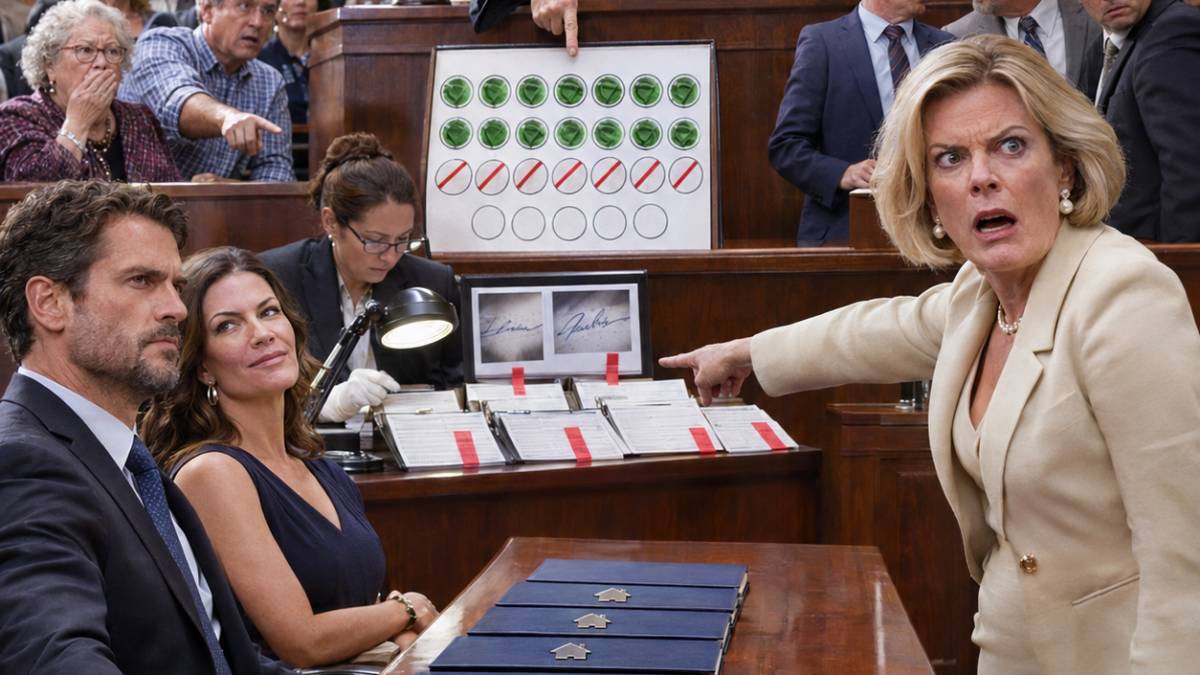
No screaming.
No gasps from a jury.
Mostly documents.
Binders.
Ballots.
Vote tallies.
Accounting ledgers.
Original bylaws.
Amendment notice.
Meeting minutes.
Collection records.
Foreclosure paperwork.
Our entire retirement crisis reduced to stacks of paper and lawyers asking people to identify signatures.
Rebecca placed the original bylaws beside the 2022 amendment vote.
Requirement:
Nineteen.
Recorded yes votes:
Sixteen.
HOA counsel argued practical reality.
Major repairs were necessary.
Insurance costs were rising.
Most owners attending supported the change.
The association needed revenue.
Rebecca did not dispute the roof.
Did not dispute balconies.
Did not dispute rising insurance.
She said:
“Need does not rewrite the voting requirement.”
Simple.
The judge agreed.
The amendment had not been validly adopted.
I closed my eyes when I heard it.
Frank did not move.
Years we had waited for that sentence.
It sounded almost ordinary.
Then the consequence.
Because the amendment was invalid, the increased assessments had not been lawfully imposed under that amendment.
Once our original payments were correctly credited, the HOA could not establish the assessment debts it had relied upon to support the disputed foreclosure sales.
The court set aside the challenged foreclosure sales and subsequent transfers, subject to resolving lawful charges and claims involving later purchasers.
The elections conducted under the defective amendment were invalidated as well.
No applause.
No Karen collapsing.
No sheriff handing us keys.
Real property litigation does not end like television.
Winning the legal issue was the beginning of another administrative marathon.
Judgment records.
County records.
Title corrections.
Claims by later buyers.
Occupancy issues.
Lawful assessments.
Mortgage coordination.
Accounting credits.
Month after month.
I checked county records obsessively.
Every morning with coffee.
One unit returned to the LLC.
Then another.
Then another.
The day all nine appeared again under our ownership, I printed the page.
Frank found me crying at the kitchen table.
He looked at the paper.
Then sat down.
“We got them back.”
“Yes.”
“All?”
“Yes.”
He put his hands over his face.
For maybe thirty seconds, neither of us spoke.
Then he started laughing.
I laughed too.
Not joy exactly.
Release.
The new board election followed under the original valid rules.
Frank and I voted our nine units ourselves.
No manager.
No proxy.
Frank held the ballots like they were explosives.
I said:
“Don’t spill mustard.”
He glared.
Karen ran.
She lost.
Not because we controlled the election.
That is important.
Nine votes mattered.
They were not enough alone.
Other owners were exhausted.
Legal bills had climbed.
Trust in the board had collapsed.
People wanted different leadership.
Karen lost because enough owners chose somebody else.
I watched the result announced from the back.
She nodded once.
Gathered papers.
Walked out.
I expected satisfaction.
What I felt was tired.
Winning did not restore Mrs. Davenport’s eleven years in her home.
It did not refund every month of lost rent.
The court awarded only part of our attorney fees.
Later buyers had claims against the HOA.
Some units needed repairs after years of uncertain ownership.
Vacancies remained.
Mortgage costs had not vanished.
The lawful roof work still needed funding.
And once owners properly approved a valid roof plan?
We paid our share.
Of course we did.
Frank complained while writing the check.
I said:
“The roof still leaks.”
“I know.”
“The building still needs it.”
“I know.”
“So?”
“I reserve my constitutional right to complain.”
“Granted.”
That was the difference.
The assessment had finally been authorized correctly.
We did not oppose repairs.
We opposed being charged thousands under an amendment that never passed.
Karen’s defenders later said the court result proved the law cared more about procedure than common sense.
I disagree.
Procedure was the common sense.
If governing documents say nineteen votes, then sixteen people do not get to decide thirty-six owners have surrendered a protection simply because those sixteen believe their reason is good.
Maybe nineteen would have voted yes if Karen had done it properly.
Maybe twenty-five.
Maybe all thirty-six after seeing engineering reports.
We will never know.
Because she chose certainty over legitimacy.
Our former manager lost us as clients.
Years later she sent me an email.
No excuse.
Just apology.
She wrote:
I believed I could solve the dispute before it reached you. Every time the problem became worse, admitting how much I had withheld became harder. I confused protecting the client with protecting myself from admitting failure.
That was more honest than anything she had said in 2023.
I replied:
You should have told us when the first lien notice arrived.
She answered:
Yes.
Nothing else.
I respected that more than a five-page explanation.
Walt still calls.
He remains convinced every HOA board contains at least one criminal conspiracy.
Usually three.
He called after trial.
“Knew Karen was dirty.”
“No.”
“What do you mean no?”
“She wasn’t stealing roof money.”
“Doesn’t mean she wasn’t dirty.”
“The roofer’s work checked out.”
“Paperwork can be fabricated.”
“Walt.”
“I’m just saying.”
“You said she was skimming.”
“She could’ve been.”
“She wasn’t.”
“How do you know?”
“Discovery.”
He muttered.
Then:
“New board’s suspicious.”
“Why?”
“They changed pool hours.”
I closed my eyes.
Still, I listen.
Because the first time Walt warned us, Frank laughed.
I laughed too.
We lost months we could not afford because his delivery sounded dramatic.
Sometimes the annoying person is still carrying useful information.
Frank reads every HOA notice now.
Every word.
He highlights things.
Asks me questions.
Keeps envelopes.
Saves emails.
He has not signed a proxy over lunch since.
I consider that progress.
We also changed how we run the business.
No manager has authority to hide legal correspondence.
Registered-agent notices come directly to us and counsel.
Any lien communication triggers immediate attorney review.
Any disputed assessment is analyzed not just for whether we think it is lawful, but for what happens while the dispute remains unresolved.
Cash reserves increased.
We reduced leverage.
Eventually sold two units voluntarily at normal market prices.
Not because Karen beat us.
Because nine rentals in one aging complex was too much concentration for retirement.
That lesson had cost enough.
We kept seven.
Frank still renovates things that do not need renovation.
He says retirement would kill him.
I say tile will do it first.
Our marriage survived.
Not untouched.
There were nights in 2024 when we barely spoke.
He blamed himself for refusing the thirty-eight-thousand-dollar offer.
I blamed myself for not pushing harder.
Then I would blame the manager.
Then Karen.
Then Frank again.
That is what long litigation does.
It gives anger too much time to find new addresses.
One night, after another foreclosure notice, Frank said:
“You told me to sell.”
I said:
“Yes.”
“I should’ve listened.”
“That isn’t helping.”
“I ruined this.”
“No.”
“I did.”
“You made one decision.”
“One expensive decision.”
“We both agreed later.”
“You wanted out first.”
“Frank.”
He looked at me.
“You know what I’m afraid of?”
“What?”
“That if we lose all nine, you’ll spend the rest of your life knowing I could’ve saved them.”
I sat beside him.
“I’m afraid if we lose all nine, you’ll spend the rest of your life thinking they were the only thing you built.”
He looked confused.
“You built this house.”
“You built our marriage.”
“You helped raise two kids.”
“You’ve fixed half the neighborhood’s plumbing for free.”
He laughed weakly.
“You hate when I do that.”
“I hate when they call during dinner.”
Different issue.
I held his hand.
“The condos matter.”
“They are not you.”
He cried.
First time in the whole fight.
Not when the first unit sold.
Not when the ninth sold.
That night.
Because losing property had become tangled with losing identity.
Karen understood that fear better than she knew.
The irony is that fear drove almost everybody.
Karen feared losing her board.
Our manager feared losing a client.
Frank feared losing the business he had spent twenty years building.
I feared our retirement disappearing.
Walt feared corruption was happening behind closed doors.
Each person protected what frightened them.
And each made something worse.
Karen responded to nine proxy votes by imagining a corporate takeover.
Our manager responded to escalating enforcement by hiding bad news.
We responded to ugly settlement and sale options by refusing compromises because we were certain the court would vindicate us.
Fear does not excuse bad decisions.
But if you want to understand them, follow what people are afraid to lose.
After everything settled, I attended one HOA meeting.
Just one.
Frank refused.
“You’re voluntarily going?”
“Yes.”
“Should I call somebody?”
“It’s ninety minutes.”
“That’s how cults start.”
The new board was discussing a valid roof assessment.
Engineering report on screen.
Three bids.
Reserve numbers.
Owner questions.
Vote requirements.
Paul Ostrander sat near the front.
Walt sat in back whispering complaints before anyone finished speaking.
The new president said:
“Before we vote, counsel will explain exactly what approval threshold applies.”
I almost laughed.
Maybe they learned.
The lawyer explained.
Owners asked questions.
Some angry.
Some reasonable.
One woman said she could not afford the proposed payment schedule.
Board discussed financing.
Nobody called her anti-community.
Nobody accused landlords of taking over.
Nobody treated disagreement as disloyalty.
Then the vote.
Proper count.
Requirement met.
Assessment approved.
I voted yes with our units.
Afterward, a woman I barely knew stopped me.
“You’re the nine-condo lady?”
I laughed.
“I suppose.”
“My husband says you bankrupted the HOA.”
“Your husband is wrong.”
“He’s wrong about many things.”
I liked her immediately.
She hesitated.
“Did Karen really think some corporation was taking over?”
“Yes.”
“Wasn’t your property manager basically voting a quarter of the complex?”
“Under proxy.”
“That would scare me.”
I appreciated the honesty.
“It scared Karen.”
“So was she completely wrong?”
“About the threat?”
“Yes.”
“About the power?”
“No.”
She waited.
“Nine units meant nine votes.”
I said.
“That is a lot.”
“Should one owner have that much influence?”
“Maybe that is a policy question worth discussing.”
“But?”
“You discuss it using valid rules.”
“You do not invent authority because you dislike the answer.”
She nodded.
That became my simplest explanation.
Karen’s fear was not absurd in every respect.
Concentrated ownership changes associations.
Nine votes out of thirty-six matter.
Rental policy matters.
Board stability matters.
Building repairs matter.
Her fatal mistake was deciding that because her concerns felt legitimate, the methods she wanted automatically became legitimate too.
They did not.
The same applies to us.
We believed the amendment was invalid.
Correct.
That did not make ignoring collection consequences smart.
We believed court would eventually unwind everything.
Correct.
That did not make every financial decision while waiting wise.
We were right on the central legal issue and still made mistakes that cost us dearly.
That is the part people dislike in justice stories.
They want innocence perfect.
Villainy complete.
It rarely is.
Karen was not a thief.
Our manager was not secretly betraying us.
The roofer was not a kickback scheme.
The building really did need repairs.
We really did own a quarter of the voting interests.
Our manager really had used all nine votes to defeat Karen’s proposals.
Karen really did fear the board could be replaced.
Those facts were true.
Then another fact:
The bylaws required nineteen votes.
Karen had sixteen.
Everything after that had to live with that number.
Years later, I found the old mustard-stained proxy while cleaning our files.
Original copy Frank had retained.
I carried it to the garage.
He was replacing a cabinet hinge.
“Look.”
He squinted.
Then laughed.
“You kept that?”
“You kept that.”
“I keep everything.”
“No, you don’t.”
“Important things.”
“You signed this while eating lunch.”
“Turkey sandwich.”
“Mustard.”
“Spicy brown.”
“You remember the mustard?”
“Good sandwich.”
I sat on a stool.
“This thing almost ruined us.”
Frank took it.
Looked at the signature.
“No.”
“What?”
“Karen almost ruined us.”
I thought.
Then shook my head.
“No.”
“Manager?”
“No.”
“Who?”
“All of us.”
He stared.
I continued.
“This paper did what a proxy does.”
“You signed it.”
“She voted.”
“Karen got scared.”
“Manager got overconfident.”
“We got stubborn.”
“Board got reckless.”
“Lawyers got expensive.”
“Court got slow.”
I pointed at the stain.
“The paper just sat there.”
Frank smiled.
“You sound like a therapist.”
“Don’t insult me.”
He laughed.
Then folded the proxy carefully.
“Keeping it.”
“Why?”
“Reminder.”
“Of what?”
“Never sign anything while holding a sandwich.”
Fair.
Mrs. Davenport eventually moved into a smaller senior apartment near her sister.
After we regained title, I called.
Told her we could return her old unit if she wanted.
She was quiet.
Then said:
“Honey, I’m done moving.”
I understood.
“I’m sorry.”
“You didn’t make me leave.”
“Still.”
She sighed.
“Life moved.”
That sentence hurt.
Winning cannot rewind.
We later sold that particular condo.
Frank stood in the empty living room before closing.
Looked at the baseboards he had installed fifteen years earlier.
“She liked this place.”
“Yes.”
“You think we should keep it?”
“No.”
He smiled sadly.
“Good.”
“You were testing me.”
“Yes.”
We sold at fair market value.
Paid taxes.
Put most into safer retirement investments.
Boring ones.
I have grown fond of boring.
The HOA eventually had to resolve claims by later foreclosure buyers whose purchases were unwound.
That process cost more.
Insurance disputes.
Settlement agreements.
Legal fees.
No one walked away untouched.
Karen moved from the complex about a year after losing the election.
I heard she bought a townhouse elsewhere.
Walt said:
“She joined that HOA board.”
I said:
“You’re lying.”
He swore.
I never checked.
Some things are healthier not to know.
I did receive one letter from Karen.
Not apology exactly.
Not defense either.
She wrote:
I still believe the association faced a legitimate governance problem from concentrated voting power and a serious financial problem from deferred maintenance. I also recognize now that we attempted to solve those problems using an amendment that did not satisfy the existing voting requirement. I wish I had insisted on getting a written legal opinion before proceeding.
Very Karen.
Even regret sounded like meeting minutes.
Then:
I did not know Frank was behind the LLC. That does not excuse the assumption that the entity represented hostile outside investors.
Better.
Then:
The foreclosures became bigger than the problem I originally believed I was solving.
I read that line twice.
She never wrote:
I’m sorry.
Maybe she could not.
Maybe she thought acknowledging error was enough.
I did not answer.
I did not need one more round.
Forgiveness was not the point.
Understanding was.
Karen had spent three years fighting a corporate takeover that did not exist.
But the consequences she created were real.
That may be the most dangerous kind of abuse of power.
Not cartoon corruption.
Not someone secretly filling their pockets.
A person genuinely convinced their authority is broader than it is.
A person who believes the emergency is so obvious that procedural limits become annoying technicalities.
Someone who says:
I know what needs to happen.
Then treats:
Am I allowed to do it this way?
as a secondary question.
Our case taught me to fear that person more than the obvious thief.
Thieves usually know rules exist.
They hide.
People convinced they are righteous sometimes do everything in meeting minutes.
Karen did.
She believed she was protecting owner control.
Protecting building repairs.
Protecting the association from concentrated rental votes.
All while pushing through an amendment without the nineteen votes required to give her the authority she thought she needed.
Then she used that invalid structure to impose costs.
Then collection mechanisms turned the disputed costs into liens.
Then fees grew.
Then foreclosure.
Each step looked administrative.
Official.
Stamped.
Recorded.
Mailed.
That is another lesson.
Paperwork can destroy you without anyone raising their voice.
The first foreclosure notice did not look dramatic.
White envelope.
Black type.
But it was more dangerous than every angry HOA meeting we had ignored.
If I could go back, I would change several things.
The first seventy-five-dollar mystery fee?
I would ask why it happened, not merely whether it was reversed.
The first proxy?
I would read the meeting agenda and ask how nine votes might affect board politics.
The first disputed dues report?
I would demand every letter.
First lien threat?
Independent lawyer immediately.
First opportunity to sell one unit at an ugly discount?
I might take it.
Frank hates when I say that.
He knows I am probably right.
Not because surrender is noble.
Because liquidity matters when you are fighting.
A legal principle does not pay a mortgage while litigation crawls.
A future judgment does not fund an injunction bond today.
Equity trapped behind liens is not cash.
I knew all those concepts as a bookkeeper.
I did not apply them emotionally because the condos were our retirement story.
Numbers become harder when they carry memory.
Frank remembers buying unit one.
Twenty-seven thousand dollars.
Kitchen smelled like cigarettes.
Bathroom vanity tilted.
He replaced almost everything.
First tenant stayed four years.
Then unit two.
Three.
Four.
By nine, the complex contained decades of his labor.
Karen looked at an LLC.
Frank saw weekends.
That mismatch mattered.
Karen’s emails described:
corporate ownership.
investment group.
management-controlled voting bloc.
All technically related to something real, but emotionally misleading.
There was an LLC because liability and bookkeeping made sense.
There was a management company because Frank hated paperwork.
There were nine votes because we owned nine units.
No takeover strategy.
No board slate.
No secret investors.
No plan.
The closest thing to corporate headquarters was our kitchen table.
That was where Frank signed the proxy.
Where I reconciled statements.
Where we later opened the foreclosure envelope.
Where we argued about selling.
Where we cried when the county records finally showed all nine units restored.
One kitchen table.
That was Karen’s corporate adversary.
I sometimes wonder what would have happened if Karen had knocked on our door in 2021.
“Do you own these nine units?”
“Yes.”
“Are you trying to replace the board?”
“No.”
“Why did your manager cast all nine votes?”
“Because you proposed rental restrictions.”
“Do you intend to run candidates?”
“No.”
Would she have believed us?
I do not know.
Maybe.
Maybe not.
But she never asked.
That absence of curiosity became expensive.
Fear filled the blank.
People do that constantly.
They lack information.
Instead of admitting the gap, they build a story.
Karen saw a company name.
Manager casting nine votes.
Rental policies defeated.
The story became:
outside investors are taking control.
I saw related roofer.
High bid summaries.
Aggressive assessments.
The story became:
Karen is stealing money.
Our manager saw a defective amendment.
A board lawyer posturing.
Years of client trust.
The story became:
I can fix this before Frank and his wife need to worry.
Frank saw court documents proving sixteen instead of nineteen.
The story became:
No judge will let them take the condos.
All of us converted incomplete facts into certainty.
Evidence eventually corrected every story.
That is why I trust documents more now.
Not blindly.
Documents can be wrong.
But certainty should earn itself.
Walt still refuses that philosophy.
He called last month.
“New treasurer’s cousin owns a plumbing company.”
“Okay.”
“Suspicious.”
“Did they hire him?”
“Not yet.”
“Then what are we investigating?”
“Potential.”
“You need another hobby.”
“I told you before, this is my hobby.”
He was right.
I listen.
Then I verify.
That is our compromise.
Frank has slowed down.
He still works on the seven condos we kept.
Only seven because we sold two intentionally after regaining them.
I pushed for diversification.
He grumbled.
Eventually agreed.
Some money went into bonds.
He called them “paper that sits there.”
I said:
“That’s the point.”
He still drives by the condo complex and critiques exterior repairs.
“They caulked that wrong.”
“You no longer maintain common elements.”
“Still wrong.”
“Drive.”
He drives.
Our new manager sends legal correspondence same day.
Even if it is nonsense.
Especially if it is nonsense.
Every monthly report includes copies of HOA statements.
I reconcile HOA ledger to our books.
If numbers differ by five dollars, somebody gets an email.
Frank says I have become terrifying.
Maybe.
One of the younger owners once asked me why I care so much about HOA votes.
We were standing near the mailboxes after a meeting.
He said:
“It’s just condo politics.”
I smiled.
“No.”
“What?”
“Condo politics decides who can sign contracts.”
“Who can raise assessments.”
“Who can enforce rules.”
“Who can spend reserves.”
“Who can record liens.”
He looked uncomfortable.
I continued.
“You don’t have to attend every meeting.”
“Just understand that boring documents can become very expensive when nobody reads them.”
He nodded.
Then asked:
“Were you the people who lost nine condos?”
I laughed.
“Yes.”
“And got them back?”
“Yes.”
“That sounds impossible.”
“It felt impossible.”
“Was Karen evil?”
The question surprised me.
“No.”
He looked disappointed.
“Really?”
“No.”
“Then why did she do all that?”
I thought about it.
“Because she was afraid.”
“Of you?”
“Of losing control.”
“That’s not evil?”
“Fear plus authority can do plenty of damage without evil.”
He looked toward the clubhouse.
“That’s worse.”
“Sometimes.”
Years after the lawsuit, I reread Karen’s deposition.
Not for legal reasons.
Curiosity.
One answer stood out.
Rebecca had asked:
“Why pursue every available collection remedy against these nine units?”
Karen answered:
“Because allowing a concentrated investor block to disregard assessments would have undermined the entire association.”
There was her world.
She did not see Frank and me disputing an invalid vote.
She saw a corporate block testing whether rules applied.
From inside that belief, aggressive foreclosure looked like defense.
That did not make it lawful.
It made the danger easier to understand.
I think about institutions differently now.
HOAs especially.
People mock them as petty.
Paint colors.
Parking.
Trash cans.
But an HOA may have meaningful powers.
Money.
Liens.
Collections.
Contracts.
Rules affecting property.
That power requires boring discipline.
Voting thresholds.
Notice.
Minutes.
Accounting.
Conflict checks.
Actual legal advice.
People hate procedure because procedure slows people who feel certain.
That is exactly why procedure exists.
Nineteen.
That number saved us eventually.
Not because nineteen is morally superior to sixteen.
Because thirty-six owners had adopted documents saying certain protections could not be removed without nineteen affirmative votes.
Maybe that threshold was inconvenient.
Then amend it properly.
Karen did not.
The board wanted major financial flexibility.
Needed repairs.
Needed money.
Sixteen owners supported change.
Not enough.
The correct answer was:
Go get three more votes.
Explain the roof.
Explain insurance.
Answer objections.
Negotiate payment plans.
Try again.
Instead, the board treated the requirement as though attendance converted it.
Once that happened, everything built above it became unstable.
Like a contractor pouring a foundation three feet off the survey line because moving the forms would delay concrete.
You may build a beautiful house.
Still on the wrong land.
Frank understands that analogy.
When I explained the judgment that way, he nodded.
“Finally, law that makes sense.”
I rolled my eyes.
There was no grand moment where Karen apologized before the community.
No microphone confession.
No residents cheering us.
Some people still believed we had abused the system.
Some believed Karen saved the building.
Some thought both sides were idiots.
That third group may be closest.
A few owners resented us because the litigation cost the association money.
I understood.
One woman confronted me after the new board election.
“My dues paid lawyers because of you.”
I said:
“My money paid lawyers too.”
“You owned nine units.”
“Yes.”
“You had more ability to fight.”
“Maybe.”
“So ordinary owners got dragged into a battle between big players.”
That stung because there was truth in it.
We were not billionaires.
But nine condos gave us more stake than most people.
Karen’s board decisions affected everyone.
Our lawsuit affected everyone.
I said:
“You’re right that people who did nothing ended up paying.”
She looked surprised.
“I am?”
“Yes.”
“What do you say to that?”
“I’m sorry.”
She waited for defense.
I did not add one.
Then:
“But I also could not let invalid foreclosures stand just because correcting them was expensive.”
She nodded slowly.
“I hate that both can be true.”
“So do I.”
That is adulthood again.
Justice does not guarantee painless correction.
Sometimes correcting abuse creates secondary costs.
Later buyers had claims.
Tenants moved.
Legal fees accumulated.
Association insurance changed.
None of that proved the original action should remain untouched.
It proved mistakes become expensive when allowed to compound.
That is why early transparency matters.
If our manager had forwarded the first serious collection letter?
Maybe we hire Rebecca a year earlier.
Maybe seek declaratory relief before liens grow.
Maybe pay increases under protest while litigating.
Maybe sell one unit cleanly.
Maybe Karen’s board gets corrected before foreclosure.
If Karen gets written legal advice before declaring sixteen sufficient?
Maybe no amendment.
Maybe new vote.
Maybe three more supporters.
Maybe no lawsuit.
Tiny decisions.
Huge branches.
The seventy-five-dollar fee I marked RESOLVED stays in my desk drawer.
Not because it mattered legally.
Because it reminds me how easy it is to close a file emotionally before you understand why it opened.
Resolved.
I wrote it confidently.
Nothing was resolved.
The system had already begun drifting.
We just could not see it.
Frank jokes less about HOA meetings now.
He still hates them.
But he reads minutes.
Once he came home from a meeting furious.
“They spent twenty-eight minutes discussing whether a storage cabinet is beige or taupe.”
“What did you do?”
“Stayed.”
“Why?”
“In case somebody changed the bylaws while I was trapped there.”
Progress.
At dinner, he sometimes calls Karen Chairman Mao with a clipboard.
I tell him that is unfair and historically incoherent.
He says:
“Still funny.”
Marriage.
We rebuilt retirement differently.
Seven rentals.
More reserves.
Less debt.
No single plan allowed to become sacred.
We travel some.
Not extravagantly.
Frank visits hardware stores in other states, which I refuse to classify as tourism.
He still cannot pass a crooked piece of trim without commenting.
I still reconcile receipts.
Normal.
That may be the best justice we received.
Normal life returned.
Not the same life.
A more cautious one.
A little poorer after legal fees and lost rent.
A lot less trusting.
But ours.
One afternoon, Frank and I drove through the complex together.
The roof looked good.
The balconies had been repaired.
Common landscaping looked better than it had in years.
I said:
“Karen was right about one thing.”
Frank almost drove onto the curb.
“What?”
“The building needed work.”
He stared at me.
“Never say that again.”
“It did.”
“I know.”
“The roof would’ve gotten worse.”
“I know.”
“The balcony engineering—”
“Stop.”
I laughed.
Then he said:
“She could’ve gotten nineteen votes.”
“Yes.”
“That’s what kills me.”
“Me too.”
If Karen had gotten three more owners to vote yes, our legal case might have looked very different.
We might have hated the increase.
But it would have been validly adopted.
We would have had to decide whether the rentals still made financial sense.
Maybe sell some.
Maybe raise rents where allowed.
Maybe accept lower returns.
That would have been painful.
But legitimate.
Instead, Karen tried to protect the community by bypassing the community’s own rule.
That contradiction destroyed her board.
The last time I saw Karen was at a grocery store.
Frozen-food aisle.
She saw me first.
I considered turning away.
Did not.
She said:
“Hello.”
“Karen.”
Awkward silence.
Then she looked at my cart.
“You still own the units?”
“Seven.”
“You sold two?”
“Voluntarily.”
She nodded.
“That’s good.”
I almost laughed.
“You know, for years I thought you were trying to take my board.”
“Our manager voted against two proposals.”
“I know.”
“That was it.”
“I know now.”
“Did you really not know Frank owned the LLC?”
“No.”
“Never looked?”
“I saw entity records.”
“But not ownership details?”
“No.”
“Why?”
She looked embarrassed.
“Because I thought I understood what I was seeing.”
There it was.
Not:
Because I am evil.
Because I thought I understood.
I nodded.
“So did we.”
She looked surprised.
I told her:
“I thought you were stealing roof money.”
Karen actually laughed.
“What?”
“Walt convinced us.”
“Oh God.”
“You know Walt.”
“I do.”
“Turns out the roofer was fine.”
“I know.”
She smiled.
Then it disappeared.
“I’m sorry about the foreclosures.”
The words came quietly.
First actual apology.
I waited.
She continued.
“I believed the assessments were valid.”
“I know.”
“And I believed if we let your nine units refuse payment, other owners would stop paying.”
“I know.”
“I still think concentrated voting is a problem.”
“Maybe.”
She looked at me.
“You agree?”
“I think it’s a governance issue.”
“Yes.”
“But governance issues require valid governance.”
Her mouth tightened.
Then she smiled slightly.
“Still carrying the nineteen votes around?”
“Always.”
She nodded.
“I should’ve gotten nineteen.”
“Yes.”
Silence.
Then:
“I’m sorry.”
This time simpler.
I believed her.
That did not erase anything.
Did not need to.
“I know.”
We walked away.
No hug.
No friendship.
No dramatic reconciliation.
Frozen peas between us.
Real life.
When I tell this story now, people usually ask one question.
“How could they take nine condos if the amendment was invalid?”
Because invalidity is something courts determine when disputes are litigated.
Because liens can be recorded.
Notices can issue.
Procedures can move.
Deadlines can expire.
Costs can accrue.
People can make decisions based on documents later found defective.
Being right eventually does not stop every intermediate consequence automatically.
That is why you do not sleep on notices.
Do not assume somebody else is handling it.
Do not confuse your legal theory with a court order.
Our manager did.
We did.
Karen did something similar from the other side.
She confused her interpretation with authority.
Everybody paid.
The second question:
“Did Karen target you because she wanted your condos?”
Evidence did not show that.
She feared our votes.
She wanted the perceived corporate block neutralized as a governance threat.
Then the disputed assessments created an enforcement path she believed legitimate.
That is bad enough.
I do not need to invent theft.
Truth is more useful.
The third question:
“Would you do anything differently?”
Yes.
Pay under protest earlier if necessary.
Preserve liquidity.
Hire counsel sooner.
Do not dismiss Walt completely just because he is dramatic.
Never allow a manager to control all legal correspondence.
Read proxies.
Read bylaws.
Read notices.
Read amendments.
And when someone says:
Don’t worry, I’ve got it handled,
ask them to prove what handled means.
The fourth:
“Was getting all nine units back worth the fight?”
That one is harder.
Legally?
Yes.
Financially?
Probably, though the cost was brutal.
Emotionally?
I do not know.
Some victories are necessary without being satisfying.
We could not knowingly allow invalid foreclosure titles to stand across nine properties representing twenty years of work.
But I will never tell anyone litigation is clean justice.
It consumed years.
Rent.
Sleep.
Relationships.
Tenants.
Cash.
Trust.
Mrs. Davenport did not get her eleven years back.
Our former manager could not undo hiding notices.
Karen could not unrecord liens after the fact.
Frank could not reclaim the good offers we rejected.
We could not make the courts move faster by being right.
Justice came.
Late.
Expensive.
Incomplete.
Still necessary.
I think that is why I keep the old proxy.
Not because it proves Karen wrong.
It reminds me how small the beginning was.
One meeting.
Two rental proposals.
One manager.
Nine votes.
A mustard stain.
Karen saw a quarter of the complex voting together.
Fear filled in the rest.
Then power gave fear tools.
That is the part I never forget.
Power does not always become abusive because somebody starts wanting to hurt people.
Sometimes power becomes abusive because somebody becomes convinced they are the only adult in the room.
Karen believed she understood the threat.
Our manager believed she understood the litigation.
Frank believed he understood the judge.
I believed I understood the corruption.
Each of us was wrong about something.
The difference was that Karen had the board.
A mistaken belief becomes more dangerous when attached to authority.
That is why rules matter most when leaders are certain.
Nineteen.
Not sixteen.
Nineteen.
Three votes.
That was the space between a lawful amendment and years of foreclosures.
Three owners Karen never convinced.
Three people whose consent the existing bylaws required.
Three votes she decided the community did not need because most of the people in the room agreed with her.
Whenever somebody tells me procedure is just red tape, I think about those three missing votes.
Those three votes represented the rights of people not sitting in the room.
Owners who had mortgages.
Tenants.
Retirements.
Savings.
Plans.
The threshold existed precisely so a temporary majority at one meeting could not casually remove financial protections affecting everyone.
Karen treated the threshold as an inconvenience.
The judge treated it as law.
That difference gave us our properties back.
Frank is in the garage as I finish telling this.
I can hear him moving tools.
Seven condos remain.
Four still have original pieces he installed decades ago.
One has that ridiculous trim Karen complimented the first day we met her.
I sometimes think about that.
Before she knew Frank was the “investor.”
Before we knew she feared the LLC.
She looked at his work and saw a contractor.
A human being.
Then paperwork gave him another identity.
Corporate owner.
Voting bloc.
Threat.
People become easier to punish when we replace their names with categories.
Investor.
Landlord.
Corporation.
Board.
Management.
Delinquent account.
Those words can be accurate.
They can also hide the kitchen table behind them.
The husband eating a sandwich.
The wife reading a statement.
The retired bus driver waiting to learn whether she has to move.
The owners paying assessments from paychecks.
The board volunteers afraid a building cannot afford its roof.
Human beings disappear quickly inside ledgers.
Maybe that is why the legal case felt so cold.
Karen looked at nine accounts.
We looked at twenty years.
The judge looked at sixteen and nineteen.
And in the end, the numbers mattered because numbers were the one language nobody could intimidate into changing.
Sixteen never became nineteen.
Not because Karen was arrogant.
Not because we were sympathetic.
Not because Frank worked hard.
Not because our manager meant well.
Sixteen simply was not nineteen.
Once the court returned everyone to that basic fact, the rest of the structure started falling into place.
The amendment had not passed.
The inflated assessments could not support the debt as claimed.
The disputed foreclosure chain could not stand.
The election changes fell with it.
Karen lost the board.
We regained title.
Then came the harder work of living after being right.
We paid valid charges.
Settled buyer issues.
Repaired units.
Found new tenants.
Sold two.
Kept seven.
Changed managers.
Changed ourselves.
Frank reads everything now.
I ask harder questions.
Walt still calls.
Karen is gone.
The roof no longer leaks.
And every time a proxy arrives, Frank brings it to me untouched.
No sandwich.
No mustard.
He sets it on the kitchen table and says:
“Read this before I accidentally start another corporate takeover.”
I always laugh.
Because after everything, laughter is cheaper than lawyers.
But I read it.
Every word.
Because the worst HOA president I ever dealt with was not a criminal mastermind.
She was something more ordinary and, in some ways, more dangerous:
A person with real authority who became absolutely convinced she had even more authority than the documents gave her.
And the only thing that finally stopped her was the one thing she should have respected from the beginning—
the rules she kept insisting everyone else had to follow.








