PART2:“YOU DESTROYED MY CHRISTMAS EVENT!” HOA Karen Sold 1,000 Tickets to My Tree Farm—So I Delivered Every Tree to the Customers Who Actually Bought Them
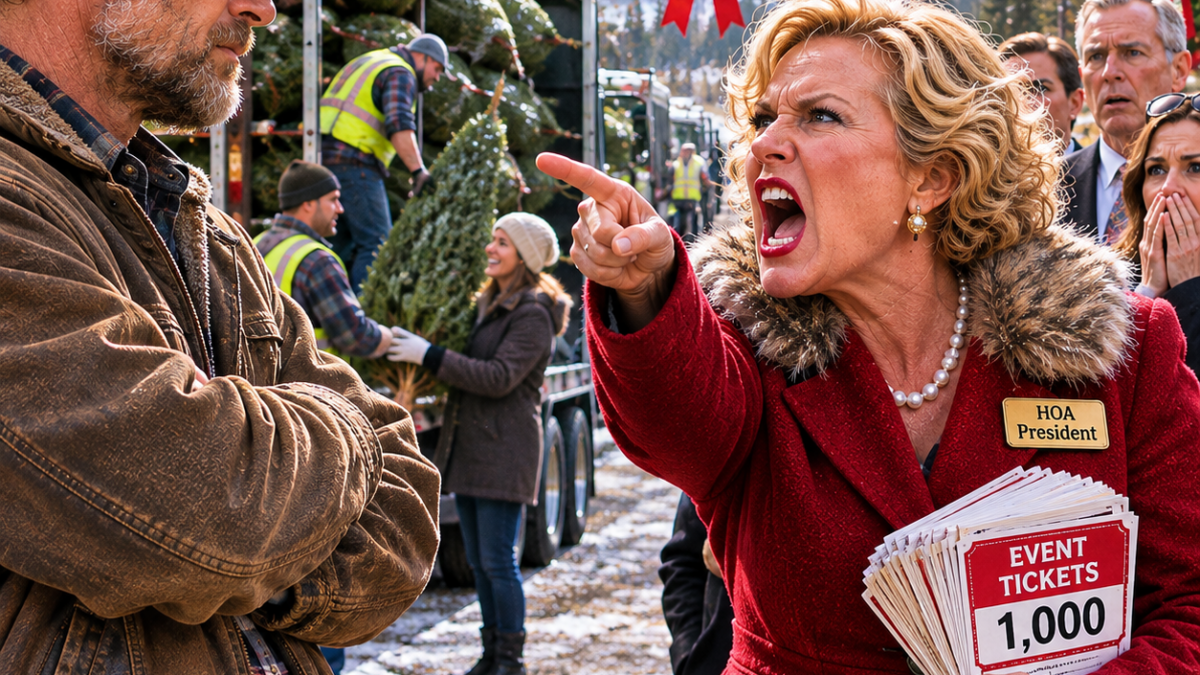
PART2
Tessa answered on the third ring.
“Harland.”
No surprise.
No hesitation.
That told me plenty.
“Tessa, I’m looking at your Christmas tree walk flyer.”
“Oh, good.”
Good.
She actually said good.
“You like the design?”
I stared at the phone.
“You’re advertising an event on my farm.”
“The grove beside Silverbrook.”
“My farm.”
“Same place.”
“No.”
I heard her sigh.
Not embarrassed.
Annoyed.
“Harland, your property has beautiful holiday scenery and absolutely no tourism strategy.”
“I grow commercial trees.”
“Exactly.”
“You’re wasting the experience.”
I leaned back.
“Every tree in that grove is inventory.”
“People understand that.”
“No, they don’t.”
I tapped the promise printed across the flyer.
“You’re telling guests they can choose a favorite tree.”
“That’s an interactive element.”
“They can’t choose trees I already sold.”
Tessa laughed.
“You sell trees.”
“I sell experiences.”
“Don’t confuse the two.”
That line stayed with me because it explained almost everything that came afterward.
To Tessa, the distinction between my property and her idea was just a branding problem.
I said:
“You’re selling your experience on land you don’t have permission to use.”
Her voice changed.
The warmth vanished.
“The HOA holds access rights.”
“What access rights?”
“The path along your eastern edge.”
“A drainage easement?”
“Our attorney reviewed it.”
“Which attorney?”
Pause.
Then:
“If you interfere with the event, Silverbrook will pursue damages.”
I looked out my office window.
Twelve acres of firs moved slightly in the November wind.
“Tessa.”
“Yes?”
“You haven’t rented my farm.”
“The access language is broad.”
“You haven’t asked.”
“We don’t need to.”
“You haven’t paid me a dollar.”
“This event benefits the entire area.”
“Not my question.”
She became colder.
“Do not sabotage this.”
I almost laughed.
Then I remembered the flyer.
One thousand tickets.
Seventy-nine dollars each.
If she actually sold them all, that was $79,000 before vendors, sponsors, or premium packages.
This was not a neighborhood potluck.
I said:
“Cancel it.”
She replied:
“No.”
Then hung up.
I did not call back.
Instead, I photographed the flyer.
Saved the event page.
Printed screenshots.
Wrote down the conversation while it was still fresh.
Then I opened the delivery binder.
Every commercial order.
Every deposit.
Every client.
Every scheduled truck.
Colby stood over my shoulder while I flipped to the final harvest page.
The last shipment date was printed in black.
DECEMBER 12
Saturday.
Exactly the day Tessa had chosen for her grand opening.
Colby let out a low whistle.
“So what happens when a thousand people show up expecting trees?”
I closed the binder.
“That’s something Mrs. Blackwood should have asked before she sold the tickets.”
Within two weeks, the Christmas tree walk was everywhere.
Local radio.
Coffee shops.
Social media.
Silverbrook community pages.
Tessa filmed promotional videos beside the stone entrance wearing an expensive red coat and talking about “bringing elevated holiday culture to the region.”
She described the event as private.
Curated.
Exclusive.
Apparently Christmas needed class restrictions now.
The ticket counter climbed.
Six hundred.
Eight hundred fifty.
Then:
SOLD OUT — 1,000 TICKETS RESERVED
She had collected money before securing one legal right to use the venue.
That should have frightened her.
Instead, it seemed to make her more confident.
The morning after the sold-out announcement, Colby called me from the south grove.
“You need to come down here.”
“What happened?”
“Event crew.”
I drove over.
Three SUVs.
Small box truck.
Workers hammering plastic stakes between my tree rows.
A tall Fraser fir had a sticker across its trunk:
PREMIUM CHRISTMAS TREE
One worker was measuring where to place a decorative arch.
Another carried a bundle of signs pointing toward proposed photo stations.
Colby had already stopped them.
The foreman looked embarrassed when I arrived.
He handed me a site map.
All twelve acres were shaded yellow.
The heading read:
EXCLUSIVE EVENT ZONE
I asked:
“Who gave you this?”
“Silverbrook.”
“Did they tell you they own the farm?”
“They said they rented the grove.”
That was new.
Not easement.
Not shared access.
Rental.
Tessa had moved from twisting an old right-of-way into claiming an entire lease.
I photographed the map.
Company name.
Truck plates.
Stakes.
Then told the crew:
“You need to leave.”
The foreman frowned.
“We have a contract.”
“With Silverbrook.”
“Yes.”
“This is Boone Evergreen Farm.”
He looked around.
“Right.”
“Silverbrook doesn’t own it.”
Nobody argued after that.
To their credit, they packed up.
I did not throw anything.
Did not tear down stakes while cameras rolled.
Did not yell.
I wanted records.
Not theater.
That afternoon, my attorney Elise Hartwell sent a formal cease-and-desist notice.
Elise was forty-four and specialized in land and commercial disputes.
She had the irritating habit of becoming calmer as everyone else became angrier.
Useful trait in a lawyer.
Her letter stated plainly:
Boone Evergreen Farm was private property.
Silverbrook held no lease.
No venue agreement existed.
No authorization existed for ticketed public access to the commercial growing area.
Every tree in the southern lot remained subject to preexisting harvest and delivery contracts.
Any advertising describing the farm as an approved event venue was unauthorized.
Tessa responded the following day.
Not privately.
Publicly.
She recorded a community video accusing me of “threatening to cancel Christmas.”
That phrase spread faster than facts ever do.
Emails began arriving.
Why are you ruining this for families?
You should be grateful the HOA is bringing business to your farm.
How selfish can you be?
One woman wrote:
This tradition means so much to our children.
Tradition.
The event had existed for approximately three weeks.
I printed the worst emails.
Not because they hurt.
They did not.
What angered me was the assumption behind them.
Someone else had promised access to my labor.
And because people had paid that person, they now believed the promise belonged to them.
That is one of the easiest ways property disputes become emotional.
Money creates expectation.
Expectation creates entitlement.
And suddenly the actual owner becomes the villain for refusing to provide what a stranger sold.
Elise came to the farm.
We spread everything across my conference table.
Flyer.
Event map.
Emails.
Screenshots.
My call notes.
Then she pulled county records.
That was when we found the little truth inside Tessa’s big lie.
An easement.
Twelve feet wide.
Running along a small section of my eastern property edge.
Granted years earlier by the previous owner.
Purpose:
Drainage maintenance.
Limited technical access.
Nothing else.
No admission rights.
No festival.
No commercial entertainment.
No authority over trees.
No control over twelve acres.
Elise tapped the line.
“She’s stretching this.”
“How far?”
“About twelve acres farther than the document allows.”
I stared.
“So she’s using a twelve-foot strip to claim festival rights over the grove.”
“Yes.”
“Can she?”
“No.”
“Then why is she?”
Elise closed the record.
“Because she expects nobody to read it.”
That became another theme.
People who abuse paperwork often do not expect paperwork to be checked.
I requested a face-to-face meeting.
Tessa arrived at the farm gate wearing the same red coat from her promotional videos.
Two private security guards stood beside her.
No attorney.
She carried a folder stamped with the Silverbrook logo.
Before I could speak, she slapped a map across the hood of my truck.
“You cannot stop a permitted holiday event.”
Elise took the county registration from her.
Read it.
Then again.
“Interesting.”
Tessa smiled.
“What?”
Elise turned the page toward me.
Approved location:
SILVERBROOK CLUBHOUSE — PRIVATE HOLIDAY RECEPTION
Nothing about Boone Evergreen Farm.
No tree walk.
No commercial grove.
No thousand guests.
I asked Tessa:
“Where’s the permit for my land?”
“The grove is an extension of the walking route.”
“Elise?”
She shook her head.
“That’s not what this says.”
Tessa stiffened.
“The HOA has approved the event.”
Elise asked:
“Did Mr. Boon sign a venue agreement?”
Silence.
“A lease?”
Silence.
“Any license?”
Tessa’s lips compressed.
“The HOA approval is sufficient.”
I turned away.
Meeting over.
Behind me, Tessa raised her voice.
“If you harvest one tree before the event is finished, we will seek an injunction.”
I stopped.
She continued:
“Those trees are essential to a commercial program.”
I turned.
“They’re my inventory.”
“If you destroy them, Silverbrook will sue for every dollar of lost revenue.”
I walked back toward her.
Not close.
Just enough that she could hear me clearly.
“Your tickets do not turn my trees into your property.”
That was the first time her face showed genuine anger.
Not irritation.
Anger.
Because I had said aloud the one fact her entire plan required everyone to ignore.
Elise sent another formal notice.
Not just to Tessa.
To the entire Silverbrook board.
The ticketing company.
Relevant contractors.
It said:
No lease existed.
No venue rights existed.
No preservation agreement existed.
All commercial trees would be harvested under preexisting contracts.
Advertising the farm as an approved venue was unauthorized.
We also asked the ticket platform to verify the location before releasing more funds.
Tessa responded by purchasing more advertising.
She called my notices “sabotage by outsiders who do not belong to the community.”
Outsider.
Interesting word.
I owned the land her event required.
But because my home was outside Silverbrook, apparently I was the outsider interfering with people who wanted to use it.
Two nights later, my phone rang.
Unknown number.
A woman introduced herself quietly.
“Mara Witford.”
Silverbrook treasurer.
She had handled the HOA books for six years.
She spoke like somebody afraid walls had ears.
“The board never approved what Tessa is doing.”
I sat straighter.
“What did you approve?”
“A small clubhouse reception.”
“How small?”
“Six-thousand-dollar budget.”
I looked across at the sold-out event page on my computer.
“One thousand tickets?”
“No vote.”
“Farm rental?”
“No.”
“Vendors?”
“No.”
“Sponsors?”
“No.”
I could hear paper moving.
Then Mara said:
“I don’t understand where she’s getting the money.”
That sentence bothered me more than everything before it.
“What do you mean?”
“She won’t give me the complete event file.”
“You’re the treasurer.”
“I know.”
“She says everything will reconcile after Christmas.”
I looked out the dark window toward the grove.
“Mara.”
“Yes?”
“Save every email.”
“I already am.”
When the call ended, I sat in silence.
Colby came in ten minutes later.
“What now?”
“I don’t know.”
That was true.
But I knew the problem had become larger than trespass.
The next morning, Colby and I walked through every delivery contract.
All 1,260 trees in the south grove.
Allocated.
Thirty-two commercial customers.
Signed in October.
Some paid deposits.
Many fully paid.
Total contract value above $100,000.
Hotels.
Restaurants.
Office towers.
Convention centers.
Christmas decorators.
These clients had real deadlines.
A lobby tree arriving December nineteenth is nearly useless.
They expected us to perform.
Colby floated the only compromise anybody had suggested that made even slight practical sense.
“Could leave a few rows.”
“For guests?”
“Maybe.”
Elise was on speakerphone.
“No.”
Colby looked at the phone.
“Why not?”
She listed it.
Crowd control.
Insurance.
Emergency exits.
Lighting liability.
Restrooms.
Medical planning.
Guest access around active farm equipment.
Written allocation of responsibility.
A thousand people cannot be casually added to a commercial harvest site because someone printed pretty tickets.
I looked at the contracts.
Then at the grove.
“No.”
Colby nodded.
“We harvest everything scheduled.”
“Exactly.”
No extra trees.
No retaliation.
No cutting outside the commercial list.
We simply did what Boone Evergreen Farm had promised its customers months earlier.
The logistics were finalized.
Six heavy freight trucks.
Harvest crews starting Friday before dawn.
Final truck out by six Saturday morning.
Every route confirmed.
Every tree matched to manifest.
Then Colby laid Tessa’s walking map beside our shipment schedule.
Her main path ran directly through the rows scheduled for the last cut.
Almost poetic.
I sent her one final message.
All contracted trees will be harvested before your advertised event begins.
She replied within minutes.
You wouldn’t dare cut a thousand Christmas trees with a thousand paying guests watching.
I read it.
Set my phone down.
Went back to work.
She still did not understand.
I had no intention of cutting trees in front of her guests.
I intended to finish before they arrived.
At a sponsor lunch two days later, Tessa made the mistake Elise had been waiting for.
The festival’s own videographer recorded it.
Tessa stood beneath Silverbrook’s Christmas decorations and promised the evergreen rows were an “essential and guaranteed part” of the event.
One sponsor asked:
“Has the farm owner signed a preservation agreement?”
Tessa smiled.
“Yes.”
That one word became very important later.
No such agreement existed.
Not incomplete.
Not expired.
Not disputed.
It did not exist.
The recording proved she was no longer merely misunderstanding documents.
She was making factual representations she knew were false.
Late Thursday night, Colby’s phone buzzed with a security-camera alert.
We pulled up the feed.
Headlights.
Flatbed truck.
A huge decorative arch with SILVERBROOK across the top.
Then vans.
Pickup trucks.
Cable spools.
Workers in headlamps.
They were entering the south grove.
Again.
This time after midnight.
We drove down.
By the time we arrived, the arch was half assembled.
Two hundred decorative lanterns sat in crates.
Power cable stretched between rows.
Workers planted signs.
A camera crew filmed Tessa standing beneath lights.
Her security guards intercepted us.
One said:
“You need to leave.”
I stared at him.
“Where?”
“This is an active event-preparation area.”
“You are standing on Boone Evergreen Farm.”
He looked at Tessa.
I continued:
“You’re asking me to leave my farm.”
Tessa walked over.
“The grove is protected for the next forty-eight hours.”
“Protected by what?”
“The event.”
“That’s not a law.”
“You are prohibited from bringing harvest machinery into this section.”
I almost admired the confidence.
“You don’t have that authority.”
“My reputation and contracts are on the line.”
“So are mine.”
She stepped close.
“If one tree disappears, I will make your farm pay for every lost ticket.”
I did not insult her.
Did not touch her equipment.
I called Elise.
Then the sheriff.
Wade Hollister arrived after midnight.
Fifty-seven.
Tired eyes.
The expression of a man who had spent his career watching adults turn boundaries into personality conflicts.
Tessa immediately handed him the county event registration.
He read it.
Elise had already emailed him the original.
He asked:
“Where’s the farm listed?”
Tessa said:
“The walking route extends—”
“Ma’am.”
He tapped the page.
“This approves an event at the Silverbrook clubhouse.”
“The grove is part of—”
“No.”
His voice stayed level.
“If you move a commercial event to agricultural land, that requires appropriate approval and owner consent.”
Tessa’s face tightened.
The lighting contractor’s site manager had heard everything.
He stepped aside.
Called his boss.
When he came back, his entire attitude had changed.
“We were told Silverbrook controlled the venue.”
Tessa snapped:
“You have a contract.”
“We also have insurance.”
He looked toward me.
“We’re pulling out until site rights are verified.”
Tessa threatened to withhold payment.
He did not care.
Workers started dismantling the arch.
Rolling cable.
Removing stakes.
I told them:
“Use the farm road.”
“Stay off irrigation lines.”
“No need to rush.”
Nobody broke a bulb.
Nobody seized equipment.
Nobody blocked exits.
By one in the morning, Mara appeared at the gate in a winter parka.
She watched workers carry away pieces of an event that supposedly could not be stopped.
Tessa stood in front of her camera insisting the festival remained “fully operational.”
Mara pulled her aside.
I heard part of it.
“Pause ticket communications.”
“No.”
“Prepare refunds.”
“No.”
“Tessa, how much money are we talking about?”
Tessa looked at her.
Then said:
“Stay out of the event accounts until after Christmas.”
Mara stopped moving.
I saw the exact moment the treasurer understood.
This was not only arrogance.
There was money somewhere Tessa did not want examined.
After the last contractor left, Colby and I stood beside the grove.
Moonlight caught the trees.
They looked beautiful.
A thousand families could absolutely have enjoyed walking through them.
That was never the question.
The question was whether somebody else could sell access without my consent.
Colby held a radio.
“First crew is ready for four-thirty.”
“Trucks?”
“Confirmed.”
I looked across rows that had taken nearly a decade to grow.
“Then we do exactly what we promised our customers.”
Friday, December eleventh.
4:30 a.m.
The first freight truck rolled into the staging yard.
Work lights turned the grove white.
Colby’s crew moved row by row.
Check tag.
Confirm manifest.
Clean cut.
Carry.
Net.
Load.
No chaos.
No anger.
No celebration.
Just work.
A Fraser fir seven feet tall might have been destined for a restaurant.
A ten-footer for a hotel lobby.
Matched Douglas firs for an office entrance.
Every tree had somewhere to go.
By noon, almost half the grove was gone.
That was when Tessa arrived.
Red coat.
Videographer.
She stopped at the fence.
Stared.
Then came toward me with mud swallowing her heels.
“Stop cutting!”
I held the manifest.
“These are deliveries.”
“I have a thousand people coming tomorrow.”
“You knew this harvest date.”
“Leave the remaining rows.”
“They’re sold.”
“Harland, I’m warning you.”
“So am I.”
She pointed toward the stumps.
“You are deliberately destroying my venue.”
“This is not your venue.”
She called the sheriff again.
Wade returned.
Second time in twelve hours.
I gave him everything.
Contracts.
Deed.
Transport records.
Customer schedule.
Tessa gave him accusations.
He asked her:
“Do you own the trees?”
“No, but—”
“Do you have a lease?”
“The easement—”
“Does it give you ownership?”
Silence.
“Do you have a preservation agreement?”
Another silence.
He looked at both of us.
“Mr. Boon is conducting scheduled commercial operations on his own land.”
Then to me:
“Do not interfere with lawful activity outside your property.”
“I won’t.”
Then to Tessa:
“And you cannot use the sheriff’s office to stop lawful harvesting because you sold tickets.”
Her face turned crimson.
But the chainsaws started again.
Truck one left.
Then truck two.
Each driver signed.
Each route confirmed.
Clients called receiving locations.
The grove became emptier by the hour.
Tessa called repeatedly.
I stopped answering.
Elise logged every voicemail.
By nightfall, only the rows along Tessa’s main advertised walking route remained.
My crew worked beneath floodlights.
Cold air.
Breath visible.
Needles beneath boots.
The rhythm became almost peaceful.
Cut.
Net.
Tag.
Stage.
Load.
At 5:48 Saturday morning, the sixth truck was ready.
I walked the rows with Colby.
No commercial tree remained.
Not one.
Only stumps.
Numbered stakes.
Tire marks.
Needles.
Inventory had become deliveries.
At 5:55, headlights came flying down the road.
Tessa’s SUV.
She stopped hard.
Got out.
For several seconds, she simply stared.
Then screamed:
“You destroyed my Christmas event!”
I closed the delivery folder.
“No, Tessa.”
She pointed at the empty field.
“Look at what you did!”
“I delivered my Christmas trees.”
“They were essential to the walk.”
“They were sold.”
“You could have waited two days.”
“My customers paid months ago.”
“You knew I sold tickets.”
“Yes.”
Her eyes widened as though that admission proved something.
I continued:
“And you knew I never gave you permission.”
She had no answer.
At six sharp, the final truck rolled out.
I looked at my watch.
“You have four hours before your event.”
“For what?”
“Cancel.”
“Move it.”
“Notify people.”
She stared at me with pure hatred.
“You’re going to explain this to every ticket holder.”
“No.”
“You are.”
“No.”
“Because you caused this.”
I looked across the empty grove.
“You sold access to something you didn’t own.”
Then I walked away.
An hour later, Silverbrook emailed:
THE CHRISTMAS TREE WALK IS STILL HAPPENING!
Colby read the message.
Then read it again.
“She’s really doing it?”
“She has a thousand reasons to cancel.”
I looked at the ticket totals Elise had collected.
“And approximately one hundred seventeen thousand reasons to keep lying.”
At 9:30, ticket holders began arriving.
Winter coats.
Families.
Phones.
Digital tickets ready.
Large banners still hung over Silverbrook’s stone gate.
A screen looped old footage of my evergreen rows beneath the words:
EXCLUSIVE HOLIDAY EXPERIENCE
Tessa appeared smiling.
She called the empty grove a:
“Minor landscape adjustment.”
Early guests followed signs toward my property line.
I had posted one notice.
PRIVATE PROPERTY — BOONE EVERGREEN FARM — NO SILVERBROOK EVENT ACCESS
From outside the fence, people could see.
Everything.
No magical path.
No glowing forest.
No trees.
Only stumps.
One man held his phone beside the view.
Looked at the advertisement.
Then at the field.
Back to the advertisement.
A woman asked a volunteer:
“Is this seriously what we paid seventy-nine dollars to see?”
The volunteer had no answer.
Tessa rushed in.
“The farm owner sabotaged the event.”
Someone yelled:
“Where’s your lease?”
She ignored it.
A sponsor asked:
“Do you have a venue contract?”
Tessa said:
“Approval was secured.”
I was standing across the fence with Colby and Elise.
I did not shout.
I explained:
“This is a commercial farm.”
“Every tree you’re looking for was sold before this festival was announced.”
“I never rented the land.”
“I never authorized the event.”
“I warned Silverbrook in writing.”
The crowd became quiet.
That was the moment many people understood.
They had not bought tickets to a poorly planned event.
They had bought tickets to a venue the organizer never possessed.
A guest filmed one of Tessa’s banners.
WALK THROUGH A MAGICAL CHRISTMAS FOREST
Then panned toward the stumps.
By early afternoon, regional news picked up the clip.
The headline was brutal in its simplicity.
$79 CHRISTMAS TREE WALK HAS NO TREES
I did not create the headline.
Reality did.
Refund demands arrived first.
One thousand regular tickets.
Then the premium photo packages.
One hundred twenty guests had paid $95 each for reserved sessions in specific tree rows.
Those trees were now inside hotel lobbies and event spaces two counties away.
Eighteen vendors had paid $500 each for booths.
Twelve sponsors had paid $1,500 packages.
They all wanted explanations.
Tessa had none.
So she called Wade again.
In front of ticket holders, she demanded he arrest me for destroying a commercial event.
Wade looked exhausted.
“Ma’am.”
“He knew!”
Tessa shouted.
“He knew we sold one thousand tickets!”
I answered:
“Yes.”
The crowd turned.
Tessa pointed at me like she had finally caught me.
I continued:
“And you knew I never agreed to sell you one tree.”
Silence.
That sentence ended the argument.
Not legally.
That had already ended.
Publicly.
Everyone heard the contradiction.
Her customers paid her.
My customers paid me.
I fulfilled my contracts.
She did not have one.
By late morning, the event had collapsed.
Contractors refused to return.
The ticketing platform received hundreds of refund requests.
Sponsors sent dispute notices.
Guests gathered near the gate.
Tessa tried to announce cancellation due to “circumstances beyond Silverbrook’s control.”
That line did not survive five minutes.
No storm destroyed the grove.
No fire.
No disease.
No vandals.
The trees were gone because their owner delivered them according to preexisting contracts.
At 12:15, the clubhouse doors opened.
Mara Witford walked out holding a thick folder.
She looked at Tessa.
“We need to stop talking about the trees.”
Tessa stiffened.
Mara continued:
“We need to talk about the money.”
That was the moment the real story began.
The board convened an emergency meeting inside the clubhouse.
Mara laid the numbers on the table.
One thousand tickets at $79.
$79,000.
One hundred twenty photo sessions at $95.
$11,400.
Eighteen vendor booths at $500.
$9,000.
Twelve sponsorship packages at $1,500.
$18,000.
Gross collection:
$117,400.
Mara was careful.
“That is not profit.”
She looked around the room.
“And it is not all money the HOA received.”
Tessa sat rigidly.
Mara opened bank statements.
A significant share of payments had bypassed Silverbrook’s normal accounts.
Instead, money had gone to:
NORTHSTAR HOLIDAY EVENTS LLC
One board member frowned.
“I thought Northstar was our contractor.”
Mara nodded.
“So did I.”
Then she placed a state business filing on the table.
Owner:
Tessa Blackwood.
The room changed.
Someone whispered:
“Oh my God.”
Tessa said:
“Northstar is a legitimate event company.”
Mara looked at her.
“Owned by you.”
“I disclosed that.”
“No.”
“I discussed it.”
“With whom?”
Tessa did not answer.
Then Mara produced something worse.
Silverbrook maintained a reserve fund.
Roofs.
Clubhouse repairs.
Major maintenance.
Weeks before the festival was advertised, $64,000 had left that fund in three transfers to Northstar.
Line item one:
FOREST RENTAL — $28,000
Line item two:
TREE RESERVATION DEPOSIT — $18,000
Line item three:
VENUE COORDINATION AND SECURITY — $18,000
Everyone looked at me.
I said:
“Boone Evergreen Farm received zero.”
Mara asked:
“Did you invoice Northstar for forest rental?”
“No.”
“Tree reservation?”
“No.”
“Venue coordination?”
“No.”
“Any agreement?”
“No.”
The silence became almost physical.
Mara slid a contract forward.
Northstar listed itself as venue provider.
Silverbrook as renter.
But Northstar did not own my land.
Did not control my land.
Did not lease my land.
Tessa’s company had charged her HOA for rights her company never possessed.
That was not an event-planning mistake.
That was a financial problem.
A very serious one.
Mara found emails too.
Tessa had instructed staff to collect festival revenue before year-end reporting.
Internal messages discussed using the new event income to cover earlier expenses and make the books “balance cleanly.”
That explained her behavior.
Why she refused to cancel after my cease-and-desist.
Why she kept selling.
Why she sent contractors after midnight.
Why she continued after the trees were gone.
She did not merely fear embarrassment.
She feared refunds.
Frozen payments.
And a board finally asking why $64,000 had left the reserve fund.
The festival needed to happen.
If a successful event generated enough legitimate-looking revenue, the questionable transfers could disappear inside a larger pile of money.
But without trees, the festival did not just fail.
It became impossible to hide what had funded it.
Mara looked at Tessa.
Quietly.
“You didn’t rent his forest.”
Tessa stared.
Mara continued:
“You rented it from yourself.”
Nobody spoke.
I will remember that silence longer than any shouting.
Wade was asked to review the documents.
He took statements.
Identified records requiring preservation.
Referred possible financial fraud and misappropriation issues to the appropriate investigators.
Nobody handcuffed Tessa at the table.
That would have made for a more dramatic story.
It would also have been dishonest.
Accusations are not convictions.
Documents still needed review.
Bank records needed tracing.
Intent needed proving.
But one thing had changed permanently.
Tessa could no longer call this a dispute with a stubborn farmer.
The evidence had moved beyond me.
Mara closed her folder.
“The trees were never our biggest problem.”
Then she looked directly at Tessa.
“The biggest problem is that you charged this community sixty-four thousand dollars for a forest we never had.”
At 2:30, the board held a formal emergency session under Silverbrook’s bylaws.
Tessa sat at the head.
Nobody waited for her to open the meeting.
Mara laid out three issues.
One:
The HOA advertised and sold access to a venue it did not control.
Two:
$64,000 from the reserve fund had been transferred without clear authorization.
Three:
Northstar Holiday Events, receiving those funds, was owned by Tessa and had not been properly disclosed to the board.
Tessa defended herself.
“Everything I did increased Silverbrook’s profile.”
One board member asked:
“How does selling a thousand tickets to an empty field increase property values?”
No answer.
Mara produced prior meeting minutes.
The board had authorized:
$6,000
For a clubhouse holiday reception.
That was all.
No $64,000 reserve transfer.
No farm rental.
No thousand-ticket festival.
No vendor program.
No sponsorship package.
No tree reservation.
Tessa tried to blame Mara.
“If you were doing your job, you would have monitored these accounts.”
Mara slid another stack forward.
Her emails.
Repeated requests for festival records.
Tessa’s responses refusing access until after Christmas.
That defense died quickly.
Then the board voted.
Four to one.
Tessa Blackwood was removed as president.
Her executive authority ended immediately.
She was ordered to surrender access credentials.
Payment systems.
Contracts.
Event files.
Northstar records relating to Silverbrook.
The woman who had brought private security to my farm and ordered me off my own land was no longer trusted to sign a check in her HOA’s name.
I did not cheer.
I watched.
There is a difference.
The ticket platform froze unreleased funds once it received proof that the advertised venue had never been authorized.
Refund requests continued.
Sponsors canceled.
Vendors demanded money back.
Auditors and lawyers replaced photographers and caterers.
By sunset, workers were taking down the Christmas Tree Walk banners.
One remained hanging over the main entrance.
A HOLIDAY TRADITION TO REMEMBER
It was accurate.
Just not in the way Tessa intended.
As she walked toward her SUV, her phone rang.
Later I learned it was Northstar’s attorney telling her company records would be subject to production.
For the first time since November, there was nobody left she could plausibly blame for the paper trail.
That evening, Colby called.
“All six trucks delivered.”
I sat in my farm office.
Every client.
On time.
No canceled loads.
No delayed hotel.
No restaurant missing its tree.
No corporate decorator forced to improvise because an HOA president decided my inventory looked prettier standing in a field.
Colby sent me a photo.
A hotel lobby.
Tall Fraser firs.
Warm golden lights.
Deep red ribbon.
My trees.
The same trees Tessa claimed I had destroyed.
They were celebrating Christmas exactly as intended.
Just in places that had actually paid for them.
I smiled.
I never hated Christmas.
I hated somebody turning my labor into their profit without permission.
Those are not the same thing.
In the weeks that followed, Silverbrook hired an independent auditor.
Mara worked with counsel.
Every Northstar payment.
Every transfer.
Every sponsor check.
Every refund.
Separated.
Verified.
The goal was not to dump all losses into one giant number and pretend everything belonged to Tessa.
Actual claims were handled according to who caused what.
That mattered.
My own damage claim was simple.
The midnight event crews had rutted farm lanes.
Driven stakes into growing areas.
Crushed part of an irrigation line.
My documented repair claim:
$14,600.
I did not demand the $117,400 in ticket revenue.
Not mine.
I did not ask Silverbrook homeowners to pay me for every bad thing their president had done before responsibility was sorted out.
I wanted my actual property damage repaired.
That was it.
At one point, the combined dispute involved roughly:
$117,400 in festival collections facing refunds and disputes.
$64,000 in reserve funds under investigation.
$14,600 in farm damage.
Different numbers.
Different claims.
Different responsible parties.
That distinction mattered because anger has a habit of making people count the same loss twice when they want a larger ending.
I did not need a larger ending.
The real one was enough.
Investigators eventually concluded Tessa knew she did not have authority to use my farm and continued collecting money anyway.
Financial-fraud and misappropriation charges followed.
Proceedings lasted months.
Not days.
Silverbrook separately completed the process to remove her from the board entirely.
No leadership position.
No contract authority.
No control of community finances.
Under the eventual court ruling and settlement, Tessa was required to repay the $64,000 connected to the reserve transfers.
Ticket refunds, sponsor claims, vendor disputes, and other matters were handled separately so nobody pretended the same dollars had been lost multiple times.
My $14,600 farm-damage claim was resolved through negotiations with the responsible parties.
Paid in full.
We regraded the damaged lanes.
Repaired the irrigation line.
Inspected the soil.
Then prepared the south grove for another planting cycle.
No part of my land transferred to Silverbrook.
I paid no festival fees.
I never surrendered my harvest rights.
The trees had been mine when they stood.
Mine when they were sold.
Mine when they were harvested.
And my customers’ once I delivered them.
An HOA ticket never changed any of that.
Late that winter, I sat across from Tessa during mediation.
No red promotional coat.
No private security.
No camera crew.
No banner.
Just attorneys.
Documents.
Water glasses.
She looked tired.
For a while she said nothing.
Then:
“If you had just left the trees standing for two more days, none of this would have happened.”
I almost laughed.
Instead:
“Tessa, you sold the tickets before you had permission.”
She stared at the table.
“You knew I refused.”
No answer.
“You knew the trees were contracted.”
Her mouth tightened.
“You kept selling anyway.”
She finally looked at me.
“I wanted Silverbrook to have something memorable.”
I considered that.
Then said:
“You gave them something memorable.”
For one second she looked almost relieved.
Then I finished:
“Just not what they paid for.”
She had no answer.
There was nothing left to argue.
Spring came slowly.
The south grove looked strange without mature trees.
Open earth.
Old stumps ground down.
Markers.
Freshly repaired irrigation.
People who only saw Christmas farms in December imagine rows simply exist.
They do not see the empty years.
The planting.
The pruning.
The waiting.
Colby and I walked the field carrying trays of young firs.
Tiny.
Fragile.
Nothing like the ten-foot trees that had left on trucks.
We set the first one.
Then another.
Measured spacing.
Straightened roots.
Pressed soil.
A car moved slowly along the Silverbrook road.
Tessa.
I recognized the SUV.
She slowed near the fence.
Looked across the field.
Colby noticed.
“You see who that is?”
“Yes.”
He waited for me to say something else.
I did not.
We planted another tree.
The forest had not disappeared forever.
It had entered the next cycle.
That is what commercial farms do.
Harvest is not destruction.
Harvest makes room for renewal.
Tessa’s reputation was different.
Power built on false promises does not regrow simply because enough time passes.
Trust requires more than seedlings.
People still asked me why I did not just leave a few rows standing.
Why not help the ticket holders?
Why not compromise?
The answer remained the same.
Because those trees belonged to customers who bought them months before Tessa’s first advertisement.
Those customers were not less deserving because they were not standing angrily at my gate.
Contracts matter most when breaking them would be emotionally convenient.
If I had held back trees to rescue Tessa’s event, I would have transferred the cost of her decision to innocent customers.
Hotels.
Restaurants.
Businesses.
Employees waiting to decorate.
People who had done everything correctly.
Why should they lose because somebody else sold something she never owned?
Compassion does not require choosing a new victim.
That is why I kept the schedule.
The ticket holders were victims too.
I never forgot that.
Most did not know.
They saw professional advertising.
A real HOA.
Sponsors.
Vendor logos.
County event paperwork.
Why would an ordinary family buying Christmas tickets assume the organizer had never secured the venue?
They should not have had to.
That is why I never yelled at them.
Never blamed them.
Never mocked the people staring at the empty field.
Some lost money temporarily.
Some lost photo plans.
Some drove long distances.
They had every right to be angry.
Just not at me.
Eventually, most understood.
The video of Tessa saying she knew we sold a thousand tickets while also admitting I never gave permission traveled widely.
It did more to explain the case than any legal filing.
One sentence.
Two facts.
Everything between them collapsed.
Mara became acting president for a while.
She did not enjoy it.
That made her better at it.
Silverbrook adopted stricter conflict-of-interest rules.
Vendor ownership had to be disclosed.
Reserve transfers above established limits required recorded board votes.
Event venues had to produce written ownership or lease documents before advertising.
No single officer could move major reserve funds alone.
None of those reforms were glamorous.
Good governance rarely is.
Mara once told me:
“I spent six years thinking my job was to make the numbers balance.”
I asked:
“What changed?”
She looked at the Northstar audit binder.
“I learned the numbers can balance and still be lying.”
That was worth remembering.
Tessa’s plan depended on transactions looking ordinary.
Forest rental.
Tree deposit.
Venue coordination.
Nice labels.
No actual forest rights underneath.
Accounting can tell you where money went.
It cannot make the underlying transaction real.
Colby never stopped making jokes about the event.
A year later, while tagging new inventory, he pointed at a three-foot sapling.
“Premium Christmas Experience?”
“No.”
“Exclusive tree reservation?”
“No.”
“Seventy-nine dollars to look at it?”
“Colby.”
He laughed.
Then became serious.
“You know, if she’d asked…”
I looked at him.
“If she had come before selling tickets, we might’ve found something.”
Not that year.
Not with the active harvest.
But perhaps a future season.
A controlled tour.
Limited attendance.
Proper insurance.
A separate field.
Signed agreements.
Maybe.
That was the saddest part.
Tessa acted as though asking permission meant risking no.
So she skipped permission entirely.
In doing so, she guaranteed the answer would eventually become no forever.
Consent can create possibilities.
Entitlement destroys them.
The following Christmas, Boone Evergreen Farm operated exactly as before.
Trees sold.
Contracts signed.
Trucks scheduled.
No walk.
No exclusive festival.
No $79 tickets.
A local elementary-school class did visit one morning.
Twenty-two children.
Two teachers.
Proper waiver.
Safe route.
No active machinery.
They learned how long Christmas trees take to grow.
One boy stared at a tiny newly planted fir.
“How long before that’s a Christmas tree?”
“Seven or eight years.”
His mouth dropped open.
“For one tree?”
“Yes.”
He looked across the field differently after that.
That was the sort of experience I did not mind sharing.
Because it began with asking.
Sometimes people reduce what happened to a clever revenge story.
HOA sells tickets.
Farmer cuts trees.
HOA embarrassed.
That version misses the point.
I did not harvest the grove to punish Tessa.
Every cut was already on the schedule.
Every tree already belonged to an order.
The trucks were booked before her festival existed.
If she had canceled the event the night before, I still would have harvested.
If she had apologized, I still would have harvested.
If she had never existed, I still would have harvested.
That is why her accusation of sabotage never made sense.
You cannot sabotage an unauthorized event by continuing lawful business exactly as planned.
Her problem was not what I changed.
Her problem was that I refused to change anything for her.
That distinction protected me legally.
Emotionally too.
Revenge traps you inside somebody else’s behavior.
You begin making decisions for them.
Thinking about them.
Planning around them.
I did not want that.
I wanted to grow trees.
So I kept growing trees.
I wanted to honor contracts.
So I honored contracts.
I wanted my land repaired.
So I documented damage and made a repair claim.
I wanted no fraudulent venue rights attached to my property.
So Elise put that into writing.
Everything stayed tied to something real.
That is why Tessa eventually ran out of places to hide.
She kept creating promises.
I kept producing records.
The old twelve-foot easement still exists.
Drainage maintenance.
Technical access.
Exactly what it always was.
Silverbrook crews occasionally use it.
They notify us first.
They stay inside the strip.
Nobody sets up lanterns.
Nobody sells tickets.
Nobody calls twelve acres an “extension.”
Funny how simple legal language becomes when nobody is trying to stretch it.
I kept one copy of the original festival flyer.
Not framed.
Just filed.
Red lettering.
Golden lights.
My grove looking beautiful.
Sometimes I look at it and think how close the image came to becoming reality.
Had Tessa called me a year earlier and said:
“Harland, I want to create a holiday walk. What would it take?”
We could have discussed it.
Maybe not in that grove.
Maybe not that season.
But something.
Instead, she started with the assumption that my answer did not matter.
Everything else flowed from that.
Unauthorized advertising.
Fake lease claims.
Contractor trespass.
False preservation agreement.
Midnight setup.
Threats.
Reserve transfers.
Northstar.
Refunds.
Investigation.
Removal.
One avoided conversation became an entire scandal.
There is another flyer I kept.
A photograph Colby took at six Saturday morning.
No trees.
Just stumps.
Tessa in the distance.
Last truck pulling away.
To outsiders, it looks like destruction.
To me, it looks like fulfillment.
Every stump represented a contract completed.
A hotel lobby decorated.
A restaurant ready for Christmas.
An office building lit.
A client who got what they paid for.
That empty field was not proof I ruined Christmas.
It was proof I kept promises.
Tessa’s customers got refunds.
Eventually.
Most of them.
Some disputes took time.
Sponsors recovered according to their contracts.
Vendors pursued their fees.
Silverbrook spent months repairing its finances and reputation.
There was no magical moment where every harmed person became whole simultaneously.
Real accountability is messy.
That is another part simplified stories leave out.
But the direction mattered.
The people who paid for false promises were not simply told to absorb the loss.
The reserve fund was addressed.
The unauthorized transfers were addressed.
My farm damage was addressed.
Tessa’s leadership ended.
The records were corrected.
That was justice.
Not perfect.
Real.
I ran into Wade Hollister at a diner months later.
He sat at the counter drinking coffee.
Saw me.
Shook his head.
“Christmas trees.”
“What about them?”
“Thirty years in law enforcement.”
“I never thought I’d get called twice in twelve hours because somebody thought a ticket gave them ownership of trees.”
I laughed.
“Neither did I.”
He took another sip.
“You handled it better than most.”
“I had Elise.”
“That helped.”
Then he added:
“And contracts.”
“Yes.”
“People argue differently when one side has paper.”
True.
I bought his coffee.
He complained.
I ignored him.
Elise kept the Northstar case file as an example for younger attorneys.
Not because of anything clever she did.
Because the chronology mattered.
First warning.
Then advertising.
Then cease-and-desist.
Then contractor intrusion.
Then false sponsor statement.
Then midnight trespass.
Then sheriff confirmation.
Then harvest.
Then ticket collapse.
Then financial records.
Evidence accumulates.
People often want one dramatic document.
Sometimes there is not one.
Sometimes truth becomes undeniable because every separate piece points in the same direction.
Tessa knew.
Tessa continued.
Tessa profited through a company she controlled.
That was the pattern.
The $64,000 reserve transfer became the figure everybody remembered.
For Silverbrook homeowners, I understood why.
Trees were mine.
Tickets belonged to outsiders.
But the reserve fund was theirs.
Roof repairs.
Clubhouse maintenance.
Shared property.
Money families paid believing it would be available when needed.
Tessa treated it like a private event budget.
Then paid her own company for nonexistent rights.
That betrayal hit deeper than the failed Christmas walk.
The HOA could recover from embarrassment.
Trust inside a community is harder.
Mara told me some homeowners stopped speaking to one another for months.
Some had defended Tessa publicly.
Others had warned about her for years.
Again:
Real endings are messy.
Tessa completed repayment obligations under the court ruling and settlement.
I never tracked every personal consequence afterward.
Where she worked.
Who invited her to dinners.
Whether neighbors spoke to her.
None of that belonged to me.
People expected me to enjoy her downfall.
I did not.
I enjoyed my farm operating.
Different thing.
There is a point where watching someone else suffer becomes its own kind of captivity.
I had trees to plant.
When we replanted the south grove, Colby and I used the same row spacing.
New irrigation sections where damaged lines had been repaired.
Fresh markers.
The seedlings looked ridiculous compared with what had been there.
Thin little branches.
Some barely reached my knee.
But every mature forest starts by looking unimpressive.
That is true of rebuilding trust too.
Small.
Slow.
Years before anyone sees what you were doing.
I liked that.
One afternoon that spring, Tessa’s SUV passed again.
Slower this time.
She looked across the field.
I did not wave.
Did not glare.
Kept planting.
Colby asked:
“Still mad?”
I thought.
“No.”
“Really?”
“I don’t trust her.”
“That wasn’t my question.”
I pressed soil around another seedling.
“Anger is expensive.”
Colby smiled.
“Sounds like something Elise told you.”
“No.”
“My father.”
That was true.
Dad grew corn.
Different crop.
Same lesson.
By the next December, several of the hotels that had bought from us renewed their orders.
One sent a photograph.
Lobby tree.
Guests gathered around.
Children.
Gold lights.
The manager wrote:
Your trees were part of hundreds of family photos this year. Thank you for getting them here exactly when promised.
I printed that email.
Pinned it near the office schedule.
Not for ego.
Reminder.
When Tessa accused me of destroying Christmas, she defined Christmas as the event she sold.
But those trees were always going somewhere.
Hundreds of people saw them.
Hotels.
Restaurants.
Businesses.
They became part of Christmas.
Just not hers.
Ownership decides who gets to make that promise.
That was the difference.
Years later, people still call it “the year of the Christmas tree walk with no trees.”
I can live with that.
Sometimes the story is told as comedy.
Guests staring at stumps.
A banner advertising a magical forest.
The visual is funny.
But underneath was a serious question.
Can someone sell access to your property because enough people want it?
No.
Can an HOA turn a narrow easement into ownership?
No.
Can ticket sales create rights that never existed?
No.
Can popularity replace consent?
No.
Those answers sound obvious.
They become less obvious when money, reputation, and public pressure enter.
That is why records matter before the crisis.
Deed.
Easement.
Contracts.
Maps.
Delivery dates.
Emails.
Keep them.
I also learned something about crowds.
A thousand angry ticket holders frightened Tessa.
They did not frighten me once they knew the truth.
Because most people do not actually want to steal your land.
They want what they paid for.
When they realized the organizer had never secured it, their anger moved toward the right place.
That is why I never treated the crowd as enemies.
Facts can redirect anger better than insults.
One guest wrote me later.
The same man who compared the advertisement with the stumps on his phone.
He said:
At first I thought you were an old farmer being difficult. Then I read the timeline. I’m sorry.
Old farmer.
Forty-nine.
I forgave him anyway.
He added:
My kids were disappointed, but I would have been angrier if you broke contracts with real customers just to save our day.
That mattered.
Sometimes people surprise you once they have complete information.
Silverbrook eventually started another holiday event.
At its clubhouse.
Exactly where the county registration said.
Lights.
Food trucks.
Carols.
Vendor booths.
No Boone Evergreen Farm.
No pretending.
Mara invited me.
I declined.
Not because I was angry.
Because December is busy.
She sent me a picture anyway.
Families looked happy.
Good.
They did not need my trees to have Christmas.
They needed honest planning.
One year, Silverbrook bought twenty trees from us for its clubhouse and common areas.
Purchase order.
Deposit.
Delivery location.
Everything written.
Colby brought me the order.
He looked amused.
“You taking it?”
I read the client name.
Silverbrook Estates HOA.
Then:
“Did they pay?”
“Yes.”
“Contract signed?”
“Yes.”
“Delivery window?”
“Yes.”
“Then they’re customers.”
He smiled.
“That simple?”
“That simple.”
We delivered twenty trees.
No drama.
That may be my favorite ending of all.
After everything, the relationship became ordinary.
Customer orders trees.
Farmer sells trees.
Nobody invents a festival lease.
Amazing.
Mara came out during delivery.
She stood beside the clubhouse tree.
“Feels strange.”
“What does?”
“Buying them.”
I laughed.
“Most people do.”
She shook her head.
“You know what I mean.”
“Yes.”
She handed me the signed delivery receipt.
“There.”
I looked at it.
“You paid for something you actually own now.”
She smiled.
“Revolutionary.”
The south grove grew.
Year one.
Small.
Year two.
Better.
Year three.
Rows becoming recognizable again.
By year four, people driving past could see green from the road.
By year five, Colby started grading some of the fastest growers for future inventory.
You cannot rush fir trees.
They do not care about HOA politics.
They grow at the pace they grow.
There is something healthy about working with living things that ignore human drama.
I never turned Boone Evergreen Farm into a major attraction.
We still focus on commercial sales.
But once a year, after harvest schedules are complete, we host a small community morning.
Free.
Limited registration.
No thousand-person crowd.
Visitors walk one designated area.
Children learn pruning.
We serve cider.
No one chooses contracted inventory.
No exclusive branding.
No $79 tickets.
The first year, Colby asked:
“Is this because of Tessa?”
“No.”
“Sure.”
I looked at families walking between young rows.
Maybe a little.
Not because she was right.
Because she was wrong in a way that made me think.
People did want to understand the farm.
That did not mean they were entitled to it.
But once they asked correctly, sharing became possible.
Consent changes everything.
I sometimes wonder whether Tessa understood that by the end.
At mediation, she kept saying:
“If you had just…”
If I had just waited.
If I had just cooperated.
If I had just left some trees.
Every sentence placed responsibility somewhere else.
Maybe later she understood.
Maybe not.
It no longer mattered.
A person does not need to agree with your boundary for the boundary to exist.
That was the lesson she learned whether she accepted it or not.
The last truck leaving at six in the morning became the image everybody remembered.
For me, the more important moment happened months earlier.
The first phone call.
“You sell trees.”
“I sell experiences.”
“Don’t confuse the two.”
She believed she could separate the experience from the ownership underneath it.
She could not.
Every experience requires something real.
A venue.
A service.
A product.
A promise someone actually has authority to make.
If the foundation is false, the glitter eventually falls off.
Her festival had everything except that foundation.
Marketing.
Sponsors.
Tickets.
Vendors.
Video.
Security.
County registration.
Banners.
Lighting.
A private event company.
Everything looked legitimate.
But none of those things created the one right she lacked.
Permission.
You can build an impressive machine around nothing.
It will still collapse when somebody asks the simplest question.
“Do you own this?”
When Mara asked Tessa:
“Did Harland ever sign a venue agreement?”
Tessa looked away.
That was the whole case.
Everything after was accounting.
I have the original flyer in a drawer beside the final delivery manifest.
Sometimes new employees ask why.
I show both.
Flyer:
A promise somebody else made.
Manifest:
Promises I made.
One failed.
One did not.
That is business.
Reputation is not what you say in promotional videos.
It is the distance between what you promise and what you deliver.
Tessa spent months telling people I had destroyed her Christmas.
I never corrected the phrase after the case ended.
No need.
By then everyone understood.
She sold a forest she did not own.
I sold 1,260 trees I did.
Every one of my customers received exactly what they paid for.
Every one of hers eventually learned why they had not.
That difference told the story better than anything I could say.
One cold December morning years later, Colby and I stood in the regenerated south grove.
The trees had grown taller than either of us expected.
Not mature yet.
But strong.
Snow rested on branches.
He looked down the main row.
“Think anybody will ever sell tickets to this place again without asking?”
I smiled.
“Probably not.”
“Shame.”
“Why?”
“I was going to charge eighty-nine dollars.”
I laughed.
He grinned.
Then we went back to tagging trees.
That was life.
Work.
Rows.
Contracts.
Customers.
The things that existed before Tessa and continued after her.
I do not think of what happened as revenge.
Revenge would have meant changing my harvest to hurt her.
I did not.
I simply refused to let her change it.
There is power in that.
People who overreach often expect resistance to be dramatic.
Shouting.
Threats.
Public fights.
Sometimes the strongest response is much quieter.
Keep the contract.
Follow the schedule.
Document the intrusion.
Read the easement.
Send the notice.
Deliver the goods.
Let the truth arrive on time.
At six on that Saturday morning, Tessa believed the empty grove proved I had destroyed something.
Standing there years later among new trees, I understood the opposite.
The empty field had exposed what was real.
Her festival existed only on tickets.
My business existed in contracts.
Her venue existed only on a glossy map.
My property existed in a deed.
Her forest rental existed only inside Northstar’s invoice.
My ownership existed before she printed her first flyer.
She had confused advertising with authority.
Revenue with rights.
And confidence with consent.
That confusion cost her the event.
Then the presidency.
Then the money.
Then the reputation she had been trying so hard to manufacture.
I never needed to take any of those things from her.
She lost them by selling something she never had.
That spring, I planted another seedling into the same soil where one of her “premium photo trees” had once stood.
Colby handed me the next one.
I set it straight.
Pressed earth around the roots.
Then looked across the rows.
The forest would return.
Not quickly.
Not magically.
The way real things return.
Slowly.
Honestly.
One tree at a time.
And if someday somebody wanted to walk through those rows at Christmas, there was one question they would have to ask before they sold a single ticket.
Not the HOA.
Not a sponsor.
Not a marketing company.
Me.
Because Tessa Blackwood sold a thousand tickets to a forest she never owned.
I sold 1,260 Christmas trees that were actually mine.
And by Christmas, every one of my customers had exactly what they paid for.
Hers had refund claims.
That was not sabotage.
That was the difference between keeping a promise—
and selling one you never had the right to make.








